City, University of London Institutional Repository
Citation
:
Wang, Z., Zhu, R. ORCID: 0000-0002-9944-0369, Fukui, K. and Xue, J-H. (2018). Cone-based joint sparse modelling for hyperspectral image classification. Signal Processing, 144, pp. 417-429. doi: 10.1016/j.sigpro.2017.11.001This is the accepted version of the paper.
This version of the publication may differ from the final published
version.
Permanent repository link: http://openaccess.city.ac.uk/21062/
Link to published version
:
http://dx.doi.org/10.1016/j.sigpro.2017.11.001Copyright and reuse:
City Research Online aims to make research
outputs of City, University of London available to a wider audience.
Copyright and Moral Rights remain with the author(s) and/or copyright
holders. URLs from City Research Online may be freely distributed and
linked to.
City Research Online: http://openaccess.city.ac.uk/ [email protected]
Cone-based Joint Sparse Modelling for Hyperspectral
Image Classification
Ziyu Wanga,b, Rui Zhuc, Kazuhiro Fukuid, Jing-Hao Xueb,∗
aDepartment of Security and Crime Science, University College London, UK b
Department of Statistical Science, University College London, UK
cSchool of Mathematics, Statistics and Actuarial Science, University of Kent, UK d
Department of Computer Science, University of Tsukuba, Japan
Abstract
Joint sparse model (JSM) is being extensively investigated on hyperspectral
images (HSIs) and has achieved promising performance for classification. In
JSM, it is assumed that neighbouring hyperspectral pixels can share sparse
representations. However, the coefficients of the endmembers used to
recon-struct a test HSI pixel is desirable to be non-negative for the sake of physical
interpretation. Hence in this paper, we introduce the non-negativity
con-straint into JSM. The non-negativity concon-straint implies a cone-shaped space
instead of the infinite sample space for pixel representation. This leads us to
propose a new model called cone-based joint sparse model (C-JSM), to
in-stall the non-negativity on top of the sparse and joint modelling. To solve the
C-JSM problem, we also propose a new algorithm through introducing the
non-negativity constraint into the simultaneous orthogonal matching pursuit
(SOMP) algorithm. The new algorithm is called non-negative simultaneous
orthogonal matching pursuit (NN-SOMP). Experiments and investigations
∗
Corresponding author.
Email addresses: [email protected](Ziyu Wang),[email protected](Rui
Zhu),[email protected](Kazuhiro Fukui),[email protected](Jing-Hao
show that the proposed C-JSM can produce a more stable, sparse
represen-tation and a superior classification than other methods which only ensure
the sparsity, non-negativity or spatial coherence.
Keywords: Hyperspectral image classification, joint sparse model,
simultaneous orthogonal matching pursuit, cone, non-negativity.
1. Introduction
Sparse representation has been proven to be superiorly effective for a
wide range of applications in computer vision, pattern recognition and signal
processing [1, 2]. It is based on the assumption that most natural signals
can be compactly represented by a linear combination of only a few basis
vectors (aka atoms) from an over-complete dictionary.
Recently, sparse representation has been extensively investigated in
hy-perspectral imaging [3–14]. A hyhy-perspectral image (HSI) is a 3-dimensional
data cube with two spatial dimensions and one spectral dimension. From the
view of the spectral dimension, each HSI pixel is a vector, namely spectral
signature whose elements correspond to reflectances at different wavelengths
(spectral bands). Different classes of spectral signatures can have distinct
reflectances at specific wavelengths and, as a result, the spectral signatures
can provide discriminative information for classification. The sparse
repre-sentation of an HSI pixel is accomplished by a linear combination of atoms
in a spectral dictionary. The sparse model can be approximately solved
by greedy algorithms such as orthogonal matching pursuit (OMP) [15] (l0
-norm based methods) or by convex optimisation problems such as the Lasso
(l1-norm based methods). In such sparse representation, the dictionary is
usually constructed by the training spectral signatures directly from HSIs
dictionary learning has been also investigated for HSI analysis. Details of
how to design and learn quality dictionaries for HSI classification can be
found in [16–20], for example.
One step further, by virtue of the signal coherence in HSIs, a joint sparse
model (JSM) has been successfully developed for HSI classification and has
achieved promising performance [3]. The underlying assumption of JSM is
that all HSI pixels in a small spatial neighbourhood can be jointly
approx-imated by sparse linear combinations of a few common training samples,
i.e. the neighbourhood shares a common sparse model. The original JSM
proposed by [3] adopts a square window centred on a test pixel for joint
modelling; a greedy algorithm, namely simultaneous orthogonal matching
pursuit (SOMP) [21], is used to solve JSM. On top of this JSM, some
ex-tensions have been proposed to overcome the limitations of JSM [4–9]. To
extend JSM for linearly non-separable class samples, the kernel versions of
SOMP have been studied in [4, 5]. To enhance JSM with a more effective
neighbourhood, the adaptive versions of JSM have been proposed in [6–9],
which aim to produce shape/size adaptive local windows for JSM.
An important property of hyperspectral signals is the non-negativity,
for both the signal itself and the abundance coefficients. It has been
inten-sively considered for problems of HSI unmixing [22–36]. A large number
of these reports have been focused on the non-negative matrix factorisation
(NMF), a typical decomposition method for the HSI unmixing problems.
NMF decomposes the sample data matrix into two low-dimensional
matri-ces serving as endmembers and coefficients, both of which are enforced to
be non-negative. The underlying assumption of the NMF-based unmixing
is that mixed HSI pixels can be decomposed into a collection of
the endmembers, which characterise the reflected electromagnetic energy of
specific materials, should be non-negative. In addition, the proportions of
the underlying physical materials (endmembers) should be non-negative for
physical interpretations.
From the representation point of view, a reconstructed HSI pixel by the
sparse representation should be as similar as possible to the original signal,
therefore is desirable to be non-negative with respect to physical
interpreta-tions. To this end, the sparse coefficients should be non-negative so long as
the atoms of dictionary are non-negative. In most settings of sparse
repre-sentation, the dictionary atoms are either constructed directly by the pixels
in an HSI, or from a well-defined library, i.e. endmembers. Work in [37]
also focuses on learning non-negative dictionaries for better representative
power. This means the dictionary atoms are non-negative and hence it is
reasonable to impose the non-negativity constraint on the coefficients. It
is known that the non-negative coefficients estimation induces a cone-shape
representation. In line with this, our recent work [38, 39] demonstrates the
reasoning and appropriateness of the non-negative constraint on the
coef-ficients, as well as the Bayesian derivations of cone-representation for HSI
target detection.
However, research of sparse representation for HSI classification,
partic-ularly the JSM-based methods in [3, 6–9], have not incorporated the
non-negativity properties of HSI. To fill in this gap, through replacing the signal
representation of JSM by cone representation, in this paper we incorporate
non-negativity into HSI classification and propose a new HSI classification
model called cone-based joint sparse model (C-JSM).
Methodologically, inspired by the NMF for HSI unmixing, we devise the
classifi-cation. Since the given atoms of a dictionary are constructed directly by
the HSIs or from spectral libraries, it implies that the dictionary atoms
are non-negative. In this fashion, both endmembers and coefficients are
non-negative, and thus the proposed C-JSM considers both sparsity and
non-negativity, making the joint sparsity recovery problem more realistic in
terms of interpretation. It will be illustrated to have a more sparse and
stable representation than the conventional JSM.
Computationally, we propose a new algorithm called non-negative
si-multaneous orthogonal matching pursuit (NN-SOMP) to solve the C-JSM
problem. The proposed NN-SOMP algorithm is developed on the basis of
the SOMP algorithm with an additional non-negative constraint on the
co-efficients, which will be illustrated easy to implement in this paper.
In short, the main contribution of this paper can be summarised as
fol-lows: 1) we incorporate the non-negativity constraints into JSM to consider
more realistic physical characteristics of the spectral signals and propose a
new HSI classification model called C-JSM; 2) we also propose a new
NN-SOMP algorithm to solve the optimisation problem of C-JSM; and 3) C-JSM
produces a stable sparse representation as well as a superior classification
performance.
The rest of the paper is organised as follows. Section 2 reviews the sparse
model (SM) and the joint sparse model (JSM) for the HSI classification.
Section 3 introduces the cone-based model and the cone-based sparse model.
In section 4, the proposed C-JSM, as well as the proposed algorithm
NN-SOMP to solve the C-JSM problem, are detailed. Experimental studies
in section 6 demonstrates the superior classification performance of C-JSM
over the compared methods on two real hyperspectral datasets. Finally this
2. Joint sparse models for HSI classification
2.1. Sparse model
Given an unknown B-dimensional signal x∈RB and a dictionary
con-structed by N training samples (also termed atoms) D = [d1, . . . ,dN] ∈
RB×N with B < N, the sparse model is formulated as finding a sparse
coefficient vectorα∈RN that
x≈Dα. (1)
The sparse coefficient vector α implies that the signal is approximated
by the linear combination of only a small number of (e.g. at mostL) atoms
inD. It can be estimated by solving the following optimisation problem:
ˆ
α= argmin
α
kx−Dαk2, s.t. kαk0 ≤L. (2)
In (2),kαk0 denotes al0-pseudo-norm ofα, which indicates the number
of non-zero elements in α; and L(LN) denotes the sparsity level of the
model. The problem in (2) is NP-hard, but it can be approximately solved
by greedy algorithms such as orthogonal matching pursuit (OMP) [15], or
be relaxed by replacing the l0-pseudo-norm with the l1-norm such as the
Lasso. It is worth noting that the dictionaryD have unitl2-norm columns.
2.2. Joint Sparse model (JSM)
In HSIs, local smoothness and sparsity are often assumed, because
neigh-bouring pixels in a small area often consist of similar materials and the
classes of these materials are few. The joint sparse model (JSM) is proposed
under these assumptions, with all neighbouring pixels around a central pixel
Instead of sparsely representing a single signal vectorx∈RB, the JSM is
designed to model for a matrixX∈RB×T of T signals simultaneously, and
assumes that the signals share a common sparse pattern. In the classification
of HSI, the matrixXdenotes a small window centring on a test pixelxcand
consisting ofT HSI pixels, with each pixelxtfort= 1, . . . , T represented by
aB-dimensional vector forB spectral bands. TheT pixels in the window are
jointly approximated by sparse linear combinations of atoms from a given
over-complete dictionary D:
X= [x1, . . . ,xT]≈D[α1, . . . ,αT] =DA, (3)
where A ∈RN×T is the matrix of unknown coefficients [α1, . . . ,αT]. It is
assumed that the coefficient vectors share the same sparsity pattern, i.e.A
only containsL(LN) non-zero rows.
The estimation of A can be achieved by solving a joint sparse recovery
problem:
ˆ
A= argmin
A
kX−DAk2F , s.t. kAkrow,0 ≤L, (4)
wherek·kF denotes the Frobenius norm; andkAkrow,0 denotes the row-wise
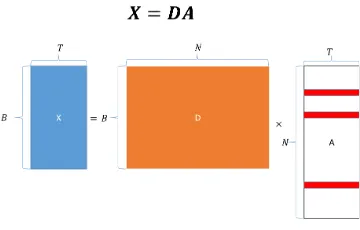
l0-pseudo-norm, which is the number of non-zero rows ofA. An illustration
of the JSM equation is shown in Figure. 1. As with (2), problem (4) is
NP-hard and it can be approximately solved by greedy algorithms such
as simultaneous orthogonal matching pursuit (SOMP) algorithm [21]. The
Figure 1: An illustration of JSM, whereXis aB×T matrix denoting a small window
consisting ofT HSI pixels,Dis aB×N matrix representing an over-complete dictionary
withN atoms; andAis anN×T coefficient matrix with onlyLnon-zero rows. The red
lines inAindicate the non-zero rows and the blank areas indicate zero rows ofA.
2.3. Classification rules of SM and JSM
For the SM, the class ofxis determined by applying the obtained sparse
coefficient vector ˆα from (2). We define the class-wise residuals as
rm(x) =kx−Dmαˆmk22, m= 1, . . . , M, (5)
where M is the total number of classes, ˆαm contains the Nm elements in
ˆ
α that are associated with sub-dictionary Dm of the mth class, with N =
PM
m=1Nm. The label of the test pixelxis determined by its minimal residual
over allM classes:
Class(x) = argmin
m=1,...,M
rm(x). (6)
For the JSM, once the sparse coefficient matrix ˆA is obtained from (4),
we calculate the class-wise residual of the matrixX from its class-wise
ap-proximation similar to (5):
rm(X) =
X−D
mAˆm
2
In (7), there are Nm rows in ˆA corresponding to a sub-dictionary Dm and
N = PM
m=1Nm. Different from the SM, the label of the central test pixel
xcin window Xis jointly determined by the minimal residual of Xover all
M classes, i.e.
Class(xc) = argmin
m=1,...,M
rm(X). (8)
3. Cone-based sparse model
3.1. Cone-based model
A cone model (CM) to represent vectors xis defined as
C:
(
x|x=
N
X
i=1
αidi=Dα, αi ≥0
)
, (9)
whereαiis thenon-negativecoefficient of atomdi, andαis anN-dimensional
vector ofnon-negative coefficients.
The non-negative coefficient vector αis estimated by solving the
follow-ing optimisation problem:
ˆ
α= argmin
α
kx−Dαk22, s.t. α≥0, (10)
where α ≥ 0 denotes that every single element of the vector α should be
non-negative. Problem (10) can be solved by the active-set methods, such
as the typical non-negative least square method (NNLS) [40] (MATLAB
functionlsqnonneg) and its extension fast-NNLS (fnnls) [41]. In this paper, we use the CM (10) as a baseline method for HSI classification. Specifically,
(10) is used for the representation of a single test HSI pixel. The label of a
3.2. Cone-based sparse model
For the l0-pseudo-norm optimisation problem, the non-negative
orthog-onal matching pursuit (NN-OMP) algorithm has been investigated in [42],
which introduces the non-negativity constraint into the conventional OMP
algorithm. Technical details of the algorithm vary, depending on different
criteria such as fast implementation [43].
In [42, 43], a desired coefficient vector α is estimated by solving the
following optimisation problem:
ˆ
α= argmin
α
kx−Dαk22+kαk0, s.t. α≥0, (11)
which is forced to be sparse and non-negative.
In this paper, we term model (11) the cone-based sparse model
(short-ened as CSM). To our knowledge, CSM is first introduced and studied in
this paper for HSI classification. To align with the rule of SM (2), the
classification of an HSI based on CSM (11) is also determined by (6).
4. Cone-based joint sparse model (C-JSM) for HSI classification
We notice that, on the one hand, SM (2), CM (10) and CSM (11) are
all constructed for a single test HSI pixel and do not take the spatial
co-herence [44] into consideration; while on the other hand, JSM accounts for
the neighbouring spatial information, but the coefficients estimated by JSM
are only assumed to be sparse, not necessarily non-negative. As with the
underlying assumptions made for HSI unmixing, an HSI pixel can be
de-composed into a collection of endmembers with non-negative proportions.
The endmembers are spectral signatures which characterise the reflect
the case of HSI classification, the dictionary atoms are usually constructed
directly from the HSI or from the spectral libraries, so the atoms can be
assumed acting as endmembers, which inspires us to devise a cone-based
representation for the joint models for a more realistic interpretation.
In the same notation as aforementioned, the cone-based representation
of a test windowX∈RB×T can be formulated as follows:
X≈DA, s.t. A≥0, (12)
whereA is anon-negative coefficient matrix andA≥0denotes that every
element ofA should be non-negative. To estimateA, problem (12) can be
reformulated as
ˆ
A= argmin
A
kX−DAk2F, s.t. A≥0. (13)
In this paper, we term model (12) the joint cone model (shortened as JCM).
We also utilise it as a baseline method.
The optimisation problem (13) can be solved by two algorithms. Firstly,
the reconstruction of each column vector xt for t = 1, . . . , T can be solved
independently by the conventional NNLS [40] or fast-NNLS [41]. Secondly, it
can be solved by an algorithm called fast combination NNLS (FC-NNLS) [45],
which is proposed to solve the large-scaled non-negativity-constrained least
square problems. It solves a set of linear reconstruction for X in a parallel
fashion instead of solving a set of single x in a serial fashion. Specifically,
it rearranges the calculations in the standard active-set NNLS on the basis
of combinational reasoning and reduces the computation burden for NNLS
win-dow size T in our case. The estimated coefficient matrices ˆXs obtained by
these two methods are the same. So we can regard FC-NNLS as a fast
implementation of NNLS for solving the JCM problem (13).
Incorporating JCM (13) into the JSM for HSI classification (4), we
pro-pose a new method as
ˆ
A= argmin
A
kX−DAk2F ,
s.t. kAkrow,0≤Land A≥0.
(14)
We call this new model (14) the cone-based joint sparse model (shortened
as C-JSM). In short, the proposed C-JSM incorporates the non-negative
constraints into the sparse representation of a test windowX by joint
mod-elling. The coefficient matrix A of the test window X is not only sparse,
but also forced to be non-negative. On top of these two desirable properties,
the spatial coherence of HSI is also reflected in that the coefficient vector
of the central test pixel xc is jointly determined by those HSI pixels in its
local neighbourhood with the same non-negative and sparse constraints. As
a result, HSI pixels in the local windowX share the same basis vectors of a
cone, and the sparsity of the coefficients are determined only in the region
of the cone.
Same as JSM, the two cone-based sparse models, JCM and C-JSM, are
also joint models, hence we adopt the classification rule (8) for them. To
solve the C-JSM problem (14), we propose a new algorithm and detail it in
5. Algorithm of NN-SOMP for solving C-JSM
We propose a new algorithm called non-negative simultaneous
orthogo-nal matching pursuit (NN-SOMP), to solve the C-JSM problem. It combines
the NNLS-based methods and the SOMP algorithm together to produce a
non-negative and sparse estimation of the coefficient matrix ˆAin (14).
Be-fore introducing the proposed NN-SOMP, we first present the non-negative
OMP to get an insight of the paradigm.
5.1. Algorithm of NN-OMP
The traditional SM in (2) with the l0-pseudo-norm constraint on the
coefficient vector is approximately solved by greedy algorithms, of which
one of the most popular algorithms is called orthogonal matching pursuit
(OMP) [15]. We assume that the columns (atoms) of the dictionary D are
normalised so that kdik2 = 1 for i = 1, . . . , N. At the beginning of the
algorithm, a residual vectorr0 is initialised to be the test HSI pixelx. The
OMP iteratively selects at each step the column ofD, i.e. the atomdi, which
has not been selected but is most correlated with the residualsrj−1, where
j is the current iteration number. The maximal correlation is calculated
asdTi rj−1
, which is the absolute value of the projection of residual vector
rj−1 onto the the atomdi. The selected atomdi is then added into the set
of selected atoms. The algorithm updates the residual vector by
project-ing the observed vector x onto the linear subspace spanned by the atoms
that have already been selected, and then iterates. The termination of the
OMP algorithm is either conducted by setting the iteration number, i.e. the
sparsity levelL, or by setting a thresholdτ of the residual.
Based on the OMP algorithm, the non-negative OMP (NN-OMP) is
into the iterations. The main difference between OMP and NN-OMP is
the updating criteria of residual vector rj. In OMP, the residual vector is
updated by rj =x−DΛjβˆj, where the coefficient vector βj is obtained by
least squares (LS) and has a closed-form solution. However in NN-OMP, to
guarantee non-negative coefficients, the coefficient vector βj at iteration j
should be solved by NNLS-based methods instead of the LS method, which
is described in (16). Hence there is no closed-form solution for βj. The
algorithm of NN-OMP used in this paper is summarised in Algorithm 1.
Other versions of NN-OMP can be found in [42, 43]. We note that there is
a slight difference between Algorithm 1 and the algorithms proposed in [42,
43]: we use the absolute value dTirj−1
instead of the maximal positive
value max(dTi rj−1) > 0 used in [42, 43]. Although these two approaches
may select different atoms from iteration 2 (for iteration 1,r0 and di both
are positive so the produced results are same), the size of residuals krjk2
can be reduced iteratively by both, which reflects the core idea of matching
pursuit algorithms. It may not be easy to claim which approach is more
appropriate. To align with the original framework of OMP and for a clearer
comparison, we only change the updating of the coefficients by (16) and
adopt Algorithm 1 as a representative of NN-OMP algorithm in the following
discussion.
5.2. Algorithm of NN-SOMP
Following the derivation of NN-OMP from OMP, we propose a new
al-gorithm called NN-SOMP, which combines the SOMP alal-gorithm [21] and
the NNLS-based methods together to solve the problem of C-JSM (14).
The SOMP algorithm [21] is a generalised OMP algorithm. It aims
Algorithm 1 The NN-OMP algorithm to solve CSM (11).
Input: • Dictionary D = [d1, . . . ,dN]∈ RB×N with kdik22 = 1 for i=
1, . . . , N.
• A test pixelx∈RB.
• Sparsity levelL or thresholdτ.
Output: A non-negative and sparse coefficient vector ˆα.
Initialisation:
• The residual vector r0=x.
• Sparse index set Λ0 =∅.
• Iteration counter j= 1.
while j6L orkrj−1k22< τ do
(1) Find an index λj that solves the easy optimisation problem:
λj = argmax i=1,...,N
dTi rj−1
. (15)
(2) Update the index set Λj = Λj−1∪ {λj}.
(3) Determine non-negative coefficient vectorβj by the NNLS algorithm in the coneC whose basis vectors are the atoms ofDindexed in Λj:
ˆ
βj = argmin
βj
x−DΛjβj
2
2,s.t. βj ≥0, (16)
whereDΛj ∈R
B×j consists of thej atoms in D indexed in Λ j.
(4) Determine the new residual:
rj =x−DΛjβˆj. (17)
(5) j←j+ 1.
end while
Compute the non-negative and sparse coefficient vector ˆαwhose non-zero elements are indexed by Λ and the corresponding L elements of vector
ˆ
columns of matrix X, by using different linear combinations of the same
atoms of the dictionary. The algorithm balances the error in approximation
against the total number of atoms that participate. Specifically, the atoms
supporting the sparse solution are sequentially selected from the dictionary.
At each iteration, the atom that simultaneously yields the best yet simple
approximation to all of the residual vectors is selected. Particularly, at the
jth iteration, we calculate an N ×T correlation matrix Corr = DTRj−1,
where Rj−1 is a residual matrix between the test window X ∈ RB×T and
its approximation from the last iteration. The (i, t)th entry in Corr is the
correlation between the ith dictionary atom di and the residual vector for
xt, where t = 1, . . . , T at the current iteration j. In the algorithm, the
lp-norm, where p ≥ 1, for each of the N rows of Corr is computed. The
row index corresponding to the largestlp-norm is then added into the sparse
index set of selected atoms. As mentioned in [3], different values ofp have
been adopted in literatures, such asp= 1 is in [21],p= 2 in [46] andp=∞
in [47]. In this paper we use p =∞ to align with [47]. Similarly to OMP,
the termination of the SOMP algorithm is either conducted by setting the
iteration number, i.e. the sparsity levelL, or by setting a threshold τ of the
size of the residual. Details of the SOMP algorithm can also be found in [3].
The proposed NN-SOMP algorithm is devised on the basis of the SOMP
algorithm; it incorporates non-negative constraints in the simultaneous
ap-proximation of a test window X and is summarised in Algorithm 2. We
replace the LS-based estimates of the coefficient matrix of SOMP by the
NNLS-based estimates (19). We can see that (19) in our proposed
algo-rithm is in fact a standard JCM problem as in (13).
As aforementioned, the optimisation problem (19) can be solved by two
implementa-tion, each column of X can be treated independently. Specifically,
prob-lem (19) in the Algorithm 2 is broken into T individual NNLS problems
formulated by (10). TheseT problems can be solved by conventional NNLS
algorithm [40] or fast-NNLS algorithm [41]. Then the coefficient matrix ˆPj
is obtained by concatenating the estimated coefficient vectors column by
col-umn. In this fashion, we need to use an inner FOR loop to compute step (3)
of the NN-SOMP algorithm (Algorithm 2). The optimisation problem (19)
can also be solved by the FC-NNLS algorithm [45], which is a generalised
NNLS algorithm. It aims to solve the non-negative least squares with
mul-tiple input vectors. FC-NNLS rearranges the selection of the support set,
and reduces substantially the computational burden required for the NNLS
problems which have large numbers of observation vectors.
The conventional NNLS algorithm utilises the active/passive set method
to solve an inequality-constrained least squares problem as a sequence of
equality-constrained problems, also termed “column-serial” [45]. FC-NNLS
is also based on this NNLS scheme. In general, the overall NNLS in the
FC-NNLS is responsible for defining the sequence, but sequentially
solv-ing the problem tends to be computationally inefficient as it can result in
redundant calculations. To this end, FC-NNLS solves the problem in a
“column-parallel” fashion. Specifically, the algorithm firstly groups
prob-lems that share a common passive set and solve them together, and then
recognises that the passive sets vary from iteration to iteration. Each NNLS
iteration for all columns are performed in parallel rather than performing all
iterations for each column in series. Note that columns will require different
numbers of iterations to achieve optimality. The conventional NNLS and the
FC-NNLS produce the same estimation results; for a faster computation, we
Algorithm 2 The NN-SOMP algorithm to solve C-JSM (14).
Input: • Dictionary D = [d1, . . . ,dN]∈ RB×N with kdik22 = 1 for i=
1, . . . , N.
• A test windowX= [x1, . . . ,xT]∈RB×T.
• Sparsity levelL.
Output: A non-negative and sparse coefficient matrix ˆA.
Initialisation:
• The residual matrix R0 =X.
• Sparse index set Λ0 =∅.
• Iteration counter j= 1.
while j6L orkRj−1k2F < τ do
(1) Find an indexλj that solves the following easy optimisation problem:
λj = argmax i=1,...,N
RTj−1di
p, p≥1. (18)
(2) Update the index set Λj = Λj−1∪ {λj}.
(3) Determine non-negative coefficient matrix Pj by the NNLS-based
algorithm in the cone C whose basis vectors are the atoms of D
indexed in Λj:
ˆ
Pj = argmin
Pj
X−DΛjPj
2
F ,s.t. Pj ≥0, (19)
where DΛj ∈ R
B×j consists of number of j atoms in D indexed
in Λj. Optimisation problem (19) can either determined in a serial
fashion that each column of X is treated independently and can be approximated by NNLS [40] or fast-NNLS [41]; or in a parallel fashion by FC-NNLS [45]. The two approaches produce the same result.
(4) Determine the new residual matrix:
Rj =X−DΛjPˆj. (20)
(5) j←j+ 1.
end while
6. Experiments
In this section, we investigate the performance of the proposed C-JSM
method on HSI classification. The experiments are carried out on two
well-known real HSI datasets: the AVIRIS Indian Pines dataset and the ROSIS
University of Pavia dataset, both of which can be downloaded from [48].
6.1. Methods compared
We evaluate the proposed C-JSM (14) and compare it with five
base-line methods: the sparse model (SM) (2), the joint sparse model (JSM) (4),
the cone model (CM) (10), the cone-based sparse model (CSM) (11) and
the joint cone model (JCM) (13). Corresponding algorithms used to learn
these models are listed in Table 1: the proposed NN-SOMP (Algorithm 2),
OMP [15], SOMP [21], NNLS [40], NN-OMP (Algorithm 1) and FC-NNLS [45],
respectively.
Table 1: Compared methods and their corresponding algorithms: CM – cone model; SM – sparse model; CSM – cone-based sparse model; JCM – joint cone model; JSM – joint sparse model; C-JSM – cone-based joint sparse model.
Meth. CM SM CSM JCM JSM C-JSM
Alg. NNLS OMP NN-OMP FC-NNLS SOMP NN-SOMP
From the point of view of models, these six methods can be grouped
into two types of models: single models (CM, SM, and CSM) and joint
models (JCM, JSM and C-JSM). The single models label a test HSI pixel
by considering only the test pixel, i.e. a vector x in (2), (10) and (11),
whereas the joint models label a central test HSI pixelxc by considering a
local window around it, i.e. a matrixX in (4), (13) and (14). The labelling
by the single models is determined by (6), whereas the labelling by the joint
according to their constraints on non-negativity and sparsity: CM and JCM
are only with the non-negativity constraint; SM and JSM are only with the
sparsity constraint; and CSM and C-JSM both consider the non-negativity
and sparsity simultaneously. Details of the relationships among the methods,
algorithms, models and constraints are presented in the confusion matrices
[image:21.612.152.462.272.317.2]in Table 2 and Table 3.
Table 2: Compared methods and their groups.
Non-negative Sparse Non-negative + Sparse
Single model CM SM CSM
Joint model JCM JSM C-JSM
Table 3: Compared algorithms and their groups.
Non-negative Sparse Non-negative + Sparse
Single model NNLS OMP NN-OMP
Joint model FC-NNLS SOMP NN-SOMP
6.2. Performance measures
We evaluate the performances of the compared methods by using three
standard measures for HSI classification: the overall accuracy (OA), the
average accuracy (AA) and kappa coefficient κ [49], which are widely used
by the remote sensing community.
The OA,AAand κ are defined as follows:
OA= Ncorr
Ntest
, AA= 1
M
M
X
m=1
Nmcorr
Nclass m
and κ= OA−pe 1−pe
. (21)
In (21), the overall accuracy (OA) is defined as the ratio of the number of
the correctly-classified test pixelsNcorr over the total number of test pixels
[image:21.612.144.464.356.402.2]accuracies of the M individual classes, where Nmclass is the total number of
test pixels of classm, andNmcorr is the number of the correctly-classified test
pixels of class m. The κ coefficients measures the percentage of classified
test pixels corrected by the number of agreements that would be expected
purely by change [49]. In (21), we havepe=PMm=1(Fm×Fmt), whereFm is
the ratio of data assigned to classm by the classifier andFmt is the ratio of
data that belong to classm.
6.3. Parameter settings
Among the compared methods, in single models, only one unknown
pa-rameter needs to be determined, i.e. the sparsity level L; in joint models,
two unknown parameters are involved, the sparsity levelL and the window
size T, except for FC-NNLS in which only the window size T is involved.
The values of the parameters for all methods are determined via the
leave-one-out cross validation (LOOCV) in the training phase.
6.4. Real dataset: Indian Pines
The AVIRIS Indian Pines dataset consists of 145×145 pixels from 200
spectral bands after removing the water absorption bands. There are sixteen
classes of materials in the scene. For each of the 16 ground-truth classes,
we randomly choose about 9% of labelled pixels as the dictionary, i.e.D ∈
R200×957. The rest pixels are used for testing, i.e.Xtest∈R200×9409. Similar
experiment settings can also be found in [3–9, 16–18, 20] with different
training/test samples and accordingly non-identical performance.
A summary of the numbers of training and test pixels for individual
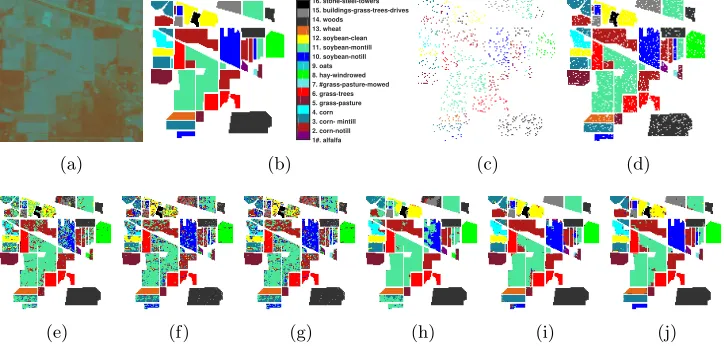
classes is given in Table 4. The false colour of the image averaging through
all the bands, the 16 ground-truth classes, the training set and the test set
Table 4: The Indian Pines dataset: Ground-truth label, class material, training set and test set. We use around (9% of all pixels) for training and the rest for testing.
Class Material Training Test
1 Alfalfa 5 49
2 Corn-notill 132 1302
3 Corn-mintill 77 757
4 Corn 22 212
5 Grass-pasture 46 451
6 Grass-trees 69 678
7 Grass-pasture-mowed 3 23
8 Hay-windrowed 45 444
9 Oats 2 18
10 Soybean-notill 89 879
11 Soybean-mintill 227 2241
12 Soybean-clean 57 557
13 Wheat 20 192
14 Woods 119 1175
15 Buildings-grass-trees-drives 35 345
16 Stone-steel-towers 9 86
Total 957 9409
(a)
1#. alfalfa 2. corn-notill 3. corn- mintill 4. corn 5. grass-pasture 6. grass-trees 7. #grass-pasture-mowed 8. hay-windrowed 9. oats 10. soybean-notill 11. soybean-montill 12. soybean-clean 13. wheat 14. woods 15. buildings-grass-trees-drives 16. stone-steel-towers
(b) (c) (d)
(e) (f) (g) (h) (i) (j)
Figure 2: The Indian Pines dataset: (a) mean image shown in the false colour; (b) ground-truth labels; (c) training set (9% pixels randomly chosen); (d) test set. Classification maps
of (e) CM (NNLS),OA= 75.42; (f) SM (OMP),OA= 74.79; (g) CSM (NN-OMP),OA
= 74.83; (h) JCM (FC-NNLS),OA = 84.88; (i) JSM (SOMP),OA= 93.79; (j) C-JSM
[image:23.612.126.488.407.580.2]For a more reliable evaluation, we perform the experiments by 10 times
of random training/test splits. For illustration, the optimal parameters
ob-tained by LOOCV of one random training/test split are listed in Table 5.
Note that the NNLS has no parameter to be tuned and hence no training
process is required. For the OMP and NN-OMP, the tuned value of
spar-sity level L is 5; for the FC-NNLS, the tuned value of window size T is 25
(5×5); for the SOMP, the values of L and T are tuned to be 30 and 81
(9×9), respectively; and for the proposed NN-SOMP, the value ofLand T
[image:24.612.136.469.356.402.2]are tuned to be 15 and 25 (5×5), respectively.
Table 5: Settings of parameters for the Indian Pines dataset in one random training/test split. The values of parameters are determined by LOOCV. “NA” stands for “not appli-cable”.
NNLS OMP NN-OMP FC-NNLS SOMP NN-SOMP
L NA 5 5 NA 30 15
T NA NA NA 25 81 25
6.4.1. Classification performances
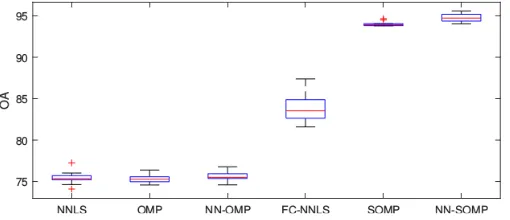
The 10 overall classificationOAs of all six compared methods are recorded
and box-plotted in Figure. 3. For illustration purposes, we also randomly
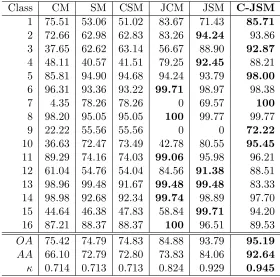
choose one of the 10 classification results and list the OA, AAand κ
coef-ficient of all methods in Table 6, and depict the classification maps of the
corresponding methods in Figure. 2(e)-2(j), respectively.
From Figure. 3, we can observe two patterns. Firstly, we can observe
that the proposed C-JSM (NN-SOMP) outperforms the other two joint
models, JCM (FC-NNLS) and JSM (SOMP). Also, among the three
sin-gle models, CSM (NN-OMP) performs the best, superior to CM (NNLS)
and SM (OMP). These indicate that incorporating the non-negativity
sparse representation-based classifiers. Secondly, the proposed C-JSM
(NN-SOMP) performs the best among all the compared methods. It indicates
that combining the non-negativity constraints and the joint sparse
repre-sentation can improve the classification performance the most, compared
with the representation with any single constraint, i.e. joint representation,
[image:25.612.180.435.256.366.2]sparse representation or non-negative representation.
Figure 3: Boxplots of the overall classification accuracies (%) of 3 single models (CM (NNLS), SM (OMP), CSM (NN-OMP)) and 3 joint models (JCM (FC-NNLS), JSM (SOMP), C-JSM (NN-SOMP)) on the Indian Pines dataset.
The one time classification results listed in Table 6 also show that the
proposed C-JSM (NN-SOMP) outperforms other methods, which is aligned
with our findings from the 10 times repeated random splits (Figure. 3). We
also notice two special cases, with class 7 and class 9, that the numbers of
training samples are extremely small, i.e. 3 for class 7 and 2 for class 9,
as listed in Table 4. All methods except for C-JSM (NN-SOMP) do not
perform very well on classifying these two tiny classes of HSI pixels. For
the single models, i.e. CM (NNLS), SM (OMP) and CSM (NN-OMP), the
bad performances may be due to the lack of training samples. For the joint
models of JCM (FC-NNLS) and JSM (SOMP), the performances are even
Table 6: The Indian Pines dataset: Ground-truth label and the classification accuracies (%) obtained by CM (NNLS), SM (OMP), CSM (NN-OMP), JCM (FC-NNLS), JSM (SOMP) and C-JSM (NN-SOMP), respectively. The best performance is indicated in bold.
Class CM SM CSM JCM JSM C-JSM
1 75.51 53.06 51.02 83.67 71.43 85.71
2 72.66 62.98 62.83 83.26 94.24 93.86
3 37.65 62.62 63.14 56.67 88.90 92.87
4 48.11 40.57 41.51 79.25 92.45 88.21
5 85.81 94.90 94.68 94.24 93.79 98.00
6 96.31 93.36 93.22 99.71 98.97 98.38
7 4.35 78.26 78.26 0 69.57 100
8 98.20 95.05 95.05 100 99.77 99.77
9 22.22 55.56 55.56 0 0 72.22
10 36.63 72.47 73.49 42.78 80.55 95.45
11 89.29 74.16 74.03 99.06 95.98 96.21
12 61.04 54.76 54.04 84.56 91.38 88.51
13 98.96 99.48 91.67 99.48 99.48 83.33
14 98.98 92.68 92.34 99.74 98.89 97.70
15 44.64 46.38 47.83 58.84 99.71 94.20
16 87.21 88.37 88.37 100 96.51 89.53
OA 75.42 74.79 74.83 84.88 93.79 95.19
AA 66.10 72.79 72.80 73.83 84.06 92.64
are 0. This is because class 7 and class 9 cover narrow regions in the Indian
Pines HSIs (as shown in Figure. 2). The label of the central test pixel can be
dominated by classes adjacent and thus misclassified. However, the proposed
C-JSM (NN-SOMP) relives this spatial-over-smoothness caused by the local
window strategy and outperforms the other five methods with substantial
improvements: achieving 100% against the second best 78.26% for class 7
and achieving 72.22% against the second best 55.56% for class 9.
6.4.2. Effects of parameters
We further investigate the effects of tuning parameters on the
perfor-mance of our proposed C-JSM (NN-SOMP). A sweep of the parameter space
of sparsity levelLand window sizeT is performed during the training phase.
The sparse levelL is tuned from 5 to 80 and the window sizeT ranges from
1 to 289 (17×17). The LOOCV result of C-JSM (NN-SOMP) is depicted
in Figure. 4(a). Within the same parameter space (L and T), we also show
the LOOCV result of JSM (SOMP) in Figure. 4(b) for comparison.
As shown in Figure. 4(a) and Figure. 4(b), we can easily see that the
surface plot ofOAs for C-JSM (NN-SOMP) is much smoother than that of
JSM (SOMP). It implies that C-JSM (NN-SOMP) is more stable than that
of JSM (SOMP) in terms of the performance sensitivity to Land T. More
specifically, we split the 3-D view of theOA surface of C-JSM (NN-SOMP)
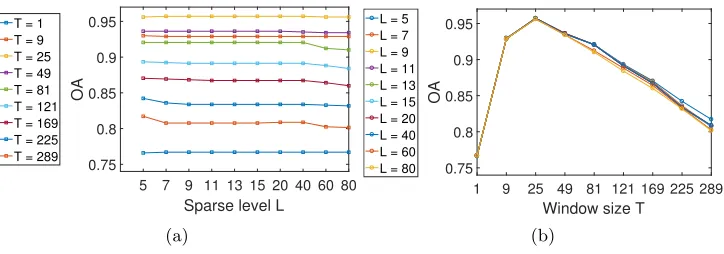
into two 2-D views, which are shown in Figure. 5(a) and Figure. 5(b). It can
be observed that the window size T dominates the performance of C-JSM
whereas the effect of sparsity levelLon the classification performance is not
as sensitive as T.
To further demonstrate the effect of sparsity levelL, we perform
5 0.8 7 9 11 L 13 OA 0.9
1520 225289
169
T
121
40 4981
60 25 1 9 80 1 (a) 0.8 5 0.9 7 OA 9 1 11 L
1320 169225289
T 121 30406080 1 9 254981
[image:28.612.126.485.176.306.2](b)
Figure 4: Overall classification accuracies over window sizeT and sparsity levelLfor (a)
the proposed C-JSM (NN-SOMP) and (b) the JSM (SOMP) on the Indian Pines training dataset via LOOCV.
5 7 9 11 13 15 20 40 60 80
Sparse level L
0.75 0.8 0.85 0.9 0.95 OA
T = 1 T = 9 T = 25 T = 49 T = 81 T = 121 T = 169 T = 225 T = 289
(a)
1 9 25 49 81 121 169 225 289
Window size T 0.75 0.8 0.85 0.9 0.95 OA
L = 5 L = 7 L = 9 L = 11 L = 13 L = 15 L = 20 L = 40 L = 60 L = 80
(b)
Figure 5: Effects of the sparsityLand window sizeT on the performance of the proposed
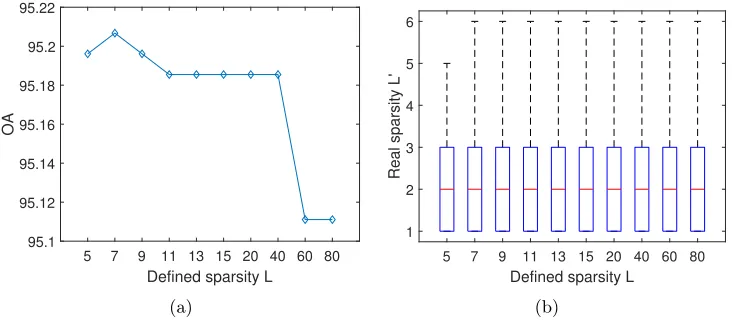
[image:28.612.127.489.456.583.2]sizeT to be 25 (5×5) as tuned by LOOCV. This test dataset is the same as
the one used in Table 6 and Figure. 2. We set the level of sparsityLfrom 5
to 80 and depict the obtainedOAs in Figure. 6(a). Accordingly, we record
the real sparsity L0 obtained in different settings of L. Since different test
HSI pixels have different real sparsitiesL0 under a definedL, we record and
box-plot them in Figure. 6(b).
5 7 9 11 13 15 20 40 60 80 Defined sparsity L 95.1
95.12 95.14 95.16 95.18 95.2 95.22
OA
(a)
5 7 9 11 13 15 20 40 60 80
Defined sparsity L
1 2 3 4 5 6
Real sparsity L'
[image:29.612.125.492.269.432.2](b)
Figure 6: Window sizeT = 5 on the test dataset of Indian Pines: (a) classification
per-formance (overall accuracies) with sparsity levelL; (b) the real sparsity levelL0obtained
from the test results with sparsity levelL.
It can be seen that, although the best OA occurs at L = 7 when T
is fixed to be 25, the performance only changes slightly with the defined
sparsityL, where the OA changes only from 95.11% to 95.21%. Therefore
the OA = 95.19% of C-JSM (NN-SOMP) listed in Table 6 with L = 5 is
in the range of the stable performance, where the parameters are tuned by
LOOCV and the testing results are reliable.
On the other hand, we can observe that the obtained sparsityL0 ranges
the defined sparsityL are. Furthermore, the obtained maximal sparsity L0
converges to 6 when the defined sparsityLis over 6, as shown in Figure. 6(b).
This explains why the performance of C-JSM (NN-SOMP) is not so sensitive
to the setting of sparsity L. However, the setting of sparsity L still gives
some room for each test HSI pixel to adaptively choose their optimal sparsity
level and hence can achieve a stable and reliable classification performance.
6.4.3. Sparseness and non-negativity
We next demonstrate the effects of sparsity and non-negativity on all the
compared methods by adopting a similar presentation in [50] and depicting
the results in Figures. 7-10. The classification results of all methods are
obtained in parameter settings listed in Table 5. For comparative purposes,
we randomly select two test HSI pixels which belong to class 10 and are
located in (48, 31) and (53, 88): one is correctly classified by all six methods
and the other is only correctly classified by C-JSM (NN-SOMP).
For pixel (48, 31), the associated class-wise residuals obtained by all six
methods are shown in Figure. 7. We can observe that the pixel is correctly
classified by all six methods into class 10, which has the minimum residuals
and is indeed the ground-truth class. Among the six methods, CSM in
Figure. 7(c) and C-JSM in Figure. 7(f), both of which contains both sparse
and non-negative constraints, perform the best with the true class (with the
smallest residual) and the most stable relative to other classes (with all large
residuals).
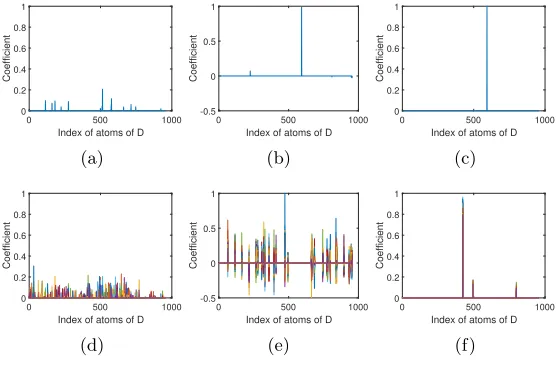
To investigate further, we plot the obtained coefficients of this pixel in
Figure. 8. Because for the single models (CM, SM and CSM) there is only
one coefficient vector for the test HSI pixelx, there is only one colour shown
1 2 3 4 5 6 7 8 9 10111213141516 Class 0 0.2 0.4 0.6 0.8 1 Normalised residuals (a)
1 2 3 4 5 6 7 8 9 10111213141516 Class 0 0.2 0.4 0.6 0.8 1 Normalised residuals (b)
1 2 3 4 5 6 7 8 9 10111213141516 Class 0 0.2 0.4 0.6 0.8 1 Normalised residuals (c)
1 2 3 4 5 6 7 8 9 10111213141516 Class 0 0.2 0.4 0.6 0.8 1 Normalised residuals (d)
1 2 3 4 5 6 7 8 9 10111213141516 Class 0 0.2 0.4 0.6 0.8 1 Normalised residuals (e)
[image:31.612.164.442.143.336.2]1 2 3 4 5 6 7 8 9 10111213141516 Class 0 0.2 0.4 0.6 0.8 1 Normalised residuals (f)
Figure 7: Normalised residuals for each class for the pixel located at (48, 31) by (a) CM, (b) SM, (c) CSM, (d) JCM, (e) JSM and (f) C-JSM. The ground-truth label is class 10. The test pixel is correctly identified by all six methods.
0 500 1000 Index of atoms of D 0 0.2 0.4 0.6 0.8 1 Coefficient (a)
0 500 1000
Index of atoms of D -0.5 0 0.5 1 Coefficient (b)
0 500 1000 Index of atoms of D 0 0.2 0.4 0.6 0.8 1 Coefficient (c)
0 500 1000 Index of atoms of D 0 0.2 0.4 0.6 0.8 1 Coefficient (d)
0 500 1000
Index of atoms of D -0.5 0 0.5 1 Coefficient (e)
0 500 1000 Index of atoms of D 0 0.2 0.4 0.6 0.8 1 Coefficient (f)
[image:31.612.164.442.422.605.2]C-JSM), the label of the central test pixel xc is jointly determined by its
local windowX, hence we plot all the coefficient vectors of the pixels in the
window in different colours. In addition, since the test HSI pixel actually
belongs to class 10, we expect to see that the coefficients mainly lie within
the sub-dictionary of class 10, where the atom indices range from 402 to
490.
From Figure. 8, we can observe that, although all methods can identify
the correct class 10 for pixel (48, 31), the coefficient vectors obtained by
dif-ferent methods are remarkably difdif-ferent, and again, the most neat (sparse)
performances are with C-JSM (Figure. 8(f)) and CSM (Figure. 8(c)). This
also indicates that incorporating the non-negativity constraint into the sparse
model is beneficial, which can produce a more sparse representation.
However, the sparse and non-negative constraints are not the only two
factors that may ensure correct label identification for HSIs. As illustrated
in Figure. 9 and Figure. 10, for a test HSI pixel located in (53, 88), only the
proposed C-JSM identifies its label as class 10 correctly (Figure. 9(f)). In
C-JSM, the non-zero elements of the coefficients vectors of all pixels within
the neighbourhood window mainly lie in class 10 and the label of the central
test pixel is jointly determined by the minimal residuals, which belongs to
class 10 (Figure. 10(f). In contrast, although the coefficient vector obtained
by CSM in Figure. 10(c) is non-negative and most sparse, it lies in class 11,
a wrong class (Figure. 9(c)). This illustrates that the joint representation of
neighbouring pixels on top of the sparsity and non-negativity can positively
contribute to the classification performance for HSIs, and hence the proposed
1 2 3 4 5 6 7 8 9 10111213141516 Class 0 0.2 0.4 0.6 0.8 1 Normalised residuals (a)
1 2 3 4 5 6 7 8 9 10111213141516 Class 0 0.2 0.4 0.6 0.8 1 Normalised residuals (b)
1 2 3 4 5 6 7 8 9 10111213141516 Class 0 0.2 0.4 0.6 0.8 1 Normalised residuals (c)
1 2 3 4 5 6 7 8 9 10111213141516 Class 0 0.2 0.4 0.6 0.8 1 Normalised residuals (d)
1 2 3 4 5 6 7 8 9 10111213141516 Class 0 0.2 0.4 0.6 0.8 1 Normalised residuals (e)
[image:33.612.164.442.143.335.2]1 2 3 4 5 6 7 8 9 10111213141516 Class 0 0.2 0.4 0.6 0.8 1 Normalised residuals (f)
Figure 9: Normalised residuals for each class for the pixel located at (53, 88) by (a) CM, (b) SM, (c) CSM, (d) JCM, (e) JSM and (f) C-JSM. The ground-truth label is class 10. The test pixel is only correctly identified by our proposed C-JSM.
0 500 1000 Index of atoms of D 0 0.2 0.4 0.6 0.8 1 Coefficient (a)
0 500 1000
Index of atoms of D -0.5 0 0.5 1 Coefficient (b)
0 500 1000 Index of atoms of D 0 0.2 0.4 0.6 0.8 1 Coefficient (c)
0 500 1000 Index of atoms of D 0 0.2 0.4 0.6 0.8 1 Coefficient (d)
0 500 1000
Index of atoms of D -0.5 0 0.5 1 Coefficient (e)
0 500 1000 Index of atoms of D 0 0.2 0.4 0.6 0.8 1 Coefficient (f)
[image:33.612.164.442.422.605.2]6.5. Real dataset: University of Pavia
The ROSIS University of Pavia dataset consists of 610×340 pixels from
103 spectral bands, with nine ground-truth labels. We randomly choose
only 1% of labelled samples from each class for constructing the
dictio-nary, i.e. D∈R103×432, and use the rest HSI pixels for testing, i.e. Xtest ∈
R103×42344. A summary of this dataset is given in Table 7. Again, a false
colour image averaging across all spectral bands, the nine ground-truth
[image:34.612.182.416.325.460.2]classes, the training set and the test set are shown in Figures. 11(a)-11(d).
Table 7: The Pavia University dataset: Ground-truth labels, class material, the training set and the test set.
Class materials Training Test
1 Asphalt 67 6564
2 Meadows 187 18462
3 Gravel 21 2078
4 Trees 31 3033
5 Painted metal sheets 14 1331
6 Bare soil 51 4978
7 Bitumen 14 1316
8 Self-blocking bricks 37 3645
9 Shadows 10 937
Total 432 42344
For a reliable evaluation, the experiments are also performed by 10 times
random train/test splits, as with the Indian Pines dataset in section 6.4.
For illustration, the optimal values of parameters tuned by LOOCV using
one time train/test random spilt are listed in Table 8. The OAs of all six
compared methods are box-plotted in Figure. 12; we also randomly select one
of 10 classification results and illustrate them in Table 9 and Figure.
11(e)-11(j).
Once again, we can observe that the proposed C-JSM (NN-SOMP)
out-performs other methods. We also note that in Figure. 12 the performance
(a)
1. asphalt 2. meadows 3. gravel 4. trees 5. painted metal sheets 6. bare oil 7. bitumen 8. self-blocking bricks 9. shadows
(b) (c) (d)
[image:35.612.128.490.165.416.2](e) (f) (g) (h) (i) (j)
Figure 11: The University of Pavia dataset: (a) mean image shown in the false colour; (b) ground-truth labels; (c) training set (1% pixels randomly chosen); (d) test set.
Clas-sification maps of (e) CM (NNLS),OA= 78.65; (f) SM (OMP),OA = 78.72; (g) CSM
(NN-OMP),OA = 78.75; (h) JCM (FC-NNLS),OA = 82.81; (i) JSM (SOMP),OA =
84.91; (j) C-JSM (NN-SOMP),OA= 86.53.
Table 8: Settings of parameters for the University of Pavia dataset in one random train-ing/test split. The values parameters are determined by LOOCV. “NA” stands for ”not applicable”.
NNLS OMP NN-OMP FC-NNLS SOMP NN-SOMP
L NA 5 5 NA 10 3
[image:35.612.136.467.598.641.2]NNLS OMP NN-OMP FC-NNLS SOMP NN-SOMP 78
80 82 84 86 88 90
[image:36.612.180.434.161.278.2]OA
Figure 12: Boxplots of the overall classification accuracies (%) of CM (NNLS), SM (OMP), CSM (NN-OMP), JCM (FC-NNLS), JSM (SOMP) and C-JSM (NN-SOMP) on the Uni-versity of Pavia dataset.
Table 9: The University of Pavia dataset: Ground-truth label and the classification ac-curacies (%) obtained by CM (NNLS), SM (OMP), CSM (NN-OMP), JCM (FC-NNLS), JSM (SOMP) and C-JSM (NN-SOMP), respectively. The best performance is indicated
inbold.
Class CM SM CSM JCM JSM C-JSM
1 85.65 70.75 70.81 98.92 57.46 59.83
2 93.97 92.82 92.82 99.40 98.14 98.55
3 62.70 45.62 45.62 69.30 70.12 77.48
4 87.97 77.28 77.05 93.14 80.25 83.65
5 99.77 99.25 99.25 100.00 100.00 100.00
6 58.00 47.91 47.89 62.82 70.65 80.63
7 42.33 77.43 77.43 28.12 92.63 95.74
8 21.10 74.29 74.29 7.05 93.94 95.34
9 87.41 88.26 89.97 92.74 72.89 31.06
OA 78.65 78.72 78.75 82.81 84.91 86.53
AA 70.99 74.85 75.01 72.39 81.79 80.25
[image:36.612.157.453.455.635.2]a pattern different from the results shown for the Indian Pines dataset. As
we have analysed in section 6.4.3, sparse and non-negative representations
only may still be insufficient to produce a stable and correct classification.
On the other hand, C-JSM incorporates the sparse and non-negativity
con-straints into the joint modelling of neighbouring pixels, and hence is capable
of providing a more sparse representation and a more stable classification
performance.
6.6. Running time comparison
Table 10: Running time (sec/pixel) spent on testing the Indian Pines dataset, settings of which are shown in Table 4 and Table 5 for 9409 test pixels.
NNLS OMP NN-OMP FC-NNLS SOMP NN-SOMP
Time 0.0058 0.0175 0.0017 0.1195 0.0737 0.0392
We present the time costs for executing the compared algorithms. All
experiments are performed by a Intel i7-3370 CPU using single thread on
the platform of MATLAB R2016b. Table 10 shows the running time of each
method for the Indian Pines dataset. The time is recorded as second per
HSI pixel.
First, we can observe that, among the single models, NN-OMP takes
less time than NNLS and OMP. In fact the obtained coefficients of
NN-OMP are more sparse than the others, as indicated by Figure. 8(a)-8(c) and
Figure. 10(a)-10(c). It implies that the computational burden is lessened
by NN-OMP. Secondly, among the joint models, our proposed NN-SOMP
is more time-efficient than FC-NNLS and SOMP. It is also because the
obtained coefficients from NN-SOMP are more sparse than the others, as
indicated by Figure. 8(d)-8(f) and Figure. 10(d)-10(f), and hence the
6.7. Further remarks
It is worth noting that several literatures have studied the relationship
between the sparsity and non-negativity [42, 51]. It has been shown that the
non-negative least squares (NNLS) may be able to produce sufficient sparse
recovery, without further imposing the sparse regularisations. However, we
remark that this does not imply that the performances of NNLS and the
sparsely regularised NNLS are the same, particular for the classification
problems that are the focus of this paper. That is, the distinct classification
performances of the compared methods of different constraints in this paper
do not conflict the existing findings in [42, 51].
7. Conclusion and future work
To sum up, by considering the non-negativity of coefficients for the
jointly sparse representation of HSI pixels, a new model called cone-based
joint sparse model (J-CSM) has been proposed in this paper. To solve
the C-JSM, a new algorithm, called non-negative simultaneous orthogonal
matching pursuit (NN-SOMP), has also been proposed. The C-JSM
incor-porates the non-negativity of coefficients, as well as the spatial coherence
of the HSI pixels, into one model, yielding a more sparse and stable
rep-resentation for the test HSI pixel whose label is jointly determined by its
neighbouring pixels. As a result, the classification performance of the JSM
is enhanced by the proposed C-JSM.
We notice that the proposed C-JSM may not completely solve the
prob-lems that are caused by the local window scheme. Specifically, the square
shape of the window adopted in this paper indeed introduces bias into the
classifica-tion of the HSI pixel may not have a promising edge-preserving performance.
As aforementioned in the introduction (section 1), several literatures have
studied the improvement of the JSM by adopting size/shape adaptive
win-dows [6–9]. The proposed C-JSM can also be collaboratively conducted
with the window adaptation strategies for enhancing the classification
per-formance. On the other hand, it is also desired to exploit the non-linearity
representation, such as kernelisation [4, 5], of the HSIs together with the
non-negativity constraints for the joint sparse models. These two directions
are our future research on the proposed C-JSM.
Acknowledgment
This work was partially supported by University College London’s
Se-curity Science Doctoral Training Centre under Engineering and Physical
Sciences Research Council (EPSRC) grant EP/G037264/1.
References
[1] J. Wright, Y. Ma, J. Mairal, G. Sapiro, T. S. Huang, S. Yan, Sparse
representation for computer vision and pattern recognition, Proceedings
of the IEEE 98 (6) (2010) 1031–1044.
[2] Y. Han, Y. Yang, Y. Yan, Z. Ma, N. Sebe, X. Zhou, Semisupervised
feature selection via spline regression for video semantic recognition,
IEEE Transactions on Neural Networks and Learning Systems 26 (2)
(2015) 252–264.
[3] Y. Chen, N. M. Nasrabadi, T. D. Tran, Hyperspectral image
classifica-tion using dicclassifica-tionary-based sparse representaclassifica-tion, IEEE Transacclassifica-tions
[4] Y. Chen, N. M. Nasrabadi, T. D. Tran, Hyperspectral image
classifica-tion via kernel sparse representaclassifica-tion, IEEE Transacclassifica-tions on Geoscience
and Remote sensing 51 (1) (2013) 217–231.
[5] J. Liu, Z. Wu, Z. Wei, L. Xiao, L. Sun, Spatial-spectral kernel sparse
representation for hyperspectral image classification, IEEE Journal of
Selected Topics in Applied Earth Observations and Remote Sensing
6 (6) (2013) 2462–2471.
[6] H. Zhang, J. Li, Y. Huang, L. Zhang, A nonlocal weighted joint sparse
representation classification method for hyperspectral imagery, IEEE
Journal of Selected Topics in Applied Earth Observations and Remote
Sensing 7 (6) (2014) 2056–2065.
[7] Y. Y. Tang, H. Yuan, L. Li, Manifold-based sparse representation for
hyperspectral image classification, IEEE Transactions on Geoscience
and Remote Sensing 52 (12) (2014) 7606–7618.
[8] L. Fang, S. Li, X. Kang, J. A. Benediktsson, Spectral–spatial
classifi-cation of hyperspectral images with a superpixel-based discriminative
sparse model, IEEE Transactions on Geoscience and Remote Sensing
53 (8) (2015) 4186–4201.
[9] J. Li, H. Zhang, L. Zhang, Efficient superpixel-level multitask joint
sparse representation for hyperspectral image classification, IEEE
Transactions on Geoscience and Remote Sensing 53 (10) (2015) 5338–
5351.
[10] Y. Zhang, B. Du, L. Zhang, A sparse representation-based binary
Transactions on Geoscience and Remote Sensing 53 (3) (2015) 1346–
1354.
[11] X. Wang, Y. Gao, Y. Cheng, A non-negative sparse semi-supervised
dimensionality reduction algorithm for hyperspectral data,
Neurocom-puting 188 (2016) 275–283.
[12] H. Wang, T. Celik, Sparse representation-based hyperspectral data
pro-cessing: Lossy compression, IEEE Journal of Selected Topics in Applied
Earth Observations and Remote Sensing 10 (5) (2017) 2036–2045.
[13] Y. Zhang, B. Du, L. Zhang, T. Liu, Joint sparse representation and
mul-titask learning for hyperspectral target detection, IEEE Transactions
on Geoscience and Remote Sensing 55 (2) (2017) 894–906.
[14] H. Li, C. Li, C. Zhang, Z. Liu, C. Liu, Hyperspectral image classification
with spatial filtering and l(2,1) norm, Sensors 17 (2) (2017) 314.
[15] J. A. Tropp, A. C. Gilbert, Signal recovery from random measurements
via orthogonal matching pursuit, IEEE Transactions on Information
Theory 53 (12) (2007) 4655–4666.
[16] A. Soltani-Farani, H. Rabiee, S. Hosseini, Spatial-aware dictionary
learning for hyperspectral image classification, IEEE Transactions on
Geoscience and Remote Sensing 53 (1) (2015) 527–541.
[17] Z. Wang, N. M. Nasrabadi, T. S. Huang, Spatial–spectral
classifica-tion of hyperspectral images using discriminative dicclassifica-tionary designed
by learning vector quantization, IEEE Transactions on Geoscience and
[18] X. Sun, N. M. Nasrabadi, T. D. Tran, Task-driven dictionary
learn-ing for hyperspectral image classification with structured sparsity
con-straints, IEEE Transactions on Geoscience and Remote Sensing 53 (8)
(2015) 4457–4471.
[19] Z. Wang, N. M. Nasrabadi, T. S. Huang, Semisupervised
hyperspec-tral classification using task-driven dictionary learning with Laplacian
regularization, IEEE Transactions on Geoscience and Remote Sensing
53 (3) (2015) 1161–1173.
[20] Z. Wang, J. Liu, J.-H. Xue, Joint sparse model-based discriminative
K-SVD for hyperspectral image classification, Signal Processing 133
(2017) 144–155.
[21] J. A. Tropp, A. C. Gilbert, M. J. Strauss, Algorithms for simultaneous
sparse approximation. part i: Greedy pursuit, Signal Processing 86 (3)
(2006) 572–588.
[22] V. P. Pauca, J. Piper, R. J. Plemmons, Nonnegative matrix
factor-ization for spectral data analysis, Linear Algebra and Its Applications
416 (1) (2006) 29–47.
[23] L. Miao, H. Qi, Endmember extraction from highly mixed data using
minimum volume constrained nonnegative matrix factorization, IEEE
Transactions on Geoscience and Remote Sensing 45 (3) (2007) 765–777.
[24] X. Liu, W. Xia, B. Wang, L. Zhang, An approach based on constrained
nonnegative matrix factorization to unmix hyperspectral data, IEEE
[25] Z. Yang, G. Zhou, S. Xie, S. Ding, J.-M. Yang, J. Zhang, Blind
spec-tral unmixing based on sparse nonnegative matrix factorization, IEEE
Transactions on Image Processing 20 (4) (2011) 1112–1125.
[26] J. Liu, J. Zhang, Y. Gao, C. Zhang, Z. Li, Enhancing spectral unmixing
by local neighborhood weights, IEEE Journal of Selected Topics in
Ap-plied Earth Observations and Remote Sensing 5 (5) (2012) 1545–1552.
[27] N. Wang, B. Du, L. Zhang, An endmember dissimilarity constrained
non-negative matrix factorization method for hyperspectral unmixing,
IEEE Journal of Selected Topics in Applied Earth Observations and
Remote Sensing 6 (2) (2013) 554–569.
[28] X. Lu, H. Wu, Y. Yuan, P. Yan, X. Li, Manifold regularized sparse
NMF for hyperspectral unmixing, IEEE Transactions on Geoscience
and Remote Sensing 51 (5) (2013) 2815–2826.
[29] X. Lu, H. Wu, Y. Yuan, Double constrained NMF for hyperspectral
unmixing, IEEE Transactions on Geoscience and Remote Sensing 52 (5)
(2014) 2746–2758.
[30] C. F´evotte, N. Dobigeon, Nonlinear hyperspectral unmixing with
ro-bust nonnegative matrix factorization, IEEE Transactions on Image
Processing 24 (12) (2015) 4810–4819.
[31] Y. Yuan, M. Fu, X. Lu, Substance dependence constrained sparse NMF
for hyperspectral unmixing, IEEE Transactions on Geoscience and
Re-mote Sensing 53 (6) (2015) 2975–2986.
un-mixing, IEEE Journal of Selected Topics in Applied Earth Observations
and Remote Sensing 8 (6) (2015) 2632–2643.
[33] R. Liu, B. Du, L. Zhang, Hyperspectral unmixing via double abundance
characteristics constraints based NMF, Remote Sensing 8 (6) (2016)
464.
[34] B. Du, S. Wang, N. Wang, L. Zhang, D. Tao, L. Zhang, Hyperspectral
signal unmixing based on constrained non-negative matrix factorization
approach, Neurocomputing 204 (2016) 153–161.
[35] W. He, H. Zhang, L. Zhang, Total variation regularized reweighted
sparse nonnegative matrix factorization for hyperspectral unmixing,
IEEE Transactions on Geoscience and Remote Sensing 55 (7) (2017)
3909–3921.
[36] W. He, H. Zhang, L. Zhang, Sparsity-regularized robust non-negative
matrix factorization for hyperspectral unmixing, IEEE Journal of
Se-lected Topics in Applied Earth Observations and Remote Sensing 9 (9)
(2016) 4267–4279.
[37] W. Dong, F. Fu, G. Shi, X. Cao, J. Wu, G. Li, X. Li, Hyperspectral
im-age super-resolution via non-negative structured sparse representation,
IEEE Transactions on Image Processing 25 (5) (2016) 2337–2352.
[38] Z. Wang, R. Zhu, K. Fukui, J.-H. Xue, Matched shrunken cone detector
(MSCD): Bayesian derivations and case studies for hyperspectral target
detection, IEEE Transactions on Image Processing 26 (11) (2017) 5447–
[39] Z. Wang, Essays on hyperspectral image analysis: classification and
tar-get detection, Ph.D. thesis, University College London (UCL) (2017).
URLhttp://discovery.ucl.ac.uk/id/eprint/1547605
[40] C. Lawson, R. Hanson, Solving Least Squares Problems, Society for
Industrial and Applied Mathematics, 1995.
URLhttp://epubs.siam.org/doi/abs/10.1137/1.9781611971217
[41] R. Bro, S. De Jong, A fast non-negativity-constrained least squares
algorithm, Journal of Chemometrics 11 (5) (1997) 393–401.
[42] A. M. Bruckstein, M. Elad, M. Zibulevsky, On the uniqueness of
non-negative sparse solutions to underdetermined systems of equations,
IEEE Transactions on Information Theory 54 (11) (2008) 4813–4820.
[43] M. Yaghoobi, D. Wu, M. E. Davies, Fast non-negative orthogonal
matching pursuit, IEEE Signal Processing Letters 22 (9) (2015) 1229–
1233.
[44] Q. Shi, B. Du, L. Zhang, Spatial coherence-based batch-mode active
learning for remote sensing image classification, IEEE Transactions on
Image Processing 24 (7) (2015) 2037–2050.
[45] M. H. Van Benthem, M. R. Keenan, Fast algorithm for the solution of
large-scale non-negativity-constrained least squares problems, Journal
of Chemometrics 18 (10) (2004) 441–450.
[46] D. Leviatan, V. N. Temlyakov, Simultaneous approximation by greedy
algorithms, Advances in Computational Mathematics 25 (1-3) (2006)
[47] S. F. Cotter, B. D. Rao, K. Engan, K. Kreutz-Delgado, Sparse solutions
to linear inverse problems with multiple measurement vectors, IEEE
Transactions on Signal Processing 53 (7) (2005) 2477–2488.
[48] P. R. Foundation, A freeware multispectral image data
analy-sis system, https://engineering.purdue.edu/~biehl/MultiSpec/
hyperspectral.html, [Online; accessed 22-July-2014] (2014).
[49] J. A. Richards, X. Jia, Remote Sensing Digital Image Analysis: An
Introduction, New York: Springer-Verlag, 2006.
[50] J. Li, H. Zhang, Y. Huang, L. Zhang, Hyperspectral image
classifica-tion by nonlocal joint collaborative representaclassifica-tion with a locally
adap-tive dictionary, IEEE Transactions on Geoscience and Remote Sensing
52 (6) (2014) 3707–3719.
[51] M. Slawski, M. Hein, Non-negative least squares for high-dimensional
linear models: Consistency and sparse recovery without regularization,