City, University of London Institutional Repository
Citation
:
Jarzabkowski, P. ORCID: 0000-0001-8674-6628, Bednarek, R., Chalkias, K. and Cacciatori, E. (2019). Exploring inter-organizational paradoxes: Methodological lessons from a study of a grand challenge. Strategic Organization, 17(1), pp. 120-132. doi:10.1177/1476127018805345
This is the accepted version of the paper.
This version of the publication may differ from the final published
version.
Permanent repository link:
http://openaccess.city.ac.uk/20458/Link to published version
:
http://dx.doi.org/10.1177/1476127018805345Copyright and reuse:
City Research Online aims to make research
outputs of City, University of London available to a wider audience.
Copyright and Moral Rights remain with the author(s) and/or copyright
holders. URLs from City Research Online may be freely distributed and
linked to.
1
Exploring inter-organizational paradoxes: Methodological lessons from a study of a
grand challenge
Paula Jarzabkowski*
(contact author. P. [email protected])1
Rebecca Bednarek**
Konstantinos Chalkias*
Eugenia Cacciatori*
* Cass Business School, City, University of London ** Victoria University Wellington
Abstract
In this paper we outline a methodological framework for studying the inter-organizational aspects of paradoxes and specify this in relation to grand challenges. Grand challenges are large-scale, complex, enduring problems that affect large populations, have a strong social component, and appear intractable. Our methodological insights draw from our study of the insurance protection gap, a grand challenge that arises when economic losses from large-scale disaster significantly exceed the insured loss, leading to economic and social hardship for the affected communities. We provide insights into collecting data to uncover the paradoxical elements inherent in grand challenges and then propose three analytical techniques for studying inter-organizational paradoxes: zooming in and out, tracking problematization, and tracking boundaries and boundary organizations. These techniques can be used to identify and follow how contradictions and interdependences emerge and dynamically persist within inter-organizational interactions and how these shape and are shaped by the unfolding dynamics of the grand challenge. Our techniques and associated research design help advance paradox theorizing by moving it to the inter-organizational and systemic level. This paper also illustrates paradox as a powerful lens through which to further our understanding of grand challenges.
1
2
Introduction
A wealth of organizational and strategy research has alerted us to the prevalence and
importance of paradox in organizational life (Cunha and Putnam, 2017; Schad, Lewis, Raisch
and Smith, 2016; Smith and Lewis, 2011; Schad, Lewis and Smith, 2018). A gap nonetheless
remains in our understanding of how paradoxes are constructed across organizational
boundaries (Lê and Bednarek, 2017). Complex, inherently paradoxical problems such as
climate change, healthcare, and, technological innovation are larger than any one
organizational response: they are inter-organizational. Indeed, the systemic nature of
paradoxes is a central tenet of much paradox theorizing (Schad & Bansal, 2018; Smith &
Lewis, 2011). Studying paradox across organizational boundaries is, however,
methodologically challenging.
This paper provides one possible roadmap for exploring paradoxes across organizational
boundaries. We focus on grand challenges: large-scale, complex, enduring problems with a
strong social component, such as endemic poverty and climate change (Ferraro, Etzion and
Gehman, 2015; George, Howard-Grenville, Joshi and Tihanyi, 2016; Grodal and O'Mahony,
2017). These are system-wide problems that extend beyond the boundaries of a single
organization or community, and in which numerous diverse actors have multiple competing
interests and objectives. For the purposes of this paper, when we refer to the system within
which paradoxes shift, we mean this complex social system of inter-organizational
relationships (Schad & Bansal, 2018). Isolating paradoxes for study within such systems and
following them inter-organizationally is not a simple matter. We offer some insights into
designing research to uncover the key paradoxical elements of contradictions,
interdependencies and persistence in the context of grand challenges. We then present three
analytical techniques aiming at identifying paradoxes in the data and the associated
inter-organizational processes: zooming in and out, tracking problematization, and tracking
boundaries and boundary organizations.
3
The foundation for this paper is our experience of studying a specific grand challenge, the
insurance protection gap. This is the growing gap between the insured and actual economic
losses caused by catastrophic events, such as floods, earthquakes, and terrorist attacks, which
amounts to some $1.3 trillion (for natural catastrophes alone) over the past 10 years (Swiss
Re, 2015). In the absence of adequate insurance, the burden of paying for such losses falls on
resource-constrained governments or aid organizations, and generates economic and social
hardship in both developing and developed economies (Patankar and Patwardhan, 2016).
The insurance protection gap is an example of a grand challenge, because it affects large
populations, has large negative effects on welfare, and is “seemingly intractable, resisting
easy fixes” (Ferraro et al., 2015: 365). Because it is so complex, involving many different
disciplines, interests, and organizational actors, the protection gap, as with most grand
challenges, provides fertile ground for paradoxes to emerge. The increasing threat of
uninsured losses from disasters such as earthquakes, floods and hurricanes has generated
initiatives that bring together private sector, government and inter-governmental
organizations in efforts to address the challenge. These initiatives aim to marry market
mechanisms of providing capital at a profit to social objectives of providing affordable
protection to citizens. However, marrying market and social objectives is beset with
paradoxical tensions, even within a single organization (e.g. Jay, 2013; Smith and Besharov,
2018; Smith, Gonin and Besharov, 2014), let alone when they are brought together across
organizational actors with different interests, technical knowledge and world views. In
addition, these paradoxes are grounded in tensions between local protection gaps and
potential global solutions (Marquis and Battilana, 2009; Putnam, Fairhurst and Banghart,
2016; Tracey and Creed, 2017). For example, global capital streams meet particular local
problems rooted within vastly different, sometimes contradictory, cultural understandings of
what constitutes ‘fairness’ and the role of private and public entities in the pursuit of social
objectives (Van Marrewijk, Clegg, Pitsis and Veenswijk, 2008). Hence, the grand challenge,
as it plays out globally, comprises a complex set of nested paradoxes that are multifaceted
4
Designing research into grand challenges: Collecting data to uncover paradoxes
A paradox is defined as “persistent contradictions between interdependent elements” (Schad
et al., 2016: 10). This definition informed our research design, which we now explain as a
basis for uncovering the paradoxical elements of grand challenges. We collected a global
dataset of multi-stakeholder interviews, with supporting observations and secondary data2
with the following features.
Exploring contradictions: Collecting data from multiple stakeholders and multiple sites
Researchers can access contradictions by collecting data on the stakeholders’ different roles
in, and different understandings of, the grand challenge. While differences are not necessarily
contradictory, collecting data on differences can provide insights into when and why
contradictions arise. We therefore aimed for a data set that would illuminate differences in
roles and understandings linked to specific local settings, specific stakeholders, and between
local and global contexts. First, we collected data in multiple different local sites; zooming
into 13 different regional manifestations of the protection gap (covering 23 countries
globally) from earthquake in the U.S.A., to terrorism in the U.K., to drought in Africa. This
allowed local immersion into specific manifestations of the problem while also looking at
global variation. Second, we adopted a multi-stakeholder approach to explore potentially
contradictory interests and objectives. In each local setting, we included the different
stakeholders involved in addressing the problem. This ranged from private firms (insurers,
reinsurers, brokers, modelers), to public organizations (government departments, scientific
organizations), to third-sector inter-governmental organizations (developmental banks,
OECD, aid organizations).
Exploring interdependencies: Collecting data from central organizations and
field-configuring events
Consistent with its definition, studying paradox requires investigation of the
interdependencies between seemingly contradictory elements. We designed this into our
2 This is an ongoing programme of research. However, as of July 2018 this consisted of 307 interviews with 363
5
research in three ways. First, while many different organizations take part in addressing the
grand challenge, some organizations have a central role in bringing these parties together. In
each local setting we therefore looked for organizations that had an explicit role at the
intersection of private, public, and third-sector stakeholders. One example was
state-sponsored pools that have a remit to work on specific, local insurance protection gaps
(Jarzabkowski, Chalkias, Cacciatori and Bednarek, 2018a). Second, we were interested in
interdependencies between the local protection gaps to understand the grand challenge as a
global phenomenon (Jarzabkowski, Bednarek and Cabantous, 2015a). We therefore gathered
data in multinational organizations that operated across those local contexts; such as, global
(re)insurers, brokerage, and modelling firms as well as inter-governmental organizations like
development banks, and international aid and donor organizations. Third, we observed and
participated in field-configuring events (Hardy and Maguire, 2010; Raghu, 2008). These were
conferences and workshops where numerous and diverse stakeholders gathered to discuss and
manage the protection gap as a complex global problem, learn from each other, and examine
points of interconnection.
Exploring persistence: Collecting data longitudinally
Finally, the definition of paradox above, clarifies the persistentnature of these interdependent
contradictions. Exploring persistence necessitated a longitudinal element to data collection,
drawing on secondary data and retrospective interviews. For instance, in interviews we
discussed the genesis and evolution of attempts to address specific protection gaps; such as
delving into how organizational efforts to address Caribbean hurricane risk were established
and changed over time. In addition, our real time data collection of interviews and
observations over the 18 months we were in the field, enabled us to explore the dynamic and
shifting nature of the grand challenge. For instance, in the Caribbean we engaged in
follow-up interviews with key individuals in the aftermath of the hurricanes of 2017 to track change.
At a global level, we followed the discussions of issues related to the evolving nature of the
focal protection gaps by participating in 23 industry events in different parts of the world
6
These features of our research design allowed us to identify and follow contradictions
and interdependencies as persistent features of the inter-organizational system. Our approach
differs from dominant research designs in the paradox literature that focus on
within-organization dynamics (e.g. Jarzabowski and Lê, 2017; Luscher and Lewis, 2008; Smith and
Lewis, 2011), and cross-case comparisons (e.g. Andriopoulos and Lewis, 2009; Bednarek,
Paroutis and Sillince, 2017), rather than interconnections (Schad & Bansal, 2018). It provided
the foundation for the analytical techniques explained below.
Analytical techniques for identifying paradoxes
Zooming in and Zooming out: Following paradox dynamically across a system
Our data set enables us to zoom into different elements of paradox locally and also zoom out
to place them in the broader interdependencies that shape local action. Zooming in and out
are metaphorical terms for an analytical technique that enables researchers to shift between
the detail of specific practices and the way those practices shape, and are shaped by, their
broader social context (Nicolini, 2013). This process is pertinent to studying grand challenges
as it enables us to follow the persistence of paradox within a system across time and space:
examining how paradoxes shift and become salient with different actors, at different places
and points in time as part of a wider nexus of complex inter-organizational interdependencies
(Schad & Bansal, 2018). In particular, it enables us to examine “how translocal phenomena
come into being and persist in time” through the mutual relationships between practices in
different local contexts (Nicolini, 2013: 1392). We now provide an example of one aspect of
the grand challenge we studied, the protection gap for terrorism risk, as the basis for
explaining the analytical utility of zooming in and out in order to study paradoxes within
inter-organizational systems.
The protection gap for terrorism risk: An example of zooming in and zooming out
After the 1993 bombing of the Baltic Exchange in London, the U.K. faced the sudden
emergence of a protection gap for terrorism risk for commercial properties. The gap was
born of a paradox in the insurance industry: while insurers exist to trade risk and the scale
7
made it impossible to accurately model and price terrorism risk to ensure the necessary
capital backing. Unable to surmount the problem, insurers stopped offering commercial
terrorism cover in London. This raised further paradoxes for other stakeholders. Without
terrorism insurance, commercial businesses in London could not get loans or investment
and so would be unable to continue trading. There was thus critical demand for terrorism
insurance. Yet insurers simply could not supply terrorism insurance without adequate
capital backing. The two sets of stakeholders could not reconcile their different objectives.
Alarmed at the threat to U.K. businesses and economy, a further stakeholder, the U.K.
government stepped in, despite constructing State intervention in the market as
paradoxical: “The then [Government Minister], kept saying ‘tell them [insurance market]
to find their own solution, make this market work properly.’ But it becomes a problem of
the State that free market economics doesn't work” (Interview). A new interdependency
was established as the government worked with (re)insurers. The insurance industry would
establish a terrorism pool, with the capital guarantee provided by the U.K. government.
This immediate localized solution surmounted the complex, nested contradictions
between insurance companies’ inability to supply capital, the wider U.K. business sectors’
demand for terrorism products, and the U.K. government need to ensure political,
economic and social stability through continued trading of the U.K. business sector. Yet
this ‘solution’, while addressing the immediate contradictions, was not static. As terrorist
events occurred in different local contexts, most notably the 2001 attacks on the World
Trade Centre, variations in this pattern emerged in other countries, with a range of different
localized public-private initiatives for insuring terrorism risk. These events and changes in
other contexts globally also, in turn, necessitated adaptations in the original 1993
“solution” in the U.K.
Using zooming in and out. Scholars can zoom in on specific local manifestations of paradox
at a particular moment in time. For instance, we zoomed in on the conditions through which
the U.K. terrorism pool emerged; narrowing our lens to understand what types of
contradictions individual stakeholders experienced, such as those of the U.K. Treasury in
8
stakeholders in that local solution to their grand challenge. Researchers can also zoom in on
other local contexts at similar periods as the basis for case comparison (e.g. Andriopoulos and
Lewis, 2009; Bednarek et al., 2017). For example, investigating whether the paradoxes within
which a protection gap emerges are similar or different. Furthermore, to understand the
dynamic and persistent nature of paradoxes, researchers can zoom in on multiple critical time
periods. For example, we can zoom in on the emergence of the U.K. terrorism pool during a
period of largely conventional, fire and bomb-based terrorism, as represented by the 1993
attacks. Or we can zoom in on contradictions and interdependencies at a later period, as
actors in the U.K. addressed global fears over the possibility of larger scale nuclear, or
biological terrorist attack and how to insure for them. Zooming in on different time periods
enables scholars to construct a dynamic understanding of how grand challenges evolve,
providing us with understanding of the persistence and evolution of paradoxes (Abdallah,
Denis and Langley, 2011; Lê and Bednarek, 2017).
At the same time scholars need to iterate between zooming in and zooming out to
examine the relationships between these different local contexts and temporal moments
(Jarzabkowski, Bednarek and Spee, 2015b; Nicolini, 2013; Schad & Bansal, 2018). For
example, we zoomed out to the wider U.K. context to understand how the contradictions
experienced by various local actors were renegotiated within a new interdependency and then
further zoomed out to understand the effects of the 2001 World Trade Centre attacks on
terrorism insurance provision across countries. The relationship between zooming in and out
is thus dynamic and iterative rather than separate steps. Joining instances of zooming in on
specific contexts at specific points in time, with zooming out to understand the relationships
between these instances in which paradox is manifested, including over time, we are able to
go beyond within- and between-case comparisons of paradox. Rather, we move to
understanding the relational interplay between local contexts and the wider, systemic nature
of the grand challenge (Jarzabkowski et al., 2015b; Schad & Bansal, 2018).
9
In complex inter-organizational systems paradoxes may be ‘latent’, meaning dormant,
unperceived, or ignored within parts of the system (Smith and Lewis, 2011), and so, not
experienced by all actors at all times. This poses a challenge for researchers wishing to follow
the shifting nature of paradoxes across actors, sites, and times (Jarzabkowski, Bednarek and
Lê, 2018b). We therefore focused on tracking incidents of ‘problematization’ in the data as an
analytical device for identifying and following paradox. Problematization is evident when
one or more actors experience some aspect of the protection gap as contradictory; it becomes
salient for that actor in that situation. By tracking when actors themselves problematize their
experiences as paradoxical, researchers may elicit moments of salience within a system,
without imposing it on the field (Andriopoulos and Gotsi, 2017; Jarzabkowski et al., 2018a).
Paradox studies suggest that moments of tension, conflict, or discord are indicators that actors
are constructing particular phenomena as paradoxical (e.g. Jarzabkowski, Lê and Van de Ven,
2013; Jay, 2013; Lê and Bednarek, 2017; Luscher and Lewis, 2008). Tracking
problematization means going beyond simply uncovering problems to examining whether
they arise because the actions of different actors generate contradictions, particularly when
they are required to act interdependently around some aspect of the grand challenge. We
therefore coded instances in which actors expressed contradictions that were explicitly
associated with their particular role or actions within the grand challenge. As paradoxes will
not be stable and affixed to one actor or incident, coding problematization and tracking it
across the data set is a useful analytical technique for following the dynamic and shifting
nature of paradox across an inter-organizational system.
Tracking Problematization: Contradictions and interdependencies in U.K. flood risk
insurance
Some properties in the U.K are built in areas with high risk of repeated floods, meaning
that insurance companies, consistent with their market objectives, need to charge them
higher premiums. This leads to a protection gap, as these citizens may then not buy
insurance due to its unaffordability. This generates a paradoxical problem for insurance
10
risk of those properties. Yet the means by which an insurance company might afford to
lower its premiums are not within its control but necessitate interdependencies with other
actors.
Specifically, risk mitigation, such as flood defense and structural features of housing, is
a solution. However, other stakeholders are responsible for the elements of such solutions;
from urban planners, to building contractors, to government legislators, to local authorities.
These actors may not experience a problem, even as the insurance company does. For
example, ensuring affordable insurance premiums, or even resilience to natural catastrophe,
is not a primary concern for contractors who operate in a context where other factors are
much more important in driving price and sales. Similarly, a local planning authority might
ignore flood defenses in the context of a shrinking budget, because their problem is how to
meet housing demands with too few resources. The various and partial solutions that the
different stakeholders will generate may address some of their separate problems, but may
also exacerbate the problems of others, such as the insurers who provide U.K. flood
insurance. In the U.K. such problems escalated as the protection gap increased. Eventually,
as the social objectives of providing citizens with affordable insurance became more
marked and in contradiction with the market objectives of insurers, the government stepped
in to instigate interdependent interactions. Over several rounds of negotiation between key
stakeholders, from the Environment Agency, to the Treasury, to the insurance industry, a
partial solution was reached that took account of some of the various problems by enabling
more affordable flood insurance. Yet the solution itself carries forward the paradox of how
to connect market pricing of insurance with risk mitigation of property, which actions still
reside within separate actors (Jarzabkowski et al., 2018a). Thus, the problems that gives
rise to contradictions between actors may be temporarily resolved through moments of
interdependency, but these problems will recur at other points in time.
Using tracking of problematization. Tracking problematization is an analytical technique to
capture contradictions: those points at which the particular grand challenge raises a paradox
for specific actors. As paradox is often latent (Jarzabkowski et al., 2018b), it is difficult to
11
zooming in on explicit moments of contradiction and then zooming out to track the
interconnections between them. This technique is valuable for following how paradox moves
within and between inter-organizational actors in the following ways.
First, identifying when actors experience problems enables us to trace the movement
from latent to salient paradox. In our flood insurance example, the paradox for insurance
companies may be latent until they face reputational problems or government scrutiny
because they cannot provide affordable insurance. The paradox then becomes highly salient
(Knight and Paroutis, 2017), generating instances in which actors problematize the
contradiction inherent in their situation. For example, we coded data extracts in which
insurance companies expressed contradictions between risk reflexive and affordable pricing,
such as: “I do get the social thing. Affordability is always a concern for the industry but at the
same time, we're publicly listed companies, we are not charities. We have shareholders, so
we have to charge an appropriate premium.” As government demands increase the salience
of these contradictions, the problem may shift to other actors, such as pressure on local
authorities to address repeated losses to householders. Zooming in on problematization by
individual stakeholders enables tracking of where paradoxes originate, in which
organizations, and when they shift to either a different organization, or, by zooming out,
when they become inter-organizational.
Second, we can track how the meaning of paradox shifts as it moves between actors.
Paradoxes are not accorded the same meaning for each actor. By tracking problematization,
we can uncover how an insurance company’s problem of risk reflexive pricing (private
market concern) versus affordability (public good concern), shifts meaning as it becomes a
local authority’s problem of sustainable housing versus affordable housing, due to the
expense of rebuilding for more resilient housing. This provides a more nuanced
multi-stakeholder view of paradox as persistent because it is grounded in pluralistic stakeholder
objectives, interests and values that shift over time (Comeau-Vallée, Denis, Normandin and
Therrien, 2017). Tracking problematization thus provides a means to more fully explore
12
scholars to move towards the study of multiple, related paradoxes (Bednarek et al., 2017),
rather than the current tendency to examine polarized dualities.
Tracking boundaries and boundary organizations: Identifying interdependence
The final analytical technique involves understanding interdependence at the boundaries
between organizations and between paradoxical elements. The paradoxes of the grand
challenge are central to the core activities of some organizations, while for others they only
arise at points of interdependence. Exploring these distinctions is critical to understanding the
interactions that shape paradox within inter-organizational systems. Grand challenges often
feature one or more organizations that are central to the field in terms of their connections
with a diverse set of actors. These often perform as boundary organizations3that have a core
role in boundary work between different stakeholders with contradictory objectives (Guston,
1999; Lemos, Kirchhoff, Kalafatis, Scavia and Rood, 2014). Boundary organizations that
facilitate interdependence between stakeholders (O'Mahony and Bechky, 2008), are sites in
which contradictions are often most salient (e.g. Chataway et al., 2007). However, it is
equally important to identify the boundaries other organizational actors construct to define
their engagement with the grand challenge. By identifying these boundaries, scholars can
better understand the different roles, interdependencies between, and contributions of
inter-organizational actors. Tracking which actors are at the nexus of multiple boundaries, which
contribute only at specific boundaries, and how they are collectively engaged in redrawing
boundaries, is critical to understanding the inter-organizational dynamics of when and how
paradoxes become salient for some actors, and how they shift across organizations at points
of interdependence.
Boundaries in addressing the protection gap in developing economies
In developing economies with low insurance penetration, there is typically little data to
model risk to a suitable standard to make a commercially tradable product. There is also
little revenue to be yielded from investment in risk modelling and pricing. Hence,
3This analytic technique is informed by the theory of boundary organizations: organizations designed to sit
13
insurance market players construct boundaries between protection gaps in developing
economies and their core activities. As one reinsurer explained: “A collection of private
players, would not seek to start that marketplace on their own. That's the place where it
makes a lot of sense for a government to be a first mover.” By contrast, for
inter-governmental organizations, such as the World Bank, bringing about the necessary
interdependencies to establish some insurance cover against disaster in developing
economies is central to their organizational mission. As one such organization explained:
“The work we have been doing is supporting the risk financing […] We develop
diagnostics and financial strategies. It's just trying to help each of these countries get a
handle on what their risk is. And then we’re bringing a country to the market.” These
organizations are thus working at the boundaries drawn by other actors, such as nation
states and private (re)insurance organizations, to effect interdependence between them.
Without their actions, no one will address the protection gap. Yet they cannot address it on
their own but must act at the nexus of the various other actors; each of whom contributes
something, even as each experiences contradictions between their core activities and
engaging with the grand challenge.
Using tracking of boundaries and boundary organizations. This analytical technique
supports our understanding of paradox interdependence. Defining paradox as comprising
contradictory elements that are also interdependent (Lewis, 2000; Schad et al., 2016; Smith
and Lewis, 2011) has become something of a catch-all for identifying paradox empirically.
Yet how and why contradictory elements become interdependent is challenging to study
across organizational boundaries. Most studies examine organizations that have a basis for
interdependence, such as competitors that are also in a collaborative relationship (Das and
Teng, 2000; Jarzabkowski and Bednarek, 2018). By contrast, in a grand challenge, part of the
problem is that these organizations, such as environmental agencies and insurers, or aid
organizations and capital markets, are not normally interdependent. Hence, their objectives
are not normally contradictory because they are not connected.
By examining the boundaries drawn by actors in relation to the grand challenge, we can
14
For instance, private market players experience a paradox in investing capital to bridge the
protection gap in a developing country, because there is no reasonable cost:benefit ratio
(Jarzabkowski et al., 2018a). They typically draw boundaries to engaging with the protection
gap in such contexts. Thus, the interdependencies brought about by boundary organizations
who bring these other stakeholders together over aspects of the grand challenge will also
prompt the construction of new boundaries. Yet in doing so, insurance market players will
not become development organizations or vice versa. Rather, each will be able to bring their
skills; the former in trading risk for a profit, and the latter in supporting developing countries
to make fiscal decisions about managing risk, precisely because they remain separate. Hence,
we can better understand how boundaries shift but also how the separateness of the
paradoxical poles is maintained over time (Smith and Lewis, 2011) rather than compromised,
traded-off or blurred.
Concluding remarks: Implications for paradox approaches and grand challenges
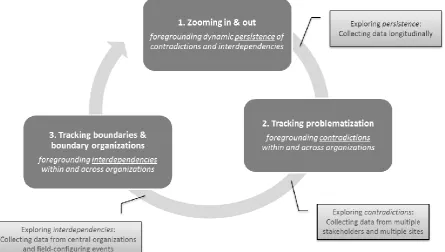
We have developed a methodological framework (see Figure 1) that enables the study of
paradox as inter-organizational phenomena. The paradox literature has, thus-far, largely
examined paradox at organizational (Andriopoulos and Lewis, 2009; Bednarek et al., 2017;
Jarzabkowski et al., 2013; Smith, 2014) and individual (Dameron and Torset, 2014;
Miron-Spektor, Ingram, Keller, Smith and Lewis, 2017) levels. Our approach, illustrated in Figure 1,
provides the opportunity to extend current understandings of paradox by (1) focusing on the
dynamically persistent and multi-faceted nature of paradoxes as they surface across time and
space (zooming in and out); (2) foregrounding how contradictions shift and (re)surface not
only within but also between organizational actors (tracking problematization); and (3)
examining the changing salience of paradoxes among actors as they construct the terms of
their interdependence (tracking boundaries and boundary organizations).
Drawing on our methodological framework, scholars will be able to develop a more
textured understanding not only of individual organizational experiences of paradoxical
tensions but also how such experiences may be grounded in wider systemic tensions. Further
15
whilst not over-privileging that experience at the expense of addressing the grand challenges
from which such tensions stem (Schad & Bansal, 2018). In doing so, we can address calls for
paradox research to go beyond its focus on the dualities that comprise organizational
paradoxes, to embracing, and potentially addressing, the complex, nested, and pluralistic
origins of these paradoxes (Comeau-Vallee et al, 2017; Schad & Bansal, 2018; Smith &
Tracey, 2016). Indeed, in drawing on this framework to analyze our own data, we hope both
our and others’ future research will illustrate the power of a paradox perspective to provide
insight into some of the critical challenges facing society.
Insert Figure 1 here
While we focused on the protection gap, our framework is also valuable for studying other
grand challenges such as climate change (Schüssler, Rüling and Wittneben, 2014) or
alleviating poverty (Mair, Martí and Ventresca, 2012). For instance, in the context of climate
change our framework could enable tracking of when non-commercial interests (such as
climate change research) provide a boundary to the contradictions raised by commercial
interests (such as greenhouse gas emissions); when markets might be engaged (for example,
through carbon trading or green investing); and how governments or inter-governmental
organizations might leverage these interdependencies to further the climate change agenda. In
addition, events such as the 2016 Paris Agreement on climate action, may be understood as
partial solutions that motivate new and ongoing ways of working with inherent
contradictions. A paradox-informed understanding thus shifts attention from ‘managing’
grand challenges to creating a system whereby problems are actively worked through,
productive interdependencies are (re)constructed, and specific contradictions are navigated in
relation to the larger system; providing a powerful tool to support robust action in grand
challenges (Ferraro et al., 2015)
A paradox approach will also be useful for the practitioners addressing grand challenges,
shifting their expectations from resolving contradictions to understanding that contradictions
will continue to resurface in the dynamic process of engaging with a grand challenge.
Understanding grand challenges as paradoxical can enable practitioners to understand that
16
may focus on generating productive interactions, moving beyond the more peaceful notion of
collaboration (George et al., 2016) to one of working through shifting contradictions. This
might help alleviate feelings of disappointment and defeat associated with navigating such
complex, important and intractable societal problems. In summary, a paradox lens helps
actors develop a productive and realistic relationship to both the contradictions and
17
References
Abdallah C, Denis J-L and Langley A (2011) Having your cake and eating it too: Discourses of transcendence and their role in organizational change dynamics. Journal of Organizational Change Management 24(3): 333-348.
Andriopoulos C and Gotsi M (2017) Methods of paradox. In: Smith WK, Lewis MW, Jarzabkowski P, et al. (eds) The Oxford Handbook of Organizational Paradox. Oxford, UK: Oxford University Press, pp. 513-527.
Andriopoulos C and Lewis MW (2009) Exploitation-exploration tensions and organizational ambidexterity: Managing paradoxes of innovation. Organization Science 20(4): 696-717.
Bednarek R, Paroutis S and Sillince J (2017) Transcendence through rhetorical practices: responding to paradox in the science sector. Organization Studies 38(1): 77-101.
Chataway J, Brusoni S, Cacciatori E, Hanlin R and Orsenigo L (2007) The International AIDS Vaccine Initiative (IAVI) in a changing landscape of vaccine development: A public private partnership as knowledge broker and integrator. The European Journal of Development Research 19(1): 100-117.
Comeau-Vallée M, Denis J-L, Normandin J-M and Therrien M-C (2017) Alternate prisms for pluralism and paradox in organizations. In: Smith WK, Lewis MW, Jarzabkowski P, et al. (eds) The Oxford Handbook of Organizational Paradox. Oxford, UK: Oxford University Press, pp. 197-215.
Cunha MP and Putnam LL (2017) Paradox theory and the paradox of success. Strategic Organization. Epub ahead of print 31 October. DOI: 10.1177/1476127017739536. Dameron S and Torset C (2014) The discursive construction of strategists’ subjectivities:
towards a paradox lens on strategy. Journal of Management Studies 51(2): 291-319.
Das TK and Teng B-S (2000) A resource-based theory of strategic alliances. Journal of Management 26(1): 31-61.
Ferraro F, Etzion D and Gehman J (2015) Tackling grand challenges pragmatically: Robust action revisited. Organization Studies 36(3): 363-390.
George G, Howard-Grenville J, Joshi A and Tihanyi L (2016) Understanding and tackling societal grand challenges through management research. Academy of Management Journal 59(6): 1880.
Grodal S and O'Mahony S (2017) How does a grand challenge become displaced? Explaining the duality of field mobilization. Academy of Management Journal 60(5): 1801-1827.
Guston DH (1999) Stabilizing the boundary between US politics and science: The role of the office of technology transfer as a boundary organization. Social Studies of Science
29(1): 87-111.
Hardy C and Maguire S (2010) Discourse, field-configuring events, and change in organizations and institutional fields: Narratives of DDT and the Stockholm Convention. Academy of Management Journal 53(6): 1365-1392.
18
Jarzabkowski P, Bednarek R and Cabantous L (2015) Conducting global team-based ethnography: Methodological challenges and practical methods. Human Relations
68(1): 3-33.
Jarzabkowski P, Chalkias K, Cacciatori E and Bednarek R (2018a) Between State and Market: Protection Gap Entities and Catastrophic Risk. London: Cass Business School, City, University of London.
Jarzabkowski P, Bednarek R and Lê JK (2018b) Studying paradox as process and practice: Identifying and following moments of salience and latency. In: Farjoun M, Smith W, Langley A, et al. (eds) Dualities, Dialectics, and Paradoxes in Organizational Life. Oxford, UK: Oxford University Press, pp. 175-194.
Jarzabkowski P, Bednarek R and Spee AP (2015) Making a Market for Acts of God: The practice of risk trading in the global reinsurance industry. Oxford, UK: Oxford University Press.
Jarzabkowski P, Lê J and Van de Ven AH (2013) Responding to competing strategic demands: How organizing, belonging, and performing paradoxes coevolve. Strategic Organization 11(3): 245-280.
Jarzabowski P and Lê J (2017) We have to do this and that? You must be joking. Constructing and responding to paradox through humor. Organization Studies 38(3-4): 433-462.
Jay J (2013) Navigating paradox as a mechanism of change and innovation in hybrid organizations. Academy of Management Journal 56(1): 137-159.
Knight E and Paroutis S (2017) Becoming salient: The TMT leader’s role in shaping the interpretive context of paradoxical tensions. Organization Studies 38(3-4): 403-432.
Lê J and Bednarek R (2017) Paradox in everyday practice: Applying practice-theoretical principles to paradox. In: Lewis M, Smith WK, Jarzabkowski P, et al. (eds) The Oxford Handbook of Organizational Paradox. Oxford, UK: Oxford University Press, pp. 490-509.
Lemos MC, Kirchhoff CJ, Kalafatis SE, Scavia D and Rood RB (2014) Moving climate information off the shelf: Boundary chains and the role of RISAs as adaptive organizations. Weather, Climate, and Society 6(2): 273-285.
Lewis MW (2000) Exploring paradox: Toward a more comprehensive guide. The Academy of Management Review 25(4): 760-776.
Luscher LS and Lewis MW (2008) Organizational change and managerial sensemaking: Working through paradox. Academy of Management Journal 51(2): 221-240.
Mair J, Martí I and Ventresca MJ (2012) Building inclusive markets in rural bangladesh: How intermediaries work institutional voids. Academy of Management Journal 55(4): 819-850.
Marquis C and Battilana J (2009) Acting globally but thinking locally? The enduring influence of local communities on organizations. Research in organizational behavior
29283-302.
19
Nicolini D (2013) Practice Theory, Work and Organization. Oxford, UK: Oxford University Press.
O'Mahony S and Bechky BA (2008) Boundary Organizations: Enabling Collaboration among Unexpected Allies. Administrative Science Quarterly 53(3): 422-459.
Patankar A and Patwardhan A (2016) Estimating the uninsured losses due to extreme weather events and implications for informal sector vulnerability: a case study of Mumbai, India. Natural Hazards: Journal of the International Society for the Prevention and Mitigation of Natural Hazards 80(1): 285-310.
Putnam LL, Fairhurst GT and Banghart S (2016) Contradictions, dialectics, and paradoxes in organizations: A constitutive approach. The Academy of Management Annals 10(1): 65-171.
Raghu G (2008) Conferences as venues for the configuration of emerging organizational fields: The case of cochlear implants. Journal of Management Studies 45(6): 1061-1088.
Schad J, Lewis M, Raisch S and Smith WK (2016) Paradox research in management science: Looking back to move forward. The Academy of Management Annals 10(1): 5-64.
Schad J, Lewis MW and Smith WK (2018) Quo vadis, paradox? Centripetal and centrifugal forces in theory development. Strategic Organization. Epub ahead of print 10 July. DOI: 10.1177/1476127018786218.
Schad J and Bansal P (2018) Seeing the forest and the trees: How a systems perspective informs paradox research. Journal of Management Studies. Epub ahead of print 18 July. DOI: 10.1111/joms.12398.
Schüssler E, Rüling C-C and Wittneben BB (2014) On melting summits: The limitations of field-configuring events as catalysts of change in transnational climate policy.
Academy of Management Journal 57(1): 140-171.
Smith WK (2014) Dynamic decision making: A model of senior leaders managing strategic paradoxes. Academy of Management Journal 57(6): 1592-1623.
Smith WK and Besharov ML (2018) Bowing before dual gods: How structured flexibility sustains organizational hybridity. Administrative Science Quarterly. Epub ahead of print 19 December. DOI: 10.1177/0001839217750826.
Smith WK, Gonin M and Besharov ML (2014) Managing social-business tensions: A review and research agenda for social enterprise. Business Ethics Quarterly 23(3): 407-442.
Smith WK and Lewis MW (2011) Toward a theory of paradox: A dynamic equilibrium model of organizing. Academy of Management Review 36(2): 381-403.
Smith WK and Tracey P (2016) Institutional complexity and paradox theory: Complementarities of competing demands. Strategic Organization, 14(4): 455-466.
Tracey P and Creed D (2017) Beyond managerial dilemmas: The study of institutional paradoxes in organization theory. In: Lewis M, Smith WK, Jarzabkowski P, et al. (eds) The Oxford Handook of Organizational Paradox. Oxford, UK: Oxford University Press, pp. 490-509.
21
[image:22.595.80.526.117.369.2]22 Biographies
Paula Jarzabkowski is Professor of Strategic Management at Cass Business School, City University London. Her research takes a practice theory approach to strategizing in complex contexts, such as regulated firms, third sector organizations and financial services, particularly insurance and reinsurance. She is experienced in qualitative methods, having used a range of research designs, including cross-sectional and longitudinal case studies, and drawing on multiple qualitative data sources including audio and video ethnography interviews, observation, and archival sources. Her research has appeared in a numerous leading journals including Academy of Management Journal, Journal of Management Studies, Human Relations, Organization Science, Organization Studies and Strategic Management Journal.
Rebecca Bednarek is Senior Lecturer in Strategy at Victoria University Wellington. Her research interests include strategizing practices in complex, often paradoxical, organizational settings and understanding the dynamics of financial markets via social practice theory. She has a passion for qualitative methods; developing insights into the likes of global ethnography, ethnographic textwork, and studying paradox based on her experience studying the New Zealand science sector and the global (re)insurance industry. She has co-authored an ethnographic monologue “Making a Market for Acts of God” (Oxford University Press) on risk-trading practices in the global reinsurance industry. And her research has published in journals such as Human Relations, Long Range Planning, Organizational Studies, Strategic Management Journal, and Strategic Organization.
Konstantinos Chalkias is a Research Fellow at Cass Business School, City, University of London. His research interest resolves around the practices and strategic dynamics of organizations and markets. Drawing from social-practice theory, he studies how strategy is done inside organizations and how financial markets are constructed. He is also interested in organization theories of risk and risk management, with a recent focus on investigating the market mechanisms that transfer uninsurable risk into global financial markets to bridge the global insurance gap.