City, University of London Institutional Repository
Citation
:
Denisova, A., Guckelsberger, C. and Zendle, D. (2017). Challenge in Digital
Games: Towards Developing a Measurement Tool. In: Proceedings of the 2017 CHI
Conference Extended Abstracts on Human Factors in Computing Systems. (pp. 2511-2519).
New York, USA: ACM Press. ISBN 9781450346566
This is the published version of the paper.
This version of the publication may differ from the final published
version.
Permanent repository link:
http://openaccess.city.ac.uk/id/eprint/21356/
Link to published version
:
http://dx.doi.org/10.1145/3027063.3053209
Copyright and reuse:
City Research Online aims to make research
outputs of City, University of London available to a wider audience.
Copyright and Moral Rights remain with the author(s) and/or copyright
holders. URLs from City Research Online may be freely distributed and
linked to.
City Research Online:
http://openaccess.city.ac.uk/
[email protected]
Challenge in Digital Games: Towards
Developing a Measurement Tool
Alena Denisova
Swansea University Swansea SA2 8PP, UK
Christian Guckelsberger
Goldsmiths, University of London London SE14 6NW, UK
David Zendle
University of York York YO10 5DD, UK [email protected]
Permission to make digital or hard copies of part or all of this work for personal or classroom use is granted without fee provided that copies are not made or distributed for profit or commercial advantage and that copies bear this notice and the full citation on the first page. Copyrights for third-party components of this work must be honored. For all other uses, contact the owner/author(s).
Copyright held by the owner/author(s).
CHI’17 Extended Abstracts, May 06-11, 2017, Denver, CO, USA ACM 978-1-4503-4656-6/17/05.
http://dx.doi.org/10.1145/3027063.3053209
Abstract
Challenge is arguably the most important experience that players seek in digital games. However, without a mea-sure of how challenged players feel during the act of play, it is hard to design games that are neither too easy nor too hard and, therefore, truly enjoyable. Especially in industry, challenge is dominantly assessed by means of manual play testing in ad-hoc trials. The aim of this research is to cre-ate a more systematic, complete, and reliable instrument to evaluate the level of players’ experienced challenge in games in the form of a questionnaire. This paper presents the key results from an extensive literature survey which will inform further development. We survey definitions of challenge, challenge types, and their relation to player ex-perience based on the observations of game designers. We furthermore draw from empirical findings in a diverse range of fields such as game studies, human computer interaction (HCI) and artificial intelligence (AI).
Author Keywords
Challenge; Difficulty; Digital Games; Questionnaire; Player Experience; Survey.
ACM Classification Keywords
Introduction
Challenge is a central hub of the gameplay in digital games [13], and is widely believed to play a crucial role in mak-ing games enjoyable [37]. Play in general is understood as “free movement within a more rigid structure” [32]. Unlike application-system users who expect to complete a task in the most efficient and optimal way, game players conse-quently enjoy to be challenged in the mastery of a game in different ways [9, 35].
Digital games that are not too challenging for players with varied levels of skill, experience, and motivation while at the same time not being too easy, are hard to design.Optimal challengeis considered the key ingredient of an enjoyable game, an essential requirement to achieve the state of flow [8], and plays an important role in leading players towards an immersive experience [12, 19].
Despite the evident importance of this experience, little re-search has gone into exploring exactly how challenge is created, what it consists of, and how it affects player ex-periences. This is partially due to the lack of definitions of challenge as player experience in digital games, and also due to the absence of an instrument to measure the whole range of challenge experiences quantitatively.
At the same time, the games industry predominantly as-sesses challenge in their games by interviewing manual playtesters in an unstructured way. As a consequence, the information provided does likely not cover the whole range of challenges present in the game. A better instrument to measure challenge would allow game developers to reliably assess a larger spectrum of challenge types, potentially leading to a more diversified and fuller player experience. We envisage this to be used during- and post-development, but potentially also at the design stage by drawing on post-mortem data from a game’s potential predecessor.
This instrument could be used together with more objective measures, e.g. eye-tracking, as well as other subjective tools measuring player engagement. Correlating objective and subjective responses could allows us to relate objective measures to specific types of challenges. This tool would also allow to study the relationship between different types of challenge and other gaming experiences.
The ultimate goal of this research is to develop a ques-tionnaire to reliably measure the complete experience of challenge in digital games. The aim of this paper is to doc-ument our key findings from a literature survey, highlighting how different fields provide valuable insights on the experi-ence of challenge, the variety of challenge types, and how challenge is positioned with regards to other player expe-riences. We also hope that our findings raise awareness for the less well known types of challenge, representing promising yet under-investigated research topics in HCI.
What is Challenge?
Gameplay characterises the core activity of a game. It is defined as a series of actions performed by the player or game actors and their associated feedback or outcomes [37]. Challenges are the central hub of gameplay:
“Gameplay is challenges and actions that entertain. People enjoy a challenge, as long as they can rea-sonably expect to accomplish it. People also try a challenge they do not expect to meet if the risk is low and the reward is high. Challenges create tension and drama. At the simplest level, presenting players with a challenge amounts to asking a question: “Can you do it?” They’ll enjoy trying to prove that you can.” [3]
tasks which they have to perform to make progress [3]. Cu-mulatively, they contribute to the overall difficulty of a game.
Although the terms ‘difficulty’ and ‘challenge’ are often used interchangeably both by researchers and players alike, they are not the same. ‘Difficult’ implies that something is ‘hard to do’, while ‘challenge’ describes a stimulating task or problem [11]. In a stimulating game, players are motivated to respond to a challenge, their actions make a difference, and they feel in control over the outcomes of their actions [24]. A stimulating game would make this consequence transparent, give hints to the player on how to counteract, e.g. by means of traps, and make the player’s actions affect the course of the game. Watching a cut scene, in contrast, is neither difficult nor challenging as it does not require any actions from the player and it is not possible for them to fail. A game does not need to be difficult to be challenging [6]. Players’ perception of this difficulty and thus their enjoyment varies depending on their skills and their previous experi-ences with this or other games involving similar types of challenge. It is due to this subjectivity that ‘challenge’ often also denotes a player’sperceiveddifficulty of the game.
CHALLENGE TYPES Cognitive Challenge:
Challenge that addresses the player’s cognitive and problem-solving capac-ities. The player has to invest cognitive effort to predict the consequences of actions or comprehend ambiguous elements of the narrative or the storyline.
Physical Challenge:
Challenge that addresses the player’s physical lim-itations to interact with the game, i.e. the speed and accuracy with which actions can be performed.
Emotional Challenge:
Challenge which confronts the player with emotion-ally salient material or the use of strong characters, and a captivating story. A player cannot overcome emotional challenge with skill or dexterity, but by resolving tension in the narrative, by identifying with characters, and by resolving ambiguities.
Challenge Types
Adams [3] distinguishes two well-established classes of challenges by specifying what they demand from the player: “Overcoming a challenge must require either mental or physical effort.”. More commonly, these two types are la-belled ascognitiveandphysicalchallenges [7, 12, 15].
Physical challengesaddress a player’s abilities with regards to the speed and accuracy with which they perform actions in games [7]. These challenges exercise one’s physical en-durance, dexterity, coordination, and, sometimes, strength [33]. Physical challenges were dominant in early arcade games, e.g.Space Invaders, but also present in many
mod-ern games, such asOverwatch, which require good reac-tion and mastery of controls.
Conversely,cognitive challengesrefer to a player’s mem-ory, observation, and problem solving capacities. Typically, cognitive challenges require players to have good spatial reasoning, decision making, and planning in order to make progress in the game, and are often found in puzzle games, e.g.Candy Crush, or in strategy games such asCivilization. Challenges arising during play against or with human or AI players, i.e. social challenges, could be viewed as a sub-set of this type, as they require players to deal with hidden information. The capacity to read an opponent, predict-ing their moves and makpredict-ing split-second decisions can aid players in deceiving opponents. Conversely, success as a team depends heavily on being able to predict the targets of teammates and to coordinate joint actions.
Cole et al. [6] classify both physical and cognitive chal-lenges asfunctional, and introduce another, less prominent type:emotional challenges. Games stimulate players with emotional challenges by providing them with a compelling narrative or story, through ambiguous or difficult material or by using strong characters for which the player can feel empathy. According to Cole et al. [6],“the core pleasure here for the player is the resolution of tension within the narrative, emotional exploration of ambiguities within the diegesis, or identification with characters.” While games like JourneyorLife is Strangedo not require players to master controls in order to advance in the game, they allow players to experience an emotional connection with the game world and to relate to the characters and the story.
by findings in general game AI, where researchers strug-gle to develop a player agent that performs equally well in a wide range of games [5]. An instrument for measuring this experience must therefore be comprehensive enough to address perceived challenge in any digital game, while also being sufficiently specific to differentiate between chal-lenge types that potentially lead to different experiences – the emotional involvement in a game with dominantly phys-ical challenges such as the classicWinter Gameswould certainly differ from the the emotional involvement in the avant-garde gamePapers, Please.
Challenge as Player Experience
Different types of challenges can invoke different player experiences. To create a complete yet sufficiently specific questionnaire, we consequently need to understand what factors influence one’s experience of challenge and what experiences emerge as a result of being challenged.
Difficulty and Skill
A player’s perception of challenge largely depends on the difficulty of the game [3]. A difficult game is harder to beat if the player lacks the relevant skills or expertise. Therefore, this ability to successfully face challenges affects players’ perception of difficulty – a more skilled player would expe-rience less challenge when overcoming the same obstacle than a player with less experience and less relevant skills.
Learning and Mastery
As difficulty in the game increases with time, players should be able to learn and improve their skills in order to eventu-ally master the game. Some of these skills might be trans-ferable to other games and everyday life. According to Rouse [30]:“In the best games, players will learn lessons through gameplay that can be applied to other aspects of their life, even if they do not realise it.”
Flow and Immersion
If the game supports the improvement of one’s abilities and skills, players should experience optimal challenge, i.e. a perfect match between the game difficulty and the players’ skill level. This is also an essential component ofFlow[8] – an optimal experience that can be evoked by high levels of engagement in an activity. In this state, a person experi-ences high concentration as they become focused on play.
Flow, however, is not the only experience that emerges as a result of well-balanced challenge. Players feel more im-mersedwhen the balance between the challenge and their expertise level is matched fairly closely [7, 19]. Ermi and Mäyrä [12] distinguish challenge-based immersion from other types and hypothesise that it is affected by both the challenge of ‘pace’ (i.e. physical challenge) and ‘cognitive challenge’. Cox et al. [7] report from experiments that an in-creased physical demand did not lead to an inin-creased level of immersion, but adding time pressure increased physical and cognitive challenge and consequently immersion.
Uncertainty
Challenge can also emerge as a result of players feeling uncertain [26]. Being unable to predict the outcome of one’s actions, failing to read the opponent, or feeling uncertain about the best possible tactic for a battle increases one’s perception of challenge. Being unable to predict whether the player will succeed or fail has been claimed to provide a strong motivation to play [25], and empirical studies show that outcome uncertainty relates to the feeling of suspense, which in turn increases enjoyment [2]. This also represents one explanation for the appeal of competition [28].
Performance Evaluation
vari-ety and depth of challenge in different games by comparing the relative performance of AI agents of various complexity. This is based on the assumption that in games with more varied challenge, we can expect a larger score difference between a simple and a sophisticated AI [27].
Enjoyment and Pleasure
Players might experience positive or negative emotional responses not only from emotional challenge. When the challenge is beyond one’s abilities, this may lead to anxiety, or if the player does not feel challenged enough – boredom [8]. Being optimally challenged leads players to experience enjoyment [1] and pleasure [16]. Players enjoy games more when the perceived level of skills and challenge is higher than the subjective difficulty offered by the game [4, 21].
Competence
Optimal challenge provides players with the sense of com-petence [1, 31] – the feeling of being able to meet the re-quirements of tasks they have / want to complete. Deci and Ryan claim:“It is success at optimally challenging tasks that allows people to feel a true sense of competence.” [10]
Suspense and Curiosity
Playing task-based or competitive games is enjoyable as long as the outcome of the task remains uncertain and the balance between challenge and mastery is achieved [23]. Players often experience suspense and curiosity as a re-sult of uncertainty with regards to being able to cope with challenges as they arise [22].
Anticipation and Tension
Challenge, however, does not always lead to positive periences. According to Poels et al. [28], players can ex-perience tension, which for more exex-perienced players can often turn into irritation, disappointment, anger and frustra-tion. Frustration and irritation are particular emotions that emerge from a mismatch between challenge and skills [28].
Success and Failure
Frustration can also be caused by failure, although it is an essential part of learning. Without failing, players would find games boring quickly [20]. Failure not only makes winning more enjoyable, it also makes players readjust their percep-tion of a game:“Failure adds content by making the player see new nuances in a game.”[20]. According to Rouse [30]:“Players need to blame only themselves for not suc-ceeding, but at the same time the game must be challeng-ing enough so that they do not succeed right away.”
Measuring Challenge in Games
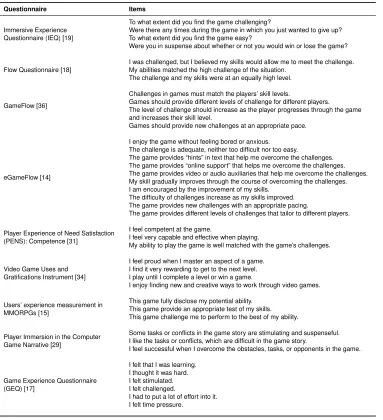
Just like other player experiences, perceived challenge can be measured quantitatively. To the best of our knowledge though, no instrument exists that captures all facets of chal-lenge in games in sufficient depth. Nevertheless, some scales designed to measure broader player experiences contain challenge as a factor or a component. We system-atically surveyed nine widely used and easily accessible questionnaires, and summarised their challenge-related items in Table 1.
The existing questionnaires already cover the level of ex-perienced challenge and its diversity, and as how stimu-lating tasks were perceived. They also probe the player’s outcome uncertainty, and related, they check for suspense and player churn. They assess the perceived match be-tween the player’s skill and abilities and the demands of the game, the perceived learning progress in acquiring the skills and the invested effort to master the tasks. Closely re-lated, one questionnaire also asks for the player’s perceived competence and causal efficacy. Other questions ask for the player’s emotional responses of anxiety and boredom and for the level of support the player received in the game.
Questionnaire Items
Immersive Experience Questionnaire (IEQ) [19]
To what extent did you find the game challenging?
Were there any times during the game in which you just wanted to give up? To what extent did you find the game easy?
Were you in suspense about whether or not you would win or lose the game? Flow Questionnaire [18]
I was challenged, but I believed my skills would allow me to meet the challenge. My abilities matched the high challenge of the situation.
The challenge and my skills were at an equally high level.
GameFlow [36]
Challenges in games must match the players’ skill levels.
Games should provide different levels of challenge for different players. The level of challenge should increase as the player progresses through the game and increases their skill level.
Games should provide new challenges at an appropriate pace.
eGameFlow [14]
I enjoy the game without feeling bored or anxious. The challenge is adequate, neither too difficult nor too easy.
The game provides “hints” in text that help me overcome the challenges. The game provides “online support” that helps me overcome the challenges. The game provides video or audio auxiliaries that help me overcome the challenges. My skill gradually improves through the course of overcoming the challenges. I am encouraged by the improvement of my skills.
The difficulty of challenges increase as my skills improved. The game provides new challenges with an appropriate pacing.
The game provides different levels of challenges that tailor to different players. Player Experience of Need Satisfaction
(PENS): Competence [31]
I feel competent at the game.
I feel very capable and effective when playing.
My ability to play the game is well matched with the game’s challenges. Video Game Uses and
Gratifications Instrument [34]
I feel proud when I master an aspect of a game. I find it very rewarding to get to the next level. I play until I complete a level or win a game.
I enjoy finding new and creative ways to work through video games. Users’ experience measurement in
MMORPGs [15]
This game fully disclose my potential ability. This game provide an appropriate test of my skills. This game challenge me to perform to the best of my ability. Player Immersion in the Computer
Game Narrative [29]
Some tasks or conflicts in the game story are stimulating and suspenseful. I like the tasks or conflicts, which are difficult in the game story.
I feel successful when I overcome the obstacles, tasks, or opponents in the game.
Game Experience Questionnaire (GEQ) [17]
I felt that I was learning. I thought it was hard. I felt stimulated. I felt challenged.
[image:7.792.69.452.114.534.2]I had to put a lot of effort into it. I felt time pressure.
Table 1:Challenge-related items in player experience questionnaires.
the questions are fragmented, and the questionnaires were not specifically designed to measure the experience of chal-lenge. Due to the lack of statistical validation, they therefore cannot be presumed reliable tools. Furthermore, despite addressing the very general properties of challenge, the questionnaires lack depth. Most importantly, different types of challenge are not distinguished, in particular not emo-tional and social challenge. Also only very few emotions are considered, compared to the breadth we outlined earlier. Moreover, the previous section demonstrates that different challenges can lead to different experiences, which is why we need a questionnaire that is comprehensive enough to capture experiences of players with varied levels of skill and experience playing different kinds of games.
Discussion and Future Work
We demonstrated that existing questionnaires are insuffi-cient to assess challenge as player experience in a com-plete and reliable way. Considering the growing interest in studying challenge in digital games and designing for the optimal experience, the lack of an instrument to empirically evaluate this experience poses a problem.
At the time of writing, we are developing theChallenge Questionnaireto measure the full experience of challenge in digital games across different genres. The development contains two stages: preliminary items are based on the common themes in the surveyed literature. We will then iteratively revise and complement the existing items with in-sights from interviewing experts in the fields of HCI, AI, and games development. The scale will eventually be evaluated using a number of games with players of varied skill levels.
ACKNOWLEDGMENTS
CG is funded by EPSRC grant [EP/L015846/1] (IGGI).
REFERENCES
1. Sami Abuhamdeh and Mihaly Csikszentmihalyi. 2012. The importance of challenge for the enjoyment of intrinsically motivated, goal-directed activities. Personality and Social Psychology Bulletin38, 3 (2012), 317–330.
http://dx.doi.org/10.1177/0146167211427147
2. Sami Abuhamdeh, Mihaly Csikszentmihalyi, and Baland Jalal. 2015. Enjoying the possibility of defeat: Outcome uncertainty, suspense, and intrinsic
motivation.Motivation and Emotion39, 1 (2015), 1–10. http://dx.doi.org/10.1007/s11031-014-9425-2
3. Ernest Adams. 2014.Fundamentals of game design. Pearson Education.
4. Scott Bateman, Andre Doucette, Robert Xiao, Carl Gutwin, Regan L Mandryk, and Andy Cockburn. 2011. Effects of view, input device, and track width on video game driving. InProceedings of Graphics Interface 2011. Canadian Human-Computer Communications Society, 207–214.http:
//dl.acm.org/citation.cfm?id=1992917.1992952
5. Philip Bontrager, Ahmed Khalifa, Andre Mendes, and Julian Togelius. 2016. Matching Games and Algorithms for General Video Game Playing. InProceedings of the 12th International Conference on Artificial Intelligence and Interactive Digital Entertainment (AIIDE).
6. Tom Cole, Paul Cairns, and Marco Gillies. 2015. Emotional and Functional Challenge in Core and Avant-garde Games. InProceedings of the 2015 Annual Symposium on Computer-Human Interaction in
Play. ACM, 121–126.
http://dx.doi.org/10.1145/2793107.2793147
7. Anna Cox, Paul Cairns, Pari Shah, and Michael Carroll. 2012. Not doing but thinking: the role of challenge in the gaming experience. InProceedings of the SIGCHI Conference on Human Factors in Computing Systems. ACM, 79–88.
http://dx.doi.org/10.1145/2207676.2207689
8. Mihaly Csikszentmihalyi. 1990.The psychology of optimal experience. Harper&Row, New York.
9. John P Davis, Keith Steury, and Randy Pagulayan. 2005. A survey method for assessing perceptions of a game: The consumer playtest in game design.Game Studies5, 1 (2005).
10. Edward L Deci and Richard M Ryan. 2000. The" what" and" why" of goal pursuits: Human needs and the self-determination of behavior.Psychological inquiry 11, 4 (2000), 227–268.
www.jstor.org/stable/1449618
11. Difficulty. 2016.Merriam-Webster.com. Merriam-Webster.
12. Laura Ermi and Frans Mäyrä. 2005. Fundamental components of the gameplay experience: Analysing immersion.Worlds in play: International perspectives on digital games research37 (2005), 2.
13. John Feil and Marc Scattergood. 2005.Beginning game level design. Thomson Course Technology.
14. Fong-Ling Fu, Rong-Chang Su, and Sheng-Chin Yu. 2009. EGameFlow: A scale to measure learners enjoyment of e-learning games.Computers & Education52, 1 (2009), 101–112.
15. Shang Hwa Hsu, Ming-Hui Wen, and Muh-Cherng Wu. 2007. Exploring design features for enhancing players’ challenge in strategy games.CyberPsychology & Behavior10, 3 (2007), 393–397.
http://dx.doi.org/10.1089/cpb.2006.9940
16. Robin Hunicke, Marc LeBlanc, and Robert Zubek. 2004. MDA: A formal approach to game design and game research. InProceedings of the AAAI Workshop on Challenges in Game AI, Vol. 4. 1.
17. Wijnand IJsselsteijn, Yvonne De Kort, Karolien Poels, Audrius Jurgelionis, and Francesco Bellotti. 2007. Characterising and measuring user experiences in digital games. InInternational conference on advances in computer entertainment technology, Vol. 2. 27. https://doi.org/10.1093/iwc/iwt015
18. Susan A Jackson, Herbert W Marsh, and others. 1996. Development and validation of a scale to measure optimal experience: The Flow State Scale.Journal of sport and exercise psychology18 (1996), 17–35. http://dx.doi.org/10.1123/jsep.18.1.17
19. Charlene Jennett, Anna L Cox, Paul Cairns, Samira Dhoparee, Andrew Epps, Tim Tijs, and Alison Walton. 2008. Measuring and defining the experience of immersion in games.International journal of human-computer studies66, 9 (2008), 641–661. http://dx.doi.org/10.1016/j.ijhcs.2008.04.004
20. Jesper Juul. 2009. Fear of failing? the many meanings of difficulty in video games.The video game theory reader2 (2009), 237–252.
21. Madison Klarkowski, Daniel Johnson, Peta Wyeth, Mitchell McEwan, Cody Phillips, and Simon Smith.
2016. Operationalising and Evaluating Sub-Optimal and Optimal Play Experiences through Challenge-Skill Manipulation. InProceedings of the 2016 CHI
Conference on Human Factors in Computing Systems. ACM, 5583–5594.
http://dx.doi.org/10.1145/2858036.2858563
22. Christoph Klimmt. 2003. Dimensions and determinants of the enjoyment of playing digital games: A three-level model. InLevel up: Digital games research conference. 246–257.
23. Christoph Klimmt, Tilo Hartmann, and Andreas Frey. 2007. Effectance and control as determinants of video game enjoyment.Cyberpsychology & behavior10, 6 (2007), 845–848.
http://dx.doi.org/10.1089/cpb.2007.9942
24. Nicole Lazzaro. 2004. Why we play games: Four keys to more emotion without story. (2004).
25. Geoffrey R Loftus and Elizabeth F Loftus. 1983.Mind at play; The psychology of video games. Basic Books, Inc.
26. Thomas W Malone. 1981. Toward a theory of
intrinsically motivating instruction.Cognitive science5, 4 (1981), 333–369.
http://dx.doi.org/10.1016/S0364-0213(81)80017-1
27. Thorbjørn S Nielsen, Gabriella A B Barros, Julian Togelius, and Mark J Nelson. 2015. General Video Game Evaluation Using Relative Algorithm Performance Profiles. InProceedings of the 18th Conference on Applications of Evolutionary Computation. Springer, 369–380.
28. Karolien Poels, Yvonne De Kort, and Wijnand Ijsselsteijn. 2007. It is always a lot of fun!: exploring dimensions of digital game experience using focus group methodology. InProceedings of the 2007 conference on Future Play. ACM, 83–89. http://dx.doi.org/10.1145/1328202.1328218
29. Hua Qin, Pei-Luen Patrick Rau, and Gavriel Salvendy. 2009. Measuring player immersion in the computer game narrative.Intl. Journal of Human–Computer Interaction25, 2 (2009), 107–133.
http://dx.doi.org/10.1007/978-3-540-74873-1_60
30. Richard Rouse III. 2010.Game design: Theory and practice. Jones & Bartlett Learning.
31. Richard M Ryan, C Scott Rigby, and Andrew
Przybylski. 2006. The motivational pull of video games: A self-determination theory approach.Motivation and emotion30, 4 (2006), 344–360.
http://dx.doi.org/10.1007/s11031-006-9051-8
32. Katie Salen and Eric Zimmerman. 2004.Rules of play: Game design fundamentals. MIT Press.
33. Jesse Schell. 2014.The Art of Game Design: A book of lenses. CRC Press.
34. John L Sherry, Kristen Lucas, Bradley S Greenberg, and Ken Lachlan. 2006. Video game uses and gratifications as predictors of use and game
preference.Playing video games: Motives, responses, and consequences24 (2006), 213–224.http: //www.allacademic.com/meta/p111471_index.html
35. Ben Shneiderman. 1982. Direct manipulation: A step
beyond programming languages.ACM SIGSOC
Bulletin13, 2-3 (1982), 143.
http://dx.doi.org/10.1109/MC.1983.1654471
36. Penelope Sweetser and Peta Wyeth. 2005. GameFlow: a model for evaluating player enjoyment in games. Computers in Entertainment (CIE)3, 3 (2005), 3–3. http://dx.doi.org/10.1145/1077246.1077253