City, University of London Institutional Repository
Citation
: Strigini, L. and Littlewood, B. (2000). A discussion of practices for enhancing
diversity in software designs. London, UK: Centre for Software Reliability, City University London.This is the unspecified version of the paper.
This version of the publication may differ from the final published
version.
Permanent repository link:
http://openaccess.city.ac.uk/275/Link to published version
:
Copyright and reuse:
City Research Online aims to make research
outputs of City, University of London available to a wider audience.
Copyright and Moral Rights remain with the author(s) and/or copyright
holders. URLs from City Research Online may be freely distributed and
linked to.
City Research Online: http://openaccess.city.ac.uk/ [email protected]
enhancing diversity in software
designs
Title of Project: DIverse Software PrOject (DISPO)
(British Energy - ex Scottish Nuclear - Project under Contract PP/96523/MB)
Authors:
Bev Littlewood, Lorenzo Strigini
Document Identifier: DISPO LS_DI_TR-04_v1_1dDate Last Modified 23 November 2000 Version: 1.1d
Document Type: DISPO report (Deliverable) Intended Recipients: Public distribution
Confidentiality: Cleared for publication
Contact Lorenzo Strigini <[email protected]>
diversity in software designs
Bev Littlewood, Lorenzo Strigini
Centre for Software Reliability, City University Northampton Square, London EC1V OHB, UK
{b.littlewood,[email protected]}
DISPO Project Draft Technical Report LS_DI_TR-04,
Version 1.1d, 23 November 2000
Abstract
This report discusses the practices which have been used or recommended for increasing the degree of diversity between redundant implementations of software or software-based systems. Its purpose is to give useful indications for designers, project managers and safety/reliability assessors in deciding about how great an advantage should be expected from the use of these practices, in absolute and in comparative terms. Existing knowledge does not allow one to state any strong general recommendations, but it is possible to improve on the intuitive justifications usually given for these various practices. This report clarifies the ways the various practices are conjectured to aid system reliability, the factors that should affect their efficacy, and thus, for a practitioner, the aspects of a specific project situation that need to be considered to inform decisions.
Thus this report is meant to improve on the many recommendations available in the literature by a more rigorous analysis of the support available for individual recommendations and for decision between them, on the basis of existing known evidence about diversity, of general experience in software engineering and of the result of our reliability modelling work.
An executive summary gives the highlights of the report and a guide to the topics treated. The other sections are an introduction giving the scope and background of the work; a general analysis of the factors affecting the achievement of useful diversity and the criteria for choosing among possible "diversity-seeking decisions" to this end, and a summary table of the considerations applying to each category of "diversity-seeking decisions", with explanations of detail in an appendix.
This report updates and supersedes the previous DISPO project report AT_DI-D-01-v1.7, "A list of intuitive diversity enhancing measures/practices", 20 February 1998, which was produced at the beginning of the DISPO project, to reflect our changed understanding at the end of the project. Parts of the old report have been eliminated as the corresponding topics are now covered by separate DISPO documents.
The information contained in this report has been produced for BEG(UK) Ltd on behalf of the Industry Management Committee (IMC). thus is the joint property of British Energy Generation Ltd, British Energy Generation (UK) Ltd, British Nuclear Fuels Limited and British Nuclear Fuels Magnox Generation Ltd, and their successor companies.
Background and scope (Section 1)... 1
General principles of analysis, and limits to the analysis (Sections 2.1 -2.5)... 1
Criteria for choosing diversity-seeking decisions (Sections 2.6-2.8)... 2
Discussion of individual diversity-seeking decisions (Section 3 and Appendix)... 4
Conclusions ... 4
Difficulties ... 4
Positive results ... 4
1. Introduction... 6
1.1 Scope of application of diversity and scope of this study... 6
1.2 Ways of pursuing diversity and how they relate to failure diversity ... 8
1.3 The various aspects of diversity and of "independence"... 9
1.4 Conceptual models of diversity ... 10
2. General analysis: how project decisions affect failure diversity... 13
2.1 Data diversity and its mechanisms of action... 13
2.2 Mechanisms of action of design or functional diversity ... 14
2.3 Failure diversity: separate failure points vs diverse failures on the same demand ... 18
2.4 Human errors in development: random variation vs cognitive diversity ... 19
2.5 Difficulties in relating diversity-seeking decisions to failure diversity... 22
2.5.1 The "mistake-fault-failure" cause-effect chain... 22
2.5.2 Fault "types" as a basis for reasoning about DSDs... 23
2.5.3 Fault location as a basis for reasoning about DSDs... 24
2.5.4 Mapping of mistake/fault/error/failure types to DSDs ... 24
2.6 Practical criteria for matching DSDs to required fault diversity... 24
2.6.1 General classes of threats... 26
2.6.2 Choosing between "high-level" and "low-level" DSDs ... 27
2.7 Trade-offs between diversity and reliability of the individual versions... 28
2.8 Use of diversity within the development of each version ... 30
2.8.1 Two diverse versions, or one version with all the benefits of diversity? ... 30
2.8.2 Best allocation of diversity across the development of a diverse system... 32
3. Detailed discussion of diversity-seeking decisions (DSDs)... 33
Appendix to section 3: detailed comments on DSDs... 37
A.1 Data Diversity... 37
A.2 Design Diversity... 38
A.2.1 Separate ("independent") developments... 38
A.2.2 Diverse development teams... 39
A.2.3 Diversity in description/programming languages and notations... 40
A.2.4 Diverse requirements or specifications ... 41
A.2.4.1 Different expressions of substantially identical requirements. 43 A.2.4.2 Different required properties implying the same behaviour 43 A.2.4.3 Requiring different behaviours from the diverse versions 43 A.2.5 Diverse development methods ... 44
A.2.6 Diverse verification/validation/testing... 45
A.2.7 Automatic code transformation... 46
A.2.8 Diverse development platforms: diverse tools... 46
Executive summary
Design diversity is an attractive and popular defence against common-mode failures due to design faults in redundant systems. It is considered especially important when all channels in a critical system, e.g. a protection system, have to be realised as programmable systems. However, the abundant advice available about how to pursue diversity so as to best reduce common-mode failures is confusing and usually lacking convincing bases.
In this section, we indicate the topics studied in the various parts of this document, and summarise the conclusions reached.
Background and scope (Section 1)
Section 1 sets the background for this study: its role within the DISPO project, its scope, the common understanding of the problems in the technical community, the essential models and terminology necessary for the following discussion. This study was motivated by the issues raised by the possibility of completely software-based protection systems. Its focus was thus on systems with two diverse channels (versions), Boolean outputs and 1-out-of-2 redundancy, but many of its considerations apply beyond this area. Section 1.1 defines the scope of this study and outlines how other kinds of architectures using diversity may differ from these systems. In Section 1.2, we recall the common approaches followed in pursuing design diversity and define the term "diversity-seeking decision" (DSD): a decision available to system designers to attempt to promote failure diversity between two program versions. Common DSDs are, for instance, the decision that two protection channels will be developed by separate teams, and giving these teams specifications formulated in different notatons; making them use different programming languages; and using different microprocessors in the two channels. We defined the special term "DSD" to avoid the common confusion between descriptions of decisions made and descriptions of their desired or actual effects - the actual diversity achieved between versions or their failure behaviours. Decisions are obviously under our control, but we do not usually know their likely effects. Their actual effects can to some extent be measured after the fact, but are difficult to predict at decision time. A DSD is a choice of differences between two development processes. In section 1.3 we list the essential different meanings of "diversity" that have to be kept separated to avoid errors in analysing them, and in section 1.4 we recall the mathematical models (the "EL" and "LM" models) which are at the origin of our current understanding of "failure diversity" between the versions, the actual goal of interest.
General principles of analysis, and limits to the analysis (Sections 2.1 -2.5)
So, the topic of this report is how to choose DSDs for best effect on system reliability. This cannot be based on statistical evidence of their effectiveness, which is lacking because:
• there are many possible variations and combinations of DSDs;
• experiments (producing many different program versions under controlled conditions, and comparing their failure behaviours) could show, at great expense, how effective a DSD was in a particular case, but not whether that effectiveness would be retained when developing a different system;
• we should expect the relative effectiveness of DSDs to change between different project contexts: product type, company culture, dependability requirements, project constraints. Instead of seeking general measures to attach to each DSD in the abstract, we need to understand the factors that make a DSD useful, and the effects of project conditions on the relative weights of these factors. To this end we can use some of the known experimental results, together with our general understanding of software development and software reliability. We can identify several mechanisms that explain the positive effects of DSDs on failure diversity, and are common to many DSDs, although active in different measures. Section 2 describes these mechanisms, the difficulties in ascertaining their role and power, and the general practical approaches available for choosing among DSDs.
• the "obvious" chain of cause and effects: a DSD directly ensures that developers are likely, if they make mistakes, to make different mistakes, which will cause any faults in the developed versions to be conceptually different, which will cause failures not to occur on the same demands for both versions; but also
• several other mechanisms: data diversity (intentional or accidental), such that even similar faults are only triggered in one of the channels; accidental differences in the effects of similar development mistakes; the fact that the constraints we create for development teams may indirectly create further diversity between the individual tasks in which they engage. Any DSD should be based on some understanding of human error mechanisms. Section 2.4 is dedicated to this. Although psychology has delivered interesting insights into human error processes, important uncertainties remain when we consider the complex web of activities that forms software development, many of these activities being specifically aimed at detecting and removing the effects of previous errors. Two fundamental characteristics of human errors are that they occur in random fashion, but on the other hand they are affected by the characteristics of the tasks to be performed. The latter aspect would encourage us to select DSDs so as to diversify the tasks presented to the two development teams. The former aspect, together with the complexity of how development errors produce system failures, would indicate that the most important DSD is the most basic one, i.e., simple separation between development efforts. Ideally, the correct way of choosing a DSD is to verify that the two development processes it creates are in a sense complementary: the demands on which the programs created by one process are more likely to fail must be those on which programs created by the other are less likely to fail. In addition, we normally wish each process on its own to be as good as practically possible. In practice, many difficulties stand in the way of such ideal choices:
• we seldom know in detail the strengths and weaknesses of the different methods that comprise our development processes, and what we do know is usually in terms of the likelihood of people making [certain kinds of] mistakes when using those methods, not of the likelihood that the defects caused by these mistakes cause failures on the same sets of demands, or the probability of such common failures in operation;
• system development includes many different, interacting activities. We often have ideas about the influence of a DSD on one activity, but not about its side-effects on other activities and the relative importance of all these influences. So, we have both many possible combinations of available choices for the various activities in a development process, and little support for comparing these combinations;
• there are trade-offs between increasing the reliabilities of the versions and their diversity. There are even cases, in theory, in which we should produce two versions with two processes that are much less than ideal rather than with better processes, because the increased diversity produces in the end higher system reliability. We are unlikely in practice to be able to recognise such a situation, but a dedicated subsection (2.7) deals with related questions of practical importance - when is it that applying a DSD to increase diversity may at the same time decrease version reliability? - and the available decision criteria;
• practical constraints (budget, staff, contractual obligations and so on) will normally reduce the number of possible choices, but often not the complexity of the factors to be compared. We explain these difficulties in section 2.5, which is mostly a set of negative conclusions and warnings about the limits to the extent to which the efficacy of DSDs can be judged.
possibility that a decision intended to increase diversity will in practice decrease it, but it is reasonable to assume this not to be the case, so long as we have no evidence of it actually occurring.
Since the main concern is that excessive similarities between the problems posed to the two development teams (i.e., similarities in the "difficulties" they present - cf section 1.4) cause too high a risk of common failures, any DSD for which we can reasonably expect some degree of effectiveness appears desirable. The limits on adopting DSDs are cost constraints, organisational problems, or the fear of direct negative effects on system reliability. We will naturally adopt all the DSDs that have low cost and no evident negative side effects and appear potentially useful. For those among which we must instead choose, we have two main, possibly competing criteria: diversifying with higher priority those aspects of the development processes from which we expect the more substantial risk of common failures, despite the other precautions that we can adopt; and diversifying the processes "as completely as possible", to compensate for our limited ability to identify the main residual threats in high-quality processes. From our analysis of DSDs, three essential groupings emerge based on the threats they primarily address: defences against high-level mistakes in defining system structure or algorithms, defences against coding (or generally, detail implementation) mistakes in implementing these high-level decisions, and defences against defects in the "support platform" (compilers-linkers-loaders, hardware and run-time executive or operating system).
The benefits of DSDs generally propagate (unidirectionally) across these three levels: e.g., imposing different high-level architectures for two versions, for the purpose of avoiding common mistakes in defining the basic algorithms, is likely also to cause some diversity in errors of coding, and to create different enough source programs to reduce the risk of common failures due to compiler errors or microprocessor bugs. However, the high-level DSDs may be more expensive and more difficult to apply correctly than the lower-level ones. There is an analogy here with the general issues in fault-tolerant design, of how to choose and combine between end-to-end fault tolerance (e.g. application-level checks and recovery actions) and low-level fault tolerance (e.g. hardware duplication or data redundancy), with their different coverages of different fault types and their different costs.
There is a general opinion that the really threatening problems in development arise from the high-level aspects of design: requirements specification, high-level specifications of algorithms; for threats in the lower level (conceptually later) phases of development we already have effective defences that should be applied anyway (irrespective of diversity) and are probably sufficient. On this basis, it would seem that the more useful DSDs are those applied earlier in the development process and higher in the design refinement hierarchy. E.g., functional diversity would be the most effective DSD; by contrast, a DSD like developing two different versions with C and assembly language would be much less valuable. We agree with the general thrust of the argument that the latter DSD should not be trusted much as a defence against high-level specification error, but we underscore reasons why DSDs in the later stages of development should not be discarded without proper analysis:
• system developers have minimal or no control over essential parts of the support platform, and high-level DSDs may be ineffective against their failures. E.g., in civil airliners avionics, microprocessor diversity is absolutely necessary as developers have to use off-the-shelf, complex, notoriously bug-ridden microprocessors;
• despite apparent high-level diversity, commonalities may re-emerge in the implementation of diverse channels (see examples in the discussion of functional diversity in the main text): one should explicitly check for such commonalities rather than trusting that they do not exist;
• methods for protection against errors in the lower levels of development, like the coding phase, do exist but are not necessarily applied, even in safety-critical developments. This defeats the premise that diversity is only needed against higher-level design mistakes. This is a special concern with COTS systems or systems "imported" from industry sectors with different certification and regulation cultures.
• analysis of threats (possible sources of human failures that will cause system failures);
• selection of DSDs by probable effectiveness on threats in the earlier stages of development;
• analysis of threats in later stages, and possible failure causes in the support platform, that may require further DSDs.
We also discuss how to deal with two further difficulties in decisions:
• one may need to trade diversity against reliability of the individual versions. Here, decisions are aided by analysing which weaknesses caused by DSDs can be obviated without reducing the positive effects of the DSD (section 2.7);
• forms of diversity are useful within the development of each version as well as between versions, and their combined efficacy will depend on how in detail they are used (section 2.8).
Discussion of individual diversity-seeking decisions (Section 3 and Appendix)
The preceding analysis is organised in a "top-down" fashion, starting from the general mechanisms of actions for all DSDs, and the general criteria for guiding their choice. Section 3 provides a "bottom-up" view, organised by categories of DSDs, and giving:
• a summary table of the mechanisms of actions, types of problems against which the DSD is a defence, and considerations about their cost and efficacy;
• an appendix with more detailed discussion and references to the parts of the "top-down" analysis (section 2) that support our conclusions.
Conclusions
Difficulties
A manager who wishes to employ diversity in a development project is confronted with a bewildering range of possible "diversity-seeking decisions" and their combinations. Despite the amount of industrial development effort and scholarly work spent to date on diversity, there is little guidance for these choices.
Massive obstacles stand in the way of better choices of methods for forcing diversity. Some of them will be reduced by additional research, especially combining existing understanding of human error with focused experiments, but we should not expect either simple cookbook recipes applicable to all situations, or simple algorithms that derive the ideal combination of DSDs from objectively measurable characteristics of a project. In this, the difficulties with diversity are not very different from those with any other choice of engineering methods. However, one can argue that diversity is especially difficult to comprehend intuitively, and so we will have special difficulties in applying our informal understanding to decisions about diversity. Indeed, many pages of this report are about ways in which intuitive understanding may be wrong.
Positive results
decision rules proposed by others and developing their own decisions in their specific circumstances.
1. Introduction
1.1 Scope of application of diversity and scope of this study
This study discusses measures for achieving useful diversity between redundant channels in a redundant system.
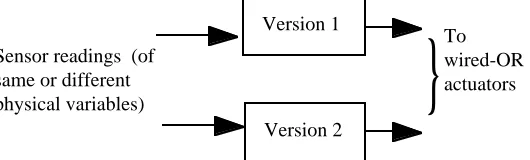
Diversity for achieving reliable systems is a very general approach with many possible variations. In particular, various architectures are possible for software-based systems that use diverse redundancy (see e.g. [Avizienis 1985, Strigini & Avizienis 1985, Strigini 1990, Lyu 1995]). The DISPO project has been mainly concerned with architectures that we may call "diverse-modular redundant" (Fig. 1.1), in which two or more diverse channels perform essentially the same function, seen at some level of abstraction. For instance, duplication with "conventional" "design diversity" implies two software programs that compute the same mathematical function (mapping from input values received to output values). Initially, the specified scope of the DISPO project was limited to simple design diversity in duplicated, diverse-modular redundant systems: two software versions perform the same plant protection function; the two versions are fed the same inputs and required to produce a command to shut down the plant under identical circumstances. "Parallel" actuation is assumed, guaranteeing that if either of the two versions correctly issues a shut-down order, the plant will be shut down. This is thus a 1-out-of-2 system, from the viewpoint of reliability of the shut-down function. The only aspect of interest was the reliability of the shut-down function, measured by the probability of failure per demand of the two-version system.
During the project, this scope was extended somewhat, to answer requests from the sponsors or to take advantage of possibilities opened by the research under way. So, some attention was also paid to how to extend the models for demand-oriented systems to continuous-control systems, and from "design diversity" to "functional diversity": two (hardware plus software) subsystems that perform the same system-level function, like sensing subsets of the state variables of a plant and ordering a safe shut-down when required, although using different subsets of state variables and different principles of operation. The limitation to "1-out-of-2" configurations was retained, given the central interest for the shut-down initiation function of protection systems.
Version 1
To wired-OR actuators
Version 2
}
[image:10.595.152.417.451.531.2]Sensor readings (of same or different physical variables)
Fig. 1.1. Diverse-modular redundancy: example of 1-out-of-2 configuration (design diversity or functional diversity).
Diverse-modular redundant systems exist in many other forms apart from the 1-out-of-2, parallel actuation protection system. The main conceptual difference is in "adjudication", the process that determines the output of the diverse-redundant system on the basis of the outputs of all the versions. 1-out-of-N architectures are possible for protection systems, if either:
• the system has Boolean outputs and is built with wired-OR, parallel actuation, or
output as the system's output. How to pursue this goal is the topic of this study. We do not study the adjudication function, which is also important in determining system reliability. Adjudication is reasonably well understood, and for applications like nuclear protection is very simple. For a given set of versions and a given chosen objective function (e.g., the probability of a correct system output), there will be a specific design of adjudication that (if implemented correctly) maximises that objective function (see [Di Giandomenico & Strigini 1990] for a survey of adjudication and a specification of optimal adjudication). Different forms of adjudication practically imply different redundant configurations. Most of the considerations that we make in this report apply to the whole spectrum of these configurations. 1
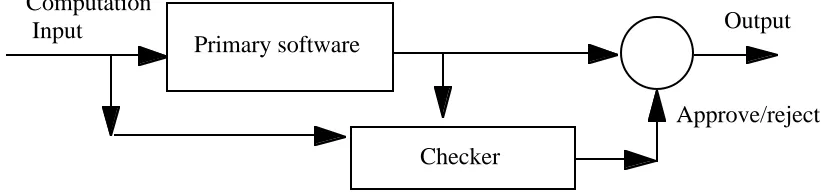
There is another class of diverse configurations, "primary-checker" architectures (Fig. 1.2), in which the modules added for redundancy do not emulate the functions of the other modules, but have the purpose of detecting or containing their failures. These architectures include programs with run-time checks inserted in their code, combinations of modules which implement the intended function of the system with others that run reasonableness or safety checks on their outputs, auditing of a program's data structures (and possibly repair of damaged data structures using built-in redundancy), and so on.
Primary software
Output Computation
Input
Checker
[image:11.595.87.500.293.391.2]Approve/reject
Fig. 1.2. Primary-checker architecture - basic concept
With these methods, it is still important to minimise the likelihood of common failure between the "checked" and the "checker" parts, but some of the considerations about achieving failure diversity that apply to diverse-modular redundant architectures may not apply to them. Diverse-modular redundant architectures are symmetrical, primary-checker architectures are not. One difference is that the "diversity" on which a designer depends is usually implicit in the application requirements; for instance, if the "checked" component computes a function that is easy to invert, a correctness check is readily available; if not, the designer may have to make do with less complete "reasonableness" checks. The checker and checked modules perform (often radically) different functions, which makes it appear easier to avoid mistakes leading to joint failures. Last, the designer may have more direct control on the failure probabilities of the checker: the probability of a checker failing to detect an error depends on its specification (how stringent a check is chosen), not only on the correctness of its implementation. For instance, in a primary-checker architecture the designer may choose to build an over-stringent checker, which reduces the risk of undetected failure at the cost of more spurious alarms, or an over-lenient one, with opposite results; he may trade off the effectiveness of a checker against its development or run-time cost. This degree of freedom about the stringency of checks for detecting errors in responding to demands is somewhat similar to that available, in designing channels of a protection systems, in choosing checks for detecting the demands themselves.
Many other architectural decisions differentiate architectures using diversity. Some of them may constrain the diversity achievable. For instance, a requirement for frequent cross-checking of intermediate results computed by two versions may impose a common structure to the algorithms they implement. However, these architectural issues and constraints do not affect the central questions about the efficacy of the various possible ways of pursuing diversity.
1 The adjudication function itself has to be protected via redundancy and possibly diversity, of course. This
1.2 Ways of pursuing diversity and how they relate to failure diversity
Software diversity, as initially proposed by Avizienis [Chen & Avizienis 1977], involves the development of functionally equivalent but independently developed versions of a software system. The term "independently developed" here meant that the versions are developed by individuals or teams that did not interact during the development process. It is hoped that, as a result, the versions (and in particular their faults) will be sufficiently different that, if they fail in operation, they will rarely do so simultaneously, and so an adjudicator, such as a voter, will be able to provide a correct output even in the presence of individual version failure(s).
The important question is how best to achieve effective diversity, i.e., a low probability that the versions will fail together. A project manager can indirectly control this by various decisions. The teams developing the versions are typically not allowed to exchange information about the development. Considering that people engaged in similar activities often make similar mistakes, they may also be given explicit directives for diversifying the internal structures of their products (e.g., using different algorithms). However, how do we know that these decisions will actually improve the delivered multi-version product?
The existing literature contain lists of such decisions that a design manager can apply to pursue diversity, which can be seen as "common-sense" advice (e.g., [Saglietti 1991, Lyu & He 1993] give developer-oriented advice; standards and guidelines, like [MoD 1996, MoD 1997] give customer-oriented requirements). For brevity, we shall call them "diversity-seeking decisions", or "DSDs". Quite often, in informal discussions of design diversity, the distinction is lost between "diversity-seeking decisions", i.e., what project managers can control, and the actual diversity achieved among the produced program versions and their failure behaviours, which we can measure a posteriori.
A complete list of plausible DSDs would span the whole development process, from team selection, to using different development environments, different tools and languages at every level of specification, design and coding, implementing each function with different algorithms, applying different V&V methods, etc. Some DSDs concern imposing differences between development processes, which can be specified regardless of the product to be developed. Others (like imposing the use of different algorithms) can only be specified with reference to an individual product.
However, the arguments in support of these various DSDs are mostly described at an intuitive level, and it is difficult both to trust them and to compare the relative merits of various DSDs. Most DSDs have a cost: duplication of activities, added co-ordination effort, need for staff with specific skills. The question becomes: how many DSDs are enough for us to achieve the desired level of assurance against design faults, or what is a cost-effective set of DSDs? There is currently no scientific answer to these questions, in the sense of either strong empirical evidence or a clear, predictive model of how DSDs produce their supposed benefits. A project manager or system-level designer will tend to rely on intuition, guided by personal experience. Experience is a poor guide for drawing general laws on how to avoid problems that are very rare in the first place. Intuition has been shown repeatedly to fail on these matters: the issues with diversity are subtle, and difficult even to define properly. For instance, some developers maintained that design-diverse channels would obviously fail independently, until this was proven wrong by theory and experiments alike. This report attempts to improve on unaided intuition by exploring in more detail the supposed mechanisms of action of DSDs in light of evidence from either general software practice or specific research on diversity.
forcing the use of inferior techniques (or techniques less familiar to developers), chosen for the sake of diversity.
1.3 The various aspects of diversity and of "independence"
The only diversity that matters in practice is the diversity between the failure behaviour of the different versions. Informally, we want the failures (if any) of the different versions to occur in different circumstances.
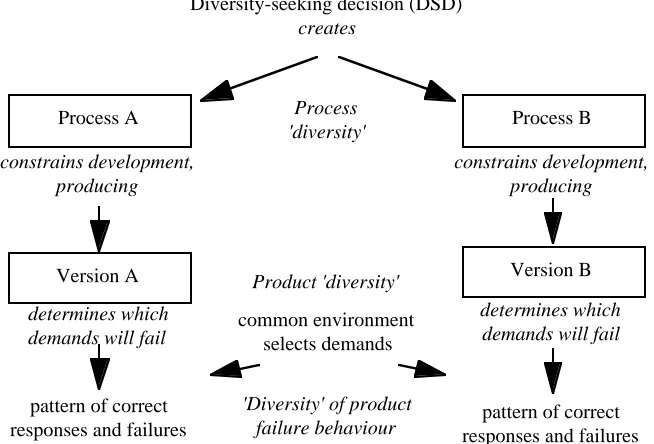
Most discussions about diversity use the terms "diversity" and "independence" in a rather informal way. We need to clarify their meaning, if we wish to learn more about them by scientific methods. First of all, the term "diversity" may designate several concepts (Fig. 1). DSDs produce "process diversity". They presumably cause the versions to be visibly different in their structure and internal operation ("product diversity"). They also cause -one hopes- the versions to be less likely to contain identical defects than if the DSD were not employed in the first place ("fault diversity"). And finally, if successful, they reduce the probability that the versions will fail in the same way on the same demands ("failure diversity"). Failure diversity is the actual goal of DSDs. All the rest are means to this end, and without more analysis we cannot even be sure that they are necessary means.
Process 'diversity'
Product 'diversity'
'Diversity' of product failure behaviour
Diversity-seeking decision (DSD)
creates
Process B Process A
Version B Version A
constrains development, producing
common environment selects demands
pattern of correct responses and failures
determines which demands will fail constrains development,
producing
determines which demands will fail
[image:13.595.134.461.310.532.2]pattern of correct responses and failures
Fig. 1.3. The causal links from diversity-seeking decisions to failure diversity
The terminology used in describing such scenarios is affected by many ambiguities which cause confusion in analyses. A completely unambiguous terminology is unattainable and would be cumbersome to use, but it is important to point out the possible sources of confusion where they arise. Here, for instance:
• we say that DSDs cause "process" diversity. One may argue that many DSDs are really about product diversity, e.g. a DSD specifying two different algorithms for two versions, or mandating that two application versions shall run on different platforms. These are legitimate points; the important distinction to make is simply between diversity-related decisions (i.e., inputs to the development processes), which affect the way developers work (possibly by mandating aspects of the product they must develop) and the results of these decision in terms of actual differences between the delivered products or development, or between their failure behaviours;
systems is to make sure that the versions are developed as "independently" as possible. This seems to call simply for the strictest separation between version developments, to protect them from any common influence (apart from the high-level requirements that they need to share). Actually, supporters of "independent" development of versions often support "forced diversity" - DSDs. Mathematical models [Littlewood & Miller 1989, Littlewood et al. 2001] confirm that "forced diversity" is better (in a specific, precise sense) than simple separation. Even with fully (statistically) independent developments, we should expect positive correlation between version failures. But "forced diversity" is, mathematically speaking, a way of introducing a certain form of negative correlation, i.e. of avoiding independence, between development, in order to pursue low correlation (independence or better - negative correlation) between failures. So, the phrase "independent development" often leads to confusion in these arguments and should be used with care.
1.4 Conceptual models of diversity
We briefly recall here the basic models that inform the discussion in this paper. An extensive explanation is in [Littlewood et al. 2001].
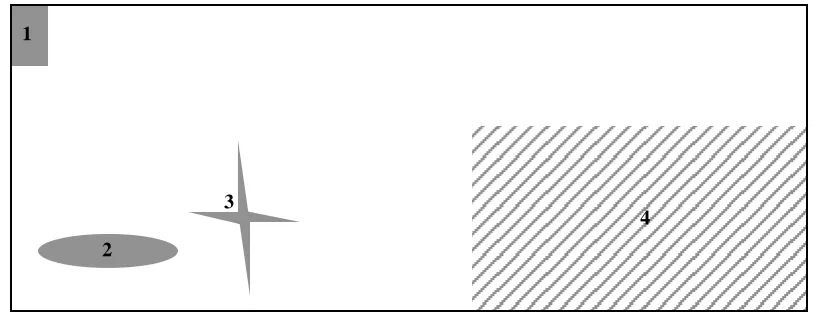
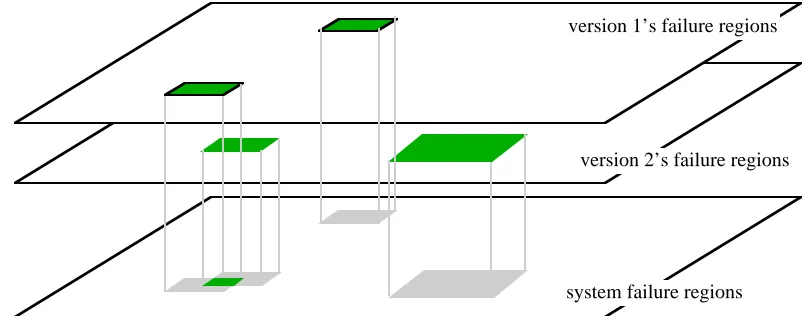
A common concept is that of possible demands forming a demand space. Each point (demand) in this many-dimensional space can be thought of as completely characterising a particular physical demand. For instance, for a reactor protection system a demand would be a vector of temperatures, pressures, flow rates, etc., sampled at regular intervals by sensor scans (the period of time required to define a 'demand' will influence the dimension of the vector). In this space, for a given program version containing a specific set of faults, some points are failure points: they are those on which the version will fail. We may group these points into failure regions, e.g. identifying a certain failure region as the set of all failure points that would be eliminated by fixing a specific defect in the code. The set of all the failure points (union of all failure regions) form the failure set of the given version. In a 1-out-of-2 system, the failure set of the system is the intersection of the failure sets of the two versions (Fig. 1.5).
1
2
[image:14.595.94.503.435.593.2]4 3
version 1’s failure regions
version 2’s failure regions
[image:15.595.94.497.76.234.2]system failure regions
Fig. 1.5. In a 2-version, 1-out-of-2 system, the demand spaces for both versions and for the whole system are identical (and represented here by the three horizontal planes), but the failure set of the system is the intersection of those of the versions, as visualised here by projection: only the dark-grey intersections -on the bottom plane - are system failure regions.
The first conceptual model of software diversity was proposed by Eckhardt and Lee (EL) [Eckhardt & Lee 1985]. The key idea in the EL model is the notion of variation of "difficulty" over the space of possible demands. Consider, for simplicity, the case of a 1-out-of-2 system, involving two diverse versions. If an input is selected, and version A fails to execute the input correctly, what is the chance that version B fails, i.e. that the system will fail? The important point is that this conditional probability of B failing is then greater than the marginal probability of B failing, which would be the case under a naive assumption of failure independence. The reasoning is that the failure of A suggests that the input was probably a "difficult" one, and thus the chance of B failing is greater than it otherwise would be. The underlying informal idea is that designing software involves producing solutions to different problems, represented by different sets of inputs, and that some of the problems represent greater intellectual challenges (and thus scope for human error) than others. Consider, as an example, the case of a fly-by-wire aircraft: the inputs being received during a landing in severe wind-shear would be intrinsically harder to respond to correctly (i.e. would be intrinsically harder for designers of the various versions to program correct responses to) than those coming from straight and level flight in perfect conditions.
Littlewood and Miller (LM) [Littlewood & Miller 1989] generalised the EL model to represent the situation where diversity of design is forced upon the different versions, e.g. by stipulating that the different development teams use different algorithms, different programming languages, different testing methods, etc. - i.e., by applying DSDs. The useful effect of such forced diversity is that the "difficulty" of each demand will usually be different for the two developments, and vary differently among demands. If the variation is such that - informally speaking - the demands with higher "difficulty" values for one development tend to have lower values for the other, the expected reliability of a 1-out-of-2 system will be greater -everything else being equal- than if these variations are similar in the two developments. DSDs have the purpose of making this favourable situation more likely.
Clearly, some discretion needs to be exercised in practice over the extent to which diversity and thus particular design solutions are imposed on the developers. E.g., by mandating specific algorithms the specifications are enriched with more details than strictly necessary, thus extending the possibility of common influences of the (single) top-level specification activity over the development teams. These common influences may favour similar modes of thought which are prone to similar mistakes. Intuitively, the idea is to try to force sufficient "deliberate" diversity to decrease the tendency for coincident failures, without introducing novel opportunities for failure similarity via extra commonality in the high-level design.
2. General analysis: how project decisions affect failure diversity
We begin by examining in general how diversity-seeking methods may actually achieve failure diversity. We will thus be able to discuss the individual DSDs in the list that will follow as special cases of general categories. This is important both to simplify the task of discussing them all, especially since the list is really open-ended, and to make it easier to compare the plausible effects of different DSDs, in the absence of empirical measurements.
Uses of diversity as protection against common mode faults in modular-redundant systems can be classified into three categories: data diversity, design diversity and functional diversity.
2.1 Data diversity and its mechanisms of action
Data diversity differs from the other two in that it does not require the channels of a redundant system to be themselves diverse. It is true that identical redundant channels would all fail when presented with an input sequence that caused one of them to fail. With data diversity, the designer attempts to present them with different sequences, with differences between them small enough not to prevent any of the channels from performing its intended function, nor their outputs from being in agreement (within some tolerance specified by the designer).
Data diversity may be achieved, e.g.:
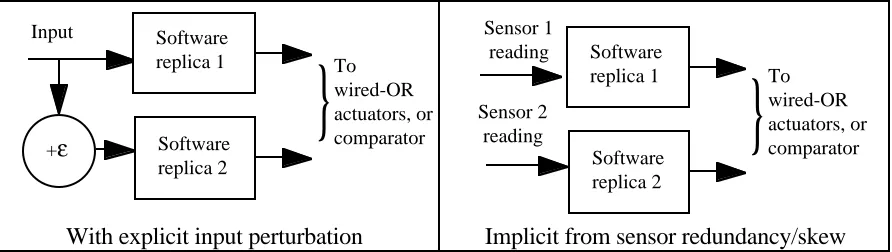
• implicitly, via loosely coupled execution of the software copies and sampling of their sensor inputs (from different sensors or at slightly different times, relying on natural random differences between readings), or
• explicitly, by seeding small (possibly random) differences between the inputs to the components.
Input
+ε
Software
replica 1 To
wired-OR actuators, or comparator Software
replica 2
}
Sensor 1
reading Software
replica 1 To wired-OR actuators, or comparator Software
replica 2
}
Sensor 2 reading
[image:17.595.74.520.383.509.2]With explicit input perturbation Implicit from sensor redundancy/skew Fig. 2.1. Data diversity in duplex configurations
If the design faults are such that, of two similar input sequences, one will cause failure and the other will not, this can be exploited in fault-tolerant architectures:
• with two replicas of the software, comparison of their outputs allows detection of failures, and two such replicas constitute a self-checking pair
• with three or more replicas, it may even be possible to mask failures by voting, provided the failure regions are small compared to the distance between the diverse input sequences fed to the identical replicas of the software, because this would make it unlikely for more than one software copy to receive a demand that is in a failure region.
using design or functional diversity will also be affected by "unintentional" data diversity: for instance, if two diverse redundant channels produce an intermediate result through a numerical computation, even though code parts that nominally implement the same algorithm, they will often produce different results through the effects of numerical approximation. These differences will effectively appear as data diversity to the functions that consume these intermediate results: even if the implementations of these latter functions in the two channels suffered from the same conceptual mistakes, this "data diversity" would reduce the risk of common failure. The risk of spurious disagreements of course remains. This is a risk which the designers of diverse systems must consider in any case, though - it is useful to recall - it is less of a problem for a basic protection system (1-out-of-2 system with a single Boolean output per channel) than for continuous-control, majority-voted system.
2.2 Mechanisms of action of design or functional diversity
To examine how failure diversity may be achieved or enhanced, let us consider the steps from a development error to a common failure in a 2-version system in detail.
• developers (designers, inspectors, testers, ..) of a channel (version) in the diverse system make some mistake[s] so that a fault is left in the program. After the fact, we could describe the fault by asking the developers how the program created differs from the one that should have been created;
• on specific demands (the "error region" corresponding to that fault), the fault is triggered, i.e., the program behaves differently from what the developers would consider correct. The program reaches an erroneous state, in which some of its internal variables (including the program counter or other registers) has a different value from what was intended;
• either the error is masked (e.g., erroneous variables are overwritten before being used, the program terminates before they are used, they are used in an operation such that the erroneous value does not affect its result ....) or it propagates (i.e., causes further errors);
• if it propagates, it may eventually cause a failure of the channel, i.e., an erroneous output from the channel;
• if a similar chain of events in the second channel, possibly involving completely different mistakes, error regions and details of propagation, leads to the second channel failing concurrently with the first, the two-channel system may fail (or will fail, in the case of failure on demand in a protection system with pure wired-OR actuation).
Channel A Channel B Perfect adjudication
System output
System failure
Failure of channel A
Failure of channel B
Human errors in building
Human errors of omission in
V&V Faults (code
defects)
A fault is triggered: the current demand is within some fault’s error region Run-time
error Error
propagates to output from
[image:19.595.61.539.75.351.2]channel
...
...
System structure Fault tree for the event "common failure on a specific demand" Fig. 2.2. Mechanisms of system failure in a 1-out-of-2, diverse system. (For systems where coincident failures of the two channels can be detected and tolerated, discussed in Section 2.3, a complete fault tree would be more complex)
If redundancy is applied by deploying identical copies of a program, all the steps in the list above will be identical between the two channels, except that data diversity might cause a difference starting from the fault triggering step. If instead we have process diversity, and thus some degree of product diversity between versions, differences may start at any stage of the causal chain:
1. mistakes may be different and cause code defects that are different; we could use the terms human failure diversity2 and fault diversity; the two are distinct phenomena, and we would
recognise them by subjective judgement, by examining the program versions and their development documentation;
2. we can hope that fault diversity will cause error regions in diverse versions that have limited or no overlap. This effect, however, may also happen without diversity of human failures or (probably) of faults either. For instance, two teams may both misinterpret a termination condition for a loop, but one of them may also use an extra condition that is sufficient to cause correct termination on most inputs. Conversely, even clearly diverse human failures may produce coincident error regions to exist for the diverse versions. Last, as discussed in the previous section, "internal data diversity" may occur: even if some parts of the code are so designed that they would err on identical data, the diversity between the parts that compute those data means that, for the same demand on the system, these code sections receive different data and the probability of their failing together is reduced;
3. error diversity causes failure diversity: two versions can fail together only if both have entered erroneous states. However, we may have failure diversity even if a certain demand triggers errors in two versions: these may propagate differently (including the possibility that one propagates while the other does not) because the two versions have different internal structures. Imagine, for instance, an overflow in writing to a data structure happens
2 We are referring to human errors that are not corrected ("tolerated" by redundancy in the process), hence our use
in two versions A and B, causing in both versions the overwriting of other variables. These variables may be ones that are immediately used in version A, but variables that will be overwritten before the next use in version B: when the overflow occurs, A will be likely to fail and B will not. Although the faults produce "error regions" that are the same subset of the demand space for both A and B, for A this is a failure region, for B it is not. It may also happen that both versions fail, but in different ways, e.g. with different results so that the failure can be detected.
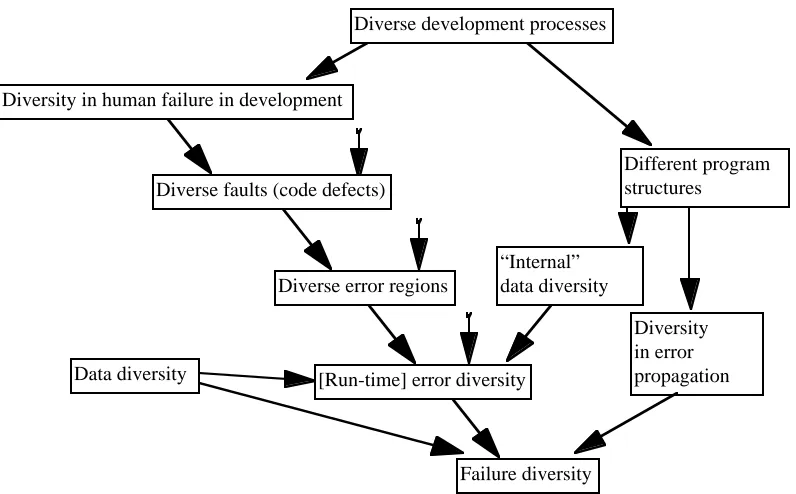
These various forms of differences between events for two versions are summarised in the following figure. The arrows indicate causality. The open-tailed arrows indicate that "downstream" differences may occur even without the corresponding "upstream" difference.
[Run-time] error diversity Diverse faults (code defects)
Diversity in human failure in development
Diverse error regions
Data diversity
“Internal” data diversity
Diversity in error propagation Different program structures
Diverse development processes
[image:20.595.101.499.213.460.2]Failure diversity
Fig. 2.3. A first sketch of the possible causes of failure diversity. Here (as elsewhere in this paper) "Development processes" includes both building and error-removal processes.
Channel A
Subsystem A1
Subsystem A2
[image:21.595.56.541.75.397.2]Subsystem Am
... ...
Channel B
Subsystem B1
Subsystem B2
Subsystem Bn
... Perfect adjudication
System output
System failure
Failure of
channel A Failureof channel B
Subsystem B1 fails
Subsystem Bn fails
... .... Subsystem
A1 fails
Subsystem Am fails
...
...
Human errors in building
Human errors of omission in
V&V Faults (code
defects)
A fault is triggered: the current demand is within some fault’s error region Run-time
error Error propagates to
output from subsystem
... ...
System structure Fault tree for the event "common failure on a specific demand" Fig. 2.4. Mechanisms of system failure in a 1-out-of-2, diverse system: role of series subsystems in each channel
There is yet another way in which diversity may improve system reliability. A subsystem failure may be caused not only by design faults within it, but also by another subsystem failing. For instance, an application program may fail because the operating system on which it relies fails. Diversity between the implementations of a certain function (subsystem) in the two channels may be a protection against this kind of system (channel) failure, due to a fault external to the diversely-implemented subsystems.
For instance, a corrupted input value may cause failure of one version of a program, but not of another version which uses a different algorithm. An operating system (replicated identically in both channels) may erroneously shorten the time frame allotted to an application process for a certain operation, yet one version of the application may perform the operation within this reduced time frame while another does not. For want of a better name, we may call this robustness diversity. Robustness diversity differs from intentionally designed resilience, e.g., the ability of a channel (or a subsystem thereof) to detect pre-specified sets of illegal inputs, so that these may be better tolerated within each channel separately. With respect to intentionally designed resilience, we use diversity as a protection against mistakes in implementing it: so, if a channel fails to tolerate one of these illegal inputs or internal errors, the other channel will. By "robustness diversity" we mean, instead, unintentionally different reactions, in the two channels, to situations that are outside the design envelope (including both correct demands and those incorrect demands that the system is required to detect) for each channel or parts thereof.
[Run-time] error diversity Diverse faults (code defects)
Diversity in human failure in development
Diverse error regions
Data diversity
Diverse reactions to errors from other subsystems “Internal”
data diversity
Diversity in error propagation
Different program structures
[image:22.595.83.525.79.323.2]Failure diversity Diverse development processes
Fig. 2.5. Error propagation through diverse program structure as a cause of failure diversity. Reasoning about diversity usually focuses on the main diagonal sequence shown in the figure: diverse developments cause different mistakes to be most likely for each different development team, and these different mistakes, if they are indeed made, are likely to create disjoint, or at least non-coincident, failure regions. This is the mechanism that is usually implicitly invoked in common-sense arguments in support of DSDs.
2.3 Failure diversity: separate failure points vs diverse failures on the same demand
There are two meanings of "failure diversity" or "diverse failure behaviour":
• diversity in failure occurrence: two versions tend not to fail on the same demands;
• diverse behaviour during failures: although two versions fail together on a certain demand, they do so with different (though both erroneous) behaviours, typically different output values.
The possibility of this second kind of failure diversity clearly adds to the benefit of diverse developments, although it would become irrelevant if the first kind were fully achieved, i.e. the versions had no common failure points. However, this knowledge has little practical use in design-diverse systems.
For a simple protection system having a single Boolean output ("trip" vs "do not trip"), diverse behaviour during failures is impossible and thus brings no advantage. However, even for systems with simple Boolean outputs it is often specified that the versions must produce certain common intermediate results, to be compared so as to improve failure-detection ability (at the possible cost of reduced potential for diversity in their implementations).
So, diverse behaviour during failures may offer an additional safety margin on top of that provided by difference between failure points, as it allows even common failures to be detected. When it occurs it allows, for instance:
• there is no possible gain if the comparison or voting takes as inputs a single Boolean variable from each version;
• the probability of a common failure being detected would seem to increase with increasing numbers of possible output values. In reality, what matters is the probability of erroneous outputs coinciding. In theory, given 10 possible output values, the probability distributions that are possible span the spectrum between these two extremes:
- it may be that the typical faults cause both versions always to fail with the same erroneous value, so that there is no advantage at all over the case of Boolean outputs, or - perhaps typical faults cause errors such that the versions fail choosing each possible
erroneous value with probability 1/9 and independently, so that the probability of undetectable common failure decreases by a factor of 9. This optimistic assumption is actually made at times, but is unjustified. In fact, if we do assume independence among the erroneous values (which seems optimistic), assuming them equiprobable is then again the most optimistic assumption possible.
If we believe that common failures are mostly due to similar mistakes and similar faults, we should believe the first extreme scenario above to be the closer to probable situations: we cannot rely at all on the advantages given by the possibility of diverse behaviour during failures. Sometimes, the fact that the erroneous outputs may take many different values is used to justify a reduction by a certain agreed factor (e.g., 10 times) in the claimed probability of common failure due to physical faults, but we have not found any empirical or theoretical justification for such practices with regard to design faults.
Even when some DSD seems to improve the probability of diverse behaviour during failures, separately from that of diversity in failure occurrence, the former remains a more difficult issue and it seems unavoidable to take the pessimistic stance that one should not depend on this possibility in assessing the resulting reliability.
2.4 Human errors in development: random variation vs cognitive diversity
We have seen that failure diversity may depend heavily on developers of different versions making different mistakes. There are at least two mechanisms that may produce this "human failure diversity", due to the two characteristics of human errors:
• mistakes are a random disturbance in the development activity;
• yet, constraints on the activity affect the likelihoods of the various possible mistakes.
Because errors are unintended and unpredictable, repeating any human task in seemingly identical conditions will produce some differences in the errors committed. Hence the usefulness of "independent" (separate) development of versions. However, some errors are more likely than others: we may well observe that in performing a certain task there is a mistake that most people make. Against this possibility, simple "independence" does not help much: given a mistake (human failure in development) so common that the corresponding fault would affect, say, 90% of the versions developed, reducing this incidence to 81% via two-version programming does not seem very useful. No-one knows whether such high-probability faults characterise many projects. We do know that good projects tend to produce programs without frequent failures, i.e., that if there are such "90% faults" they have low probabilities of manifesting themselves as failures. But if we believed such faults to be common in high-quality developments, we should also expect limited advantages from "independent" developments: we should definitely try to "force" diversity.
mistakes will cause the two-version system to be much better than any one version and likely to have no failure point (with high probability).
Is it true that our diversity-seeking decisions can cause such sharp differences between the faults likely to be present of two processes applied to the same application problem? The answer is not clear. It is obvious that some development processes make some mistakes impossible. For instance, if one of two development teams is instructed never to use pointers, no pointer-related mistakes are possible. On the other hand, not using pointers means using a less powerful programming language, and will make some other aspects of software design more complex and thus error-prone. This looks like a useful form of diversity, but of course it will only be so in practice if the pointer errors likely for one team affect different demands from those affected by the errors caused in the other team by the difficulty of programming without pointers. Two extreme viewpoints are possible:
• with high-quality development processes, all important faults are due to basic difficulties in the application problem. Hence the dominance of requirement specification problems over coding problems, for instance. These difficulties cannot be changed by changes to the development process, which in practice affect the appearance of the problem, not its substance;
• the difficult parts of a complex development task are really the result of the combination of the problem to be solved with the strengths and weaknesses of the development process and team. Hence, changes to the development process, team and constraints really change the relative difficulties of parts of the task.
The truth, for any given project, must lie somewhere in between. The viewpoint that only high-level errors inherent in the application problem really matter is refuted by counter-examples from experience. E.g., the massive AT&T network outage in 1990 was triggered by "a break
clause within an if clause nested within a switch clause" - a violation of a coding style standard.
Its avalanche propagation mode was a system design fault, symptom of a lack of V&V procedures or run-time defences against it, but it would not have happened without the coding fault [Neumann 1995, p. 14]. Likewise, multiple telephone outages in 1991 were due to causes that included "a '6' instead of a 'D'" in the code, hardly a high-level conceptual error [Neumann 1995, p. 16]. Articles like [Lindner 1998] document that even simple procedures for code verification against such errors are not yet common practice. And the argument that high-quality processes eliminate those errors for which forcing diversity is possible is irrelevant for those projects for which such high-quality development processes are not practically available (due to the available staff qualifications, budgets, etc.), or for which "high quality" is not well understood.3
The viewpoint that the application difficulties can be changed greatly by altering the development process is supported by several pieces of evidence:
• psychological research has shown that even substantially identical tasks present greatly varying levels of difficulty, and hence different probabilities of errors, according to the way
3 We should be aware that there are two meanings of "high-level" that are relevant here, and there may be
the tasks are described. Apart from laboratory examples4, we are all familiar with the hopes
raised by new programming languages that radically simplified development for some class of application - LISP, PROLOG, "4-th generation" languages, automatic control-oriented languages - by providing a way of programming that matched the way [some] developers instinctively "saw" the application problem. Notice that the simplifying effect of these languages is often culture-specific: the language may be natural for mathematicians, or for control engineers, but highly unnatural and error-prone for others. Likewise, a mathematically-oriented programmer may, for instance, feel at ease with both LISP or BASIC, and -all things considered - prefer LISP for a given task in view of its allowing a more concise, readable and verifiable representation; for another, LISP will still bring conciseness but at the cost of obscurity and thus be - on balance - more error-prone;
• at least for the more complex systems, only a minority of the developers actually face the application problem in its entirety. The task given to most developers is to create software modules according to some specification handed down by system-level designers, to test specific features, etc. For people developing utility procedures, for instance, the difficulty of their task is not related to which demands will cause the procedures to be invoked, but to how the various functions required in the system have been allocated to the procedures, affecting their individual complexity, numbers of arguments and so on.
If representation affects task difficulty, it will have the usual two effects: on the reliability of individual versions and on their diversity. If representation A makes a task less error-prone than representation B, why not choose A for developing all versions? Choosing A for all is indeed the best option if it makes all types of errors less likely; but software development is a complex activity, and a process characteristic that makes one task (or one aspect of task) easier may well make another one less easy.
When discussing the supposed advantages of diversity-seeking decisions we will thus often mention "cognitive diversity", meaning that a DSD may cause the tasks presented to the developers of the diverse versions to differ enough, either in their essence or in the way they are specified, to cause different error patterns.
There seem to be two important ways of creating "cognitive diversity": one applies within a single development task: e.g., adopting two different procedures for eliciting requirements, or programming a procedure with two vastly different languages, or starting from equivalent but very different representations. The other one is in the definition of the tasks: for instance, in subdividing a system into modules. The structure of a version of a software system generates a series of mappings from the demand space for the system to those of the version's subsystems. For the developers of each subsystem, the likelihoods of the various faults are determined by the specifications of the subsystem (and the tools and skills available). So, different subdivisions of the two versions into subsystems create the possibility of useful diversity in the mistakes made and the faults created. Likewise, the task of deriving the subsystems' specifications from the system specifications and the initial subdivision of the system into subsystems is a possible source of errors, and different structures for two versions give the possibility of useful diversity in these mistakes and the faults they could introduce.
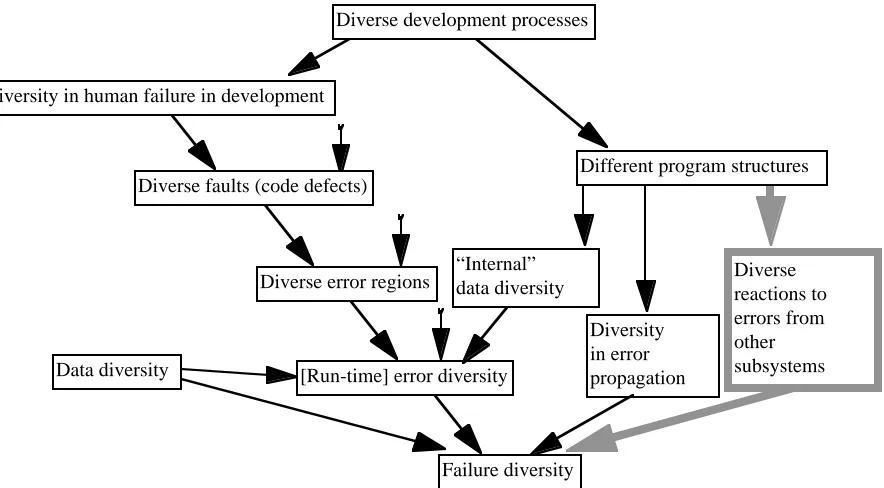
This possible contribution to useful diversity is shown by the added arrow in the figure below.
4 A famous laboratory example showed that playing the "tower of Hanoi" game became much easier if the
[Run-time] error diversity
Failure diversity Diverse faults (code defects)
Diversity in human failure in development
Diverse error regions
Data diversity
Diverse reactions to errors from other subsystems “Internal”
data diversity
Diversity in error propagation
[image:26.595.81.523.79.322.2]Different program structures Diverse development processes
Fig. 2.6. Causes of failure diversity, including effect of program structure on human error
2.5 Difficulties in relating diversity-seeking decisions to failure diversity
This section delves into the causes of confusion that affect most discussions of forced diversity in the literature. We think this discussion useful as a defence against the common fallacies in technical discussions about diversity. In terms of practical advice for practitioners, this section can be summarised as saying that common-sense, intuitive judgement about forcing diversity should be taken with a large dose of scepticism: the suggested DSDs are usually likely to do no harm and possibly some good, but the arguments given about their utility for a specific project usually fail to prove that they actually do good. Readers who are not interested in the discussion of why this is so can safely skip the rest of this section. In the subsequent sections, we summarise useful criteria of judgement in the presence of this uncertainty and confusion.
2.5.1 The "mistake-fault-failure" cause-effect chain