City, University of London Institutional Repository
Citation
:
Bogosian, A., Moss-Morris, R., Yardley, L. and Dennison, L. (2009). Experiences
of partners of people in the early stages of multiple sclerosis. Multiple Sclerosis, 15(7), pp.
876-884. doi: 10.1177/1352458508100048
This is the accepted version of the paper.
This version of the publication may differ from the final published
version.
Permanent repository link:
http://openaccess.city.ac.uk/4979/
Link to published version
:
http://dx.doi.org/10.1177/1352458508100048
Copyright and reuse:
City Research Online aims to make research
outputs of City, University of London available to a wider audience.
Copyright and Moral Rights remain with the author(s) and/or copyright
holders. URLs from City Research Online may be freely distributed and
linked to.
City Research Online:
http://openaccess.city.ac.uk/
[email protected]
Experiences of partners of people in the early stages of
multiple sclerosis
A Bogosian, R Moss-Morris, L Yardley and L Dennison
Background Partners of people with multiple sclerosis are known to experience a heavy physical and psychological burden. However, little research has explored, in detail, the partners’experience in the first years after diagnosis. The aim of this study was to explore and describe the experiences of partners of people who are in the relatively early stages of multiple sclerosis.
Methods Fifteen semi-structured telephone interviews were conducted to assess partners’concerns and difficulties. Data were audio-taped, transcribed, and analysed using an inductive thematic analysis.
Results Key themes were being unsure of what the future might hold and feeling helpless and out of control. Furthermore, partners reported that other people could not understand and support them, which led to a feeling of social isolation.
Conclusion The research illustrates the disruptive impact that MS has on partners’lives and high-lights the need for support to focus on partners’needs even in early stages of the disease. Multiple Sclerosis2008;00:1–9.http://msj.sagepub.com
Key words:adjustment; coping; experiences; family; multiple sclerosis; partners
The severity of multiple sclerosis (MS), the unpre-dictability of its course, and the modest effective-ness of medical treatment make it a particularly dif-ficult disease to adjust not only for the patient but also for family members [1]. The time taken from the first awareness of symptoms to diagnosis can be long, frustrating, and confusing. The waiting and wondering can lead to feelings of powerlessness and loss of a sense of control for people with MS and their spouses [2].
The majority of studies to date have focused on the psychological impact on partners who have become carers.
Q1 Results suggest that providing care for a person with MS can have a detrimental effect on the psychological well-being of the caregivers [3–11].
Depressed mood is present in 19% of caregivers and significant others of people with MS and this is twice as high as in healthy controls [12].
Q2 Further,
MS disease-specific factors have been identified to be related to caregiver’s distress, including the pro-gressive nature of the disease and the resultant uncertainty of the future [8,10]. Care recipient’s memory problems appeared to be an additional
fac-tor in determining the level of strain experienced by the caregivers [5]. All these disease factors may be present even at the early stages of MS, although the impact of these on psychological well-being of their partners has yet to be explored.
The quality of relationships also seems to be affected by having a partner with MS. In particular, relationships within the couple appear to be charac-terised by disagreement and detachment from their partner with MS, and often loyalty turns into a duty [13,14].
Providing care for a person with MS may have a detrimental impact upon the carer’s career pro-spects and employment opportunities. Carers reported turning down job opportunities, changing from full- to part-time employment and having to retire altogether in order to provide care [7]. Q3
Some studies have attempted to identify how carers of people with MS adjust to the overwhelm-ing impact of the illness. O’Brien argues that part-ners tend to use more action-oriented coping beha-viours directed at maintaining or controlling the situation [15]. However, the interaction of coping styles between the caregiver and the care recipient
School of Psychology, University of Southampton, Highfield, Southampton, SO17 1BJ, UK
Correspondence to: Angeliki Bogosian, School of Psychology, University of Southampton, Highfield, Southampton, SO17 1BJ, UK. Email:[email protected]
Received 1 January 2099; accepted 1 January 2099
ARTICLE
Multiple Sclerosis
2008;
00:
1
–
9
may be more important than the coping strategies of either person alone [16]. There are also findings demonstrating the beneficial effect of social support upon carers’health and family life [1,8,9,17]. Part-ners’coping strategies in the early stages of MS has yet to be explored.
Qualitative studies conducted on caregivers of people with other chronic illnesses illustrated simi-lar findings to the work done on MS. The vast majority of these studies used phenomenological approaches to analyse data from interviews. Find-ings from these studies that used phenomenological hermeneutic interpretation showed that close rela-tives living with a person with serious chronic ill-ness felt that their life was shrinking; further, these people felt that they were forced to take responsibilities and struggled to keep going [18,19], disconnected from themselves and others [19] and also felt that the meaning of being a close relative was to follow the ups and downs of the per-son with the illness [20].
Qualitative methods can be roughly divided into two groups. The first group comprises methods tied to a particular theoretical position, such as phe-nomenology. Phenomenological analysis gives the primacy of subjective experience [21], and involves interpreting people’s experiences of reality, usually in depth [22]. Within the second group, the meth-ods used are essentially independent of theory. The-matic analysis is a method for identifying, analys-ing, and reporting themes within data that belong to this atheoretical group of qualitative approaches [23]. Therefore, thematic analysis can be used in a relatively straightforward way to categorise and describe what has been said by interviewees.
The present study used thematic analysis to ana-lyse the accounts of partners of people with MS, who are not in a caregiving role. We used thematic analysis as the main aim of the study was to describe experiences of the partners without trying to fit them into researchers’theoretical ideas. To the best of our knowledge, only two studies have focused on the experiences of partners in the early stages of MS, where disability is more subtle and the need to take on the role of carer is less frequent. Jassens, et al. in a study on couples in the early period after diagnosis (no more than two years) found that about half of the partners had clinically high levels of anxiety and distress. Furthermore, psychological well-being and quality of life were not related to the level of functional limitations of the patient [24]. In a longitudinal quantitative study, patients and their partners continued to have high anxiety and distress levels for 2–3 years after the diagnosis [25]. However, an in-depth qual-itative study is needed to explore the individual’s subjective experience and provide a more detailed picture of issues that partners may face after the
diagnosis and before assuming a caregiver role. Fur-ther, in this under-researched area, the use of open-ended questions may elicit aspects not expected by the researcher. This gives an opportunity not only to build theoretical understanding but also to design interventions.
The aim of the present study was to use a detailed inductive qualitative analysis to explore partners’ experiences of living with someone in the early stages of MS. The purpose of undertaking the analy-sis was to inform an intervention designed for help-ing people with MS and their partners to adjust early in the illness. Taking an early action may enable partners to understand and deal more effectively with many effects of MS and possibly prevent some of the future difficulties from occurring.
Participants and methods
Prior to proceeding with the project, the study was approved by the Thames Valley Ethical Committee Q4
(07/MRE 12/6) and the Ethics Committee at South-ampton University (H/2002/89).
Participants were accessed via their partners with MS who were taking part in a parallel interview study [26] on the experiences of the patients with early stage MS. Patients with MS were recruited via the MS Society website (n= 18) and MS nurses working in Southampton and South London MS
Centres(n= 12). Q5
For the parallel study, we purposively sampled 30 patients out of 64, who showed interest in taking part, for interview. We deliberately chose a sample with a wide range of demographic and illness pro-files in order to ensure a range of accounts of illness experiences. On consenting to take part in the study, the patients were asked if they had a part-ner/spouse who may be interested in being inter-viewed for a corresponding study. Where appro-priate, information sheets and written consent Q6
documents were then posted out to partners. Only 19 patients out of 30 had current partners, three did not wish to pass on the invitation to their partner and one partner refused. One patient said her husband would not want to do anything to do with MS because he was in denial. Another said that her husband would not want to talk because “it’s different for men”. The third partner said that it is
“my problem, nothing to do with him” and the fourth partner refused to participate without giving any reason, so 15/19 took part.
not to participate in the parallel study. Six patients had minimal ambulation difficulties and were able to walk at least 300 m without aid or rest, six patients had significant difficulties with walking and needed to use sticks or crutches and two patients could walk a few steps or less and used wheelchairs.
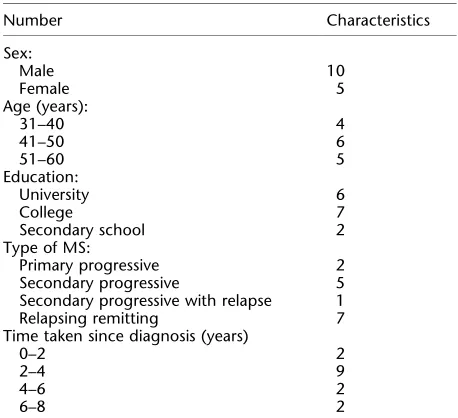
Details of the individuals involved in this study are shown in Table 1. The sample consisted of 5 females and 10 males, all white British, between the ages of 32 and 59. The participants were from various geographical locations around England and varied in occupational status.
Semi-structured in-depth telephone interviews were carried out to elicit accounts of participants’ experiences. Interview questions (Table 2) were broad, open-ended, and guided by issues that the participants felt were important to them. Care was taken to avoid sources of bias resulting from poor quality questioning such as using jargon, leading questions, not asking all the questions, and making evaluative comments [27]. The interviews lasted
between 30 and 70 min. They were transcribed ver-batim and analysed using inductive thematic analysis.
We analysed the data using an inductive the-matic analysis. An inductive approach means the themes identified emerge from the data themselves [28]. Therefore, inductive analysis is a process of coding the data without trying to fit it into a pre-existing coding frame, or the researcher’s analytic preconceptions. This form of thematic analysis is, therefore, data driven [23].
Coding was undertaken by the first author under the supervision of the third author, and with the discussion of emerging themes with the co-authors. Audiotapes of each interview were listened repeatedly and transcripts were read and reread in order to become highly familiarised with the con-tent. Each unit of coding in the first transcript is then given a code name [29], using vocabulary that is as close as possible to that used by the parti-cipants themselves [30]. This procedure was repeated on the second transcript. When the same themes reoccurred they were provided with the same label. The next step was to take these initial codes and apply them to the rest of the data. As data analysis proceeded, codes were redefined and regrouped and then new and alternative themes arose. Earlier transcripts were recoded as codes were developed and refined. This cyclical process continued until all instances of the themes were identified and the themes were coherently orga-nised into a framework. We also examined whether themes differed across sub-groups (e.g. method of recruitment, gender, family, circumstances, etc.). Our understanding of the text and descriptions of the themes were continually checked against the raw data in order to ensure that the themes accu-rately represented the data [27]. In order to docu-ment the analysis process, a detailed paper trail recorded the development of the codes and rela-tionship between the raw data and the refined cate-gories and codes. This paper trail was used by the third author to agree and check the codes and is
[image:4.595.58.287.95.304.2]available on request. Q7
Table 1 Characteristics of the partners (totaln= 15)
Number Characteristics
Sex:
Male 10
Female 5
Age (years):
31–40 4
41–50 6
51–60 5
Education:
University 6
College 7
Secondary school 2
Type of MS:
Primary progressive 2
Secondary progressive 5
Secondary progressive with relapse 1
Relapsing remitting 7
Time taken since diagnosis (years)
0–2 2
2–4 9
4–6 2
6–8 2
Table 2 Interview schedule
Questions Prompts
Can you start by telling me all about what you thought and felt when your partner was first diagnosed with MS?
Main issues, explore concerns, feelings, practical problems, social difficulties; what did he/she do about each problem that was identified? Was there anything helpful/unhelpful?
Can you tell me about what you think and feel about your partner having MS now?
What problems or concerns do you think we need to address in our programme of support?
Experiences of partners of people with multiple sclerosis 3
Results
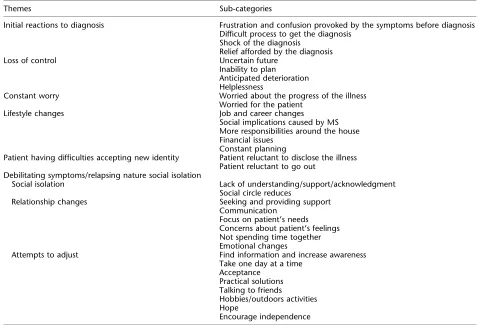
The results are presented by progressing from the first thoughts and feelings when their partner had been diagnosed, to the impact of MS on different aspects of their lives, and to the way they coped with these challenges. Names have been changed. The theme labels and their organisation are shown in Table 3.
Initial reactions to symptoms and diagnosis
Participants discussed how worried and confused they were by the symptoms before the diagnosis.
“Especially before it was diagnosed properly, we went through all sorts of possibilities, was it a brain tumour? Was it some kind of other neurological disease? Because we were sort of only guessing at what was wrong it was very frightening for Mary and very worrying for me too”
(male, 59)
Because the symptoms were not severe initially, the participants did not think of MS as a diagnosis and they tried to cope with the symptoms. Many parti-cipants encountered problems in gaining a diagno-sis, with several describing difficulties in finding appropriate advice or treatments. Most of the men and one woman described how frustrated they were with the health care system. Doctors were typically described as useless or not well trained. The major-ity of the participants felt anger but they could not explain that further. Anger tended to be directed at the health care system, the doctors, and the nurses.
“I was absolutely furious and he (the doctor) wouldn’t listen to me, I was not important, not relevant at all in the slightest. I was just an instrument to corroborate Mary’s story, as he called it.”
(male, 38)
[image:5.595.56.550.395.723.2]“I think that these things are very close to being angry […] and I think the hardest thing is to try and understand why you do feel that and try to channel it into something, because there is nowhere you can really direct it otherwise. You
Table 3 Themes and sub-categories elicited from the data
Themes Sub-categories
Initial reactions to diagnosis Frustration and confusion provoked by the symptoms before diagnosis Difficult process to get the diagnosis
Shock of the diagnosis Relief afforded by the diagnosis
Loss of control Uncertain future
Inability to plan Anticipated deterioration Helplessness
Constant worry Worried about the progress of the illness
Worried for the patient
Lifestyle changes Job and career changes
Social implications caused by MS More responsibilities around the house Financial issues
Constant planning
Patient having difficulties accepting new identity Patient reluctant to disclose the illness Patient reluctant to go out
Debilitating symptoms/relapsing nature social isolation
Social isolation Lack of understanding/support/acknowledgment
Social circle reduces
Relationship changes Seeking and providing support
Communication Focus on patient’s needs Concerns about patient’s feelings Not spending time together Emotional changes
Attempts to adjust Find information and increase awareness
Take one day at a time Acceptance
Practical solutions Talking to friends
Hobbies/outdoors activities Hope
do feel kind of angry at something which is invisible, it’s quite hard.”
(male, 46)
The majority of the participants were shocked when they first heard the diagnosis. One participant rea-lised what MS was about only after the first major symptoms. However, some other participants were also relieved that it was not something more serious diseases such as a brain tumour.
Loss of control
Some participants felt they were losing control over their lives. As shown in Table 3, participants were afraid of the uncertain future, which led to a feeling of inability to make plans.
“it’s almost like you have nothing left, nothing to look forward to. Even, simple things like saying: “yes, let’s all go down to the pub on Friday night”, you can’t actually plan that.”
(female, 50)
Another factor that seemed to contribute to the feeling of losing control was the deteriorating nature of the illness, which made them feel that there was nothing they could do to help their partners.
“As the actual man I am supposed to protect, to lay down my life, and do whatever it takes to protect my partner, my wife. But in that situation there’s nothing you can do. You physically… It’s very difficult to describe, you feel like you’re just powerless to actually do anything, it is like the control has been taken from you, so it’s emasculating really, it’s difficult to describe more than that…”
(male, 55)
Constant worry
Participants were worried about the possible future progression of the illness and the possible impact this deterioration might have on their lives. Another source of worry was the fear that some-thing might happen to their partner when they were not around. Even when they were doing other activities to relax and distract themselves, they were preoccupied by this worry and checked constantly if he/she was alright.
“I think there is always some worry…it’s a bit like the kind of worry you have if you have small children who you know are outside playing and
it’s always a bit of an alert at the back of my mind that something might happen and I just keep an eye out.”
(male, 42)
Life style changes
Participants reported many life style changes as listed in Table 3. Some male participants had to change their work to another more flexible job or reduce their working hours so as to spend time with their partner.
Participants referred to changes in their social activities caused by the MS symptoms, such as fatigue, difficulties walking around or standing for a long period, which constrained their attendance at social occasions. Furthermore, the most cited fact was that patients did not want to go outside and be with other people after the diagnosis. This was either because they were depressed or because they did not want to use a stick or wheelchair, or even because they were afraid of a possible accident, which would reveal their disability.
“So things that we would have done normally, we don’t do, either because he can’t get around and he doesn’t like being in a chair or because he is worried he is going to have an accident”
(female, 50)
The majority of the participants mentioned how the constant planning and the lack of spontaneity were tiring and frustrating and sometimes they gave up activities because of the difficulty of planning everything ahead. Some male participants claimed that they had to take more responsibilities around the house and that this had an impact on their daily routine.
Finally, almost all the male participants and one female mentioned the financial worries they had. Financial worries were caused either because they reduce their working hours or because their partner could no longer work. Furthermore, their expenses were increased because of special equipment or treatment needed.
Social isolation
Both patients’ reluctance to accept and disclose their illness as well as the nature of the illness itself resulted in a feeling of social isolation; other people could not understand and support them. Partners reported that patients tried to hide their illness from friends and family, especially as long as the symptoms were invisible. This caused partners’
Experiences of partners of people with multiple sclerosis 5
problems in terms of socialising and seeking sup-port and understanding from others.
“Him not wanting to see people, to begin with not telling people, refusing for a year to use a stick, so he used me as a stick, when he went out and um…not wanting really to go anywhere, or be with people and he still doesn’t particularly.”
(female, 50)
“I would like to just tell her mother and the rest of her family exactly what the situation is so that they would be ... Perhaps be bit more understanding about Mary’s situation, but I will not do that unless Mary agrees to it.”
(male, 59)
As shown in Table 3, another factor that contrib-uted to partners’social isolation was the nature of the illness itself. Several participants pinpointed the fact that debilitating symptoms, such as fatigue and the relapsing nature of the illness were not fully understood and appreciated by others. They also reported lack of acknowledgment and support. Some participants mentioned that after the diagno-sis they had to either find new friends or reduce their social circle to people who really understood and accepted the new situation.
Relationship changes
All of the partners reported that they tried hard to support and assist their partners as much as possi-ble. Some said that they had joined the MS Society and sought support through that, others tried to help more with the housework, participated in giv-ing injections, or drove or assisted their partner when moving around. In addition, several partici-pants discussed their attempts to make their part-ner’s life more stress free. Many reported that their main concern is the patient’s illness and the way their partner comes to terms with that illness, and how hard it was for them to see their loved ones going through this.
As a result, the partner’s lives became focused on the patient’s needs. They became so preoccupied with their partners’ illness that there was no time left for themselves. Some reported that they had to put their own health secondary.
“I’m always worrying about what Tracy might want, or might need or what the next problem might be or what might come along. And because of that, you are always quietly planning at the back of your mind what you might do and I think I think you know, you don’t really leave
yourself any space so I haven’t left myself any space to think about how I feel about it.”
(male, 42)
Two participants reported that they stopped dis-cussing their own problems or feelings with their partner because they did not want to overwhelm them. The couple seemed to spend less time together and the participants reported that they no longer do the activities they used to do with their partners.
The majority of the participants reported that their feelings for their partner had remained the same. However, a few participants reported that their partners sometimes had become angry and frustrated or depressed, and these emotional changes resulted in changes in their relationship. One mentioned that she prefers to have people around because only then her partner becomes as
he used to be. Q8
“He gets very angry, and quite rightly he takes that out with me, because that’s what you’re there for to some extent, and sometimes it is difficult to remember that he’s not angry with you, he’s angry about being frustrated that he can’t do what he used to be able to do etcetera. And you kind of learn to let that go … but not always [laughs]”
(female, 50)
Attempts to adjust
Table 3 shows the different strategies of the partners who used to come to terms with the illness. Most of the participants reported their attempts to find out information and increase their awareness of the ill-ness and the available therapies. Most of the parti-cipants who searched information on the Internet were aware that this information could be inaccu-rate and were distressed by this.
Some participants found it helpful to deal with new challenges as they come along. They learned to accept the new situation and adjust their lives around MS with time passing.
“So, we’ve got to deal with it as it comes along, we’re finding it easier to deal with because time has helped from the first understanding of the disease and that y’know, the longer you live with it, sort of accept it, you adapt.”
(male, 42)
indepen-dent, or made house modifications. Male partici-pants, in particular, seemed to find it more helpful to deal with practical problems rather than deal with their feelings. Some women reported that talk-ing to friends helped them share their worries and keep their mind off the illness. Some hobbies or outdoors activities helped the partners to distract themselves and relax. Several participants reported that hope helped them to keep going, either hope for a cure or hope for a slow disease progression without severe symptoms. Finally, some partici-pants, mostly women, described their attempts to encourage the patient’s independence.
“we have really got to the stage that I do everything but then maybe I just sometimes think there are little things he could do and it is sometimes too easy for him to go “I can’t do that”. I know his disability and such but sometimes I start to think that… even sort of like, if he goes to the pub it isn’t so far away, it’s so much easier for him to call in at work and for me to walk and pick his car up. I know he does struggle but it’s the thing of ‘using it or losing it’.”
(female, 48)
Discussion
This study aimed to explore the experiences of part-ners of people with MS. The results revealed some useful insights into the impact of MS on partners’ lives and the ways they try to adjust. The first few years were particularly difficult to adjust because participants were shocked by the diagnosis and unaware of what the future might hold, hence they often felt helpless and out of control. Further-more, partners reported that other people could not understand and support them which in turn led to a feeling of social isolation. This suggests future areas for possible psychological support for partners of people with MS.
The research findings support the combined results of a number of different studies suggesting that providing care to a person with MS can have a negative impact upon the social life of caregivers [1,6]. However, unlike most other studies, 14 out of 15 participants were not carrying out the role of carer as the MS was in relatively early stages and levels of disability were mild to moderate.
This study also found that relationships within the couple had changed. This mirrors the results of other studies conducted on carers [13,26]. Eriksson and Svedlund, who showed role changes and rela-tionship changes within the couple, argue that the couples may experience loneliness, in that they may not share feelings about the illness and the
altered circumstances [13]. Nevertheless, in the cur-rent study, the cause of the relationship changes and the partners’ feeling of loneliness seem to be the focus of both partners on the illness. Their lives changed and re-arranged around the illness Q9
and the needs of the patient. This may be rational at this early stage but may have a detrimental effect in the long term if partners’needs and feelings con-tinue to be put aside. Worry expressed by the parti-cipants about the patient and about future disabil-ities mirrors findings in other studies on MS [24].
A number of studies report that the financial sit-uation of caregivers is adversely affected [5,10]. Financial difficulties were a common theme for almost all the partners interviewed, indicating that MS has an adverse effect on the financial situation of partners and patients, even in the early stages of the illness.
As far as their attempts to adjust were concerned, most of the participants tried to find out more information about the illness and possible treat-ments, accepted the new challenges and implemen-ted solutions to their practical problems as they came along. This is consistent to findings showing that spousal carers attempt to overcome the con-stant and daily inconvenience in their lives by strat-egies such as taking each day as it comes, and man-oeuvring around the present challenges [13].
Interestingly, there were no key differences in the findings of this study when compared to the studies conducted on carers of people with MS. The current study also revealed some important issues arise in relation to partners, who are in the early stages of the illness. Patients’ reluctance to accept a new identity had an impact on partners’ social life. Moreover, social isolation is present even in early stages when caregiving burden is unlikely to be an issue. Further research is needed to identify the factors contributing to social isola-tion. Possible factors arising from this study are the lack of understanding from other people, the invisible symptoms of the illness, patients’ reluc-tance to accept a new identity, which incorporates MS, and the inadequate public awareness about the disease. Furthermore, major lifestyle changes were identified even at the initial stages of the illness.
In addition, the findings of the present study were consistent to other qualitative studies con-ducted on family members of people with a chronic disability (e.g. cancer, lung disease, heart failure, neurological, haematological or kidney diseases). Feelings of social isolation, change in life focus, and constant preoccupation with the illness were also found in previous studies on carers [19,20] that used phenomenological approaches to inter-pret their data.
Certain limitations of this study should be noted. The single data-gathering period cannot elucidate
Experiences of partners of people with multiple sclerosis 7
the variable and ever-changing challenges that part-ners may encounter. Partpart-ners may face new chal-lenges as the illness progresses and adjustment may be an active and flexible process, so future assessment needs to be ongoing and across the course of the illness. Carrying out a series of inter-views at different stages of the illness, stages that might be better defined not by the years of diag-nosed but by the caring needs of the patient, could more sensitively track the partners’ experi-ences and beliefs across time and identify factors that influence the adjustment process.
Since the interviewer is the main research“tool” in qualitative interviewing, the interviewer charac-teristics (i.e. young, female, Greek, postgraduate stu-dent) could have affected the experiences and ideas that interviewees voiced. Although, some partici-pants appreciated that they got the opportunity to talk openly to someone, it is not certain that inter-viewees would have shared different stories, had they met another interviewer. However, on the pos-itive side, it appeared that the fact that the inter-viewer was young and less experienced made the situation less formal, framed the participants as experts, and provided a comfortable context in which they could tell their stories.
Furthermore, telephone interviews could be seen as inferior to in-person since it can be harder to establish rapport. However, the length of the inter-views suggests that people did respond well to this approach, and some people may find it easier to talk when not face-to-face. Another limitation is that the sample consisted of volunteers. These people may have come to terms with the illness and accepted and adjusted to the new challenges; there-fore, it might be easier for them to talk about these issues than people who have not come to terms with the illness. This may also have influenced their thoughts and experiences. Alternatively, it is possible that this
Q10 was patients and partners with current difficulties adjusting to MS who may have been most motivated to take part in a study on the impact of MS on their lives. Another source of bias could be the recruitment procedure, that is, partners were not approached directly but through patients who agreed to take part in another interview study. Taking into consideration the reasons given for refusal, it is likely our sample consisted of partners who had fairly good relationships with the patient and were open to talk about MS.
These limitations notwithstanding, this study adds to the existing knowledge about people with a partner with MS. It illustrates that MS has a dis-ruptive impact on multiple areas of the partners’ lives even before adopting a caring role. Future quantitative work would help us understand these issues in a more representative sample. Longitudi-nal studies investigating associations between
envi-ronmental factors (e.g. family cohesion and social support) and illness characteristics (e.g. severity, function, emotional, and cognitive changes) and partners’ adjustment will give us a clearer under-standing of partner’s adjustment over time and fac-tors, which facilitate or impede this. Partners may benefit from psychosocial interventions, not only to be able to provide better support for the patient, but also to address their own needs and difficulties. Early interventions may help partners develop the skills and flexibility to adjust to the constantly changing challenges of MS and minimise distress. Such intervention studies may involve psycho-education and support courses for relatives, on an individual basis or in groups, to assist partners to deal with the specific challenges of MS. The data from this study suggest that interventions should incorporate issues such as coping with emotional responses to diagnosis, dealing with worries about the future, problem solving around lifestyle changes to accommodate the illness, maintaining and build-ing social support networks and relationships with the significant other, and the process of adjustment to new challenges.
Acknowledgement
This study was funded by a grant awarded to Profes-sors Rona Moss-Morris, Lucy Yardley, and Trudie Chalder by the Multiple Sclerosis Society, UK. We would also like to thank the Multiple Sclerosis Soci-ety for assisting with recruitment, as well as Jane Ware, Sheila Chartres, Hazel Daniel, Dr Alan Turner, Dr Ian Galea, and Dr Christopher Half-penny from the MS service at Southampton Hospi-tal and Pauline Shaw, Joan Regan, and Dr Eli Silber from the MS service at King’s College Hospital for their help and support with this study. We would also like to thank Emily Arden-Close for her com-ments on an earlier draft of this article.
References
Q111. DesRosier, MB, Catanzaro, M, Piller, J. Living with chronic illness: social support and the well spouse per-spective.Rehabil Nurs1992;17: 87–91.
2. Courts, FN, Buchanan, EM, Werstlein, PO. Focus groups: the lived experience of participants with multiple sclero-sis.J Neurosci Nurs2004;36: 42–47.
3. Aronson, KL, Cleghorn, G, Goldenberg, E. Assistance arrangements and use of services among persons with multiple sclerosis and caregivers. Disabil Rehabil 1997;
18: 354–361.
4. Aronson, KJ. Quality of life among persons with multiple sclerosis and their caregivers.Neurol1997;48: 74–80. 5. Chipchase, SY, Lincoln, NB. Factors associated with carer
6. Dewis, MME, Niskala, H. Nurturing a valuable resource: family caregivers in multiple sclerosis.Axone 1992;13: 87–94.
7. O’Brien, MT. Multiple sclerosis, the role of social support and disability.Clin Nurs Res1993;2: 67–85.
8. O’Brien, MT, Wineman, NM, Nealon, NR. Correlates of the caregiving process in multiple sclerosis.Sch Inq Nurs Pract1995;9: 323–342.
9. Pakenham, KI. Application of a stress and coping model to caregiving in multiple sclerosis. Psychol Health Med 2001;6: 13–27.
10. Wollin, J, Reiher, C, Spencer, N, Madl, R, Nutter, H. Care-giver burden: meeting the needs of people who support the person with multiple sclerosis.Int J MS Care1999;1: 6–15.
11. Wollin, J, Sato, A. An international comparison of care-giver burden in multiple sclerosis. Australas J Neurosci 2001;14: 21–25.
12. Solari, A, Ferrari, G, Radice, D. A longitudinal survey of self-assessed health trends in a community cohort of people with multiple sclerosis and their significant others.J Neurol Sci2006;243: 13–20.
13. Eriksson, M, Svedlund, M.“The intruder”: spouses’ narra-tives about life with a chronically ill partner.J Clin Nurs 2006;15: 324–333.
14. Boeije, RH, van Doorne-Huiskes, A. Fulfilling a sense of duty: how men and women giving care to spouses with multiple sclerosis interpret this role. Community Work Fam2003;6: 223–244.
15. O’Brien, MT. Multiple sclerosis: stressors and coping strategies in spousal caregivers.J Community Health Nurs 1993;10: 123–135.
16. Pakenham, KI. Couple coping and adjustment to multi-ple sclerosis in care receiver-carer dyads.Fam Relat1998;
47: 269–277.
17. Rivera-Navarro, J, Morales-Gonzalez, MJ, Benito-Leon, J. ; Madrid Demyelinating Diseases Group. Informal caregiv-ing in multiple sclerosis patients: data from the Madrid
demyelinating disease group study.Disabil Rehabil2003;
25: 1057–1064.
18. Ohman, M, Soderberg, S. The experiences of close rela-tives living with a person with serious chronic illness. Qual Health Res2004;14: 396–410.
19. Backstrom, B, Sundin, K. The meaning of being a middle-aged close relative of a person who has suffered a stroke, one month after discharges of a rehabilitation clinic. Nurs Inq2007;14: 243–254.
20. Brannstrom, M, Ekman, I, Boman, K, Standberg, G. Being a close relative of a person with severe, chronic heart fail-ure in palliative advanced home care–a comfort but also a strain.Scand J Caring Sci2007;21: 338–344.
21. Holloway, I, Todres, I. The status of method: flexibility, consistency and coherence.Qual Res2003;3: 345–357. 22. McLeod, J. Qualitative research in counselling and
psy-chotherapy. Sage; 2001.
23. Braun, V, Clarke, V. Using thematic analysis in psychol-ogy.Qual Res Psychol2006;3: 77–101.
24. Janssens, ACJW, van Doom, PA, de Boor, JB,et al. Impact of recently diagnosed multiple sclerosis on quality of life, anxiety, depression and distress of patients and partners. Acta Neurol Scand2003;108: 389–395.
25. Janssens, ACJW, Buljevac, D, van Doom, PA,et al. Predic-tion of anxiety and distress following diagnosis of multi-ple sclerosis: a two-year longitudinal study. Mult Scler 2006;12: 794–801.
26. Devereux, A. Experiences of people in early stages of, MS: an interview study. MSc Dissertation, University of Southampton: School of Psychology; 2007.
27. Patton, MQ. Qualitative evaluation and research meth-ods. 2nd ed. Sage; 1990.
28. Payne, S. Interview in qualitative research. In: Memon, A, Bull, R, (eds), Handbook of psychology of interview-ing. London: Wiley and Sons; 1999. p. 89–102.
29. Glaser, BG. Theoretical sensitivity. Mill Valley; 1978. 30. Glaser, BG, Strauss, SA. Discovery of grounded theory.
Strategies for qualitative research. Aldine; 1967.
Experiences of partners of people with multiple sclerosis 9