City, University of London Institutional Repository
Citation
: Ford, E. and Ayers, S. (2011). Support during birth interacts with prior trauma
and birth intervention to predict postnatal post-traumatic stress symptoms. Psychology & Health, 26(12), pp. 1553-1570. doi: 10.1080/08870446.2010.533770This is the unspecified version of the paper.
This version of the publication may differ from the final published
version.
Permanent repository link:
http://openaccess.city.ac.uk/2080/Link to published version
: http://dx.doi.org/10.1080/08870446.2010.533770
Copyright and reuse:
City Research Online aims to make research
outputs of City, University of London available to a wider audience.
Copyright and Moral Rights remain with the author(s) and/or copyright
holders. URLs from City Research Online may be freely distributed and
linked to.
City Research Online: http://openaccess.city.ac.uk/ [email protected]
Support during birth interacts with prior trauma and birth intervention to predict postnatal post-traumatic stress symptoms
Background: Many women experience childbirth as traumatic and 2% develop
post-traumatic stress disorder (PTSD). This study examined the role of health practitioner
support and personal control during birth as predictors of PTS symptoms, adjusting for
vulnerability factors of prior trauma, depression, control beliefs and birth intervention. It
also investigated interactions between support, prior trauma and birth intervention and
their association with PTS symptoms.
Methods: A prospective longitudinal survey of 138 women recruited from UK NHS
maternity clinics. Measures were taken in pregnancy, three-weeks and three-months after
the birth.
Results: Support and control during birth were not predictive of postnatal PTS
symptoms. However, support was predictive of PTS symptoms in a subset of women
with prior trauma (beta = -.41, R2 = 16%) at both three-weeks and three-months
postpartum. The interaction of birth intervention and support was associated with PTS
symptoms three-months after birth, the relationship between support and PTS symptoms
was stronger in women experiencing more intervention.
Conclusions: Low support from health practitioners is predictive of postnatal PTS
symptoms in women who have a history of trauma. Longer-term effects of low support
on postnatal PTS symptoms are also found in women who had more intervention during
birth.
Following childbirth between 20 and 48% of women rate their experience of birth as
traumatic (Alcorn, O’Donovan, Patrick, Creedy & Devilly, 2010; Ayers, Harris, Sawyer,
Parfitt & Ford, 2009; Creedy, Shochet, & Horsfall, 2000; Soet, Brack, & Dilorio, 2003),
and a similar number display one or more symptoms of post-traumatic stress disorder
(PTSD; Maggioni, Margola, & Filippi, 2006). The full disorder affects between one and
six percent of women in the first year following the birth of their child (Ayers &
Pickering, 2001; Czarnocka & Slade, 2000; Maggioni et al., 2006; Olde, van der Hart,
Kleber, & van Son, 2006; Soderquist, Wijma, & Wijma, 2006; Soet et al., 2003; White,
Matthey, Boyd, & Barnett, 2006; Wijma, Soderquist, & Wijma, 1997). PTSD is
characterised by three classes of symptoms: re-experiencing the event through
flashbacks, nightmares and intrusive thoughts; avoiding reminders of the event; and
hyperarousal e.g. being overly alert, jumpy and irritable (American Psychiatric
Association, 2000). Given the large numbers of women who give birth every year
(600,000 per year in the UK, Richardson & Mmata, 2007) the extent of post-traumatic
stress responses in women following childbirth may be notable.
The fact that childbirth is a common event in society means it is viewed by most
people as “normal”. It therefore may be difficult to understand how it can be classed as a
trauma for some women, and some authors suggest diagnosing PTSD in these women
could risk over-pathologising emotional reactions to a normal event (see, for example,
McNally, 2009). However, a small proportion of pregnancies and births involve events
that most people would agree are potentially traumatic, such as stillbirth, life-threatening
complications such as haemorrhage, or undergoing medical interventions without pain
such believing their baby will die, feeling violated by intimate examinations, or
perceiving hostile or negative attitudes of people around them (Elmir, Schmied, Wilkes,
& Jackson, 2010).
Several studies have attempted to identify aspects of childbirth associated with
post-traumatic stress (PTS) symptoms. Evidence for the effect of birth events on PTS
symptoms is currently inconsistent. In some studies assisted vaginal delivery (forceps)
and emergency caesarean section are related to symptoms of PTS (Creedy et al., 2000;
Maclean, McDermott, & May, 2000; Soderquist, Wijma, & Wijma, 2002). However,
other studies find no relationship between type of delivery and subjective distress (Skari
et al., 2002) or PTS symptoms (Ayers, 1999; Czarnocka & Slade, 2000). Other factors,
such as pain and medical interventions have been associated with appraisal of birth as
traumatic, although not with development of PTS symptoms (Soetet al., 2003).
Evidence for the effect of birth events on PTS symptoms is therefore inconsistent and
there is accumulating evidence that individual perceptions of health events are more
important than objective severity in determining a traumatic response (Tedstone &
Tarrier, 2003).
Charuvastra and Cloitre (2008) have argued that PTSD risk and recovery are
highly dependent on social phenomena. They draw on a variety of evidence, such as that
support can buffer the effect of stress and that interpersonal traumas are associated with
poorer outcomes than non-interpersonal traumas (Kessler, Berglund & Demler et al.,
2005). One meta-analysis of risk factors for PTSD following a range of traumatic events
found that lack of support was the strongest predictor of PTSD symptoms (Brewin,
research on PTSD following childbirth. Several studies have examined women’s
perceptions of care and support during birth and associations have been found between
PTS symptoms and poor interaction with medical personnel (Soetet al., 2003),
inadequate intrapartum care (Creedyet al., 2000), low staff and partner support
(Czarnocka & Slade, 2000), feeling poorly informed and not listened to (Czarnocka &
Slade, 2000), inadequate contact with the staff (Wijmaet al., 1997), and low perceived
and desired support or help (Cigoli, Gilli, & Saita, 2006; Maggioni et al., 2006). There is
also evidence that support during the birth may have a greater effect on women’s
emotional response than the severity of events (Ford & Ayers, 2009). Experimental
studies suggest that providing additional support during birth results in better physical
outcomes for both mother and baby, less pain, higher maternal satisfaction with the birth
experience, and less depression after birth. (Hodnett, Gates, Hofmeyr, & Sakala, 2003;
Sauls, 2002; Scott, Klaus, & Klaus, 1999; Zhang, Bernasko, Leybovich, Fahs, & Hatch,
1996).
Support and control during birth are likely to be highly related (Green & Baston,
2003; Lundgren, 2005; Melender, 2006; Nystedt, Hogberg, & Lundman, 2006). The
often uncontrollable nature of labour and delivery means perceptions of control may be
influenced by caregiver support during labour. Green and Baston (2003) found that
feeling in control during labour was related to interpersonal variables such as receiving
considerate and supportive behavior from staff. Several qualitative studies have also
found that support from health practitioners increases perception of control (Lundgren,
2005; Melender, 2006; Nystedtet al., 2006). In turn, low perceived control has been
1993), postnatal depression (Goodman, Mackay, & Tavakoli, 2004; Green & Baston,
2003; Slade et al., 1993), perceiving the birth as traumatic (Soetet al., 2003) and PTS
symptoms (Czarnocka & Slade, 2000).
Health-practitioner support and perception of control are therefore associated with
PTS symptoms after birth and may be important risk factors for PTSD generally. The
study of childbirth enables unique prospective examination of how support and control
during birth contribute to the development of PTS symptoms whilst controlling for
pre-event factors. However, research into health-practitioner support and perception of
control in birth has been limited to date, examining the variables as single dimensions
(Czarnocka & Slade, 2000; Soet et al., 2003), using scales that have not been validated
(Creedy et al., 2000; Green & Baston, 2003; Slade et al., 1993), and failing to control for
personality confounds such as self-efficacy and locus of control.
Pre-event factors that are likely to influence the relationship between support,
control, and PTS symptoms after birth include a history of trauma (Cohen, Ansara, Schei,
Stuckless, & Stewart, 2004; Kennedy & MacDonald, 2002; Soet et al., 2003), depression
and anxiety (Cigoli et al., 2006; Cohen et al., 2004; Czarnocka & Slade, 2000; Maggioni
et al., 2006; Soderquist et al., 2006; Wijma et al., 1997), low self-efficacy (Soetet al.,
2003) and locus of control (Soetet al., 2003). The association between support and
control during birth and postnatal PTS symptoms after controlling for these factors has
not yet been studied. Furthermore, the relationship between health-practitioner support
during birth and PTS symptoms may be more marked in certain groups of women. For
example, the stress generation hypothesis (Hammen, 1991, 2005) suggests women with
during interpersonal interactions. This may also be the case for a history of trauma, which
may affect perceptions and responses to support (Charuvastra & Cloitre, 2008; Soderquist
et al., 2006). One study found that women with PTS symptoms reported a decrease in
social support in the first year after birth (Soderquist et al., 2006). Longer, more painful
labours or those involving obstetric complications provide different challenges for the
provision of, or need for, health-practitioner support, and the association between support
and psychological outcome may be more prominent during a stressful birth.
This study prospectively examined the relationship between health-practitioner
support and perception of control during birth and PTS symptoms after birth, whilst
controlling for the vulnerabilities of previous trauma, depression during pregnancy,
self-efficacy, external locus of control, and birth interventions. With the exception of birth
interventions, all other vulnerability factors were measured in pregnancy so they would
not be influenced by the experience of birth. It was hypothesized: 1) that support from
health practitioners and perceived control during birth would be negatively associated
with PTS symptoms, after controlling for the other risk factors; 2) that the association
between support and PTS symptoms would vary depending on prior trauma status, where
the association would be greater in women with prior trauma; and 3) that the association
between support and PTS symptoms would vary depending on birth interventions, with
the association greater in women with more intervention. These hypotheses were tested
using data from a longitudinal questionnaire survey of women from the last trimester of
pregnancy to three months after birth, and were analysed using hierarchical linear
Methods
Design
A longitudinal survey with questionnaires completed at three time points: 36 weeks of
pregnancy (mean 36.5 weeks, SD 10 days), three weeks after the birth (mean 20 days; SD
11 days), and three months after the birth (mean 3.4 months; SD 21 days). The following
measures were taken at each time point:
• Pregnancy: demographic information, trauma history, PTS symptoms, depression
symptoms, self-efficacy, locus of control.
• Three weeks after birth: PTS symptoms, birth interventions, support and control
during birth.
• Three months after birth: PTS symptoms.
Sample
Women were recruited from public hospital and community antenatal clinics in
one UK city. Women were eligible if they were between 33 and 37 weeks pregnant.
Women were excluded if they were under 18 years of age, if their level of English was
not sufficient to understand the questionnaires, or if the midwife indicated that it would
not be appropriate to approach them (for example, one woman was not approached
because her baby was going to be put on the child protection register).
A statistical power analysis suggested 109 women were needed to find an
association between support and PTS symptoms of r = 0.3 significant at the 5% level.
Allowing for 40% attrition, 215 women were recruited into the study and 138 (64%)
rates were reasonable and questionnaires were returned by 136 (63.2% of the consented
sample) participants in pregnancy; 125 (58.1%) three weeks postpartum; and 109
(50.6%) three months postpartum. Women who did not complete all questionnaires were
more likely to be single (χ2(1) = 6.48, p< .025) and have more children (χ2 (2) = 6.35, p<
.05) but did not differ on psychological and obstetric measures. For 46 of the 71 women
who did not send back any questionnaires, it was possible to obtain age, parity and mode
of delivery from the hospital register of births. There were no differences between
responders and non-responders in terms of age or caesarean rate, however responders
were likely to have fewer previous children (χ2
(2) = 11.63, p< .01).
Measures
Demographic information
This measure included information on age, marital status, accommodation, ethnic
group, educational attainment, work, and obstetric history.
Prior trauma and PTS symptoms after the birth
Prior trauma and PTS symptoms were measured using the PTSD diagnostic scale
(PDS; Foa, Cashman, Jaycox, & Perry, 1997). Trauma history was measured with a
checklist of 11 traumatic events (e.g. sexual assault, serious accident, natural disaster or
other event). Seventeen PTS symptoms in a typical month following the traumatic event
were measured according to DSM-IV criteria for PTSD, including criterion B
(re-experiencing), C (avoidance), and D (arousal). Symptoms were rated on a four-point
scale of frequency of occurrence. The PDS has internal consistency alphas of .92 for
Sensitivity of the PDS was .89 and specificity .75 with diagnoses obtained from the
standardised diagnostic interview (Foaet al., 1997).
Participants were categorised into two groups according to prior trauma. The
“prior trauma” group endorsed one or more prior traumatic events and indicated they had
experienced one or more symptom as a result. The “no prior trauma” group either had
experienced no prior trauma or had not experienced any symptoms following a trauma.
This broad definition of prior trauma allowed sufficient numbers in each group to retain
statistical power for the analysis.
Postnatal measures were amended so PTS symptoms were measured in relation to
childbirth by moving the trauma history section to the end and instructing participants to
answer the same symptom questions about their experience of birth. Thus symptom
questions were rephrased with “the birth” replacing “the event”.
Depression
Depression was measured using the Edinburgh Postnatal Depression Scale (Cox,
Holden, & Sagovsky, 1987), a 10-item scale where a high score indicates risk for
postnatal or other depression. Items have a four-point response scale from “no never” (0)
to “yes most of the time” (3). A score of >9 indicates possible depression and >13 high
risk. The EPDS has a sensitivity of 86% and a specificity of 78%; split-half reliability is
.88 and the standardised alpha-coefficient is .87 (Cox et al., 1987).
Locus of Control
Locus of control was measured using the Multidimensional Health Locus of
Control scale (Wallston, Wallston, & Devellis, 1978).The 18-item Form A scale includes
chance. These are scored using six point Likert scales. Alpha reliabilities range from .70
to .73, and test-retest reliability ranges from .63 to .75 (Hubley & Wagner, 2004). The
subscales are independent of one another. Only the 6 items of the “powerful others”
dimension were used in this study as the other scales were found to be unrelated to PTS
symptoms.
Self-efficacy
Self-efficacy was measured using part of the Self-efficacy Scale (Sherer, Maddux,
Mercandante et al., 1982). Seventeen items were included from the general self-efficacy
factor of the full scale, using a six point Likert scale (instead of the usual 14-point Likert
scale) for ease of response. This 17-item factor accounted for 26.5% of the variance, and
has a Cronbach's alpha reliability coefficient of .86 (Shereret al., 1982).
Birth intervention
Interventions during birth were measured using the Intrapartum Intervention
Score (Clement, Wilson, & Sikorski, 1999) from self-reported information on
intervention during birth. Scores were calculated for each participant for extent of
intervention in their birth. The weighted sum was taken of the following interventions:
pethidine; epidural; entonox; transcutaneous electrical nerve stimulation (TENS);
oxytocin drip; external heartbeat monitor; internal heartbeat monitor; episiotomy; tearing;
forceps; caesarean. The range of the intervention score in this study was 0-45 (mean
intervention score 17.1, SD 10.49).
Support and Control during Birth
Support and control in birth was measured using a 33-item questionnaire with
2009).The internal control subscale contained 10 items focussing on control of pain,
emotions, behaviour e.g. ‘I was overcome by the pain’, ‘I could control the sounds I was
making’. The external control subscale contained 11 items on control over information,
decisions and procedures e.g. ‘I had control over when procedures happened’, ‘I had
control over the decisions that were made’. The support subscale was formed of 12 items
on attitude, patience, empathy, help with pain and coping e.g. ‘the staff went out of their
way to try to keep me comfortable’, ‘the staff dismissed things I said to them’ (reverse
scored). Items were scored on a 5-point Likert Scale (completely agree – completely
disagree). The three components have high reliability (Cronbach’s alphas of 0.86 to 0.93)
and were inter-correlated between r=.51 and r=.69 (Ford et al., 2009). In this study the
inter-correlations were lower at r=.25 to r=.54.
Procedure
Ethical approval was obtained from the University Research Governance
committee and the NHS Local Research Ethics Committee. Women were approached in
hospital and community antenatal clinics over a 14-week period. If they were willing to
take part in the study, details were explained using an information sheet, informed
consent was obtained, and participants took away the first questionnaire. Birth records at
the hospital were checked for information on delivery dates and postnatal questionnaires
sent out as soon as it was established mother and baby had been discharged home safely,
but not less than one week after the birth. Three months from the date of the baby’s birth,
the third questionnaire was sent. At each time point, if the questionnaire was not returned
Results
Data Screening
Missing data ranged from 0 to 6% of items and subscales. Randomly missing
data were replaced with the individual’s mean for that subscale (Tabachnick & Fidell,
2001). Cases where missing data exceeded 10% of a scale were excluded from the
analysis. A number of variables were skewed so were transformed by logarithm if
positively skewed and by square root of the reverse score if negatively skewed. Analyses
were performed on the raw data and the transformed data. The results (in terms of
significance) were not different, so the analyses with the raw data are presented, as it is
conceptually more meaningful (Tabachnick & Fidell 2001).
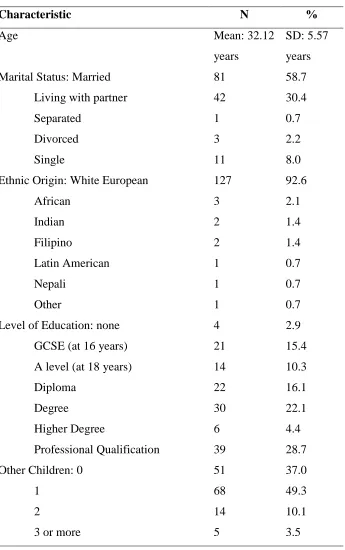
Sample characteristics
Demographic characteristics of participants are shown inTable 1. Participants
were predominantly of White European origin (92.6%), in their 30s and married or
cohabiting with a partner (90.1%). This was also a highly educated sample, with 56%
having continued education after age 18 and 55.2% having a degree or professional
qualification. Sixty-three percent of participants already had one or more children.
- insert Table 1 about here -
Prevalence of PTSD (cases and symptoms)
In pregnancy, 52 women reported previously experiencing symptoms of PTS
following a traumatic event and ten women (7.2% of total sample) fulfilled DSM IV
any prior symptoms formed the “prior trauma” group. Three weeks after birth, one
woman (0.8%) fulfilled DSM IV criteria A to D (traumatic event plus symptoms) for
PTSD related to birth, but at this time-point the duration criterion could not be met. Three
months after birth one woman (0.9%) fulfilled all DSM IV criteria for PTSD related to
birth (including duration, however this was not the same woman as at three weeks after
the birth). The mean PTS symptom score recorded in pregnancy (relating to PTS
symptoms in those who had experienced a trauma, in a typical month following the event,
not to symptoms in pregnancy) was 16.4 (SD 14.1). At three weeks following the birth
the mean symptom score, relating only to the birth, was 4.2 (SD: 6.0), and at three
months following the birth the mean score was 4.2 (SD: 5.6). The mean scores of all
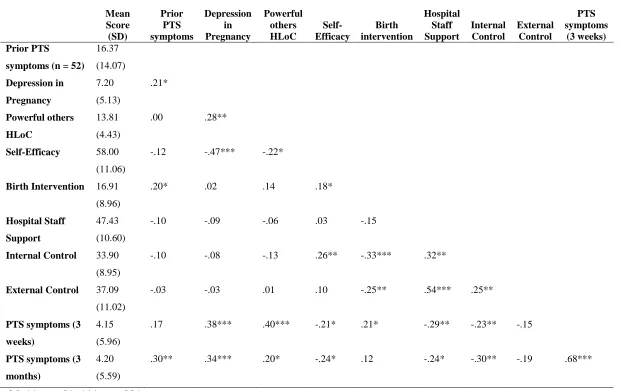
variables are shown in Table 2.
Associations between vulnerability factors and PTSD
Correlations between all the variables are shown in Table 2. Several of the prior
vulnerabilities were related to each other, notably depression in pregnancy, self-efficacy,
and “powerful others” locus of control. For the correlations, prior PTS symptom score
was used to increase power, and was not significantly associated with other
vulnerabilities except weakly with depression in pregnancy. Several of the vulnerability
factors measured in pregnancy were associated with PTS symptoms following the birth
(depression, self-efficacy and “powerful others” locus of control). Prior PTS symptoms
were associated with new PTS symptoms only at three months after the birth. Birth
interventions were weakly associated with early postnatal PTS symptoms and not at all
three months after the birth. Support and internal control were significantly associated
control was not associated with symptoms. Internal control was also associated with birth
interventions and self-efficacy.
- insert Table 2 about here -
Support and control during birth and PTS symptoms
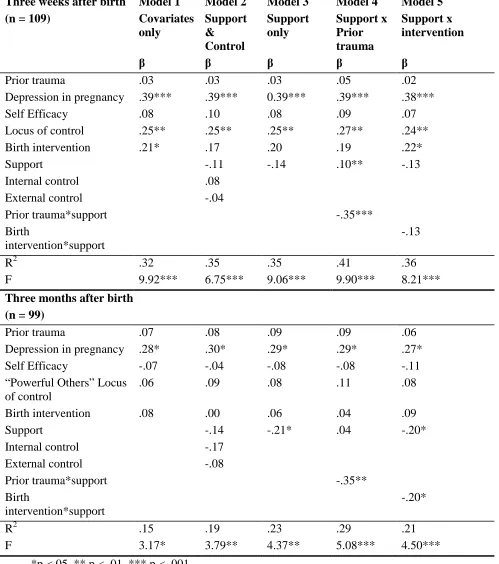
Hierarchical multiple regressions were carried out according to study aims.
Regression model parameters can be seen in Table 3. The vulnerability covariates entered
in the first step (prior trauma, depression in pregnancy, self-efficacy, “powerful others”
locus of control, and birth interventions) predicted 32% of the variance in PTS symptoms
at three weeks but only 15% of the variance at three months. At three weeks following
the birth, depression in pregnancy, “powerful others” locus of control, and birth
interventions were significant individual predictors (betas = .39, .25 and .21 respectively).
At three months post-birth, depression in pregnancy (beta = .28) was the only significant
predictor of PTS symptoms.
- insert Table 3 about here –
Hypothesis 1: Support, Control and PTS symptoms
Support, internal and external control were added to the model in a second step.
None of these three variables were found to be significant predictors of PTS symptoms at
either time point. In a third model, support was added alone without control, as it was
highly correlated with the control variables and therefore there may have been
multi-colinearity between these variables. At three months support was a significant predictor
of PTS symptoms (beta = .21, p <.05), explaining an extra 8% of the variance. It did not
significantly predict PTS symptoms at three weeks post-birth.
The variation of the support – PTS symptom relationship by prior trauma was
explored by adding an interaction term (support*prior trauma) to the model in the third
step. This interaction term was significantly associated with of PTS symptoms at three
weeks following the birth (beta = -.35, p < .001), and at three months following the birth
(beta = -.35, p < .01). This suggests that the effect of low hospital staff support on PTS
symptoms differs in women with different prior trauma status.
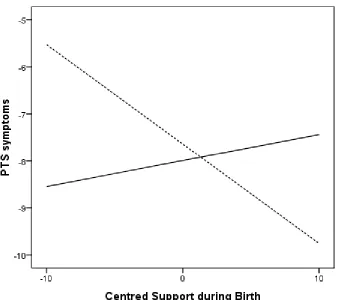
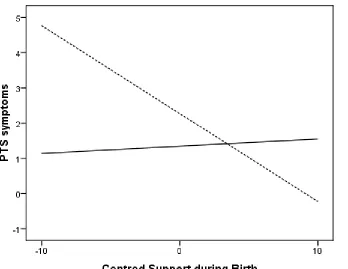
The simple slope of the regression line of support on PTS symptoms was plotted
for the two levels of prior trauma (no prior trauma and prior trauma). These slopes are
depicted in Figures 1 and 2. At three weeks post-birth there was no effect of support on
postnatal PTS symptoms in women with no prior trauma (beta = .10, p > .05, additional
R2 = 1.0%, F change (1,60) = 1.05, p >.05). However there was a strong effect of support
on postnatal PTS symptoms in the prior trauma group (beta = -.39, p = .001, additional R2
= 16.2%, F change (1,37) = 10.35, p < .01).
The same effect was found at three months post-birth with no effect of support on
PTS symptoms in the no prior trauma group (beta = .04, p = >.05, additional R2 = 0.1%,
F change (1,53) = 0.07, p > .05), but there was a strong effect of support on PTS
symptoms in the prior trauma group (beta = -.46, p = .001, additional R2 = 15.6%, F
change (1,30) = 7.13, p = .01).
Hypothesis 3: Association of support with postnatal PTS symptoms by birth intervention
The variation of the support – PTS symptom relationship by birth intervention
was explored by adding an interaction term (support*birth intervention) to the model in a
third step. Three weeks following the birth, the interaction between birth intervention
significant predictor (beta = -.20, p<.05). This suggests that the impact of support during
birth on later PTS symptoms does vary according to the level of intervention during the
birth.
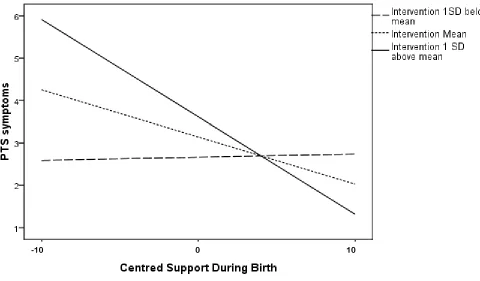
The simple slope of the regression line of support on PTS symptoms three months
post-birth was plotted for the mean intervention score and for values one standard
deviation above and below the mean (see Figure 3). A simple slopes analysis gave betas
of -.01 (p = ns), -.20 (p < .05), and -.42 (p < .01) for low (-1 SD), mean and high (+1 SD)
values of intervention, respectively. This suggests that support becomes more highly
associated with postnatal PTS symptoms three months after the birth, as levels of birth
intervention increase.
Discussion
This study examined women’s perception of health-practitioner support and
personal control during birth, and their effect on the development of postnatal PTS
symptoms after controlling for previous mental health, control beliefs and birth
intervention. The results suggest that control beliefs, level of intervention during birth
and depression in pregnancy are likely to be risk factors for acute PTS symptoms
following childbirth; and that depression in pregnancy and support during birth are risk
factors for more chronic symptoms of PTS. The key finding of this study, however, was
that support during birth is particularly important for women with a history of prior
trauma or who have high levels of intervention during birth. In these women, support
from health-practitioners may protect against the development of PTS symptoms or,
These findings are broadly consistent with previous research on PTSD following
childbirth and other non-obstetric traumas. Childbirth research has demonstrated the
importance of support in both physical and psychological outcomes (Hodnett et al., 2003)
including symptoms of PTS after childbirth (Cigoli et al., 2006; Czarnocka & Slade,
2000; Maggioni et al., 2006). Meta-analyses of trauma in non-obstetric samples find
associations between lack of support and PTSD, as well as smaller effects of prior trauma
and trauma severity or life threat (Brewin et al., 2000; Ozer, Best, Lipsey & Weiss,
2003). Previous studies of variables that moderate these relationships suggest that prior
trauma and severity of the event are more strongly associated with PTSD following
interpersonal traumatic events (Ozer et al., 2003); and that the effect of severity of the
event and support increases over time, which is consistent with results of the current
study.
The interaction found between birth intervention and support is intuitively viable
and consistent with the buffering hypothesis i.e. that support buffers against the negative
effects of stressful events. However, these findings are in contrast with results from a
recent experimental analogue study, which used birth stories to examine the interaction
between stressful interventions or complications in birth and level of support. This study
found no significant interaction between these variables in predicting changes in anxiety
and mood (Ford & Ayers, 2009). This inconsistency is probably due to methodological
differences i.e. the current study was on real birth events as opposed to imagined events,
and measured PTSD symptoms rather than anxiety or mood. The experience of pain and
obstetric intervention is potentially more frightening for women and may therefore result
subsequently symptoms of PTS. Reassurance and explanations from caregivers may
therefore be of greater importance in these situations to ameliorate fear responses.
However, more research is needed to unpick this interaction before firm conclusions can
be drawn.
The interaction between prior trauma and support during birth is consistent with
previous childbirth research. Women with a history of trauma or PTSD have been found
to be at higher risk of PTSD following childbirth (Ayers et al.,2009; Cohen et al., 2004;
Kennedy & MacDonald, 2002; Soet et al., 2003). Childbirth can involve pain, invasion of
bodily integrity (for example pelvic examinations), and feelings of loss of control, so may
remind women of previous traumas, thereby rekindling earlier symptoms (Kennedy &
MacDonald, 2002). Various theories of PTSD suggest cognitive processing immediately
after the event is important in whether symptoms are resolved or develop into PTSD
(Horowitz, 1979; Ehlers & Clark, 2000). Positive social interactions may facilitate this
processing and negative interactions may reinforce maladaptive beliefs or appraisals
(Charuvastra & Cloitre, 2008). During birth, a perception of lack of care or neglect, or
negative or hostile interactions with health-practitioners, may constitute additional
stressors in themselves. Individuals with a history of PTSD may be more likely to react
with greater fear to negative interactions in comparison with those who have no prior
vulnerability (Charuvastra & Cloitre, 2008).
This study therefore confirms and extends previous research by providing
prospective evidence of the importance of support in the development of PTSD after
childbirth; and by showing this relationship is moderated by vulnerability factors of prior
factors for PTS symptoms following childbirth, and extends our understanding of the
relationship between health-practitioner support and postnatal outcomes. Findings
suggest that women with a history of trauma are especially vulnerable to the effects of
poor care during labour and birth. Screening for prior trauma during pregnancy could
identify these women and a care plan could be put in place to ensure they receive the care
they need during birth. This may help to reduce PTS symptoms following birth in this
group of women.
Conclusions from this study are limited by the high rate of attrition and
subsequent sample size, although analysis of non-completers suggests the only
differences between women who completed the study and those who did not were having
more children and not living with a partner. Reasons for attrition may include the length
of the questionnaires, the face-to-face method of recruitment, or participants’ babies
being born before the first questionnaire was completed. Due to the high rate of attrition
this study has limited statistical power and results cannot be generalized. Further studies
should attempt to replicate the relationships between support and PTS symptoms in larger
samples.
Another caveat is that associations found with PTS symptoms may not indicate
the same relationships with cases of PTSD. Furthermore, PTSD diagnostic criteria
(American Psychiatric Association, 2000) require one month duration before a diagnosis
can be made so three weeks after birth only initial or acute stress reactions are being
predicted. This time-point was chosen in order to achieve reports of birth interventions,
support and control as close in time as possible to the event, given the postal survey. In
maintenance (e.g. Ehlers & Clark, 2000). Therefore, despite not being able to learn about
actual cases at two to four weeks post-event, we can gather data about symptom onset.
This problem of the duration criterion for PTSD was partially resolved by including a
three month follow-up. There is evidence that there is still some spontaneous resolution
of PTS symptoms after one month but that cases presenting at three months post-event
will generally be chronic (Koren, Arnon, & Klein, 1999; Rothbaum, Foa, Riggs,
Murdock, & Walsh, 1992). Therefore, the results from the third time point can be
assumed to show risk factors predicting chronic PTS symptoms (but not cases).
A further methodological issue which may be of importance is the significant
correlation between support and external control. It is difficult to know whether the
correlation between external control and support is due to measurement bias or the strong
relationship between these variables under challenging conditions, such as birth. It could
be argued these two constructs will always be overlapping due to the nature of childbirth,
and the fact that the measurement is of health-practitioner support rather than partner or
other support. However, in the development of the measure used for these constructs,
support and external control formed distinct and separate factors (Ford et al., 2009) and
therefore it appears it is worth examining them separately. Two further variables which
were significantly correlated in this study and which may have introduced bias were
depression in pregnancy and recall of number of prior traumas. Depressed participants
may recall more traumatic experiences than non-depressed participants, although
evidence for this is inconsistent (Brewin, Andrews, & Gotlib, 1993; Kuyken & Brewin,
and PTS symptoms following the birth. However, this issue was partly resolved by
adjusting for depression in the regression analysis.
The finding that low support from health-practitioners during birth is predictive of
PTS symptoms in certain groups of women or birth situations has implications for
maternity care in the UK and elsewhere. Results suggest that priority should be given to
the provision of individualised maternity care. To reduce the occurrence of PTS
symptoms, health-practitioners should focus on providing support such as being
empathetic, being woman-centred, listening and responding to women’s communications,
searching for ways to make women comfortable, and suggesting new ways of coping.
Results suggest that supportive behaviour should be prioritised over giving women
control, as control was not associated with PTS symptoms. As suggested, screening of
women with prior trauma may be valuable to make sure women with this vulnerability
are given appropriate levels of support.
In summary, low support during birth from health-practitioners is directly
predictive of symptoms of PTS in women with prior trauma, even after controlling for
previous mental health, control beliefs and birth intervention. At three months
postpartum, the effect of low support on PTS symptoms is also greater in women with
more births intervention. This study supports the notion that one-to-one supportive care
during labour and birth is necessary to maximize positive psychological outcomes for
References
American Psychiatric Association. (2000). Diagnostic and Statistic Manual of Mental Disorders, Fourth Edition, Text Revision (DSM-IV-TR). Washington DC. Alcorn, K. L., O'Donovan, A., Patrick, J. C., Creedy, D., & Devilly, G. J. (2010). A
prospective longitudinal study of the prevalence of post-traumatic stress disorder resulting from childbirth events. Psychological Medicine.
doi:10.1017/S0033291709992224
Ayers, S. (1999). Post-traumatic Stress Disorder Following Childbirth Unpublished Ph.D Thesis, University of London.
Ayers, S., Harris, R., Sawyer, A., Parfitt, Y., & Ford, E. (2009). Posttraumatic stress disorder after childbirth: Analysis of symptom presentation and sampling. Journal of Affective Disorders, 119, 200-204.
Ayers, S., & Pickering, A. (2001). Do Women get posttraumatic stress disorder as a result of childbirth? A Prospective study of incidence. Birth, 2, 111-118.
Brewin, C. R., Andrews, B., & Gotlib, I. H. (1993). Psychopathology and Early Experience: A Reappraisal of Retrospective Reports. Psychological Bulletin, 113(1), 82-98.
Brewin, C. R., Andrews, B., & Valentine, J. D. (2000). Meta-Analysis of Risk Factors for Posttraumatic Stress Disorder in Trauma-Exposed Adults. Journal of Consulting and Clinical Psychology, 68(5), 748-766.
Charuvastra, A., & Cloitre, M. (2008). Social Bonds and Posttraumatic Stress Disorder.
Annual Review of Psychology, 59, 301-328.
Cigoli, V., Gilli, G., & Saita, E. (2006). Relational factors in psychopathological responses to childbirth. Journal of Psychosomatic Obstetrics and Gynecology, 27(2), 91-97.
Clement, S., Wilson, J., & Sikorski, J. (1999). The development of an intrapartum intervention score based on women's experiences. Journal of Reproductive and Infant Psychology, 17(1), 53-62.
Cohen, M., Ansara, D., Schei, B., Stuckless, N., & Stewart, D. (2004). Posttraumatic Stress Disorder after Pregnancy, Labor and Delivery. Journal of Women's Health, 13(3), 315-324.
Cox, J. L., Holden, J. M., & Sagovsky, R. (1987). Detection of Postnatal Depression: Development of the 10-item Edinburgh Postnatal Depression Scale. British Journal of Psychiatry, 150, 782-786.
Creedy, D., Shochet, I., & Horsfall, J. (2000). Childbirth and the Development of Acute Trauma Symptoms. Birth, 27(2), 104-111.
Ehlers, A., & Clark, D. M. (2000). A cognitive model of posttraumatic stress disorder.
Behaviour Research and Therapy, 38(4), 319-345.
Elmir, R., Schmied, V., Wilkes, L., & Jackson, D. (2010). Women's perceptions and experiences of a traumatic birth: A meta-ethnography. Journal of Advanced Nursing, 66(10), 2142-2153.
Foa, E. B., Cashman, L., Jaycox, L., & Perry, K. (1997). The Validation of a Self-Report Measure of Posttraumatic Stress Disorder: The Posttraumatic Diagnostic Scale.
Psychological Assessment, 9(4), 445-451.
Ford, E., & Ayers, S. (2009). Stressful events and support during birth: The effect on anxiety, mood and perceived control. Journal of Anxiety Disorders, 23, 260-268. Ford, E., Ayers, S., & Wright, D. B. (2009). Measurement of maternal perceptions of
support and control in birth (SCIB). Journal of Women's Health, 18(2), 245-252. Goodman, P., Mackay, M., & Tavakoli, A. (2004). Factors related to childbirth
satisfaction. Journal of Advanced Nursing, 46(2), 212-219.
Green, J. M., & Baston, H. A. (2003). Feeling in control during labor: Concepts, correlates, and consequences. Birth-Issues In Perinatal Care, 30(4), 235-247. Hammen, C. (1991). Generation of stress in the course of unipolar depression. Journal of
Abnormal Psychology, 100(4), 555-561.
Hammen, C. (2005). Stress and Depression. Annual Review of Clinical Psychology, 1, 293-319.
Hodnett, E. D., Gates, S., Hofmeyr, G., & Sakala, C. (2003). Continuous Support for women during childbirth. The Cochrane Database of Systematic Reviews(3), Art No.: CD003766. DOI:003710.001002/14651858.CD14003766.
Horowitz, M. J. (1979). Psychological response to serious life events. . In V. Hamilton & D. M. Warburton (Eds.), Human Stress and Cognition: An Information
Processing Approach. New York: Wiley.
Hubley, A. M., & Wagner, S. (2004). Using alternate forms of the Multidimensional Health Locus of Control Scale: Caveat emptor. Social Indicators Research, 65(2), 167-186.
Kennedy, H., & MacDonald, E. (2002). "Altered consciousness" during childbirth: potential clues to post traumatic stress disorder? Journal of Midwifery & Women's Health, 47(5), 380-382.
Kessler, R. C., Berglund, P., Demler, O., Jin, R., Merikangas, K. R., & Walters, E. E. (2005). Lifetime prevalence and age-of-onset distributions of DSM-IV disorders in the National Comorbidity Survey Replication. Arch Gen Psychiatry, 62(6), 593-602.
Koren, D., Arnon, I., & Klein, E. (1999). Acute Stress Response and Posttraumatic Stress Disorder in Traffic Accident Victims: A One-Year Prospective, Follow-Up Study.
American Journal of Psychiatry, 156(3), 367-373.
Depression and Reports of Early Abuse. Journal of Abnormal Psychology, 104(4), 585-591.
Lundgren, I. (2005). Swedish women's experience of childbirth 2 years after birth.
Midwifery, 21(4), 346-354.
Maclean, L., McDermott, M., & May, C. (2000). Method of delivery and subjective distress: women's emotional responses to childbirth practises. Journal of Reproductive and Infant Psychology, 18, 153-162.
Maggioni, C., Margola, D., & Filippi, F. (2006). PTSD, risk factors, and expectations among women having a baby: A two-wave longitudinal study. Journal of Psychosomatic Obstetrics and Gynecology, 27(2), 81-90.
McNally, R. J. (2009). Can we fix PTSD in DSM-V? Depression and Anxiety, 26, 597-600.
Melender, H. L. (2006). What constitutes a good childbirth? A qualitative study of pregnant Finnish women. Journal of Midwifery & Womens Health, 51(5), 331-339.
Nystedt, A., Hogberg, U., & Lundman, B. (2006). Some swedish women's experiences of prolonged labour. Midwifery, 22, 56-65.
Olde, E., van der Hart, O., Kleber, R., & van Son, M. (2006). Posttraumatic stress following childbirth: A review. Clinical Psychology Review, 26(1), 1-16.
Ozer, E. J., Best, S. R., Lipsey, T. L., & Weiss, D. S. (2003). Predictors of Posttraumatic Stress Disorder and Symptoms in Adults: A Meta-Analysis. Psychological Bulletin, 129(1), 52-73.
Richardson, A., & Mmata, C. (2007). NHS Maternity Statistics, England: 2005-06. Retrieved 28th July 2008, from
http://www.ic.nhs.uk/webfiles/publications/maternity0506/NHSMaternityStatsEn gland200506_fullpublication%20V3.pdf
Rothbaum, B. O., Foa, E. B., Riggs, D. S., Murdock, T., & Walsh, W. (1992). A
prospective examination of post-traumatic stress disorder in rape victims. Journal of Traumatic Stress, 5(3), 455-475.
Sauls, D. (2002). Effects of Labor support on mothers, babies and birth outcomes.
Journal of Obstetric Gynecologic and Neonatal Nursing, 31(6), 733-741. Scott, K. D., Klaus, P. H., & Klaus, M. H. (1999). The obstetrical and postpartum
benefits of continuous support during childbirth. Journal of Women's Health and Gender-based Medicine, 8(10), 1257-1264.
Sherer, M., Maddux, J. E., Mercandante, B., Prenticedunn, S., Jacobs, B., & Rogers, R. W. (1982). The Self-Efficacy Scale - Construction and Validation. Psychological Reports, 51(2), 663-671.
fathers. BJOG: An International Journal of Obstetrics and Gynaecology, 109(10), 1154-1163.
Slade, P., MacPherson, S., Hume, A., & Maresh, M. (1993). Expectations, Experiences and Satisfaction with Labour. British Journal of Clinical Psychology, 32, 469-483.
Soderquist, J., Wijma, B., & Wijma, K. (2006). The longitudinal course of post-traumatic stress after childbirth. Journal of Psychosomatic Obstetrics and Gynecology, 27(2), 113-119.
Soderquist, J., Wijma, K., & Wijma, B. (2002). Traumatic Stress after Childbirth: the role of obstetric variables. Journal of Psychosomatic Obstetrics and Gynecology, 23, 31-39.
Soet, J., Brack, G., & Dilorio, C. (2003). Prevalence and Predictors of Women's Experience of Psychological Trauma During Childbirth. Birth, 30, 36-46.
Tabachnick, B. G., & Fidell, L. S. (2001). Using Multivariate Statistics (4th Edition ed.). Boston MA, USA: Allyn and Bacon.
Tedstone, J. E., & Tarrier, N. (2003). Posttraumatic stress disorder following medical illness and treatment. Clinical Psychology Review, 23(3), 409-448.
Wallston, K. A., Wallston, B. S., & Devellis, R. (1978). Development of
Multidimensional Health Locus of Control (MHLC) Scales. Health Education Monographs, 6(2), 160-170.
White, T., Matthey, S., Boyd, K., & Barnett, B. (2006). Postnatal depression and post-traumatic stress after childbirth: Prevalence, course and co-occurrence. Journal of Reproductive and Infant Psychology, 24(2), 107-120.
Wijma, K., Soderquist, J., & Wijma, B. (1997). Posttraumatic Stress Disorder After Childbirth: A Cross Sectional Study. Journal of Anxiety Disorders, 11(6), 587-597.
Zhang, J., Bernasko, J. W., Leybovich, E., Fahs, M., & Hatch, M. C. (1996). Continuous labor support from labor attendant for primiparous women: a meta-analysis.
Table 1: Participant Characteristics (N = 138)
Characteristic N %
Age Mean: 32.12
years
SD: 5.57
years
Marital Status: Married 81 58.7
Living with partner 42 30.4
Separated 1 0.7
Divorced 3 2.2
Single 11 8.0
Ethnic Origin: White European 127 92.6
African 3 2.1
Indian 2 1.4
Filipino 2 1.4
Latin American 1 0.7
Nepali 1 0.7
Other 1 0.7
Level of Education: none 4 2.9
GCSE (at 16 years) 21 15.4
A level (at 18 years) 14 10.3
Diploma 22 16.1
Degree 30 22.1
Higher Degree 6 4.4
Professional Qualification 39 28.7
Other Children: 0 51 37.0
1 68 49.3
2 14 10.1
Table 2: Correlations between risk factors and PTS symptoms Mean Score (SD) Prior PTS symptoms Depression in Pregnancy Powerful others HLoC Self-Efficacy Birth intervention Hospital Staff Support Internal Control External Control PTS symptoms (3 weeks) Prior PTS
symptoms (n = 52)
16.37 (14.07) Depression in Pregnancy 7.20 (5.13) .21* Powerful others HLoC 13.81 (4.43)
.00 .28**
Self-Efficacy 58.00
(11.06)
-.12 -.47*** -.22*
Birth Intervention 16.91
(8.96)
.20* .02 .14 .18*
Hospital Staff
Support
47.43
(10.60)
-.10 -.09 -.06 .03 -.15
Internal Control 33.90
(8.95)
-.10 -.08 -.13 .26** -.33*** .32**
External Control 37.09
(11.02)
-.03 -.03 .01 .10 -.25** .54*** .25**
PTS symptoms (3
weeks)
4.15
(5.96)
.17 .38*** .40*** -.21* .21* -.29** -.23** -.15
PTS symptoms (3
months)
4.20
(5.59)
.30** .34*** .20* -.24* .12 -.24* -.30** -.19 .68***
Table 3:Regression models of PTS symptoms
Three weeks after birth (n = 109)
Model 1 Covariates only Model 2 Support & Control Model 3 Support only Model 4 Support x Prior trauma Model 5 Support x intervention
β β β β β
Prior trauma .03 .03 .03 .05 .02
Depression in pregnancy .39*** .39*** 0.39*** .39*** .38***
Self Efficacy .08 .10 .08 .09 .07
Locus of control .25** .25** .25** .27** .24**
Birth intervention .21* .17 .20 .19 .22*
Support -.11 -.14 .10** -.13
Internal control .08
External control -.04
Prior trauma*support -.35***
Birth
intervention*support
-.13
R2 .32 .35 .35 .41 .36
F 9.92*** 6.75*** 9.06*** 9.90*** 8.21***
Three months after birth (n = 99)
Prior trauma .07 .08 .09 .09 .06
Depression in pregnancy .28* .30* .29* .29* .27*
Self Efficacy -.07 -.04 -.08 -.08 -.11
“Powerful Others” Locus of control
.06 .09 .08 .11 .08
Birth intervention .08 .00 .06 .04 .09
Support -.14 -.21* .04 -.20*
Internal control -.17
External control -.08
Prior trauma*support -.35**
Birth
intervention*support
-.20*
R2 .15 .19 .23 .29 .21
F 3.17* 3.79** 4.37** 5.08*** 4.50***
Figure 3: Simple Slopes of support during birth on PTS symptoms at three months after birth by level of birth intervention