City, University of London Institutional Repository
Citation
:
Ravasi, D. and Verona, G. (2001). Organising the process of knowledge integration: The benefits of structural ambiguity. Scandinavian Journal of Management, 17(1), pp. 41-66. doi: 10.1016/S0956-5221(00)00032-4This is the accepted version of the paper.
This version of the publication may differ from the final published
version.
Permanent repository link:
http://openaccess.city.ac.uk/4602/Link to published version
:
http://dx.doi.org/10.1016/S0956-5221(00)00032-4Copyright and reuse:
City Research Online aims to make research
outputs of City, University of London available to a wider audience.
Copyright and Moral Rights remain with the author(s) and/or copyright
holders. URLs from City Research Online may be freely distributed and
linked to.
City Research Online: http://openaccess.city.ac.uk/ [email protected]
Organising the Process of Knowledge Integration: the Benefits of
Structural Ambiguity
Davide Ravasi
SDA Bocconi – Graduate School of Management Universita‘ Commerciale Luigi Bocconi
Via Bocconi 8, Milano, Italy Tel. (39) 2.5836.2540 Fax (39) 2.5836.2530
E-mail: [email protected]
Gianmario Verona
SDA Bocconi – Graduate School of Management Universita‘ Commerciale Luigi Bocconi
Via Bocconi 8, Milano, Italy Tel. (39) 2.5836.6824
E-mail: [email protected]
Organising the Process of Knowledge Integration: the Benefits of
Structural Ambiguity
Abstract
In this article we examine how loose coupling between units and people can benefit a firm’s ability to combine and recombine knowledge-based resources continuously in a creative and flexible way. An in-depth study of Oticon A/S suggests that loose coupling can be deliberately brought into the design of the organisation by introducing a certain structural
ambiguity into the configuration of role systems and authority relationships. In the first part of
In hypercompetitive environments, where competitive advantage is quickly eroded by technological development or by the imitative or innovative behaviour of competitors, firms are continually engaged in a process of renewal regarding their market strategies and product lines (Baden Fuller, 1994; Dougherty, 1992; Eisenhardt and Tabrizi, 1995; Teece, Pisano and Shuen, 1997). A knowledge-based view of competition suggests that continuous renewal rests, in turn, on the ability to combine and recombine organisational and individual knowledge continuously into new and creative products and strategies (e.g. Kogut and Zander, 1992 and 1996; Grant, 1996; Spender, 1996; Quinn, Anderson and Finkelstein, 1996). Much of this literature assumes, more or less explicitly, that a “knowledge base” or “intellectual capital” exists in the organisation, either as individual specialised knowledge (i.e. Grant, 1996a; Tsoukas, 1996) or as collective knowledge embodied in group routines and in systems and structures (i.e. Leonard-Barton, 1992; Kusunoki, Nonaka and Nagata, 1998), and then focuses on how to identify and make the best use of this dispersed and often tacit knowledge. The design of processes and structures that provide the organisation with a comparative advantage in the managing processes of creating, acquiring, sharing, transferring, replicating, storing and retrieving knowledge has therefore been proposed as a critical strategic variable (Grant, 1996b).
However, although the “what” has been widely discussed by management scholars, much remains to be said about the “how”. A major stream of research has investigated – mostly at a theoretical level – the common requirements conducive to knowledge integration, in terms of organisational or managerial capabilities (Kogut and Zander, 1992; Grant, 1996a; Volberda, 1996; Teece, Pisano and Shuen, 1997). But the way firms develop these crucial capabilities is still left largely unexplained, or is attributed mainly to institutional specificity and to historical path-dependency. The result is that little help can be provided for managers, apart from a general recommendation to strive to develop “architectural” (Henderson and Clark, 1990; Henderson and Cockburn, 1994) or “dynamic” (Teece, Pisano and Shuen, 1997) capabilities to support the integration process. In this article, following the prescription in Mahoney (1995) for shifting research away from the content and towards the process of strategic management, we try to move one step further along the chain of causality and to investigate the conditions that lead to the development of an organisational capability for knowledge integration. Building on evidence from a case study of Oticon A/S, an excellent performer and outstanding product innovator in the hearing-aid industry, we argue that the firm’s ability to integrate knowledge has benefited from the properties of a loosely coupled structural arrangement, characterised by structural ambiguity in the distribution of authority and in the role system (Weick, 1976). Contrary to the prevailing interpretation, we argue that loose coupling can be the consequence of a deliberate structural choice about the division of labour, the distribution of authority, and the co-ordination of activities. By tracing the links between structural ambiguity and knowledge integration along a range of structural solutions and managerial actions, we discuss how and why the introduction of a degree of freedom and ambiguity in the role system and in the authority structure may conduce to significant improvements in the pace and effectiveness of the knowledge-integration process.
ambiguity in the hierarchy and the role system. In the second part, we explore the characteristics that led from structural ambiguity to an enhanced ability to generate and combine knowledge into successful new products and strategies. Building on insights from the case study, we develop the concept of “multipolarity”, “fluidity” and “interconnectedness”, and show how these are related to continuous innovation through a creative combination and recombination of individual and organisational knowledge.
Research Method
By its very nature the empirical study of new organisational forms demands a focus on companies at the forefront of experimentation with new organisational solutions. A profound understanding of the mechanisms and processes that confer on these companies a superior adaptive or innovative ability is a necessary precondition for the development of middle-range theories. Rich, qualitative methods for data collection and analysis are likely to be the most appropriate, given the early stage of research in the field (Daft and Lewin, 1993; Ilinitch, D’Aveni and Lewin, 1996). We therefore based our research on an in-depth exploratory case study of a high-end hearing-aid manufacturer - Oticon A/S. We selected the company because of the high visibility of the research topic (Pettigrew, 1990) and the sustained high performance of the company within its industry (Rouse and Daellenbach, 1999). In 1991 the company underwent a radical transformation of structures, systems and processes aimed at the creation of a faster, more creative and more efficient organisation that would be able to take advantage of the upcoming transition from analog amplifiers to digital signal processing. A traditional functional structure was changed in what the newly appointed CEO, Lars Kolind (1994), called a “knowledge-based organisation”. This radical change is given credit for the unprecedented results in terms of growth rate and return on equity that the company achieved in the following years (Peters, 1992), and has been maintained at least until this article was being written.
“knowledge”, “knowledge integration” or “knowledge management.” Each interview lasted about an hour. A subsequent follow-up was conducted to clarify minor details, to solve any small discrepancies and to integrate the different perspectives.
An analysis of the interviews was then conducted independently by the two authors and was integrated with the results of the archival data collection. Given the early stage of theory development on innovative organisational forms, we followed a logic of grounded theory building, which implies deriving theoretical insights from a qualitative study (Glaser and Strauss, 1967). Our aim was to build on, and move beyond, our informants’ interpretations, in an attempt to explicate facts and narrative within an emerging theoretical framework. Although our analysis followed a sequential path, results from each stage were adjusted and refined as new interpretations modified the overall framework. In a first stage of the analysis, we focused on the transformation process and identified and analysed in detail the critical changes that affected the organisation. Karl Weick’s concept of loose coupling soon emerged as a helpful theoretical reference in interpreting and describing the change as the introduction of a degree of ambiguity into the tight-coupling mechanisms of the organisation. In accordance with Weick’s methodological prescriptions for studying loosely coupled organisations (Weick, 1976), our first concern was then to flesh out and provide adequate evidence of the structural loose coupling in the new organisation. A historical reconstruction of the events based on our informants’ accounts and on archival sources helped us to trace back the introduction of ambiguity in the authority structure and the role system into the decisions and actions that brought about the transformation.
In a second stage we concentrated on ways in which the new organisation could solve problems that are commonly ascribed to loosely coupled organisations (Weick, 1976, Orton and Weick, 1990). More specifically, we investigated how the organisation could prevent local rationality and opportunistic behaviour from prevailing over a logic of overall efficiency, and how individual actions were oriented towards a common goal even in the absence of traditional tight control mechanisms. This second step improved our understanding of the way the new organisation works, and helped us to form a more detailed picture of the social dynamics within it. Findings from this second stage also led to theoretical insights on alternative sources of order in loosely coupled systems, which have been presented and discussed more extensively elsewhere (Ravasi and Verona, 1998).
In a third stage we analysed the factors that were associated by our informants with the improved performance of the innovation process. We searched our informants’ accounts for causal associations between measures of outcome (i.e. improved efficiency, reduced time-to-market, etc.) and the distinctive features of the new organisation. Our concern was not so much to “count” causal associations, as to reconstruct the underlying logic of the system. Consequentiality, plausibility, and internal consistency were considered more important than frequency. Our analysis revealed evidence that improved performance in the innovative process was related to three structural properties of the new organisation, whose development could in turn be traced back to the managerial actions that established structural ambiguity in the organisation. A repeated iteration with some of our informants, to whom we submitted our descriptions and provisional interpretations, helped us to refine our analysis and reinforced our confidence in the plausibility of our arguments.
indeterminacy results from the possibility for individuals to redefine their own roles and to negotiate dependence relationships, and from the distribution of tasks, such as the co-ordination of functional skills or the allocation of resources and rewards, that are usually concentrated in hierarchical positions. In the following sections, we will discuss the major findings of our analysis. Building on our informants’ accounts, we will trace the enhanced innovative ability back to structural properties of the new organisation which increased the pace and effectiveness of the knowledge-integration process. In each section, using a method common in inductive studies, we will first present empirical evidence and then discuss its theoretical implications.
Building a Loosely Coupled Structure
By the end of the 1970s Oticon occupied the number one position in the world market, with a share of about 15 per cent. Throughout the 1980s, however, while the industry evolved and saw the emergence of “in-the-ear” (ITE) hearing aids, Oticon continued to rely on the old “behind-the-ear” (BTE) devices, that were considered cosmetically inferior by most customers. Oticon’s market share plummeted, and by 1987 the company was suffering heavy financial losses. The rationalization measures adopted by the newly appointed CEO, Lars Kolind, brought the company back into the black in two years. However, the new CEO was aware that more serious changes were needed in order to regain market leadership.
By the end of the 1980s Oticon was organised according to a traditional division of labour and authority: functional departments such as marketing, finance, and manufacturing were led by managers, who were also members of the senior-management team responsible for all strategic decisions. Functional heads managed their departments as fiefdoms and cross-functional communication was rare. In the dawn of the radical changes that would affect the industry in the coming years, this structure was considered inadequate for the new strategic requirements. The new top management believed, in fact, that the emergence of digital signal processing would reward the ability “to combine different expertise into new creative solutions” – as Kolind officially declared. In this context, cross-functional communication and co-operation would become critical; a new way of thinking and working was needed. The new CEO described the implications of the technological discontinuity to us as follows:
In 1991 radical changes were consequently introduced in the way the headquarters – administration, research and development, and marketing, to a total of approximately 150 people – were organised. The formal structures regulating the task system were completely dismantled. Departments, positions, titles, and job descriptions were all abolished and a radical project-based organisation was introduced. Most headquarters activities are now run by project teams. To begin with, even financial and accounting activities were assigned to projects, although the intrinsic repetitiveness of the tasks underlying such activities subsequently brought the company to reorganise them in separate units. A “multi-job system” has replaced traditional jobs: everyone is now responsible for the development of a portfolio of jobs – corresponding to the activities performed in the different projects in which they take part – according to their own inclinations, skills, and personal aspirations. To start with, employees were not only encouraged but were even required to include tasks outside their specific competence or professional area in their portfolio of activities, so most employees now perform several different activities, some of which are outside their formal areas of competence or education.
Most of the previous department heads have become “professional managers” - specialists whose task is to co-ordinate the diverse professional skills involved in product development and other activities. Few of the professional areas correspond to the old departments: Marketing and Audiology, Quality Assurance and several technological development groups known as “competence centres” (Integrated Circuit, Mechanical Engineering, etc.) have replaced the old functions. Professional managers are responsible for securing technological and human resources for the projects. They are responsible for selecting, hiring and training people and co-ordinating the development of internal skills. They are also responsible for the acquisition or the in-house development of technology in their specific area. Professional managers have a co-ordinating role, but they do not manage anybody in a traditional sense. People are free to decide about their own working hours, vacation days, and the time they allocate to the different projects in which they take part. They are not assigned to tasks by a professional manager, but are encouraged to participate, according to their own competence and interest.
Every project has a project leader who is responsible not only for completing the project, but also for assembling the project group. The formation of a project team, then, is the result of negotiations among project leaders and would-be members, although professional managers often take part in it. The resolution of conflicts among different projects is left to mutual agreement: the project managers, the employees and their professional managers try to work out a solution that is acceptable to everyone. If they can’t reach an agreement, then top management intervenes, but informants reported that this happens on average once every two months.
Someone comes along and says: “I have an idea.” We say: “Fine. Could you make some sort of proposal?” At the next meeting of the development group we call that person in. We have him explain about his idea and we discuss it. Then we decide. (…) We do not rank projects, but every project is evaluated on its own merits. We try very hard to work towards a consensual decision. We obviously calculate expected costs and benefits, we try to assess the size of the market for new products, the price they can be sold at, etc. but we do not have a nice formalised system based on specific parameters: it’s all “gut feeling”. But then again we are all basically experts.
Finally, an important role in the new organisation is played by the so-called “mentors” (or “people managers”), whose responsibilities are to support their pupils’ personal and professional development, to review their performance and to co-ordinate annual salary adjustments. The mentors’ decisions on salary increases, career promotions, and education are not arbitrary, but are usually made after consulting with all the people – project leaders and team mates, professional managers, etc. – with whom their pupils have recently been working. Even selecting or changing a mentor is subject to negotiation. Initially, people are associated with those who hired them and who co-ordinate their primary skill area, but later they have the chance to change their mentor, if for any reason they are dissatisfied. There are no exact rules about mentorship. Almost anyone could be a mentor, provided they have some seniority: employees are simply expected to make “a reasonable choice”.
The theory of loosely-coupled systems seems to offer a powerful conceptual framework for interpreting the deep structural changes mentioned above. The theory of loose coupling suggests that co-ordinated action is accomplished through a technical and a hierarchical coupling based on the task system and the authority structure (Weick, 1976). The former is related to the division of labour among units and subunits, to the attribution of roles and to the definition of procedures; the latter refers to the distribution of responsibility, of decision-making authority, and of control over rewards. In some cases factors such as the fragmentation of authority or the distribution of critical knowledge reduce the level of coupling in the system and alternative solutions must be sought to achieve co-ordinated action (Firestone, 1985; Gamoran and Dreeben, 1986).
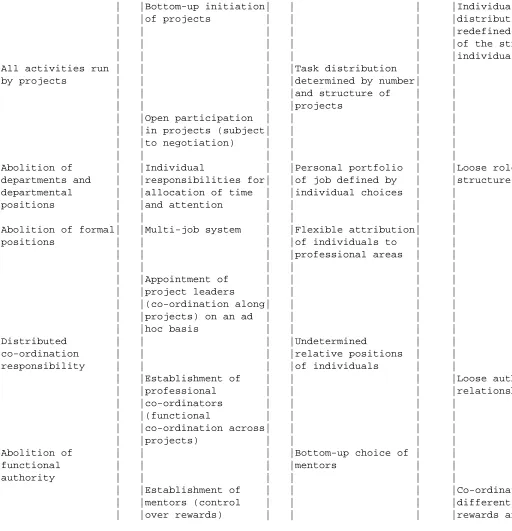
The concept of loose coupling was proposed by Karl Weick (1976) as an alternative perspective for the analysis of educational organisations. Later, it was adopted as a research framework for the study of ambiguous structures and unconventional organisations. With few exceptions (e.g. Hedberg, 1984; Sanchez and Mahoney, 1996), however, most research on loosely coupled systems has been carried out in organisations such as schools (e.g. Weick, 1976, Gamoran and Dreeben, 1986) or hospitals (e.g. Denis, Langley and Cazale, 1996), rather than firms. Most researchers, in fact, tend to consider loose coupling as an intrinsic attribute of certain kinds of organisation: a consequence of their primary activity (Clark, 1983), of a lack of clear goals and of the complexity of the authority relationship (Denis, Langley and Cazale, 1996), or of the ambiguity of the technology involved in the operations (Hardy, Langley, Mintzberg and Rose, 1984). In these circumstances, loose coupling is considered a natural condition of the system. In the case of Oticon, it was the deliberate introduction of elements of ambiguity into the role system and the authority structure that brought the company to change from a tightly-coupled to a loosely-coupled organisation. The causal links between actions, events and the establishment of a looser coupling, as these emerged from our longitudinal analysis, are displayed in Figure 1.
---insert Figure 1 about here
---Introducing ambiguity into the role system means that although a new set or roles and positions has been created (professional manager, people manager, etc.), the distribution of these roles is not defined a priori by design, because the multi-job system allows the changing needs of the organisation and people’s evolving competencies and inclinations to continually redefine the role system. Also, in the authority structure, professional co-ordination has been de-coupled from control over rewards. Neither professional managers nor project managers actually have any hierarchical authority over one another or over the people they co-ordinate, and although control over rewards (i.e. salary increases) ultimately resides in the people managers, it is subject to revocation, so that by changing their mentors people have the opportunity to subtract themselves from the exercise of power. Even the central determination of priorities and allocation of resources is balanced by dispersed initiative and the local allocation of time and skills.
As Orton and Weick (1990) suggest, this ambiguity, this simultaneous presence of elements of coupling and uncoupling, is at the core of the concept of loose coupling, whereby the links among the interdependent elements in the system preserve some degree of determinacy, but are subject at the same time to spontaneous change. At any point in time the activity of the development group ensures that priorities are clear, people’s jobs and objectives are defined, and projects have tasks for which their leaders are held responsible. A once-and-for-all representation of the organisation, however, is not possible, as projects are initiated and terminated, responsibilities shift and roles modify, while no formal structure, no precise division of labour or authority provide a stable point of reference over time. The structure is not superimposed on the flow of the process as it is in a tightly coupled organisation; rather it is defined at any time by the allocation of people, resources and tasks among the projects. People’s roles within the organisation are not defined by their positions or job descriptions, but by their evolving portfolio of jobs. The division of labour thus changes continually, as people take part in new projects, develop new skills and eventually redefine their roles. In this sense the structure is continually being reproduced according to current needs, and it emerges from the interaction between the people initiating, running and taking part in the projects. It is this continual interaction, and not a pre-determined plan or design, that determines the allocation of time, resources and attention, and ultimately the structure of the organisation. It is the interplay of people at every level, who possess the capability to identify resources and combine them in new ways, that continuously redesigns the organisation, redistributing roles, tasks and responsibilities.
Structural Properties of Loose Coupling and the Effective Integration of Knowledge
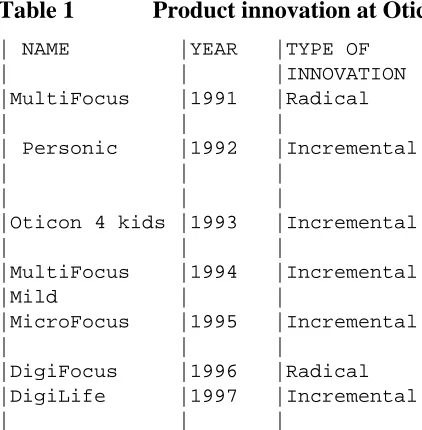
from 1991 to 1996, Oticon was able to introduce two radical reconfigurations of the architecture of the product (see Table 1). MultiFocus in 1992 and DigiFocus in 1996 marked two substantial discontinuities in the technology and design of hearing aids. MultiFocus introduced a fully automatic system for adjusting amplification and tonal balance according to the frequency of sounds, while traditional hearing aids used to amplify weak sounds as much as loud sounds, and high frequencies as much as low ones, so that people had to keep adjusting the volume control. The commercial success of MultiFocus was far beyond expectations and helped the company to regain market shares in the declining BTE segment. Yet MultiFocus technology, although relying on electronic circuitry for sound processing, was still based on analogue amplification. In 1996 the introduction of DigiFocus again reconfigured the basic architecture of the product and opened up a fast-growing and highly-profitable segment that soon accounted for a considerable share of the market worldwide (Business Week, 1999). DigiFocus was in fact the first fully digital hearing aid and was programmed to reproduce sounds in an entirely new way: sounds of different frequency could be processed separately and the amplification could be constantly adjusted according to the changes in the external environment. DigiFocus could therefore improve speech understanding in a wider variety of situations, including noisy environments. Again, Oticon set the new standard and further eroded the market shares of its larger competitors, who were still exploring the possibilities of the new technologies.
During these years the company paced the rate of innovation by alternating products which, without altering the basic technological architecture, incorporated incremental changes exploiting the potential of current designs, making them more appealing to specific target groups. In 1993 an expansion of the MultiFocus concept led to MultiFocus Mild, a hearing aid suited to younger people with an incipient hearing reduction, produced as a mini BTE and an ITE. Later, MicroFocus combined the knowledge gained from MultiFocus with some of the digital technology that would later be fully applied to DigiFocus, as it could be programmed to filter sounds according not only to the specific impairment of the individual patients, but also to their preferences for sound quality factors and their specific communicative context. Even the DigiFocus basic design was soon refined and applied to a new family of hearing aids, DigiLife, operating on a simpler and faster fitting principle, which could also be programmed using a small portable called EasyFit.
In an effort to reframe the general perception of hearing aids, Oticon also introduced significant changes in the aesthetic aspects of the product. First, the external appearance of all the visible external devices was redesigned. More appealing shapes and surface textures were chosen, and a different colour (titanium) used, in order to encourage an association with hi-tech consumer electronics rather than medical devices for handicapped people. Further, the Personic line was released in a variety of colours, with a view to harmonising with the wearer hair type, rather than making a poor attempt at reproducing the skin colour, thus changing the perception of the hearing aid from something to hide to a “modern communication system, that reflects the user’s personality, hair–style and life-style.” Finally, the company designed a special line for young hearing-impaired people, Oticon 4 Kids, based on a colourful and original look and a specifically designed package and information material, all meant to reduce the psychological burden of wearing a hearing aid at a young age.
---insert Table 1 about here
---Most of our informants generally attributed this sustained stream of new products to an improved ability in the organisation to exploit the individual skills, information and ideas that resided in the engineering department, in the research centre, among the marketing and production people, and to harness all these to all stages of the development projects. This interpretation is consistent with a dominant perspective on new product development, which conceives innovation as the creative integration of knowledge of different kinds (scientific, technological, marketing, etc.) into a comprehensive package of attributes that constitutes the product configuration (Dougherty, 1992). To put it in another way, a knowledge-based perspective suggests that long-term, continuous renewal rests on three processes conceptually distinct but intertwined in practice:
• dispersed development of specialised knowledge of different kinds, as a product of individual and collective learning (Nonaka and Takeuchi, 1995; Henderson and Cockburn, 1994);
• creative and valuable integration of specialised knowledge into strategic initiatives or product development projects (Burgelman, 1991; Leonard-Barton, 1992; Dougherty, 1992; Kogut and Zander, 1992; Grant, 1996a);
• periodic reconfiguration, through changes in the dominant design and competitive logic, of the patterns of combined knowledge that form the essence of products and strategies (Henderson and Clark, 1990; Galunic and Rodan, 1998).
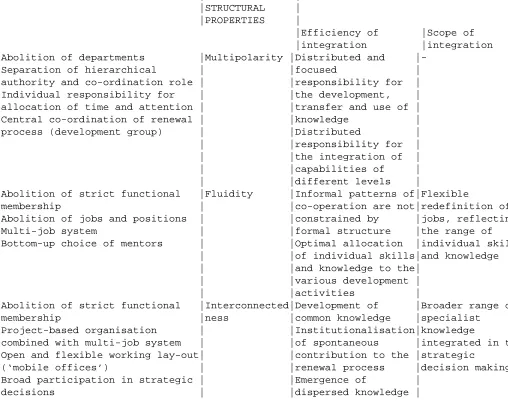
According to Grant (1996a), the effectiveness of this renewal process depends on three characteristics of the underlying process of knowledge integration, namely the efficiency of the integration, its scope and its flexibility. The efficiency of the process is related to the extent to which the firm is able to access and utilise the pool of knowledge and skills possessed by individual members. The efficiency of the process is then related to the depth of the individual specialist knowledge that the firm is able to harness, while the scope of the integration refers to its breadth and variety. The greater the scope, the higher the complexity of the resulting product, and consequently the difficulty for competitors to replicate the formula. Finally, given that hypercompetitive environments require the continuous renewal of competitive advantage, the effectiveness of the process requires a degree of flexibility - i.e. the process should be open to a periodic reconfiguration of the patterns of integration that constitute products and strategies. Grant is less explicit, though, on how a firm can improve the efficiency, the scope and the flexibility of their integration process.
---insert Table 2 about here
---Distributing the management of knowledge flows
The analysis of the development process that led to Oticon’s major innovations in the 1990s revealed that although some projects were induced and sponsored by the top management (i.e. MultiFocus), others were the product of the spontaneous aggregation of individual knowledge and ideas (i.e. MicroFocus). In both cases, the pace and effectiveness of the process was related by some of our informants to the fundamental distribution of responsibility for managing people’s “skills”, “ideas”, and “perspectives” and for integrating them along development projects.
On the one hand, professional and people managers described themselves as responsible for the co-ordination of all the activities related to the acquisition, development and transfer of what one of them called “knowledge resources” and another called “professional skills”. More specifically, people managers have responsibility for the professional growth of individual employees; in other words, they are responsible for the development of specialised skills at the individual level. Professional managers, on the other hand, are responsible for co-ordinating the acquisition and development of specialised knowledge of specific kinds (i.e. marketing, integrated circuit design, audiology etc.), be it embodied in technical devices, in data bases, in design rules or in people’s skills. Development projects exploit technological, scientific or marketing knowledge developed in the professional areas and competence centres. The Integrated Circuit Group, for example, launched a project known as “LEGO”, to define a set of building blocks for the circuits developed within projects. As commonalties between the needs of the different projects in terms of IC design range between 50 and 90 per cent, the LEGO project aimed at optimising component design, so that developing circuits for specific projects would get faster and more efficient. New technological knowledge is often also developed as a by-product of development projects. To some extent this locally developed knowledge circulates spontaneously as a consequence of the numerous links provided by people participating in different projects and bringing experience developed elsewhere into each project. However, the active co-ordination of knowledge transfer among projects takes place at the level of the professional area or the competence centre. A competence manager who we interviewed told us how he organised weekly meeting at which all the people involved in the projects discussed issue of general interest for a couple of hours together, so that individual learning could be shared across projects.
The integration of specialised individual knowledge into new products and ventures, on the other hand, takes place at the project level. In this respect, dispersed spontaneous initiatives play a fundamental role in the change process. One of the project leaders who we interviewed gave us an example of the way new product development or adjustments in market strategies have arisen as a result of individual or group initiative:
dimensions of the hearing aid had to be reduced and its appearance made more appealing to the customers. I was one of the engineers. Together with some marketing people we developed a business plan independently, and we proposed four new product development projects.
Their proposal was approved with minor modifications (one product was cancelled) and two new development projects soon started: a new BTE hearing aid and a smaller version of an ITE hearing aid, that were later sold under the name MultiFocus Mild. Due to lack of resources, it was a year before the third project started, but it led to the development of an innovative canal hearing aid using digital signal processing, MicroFocus.
Once the projects have started, the efficiency and pace of the process are stimulated by granting the project leaders full responsibility to get the projects done. At Oticon, project management – i.e. co-ordinating the use of human, technological and financial resources throughout the projects – is considered a skill in its own right, and although to start with project leadership was entrusted to a member of the project group who also contributed professional skills, later several people became full-time project leaders. In the words of one of our informants, “the project manager is considered responsible to get, not the product, but the ‘business’ developed.” Project managers are asked to adopt a broad perspective, because part of their function is to bring together people with different backgrounds. In this way the project managers facilitate the integration of individual specialised knowledge, both in terms of professional skills and functional culture, within the development project. Project leaders are also responsible for project budgets, attending to all the economic aspects of project activities. Further, project leaders have broad control over the use of resources: within the assigned limits, they are free to allocate their budget as they think fit. The development group co-ordinates the overall process. Although top management recognises the importance of spontaneous creative initiatives, such initiatives should, to some degree, be consistent with one another and with the general direction of change. At Oticon the development group accomplishes this function by setting priorities and communicating the strategic guidelines that orient the direction of autonomous initiatives, and through the allocation of resources among different projects and their periodic review.
Grant (1996a) claims that if knowledge integration is to be carried out efficiently - i.e. if development teams are to access the full breadth and depth of the available knowledge relevant to the project - the structure of authority, communication and decision making should reflect what he calls “the architecture of capabilities”, i.e. the distribution of skills and capabilities among individuals, units and functions. At Oticon the introduction of elements of ambiguity into the role system and the fragmentation of authority were associated with the multiplication of the centres and dimensions of co-ordination in the structure – a property that we have termed multipolarity. In the distribution of roles the traditional principle of gradual decomposition and simplification of tasks down the hierarchy was abandoned. In the fundamental knowledge-integration process responsibility was de-coupled from hierarchical positions, and – more importantly – responsibility for the development and transfer of knowledge was separated from responsibility for knowledge integration at the individual and organisational level.
professional capabilities pertaining to different functional areas and technological domains (i.e. integrated circuit design). Unlike traditional functional managers, whose task is also to co-ordinate and control their subco-ordinates and all the activities that fall within their domain, competence-centre managers are able to dedicate all their efforts and attention to the development of skills and knowledge. Although developing or acquiring specialised knowledge is an important prerequisite for continuous innovation, sustainable innovation requires – as we have noted – the integration of a broad set of specialised knowledge. At Oticon this role is performed by project managers, who facilitate the combination of all kinds of specialised capabilities (IT design, market analysis, audiological field research, etc.) in the course of strategic initiatives in which new products or market strategies are developed, thanks to the broad perspective adopted by the project managers and to their “neutral” position with respect to the different professional areas. At a higher level, finally, the co-ordination activity of the development group determines the overall strategic direction and business development, leveraging on broad functional and cross-functional capabilities (digital sound processing, hearing-aid fitting, etc.), and integrating technological, audiological and market knowledge.
Facilitating the mobility of people and the emergence of ideas
As the new CEO pointed out, a basic principle underlying Oticon’s restructuring was that if the company was to take full advantage of each and every person’s potential contribution, “jobs should be designed to fit the man and not the other way around.” Indeed, Lars Kolind believed that rigid positions restricted the full development of the individual’s skills in accordance with their own particular needs and aspirations. As a member of the development group remarked:
One of the reasons why we have abolished the concept of departments is that departments tend to close you in: good engineers, for example, may also possess very good skills in some particular aspects of marketing. Project groups provide an opportunity for people to exercise skills of different kinds: people may not use their skills to one hundred per cent, but they surely use them more than in a traditional structure, where they are discouraged to use them outside their department.
Also, the cancellation of departmental membership removed a fundamental obstacle to the mobility of people and ideas, reducing the social and psychological burden involved in the decision to move from a department to another. One of the managers we interviewed described the problem in a simple but vivid way:
And certainly the internal flexibility of the multi-job system did allow several people to find better positions within the organisation. Some engineers, for instance, moved to marketing, while other employees became full-time project managers; yet others maintained an ambiguous position that allowed them to exercise different skills at the same time. Everybody felt free to contribute to activities and to improve them and to take part in decisions that fell outside their own main professional domain. Later, the absence of departments and structured career paths also made it easier for people to adjust their jobs and positions gradually in line with their personal and professional development. Furthermore, the possibility of changing mentors allowed for a smooth adaptation of what was left of the hierarchy to evolving social relationships.
We define this capacity to adapt to internal changes as fluidity, as opposed to flexibility, which is usually defined as the ability to adapt to changes in the external environment (e.g. Aaker and Mascarenhas, 1982). All organisations are subject to changes from within, as the social dynamics evolve despite formal structures, and the skills, competencies, needs and goals of the members develop and modify over time. The very evolution of individual capabilities and knowledge is in fact an important source of opportunity, if the organisation is able to tap these resources in an effective and efficient way. Formal structures and career paths, however, tend to constrain and to channel the flow of skills and knowledge. At Oticon, in contrast, the ambiguity of the role system and the negotiated nature of the structure improve the likelihood that individual skills and knowledge will be applied where most needed, as people redesign their roles according to their own evolving skills and the needs of the organisation, and no departmental barriers constrain the development of informal patterns of co-operation in the projects. Whereas in a traditional bureaucratic organisation the position strictly defines the role and the responsibilities of the employee, employees at Oticon define and redefine their roles accumulating and changing their portfolio of jobs according to their evolving skills and competencies. The allocation of personal time and attention to different tasks and projects is not imposed by a central authority, but arises out of a negotiation process between different actors, as project leaders negotiate with each other and with prospective or current project members. As the CEO told us:
Conflicts about resources are usually very clear to the people involved, and if they have all the information, they are the ones who can best solve them. They may occasionally make a wrong decision, but I’m sure that a central manager would make more.
patterns had slowly crystallized around a “dominant design” (Henderson and Clark, 1990), namely BTE analogue devices and the technical skills on which these were based. The presence of a rigidly defined hierarchy of jobs and positions, based on tradition and professional prestige, ultimately inhibited the development of knowledge outside the established domains.
In the first few years after the change, on the other hand, Oticon rapidly introduced major changes in the architecture of the product, none of them apparently posing any obstacle to the subsequent reconfiguration of existing knowledge and competencies into other innovative products. The fluid nature of the organisation does seem to have prevented dominant designs from becoming embedded in a web of institutionalised practices and roles such as often reflect tasks critical to effective design (Henderson and Clark, 1990). The indeterminacy of the role system left the structure more open to periodic redefinition. Although formal channels are designed around component capabilities and related pools of professional knowledge, much communication is in fact left to the informal relationships that develop within and around projects, where the integration among capabilities occurs. Patterns of cooperation and communication thus evolved over time, following the continual reconfigurations of the structure that were produced at the beginning and end of the various projects. As new products became established, project teams evolved into product management structures that did not overlap or replace already existing ones, but co-existed with them.
A looser identification of individuals with the particular competence area and functional structure to which they belonged, also helped to reduce the phenomenon described by Leonard-Barton (1992), whereby entrenched capabilities, legitimated by past success and represented in the formal authority structure, pose a serious obstacle to the detection and nurture of innovative capabilities, either because of perceptual filters or because they threaten to subvert the established “hierarchy of professions”. People in Oticon, on the contrary, are only loosely coupled to any professional group. They are constantly exposed to the application of different skills and encouraged to broaden their competence base. These conditions weaken any tendency to defensive behaviour and reduce frictions in the transfer of knowledge; they improve the assessment of the relative value of one’s own and other people’s knowledge and increase the probability of detecting opportunities for novel recombinations of knowledge.
Stimulating the encounter of ideas and the integration of perspectives
Most of our respondents agreed that what had aggravated the problems and delays in product development that undermined the company’s competitiveness in the eighties was a lack of communication between the research and marketing people. The prototype that later led to the top-selling Multifocus had been with the research department for a decade, where its commercial value was greatly misjudged and its development was given low priority. It wasn’t until the new structure was introduced that its potential value became apparent, and a project group composed of people from the former research, engineering and marketing groups developed Multifocus, the first fully automated hearing aid.
Years ago we physically developed the product and then we handed it over to marketing. Now we encourage people to take responsibility for the entire project and to participate actively in every phase, regardless of whether their skills are specifically involved. The task of the project group is not just to develop a physical product: aspects such as marketing and sales or software design are developed jointly in the project.
Now, at the start of any project, all the people who will be involved throughout the project are already part of the group. The inclusion in the team of people with different backgrounds and skills right from the start helps to anticipate the kind of problems that used to arise at later stages in product development. In the past, a lot of relevant specialised knowledge, such as the marketing people possessed, was accessed late in the process, something that frequently called for several iterations between researchers, designers and the market side. Instead, the new organisation facilitates the emergence and integration of different perspectives in the early stages of product development. The result is an enrichment of the product system, which is no longer “just hardware” but offers a complete package aimed at relieving hearing deficiencies. Product development no longer focuses solely on the physical product, as it used to. The contribution of market people and audiologists has helped, on the one hand, to extend the concerns of a project to include such things as packaging, user interface, instructions and design, and on the other to offer service to users and dealers as part of the overall package.
Earlier research on innovation processes had already identified extensive communication as a relevant antecedent to continuous innovation in rapidly changing environments (e.g. Burns and Stalker, 1961; Henderson, 1994; Brown and Eisenhardt, 1997). However, our findings suggest that extensive communication is only one aspect of a broader structural attribute that we can call interconnectedness, which is related to the reduction in structural, cultural and social communication barriers that followed the elimination of the traditional departmental and hierarchical coupling mechanisms, and to the opening up of the decision-making process to contributions from individuals of different expertise and seniority, in different ways and different points in time. We define interconnectedness as the richness and frequency of contact and information exchange among the different parts of the system. Oticon’s CEO considered interconnection among units as a basic requirement for effective product development in the mutated technological scenario:
When the product becomes knowledge rather than hardware, the organisation must become a brain rather than a machine. The brain is flexible, it builds on a number of knowledge centres, and it comprises an almost chaotic network of relationships between those centres. The last thing the brain looks like is a hierarchy.
A first element in this greater interconnectedness was the elimination of departmental membership and the establishment of the team-based multi-job system, which substantially increased the number and variety of the working relationships that every individual developed, and helped to overcome inter-departmental barriers. The multi functional projects now allow engineering, audiological and market knowledge to be combined from the early stages of product development. The participation of all projects members right from the start helps the development of a common knowledge base or a common framework that facilitates the cooperation between audiologists, engineers and marketing people, and stimulates the creative application of specialised knowledge in designing, packaging and servicing, all wiht a view to increasing benefits for the end user. Customer and marketing concerns now affect product development and even research, with significant improvements in the speed and market success of new product development as a result. Functions and features that increase the benefits to the consumer may be included already at the prototype stage, and the number of iterations between designers and marketing people has been virtually reduced to zero.
complement to the indeterminacy of the structure. Traditional offices were thought to create emotional barriers and to prevent, or at least to impede, free movement and spontaneous interaction between people. Offices and corridors were thus replaced by open spaces filled with uniform workstations, consisting of a drawerless desk complete with computer, telephone, fax, etc. Everyone, including the CEO, was assigned a personal file cabinet on wheels, and people were encouraged to move freely to and from common workstations, changing their location according to their project work. In view of this, the flexible interaction allowed by the new layout is regarded as a critical condition for the periodic reconfiguration of patterns of interaction and co-operation around the development and management of products. In the words of one of our informants: “The office layout allows product groups and task forces to be formed, to act, to work and to dissolve quickly and flexibly.”
A coffee counter has been installed on every floor and employees are encouraged to stop at the counters and to stay awhile in the cafeteria. These are meeting-points; time spent talking to one another is not regarded as wasted, but as a potential source of new idea and initiatives. As one manager told us: “Ideas very often come up at lunch time. Maybe someone has just returned from a conference or talks about a competitor’s new product and I say ‘Hey, I see no reason why we couldn’t do that’.” The absence of offices and the numerous meeting-points thus make it easier for people to make contact, to combine the knowledge and information they possess and to give birth to autonomous development initiatives. Furthermore, it’s easy for everyone to get to hear about opportunities for contributing their skills and ideas to ongoing or upcoming projects, thus improving the general use of individual knowledge and capabilities at all the stages in development projects.
Finally, interconnectedness is also manifest in the decision process that shapes the strategic direction. Officially, responsibility for setting priorities and establishing the strategic direction is vested in the development group, but not many of its members are directly involved in day-to-day development. A number of subgroups and committees aid the development group by adding different perspectives to the decision-making process. For instance, a so-called review group, composed of four people from marketing, software, sales, and information technology, is responsible for reviewing short- and long-term plans twice a year. The specialised knowledge possessed by members of the group, both in terms of professional knowledge and environmental representations, is then integrated in the strategic process that guides corporate renewal. Furthermore, employee task forces are specifically constituted to ensure a richer understanding of competitive and technological development inside and outside the firm. Members of these groups come from different functional areas to ensure a broad range of views. They are deeply involved in product development and are thus able to provide immediate feedback about the implications of strategic decisions for the operations, the people and the resources engaged in product development, and vice versa. Strategic decisions can thus be said to result from a comprehensive process in which different interpretations are represented and exert an influence on the results. As one member of the development group explained: “We are not just listening to them: they take an active part in the process and ultimately influence the final decision.”
fracture between the engineers and the marketing people and facilitated a sharing of knowledge and ideas, all of which improved the efficiency of the integration process as a whole. At the same time, the increase in occasional encounters and the fostering of socialisation created a favourable context for the casual exchange and transfer of ideas. Finally, setting up a number of committees and task forces and involving them in the strategic decision-making broadened the scope of the knowledge integration, because a wider range of perspectives and points of view are now taken into consideration and incorporated in the process.
Conclusions
A knowledge-based view of competition (e.g. Kogut and Zander, 1992, Grant, 1996a) suggests that competitive advantage rests on the ability to combine and recombine organisational and individual knowledge continuously, in a creative, valuable and flexible way. In hypercompetitive industries, where products and strategies evolve from the integration of a broad range of different technological platforms and technical capabilities, the efficiency and effectiveness of this process becomes critical. Consequently, research on new organisational forms is exploring the design and the management of processes and structures that improve the firm’s ability to develop and integrate specialised knowledge (Daft and Lewin, 1993; Ilinitch, D’Aveni and Lewin, 1996).
In this article we have presented findings from an in-depth study of Oticon A/S, a producer of hearing-aid instruments and one of the most highly praised innovators of the last decade. The hearing-aid industry has witnessed at least three major reconfigurations of the dominant design of the product in the last twenty years, and the introduction of digital technology during the nineties has broadened the scope and speeded up the pace of competition considerably (Business Week, 1999). Aggressive innovators like Oticon itself and, more recently, Widex and GN Danavox – who, incidentally, have adopted an organisational structure similar to Oticon’s – are winning market shares from the previous leaders Starkey Inc. and Siemens AG, thanks to their early development and exploitation of new technologies. Long-term competitive advantage rests increasingly on continuous innovation in the basic architecture and core functions of the product. Evidence from our study suggests that the undisputed ability for continuous innovation displayed by Oticon in the period studied builds on a superior ability for integrating the specialised skills and expertise dispersed throughout the organisation into successful new products, in an efficient and flexible way. In turn, the effectiveness of the process seems to be supported by structural attributes of the company’s organisational structure.
of the three processes described above.
The effective management of knowledge integration – just like strategy-making (Mintzberg, 1979) or corporate renewal (Burgelman, 1991) – requires a careful balance between deliberate and emergent processes. On the one hand, the development and integration of knowledge can and should be actively promoted through research and experimentation and the exchange, transfer or diffusion of know-how and information. On the other, the dispersion, the context specificity and the tacit nature of much valuable knowledge reduce the likelihood of a co-ordinating unit successfully detecting and evaluating all the potential combinations (Galunic and Rodan, 1998). New patterns of knowledge integration often emerge spontaneously, as new routines and practices replace old ones (Nelson and Winter, 1982), new capabilities evolve (Leonard-Barton, 1992), and spontaneous initiatives lead to new products and internal entrepreneurial ventures (Burgelman, 1991).
Tight-coupling mechanisms such as hierarchies and formal structures often reflect dominant knowledge about environmental conditions or about the resources available within the organisation. In this way, they represent an attempt to organise knowledge flows around critical patterns of integration, embodied in products and routines, and to reproduce successful practices and behaviours. However, as environmental conditions change and dominant knowledge becomes obsolete, formal structures of co-ordination often impede the development of new and more appropriate or valuable patterns of integration (Henderson and Clark, 1990; Leonard-Barton, 1992; Dougherty and Heller, 1994). Valuable knowledge possessed by separate individuals remains hidden and unproductive; innovative solutions remain unexplored, while formal structures channel and constrain attention and the search for alternatives.
Evidence from the case suggests, rather, that the intrinsic ambiguity and indeterminacy of a loosely coupled structural arrangement create a favourable context for the coexistence of both co-ordinated and spontaneous processes of combining and recombining knowledge. Loose coupling implies not the complete absence of co-ordination, but that co-ordination in loosely coupled organisations relies on multiple centres and criteria. At Oticon, for instance, decomposing the traditional functional hierarchy allowed for the distribution of responsibility for the development, transfer and use of knowledge to a multiplicity of co-ordination roles. Professional managers and mentors now concentrate on developing and transferring knowledge, project leaders are responsible for the efficiency and effectiveness of the integration of specialised knowledge that occurs within the projects, while central co-ordination ensures a balance between initiatives aimed at exploiting existing knowledge and capabilities, and initiatives aimed at exploring new patterns of integration. The plurality of co-ordination centres ensures that a greater variety of perspectives influences the integration process, while the fluidity of the system reduces the likelihood that the new distribution of roles and the new patterns of co-operation between people will re-crystallise around dominant cognitive frameworks. In other words, the combined effect of fluidity and multipolarity improves the co-ordination of knowledge-related activities, as the dispersal of roles and responsibilities comes to reflect more closely the requirements of knowledge management and, over time, to adapt smoothly to the development of new capabilities and the emergence of new patterns of integration.
individuals are used to their best advantage and where their application is most valuable. Nonetheless, given the dispersion and the tacit nature of much individual knowledge, organisations can’t rely exclusively on purposeful search. It is often more productive to create a favourable framework, so that new combinations emerge from the spontaneous initiatives of individuals or groups. In most organisations, though, communication constraints and structural rigidities impede an effective exploitation of existing knowledge. At Oticon, in contrast, the fluid nature of the organisation got rid of most of the structural, social and psychological barriers to the free movement of people, knowledge and ideas across units. Meanwhile, greater interconnectedness has intensified the number of encounters, thus increasing the likelihood of cross-fertilisation and the spontaneous start of new explorative ventures. Both properties have contributed to changing an established culture based on departmental identification and opposition, and to developing a common framework that facilitates dialogue between specialists of different kinds.
References
Figure 1 Introducing structural ambiguity in the organisation
Table 1 Product innovation at Oticon, 1991-1997.
Table 2 Benefits of structural ambiguity to the integration of knowledge