TOEPLITZ MATRICES
J. PESTANA† AND A. J. WATHEN‡
Abstract. Circulant preconditioning for symmetric Toeplitz linear systems is well-established; theoretical guarantees of fast convergence for the conjugate gradient method are descriptive of the convergence seen in computations. This has led to robust and highly efficient solvers based on use of the fast Fourier transform exactly as originally envisaged in Gil Strang’s ‘Proposal for Toeplitz Matrix Calculations’ (Studies in Applied Mathematics, 74, pp. 171–176, 1986.). For nonsymmetric systems, the lack of generally descriptive convergence theory for most iterative methods of Krylov type has provided a barrier to such a comprehensive guarantee, though several methods have been proposed and some analysis of performance with the normal equations is available.
In this paper, by the simple device of reordering, we rigorously establish a circulant precondi-tioned short recurrence Krylov subspace iterative method of minimum residual type for nonsymmetric (and possibly highly nonnormal) Toeplitz systems. Convergence estimates similar to those in the symmetric case are established.
Key words. circulant preconditioner, MINRES, nonsymmetric matrix, Toeplitz matrix
AMS subject classifications. 65F08, 65F10, 15B05
1. Introduction. Krylov subspace methods are well suited to linear systems
(1.1) Anxn =bn
involving large nonsingular Toeplitz matrices An ∈Rn×n, since matrix vector prod-ucts can be cheaply performed via a circulant embedding and the fast Fourier trans-form [55, Section 4.2.4]. Additionally, preconditioned Krylov subspace methods can be more robust than tailored direct methods and have better complexity [8, Section 1.1]. Circulant preconditionersCn ∈Rn×nforAnare attractive, since these can also be ap-plied efficiently using the fast Fourier transform. However, theoretical guarantees of ef-fectiveness of these preconditioners have mostly been restricted to symmetric (or Her-mitian) positive definite Toeplitz matrices [4, 8, 11, 12, 14, 15, 32, 35, 38, 40, 49, 52]. This is largely due to the fact that whenCn andAn are symmetric positive definite matrices, the preconditioned conjugate gradient method (CG) [29] can be applied with its favourable properties: namely, minimization of the error in the An-norm, short-term recurrences and convergence bounds that depend only on the eigenvalues of the preconditioned matrix. These eigenvalues can be analysed in many cases, so that convergence within a certain number of iterations of CG can be guaranteed.
If An is symmetric but indefinite we can apply preconditioned MINRES [42] as long as the preconditioner is positive definite. MINRES has similar properties to CG, namely minimization of the preconditioned residual, short-term recurrences and convergence bounds in terms of the eigenvalues of the preconditioned matrix. However, the spectrum of the preconditioned matrix may be more difficult to analyse than in case of positive definiteAn [9, 39].
Often considered hardest to solve by preconditioned iterative methods are sys-tems with nonsymmetric (nonnormal) matrices. It may be more challenging to obtain
†School of Mathematics, The University of Manchester, Manchester, M13 9PL , United Kingdom ([email protected])
‡Mathematical Institute, University of Oxford, Andrew Wiles Building, Radcliffe Observatory Quarter, Woodstock Road, Oxford, OX2 6GG, United Kingdom ([email protected])
a suitable preconditioner, although effective preconditioners for certain nonsymmetric Toeplitz matrices have been proposed [13, 33, 36, 41]. However, in general Krylov sub-space methods for nonnormal matrices, such as GMRES [47], QMR [24], SQMR [25] (which requires less work than the original QMR method when applied to Toeplitz matrices) and BiCG-STAB [54], do not simultaneously minimize a relevant quantity and have short-term recurrences for general matrices [22]. Additionally, the conver-gence of these methods cannot be bounded using only the eigenvalues (or singular values). This is in stark contrast to methods for symmetric matrices. The excep-tion is the applicaexcep-tion of CG to the normal equaexcep-tions (CGNE), or MINRES to an augmented system. The former does not preserve the Toeplitz structure, although
An and ATn can still be cheaply applied, while decay properties of the Toeplitz ma-trix may be lost in the augmented mama-trix. Additionally, CGNE and MINRES on an augmented system may be more costly, may result in worse conditioning (and slower convergence), and may be more difficult to precondition effectively.
In this note we show that nonsymmetry and nonnormality of Toeplitz matrices pose no difficulty in terms of obtaining theoretical guarantees of convergence of a minimum residual method with short-term recurrences, since a simple permutation renders the Toeplitz matrix symmetric (but possibly indefinite). MINRES can, there-fore, be applied to suitably preconditioned Toeplitz problems. The preconditioner is a circulant matrix that is as cheap and easy to apply as other proposed preconditioners for Toeplitz systems. Significantly, since the convergence of MINRES can be bounded using only the eigenvalues of the preconditioned matrix, we can obtain descriptive convergence bounds.
We restrict our attention to real Toeplitz matrices here. When applied to com-plex Toeplitz matrices, our method produces comcom-plex symmetric matrices and the associated linear system can be solved by SQMR [25] or by the recently proposed CS-MINRES [17], a minimal residual method for complex symmetric matrices that can be used with a complex symmetric preconditioner.
2. Preliminaries. LetAn∈Rn×n be the nonsingular Toeplitz matrix
An=
a0 a−1 . . . a−n+2 a−n+1 a1 a0 a−1 a−n+2
..
. a1 a0 . .. ...
an−2 . .. . .. a−1 an−1 an−2 . . . a1 a0
andCn∈Rn×n be the nonsingular circulant preconditioner
Cn =
c0 cn−1 . . . c2 c1 c1 c0 cn−1 c2
..
. c1 c0 . .. ...
cn−2 . .. . .. cn−1 cn−1 cn−2 . . . c1 c0
.
If the Fourier matrix is denoted Fn = (fjk) with fjk = e−2(j−1)(k−1)πi/n, j, k = 1, . . . , n, then the circulantCn has diagonalization
where Un =Fn/
√
n and Λ = diag(Fncn), with cn the first column of Cn. A conse-quence of the relationship betweenCn and the Fourier matrix is that a matrix-vector product, or the solution of a linear system, with a circulant matrix of dimensionncan be performed inO(nlog(n)) operations using the fast Fourier transform (FFT) [55, Section 4.2.3]. Note that althoughCn is real,Fn andUn are generally complex.
Superfast direct solvers with O(nlog2(n)) complexity have been developed for Toeplitz systems but these require that a certain submatrix ofAnof dimensionbn/2cis nonsingular. The algorithms can, therefore, break down if a principal submatrix ofAn is ill-conditioned or singular, although look-ahead strategies have been proposed [14]. Iterative methods, in contrast, do not require that such a submatrix is nonsingular. Moreover, since each matrix-vector multiply withAn can be performed inO(nlog(n)) time, if the number of iterations is small the complexity of iterative methods is better than that of direct methods for solving Toeplitz systems. Typically, preconditioning is required to keep the number of iterations small.
Let An have as its coefficients the Fourier coefficients of a function f that is
L2-integrable over [−π, π], i.e.,
ak= 1 2π
Z π
−π
f(x)e−ikxdx,
k= 0,±1,±2, . . . withak the entries ofAn above. Thenf is the generating function associated with An. If the real Toeplitz matrix An is associated with a real, non-negative generating function that is not identically zero then it is symmetric positive definite. In this case a number of circulant preconditioners, including the Strang [49] and optimal [15] preconditioners, are such that for large enoughn,C−1
n Anis a pertur-bation of the identity of the formR+E, where the rank ofRis bounded independently of n and E has small norm. Consequently, the eigenvalues of C−1
n An are clustered near one with the exception of a fixed number of outliers and CG for the precondi-tioned system is guaranteed to converge within a certain number of steps. Similar results can be obtained for certain circulant preconditioners for MINRES, with the eigenvalues clustered near 1 and -1 for large enoughn[9, 39].
Circulant [13, 36, 41], ω-circulant [10] and banded Toeplitz [5, 33, 44] precondi-tioners have been proposed for nonsymmetricAn. For some of these preconditioners
Pn, the preconditioned matrix Pn−1An =In+R+E, where In is the identity ma-trix, and again the rank of Ris bounded independently ofnand E has small norm. However, as previously mentioned, this is insufficient to guarantee rapid convergence of most Krylov solvers, including GMRES, QMR, SQMR and BiCGSTAB. Despite the lack of rigorous convergence proofs, circulant preconditioners for non-Hermitian and nonsymmetric Toeplitz matrices have been used successfully with methods like GMRES [33, 41], which is perhaps favoured because it minimizes the preconditioned residual.
3. MINRES for preconditioned Toeplitz matrices. We would like to solve the Toeplitz system (1.1) by a minimal residual method with short-term recurrences and descriptive convergence bounds. It turns out that this can be achieved without any additional cost, since An is transformed to a symmetric (Hankel) matrix by swapping its rows or, equivalently, by formingYnAn, whereYn∈Rn×nis the exchange matrix
Yn=
1
. ..
1
An equivalent statement is that An is self-adjoint with respect to the bilinear form defined by Yn [26, 45]. The matrix Yn is symmetric and orthogonal, and is thus involutory. Moreover, since Yn is orthogonal, both An and YnAn have the same 2-norm condition number.
The permutationYnAnconverts a Toeplitz matrix that may be highly nonnormal to a matrix that is not only normal but symmetric, so that the system
(3.1) YnAnx=Ynb
can be solved by MINRES. Within the MINRES algorithm, multiplications by Yn are replaced by permutations. Convergence of MINRES for (3.1) depends on the eigenvalues of YnAn and may be slow if these are not nicely distributed. However, if an effective (invertible) circulant preconditioner Cn for An is known, the unitary diagonalization ofCnallows us to easily replaceCn by its absolute value. Recall that the absolute value of a general matrix B ∈ Rn×n is given by |B| = (BTB)1
2 [30,
Chapter 8]. SinceCn is normal, we find that
(3.2) |Cn|= (CnTCn)
1
2 = (CnCT
n)
1 2 =U∗
n|Λn|Un,
where|Λn|is the diagonal matrix in (2.1) with all entries replaced by their magnitudes. Additionally,
(3.3) |Cn|−1Yn=Yn|Cn|−1
because|Cn|−1is also symmetric and circulant, hence certainly Toeplitz, and
(3.4) |Cn|=CnCen, Cen=Un∗sgn(Λn)Un,
where sgn(Λn) = diag(λi/|λi|) andCen ∈Rn×n is orthogonal and involutory. Since
|Cn| is a circulant, matrix-vector products, or linear solves, with |Cn| can also be applied inO(nlog(n)) operations, so that|Cn|is no more difficult to apply thanCn. Note that if Cn is positive definite then Λ = |Λ|, i.e., the absolute value leaves Cn unchanged.
Accordingly, the solution x of (1.1) can be found by applying preconditioned MINRES, described in, for example, Elman, Silvester and Wathen [21, Chapter 6] to (3.1) with preconditioner |Cn|. The preconditioned MINRES method produces iterates{xk}, with residualrk =b−Anxkso that norm of the preconditioned residual
k|Cn|−1Ynrkk2=kYn|Cn|−1rkk2=k|Cn|−1rkk2
is minimized. Since |Cn| has unitary eigenvectors,k|Cn|−1rkk2 =k|Λn|−1vkk2 with vk =Unrk, so thatkvkk2=krkk2. Relative preconditioned residuals are bounded as
follows:
k|Cn|−1rkk2 k|Cn|−1r0k2
≤ min p∈Πk
p(0)=1
max λ∈σ(|Cn|−1YnAn)
|p(λ)|,
particular, if the eigenvalues of |Cn|−1YnAn lie in two intervals [−a,−b]∪[c, d], of equal length, so thatd−c=a−b, then [21, pp. 306–307]
(3.5) k|Cn|
−1r 2kk2 k|Cn|−1r0k2
≤2
√
ad−√bc √
ad+√bc
!k
.
To this point we have used a row permutation to symmetrizeAn. However, we could instead have applied a column permutation, since AnYn is also symmetric. In general, AnYn 6=YnAn but both approaches give the same iterates and residuals as the next lemma shows.
Lemma 1. When the same starting vector x0∈Rn is used, thekth iteratexLk of
preconditioned MINRES applied to (3.1) with preconditioner |Cn| is equal to the kth
iterate xRk of preconditioned MINRES applied to
(AnYn)z=b, x=Ynz,
with preconditioner|Cn| fork= 1,2, . . . , n.
Proof. If we solveYnAnx=Ynbby preconditioned MINRES, we effectively solve
(|Cn|−
1
2YnAn|Cn|− 1 2)|Cn|
1
2x=|Cn|− 1 2Ynb
by MINRES. At thekth step MINRES selects an iteratexLk of the form
xLk =x0+|Cn|−
1 2pL
k−1(|Cn|−
1
2YnAn|Cn|−12)|Cn|−12Ynr0,
where pLk−1 is a polynomial of degree at most k−1. Since |Cn| is real symmetric and circulant, so is |Cn|−
1
2, and it follows that Yn|Cn|−12 = |Cn|−12Yn. It is then
straightforward to show that
(3.6) xLk =x0+Yn|Cn|−1pkL−1(AnYn|Cn|−1)r0.
The polynomialpL
k−1 is selected so that the 2-norm of the preconditioned residual
|Cn|−
1
2Ynrk =qL
k(|Cn|−
1
2YnAn|Cn|−12)|Cn|−12Ynr0=Yn|Cn|−12qL
k(AnYn|Cn|−1)r0
is minimized, whereqL
k(z) = 1−zpLk−1(z). Thus, the residual polynomial is
(3.7) qLk = arg min
q∈Πk
q(0)=1 k|Cn|−
1
2q(AnYn|Cn|−1)r0k2.
On the other hand, solving (AnYn)z=b,x=Ynz by preconditioned MINRES is equivalent to solving
(|Cn|−
1
2AnYn|Cn|− 1 2)|Cn|
1
2Ynx=|Cn|− 1 2b.
Thekth iteratexRk is of the form
xRk =x0+Yn|Cn|−
1 2pR
k−1(|Cn|−
1
2AnYn|Cn|−21)|Cn|−12r0
or
wherepR
k−1 is also a polynomial of degree at mostk−1. The 2-norm of the
precon-ditioned residual
|Cn|−
1
2rk=qR
k(|Cn|−
1
2AnYn|Cn|− 1 2)|Cn|−
1
2r0=|Cn|− 1 2qR
k(AnYn|Cn|−1)r0
is minimized by MINRES, withqR
k(z) = 1−zpRk−1(z), and so
qkR= arg min q∈Πk
q(0)=1 k|Cn|−
1
2q(AnYn|Cn|−1)r0k2.
Comparison with (3.7) shows thatqL k =q
R
k. From the definitions ofq L k andq
R k we see thatpL
k−1=p
R
k−1 and, from (3.6) and (3.8), thatx
L k =x
R
k at each iteration.
Let us contrast this proposed MINRES method with two alternatives, CG for the normal equations and SQMR. When the eigenvalues of |Cn|−1YnAn are completely symmetric about the origin, CGNE converges in half the number of iterations of MINRES, but each CGNE iteration requires two matrix-vector products withAnand two solves with Cn, so that the work of the two methods is roughly the same [23]. When this exact symmetry does not apply MINRES converges faster, i.e. requires fewer matrix-vector multiplies and preconditioner solves. Both methods minimize the residual and use short-term recurrences. However, it may be more difficult to find suitable preconditioners for the normal equations than it is to find preconditioners for MINRES. This issue is not restricted to Toeplitz matrices, but more generally a good preconditionerP forA does not imply thatP PT is a good preconditioner forAAT.
Now consider SQMR, which uses Yn to reduce the work of QMR. Unlike MIN-RES, SQMR can be used with an indefinite preconditioner but it does not min-imize the residual or the error with respect to a standard norm and breakdown may still occur. These properties make guarantees on convergence rates difficult, if not impossible, to obtain. A similar analysis to that in the proof of Lemma 1 shows that SQMR applied to (YnCn)−1(YnAn)x = (YnCn)−1(Ynb) is equivalent to SQMR applied to (CnYn)−1(AnYn)(Ynx) = (CnYn)−1b and that SQMR applied to the system (CnYn)−1(YnAn)x = (CnYn)−1(Ynb) is equivalent to SQMR applied to (YnCn)−1(AnYn)(Ynx) = (YnCn)−1b.
4. Using existing circulant preconditioners in MINRES. The previous section showed that the proposed MINRES method can be used to solve systems (1.1) with nonsymmetric Toeplitz coefficient matrices, provided we can find suitable positive definite preconditioners |Cn| in (3.2). Here, we show that certain existing circulant preconditioners can be used to build|Cn|.
As discussed in Section 2, for certain nonsymmetric Toeplitz matrices and cir-culant preconditioners the preconditioned matrixC−1
n An =In+R+E, whereIn is the n×n identity matrix,R ∈ Rn×n has low rank and E ∈Rn×n has small norm. Fortuitously, a similar relationship also holds for the transformed matrix|Cn|−1YnAn.
Proposition 2. Let
(4.1) Cn−1An =I+R+E
whererank(R) =K andkEk ≤, wherek · kis a unitarily invariant norm. Then,
(4.2) |Cn|−1YnAn =Qn+Rb+E,b
Proof. If (4.1) holds then, using (3.3) and (3.4),
|Cn|−1YnAn =Yn|Cn|−1An=YnCenCn−1An =Qn+Rb+E,b
where Qn =YnCen, Rb =QnR and Eb =QnE. SinceCen is circulant,Qn is not only orthogonal but symmetric and so has eigenvalues±1, while the orthogonality of Qn means that rank(Rb) = rank(R) = K and kEkb = kEk with respect to any unitarily invariant norm.
Remark 1. A similar relationship betweenCn and|Cn|was proposed by Ng and Potts for symmetric indefinite problems [39, Theorem 4.3].
Remark 2. An analogous result can be proved for right preconditioning. Proposition 2 shows that ifC−1
n An satisfies (4.1), the eigenvalues of|Cn|−1YnAn are clustered near±1 with a certain number of outliers. Additionally, the eigenvalues ofYn|Cn|−1An=|Cn|−1YnAn are real. This clustering of eigenvalues, in conjunction with the results of Campbell et al. [3] allow us to provide a more precise bound than (3.5) in this case.
Proposition 3. Let |Cn|−1YnAn havepeigenvalues λ∈ {z:|1−z| ≤} andq
eigenvaluesλ∈ {z:|1 +z| ≤}with the remainingd=n−p−qoutlying eigenvalues satisfying λ∈ {z :|1−z|> and| −1−z|> }. If we apply preconditioned MIN-RES to (3.1)with preconditioner|Cn|then, after thedth iteration, the preconditioned
residuals satisfy
(4.3) k|Cn|
−1r
d+2kk2 k|Cn|−1r0k2
≤C(2+2)k,
where C is independent of k but depends on and the distance from the outliers to the clusters at1 and−1.
Proof. Recognising that MINRES and GMRES are mathematically equivalent, the result is obtained directly from Proposition 5.1 in Campbell et al. [3] withσ= 2+,
ρ=andP = 2 clusters.
Combining the results of Propositions 2 and 3 we see that if Cn is such that
C−1
n An = I+R+E where rank(R) = K and kEk ≤ , and k · k is a unitarily invariant norm, we can expect convergence of our MINRES method in a number of iterations that depends onKand on. Moreover, ifK andare independent of the dimension n of the problem then MINRES will converge in a number of iterations that is independent ofn.
Proposition 3 also leads to a 2-step superlinear convergence result that is a natural extension of the results for circulant preconditioners for positive definite Toeplitz matrices [8, page 431]. To achieve this superlinear convergence, as in the positive definite case, we require the notion of a clustered spectrum. For this purpose, we generalize the definition for positive definite matrices given in the survey paper by Chan and Ng [8, Definition 1.1] to our problem.
Definition 4. A sequence of matrices{Zn}∞n=1is said to have clustered spectrum around 1 and -1 if for any >0 there exist positive integers n1 andn2 such that for alln > n1, at most n2 eigenvaluesλof Zn are such that|λ−1|> and|λ+ 1|> . Examining (4.3) in Proposition 3 we see that ifC−1
n An has clustered spectra then we can expect 2-step superlinear convergence (c.f. equation (1.8) in Chan and Ng [8]).
Although it seems more common in the literature to prove that (4.1) holds, there are cases in which eigenvalue bounds are given for the normal equations coefficient matrix (C−1
works well for the normal equations will also work well for MINRES provided the condition number ofCn is not too large.
Proposition 5. Let the eigenvalues of(Cn−1An)T(Cn−1An)be contained in the
in-terval[1−,1+]with the exception ofKoutliers. Then the eigenvalues of|Cn|−1YnAn
are contained in
√
κ(−1−),−1 +√ κ
∪
1
− √
κ , √
κ(1 +)
,
where κ = κ2(Cn) is the 2-norm condition number of Cn, with the exception of K
outliers.
Proof. Since
(Cn−1An)T(Cn−1An) = (Yn|Cn|−1An)T(Yn|Cn|−1An) = (|Cn|−1YnAn)T(|Cn|−1YnAn),
the singular values of|Cn|−1YnAn are clustered in [1−,1 +] with the exception of
K outliers. These singular values are related to those of |Cn|−
1
2YnAn|Cn|− 1 2 by the
bound [20, Theorem 3.1]
σi(|Cn|−1YnAn) p
κ2(|Cn|)
≤σi(|Cn|−
1
2YnAn|Cn|− 1
2)≤pκ2(|Cn|)σi(|Cn|−1YnAn),
whereσi is theith singular value. The matrix|Cn|−
1
2YnAn|Cn|− 1
2 is symmetric and
so its singular values are the absolute values of its eigenvalues. The condition number of|Cn|is equal to that ofCn (see (3.2)), which gives the result.
Note that even whenκis large, the eigenvalues of|Cn|−1YnAn may be clustered. As an example, consider the Toeplitz matrix of dimension 1000 generated by the function f(x) = |x|eix, x ∈ [−π, π], and the Strang preconditioner. All but five eigenvalues λof (C−1
n An)T(Cn−1An) satisfy |1−λ| ≤0.1, with the outliers equal to 5.5×10⁻⁸, 0.27, 0.63, 0.88 and 978. Since the Strang preconditioner has condition
numberκ= 2.5×10³(see Table 6.6), we might expect the eigenvalues of|C
n|−1YnAn to be spread along the real line. However, all but five eigenvalues λof |Cn|−1AnYn satisfy|1−λ| ≤0.1 or |1 +λ| ≤0.1, with the outliers at −1.22, −0.70, −5×10⁻⁴,
1.3 and 5.3. Note also that these outliers do not vary as much in magnitude as the outliers of (Cn−1An)T(Cn−1An), although they lie on both sides of the imaginary axis. Clearly then, Proposition 5 may be pessimistic. Additionally, in our experiments the performance of our MINRES method is typically better than that of LSQR (an implementation of CGNE) even whenCn is ill-conditioned.
We now discuss a selection of preconditioners for nonsymmetric Toeplitz matrices for which our MINRES method works well. Oseledets and Tyrtyshnikov [41] show that (4.1) holds withkEk = 0 and K independent of nfor a wide class of Toeplitz matrices, namely matrices with generating function
f =P(z) +Q(z)
L(z), z=e ix,
whereP,QandLare polynomials,Lhas no roots on the unit circle, the degree ofQ
is not greater than the degree of L, andL andQhave no common roots. For these problems, Proposition 3 shows that MINRES terminates after at most K iterations and, since Definition 4 holds, we can expect 2-step superlinear convergence. For Toeplitz matrices with generating function
f =g+ ` X
α=0
m X
k=0
wheregis analytic in a disc containing|z|= 1, Proposition 2 holds for any >0 with
K= log−1[c
0+c1log−1+c2logn] +c3, wherec0,c1,c2andc3are independent ofn
and. Thus, for this class of Toeplitz matrix, which includes all examples in papers on superlinear preconditioners, we can also expect 2-step superlinear convergence with our MINRES method [41, 56]. Additionally, Oseledets and Tyrtyshnikov propose a method for constructing circulant preconditioners that satisfy (4.1) using only the elements ofAn, i.e., without reference to a generating function. GMRES is used to solve their preconditioned systems, but MINRES could be applied to the transformed systems instead.
For large enough dimensionn, and for Toeplitz matrices with 2π-periodic, con-tinuous, complex-valued generating functionf having no zeros, the optimal precondi-tioner proposed by Chan [15] satisfies (4.1) and has clustered spectrum [13, Corollary 1]. Thus, we can expect 2-step superlinear convergence. Additional properties of the optimal preconditioner can by found in the paper by Chan, Jin and Yeung [7]. Tyr-tyshnikov, Yeremin and Zamarashkin [53] consider improved circulants for Toeplitz matrices with a 2π-Lebesque-integrable complex-valued generating functionf that is sparsely vanishing, i.e., for which
Z π
−π
φ(|f(x)|)dx= 0,
whereφis the characteristic function of the interval [0, ]. For these improved circu-lant preconditioners, the preconditioned Toeplitz matrix satisfiesAnCn−1=I+Eand an analogous result to Proposition 2 holds. Additionally,kEkF =o(n), wherek · kF is the Frobenius norm, so thatAnCn−1 has a clustered spectrum and 2-step superlinear convergence is achieved.
LetCn be the Strang preconditioner and let the entries ofAn be such that
∞
X
k=−∞
|ak| ≤β <∞,
∞
X
k=inf ty
ake−ikθ
≥γ >0,
for all θ and for constants α and β. Then (Cn−1An)T(Cn−1An) has all eigenvalues clustered at 1 with the exception of a fixed number, independent of n. Thus, by Proposition 5, the modified Strang preconditioner|Cn|also gives clustered eigenvalues as long as|Cn|is well conditioned. Similar results were proved for a second circulant preconditioner that utilizes all elements ofAn.
5. Extension to block matrices. Multilevel Toeplitz matrices are a natural extension of Toeplitz matrices, with the simplest, separable matrices, formed from Kronecker products of Toeplitz matrices. Separable matrices arise in, for example, partial differential equations [16, 28], two-dimensional signal processing [6] and image deblurring [18]. Preconditioners for Toeplitz matrices have been used in Kronecker products to solve multilevel problems (see, e.g., [6, 18, 34]). Note, however, that unlike in the previous section we cannot expect the number of outlying eigenvalues, i.e., the eigenvalues not belonging to a cluster, to be independent of the dimension of the matrix [48] since for multilevel Toeplitz problems only multigrid methods show convergence rates independent of the dimension [1].
To get a feel for how the results of previous sections can be applied to separable matrices, and the differences between the Toeplitz and multilevel Toeplitz cases, let
⊗represents a Kronecker product. (Pertinent properties of Kronecker products are given in, for example, the book by Horn and Johnson [31, Section 4.2].) Then if
Wnm=Yn⊗Ym, the product
WnmBnm= (Yn⊗Ym)(Sn⊗Tm) = (YnSn)⊗(YmTm).
Since the Kronecker product of symmetric matrices is symmetric,WnmBnm is sym-metric. We can define a preconditionerGnm=Jn⊗Km forBnm, whereJn∈Rn×n is a circulant preconditioner forSn andKm∈Rm×mis a circulant preconditioner for
Tm. Then, if|Jn|is the absolute value ofJn(defined analogously to|Cn|) and|Km|is the absolute value ofKm, we can define the symmetric positive definite preconditioner
|Gnm|=|Jn| ⊗ |Km|
for which
|Gnm|−1WnmBnm=|Jn|−1YnSn⊗ |Km|−1YmTm.
The eigenvalues of |Gnm|−1WnmBnm are products of the eigenvalues of |Jn|−1YnSn and |Km|−1YmTm. Specifically, if µ1, . . . , µn are the eigenvalues of |Jn|−1YnSn and
ν1, . . . , νmare the eigenvalues of|Km|−1YmTmthen the eigenvaluesλ1,1, . . . , λm,nof
|Gnm|−1WnmBnm areλi,j =µiνj,i= 1, . . . , n,j= 1, . . . , m.
The fact that the spectrum of |Gnm|−1WnmBnm comprises all products µiνj is an indicator that the eigenvalues of this preconditioned separable matrix may not be as “nice” as those of a preconditioned Toeplitz matrix. This is substantiated by the block version of Proposition 2 given below.
Proposition 6. Let Sn ∈ Rn×n and Tm∈ Rm×m be nonsingular Toeplitz
ma-trices and letJn∈Rn×n andKm∈Rm×m be circulants. Additionally, let
Jn−1Sn=I+R1+E1 and Km−1Tm=I+R2+E2
where rank(R1) = K1, rank(R2) = K2, kE1k ≤1 and kE2k ≤ 2, where k · k is a unitarily invariant norm. Then,
(5.1) G−nm1Bnm=I+R+E+F,
whererank(R)≤K1+K2+K1K2,kEk ≤1+2+12 andF =R1⊗E2+R2⊗E1. Moreover,
(5.2) |Gnm|−1WnmBnm=Qmn+Rb+Eb+F ,b
where Qmn is orthogonal with eigenvalues ±1, rank(Rb) = rank(R),kEkb =kEk and
b
F =QmnF.
Proof. Using standard properties of Kronecker products, we find that
G−nm1Bnm= (I+R1+E1)⊗(I+R2+E2) =I+R+E+F,
where R = R1⊗I+I⊗R2+R1 ⊗R2, E = E1⊗I +I ⊗E2+E1⊗E2 and F is as defined in the proposition. The subadditivity property of both the rank and norm give that rank(R) ≤ rank(R1⊗I) + rank(I⊗R2) + rank(R1⊗R2) and kEk ≤ kE1⊗Ik+kI⊗E2k+kE1⊗E2k. For any two matricesXandY, rank(X⊗Y) =
Also, since|Jn| and|Km| are symmetric and Toeplitz,Yn|Jn|−1 =|Jn|−1Yn and
Ym|Km|−1=|Km|−1Ym. It follows that
|Gnm|−1WnmBnm= (YnJen⊗YmKem)(Jn−1Sn⊗Km−1Tm),
whereJenandKemare defined analogously toCenin (3.4). The matrixQmn= (YnJen⊗
YmKem) is orthogonal and symmetric, so its eigenvalues are±1. Thus (5.2) holds with
b
R =QmnR, Eb =QmnE and Fb =QmnF. The rank and norm of a matrix are not affected by multiplication by a unitary matrix and so we have the second result.
We see from this result that the rank ofR may be larger than that ofR1 orR2
andkEkmay be larger thankE1korkE2k. However, more problematic is the matrix F which need not be low-rank or have small norm. This is not surprising in light of the results of Serra Capizzano and Tyrtyshnikov [48]. Given these results we do not consider block Toeplitz matrices further, although there may be examples for which the approach described in this section is appropriate.
6. Numerical results. In this section we compare the proposed preconditioned MINRES method, with preconditioner|Cn|, with other solvers for linear systems with nonsymmetric Toeplitz matrices. Specifically, we apply right-preconditioned GMRES and left-preconditioned LSQR [43] (which can be considered as a good implementa-tion of CGNE) with precondiimplementa-tioner Cn to (1.1) and SQMR to (3.1) with (possibly indefinite) preconditioner YnCn. Note that without preconditioning the SQMR and MINRES methods are equivalent.
The Toeplitz matrices themselves have been chosen for their nonnormality. Our first example is a Jordan block with eigenvalue 1.1 while our second is the Grcar matrix
An=
1 1 1 1
−1 1 1 1 1
. .. . .. . .. . .. . ..
−1 1 1 1 1
,
which is well-conditioned but very nonnormal [51, Chapter 7]. The third is the tridi-agonal Toeplitz matrix
An=
1 0.01 1 1 0.01
. .. . .. . ..
1 1 0.01
1 1
,
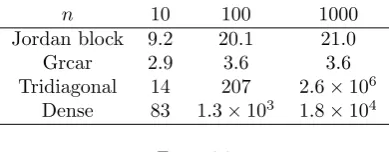
which was used by Liesen and Strakoˇs [37] as an example of a nonnormal tridiagonal Toeplitz matrix. Our final example is the dense matrix defined by the generating function f(x) = |x|eix, x ∈ [−π, π]. The condition numbers of these matrices are given in Table 6.1.
In all cases, the right-hand side vector b is a random vector scaled to have unit length. Our stopping criteria are that the relative residual satisfies krkk2/kr0k2 <
10−8 or that this residual reduction is not achieved in 1000 iterations. We denote
Table 6.1
Condition numbers of unpreconditioned matrices.
n 10 100 1000
Jordan block 9.2 20.1 21.0
Grcar 2.9 3.6 3.6
Tridiagonal 14 207 2.6×10⁶
[image:12.595.104.406.226.383.2]Dense 83 1.3×10³ 1.8×10⁴
Table 6.2
Matrix-vector products for the Jordan block with eigenvalue 1.1.
n GMRES LSQR MINRES SQMR
Unpreconditioned
10 10 20 10 10
100 98 200 100 100
1000 183 372 368 368
Strang
10 3 6 4 2
100 3 6 4 2
1000 3 6 4 2
Optimal
10 9 14 10 8
100 8 18 13 8
1000 5 12 10 5
Superoptimal
10 10 18 10 9
100 12 30 22 12
1000 7 18 16 8
the superoptimal preconditioner can be expressed in terms of the optimal precondi-tioner [7].
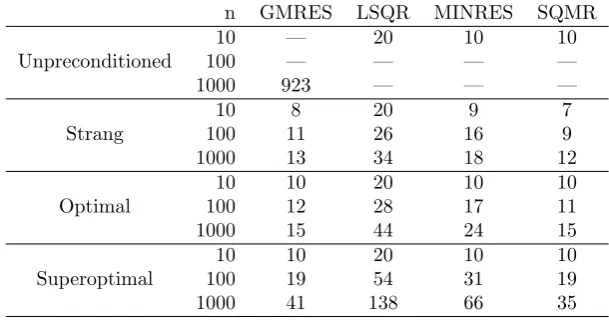
Tables 6.2–6.5 show the numbers of matrix-vector products for the different pre-conditioners and iterative methods. (All methods require one matrix-vector product per iteration except LSQR, which requires two.) We see that for each of these prob-lems the preconditioners are effective for all methods tested. However, theoretical bounds on convergence exist only for LSQR and MINRES, both of which minimize the preconditioned residual. LSQR requires more matrix-vector products than the proposed MINRES method for all problems and so it appears that the latter may be preferable in practice. It is clear that GMRES converges faster than MINRES for these examples; however, there are no theoretical guarantees of fast convergence and it is well known that convergence is not necessarily governed by eigenvalues [2, 27]. Moreover, GMRES requires long recurrences, in contrast to the proposed MINRES method, so that each iteration becomes more expensive. From Tables 6.4 and 6.5 we see that the superoptimal preconditioner is not as effective as the optimal or Strang preconditioners for the two ill-conditioned problems. This may be related to the lack of satisfaction of our theory, but it is also known in the symmetric case that when
An is ill conditioned the superoptimal preconditioner may preserve small eigenvalues that hamper convergence [19, 50] (c.f. the eigenvalue distribution for the example presented after Proposition 5).
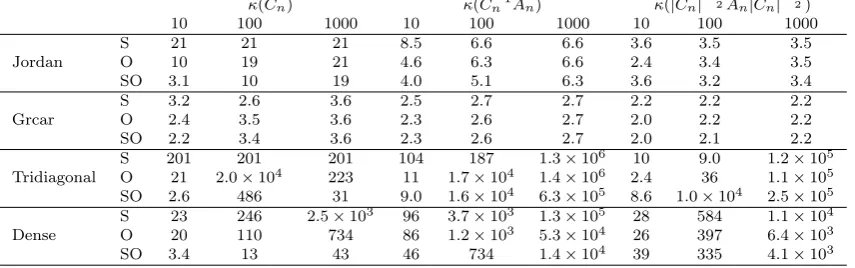
The condition numbers of the preconditioned matrices are given in Table 6.6. We see that the condition number of|Cn|−1/2YnAn|Cn|−1/2=|Cn|−1/2An|Cn|−1/2is typi-cally smaller than that ofC−1
Table 6.3
Matrix-vector products for the Grcar matrix.
n GMRES LSQR MINRES SQMR
Unpreconditioned
10 10 20 10 10
100 79 64 60 60
1000 300 66 66 66
Strang
10 6 18 10 5
100 5 18 10 4
1000 5 18 10 4
Optimal
10 11 20 10 10
100 9 22 16 8
1000 7 20 14 6
Superoptimal
10 11 20 10 10
100 9 24 18 9
[image:13.595.104.406.325.490.2]1000 7 20 14 7
Table 6.4
Matrix-vector products for the tridiagonal matrix.
n GMRES LSQR MINRES SQMR
Unpreconditioned
10 10 20 10 10
100 97 200 100 100
1000 985 — — —
Strang
10 4 12 6 3
100 4 12 6 3
1000 4 12 6 3
Optimal
10 9 14 9 9
100 10 20 13 11
1000 11 32 18 11
Superoptimal
10 10 20 10 10
100 18 48 29 17
[image:13.595.101.406.528.688.2]1000 30 106 57 30
Table 6.5
Matrix-vector products for the dense matrix.
n GMRES LSQR MINRES SQMR
Unpreconditioned
10 — 20 10 10
100 — — — —
1000 923 — — —
Strang
10 8 20 9 7
100 11 26 16 9
1000 13 34 18 12
Optimal
10 10 20 10 10
100 12 28 17 11
1000 15 44 24 15
Superoptimal
10 10 20 10 10
100 19 54 31 19
Table 6.6
Condition numbers of the Strang (S), optimal (O) and superoptimal (SO) circulant precondi-tioned matrices.
κ(Cn) κ(Cn−1An) κ(|Cn|− 1
2An|Cn|−12)
10 100 1000 10 100 1000 10 100 1000
Jordan
S 21 21 21 8.5 6.6 6.6 3.6 3.5 3.5
O 10 19 21 4.6 6.3 6.6 2.4 3.4 3.5
SO 3.1 10 19 4.0 5.1 6.3 3.6 3.2 3.4
Grcar
S 3.2 2.6 3.6 2.5 2.7 2.7 2.2 2.2 2.2
O 2.4 3.5 3.6 2.3 2.6 2.7 2.0 2.2 2.2
SO 2.2 3.4 3.6 2.3 2.6 2.7 2.0 2.1 2.2
Tridiagonal
S 201 201 201 104 187 1.3×10⁶ 10 9.0 1.2×10⁵
O 21 2.0×10⁴ 223 11 1.7×10⁴ 1.4×10⁶ 2.4 36 1.1×10⁵
SO 2.6 486 31 9.0 1.6×10⁴ 6.3×10⁵ 8.6 1.0×10⁴ 2.5×10⁵
Dense
S 23 246 2.5×10³ 96 3.7×10³ 1.3×10⁵ 28 584 1.1×10⁴ O 20 110 734 86 1.2×10³ 5.3×10⁴ 26 397 6.4×10³
SO 3.4 13 43 46 734 1.4×10⁴ 39 335 4.1×10³
convergence of GMRES or SQMR cannot be directly related to the conditioning of
Cn−1An. Since the condition number of Cn is small for the Jordan block and the Grcar matrix, Proposition 5 guarantees that the eigenvalues of |Cn|−1/2An|Cn|−1/2 of the Strang preconditioned matrix are clustered, similarly to the eigenvalues of (C−1
n An)T(Cn−1An) for the normal equations. The same comparison cannot be made in all cases for the tridiagonal or dense matrices, sinceCn may be ill-conditioned, yet we find that convergence is still better faster than that of LSQR for these problems, as measured by the number of matrix-vector products needed to achieve the desired residual norm reduction. Additionally, the eigenvalue results following Proposition 5 indicate that the eigenvalue bounds may not reflect the actual eigenvalue distribution.
7. Conclusions. We have shown that linear systems with nonnormal Toeplitz coefficient matrices can be efficiently solved by a preconditioned MINRES method by a simple reordering of rows or columns and the application of a suitable circulant preconditioner. The resulting method minimizes the preconditioned residual in the Euclidean norm, uses short-term recurrences and its rate of convergence is bounded in terms of the eigenvalues of the preconditioned coefficient matrix. The preconditioner itself is no more difficult to apply than existing circulant preconditioners for Toeplitz matrices, and our theory shows that the preconditioned MINRES method typically has fast convergence.
Our numerical results demonstrate that when modified Strang, optimal and su-peroptimal preconditioners are used, the preconditioned MINRES method converges rapidly. Although convergence can be achieved with fewer matrix-vector products when GMRES and SQMR are applied, each of these methods has its drawbacks: GM-RES requires long recurrences while SQMR does not minimize the residual. Moreover, for neither method do there exist nice convergence bounds like those for MINRES.
Since every real matrix is self-adjoint with respect to some bilinear form, in the-ory this idea of symmetrizing a matrix and applying MINRES can always be ap-plied [45, 46]. In practice, the bilinear form is often difficult to obtain but there are certain matrices, such as the persymmetric matrices described above, or Hamiltonian matrices [26, page 215], for which the bilinear form is known and is easy to use, and in these cases the proposed MINRES method could be used in an analogous manner.
suggestions and references. We also thank David Titley-Peloquin for fruitful discus-sions and comments on an earlier version of this manuscript.
REFERENCES
[1] A. Aric`o and M. Donatelli,A V-cycle multigrid for multilevel matrix algebras: Proof of
optimality, Numer. Math., 105 (2007), pp. 511–547.
[2] M. Arioli, V. Pt´ak, and Z. Strakoˇs,Krylov sequences of maximal length and convergence of GMRES, BIT, 38 (1998), pp. 636–643.
[3] Stephen L Campbell, Ilse CF Ipsen, C Tim Kelley, and Carl D Meyer,Gmres and the minimal polynomial, BIT, 36 (1996), pp. 664–675.
[4] R. H. Chan, Circulant preconditioners for Hermitian Toeplitz systems, SIAM J. Matrix Anal. Appl., 10 (1989), pp. 542–550.
[5] R. H. Chan and W.-K. Ching,Toeplitz-circulant preconditioners for Toeplitz systems and their application to queuing networks with batch arrivals, SIAM J. Sci. Comput., 17 (1996), pp. 762–772.
[6] R. H. Chan and X.-Q. Jin, A family of block preconditioners for block systems, SIAM J. Sci. Stat. Comput., 13 (1992), pp. 1218–1235.
[7] R. H. Chan, X.-Q. Jin, and M.-C. Yeung,The circulant operator in the Banach algebra of matrices, Linear Algebra Appl., 149 (1991), pp. 41–53.
[8] R. H. Chan and M. K. Ng,Conjugate gradient methods for Toeplitz systems, SIAM Rev., 38
(1996), pp. 427–482.
[9] R. H. Chan, D. Potts, and G. Steidl,Preconditioners for nondefinite Hermitian Toeplitz systems, SIAM J. Matrix Anal. Appl., 22 (2000), pp. 647–665.
[10] ,Preconditioners for non-Hermitian Toeplitz systems, Numer. Linear Algebra Appl., 8 (2001), pp. 83–98.
[11] R. H. Chan and G. Strang,Toeplitz equations by conjugate gradients with circulant precon-ditioners, SIAM J. Sci. and Stat. Comput., 10 (1989), pp. 104–119.
[12] R. H. Chan and M.-C. Yeung, Circulant preconditioners constructed from kernels, SIAM J. Numer. Anal., 29 (1992), pp. 1093–1103.
[13] ,Circulant preconditioners for complex Toeplitz matrices, SIAM J. Numer. Anal., 30 (1993), pp. 1193–1207.
[14] R. H.-F. Chan and X.-Q. Jin,An Introduction to Iterative Toeplitz Solvers, SIAM, Philadel-phia, PA, 2007.
[15] T. F. Chan,An optimal circulant preconditioner for Toeplitz systems, SIAM J. Sci. Stat. Com-put., 9 (1988), pp. 766–771.
[16] W. M. Cheung and M. K. Ng, Block-circulant preconditioners for systems arising from discretization of the three-dimensional convection-diffusion equation, J. Com-put. Appl. Math., 140 (2002), pp. 143–158.
[17] S.-C. T. Choi,Minimal residual methods for complex symmetric, skew symmetric, and skew Hermitian systems, Tech. Report ANL/MCS-P3028-0812, Computation Institute, Univer-sity of Chicago, 2013.
[18] F. Di Benedetto, C. Estatico, and S. Serra-Capizzano,Superoptimal preconditioned con-jugate gradient iteration for image deblurring, SIAM J. Sci. Comput., 26 (2005), pp. 1012– 1035.
[19] F. Di Benedetto and S. Serra-Capizzano, Spectral analysis of the superotpimal matrix algebra operators, Tech. Report 439, Dept. of Mathematics, Universit`a di Genova, 2001. [20] S. C. Eisenstat and I. C. F. Ipsen,Relative perturbation techniques for singular value
prob-lems, SIAM J. Numer. Anal., 32 (1995), pp. 1972–1988.
[21] H. Elman, D. Silvester, and A. Wathen,Finite elements and fast iterative solvers with applications in incompressible fluid dynamics, Oxford University Press, 2005.
[22] V. Faber and T. Manteuffel, Necessary and sufficient conditions for the existence of a
conjugate gradient method, SIAM J. Numer. Anal., 21 (1984), pp. 352–362.
[23] B. Fischer, A. Ramage, D. J. Silvester, and A. J. Wathen,Minimum residual methods for augmented systems, BIT, 38 (1998), pp. 527–543.
[24] R W. Freund and N. M. Nachtigal, QMR: A quasi-minimal residual method for non-Hermitian linear systems, Numer. Math., 60 (1991), pp. 315–339.
[25] R. W. Freund and N. M. Nachtigal,Software for simplified Lanczos and QMR algorithms, Appl. Numer. Math., 19 (1995), pp. 319–341.
[27] A. Greenbaum and Z. Strakoˇs,Matrices that generate the same Krylov residual spaces, in Recent Advances in Iterative Methods, G. Golub, A. Greenbaum, and M. Luskin, eds., vol. 60 of The IMA Volumes in Mathematics and its Applications, Springer, New York, NY, 1994.
[28] L. Hemmingsson,A semi-circulant preconditioner for the convection-diffusion equation, Nu-mer. Math., 81 (1998), pp. 211–248.
[29] M. R. Hestenes and E. Stiefel,Methods of conjugate gradients for solving linear systems,
J. Res. Nat. Bur. Standards, 49 (1952), pp. 409–436.
[30] N. J. Higham,Functions of Matrices, SIAM, Philadelphia, PA, USA, 2008.
[31] R. A. Horn and C. R. Johnson, Topics in Matrix Analysis, Cambridge Univeristy Press, 1991.
[32] T. Huckle,Circulant and skewcirculant matrices for solving Toeplitz matrix problems, SIAM
J. Matrix Anal. Appl., 13 (1992), pp. 767–777.
[33] T. Huckle, S. Serra-Capizzano, and C. Tablino-Possio,Preconditioning strategies for non-Hermitian Toeplitz linear systems, Numer. Linear Algebra Appl., 12 (2005), pp. 211–220. [34] T. Ku and C.-C. J. Kuo,On the spectrum of a family of preconditioned block Toeplitz matrices,
SIAM J. Sci. and Stat. Comput., 13 (1992), pp. 948–966.
[35] T.-K. Ku and C.-C. J. Kuo,Design and analysis of Toeplitz preconditioners, IEEE T. Signal Process., 40 (1992), pp. 129–141.
[36] ,Spectral properties of preconditioned rational Toeplitz matrices: the nonsymmetric case, SIAM J. Mat. Anal. Appl., 14 (1993), pp. 521–544.
[37] J. Liesen and Z. Strakoˇs,Convergence of GMRES for tridiagonal Toeplitz matrices, SIAM J. Matrix Anal. Appl., 26 (2004), pp. 233–251.
[38] M. K. Ng,Iterative Methods for Toeplitz Systems, Oxford University Press, 2004.
[39] M. K. Ng and D. Potts,Circulant preconditioners for indefinite Toeplitz systems, BIT, 41 (2001), pp. 1079–1088.
[40] J. Olkin,Linear and Nonlinear Deconvolution Problems, PhD thesis, Rice University, Houston, TX, 1986.
[41] I. Oseledets and E. Tyrtyshnikov,A unifying approach to the construction of circulant preconditioners, Linear Algebra Appl., 418 (2006), pp. 435–449.
[42] C. C. Paige and M. A. Saunders,Solution of sparse indefinite systems of linear equations, SIAM J. Numer. Anal., 12 (1975), pp. 617–629.
[43] , LSQR: An algorithm for sparse linear equations and sparse least squares, ACM T. Math. Software, 8 (1982), pp. 43–71.
[44] H.-K. Pang, Y.-Y. Zhang, and X.-Q. Jin, Tri-diagonal preconditioner for pricing options, J. Comput. Appl. Math., 236 (2012), pp. 4365–4374.
[45] J. Pestana,Nonstandard Inner Products and Preconditioned Iterative Methods, PhD thesis, University of Oxford, 2011.
[46] J. Pestana and A. J. Wathen,On choice of preconditioner for minimum residual methods for non-Hermitian matrices, J. Comput. Appl. Math., 249 (2013), pp. 57–68.
[47] Y. Saad and M. H. Schultz,GMRES: a generalized minimal residual algorithm for solving nonsymmetric linear systems, SIAM J. Sci. Stat. Comput., 7 (1986), pp. 856–869. [48] S. Serra Capizzano and E. Tyrtyshnikov,Any circulant-like preconditioner for multilevel
matrices is not superlinear, SIAM J. Mat. Anal. Appl., 21 (1999), pp. 431–439.
[49] G. Strang,A proposal for Toeplitz matrix calculations, Stud. Appl. Math., 74 (1986), pp. 171– 176.
[50] V. V. Strela and E. E. Tyrtyshnikov,Which circulant preconditioner is better?, Math. Com-put., 65 (1996), pp. 137–150.
[51] L. N. Trefethen and M. Embree,Spectra and Pseudospectra: The Behavior of Nonnormal Matrices and Operators, Princeton University Press, Princeton, 2005.
[52] E. E. Tyrtyshnikov,Optimal and superoptimal circulant preconditioners, SIAM J. Matrix Anal. Appl., 13 (1992), pp. 459–473.
[53] E. E. Tyrtyshnikov and A. Yu. Yeremin and N. L. Zamarashkin,Clusters, preconditioners,
convergence, Linear Algebra Appl., 263 (1997), pp. 25–48.
[54] H. A. van der Vorst,Bi-CGSTAB: A fast and smoothly converging variant of BiCG for the solution of nonsymmetric linear systems, SIAM J. Sci. Statist. Comput., 13 (1992), pp. 631–644.
[55] C. Van Loan,Computational Frameworks for the Fast Fourier Transform, SIAM, Philadelphia,
PA, 1992.