City, University of London Institutional Repository
Citation
:
Endress, A. and Mehler, J. (2009). Primitive computations in speech processing.
Quarterly Journal of Experimental Psychology, 62(11), pp. 2187-2209. doi:
10.1080/17470210902783646
This is the accepted version of the paper.
This version of the publication may differ from the final published
version.
Permanent repository link:
http://openaccess.city.ac.uk/5545/
Link to published version
:
http://dx.doi.org/10.1080/17470210902783646
Copyright and reuse:
City Research Online aims to make research
outputs of City, University of London available to a wider audience.
Copyright and Moral Rights remain with the author(s) and/or copyright
holders. URLs from City Research Online may be freely distributed and
linked to.
City Research Online:
http://openaccess.city.ac.uk/
[email protected]
Primitive computations in speech processing
Ansgar D. Endress
Harvard University, Cambridge, MA, USA
Jacques Mehler
International School for Advanced Studies, Trieste, Italy
Previous research suggests that artificial-language learners exposed to quasi-continuous speech can learn that the first and the last syllables of words have to belong to distinct classes (e.g., Endress & Bonatti, 2007; Pen˜a, Bonatti, Nespor, & Mehler, 2002). The mechanisms of these generalizations, however, are debated. Here we show that participants learn such generalizations only when the crucial syllables are in edge positions (i.e., the first and the last), but not when they are in medial positions (i.e., the second and the fourth in pentasyllabic items). In contrast to the generalizations, participants readily perform statistical analyses also in word middles. In analogy to sequential memory, we suggest that participants extract the generalizations using a simple but specific mechan-ism that encodes the positions of syllables that occur in edges. Simultaneously, they use another mech-anism to track the syllable distribution in the speech streams. In contrast to previous accounts, this model explains why the generalizations are faster than the statistical computations, require additional cues, and break down under different conditions, and why they can be performed at all. We also show that that similar edge-based mechanisms may explain many results in artificial-grammar learning and also various linguistic observations.
Keywords: Artificial-grammar learning; Serial memory; Language acquisition.
Traditionally, the mind has been seen as capable of formal symbolic operations (e.g., Fodor, 1975, 1983; Fodor & Pylyshyn, 1988; Lehman, Laird, & Rosenbloom, 1998; Newell, 1980, 1990), which has led many researchers to liken it to a computer. On the other hand, there is overwhelm-ing evidence, in part from the artificial-language-learning literature, that humans and other animals have sophisticated statistical abilities (e.g., Aslin, Saffran, & Newport, 1998; Hauser,
Newport, & Aslin, 2001; Saffran, Aslin, & Newport, 1996). However, it is still unclear under which conditions symbolic and statistical processes operate and if (and how) they interact. A situation where both statistical and nonstatisti-cal operations can be observed simultaneously would thus help to clarify these questions.
Such an experimental paradigm has been devised by Pen˜a, Bonatti, Nespor, and Mehler (2002). Theirs and subsequent studies suggest that
Correspondence should be addressed to Ansgar D. Endress, Harvard University, William James Hall 984, 33 Kirkland St, Cambridge MA 02138, USA. E-mail: [email protected]
This research was supported by Grant L.R. 3/98 from the Regione Friuli Venezia Giulia, by the McDonnell Foundation Grant 21002089, and by the European Commission Special Targeted Project CALACEI (Contract No. 12778 NEST). We are grateful to A´ . Kova´cs for helpful discussions and suggestions.
#2009 The Experimental Psychology Society
1
http://www.psypress.com/qjep DOI:10.1080/17470210902783646
participants may learn a regularity defined over syl-lable classes, while simultaneously performing complex statistical operations (Endress & Bonatti, 2007). However, the mechanisms of the generaliz-ations remained elusive despite substantial research (e.g., Balaguer, Toro, Rodriguez-Fornells, & Bachoud-Le´vi, 2007; Mueller, Bahlmann, & Friederici, 2008; Pacton & Perruchet, 2008; Perruchet, Tyler, Galland, & Peereman, 2004; Seidenberg, MacDonald, & Saffran, 2002). A par-ticularly important issue concerns the question of whether these results can be explained by a single, associationist mechanism, or whether one needs to posit different kinds of mechanisms for the general-izations and the statistical computations, respect-ively. Here, we ask what participants learned in these experiments, hoping that answers to this ques-tion will also provide clues to the underlying learn-ing mechanisms.
In the aforementioned experiments, partici-pants may have extracted generally applicable classes (like nouns and verbs in language) and may have learned where in words these have to occur. Alternatively, they may have learned the positions of certain syllables without extracting any classes at all; participants may have learned that one syllable set had to occur in word-onsets, while another syllable set had to occur in word-offsets, without these sets being classes in any meaningful sense.
These possibilities can be tested by noting that the crucial syllables in the aforementioned exper-iments always occurred in the word-edges. Research on sequential memory suggests, however, that edges are particularly well suited to learn the positions of items because all positions are encoded relative to the sequence-edges (see, e.g., Henson, 1998, for a review). If participants simply encoded the sequential positions of the syl-lables, we would thus expect the generalizations to exhibit the hallmarks of positional memory mech-anisms. Participants thus should learn similar regularities well when the crucial syllables are in edges, but much less so when they are in other pos-itions. If participants had extracted generally applicable classes such as nouns and verbs, in con-trast, they should also learn similar regularities in
the other positions. After all, linguistic classes are not limited to edge positions either. We thus ask whether similar regularities can be learned only when the crucial syllables are in the word-edges, or also when they are located in other positions.
These predictions can also be derived by con-sidering the kinds of grammatical processes that may be mirrored by Endress and Bonatti’s (2007) results. On the one hand, participants may have learned grammatical classes, such as nouns and verbs, and a rule-like dependency between these classes, such as the fact that the object of a transi-tive word is a noun. If so, generalizations should be observed both when the crucial syllables are in word-edges and when they are in word-middles. In contrast, if participants just learned that certain syllables had to occur word-initially and others word-finally, such regularities are more likely to reflect affixation rules, such as the English past tense, where the [ed] suffix has to occur word-finally. If so, the generalizations should be much easier to extract in edge positions than in middle positions, since, as we show below, virtually all linguistic regularities that appeal to the positions of items (including affixation) are defined relative to the edges of some linguistic constituents. It is thus possible that, to encode the sequential positions of items, language may use edge-based mechanisms similar to those uncovered in memory research. Here, we start addressing this possibility by asking whether such edge-based mechanisms may be the psycho-logical basis of artificial-grammar-learning results such as those by Pen˜a et al. (2002).
A test case for statistical and nonstatistical
operations
with strings of non-sense syllables (such as PEL– TAM–PEL–JIC). These strings were generated by a finite-state grammar similar to those in artificial-grammar-learning studies with adults (e.g., Miller, 1958; Reber, 1967, 1969). After this familiarization, Go´mez and Gerken (1999) showed that infants detected both item-specific information from the strings and more abstract information. When tested on new strings, they discriminated “legal” strings conforming to the grammar from those with illegal final syllables or illegal syllable bigrams. Infants had also acquired more abstract knowledge from the strings. They could discriminate legal strings from illegal ones even when the strings were implemented using new syllables that the infants had not heard during familiarization.
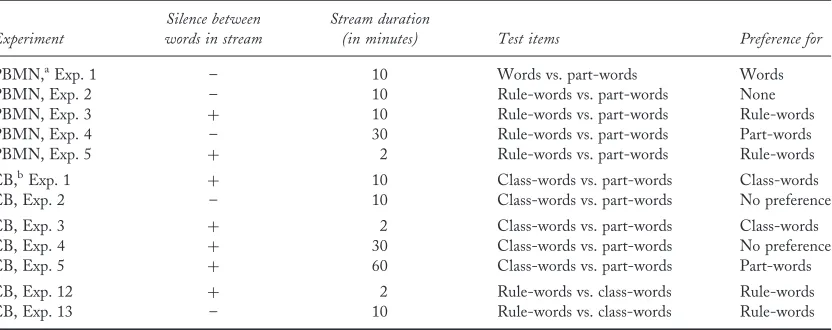
Another paradigm where statistical and nonsta-tistical computations could be observed was devised by Pen˜a et al. (2002). They familiarized participants with continuous speech streams com-posed of a sequence of non-sense words, and asked under which conditions statistical and nonstatisti-cal computations could be observed. In short, while they observed statistical computations under all familiarization conditions, nonstatistical generalizations were observed only when the words in the stream were separated by short silences. Pen˜a et al. (2002) initially suggested that participants had learned a rule-like depen-dency between the first and the last syllables of each word; Endress and Bonatti (2007) sub-sequently showed that participants had rather learned which syllables could occur word-initially, and which could occur word-finally, again only when words were separated by small silences. As the experiments presented here are modelled after those by Pen˜a et al. (2002) and Endress and Bonatti (2007), we now describe their crucial experiments in more detail; these experiments as well as the test items used are summarized in Tables 1 and 2, respectively.
Pen˜a et al. (2002) familiarized participants with a monotonous stream of trisyllabic non-sense
words. In each non-sense word (henceforth just “word”), the first syllable predicted the last syllable with certainty; the middle syllables, in contrast, varied, yielding words of the form AiXCi. (We
use the term “word” just to designate statistically coherent syllable sequences, but do not imply any prosodic or syntactic properties that real words may have.) In line with much research showing that learners can use co-occurrence statistics among syllables such as transitional probabilities (TPs)1to extract words from fluent speech (e.g., Aslin et al., 1998; Saffran, 2001; Saffran et al., 1996), also participants in Pen˜a et al.’s (2002) experiments could use the statistical dependency between the first and the last syllables of words to segment the stream. However, they could not generalize this dependency to new items. Generalization was tested by having participants choose between rule-words and part-words (see Table 2). Rule-words had the structure AiX0Ci;
they conformed to the dependency between the first and the last syllables but had a middle syllable that had never occurred in this position during the stream. Part-words did occur in the stream but straddled a word boundary (e.g., by taking the last syllable from one word and the first two sylla-bles from a following word) and thus did not conform to the regularity between the first and the last syllables. As rule-words did not occur in the stream while part-words did, participants can prefer rule-words to part-words only if they gener-alize the dependency between the first and the last syllables.
When familiarized with a continuous speech stream, participants could not use the statistical regularities in the stream for generalizing the dependency between the first and the last syllables of words, even when exposed to a stream as long as 30 min. When words in the stream were separ-ated by short, probably subliminal, silent pauses of 25 ms, in contrast, participants generalized the dependency after a familiarization of only 2 min. Apparently, these subliminal segmentation cues
1TPs are conditional probabilities on syllable sequences. For two syllabless
were required for the generalizations to be drawn. According to Pen˜a et al. (2002), these silences pro-vided the stream with some minimal bracketing cues, similar to prosodic cues that mark constituent boundaries in real speech. (We come back to the probable role of the silences later.)
[image:5.536.64.480.72.237.2]What were the generalizations that participants extracted? On the one hand, they might have gen-eralized the aforementioned dependency between the first and the last syllables of words. On the other hand, they may have learned that certain syllables had to occur word-initially and others
Table 1.Summary of the main experiments of Pen˜a et al. (2002) and Endress and Bonatti (2007)
Experiment
Silence between words in stream
Stream duration
(in minutes) Test items Preference for
PBMN,aExp. 1 – 10 Words vs. part-words Words
PBMN, Exp. 2 – 10 Rule-words vs. part-words None
PBMN, Exp. 3 þ 10 Rule-words vs. part-words Rule-words
PBMN, Exp. 4 – 30 Rule-words vs. part-words Part-words
PBMN, Exp. 5 þ 2 Rule-words vs. part-words Rule-words
EB,bExp. 1 þ 10 Class-words vs. part-words Class-words
EB, Exp. 2 – 10 Class-words vs. part-words No preference
EB, Exp. 3 þ 2 Class-words vs. part-words Class-words
EB, Exp. 4 þ 30 Class-words vs. part-words No preference
EB, Exp. 5 þ 60 Class-words vs. part-words Part-words
EB, Exp. 12 þ 2 Rule-words vs. class-words Rule-words
EB, Exp. 13 – 10 Rule-words vs. class-words Rule-words
aPBMN: Pen˜a et al. (2002).bEB: Endress and Bonatti (2007).
Table 2.Summary of the main test item types used
Words Part-words Rule-words Class-words
ITEMS USED BY PEN˜ A ET AL. (2002) AND ENDRESS AND BONATTI (2007)
AiXCi CijAjX or AiX0Ci AiX0Cj
XCijAj
ITEMS USED IN THE CURRENT EXPERIMENTS
Edge condition AiXYZCi YZCijAjX or AiX0Y0Z0Ci AiX0Y0Z0Cj ZCijAjXY
Middle condition XAiYCiZ CiZjXAjY or X0AiY0CiZ0 X0AiY0CjZ0 YCiZjXAj
EXPLANATION
Appear in the stream TP(Ai!Ci)¼1
Appear in the stream but straddle a word boundary
As words, but with new X, Y, and Z syllables
As rule-words, but with first and last syllables from different families Violate dep. between
1st and last syllables
Respect dep. between 1st and last syll
Violate dep. between 1st and last syllables Violate class-based
regularity
Respect class-based regularity
Respect class-based regularity
[image:5.536.61.483.367.594.2]word-finally—irrespective of any dependency between particular first and last syllables. If so, they may have learned that the first and the last syllables of words had to belong to distinct syllable classes, the classes being the sets of syllables that could occur in these respective positions. We call this regularity a class-rule. (In the following, we argue that these classes are merely the lists of items that can occur initially and word-finally and not classes such as nouns and verbs; for consistency with Endress and Bonatti’s, 2007, wording, however, we keep the class-terminology.) To evaluate this possibility, Endress and Bonatti (2007) familiarized participants with sylla-ble streams as in Pen˜a et al.’s (2002) experiments. Recall that words had the structure AiXCi, where
the “A” and “C” syllables came from different families. After familiarization, participants had to choose between class-words and part-words. Class-words had the structure AiX0Cj, where Ai
and Cjbelonged to different families, and X0 had
occurred in the familiarization stream but never in word-medial positions (that is, it was either an “A” or a “C” syllable); class-words thus conformed to the class rule (as the initial and the final syllables belonged to the appropriate syllable sets) but never occurred during the familiarization streams (in fact, their constituent syllables came from three different words). As mentioned above, part-words occurred in the stream but straddled a word boundary and thus did not conform to the class-rule. Only if participants generalized the class-rule should they prefer class-words to part-words.
Participants preferred class-words to part-words when familiarized with segmented streams with 25-ms silences between words, but not after familiarizations with continuous streams, suggesting that the subliminal segmentation cues induced participants to extract the class-rule. Endress and Bonatti (2007) then familiarized par-ticipants with segmented streams of various dur-ations. When familiarized with a 2-min stream, participants preferred class-words to part-words; in contrast, when familiarized with a 60-min stream, they preferred part-words to class-words. In between, the preference for class-words was
negatively correlated with the familiarization duration.
Endress and Bonatti (2007) investigated also whether participants could track statistical infor-mation in the speech streams. They familiarized participants with the same streams as before, but then asked them to choose between rule-words and class-words. (As mentioned above, rule-words are similar to rule-words from the speech stream but have a new middle syllable; class-words differ from rule-class-words in that their first and last syllables come from different families. The crucial difference between these test items is thus that the first syllable predicts the last one with probability 1.0 in rule-words, while this probability is 0 in class-words.) Rule-words were preferred to class-words after both segmented and continuous familiarizations, suggesting that participants could track statistical information in either familiarization condition.
Endress and Bonatti (2007) interpreted these results as evidence for an interaction between two mechanisms: A rapid, nonstatistical, mechan-ism may extract the class-rule; this mechanmechan-ism may explain why participants prefer class-words initially. A second, statistical, mechanism may track the syllable distribution; this mechanism should also mediate the familiarity with part-words, which should be strengthened over time. In contrast, no such strengthening should occur for the familiarity with the class-rule, since it may be at ceiling early on. Hence, only the famili-arity with part-words but not that with class-words should be strengthened over time; the pre-ference for class-words compared to part-words should thus disappear for long familiarizations.
2004; Seidenberg et al., 2002). By clarifying the mechanisms of the generalizations, we hope to provide answers also to these questions.
What kinds of classes did participants learn?
While Endress and Bonatti (2007) suggested that participants had learned a regularity entailing sylla-ble classes, a vast literature suggests that it is extre-mely difficult to demonstrate class-learning in artificial-grammar-learning experiments. Where class-learning has been observed, the effects were typically weak and relied on the availability of multiple convergent cues (e.g., Braine, 1987; Gerken, Wilson, & Lewis, 2005; Go´mez & Lakusta, 2004; Mintz, 2002; Monaghan, Chater, & Christiansen, 2005; Redington, Chater, & Finch, 1998). One may thus be suspicious whether Endress and Bonatti’s (2007) classes were classes in the sense of nouns and verbs, or whether there may be a simpler interpretation.
One possible interpretation is that participants have learned the positions of the crucial syllables; they may just have learned which syllable sets occurred in the first and the last positions. This interpretation is made plausible by the observation that the crucial syllables were always located in the word-edges, as it has been shown that edges are particularly conducive to learning regularities involving the positions of items.
To see why edges are well suited for learning positional regularities, it is necessary to consider the kinds of memory that can be used to encode sequences (see Henson, 1998, 1999, for reviews). On the one hand, sequences such as ABCD can be encoded by remembering the transitions A!B, B!C and C!D; this form of memory is strongly related to the transitional probabilities investigated in the literature follow-ing Saffran et al. (1996). On the other hand, one can remember that A came first, D last, and B in the second position. Among many other obser-vations suggesting that these two modes of sequential memory are distinct and independent, the most striking one are maybe intrusion errors, a frequent mistake in memory experiments. Participants can make such errors when recalling
multiple sequences such as ABCD and EFGH. Under these circumstances, they sometimes recall an element in an incorrect sequence—but in its correct position. For example, they may erro-neously recall the sequences EBGH instead of EFGH. Although the item B never occurred with any of the items of the sequence it was recalled in, it kept its correct position from its original sequence. These and many other observations suggest that memory for positions is distinct and at least partially independent from other forms of sequential memory, and that positions must be encoded in a sufficiently abstract way so that they can be generalized from one sequence to another (e.g., Hicks, Hakes, & Young, 1966; Schulz, 1955).
Further research suggests that positions are encoded relative to sequence-edges as anchor points. In fact, according to most recent models of memory for sequential positions, items in a sequence become linked to edge-based, positional codes (whose implementation vary widely among models), and their position is encoded relative to these edge-based codes (e.g., Henson, 1998; Hitch, Burgess, Towse, & Culpin, 1996; Ng & Maybery, 2002). Moreover, it has previously been shown in other artificial-grammar-learning experiments that regularities appealing to the positions of items are learned much more easily when the crucial items occur in the sequence-edges than when they occur in other positions (e.g., Endress & Mehler, in press; Endress, Scholl, & Mehler, 2005); it is thus plausible that this may be the case also for Pen˜a et al.’s (2002) and Endress and Bonatti’s (2007) experiments.
Note that, even if the aforementioned genera-lizations reflect that participants have encoded (and generalized) the positions of certain syllables, they may still reflect language-related processes. Indeed, as we show in more detail in the General Discussion, almost all linguistic regularities appeal-ing to the positions of items are defined relative to the edges of some constituents. Hence, it is possible that a simple memory process such as the one encod-ing the positions of items in a sequence may be used for a wide variety of linguistic computations.
The current experiments
In the experiments presented below, we ask whether the generalizations observed by Pen˜a et al. (2002) can be explained by an edge-based mechanism, or whether they may also be available in other positions. The test items and experiments are summarized in Tables 2 and 3, respectively. We asked whether participants can extract a class-based rule in longer words when the crucial syllables are located either in edge positions or in nonedge positions. Participants were familiarized with a segmented stream of pentasyllabic items. In Experiment 1a, we asked whether they could learn that the first and the last syllables of words had to belong to distinct syllable classes. Experiment 1b asked the same question for the second and the fourth positions (such that the crucial syllables were no longer in edge positions). Experiment 2 asked whether such generalizations would also be possible when participants were familiarized with continuous streams. If partici-pants had learned classes such as nouns and verbs, they should generalize fairly well also
when the crucial syllables were located in word-middles. In contrast, if they had simply encoded the positions of the crucial syllables, the genera-lizations should be much stronger when the crucial syllables are in the word-edges. Finally, Experiment 3 tested whether participants could perform statistical computations in word-middles.
EXPERIMENT 1A: GENERALIZATIONS
IN WORD-EDGES
This experiment asked whether participants can learn a class-based regularity in pentasyllabic words when the critical syllables are located in the word-edges. Participants were familiarized with a concatenation of words with the structure
AiXYZCi; words in this stream were separated by silences. In each word, the first syllable predicted the last syllable with certainty, while the middle syllables were variable. The structure of the words was thus analogous to those used by Pen˜a et al. (2002), except that they had three (instead of one) middle syllables (see Table 2). As in Pen˜a et al.’s (2002) experiments, the crucial “A” and “C” syllables were located in word-edges.
[image:8.536.56.476.518.593.2]Participants were told that they would listen to a monologue in Martian (a made-up language). After this familiarization, they were presented with pairs of items. As the purpose of the present experiment was to investigate the psycho-logical mechanisms of the fast, class-based gener-alizations observed by Endress and Bonatti (2007), we chose similar test items as in their experiments; participants thus had to choose class-words and part-words. In each trial, they
Table 3.Summary of the experiments
Exp. Silence between words in stream Position of crucial syll. Word Test items Preference for
1a þ First, last AiXYZCi Class-words vs. part-words Class-words 1b þ 2nd, 4th XAiYCiZ Class-words vs. part-words None
2a – First, last A
iXYZCi Class-words vs. part-words Part-words – 2nd, 4th XAiYCiZ Class-words vs. part-words Part-words 3 þ 2nd, 4th XAiYCiZ Rule-words vs. class-words Rule-words
aThe conditions with the first and the last syllables as crucial syllables and with the second and fourth syllables as crucial syllables were
had to decide which of these items sounded more Martian-like. As mentioned above, class-words conformed to the class-based regularity, but they did not appear in the speech stream. Their first and last syllables had occurred in these respective positions but never in the same word; their middle syllable had never occurred in middle pos-itions during familiarization. Part-words, in con-trast, did occur during the stream but straddled a word boundary and thus did not conform to the class-rule. If participants had learned that the first and the last syllables had to be members of distinct classes (where the “classes” may be merely the lists of syllables that can occur in these positions), they should prefer class-words to part-words, but not otherwise.
Method
Participants
A total of 14 French participants (7 females, 7 males, mean age 24.2 years, range 19 –34 years) took part in this experiment for monetary reward.
Apparatus
All experiments were run on a PC using Presentationw software. Participants were tested individually in a quiet room. Stimuli were pre-sented over headphones. Responses were collected on premarked keys on a keyboard.
Familiarization
Participants were familiarized with a syllable stream of 3.45 min constructed from a concatena-tion of non-sense words (henceforth just “words”). Participants were informed that they would hear a monologue in Martian and that they would have to discover the words it contained.
Words had the structure AiXYZCi, where the “A” and “C” syllables belonged to four different Ai. . .Ci combinations (called “families”: ba. . .de,
fu. . .gi, mY. . .lo, Ri. . .na). The “X”, “Y”, and “Z”
syllables were filler syllables (as the “X” syllables in Pen˜a et al.’s, 2002, words). Three syllables could appear in each of the “X”, “Y”, and “Z” pos-itions (X:/fa/,/Re/,/zu/; Y: /do/,/lY/,/ne/;
Z:/bo/,/gu/,/zi/). The transition probabilities
(TPs) between “X” and “Y” syllables and between “Y” and “Z” syllables were .5, those between “A” and “X” syllables .33, and those between “Z” and “C” syllables .25; TPs across word boundaries were .33. Concerning the higher order TPs, the first syllable predicted the last syllable with cer-tainty (i.e., the corresponding TP was 1.0) while the other TPs were much smaller. The stream con-tained two repetitions of each of the 48 words; no syllable could appear in two consecutive words.
In contrast to Pen˜a et al. (2002) and Endress and Bonatti (2007), where words in the segmented streams were separated by 25-ms silences, pilot studies revealed that such silences would not be sufficient for inducing generalizations in pentasyl-labic words, maybe due in part to their more complex statistical structure, or to the prosodic implausibility of flat five-syllable items. We thus used clearly perceptible silences of 1 s.
The stream was synthesized using the fr2 (French female) diphone base of MBROLA (Dutoit, Pagel, Pierret, Bataille, & van der Vreken, 1996). It was synthesized with an increas-ing amplitude ramp in the first 5 s and a decreasincreas-ing amplitude ramp in the last 5 s. This ensures that the stream fades in and out at no point corre-sponding to either words or part-words. (In this experiment, the silences gave clearly perceptible cues to word onsets, but we used the ramping manipulation nevertheless to keep the material as close as possible to that of Experiment 2, where the speech stream was continuous.) Syllables had a duration of 232 ms and a fundamental frequency of 200 Hz.
Test
Participants had to choose between class-words and part-words (see below and Table 2); they had to decide which of these alternatives was more likely to be a Martian word. Test items were synthesized using the fr2 diphone base of MBROLA (Dutoit et al., 1996) with the same parameters as those for the familiarization stream. Class-words had the form AiX0YZ0Cj. As Ai
and Cj belonged to different families, the TPs
these syllables appeared in the positions in which they had been encountered during familiarization (that is, in the first and the last positions in words, respectively) and thus conformed to the class-rule. Y syllables were the same as those in the familiarization stream. Finally, the X0
and Z0 syllables have never appeared in their
respective positions during familiarization but were “A” or “C” syllables from the stream; hence, class-words could have one of the following struc-tures: AiAkYAlCj, AiAkYClCj and AiCkYAlCj,
AiCkYClCj, which were equally represented in
the test pairs. All “A” and “C” syllables in a class-word came from different families.
Part-words could have one of the following structures: XYZCijAj, YZCijAjX, ZCijAjXY and
CijAjXYZ, where the vertical bars indicate the
pos-itions of word boundaries during the familiariz-ation (although no boundaries were present in part-words during test). We used only two types of part-words, namely YZCijAjX and ZCijAjXY,
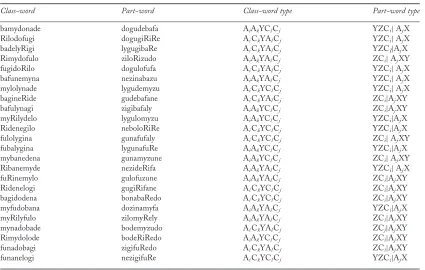
because “A” and “C” syllables would appear in the edges of the other part-word types. We used 24 test pairs presented once in random order. In each pair, the class-words shared the “A”, “C”, and “Y” syllables with the part-word. Half of the trials started with a class-word and the other half with a part-word. Appendix A lists all test pairs.
Results
As shown in Figure 1, participants preferred class-words to part-class-words (percentage of preference for class-words:M¼63.7%,SD¼9.9%),t(13)¼5.2, p,.0002, Cohen’s d¼1.4, confidence interval, CI.95¼58.0%, 69.39%; the preference for
class-words did not differ depending on the part-word type in a test pair, t(13)¼0.2,p¼.813, Cohen’s d¼0.07, ns (paired t test). (Statistical tests are two-tailed throughout this article; t tests are reported with respect to a chance level of 50%.)
EXPERIMENT 1B: GENERALIZATIONS
IN WORD-MIDDLES
Experiment 1b was almost identical to Experiment 1a except that participants had to learn that “A”
and “C” syllables had to belong to distinct classes in words with the form XAiYCiZ (rather than
AiXYZCi as in Experiment 1a); in other words, the critical syllables were now word-medial rather than in word-edges. Again, the particularity of the relation between each Aiand its Ciwas that
the TP between these syllables was 1.0. We thus asked whether participants could learn that the second and the fourth positions in words had to belong to distinct classes (noting again that these classes may be merely the lists of syllables that can occur in these positions). In contrast to Experiment 1a, where the crucial syllables were in edges, the crucial syllables were now in middles. After familiarization with a speech stream, participants had again to choose between class-words and part-words.
Method
Participants
A total of 14 French participants (8 females, 6 males, mean age 25.9 years, range 18 –58 years) took part in this experiment for monetary reward.
Familiarization
The familiarization stream was constructed as in Experiment 1a, except that words had the struc-ture XAiYCiZ such that the critical syllables were no longer in the edges. The assignment of the syl-lables to the different positions (X, A, Y, C, and Z) was mostly the same as that in Experiment 1a. In order to avoid French words in the stimuli, /na/
has been used as a “Z” syllable rather than “C” syl-lable,/zi/as a “C” syllable rather than a “Z” sylla-ble, /fa/ as a “Z” syllable rather than an “X” syllable, and/gu/as an “X” syllable rather than a “Z” syllable.
Test
Also in this test phase, participants had to choose between class-words and part-words; again, they should prefer class-words only if they extracted the class-rule.
Class-words had the form X0A
iYCjZ0, where X0
and Z0were in reality “A” and “C” syllables and had
never appeared in initial or final positions during fam-iliarization. As in Experiment 1a, Aiand Cjbelonged
to distinct families; the TPs between the “A” and “C” syllables were thus broken. Still, since these syllables appeared in the positions in which they were encoun-tered during familiarization, class-words respected the class-rule. Importantly, in contrast to Endress and Bonatti’s (2007) experiments and Experiment 1a, the crucial syllables occurred in middles rather than in edges.
Class-words could have one of the following structures: AkAiYCjAl, AkAiYCjCl, CkAiYCjAl,
or CkAiYCjCl; each of these structures appeared
equally often in the test pairs. Part-words could have the structures AiYCiZjX, YCiZjXAj,
CiZjXAjY, and ZjXAjYCj, but we used only the
structures CiZjXAjY and YCiZjXAj, because these
[image:11.536.118.415.66.357.2]are the only structures where the “A” and “C” sylla-bles come from different families, and where the “X” and “Z” syllables do not occur in edges, and because the word boundaries in these part-words were at the same positions as in Experiment 1a (that is, between the second and the third syllables, or between the third and the fourth syllables). Each part-word type was represented equally in the test pairs. In each test pair, both test items shared the “A”, “C”, and “Y” syllables.
We assessed the influence of the frequency of the transitions between “Z” and “X” syllables in part-words by forming a “frequent” group of part-words with an average TP of .416 between “Z” and “X” and a “rare” group with an average TP of .168 between “Z” and “X”, and we included this factor in the data analysis. Appendix B shows the test pairs used in Experiment 1b. Test pairs were presented in random order.
Results
As shown in Figure 1, participants had no prefer-ence for class-words (M¼48.2%, SD¼12.1%), t(13)¼0.6, p¼.59, Cohen’s d¼0.15, CI.95¼
41.2%, 55.2%,ns. A repeated measure analysis of variance (ANOVA) with the intrasubject factors part-word type and frequency of the transitions in words revealed no main effect of the part-word type,F(1, 13)¼1.3,p¼.269,hp2¼.09,ns,
nor of the frequency of the transitions, F(1, 13)¼1.4, p¼.264,hp2¼.09,ns; neither did the
interaction between these factors reach signifi-cance,F(1, 13),.01,p¼.928,hp2,.01,ns.
The preference for class-words was higher in Experiment 1a than in Experiment 1b, F(1, 26)¼13.8,p,.001,h2¼.35.
Discussion
Experiments 1a and 1b investigated whether the extraction of a class-based regularity from a speech stream such as the one observed by Endress and Bonatti (2007) is limited to word-edges, or whether it can be observed also in word-medial positions. This would allow us to determine whether participants had learned classes such as nouns and verbs (that should not be limited to edge-positions), or whether they had generalized the positions of the crucial syllables by mechanisms of positional memory (in which case the generalizations should be observed primarily in edges).
In Experiments 1a and 1b, participants had to learn that the “A” and “C” syllables had to belong to different classes in words with the struc-tureAiXYZCi(where the critical syllables were in
the edges; Experiment 1a) or in words with the structure XAiYCiZ (where the critical syllables were in word-medial positions; Experiment 1b). Participants preferred class-words to part-words in Experiment 1a (where the critical syllables were in the edges), but not in Experiment 1b (where the critical syllables were in word-middles). These results suggest that participants learned the positions of the crucial syllables by the edge-based mechanisms of positional memory, rather than extracting general classes such as nouns and verbs.
Of course, given the small effect size in Experiment 1b, the statistical power is low with only 14 participants; in fact, the power is only 8%. However, given this effect size, one would need at least 362 participants to achieve a power of at least 80%. It thus seems that, even if we did not detect a significant effect in Experiment 1b due to our small sample size, this effect, if it exists, was much smaller in Experiment 1b than in Experiment 1a. As discussed below in more detail, this is in fact the prediction of our central conclusion: It is much easier to generalize the positions of syllables when the critical syllables are in the word-edges than when they are in word-middles.
Still, participants may not generalize in middles for another reason. In class-words in the middle condition, the edge syllables have not occurred in these positions during familiarization—because they were taken from syllables that occurred only in middles during familiarization. Hence, the edge syllables in class-words may be perceived as “illegal”, which may lead participants to reject these items in the middle condition. This may be so, but it highlights again the importance of edges for the participants’ choices. If the syllables that occurred in edges during familiarization are not in the appropriate positions during test, par-ticipants may well simply reject these items. Violations in other positions, however, seem to be much less important; after all, in class-words in the edge condition, the middle syllables were illegal in just the same way.
tracked in word-middles (which many memory experiments have shown to be possible, at least to some extent). Rather, the generalization items in Endress and Bonatti’s (2007) experiments were implemented by having “legal” syllables in some positions, but “illegal” ones in others. Our experiments show that similar generalizations are computed when—as in Endress and Bonatti’s (2007) experiments—the legal syllables are in the edges and the illegal ones in middles; in contrast, no such generalizations are observed when the illegal syllables are in edges and the legal ones in middles. Hence, even though participants can also probably track positional information to some extent in word-middles, edges seem to be the predominant positions over which such gener-alizations are computed.
Finally, one may ask whether participants would generalize in middles with more exposure. This possibility, however, is unlikely. Indeed, Endress and Bonatti (2007) showed that the preference for class-words was negatively corre-lated with the familiarization duration. More exposure thus hurts the generalization ability, and it is thus unlikely to observe the class-based generalizations in middles after longer familiarizations.
Before concluding that the generalizations that Pen˜a et al. (2002) and Endress and Bonatti (2007) observed were indeed bound to the edge positions, one has to exclude that the participants’ preference for class-words differed between Experiments 1a and 1b regardless of the familiarizations. We thus replicated these experiments but by familiar-izing participants with continuous speech streams. Since Pen˜a et al. (2002) and Endress and Bonatti (2007) showed that generalizations are observable only after familiarizations with seg-mented streams, class-words should not be preferred after a familiarization with a continuous stream, neither when the critical syllables are in edges nor when they are in middles. If no general-izations are observed after a familiarization with such a stream, the generalizations in Experiment 1a would seem truly comparable to those observed by Pen˜a et al. (2002) and Endress and Bonatti (2007).
EXPERIMENT 2:
GENERALIZATIONS AFTER
FAMILIARIZATION WITH
CONTINUOUS STREAMS
Experiments 1a and 1b suggest that participants can extract the class-rule much better when the critical syllables are in word-edges than when they are in word middles. Before accepting this conclusion, however, we have to rule out that par-ticipants prefer class-words in Experiment 1a (but not in Experiment 1b) independently of the familiarizations. We thus replicated Experiments 1a and 1b but using continuous familiarization streams. Pen˜a et al.’s (2002) and Endress and Bonatti’s (2007) results suggest that no generaliz-ations should be observed under these conditions; in their experiments, neither rule-words nor class-words were preferred to part-class-words unless the familiarization streams were segmented. Hence, unless class-words are intrinsically favoured inde-pendently of the familiarization, participants should not prefer class-words when familiarized with a continuous stream.
Method
Participants
A total of 14 French participants (6 females, 8 males, mean age 27.6 years, range 18 –44 years) took part in this experiment for monetary reward.
Procedure
The procedure was the same as that in Experiments 1a and 1b with one exception. Each participant took part in two conditions—namely, the replications of Experiments 1a and 1b with continuous familiari-zations streams, respectively; the order of these con-ditions was counterbalanced across participants.
Results
measure ANOVA with the condition (critical sylla-bles in edges or middles) as within-subject factor and the order of the conditions (edge condition first or middle condition first) as between-subject factor showed neither a main effect of the condition, F(1, 12)¼0.328, p¼.577, hp2¼.03, ns, nor a
main effect of the order of the conditions, F(1, 12)¼0.256,p¼.622,hp2¼.02,ns, nor an
inter-action between these factors, F(1, 12)¼0.15, p¼.705,hp2¼.01,ns.
In the edge condition, participants tended to prefer part-words (preference for class-words: M¼41.1%,SD¼16.2%),t(13)¼2.07,p¼.059, Cohen’sd¼0.55, CI.95¼31.7%, 50.4%, with no
effect of the part-word type in the test pairs, t(13)¼0.9, p¼.39, Cohen’sd¼0.24,ns(paired ttest). Also in the middle condition, participants preferred part-words (preference for class-words: M¼37.9%,SD¼10.8%),t(13)¼4.21,p¼.001, Cohen’s d¼1.1, CI.95¼31.6%, 44.1%. There
was no effect of the part-word type in test pairs, F(1, 13)¼1.19,p¼.295,hp2¼.08,ns, nor of the
frequency of the transitions in the part-words, F(1, 13)¼0.18, p¼.682, hp2¼.01, ns, nor an
interaction between these factors, F(1, 13)¼2.6, p¼.133,hp2¼.165,ns.
Discussion
In Experiment 2, participants preferred part-words to class-part-words both in the middle and in the edge condition after familiarization with con-tinuous streams. That is, they preferred items that have appeared in the familiarization streams (i.e., the part-words) to those that conformed to the class-rule (i.e., the class-words). These results contrast with Experiments 1a and 1b. In the latter experiments, participants were familiarized with segmented streams; then, during test, they preferred class-words to part-words (and thus generalized the class-based regularities) when the critical syllables were located in edge positions but not when they were located in middle positions. These results are in line with Pen˜a et al.’s (2002) and Endress and Bonatti’s (2007) results, who did not observed any generalizations after familiarizations with continuous streams;
also here, the silences seem to be required for the generalizations (at least in the edge condition) to be drawn.
While we observed a difference between the edge and the middle conditions when participants were familiarized with a segmented stream (that is, in Experiments 1a and 1b), there was no such effect when participants were familiarized with a continuous stream: After a familiarization with a segmented stream, participants preferred class-words in Experiment 1a but not in Experiment 1b. After a familiarization with a continuous stream, in contrast, there was no difference between the edge condition and the middle con-dition; participants preferred part-words in both conditions.
Why did participants prefer part-words in Experiment 2 rather than being at chance when familiarized with a continuous stream as in Endress and Bonatti (2007)? The preference for part-words may be due to how the test items have been constructed. Part-words appeared in the familiarization streams while class-words con-tained syllables from four different words. Participants thus had to choose between very “strange” items and items having appeared in the stream; in the absence of segmentation cues, there are no edges to make the class-words less “strange”. Hence, it seems reasonable to expect that participants should prefer part-words, at least after some minimal familiarization.
(and thus the silences) by definition, one would thus expect that they cannot be preferred to class-words after a familiarization with a segmented stream. Importantly, however, this does not explain why class-words are actually preferred in edges but not in middles, suggesting again that some form of gen-eralization must occur under these conditions.
In sum, Experiments 1 and 2 suggest that the segmentation cues in speech streams trigger some generalizations but only in edge positions; also the generalizations observed by Pen˜a et al. (2002) and Endress and Bonatti (2007) may thus be based on such an edge-phenomenon. Below, we interpret these results in terms of specific edge-based positional codes such as those hypoth-esized in the sequential learning literature (e.g., Henson, 1998). Before, however, we need to rule out another possible confound.
Possibly, participants did not generalize the class-rule when the critical syllables were in word-middles because they simply did not perceive the middle syllables. This interpretation is unlikely for three reasons. First, most sentences are longer than five syllables; if people had problems proces-sing sentence-internal syllables, they would have a hard time understanding any sentence. Second, we showed elsewhere that participants process sequence-internal syllables just as well as syllables in sequences edges even in seven-syllable sequences (Endress et al., 2005); specifically, participants were at ceiling at discriminating seven-syllable sequences irrespective of whether the sequences differed in their edge syllable or in their middle syl-lables. This suggests that a brute impairment for processing internal syllables cannot be the reason for the failure to observe class-based generaliz-ations in even shorter sequences when the crucial syllables were located in word-middles. Third, to control for the possibility that participants may simply ignore middle syllables when familiarized with segmented streams, Endress and Bonatti (2007) exposed participants again to a segmented stream, but then asked them to choose between words (that occurred in the stream) and rule-words. Rule-words have the structure AiX0Ci;
they thus conform to the dependency between the first and the last syllables in words, but they
have a middle syllable that has never occurred in this position during the familiarization stream. As the only difference between words and rule-words is the middle syllable, participants should be at chance if they simply ignored the middle syllables. In contrast, participants strongly preferred words to rule-words.
Nevertheless, we perform a control experiment that is interesting for a more theoretical reason. In Pen˜a et al.’s (2002) and Endress and Bonatti’s (2007) experiments, participants did not only compute generalizations, but simultaneously ana-lysed the statistical distribution of the syllables in the speech streams. We can thus ask whether similar constraints as for the class-based generaliz-ations apply also to statistical computgeneraliz-ations: Are such computations possible only in word-edges, or can they be observed also in word-middles? We thus ask whether participants are sensitive to second-order TPs in word-middles; if they are, a brute impairment for processing middle syllables is an unlikely explanation of the failure to find generalizations in word-middles.
EXPERIMENT 3: STATISTICAL
COMPUTATIONS IN
WORD-MIDDLES
Experiment 3 asked whether statistical compu-tations are constrained in the same way as the class-based generalizations, or whether they can be observed also in word-middles. Participants were familiarized with the stream from Experiment 1b (that is, the segmented stream with the critical syllables in word-middles). During test, they had to choose between rule-words and class-words (see Table 2). Rule-words were identical to class-words except that their “A” and “C” syllables belonged to the same family; they thus had the structure X0A
iYCiZ0 (while class-words had the structure
X0A
iYCjZ0). The crucial difference between
Using trisyllabic words, Endress and Bonatti (2007) showed that participants prefer rule-words to class-words because of the high TP between the “A” and “C” syllables. If such computations are possible also in word-middles, participants should prefer rule-words to class-words also for pentasyllabic words where the critical syllables are located in word-middles. In contrast, if statistical computations are limited in the same way as the generalizations studied in Experiments 1 and 2, such a preference should not be observable.
Method
Participants
A total of 14 French participants (11 females, 3 males, mean age 23.4 years, range 18 – 30 years) took part in this experiment for monetary reward.
Familiarization
The familiarization was identical to that of Experiment 1b. That is, the stream was segmen-ted, and the critical syllables appeared in word-middles.
Test
Participants had to choose between rule-words and class-words. Rule-words had the structure X0A
iYCiZ0, where X0 and Z0 have never occurred
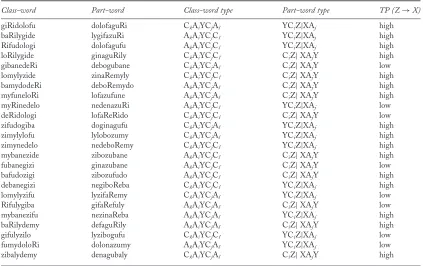
in the edge positions during familiarization but were in reality “A” or “C” syllables. In half of the test pairs, the rule-words differed from the class-word in their “A” syllables; in the remaining pairs, the items differed in their “C” syllables. Appendix C lists the 24 test pairs. Test pairs were presented in random order.
Results
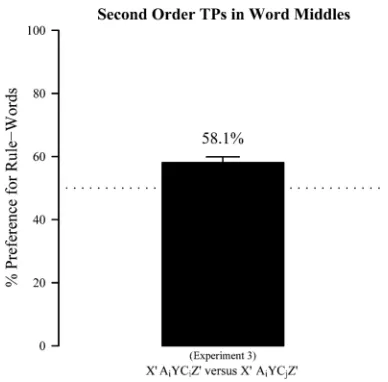
As shown in Figure 2, participants preferred rule-words to class-rule-words (preference for rule-rule-words: M¼58.1%, SD¼7.0%),t(13)¼4.6,p¼.0003, Cohen’sd¼1.1, CI.95¼54.3%, 61.8%. This
pre-ference did not depend on whether the items dif-fered in their “A” or their “C” syllable, t(13)¼0.2, p..8, Cohen’s d¼0.04, ns(paired ttest).
Discussion
In Experiment 3, participants preferred rule-words to class-words and were thus sensitive to TPs among nonadjacent middle syllables. This suggests that statistical computations may not be limited in the same way as the class-based generalizations. At the same time, this experiment shows that participants can process word-medial syllables, suggesting that the failure to generalize the word-medial class-based regularities was not due to a psychophysical impairment for processing word-medial syllables.
[image:16.536.280.474.360.551.2]It is interesting to note that the performance in Experiment 3 was comparable to that in Endress and Bonatti’s (2007) Experiment 12. In the latter experiment, participants had to choose between trisyllabic rule-words and class-words after fam-iliarization with a segmented 2-min stream. As in Experiment 3, participants thus had to track nonadjacent associations between syllables with a lag of one syllable; in contrast to Experiment 3, however, the crucial syllables were in edges. Together, these results thus suggest that the
impairment for generalizations in middles may not be entirely due to problems memorizing or encod-ing items in edges, but at least partly to processes inherent to the generalizations and thus to the processes underlying memory for positions.
GENERAL DISCUSSION
There is overwhelming evidence that learners can perform powerful statistical computations over fluent speech to extract the underlying words (e.g., Aslin et al., 1998; Saffran et al., 1996). However, learners do not acquire only the words of their native language, but also its grammar. There are indications that grammar-like regu-larities can also be extracted from fluent speech (Endress & Bonatti, 2007; Pen˜a et al., 2002). In Endress and Bonatti’s (2007) experiments, for example, participants learned that the first and the last syllables of each word had to belong to two distinct syllable classes. These classes may be either classes like nouns and verbs in language, or they may merely be the lists of syllables that can occur initially or finally and thus in the word-edges. The latter possibility is particularly plausible because memory for positions is encoded relative to the edges as anchor points (e.g., Henson, 1998) and because the crucial syllables in the aforementioned experiments (those that had to belong to distinct classes) were located in edge positions. If so, partici-pants should learn similar generalizations much better when the crucial syllables are in edge pos-itions than when they are in other pospos-itions. Alternatively, if participants have learned classes such as nouns and verbs in language, one would expect similar generalizations also in nonedge positions, as nouns and verbs are not restricted to edges either.
We tested these possibilities by familiarizing participants with streams of five-syllable words. When familiarized with a stream in which words were separated by silences, participants generalized the class-based regularity when the crucial syllables were in the word-edges, but not when they were in the word-middles. When familiarized with con-tinuous streams, in contrast, participants did not
generalize the class-based regularity, but rather preferred items that had occurred in the familiar-ization streams but violated the class-based regu-larity—irrespective of whether the crucial syllables were in word-edges or word-middles. As participants generalized the class-rule only when the critical syllables were in edges (and when familiarized with a segmented stream), also the class-based generalizations observed by Endress and Bonatti (2007) may have been carried by the edge syllables. In contrast to the generalizations, participants were sensitive to TPs between nonadjacent syllables also in word-middles, suggesting that the corresponding stat-istical computations may not be constrained in the same way as the generalizations.
Overall, two kinds of mechanisms may thus explain the results following Pen˜a et al.’s (2002) publication: An edge-based, positional memory mechanism allowing participants to track which syllables occurred in edges may account for the generalizations, while other mechanisms may track different forms of co-occurrence statistics among syllables.
Four puzzles solved
The first puzzle for single-mechanism, associa-tionist accounts is why statistical computations are readily observed with continuous speech streams, while the generalizations require segmentation cues to emerge. In contrast, if the generalizations are computed by an edge-based positional mech-anism, it becomes clear why the silences were required for the generalizations: Without the silences, there would be no edges, and positional memories could not be constructed—since the latter are edge-based.
The second puzzle is why class-words should ever be preferred to part-words, as class-words never occurred during familiarization and con-tained syllables from four different words while part-words occurred in the stream. A positional memory mechanism easily accounts for a prefer-ence for class-words (and why they can be accepted at all), as it is well known that learners can recog-nize the sequential positions of items also when the items are transplanted to a new sequence (e.g., Hicks et al., 1966; Schulz, 1955).
The third puzzle solved by our model is the time course of the generalizations. The negative correlation between the preference for class-words versus part-class-words and the familiarization duration, and the inversion of this preference after long exposure durations, is easily explained by a dual-mechanism account. Participants should be familiar with class-words early on because edges, in addition to having positional codes, are salient, and edge-based generalizations may thus be fast. Part-words (the alternative choice), however, can become familiar only through tracking the syllable distribution in the speech streams; as such a distributional analysis presumably takes time to strengthen the memory representations of part-words, one would predict that the preference for class-words decreases with longer familiarization durations. For a single-mechanism model, however, such a reversal is hard to explain.
The experiments presented here pose yet another puzzle to single-mechanism, association-ist accounts. Experiments 1 and 2 showed that generalizations are observed predominantly in edges, while Experiment 3 revealed that
co-occurrence statistics are tracked in middles (in fact, to the same extent as in Endress and Bonatti’s, 2007, Experiment 12). However, it seems problematic to postulate that a single-route, “general associative” mechanism should be constrained to fail in middles (for generaliz-ations) and, at the same time, to work well in middles (for associations). If the generalizations are due to a mechanism of positional memory, in contrast, no such contradiction follows: Different mechanisms may break down under different conditions.
In sum, our results suggest a simple dual-mechanism account of Pen˜a et al.’s (2002) results: The generalizations may be due to special positional codes for edges similar to those thought to be crucial to positional memory (e.g., Henson, 1998); syllables then get linked to these codes in some way, possibly through some form of association. These codes may thus allow partici-pants to track which syllables occurred in the edges. At the same time, a slower mechanism analyses the syllable distribution, for instance by computing co-occurrence statistics.
Edges in artificial and natural grammars
Our results suggest that the class-based generaliz-ations observed by Pen˜a et al. (2002) and Endress and Bonatti (2007) were due to a simple and specialized mechanism that provides positional codes in edges. Edges are usually considered unin-teresting confounds to be controlled for (e.g., Redington & Chater, 1996, but see, e.g., Dienes, Broadbent, & Berry, 1991; Johnstone & Shanks, 1999; Shanks, Johnstone, & Staggs, 1997, who used them as an explanation for generalization in other artificial-grammar-learning experiments). However, as we argue below, edge-based mechan-isms are the psychological basis of surprisingly complex generalizations.
1967, 1969). In these experiments, participants were familiarized with bigrams of four types of items, dubbed M, N, P, and Q. The bigrams always had the form minj or piqj; that is, M
items were always followed by N items, and P items by Q items. Still, participants learned only that the Ms and Ps had to occur initially and Ns and Qs finally, but they did not reject strings such as miqj, although M items were never
fol-lowed by Q items. Hence, it has been concluded by these authors that participants essentially learned the sequential positions in which the items had to appear, which appears to be what Pen˜a et al.’s (2002) participants learned too.
Another example for the importance of edges in artificial-grammar learning comes from Marcus et al.’s (1999) studies. These authors familiarized young infants with syllable sequences conforming to one of the grammars ABA, AAB, or ABB (e.g., a sequence like “wo – fe– fe” would conform to ABB) and showed that the infants generalize these grammars to new syllables. The repetitions in these structures, however, occurred in the sequence-edges. Using seven-syllable sequences, Endress et al. (2005) showed that participants generalize repetition-based grammars much more readily when the repetitions are in edges than when they are in middles, even though participants could process syllables in sequence-middles as well as in edge positions when they were not required to draw generalizations. These results suggest that positional regularities are learned predomi-nantly in edges, even if participants have no pro-blems processing the items that occur in other positions.
Edges are also important for most linguistic regularities that appeal to positions of items. Of course, in natural speech edges are usually not defined by silences of the kind used here, but we suggest that edges may be provided by prosodic break-points of various kinds and by utterance boundaries. Some examples for edge-based regu-larities come from phonology. For instance, the location of word stress is defined relative to either the left or the right edge of words; it may be word-initial (as in Hungarian) or word-final (as in French), or on another syllable counted
from the right edge (e.g., the second from the last in Italian). In contrast, languages do not appeal to word-middles—for example, by stating that stress falls on the middle syllable (e.g., Halle & Vergnaud, 1987; Hayes, 1995; Kager, 1995).
Also morphological processes such as affixation often appeal to edges: Many languages have suf-fixes and presuf-fixes, but insuf-fixes are rare (e.g., Greenberg, 1957; Julien, 2002). If prefixation and suffixation rely on edge-based positional codes, one can easily explain this observation. Finally, edges are also crucial for interfacing differ-ent levels of represdiffer-entation. While both being hierarchical, morphosyntactic and phonological representations have distinct hierarchies; for example, the plural [s] in English is a morpheme, but it is not a syllable. In examples such as these, where constituents of the two hierarchies do not coincide, at least one of the edges of the constitu-ents must be aligned (McCarthy & Prince, 1993; Nespor & Vogel, 1986); for example, the right edge of the [s] morpheme always coincides with the right edge of a syllable. Edges thus seem to mediate between different hierarchies and levels of representations; in some cases, they may be the common currency by which these hierarchies can be coordinated.
Original manuscript received 30 July 2008 Accepted revision received 4 December 2008 First published online day month year
REFERENCES
Aslin, R. N., Saffran, J., & Newport, E. L. (1998). Computation of conditional probability statistics by 8-month-old infants. Psychological Science, 9, 321 – 324.
Balaguer, R. D. D., Toro, J. M., Rodriguez-Fornells, A., & Bachoud-Le´vi, A.-C. (2007). Different neurophy-siological mechanisms underlying word and rule extraction from speech. PLoS ONE, 2(11), e1175. doi:10.1371/journal.pone.0001175
Braine, M. (1963). On learning the grammatical order of words.Psychological Review,70, 323 – 348. Braine, M. (1966). Learning the positions of words
rela-tive to a marker element. Journal of Experimental Psychology,72, 532 – 540.
Braine, M. (1987). What is learned in acquiring word classes—a step toward an acquisition theory. In B. MacWhinney (Ed.),Mechanisms of language acqui-sition (pp. 65 – 87). Hillsdale, NJ: Lawrence Erlbaum Associates.
Cooper, R. P., & Shallice, T. (2006). Hierarchical schemas and goals in the control of sequential beha-vior.Psychological Review,113, 887 – 916; discussion, 917 – 931.
Dienes, Z., Broadbent, D., & Berry, D. (1991). Implicit and explicit knowledge bases in artificial grammar learning. Journal of Experimental Psychology Learning, Memory & Cognition,17, 875 –887. Dutoit, T., Pagel, V., Pierret, N., Bataille, F., & van der
Vreken, O. (1996). The MBROLA project: Towards a set of high-quality speech synthesizers free of use for non-commercial purposes. InProceedings of the Fourth International Conference on Spoken Language Processing (Vol. 3, pp. 1393– 1396). Philadelphia.
Endress, A. D., & Bonatti, L. L. (2007). Rapid learning of syllable classes from a perceptually continuous speech stream.Cognition,105, 247 – 299.
Endress, A. D., & Mehler, J. (in press). Perceptual constraints in phonotactic learning. Journal of Experimental Psychology: Human Perception and Performance.
Endress, A. D., Scholl, B. J., & Mehler, J. (2005). The role of salience in the extraction of algebraic rules. Journal of Experimental Psychology: General, 134, 406 – 419.
Fodor, J. A. (1975).The language of thought. Cambridge, MA: Harvard University Press.
Fodor, J. A. (1983).The modularity of mind. Cambridge, MA: MIT Press.
Fodor, J. A., & Pylyshyn, Z. W. (1988). Connectionism and cognitive architecture: A critical analysis. Cognition,28, 3– 71.
Gallistel, C. (1990). The organization of learning. Cambridge, MA: MIT Press.
Gallistel, C. (2000). The replacement of general-purpose learning models with adaptively specialized learning modules. In M. Gazzaniga (Ed.),The cogni-tive neurosciences (2nd ed., pp. 1179– 1191). Cambridge, MA: MIT Press.
Gerken, L., Wilson, R., & Lewis, W. (2005). Infants can use distributional cues to form syntactic cat-egories.Journal of Child Language,32, 249 –268. Go´mez, R. L., & Gerken, L. (1999). Artificial grammar
learning by 1-year-olds leads to specific and abstract knowledge.Cognition,70, 109 – 135.
Go´mez, R. L., & Lakusta, L. (2004). A first step in form-based category abstraction by 12-month-old infants.Developmental Science,7, 567 – 580. Greenberg, J. (1957). Essays in linguistics. Chicago:
University of Chicago Press.
Halle, M., & Vergnaud, J.-R. (1987).An essay on stress. MIT Press: Cambridge, MA.
Hauser, M. D., Newport, E. L., & Aslin, R. N. (2001). Segmentation of the speech stream in a non-human primate: Statistical learning in cotton-top tamarins. Cognition,78, B53– B64.
Hayes, B. (1995).Metrical stress theory: Principles and case studies. Chicago: University of Chicago Press. Henson, R. (1998). Short-term memory for serial
order: The start-end model. Cognitive Psychology, 36, 73 – 137.
Henson, R. (1999). Positional information in short-term memory: Relative or absolute? Memory and Cognition,27, 915 –927.
Hicks, R., Hakes, D., & Young, R. (1966). Generalization of serial position in rote serial learning. Journal of Experimental Psychology, 71, 916 – 917.
Hitch, G. J., Burgess, N., Towse, J. N., & Culpin, V. (1996). Temporal grouping effects in immediate recall: A working memory analysis.Quarterly Journal of Experimental Psychology: Human Experimental Psychology,49, 116 – 139.
(1997).Journal of Experimental Psychology: Learning, Memory, and Cognition,25, 524 – 531.
Julien, M. (2002).Syntactic heads and word formation. New York: Oxford University Press.
Jusczyk, P. W., Hohne, E., & Bauman, A. (1999). Infants’ sensitivity to allophonic cues for word segmentation. Perception and Psychophysics, 61, 1465– 1476.
Kager, R. (1995). Consequences of catalexis. In H. van der Hulst & J. van de Weijer (Eds.),Leiden in last: HIL phonology papers I(pp. 269 – 298). The Hague, The Netherlands: Holland Academic Graphics. Lehman, J. F., Laird, J. E., & Rosenbloom, P. (1998). A
gentle introduction to soar, an architecture for human cognition. In D. Scarborough & S. Sternberg (Eds.), An invitation to cognitive science (2nd ed., Vol. 4, pp. 211 –253). Cambridge, MA: MIT Press. Marcus, G. F., Vijayan, S., Rao, S. B., & Vishton, P.
(1999). Rule learning by seven-month-old infants. Science,283, 77 – 80.
Marr, D. (1982).Vision. San Francisco: W. H. Freeman and Company.
Marr, D., & Nishihara, H. K. (1992). Visual infor-mation processing: Artificial intelligence and the sensorium of sight. In S. M. Kosslyn & R. A. Andersen (Eds.), Frontiers in cognitive neuroscience (pp. 165 – 186). Cambridge, MA: MIT Press. (Reprinted from Technology Review, 81, 2– 23, 1978).
Mattys, S. L., & Jusczyk, P. W. (2001). Phonotactic cues for segmentation of fluent speech by infants. Cognition,78, 91 – 121.
Mattys, S. L., Jusczyk, P. W., Luce, P., & Morgan, J. L. (1999). Phonotactic and prosodic effects on word segmentation in infants. Cognitive Psychology, 38, 465 – 494.
McCarthy, J. J., & Prince, A. (1993). Generalized alignment. In G. Booij & J. van Marle (Eds.), Yearbook of morphology (pp. 79 – 153). Boston, MA: Kluwer.
Miller, G. A.(1958). Free recall of redundant strings of letters. Journal of Experimental Psychology, 56, 485 – 491.
Mintz, T. H. (2002). Category induction from distribu-tional cues in an artificial language. Memory and Cognition,30, 678 – 686.
Monaghan, P., Chater, N., & Christiansen, M. H. (2005). The differential role of phonological and dis-tributional cues in grammatical categorisation. Cognition,96, 143 – 182.
Mueller, J. L., Bahlmann, J., & Friederici, A. D. (2008). The role of pause cues in language learning: The emergence of event-related potentials related to sequence processing. Journal of Cognitive Neuroscience,20, 892 – 905.
Nespor, M., & Vogel, I. (1986). Prosodic phonology. Dordrecht, The Netherlands: Foris.
Newell, A. (1980). Physical symbol systems.Cognitive Science,4, 135 – 183.
Newell, A. (1990). Unified theories of cognition. Cambridge, MA: Harvard University Press. Ng, H. L., & Maybery, M. T. (2002). Grouping in
short-term verbal memory: Is position coded tem-porally?Quarterly Journal of Experimental Psychology: Section A,55, 391 – 424.
Pacton, S., & Perruchet, P. (2008). An attention-based associative account of adjacent and nonadjacent dependency learning. Journal of Experimental Psychology. Learning, Memory and Cognition, 34, 80–96.
Pen˜a, M., Bonatti, L. L., Nespor, M., & Mehler, J. (2002). Signal-driven computations in speech pro-cessing.Science,298, 604 – 607.
Perruchet, P., Tyler, M. D., Galland, N., & Peereman, R. (2004). Learning nonadjacent dependencies: No need for algebraic-like computations. Journal of Experimental Psychology: General,133, 573 – 583. Reber, A. S. (1967). Implicit learning of artificial
gram-mars.Journal of Verbal Learning and Verbal Behavior, 6, 855 – 863.
Reber, A. S. (1969). Transfer of syntactic structure in synthetic languages. Journal of Experimental Psychology,81, 115 –119.
Redington, M., & Chater, N. (1996). Transfer in artifi-cial grammar learning: A reevaluation. Journal of Experimental Psychology: General,125, 123 – 138. Redington, M., Chater, N., & Finch, S. (1998).
Distributional information: A powerful cue for acquir-ing syntactic categories.Cognitive Science,22, 425–469. Saffran, J. R. (2001). Words in a sea of sounds: The output of infant statistical learning.Cognition,81, 149–169. Saffran, J. R., Aslin, R. N., & Newport, E. L. (1996).
Statistical learning by 8-month-old infants.Science, 274, 1926– 1928.
Schulz, R. W. (1955). Generalization of serial position in rote serial learning. Journal of Experimental Psychology,49, 267 –272.