Ames Laboratory Publications
Ames Laboratory
11-2011
Adsorption and Diffusion of Gallium Adatoms on
the Si(100)-2 × 1 Reconstructed Surface: A
Multiconfiguration Self-Consistent Field Study
Utilizing Molecular Surface Clusters
Luke Roskop
Iowa State University, [email protected]
James W. Evans
Iowa State University, [email protected]
Mark S. Gordon
Iowa State University, [email protected]
Follow this and additional works at:
http://lib.dr.iastate.edu/ameslab_pubs
Part of the
Applied Mathematics Commons
,
Astrophysics and Astronomy Commons
, and the
Chemistry Commons
The complete bibliographic information for this item can be found at
http://lib.dr.iastate.edu/
ameslab_pubs/347
. For information on how to cite this item, please visit
http://lib.dr.iastate.edu/
howtocite.html
.
Adsorption and Diffusion of Gallium Adatoms on the Si(100)-2 × 1
Reconstructed Surface: A Multiconfiguration Self-Consistent Field Study
Utilizing Molecular Surface Clusters
Abstract
Ab initio electronic structure theory was used to model systems that depict Ga and Ga2adsorbed on the
Si(100)-2 × 1 reconstructed surface. The prototypical Si15H16 molecular cluster based on quantum
mechanics (QM) was used to model the Si(100)-2 × 1 reconstructed surface. A larger Si199H92 molecular
cluster based on a hybrid quantum mechanics molecular mechanics (QM/MM) methodology was used to
incorporate bulk substrate effects on the adsorbed species. Since the Si(100)-2 × 1 reconstructed surface is
comprised of Si dimers that exhibit significant diradical character, multiconfiguration self-consistent field
(MCSCF) methodology was used to treat the relevant potential energy surfaces. Hessian calculations were
used to characterize all structures, while intrinsic reaction coordinate (minimum energy path) computations
were performed to validate the potential energy surface. Dynamic correlation effects were computed at
MCSCF optimized structures by multireference second-order perturbation theory. Results from the two
cluster models were compared to assess the need to include bulk effects in the surface model.
Disciplines
Applied Mathematics | Astrophysics and Astronomy | Chemistry
Comments
Reprinted (adapted) with permission from
Journal of Physical Chemistry C
115 (2011): 23488, doi:10.1021/
jp208410t. Copyright 2011 American Chemical Society.
Published: November 08, 2011
r2011 American Chemical Society 23488 dx.doi.org/10.1021/jp208410t|J. Phys. Chem. C2011, 115, 23488–23500
ARTICLE
pubs.acs.org/JPCC
Adsorption and Diffusion of Gallium Adatoms on the Si(100)-2
1
Reconstructed Surface: A Multiconfiguration Self-Consistent Field
Study Utilizing Molecular Surface Clusters
Luke Roskop,
†James W. Evans,
‡and Mark S. Gordon*
,†Ames Laboratory-USDOE and†Department of Chemistry and‡Departments of Physics & Astronomy, and Mathematics, Iowa State University, Ames, Iowa 50011, United States
1. INTRODUCTION
The deposition of group III metal adatoms onto the Si(100)-2 1 reconstructed crystal surface leads to the spontaneous formation of 1-D islands.15These 1-D islands are sometimes described as atomic wires and have the potential to serve as interconnects for future nanodevices that are supported on the Si(100)-21 reconstructed surface. The self-assembly of group III metal adatoms into atomic wires is mediated by surface dif-fusion, so a detailed characterization of this process is important. Due to the high reactivity of the Si(100) surface, reliable models that accurately describe the diffusion process of metal adatoms on this surface require a level of electronic structure theory that is reliable across all relevant regions of the potential energy surface. The Si(100)-21 reconstructed surface has a structure that is dominated by rows of surface Si dimers. These surface dimers are comprised of two silicon atoms, each of which formally has an attached dangling bond that contains a single electron. As a result, each surface dimer may be thought of as a diradical. The diradical nature of the Si dimers contributes to the high reactivity of the Si(100)-21 reconstructed surface (referred to hence-forth as the Si(100) surface). The diradical nature of these surface Si dimers undoubtedly plays a central role in the diffusion process. In fact, group III metal adatoms prefer adsorption sites that maximize the interaction with multiple dangling Si dimer bonds. In what is referred to as the parallel dimer model, metal atoms form in rows (atomic wires) that are perpendicular to the Si dimer rows. This arrangement maximizes the interaction between each metal adatom and two dangling dimer bonds that originate from adjacent Si dimers in the same Si dimer row.1,610
At low coverage, it is understood that no two rows of metal adatoms lie adjacent to one another. This may be the result of an effective repulsion between the atomic wires.11
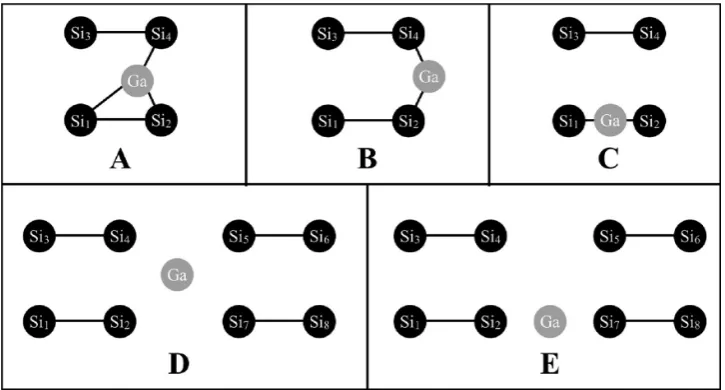
In an effort to understand the surface diffusion of Ga on the Si(100) reconstructed surface, previous studies have identified several stable adsorption sites. Previously, Takeuchi12used plane-wave density functional theory (PW-DFT) and located two adsorption sites referred to as a 3-fold and a 2-fold site (Figure 1: A, B). Takeuchi predicted that the 2-fold site (B) lies 0.17 eV (3.9 kcal/mol) lower in energy than the 3-fold site (A).
More recently, Albao, Hsu, Putungan, and Chuang (AHPC)13 examined the adsorption and diffusion of a Ga adatom on a periodic slab model that represented the Si(100)-c(24) reconstructed surface. Within the generalized gradient approximation (GGA) to density functional theory (DFT), AHPC locatedfive structures (Figure 1: B, C, D, Eu, Ed). Two similar structures were reported for structure E in Figure 1, in which the two Si atoms that closely interact with the Ga adatom (Si2and Si7) are buckled upward (Eu) or downward (Ed). AHPC reported that structures C and Eu are saddle points and structures D and Edare metastable, and B is the global minimum energy structure. Relative to the B global minimum, the relative energies of the remaining structures are as follows: B < C < D < Ed< Eu. Unlike the report from Takeuchi, AHPC did notfind a 3-fold structure (Figure 1A). AHPC predict
Received: August 31, 2011
Revised: October 22, 2011
ABSTRACT:Ab initio electronic structure theory was used to model systems that depict Ga and Ga2 adsorbed on the Si(100)-2 1 reconstructed surface. The prototypical Si15H16molecular cluster based on quantum mechanics (QM) was used to model the Si(100)-21 reconstructed surface. A larger Si199H92 molecular cluster based on a hybrid quantum mechanics molecular mechanics (QM/MM) metho-dology was used to incorporate bulk substrate effects on the adsorbed species. Since the Si(100)-21 reconstructed surface is comprised of Si dimers that exhibit significant diradical character, multiconfiguration self-consistent field (MCSCF) methodology was used to treat the
ARTICLE
the diffusion barriers for the Ga adatom parallel and perpendi-cular to the Si dimer row to be 6.5 and 7.7 kcal/mol, respectively. Reliable models of complex chemical behavior must employ a level of theory that can accurately treat the potential energy surface (PES) for the processes under consideration. Since multireference behavior is exhibited by transition state structures and the Si(100) surface dimers, an accurate chemical model must have the capability to treat this behavior. Multiconfiguration self-consistentfield (MCSCF) methods are specifically used to treat chemical systems that exhibit multireference (i.e., diradical) behavior. MCSCF methods also have the capability to measure the multireference character of their constructed wave functions. From the MCSCF one-particle density matrix, a set of natural orbitals and natural orbital occupation numbers (NOONs) can be generated.14NOON values provide a convenient metric to analyze the diradical character of a system. Diradical character is characterized by NOON values that significantly deviate from the standard restricted open-shell HartreeFock (ROHF) oc-cupation numbers of zero, one, or two.15For example, consider theπ* natural orbital of the Si9H12cluster, which is a minimal representation of a single Si(100) surface dimer (Figure 2). The NOON value for this antibonding orbital reveals that it is occupied by approximately one-third of an electron, which is a significant amount of multireference character. On the other hand, theσ* natural orbital has a NOON value of∼0.02, which
indicates that a negligible amount of multireference character originates from this natural orbital.
A reliable surface model should also incorporate subsurface effects from the bulk, as they can affect the PES. One should attempt to model the supporting substrate by a molecular cluster that is physically large enough to avoid edge effects that can exist if one uses a molecular cluster that is too small. On the other hand, the cluster size must be balanced against the need for computational tractability within the chosen level of theory. Thus, the physical size of the employed model is a practical consideration as bulk effects are introduced through it.
[image:4.607.123.486.66.261.2]There are two approaches that are commonly employed to represent crystal surfaces. The first approach uses molecular clusters that best mimic the bare surface. The inherent simplicity of this approach and its compatibility with standard computa-tional techniques has resulted in its widespread use. The relia-bility of molecular clusters is questionable since they can manifest spurious edge effects. An advantage of clusters is that the use of very accurate electronic structure methods is feasible. To cir-cumvent the edge effects seen in molecular clusters, slab models are commonly used since they incorporate periodic boundary conditions, thereby avoiding undesirable edge effects.16Slab models are typically used with single reference methods like GGA DFT that do no always provide results of sufficient accuracy.
Figure 1. (A) 3-Fold structure predicted by Takeuchi, (B) 2-fold structure predicted by Takeuchi and AHPC, (C) on-dimer structure predicted by AHPC, (D) hollow site predicted by AHPC, and (E) cave site predicted by AHPC. In E there are two possible structures in which atoms Si2and Si7are buckled upward (Eu) or buckled downward (Ed).
[image:4.607.115.491.314.425.2]23490 dx.doi.org/10.1021/jp208410t |J. Phys. Chem. C2011, 115,23488–23500
The Journal of Physical Chemistry C ARTICLE
One compromise between simple cluster models and slab models with periodic boundary conditions is the embedded cluster model. One such approach, the surface integrated mo-lecular orbital momo-lecular mechanics (SIMOMM) method, is employed here.17The SIMOMM method uses both quantum mechanics (QM) and molecular mechanics (MM), which allows for the treatment of large surface clusters that can be computa-tionally impractical with QM alone. SIMOMM ameliorates the edge effects of a QM cluster by embedding it into a much larger cluster that is treated with MM. The larger MM cluster com-pensates for the edge effects encountered within the QM cluster. As a result the QM region of the QM/MM cluster better resembles the pristine surface than if one were to use the QM cluster by itself. An important advantage of embedded cluster models like the SIMOMM method is that the QM component can use any available quantum chemistry method, ranging from GGA DFT to multireference ab initio techniques.
This paper examines the adsorption of Ga and Ga2on Si(100) surface clusters. Various minima and transition state structures are located, which are subsequently connected to map out the PES. This provides some insight into the diffusion of Ga and Ga2 on the Si(100) surface. In addition, QM and SIMOMM QM/ MM results are compared to understand the extent to which the bulk crystal affects the PES.
2. COMPUTATIONAL METHODS
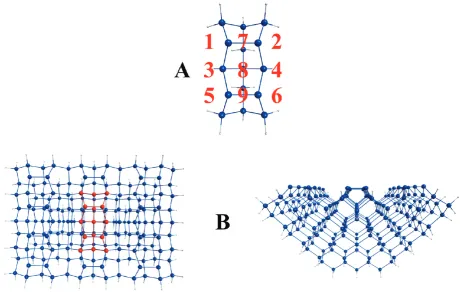
All results reported here have been obtained using either QM or hybrid QM/MM methodology. The QM cluster, Si15H16 (Figure 3A), is constructed with the minimum number of atoms that can adequately represent two Si(100) surface dimers. Bulk
effects are considered using a larger QM/MM cluster, Si199H92 (Figure 3B). The QM/MM cluster represents a region of the Si(100) surface that is 11 layers deep and contains 12 surface dimers. The reactive region of the QM/MM cluster is the same two-dimer (Si15H16) QM cluster seen in Figure 3A, which is represented by the red atoms in Figure 3B. The QM/MM model is constructed by the SIMOMM method,17which mechanically embeds the Si15H16QM cluster into the larger Si199H92QM/ MM cluster. The MM component of the QM/MM cluster is optimized using the MM318forcefield parameters in the Tinker program.19To save space, all structures that correspond to the Si199H92QM/MM cluster are represented by the embedded QM region (Si15H16).
[image:5.607.72.533.65.357.2]ARTICLE
For the Ga2calculations, a CAS was constructed with theπ,π* orbitals from each SiSi dimer and the 4s, 4px, 4py, 4pzorbitals from each Ga adatom. This results in a CAS(10,12) active space. All CASSCF minima and transition state structures were confirmed as stationary points by diagonalizing the Hessian (matrix of second-order energy derivatives). Transition states were connected to their respective reactants and products by com-puting the intrinsic reaction coordinate (IRC),22also referred to
[image:6.607.125.485.79.603.2]23492 dx.doi.org/10.1021/jp208410t |J. Phys. Chem. C2011, 115,23488–23500
The Journal of Physical Chemistry C ARTICLE
(GAMESS)27 was used for all QM calculations, while the GAMESS/Tinker interface was used for all SIMOMM computa-tions. It is important to note the model systems used here cannot determine diffusion barriers that correspond to the migration of the Ga adatom between adjacent dimer rows.
3. RESULTS AND DISCUSSION
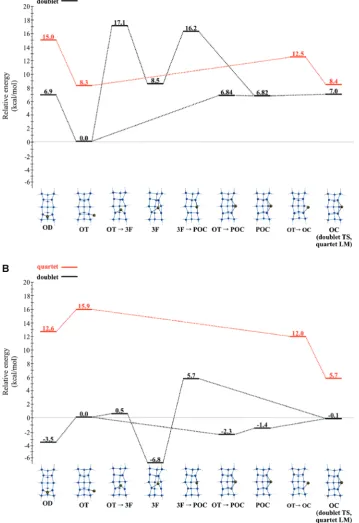
3A. Ga Adsorption on Si(100). Adsorption sites.Figures 4A and 4B (Figures 5A and 5B) display doublet and quartet potential energy surfaces that depict adsorption sites for Ga adatom on the Si15H16QM (Si199H92QM/MM) cluster. Results for the smaller QM cluster are presented first. Three local minima (on-top (OT), 3-fold (3F), pseudo off-center (POC)) and five transition states are found on the CASSCF QM doublet surface (Figure 4A). All energies are relative to the doubletOT structure. While the minimum energy paths were determined at the CASSCF level of theory, the discussion here will refer to the MRMP2//CASSCF energies (Figure 4B) since they are more reliable. MRMP2//CASSCF energies indicate that the3Fsite is the global minimum energy structure. The MRMP2//CASSCF energies suggest that the addition of dynamic correlation modi-fies the qualitative nature of the doublet potential energy surface. The off-center (OC) adsorption site (referred to as the 2-fold site in Figure 1B) is similar to the structure found by Takeuchi and AHPC. Takeuchi and AHPC report that theOCadsorption site is a minimum; however, the CASSCF OC structure is a transition state. This discrepancy may be a consequence of the DFT methodology used by Takeuchi and AHPC, which includes dynamic correlation effects. TheOCstructure may be a mini-mum on the MRMP2 surface as MRMP2//CASSCF relative
energies predict that theOCstructure is 0.1 kcal/mol lower in energy than theOTstructure.
The3Fabsorption site in Figure 4A is similar to the structure found by Takeuchi (Figure 1A). Takeuchi predicts the OC structure to be 3.9 kcal/mol lower in energy than the3Fstructure. In contrast, MRMP2//CASSCF indicates (Figure 4B) the3Fsite is 6.7 kcal/mol lower in energy than theOCsite.
The on-dimer (OD) adsorption site (Figure 1C) is similar to the structure found by AHPC. AHPC predicted theOCsite to be lower in energy than the OD site by 6.5 kcal/mol, whereas MRMP2//CASSCF (Figure 4B)finds that theODsite is lower in energy than theOCsite by 3.4 kcal/mol. These discrepancies are most likely related to the inability of single determinant GGA DFT methods to capture the significant diradical character of many of the species considered here.
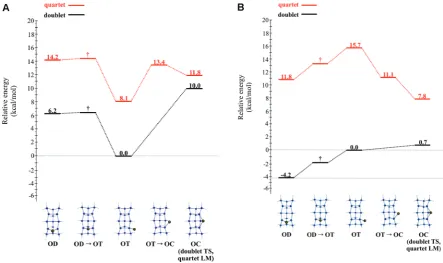
[image:7.607.80.524.65.328.2]Now, consider the QM/MM SIMOMM clusters. Figure 5A displays the doublet and quartet PESs that depict adsorption sites of a single Ga adatom on the Si199H92QM/MM cluster (Figure 2B). Two minima and one transition state are found on the doublet surface. TheODstructure is a minimum on the CASSCF QM/MM doublet surface. This observation is in contrast with the QM-only model in which the CASSCFOD structure is a transition state. Attempts to locate a QM/MMODfOTtransition state have been unsuccessful. The difficulty associated with the location of an ODfOT transition state is probably the result of a small energy barrier (<0.1 kcal/mol) relative to theODstructure. Since MRMP2//CASSCF relative energies (Figure 5B) indicate that theODsite is the global minimum energy structure, it is likely that theODfOTstructure will have a relative energy that is similar to that of theODsite.
ARTICLE
Attempts to locate a 3F structure have been unsuccessful; however, it may exist on the MRMP2 surface since MRMP2// CASSCF relative energies indicate that it is the global minimum for the smaller QM cluster (Figure 4B). Previous work by Zorn, Albao, Evans, and Gordon (ZAEG)28examined the adsorption of an Al adatom on the Si(100) surface using the QM/MM method discussed above. Unlike the Ga adatom, a QM/MM3Fsite was found on the doublet PES for an Al adatom. Similar to the results above, ZAEG report that the AlODstructure is the MRMP2// CASSCF global minimum energy structure. ZAEG also report that the QM/MM Al3Fsite is higher in energy than the QM/MM Al ODsite by∼7.2 kcal/mol. This prediction by ZAEG suggests that if a QM/MM 3-fold structure that involves a Ga adatom is found it is likely to lie higher in energy than the QM/MMODstructure.
Two minima and two transition states are reported on the QM/MM quartet surface (Figure 5A). Attempts to locate an ODfOTtransition state on this PES have also been unsuccess-ful. MRMP2//CASSCF relative energies (Figure 5B) indicate that the OC adsorption site is the global minimum energy structure. Relative to the energy of the OTsite, the relative energies of those structures that associate the Ga adatom with more than one dangling dimer bond are lowered when dynamic correlation is introduced, while the relative energy of theOT structure associated with one dangling dimer bond increases.
Diffusion Paths. Two paths on the QM doublet surface
(Figure 4A) describe the migration of a Ga adatom from one surface dimer to the other. Both paths begin at anOTstructure, pass throughPOCandOCstructures, and ultimately end at an adjacentOTstructure. The difference between the two paths is the route from theOTstructure to thePOCstructure. The low-energy path proceeds through anOTfPOCtransition state to a POCstructure. The high-energy path is a two-step process in which the Ga adatom passes through anOTf3Ftransition state to a 3F structure; then the Ga adatom proceeds through a 3FfPOCtransition state to thePOCstructure. Relative to the OT structure, there is apparently no MRMP2//CASSCF net energy barrier for the low energy path, while the high energy path is predicted to have a 5.7 kcal/mol MRMP2//CASSCF energy barrier.
While the minimum energy paths were determined at the CASSCF level of theory, the discussion here will refer to the
MRMP2//CASSCF energies (Figure 4B) since they are more reliable. On the basis of this fairly comprehensive overview of the PES, the MRMP2//CASSCF effective barrier for the diffusion of a Ga adatom along the Si dimer row is 7.3 kcal/mol. The pathway starting from the lowest energy3Fsite is3Ff(OTf3F)f OT f (OTfPOC) f POC f OC f POC0 f (OTf POC)0fOT0f(OTf3F)0f3F0. The doubletOTf3Fsite is the highest energy structure a Ga adatom will encounter for surface diffusion along a row of surface dimers. On the lower-energy doublet path, all species are within a 2.3 kcal/mol range, while on the higher energy path, only the3Fand the3FfPOCstructures are outside this energy range.
The Ga adatom also diffuses between twoOTsites located at either side of the same dimer. These two sites are connected by anODstructure, which is found to be a transition state at the CASSCF level of theory. However, the MRMP2//CASSCF relative energies indicate that theODstructure is 3.5 kcal/mol lower in energy than the connecting OT (CASSCF) local minimum. Therefore, it is likely that at the MRMP2 level of theory theODstructure is not a transition state.
On the QM/MM doublet surface, MRMP2//CASSCF en-ergies indicate that there is a 0.7 kcal/mol energy barrier that connectsOT(Figure 5B) sites on adjacent surface dimers. This is in contrast to the QM-only cluster results since the order of the MRMP2//CASSCF relative energies between theOTandOC structures is switched. However, this is not unreasonable since the energy difference between theOTandOCstructures in the QM and QM/MM models is small (e0.7 kcal/mol). It is clear that both the QM and QM/MM doublet PESs areflat in the region between theOTandOCstructures. With respect to theOD global minimum energy structure on the MRMP2//CASSCF QM/MM surface, there is a 4.9 kcal/mol diffusion barrier for a Ga adatom to hop betweenODsites on adjacent dimers.
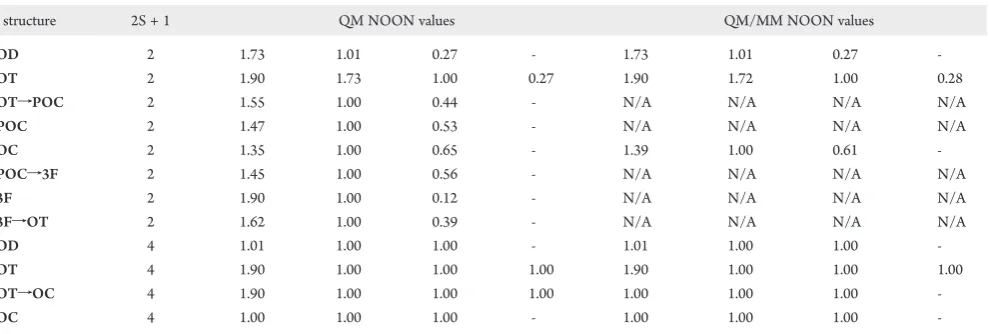
[image:8.607.61.556.79.246.2]Natural orbital occupation numbers (NOONs) are reported in Table 1 for all QM and QM/MM structures. The NOONs for a single determinant wave function are integers, so each NOON should have a value of 2 or 1 for occupied orbitals and 0 for virtual orbitals. Clearly, many NOON values deviate significantly from integer values, indicating significant diradical character, and therefore significant multireference character in the correspond-ing wave functions. The 3F QM structure exhibits the least Table 1. NOON Values for All Structures That Involve the Ga Adatom on QM (Si15H16) and QM/MM (Si199H92) Clustersa
structure 2S + 1 QM NOON values QM/MM NOON values
OD 2 1.73 1.01 0.27 - 1.73 1.01 0.27
-OT 2 1.90 1.73 1.00 0.27 1.90 1.72 1.00 0.28
OTfPOC 2 1.55 1.00 0.44 - N/A N/A N/A N/A
POC 2 1.47 1.00 0.53 - N/A N/A N/A N/A
OC 2 1.35 1.00 0.65 - 1.39 1.00 0.61
-POCf3F 2 1.45 1.00 0.56 - N/A N/A N/A N/A
3F 2 1.90 1.00 0.12 - N/A N/A N/A N/A
3FfOT 2 1.62 1.00 0.39 - N/A N/A N/A N/A
OD 4 1.01 1.00 1.00 - 1.01 1.00 1.00
-OT 4 1.90 1.00 1.00 1.00 1.90 1.00 1.00 1.00
OTfOC 4 1.90 1.00 1.00 1.00 1.00 1.00 1.00
-OC 4 1.00 1.00 1.00 - 1.00 1.00 1.00
-aThe NOON values reported correspond to natural orbitals that exhibit the largest amount of multireference behavior (critical NOON range:
23494 dx.doi.org/10.1021/jp208410t |J. Phys. Chem. C2011, 115,23488–23500
The Journal of Physical Chemistry C ARTICLE
amount of diradical character, with NOONs of 1.90, 1.00, and 0.10. Interestingly, the lowest energy MRMP2//CASSCF structures are those in which the Ga adatom maximizes its interaction with more than one dangling dimer bond, thereby decreasing the diradical (multireference) character.
Quartet Potential Energy Surfaces.Two minima (OT and
OC) and two transition states are found on the QM quartet PES (Figure 4A). Relative to the energy of the doubletOTstructure, the MRMP2//CASSCF level of theory (Figure 4B) predicts that the OC structure is the global minimum energy structure on the quartet potential energy surface. The QM MRMP2//CASSCF relative energies of the quartetOD,OTfPOC, andOCstructures are lowered relative to the CASSCF energies. These three struc-tures correspond to arrangements in which the Ga adatom interacts with two dangling dimer bonds. The relative energy of theOT structure, which interacts with just a single dangling dimer bond, increases when dynamic correlation is introduced.
NOON values (Table 1) indicate that the CASSCF structures on the QM and QM/MM quartet surfaces are triradicals, with three NOON = 1.0. The quartet NOON values do not signifi -cantly deviate from the restricted open shell HartreeFock occupation numbers (2, 1, 0). This indicates that a multirefer-ence treatment is less critical for the quartet structures. The quartet QM and QM/MM surfaces exhibit good agreement with each other with regard to relative CASSCF energies, relative MRMP2//CASSCF energies, and the various structures. The deviations between the QM and QM/MM surfaces are smaller than those observed for the doublet surfaces.
3B. Ga2on Si(100).This section is split into three subsections:
First, the diffusion of two nearby Ga adatoms that are not bonded to one another is considered. Next, the formation of the Ga2 dimer from Ga atoms on opposite sides of a Si dimer row is examined. The last subsection examines the mobility of the Ga2 dimer. Each subsection presents QM cluster results followed by QM/MM cluster results. The red numbers in Figure 3 are used in subsequent figures and in the text to identify structures that involve two Ga adatoms. These numbers specify the position of each Ga adatom relative to the Si15H16QM cluster. For example,
the 51 label (see Figure 6A) refers to the local minimum structure in which one Ga adatom is at the ‘5’ position and another is at the‘1’position. If the label contains a‘f’then the structure is a transition state. For example, the51f52label in Figure 6A refers to the transition state structure that connects local minima51and52.
Potential Energy Surface for Nonbonded Adsorption.
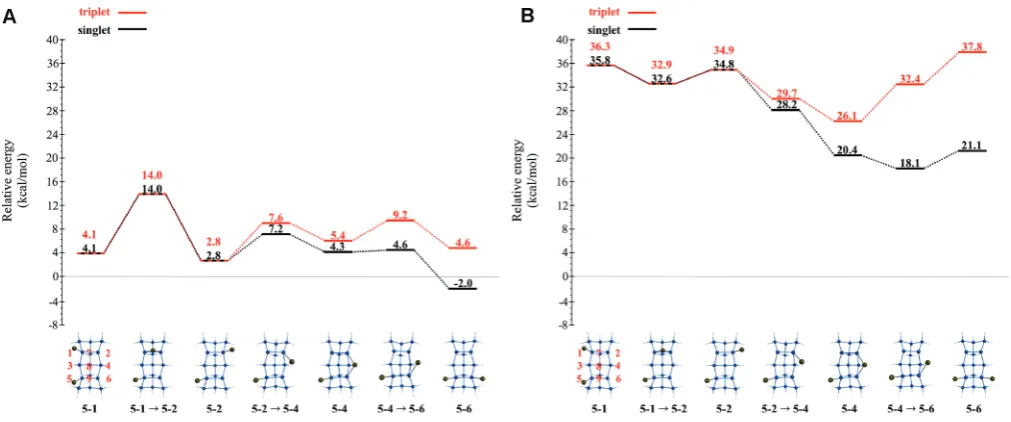
Figures 6A (CASSCF) and 6B (MRMP2//CASSCF) display stationary points on the singlet and triplet potential energy surfaces for the adsorption of two separated Ga adatoms on the Si15H16QM cluster. These PESs describe the diffusion of one Ga adatom, while the other Ga adatom is fixed at the‘5’position. Four minima and three transition states are found on both the singlet and triplet PESs. All energies in Figures 6A and 6B are reported relative to the singlet34Bstructure from Figures 10A and 10B.
[image:9.607.52.558.64.275.2]There are significant differences in the CASSCF (Figure 6A) and MRMP2//CASSCF (Figure 6B) potential energy surfaces. On the former, the56structure is the lowest energy species; however, the relative energy of this diradicaloid species is likely to increase when dynamic correlation is introduced, and this is indeed the case. Interestingly, the MRMP2//CASSCF lowest energy species is the54f56structure, which is a transition state on the CASSCF PES, but apparently not when dynamic correlation (MRMP2) is added. Relative to the 54f56 structure, the MRMP2//CASSCF relative energies (Figure 6B) indicate that the singlet surface becomes increasingly repulsive (up to 17.7 kcal/mol) as the system advances to the 51 structure. That is, the energy continuously increases along the path leading from54f56to51. The high relative energies of most of the structures along this reaction path correlate with an increase in diradical character, as may be seen in Table 2. Relative to the 54f56 structure, the high MRMP2// CASSCF relative energies of the 51 (17.7 kcal/mol), 51f52(14.5 kcal/mol), and 52(16.7 kcal/mol) struc-tures indicate that the two Ga adatoms prefer arrangements that maximize their interaction with the same surface dimer (or with each other).
ARTICLE
The MRMP2//CASSCF (Figure 6B) relative energies indi-cate that the54structure is the global minimum on the triplet
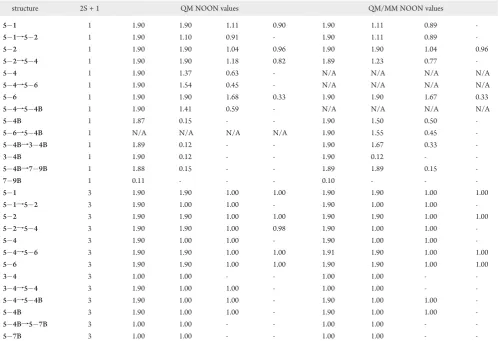
[image:10.607.56.556.81.422.2]QM surface. Both the CASSCF and MRMP2//CASSCF levels of theory predict that the singlet and triplet PESs are essentially Table 2. NOON Values for Ga2Structures on QM (Si15H16) and QM/MM (Si199H92) Clustersa
structure 2S + 1 QM NOON values QM/MM NOON values
51 1 1.90 1.90 1.11 0.90 1.90 1.11 0.89
-51f52 1 1.90 1.10 0.91 - 1.90 1.11 0.89
-52 1 1.90 1.90 1.04 0.96 1.90 1.90 1.04 0.96
52f54 1 1.90 1.90 1.18 0.82 1.89 1.23 0.77
-54 1 1.90 1.37 0.63 - N/A N/A N/A N/A
54f56 1 1.90 1.54 0.45 - N/A N/A N/A N/A
56 1 1.90 1.90 1.68 0.33 1.90 1.90 1.67 0.33
54f54B 1 1.90 1.41 0.59 - N/A N/A N/A N/A
54B 1 1.87 0.15 - - 1.90 1.50 0.50
-56f54B 1 N/A N/A N/A N/A 1.90 1.55 0.45
-54Bf34B 1 1.89 0.12 - - 1.90 1.67 0.33
-34B 1 1.90 0.12 - - 1.90 0.12 -
-54Bf79B 1 1.88 0.15 - - 1.89 1.89 0.15
-79B 1 0.11 - - - 0.10 - -
-51 3 1.90 1.90 1.00 1.00 1.90 1.90 1.00 1.00
51f52 3 1.90 1.00 1.00 - 1.90 1.00 1.00
-52 3 1.90 1.90 1.00 1.00 1.90 1.90 1.00 1.00
52f54 3 1.90 1.90 1.00 0.98 1.90 1.00 1.00
-54 3 1.90 1.00 1.00 - 1.90 1.00 1.00
-54f56 3 1.90 1.90 1.00 1.00 1.91 1.90 1.00 1.00
56 3 1.90 1.90 1.00 1.00 1.90 1.90 1.00 1.00
34 3 1.00 1.00 - - 1.00 1.00 -
-34f54 3 1.90 1.00 1.00 - 1.00 1.00 -
-54f54B 3 1.90 1.00 1.00 - 1.90 1.00 1.00
-54B 3 1.90 1.00 1.00 - 1.90 1.00 1.00
-54Bf57B 3 1.00 1.00 - - 1.00 1.00 -
-57B 3 1.00 1.00 - - 1.00 1.00 -
-aThe NOON values reported correspond to natural orbitals that exhibit the largest amount of multireference behavior (critical NOON range:
1.900.10).
[image:10.607.52.557.455.668.2]23496 dx.doi.org/10.1021/jp208410t |J. Phys. Chem. C2011, 115,23488–23500
The Journal of Physical Chemistry C ARTICLE
degenerate at the 51,51f52, and 52structures. The singlet and triplet NOON values (Table 2) indicate that all three species are nearly pure diradicals on the singlet surface and pure diradicals on the triplet PES.
Now consider the QM/MM cluster. Figures 7A (CASSCF) and 7B (MRMP2//CASSCF) display singlet and triplet surfaces that depict adsorption sites of two separated Ga adatoms on the QM/MM cluster. All energies in Figures 7A and 7B are reported relative to the singlet34Bstructure (Figures 11A and 11B). Unlike the Si15H16 QM cluster, attempts to locate both a 54f56and54structure on the singlet QM/MM surface have been unsuccessful. It is possible that bulk effects influence the CASSCF surface such that it is very flat in this region. MRMP2//CASSCF energies indicate that the56structure is the singlet global minimum. This agrees with the notion that the more stable structures correspond to geometrical arrangements in which Ga adatoms interact with the same surface dimer.
Four minima and three transition states are found on the triplet QM/MM surface. These transition states and minima closely correspond with those found for the QM cluster. MRMP2//CASSCF energies indicate the54structure is the triplet global minimum. The stability of this structure may be related to the54arrangement of Ga adatoms such that they optimally interact with three of the four dangling dimer bonds.
The triplet QM and QM/MM surfaces discussed above are in good agreement with each other for the relative CASSCF energies and relative MRMP2//CASSCF energies. For the singlet surfaces, two structures (54and54f56) that were found on the singlet QM surface (Figures 6A and 6B) have not been found on the QM/MM surface (Figures 7A and 7B). Since these structures occur in a rather flat region of the potential energy surface, it is possible that they do exist on the QM/MM PES but were not detected in geometry searches.
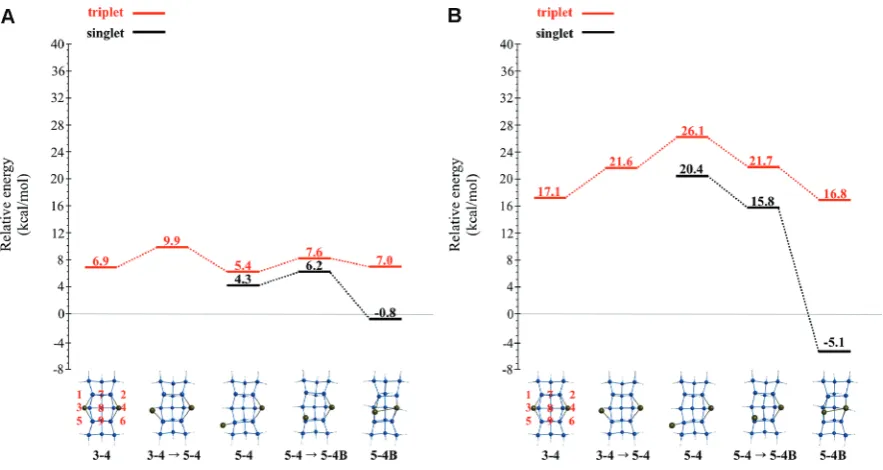
Ga2 Dimer Formation. Figures 8A (CASSCF) and 8B
(MRMP2//CASSCF) display singlet and triplet surfaces that
depict the formation of the Ga2dimer on the QM cluster. For structures in which the two Ga adatoms are considered to be bonded to each other, a“B”is added to the label. For example, 54B(see Figure 8A) indicates that the adatoms at the4and5 positions are bonded to each other. All energies in Figures 8A and 8B are relative to the singlet34Bstructure (Figures 10A and 10B).
The singlet QM surface (Figure 8A) illustrates that the Ga adatoms in the 54 structure can form a Ga2 dimer via the 54f54B transition state structure. Relative to the 54 structure, MRMP2//CASSCF (Figure 8B) energies indicate that the54Bstructure is lower in energy by 25.5 kcal/mol. Once dynamic correlation is introduced via MRMP2//CASSCF cal-culations, there is no energy barrier that prevents the formation of the Ga2 dimer. This suggests that the two Ga adatoms will spontaneously form a Ga2dimer when they approach each other on the Si(100) surface. NOON values (Table 2) show that the 54B structure has little multireference character, which is consistent with the large energy lowering upon the GaGa bond formation.
The triplet MRMP2 surface (Figure 8B) isflatter than the singlet surface, demonstrating less of an energetic preference for the bonded vs nonbonded structures. For example, the54B triplet species is less than 10 kcal/mol lower in energy than triplet 54. The triplet surface also has a second route, in which the two Ga adatoms diffuse from the54species to the34structure. This pathway has no intervening MRMP2//CASSCF energy barrier. At the MRMP2//CASSCF level of theory, the 34 structure is higher in energy than the54Bstructure by just 0.3 kcal/mol.
[image:11.607.83.525.64.299.2]ARTICLE
54B structure is formed from the 56 structure via the 56f54Btransition state. According to MRMP2//CASSCF energies (Figure 9B), the QM/MM pathway forms a Ga2dimer without an energy barrier, in agreement with the QM-only pathway discussed above. The QM/MM 54B structure is favored over the QM/MM56structure by 11.1 kcal/mol.
The triplet QM/MM surface is similar to the triplet QM-only surface. From the QM/MM 54 structure, the Ga adatoms dimerize to form the 54B structure (Ga2 dimer) without a MRMP2//CASSCF energy barrier. The Ga adatoms can also form the triplet34structure without an MRMP2//CASSCF energy barrier. The lowest energy structure on the triplet surface described by Figure 9B is54B, but this structure is only 1 kcal/ mol lower in energy than the34structure.
The triplet QM and QM/MM surfaces discussed above are in good agreement with each other, with regard to the relative CASSCF energies and relative MRMP2//CASSCF energies. For the singlet surface, the major difference between the formation of the Ga2dimer on the QM vs the QM/MM surface concerns the path along which the Ga2dimer is formed. On the QM surface (Figures 8A and 8B), the54Bstructure is formed via the54 and54f54Bstructures. The54Bstructure is formed on the QM/MM surface (Figures 9A and 9B) via the56 and 56f54B structures. The MRMP2//CASSCF relative en-ergies predict that both paths proceed without an energy barrier.
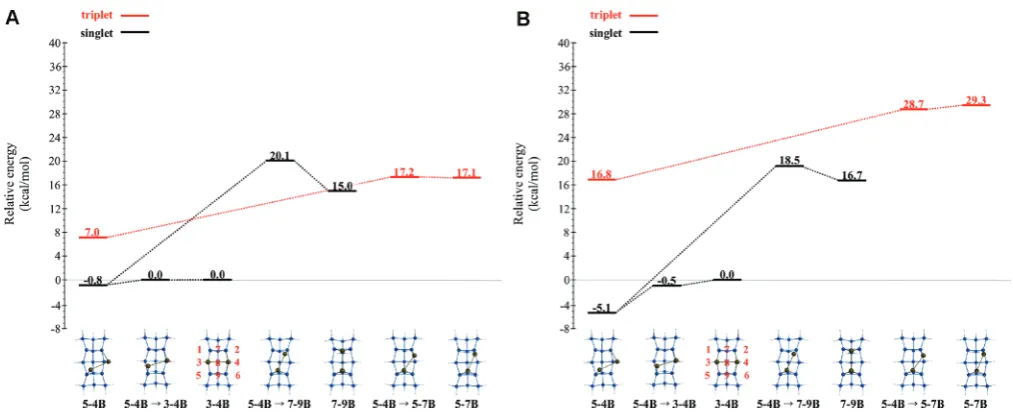
Ga2 Dimer Rotation. Figures 10A (CASSCF) and 10B
[image:12.607.53.556.63.271.2](MRMP2//CASSCF) display the singlet and triplet potential energy surfaces that depict the mobility of a Ga2dimer on the Figure 9. (A) Singlet and triplet potential CASSCF energy surfaces for the formation of the Ga2dimer from two separated Ga adatoms on the QM/MM Si199H92cluster. All energies are relative to the singlet34Bstructure. Energies are in kcal/mol. Note: MM region of the QM/MM model is not shown. (B) Singlet and triplet potential MRMP2//CASSCF energy surfaces for the formation of the Ga2dimer from two separated Ga adatoms on the QM/MM Si199H92cluster. All energies are relative to the singlet34Bstructure. Energies are in kcal/mol. Note: MM region of QM/MM model is not shown.
[image:12.607.51.558.331.540.2]23498 dx.doi.org/10.1021/jp208410t |J. Phys. Chem. C2011, 115,23488–23500
The Journal of Physical Chemistry C ARTICLE
QM cluster. These surfaces examine the rotational mobility of a Ga2dimer on the Si(100) surface. All energies in Figures 10A and 10B are reported relative to the singlet34Bstructure.
The54Bstructure is the singlet global minimum on both the CASSCF and MRMP2 PESs. Focusing on the MRMP2 PES, from the 54B structure, the Ga2 dimer can form either the 34B or 79B structures. The MRMP2//CASSCF relative energies increase by 5.1 kcal/mol as the Ga2dimer rotates from the54Bstructure through the54Bf34Btransition state to the34Bstructure. The54Bstructure can also form the 79Bstructure via the54Bf79Btransition state with an energy barrier of 23.6 kcal/mol. Singlet NOON values, summar-ized in Table 2, demonstrate that the structures that contain the Ga2dimer have less diradical character than structures that have
separated Ga adatoms, and therefore these GaGa bonded species have lower relative MRMP2//CASSCF energies. On the triplet PES, starting from54B, the Ga2dimer can form the 57Bstructure with an energy increase of about 12.5 kcal/mol. No other stationary points have been found on the triplet PES. Figures 11A (CASSCF) and 11B (MRMP2//CASSCF) dis-play the singlet and triplet QM/MM PESs for the Ga2dimer. All energies in Figures 11A and 11B are reported relative to the singlet34Bstructure. From the54Bstructure, the Ga2dimer can form the singlet global minimum34Bstructure without an MRMP2//CASSCF energy barrier. Alternatively, the Ga2dimer in the54Bstructure can also form the79Bstructure, but this process must surmount a 10.5 kcal/mol MRMP2//CASSCF energy barrier.
As noted above for the QM-only species, the79Band34B NOON values (Table 2) demonstrate little multireference character. The triplet QM/MM surface is very similar to the triplet QM-only surface. From the 54B structure, as the Ga2dimer forms the57Bstructure, the energy of the system increases.
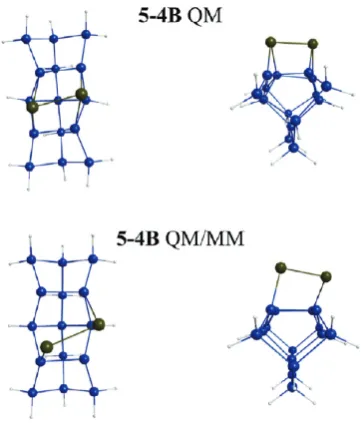
[image:13.607.55.554.64.266.2]The triplet QM and QM/MM surfaces discussed above are in good agreement with each other with regard to the relative CASSCF energies and relative MRMP2//CASSCF energies. The largest deviations between the QM and QM/MM surfaces occur on the singlet surfaces. The QM/MM model predicts that the 34B structure is the global minimum energy structure (Figure 11B), whereas the QM model predicts the 54B structure (Figure 10B) is the global minimum energy structure. So, expanding the cluster by incorporating MM atoms to minimize edge effects does have an impact on the predicted PES. Figure 12 compares the QM and QM/MM (QM region) geometries for the singlet 54B structures. The QM-only structure appears to be twisted. The bulk support structure (MM region) in the QM/MM model causes an adjustment in the QM region, and the surface cluster looks more symmetric. This demonstrates the importance of incorporating bulk effects in the surface model.
Figure 11. (A) Singlet and triplet CASSCF potential energy surfaces for the rotation of the Ga2dimer on the QM/MM Si199H92cluster. All energies are relative to the singlet34Bstructure. Energies are in kcal/mol. Note: the MM region of the QM/MM model is not shown. (B) Singlet and triplet MRMP2//CASSCF potential energy surfaces for the rotation of the Ga2dimer on the QM/MM Si199H92cluster. All energies are relative to the singlet 34Bstructure. Energies are in kcal/mol. Note: the MM region of the QM/MM model is not shown.
[image:13.607.82.263.327.539.2]ARTICLE
4. CONCLUSIONS
Ab initio electronic structure calculations were performed to develop an understanding of the adsorption energetics and diffusion of Ga and Ga2 on the Si(100)-2 1 reconstructed surface. These processes were modeled with a QM (Si15H16) and a larger QM/MM (Si199H92) molecular cluster.
Structures for a single Ga adatom similar to the ones found by Takeuchi and AHPC were observed in this work, with differences both in the energy ordering among the structures and in the characterization of those structures as minima or saddle points. Both Takeuchi and AHPC reported the off-center (so-called M-site) structure as a minimum energy structure, but in the present work the doubletoff-centerstructure is found to be a transition state by both the QM and QM/MM cluster models. AHPC predict that the on-dimer structure is a transition state, which agrees with the QM cluster model. However, the QM/ MM cluster model predicts theODsite to be a minimum energy structure. In any event, the MRMP2//CASSCF relative energies from the QM/MM model indicate that theODsite is the global minimum on the potential energy surface and a local minimum on the QM surface. The3Fstructure is predicted to be the global minimum on the QM surface.
Both Takeuchi and AHPC predict that the OC (M-site) structure is the global minimum. In contrast, MRMP2finds that the3Fstructure is the QM global minimum and that theOD structure is the QM/MM global minimum. Another discrepancy between this work and the report by Takeuchi concerns the formation of the atomic row structure of Ga adatoms. Takeuchi reports that the most stable single-atom adsorption site guides the subsequent dimer and atomic row structure. Takeuchi predicts that the lowest energy single atom site is the OC structure. Both this work and the report by ZAEG on Al predict that theODsite is the lowest in energy.
An important consideration in developing an understanding of the relative energies of various species on the Si(100) surface is the trade-offbetween metalsurface bonding vs metalmetal bonding. To form metal rows, metal atoms must give up some of their bonding to the surface to achieve stronger metalmetal bonding.
The doublet/quartet surfaces that depict Ga adatom diffusion indicate that the QM-only OD sites (Figures 4A, 4B) are transition states, while the QM/MM ODsites (Figures 5A, 5B) are minima. In addition, the QM-only and QM/MM geometries have noticeable differences because the QM cluster does not have sufficient structural rigidity. Compared to the QM/MM model, the QM-only structures in which a Ga adatom or a Ga2 dimer span more than one surface dimer have the largest distor-tions in geometries.
For the Ga2dimer, the order of stability for structures that are common to both QM and QM/MM models is inconsistent. QM/MM energies predict that the34Bstructure is the singlet global minimum. No QM/MM energy barriers are found for structures that lead to the34Bstructure. This suggests that Ga adatoms self-assemble into rows of metal atoms that are perpen-dicular to the Si-dimer rows, consistent with experimental observations. On the other hand, MRMP2//CASSCF relative energies for the QM-only cluster indicate an energy increase as the Ga2 dimer rotates from the 54B position to the 34B position. This demonstrates the need for surface models that consider bulk effects.
Previous studies of the parallel dimer model15,12found that Ga2 dimers are located between two Si-dimer rows. The geo-metry of the lowest energy singlet MRMP2//CASSCF QM/ MM Ga2dimer found here (34B) places the Ga2dimer on top of a single Si dimer row (not between Si dimer rows). To investigate the adsorption of the Ga2dimer between Si dimer rows would require a larger QM region to model the interaction of the Ga2dimer with two Si dimer rows.
Some aspects of the QM-only and QM/MM potential energy surfaces are in qualitative agreement. Relative energies for structures in which two Ga adatoms are separated appear to be insensitive to the presence of bulk MM atoms. Both the QM and QM/MM models demonstrate that pairs of Ga adatoms sponta-neously form a Ga2dimer when they approach one another. Both models also predict similar diffusion of the Ga adatom along the dimer row.
In both the QM and QM/MM models, the lowest energy structures correlate with the ones that exhibit the least amount of diradical (i.e., nearly closed shell) character. These structures correspond to arrangements of Ga adatoms or Ga2 dimer that maximize the interaction with the dangling dimer bonds. In addition, the formation of the Ga2dimer bond surely plays an important role in the stabilization of the surface clusters investigated here.
’ACKNOWLEDGMENT
This work was supported by grants from the Air Force Office of Scientific Research (LR) and from the Basic Energy Sciences, Division of Chemical Sciences of the Department of Energy (MSG, JWE) to the Ames Laboratory, administered by Iowa State University under Contract No. DE-AC02-07CH11358. Enlightening discussions with Dr. Deborah Zorn and Professor Yingbin Ge are gratefully acknowledged.
’REFERENCES
(1) Nogami, J; Baski, A. A.; Quate, C. F.Phys. Rev. B1991,44, 1415. (2) Nogami, J.; Park, S.-I.; Quate, C. F. Appl. Phys. Lett. 1988, 53, 2086.
(3) Nogami, J.Atomic and Molecular Wires, Joachim, C.; Roth, S., Eds.; NATO ASI Series E; Kluwer: Dordrecht, 1997; Vol. 341, p 11.
(4) Evans, M. M.; Nogami, J.Phys. Rev. B1999,59, 7644. (5) Itoh, H; Itoh, J.; Schmid, A.; Ichinokawa, T.Phys. Rev. B1993, 48, 14663.
(6) Brocks, G.; Kelly, P. J.; Car, R.Phys. Rev. B1993,70, 2786. (7) Northrup, J. E.; Schabel, M. C.; Karlsson, C. J.; Uhrberg, R. I. G. Phys. Rev. B1991,44, 13799.
(8) Adams, B. G.; Sankey, I. F.J. Vac. Sci. Technol. A1992,10, 2046. (9) Sakama, H.; Murakami, K.; Nishikata, K.; Kawazu, A.Phys. Rev. B 1994,50, 14977.
(10) Steele, B. E.; Li, L.; Stevens, J. L.; Tsung, I. S. T.Phys. Rev. B 1993,47, 9925.
(11) Albao, M. A.; Evans, M. M. R.; Nogami, J.; Zorn, D.; Gordon, M. S.; Evans, J. W.Phys. Rev. B2005,72, 35426.
(12) Takeuchi, N.Phys. Rev. B2000,63, 35311.
(13) Albao, M. A.; Hsu, C.; Putungan, D. B.; Chuang, F.-C.Surf. Sci. 2010,604, 396–403.
(14) L€owdin, P.-O.Phys. Rev.1955,97, 1474.
(15) Gordon, M. S.; Schmidt, M. W.; Chaban, G. M.; Glaesemann, K. R.; Stevens, W. J.; Gonzalez, C. J.Chem. Phys.1999,110, 4199.
(16) Dovesi, R.; Civalleri, B.; Orlando, R.; Roetti, C.; Saunders, V. R. Reviews in Computational Chemistry; Lipkowitz, K. B.; Larter, R.; Cundari, T. R., Eds.; Wiley: New York, 2005; Vol. 21, Chapter 1.
23500 dx.doi.org/10.1021/jp208410t |J. Phys. Chem. C2011, 115,23488–23500
The Journal of Physical Chemistry C ARTICLE
(18) Lii, J. H.; Allinger, N. L.J. Am. Chem. Soc.1989,111, 8566. Lii, J. H.; Allinger, N. L.J. Am. Chem. Soc.1989,111, 8576. Allinger, N. L.; Yuh, Y. H.; Lii, J. H.J. Am. Chem. Soc.1989,111, 8551.
(19) Kundrot, C. E.; Ponder, J. W.; Richards, F. M.J. Comput. Chem. 1991,12, 402. Ponder, J. W.; Richards, F. M.J. Comput. Chem.1987,8, 1016. (20) Seigbahn, P. E.; Herberg, A.; Roos, B. O.; Levy, B.Phys. Scr. 1980,21, 323.
(21) Ruedenberg, K.; Sundberg, K. R.Quantum Science; Calais, J.-L.; Goscinski, O.; Lindenberg, J.;Ohrn, Y., Eds.; Plenum:New York, 1976;€ p 505.
(22) Garrett, B. C.; Redmon, M. K.; Steckler, R.; Truhlar, D. G.; Baldridge, K. K.; Bartol, D.; Schmidt, M. W.; Gordon, M. S.J. Phys. Chem.1988,92, 1476.
(23) Gonzales, C.; Schlegel, H. B.J. Chem. Phys.1989,90, 2154. (24) Møller, C.; Plesset, M. S.Phys. Rev.1934,46, 618. (25) Hirao, K.Chem. Phys. Lett.1992,190, 375.
(26) Hehre, W. J.; Ditchfield, R.; Pople, J. A.J. Chem. Phys.1972, 56, 2257. M. S. Gordon, M. S.Chem. Phys. Lett.1980,76, 163. Rassolov, V. A.; Ratner, M. A.; Pople, J. A.; Redfern, P. C.; Curtiss, L. A.J. Comput. Chem.2001,22, 976.
(27) Schmidt, M. W.; Baldridge, K. K.; Boatz, J. A.; Elbert, S. T.; Gordon, M. S.; Jensen, J. H.; Koseki, S.; Matsunaga, N.; Nguyen, K. A.; Su, S.; Windus, T. L.; Dupuis, M.; Montgomery, J. A.J. Comput. Chem. 1993,14, 1347.Gordon, M. S.; Schmidt, M. W.Theories and Applications of Computational Chemistry, the First Forty Years; Dykstra, C. E., Frenk-ing, G., Kim, K. S., Scuseria, G. E., Eds.; Elsevier: Amsterdam, 2005; pp 11671189.