Cloud-based Parallel Implementation of SLAM
for Mobile Robots
Supun Kamburugamuve1, Hengjing He2, Geoffrey Fox1, David Crandall1
1
School of Informatics and Computing, Indiana University, Bloomington, USA
2
Dept. of Electrical Engineering, Tsinghua University, Beijing, China
Abstract. Simultaneous Localization and Mapping (SLAM) for mobile
robots is a computationally expensive task. A robot capable of SLAM needs a powerful onboard computer, but this can limit the robot’s mo-bility because of weight and power demands. We consider moving this task to a remote compute cloud, by proposing a general cloud-based architecture for real-time robotics computation, and then implement-ing a Rao-Blackwellized Particle Filterimplement-ing-based SLAM algorithm in a multi-node cluster in the cloud. In our implementation, expensive com-putations are executed in parallel, yielding significant improvements in computation time. This allows the algorithm to increase the complexity and frequency of calculations, enhancing the accuracy of the resulting map while freeing the robot’s onboard computer for other tasks. Our method for implementing particle filtering in the cloud is not specific to SLAM and can be applied to other computationally-intensive tasks.
1
Introduction
The Internet of Things (IoT) promises to bring Internet connectivity to devices ranging from simple thermostats to highly complex industrial machinery and robots. Many potential IoT applications involve analyzing the rich, large-scale datasets that these devices produce, but analytics algorithms are often compu-tationally expensive, especially when they have to scale to support vast numbers of devices. Cloud services are thus attractive for doing large scale offline and real-time analytics on the data produced in IoT applications. This paper inves-tigates a computationally-expensive robotics application to showcase a means of achieving complex parallelism for real-time applications in the cloud.
error. This problem is computationally challenging and has been studied exten-sively in the literature. Here we consider a popular algorithm called GMapping, which builds a grid map by combining (noisy) distance measurements from a laser range finder and robot odometer using Rao-Blackwellized Particle Filter-ing (RBPF) [1, 2]. It is known to work well in practice and has been integrated into robots like TurtleBot [3]. The algorithm is computationally expensive and produces better results if more computational resources are available.
We have implemented GMapping to work in the cloud on top of the IoTCloud platform [4], a framework for transfering data from devices to a cloud computing environment for real-time, scalable data processing. IoTCloud encapsulates data from devices into events and sends them to the cloud, where they are processed using a distributed stream processing framework (DSPF) [5]. In our GMapping implementation, laser scans and odometer readings are sent from the robot as a stream of events to the cloud, where they are processed by SLAM and results are returned to the robot immediately. The algorithm runs in a fully distributed environment where different parts can be run on different machines, taking ad-vantage of parallelism to split up the expensive computations.
Our main contribution is to propose a novel framework to compute particle filtering-based algorithms, specifically RBPF SLAM, in a cloud environment to achieve high computation time efficiency. In the following sections, we first discuss related work before introducing background on the IoTCloud framework and the SLAM algorithms. Then we show how to design and implement parallel RBPF SLAM in IoTCloud, before concluding with results and discussion.
2
Related Work
envi-ronment. We instead focus on bringing this data to the cloud and processing it in a scalable and robust manner, exploiting (potentially) unlimited cloud resources.
3
Background
3.1 IoTCloud framework
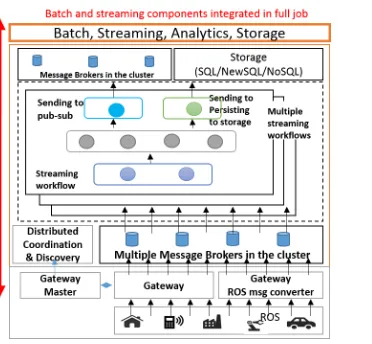
IoTCloud [4]3 is an open source framework developed at Indiana University to connect IoT devices to cloud services. As shown in Figure 1, it consists of a set of distributed nodes running close to the devices to gather data, a set of publish-subscribe brokers to relay information to the cloud services, and a distributed stream processing framework (DSPF) coupled with batch processing engines in the cloud to process the data and return (control) information to the IoT devices. Applications execute data analytics at the DSPF layer, achieving streaming real-time processing. The IoTCloud platform uses Apache Storm [15] as the DSPF, RabbitMQ [16] or Kafka [17] as the message broker, and an OpenStack academic cloud [18] (or bare-metal cluster) as the platform. We use a coordination and discovery service based on ZooKeeper [19] to scale the number of devices.
In general, a real-time application running in a DSPF can be modeled as a directed graph with streams defining the edges and processing tasks defining the nodes. A stream is an unbounded sequence of events flowing through the edges of the graph and each such event consists of a chunk of data. The processing tasks at the nodes consume input streams and produce output streams. A DSPF provides the necessary API and infrastructure to develop and execute applications on a cluster of nodes. In Storm these tasks are called Spouts and Bolts. To connect a device to the cloud services, a user develops a gateway application that connects to the device’s data stream. Once an application is deployed in an IoTCloud gateway, the cloud applications discover those applications and connect to them for data processing using the discovery service.
3.2 Design of robot applications
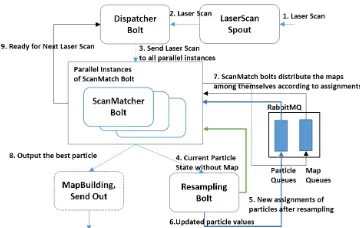
We designed a cloud-based implementation of GMapping for a real robot, the TurtleBot [3] by Willow Garage, using the IOTCloud platform. TurtleBot is an off-the-shelf differential drive robot equipped with a Microsoft Kinect sensor. An overview of the implementation is shown in Figure 2. The application that con-nects to the ROS-based [20] Turtlebot API is deployed in an IoTCloud Gateway running on a desktop machine, where it subscribes to the TurtleBot’s laser scans and odometer readings. It converts the ROS messages to a format that suits the cloud application and sends transformed data to the application running in the FutureSystems OpenStack [18] VMs using the message brokering layer. The cloud application generates a map and sends this back to the workstation running the gateway, which saves and publishes it back to ROS for viewing.
3
Fig. 1:IoTCloud Architecture Fig. 2:GMapping Robotics application
3.3 RBPF SLAM Algorithm
A detailed description of the Rao-Blackwellized particle filter for SLAM is given in [1, 2], but we give a brief overview here. Suppose we have a series of laser readingsz1:t= (z1, ..., zt) over time, as well as a set of odometer measurements u1:t−1= (u1, ..., ut−1) from the robot. Our goal is to estimate both a mapmof
the environment and the trajectory of the robot,x1:t= (x1, ..., xt). For any time
t, we can sample from the posterior probability,
p(x1:t, m|z1:t, u1:t−1) =p(x1:t|z1:t, u1:t−1)p(m|x1:t, z1:t), (1)
by sampling from the first term on the right hand side to produce an estimate of the robot’s trajectory given just the observable variables, and then sample from the second term to produce an estimate of the map using that sampled trajectory. The particle filter maintains a set of particles, each including a possible map of the environment and a possible trajectory of the robot, along with a weight which can be thought of as a confidence measure. A standard implementation of the algorithm executes the following steps for each particleias follows:
1. Make an initial estimate of the position of the robot at time t, using the estimated position at time t−1 and odometry measurements, i.e. x0ti = x0ti−1⊕ut−1 where ⊕ is a pose compounding operator. The algorithm also
incorporates the motion model of the robot when computing this estimate. 2. Use the ScanMatching algorithm shown in Algorithm 1 with cutoff of ∞to
refinex0i
t using the mapmit−1and laser readingzt. If the ScanMatching fails, use the previous estimate.
3. Update the weight of the particle. 4. The mapmi
[image:4.612.342.435.121.290.2]input : poseuand laser readingz output:bestP oseandl
steps←0;l← −∞;bestP ose←u;delta←InitDelta; 1
currentL←likelihood(u, z); 2
fori←1tonRef inementsdo 3
delta←delta/2; 4
repeat 5
pose←bestP ose;l←currentL; 6
ford←1toKdo
7
xd←deterministicsample(pose, delta);
8
localL←likelihood(xd, z); 9
steps+ = 1; 10
if currentL < localLthen 11
currentL←localL;bestP ose←xd; 12
end 13
end 14
untill < currentLandsteps < cutof f ; 15
end 16
Algorithm 1:Scan Matching
After updating each particle, the algorithm normalizes the weights of all par-ticles based on the total sum of squared weights, and then resamples by drawing particles with replacement with probability proportional to the weights. Resam-pled particles are used with the next reading. At each reading the algorithm takes the map associated with the particle of highest weight as the correct map. The computation time of the algorithm depends on the number of particles and the number of points in the distance reading. In general the accuracy of the algorithm improves if more particles are used.
4
Streaming parallel algorithm design
We found that RBPF SLAM spends nearly 98% of its computation time on Scan Matching. Because Scan Matching is done for each particle independently, in a distributed environment the particles can be partitioned into different compu-tation nodes and computed in parallel. However, the resampling step requires information about all particles so it needs to be executed serially, after gathering results from the parallel computations. Resampling also removes and duplicates some particles, which means that some particles have to be redistributed to different nodes after resampling.
Fig. 3:Storm streaming workflow for parallel RBPF SLAM.
the robot and sends it to the rest of the application. After computation, results are passed to SendOut bolts which send it back to the robot. If required, data can be saved to persistent storage as well.
A key idea behind our implementation is to distribute the particles across a set of tasks running in parallel. This particle-specific code is encapsulated in the ScanMatcher bolt, so we can control the parallelism of the algorithm by changing the number of ScanMatcher bolt instances. The Resampling bolt must wait until it receives the results of the ScanMatcher bolts. After a resampling happens, the algorithm removes some existing particles and duplicate others, so the assignments of particles to ScanMatcher tasks have to be rearranged. The directed communication required among the parallel ScanMatcher tasks to do the reassignment is not well supported by Apache Storm, so we use an external RabbitMQ message broker. All the data flowing through the various communication channels are in a byte format serialized by Kryo. The steps for a single reading as shown in Figure 3 are:
1. LaserScan spout receives laser and odometer readings via the message broker. 2. The reading is sent to a Dispatcher, which broadcasts it to the parallel tasks. 3. Each ScanMatcher task receives the laser reading, updates its assigned
par-ticles, and sends the updated values to the Resampling bolt.
4. After resampling, the Resampling bolt calculates new particle assignments for the ScanMatchers, using the Hungarian algorithm to consider relocation costs. The new particle assignment is broadcast to all the ScanMatchers. 5. In parallel to Step 4, the Resampling bolt sends the resampled particle values
to their new destinations according to the assignment.
6. After ScanMatchers receive new assignments, they distribute the maps as-sociated with the resampled particles to the correct destinations, using Rab-bitMQ queues to send messages directly to tasks.
7. The ScanMatcher with the best particle outputs its values and the map. 8. ScanMatcher bolts send messages to the dispatcher, indicating their
willing-ness to accept the next reading.
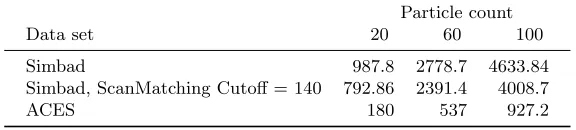
Table 1:Serial average time (in ms) for different datasets and numbers of particles. Particle count
Data set 20 60 100
Simbad 987.8 2778.7 4633.84
Simbad, ScanMatching Cutoff = 140 792.86 2391.4 4008.7
ACES 180 537 927.2
to avoid memory overflow. Owing to the design of the GMapping algorithm, only a few resampling steps are needed during map building. If resampling does not happen then steps 5 and 6 are omitted. Although an open source serial version of the algorithm in C++ is available through OpenSlam4, it is not suitable for our platform which requires Java. The algorithm described above was implemented in Java and is available in github5along with steps to run the experiments.
5
Results and Discussion
The goal of our experiments was to verify the correctness and practical feasibility of our approach, as well as to measure its scalability. All experiments ran in FutureSystems [18] OpenStack VMs each having 8GB memory and 4 CPU cores running at 2.8GHz. Our setup had 5 VMs for Apache Storm Workers, 1 VM for RabbitMQ and 1 VM for ZooKeeper and Storm master (Nimbus) node. For all the tests the gateway node was running in another VM in FutureSystems. Each Storm worker instance ran 4 Storm worker processes with 1.5GB of memory allocated. We used the ACES building data set [21] and a small environment generated by the Simbad [22] robot simulator for our experiments. ACES has 180 distance measurements per laser reading and Simbad has 640 measurements per laser reading. For the ACES dataset we used a map of size 80x80m with 0.05 resolution, and for Simbad the map was 30x30m with 0.05 resolution.
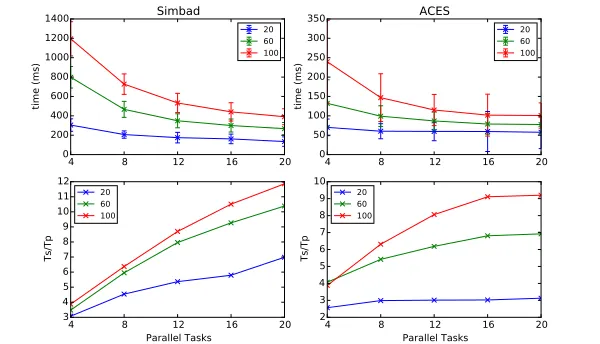
A sample result from ACES is shown in Figure 10. Since GMapping is a well-studied algorithm, we did not extensively test its accuracy on different datasets, but instead focused on the parallel behavior of our implementation. We measured parallel speedup (defined as serial time over parallel time, i.e.Ts/Tp) by recording the time required to compute each laser reading and then taking an average. We tested the algorithm with 20, 60 and 100 particles for each dataset. The serial time was measured on a single FutureSystems machine, as shown in Table 1, and the parallel times were measured with 4, 8, 12, 16 and 20 parallel tasks.
The parallel speedups gained for the ACES and Simbad datasets are shown in Figure 4. For ACES, the number of points per reading is relatively low, requiring relatively little computation at the the ScanMatcher bolts, which results in only a modest parallel speedup after 12 particles. On the other hand, Simbad has about 4 times more distance measurements per reading and produces higher speed
4
gains of about a factor of 12 for 20 parallel tasks with 100 particles. While not directly comparable because we test on different datasets with different resources, our parallel speed-ups are significantly higher than those of [9], e.g. up to 12x compared with up to about 2.6x, illustrating the advantage of implementing in a distributed memory cloud versus the single node of [9].
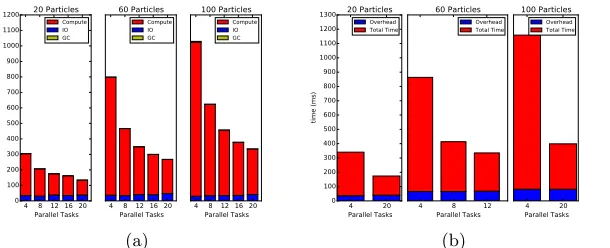
However, ideally the parallel speedup should be close to 20 with 20 parallel tasks, so we investigated factors that could be limiting the speedup. Figure 5a shows I/O, garbage collection, and computation times for different parallel tasks and particle sizes. The main culprit for limiting the parallel speedup appears to be I/O: when the number of parallel tasks increases, the compute time decreases, but because of I/O overhead the speedup also decreases. The average garbage collection time was negligible, although we have seen instances where it increases the individual computation times. Additionally, the resampling step of the al-gorithm is done serially, although since this is relatively inexpensive compared with Scan Matching, it is not a significant source of speedup loss.
Another factor that affects parallel speedup is the difference in computa-tion times among parallel tasks. Assume we have n ScanMatcher tasks taking t1, ..., tm, ..., tnseconds, wheretmis the maximum among these times. In the
se-rial case, the total time for ScanMatching isTs=t1+...+tm+...+tn, while for
the parallel case it is at leasttmbecause Resampling has to wait for all parallel tasks to complete. The overhead introduced because of this time imbalance is toverhead=tm−Ts/n, which is 0 in the ideal case when all tasks take the same time. Figure 5b shows the average overhead for the Simbad dataset compared with the total time. The average overhead remained almost constant while the total time decreased with more parallel tasks, restricting the speedup.
4 8 12 16 20
0 200 400 600 800 1000 1200 1400 time (ms) Simbad 20 60 100
4 8 12 16 20
Parallel Tasks 3 45 67 8 9 10 11 12 Ts/Tp 20 60 100
4 8 12 16 20
Parallel Tasks 2 3 4 5 6 7 8 9 10 Ts/Tp 20 60 100
4 8 12 16 20
[image:8.612.157.457.449.621.2]0 50 100 150 200 250 300 350 time (ms) ACES 20 60 100
4 8 12 16 20 Parallel Tasks 0 100 200 300 400 500 600 700 800 900 1000 1100 1200 time (ms) 20 Particles Compute IO GC
4 8 12 16 20 Parallel Tasks
60 Particles Compute IO GC
4 8 12 16 20 Parallel Tasks 100 Particles Compute IO GC 4 20 Parallel Tasks 0 100 200 300 400 500 600 700 800 900 1000 1100 1200 1300 time (ms) 20 Particles Overhead Total Time
[image:9.612.160.465.120.244.2]4 8 12 Parallel Tasks 60 Particles Overhead Total Time 4 20 Parallel Tasks 100 Particles Overhead Total Time (a) (b)
Fig. 5: Overhead on the Simbad dataset: (a) I/O, garbage collection, and Com-pute time. (b) Overhead of imbalanced parallel computation.
To further investigate the behavior of the algorithm, we plotted the computa-tion times for each reading, as shown in Figures 6a and 6b. There are high peaks in the individual times in both serial and parallel algorithms. This is caused by the while loop ending in line 5 of Algorithm 1, which can execute an arbitrary number of times if the cutoff is ∞. We have observed a mean of about 150 and standard deviation around 50 for number steps executed by the ScanMatching algorithm for Simbad, although sometimes it is as much as 2 to 3 times the aver-age. This is especially problematic for the parallel case because even one particle can significantly increase the response time. An advantage of nondeterministic particle-based algorithms is that if there are a sufficiently large number of parti-cles, cutting off the optimization for a few of them prematurely does not typically affect the results, and we can easily increase the number of particles if needed to compensate for these premature cutoffs. We also observed that these large numbers of steps typically occur at later refinements with small delta values, where the corrections gained by executing many iterations is usually small.
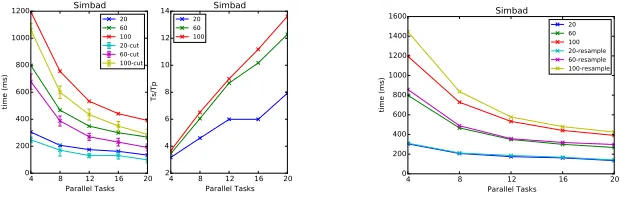
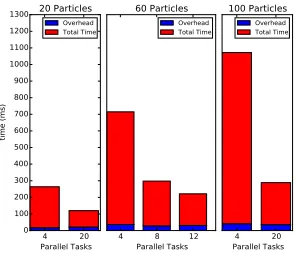
We thus changed the original algorithm shown in Algorithm 1 to have a configurable cutoff for the number of steps and performed experiments by setting the maximum number of steps to 140, which is close to the empirical average. We found that maps built by this modified algorithm were of comparable quality to the originals. The resulting time variations for two tests are shown in Figure 6c. Here we no longer see as many large peaks as in Figure 6b, and the remaining peaks are due to minor garbage collection. Figure 7 shows the average time reduction and speedup after the cutoff. As expected, we see an improvement in speedup as well, because the parallel overhead is now reduced as shown in Figure 9 after cutoff at 140 steps. This shows that cutoff is an important configuration parameter that can be tuned to balance performance and correctness.
(a) Serial time (b) Parallel without cutoff
[image:10.612.138.479.117.285.2](c) Two trials of parallel with cutoff at 140 steps
Fig. 6: Computation time across individual readings, for Simbad and 60 particles.
4 8 12 16 20 Parallel Tasks 0
200 400 600 800 1000 1200
time (ms)
Simbad 20 60 100 20-cut 60-cut 100-cut
4 8 12 16 20 Parallel Tasks 2
4 6 8 10 12 14
Ts/Tp
Simbad 20 60 100
Fig. 7:Average time and speedup for Sim-bad with cutoff at 140
4 8 12 16 20 Parallel Tasks
0 200 400 600 800 1000 1200 1400 1600
time (ms)
Simbad 20 60 100 20-resample 60-resample 100-resample
Fig. 8:Resampling overhead with Simbad
the I/O time. The original serial algorithm for Turtlebot runs every 5 seconds. Because the parallel algorithm runs much faster than the serial version, it can be used to build a map for a fast-moving robot. In particle filtering-based methods, the time required for the computation increases with the number of particles. By distributing the particles across machines, an application can utilize a high number of particles, improving the accuracy of the algorithm.
6
Conclusions & Future Work
[image:10.612.142.455.326.425.2]4 20 Parallel Tasks 0 100 200 300 400 500 600 700 800 900 1000 1100 1200 1300
time (ms)
20 Particles
Overhead Total Time
4 8 12
Parallel Tasks 60 Particles
Overhead Total Time
4 20 Parallel Tasks 100 Particles
[image:11.612.141.290.122.249.2]Overhead Total Time
Fig. 9:Parallel overhead with cutoff at 140 Fig. 10:Map of ACES
There are many possible enhancements to our system. We addressed the prob-lem of imbalances in particle computation times by simply discarding particles that exceed a hard computation limit, which works well for this particular algo-rithm but may not for others. Also we have observed fluctuations in processing time caused by virtualization, multi-stream interference and garbage collection. In the future we would like to address these fluctuations with a generic approach such as running duplicate computation tasks. Also, we have observed that re-sult broadcast and gathering in the streaming tasks takes considerable time, so reducing I/O would also significantly improve performance.
Reducing programming complexity is also an interesting direction. Modern distributed stream processing engines expose low-level APIs, making developing intricate IoT applications quite complex. Future work should propose higher-level APIs to handle complex interactions by abstracting out the details. Dis-tributing state between parallel workers currently requires a third node, such as an external broker or a streaming task acting as an intermediary. A group communication API between the parallel tasks would be a worthy addition to DSPF. Extending our work to abstract out a generic API to quickly develop any particle filtering algorithm would also be interesting.
Acknowledgments. The authors would like to thank the IU FutureSystems
team for support in setting up the system in FutureSystems NSF award OCI-0910812. This work was partially supported by AFOSR award FA9550-13-1-0225, “Cloud-Based Perception and Control of Sensor Nets and Robot Swarms.”
References
1. Grisetti, G., Stachniss, C., Burgard, W.: Improving grid-based SLAM with Rao-Blackwellized particle filters by adaptive proposals and selective resampling. In: IEEE International Conference on Robotics and Automation. (2005) 2432–2437 2. Grisetti, G., Stachniss, C., Burgard, W.: Improved techniques for grid mapping
with Rao-Blackwellized particle filters. IEEE Transactions on Robotics 23(1)
[image:11.612.145.449.124.250.2]3. Willow Garage: Turtlebot. http://turtlebot.com/
4. Kamburugamuve, S., Christiansen, L., Fox, G.: A framework for real time
process-ing of sensor data in the cloud. Journal of Sensors2015(2015) 11
5. Kamburugamuve, S., Fox, G., Leake, D., Qiu, J.: Survey of distributed stream processing for large stream sources. Technical report, Indiana University (2013) 6. Kehoe, B., Patil, S., Abbeel, P., Goldberg, K.: A survey of research on cloud
robotics and automation. IEEE Transactions on Automation Science and
Engi-neering12(2) (2015)
7. Hu, G., Tay, W.P., Wen, Y.: Cloud robotics: architecture, challenges and
applica-tions. IEEE Network26(3) (2012) 21–28
8. Chitchian, M., van Amesfoort, A.S., Simonetto, A., Keviczky, T., Sips, H.J.: Par-ticle filters on multi-core processors. Technical Report PDS-2012-001, Dept. Com-put. Sci., Delft Univ. Technology (2012)
9. Gouveia, B.D., Portugal, D., Marques, L.: Speeding up Rao-blackwellized parti-cle filter SLAM with a multithreaded architecture. In: IEEE/RSJ International Conference on Intelligent Robots and Systems. (2014) 1583–1588
10. Riazuelo, L., Civera, J., Montiel, J.: C2TAM: A Cloud framework for cooperative
tracking and mapping. Robotics and Autonomous Systems62(4) (2014) 401–413
11. Klein, G., Murray, D.: Parallel tracking and mapping for small ar workspaces. In: IEEE and ACM International Symposium on Mixed and Augmented Reality. (2007) 225–234
12. Zhang, H., Martin, F.: CUDA accelerated robot localization and mapping. In: IEEE International Conference on Technologies for Practical Robot Applications. (2013) 1–6
13. Tosun, O., et al.: Parallelization of particle filter based localization and map match-ing algorithms on multicore/manycore architectures. In: Intelligent Vehicles Sym-posium. (2011) 820–826
14. Portugal, D., Gouveia, B.D., Marques, L.: A Distributed and Multithreaded SLAM Architecture for Robotic Clusters and Wireless Sensor Networks. In: Cooperative Robots and Sensor Networks 2015. Springer (2015) 121–141
15. Anderson, Q.: Storm Real-time Processing Cookbook. Packt Publishing Ltd (2013) 16. Videla, A., Williams, J.J.: RabbitMQ in action: distributed messaging for everyone.
Manning (2012)
17. Kreps, J., Narkhede, N., Rao, J., et al.: Kafka: A distributed messaging system for log processing. In: Proceedings of 6th International Workshop on Networking Meets Databases. (2011)
18. Fox, G., et al.: FutureGrid: A reconfigurable testbed for Cloud, HPC and Grid Computing. Contemporary High Performance Computing: From Petascale toward Exascale (2013)
19. Hunt, P., Konar, M., Junqueira, F.P., Reed, B.: Zookeeper: Wait-free coordination for internet-scale systems. In: USENIX Annual Technical Conference. (2010) 20. Quigley, M., Conley, K., Gerkey, B., Faust, J., Foote, T., Leibs, J., Wheeler, R.,
Ng, A.Y.: ROS: an open-source Robot Operating System. In: ICRA Workshop on Open Source Software. Volume 3. (2009)
21. K¨ummerle, R., Steder, B., Dornhege, C., Ruhnke, M., Grisetti, G., Stachniss, C.,
Kleiner, A.: On measuring the accuracy of SLAM algorithms. Autonomous Robots
27(4) (2009) 387–407