International Journal of Innovative Technology and Exploring Engineering (IJITEE) ISSN: 2278-3075, Volume-8 Issue-8S2, June 2019
Abstract: The size of the Korean coffee market in 2016 was 6.4 trillion KRW, up 13% from 2014, and the size of the coffee shop market in 2016 grew 53.8% to KRW 4 trillion. Research on coffee shops may seem common, but even with the same nature of the rapidly changing coffee market every year, research on the same subject can have different results. Therefore, it is the most desirable direction at present to accurately analyze the competitive landscape of coffee specialty shops and to suggest marketing strategies for them.
In this study, the selection attributes to be considered when the customer wants to go to a coffee shop are derived through previous research and expert verification, and the importance of optional attributes is analyzed through AHP (Analytic Hierarchy Process) technique. As a result, the preference attributes of coffee shop were relatively high in order of product, interior and exterior, brand and service. From these results, suggestions of management that can contribute to the operation of coffee shop were suggested.
Keywords: Selection attributes, Coffee shop, Analytic hierarchy process, Consistency rate, Relative importance
I.INTRODUCTION
In the past, Korean coffee market was dominated by instant coffee, but the proportion of espresso coffee in the coffee market is gradually expanding due to the emergence of foreign espresso coffee shops such as Starbucks. In addition, consumers use their products or use their brands to express their individuality or self. Especially, coffee has become a culture by giving new value to coffee itself. The demand for the coffee industry is rapidly increasing as the number of women entering the society increases, the leisure time increases, the change of values, the change of life pattern, and the quality of life due to the improvement of income level [1].The rapidly changing coffee culture creates a new space for living. Coffee has become a cultural element that renews the value of life, not a property of general beverages. Both coffee producing countries and consumer countries have a large share in trade, and have become interested in important products in terms of economy [2].
Due to foreign coffee shops such as Starbucks, consumers who have experienced espresso coffee tend to prefer coffee shop as a high quality coffee and resting space [3]. In recent years, there have been many changes related to coffee in Korea, and coffee shops are exploding. As the coffee market expands, the number of new entrants to the market has increased significantly. At present, the market for domestic
Revised Manuscript Received on May 22, 2019.
Choong-soo Lee Dept. of International Logistics & Trade, Gwangju University, Gwangju, Korea, [email protected]
coffee shops is rapidly growing, as well as large-scale international coffee shops, domestic coffee shops and other small coffee shops[4].
The size of the coffee market in 2016 is 6,040 billion won, which is 13% larger than the 4,902 billion won in 2014, and the size of the coffee specialty store market has grown by 53.8% from 2,600 billion won in 2014 to 4 trillion won in 2016 [5].In this way, it is necessary to actively cope with the coffee shop market overheating, how the customers find the coffee shop according to what criteria, the quality of satisfaction they perceive and the process leading to the recommendation. The coffee shop sector is characterized by many young customers and female customers, and a number of companies are emerging as new brands in a short period of time. Yoon et al. [6] suggested that selection and satisfaction of choice attributes can influence consumers' overall behavioral intentions.
Research on coffee shops may seem common, but even with the same nature of the rapidly changing coffee market every year, research on the same subject can have different results. Therefore, it is the most desirable direction to accurately analyze the competitive landscape of coffee shops and to suggest marketing strategies for them. Until now, research on the selection attributes of coffee shops has mainly focused on selective properties, and most studies have been applied to coffee shops using restaurant selection attributes.
The purpose of this study is to analyze the importance of customer selection attributes for Korean coffee shops through Analytic Hierarchy Process (AHP). First, we derive the selection attributes of coffee specialty shops through previous research and expert opinions, and then determine which attributes are most important for customers' selection attributes. The result of this study can suggest the management implications that can contribute to the operation of coffee shops.
II.THEORETICALBACKGROUND
2.1. Concept of selection attributes
Selection attributes are properties that consumers consider important in the purchase process, and attributes that relate to the product or brand that affect the choice. Selection attributes are the attributes of a product, a trademark, or a store that are closely related to the consumer's preferences, purchase decisions, and store visits [7].Among the attributes of a product, a brand or a
store, there are properties
that have a decisive
influence on consumers'
A Comparative Study for Selection Attributes of
Coffee Shop using AHP
behavior and product preferences and visits to stores that are actual purchasing behaviors. The selection attributes are the attributes that are most directly and directly related to the preference behavior and the purchasing chair decision [8].
Selection attributes relate to grasping consumers' needs because they are satisfied by fulfilling their needs by realizing the benefits that a consumer purchases and offers through a particular product.
2.2. Literature review of selection attributes on coffee shop
Park [9] distinguished the selection attributes of coffee shops from product factors, price factors, diversity factors, environmental factors, accessibility factors, and promotional factors. Son [10] categorized the coffee shop selection attributes into five factors: tangibility, comfort, trustworthiness, kindness, and credibility. Kim et al. [11] identified competitiveness and similarity among five brands of coffee brands including Starbucks, Coffee Bean, Harris, Angelinus, and Tom & Toms in a study on positioning of espresso coffee shops according to selection attributes. This resulted in eight selection attributes such as coffee taste, cleanliness and hygiene, location, atmosphere, price, service speed, variety of menu, and brand. As a result of the research, coffee flavor was the most important factor in choosing the coffee shop, and Starbucks and Coffee Bean were recognized as distinctive brands unlike the other three brands.
Cho [12] tried to derive the selection attributes of the coffee shop only through the study of measurement attributes. After extracting all of the coffee shop selection attributes used in previous studies, they reclassified similar concepts among selection attributes according to the degree of similarity. Then, the selection attributes of the coffee shop completed through in-depth interview with the expert group were verified by the consumer again. As a result, six factors such as service, atmosphere, quality, convenience, price, and cleanliness were derived and composed of 20 detailed items. In this study, to derive coffee shop selection attributes, all of the coffee shop selection attributes used in previous research were extracted and reclassified according to the degree of similarity among selection attributes. We then examined the selection attributes of completed coffee shops through in-depth interviews with expert groups. As a result, four selection attributes of brand, product, service, interior and exterior are derived and composed 17 detailed items.
III.EXPERIMENTALDESIGNANDANALYSIS
3.1. AHP overview
The Analytic Hierarchy Process (AHP) is a flexible decision-making method that uses objective and subjective evaluation factors together. The quantitative analysis developed by Saaty can be usefully applied to the weight or importance of analytic factors by using the qualitative knowledge of experts in decision making field. The reason why AHP can make a decision using qualitative factors is that the analysis process itself deconstructs the function of the brain systematically when making human decision
making. In other words, human decision making process is based on hierarchical structuring, relative importance setting and logical consistency maintenance, and AHP is made through decision process similar to human decision making [13] [14].
The AHP advantage is to measure the inconsistency index to assess the inconsistency problems that may arise in the process of setting the relative weights. Consistency means that logical inference errors (A is preferred to B, B is preferred to C, A is preferred to C, but C is preferred to A). Therefore, by measuring the inconsistency index, which is a degree of consistency, it is possible to confirm the logical consistency of the decision maker and to increase the rationality and the logic of judgment [13] [14].
3.2.Analysis model design
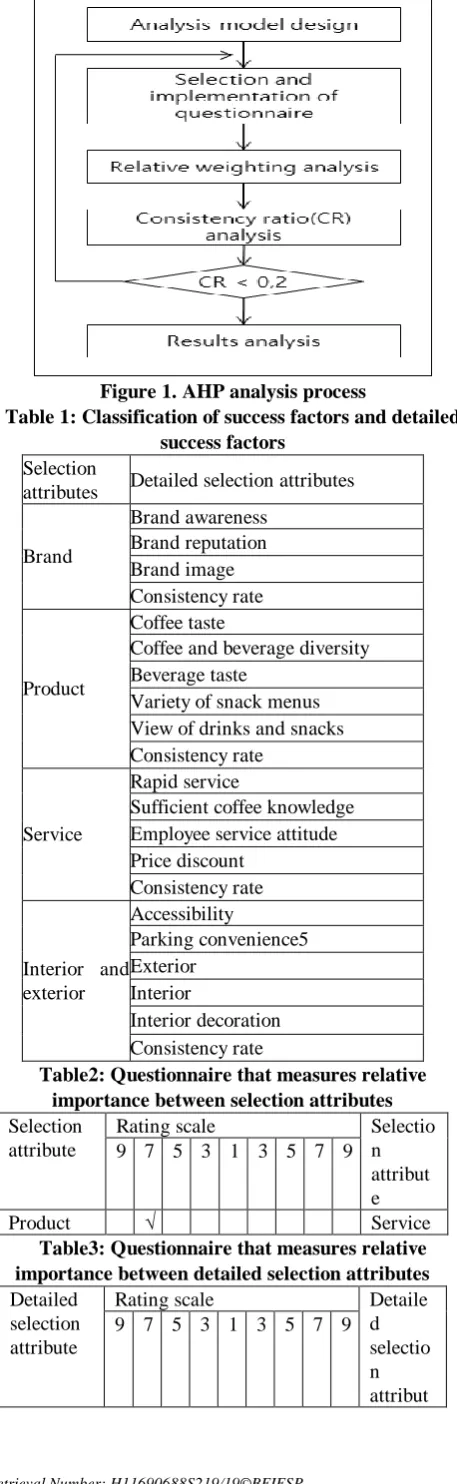
The priority analysis model used in this study is performed by five analysis processes as shown in [Figure 1]. The five analysis processes are as follows. (1) Defining the factors for analysis, structuring the factors, designing the analysis model to design the questionnaire, and selecting the survey subjects. (2) Selection and implementation phase of survey. (3) Relative weighted analysis step for analyzing relative weights among structured factors based on the survey results. (4) Consistency analysis step that evaluates the results of the survey by the consistency rate (CR). (5) A comprehensive evaluation step that analyzes the model and evaluates the significance of the model through empirical analysis of the evaluation model[15].
In this study, we extracted the coffee shop selection attributes that were important in the previous studies and classify the selection attributes into four categories(brand, product, service, interior and exterior) according to the similarity among the selection attributes, and classify 17 detailed selection attributes as [Table 1].
The questionnaire was designed as [Table 2] and [Table 3] to measure the relative importance between each selection attributes. In order to measure the relative importance of AHP, a questionnaire is prepared to compare the relative importance of the same level (hierarchy) selection attributes. First, we compare the relative importance of the selection attributes of the same level, brand, product, service, interior and exterior, and compare the relative importance of the detail selection attributes belonging to each level.[Table 4] summarizes the criteria for displaying the preference in pair comparison. [Table 2] shows an example in which product is highly preferred between two selection attributes (product, service) rather than service. [Table 3] is a survey to measure the detailed selection attribute accessibility and interior belonging to the selection attribute "interior and exterior". The number of these pairwise comparisons is nC2, which is designed so that the number of question items is not missing. A questionnaire survey was conducted on face to face interviews of 100 men and women in their 20s and 30s who preferred coffee as a data collection method. AHP analysis
was performed on 93
International Journal of Innovative Technology and Exploring Engineering (IJITEE) ISSN: 2278-3075, Volume-8 Issue-8S2, June 2019
[image:3.595.314.538.49.189.2]comparison item and the questionnaires which were checked by visual inspection to remove the non-logical questionnaire.
[image:3.595.73.280.80.281.2]Figure 1. AHP analysis process
Table 1: Classification of success factors and detailed success factors
Selection
attributes Detailed selection attributes
Brand
Brand awareness Brand reputation Brand image Consistency rate
Product
Coffee taste
Coffee and beverage diversity Beverage taste
Variety of snack menus View of drinks and snacks Consistency rate
Service
Rapid service
Sufficient coffee knowledge Employee service attitude Price discount
Consistency rate
Interior and exterior
Accessibility
Parking convenience5 Exterior
Interior
Interior decoration Consistency rate
Table2: Questionnaire that measures relative importance between selection attributes
Selection attribute
Rating scale Selectio
n attribut e 9 7 5 3 1 3 5 7 9
Product √ Service
Table3: Questionnaire that measures relative importance between detailed selection attributes
Detailed selection attribute
Rating scale Detaile
d selectio n attribut 9 7 5 3 1 3 5 7 9
e Accessibil
ity
√ Interior
Table 4: Preference of pair comparisons
value meaning
1 A and B are equally preferred 3 A is weakly favored than B
5 A is strongly more important than B 7 A is much more strongly or demonstrably
important than B
9 A is absolutely more important than B
3.3. Experimental result and analysis
In order to measure the relative importance of AHP, questionnaires were asked to 20-30 aged men and women preferring coffee by comparing the relative importance of selection attributes at the same level (hierarchy). The relative weights of each selection attribute were obtained as shown in [Table 5] by calculating the normalized weights in order to obtain the relative importance of each selection attribute by constructing a pairwise comparison matrix based on the geometric mean of the individual survey results.
The AHP has a device called the Consistency Rate (CR) that can be used to verify the logical consistency of the evaluators' judgments, thereby increasing the reliability of the results. If the respondents responded completely in a paired comparison, the CR would be zero, but in reality it would not be a complete match, and if the CR is usually 0.1 (less than 10%) then the consistency is considered good. And if it is more than 0.2, it is considered inconsistent and needs to be reviewed. In this study, the overall consistency ratio is 0.0852, and the consistency ratios for the detailed selection attributes such as brand, product, service, interior and exterior are 0.0756, 0.0872, 0.0963, 0.0925. Since all are smaller than 0.1, the weight of all evaluation indicators is consistent. The selection attributes weight, total consistency ratio, and consistency ratios of the detailed evaluation indicators are summarized in [Table 5].
The relative importance of the coffee shop selection attributes was analyzed by using the AHP technique. The results are summarized as follows. First, coffee selection attributes were relatively high in order of product (0.29), interior and exterior (0.26), brand (0.24) and service (0.21). Second, the detailed selection attributes of the product had a high priority for coffee taste. In the interior and exterior, the interior was a high priority. Brand placed importance on brand reputation and brand image, while service emphasized price discount.
Table 5: The relative weight and consistency ratio of the selection attributes
Selection
attributes Weight
Detailed selection
attributes Weight
Brand 0.24
Brand awareness 0.29
Brand reputation 0.36
Brand image 0.35
[image:3.595.57.286.82.825.2]Product 0.29
Coffee taste 0.24
Coffee and beverage
diversity 0.21
Beverage taste 0.18
Variety of snack
menus 0.17
View of drinks and
snacks 0.20
Consistency rate 0.0872
Service 0.21
Rapid service 0.24
Sufficient coffee
knowledge 0.20
Employee service
attitude 0.27
Price discount 0.29
Consistency rate 0.0963
Interior and exterior 0.26
Accessibility 0.20
Parking convenience 0.18
Exterior 0.21
Interior 0.22
Interior decoration 0.19 Consistency rate 0.0925 Consistency rate 0.0852
IV.CONCLUSION
In this study, AHP analysis model is proposed to derive the selection attributes that are important for Korean consumers to go to the coffee shop and analyze them synthetically. In the analysis model, coffee shop selection attributes and detailed selection attributes were designed and surveyed. Relative weight analysis and consistency ratio analysis were carried out. The results were analyzed and the following implications were derived.
First, coffee selection attributes were relatively high in order of product (0.29), interior and exterior (0.26), brand (0.24) and service (0.21). Coffee was the most important because it was a coffee shop. Next to the interior and exterior of the coffee shop, it is interpreted as a preference for the uniqueness of the exterior of the coffee shop and the relaxed atmosphere of coffee, since it is the young people of the 20s and 30s. It is interpreted that the brand is subordinated to the economic consumption rather than the expensive brand, and the importance of the service is lowered because the service is somewhat leveled. Second, in product attribute, since it is the coffee shop, the coffee flavor is the most important and it is preferable to provide various drinks other than coffee. In addition, since it is the generation enjoying the social networking, it paid special attention to the view of the special type of drinks and snacks that can be photographed. From this, the taste is also important, but it is pointed out that the visualization of the product is very important because the customers have to take a nice picture of the product and put it on the SNS.Third, the interior and exterior emphasized interior and exterior rather than accessibility and parking convenience. The exterior and interior atmosphere seemed to prefer special things when choosing a coffee shop. This seems to be the result of the needs of customers who want to
put something special on the SNS and upload it to the SNS. Fourth, the brand emphasized brand reputation and brand image. Brand attributes are subordinated to other properties because many coffee shops are available, and many coffee shops offer high quality coffee at low prices. It seems that 20-30 generations with low income have chosen economics rather than brands. Fifth, service emphasized price discount and service attitude of employees. Service is important in the service industry such as coffee shop, but the service attribute is pushed to the subordinate level because the service leveling is done and it is less importance than other attributes. However, low-quality service is still considered to be a factor for customers to avoid the coffee shop.
We look forward to seeing the priorities of selection attributes, which are important when choosing coffee shops in the 20-30 's, which are the main customers in the recently intensifying competition. These results indicate that customers' needs and business environment changes in each area of brand, product, service, interior and exterior selection attributes should be reflected in product and management strategies so that customers can succeed with their preferred coffee shop do.
As there are limitations in many other previous studies, there was a limit to the representation and sampling methods of the sample. In order to ensure high accuracy, reliability, and representativeness of the study results, it was necessary to extract a broader and more accurate sample of the nationwide range in consideration of area, age, sex, and technology in selecting the sample.
ACKNOWLEDGMENT
This study was conducted by research funds from Gwangju University in 2019.
REFERENCES
1. Kim YJ, Kim KJ, Park KY. A study on Consumer Attitude to a Coffee Shop Using the Fishbein Attitude Model: Focused on college students in Busan. Culinary Science & Hospitality Research. 2011;17(5):30-41.
2. Park SK, Kang MS. A Study on the Effects of Service Quality on Customer Satisfaction: Case of the Korean, Chinese and Foreigner. Korean Operations Research and Management Society. 2015;40(2):79-93. 3. Noh YJ, Ku CH, Kim HB. A Study on the Importance and Satisfaction
Factors of Customer’s Choice to Coffee Stores. FoodService Industry Journal. 2006;2(2):31-45.
4. Kim TH, Yoo HJ, Lee IO. Evaluation of How the Motivation the Use of Specialized Coffee Branches Brand Attitude, Satisfaction and Loyalty. Journal of the East Asian Society of Dietary Life. 2010;20(1):149-158. 5. Korea Agro-Fisheries & Food Trade Corporation. Report of Processed
Food Subdivision Market Status: Coffee Market. 2016.
6. Yoon HS, Oh SK, Yoon HH. The Study on the Influence of Selection Attributes for Coffee Shop on Revisit Intention: Based on Customers of Twenties and Thirties. Korean Journal of Hospitality & Tourism. 2016;25(5):25-44.
7. Lewis RC. Restaurant advertising, appeals & consumers’ intention. Journal of advertising research. 1981;21(5):69-74.
8. Chung YS. Park YS. Use-Utility of Kitchen Center and Cooking Equipments: Comparison between U.S.A. and Korea. Journal of the East Asian Society of Dietary Life. 2009;19(6);1039-1048.
9. Park KM. A Study of College Students` Actual Conditions of Using Coffee Shops and Choice Attributes: focused on Seongnam Area.The Korean Journal of Food and Nutrition. 2010;23(1):52-62.
International Journal of Innovative Technology and Exploring Engineering (IJITEE) ISSN: 2278-3075, Volume-8 Issue-8S2, June 2019
& Hospitality Research. 2010;16(4):76-93.
11.Kim DJ, Kim KR. A Perceptual Mapping of Coffee Shop Brands and Preference Attributes. Culinary Science & Hospitality Research. 2010;16(3):66-75.
12.Cho WS. The Study about Scale to Measure the Selection Attributes of Coffee Shop. International Journal of Tourism and Hospitality Research. 2012;26(4):155-166.
13.Saaty TL. The Analytic Hierarchy Process. New
York:McGraw-Hill;1980.
14.Saaty TL, Vargas LG. The Logic of Priorities. London:kluwer-Nijhoff Pulishing;1982.