Abstract: As organizations become dynamic in nature, managers find it challenging sustaining organization’s viability. Little literature exists in the area of the positive net effect of effective conflict management. The current study aims to examine the mediation effect of group innovative performance on the relationship between conflict management strategies and project conflict manifestation within IT firms in the United Arab Emirates. Data was collected with the help of survey questionnaire administered through online platform using five likert scale and PLS (Partial Least Squares) SEM-VB (Structural Equation Modelling-Variance Based) was employed to assess the research model by utilising the software SmartPLS 3.0. The finding of this study has confirmed the mediation effect of group innovative performance on the relation between conflict management and the manifestation of project conflict in addition to the direct effect. Moreover, conflict management strategies had a positive effect on the innovative performance in a group, while a negative impact was revealed on the project conflict manifestation from the group innovative performance. At the end, results added to the body of knowledge, moreover give insights to the managers how to control the project conflicts manifestations.
Index Terms: Conflict management strategies, group innovative performance, project conflict manifestations, UAE.
I. INTRODUCTION
As organizations become dynamic in nature, managers find it challenging sustaining organization’s viability [1, 2]. According to Kolb & Glidden (1986) [3], the “interdependency of tasks” in an organizational life is said to be the cause of interpersonal conflict. Significant evidence exists that conflict leads to counterproductive work [4, 5], absenteeism in the workplace [5, 6], and can lead to significant reduction in commitment to work and commitment to the organization [5, 7] to mention just a few. Little literature exists in the area of the positive net effect of effective conflict management [8] even though consensus
Revised Manuscript Received on May 22, 2019.
Saeed Alhassani, Faculty of Business and Accountancy, Lincoln University College, Selangor, Malaysia.
Dr Amiya Bhaumik, Faculty of Business and Accountancy, Lincoln University College, Selangor, Malaysia.
exists that conflicts need to be managed as part of effective management. According to Tjosvold (2008) [9]; van den Berg, Curseu, & Meeus (2014) [10], organizations must strive to manage conflict in a constructive manner [11]. It is important to note that effective conflict management has remained a function of every effective management situation, channelling conflicts towards positive competition, innovation, creativity and productivity [12]. Furthermore, in every organization, projects are the driver for sustainability, thus, the conflict will appear in every stage of each project. Therefore, conflict management strategies plays a major role in attenuating the manifestation of project conflicts throughout project life cycle
Exploring innovativeness in UAE IT sector is in the right direction. Considering the global information and communication technology (ICT) market growth of about 6 percent in 2010 a growth of 15% was recorded in the UAE alone; and it was expected that the country records a growth of about 17 percent in the following year [13]. This growth was strongest in outsourcing service, smartphones, and disk storage as well as midrange-volume servers. This fast growth of the ICT market in the UAE implies that the country would enjoy significant increase in jobs growth and expansion [13]. The main objective of this study is to examine the mediation effect of group innovative performance between conflict management strategies (CMS) and the project conflict manifestation (PCM). In addition to the direct effect of the CSM on the PCM. Result should give insights for practical and theoretical implications.
II. LITERATUREREVIEW A. Project Conflict Manifestations
Although no single definition of conflict exists, most definitions cuts across having at least two independent groups who are incompatible and interacting in a not so friendly manner. According to Putnam & Poole (1987) [14], conflict is defined “as a pervasive aspect of organizational life” evident in “intrapsychic,
dyadic, inter-group and inter-organizational
contentions.” It is a
The Mediation Effect of Group Innovative
Performance on the Relationship between
Conflict Management Strategies and Project
Conflict Manifestations within Engineering and
IT Firms in the UAE
phenomenon which is universal and inevitable. It has been argued that as social beings we do have “individual self-interests”. There are two main types of conflict – affective and cognitive conflict. Guetzkow & Gyr (1954) [15] identified two types of conflict – one based on task and the other on group’s interpersonal relations. Priem & Price (1991) [16] also identified task related conflict and socio-emotional conflicts as two different types of conflict. The manifestation of project conflict appears throughout different stages of the project due to the variance in groups inside the projects and it is also impacted by many different factor.
B. Conflict Management Strategies
Conflict management is the process by which parties attempt to negotiate a real or imagined difference to a mutually acceptable settlement [17]. Sources of organizational conflict include communication difficulties, differences in expectations, poor organizational structure, and lack of energy, cultural differences, and lack of cooperation and lack of commitment [18]. Also, Daft & Sharfman (1992) [19] cite limited resources, task responsibility, and goal difference, lack of communication and personality differences as key sources of organizational conflict.
Regardless of how conflict is defined, it has become an underlying truth that conflict cannot be suppressed in an organization, at least for a long period of time [8, 14, 20, 21] and given the inevitability of its occurrence in organizations, it is the responsibility of managers to make something productive out of it [22]. According to De Dreu & de Vliert (1997) [23], conflict should be allowed in organizations. This is because a peaceful or cooperative organization is likely to become static and unresponsive to change. Conflicts should therefore be encouraged as it promotes creativity. Depending on how conflict is handled, it can either be constructive or destructive [24].
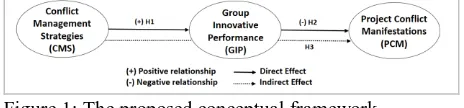
Schulze, Janina, Stade, & Netzel (2014) [25] examined how the various types of conflict and conflict management style lead to innovative performance as intended in the present study. Ultimately, conflicts help create inter-functional relationships which help drive group innovative performance [26-28]. The benefits of managing conflicts effectively have been established in many areas of overall corporate success. Moreover, Innovation has no doubt been argued as one of the key outcomes of effective conflict management [9, 29]. Pegels, Yang, & Baik (2000) [30] and Pettus (2001) [31] agree that managers should develop effective ways to adapt to the changing environment. Consequently, the following hypotheses are proposed:
H1: Conflict management strategies has a positive effect on group innovative performance.
C. Group Innovative Performance
West & Wallace (1991) [32] define innovation in the context of work teams as the deliberate introduction and implementation of new ideas, procedures or products in work teams in order to create significant benefits to individuals,
the team, the organization, or society as a whole. West, Tjosvold, & Smith (2003) [33] add that innovation is generated after work teams continuously interact internally. Several Researchers have concurred to the assumption that the effectiveness of work teams in terms of innovation, as well as their ability to be innovative lies greatly in the nature of their internal relationships [21-23]. The way team members handle themselves in conflicts influences the nature of their internal relationships to a large extent. Therefore, project conflict manifestation is greatly affected by the group innovative performance, the more innovative the team working on the project the less the manifestation of project conflicts. Consequently, the following hypotheses are proposed:
H2: Group innovative performance has a negative effect on project conflict manifestations.
H3: Conflict management strategies has an indirect effect on project conflict manifestations through group innovative performance.
III. RESEARCH METHOD
A. Overview of the Proposed Conceptual Framework
[image:2.595.313.545.519.573.2]Figure 1 posits the proposed model, the model revolves around the project life cycle which was originally proposed by Thamhaim & Wilemon (1975) [34] based on Tuckman's 1965 developmental model of groups and the project conflicts manifestation. When managed effectively, the projects, even conceptualized around concomitant conflicts, would lead to innovative group performance [8, 29] [H1]. Furthermore, innovative group performance [8, 29] negatively affect the manifestation of project conflict, as the higher the innovative performance the lower the project conflict manifestation [H2]. Moreover, the proposed model will examine the mediation effect of innovative group performance between CMS and PCM [3].
Figure 1: The proposed conceptual framework
B. Development of Instrument and Data collection
Data was collected with the help of survey questionnaire administered through online platform using five likert scale. The survey was mounted online onto Survey Monkey Online Data Collection Platform. The entire period of data collected lasted 12 weeks. The gatekeepers were encouraged to adapt the use of a random sampling technique to select the number of participants allocated to them. The Abu Dhabi Airport Free Zone (ADAFZ) therefore, for instance, was made to select 120 respondents randomly from within their database of employees in the technology related businesses or professions. The gatekeepers were encouraged to use a random number calculator
IV. DATAANALYSIS
[image:3.595.42.560.505.729.2]PLS (Partial Least Squares) SEM-VB (Structural Equation Modelling-Variance Based) was employed to assess the research model by utilising the software SmartPLS 3.0 [35]. A two-phase analytical technique [36, 37] consisting of (i) measurement model analysis (reliability and validity) and (ii) structural model analysis (examining the conceptualised relationships) was employed after performing the descriptive assessment. This two-phase analytical technique consisting of a structural and a measurement model assessment is better than a single phase assessment [38, 39]. While the model of measurement explains each parameter’s measurement, the structural model describes the correlation between the parameters in this model [37].
A. Descriptive Analysis
Table 1 presents the mean and standard deviation of each variable in the current study. The respondents were asked to indicate their opinion in relation to transformational leadership and human capital based on a 5-point scale ranging from 1 (strongly disagree) to 5 (strongly agree). Group innovative performance score the highest with mean 3.283 out of 5.0, with a standard deviation of 1.121. Project conflict manifestations score the lowest with mean 2.441 out of 5.0, with a standard deviation of 1.070.
B. Measurement of Model Assessment
Construct reliability as well as validity (comprising discriminant and convergent validity) were used to examine the measurement model. The particular alpha coefficients of Cronbach were tested to determine the reliability of every
core parameter in the measurement model (construct reliability). The quantities of all the unique alpha coefficients of Cronbach in this research ranged from 0.914 to 0948, which went beyond the proposed value of 0.7 [40]. Moreover, for inspecting construct reliability, all the CR (composite reality) values ranged from 0.934 to 0.957, which went beyond 0.7 [41-43]. Thus, as Table 1 shows, construct reliability has been fulfilled as Cronbach’s CR and alpha were rather error-free for all the parameters.
Analysis of indicator reliability was conducted by utilising factor loadings. When the related indicators are very similar, this is reflected in the construct and signified by the construct’s high loadings [37]. As per Hair et al. (2010) [39], the exceeding of values beyond 0.70 suggests substantial factor loadings. Table 1 displays that all articles in this research had factor loadings greater than the suggested value of 0.7 with the exception of the item GIP7 which was removed from the scale because of low loading. AVE (average variance extracted) was employed in this study to analyse convergent validity, which represents the degree to which a measure is correlated positively with the same construct’s other measures. All the AVE values ranged from 0.701 and 0.762, which went beyond the proposed value of 0.50 [39]. Thus, all constructs have complied with the convergent validity acceptably, as shown in Table 1.
Table 1: Mean, standard deviation, loading, cronbach’s Alpha, CR and AVE
Constructs Item Loading
(> 0.5) M SD
α (> 0.7)
CR (> 0.7)
AVE (> 0.5)
Conflict Management Strategies (CMS)
CMS1 CMS2 CMS3 CMS4 CMS5 CMS6 CMS7
0.853 0.864 0.859 0.854 0.862 0.868 0.846
3.283 1.121 0.940 0.951 0.736
Group Innovative Performance (GIP)
GIP1 GIP2 GIP3 GIP4 GIP5 GIP6 GIP7
0.835 0.877 0.861 0.835 0.854 0.756 Deleted
3.439 1.028 0.914 0.934 0.701
Project Conflict Manifestations (PCM)
PCM1 PCM2 PCM3 PCM4 PCM5 PCM6 PCM7
0.855 0.897 0.917 0.894 0.896 0.830 0.815
2.441 1.070 0.948 0.957 0.762
Note: M=Mean; SD=Standard Deviation, α= Cronbach’s alpha; CR = Composite Reliability, AVE = Average Variance Extracted. The measurement used is seven-point scale ranging from 1 (strongly disagree) to 5 (strongly agree).
Key: CMS: conflict management strategies, GIP: group innovative performance, PCM: project conflict manifestations.
CMS GIP PCM
CMS1 0.853 0.311 -0.390
CMS2 0.864 0.272 -0.404
CMS3 0.859 0.310 -0.377
CMS4 0.854 0.316 -0.410
CMS5 0.862 0.257 -0.360
CMS6 0.868 0.306 -0.378
CMS7 0.846 0.270 -0.352
GIP1 0.253 0.835 -0.600
GIP2 0.263 0.877 -0.612
GIP3 0.320 0.861 -0.609
GIP4 0.331 0.835 -0.598
GIP5 0.303 0.854 -0.646
GIP6 0.241 0.756 -0.581
PCM1 -0.387 -0.655 0.855
PCM2 -0.336 -0.628 0.897
PCM3 -0.382 -0.634 0.917
PCM4 -0.394 -0.586 0.894
PCM5 -0.409 -0.633 0.896
PCM6 -0.421 -0.653 0.830
PCM7 -0.388 -0.641 0.815
[image:4.595.43.554.59.253.2]Key: PRMS: project risk management strategies, GIP: group innovative performance, LT: latent tensions, PCM: project conflict manifestations.
Table 3: Results of discriminant validity by Fornell-Larcker criterion
Factors 1 2 3
CMS GIP PCM
1 CMS 0.858
2 GIP
0.342 0.837
3 PCM -0.446 -0.727
0.873
Note: Diagonals represent the square root of the average variance extracted while the other entries represent the correlations.
Key: CMS: conflict management strategies, GIP: group innovative performance, PCM: project conflict manifestations.
The degree to which the articles distinguish among concepts or measure different constructs is demonstrated by discriminant validity. Cross-loadings as well as Fornell-Larcker were employed to analyse the measurement model’s discriminant validity. Generally, cross-loadings are employed as the initial step in examining discriminant validity of the markers [37]. In this research, the markers’ outer loadings on a parameter went beyond all the cross-loadings with other parameters, and thus the cross-loading condition had met the requirements (refer to Table 2).
Table 3 shows the outcomes for discriminant validity by employing the Fornell-Larcker condition. It was discovered that the AVEs’ square root on the diagonals (displayed in bold) is bigger than the correlations among constructs (corresponding row as well as column values), suggesting a strong association between the concepts and their respective markers in comparison to the other concepts in the model [44-46]. According to Hair et al. (2017) [37], this indicates good discriminant validity. Furthermore, the exogenous constructs have a correlation of less than 0.85 [47]. Therefore, all constructs had their discriminant validity fulfilled satisfactorily.
C. Structural Model Assessment
The structural model can be tested by computing beta (β), R², and the corresponding t-values via a bootstrapping procedure with a resample of 5,000 [37].
Key: CMS: conflict management strategies, GIP: group innovative performance, PCM: project conflict
manifestations
Figure 2: PLS algorithm results
- Direct Hypotheses Tests
Depict the structural model assessment, showing the results of the hypothesis tests, with 2 out of the 2 hypotheses are supported. Conflict management strategies positively influence group innovative performance. Hence, H1 is accepted with (tp <0.001). Group innovative performance negatively influence project conflict
manifestations. Hence, H2 is accepted with
(tp <0.001).
[image:4.595.39.554.281.351.2]Table 4: Direct Hypotheses Results
Hypothesis Relationship Std Beta Std
Error t-value p-value Decision R²
H1 CMS→GIP 0.342 0.051 6.673 0.000 Supported 0.12
H2 GIP→ PCM -0.727 0.031 23.379 0.000 Supported 0.53
Key: CMS: conflict management strategies, GIP: group innovative performance, PCM: project conflict manifestations.
- In direct Hypothesis:
To test the mediation hypothesis H3, the Preacher & Hayes (2004) [49] and Preacher & Hayes (2008) [50] method of bootstrapping the indirect effect was applied.
The bootstrapping analysis showed that the indirect effect was significant with a t-value of 5.806 and p-value< 0.001. Preacher & Hayes (2008) [50] indicated that when the
[image:5.595.40.561.150.190.2]indirect impact of user satisfaction on performance impact through cognitive absorption, with 95% Boot CI: [LL = -0.337, UL = -0.171], does not straddle a 0 in between, this indicates there is mediation. Thus we can conclude that the mediation effect is statistically significant, indicating that H3 was also supported (see table 5).
Table 5: Indirect Hypothesis Results
Hypothesis Relationship Std Beta Std
Error t-value p-value Decision
H3 CMS→ GIP→ PCM -0.249 0.043 5.806 0.000 Supported
Key: CMS: conflict management strategies, GIP: group innovative performance, PCM: project conflict manifestations.
V. DISCUSSION
The main objective of the current study is to examine the direct and indirect effect of conflicts management strategies on the project conflicts manifestation through the mediation effect of group innovative performance. Results showed in the structural model test have given insight toward supporting the assumed hypothesis.
Conflicts have remained attendant in project management throughout the project life cycle [51]. Evidence also stipulate that differences in employees and group compositions have remained a key contributor to the persistent nature of conflicts in group performances. A number of studies however have established that conflicts lead to positive group innovative outcomes [12, 52]. Building on this insight remains essential to group processes and overall innovative performance in business organizations. Regardless, the presence of effective conflict management processes has equally gained roots as critical to overall accomplishment of set group goals. At the end H1 was supported with (tp <0.001) as the better the managing of conflicts in a project, the more innovative groups become which will consequently effect the outcome of the project.
Moreover, H2 was supported as the group innovative performance greatly negatively affect the manifestation of project conflicts (tp <0.001).. As the groups in projects are able to arrive at innovative procedures for work performance, capable of coming up with procedures that are critical for work performance, able to make significant progress in our work performance, the less serious conflicts surrounding administrative procedures in project
management, besides Staffing and personnel allocation will not be a major problem when managing projects, and Inter-personal issues attributable to personality differences will be reduced.
Regarding the mediation test, findings have revealed promising mediating between conflict management strategies and project conflict manifestation via group innovative performance. This finding has given special evidence of support to the mediation effect of GIP in eastern setting. This decreases the appropriateness of manifestation of project conflict. The adoption in a special setting: eastern countries, more specifically the IT sector in the United Arab of Emirates (UAE) resulting in a model fit which gives GIP a thumb’s up.
VI. IMPLICATIONS,LIMITATIONSANDFUTURE DIRECTIONS
Building on the present findings or research model, conflict management strategies characteristics is observed as critical conflict management’s ability to generate innovative performance. The study is of key practical implications. It adds to the UAE’s quest to improve the country’s position on the Global Innovation Index. The UAE has remained keen on supporting innovation. Part of these include the National Innovation Strategy Program and the UAE Vision 2021 [53]. Any study’s contribution must be evaluated in light of its limitations, and this study is no exception. First, there are many constructs that affect
the manifestation of project conflict. This study only
management strategies and the group innovative performance. More variables that affect the project conflict manifestation need to be studied i.e. project risk management and group latent tension. Second, this study was embedded in the context of IT sector specifically in the UAE, and no other sectors. So, it is suggested to include other sectors like constructions to measure the conflicts that can appear throughout their projects.
VII. CONCLUSIONS
Organizations management is a wide concept, projects what makes conflicts in their different stages and succeeding in these projects depend in many factors. The main objective of this study is to examine the direct and indirect impact of
CMS on the PCM through the GIP. In line with the literature, results confirms the direct impact CMS on the innovative performance of groups in projects and throughout its different phases. As managers takes care of managing and administrating these conflicts it will by practical test increase the group innovative performance. While innovative performance of groups has a negative impact on the project conflicts manifestation. The more innovative performance the less manifestation of project conflicts in the UAE IT sector projects. Moreover, as demonstrated by this study the mediation impact of GIP shows that CMS can affect the PCM indirectly.
APPENDIX
Appendix A
Instrument for variables
Varible Measure Source
Conflict
Management
Strategies
(CMS)
CMS1: When conflict occurs, we usually let go (inaction) when there are no party benefits CMS2: Managers compete for the use of power and pressure when minor conflicts occur. CMS3: Managers support employees on conflict matters important to employees CMS4: Managers bargain and negotiate when dealing with employees with equal power CMS5: Where synergy is possible, managers preach collaboration to solve conflicts CMS6: Managers attempt to dominate some issues when conflicts arise
CMS7: Negotiating the way out is sometimes considered as a viable conflict resolution strategy in my company
[8]
Group
Innovative
Performance
(GIP)
GIP1: In my organization, we are able to install and achieve innovative work targets together GIP2: We are able to achieve step by step work procedures without problems
GIP3: As a group, we are able to arrive at innovative procedures for work performance GIP4: As a group, we are capable of coming up with procedures that are critical for work performance.
GIP5: As a group, we are able to make significant progress in our work performance GIP6: We are able to achieve high work innovation when we work together as a group in my organization
GIP7: There is an increased chance of success when we work together as a group in my organization
[32]
Project
Conflict
Manifestations
(PCM)
PCM1: When undertaking projects, employees often displace priorities
PCM2: We have serious conflicts surrounding administrative procedures in project management PCM3: We always have disagreements on technical opinions in project management
PCM4: Staffing and personnel allocation is a major problem when we are managing projects PCM5: Cost and budget conflicts often occur in project management in my company
PCM6: During project management, conflicts arise out of timing related activities such as sequencing and scheduling.
PCM7: Inter-personal issues attributable to personality differences always arise in event of project management
[34]
REFERENCES
1. C. Jordan, P. Sevatos. (2003). Improved Understanding of Job Performance: Predicting Organizational Citizenship Behaviours from Perceived Organizational Support and Fairness. Aus. J. Psychol.55(1). pp. 131–132.
2. D. M. Kolb, P. A. Glidden. (1986). Getting to know your conflict options: Using conflict as a creative force. Person. Admin.31(6). pp. 77–90.
3. N. Bayram, N. Gursakal, N. Bilgel. (2009). Counterproductive Work Behavior Among White-Collar Employees: A study from Turkey. Int. J. Sel. Assess.17(2). pp. 180–188.
4. E. M. Eatough. (2010). Understanding the Relationships between Interpersonal Conflict at Work, Perceived Control, Coping, and Employee Well-being. University of South Florida. Retrieved from http://citeseerx.ist.psu.edu/viewdoc/download?doi=10.1.1.896.55 27&rep=rep1&type=pdf
5. C. Liu, P. E. Spector, L. Shi. (2007). Cross-national job stress: a quantitative and qualitative study. J. Organ. Behav. 28(2). pp.
209–239.
6. S. H. Appelbaum, B. Shapiro, D. Elbaz. (1998). The management of multicultural group conflict. Team Performance Management: An International Journal. 4(5). pp. 211–234.
7. D. Tjosvold. (2008). The conflict-positive organization: it depends upon us. J. Organiz. Behav.29(1). pp. 19–28.
8. W. van den Berg, P. L. Curseu, M. T. H. Meeus. (2014). Emotion regulation and conflict transformation in multi-team systems. Int. J. Conf. Manag.25(2). pp. 171–188.
9. A. S. M. Leung. (2008). Interpersonal conflict and resolution strategies: An examination of Hong Kong employees. Int. J. Team. Perform. Manag.14(3/4). pp. 165–178.
10.G. N. Root. (2016). Positive and Negative conflict in the workplace.
Retrieved from
http://smallbusiness.chron.com/positive-negative-conflicts-workpla ce-11422.html
https://www.thenational.ae/business/uae-on-the-fast-track-for-grow th-in-it-sector-1.424215
12.L. L. Putnam, M. S. Poole, “Conflict and negotiation,” in Handbook of organizational communication: An interdisciplinary perspective. , US: Sage Publications. 1987, pp. 549–599.
13.C. A. Robarchek, "A Community of Interests: Semai Conflict Resolution," in Cultural variation in conflict resolution: Alternatives to violence, D. P. Fry, K. Bjorkqvist, ed. New York: Taylor and Francis, 1997, pp. 51–58.
14.L. T. Simons, S. R. Peterson. (2000). Task Conflict snd Relationship Conflict in Top Management Teams:The Pivotal Role of Intragroup Trust. Academy of Management Proceedings. 85(1), 102. 15.H. Guetzkow, J. Gyr. (1954). An analysis of conflict in
decision-making groups. Hum. Rel.7. pp. 367–382.
16.R. L. Priem, K. H. Price. (1991). Process and Outcome Expectations for the Dialectical Inquiry, Devil’s Advocacy, and Consensus Techniques of Strategic Decision Making. Group & Organization Studies. 16(2). pp. 206–225.
17.G. O. Faure, J. Z. Rubin, “Culture and Negotiation: The Resolution of Water Disputes”. SAGE Publications. 1993.
18.A. A. Ikeda, T. M. Veludo-de-Oliveira, M. C. Campomar. (2005). Organizational Conflicts Perceived by Marketing Executives. Elect. J. Business. Ethics. Organiz. Stud.10(1). pp. 22–28. 19.R. L. Daft, M. P. Sharfman. Organization theory: cases and
applications. West Pub. Co. 1992.
20.M. Myatt. (2012). 5 Keys of Dealing with Workplace Conflict. 21.M. Rau-Foster. (2016). Conflict in the Workplace.
22.E. Phillips, R. Cheston. (1979). Conflict Resolution: What Works? Calif. Manag. Rev.21(4). pp. 76–83.
23.C. K. W. De Dreu, E. de Vliert, “Using Conflict in Organizations.” SAGE Publications. 1997.
24.P. T. Coleman, M. Deutsch. “Some guidelines for developing a creative approach to conflict,” in The handbook of conflict resolution: Theory and practice. San Francisco: Jossey-Bass. 2000, pp. 355–365.
25.A. D. Schulze, M. Janina, C. Stade, J. Netzel. “Conflict and Conflict Management in Innovation Processes in the Life Sciences”. 2014. 26.C. Homburg, O. Jensen. (2007). The Thought Worlds of Marketing and Sales: Which Differences Make a Difference? J. Market.71(3). pp. 124–142.
27.H. Krohmer, C. Homburg, J. P. Workman. (2002). Should marketing be cross-functional? Conceptual development and international empirical evidence. J. Bus. Res.55(6). pp. 451–465.
28.A. P. Opute. (2009). Empirical investigation of accounting-marketing integration UK financial services organisations: dimensions, antecedents and strategic marketing evidence. University of East Anglia, Norwich, UK.
29.N. Schmitt, R. J. Klimoski, G. R. Ferris, K. M. Rowland, "Research methods in human resources management," South-Western Pub. Co. 1991.
30.C. C. Pegels, Y. I. Yang, S. Baik. (2000). Management heterogeneity, competitive interaction groups, and firm performance. Strat. Manag. J.21(1). pp. 911–923.
31.M. L. Pettus. (2001). The Resource-Based View as a Developmental Growth Process: Evidence From the Deregulated Trucking Industry. Acad. Manag. J.44(4). pp. 878–896.
32.M. A. West, M. Wallace. (1991). Innovation in health care teams. Eur. J. Soc. Psychol.21(4). pp. 303–315.
33.M. A. West, D. Tjosvold, K. G. Smith, "International handbook of organizational teamwork and cooperative working." England: John Wiley & Sons Ltd. 2003.
34.H. J. Thamhaim, D. L. Wilemon. (1975). Conflict management in project life cycles. Sloan Management Review. 16(3). pp. 31–50. 35.C. M. Ringle, S. Wende, J. M. Becker. (2015). SmartPLS 3.
Bonningstedt: SmartPLS.
36.C. Anderson, D. W. Gerbing. (1988). Structural Equation Modeling in Practice : A Review and Recommended Two-Step Approach. Psychol. Bul.103(3). pp. 411–423.
37.J. F. Hair, G. T. M. Hult, C. Ringle, M. Sarstedt. A Primer on Partial Least Squares Structural Equation Modeling (PLS-SEM). London: Thousand Oaks: SAGE. 2nd ed. 2017.
38.R. E. Schumacker, R. G. Lomax, "A Beginner’s Guide to Structural Equation Modeling," New York: Lawrence Erlbaum, 2004. 39.J. F. Hair, W. C. Black, B. J. Babin, R. E. Anderson, "Multivariate
Data Analysis," Prentice Hall, 7th ed. 2010.
40.V. R. Kannana, T. C. Tan. (2005). Just in time, total quality
management, and supply chain management: understanding their linkages and impact on business performance. Omega: The International Journal of Management Science. 33(2). pp. 153–162.
41.C. E. Werts, R. L. Linn, K. G. Jöreskog. (1974). Intraclass reliability estimates: Testing structural assumptions. Educational and Psychological Measurement. 34(1). pp. 25–33.
42.R. B. Kline, "Principles and practice of structural equation modeling," 3rd ed. New York: The Guilford Press, 2010. 43.D. Gefen, D. Straub, M. .C Boudreau. (2000). Structural equation
modeling and regression: Guidelines for research practice. Comm. Assoc. Info. Sys.4(1). pp. 1–79.
44.C. Fornell, D. F. Larcker. (1981). Evaluating structural equation models with unobservable variables and measurement error. J. Market. Res.18(1). pp. 39–50.
45.W. W. Chin. (1998a). Issues and opinion on structural equation modeling. MIS Quarter.22(1). pp. 7–16.
46.W. W. Chin, "The partial least squares approach to structural equation modeling. In G. A. Marcoulides (Ed.), Modern methods for business research," New Jersey: Lawrence Erlbaum Associates, 1998b, pp. 295-358.
47.Z. Awang (2014). Structural Equation Modeling Using AMOS. Shah Alam.Malaysia: University Teknologi MARA Publication Center.
48.J. Cohen, "Statistical Power Analysis for the Behavioral Sciences," 2nd Ed. New Jersey: Lawrence Erlbaum Associates, 1988. 49.K. J. Preacher, A. F. Hayes. (2004). SPSS and SAS procedures for
estimating indirect effects in simple mediation models. Behav. Res. Method. Instr. Comp.36(4). pp. 717–731.
50.K. J. Preacher, A. F. Hayes. (2008). Asymptotic and resampling strategies for assessing and comparing indirect effects in multiple mediator models. Behav. Res. Method.40(3). pp. 879–891. 51.A. S. Bu-Qammaz, I. Dikmen, M. T. Birgonul. (2009). Risk
assessment of international construction projects using the analytic network process. Can. J. Civ. Eng.36(7). pp. 1170–1181. 52.M. Vijayakumar, K. S. Manoj Kumar. (2015). Conflict Management
in Management Library Professionals.