International Journal of Innovative Technology and Exploring Engineering (IJITEE) ISSN: 2278-3075, Volume-8 Issue-10, August 2019
642
Published By:
Blue Eyes Intelligence Engineering & Sciences Publication
Retrieval Number: J87630881019/2019©BEIESP DOI: 10.35940/ijitee.J8763.0881019
Abstract:As the demand of video transmission over communication network has grown rapidly, the data compression and error correction in video processing have shown significant improvement day by day. When the error occurs in a single frame, the visual quality of the subsequent frames gets degraded due to error propagation. Thus, the error control techniques are required for the recovery. Concealment of error at the receiver (decoder) side feats the spatial and temporal characteristics of the frame. Without the requirement of the extra bandwidth and retransmission delay, it enhances the quality of the reconstructed video. However, the output of the error concealment may get affected if the error located before is misleading. Thus error detection also plays an important role while reconstructing the video. However, the output of the error concealment may get affected if the error located before is misleading. This paper proposes error detection and concealment approach for the recovery of lost Macro Block (MB) in video. The spatio-temporal techniques has been used for the error detection followed by the MB type decision applied for classifying the damaged macro block .For the concealment method a new method i.e. Modified Spatio-Temporal Boundary Matching Algorithm (MSTBMA) has been proposed. The proposed work is compared with various existing method for spatial and temporal error concealment. The comparison has been done for various types of error such as block error (single, multiple), burst error and random error generated by the software. Performance is improves in terms of PSNR and visual quality by considering the type of lost MB.
Index Terms: Macro block, Error Detection, Spatio-temporal error, Temporal Error detection, Error concealment, Modified Boundary Matching algorithm
I. INTRODUCTION
The information transmitted can be affected or lost due to channel noise which proves to be the inherent problem of the communication system. The loss to the compressed bit stream may result into overall distortion in the video. Due to the bandwidth limitation data is compressed, thus loss of a bit may result into the loss of a whole frame. Considering the real-time application, retransmission has never been a solution due to the delay factor. Error resilience works on the encoder side, but after the transmission frames can get erroneous. To combat the above problem, error concealment
Revised Manuscript Received on August 03, 2019.
Ketki C. Pathak, Electronics & Communication Engineering Department ,Sarvajanik College of Engineering & Technology, Gujarat Technological University, Surat, India.
Jignesh N Sarvaiya, Electronics Engineering Department, SardarVallabbhai National Institute of Technology(S.V.N.I.T.) , Surat, India.
AnandD.Darji, Electronics Engineering Department, SardarVallabbhai National Institute of Technology(S.V.N.I.T.) , Surat, India.
is used for the recovery of damaged area at the decoder. The spatial and temporal characteristics of the neighborhood and previous /future frames are exploited for the concealment of errors. In order to provide the good visual quality to the end user, robust and effective error concealment technique should be applied. Due to bandwidth and Power limitation in real time scenario, computational complexity should be taken in consideration. Presently there are no defined standards for the comparison of complexity in different error concealment algorithms. The purpose of applying error detection algorithm before error concealment is that , if we received any information without any correction, then based on error detection algorithm, we can able to identify the nature of corrupted or lost macroblock . This way we can reconstruct the lost or erroneous block correctly without retransmission and extra bandwidth requirement. Error detection is the means where errors can be detected based upon received information without correction. In 2007, Guan-Lin Wu and Shao-Yi Chienhad analyzed various spatio-temporal error detection algorithm to transmit the video frames over erroreous channel [11]. According to the characteristic of spatio-temporal behavior, they have detected various corrupted macro-block or errors within frame. For spatial characteristic, the parameter called Average Inter pixel Difference Boundary (AIDB)is calculated and for temporal characteristic, Average Difference Across the Frame (ADF) (Average Difference across the Frames) is calculated. To detect spatial type of error or temporal type of error equations (1), (2) and (3) were implemented. This method ruled out the possibility of complexity in the calculations as it was simple in implementation with both spatial and temporal error detections applied on a frame giving better results.
( : )
(1)
(2)
(3)
Modified Boundary Matching algorithm for
Error detection and Error Concealment for Video
Communication
Modified Boundary Matching algorithm for Error detection and Error Concealment for Video
Communication
643
Published By:
Blue Eyes Intelligence Engineering & Sciences Publication
Retrieval Number: J87630881019/2019©BEIESP DOI: 10.35940/ijitee.J8763.0881019
Yan Chen,[21] derived a cost function based on smoothness property of video macroblock.He has suggested two stage error concealment procedure. He has designed two stage algorithm. The cost function is minimized in first stage so that Motion Vector (MV) of each lost Macro Block (MB) in the reference frame is retrieved again. Copy paste algorithm is applied on lost MB in second stage of algorithm.InPartial Differential Equation (PDE) based algorithm, weighting factor is used to remove blocking artifacts of reconstructed frameThis algorithm achieves higher degree of removal of blocking artifacts while preserving lost macroblock.
Youjun Xiang et.al suggested an efficient spatiotemporal boundary matching algorithm (ESTBMA) by introducing the concept of smoothness measurement. They suggested medical motion vector which improves the subjective visual quality of concealed video.
After reviewing various literatures, we have analyzed that the various algorithm suggested the smoothness property of Macroblock in video frames as a spatial and temporal prime characteristic. None of the authors consider the texture or edge based property of lost MB. So, in our proposed modified Spatio-Temporal Boundary matching algorithm, we first analyzed the lost MB type like whether it is texture, edge or smooth, based on that decision we have applied of proposed BMA algorithm. So our proposed algorithm divides in three major tasks, a). Error detection b). Type of lost MB decision and c). BMA based novel algorithm to conceal lost MB.
Rest of the paper arranged in this manner. Section II describes conventional BMA algorithm and its classification. Section III describes proposed modified spatio-temporal boundary matching algorithm (MSTBMA). Section IV gives results analysis and final section summarizes the proposed work flow and future improvement.
II. BOUNDARYMATCHINGALGORITHM(BMA)
For any kind for visual improvement, there is a tradeoff criteria between computational complexity of algorithm and vision enhancement of reconstructed video sequences. The boundary matching algorithm provides better performance for low complexity error concealment to recover lost MB. BMA is considered as a not adhering to a standardH.264 for temporal error concealment [13].However, in the case of continuous loss of slices, the frames are not concealed properly leading to poor visual quality. There are many algorithms are designed to minimize side match distortion factor between inner and outer boundaries of video frames. The minimization of boundary Side Match Distortion (Dsm) between inner and outer boundaries of Macro block can be applied so that lost or erroreous Motion vector can be recovered using standard BMA algorithm.Dsm is the measure of Sum of Absolute Difference (SAD) between the inner boundaries of the candidate block of interest in the reference frame and the outer boundaries of the lost block in current frame. Internal boundaries are the boundary of the lost MB and external boundaries are the pixels of spatially neighboring MBs. For spatio temporal BMA side match distortion is summation of Spatial Distortion and Temporal Distortion.
(4)
[image:2.595.327.534.60.197.2]Where, a and b are the coefficients. The values are between 0 and 1.
Fig. 1. Frame Fn with the missing area B and its
boundary pixel area A [12]
In Fig.1, B is boundary of missing block in nth frame and it is one pixel wide.According to the availability of boundary pixel, we can able to find Motion vectors in missing block. The coordinates are found in the reference frame as the best matching criteria to Bregion within the searching area A:
(5)
The Mean Absolute Differences (MAD) is the measuring parameter which is used to find similarity. Motion requirement sets the parameter A for the search of best match MB. In this research work search area of 20 x 20 pixel area is used.
A.Classification of BMA
International Journal of Innovative Technology and Exploring Engineering (IJITEE) ISSN: 2278-3075, Volume-8 Issue-10, August 2019
644
Published By:
Blue Eyes Intelligence Engineering & Sciences Publication
Retrieval Number: J87630881019/2019©BEIESP DOI: 10.35940/ijitee.J8763.0881019
Boundary Matching Algorithm (BMA)
Conventional BMA Adaptive BMA
WBMA Iterative WBMA
EBMA STBMA
OBMA DTBMA
ABMA Edge Adaptive BMA
[image:3.595.47.291.49.250.2]Adaptive Multisite BMA
Fig. 2. Classification of BMA algorithm [2]-[9] B.Adaptive temporal error concealment
As explained in section 1, the edge statistical model is used to decide the class of MB (i.e. smooth or edge) [10]. In research work [10], adaptive spatial error con-cement is used with the MB type Decision for the recovery of damaged MB. But in the case where neighborhood of the damaged MB is lost in the same frame, the spatial concealment doesn’t prove to be efficient then. Therefore information from the reference frame is vital for concealment.
With the help of spatio temporal error detection approach which are then categorized into different classes of MB (i.e. edge or smooth) by edge statistical mod-el. If the damaged MB is smooth then it is concealed with simple copy paste algorithm and if it is edge, then STBMA is used for concealment. The following Fig.3 shows the error detection algorithm according to the nature of MBs type.
Fig. 3. Flowchart for the decision of Macroblcok
type and suitability of BMA algorithm
[image:3.595.128.246.476.660.2]International Journal of Innovative Technology and Exploring Engineering (IJITEE) ISSN: 2278-3075, Volume-8 Issue-10, August 2019
645
Published By:
Blue Eyes Intelligence Engineering & Sciences Publication
[image:4.595.43.567.68.425.2]Retrieval Number: J87630881019/2019©BEIESP DOI: 10.35940/ijitee.J8763.0881019
Table 1.PSNR(dB) and SSIM Comparison for different algorithms on different sequences
Video Sequence
BI DI BI+DI Copy Paste STBMA Modified
STBMA (proposed)
PSNR SSIM PSNR SSIM PSNR SSIM PSNR SSIM PSNR SSIM PSNR SSIM
Foreman 33.27 0.978 34.17 0.981 34.82 0.981 34.90 0.985 35.00 0.989 36.02 0.99
Akiyo 28.43 0.95 25.96 0.929 26.09 0.933 42.69 0.952 44.28 0.97 49.80 0.99
Baboon 23.15 0.95 23.52 0.96 24.15 0.965 24.52 0.975 25.17 0.98 26.17 0.99
Bunny 25.47 0.94 26.45 0.951 27.01 0.96 28.73 0.972 28.95 0.981 30.63 0.98
Salesman 26.28 0.879 25.47 0.870 25.58 0.875 28.58 0.91 29.52 0.92 29.86 0.93
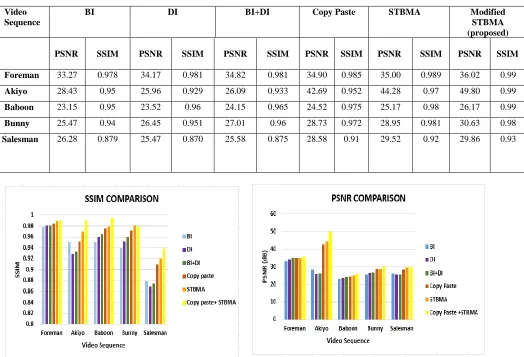
Fig. 4. Comparison of PSNR and SSIM for different methods III. ROPOSEDMETHODMODIFIED
SPATIO-TEMPORALBOUNDARYMATCHING
ALGORITHM(MSTBMA)
The proposed method is the modification in Spatio-Temporal Boundary Matching Algorithm (MSTBMA) in which two factors are considered for minimization of side distortion match. The proposed method include the third factor which undertakes the concealment of boundary when neighborhood of lost MacroBlock(MB) are also lost, which is not considered in previous algorithm of Boundary matching algorithms for error concealment purpose.
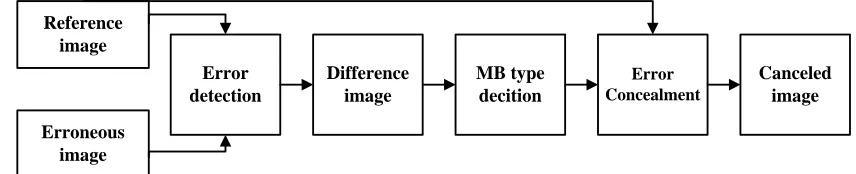
The Fig.4 shows the block diagram used for the implementation of the system. It shows the decoder side where the error is detected and concealed. The spatio-temporal error detection method is carried out for the determination of the error.
Modified Boundary Matching algorithm for Error detection and Error Concealment for Video Communication.
646
Published By:
Blue Eyes Intelligence Engineering & Sciences Publication
[image:5.595.88.516.60.147.2]Retrieval Number: J87630881019/2019©BEIESP DOI: 10.35940/ijitee.J8763.0881019 Reference image Erroneous image Error detection Difference image MB type decition Error Concealment Canceled image
Fig. 5. Block Diagram for Implementation
The erroneous image received at the decoder is first compared with the reference image for the determination of error.
1.The spatio temporal error detection method is carried out for the determination of the error. The factors like Average Interpixel Difference across Boundary (AIDB) and Average Difference across Frame (ADF) detects the presence of error in MB.
2.The difference image received is the image highlighting the error in the frame.
3.The MB type decision for the damaged MB is done by the edge statistical model. The mean and the variance is determined and compared with the threshold value. If the variance value is greater than threshold then the block is considered to be smooth else it is edged.
4.After the type of the MB decided, the error concealment is implemented on the damaged area. In the adaptive approach presented in thesis, the copy paste algorithm is used to conceal the smooth MB and STBMA is used for the edged MB. The combination of both algorithm yields the better results than other.
5.Moreover, the thesis propose the modified STBMA algorithm for the concealment of the frame which include the third factor in order to minimize the side distortion factor.
6. Thus, the concealed image is received at the end.
A.Technical Description of Proposed MSTBMA
In STBMA D1 and D2 factors are used for minimizes the side match distortion which is defined as under:
(6)
In above equation x (; ; n) indicates the pixel present in current frame and (; ; n-1) is the pixel which corrosponds to reference frame. For any boundary matching algorithm we are considering four main directions of Macro block MB (i,j) . WN, WS, WW, WE are the weighting coefficient corresponding to Four direction like North, South, West and East respectively. Here M indicated the size of Current Macro block. The location of candidate Motion vector of the current lost block is denoted as (MVx, MVy). Conventional BMA algorithm is most suitable to recover the lost MV by
[image:5.595.313.523.284.391.2]exploiting smoothing property f adjacent pixels .But it increases complexity for abrupt change in edges and textures based Motion vector which are present at the border or if there is an abrupt scene change. This increases side distortion. Which is demonstrated in Fig.6. SR indicated search region and LMB indicates Lost Macro Block. D1 measure is used to find strong structure similarity of adjust block of lost block and reference block
Fig. 6. Structural similarity[15]
D2 ,which uses to find the average difference between the external boundaries of the candidate reference block in the reference frame and those of the lost block in current frame.
(7)
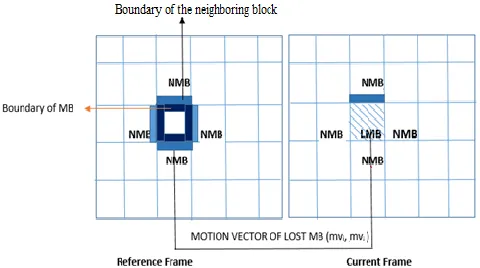
The third factor is considered for the case when neighboring MBs are also erroneous. Thus considering the smoothness at the boundaries, the MSE of the boundary of the candidate MB in the reference MB and the boundary of the neighboring MB of candidate MB in reference MB is considered as it will help to provide the smoothness at the boundary of the concealed image and will improve the overall PSNR and SSIM of the image. The conceptual representation of MVs for the proposed work is
International Journal of Innovative Technology and Exploring Engineering (IJITEE) ISSN: 2278-3075, Volume-8 Issue-10, August 2019
647
Published By:
Blue Eyes Intelligence Engineering & Sciences Publication
[image:6.595.49.289.53.187.2]Retrieval Number: J87630881019/2019©BEIESP DOI: 10.35940/ijitee.J8763.0881019
Fig. 7. Smoothness measurement at the boundary
Thus, the proposed factor for the minimization of overall distortion is given as:
MSE = (Boundary of candidate MB in reference
frame)-(boundary of neighboring MB of candidate MB in reference frame)
D3(MVx, MVy) =
+wE
m=0 |x(i+MVx+m,j+MVy x(i+MVx+m,j+M
(8) In this algorithm we consider Match distortion as a const function DST which utilize sptio-temporal smoothness characteristic, structural similarity factor of nearby frames as well as smoothing properties of left boundary and right boundary.
DST is average value of spatial boundary-match distortion D 1
, temporal boundary-match distortion D2 and side smoothness distortion D3. Overall distortion is given as DST:
The winning Motion Vector (MV) is the candidate MV which minimizes DST where a, b, c are weighting coefficients, where, a+b+c=1. The estimated MV is used to find out the corresponding MBs in the reference frame, and the MBs are used to substitute the missing MBs. For the analysis of the proposed work, Block errors- Single block error, multiple block error, Burst errors – Checkerboard error, Random error are considered. The JM Software is used for the generation of random error. The MB size considered for the concealment is 16*16.
IV. EXPERIMENTALSETUPANDSIMULATION
RESULTS
There are various temporal methods for error concealment which recovers lost MVs for the damaged MB like copy paste, Block Matching Algorithm, Boundary Matching Algorithm and its variations such as STBMA .According to the analysis, the STBMA proved to be best for the recovery of edge type MBs. The STBMA exploits both spatial and temporal characteristic and find the minimum distortion factor.The performance is evaluated on the basis of PSNR and visual quality. The modified STBMA considers all the 4 neighborhood of the candidate MB. Moreover, it doesn’t calculate the MV for the neighborhood (of candidate MB)
In this paper, there is an assumption for gradual change in the scene, thus considering the neighborhood of candidate MB as the best fit for estimation of the third factor. The result
comparison has been done for five QCIF sequences i.e. foreman, akiyo, salesman, city and bunny. The two cases are considered namely the concealment for the burst error and the concealment for the random error (considering the real case scenario).
A.Specification for Implementation
Modified Boundary Matching algorithm for Error detection and Error Concealment for Video Communication.
648
Published By:
Blue Eyes Intelligence Engineering & Sciences Publication
[image:7.595.79.518.61.582.2]Retrieval Number: J87630881019/2019©BEIESP DOI: 10.35940/ijitee.J8763.0881019
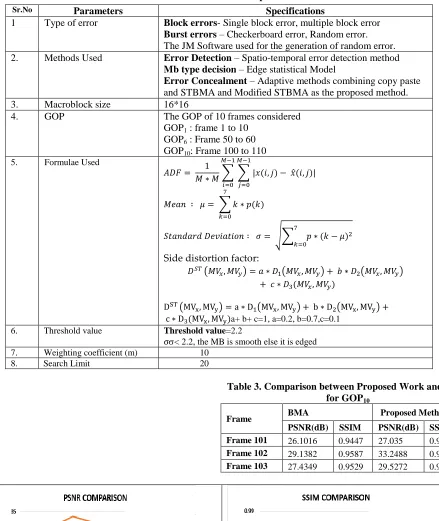
Table 2. Parameters and their specifications
Sr.No Parameters Specifications
1 Type of error Block errors- Single block error, multiple block error
Burst errors – Checkerboard error, Random error. The JM Software used for the generation of random error.
2. Methods Used Error Detection – Spatio-temporal error detection method
Mb type decision – Edge statistical Model
Error Concealment – Adaptive methods combining copy paste and STBMA and Modified STBMA as the proposed method.
3. Macroblock size 16*16
4. GOP The GOP of 10 frames considered
GOP1 : frame 1 to 10 GOP6 : Frame 50 to 60 GOP10: Frame 100 to 110 5. Formulae Used
Side distortion factor:
a+ b+ c=1, a=0.2, b=0.7,c=0.1
6. Threshold value Threshold value=2.2
< 2.2, the MB is smooth else it is edged 7. Weighting coefficient (m) 10
[image:7.595.64.556.422.698.2]8. Search Limit 20
Table 3. Comparison between Proposed Work and BMA for GOP10
Frame BMA Proposed Method
PSNR(dB) SSIM PSNR(dB) SSIM
Frame 101 26.1016 0.9447 27.035 0.9607
Frame 102 29.1382 0.9587 33.2488 0.9802 Frame 103 27.4349 0.9529 29.5272 0.9716
International Journal of Innovative Technology and Exploring Engineering (IJITEE) ISSN: 2278-3075, Volume-8 Issue-10, August 2019
649
Published By:
Blue Eyes Intelligence Engineering & Sciences Publication
Retrieval Number: J87630881019/2019©BEIESP DOI: 10.35940/ijitee.J8763.0881019
Corrupted Frame 101 BMA algorithm Modified STBMA
Corrupted Frame 102 BMA algorithm Modified STBMA
[image:8.595.118.478.47.361.2]Corrupted Frame 103 BMA algorithm Modified STBMA
Fig. 9. Graphical analysis of PSNR and SSIM comparison between BMA and STBMA for GOP10
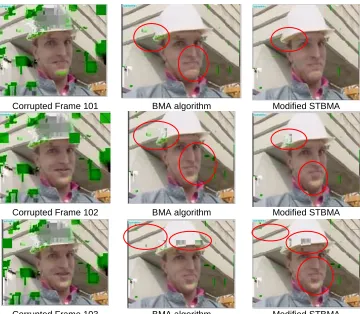
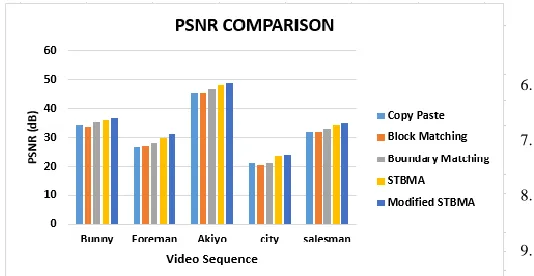
[image:8.595.47.555.633.721.2]Table 3 shows the comparison between BMA and Proposed Method for random error considering the GOP of 10 frames. Assuming 100th frame to be received correctly, the concealment of 101th, 102nd and 103rd frame is done. The previous frame is considered as the reference frame. Fig.8 gives the graphical representation with visual quality comparison for video sequence using conventional BMA and our proposed algorithm. Fig. 9 represents visual content using our proposed algorithm in comparison with conventional in Fig.8. The Table 4 analyzes the comparison between the proposed algorithm with the classic temporal error concealment methods such as copy paste, Block matching algorithm, BMA and STBMA (proposed in [2]). The approaches are tested on 5 QCIF sequences namely foreman, akiyo, city, salesman and bunny. PSNR is used as a performance parameter for the analysis shown in Fig.9.
Table 4.PSNR (dB)comparison of proposed method with different temporal error Concealment methods Video
Sequence
Copy Paste Block Matching Boundary[2] Matching
STBMA[2] Proposed Modified STBMA
PSNR PSNR PSNR PSNR PSNR
Bunny 34.6801 33.781 35.4064 36.281 36.989
Foreman 26.7702 27.2521 28.0785 30.041 31.242
Akiyo 45.4721 45.4722 46.8498 48.283 49.102
City 21.2645 20.5094 21.2900 23.761 24.267
Modified Boundary Matching algorithm for Error detection and Error Concealment for Video Communication.
650
Published By:
Blue Eyes Intelligence Engineering & Sciences Publication
[image:9.595.45.312.50.188.2]Retrieval Number: J87630881019/2019©BEIESP DOI: 10.35940/ijitee.J8763.0881019
Fig. 10. Graph for the comparison of temporal EC methods
V.CONCLUSION
In this research work, one of the error concealment method i.e. modified STBMA has been proposed. This method is a temporal error concealment technique which has its root in the Boundary Matching Algorithm (BMA). The proposed work showed the increment of 0.5 dB to 1 dB improvement in PSNR and approximately 0.05 in SSIM than the conventional method. The proposed method proves to be better than the conventional BMA. But it was observed in the case of random error concealment that some parts (specially the sharp edges) were not concealed. The factor added, helps to estimate the lost MV at the boundary which are difficult to recover. Various algorithm of error concealment have been tested for different video sequences. The video sequences with gradual motion were considered which were easier to conceal than abrupt change in scene as most of the motion vectors were correlated and minimal energy loss was observed. The sequences that proved harder to conceal were the ones where the area with sharp edges. Previously an adaptive approach for spatial error concealment was suggested which has been implemented with the temporal error concealment in this research work. The results shows that adaptive approach with copy paste algorithm for smooth MB and STBMA algorithm for STBMA gives better result than the existing adaptive spatial error concealment method over images/video sequences. In future, the hybrid error concealment technique can be applied on the real time video for error detection and concealment automatically. The future work includes the development of the application for medical image processing based of Region of Interest for Telemedicine based system which provides high end reliability at the source and receiver side for correct diagnostic purpose.
REFERENCES
1. Jung, Y. H., Kim, Y. G., &Choe, Y : “Robust error concealment algorithm using iterative weighted boundary matching criterion”, IEEE, Vol. 3, pp. 384-387, (2000).
2. Kim, Eung Tae, Seung-Jong Choi, and Hyung-MyungKim : “Weighted boundary matching algorithm for error concealment in the MPEG-2 video bit stream. Signal processing”, vol.: 3, pp: 291-295, (1999). 3. Lam, Wai-Man, Amy R., and Bede Liu : “Recovery of lost or
erroneously received motion vectors. IEEE”, Vol. 5, pp: 417-420, (1993).
4. Thaipanich, T., Wu, P.H. and Kuo, C.J. : “Low-complexity video error concealment for mobile applications using OBMA”. IEEE Transactions on Consumer Electronics, vol.:54(2), pp: 753-761, (2008).
5. Thaipanich, Tanaphol, Ping-Hao Wu, and CC Jay Kuo. : “Video error concealment with outer and inner boundary matching algorithm”.optical
engineering application International society for optics and Photonics(2017) Chen, Yan, Oscar Au, Chiwang Ho, and Jiantao Zhou. : “Spatio-temporal boundary matching algorithm for temporal error concealment”, IEEE International Symposium, pp:4, (2006). 6. Deng, X., Liu, Y., Hong, C., Bu, J., & Chen, C. : “A temporal error
concealment algorithm for H. 264/AVC based on edge directions”, IEEE International Conference, pp: 941-944, (2009).
7. Su, C.Y. and Huang, C.H.August, : “Temporal error concealment algorithm using multi-side boundary matching principle”, IEEE International Symposium, pp: 448-453, (2006).
8. M. Zadeh, S.M., H. G. Yakhdan, and S. Kasaei. : “An Efficient Adaptive Boundary Matching Algorithm for Video Error Concealment”, Iranian Journal of Electrical & Electronic Engineering, Vol.: 10.3, (2014). 9. Wang J, Wang L, Ikenaga T, Goto S. : “An adaptive spatial error
concealment (SEC) with more accurate MB type decision in H. 264/AVC”, 5th International Conference on Visual Information Engineering, pp: 759-764, (2008).
10. Wu, Guan-Lin, and Shao-Yi Chien. : “Spatial-temporal error detection scheme for video transmission over noisy channels”, ,Ninth IEEE International Symposium on, pp. 78-85, (2007).
11. ZiguanCUI ,Zongliang GAN, Xuefeng ZHAN, XiuchangZHU :”Error Concealment Techniques for Video Transmission over Error- prone Channels: A Survey”, in Journal of Computational Information Systems, vol.:8, pp:8807-8818, (2012).
12. Jung, Y. H., Kim, Y. G., &Choe, Y:Robust “error concealment algorithm using iterative weighted boundary matching criterion”, IEEE, Vol. 3, pp. 384-387, (2000)
13. Usman, M., He, X., Xu, M., & Lam, K. M :“Survey of Error Concealment techniques”, Research directions and open issues, IEEE, pp: 233-238, (2015).
14. Wang J, Wang L, Ikenaga T, Goto S.:“An adaptive spatial error concealment (SEC) with more accurate MB type decision in H. 264/AVC”, 5th International Conference on Visual Information Engineering, pp: 759-764,(2008).
15. Marvasti-Zadeh, SeyedMojtaba, and HosseinGhanei-Yakhdan. “Video temporal error concealment using improved directional boundary matching algorithm.” Turkish Journal of Electrical Engineering & Computer Sciences 24, no. 6 :pp 5195-5209(2016).
16. Hasan, MdMehedi, Tasneem Rahman, KiokAhn, and
OksamChae.“Artifacts Detection and Error Block Analysis from Broadcasted Videos.” arXiv preprint arXiv:1808.10086 (2018).
17. Shih, Huang-Chia, Chiung-Ting Wang, and Chung-Lin Huang.
“Spiral-Like Pixel Reconstruction Algorithm for Spatiotemporal Video Error Concealment.” IEEE Access 6 pp: 6370-6381(2018).
18. Choe, Gwangmin, Cholman Nam, and ChanggonChu,“An effective temporal error concealment in H. 264 video sequences based on scene change detection-PCA model.”, Multimedia Tools and Applications 77, no. 24 pp:31953-31967(2018).
19. El‐Shafai, Walid, S. El‐Rabaie, M. M. El‐Halawany, and Fathi E. Abd
El‐Samie. “Performance evaluation of enhanced error correction algorithms for efficient wireless 3D video communication systems,”,International Journal of Communication Systems 31, no. 1: e3396, (2018).
20. Chen, Yan, Yang Hu, Oscar C. Au, Houqiang Li, and Chang Wen Chen.
“Video error concealment using spatio-temporal boundary matching and partial differential equation.” in IEEE Transactions on
Multimedia 10, no. 1 (2007): 2-15.
AUTHORSPROFILE
Ketki C. Pathak She is PhD scholar and doing her research work in the area of medical image processing using video compression standard from Electronics Engineering Department, SVNIT, Surat. Her are of interest are VLSI design technology, signal and image processing, image compression and using video compression standard like HEVC.
International Journal of Innovative Technology and Exploring Engineering (IJITEE) ISSN: 2278-3075, Volume-8 Issue-10, August 2019
651
Published By:
Blue Eyes Intelligence Engineering & Sciences Publication
Retrieval Number: J87630881019/2019©BEIESP DOI: 10.35940/ijitee.J8763.0881019
He has published various journal paper in the domain of image super resolution and image registration. Personal profile which contains their education details, their publications, research work, membership, achievements, with photo that will be maximum 200-400 words.
![Fig. 1. Frame F n with the missing area B and its boundary pixel area A [12]](https://thumb-us.123doks.com/thumbv2/123dok_us/8182961.255480/2.595.327.534.60.197/fig-frame-f-missing-area-boundary-pixel-area.webp)
![Fig. 2. Classification of BMA algorithm [2]-[9]](https://thumb-us.123doks.com/thumbv2/123dok_us/8182961.255480/3.595.128.246.476.660/fig-classification-of-bma-algorithm.webp)