Munich Personal RePEc Archive
Business models as systemic instruments
for the evolution of traditional districts?
Cocchi, Andrea
Newcastle University Business School
2011
Online at
https://mpra.ub.uni-muenchen.de/33766/
Business Models as systemic instruments for the evolution of
traditional districts?
KEYWORDS: Innovation Intermediaries, Market Devices, Collaborative Entrepreneurship
1 - INTRODUCTION ... 2
2 - THE RISE OF INNOVATION INTERMEDIARY ORGANISATIONS... 4
2.1 -‐ Innovation Intermediaries: Definition and Rationales... 4
2.2 -‐ Intermediaries: new actors in Innovation Systems?... 5
3 - BUSINESS MODELS: Review and Classification ... 8
4 - BUSINESS MODELS AS SYSTEMIC INSTRUMENTS. ... 12
5 - CASE STUDY BACKGROUND ... 16
6 - NEW BUSINESS MODELS DESIGN FOR THE MANUFACTURING SECTOR... 20
6.1 -‐ New Business Models in Manufacturing... 20
6.2 -‐ The Intermediary Organisation... 23
6.3 -‐ The Opportunity... 24
6.4 -‐ The Innovation proposed... 25
7 – DISCUSSION ... 29
8 - CONCLUSIONS ... 33
REFERENCES ... 35
ABSTRACT
This paper aims to explore the potential role of Innovation Intermediaries in the evolution of a
traditional cluster toward a service-oriented perspective. In particular, we will highlight the
generative function of business models, here as market devices, in stimulating the
1 -‐ INTRODUCTION
Recently scholars, practitioners and policy circles focused their attention on an emergent
phenomenon in the innovation landscape: the innovation intermediaries and related
intermediation functions (Howells, 2006). Although a clear definition of intermediaries is not
available yet, we can say that intermediaries are specialised agents, embedded in a system
of innovation and focused on the translation of knowledge between different epistemic
dimensions (Coeurderoy and Duplat, 2008), governance levels (Klerkx and Leeuwis, 2009),
actors (Yusuf, 2008) and networks (Kirkels and Duysters, 2010). While intermediation
functions can be fulfilled by private or public organisation, scholars focused their attention the
private side of innovation process. Howells in his seminal paper classifies the functions of
private intermediaries in UK (Howells, 2006), others analyse the role of innovation brokers for
specific sectors (Winch and Courtney, 2007) or in connecting different SME’s networks in the
co-development of innovation (Kirkels and Duysters, 2010). The main point here is that the
emergence of this new typology of actors refers to the creation of a market for technological
knowledge, and the solution of related coordination problems. Few studies place
intermediaries (and intermediation activities) in a systemic context, where the development of
specific strategies impact on system’s performances (Klerkx and Leeuwis, 2009, van der
Maulen et al., 2005).
Aim of this paper is to explore the potential role of Innovation Intermediaries in the evolution
of a traditional cluster toward a service-oriented perspective. In particular, we will highlight the
generative function of business models, here as market devices, in stimulating the
co-evolution of Intermediary and target firms’ strategies. To do so, we will justify the similarities
between business models and systemic instruments, highlighting their specificities and
uniqueness. The focus here is on specific infrastructures created by the Emilia-Romagna
government as part of the renewal process of its innovation strategy. These intermediary
organisations are Applied Research Laboratories (LABS) established in the Emilia-Romagna
Region. Created in 2004 LABS are composed by universities, local firms and other local
stakeholders (chamber of commerce, employers associations, provinces and municipalities).
Their aim is to organise, match and steer the regional R&D activities, under the co-ordination
of the regional R&D agency (ASTER). More recently, these laboratories gained the
administrative and organisational independence by universities and other prominent
stakeholders, as basic condition for the access to the regional funding programs. The
assumption we further here is that these intermediaries develop specific strategies, and then
a specific business model, to fulfil their specific tasks. The unintended (and potential)
outcome here is the realisation of a systemic impact on the dynamics and strategies of a
traditional cluster, and on its path of revitalisation.
This paper is organised in three main sections. Firstly, we structure a critical review of the
literature on innovation intermediaries and business model research. The section closes with
business models’ deployment. Secondly, we offer an introduction to the background of the
Emilia-Romagna regional strategy and plan for the upgrading of its regional system. The last
section deals with the presentation and discussion of a case study regarding the design
process for the development of new business models for the machine tool sector. Finally
some conclusion will be offered in order to highlight the possible definition of business models
2 -‐ THE RISE OF INNOVATION INTERMEDIARY ORGANISATIONS
Historically the role of intermediaries can be traced back to the role of middlemen in 16th
century Britain (and United States in the 17th), providing information for the use and diffusion
of new technologies for the agriculture and textile industries (Howells, 2006, Chandler, 1977).
Their role has been fundamental in defining the efficiency and effectiveness of production
processes in newly manufacturing sectors. With the passage form a scattered system of
production (i.e. putting-out) toward a modern industrial system, the importance of innovation
intermediaries declined (Freeman, 1995, Lipsey, 2009). Their role has been internalised as
an outcome of centralised organisational structures (i.e. structural innovation - cfr.Chandler,
1977) and the definition of managerial functions (Barnard, 1968). Only with the demise of the
so-called linear model and the rise of a distributed innovation processes, intermediary
functions came back to the forefront. Howells relates the emergence of innovation
intermediaries to different stands of the innovation literature, such as: (a) studies on
technology transfer and diffusion; (b) the literature on technology management; (c) the
development of the innovation systems concept; (d) the research into Knowledge Intensive
Business Services (Howells, 2006). Other authors pinpoint how the development of R&D
outsourcing practices highlight the importance of intermediary’s functions in the technological
and innovation processes (Piller and Ihl, 2009).
2.1 -‐ Innovation Intermediaries: Definition and Rationales
Although a clear definition of intermediaries is not available yet, we can say that
intermediaries are specialised agents, embedded in a system of innovation and focused on
the translation of knowledge between different epistemic dimensions (Coeurderoy and Duplat,
2008), governance levels (Klerkx and Leeuwis, 2009), actors (Yusuf, 2008) and networks
(Kirkels and Duysters, 2010). Innovation intermediaries can be defined according to different
standards or reference. Surveying the literature, we propose three different classification
systems here, based on a) the definitions of intermediaries, b) their active of functional role
and c) their organisational status.
The recent literature renders two broad concepts of innovation intermediaries: functional and
relational. The functional perspective highlights specific quality or ability: brokering,
gatekeepers and boundary-spanning organizations (Youtie and Shapira, 2008, Howells,
2006). According to this perspective Innovation Intermediaries can be defined as “an organization or body that acts an agent or broker in any aspect of the innovation process between two or more parties” (Howells, 2006:720). Beside this we have, a relational perspective highlighting the multi-level and multi-actor capabilities displayed by
have the juxtaposition between intermediaries’ agency and function in a system stressing
their active or
passive
role.We can distinguish a second classification’s rationale highlighting the topic of intermediaries’
role. This rationale could be synthesised along a static/dynamic continuum, and used to
classify their behaviour in different periods and situations. Intermediaries could work here to
promote or hinder the diffusion and application of specific information and, therefore
influencing the shape of institutions and standards (Garud et al., 2007, Sorenson et al., 2006,
Garud and Karnøe, 2003). This helps to put forward the evolution of intermediaries’
propositions according to path dependant trajectory. On the other hand, the introduction of
time dimension, stresses their adaptive behaviour and the proposition of different varieties.
As the term implies, Intermediation functions can be fulfilled according to different
organisational status: internal and external to a specific organisation (Daziel, 2010). As the
role of innovation became a central topic in defining the performance of organisations (and
systems), the definition of intermediation practices renders the
antithesys
between emergingand normative organisational rationales. Intermediaries here have been established as
independent bodies to tackle market failures in the circulation and diffusion of technological
knowledge (Bozeman, 2000, Smits and Kuhlmann, 2004) or as an emerging feature of a
changing division of labour between actors in different systems (Coombs et al., 2003,
Howells, 1999). This literature in generally routed in the network/system paradigm and
focuses
on intermediaries’ expected outcomes and/or specific processes. Examples ofinternal intermediary are: Technology transfer offices in universities or specific R&D
departments in big companies. External intermediaries can be private or publicly owned too
and generally can be defined as Contract Research Organisation (C-RTO) or as Knowledge
Intensive Business Services.
2.2 -‐ Intermediaries: new actors in Innovation Systems?
Some recent contributions analyse how the Innovation System’s rationale
,
(i.e. Regional Innovation Systems), has been proposed as standard of reference for the design andevaluation of public intervention programmes, according to a normative and prescriptive
assumptions (Uyarra and Flanagan, 2010). They observe how traditional STI policies are
normally a-spatial and their effect on different spaces and territories could be mediated by the
strategies of regional actors (their agency) or structural characteristics of the regions (Uyarra
and Flanagan, 2010, Strenberg, 1996, Pollock and Williams, 2010). This perspective focuses
on the expected outcomes of intermediaries at systemic level, highlighting the dynamic and
active role of intermediaries as new agents in a system of innovation. This can be achieved
by a transformation of the organisations already existent (Winch and Courtney, 2007) of by
the creation of specific ones (Lopez-Vega, 2009, Koschatzky and Stahlecker, 2010, Laranja,
Focusing on the public (or public oriented) intermediaries, we can survey a variety of
organizational arrangements and institutional settings. Some examples are the Co-operative
Technical Organizations (CTOs) (Winch and Courtney, 2007), Institutions of Technological
Infrastructure (ITIs) (Koschatzky et al., 1996); research alliances and other forms of strategic
partnerships (steered by public policy programmes), such as the manufacturing extension
programmes in the United States (Shapira, 2001, Hagedoorn et al., 2003). In analysing the
potential role of business models as systemic instruments for the evolution of traditional
clusters, our attention will be on specific external intermediary organisations (C-RTO)
established in a regional system of innovation (Emilia-Romagna) from a dynamic perspective
(Business Model Design). A broad definition of Research Technology Organisation (RTO)
could be “publicly or partly publicly financed research institutes that contribute either directly or indirectly to systems of innovation” (Preissl, 2006:133). Other authors prefer differentiate between RTOs and Contract RTOs (C-RTO), to specify their contractual (or market) orientation (Howells, 1999). The frequent involvement of Universities and other research
institutions as stakeholders in public oriented intermediaries is an evident outcome of the
prominence, assigned by public actors, to the exploitation of scientific knowledge. Private
intermediation, on the other hand, relies on a wider array of knowledge bases accessed,
normally, according to contractual/relational logic.
However, the idea of an evolution of intermediation activities toward an entrepreneurial or
proactive stance seems to be a common, emerging trend. We offer some evidence from
recent literature to support this claim. Firstly, we have the competition between public and
private intermediaries (mostly KIBS) for the provision of similar services to firms and public
institutions (Viljamaa et al., 2010). Secondly, we have the emergence of new organisational
structures for the provision of intermediation services, through the development of newly
Public Private Partnerships (PPP) between Universities and firms (Koschatzky and
Stahlecker, 2010). However, this trend does some consequence. Public oriented
intermediaries seem to have lost their “neutrality” in relation to specific “core-functions” (e.g.
technology sourcing, gate-keeping, facilitator). If University’s Technology Transfer Offices
behave as institutional entrepreneurs, to influence the diffusion of specific technologies (Jain
and George, 2007), this trend raised concerns about the neutrality of research activities and
their exploitation processes (Nottenburg et al., 2002).
Summarising we can say that there is an ongoing process of division of labour at work here.
This process is governed by the rationale of competition, commanded by the development of
specific markets of by the delivery of specific innovation programs. And finally, that the
proposition of clusters as one prominent tools for the management of industrial and innovative
dynamics, implies the development of business like behaviours among public or publicly
oriented intermediaries (Carlsson, 2005, Hagedoorn et al., 2003). Regarding the innovative
outcome of these activities, their aim is to transform the concept of proximity in a superior
innovative output (Uyarra and Flanagan, 2010). However, if the “thickness” of the system is
regional knowledge base (Cantner et al., 2010) and, with specific reference to manufacturing
activities, b) the innovation strategies of single firms (Kalafsky, 2006a, Kalafsky, 2006b) and
the complementarities between intermediaries and industrial knowledge bases (Vega-Jurado
3 -‐ BUSINESS MODELS: Review and Classification
The increasing number of publications point out how Business Models (BM) has become
an “hot topic” in the field of business and entrepreneurial studies (cfr. Baden-Fuller et al.,
2010 - Special Issue Long Range Planning). We offer here an analysis of the literature to
highlight some prominent trends and issues on BM: the search for a common definition and
their contextual/dynamic nature. The BM’s path to stardom begins at the looming of the
“dot.com” era, as a buzzword in use among investors, financial analysts and other
professional to summarise the “way of doing things” specific to a business. Since then,
several scholars tried to define BM according to their own perspective (Osterwalder et al.,
2005, Makinen and Seppanen, 2007, Morris et al., 2005). Recently, the focus shifted to a
critical analysis of the literature produced in order to converge on common points such as
definition, functions and roles. Here the literature is divided between academic and
practitioners’’ perspective. A recent study on the perception of BM in the business community
tries to reach a synthesis thanks to a discourse analysis on BM practices. Here, the dominant
logic for BM is their capability to enact a commercial opportunity, three main rationales (or
dimensions) seems to emerge: a) importance of the resource specificities and their
organisation; b) the relational/contractual dimension as enabling factor; c) the BM as a
precursor for sense making (cfr. George and Bock, 2011). The second position reported here,
deals with the dynamic and contextual perspective on BM, emphasising their evolutionary
properties. Business models have been described as a tool leading the evolution and
adaptation of businesses to their context (Demil and Lecocq, 2010, McGrath, 2010), as a
system of relations channelling feed backs and connecting the strategic and the tactical levels
(Casadesus-Masanell and Ricart, 2010) and influencing the process of structural change,
proposing new actors and agencies (Teece, 2010, Gambardella and McGahan, 2010). Finally
we have an analysis on the intrinsic knowledge dynamics related to the emergence of BM as
a market device (Doganova and Eyquem-Renault, 2009).
The theoretical discourse on BM bears to some commonalities too. Teece proposes a list
of drivers related to this topic: (a) the emerging of the knowledge economy; (b) the
importance of ICT in the creation an delivering of value to customers; (c) the re-organisation
of the industrial production by outsourcing and off shoring strategies; (d) the rise of services
accompanying the industrial’s structural change (Teece, 2010:4). At first glance it is clear how
the rise of BM is actually grounded in the contemporary industrial and economic landscape.
On the other hand, this justifies the flourishing of classification and taxonomical schemes
proposed in the last decade. Baden-Fuller and Morgan offer an interesting perspective in
questioning the usefulness of BM generalisations. They observe how BM operate at an
“intermediate level” between description and abstraction, assuming an intermediary role between theoretical and applied landscapes: “as practical models of technology that are ready for copying, but also open for variation and innovation” (Baden-Fuller and Morgan,
BM as structural/organisational models, the example proposed by Oswelander regarding the
“meta BM”, defined as “an abstract concept that allows describing what a business does for a
living”, seems to “fit the bill” (Osterwalder et al., 2005:10). On the other hand, this idea
indirectly refers to other interesting topics such as the issue of routine inheritance and
replication dynamics, in their relationship with firms’ performance and organizational
dimensions (Winter and Szulanski, 2001).
This introduces the last unifying point on BM: the dynamic perspective. Demil and Lecocq
summarise this position as a “transformational approach, where the BM is considered as a
concept or a tool to address change and focus on innovation, either in the organization, or in
the BM itself” (Demil and Lecocq, 2010:228). This perspective highlights the importance of the
successful adaptation to a specific (dynamic) environment and the systemic interdependence
between different actors and governance levels. The entry points for this kind of analysis are
different such as the construction of the value proposition (Teece, 2010, Chesbrough and
Rosenbloom, 2002), the learning dynamics induced by the adaptation process (McGrath,
2010), the boundary spanning and translational role of BM’s related processes (Zott and Amit,
2008, Doganova and Eyquem-Renault, 2009).
The elaboration of this transformational approach introduces to a translational role of
business models, aiming to legitimise the action of a single actor in a complex system of
interdependencies. This perspective proposes an interesting review on BM studies organized
according to three streams of analysis (Doganova and Eyquem-Renault, 2009). The first,
leaded by the research community, defines business models thanks to its relations to the firm,
its functioning and purposes, and relies on an “essentialist” stance. However, this search for a
unique definition able to blend epistemic and structural dimensions of a business model is still
in its prime, as the different contributions provide more questions than answers. At this stage
is not possible to understand if this “mode 1” research stand is the correct one, as the position
of this concept in the disciplinary landscape is still unclear (Morris et al., 2005, Makinen and
Seppanen, 2007). The second position, aims to clarify nature and content of business
models, is expression of a “functionalist” perspective. Object of analysis are the functions and
problems that business models help to describe and unravel when used as a strategic tool.
This perspective can be defined as a “mode 2” research program, because it tries to reach
useful insights and knowledge from the observation (and scrutiny) of a complex reality
(Chesbrough and Rosenbloom, 2002, McGrath, 2010). Finally, we have a “pragmatic”
perspective according to which, business models can be conceived as market devices
(Doganova and Eyquem-Renault, 2009, Muniesa et al., 2007). According to this perspective,
business models are analysed according to an Actor-Network Theory perspective in
addressing (and shaping) a problem solving heuristic. The specific theoretical framework here
is then included in a critical appraisal of the reality, aiming at gain useful knowledge while
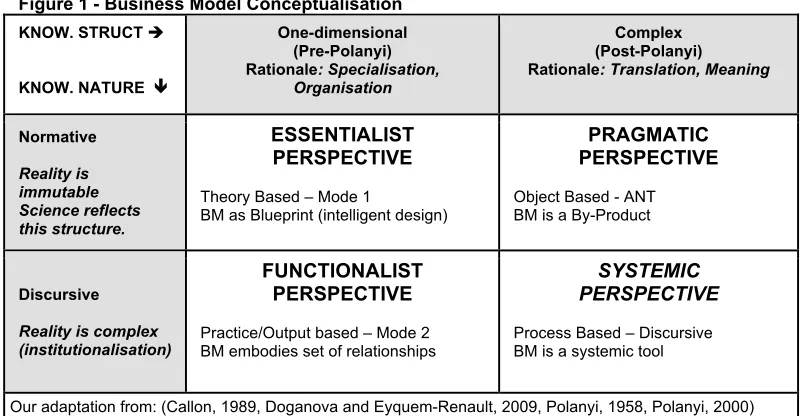
In Figure 1, we try to summarise the different perspectives on BM according to an
epistemological classification proposed by Callon (Callon, 1989). On the columns we have
the passage toward a multidimensional and social dimension in the development of
knowledge, represented here by the introduction of Polanyi work on tacit knowledge and
knowing (Polanyi, 1958). On the other hand, the rows represent the different use of the
knowledge produced. Here we contrast the normative, unchangeable nature of knowledge
produce by Mode1 and ANT paradigms, against the challengeable perspective presented by
a Mode 2 perspective. In the table we present a classification of the different perspectives
introduced by (Doganova and Eyquem-Renault, 2009), to which we add a systemic
[image:11.595.95.498.254.462.2]perspective, branding BM as Systemic Instruments (or tools).
Figure 1 - Business Model Conceptualisation
KNOW. STRUCT
KNOW. NATURE
One-dimensional (Pre-Polanyi) Rationale: Specialisation,
Organisation
Complex (Post-Polanyi) Rationale: Translation, Meaning
Normative Reality is immutable Science reflects this structure. ESSENTIALIST PERSPECTIVE
Theory Based – Mode 1
BM as Blueprint (intelligent design)
PRAGMATIC PERSPECTIVE
Object Based - ANT BM is a By-Product
Discursive
Reality is complex (institutionalisation)
FUNCTIONALIST PERSPECTIVE
Practice/Output based – Mode 2 BM embodies set of relationships
SYSTEMIC PERSPECTIVE
Process Based – Discursive BM is a systemic tool
Our adaptation from: (Callon, 1989, Doganova and Eyquem-Renault, 2009, Polanyi, 1958, Polanyi, 2000)
This classification stresses a trend already appreciable in the literature discussed up to
now. BM studies progresses form a close to an open perspective, in which the BM knowledge
(regarding their nature, meaning and components) is contested between different branches of
science (essentialist perspective) or among an enlarged community of users/practitioners (as
in the case of market devices). The outcome of the essentialist and pragmatic perspectives is
normative in nature; the aim is to produce “standards” regulating specific typologies of
exchanges (e.g. according to mertonian and market norms respectively). On the other hand,
we highlight the emergence of another dynamic here, where knowledge nature is contested
and closure is agreed among different epistemic communities. Callon talks about networks of
extended translations where knowledge is produced in a circular and discursive manner
(Callon, 1989:52). Common statements are agreed among network participants in order to
regulate the production of scientific statements and therefore grant a steady, although
temporary, reproduction of knowledge. The difference between functionalist and systemic
perspective here is in the nature of the participating actors and in the permeability of the
networks established. According to the functionalist logic, these aspects are agreed at the
beginning (i.e. business models can be produced in specific contexts by a selected
who and according to which logic a business model can be produced and, where the
business models can be applied and understood is a matter of understanding. What in a
context regulate the market exchange and the value (or price) of an object (i.e. between
firms), in other contexts the same behaviour can be appreciated according to a different logic
4 -‐ BUSINESS MODELS AS SYSTEMIC INSTRUMENTS.
Systemic Instruments are a topic relatively new to the policy innovation arena, although
relying on a strong tradition in policy studies. We highlight here some issues justifying their
adoption among the innovation community: the problem of fragmentation of policy arena and
connected problems of governance; the management and evaluation of performances, the
co-evolution of policy and practices steered by the ability to learn and adapt (Howlett, 2009,
Talbot, 2005, Kuhlmann et al., 1999, Mytelka and Smith, 2002). Policy instruments then
emerged as a common field of interest to design, manage and pace the evolution of systemic
contexts (Howlett, 2000, Smits and Kuhlmann, 2004). We can distinguish here two main
rationales for the deployment of public influence. The first based on the administration of
public power, according to the concepts of independence and substitutability. The second
generation develops along the concept of governance and co-ordination, dealing with
problems of specificity and complexity (Howlett, 2005).
Smits and Kuhlman introduced systemic instruments in the discourse on the governance
of innovation systems, with the aim to define new ways to maximise the impact of public
policies on complex systems. The rationale for the adoption of a systemic perspective is
organised according to three major trends characterising the evolution of innovation
processes and systems: a) the interconnected nature of the innovation processes, b) the rise
of systemic approaches in the innovation theory and c) the importance of intelligence and
learning practices in designing and assessing specific innovation strategies (Smits and
Kuhlmann, 2004). The application of systemic instruments in the fields of sustainability and
regional innovation furthered the evolution of this concept. In sustainability studies systemic
instruments can be defined as “methods and mechanisms used by governments, political parties, businesses or individuals to organise, coordinate and direct innovation systems”
(Wieczorek et al., 2010:16). The major shift here regards the nature of power: not only public
institutions but even individuals and business can use systemic instruments. The validity of
this observation seems to be confirmed by some recent contribution on regional STI policies.
Here the development of specific policy mix for in delivering regional innovation policies
comprises traditional and systemic instruments for the creation of a favourable institutional
environment. These approaches normally emphasises the importance of the “institutional
thickness” and related institutional framework, composed by private and public actors: the
issue of coordination is on the forefront here (Laranja et al., 2008:828).
According to Elidas, Hill and Howlett, systemic instruments are specific and unique.
Specificity implies that systemic tools aim to solve particular issues, while uniqueness implies
not substitutability between instruments (McDonald, 2005, Eliadis et al., 2005, Howlett, 2000).
We argue that business models, according to their systemic perspective, can be defined as
systemic tools because they display specific and unique features toward the governance of
territorial sub system of innovation (i.e. clusters). This because they represent the processes
The specificity of business models is characterised according to three points: 1) they can be
considered as a constitutive characteristic of innovation system ontology (or polity); 2) they
render the dynamic specialisation process for specific problem-solving networks, 3) they
contribute to trace the emergence of common rules and routines between micro and meso
dimensions.
On the other hand, cluster policies can be defined as an application of systemic
instruments to the governance of territorial agglomeration’s dynamics, occurring in specific
socio-technical contexts (Werker and Artheye, 2004, Smits and Kuhlmann, 2004). Pacing the
discourse on regional innovation studies, the topic of systemic instruments moves away from
the exclusive dominion of public policies. In particular, the presence of specific bundling of
procedural and systemic instruments (e.g. innovation policy mix) represents a structural
feature of a specific territorial configuration (Uyarra, 2011, Uyarra and Flanagan, 2010).
Summarising, if the role of systemic tools is to solve a problem of coordination between
system’s agents, they can be defined by “a organised system of relationships connecting one
or more typology of agents and aiming at steer the division of labour by mutual learning
practices”. This definition stresses the generative role of knowledge dynamics in steering the
system’s structural change, attained by a progressive generation, circulation and
consumption of knowledge. Moreover, this perspective testifies about a shift in regional
policies rationales, in which territory is not ore an “empty vessel” to fill with policy contents
and the representative agent looses its explanatory power (Garofoli, 2002).
As mentioned in the previous section, business models address an important role at firm
level, guiding the process of learning, discovery and specialisation (Demil and Lecocq, 2010).
This feature is particularly important in the understanding of innovation systems’ dynamic.
Traditionally the literature on this topic emphasised the concept of interdependency and
collective effort prioritising the systemic traits (in term of fixtures) over the dynamic concept
related to innovativeness. Innovation systems has been considered as a collection of biotypes
of different institutions, characterised by their technological or knowledge specialisation, or as
a canvass to which policy makers could refer in designing specific interventions (Smits and
Kuhlmann, 2004:9). Here learning was primarily related to the translation of knowledge from
scientific to the industrial context, the networking aimed at facilitates the access to specific
information, and the systemic functions assured by the intensiveness of cooperation between
actors. Actually, this rationale is not far form the traditional linear model of innovation (Godin,
2009, Godin, 2006, Balconi et al.). A recent contribution stresses the knowledge and
structural dynamics implied in the innovation process (Metcalfe et al., 2005), where
“innovations result from a process of accumulation of knowledge that unfolds stepwise in a largely path-dependent fashion within a design space defined by the perception of the problem at hand” (Consoli and Mina, 2009:310). Problem solving here is an open-ended process that, in turn, contributes to the solution of specific problems and challenges the
we refer to the translation of strategies into tactics. With external consistency, we refer to the
way in which the actor is able to define select and coordinate the different sets of stakeholder,
functional to the realisation of its aims (Teece, 2010, Doganova and Eyquem-Renault, 2009).
The development of a common understanding and its contextual nature represents the
conceptual basis for discussing the potential role of business models from a policy
perspective. We argue here that the potential value of specific business models, according to
their structural, systemic and strategic perspective, can be used as systemic instrument
enhancing the learning capabilities of public actors. With particular regard to the field of
innovation policies, the topic of policy learning has been tackled according by specific
evaluation tools (Georghiou and Roessner, 2000, Georghiou, 1998). With the aim to provide
useful insights and appropriate information for the formulation and delivery of proper policy
intervention, the issue of systemic intelligence come to the forefront, reflecting the increasing
complexity of the systems in object (Kuhlmann et al., 1999, Kuhlmann, 2001). More recently,
the establishment of cluster policies as an important concept for public intervention on
innovation and industrial contexts, introduced the issue of evaluation (Schmiedeberg, 2011).
The specificity of business models can be seen here according to their specific representation
of ongoing processes and as emerging ontological dimension. This perspective highlights the
importance of meso level as specific context for comparing and scrutinising the evolution of
socio-technical systems and networks (Elsner, 2008). On the other hand, the topic that
business models could contribute to is the innovation in public policymaking and the
possibility to experimentation and learning (Elsner, 2010, Potts, 2009). In this perspective the
role of business models developed by a specific group of firms and other connected
organisations (i.e. Innovation Intermediaries) could provide an useful insight on the ongoing
system’s innovation processes (Niosi, 2002). Moreover, this kind of analysis can help to
unravel the value of entrepreneurial actions according to its multilevel and multiactor nature
(Breslin, 2008) and in appreciating the impact of these activities under different lights and
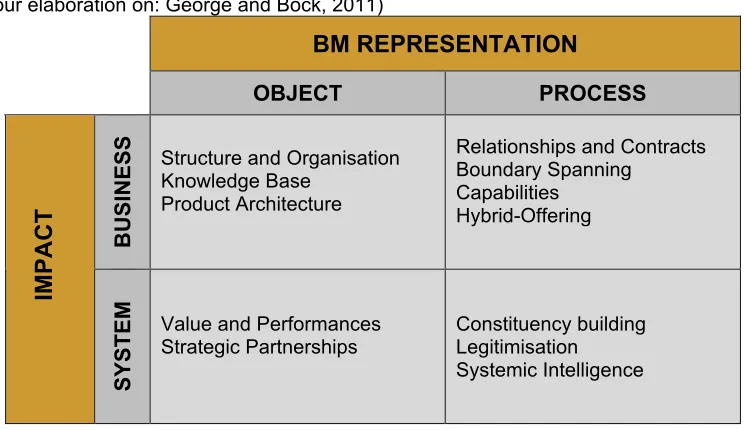
Figure 2 - Business Models Matrix
(our elaboration on: George and Bock, 2011)
BM REPRESENTATION
OBJECT
PROCESS
BUSI
NESS
Structure and Organisation Knowledge Base
Product Architecture
Relationships and Contracts Boundary Spanning
Capabilities Hybrid-Offering
IM
PA
C
T
SY
STEM
Value and Performances Strategic Partnerships
Constituency building Legitimisation
Systemic Intelligence
In Figure 2, we try to summarise the concept of BM as systemic instrument. The logic here
is organised according to the nature of BM (columns) and their possible impact on firms and
systems (rows). If we conceptualise BM as a static object, a snapshot describing the
behaviour of a single actor in the deployment of its strategic intent, the expected outcome can
be defined according to the resource based view of the firm and its relationship with value
creation according to the specific network firm’s is embedded in. According to George and
Bock, this perspective deals with the measurement (or appreciation) dynamics relating to
firm’s performance (George and Bock, 2011). On the other hand, the dynamic and
evolutionary perspective (right column) focus on the learning processes involved in the
system of exchange and relationships needed to attain a specific objective. This stance builds
on the idea of BM as tool leading the firms’ adaptation process (Demil and Lecocq, 2010,
McGrath, 2010), as a process translating strategic aims in actions (Casadesus-Masanell and
Ricart, 2010). Moreover as a complement to the static definition on BM these dynamics
highlight the emergence of new agents and agencies in a complex system (Dopfer and Potts,
2008). An interesting point here is the relationship between an important stream of literature
on entrepreneurship, according to a process perspective (Morris and Lewis, 1994) and the
recent literature on the evolutionary nature of this phenomenon (Veciana, 2007, Breslin,
2008, Metcalfe and Ramlogan, 2005). Summarising, conceiving BM as systemic instruments
could be an interesting perspective for three main reasons: a) exploring the entrepreneurial
phenomenon from an evolutionary perspective; b) modelling the behaviours of specific agents
highlighting the topic of agency; c) gain a better understanding about the social and
5 -‐ CASE STUDY BACKGROUND
Located in the Northeast of Italy, Emilia-Romagna is one of the wealthiest regions in the
country. With a surface of 22,000 sqkm, Emilia-Romagna population reaches 4,432,439
inhabitants (11,3% of which are foreigners). In its nine provinces are localised 383.549 firms,
characterising the industrial profile of this region according to their industrial specialisation
(ISTAT 2009). Traditional sectors are still at the core of Emilia-Romagna’s economic activity,
manufacturing accounts for the 30% (circa) of its GDP. Beside the Agri-Food district in
Parma, we have the car and tiling clusters near Modena and Reggio-Emilia, the Packaging
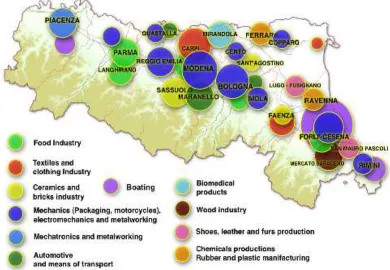
[image:17.595.111.501.273.543.2]District of Bologna and the newly emerged Biomedical district in Mirandola1.
Figure 3 -Emilia-Romagna Region (source www.investinemiliaromagna.it)
Emilia-Romagna enjoys a diffused system of research and innovation. The presence of
seven Universities (one private) and the research laboratories of CNR (National Research
Council) and ENEA (National Agency for New Technologies, Energy and the Environment),
the two national research institutions, constitute a specific trait of this region in the Italian
landscape. Beside the specialisation of the research activities (67% of researchers works on
science, technology ad engineering), the distribution of research institutes in the region
represents a real asset. As for other regions, Emilia Romagna’s research potential is
organised around the Universities, and other research institutions. In total the researchers
form the universities are 6,711 plus1,500 circa from CNR and ENEA institutes localised in the
region
1
Since the publications of Brusco in 1982, the Emilia-Romagna model became one of the
most cited examples to explain the socio economic development of the so-called Third Italy
(Brusco, 1982, Cooke, 1996, Rinaldi, 2002). The reason of this interest can be summarized
according to structural and socio-economic considerations. The first topic deals with the
peculiar structure of the production system and the capability of the Italian SMEs to cooperate
in order to compete at national and international level as a single productive cycle (Piore and
Sabel, 1984). Regarding the Emilia-Romagna case Brusco highlights the development of
traditional artisan sectors and the definition of sub-contracting practices (Gagliardi et al.,
2007). The second topic characterise the intermediary role of regions under the constraint of
a limited power of intervention. In managing the relationship between industrial peripheries
and central government, regions create specific governance systems. At the core of this
model there is the creation of regional agencies, adopting different operative models: financial
model (Lombardy, Lazio and Tuscany) and an operative model (Emilia-Romagna and
Marche) (Bellini et al., 1990). In 1973, Emilia-Romagna established ERVET2 (Regional
Agency for the Economic Enhancement of the Territory), a holding company with the specific
task to leverage the impact of regional economic and industrial policies.
While ERVET´s mission and remits evolved during the 1980s and 1990s, the governance
system of this agency has always been defined by the inclusion of relevant public and private
actors (e.g. business associations, financial institutions, banks and chambers of commerce).
On the other hand, ERVET’s modus operandi is characterised by the development of a
specific network of service centres conceived for the provision of “real services” to the local
production systems (Maccani, 2004, Bellini, 2000, Bianchi and Bellini, 1991). In the second
half of the 1990s (L.59/97), Italian regions faced process of progressive devolution
concerning a wide set of competences. With the modification of the Italian Constitution
(Constitutional Law 3/2001, art. 117), Research Technology and Innovation (RTI) policies are
now part of the regional responsibilities. Emilia-Romagna approached this new mission
according to its distinctive characteristics. Aiming at the fulfilment of Lisbon Strategy’s
objectives, the regional government engaged the regional research system in a regional
network for the applied research and technology transfer (Regional Law 7/2002). Important
operative outcomes of this initiative have been the establishment of a regional agency for
applied research and technology transfer (ASTER) and the definition of a regional RTI
program (PRRIITT). Mission of this agency is to promote the cooperation between the
regional government and the universities in Emilia-Romagna, by a set of coordinated
activities. On the other hand, to build the competitive advantage of the region on the
knowledge economy principles (Lisbon Strategy), calls for wide policy platform. With the
“Patto per la qualità dello sviluppo e la coesione sociale” (Pact for the quality of economic
and social development) signed in 2004 steered the cooperation between institutions and
civil society for the sake of regional economic advancement (cfr. Gagliardi et al., 2007).
The combination between industrial, scientific and territorial processes is at the core of
Emilia-Romagna’s innovation strategy. Since 2004, one important activity of ASTER has been
the establishment (and coordination) of the regional network for the applied research and
technology transfer (High Technology Network - HTN). It is organised according to six
thematic platforms and composed by Research Laboratories, Technology Transfer Centres
and Technology Parks. Research laboratories (LABS) represent the way in which universities
engaged with industries and local institutions. Thy can be defined as Contract Research and
Technology Organisations (C-RTO). Characterised by a variety of organisational, institutional
and governance models, their mission is to match the Universities’ research activities
according to the need and strategies expressed by local production systems. The process
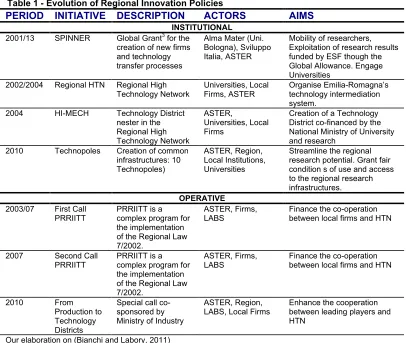
[image:19.595.97.503.270.613.2]followed by the region (and ASTER) is marked by specific initiatives.
Table 1 - Evolution of Regional Innovation Policies
PERIOD INITIATIVE DESCRIPTION ACTORS AIMS INSTITUTIONAL
2001/13 SPINNER Global Grant3 for the
creation of new firms and technology transfer processes
Alma Mater (Uni. Bologna), Sviluppo Italia, ASTER
Mobility of researchers, Exploitation of research results funded by ESF though the Global Allowance. Engage Universities
2002/2004 Regional HTN Regional High Technology Network Universities, Local Firms, ASTER Organise Emilia-Romagna’s technology intermediation system.
2004 HI-MECH Technology District nester in the Regional High Technology Network
ASTER,
Universities, Local Firms
Creation of a Technology District co-financed by the National Ministry of University and research
2010 Technopoles Creation of common infrastructures: 10 Technopoles)
ASTER, Region, Local Institutions, Universities
Streamline the regional research potential. Grant fair condition s of use and access to the regional research infrastructures. OPERATIVE
2003/07 First Call PRRIITT
PRRIITT is a complex program for the implementation of the Regional Law 7/2002.
ASTER, Firms, LABS
Finance the co-operation between local firms and HTN
2007 Second Call PRRIITT
PRRIITT is a complex program for the implementation of the Regional Law 7/2002.
ASTER, Firms, LABS
Finance the co-operation between local firms and HTN
2010 From Production to Technology Districts
Special call co-sponsored by Ministry of Industry
ASTER, Region, LABS, Local Firms
Enhance the cooperation between leading players and HTN
Our elaboration on (Bianchi and Labory, 2011)
The evolution of regional policy actions is summarised in Table 1. The actual situation
accounts for 10 Technopoles established between the end of 2009 and the beginning of
2010. They are infrastructures meant to host and organise all the regional industrial research
infrastructures. The major change observed here, has been the realisation of the importance,
3 A Global Grant is a specific instrument for the mobilisation of European Structural Funds that delegate to an
intermediary organisation the implementation and management of a specific plan (cfr.
at least in term of funding opportunities and engagement with local partners, of this program
by universities and other public research institution. The Regional Government ‘s action, once
very much active in the engagement with the regional research community, is now directed to
the coordination of the network according to a specific agenda highlighting. The main points
are:
1. The access by local firms to infrastructures and equipment hosted in the Technopoles
2. The standardisation of the LABS’ operative procedures and quality standards
3. The enhancement of the cooperation inside the technology platforms
4. The design of common marketing tools for the network
5. The creation of a monitoring system
All these activities are managed by ASTER as part of its statutory objectives. Their
realisation is planned as follows. The Points 1,2 realised through the definition of a mandatory
certification process and standards, for all laboratories and centres of the network. The points
3,4 are delegated to specific network activities inside each platform (i.e. development
coordination of projects for new products, common marketing activities and initiatives). The
last point deals with the development of a monitoring system appreciating the autonomy level
6 -‐ NEW BUSINESS MODELS DESIGN FOR THE MANUFACTURING SECTOR
Profiting from a real case study, regarding the design process of innovative business
models for manufacturing SMEs (Cocchi, 2011), our contribution will highlight how this
process impinges, in turn, on the nature of the intermediary and on the innovation strategies
of manufacturing SMEs. The evolution of Innovation Intermediaries, as discussed previously,
is meant to sign a passage from a reactive (or stewardship) position to a more proactive (or
entrepreneurial) one. We think that this role could be explored by the analysis of the
intermediary’s BM, an aspect that seems to be largely unexplored. The second point,
explores the possible impact on manufacturing firms. Following the adoption of a new
perspective, quite different from their usual approach to innovation, these firms are
encouraged to approach the enabling aspects of technologies and practices already in
adopted in other sectors. The case in object relates to a pilot experiment aiming at design and
presents a new business concept to a local cluster of manufacturing firms (machine tool
producers). As the project is still ongoing, we can offer only preliminary conclusions based on
the first part of the process.
6.1 -‐ New Business Models in Manufacturing
In the last two decades, New Business Models (NBM) in manufacturing sectors and
related product processes, have been introduced according to a Product Service System
(PSS) perspective. Defined as "a marketable set of products and services capable of jointly
fulfilling a user's needs" (Goedkoop et al., 1999:111), PSS represents the main organisational
and operative framework adopted by manufacturers to define, design and implement a unique
value proposition. The logic underpinning this prerogative is known as Hybrid Value Creation
(HVC), defined as: the process of generating additional value by innovatively combining products (tangible component) and services (intangible component) (Velamuri et al., 2011:4). The impact of PSS on manufacturing processes can be appreciated by the variety of terms
adopted to describe it: soft products, total offers, through life solutions, and service 2.0.
According to the literature, four main drivers underpin the introduction of PSS in
manufacturing (Isaksson et al., 2001). They are:
1. the introduction of new regulations, specifying limits and standards on users and
suppliers along all the products’ life cycle.
2. the increasing competition induces producers and suppliers to differentiate their
offerings (by the introduction of services).
3. the progressive adoption of total const of ownership and total life-cycle costs as
standards for the products’ selection.
4. the increased variability of demand, induces the adopt hybrid solutions to manage
The outcome is a process of progressive “servicisation” of traditional sectors, revolving on
the dyadic relationship between technology contents of products and processes and the new
importance of clients and services for value generation and profitability. To assist this
passage, a quantity of literature and analysis has been produced, highlighting possible
methodologies to assist the transition and challenges to be solved (Vladimirova et al., 2011,
[image:22.595.84.512.185.318.2]Biege et al., 2011).
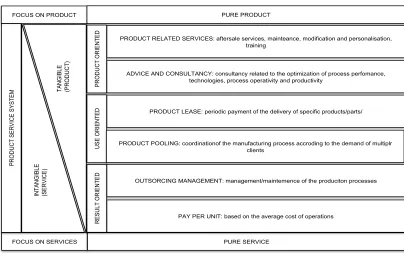
Figure 4 - PSS Classification
(source: Tukker, 2004)
PRODUCT-SERVICE SYSTEM Value in
Product Service (intangible)
Product (Tangible)
Value in Service
Pure Product Product
Oriented Use Oriented
Results
Oriented Pure Service
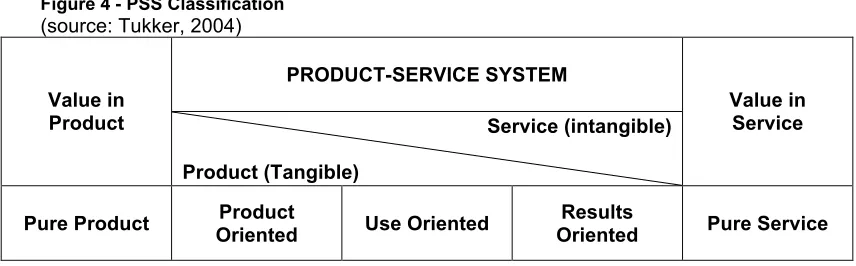
From Figure 4, we can observe how the PSS is generally based on a product-centred
perspective, where services follow a “reverse-life cycle” logic (Barras, 1986). This antithesis
between material and immaterial offering’s components, seems to be a common logic guiding
the “non technological” innovation in manufacturing processes (Gallouj, 1998). The demand
of industrial sector focused primarily on the restructuration of supply chains organisation, in
turn, to counter the emerging market dynamics and abide to the compelling normative toward
environmental friendly, energy saving production processes. Follows how the PSS logic is
generally routed in defining strategies for the recovery of efficiency in manufacturing
processes, according to an incremental innovation logic.
On the other hand, the application of the PSS rationale to the manufacturing sector is a
relevant topic of research across Europe, as showed by the number of research project
funded by the European Union. Here some examples retrieved form Cordis website
(Commission, 2011). MEPSS (Methodology for Product Service Systems) aiming at provide
the industry a toolkit to analyse and appraise the implementation and impact of new PSS
solutions (2001-2004). SUSPRONET (Sustainable product development network;
2002-2004), a project based on the construction of a network of expertises for the definition and
exchange of best practices on PSS and related research opportunities. KOBAS (Knowledge
Based Customized Services for Traditional Manufacturing Sectors Provided by a Network of
High Tech SMEs, 2004-2007), a project oriented to provide new insights in the current
practices in the use of manufacturing machines, to enable the quick customisation of
solutions as well as machine configuration, maintenance, training and management support
functions. And finally NEXT (NEXT generation production systems, 2004-2007), an
interesting project committed in determining the machines of the future and the sector's new
business models, and in assisting to the transformation the manufacturing industry. A review
paper. However, we try to reach some conclusions about this activity from this short survey of
the literature. We think there is a lock in action here, steering the discourse on NBM in
manufacturing dominated by an engineering-financial culture. This situation has been
encouraged by the influence of external trends. The research activities, conducted mainly at
European level, look at the energy consumption and to the introduction of new materials to
comply with the sustainability discourse dominating the manufacturing landscape. On the
other hand, the demand id dominated by big firms, associations and thematic platforms. Their
need to prioritise and select themes and actors to access to European funding complemented
the technological (bottom line) rationale, proposed by research and governmental institutions.
The core dynamics of NBM in manufacturing are therefore characterised by engineering
(industrial, mechanic and new material), ICT and finance. This, in turn, facilitates the
cooperation with industrial partners (normally big firms) but impose some limitation on the
[image:23.595.105.502.322.490.2]scope and variety of the solutions proposed.
Figure 5 - New Business Models as PSS
(source: Copani, 2011)
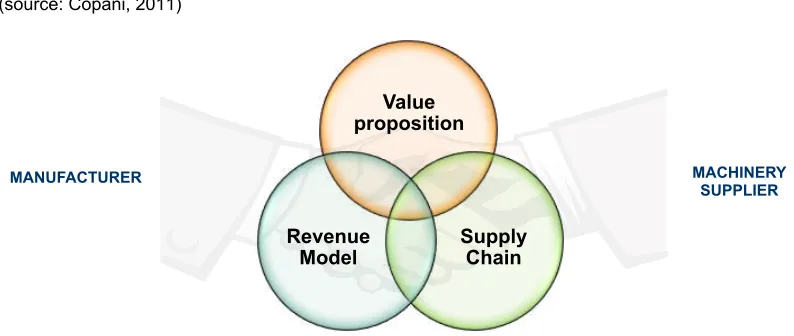
As we can see from Figure 5, the rationale for the development of NBM according to the
PSS framework is mainly based on the development of products’ implicit technologies and
properties. Furthering the tradition of PSS design, the NBS rationale is centred on the
evolution of the supply chain structure and management. The pre-eminence of a strict
vertical/sectoral dimension however, is challenged by recent contributions dealing, trying to
shift the focus from a product to a client centred perspective (Kobler et al., 2009, Biege et al.,
2009). The rationales used to justify the adoption of NBM (based on a PSS logic) are
normally related to the rationalisation of production processes, the related decrease of energy
consumption and finally the financial benefits accruing from the new capital structure (Kang
and Wimmer, 2008). Notwithstanding the valiant efforts to move the research from the
theoretical to the industrial level, the adoption of new business models seems to be a
privilege of big manufacturing firms (Lay et al., 2009). Looking at the general trends of the
European manufacturing sector, a common positive trend seems to emerge. The comparison
between the 2006 and 2010 on the European Manufacturing Survey shows a clear propensity
to embrace a service-centred strategy. In 2006, the 88% of firms surveyed did not plan to
MANUFACTURER MACHINERY
SUPPLIER Value
proposition
Supply Chain Revenue
adopt a NBM based on PSS logic, while in 2010 the great majority integrate their offering with
services (85%), witch directly or indirectly generates the 16% of revenues (cfr. Copani et al.,
2007, Lay et al., 2010).
6.2 -‐ The Intermediary Organisation
MUSP is an applied research laboratory pertaining to the technological district on
manufacturing and located in the Piacenza’s technopole. It has been founded in 2005 as joint
initiative between universities (Polytechnic of Milan and Catholic University of Milan), local
manufacturing firms, a sectoral association (UCIMU, the national association of machine tool
and equipments producers) and local institutions (a bank foundation, province and city
governments, local employers association). In 2008 MUSP strengthen its technology transfer
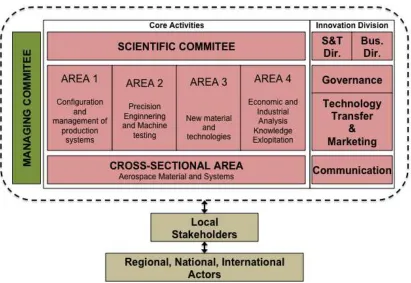
capabilities by the establishment of an innovation division (Innovation MUSP - i-MUSP),
following the incorporation of a local innovation centre (the actual organizational and
[image:24.595.109.520.340.623.2]governance structure is showed here below – Figure 6).
Figure 6 - MUSP Lab.: Organizational and Governance Structure
MUSP is an example of the research laboratories recently established with the support of
the regional government, with the am to integrate the regional industrial and research
systems toward a regional innovation system. Although the organizational, governance and
operative models are still very different, the establishment of technopoles highlighted the
requirement of organizational and legal independence of each laboratory from its
shareholders (mainly universities’ departments). In this respect, MUSP constitute an
private logics and expectations. The managing director is a full professor in mechanical
engineering with relevant professional and industrial vision, thanks to its professional
experience as manager in an important manufacturing company.
6.3 -‐ The Opportunity
The opportunity for this service-innovation has been introduced by the disruptive effect of
the economic downturn on manufacturing sector. This forced firms and researchers to focus
on different key factors, other than the superior performances granted by the technological
edge of Italian firms. On the other hand, the effectiveness of traditional strategies (relationship
with clients) is partially countered by financial pinch and credit restriction (the demand is only
potential or not existent). In this context MUSP decided to start an internal, independent
project aiming at explore the feasibility of NBM based on renting and leasing. The idea was to
propose solutions ready to use, easy to adopt and understand from SMEs. The rationale for
this project was based on some simple assumption: a) the potential value accruing from the
technological content of modern machinery was actually underestimated, b) other engineering
intensive sectors already introduced leasing and renting in their business models (i.e. power
generation, oil and gas industry), c) the technical life of machine tool is actually longer that
they commercial one. On the other hand, the research centre was actually interested in
analysing the technical problems associated to the passage from a traditional to a service
centred orientation. It is widely accepted that the introduction of PSS in firms’ manufacturing
strategies implies a revision of the traditional architecture of the products. This problem
however, is normally tackled form a technological perspective and not starting form the final
service (or service system) (Biege et al., 2011).
The idea to propose renting and leasing as key elements for this business model, was
initially advanced by the director of the newly born innovation division. He is an external
consultant with relevant experience in the field of applied research and development. The
idea came from the simple observation of how renting and leasing were diffused and common
practices in different manufacturing sectors. Moreover, given the result of the 2006 European
Manufacturing Survey - 25% of firms not adopting NBM due to limited technical or commercial
capabilities, the 63% do not understand the applicability – has been actually interpreted as a
positive element here. We read these results as lacking of absorption capabilities from firms,
combined with a weak relational capability from research and consultancy organisations.
Conversely, this was an opportunity to explore, in order to propose new solutions for a quite
conservative environment like the tooling machine sector. A point of view that seems to be
comforted by recent studies on manufacturing challenges on his way to servicisation
6.4 -‐ The Innovation proposed
The innovation proposed could be defined as an architectural one, a bundling of contracts
and practices that are innovative for the market/sector, but at the same time familiar for
producers and consumers. The conceptual bases of this model are the importance of
networks and system of relationships in structuring and delivering the value proposition, the
rapid adaptation of contractual and procedural schemes already existents, the re-redefinition
of service’s role in the strategy of the firm. Our aim is to propose an effective, simply
understandable model aiming at exploit the massive use of ancillary technologies in the
modern tooling machines as well as tapping in the growing market of retrofitting and
second-hand machinery (e.g. ICT, MEMS, RFDI sensors and accelerometers) (AAVV, 2011, Conti,
2007). The basic idea is to introduce the practice of renting and leasing in the sector of tooling
machines, thanks to an adaptation of the contractual and functioning mechanisms. This
should mitigate the problems (and limits) manifested by producers and clients in
understanding and exploiting the new business models. In order to ease the design,
communication and delivery processes, it has been necessary to expand the traditional
system of partnerships adding, to the usual vertical dimension, a horizontal one (Lay et al.,
2009). There is a bank with experience on renting and leasing contracts, a rental association
with experience in the management of the contracts and the logistics of the renting and
leasing processes for industrial machinery, and a research centre able to select, manage and
[image:26.595.102.521.444.604.2]adapt specific technologies for renting and leasing purposes.
Figure 7 - Traditional and New Business Models
(our adaptation from Miles, 2009)4
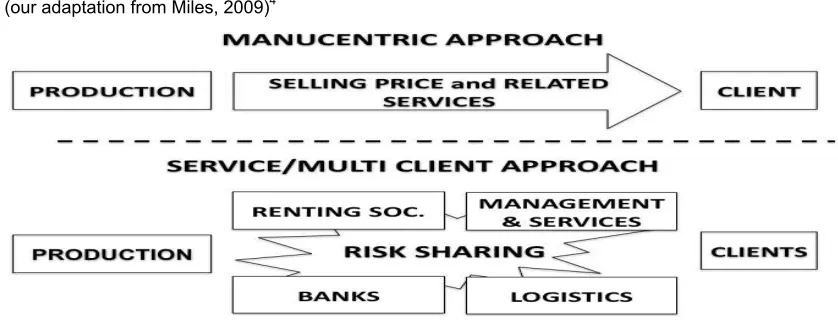
In Figure 7 above, we compare the two business models proposed. The first,
“manucentric” is focussed on the specific product. This refers to the traditional business
model adopted by the SMEs in this sector. The value proposition is characterised by the level
of personalisation of the product (machine tool) and by the ancillary nature of the services
introduced. This strategy, already known in service studies as “encapsulation” (Howells,
4 MANUCENTRIC – “assuming that the models and logic of manufacturing industry, or parts thereof (typically
2004), represents the dominant heuristic in manufacturing business model and has been
classified by Tukker among the product oriented strategies (Tukker, 2004, cfr.Figure 4).
According to this model, the tool machine (product) is designed to solve specific problems
faced by the target market, and the profitability is highly connected to the after sale services
as well as maintenance and other specific functions proposed by the supplier. This close
relationship with customers allows the producers to constantly monitor critical market and
technological trends but, on the other hand, overlooks the possibilities given by the
introduction of ICT (e.g. interoperability and remote management of the process). On the
other hand, the transfer of property rights form supplier to customer highlights the intrinsic
value of the machine in a specific moment, neglecting the strategic value related to the life
span of the machine. Then we defined this concept as manucentric as related to a culture
based on physical product, where engineering (in particular mechanical engineering) defines
the main terms of reference. Here services still have an ancillary position, while the design is
mainly focused on the deployment of functional characteristics of products and technologies
[image:27.595.93.505.366.610.2](Mitsuishi et al., 2008, Meyer-Kramer, 1996).
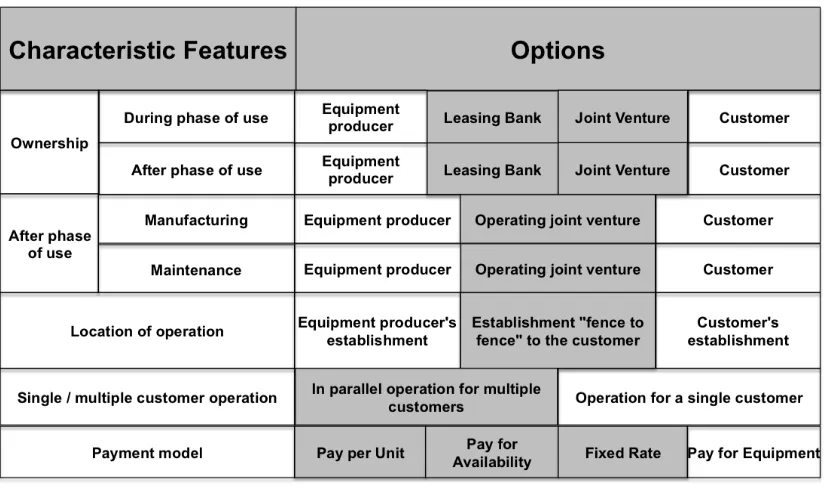
Figure 8 – Morphological Box for NBM on renting
(adapted from: Lay et al., 2009)
The aim of this new business model is to explore the possibilities offered by contracts and
practices extensively used in other sectors, for the provision of services along all the life cycle
of the machine. The feasibility of the concept has been explored in two consecutive meetings
with academics, consultants and representatives of the machine tool sector. The tool utilised
to explain the possible model’s architectures and explore related issues has been the
“morphological box”, a scheme introduced during the last part of the 1960’s and widely used
in the field of PSS modelling (Lay et al., 2009). To introduce the topic of new business