DISTRIBUTED HIGH PERFORMANCE VIRTUAL CLUSTERS
by
Andrew J. Younge
Submitted to the faculty of Indiana University
in partial fulfillment of the requirements for the degree of
Doctor of Philosophy
Department of Computer Science Indiana University
GRADUATE COMMITTEE APPROVAL
of a dissertation submitted by Andrew J. Younge
This dissertation has been read by each member of the following graduate committee and by majority vote has been found to be satisfactory.
Date Geoffrey C. Fox, Ph.D, Chair
Date Judy Qiu, Ph.D
Date Thomas Sterling, Ph.D
ARCHITECTURAL PRINCIPLES AND EXPERIMENTATION OF DISTRIBUTED HIGH PERFORMANCE VIRTUAL CLUSTERS
Andrew J. Younge
Department of Computer Science Doctor of Philosophy
With the advent of virtualization and Infrastructure-as-a-Service (IaaS), the broader scientific computing community is considering the use of clouds for their scientific computing needs. This is due to the relative scalability, ease of use, advanced user environment customization abilities, and the many novel computing paradigms available for data-intensive applications. However, a notable performance gap exists between IaaS and typical high performance computing (HPC) resources. This has limited the applicability of IaaS for many potential users, not only for those who look to leverage the benefits of virtualization with traditional scientific computing applications, but also for the growing number of big data scientists whose platforms are unable to build on HPCs advanced hardware resources.
pabilities for both differing distributed systems use cases. This dissertation proposes such an endeavor by leveraging the performance and advanced hard-ware from the HPC community and providing it in a virtualized infrastructure using High Performance Virtual Clusters. This will not only enable a more diverse user environment within supercomputing applications, but also bring increased performance and capabilities to big data platform services.
As committee members of the candidate’s graduate committe, I have read the dissertation abstract of Andrew J. Younge and found it in a form satisfactory to the graduate committee.
Date Geoffrey C. Fox, Ph.D, Chair
Date Judy Qiu, Ph.D
Date Thomas Sterling, Ph.D
I am grateful to many, many people for making this dissertation possible. First, I want to express my sincere gratitude and admiration to my advisor, Geoffrey Fox. Geoffrey has provided invaluable advice, knowledge, insight, and direction in a way that made this dissertation possible. It has been a distinct honor and privilege working with him, something which I will carry with me throughout the rest of my career.
I would like to thank my committee members, Judy Qiu, Thomas Sterling, and Martin Swany. The guidance received in the formation of this dissertation has been of great help and a fruitful learning experience. Conversations with each member throughout the dissertation writing have proven exceptionally insightful, and I have learned a great deal working with each of them. I also want to explicitly thank Judy Qiu for giving me the opportunity to help organize and lecture in the Distributed Systems and Cloud Computing courses over the years. This teaching experience has taught me how to be both a better lecturer and mentor.
Zhou for their support over the years. Many of these individuals have helped me directly throughout my tenure at Indiana University and their efforts and encouragement is greatly appreciated.
I would like to express my gratitude to the APEX research group at the University Of Southern California Information Sciences Institute, where I was a visiting researcher and intern in 2012 and 2013. In this, I would like to give a special thanks to John Paul Walters at USC/ISI who worked directly with me on many of the research endeavors described within this dissertation. He has provided hands-on mentorship that aided with the basis of this dissertation, and his leadership is one in which I look to emulate in the future. I would also like to thank the Persistent Systems Fellowship through the School of Informatics and Computing for providing me with a fellowship to fund the last three years of my PhD.
to the end. John has donated countless hours of his time helping me edit and revise this manuscript, along with many after-hour philosophical discussions that proved crutial to the work at hand. Without all of these wonderful peo-ple in my life here in Bloomington, this dissertation would have likely been completed many months earlier.
Table of Contents x
List of Figures xiii
1 Introduction 1
1.1 Overview . . . 1
1.2 Research Statement . . . 7
1.3 Research Challenges . . . 14
1.4 Outline . . . 17
2 Related Research 20 2.1 Virtualization . . . 20
2.1.1 Hypervisors and Containers . . . 23
2.2 Cloud Computing . . . 25
2.2.1 Infrastructure-as-a-Service . . . 30
2.2.2 Virtual Clusters . . . 40
2.2.3 The FutureGrid Project . . . 44
2.3 High Performance Computing . . . 47
2.3.1 Brief History of Supercomputing . . . 47
2.3.2 Distributed Memory Computation . . . 49
2.3.3 Exascale . . . 51
3 Analysis of Virtualization Technologies for High Performance Com-puting Environments 54 3.1 Abstract . . . 54
3.2 Introduction . . . 55
3.3 Related Research . . . 57
3.4 Feature Comparison . . . 59
3.4.1 Usability . . . 61
3.5 Experimental Design . . . 63
3.5.1 The FutureGrid Project . . . 63
3.5.2 Experimental Environment . . . 65
3.6 Performance Comparison . . . 68
3.7 Discussion . . . 73
4 Evaluating GPU Passthrough in Xen for High Performance Cloud Computing 77 4.1 Abstract . . . 77
4.2 Introduction . . . 78
4.3 Virtual GPU Directions . . . 80
4.3.1 Front-end Remote API invocation . . . 81
4.3.2 Back-end PCI passthrough . . . 83
4.4 Implementation . . . 85
4.4.1 Feature Comparison . . . 86
4.5 Experimental Setup . . . 87
4.6 Results . . . 88
4.6.1 Floating Point Performance . . . 89
4.6.2 Device Speed . . . 90
4.6.3 PCI Express Bus . . . 92
4.7 Discussion . . . 94
4.8 Chapter Summary and Future Work . . . 97
5 GPU-Passthrough Performance: A Comparison of KVM, Xen, and LXC for CUDA and OpenCL Applications 98 5.1 Abstract . . . 98
5.2 Introduction . . . 99
5.3 Related Work & Background . . . 100
5.3.1 GPU API Remoting . . . 101
5.3.2 PCI Passthrough . . . 101
5.3.3 GPU Passthrough, a Special Case of PCI Passthrough . . . . 102
5.4 Experimental Methodology . . . 103
5.4.1 Host and Hypervisor Configuration . . . 103
5.4.2 Guest Configuration . . . 105
5.4.3 Microbenchmarks . . . 105
5.4.4 Application Benchmarks . . . 106
5.5 Performance Results . . . 107
5.5.1 SHOC Benchmark Performance . . . 109
5.5.2 GPU-LIBSVM Performance . . . 114
5.5.3 LAMMPS Performance . . . 116
5.5.4 LULESH Performance . . . 118
5.6 Lessons Learned . . . 119
6 Supporting High Performance Molecular Dynamics in Virtualized
Clusters using IOMMU, SR-IOV, and GPUDirect 122
6.1 Abstract . . . 122
6.2 Introduction . . . 123
6.3 Background and Related Work . . . 126
6.3.1 GPU Passthrough . . . 127
6.3.2 SR-IOV and InfiniBand . . . 128
6.3.3 GPUDirect . . . 129
6.4 A Cloud for High Performance Computing . . . 130
6.5 Benchmarks . . . 131
6.6 Experimental Setup . . . 133
6.6.1 Node configuration . . . 133
6.6.2 Cluster Configuration . . . 134
6.7 Results . . . 135
6.7.1 LAMMPS . . . 135
6.7.2 HOOMD . . . 138
6.8 Discussion . . . 138
6.9 Chapter Summary . . . 140
7 Virtualization advancements to support HPC applications 141 7.1 PCI Passthrough . . . 145
7.2 Memory Page Table Optimizations . . . 153
7.3 Time in Virtual Machines . . . 159
7.4 Live Migration Mechanisms . . . 162
7.4.1 RDMA-enabled VM Migration . . . 164
7.4.2 Moving the Compute to the Data . . . 167
7.5 Fast VM Cloning . . . 169
7.6 Virtual Cluster Scheduling . . . 171
7.7 Chapter Summary . . . 175
8 Conclusion 176 8.1 Impact . . . 180
1.1 Data analytics and computing ecosystem compared (from [25]), with
virtualization included . . . 6
1.2 High Performance Virtual Cluster Framework . . . 9
1.3 Architectural diagram for High Performance Virtual Clusters . . . 11
2.1 Virtual Machine Abstraction . . . 21
2.2 Hypervisors and Containers . . . 24
2.3 View of the Layers within a Cloud Infrastructure . . . 28
2.4 Eucalyptus Architecture . . . 34
2.5 OpenNebula Architecture . . . 38
2.6 Virtual Clusters on Cloud Infrastructure . . . 41
2.7 FutureGrid Participants, Network, and Resources . . . 45
2.8 Top 500 Development over time from 2002 to 2016 [8] . . . 50
3.1 A comparison chart between Xen, KVM, VirtualBox, and VMWare ESX 59 3.2 FutureGrid Participants and Resources . . . 64
3.3 Linpack performance . . . 70
3.4 Fast Fourier Transform performance . . . 71
3.5 Ping Pong bandwidth performance . . . 72
3.6 Ping Pong latency performance (lower is better) . . . 73
3.7 Spec OpenMP performance . . . 74
3.8 Benchmark rating summary (lower is better) . . . 75
4.1 GPU PCI passthrough within the Xen Hypervisor . . . 86
4.2 GPU Floating Point Operations per Second . . . 90
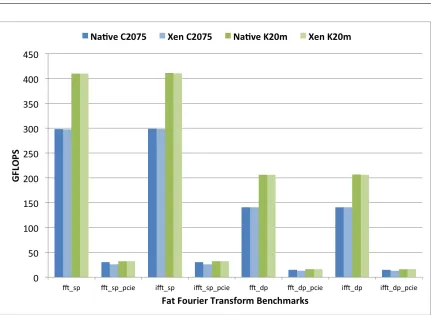
4.3 GPU Fast Fourier Transform . . . 91
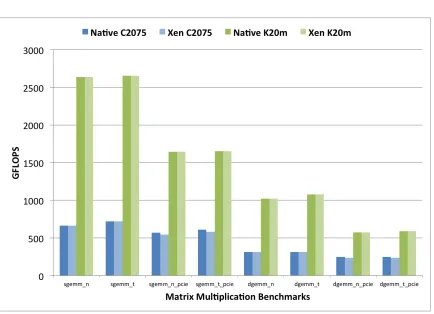
4.4 GPU Matrix Multiplication . . . 92
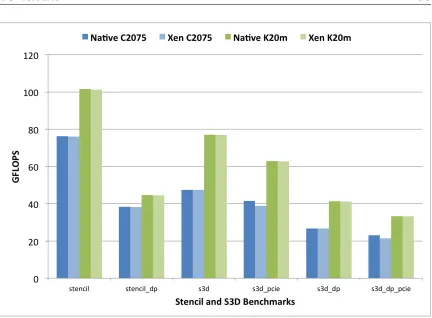
4.5 GPU Stencil and S3D . . . 93
4.6 GPU Device Memory Bandwidth . . . 94
4.7 GPU Molecular Dynamics and Reduction . . . 95
4.8 GPU PCI Express Bus Speed . . . 96
5.1 SHOC Levels 0 and 1 relative performance on Bespin system. Results show benchmarks over or under-performing by 0.5% or greater. Higher
is better. . . 110
5.2 SHOC Levels 1 and 2 relative performance on Bespin system. Results show benchmarks over or under-performing by 0.5% or greater. Higher is better. . . 111
5.3 SHOC Levels 0 and 1 relative performance on Delta system. Bench-marks shown are the same as Bespin’s. Higher is better. . . 112
5.4 SHOC Levels 1 and 2 relative performance. Benchmarks shown are the same as Bespin’s. Higher is better. . . 113
5.5 GPU-LIBSVM relative performance on Bespin system. Higher is better.114 5.6 GPU-LIBSVM relative performance on Delta showing improved per-formance within virtual environments. Higher is better. . . 115
5.7 LAMMPS Rhodopsin benchmark relative performance for Bespin sys-tem. Higher is better. . . 116
5.8 LAMMPS Rhodopsin benchmark relative performance for Delta sys-tem. Higher is better. . . 117
5.9 LULESH relative performance on Bespin. Higher is better. . . 118
6.1 Node PCI Passthrough of GPUs and InfiniBand . . . 134
6.2 LAMMPS LJ Performance . . . 136
6.3 LAMMPS RHODO Performance . . . 137
6.4 HOOMD LJ Performance with 256k Simulation . . . 139
7.1 Comparison of GPU Passthrough in Xen to rCUDA across various interconnects . . . 149
7.2 Efficient VM networking comparison [208] . . . 150
7.3 SR-IOV Architecture with Virtual Functions, PCI SIG [237] . . . 152
7.4 Native TLB miss walk compared with 2D virtualized TLB miss walk from [239]. On the left illustrates a native page table walk. On the right illustrates the lengthy 2D nested page table walk for a VM. . . . 156
7.5 Transparent Huge Pages with KVM . . . 158
Introduction
1.1
Overview
For years, visionaries in computer science have predicted the advent of utility-based computing. This concept dates back to John McCarthy’s vision stated at the MIT centennial celebrations in 1961:
“If computers of the kind I have advocated become the computers of the future, then computing may someday be organized as a public utility just as the telephone system is a public utility... The computer utility could become the basis of a new and important industry.“
Only recently has the hardware and software become available to support the concept of utility computing on a large scale.
The concepts inspired by the notion of utility computing have combined with the requirements and standards of Web 2.0 [1] to create Cloud computing [2–4]. Cloud computing is defined as “A large-scale distributed computing paradigm that is driven by economies of scale, in which a pool of abstracted, virtualized, dynamically-scalable, managed computing power, storage, platforms, and services are delivered on
demand to external customers over the Internet.” This concept of cloud computing is important to Distributed Systems because it represents a true paradigm shift [5] within the entire IT infrastructure. Instead of adopting the in-house services, client-server model, and mainframes, clouds push resources out into abstracted services hosted en masse by larger organizations. This concept of distributing resources is similar to many of the visions of the Internet itself, which is where the “clouds” nomenclature originated, as many people depicted the internet as a big fluffy cloud one connects to.
At the core of most cloud infrastructure lies virtualization, a computer architecture technology by which 1 or more Virtual Machines (VMs) are run on the same physical host. In doing this, a layer of abstraction is inserted between and around the hardware and Operating System (OS). Specifically, hardware resources such as CPUs, memory, and I/O devices, and software resources analagous to OS functionality and low level libraries are abstracted and provided to VMs directly. Virtualization has existed for many years, but its availability with Intel x86 commodity hardware in conjunction with the rise of clouds has brought it to the forefront of distributed systems.
super-computer with off-the-shelf CPUs instead of the highly customized and expensive processors and interconnects found in Supercomputers. Supercomputers and Clus-ters are best suited for large-scale applications, due to their innate ability to divide the computational efforts into smaller concurrent tasks. These tasks often run in par-allel on many CPUs, whereby each task communicates results to other tasks in some way as per the application design. These HPC applications can even include “Grand Challenge” applications [7] and can represent a sizable amount of the scientific calcu-lations done on large-scale Supercomputing resources today. However, there exists a gap of many orders of magnitude between leading-class high performance computing and what is available on the common laboratory workshop. This gap, described here as mid-tier scientific computation, is a fast growing field that struggles to harness dis-tributed systems efficiently while hoping to minimize extensive development efforts. These mid-tier scientific endeavors need to leverage distributed systems to complete the calculations at hand effectively, however, they may not require the extreme scale provided by the latest machines at the peak of the Top500 list [8]. Some small research teams may not have the resources available or the desire to handle the development complexity of high end supercomputing systems, and can look towards other options instead. This can include some scientific disciplines such as high energy physics [9], materials science [10], bioinformatics [11], and climate research [12], to name a few.
spe-cific initiatives such as the NSF iPlant collaborative [15].Substantial growth can be seen in the number of computational resource requests [14,16] from many of the larger computational facilities. Concurrently, there has also been an increase in accelerators and hybrid computing models capable of quickly providing additional resources [17] beyond commodity clusters.
Historically, application diversity was separated into High Performance Comput-ing (HPC) and High Throughput ComputComput-ing (HTC). With HTC, computational problems can be split into independent tasks that execute in a pleasingly parallel fash-ion, happily gaining any available resources and rarely requiring significant commu-nication or synchronization between tasks. Example of this can include independent tasks or parameter sweeps of an application to find the optimal application settings, or many similar tasks with only slightly different input datasets. HPC often represents computational problems that require significant communication and coordination to produce results effectively, usually with the use of a communication protocol such as MPI [18]. These applications are often tightly coupled sequential tasks operat-ing concurrently and communicatoperat-ing often to complete the collective computational problem. While there are many examples of such HPC applications, common exam-ples often involve significant matrix and/or vector multiplication mechanisms [19] for completing simulations.
industry and academic problem sets created by a data deluge [24]. This has lead to a number of novel platform services for handling big data problems in parallel, and supporting these different distributed computational paradigms requires a flexible in-frastructure capable of providing computational resources for all possible models in a fast and efficient manner.
Currently, we are at the forefront of a convergence within scientific computing between HPC and big data computation [25]. This amalgamation of historically differing viewpoints of Distributed Systems looks to combine the performance char-acteristics of HPC and the pursuit towards Exascale with the data and programmer oriented concurrency models found in Big Data and cloud services.
success of the research in virtualization could be defined by the ability to support the convergence between HPC and Big Data.
Figure 1.1 Data analytics and computing ecosystem compared (from [25]), with virtualization included
at a critical level.
This work proposes the use of virtual clusters [32] to provide distinct, separate environments on similar resources using virtual machines. These virtual clusters, similar in design to the Beowulf clusters and commodity HPC systems, provide a distributed memory environment, usually with a local resource management system [33]. However, past concerns with virtualization have limited the adoption of virtual clusters in many large-scale cyberinfrastructure deployments. This has in part been due to the overhead of virtualization, whereby many scientific computations have experienced a significant and notable degradation in performance. In an ecosystem familiar with HPC systems in which performance is paramount, this has been an obstructive hurdle for deploying many tightly coupled applications.
1.2
Research Statement
plat-form services have evolved complimentary to cloud infrastructure, and as such have a symbiotic relationship with virtualization technologies [36].
However, with tightly coupled, high performance distributed memory applications, the same endeavors that support leading class scientific efforts, run very poorly on virtualized cloud infrastructure [37]. This is due to a myriad of addressable reasons ranging from scheduling, abstraction overhead, and a lack of advanced hardware support necessary for tightly coupled communication. This postulates the question regarding whether virtualization can in fact support such tightly coupled large-scale applications without an imposed significant performance penalty. Simply put, the goal of this dissertation is to investigate the viability of mid-tier scientific applications
supported in virtualized infrastructure.
Historically, mid-tier scientific applications are distributed memory HPC applica-tions that require more complex process communication mechanisms. These systems need far more performance than a single compute resource (such as a workstation) can provide. This could include hundreds or thousands of processes calculating and communicating concurrently on a cluster, perhaps using a messaging interface such as MPI. These applications can be distinct (and sometimes simpler), either in applica-tion composiapplica-tion or operating parameters, from extreme-scale HPC applicaapplica-tions that run at the highest end of the supercomputing resources today operating on petascale machines and beyond.
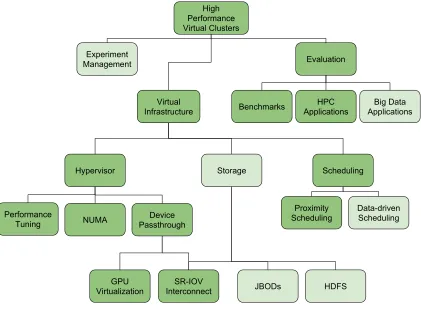
ap-plications. Areas marked in darker green indicate topics this dissertation may touch upon, whereas light green areas in Figure 1.2 identify outstanding considerations to be investigated. Specifically, mid-tier distributed memory parallel computations is identified as a focal point for the computational challenges at hand as a way to sep-arate from some of the latest efforts towards Exascale computing [38–40]. While virtualization may in fact be able to play a role towards usable Exascale computing, such efforts fall outside the immediate scope of this dissertation.
[image:23.612.113.534.284.593.2]Hypervisor Virtual Infrastructure Scheduling Performance Tuning NUMA GPU Virtualization SR-IOV Interconnect Proximity Scheduling Experiment Management High Performance Virtual Clusters Data-driven Scheduling Device Passthrough Evaluation Benchmarks HPC Applications Big Data Applications Storage JBODs HDFS
Figure 1.2 High Performance Virtual Cluster Framework
memory access (NUMA) effects, and advanced hardware device passthrough. Specifi-cally, device passthrough in the context of this manuscript refers to two major device types; GPUs and InfiniBand interconnects (the later using SR-IOV). The virtual in-frastructure also must consider scheduling as a major factor in performing efficient placement of workloads on the underlying host infrastructure, and in particular a Proximity scheduler is of interest [41]. Storage solutions in a virtualized environment is an increasingly important aspect of this framework, as some HPC and big data solutions are prioritizing I/O performance more than computation. Storage is also likely to be heavily dependent on interconnect considerations as well, which could be potentially provided by device passthrough. However, such I/O considerations lie beyond this dissertation’s immediate scope.
However, simply providing an enhanced virtualized infrastructure may not guar-antee that all implementations of high performance virtual clusters are performant. Specifically, proposed infrastructures need to be properly evaluated in a systematic way through the use of a wide array of benchmarks, mini-applications, and full-scale scientific applications. This effort can further be separated into three major problem sets; base level benchmarking tools, HPC applications, and big data applications. Evaluating the stringent performance requirements of all three sets, when compared with bare metal (no virtualization) solutions, will illuminate not only successful de-signs but also the focus areas that require more attention. As such, we look to continually use these benchmarks and applications as a tool to measure the viability of virtualization in this context.
condi-tions, and vary the number of processors and execution units (including GPUs) across multiple virtualized and non-virtualized architectures. Generally, a successful solu-tion will demonstrate strong scaling characteristics as close to a native, bare-metal runtime as possible, illustrating little overhead of the added methods. Furthermore, variability between runtimes are also important to consider, as high variability and noise within large scale distributed systems can lead to tail latencies and significant efficiency losses. While weak scaling experiments that increase the problem size rel-ative to the number of available processors could be used for future evaluation, such efforts are outside of the immediate scope of this dissertation.
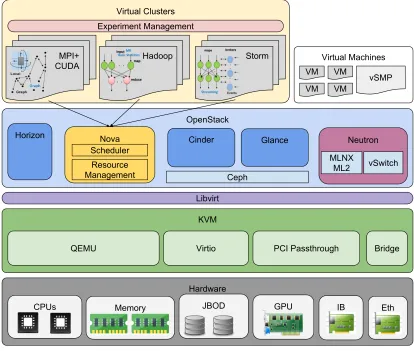
Hardware KVM OpenStack Virtual Clusters
Virtual Machines
CPUs Memory GPU IB Eth
Libvirt PCI Passthrough Nova Experiment Management Scheduler Resource Management Storm Hadoop MPI+ CUDA VM VM VM VM vSMP
Cinder Glance Neutron
[image:25.612.121.535.331.682.2]Ceph MLNX ML2 vSwitch QEMU JBOD Virtio Bridge Horizon
Starting from the historical perspective of virtual clusters in Grid computing, we see the new architectural model for high performance virtual clusters illustrated in Figure 1.3 that is implied by the efforts described in this dissertation. Here, we leverage commodity hardware, as well as some advanced HPC hardware withint he same system. Providing advanced hardware in this scenario has a twofold effect. First, we look to provide classic distributed memory HPC applications in an virtualized environment that still utilize the same hardware that such applications have grown accustomed to. Second, it allows for novel big data analytics and cloud platform services to move towards hardware that may drastically speed up their computational efforts. Specifically, we allow for such platform services to leverage the high-speed, low-latency interconnects that HPC systems have relied upon. While such cloud systems may not be able to take full advantage of the latency improvements, it is estimated the the increased bandwidth may have a significant impact on the overall runtime of these systems, reducing the overall time-to-solution. While this notion could incorporate a wide array of differing technologies, we focus here on GPU-based accelerators and InfiniBand interconnects in conjunction with x86 CPUs.
resource management solutions could be swapped in if such a design was warranted. Building form Libvirt comes the OpenStack private cloud infrastructure. In Fig-ure 1.3 we illustrate some (but not all) of OpenStack’s services including the Horizon UI, Cinder and Glance storage mechanisms, and the Neutron (previously Quantum) components. The Nova component of OpenStack is the point of focus for provid-ing comprehensive VM management. 1 OpenStack provides a comprehensive cloud
infrastructure service for managing up to thousands of nodes in a cluster using virtu-alization. Its integration with KVM through Libvirt is highly tuned for efficient VM deployment and advanced plug-ins such as the ML2 Neutron service can managed an advanced interconnect such as InfniBand and 40GbE provided by Mellanox.
Atop OpenStack, we can create a wide array of virtual clusters and machines to support diverse scientific computing ecosystems necessary. This includes application models ranging from tightly coupled MPI+CUDA HPC applications, to emerging big data analytics toolkits such as Apache Storm [42]. Such virtual clusters can be built manually through users requesting highly tuned images from a repository and deploying them to scale. This also allows for the use of virtualized SMP systems such as ScaleMP [43].
One of the higher-level aspects of providing high performance virtual clusters is the orchestration of the virtual clusters themselves, which could be called experiment management. While this largely remains tangential to this immediate research, it is nonetheless a key aspect for a successful solution. Some effort has been put forth for virtual cluster experiment management [44], and many ongoing open sources solutions
1While many of the features for nova’s additions in GPU Passthrough and SR-IOV
InfiniBand support have been put together at USC/ISI as an OpenStack Nova fork
(https://libraries.io/github/usc-isi/nova), the features have since been modified and matured by
also offer compelling options, such as OpenStack Heat [45]. An example of a project delivering advanced orchestration mechanisms and a toolkit to aid in configurable virtual clusters on heterogeneous IaaS deployments is the Cloudmesh effort [46].
1.3
Research Challenges
The framework, architecture, and efforts described in this dissertation represent a movement forward in providing virtualized infrastructure to support a wide arrange of scientific applications. However, there still exist some challenges that will need to be addressed. This includes a stigma of virtualization being inherently slow and unable to support tightly coupled computations, limitations associated with operating at scale, and even that containers may provide a better alternative. While this work hopes to move beyond these challenges, they none the less must be considered.
The notion that virtualization and Cloud infrastructure are not able to support parallel distributed memory applications has been characterized many times. One of the most prominent examples of this is the Department of Energy’s Magellan Project [47], whereby the Magellan Final Report [48] states the following finding as a Key Finding:
“Finding 2. Scientific applications with minimal communication and I/O are best suited for clouds.
EC2 instances compared to Magellan bare-metal (non-virtualized) at 64 cores and about 7x slower at 1024 cores on Amazon Cluster Compute in-stances, the specialized high performance computing offering. As a result, current cloud systems are best suited for high-throughput, loosely coupled applications with modest data requirements.“
These findings underscore how classical usage of virtualization in cloud infrastruc-ture has serious performance issues when running tightly coupled distributed memory applications. Many of these performance concerns are sound, given the limitation of a number of virtualization overheads commonplace at the time, including shadow page tables, emulated Ethernet drivers, experimental hypervisors, and a complete lack of sophisticated hardware commonplace in supercomputers and clusters. As a result, the advantages of virtualization, including on-demand resource allocation, live migration and advanced hybrid migration, and user-defined environments, have not been able to show effectively their value in the context of the HPC community.
the results would be drastically different.
One limitation in this research in high performance virtual clusters is the fact that the degree to which applications can scale remains relatively unknown. While initial results with SR-IOV InfiniBand are promising, scaling is naturally hard to predict. It would be hypothetically possible that as the number of VM’s increases, interconnect communication tail-latency could also increase, causing notable slowdowns during distributed memory synchronization barriers. It is only when infrastructure able to support high performance virtual clusters becomes available will scaling to thousands of cores and beyond be investigated.
Another potential challenge, and perhaps also a strength, is the rising use of containers within industry, such as we see in efforts like Docker [50]. Recently, we have seen efforts at NERSC/LBNL adapt a container solution called Shifter with the SLURM resource manager on CRAY XC based systems [51]. Shifter’s goal is to pro-vide user defined images for NERSC’s bioinformatics users, and it adapts remarkably well to the HPC environment. While further efforts are needed by Cray and NERSC to fully provide a container-based solution on a large-scale Supercomputer for all ap-plications, its efforts are in many ways related to virtualization. In Chapter 5, we specifically compare virtualization efforts with LXC [52], a popular Linux container solution, and find performance to be comparable and largely near-native.
enhanced usability and enable specialized runtime components to future HPC re-sources, adding significant value over today’s supercomputing resources. This could potentially include infrastructure advances for higher level cloud platform services for supporting big data applications [27].
1.4
Outline
The rest of this dissertation is organized into chapters, each signifying the steps to move forward the notion of a high performance virtual cluster solution.
Chapter 2 investigates the related research surrounding both cloud computing and high performance computing. Within cloud computing, an introduction to cloud infrastructure, virtualization, and containers will all be discussed. This also includes details regarding virtual clusters as well as an overview of some national scale cloud infrastructure efforts that exist. Furthermore, we investigate the state of high per-formance computing and supercomputing, as well touch upon some of the current Exascale efforts.
Chapter 3 takes a look at the potential for virtualization, in a base case, to sup-port high performance computing. This includes a feature comparison for hardware availability of a few common hypervisors, specifically Xen, KVM, VirtualBox, and VMWare. Then, a few common HPC benchmarks are evaluated in a single node con-figuration to determine what overhead exists and where. This identifies how in some scenarios, virtualization adds only a minor overhead, whereas with other scenarios, overheads can be up to 50% compared to native configurations.
allowing for GPUs to be used in a guest VM. The efficiency of this method is briefly evaluated using two different hardware setups, and finds hardware can play a notable role in single node performance.
Chapter 5 continues where chapter 4 leaves off, by demonstrating that GPU passthrough is possible on many other hypervisors, specifically also KVM and VMWare, and compares with one of the main containerization solutions, LXC. Here, the GPUs are evaluated using not only the SHOC GPU benchmark suite developed at Oak Ridge National Laboratory, but also a diverse mix of real-world applications in order to examine how and where overhead exists with GPUs in VMs for each virtualization setup. Specifically, we find that with properly tuned hardware and NUMA-balanced configurations, the KVM solution can perform at roughly near-native performance, with on average 1.5% overhead compared to no virtualization. This illustrates that with the correct hypervisor selection, careful tuning, and advanced hardware, scien-tific computations can be supported using virtualized hardware.
Chapter 6 takes the findings from the previous chapter to the next level. Specifi-cally, the lessons learned from successful KVM virtualization with GPUs are expanded and combined with a missing key component of supporting advanced parallel com-putations: a high speed, low latency interconnect, specifically InfiniBand. Using SR-IOV and PCI passthrough of QDR InfiniBand interconnect across a small cluster, it is demonstrated that two Molecular Dynamics simulations, both very commonly used in the HPC community, can be run at near-native performance in the designed virtual cluster.
Specifically, this chapter outlines and investigates potential next steps for virtualiza-tion, including the potential for advanced live migration techniques and VM cloning, which can be made available with the inclusion of a high-performance RDMA-capable interconnect.
Related Research
In order to depict the research presented in this article accurately, the topics within Virtualization, Cloud computing, and High Performance Computing are reviewed in detail.
2.1
Virtualization
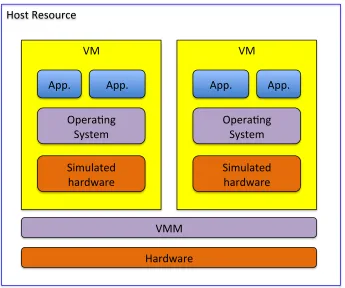
Virtualization is a way to abstract the hardware and system resources from an op-erating system. This is typically performed within a Cloud environment across a large set of servers using a Hypervisor or Virtual Machine Monitor (VMM), which lies in between the hardware and the Operating System (OS). From here, one or more virtualized OSs can be started concurrently, as seen in Figure 2.1, leading to one of the key advantages of virtualization. This, along with the advent of multi-core processing capabilities, allows for a consolidation of resources within a data center. It then becomes the cloud infrastructure’s job, as discussed in the next section, to exploit this capability to its maximum potential while still maintaining a given QoS. It should be noted that virtualization is not specific to Cloud computing. IBM
inally pioneered the concept in the 1960’s with the M44/44X systems. It has only recently been reintroduced for general use on x86 platforms.
VM VM
VMM
Hardware Simulated
hardware Opera3ng
System
App. App.
Simulated hardware Opera3ng
System
App. App.
[image:35.612.153.498.153.441.2]Host Resource
Figure 2.1Virtual Machine Abstraction
However, virtualization, in the most general sense, is just another form of abstrac-tion. As such, there are in fact many levels to virtualization that exist [53].
• Hardware - One of the most important technologies in cloud computing is hardware level virtualization [54, 55]. Hardware virtualization, in its most pure form, refers to the process of creating virtual abstraction to hardware platforms, operating systems, or software resources. This enables the creation of 1 or more virtual machines (VMs) that are run concurrently on the same operating environment, be it hardware or some higher software. Here, a virtual hardware environment is generated for a VM, providing virtual processors, memory, and I/O devices that allow for VM multiplexing, as depicted in Figure 2.1. This layer also manages the physical hardware on behalf of a host OS, as well as for guests. While the most popular implementations of hardware virtualization is the Xen Virtual Machine Monitor [54]; this method has further separated into type 1 and type 2 hypervisors, as detailed further in Section 2.1.1.
• Operating System - Moving up the latter of implementation with virtu-alization, we find OS level virtuvirtu-alization, where multiplexing happens at the level of the OS, rather than the hardware. Usually, this refers to isolating a filesystem and associated process and runtime effects in a single ”chroot” or
container environment at the user level, where all system level operations are still handled by a single OS kernel. This containerization allows for multiple user environments to exist concurrently without the complexity of hardware or ISA level virtualization. Containers are also described in more detail in the next section.
within the operating environment, which can give the effect that resources are local, when they are in fact remote. This is how GPUs are ”virtualized” with tools such as rCUDA [56] and vCUDA [57]. This method’s performance often can be very dependent on the underlying communications mechanisms, as well as complete virtualization of the whole API (which may be difficult). API virtualization also exists for entire OS libraries to translate between differing OS, without actual containerization.
• Process - Virtualization can also take form at the process or user level, which can then be used to deliver a specialized or high level language that is the same across several different OSs. This is how the Java Virtual Machine (JVM) and Microsoft’s .NET platform operate. This type of application predominantly falls outside of the scope of this dissertation.
2.1.1
Hypervisors and Containers
While there are many types of virtualization, this dissertation predominately focuses on hardware and OS level virtualization. With hardware virtualization, a Virtual Machine Monitor, or hypervisor, is used. Abstractly, a hypervisor is a piece of software that creates virtual machines or guests, usually that model the underlying physical machine’s host system.
Figure 2.2Hypervisors and Containers
provided as a Linux kernel module within a given host, and guest VMs are run as a single process on the host OS.
Type 1 and Type 2 hypervisors are very distinct from OS level virtualization, also known as containerization. With containers, there is a single OS; however, instead of direct hardware abstraction, a single kernel is used to simultaneously run multiple user-space instances in a jailed-root environment. These environments may look and feel like a separate machine, but in fact are not. Oftentimes the kernel itself pro-vides resource management tools to help control resource utilization and allocations. Linux container (LXC) is a great example of this, with their use of namespaces for filesystem control and cgroups for resource management. With the recent advent of Docker, which looks to control versioning and easy deployment of traceable contain-ers, this aspect of OS level virtualization has grown in popularity; however, security and usability concerns still exist, as dedicated isolation mechanisms do not exist and the kernel space is the only point of security separation.
2.2
Cloud Computing
Cloud computing [59] is one of the most explosively expanding technologies in the computing industry today. However, it is important to understand where it came from in order to figure out where it will be heading in the future. While there is no clear cut evolutionary path to Clouds, many believe the concepts originate from two specific areas: Grid Computing and Web 2.0.
en-gineering computing problems. Grids aim to enable applications to harness the full potential of resources through coordinated and controlled resource sharing by scalable virtual organizations. While not all of these concepts carry over to the Cloud, the control, federation, and dynamic sharing of resources is conceptually the same as in the Grid. This is outlined by Foster et al [3], as Grids and clouds appear concep-tually similar when compared abstractly. From a scientific perspective, the goals of clouds and Grids are also similar. Both systems attempt to provide large amounts of computing power by leveraging a multitude of sites running diverse applications concurrently in symphony.
The other major component, Web 2.0, is also a relatively new concept in the history of Computer Science. The term Web 2.0 was originally coined in 1999 in a futuristic prediction by Dracy DiNucci [62]: “The Web we know now, which loads into a browser window in essentially static screenfulls, is only an embryo of the Web to come. The first glimmerings of Web 2.0 are beginning to appear, and we are just starting to see how that embryo might develop. The Web will be understood not as screenfulls of text and graphics but as a transport mechanism, the ether through which interactivity happens. It will [...] appear on your computer screen, [...] on your TV set [...] your car dashboard [...] your cell phone [...] hand-held game machines [...] maybe even your microwave oven.” Her vision began to form, as illustrated in 2004 by the O’Riley Web 2.0 conference, and since then the term has been a pivotal buzzword among the internet. While many definitions have been provided, Web 2.0 really represents the transition from static HTML to harnessing the Internet and the Web as a platform in of itself.
with and spread accordingly. This requires extensive, dynamic, and scalable host-ing resources for these applications, the demand for which provides the user-base for much of the commercial Cloud computing industry today. Web 2.0 software requires abstracted resources to be allocated and relinquished on the fly, depending on the Web’s traffic and service usage at each site. Furthermore, Web 2.0 brought into exis-tence Web Services standards [63] and the Service Oriented Architecture (SOA) [64], which outlined the interaction between users and cyber infrastructure. In summary, Web 2.0 defined the interaction standards and user base, and Grid computing defined the underlying infrastructure capabilities.
A Cloud computing implementation typically enables users to migrate their data and computation to a remote location with some varying impact on system perfor-mance [65]. This provides a number of benefits which could not otherwise be achieved: • Scalable - Clouds are designed to deliver as much computing power as any user needs. While in practice the underlying infrastructure is not infinite, the cloud resources are projected to ease the developer’s dependence on any specific hardware.
• Quality of Service (QoS) - Unlike standard data centers and advanced com-puting resources, a well-designed Cloud can project a much higher QoS than traditionally possible. This is due to the lack of dependence on specific hard-ware, so any physical machine failures can be mitigated without the prerequisite user awareness.
• Specialized Environment- Within a Cloud, the user can utilize customized tools and services to meet their needs. This can be to utilize the latest library, toolkit, or to support legacy code within new infrastructure.
rather than putting forth a large capital investment in infrastructure. This re-duces the risk for institutions potentially looking to build a scalable system, thus providing greater flexibility, since the user is only paying for needed in-frastructure while maintaining the option to increase services as needed in the future.
[image:42.612.118.534.348.696.2]• Simplified Interface - Whether using a specific application, a set of tools or Web services, Clouds provide access to a potentially vast amount of computing resources in an easy and user-centric way. We have investigated such an interface within Grid systems through the use of the Cyberaide project [66, 67].
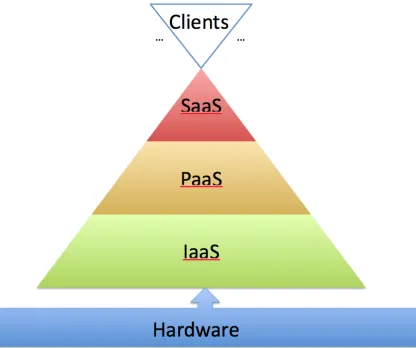
Many of the features noted above define what Cloud computing can be from a user perspective. However, Cloud computing in its physical form has many different meanings and forms. Since Clouds are defined by the services they provide and not by applications, an integrated as-a-service paradigm has been defined to illustrate the various levels within a typical Cloud, as in Figure 2.3.
• Clients - A client interacts with a Cloud through a predefined, thin layer of abstraction. This layer is responsible for communicating the user requests and displaying data returned in a way that is simple and intuitive for the user. Examples include a Web Browser or a thin client application.
• Software-as-a-Service (SaaS) - A framework for providing applications or soft-ware deployed on the Internet packaged as a unique service for users to consume. By doing so, the burden of running a local application directly on the client’s machine is removed. Instead, all the application logic and data is managed centrally and displayed to the user through a browser or thin client. Examples include Google Docs, Facebook, or Pandora.
• Platform-as-a-Service (PaaS) - A framework for providing a unique computing platform or software stack on which applications and services can be developed. The goal of PaaS is to alleviate many of the burdens of developing complex, scalable software by proving a programming paradigm and tools that make ser-vice development and integration a tractable task for many. Examples include Microsoft Azure and Google App Engine.
for their own use without needing to operate or manage physical infrastructure. Examples include Amazon EC2, and OpenStack, and is the major cloud focal point for this dissertation.
• Physical Hardware- The underlying set of physical machines and IT equipment that host the various levels of service. These are typically managed at a large scale using virtualization technologies which provide the QoS users expect. This is the basis for all computing infrastructure.
When all of these layers are combined, a dynamic software stack is created to focus on large scale deployment of services to users.
2.2.1
Infrastructure-as-a-Service
Today, there are a number of Clouds that offer solutions for Infrastructure-as-a-Service (IaaS). There have been multiple comparison efforts between various IaaS service [4, 68–70], which provide insight to the similarities and differences between the long array of cloud infrastructure deployment solutions. However, at a high level, IaaS can be split into 3 tiers based on their availability.
• Public - Public IaaS is where the services and virtualizaton of hardware re-sources are provided over the internet. Usually this is in a centralized data center whereby many users concurrently access these resources from across the globe, often at a pre-negotiated price point and service level agreement (SLA) [71]. Public clouds, which sell hosting services en-masse at competitive costs, are best suited to utilize the economies of scale. The Amazon Elastic Compute Cloud (EC2) is a primary example of a public cloud.
private cloud infrastructure is also on a private, dedicated network that can either be separate or connected to other services. Data within private clouds are often more secure than those on a public cloud, and as such can be the choice for many users who have sensitive data, or who large-scale users who find better cost, performance, or QoS than what is provided within public clouds.
• Hybrid- Hybrid cloud IaaS combines the computational power of both private and public IaaS, enabling users to keep data or costs within a private IaaS, but then ”burst” usage to a public cloud on peak computational demands. Virtual Private Networks (VPN) can be useful to try to handle such a hybrid cloud not only for management and network addressing but also for security.
Amazon EC2
The Amazon Elastic Compute Cloud (EC2) [72], is probably the most popular of cloud infrastructure offerings to date, and is used extensively in the IT industry. EC2 is the central component of Amazon Web Services platform. EC2 allows users to effectively rent virtual machines (called instances), hosted within Amazon’s data centers, at a certain price point. Through their advanced UI or a RESTful API, users can start, stop, pause, migrate, and destroy instances exactly as needed to match the required computational tasks at hand.
There is also Spot pricing, where VMs are provisioned only when a given spot price is met, which is determined simply based on supply and demand within the EC2 system itself.
EC2 supports a wide array of user environments and setups. From an OS per-spective, this includes running Linux, Unix, and even Windows VM instances. EC2 also provides instances with persistent storage through Elastic Block Storage (EBS) and Simple Storage Service (S3) object storage mechanisms. These tools are nec-essary for data persistence, as EC2 instances, as with most IaaS solutions, do not implicitly persist data beyond the lifetime of the instance. EBS-rooted instances use an EBS volume as a root disk device and, as such, keep data beyond the lifetime of a given instance. EC2 also offers elastic IPs, whereby public IP addresses are assigned to instances at boot (or in-situ); however, these elastic IPs do not require the DNS updates to propagate or an administrator to adjust the network.
These advanced features, coupled with the first-to-market viability and continual updates have made EC2 the largest cloud infrastructure today. While vendor lock-in is a concern (EC2 is not available for download or replication), other alternatives exist such as Google’s Compute Engine [73], the prevalence and support with EC will likely mean its status quo as the public cloud of choice will continue for the foreseeable future.
Nimbus
de-ploying virtual machines (VMs) among remote resources. To such an end, Nimbus provides a web interface called Nimbus Web. Its aim is to provide administrative and user functions in a friendly interface.
Within Nimbus, a storage cloud implementation called Cumulus [74] has been tightly integrated with the other central services, although it can also be used stan-dalone. Cumulus is compatible with the Amazon Web Services S3 REST API [76], but extends its capabilities by including features such as quota management. The Nimbus cloud client uses the Jets3t library [77] to interact with Cumulus. However, since it is compatible with S3 REST API, other interfaces like boto [78] or s2cmd [79] can also be used to interact with Nimbus.
Nimbus supports two resource management strategies. The first one is the default “resource pool” mode. In this mode, the service has direct control of a pool of virtual machine managers (VMM) nodes and it assumes it can start VMs. The other supported mode is called “pilot”. Here, the service makes requests to a cluster’s Local Resource Management System (LRMS), to get a VMM available to gather where deploy VMs.
Nimbus also provides an implementation of EC2’s interface that allows clients developed for the EC2 system to be used on Nimbus-based clouds.
Eucalyptus
Eucalyptus is a product from Eucalyptus Systems [80–82] that developed out of a research project at the University of California, Santa Barbara. Eucalyptus was initially aimed at bringing the cloud computing paradigm of computing to academic super computers and clusters. Eucalyptus provides an Amazon Web Services (AWS) complaint EC2 based web service interface for interacting with the Cloud service.
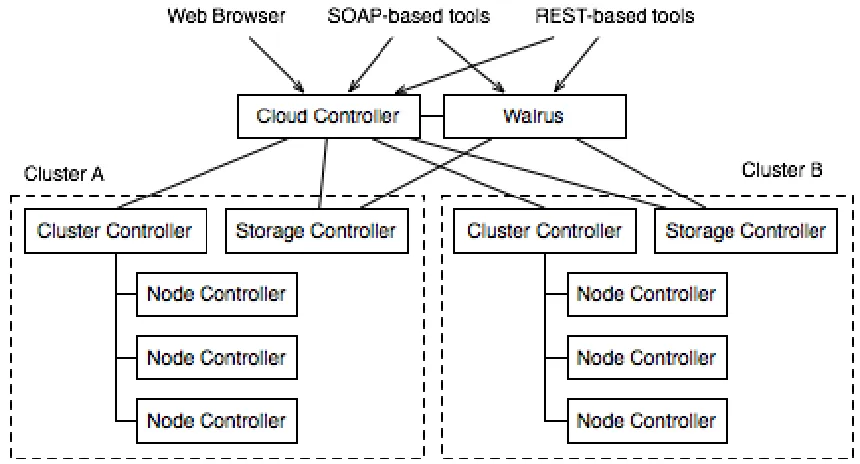
Figure 2.4Eucalyptus Architecture
Cloud controller and the Cluster controller [83]. The Cluster Controller usually man-ages the nodes within a single cluster and multiple Cluster Controllers can be used to connect to a single Cloud Controller. The Cloud Controller is responsible for the resource management, scheduling and accounting aspects of the Cloud.
Being one of the first private cloud computing solutions, Eucalyptus has a focus on the user interface. Much of Eucalyptus’s design is based on the functionality of Amazon’s EC2 cloud solution, and the user interface is a prime example of that model. While EC2 is a proprietary public cloud, it uses an open interface through the use of well designed Web Services which are open to all. Eucalyptus, looking to provide complete compatibility with EC2 to market the private cloud market, uses the same interface for all communication to the Cloud Controller. Because Eucalyptus’s interface is AWS complaint, it provides the same form of authentication that AWS supports, namely the shared key and PKI models.
own specific tool set: euca2ools. Euca2ools provides support for creating and man-aging keypairs, querying the cloud system, manman-aging VMs, starting and terminating instances, network configuration, and block storage usage. The Eucalyptus system also provides a secure web front-end to allow new users to create and manage account information, view available VMs, and download their security credentials.
As seen with the user interface, Eucalyptus takes many design queues from Ama-zons EC2, and the image management system is no different. Eucalyptus stores images in Walrus, the block storage system that is analogous to the Amazon S3 ser-vice. As such, any user can bundle his/her own root filesystem, upload and then register this image and link that image with a particular kernel and ramdisk im-age. This image is uploaded into a user-defined bucket within Walrus, and can be retrieved anytime from any availability zone. This allows users to create specialty virtual appliances and deploy them within Eucalyptus with ease.
In 2014, Eucalyptus was acquired by Hewlett-Packard, which now maintains the HPE Helion Eucalyptus Cloud to have full compatibility with Amazon EC2. The most recent release of Helion eucalyptus is version 4.2.2 in early 2016.
OpenStack
OpenStack [84, 85], another private cloud infrastructure service, was introduced by Rackspace and NASA in July 2010. The project aims to build an open source com-munity spanning technologists, developers, researchers, and industry that allows for the sharing of resources and technologies in order to create a massively scalable and secure cloud infrastructure. In tradition with other open source projects, the entire software is open source.
OpenStack Storage solutions. According to the documentation “OpenStack Com-pute is the internal fabric of the cloud creating and managing large groups of virtual private servers” and “OpenStack Object Storage is software for creating redundant, scalable object storage using clusters of commodity servers to store Terabytes or even petabytes of data.” However, OpenStack as a platform has evolved much more than its original efforts, and has created a wide array of new sub-projects.
As part of the computing support effort, OpenStack utilizes a cloud fabric con-troller known under the name Nova. The architecture for Nova is built on the concepts of shared-nothing and messaging-based information exchange. Hence most commu-nications in Nova are facilitated by message queues. To prevent blocking components while waiting for a response from others, deferred objects are introduced. Nova supports multiple scheduling paradigms and includes plugins for a wide array of hy-pervisors, including Xen, KVM, and VMWare. The flexibility found within Nova is useful for supporting a wide array of cloud IaaS computational efforts. Recently, OpenStack has even looked to implement containers and bare-metal provisioning to keep on pace with the latest technologies.
The OpenStack Swift storage solution is build around a number of interacting com-ponents and concepts, including a Proxy Server, a Ring, Object Server, a Container Server, an Account Server, Replication, Updaters, and Auditors. This distributed ar-chitecture attempts to have no centralized components in order to enable scalability and resiliency for data. Swift represents the long-term, object-based storage similar to Amazon S3, and attempts to maintain rough API compatibility with S3. As Swift looks to use simple data replication as a main form of resiliency and fast read/write is rarely a priority, Swift is often built using commodity disk drives instead of more costly flash solutions.
projects has also increased to support Nova. While there are many other recent Open-Stack projects, these listed OpenOpen-Stack efforts, along with Nova and Swift, represent the common core of a current OpenStack deployment.
• Cinderfor persistent block-level storage mechanisms to support VM instances and elastic block storage.
• Neutronprovides advanced networking and SDN solutions, IP addressing, and VLAN configuration.
• Glancedelivers comprehensive image management, including image discovery, registration, and delivery mechanisms.
• Keystone identity and authentication service for all OpenStack services.
• Horizon, a dashboard web-based UI framework, complimentary to the RESTful
client API.
Currently, OpenStack exists as one of the largest ongoing private IaaS efforts, with over 500 companies contributing to the effort, and thousands of deployments. While releases have pushed forth approximately every 6 months, the latest current release at the time of writing is Mitaka, which now includes full support for GPUs and SR-IOV interconnects, as detailed later in this dissertation. It is expected that OpenStack’s prevalence in the cloud computing community will only increase in the next few years.
OpenNebula
cloud-like interfaces. Figure 2.5 shows the OpenNebula architecture and their main components.
Figure 2.5OpenNebula Architecture
infrastructure to expose the basic functionality of the monitoring, storage and virtu-alization services available in the cluster. Therefore, OpenNebula is not tied to any specific environment and can provide a uniform management layer regardless of the virtualization platform.
Additionally, OpenNebula offers management interfaces to integrate the core’s functionality within other data center management tools, such as accounting or mon-itoring frameworks. To this end, OpenNebula implements the libvirt API [89], an open interface for VM management, as well as a command line interface (CLI). A subset of this functionality is exposed to external users through a cloud interface.
Others
Other cloud specific projects exist, such as In-VIGO [91], Cluster-on-Demand [92], and VMWare’s own proprietary vCloud Air [93]. Each effort provides its own in-terpretation of private cloud services within a data center, often with the ability to interplay with pubic cloud offerings such as Amazon’s EC2. Docker [50] also looks to provide IaaS capabilities with specialized and easily configurable containers, based on LXC and libcontainer solutions. While it is still to be determined how Docker and containers will change the private IaaS landscape, they do provide similar func-tionality for Linux users without some of the complexities of traditional virtualized IaaS.
2.2.2
Virtual Clusters
While virtualization and cloud IaaS provide many key advancements, this technology alone is not sufficient. Rather, a collective scheduling and management for virtual machines is required to piece together a working virtual cluster.
templates. When a job arrives at the head node of the cluster, a correspondent virtual machine is dynamically started on a certain compute node within the cluster to execute the job. While the LHC project and CERN’s cloud effort is a formidable one, it only covers pleasingly parallel HTC workloads, and often times HPC and big data workloads can be equally complex yet drastically different.
Virtual Cluster 3
Virtual Cluster 2 Virtual Cluster 1 Cloud Infrastructure 1
VM VM VM VM VM VM VM VM VM VM VM VM VM VM VM VM
Cloud Infrastructure 2
VM VM VM VM VM VM VM VM VM VM
Cloud Infrastructure 3
VM VM VM VM VM VM VM VM VM VM
Figure 2.6 Virtual Clusters on Cloud Infrastructure
architecture across many users. With the advent of modern virtualization, virtual clusters are deployed across a set of VMs in order to gain relative isolation and flexibility between disjoint virtual clusters. Virtual clusters, or a set of multiple cluster computing deployments on a single, larger physical cluster infrastructure, often have the following properties and attributes [53]:
• Resources allocation based on a VM unit
• Clusters built of many VMs together, or by provisioning physical nodes
• Leverage local infrastructure management tools to provide a middleware solu-tion for virtual clusters
– Implementations could be a cloud IaaS such as OpenStack – Some instances use a queueing system such as PBS
• User experience based on virtual cluster management, not single VM manage-ment
• Consolidates functionality on a smaller resource platform using multiple VMs
• Can provide fault tolerance through VM migration and management
• Can utilize dynamic scaling through the addition or deletion of VMs from the virtual cluster
• Connection to back-end storage solution to provide virtual persistent storage
OSs on a single physical resource. Virtual clusters generally have the ability to pro-vide and manage their own user environment and tuned internal middleware. Virtual clusters may enable the separation of multiple tasks into separate VMs, which still in fact run on the same or similar underlying physical resources, effectively providing task isolation. Virtual clusters can be deployed to be persistent, stored, shared, or re-provisioned on demand. The size of a virtual cluster could potentially expand and contrast relative to the necessary resource requirements, taking advantage of elastic-ity found with virtualization. Furthermore, VM migration may enable fault tolerance in the event of physical machine errors if properly managed.
With virtual clusters, the capability to deploy custom environments quickly be-comes critical. As such, efforts have been put forth to configure and create VM images on-demand. This includes custom efforts with configuration engines such as CfEngine, Chef, Ansible, and others. Within FutureGrid, an image management sys-tem was defined to provide preconfigured VM images for cloud infrastructure using the BCFG2 engine [97].
Initially, virtual clusters were proposed for the use of Grid communities [32]. Specifically, Foster et al look to provide commodity clusters to various Virtual Or-ganizations [98], whereby grid services can instantiate and deploy VMs. This design and implementation was further refined through the use of metadata and contextu-alization using appliances [99]. Some of these ideas have even come to take shape in larger scale supercomputing deployments, such as with SDSC Comet’s virtual cluster availability [100].
connected to and monitored, as well as how VMs are stored in a repository and pro-visioned across multiple heterogeneous resources. This effort moved forward with Cloudmesh [46], which provides a simple client interface to access multiple cloud resources with a command-line shell interface.
Another virtual cluster orchestration, named OpenStack Heat [45], has developed within the OpenStack community. Heat provides a method by which an individ-ual or group can deploy ”stacks”, which could essentially be virtindivid-ual clusters, using OpenStack infrastructure. Specifically, Heat provides a human readable and machine-accessible template for specifying environments and requirements, as well as a REST-ful API. In submitting a Heat orchestration template to the API, heat will interpret and build the designed custom environment within a given OpenStack cloud deploy-ment. Kubernetes [101], a related effort, is a infrastructure orchestration framework for managing containerized applications within Docker.
2.2.3
The FutureGrid Project
FutureGrid was a NSF-funded national-scale Grid and Cloud test-bed facility that in-cluded a number of computational resources across many distributed locations. This FutureGrid test-bed allowed users to evaluate differing systems for applicability with their given research task or application. These areas include computer science research topics ranging from authentication, authorization, scheduling, virtualization, middle-ware design, interface design and cybersecurity, to the optimization of grid-enabled and cloud-enabled computational schemes for Astronomy, Chemistry, Biology, Engi-neering, High Energy Physics, or Atmospheric Science. This project started at an opportune time, when cloud infrastructure was still in its experimental stages and its applicability to mid-tier scientific efforts were unknown.
multitude of experiments specifically designed for evaluating middleware technologies and experiment management services. This network can be dedicated to conduct experiments in isolation using a network impairment device for introducing a variety of predetermined network conditions. Figure 2.7 depicts the geographically distributed resources that are outlined in Table 2.1 in more detail. All network links within FutureGrid are dedicated 10GbE links with the exception of a shared 10GbE link to TACC over the TeraGrid [102, 103] network, enabling high-speed data management and transfer between each partner site within FutureGrid.
NID 10GB/s 10GB/s 10GB/s 10GB/s 10GB/s 1GB/s Router 11 6 5 12 4 7 2 7 Germany France
IU: 11 TF IBM 1024 cores 6 TF Cray 672 cores 5 TF SGI 512 cores TACC: 12 TF Dell 1152 cores UCSD: 7 TF IBM 672 cores UC: 7 TF IBM 672 cores PU: 4 TF Dell 384 cores UF: 3 TF IBM 256 cores
Interet 2 TeraGrid
Figure 2.7FutureGrid Participants, Network, and Resources
Table 2.1 FutureGrid hardware
System type Name CPUs Cores TFLOPS RAM(GB) Disk(TB) Site
IBM iDataPlex India 256 1024 11 3072 †335 IU
Dell PowerEdge Alamo 192 1152 12 1152 15 TACC
IBM iDataPlex Hotel 168 672 7 2016 120 UC
IBM iDataPlex Sierra 168 672 7 2688 72 UCSD
Cray XT5m Xray 168 672 6 1344 †335 IU
ScaleMP vSMP Echo 32 192 3 5872 192 IU
Dell PoweEdge Bravo 32 128 2 3072 192 IU
SuperMicro Delta 32 192 ‡20 3072 128 IU
IBM iDataPlex Foxtrot 64 256 2 768 5 UF
Total 1112 4960 70 23056 1394
†Indicates shared file system. ‡Best current estimate
accommodate the needs of an experiment management system.
2.3
High Performance Computing
2.3.1
Brief History of Supercomputing
Supercomputing can date back to some of the forefront of computing itself, especially if we consider the ENIAC [104], the first Turing Complete general purpose digital computer, also as the first supercomputer. ENIAC was first deployed to calculate artillery firing tables, but was later used during the Second World War for helping the Manhattan project’s thermonuclear calculations and later dedicated to the University of Pennsylvania after the war.
The first properly termed supercomputer was the Control Data Corporation’s 6600 mainframe [105], first delivered to CERN in 1965. The CDC 6600 was notably faster than the IBM counterparts, and the first deployments were able to perform on the order of 1 MFLOP. Interestingly, the CPU design that came from Seymour Cray’s CDC 6600 took advantage of a simplified yet fast CPU design with silicon-based transistors, which founded the basis of the RISC processor architecture.
Cray’s efforts eventually lead him to start his own company, and in 1975 released the Cray 1 system [106]. The Cray 1 took the powerful aspects of vector processing and memory pipelining from the STAR architecture (developed later by CDC) and in-troduced scalar performance through splitting vectors and instruction chaining. This resulted in an overall performance of around 250 MFLOPS at peak, but realistically closer to 100 MFLOPS for general applications. The Cray 1 system also helped push forward the integrated circuit design, which was finally performant enough to be used. Interestingly enough, the Cray 1 also required an entirely new Freon-based coolant system.
X-MP and up to 8 processors for the later Y-MP systems. These first shared-memory systems were aided by increased memory speeds. The X-MP machine was capable of 200 MFLOPS sustained and 400 MFLOPS peak performance, whereas the Y-MP variants were capable of over 2 GFLOPS.
Concurrently, during the 1980s, the advent of distributed memory architectures for supercomputing were also starting to emerge. Specifically work on Caltech’s Cosmic Cube, also known as a Hypercube, by Seitz and Fox [19,107], started the movement of concurrent or parallel computing. The Cosmic Cube leveraged new VLSI techniques and assembled Intel 8086/87 processors together with a novel hypercube interconnect which required no switching, creating one of the first truly parallel computers. SIMD programming and computation was done through a novel message passing architec-ture, instead of shared variables. This design was first commercialized with Intel’s iPSC, and later contributed directly to designs in the Intel Paragon, ASCI Red, and Cray T3D/E systems.
While concurrent and parallel processor supercomputers continued into the 90s with aforementioned hypercube designs and the IBM Thinking Machines [108], a new commodity-based strategy emerged with Becker and Sterling’s Beowulf clusters [6]. Effectively, a Beowulf cluster is simply a cluster of commodity x86 machines linked together with a simplified LAN network. Beowulf clusters often (but not always) run Linux OS and leverage Ethernet solutions, and are programmed using a message passing construct such as MPI [18]. This allows for the building of massively parallel systems with relatively low cost and investment. Many specialized clusters today still utilize commodity x86 hardware and Linux OSs similar to the original Beowulf systems.
![Figure 1.1 Data analytics and computing ecosystem compared (from [25]),with virtualization included](https://thumb-us.123doks.com/thumbv2/123dok_us/8134743.243204/20.612.111.540.156.477/figure-data-analytics-computing-ecosystem-compared-virtualization-included.webp)