FutureGrid Education: Using Case Studies to Develop A
Curriculum for Communicating Parallel and Distributed
Computing Concepts
Jerome E. Mitchell
Indiana University Bloomington, Indiana
[email protected]
Judy Qiu
Indiana University Bloomington, Indiana
[email protected]
Massimo Canonio
University of Piemonte Orientale Vercelli, Italy
[email protected]
Shantenu Jha
Lousiana State University Baton Rouge, LA
[email protected]
Linda Hayden
Elizabeth City State University Elizabeth City, North Carolina
[email protected]
Barbara Ann O’Leary
Indiana University Bloomington, Indiana
[email protected]
Renato Figueiredo
University of Florida Gainesville, Florida
[email protected]
Geoffrey Fox
Indiana University Bloomington, Indiana
[email protected]
ABSTRACT
The shift to parallel computing – including multi-core com-puter architectures, cloud distributed computing, and general-purpose GPU programming – leads to fundamental changes in the design of software and systems. As a result, learning parallel, distributed, and cloud techniques in order to allow software to take advantage of the shift toward parallelism is of important significance. To this end, FutureGrid, an experimental testbed for cloud, grids, and high performance computing, provides a resource for anyone to find, share, and discuss modular teaching materials and computational platform supports.
This paper presents a series of case studies for experiences in parallel and distributed education using the FutureGrid testbed. Building on previous experiences from courses, workshops, and summer schools associated with FutureGrid, we present a viable solution to developing a curriculum by leveraging collaboration with organizations. Our approach to developing a successful guide stems from the idea of any-one interested in learning parallel and distributing comput-ing can do so with minimum assistance from a domain ex-pert, and it addresses the educational goals and objectives to help meet many challenges, which lie ahead in the discipline.
We validate our approach to developing a community driven curriculum by providing use cases and their experiences with
Permission to make digital or hard copies of all or part of this work for personal or classroom use is granted without fee provided that copies are not made or distributed for profit or commercial advantage and that copies bear this notice and the full citation on the first page. To copy otherwise, to republish, to post on servers or to redistribute to lists, requires prior specific permission and/or a fee.
XSEDE’12 Chicago, Illinois USA
Copyright 20XX ACM X-XXXXX-XX-X/XX/XX ...$15.00.
the teaching modules. Examples of some use cases include the following: hosting a workshop for faulty members of historically black colleges and universities, courses in dis-tributed and cloud computing at universities, such as Indi-ana University, LouisiIndi-ana State University, and the Univer-sity of Piemonte Orientale.
1.
INTRODUCTION
In order to prepare students for the many-core era, com-puter science educators must urgently increase the promi-nence of parallel computational concepts and programming in their curriculum. The concurrency evolution is not the only reason to teach parallelism to interested students. Cur-rent avenues to teach parallel and distributed computing fo-cus on smaller-sized problems and datasets, which can be processed on a student’s personal computer, making them ill-prepared to cope with the vast quantities of data in oper-ational environments. Even when larger datasets are lever-aged in a control medium, they are mostly used as static resources. Thus, students experience a disconnect as they transition from a learning environment to where they work on real-world problems. Some of the most exciting emerg-ing applications of computemerg-ing involve data-intensive scalable computing, which allow computational frameworks, such as, Google’s proprietary, MapReduce and the open-source Apache Hadoop to be applied to datasets of web scale.
have produced flexible, customizable teaching modules to aid multiple courses and institutional learning with parallel platforms to support hands-on assignments.
Our goals for the community of educators include the follow-ing: feedback and supplementation of the initial modules, contribution of new modules and platform packages from the community, and mentoring and support for new users of these materials. The combination of modular materials and a supportive community of peers is designed to make it practical for courses, workshops, and summer schools to introduce parallel computing.
In this paper, we discuss our rationale, describe educational modules, and present case studies of a supportive commu-nity of educators.
2.
FUTUREGRID EDUCATION
FutureGrid provides unique capabilities by enabling re-searchers to deploy customized environments for their ex-periments in grid and cloud computing, and it allows educa-tors and students to use virtual private clusters for hands-on education and training activities. A core technology sup-porting FutureGrid’s training and education activities is a virtual Grid appliance [4] [6]: a system which leverages virtu-alization, cloud computing and self-configuring capabilities to create self-contained, flexible, plug-and-play executable modules; this capability isolates virtual clusters, so individ-ual students, student groups, or classes can acquire resources on demand. Within the virtual cluster, an entire distributed computing middleware stack is self-configured, allowing ac-tivities to focus on the application of distributed/cloud com-puting platforms rather than the configuration of middle-ware. The provisioning time of an isolated, educational vir-tual cluster is of the order of a few minutes. It requires no configuration from instructors or students other than joining a Web 2.0 site to create and manage a group for their class.
In terms of design and implementation, the educational vir-tual cluster on-demand builds upon Grid virvir-tual appliances, which encapsulate pre-configured software environments. Ap-pliances are deployed on FutureGrid using either Nimbus or Eucalyptus. Once appliances are deployed, a group virtual private network (GroupVPN [5] ) is self-configured to pro-vide a seamless IP-layer connectivity among members of a group and support unmodified middleware and applications. Within deployed appliances, Condor is used as the core un-derlying scheduler to dispatch tasks. In our system, these tasks could be jobs students schedule directly with Condor, as well as tasks, which are used to bootstrap MPI , Hadoop, or Twister pools on demand. The GroupVPN virtual net-work and the Condor middleware are both self-configured by using a peer-to-peer Distributed Hash Table (DHT) as an information system to publish and query information about available job scheduler(s) and assign virtual IP addresses. Users create on-demand MPI, Hadoop, and Twister virtual clusters by submitting Condor jobs, which are “wrappers” for dispatching and configuring the respective run-time sys-tems. MPI tasks are submitted together with the job that creates an MPI ring, while Hadoop and Twister tasks are submitted to the virtual cluster using standard tools, respec-tively. The entire system can be seamlessly deployed on a managed IaaS infrastructure, but it is also easily installable
on end-user resources the same virtual appliance image is used in both environments. On a managed cloud infrastruc-ture, IaaS middleware is used to deploy appliances, while in desktop/user environments, appliances are deployed with the native user interface of a virtual machine monitor. The appliance has been tested on widely-used open-source and commercial desktop and server virtualization technologies; the same image can be instantiated on VMware, KVM, and VirtualBox on x86-based Windows, MacOS and Linux sys-tems. Academic institutions with restrictive computational resources can use virtual appliances providing students the opportunity to easily experiment with cloud technology.
3.
THE NEED FOR COMMUNITY MODULES
To handle the rapid changes in computer architecture, we will benefit from community-based modules offering addi-tional services and features to support efforts in anyone will-ing to learn parallel and distributed computwill-ing. We envision support resources for providing open and inviting environ-ments, in which prior parallel computing knowledge or ex-perience is not a prerequisite.
4.
MODULES AND PLATFORM PACKAGES
In our approach for supporting education in parallel and distributed computing, we provide course (described in Sec-tion 5) and software modules; this concept allows students and educators to have a theoretical concept of the area as well as sandbox resources in order to have practical experi-ence.
4.1
Modular Approach to Parallelism
The FutureGrid modular curriculum has the following char-acteristics: seamless with respect to the “host” course, and it reinforces rather than replace existing material. Our mod-ules provide examples and exercises to present a context for standard topics covered in a course, workshop or summer school. By focusing on examples, we increase the student’s awareness and sophistication with respect to this area.
4.2
Platform Packages
Every organization dedicated to advancing computer sci-ence education has its own interests and is usually imple-mented in the context of the organization’s faculty with their individual area of expertise. These attributes led us to cre-ate customizable teaching mcre-aterials and “hands-on” expe-riential learning exercises. If such teaching modules incor-porate different programming models and presume minimal prerequisite assumptions, they will have wide compatibility with a student’s knowledge and flexibility for use in multi-ple educational contexts. Platform-specific supports, such as “virtual clusters,” combined with community support tu-torials, will expedite and simplify the use of parallel compu-tation resources students will need in order to learn about parallelism by experiencing it first-hand. The following are modules supported by our virtual clusters and available to the computing community:
4.2.1
Twister
those worker nodes. All communication and data transfers are performed by a pub/sub broker network, which is a dis-tributed messaging infrastructure. As in other MapReduce runtimes, a master (MRDriver) controls other workers ac-cording to instructions given by the user program. Twister uses a pub/sub broker network to handle four types of com-munication needs: send and receive control events, send data from the client-side MapReduce driver to the Twister dae-mons, transfer intermediate data between map and reduce tasks, and send the outputs of the reduce tasks to the client
4.2.2
Hadoop
Hadoop [3] is an open source implementation of the MapRe-duce programming model. A MapReMapRe-duce job usually con-sists of three phases: map, copy, and reduce. In the map phase, a user defined function operates on every chunk of input data producing intermediate key-value pairs, which are stored on local disk. A map process is invoked to pro-cess one chunk of input data while in the copy phase, the intermediate key-value pairs are transferred to the location where a reduce process would operate on the intermediate data. In reduce phase, a user defined reduce function oper-ates on the intermediate key-value pairs and generoper-ates the output. One reduce process is invoked to process a range of keys.
4.2.3
MPI
MPI [2] is a message passing interface used for parallel processing in distributed memory systems. MPI is a library of routines that can be called from C, C++, FORTRAN77 and FORTRAN90 programs. A single user program is pre-pared, but is run on multiple processes. Each instance of the program is assigned a unique process identifier, so that it is labelled and known which process it is. This allows the same program to be executed, but different tasks are per-formed in each process. By convention, the user sets up one process as a master, and the others as workers, but this is not necessary. Each process has its own set of data, and can communicate directly with other processes by passing data around. Because the data is distributed, it is likely that a computation on one process will require that a data value be copied from another process.
5.
CASE STUDIES
5.1
A Cloudy View on Computing workshop
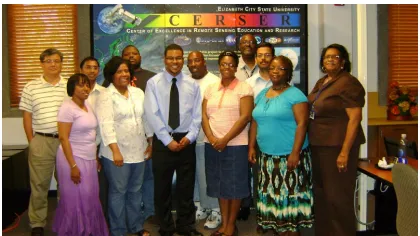
A hands-on workshop for faculty from historically black colleges and universities (HBCUs) was conducted on June 6-10, 2011 at Elizabeth City State University. Participants were immersed in a MapReduce boot camp, where faculty members sought introduction to the MapReduce program-ming framework. An overview of parallel and distributed processing provided a transition into the abstractions of func-tional programming, which introduces the context of MapRe-duce along with its distributed file system. Lectures focused on specific case studies of MapReduce, such as graph analy-sis and information retrieval. The workshop concluded with a programming exercise (PageRank or All-Pairs problem) to ensure faculty members have a substantial knowledge of MapReduce concepts and the Twister/Hadoop API. The fol-lowing were themes for five boot camp sessions: [image:3.612.316.526.52.170.2]• Module 1 Introduction to parallel and distributed pro-cessing
Figure 1: the Cloudy View on Computing partici-pants and presenter
• Module 2 Introduction to parallel and distributed pro-cessing
• Module 3 “Hello World” MapReduce Lab
• Module 4 Graph Algorithms with MapReduce
• Module 5 Information Retrieval with MapReduce
FutureGrid was leveraged to create a self-contained, flex-ible, plug-and-play educational “virtual appliances”. The virtual appliances support multiple virtualization technolo-gies allowing them to run on a variety of resources, including user workstations and desktop grids. The “Cloudy View on Computing” workshop highlighted two specific educational virtual appliances detailing different middleware stacks used actively in clouds: Hadoop and Twister, each with varying data-intensive applications.
5.2
Courses in Distributed Systems and Cloud
Computing
5.3
Indiana University
CSCI-B534 (Distributed Systems) is offered to PhD and Master’s students who are interested in the evolutional changes in computing landscape characterized by parallel, distributed, and cloud computing systems. The following modules were intended to provide an understanding of the technical is-sues involved in the design of modern distributed systems. Besides conveying the central principles involved in design-ing distributed systems, these modules also aims to present some of the major current paradigms.
• Module 1: Computer clusters for Scalable Parallel Com-puting
• Module 2: Introduction to Distributed Systems, Ar-chitectures, and Communication
• Module 3: Processes, Performance Issues, and Syn-chronization
• Module 4: Naming
• Module 5: Data Centers, Clouds Platform and Infras-tructure, Energy Efficiency, and Virtualization Tech-nologies and tools
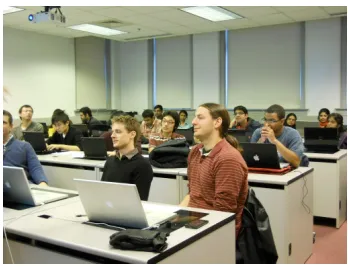
Figure 2: the Cloud Computing for Data Intensive Sciences course at Indiana University
• Module 7: Security and Distributed File Systems
FutureGrid was used to build a prototype system and ac-quire an in-depth study of essential issues in practice, such as scalability, performance, availability, security, energy-efficiency, and workload balancing. Students took advantage of Fu-tureGrid’s dynamic provisioning infrastructure to switch be-tween bare metal and virtual machine environments and en-abled a message broker monitored the CPU and memory usage of a MPI PageRank application the dynamic cluster.
The course, Cloud Computing for Data Intensive Sciences, offers graduate students cloud computing programming mod-els and tools to support data-intensive science applications. These include virtual machine-based utility computing envi-ronments, such as Amazon AWS and Microsoft Azure. The following modules supported this course:
• Module 1: Data Intensive Sciences, Data Center Model, Current Clouds with Infrastructure, and Platforms and Software as a Service
• Module 2: Parallel Programming/MPI vs. MapRe-duce/Hadoop
• Module 3: Virtualization Technologies and Tools
• Module 4: MapReduce and Data Parallel Applica-tions, Building All-to-All Blast Using Hadoop
• Module 5: Iterative MapReduce and EM Algorithms
• Module 6: MapReduce on Multicore/GPU
• Module 7: Storage
Project topics included: Matrix Multiplication with DryadLINQ; Implementing PhyloD application with DryadLINQ; Paral-lelism for Latent Dirichlet allocation (LDA); Memcached In-tegration with Twister; Improving Twister Messaging Sys-tem Using Apache Avro; Large Scale PageRank with DryadLINQ; A Survey of Open-Source Cloud Infrastructure; A Survey on Cloud Storage Systems; Performance Analysis of HPC Virtualization Technologies. The projects were performed on FutureGrid and carefully chosen to include different as-pects of the cloud architecture stack from top-level biol-ogy and large-scale graphics applications, optimization of MapReduce runtimes, cloud storage, to low-level virtualiza-tion technologies.
5.4
University of Piemonte Orientale
A course in cloud computing was offered to Master’s and Ph.D students interested in learning and experiencing with the most important cloud solutions (Eucalyptus, Nimbus, and OpeNebula).
Figure 3: the Cloud Computing course at the Uni-versity of Piemonte Orientale
• Module 1: Introduction to Cloud Computing
• Module 2: Introduction to Eucalyptus, Nimbus, and OpenNebula
• Module 3: Eucalyptus: Image Management; Monitor-ing and ClonMonitor-ing, HybridFox
• Module 4: Nimbus LAMP + CMS installation
• Module 5: One-click Cluster
FutureGrid allowed students to implement a service, such as a web server, and to monitor its response time. A sched-uler, considering the response time, decided where/when to switch on/off virtual machines.
6.
SCIENTIFIC COMPUTING
6.1
Louisiana State University
A graduate course covering the basics of practical scientific computing for mathematicians, computer scientists, physical scientists, and finance. Topics ranged from basic mathemat-ical principles and algorithms of numermathemat-ical analysis to prac-tical issues in software reliability to performance on modern computing hardware. Modules supported for this course is outlined in the following:
• Module 1: Introduction to Numerical Methods
• Module 2: Vector Algebra, Basic Visualization Pro-gramming
• Module 3: Advanced Secure Shell Usage
• Module 4: Best Coding Practices
• Module 5: Software Development, Revision Control
• Module 6: Compiling, Debugging, Profiling
[image:4.612.345.528.122.257.2]complicated computational research, such problems with compilation and deployment etc., and it further pro-vided students with the confidence to work through these problems and to be aware of the options for as-sistance through documentation and help desk facili-ties.
7.
ACKNOWLEDGMENTS
This paper was developed with support from the National Science Foundation (NSF) under Grant No. 0910812 to In-diana University for “FutureGrid: An Experimental, High– Performance Grid Testbed.” Any opinions, findings, and conclusions or recommendations expressed in this material are those of the authors and do not necessarily reflect the views of the NSF.
8.
CONCLUSIONS
We have adopted an incremental, modular approach to in-troducing parallel computing concepts and experiential exer-cises as a strategy for addressing the urgent need for anyone interested in learning parallelism. Modules and support ma-terials were designed for flexible use in diverse course and in-stitutional settings, and for ease of adoption. We sought the creation of a supportive community of educators who share and encourage efforts to teach more parallelism through this modular approach, including instructors without particular expertise in parallelism.
9.
ADDITIONAL AUTHORS
10.
REFERENCES
[1] J. Ekanayake, H. Li, B. Zhang, T. Gunarathne, S. Bae, J. Qiu, and G. Fox. Twister: a runtime for iterative mapreduce. InProceedings of the 19th ACM International Symposium on High Performance Distributed Computing, pages 810–818. ACM, 2010. [2] P. Pacheco.Parallel programming with MPI. Morgan
Kaufmann, 1997.
[3] T. White.Hadoop: The definitive guide. Yahoo Press, 2010.
[4] D. Wolinsky, P. Chuchaisri, K. Lee, and R. Figueiredo. Experiences with self-organizing, decentralized grids using the grid appliance.Cluster Computing, pages 1–19, 2011.
[5] D. Wolinsky, K. Lee, P. Boykin, and R. Figueiredo. On the design of autonomic, decentralized vpns. In
Collaborative Computing: Networking, Applications and Worksharing (CollaborateCom), 2010 6th International Conference on, pages 1–10. IEEE, 2010.
[6] D. Wolinsky, A. Prakash, and R. Figueiredo. Grid appliance ˜Non the design of self-organizing,