ScaleMirror: A Pervasive Device to Aid
Weight Analysis
Abstract
As today’s fast paced environment continually
encourages poor dietary habits and a lack of exercise, there is a growing need to properly monitor and control weight gain. With the advent of pervasive and
ubiquitous computing, there are new opportunities to help promote personal wellness that was previously unobtainable. This work describes the novel design and creation of ScaleMirror; a prototype pervasive device to help users monitor their weight. This awareness is achieved through an accurate scale system, detailed statistics with historical data, and an intuitive design seamlessly embedded into a user’s existing daily routine. The goal is to help a wide array of people concentrate on obtaining and maintaining a proper weight to promote a healthy and fulfilling lifestyle.
Keywords
Ubiquitous Computing, Pervasive Weight Measurement, Personal Wellness
ACM Classification Keywords
H5.m. Information interfaces and presentation
General Terms
Human Factors, Design Copyright is held by the author/owner(s).CHI 2011, May 7–12, 2011, Vancouver, BC, Canada. ACM 978-1-4503-0268-5/11/05.
Andrew J. Younge Indiana University 901 E. 10th St. Bloomington, IN 47408 [email protected]
Vinod Periasamy Indiana University 901 E. 10th St. Bloomington, IN 47408 [email protected]
Mohammed Al-Azdee Indiana University 901 E. 10th St. Bloomington, IN 47408 [email protected]
William Hazlewood Indiana University 901 E. 10th St. Bloomington, IN 47408 [email protected]
Introduction
There are a number of weight-related health issues that exist today, and perhaps the most prominent among developed nations is obesity. In the United States alone, obesity has risen significantly in the past 20 years. Over 60 million adults and nine million children are considered obese [1]. Obesity is caused by an energy imbalance that results from adding too many calories and not getting enough exercise to consume them. Being overweight increases the risk of many health conditions and diseases, including heart disease, diabetes, hypertension, dyslipidemia, stroke,
osteoarthritis, gallbladder disease, sleep apnea, respiratory problems, and even some cancers [3]. In 1991, only four states had obesity rates of 15 to 19% and zero states had obesity rates above 20%. In 2004, this had dramatically changed, with seven states reporting obesity rates of 15 to 19%, 33 states with obesity rates of 20 to 24%, and nine states had obesity rates that were more than 25%.
In order to help people reach a caloric balance, technology can be used to monitor and present information to an individual so they can better understand what changes they need to make in order to maintain or lose weight. In addition, technology can be used to encourage people attempting to make lifestyle changes by showing them their progress, which may not be immediately apparent since weigh gain/loss is often a slow process.
As such, our group has designed and implemented a device that leverages technologies within the field of Ubiquitous Computing [5] to help users constantly track their weight. Specifically, we employ the use of a specialized scale and display within a home bathroom
environment to help users effectively track their weight over a substantial period of time. One key feature of our project is that we don’t force users to take measures to reduce their weight. Instead, we simply try to motivate them by offering each user an output that represents their own weight and corresponding analysis over a particular period of time, as doing anything more is largely impractical within the realm of Computer Science. We have designed our device to accomplish this goal in the most effective way by concentrating on when, where, and how to interact to the user about such matters in a way that requires little to no change in the user’s daily life activities.
Related Research
In order to properly assess the novelty of our design, a review of previous related work is necessary. Here we look at two types of work; pervasive technologies in home bathrooms, and technology related to promoting personal wellness and health.
From the beginning of Smart Homes [6,13] as part of Ubiquitous computing, the bathroom has been in focus. It’s found that the most fascinating features of pervasive technology is to have a smart bathroom with sensors for measuring height, weight temperature and ECG [11]. In smart bathrooms, the master bathroom can include a toilet paper sensor, a toothbrush detector, a shower that regulates water temperature and prevents scalding, and a soap dispenser that monitors occupant cleanliness and notices the service center when a refill is required [15]. In [7],
activities and whereabouts of residents, lighting the way to the bathroom if someone gets out of bed late at night and recording frequent trips to the bathroom, which might indicate a urinary tract infection [12]. Michio Kaku states that, “the bathroom is a great laboratory for continuous analysis of the state of our body. In the future, the bathroom will be more intelligent than a hospital” [14]. The bathroom mirror has continually been an excellent display medium to interact with users. In [10], an AwareMirror presents information relevant to a person in front of it by super-imposing his/her image, and provides a toothbrush as a method of activation similar to the work described below. A detailed case study has been conducted in [8] which details the extensibility and usability of mirrors as ambient displays within our current home
environments, giving further merit to our practice of utilizing the bathroom mirror. Monitoring the health in front of the mirror has always been an effective option. A case study has been conducted in [9] in which the result shows that an ambient display like a mirror is a persuasive medium in induce awareness of exercise routines. They have used a mirror to display the exercise routine of an individual on a daily basis in order to improve his personal health.
Design
In order to properly design our prototype in a way to fit real-world user needs, we conducted a survey to collect valuable themes that contributed to the potential project idea we had in mind. This survey of 40
participants was used to evaluate the locality, common usage, need, and demand for a device such as ours. These results were analyzed to form functional and non-functional requirements that helped fuel and
provide a common design vision for our current implementation.
From our survey, a number of requirements became clear. The first obvious conclusion is that our design should weigh individuals automatically when triggered by some external environment, perhaps by some benign task that users already perform. It should calculate statistical information about the user's weight over defined history points and present the user with this data, allowing for the user to monitor their weight over a substantial period of time. This includes details about a user’s Body Mass Index [4,16], BMI or as person’s weight and height are taken into account to obtain an estimate of the body fat a person holds. While other metrics for measuring personal weight and health such as the Basal Metabolic Rate, Body Fat metric, or the Hip to Waist Ratio. However these rely on either ambiguous values or input parameters that are impractical to measure on a daily basis. BMI values can keep the user motivated to achieve better results as per their own plans. The device can also reward the user for operating the system by offering additional useful information like weather, healthy diet routines and exercise routines. According to our survey, the device is best suited to be placed in a user’s bathroom, especially because it facilitates integration of the device into the normal background of the environment to tackle the issue of stigma associated with such devices. Providing feedback is an essential part of the project, as it will help the user monitor their weight. The device should only display information when it is being operated, as to operate as unobtrusively as possible. Since there are no specific restrictions on the
[image:3.792.14.186.202.330.2]demographics of the potential users, the device should be reachable to a vast majority of people who may not Figure 1. The big-picture design
be technologically sound. Training should be minimal, if at all necessary. The device should require
straightforward configuration and calibration that can be done during initial setup and left untouched
afterwards. Information can be displayed on a common focal point on his bathroom’s mirror for easy reading. The user can recalibrate the scale or reconfigure settings whenever he desires.
The Object Prototype
The sketch in Figure 1 shows our desired placement of the device. It will be located in the bathroom and right in front of the sink, blending in with the natural environment. This would be an ideal position for the user to operate while they perform the various tasks introduced in a morning routine. As almost everyone brushes his or her teeth at a regular daily interval (or so we hope), we found it was best to set an automatic activation mechanism to this task. After stepping onto the area where the weight scale is embedded, the user reaches out to a toothbrush. This toothbrush has a special magnet embedded in the end that activates a sensor underneath the toothbrush holder in order to know when it is removed. This sensor detects the magnetic field produced by the sensor and doesn’t impede on the user’s normal daily interaction. This sensor data is then relayed to the CPU, which beyond a threshold activates the weight scale. Simultaneously the LCD on the mirror is also activated while the CPU receives the data pertaining to the weight of the user. The CPU then performs the necessary computations and relays all the computed data onto the display for the user to read. The user deactivates the system by placing the toothbrush back into its holder, which again is detected by the magnetic sensor and the CPU sends
signals that shuts down the display and moves to a sleep state. The user scenario provided in Figure 2 explains how this device operates under normal conditions.
Implementation
One of the key features of the prototype is its inherent pervasive ability, specifically, this relates to the device being placed in an environment where it otherwise would not be, and in a manner that is unobtrusive and unnoticeable to the user, at least at first glance. In order to do this, we decided to build the device directly into an existing bathroom mirror within the Indiana University E.T.H.O.S living laboratory [17].
First, the standard glass mirror was replaced with special density one-way mirror glass. This allows for an LCD screen to be placed behind the mirror and shine through when operating, yet appear as any normal mirror when turned off. Behind the mirror is a black pad to prevent any ambient light or color differences to become noticeable. On the other side of the pad, the electronics are affixed. This includes the 15” LCD screen with the LCD inverter, video converter and power module. The power of the LCD is attached to a special circuit controlled by a Phidgets dual relay device and adjoined to a GFCI, which provides the main power to the system. The relay is controlled through a
Phidgets 8/8/8 USB board by the main CPU placed within the center of the mirror. This CPU is a fan-less and state-lite device in order to operate silently and use as little power as possible, as large computations are not necessary in its normal activity.
The Phidgets USB board is also connected to magnetic sensors wired underneath the toothbrush holder. All
We introduce Sally – a user of the ScaleMirror. Sally wakes up and takes a quick shower, and afterwards heads to her sink to get ready for her long day ahead. In doing so, she reaches for her toothbrush in to clean her teeth. As she picks up her toothbrush, a small hidden computer is activated and slight “ding” noise sounds, letting her know she has activated the ScaleMirror. As Sally starts to brush her teeth, the computer tells a scale under Sally’s feet to take a current measurement of her weight and activates a display built into Sally’s vanity mirror. While brushing her teeth, Sally is presented with her current weight on the screen, followed by her calculated BMI, weight she should lose, and a chart of her weight change over the past few months. This process gets Sally thinking about her current weight, and her target goal of losing another 15 pounds. After observing her weight, Sally notices on the display that today’s weather is going to be warm and sunny and thinks to her self it would be a perfect day to go for a run after work. When Sally is finished brushing her teeth, she places her toothbrush back into its holder, thereby instantaneously deactivating the scale and display.
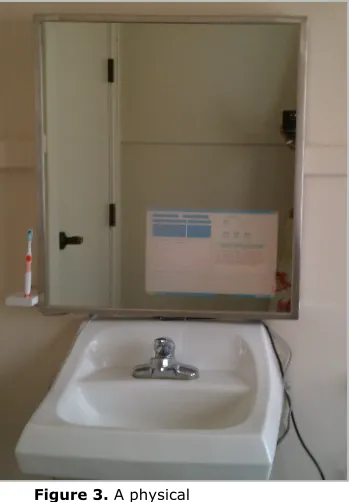
electronics and the corresponding cables are secured using a strong adhesive and protected by 3” wood trim painted to match the room the device is installed in. Below the mirror is a USB cable that connects the Phidget scale mounted within a floor platform. This platform simulates a normal throw rug and blends into the normal surroundings of the room. The final results, seen in in Figure 3, leave the average guest with no obvious signs that such a device even exists, and is only activated when the indented users picks up their toothbrush, a task rarely done by other occupants.
The entire GUI used to present information and interact with the user was developed in C#. A screenshot of this GUI is featured in Figure 4. There are five different things the GUI displays; the weight of the user, their current BMI, a graph of their weight over a period of months, the current weather outside his present location and an RSS reader which displays tips on maintaining a healthy body. Input to this display is from two main sources. First is the scale itself, and second is the XML file, which acts as a database to hold the users information.
The scale is placed directly below the sink where the user stands before the mirror. This is connected to the processor directly and the reading is taken with the help of Phidgets C# API. Once the weight is recorded into an XML file, it is displayed in the GUI and also at the same time. The XML file also holds persistent information about a user, such as their name, height, zip code, and the historical weight of the user. This XML file is sourced to display while displaying the graph in the GUI, and can also be used to send directly to your primary care physician, a feature yet to be fully explored.
Discussion
From the start, this project is aimed at aiding users of all varieties to continually manage their weight without the burden of adjusting their daily activities. As described above, obesity is a growing epidemic, however there is a wide range of opportunities for improvement within our society. Specifically, the practices of pervasive and ubiquitous computing can be used to help people lose weight, as demonstrated through the design and implementation of the ScaleMirror project.
One key feature of the project is that we don’t force users to take measures to reduce their weight. Instead, we simply try to motivate them by offering each user an output that represents their own weight and
corresponding analysis over a particular period of time, in the end, leaving the choice up to those who are willing to make it. We have designed the device to accomplish this goal in the most effective way by concentrating on when, where, and how to present the information to the user. Furthermore, we have
implemented this design in an environment that requires little to no change in the user’s daily life activities.
Future Work
[image:5.792.14.189.111.362.2]Future developments on this device can be made in many dimensions. Weight calculation methods, for example, can be expanded to provide targeted weights after considering that different people have different metabolisms relying on their age, gender, and other parameters. The device can be calibrated to consider these factors that differ per each user. The weight feedback provided by the device can be shared with an approved primary care physician electronically without Figure 3. A physical
implementation in the Indiana University E.T.H.O.S Living Laboratory, a normal household setting structured for seniors.
[image:5.792.15.185.432.530.2]cumbersome user interaction. This can help doctors properly monitor patients and provide a more rigorous and safe dietary and exercise schedule. This is
dependent both on the ability to protect the security and privacy of the user, as well as a
yet-to-be-determined data format standard. As pervasive sensors improve and become more cost effective, the device can be extended to provide other measures to the user and doctor, such as body temperature, blood pressure, and sugar and cholesterol levels, thereby aiding users in pursuing a healthy and full life.
Citations
[1] ObesityinAmerica.org
http://www.obesityinamerica.org/
[2] Garner, D.M. and Garfinkel, P.E. The Eating Attitudes Test: An index of the symptoms of anorexia nervosa. Psychological medicine (1979), vol. 9, 273— 279.
[3] Wrong Diagnosis.
http://www.wrongdiagnosis.com/o/obesity/complic.htm
[4] Garrouste-Orgeas, M. and Troche, G. and Azoulay, E. and Caubel, A. et al. Body Mass Index. Intensive care medicine, vol 30 no 3, 2003.
[5] Weiser, M. The computer for the 21st century. Scientific American, p. 94–104, 1991.
http://www.ubiq.com/hypertext/weiser/SciAmDraft3.ht ml
[6] S. S. Intille, "Designing a home of the future, In IEEE Pervasive Computing, vol. April-June, 2002. pp. 80-86
[7] Mynatt, E., Melenhorst, A., Fisk, A.D., and Rogers, W. Aware technologies for aging in place:
Understanding user needs and attitudes. In Pervasive Computing(2004), 36-41.
[8] Kaori Fujinami and Tatsuo Nakajima. AwareMirror: A Personalized Display using a Mirror. In Pervasive
Computing, Third International Conference, Pervasive 2005, 315-332.
[9] Kaori Fujinami and Jukka Riekki. A Case Study on Ambient Display as a Persuasive Medium for Exercise Awareness. . In Pervasive Technology, Third
International Conference, 2008, 266-269.
[10] Kaori Fujinami and Fahim Kawsar. An Experience with Augmenting a Mirror as a Personal Ambient Display. In Computer-Human Interaction 8th Asia-Pacific
Conference, APCHI 2008, 183-192.
[11] Pervasive Healthcare Computing: EMR/EHR, Wireless and Health Monitoring
[12] Ssu-Hsuan Lu, Kuan-Chou Lai, Don-Lin Yang, Ming-Hsin Tsai, Kuan-Ching Li and Yeh-Ching Chung., Pervasive health service system: insights on the development of a grid-based personal health service system. In e-Health Networking Applications and Services (Healthcom), 2010 12th IEEE International Conference on , vol., no., pp.61-67, 1-3 July 2010 [13] Choonhwa Lee., Nordstedt, D., and Helal, S., "Enabling smart spaces with OSGi 9. In Pervasive Computing, IEEE, vol.2, no.3, pp. 89- 94, July-Sept. 2003
[14] Kaku The Digital home: The Bathroom – PCMAG [15] Helal, S., Mann, W., El-Zabadani, H., King, J., Kaddoura, Y., and Jansen, E., In The Gator Tech Smart House: a programmable pervasive space, Computer , vol.38, no.3, pp. 50- 60, March 2005
[16] National Heart Lung and Blood Institute. http://www.nhlbisupport.com/bmi/bmicalc.htm