Abstract: In this paper, the authors discuss the principles and models of authentic learning, which have been proposed by several leading experts in the field of authentic learning. Among the principles, authentic learning materials, authentic assessment, and teaching and learning activities based on the real world are the core principles shared by most models. In particular, the authors propose an authentic learning model that will be used for the essay teaching process in the classroom consisting of six important principles, namely actual (hands-on) learning materials, easily accessible learning sources that are realistic and tangible, emphasis on community input, outdoor activities, and freedom for students to express their views and interpretations, and authentic assignments. Using these principles, the authors propose a practical implementation of the teaching and learning activities based on this approach for the teaching of essay writing. With such proposed activities, teachers and instructors will be able to plan and carry out their essay writing classes more effectively through which their students will learn more meaningfully.
Keywords: Authentic assessment, authentic learning, essay writing, learning context, teaching approach.
I. INTRODUCTION
The authentic teaching of Malay language is able to create an interesting learning environment that provides a learning opportunity for students to experience a meaningful learning process. In particular, through the principle of ‘learning by doing’ and contextualized learning, the student learning process will become more meaningful that helps improves and retains their understanding and knowledge of a particular concept over a longer duration. In this regard, the Malay Language Primary School Standard Curriculum (Kurikulum Standard Sekolah Rendah Bahasa Malaysia) (2012) and the Malaysian Educational Development Plan 2013-2025 (Pelan Pembangunan Pendidikan Malaysia 2013-2025) highlight the emphasis on learning based on authentic learning materials and activities.
Revised Manuscript Received on May 28, 2019.
Zulkifli Osman, Faculty of Languages and Communication, Sultan Idris Education University, Malaysia
Anida Sarudin, Faculty of Languages and Communication, Sultan Idris Education University, Malaysia
Dahlia Janan, Faculty of Languages and Communication, Sultan Idris Education University, Malaysia
Ani Omar, Faculty of Languages and Communication, Sultan Idris Education University, Malaysia
Despite such an emphasis, the current learning environment of the Malay language learning in the classroom is heavily oriented toward examination (Zulkifley Hamid, 2000; Radiah Yusoff et al.,2010; Zulkifli Osman, 2013a). For example, several studies have shown that most teachers rely on the textbook as the main learning material for such learning (Zulkifli Osman, 2013a; Zulkifli Osman, 2013b; Mahzan Arshad, 2003). Engaged in such a context, naturally, students will be deprived of diverse learning materials, in particular materials with authentic characteristics. Furthermore, the current learning environment in the classroom seems divorced from reality. More revealingly, studies by Zulkifli Osman (2013c) and Masoud, Fatemeh, dan Seyyed (2014) provide a number of interesting findings, in which they found that students preferred to use authentic learning materials in Malay language learning. In fact, the use of such learning materials had made the students become more discernable about and appreciate the Malay culture of the society. In addition to these findings, authentic learning has been proven to be effective in improving students’ achievements and creativity (Hazrati, Rosseni, Aidah, Helmi dan Analisa, 2013).
As amply demonstrated by the above revelations, authentic learning should be used by teaching teachers and instructors to help them realize meaningful learning condition, in which their students could learn more efficaciously. In addition, previous studies (Richards, 2001; Mahzan Arshad, 2003; Zulkifli Osman, 2013a; Zulkifli Osman, 2013b; Brown, 2001; Mary Tan Mun Yee, 2012) have shown that such learning using authentic learning activities and materials are able to improve students’ motivation and achievements. In view of the lack of research on the Malay language learning based on such an approach, the researchers will undertake the effort to develop a Malay language teaching module that was based on the principles of authentic learning. More specifically, the development of the learning materials and teaching and learning activities, which took into account such principles, would help a group of students to experience a meaningful, interesting learning environment in which they could improve their composition or writing skill of the Malay language.
The Teaching of Malay Essay Writing based
on an Authentic Approach
The Teaching of Malay Essay Writing based on an Authentic Approach
II. AUTHENTIC LEARNING PRINCIPLES According to Zemelman, Daniels, and Hyde (2005), authentic learning is not a method, but a condition that engenders a learning condition based on an approach, activities, and learning tools that are authentic in nature. In this respect, Zemelman and his colleagues argue that the main aim of such learning is to make learning condition more in touch with reality, which is in line with their ‘make it real’ concept. To help realize such a concept, two approaches could be implemented to make a learning environment become realistic, namely by bringing in the ‘world’ into the classroom and by taking out the students to the outside ‘world’. Such a concept reinforces that the teaching and learning process could not be separated from the reality of the outside world. Of late, such a teaching and learning process that helps students learn meaningfully has become more prominent in the educational realm. The shift from conventional learning to authentic learning has taken place in earnest as latest research has shown that student-centered, realistic learning condition would have a profound impact on the quality of student learning (Herrington and Herrington, 2007). To help create authentic learning condition, Zemelman and his colleagues (2005) developed a number of guidelines as follows:
a) Materials to be used need to be artifacts that are tangible such that they can be held or touched. b) Learning characterized by ‘learn-by-doing’ needs to
be prioritized over learning characterized by ‘learn-by-sitting’ (or static and passive).
c) Teaching and learning activities in the classroom that need to be carried out have to be aligned with the current issues.
d) Teaching and learning activities need to blend with students’ multiple intelligences and learning styles. e) The use of actual materials, such as newspapers,
should be given more emphasis over the textbooks and those provided by publishers.
f) Available materials and those that can be easily accessed (which not textbooks) have to be used as much as possible.
g) Students’ assignments should involve the support, assistance, and assessment of family and community whenever possible.
h) Subject matter experts have to be involved to help students to gain a direct access to information. i) External activities need to be encouraged to help
students to gain a direct access to information. j) Students need to be engaged in local community
programs.
k) Inquiry-based techniques, such as interviews, observations, and field work, have to be adopted in the teaching and learning process.
l) Students’ assignments should be shared with the general public.
In addition, Muijs and Renolds (2011: 79) contend that language learning that is meaningful can take place when students will be able to construct their own knowledge through
a learning process that is active, involving the search of meanings, social constructs, and sufficient knowledge among the teachers, which is delivered contextually with the use of effective materials in a learning environment that is both realistic and authentic. On the other hand, Lombardi (2007) deconstructs the concept of authentic as learning that focuses on the real world, involving real problems, with the use of role-play technique, problem-based activities, case studies, and student involvement in the community. In essence, authentic learning focuses on meaningful learning that reflects or represents aspects of the real world.
In implementing such authentic learning, Lombardi (2007) asserts that learning activities have to be relevant to the actual practices of the real world. As such, he emphasizes that students’ assignments need to be developed that can help foster meaningful interpretations through inquiry-based activities, such as field study, and to provide students the opportunity to construct their perspectives from diverse sources. In addition, Lombardi (2007) argues that such learning will be able to foster collaboration among students and enable them to make choices and reflect on the learning process. From the assessment standpoint, the same researcher stresses that formative assessments need to be given a strong emphasis based on problems that are relevant to the real world. In short, authentic learning helps train students to solve real-world problems through learning activities.
From the methodological perspective, Donavan, Bransford, and Pellegrino (1999) and Newmann, Secada, and Wehlage (1995) argue that authentic learning and traditional learning differ significantly. To help highlight such a difference, they outlined several characteristics of authentic learning, one of which is that such learning focuses on authentic tasks that entail students to engage in explorative, inquisitive learning. Furthermore, such learning is closely related to the real world, extending beyond the confines of the classroom. In addition, authentic learning will use challenging assignments to compel students to engage in higher order thinking, such as analyzing, synthesizing designing, manipulating, and making an assessment. Students are also encouraged to produce products that can be shared with the local community, in particular through social activities, such a social discourse. To help create an authentic learning environment, Herrington and Herrington (2007) proposed nine approaches as follows:
a) Provide authentic contexts to ensure knowledge can be applied in the actual contexts.
b) Create authentic learning activities that are relevant to the real world and complex assignments that need to be completed based on a prescribed duration. c) Exposure students to the problem-solving process or
to assignments that are realistic with the actual contexts.
d) Encourage students to explore multiple perspectives and diverse roles.
help develop knowledge.
f) Reflect on the problems and their solutions. g) Articulate discussions among students.
h) Provide scaffolding for students during the learning process.
i) Carry out the authentic assessment.
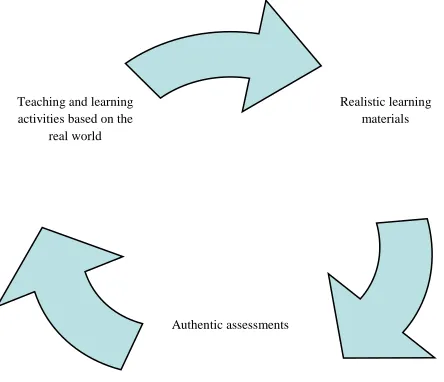
As highlighted above, it is evidently clear that there are several principles or models that serve as the foundation for authentic learning. Admittedly, some of the principles share a common notion, positing that authentic learning focuses on a learning process that is based on reality. As such, such learning emphasizes activities, materials, and assessments that represent the real world that is both realistic and authentic. In addition, authentic learning encourages students to get involved with the local community or its environment in each learning activity whenever possible. Another important aspect of such learning is that it also stresses active learning involving an inquiry-based process. Figure 1 highlights the core principles of authentic learning for language learning.
[image:3.612.58.280.305.496.2]
Fig . 1 The core principles of authentic learning for language learning
III. AUTHENTIC LEARNING MODEL
To help implement authentic learning, a number of models have been proposed by several leading scholars, including the model developed by Zemelman and his colleagues (2005), Lombardi (2007), Donavan, Bransford, and Pellegrino (1999), and Herrington and Herrington (2007), the synthesis of which will show they consist of several important principles, such as authentic learning materials, authentic learning sources, the role of community, authentic activities, freedom in making interpretations, and the type of assignments. From the aspect of learning materials, it is clear that materials to be used for learning based on the above models are real, hands-on artifacts that are relevant with current issues and appropriate with
students’ diverse learning styles. From the aspect of sources, immediate learning sources, such as those related to students’ family or local leading personalities, are the natural choice based on such learning models. Such models also advocate strongly the use of interviews, observations, and fieldwork through which students will be able to gain important information.
Likewise, communal aspect is also an important focus of such learning models, which emphasizes that learning activities must involve the local people and encourages that students provide suggestions, make plans, and conduct assessments of projects or issues prevailing in the community. In addition, such learning models stress the importance of providing sufficient opportunities for students to display their works or assignments to the public. In actuality, these models also encourage students to develop products that can be shared with the public and to directly engage with specific segments of the local community (such as firemen), the engagement of which will help the students to gain real, relevant information directly that is deemed vital for their specific assignments. For example, in composing an essay with regard to the experience of extinguishing fires, firemen will be the most appropriate individuals to be invited to the classroom to share their real experiences with the students such that the latter will be able to acquire the relevant facts and precise information, with which interesting and appealing narrative can be developed.
From the aspect of activities, such learning models stipulate that both students and teachers to conduct outdoor activities and visits, such that the former will not be confined in their classroom. Specifically, such visits will provide an opportunity for the students to see the outside world that can help them to carry out their assignments more meaningfully. In addition, the learning models emphasize inquiry-based activities to help improve students’ knowledge and skills and advocates the use of relevant scaffolding for learning activities. Likewise, such learning models also stress the freedom that can help students in carrying out their assignments and learning activities more efficaciously. With such freedom, students will have more opportunities to use their interpretations in solving their tasks, as opposed to learning based on the conventional approach. In addition, students will be encouraged to fully use their capability with the support of their parent, family, and the public. From the aspect of assignments, such learning models place a strong emphasis on the use of authentic, inquiry-based assignments that entails students to engage in higher order thinking skill (HOTS), complex tasks that require students to solve within a given duration, and authentic assessments. Table 1 summarizes the principles of the authentic learning models discussed above.
Table. 1 The principles of the authentic learning models Realistic learning
materials
Authentic assessments Teaching and learning
The Teaching of Malay Essay Writing based on an Authentic Approach
No. Item Description Example of best technique and
approach.
1 Learning
material
Actual, hands-on materials that are related to the current issues and that are suitable with students’ learning styles.
2 Learning
source
Readily available sources, such as students’ families or local influential personalities.
Method of collecting information includes interviewing members of the society, making observations, and conducting fieldworks.
1. Talk by an influential personality.
2. Interview.
3 Role of the
community
The local community provides the required information as input for the students.
1. Discourse by a leading figure. 2. Problems faced by the local community.
4 Activity Encouraging outdoor activities and visits to the outside world such that
students will not be confined to their classroom.
1. Academic visit.
5 Interpretation
approach.
Giving students the freedom to help make and apply their own interpretations. -
6 Type of
assignments
Emphasizing the use of authentic, inquiry-based assignments that entails students to use higher order thinking skills (HOTS), complex assignments that have to be completed within a prescribed duration, and authentic assessments.
-
IV. THE APPLICATION OF AUTHENTIC ELEMENTS IN WRITING ESSAY
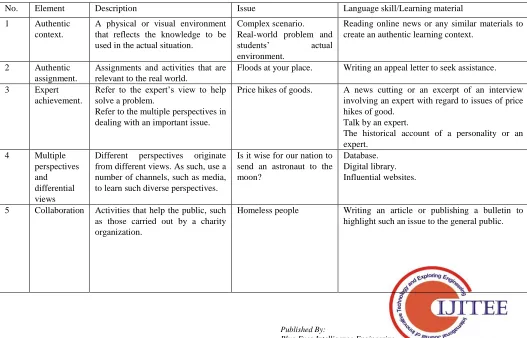
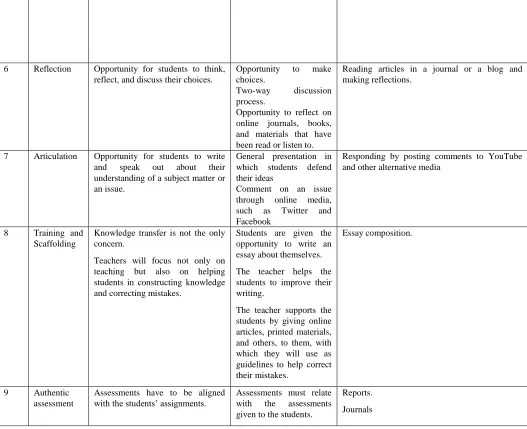
In the proposed study, nine elements of Herrington and Herrington’s (2007) authentic learning approach will be used as the guidelines in creating an authentic learning environment, namely authentic context, authentic assignment,
[image:4.612.42.569.429.767.2]expert achievement, multiple perspectives and differential views, collaboration, reflection, articulation, training and scaffolding, and authentic assessment. Table 2 summarizes these elements that will be embedded in the teaching of Malay language composition.
Table. 2 The nine elements and the proposed authentic learning activities in the teaching and learning of Malay language composition
No. Element Description Issue Language skill/Learning material
1 Authentic
context.
A physical or visual environment that reflects the knowledge to be used in the actual situation.
Complex scenario. Real-world problem and
students’ actual
environment.
Reading online news or any similar materials to create an authentic learning context.
2 Authentic
assignment.
Assignments and activities that are relevant to the real world.
Floods at your place. Writing an appeal letter to seek assistance.
3 Expert
achievement.
Refer to the expert’s view to help solve a problem.
Refer to the multiple perspectives in dealing with an important issue.
Price hikes of goods. A news cutting or an excerpt of an interview
involving an expert with regard to issues of price hikes of good.
Talk by an expert.
The historical account of a personality or an expert.
4 Multiple
perspectives and differential views
Different perspectives originate
from different views. As such, use a number of channels, such as media, to learn such diverse perspectives.
Is it wise for our nation to send an astronaut to the moon?
Database. Digital library. Influential websites.
5 Collaboration Activities that help the public, such
as those carried out by a charity organization.
Homeless people Writing an article or publishing a bulletin to
6 Reflection Opportunity for students to think, reflect, and discuss their choices.
Opportunity to make
choices.
Two-way discussion
process.
Opportunity to reflect on online journals, books, and materials that have been read or listen to.
Reading articles in a journal or a blog and making reflections.
7 Articulation Opportunity for students to write
and speak out about their
understanding of a subject matter or an issue.
General presentation in which students defend their ideas
Comment on an issue
through online media,
such as Twitter and
Responding by posting comments to YouTube and other alternative media
8 Training and
Scaffolding
Knowledge transfer is not the only concern.
Teachers will focus not only on teaching but also on helping students in constructing knowledge and correcting mistakes.
Students are given the opportunity to write an essay about themselves.
The teacher helps the students to improve their writing.
The teacher supports the students by giving online articles, printed materials, and others, to them, with which they will use as guidelines to help correct their mistakes.
Essay composition.
9 Authentic
assessment
Assessments have to be aligned with the students’ assignments.
Assessments must relate
with the assessments
given to the students.
Reports.
Journals
Accordingly, the researchers propose the teaching and learning activities based on the nine elements, which will be used to examine the extent to which such leaning authentic
[image:5.612.43.570.54.483.2]will be able to improve students’ essay writing ability. Table 3 summarizes the proposed activities that will be used for the following research.
Table. 3 The proposed teaching and learning activities for essay writing based on the authentic approach
Title: The effects of bullying Language skill: Essay writing skill
Material: 1. Newspaper cuttings (printed or online Berita Harian Online and Utusan Online, dated 7th. September 2016
2. Video clip from You Tube. Teaching step
Set induction Learning content Authentic element
The Teaching of Malay Essay Writing based on an Authentic Approach
The bullying phenomenon among adolescents.
The authentic context.
Students read online news or watch a video regarding bullying to establish the context of learning.
Learning material: Newspaper cutting or a video clip on bullying.
Step 1 The causes of
bullying among students.
The views of
experts and
leading personalities.
Discuss the views of experts and leading personalities regarding the causes and contributing factors of bullying in schools and among adolescents.
Newspaper cutting or an excerpt of an interview with experts regarding
such a
phenomenon.
V. CONCLUSION
As discussed above, it is clear that the process of teaching essay writing in the classroom has to take into account several important factors. For example, the learning process needs to be implemented in the actual context that is most appropriate
with students’ learning needs. Such contextualized learning can be realized with the use of relevant assignments that reflect the real world. In particular, the assignments should be based on inquiry-based, explorative learning activities, through which students can achieve a meaningful learning experience. In addition, students must be given the freedom to express their perceptions and views of the given tasks from various perspectives and roles. Given such freedom, surely the
students will be able to learn more efficaciously of the subject matter as well as play an active role in the community.
VI.
ACKNOWLEDGMENT
Step 2 The means of
overcoming bullying.
The articulation of
views from
multiple, different perspectives.
Carry out appropriate activities, such as a forum, a dialog, or a discourse, to help overcome bullying among students. or
Make a presentation to the public in defending students’ ideas.
or
Comment on the issue using online media, such as Twitter or
Facebook.
Slides.
Large-size papers. or
Social media.
Step 3 Essay writing on
the ways of overcoming bullying among
students or
adolescents.
The training and scaffolding
Students are given the opportunity to write their own essays.
The teacher helps the students in correcting their essays. The teacher provides support materials, such as online articles and printed materials, which serve as guidelines to help them correct their mistakes on their own.
Support materials for the essay writing.
Closure Learning
assessment
The authentic assessment
Re-evaluating student learning by carrying out the following activities:
Reflection.
Question-and-Answer. Expression of feelings.
This paper is based on the research project entitled Keberkesanan Pendekatan Pengajaran Bahasa Melayu Secara Autentik dalam Meningkatkan Penulisan Karangan Murid Tingkatan Dua. The authors would like to extend their gratitude to the Research Management and Innovation Centre (RMIC), Sultan Idris Education University, Perak, Malaysia for the University Research Grant (Code 2015-0124-106-01) that helped fund the research.
REFERENCES
1. Brown, H. D. (2001). Teaching by principles: An interactive approach to language pedagogy. (2nd ed.). New York: Longman.
2. Donovan, M. S., Bransford, J. D., & Pellegrino, J. W. (Eds.). (1999). How people learn: Bridging research and practice. Washington, DC: National Academy Press.
3. Hazrati Husnin, Rosseni Din, Aidah Karim, Helmi Norman dan Analisa Hamdan (2013). Assesing authentic learning via storyboarding: A Malaysia Perspective. Asian Social Science, 9(16), 46-53.
4. Herrington, A. J. & Herrington, J. A. (2007). What is an authentic learning environment?. In L. A. Tomei (Eds.), Online and distance learning: Concepts, methodologies, tools, and applications (pp. 68-77). Hershey, PA: Information Science Reference.
5. Lombardi, M. M. (2007). Authentic Learning for the 21st Century: An Overview. Educause learning initiative. ELI paper 1.
6. Mary Tan Mun Yee (2012). Kesan penggunaan aktiviti “hands-on” dalam proses pembelajaran sains tahun empat. Kertas kerja yang dibentang dalam Seminar Penyelidikan Tindakan IPG KBL pada 27 & 28 September 2012.
7. Masoud Zoghi, Fatemeh Moradiyan Zardak, dan Seyyed Ali Kazemi (2014). The effects of authentic materials on vocabulary development. International Journal of Language Learning and Applied Linguistics World (IJLLALW), 5 (4). 155-160.
8. Muijs, D dan Renolds, D. (2011). Effective teaching: Evidence and ptractice. 3rd edition. New York: Sage Publications Ltd.
9. Newmann, F., Secada, W., & Wehlage, G. (1995). A guide to authentic instruction and assessment: Vision, standards and scoring. Alexandria, VA: ASCD.
10. Radiah Yusoff, Eileen Sim Sew Wah, Jafizah Jaafar, dan Tang Tyy Ling (2010). Kaedah suapan dalam kelas Bahasa Melayu: Satu tinjauan awal terhadap pandangan guru. Dalam Ambigapathy Pandian, Murshidi Harun @ Zakaria, Tan Hock Thye, Siti Noraini Jupri, dan Noraini Ali (Eds.), Pancadimensi pengajaran dan pembelajaran bahasa: Trend dan amalan. Pulau Pinang: Penerbit Universiti Sains Malaysia, 207-216.
11. Richards, J. C. (2001). Curriculum development in language teaching. Cambridge: Cambridge Universiti Press.
12. Zemelman, S., Daniels, H., dan Hyde, A. (2005). Best practices: Today’s standards for teaching & learning in America’s School. 3rd Edition. Portsmouth: Heinemann.
13. Zulkifley Hamid (2005). Penilaian pengajaran dan pembelajaran Bahasa Melayu. Kuala Lumpur: Dewan Bahasa dan Pustaka.
14. Zulkifli Osman (2013a). Pembangunan modul pengajaran Bahasa Melayu secara bersepadu. Tesis doktor falsafah yang tidak diterbitkan. Fakulti Pendidikan, Universiti Malaya.