DECISION MAKING AT THE
LOCAL LEVEL – THE MISSING
LINK?
AN EMPIRICAL STUDY OF THE LOCALISM ACT AND SURE START 2010–2012
Jayne Ruth Meyer Tucker
A thesis submitted for the degree of Doctor of Philosophy of the Australian National University
Declaration
I declare that, except where acknowledged, this dissertation is my own original work and has not been submitted for a higher research degree at any other university or institution.
Acknowledgements
There are many points of acknowledgement and recognition to be made for this thesis. I am most appreciative of the varied support received in assisting me in shifting from strong aspirational deep thought into the current completed physical written format. There is, of course, an order to the thesis’s physical form, including the structure that commences with the Introduction. The Introduction provides the reader with an outline of the exciting puzzle around top-down policy implementation and its influence on decision making at the local level. This is followed by the fusion of two literatures, those of political and complexity sciences, which in turn leads to the chosen methodology and the exciting findings and introduction of the three discoveries. Explorations and provision of arguments are summarised as concluding thoughts, leaving the reader with an invitation in the form of future recommendations, whether they be a researcher, policy maker or advocate for decision making at the local level.
To complement the thesis structure, these acknowledgements will follow a similar framework. As with the the Introduction and framing of the thesis, there would be no thesis without some key people. Most importantly, Ronnie Tucker, my husband and soul mate who, for as long as he has known me, has supported my desire to pursue this puzzle – even at the point in time when the puzzle was more a feeling than an articulated contribution to knowledge and academia. His support has been unconditional and runs so deep that its essence lives in every single word. Every thought, every word of this thesis are only possible because of his unquestioning support for my indulgence in deep thought and absence from everyday commitments.
her wisdom and exceptional ability to steer a PhD candidate who visualised the argument long before the written word could articulate its meaning. Ann’s ability to keep me motivated for every one of the 1825 days is a testament to her and I am so proud to recognise how, under her stewardship, I have achieved a lifelong goal. I have also been most fortunate to have the wise input of my supervisory panel, including Professor Adrian Kay, Professor Peter Shergold and Dr Naomi Eisenstadt, each of whom has contributed in individual ways. This has gone beyond formal group discussions, and our extended breakfast chats and/or lunches all afforded snippets of wisdom fundamental in shaping my thoughts. I am most honoured to have received their individual and collective attention.
It is important at this point to note the year of my graduation: thirty years earlier I experienced a life tragedy, suffering serious injuries and becoming a widow at a young age in consequence of a tragic car accident. In light of this experience, there are for me many reasons that completing a PhD has been a challenge. I therefore devote this PhD to three important people who, though having departed this world, played a very important part in my life before and after the accident – my first husband, Garry Meyer, and my Mother and Father who, through their unconditional love, gave me the strength for my second chapter of life. Just like a methodology, a framework was established for me in the earlier chapter of my life, laying foundations that gave me the resilience to cope with the ups and downs of a PhD, to value each moment and to embrace change.
I also thank my professional colleagues, including the ladies of the ‘Village’ who would always listen with interest and insightful questions – even when my thoughts were still forming! I particularly thank Bryan Raines for mastering my UK interview schedule, and Tara Egan, who willingly and effortlessly assisted with transcriptions of over thirty interviews. Through ANU I have met some incredibly important people, including two of the worlds’ best: Dr Megan Poore – the world’s best PhD Academic and Research Skills Advisor, and Matthew Sidebotham – the world’s best editor, who provided copyediting and proofreading services according to the guidelines laid out in the university-endorsed national guidelines for editing research theses. The support I required was always gauged precisely and expertly timed, whether it was a simple analogy (of cats and whiskers) or questions that assisted me with my clarity.
Preface
As a seasoned senior executive within the not-for-profit sector, I have over three decades of policy implementation experience that has crossed each of the sectors including the for profit, public and community sectors. This experience has also provided me with opportunities to work in both Australia and the UK. It is the accumulation of this experience that has led me to the desire to complete a rigorous enquiry into the tensions I have experienced between top-down command and control policy implementation and the desire for bottom-up decision making at the local level. In my enquiry I have introduced and explained these experiences as relationship tensions, which, in my experience, have been the one common denominator over the last three decades.
In my attempt to reduce any research bias, particularly within the application of a single case study model, I have chosen to adopt the role of an analytical spectator of the whole policy system, but from afar. Although my interpretive enquiry is focused on a particular reform I was involved with (Sure Start), I no longer live in the UK or work within this reform. My past Sure Start role has provided me with benefits, such as access to key actors and own local knowledge, particularly within the chosen location (Dover, Kent UK). I now live, work and study in Australia and have done for the past decade. Although my physical removal from the project has provided an opportunity to be both objective and reflective, my previous involvement has provided me with the ability to ask insightful questions about the nuances within and between top-down and bottom-up relationship tensions.
Abstract
The tension between top-down directives and local-level decision-making is a constant theme running through implementation studies. Through the case study of Sure Start (a UK early childhood program introduced in 1997, which brings together services for children under four and their families and has a particular focus on local level decision-making), this thesis provides a deeper understanding of these relationship tensions by examining the impact of the
Localism Act 2011 (UK) on decision-making at the local level. (The aim of the Localism Act, introduced in November 2011, is to facilitate the devolution of decision-making powers from central government to individuals, communities and local councils).
The research involved interviews with local-level service providers and bureaucrats, county- and national-level bureaucrats, government ministers and national peak bodies involved in the implementation of Sure Start. Interviews with key actors revealed little evidence of the Localism Act positively influencing decision making at the local level.
As well as identifying the reasons why the Localism Act has had so little impact on local-level decision making, the thesis combines policy implementation and complexity leadership theories to develop a new way of thinking about the complex relationships that characterise implementation of local-level programs initiated and funded by central government.
Contents
Declaration ... iii
Acknowledgements ... v
Preface ... ix
Abstract ... xi
Contents ... xiii
List of Tables ... xv
List of Figures ... xv
Chapter 1. Introduction ... 1
Overview... 1
1.3 The literatures ... 7
1.4 Normative model – Enabling Continuum ... 9
1.5 Governance and Complexity ... 10
1.6 Purpose and central argument of study ... 11
1.7 Thesis structure and chapters ... 12
1.8 Thesis conclusion (chapter 8) ... 17
Chapter 2. Literature Review Part 1 – Policy Implementation Literature ... 19
2.1 Introduction ... 19
2.2 Policy implementation ... 20
2.3. Governance ... 28
Chapter 3. Literature Review Part 2 – Complex Adaptive Systems Theory ... 41
Introduction ... 41
3.1. Complex Adaptive Systems theory ... 41
3.2. Complexity Leadership Theory and propositions for governance ... 48
3.3 Emergence and change ... 56
3.4 Exploitation and exploration (Enabling Continuum) ... 64
Chapter 4. Methodology ... 67
Introduction ... 67
4.1Research setting ... 68
4.2 Research design ... 72
4.3 Research methodology ... 82
4.4 Research boundaries ... 87
Chapter 5. Findings: Discovery One – Funding ... 89
Introduction ... 89
5.1 Funding as a key principle... 91
5.2 Influence of the Localism Act ... 98
5.3 Enabling Continuum ... 112
Chapter 6. Findings: Discovery Two – Leadership ... 119
Introduction ... 119
6.1 Leadership as a notable missing link ... 120
Chapter 7. Findings: Discovery Three – Fragmentation ... 151
Introduction ... 151
7.1 The paradox of fragmentation ... 152
7.2 Influence of the Localism Act ... 163
Chapter 8. Conclusion and Implications for Practice and Research ... 179
Overview... 179
8.1. Significance of the six scenarios ... 180
8.2. Summary of findings ... 183
8.3 Implications of the findings ... 186
8.4 Recommendations for practice ... 189
8.5 Contributions to future research – Next Steps ... 191
8.6 Final thoughts... 194
Appendix A – Key Actors interviewed 2014 ... 195
Appendix B – Glossary of key events & dates ... 197
Appendix C – Interview Collective Impact Prompts ... 203
Glossary ... 205
List of Tables
Table 2.1: Five generations of policy thought ... 20
Table 4.1: Collective Impact Framework – three preconditions ... 73
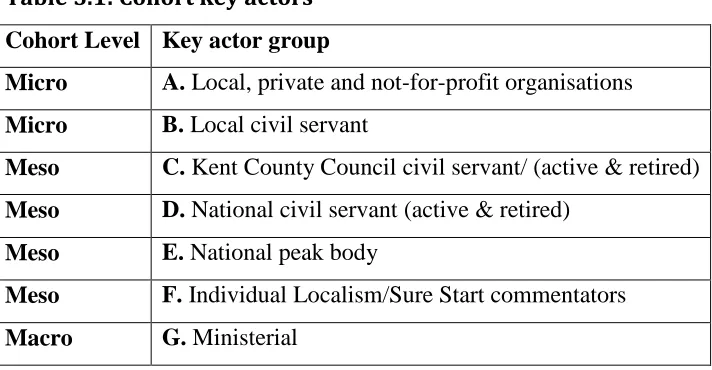
Table 5.1: Cohort key actors ... 91
List of Figures
Figure 3A: Entanglement & enabling leadership in Complexity Leadership Theory . 53 Figure 3 B: How emergent strategy works ... 59Figure 3C: Theory of Change ... 62
Figure 3D: The path of criticalisation ... 64
Figure 3E: Enabling Continuum ... 65
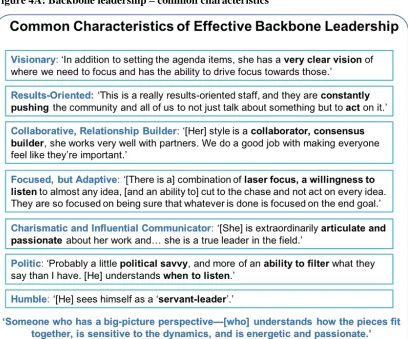
Figure 4A: Backbone leadership – common characteristics ... 77
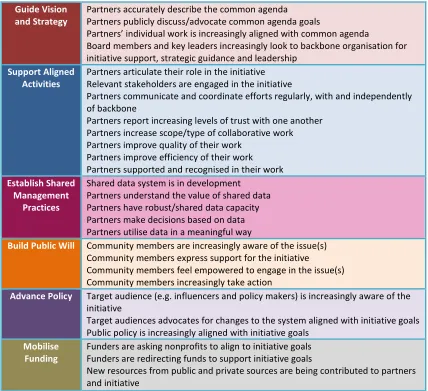
Figure 4B. Backbone Effectiveness – 27 Indicators ... 78
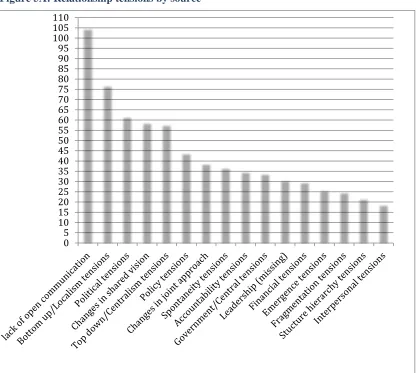
Figure 5A: Relationship tensions by source ... 92
Figure 5B: Discovery One: Key Principle ... 98
Figure 6A: Discovery Two – missing link ... 128
Figure 6B: Enabling Continuum – exploitation tension ... 140
Figure 6C: Enabling Continuum – entrenched silos ... 142
Figure 6D: Enabling Continuum – exploration tension ... 143
Figure 7A: Discovery Three – paradox ... 164
Figure 7B: Enabling Continuum – quadrants ... 173
Chapter 1. Introduction
Overview
The title of this research may evoke debate by challenging deeply held beliefs about how best to achieve desired policy outcomes while engaging at a local level. My argument examines the tensions arising where too much of a ‘command and control’ stance stifles local engagement, but where too much ‘freedom and flexibility’ can affect lines of accountability. The greater the need for central consistency, the more prominent such tensions become, and they are often manifested through less responsiveness to local need.
Tensions cannot be eradicated by this or any other study, but better understanding the nuances, particularly over periods of time, can assist in navigating constant change and deciding the most effective way to influence decision making at the local level. I have chosen to adopt the role of an analytical spectator of the whole policy system, but from afar. Building on each chapter (see Section 1.7), I argue that decision making at the local level is inhibited and negatively influenced by the inability of policy directives to enable conditions for local engagement. Within this context, I argue that top-down policy directives do not support decision making at the local level. Through my argument, I contribute towards knowledge and understanding of this topic, concluding with three recommendations that straddle top-down and bottom-up relationship tensions. To achieve this, I pursue an interpretive analysis, using the constructive engagement between key components of political science and complexity science to present a theoretical link that is particularly helpful for policy implementation literature. In sum, further exploration of policy implementation, using a non-traditional approach, is needed to address the central tension between top-down and bottom-up relationships – a tension presented in this study as a paradox.
local level and those related to joined-up-working – particularly the absence of decision making at the local level and the resulting silos. The term ‘silo working’ is used throughout the study to describe non–joined-up ways of working, the polar opposite of being collaborative. I do not explore the multitude of reasons for barriers to collaboration, but I do examine the missing links of the relationship tensions that arise from the gaps and entrenched silos.
1.1 Why decision making at the local level?
Many traditional approaches to change at the local level commence with a needs analysis and are often based on the deficiencies and needs of communities. In the spirit of engagement, it would be preferable to proactively seek communities’ values, concerns and aspirations and build these into a decision-making process or processes. Ultimately, establishing an ongoing partnership to ensure that the localities’ priorities and values continue to shape any future decisions.
Understanding the needs of localities is often achieved through a process referred to as ‘community engagement’. As argued by Stuart (2013; 2016), there is no widely accepted definition of community engagement. In attempts to describe community engagement, it is often considered in the terms of planning and decision making. This, of course, brings an immediate set of challenges, primarily around how the role of planning is led and who has the ultimate decision-making authority. It is widely accepted that the preferred approach includes engagement with a representative collective of community stakeholders, exchanging information and/or negotiating mutually acceptable actions.
summarised by Kretzmann 2010; Kretzmann and McKnight 1993; Mathie and Cunningham 2003):
1. Focus on community assets and strengths rather than problems and needs; 2. Identify and mobilise individual and community assets, skills and passions; 3. Community driven – ‘building communities from the inside out’; and 4. Relationship driven.
Although all four foundations are of interest in this study, it is the fourth – relationship driven – and, more importantly, the tensions found between relationships that are further examined. There is an argument to be made about the difference between community engagement or decision making at the local level as a two-way process, and a perspective to obtain census or agreement taken from a predetermined position. These tensions in decision making at the local level are not dissimilar to a recent challenge posed by Matthew Taylor, CEO of the Royal Society of Arts (2015). Taylor expressed the tensions surrounding decision making at the local level in the form of ‘emergent impact’. He was inviting a new way of thinking about change, particularly at a time when the pace of change is faster than ever and the impact of change at the local level is a moving target:
‘[E]mergent impact’ involves setting out with a clear mission and set of goals but then being
able to shift focus and method as the project develops On the one hand, social impact
assessment has often failed to provide consistent, reliable useful metrics its advocates promised,
while, on the other hand, a focus on measurable cause and effect tends to favour narrow, linear
interventions over more emergent system level change (Taylor 2015, p.1).
The importance of change in relationships, local need and neighbourhood are subjects that involve, and invite debate from, many standpoints, and all place importance on community engagement. For the purpose of this study, I have adopted Sullivan’s (2010) term of neighbourhood, which I extend to include ‘citizen engagement’. The phrase ‘citizen engagement’ builds on both the four foundations of Stuart’s addressing of local need, and the four principles of neighbourhood governance origin (Lowndes and Sullivan 2008), namely empowerment, partnership, government and
Another way of describing citizen engagement is as bottom-up dynamics, a term also adopted throughout this study. Bottom-up policy implementation similarly occurs when policies enable change through the inclusion of those primarily affected in the planning and execution of the policy or social programs. The best way to achieve citizen engagement – or connected and empowered local communities – is when decision making is guided by the desire to be collaborative and promote self-actualisation, rather than paternalism. The opposite of citizen engagement and collaborative action is entrenched ‘silos’. Later in this thesis, I describe the implications of entrenched silos as the ‘parent/child syndrome’ and ‘missing link’. The concept of the missing link is of interest to this research, not only in how it relates to policy implementation, but also in how the missing links can be explored and understood through the subsequent links to governance and leadership.
1.2 Why joined-up-working?
Joined-up-working can be challenging due to the complexity of links and events, including horizontal (working across systems or sectors) and vertical (seeking change at the individual, family and community level) arrangements. There are also governance tensions in balancing vertical and horizontal relationships between those implementing and those affected by policies. Navigating these levels of complexity can be difficult due to the extremes of changing contexts, the flexible and evolving nature of interventions and the breadth and range of outcomes being pursued.
Child poverty
The significant economic costs of social issues such as child poverty are often exacerbated by a lack of joined-up-working and decision making at the local level. This tension is particularly salient in citizen engagement and changes that could affect particular communities. This is most prominent in the field of child poverty, as those most affected are often the voices least heard (Howarth et al. 1999; Bradshaw 2001; Eisenstadt 2011; UN 2015). Collective responsibility for reducing child poverty need not be based solely on altruistic reasons, but for society to flourish it must be built on a base of healthy children growing to be engaged, productive adults (UNICEF 2012).
Academic research on child poverty reforms indicates that the best results are achieved by joined-up-working and engaging communities through decision making at the local level, as well as intervening early in life transitions (CYPU 2001; Willow 2002). Such influences on decision making at the local level will be explored in the following chapters, utilising Sure Start as the case study. Sure Start, a UK reform intended to reduce child poverty, is a cross-departmental policy directive aimed at bringing together services for children under four and their families, emphasising the need for decision making at the local level and involvement in managing local programs. As a UK policy directive commencing in 1997, it had a strong emphasis on joined-up-working, citizen engagement and decision making at the local level. In this study I will not be presenting a chronological account of Sure Start, as other commentators have more than adequately explored this (Eisenstadt 2011). Sure Start is presented as a useful platform for governance in child poverty through which to examine top-down policy influence on bottom-up decision making at the local level. My focus is on Sure Start as representative of an attempt at systemic change via a policy directive designed to encourage decision making at the local level.
In a paper by the UK’s National Institute for Health and Care Excellence (NICE), joined-up-working is used as an umbrella term for planning, development and management of decisions that involve the end user:
The process of getting communities involved in decisions that affect them… including ‘the
The topic of joined-up-working and community engagement is of significant global interest. As part of an Australian paper, Stuart (2016, p.1) argued the importance of encouraging community engagement through four broad suggested types. These four broad types of community engagement were influential in my choice of governance arrangements (Collective Impact framework and Localism Act, see Chapter 4). In addition they describe the rationale for the inquiry into the experiences of Sure Start key actors:
1. Community engagement with a focus on community development or community building – such as Sure Start bringing services together with an emphasis on the need of decision making at the local level and community involvement in local programs.
2. Community participation in consultation and decision making – such as the community consultations collective experience as provided by Sure Start key actors.
3. Community engagement that helps organisations, businesses etc. improve their service delivery or achieve their goals – Sure Start as a cross-departmental policy directive designed to enhance joined-up-working.
4. Community engagement as part of social change movements or as part of the work of voluntary community organisations – such as the policy desire to reduce complex societal issues (child poverty) and enhance citizen engagement through Sure Start.
1.3
The literatures
At its most general level, this thesis contributes to understanding the value of adding Complexity Leadership Theory to policy implementation studies. This includes an examination of the most recent policy implementation paradigm of governance, but from a non-traditional Complexity Leadership Theory perspective. Complexity Leadership Theory is grounded in the theory of Complex Adaptive Systems (CAS), and this study combines elements of policy implementation literature (see Chapter 2) with Complexity Leadership Theory (Chapter 3). The three relationship tension domains (financial, interpersonal and political) introduced by Staites and Rogers (2012) are drawn from a detailed examination of the relationship between central and local government, and therefore provide a descriptive frame to further explore the subsequent links and causal chain of events between governance and leadership. The constructive engagement of these two literatures provides a useful backdrop to better understand relationship tensions and their entanglement. Although the linking of the two literatures was not specifically outlined in their concluding statements, the approach I have taken builds on the cumulative work of Uhl-Bien and Marion (2001, 2007, 2008 and 2009).
Future studies need not be quick fixes and it requires qualitative research that explores
quantitative explorations, simulations and modeling (Uhl-Bien and Marion 2009, p.467).
influence of the current ‘knowledge era’, particularly in relation to the policy implementation literature (see Chapter 2). I note that the rate of change, and resulting tension, is without historical precedent. It is partly due to this pace of change that policy directives are seeking innovative ways for citizen engagement to create and influence positive systemic change.
For innovation to occur, new ideas must be generated that have the potential to create positive
change in the organisation, and these ideas must then flow into the formal organisation systems
and structures to create this change (Uhl-Bien and Marion 2008, p.638).
In considering this changing environment, Frye and Webb (2002, p.2) note the importance of ensuring such joined-up partnership or collaboration is fit for purpose, recognising that collaboration is not the panacea to all societal issues. Huxam (2003, p.403) agrees, arguing that collaboration is not always the best way of achieving policy objectives. Both Frye and Webb and Huxam acknowledge that partnerships and collaboration don’t always work and, in drawing on their work, I argue that the key reason for this is often lack of resources to support the type of balance and leadership required, especially when confronting fragmented and complex societal issues requiring systemic change.
The difference between complex and complicated issues is introduced in Chapter 2, with the following chapters building on how these differences demand policy directives that balance and navigate shifts in between linear and non-linear design. Non-linearity creates uncertainty, which Lichtenstein and Plowman (2009) describe as being in a state of disequilibrium. Top-down or traditional policy directives are created within a linear structure and it is this relationship tension, or disequilibrium, between linear policy and a non-linear environment that creates other relationship tensions. The constant state of disequilibrium between linear and non-linear experiences often intensifies relationship tensions leading to entanglement. In my exploration, entanglement refers to the relationship tension between formal top-down administration and bottom-up dynamics – the task of navigating a balance.
Entanglement functions explain relationship behaviors rather than individual leaders... The ‘behaviours’ that individuals engage in and their effects on the organisational systems and their
In navigating the tensions between policy directives and decision making at the local level, a generative leadership style is introduced as key to navigating a balance for policy design whilst nurturing an enabling leadership approach – one of three leadership approaches introduced in Chapter 3 and further discussed in Chapter 6. To assist in understanding the effects of these three leadership approaches, and drawing on existing Complexity Leadership Theory (March 1991; Uhl-Bien and Marion 2007, 2008 and 2009; Goldstein et al. 2010), I introduce a normative model, the Enabling Continuum (Chapter 3).
1.4 Normative model – Enabling Continuum
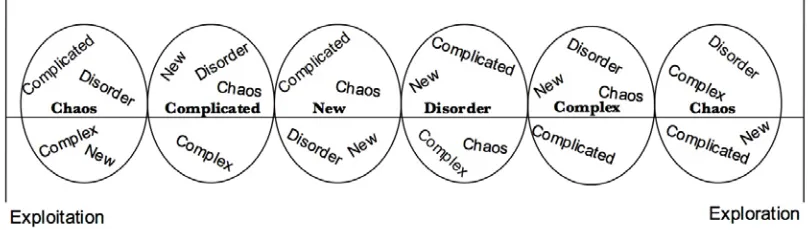
The Enabling Continuum is introduced as a navigation and analysis tool to assist in further exploring responses elicited from the research question – namely, what influences the Localism Act, as a top-down policy directive, has on decision making at the local level. The work of Sabatier and Mazmanian (1980), March (1991), Matland (1995) and Goldstein et al. (2010), and their attempts to describe the important balance between top-down and bottom-up tensions, has been fundamental to my examination of relationship tensions. I have introduced a normative model, not to solve or avoid these relationship tensions, but rather to use them constructively in certain circumstances. In all these scholarly works there is the common thread of a relationship tension described as the tension between structure and spontaneity. The relationship tensions between structure and spontaneity are found and represented at the extreme ends of the Enabling Continuum (for further detail see Figure 3E, p 65). When applied to complex societal issues, the continuum offers an ability to navigate entanglement and provide an enhanced understanding of influences on decision making at the local level. March (1991) describes this tension as the between
At one end of the Enabling Continuum, linear (top-down) experiences are those of
exploitation, where planned or established certainties are favoured. At the other end, non-linear (bottom-up) experience is presented as exploration, encouraging unplanned new possibilities. March (1991, p.71) argued that maintaining an appropriate balance between exploitation and exploration was a primary leadership factor in system survival and prosperity. In chapters 5, 6 and 7, I present my findings and examine the tensions to be found in system survival (structure) and prosperity (spontaneity).
As part of the research design, I have overlaid on the Enabling Continuum the pathway to criticalisation described by Goldstein et al. (2010), which provides a framework for how systems adapt to change (see Chapter 3, p. 63). Criticalisation is designed to articulate the complexity of change, such as moving from clarity (linear) to chaos (non-linear) in a changing environment. Focusing on the governance of policy directives (particularly policy systems or directives that encourage decision making at the local level), I use the Enabling Continuum as an analytical tool to better understand the shift and balance between linear and non-linear adaptive systems (discussed later in terms of fragmentation; see Chapter 7, p.152).
1.5 Governance and Complexity
Although my exploration does not set out to defend Complexity Leadership Theory, its importance in understanding the complexities of governance arrangements cannot be ignored. Likewise, I am not attempting to debate the definition of policy implementation, or canvass arguments for or against Complexity Leadership Theory; the focus of this thesis is more on exploring constructive engagement between these two literatures and, most importantly, the shared subsequent links and causal chain of events of their most recent paradigms as explored through two governance contexts – the Collective Impact framework and the Localism Act.
and Krammer’s (2011) ‘Collective Impact framework’, further described in Chapter 4. The Collective Impact framework is a global concept first developed by Kania and Kramer following an analysis of successful organisations that deal with complex issues crossing over the political, public administration/sociology and economic spheres. The five conditions of the Collective Impact framework are considered and underpin the structure of the semi-structured interview questions, being presented in the form of three pre-conditions and five conditions (Appendix C). The fifth Collective Impact framework condition (backbone organisation) describes a set of common activities and leadership characteristics that are further explored across non-traditional approaches to leadership (see chapters 3 and 6).
The hard governance context is represented by the Localism Act, which was passed in England to address issues in society by facilitating devolution of decision-making powers from central government to individuals and communities (DCLG 2011). Localism (both old and new – see Chapter 2) aims to ensure community visibility and government accountability (DCLG 2011). England’s Localism Act represents the first legislative attempt to articulate and advocate for citizen engagement, in that it sets out targets and strategies for enabling decision making at the local level, whilst placing duties on government ministers and local authorities to act in ways designed to increase localism and citizen engagement (DCLG 2011). The Localism Act provides a governance timeline that is reflected in the research design, with data being collected for the periods 1997–2010 (before passage of the Act) and 2011–2014 (after passage of the Act.) The reason for commencing in 1997 is that this was the date that Sure Start was established. As a result of the analysis of the findings, the period between 2010 and 2012 subsequently became the key focal point of the research.
1.6 Purpose and central argument of study
such exploration that adding a Complexity Leadership Theory perspective to policy implementation studies enables governance to be considered from a non-traditional and enabling paradigm. Hence, the purpose of this research is to better understand the subsequent links and causal chains of events between governance and leadership, and to investigate top-down policy directives and their influence on decision making at the local level.
To date, explorations of the process of policy decisions are mostly to be found within the policy implementation literature. In honouring this approach I consider governance from a policy implementation perspective and explore the current governance paradigm, which represents the fifth generation of policy implementation literature (Hill and Hupe 2009). Complexity leadership Theory, with its theoretical roots in Complex Adaptive Systems theory, presents as an effective way to describe the relationship between the (change-impeding) governance paradigm and a possible sixth paradigm – enabling paradigm (see Chapter 8) – and particularly, the parts of a system that give rise to collective behaviors of governance and how these interact and form non-linear relationships within any environment. The linking of the two literatures provides a greatly improved perspective from which to explore the complex relationship tensions between policy directives and their influence on decision making at the local level.
Through my argument, my research will contribute to understanding the value of adding Complexity Leadership Theory perspectives to policy implementation studies, and, through the Enabling Continuum, demonstrate how Complexity Leadership Theory offers thinking about governance from a non-traditional perspective to consider an enabling paradigm. The Enabling Continuum is not designed to solve or avoid the inevitable tensions between top-down and bottom-up approaches but to assist policy makers use these tensions constructively in certain circumstances.
1.7 Thesis structure and chapters
describing the research methodology and boundaries of the research (Chapter 4). The findings are presented across three chapters (5, 6 and 7) with Chapter 8 providing a conclusion and recommendations for future research including presentation of an enabling paradigm. An overview of the content of each chapter is presented below.
Literature Review 1: Policy Implementation (Chapter 2)
The first literature chapter presents the case of policy implementation drawing on the five paradigms of policy implementation thought I expand on the paradox that, in the 1980s and third policy implementation paradigm, was described as the debate around synthesis. This included thinking around the topic of policy implementation across two main fields of inquiry, one arguing that hierarchical control does not bring results, and a second introducing the importance of citizen engagement and joined-up-working. Hill and Hupe (2009) describe how the paradox is more complex than a top-down/bottom-up synthesis.
The debate over the paradox has continued through various generations of policy implementation thought, moving from a strong top-down first generation (Bardach 1977) to a second, bottom-up focused generation (Nakumura and Smallwood 1980). The third generation had a clear focus on synthesis of the two perspectives (Sabatier 1986), while the fourth generation argued policy implementation was actually dead/dormant (De Leon 1999). Bringing the same tensions and controversies into recent literature, Hill and Hupe (2009) argue there is a fifth generation and current paradigm focusing on governance. The conclusion of Chapter 2 notes the importance of expanding the policy implementation exploration to include the subsequent links and causal chain of events between governance and leadership, which is considered through a detailed analysis of Complexity Leadership Theory.
Literature Review 2: Complexity Leadership Theory (Chapter 3)
Complexity Leadership Theory, which has its roots in Complex Adaptive Systems theory. Complexity Leadership Theory is expanded upon using the domains of a Cynethin framework (Mintzberg et al. 1998) and theory of change (Weiss 1995), which are introduced to assist with the discussions of change including obvious, complicated, complex, and chaotic disorder, all further expanded in the findings chapters (5,6 and 7).
Chapter 3 presents the Enabling Continuum, a normative model that is used to plot emergent behaviours, patterns from differences between linear and non-linear environments and dynamic networks of interactions. The relationship between the two ends of the Enabling Continuum, exploitation and exploration,assists with reviewing the relationship tensions of interest in my study. I examine the experiences of Sure Start key actors along the Enabling Continuum using the two governance arrangements, frameworks (the Collective Impact framework) and legislation (the Localism Act). Following a series of semi-structured interviews, I explore governance and leadership and any influence on decision making at the local level as reflected through the Sure Start program.
The Enabling Continuum provides a suitable navigation tool for an analysis of cycles of interactions that represent non-linear and emergent change environment. Such explorations are important for understanding change, although most policies are set within a linear term and, based on an assumption of cause and effect, and attempt to predict the steps of change. Chaos is the opposite position, related to the behavior of non-linear dynamic networks and therefore closely related to emergent and changing situations. This calls for a different, non-traditional form of leadership. Complexity leadership theory presents three leadership approaches, and the addition of these leadership approaches to policy implementation offers a paradigm for thinking about governance from a non-traditional perspective.
Methodology: Collective Impact framework and Localism Act (Chapter 4)
are described and presented in two governance forms (soft and hard). The first arrangement is presented in the form of soft governance utilising the governance framework referred to as Collective Impact framework (Kania and Kramer 2011). This framework of soft governance was utilised to underpin the semi-structured questions and prompts used to interview the key actors. The responses from the interviews were considered across the timeline of the Localism Act. The Localism Act is presented as the second governance arrangement, hard governance, utilising the time period pre- and post- the Localism Act.
The research methodology is presented in three phases: exploration (the interviews of the Sure Start key actors), implementation (the influence of The Localism Act, pre- and post-implementation) and analysis (the identification and expansion of common themes). The scope of the research details the use of the Enabling Continuum as a tool to navigate the experiences of entanglement across the three relationship tension domains (Staites and Rogers 2012 – financial; interpersonal; political). The final part of Chapter 4 is the outline of the research boundaries and limitations, particularly the issues that surround single case studies. Drawing on the three relationship tensions within the findings chapters (5, 6 and 7) I introduce and discuss briefly the three discoveries: key principle adequate resources; leadership as a missing link; and
paradox of fragmentation. Six scenarios provide the framework to explore and interpret the relationship tensions that are identified between top-down policy (Localism Act) and its influence on decision making at the local level (Sure Start key actors). These are presented in the form of streamlining of funds, starving of funds, communication,
dynamic networks, principles-first approach and application-first approach. The findings chapters, the three discoveries and their six scenarios emerge from an analysis of the three relationship tension domains.
Financial domain – Discovery 1: Key principle and adequate resources (Chapter 5)
Interpersonal domain – Discovery 2: Leadership a notable missing link (Chapter 6)
Generative leadership is examined across the three leadership approaches, with particular interest in traditional and non-traditional leadership approaches. Consideration is given to non-traditional leadership behaviours that not only embrace emergence but also provide a useful way to navigate the pathway to criticalisation. As demonstrated on the Enabling Continuum the two scenarios of communication and dynamic networks are considered as integral to a non-traditional and non-linear approach to achieving systemic change.
Political domain – Discovery 3: Paradox of fragmentation (Chapter 7)
Fragmentation is presented as a paradox wherein the design of policy is often at odds with the policy intention. Extending the political rhetoric of a parent/child syndrome (discussed in Chapter 2), the Sure Start case study reveals a constant tension between positive and negative experiences of fragmentation and change. Two scenarios are introduced in Chapter 7 to assist with the discussion of the paradox. The first scenario presents as a principles-first approach, or deductive approach, which derives conclusions or facts from general principles or concepts. The second scenario is an application-first approach, which aims for open access to information but not within any pre-set boundary. Although set within a principles-first approach the purpose of the Localism Act is more akin to an application-first approach. The Act aims to address issues in society, supporting citizen engagement policy directives (such as Sure Start) to ensure community visibility of government accountability. While the Localism Act was designed to reduce tensions between central and local levels of government, its very design appears to achieve the opposite and exacerbate such tensions.
1.8 Thesis conclusion (chapter 8)
The research findings indicate that, as a result of limited funding and inadequate resources, Sure Start moved closer to the exploitation end (increased bureaucracy) of the Enabling Continuum. I argue as a result, entrenched silos, reduced leadership and decreasing decision making at the local level emerged as unintended outcomes of the Localism Act. Consequently gaps in funding and inadequate resources resulted in a gap in generative leadership. It was recognition of this gap that resulted in leadership being described as an important second discovery (a notable missing link). The reduction of resources negated the conditions for a generative leadership style and, consequently, for an enabling leadership approach to lead emergence and change. Leadership as a missing link reduced the capability for effective communication and linkage of networks, which in turn further heightened entrenched silos and increased bureaucracy. Less communication and more confusion were other results of the missing leadership link. This created fragmentation and distortion of the necessary networks, thus limiting the position at the exploration end of the Enabling Continuum, innovation and change.
The six scenarios are fundamental to the exploration of the subsequent links and causal chain of events between governance and leadership. The streamlining of funds causes an adverse impact on resources. Equally the starving of funds results in resources being reduced with blame for not achieving results. Both of these scenarios leading to inadequate resources have been used to describe how such experiences resulted in the creation of entrenched silos. Silo working is the opposite to joined-up-working and thus not positively able to influence decision making at the local level. The role leadership played in these silos was highlighted more from a position of it being a missing link particularly in joined-up-working. The missing link was intensified through lack of communication and inability to build dynamic networks.
inadequate resources leading to reduced enabling leadership styles that could navigate dynamic networks the resulting experience was often one of confusion and further entrenched silos.
Confusion can also be a way to describe fragmentation, or what is referred to in Complexity Leadership Theory as disequilibrium – the state needed for change. Of the two forms of fragmentation, principles-first can create too much bureaucracy and be too linear, whilst application-first can enable freedom of direction with room for creativity but be too non-linear. Both approaches create disequilibrium. I describe the varying states of disequilibrium and use the six scenarios to describe how they are significant and collectively considered across the Enabling Continuum normative model.
Chapter 2. Literature Review Part 1 – Policy
Implementation Literature
2.1 Introduction
Harold Lasswell (1951) introduced the idea of seven stages of the policy process: intelligence, promotion, prescription, invocation, application, termination and appraisal. This was later expanded by Pressman and Wildvasky (1973), with their considerations of policy implementation as an important separate stage. In their seminal work, Pressman and Wildavsky defined policy implementation as ‘the ability to forge links in the causal chain so as to obtain the desired results’ (Pressman and Wildavsky 1973, p.xv). This definition was based on their description of how the study of implementation required an understanding of apparently simple sequences of events, and how this in turn depended on complex chains or reciprocal interactions – the forging of subsequent links. Pressman and Wildavsky also recognised that each sequence should be considered in relation to the others. In later studies, the failure to consider such sequences was described as the missing link and became the topic of further work (see for example, Hargrove 1975; DeLeon 1999). The concept of the missing link is of interest to this research, not only in how it relates to policy implementation, but also in how it can be explored and understood through the subsequent links to governance, with a particular focus on top-down policy making, and decision making at the local level.
Interest in policy implementation as an issue independent of decision making extends beyond policy scholars. For example, Ottoson and Green, well-known scholars in public heath and education, found much of their work aligned with policy implementation. In their 1987 review of the concept and context of the theory of implementation, they contributed to the policy implementation debate through their observations on some of the scholarly work:
Implementation is variously described as a stage, a process, or as actions. For Williams (1976),
implementation ends when program operations begin, but for Weiss (1972) implementation is
program operations. For Pressman and Wildavsky (1973), implementation is a process of
interaction; for Berman and McLaughlin (1976), implementation is more specifically an
Ottoson and Green concluded that the debate as to whether policy comes before, during or after implementation was a theme running throughout most of the literature (1987, p.376). This realisation was foreshadowed by Kingdon (1984) who identified the importance of agenda setting, with Lipsky (1980) over a period of three decades introducing the term street level bureaucracy to describe how policy agenda setting was often experienced by those responsible for implementing the policy. This was an important piece of work: it provided insight into the tensions that exist before, during and after policy implementation. Interest in the tensions between policy setting and policy implementation continued throughout the 1980s and 1990s and into the new millennium. Barrett conducted research throughout this period and at the turn of the century noted a shift in approaches to policy implementation. In her reflection on policy implementation studies she concluded further exploration was needed to ‘address the central paradox of control and autonomy’ (Barrett 2004, p.261). While this central paradox is also referred to as a tension between top-down administration and bottom-up dynamics, Hill and Hupe describe how the paradox is more complex than a top-down/bottom-up dichotomy.
While the top-down/bottom-up debate was heavily influenced by the question of how to
separate implementation from policy formation, that was only part of a wider problem about
how to identify the features of a very complex process, occurring across time and space, and
involving multiple actors (Hill and Hupe 2009, p.44).
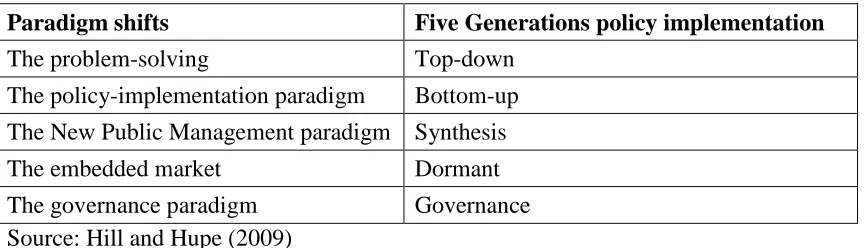
The debate over complexity has continued through various generations of policy implementation thought as detailed in Table 2.1.
[image:36.595.87.521.632.756.2]2.2 Policy implementation
Table 2.1 provides an overview of the changes in both the practice and the study of policy implementation over the last fifty years.
Table 2.1: Five generations of thinking about policy implementation
Paradigm shifts Five Generations policy implementation
The problem-solving Top-down The policy-implementation paradigm Bottom-up The New Public Management paradigm Synthesis The embedded market Dormant
The governance paradigm Governance
My research focus is on the subsequent links and causal chain of events explored in the most recent paradigm, the governance paradigm. The governance paradigm is considered to be particularly relevant when considering relationship tensions and will be utilised in this study to explore the subsequent links and causal chains between governance and decision making at the local level. The five schools of thought are explored in the five subsections below, through examination of a small but representative sample of views from scholars considered to be the leading contributors to each generation of thought.
Generation One: the problem-solving paradigm
The top-down spectrum formed much of the first generation of implementation studies. Bardach (1977) was not necessarily an advocate of the top-down approach but his work heightened understanding of the tension between the popularity of community control (decision making at the local level) and bureaucracy. In understanding that social scientists could offer much to the complex area of public policy, Bardach designed an analytical framework for examining implementation issues. Although this framework was based on four distinct types, Bardach recognised that there was often a mixture of types in the real world and that any grouping was somewhat arbitrary. Bardach likened much of policy implementation to a game, with the role of a fixer required to know who should be the stakeholders and what should be the stakes.
constant controversy between the accountability frameworks being applied and the direction chosen by the workers on the ground. The third type of policy implementation represented a form of social entropy, interpersonal and personal forces in the social world that confounded the system, adding to the complexity. Bardach noted that there was a tension and premise ‘that nearly all control systems operate on a premise that a certain degree or standardisation is possible and desirable’ (Bardach 1977, p.129). In his early thinking it was already becoming apparent that the effectiveness of top-down approaches was already being questioned.
There is a mistaken notion on the part of many people that the problems of social entropy –
incompetency, variability in the objects of control, poor coordination, and perhaps others can be
solved by designing better management tools and procedures and by giving more power to
institutions specialising in management (Bardach 1977 p.139).
It was this notion, of tension and controversy, that, gave rise to Bardach’s fourth distinct type of policy implementation – the dissipation of personal and political energies in game playing and, more importantly, the energy that was taken away from the ‘end game’ (1977).
Generation Two: the policy implementation paradigm
With Generation Two, policy implementation thinking moved into a period of exploring different approaches to policy implementation. Nakumura and Smallwood (1980) focused on case study literature of policy implementation and noted how it had grown rapidly since Pressman and Wildavsky (1973). Their exploration considered policy implementation from the perspectives of various actors (e.g. policy makers, bureaucrats and social scientists) including the politics of policy implementation. The underlying question behind their case studies was whether it was ‘possible to construct a meaningful model of policy implementation that captures the complexities or circularity in a manner that is both comprehensive and comprehensible’ (Nakumara and Smallwood 1980, p.vii).
Nakumura and Smallwood reported that the case studies on policy implementation that appeared during the 1970s revealed a progressive shift away from the classical hierarchy model (Nakumara and Smallwood 1980, p.18). Their work identified that policy implementation was best characterised as a fluid series of interrelationships, thus challenging the classical model of hierarchy and top-down spectrum where action, particularly for change, was directed from the top toward the bottom. To better understand the top-down spectrum Nakumura and Smallwood developed a conceptual framework that introduced three policy environments: policy formation, policy implementation and policy evaluation. The key finding of their 1980 conclusion was that there was a circular relationship between all three policy environments (a line of thought foreshadowed in the work of Rein and Rabinovitz (1977) and their principle of circularity). A common theme was that the tensions of a top-to-bottom functional approach could not be ignored. Nakumura and Smallwood, in embracing these tensions and the three policy environments, designed five criteria to assist with the subsequent links and casual chain of events: policy goal attainment, policy efficiency, constituency satisfaction, clientele responsiveness and system maintenance.
Our analysis has indicated that the policy implementation process is characterised by a complex
series of diverse linkages among policy makers, implementers, and evaluators, and that a high
degree of political judgment and leadership is required to tie this system into an integrated
The issue of leadership was recognised, although not included as part of these criteria. The recognition of there being some alignment and linkage with leadership did, however, prompt many of the second generation thinkers to explore the best way to enable change and move a policy proposal to successful fruition. Mazmanian (1983), Nakumara et al. (1980) and Berman (1978) were some of the second-generation thinkers to characterise how a shift in the top-down spectrum, to a less authoritative and administrative approach, was needed to incorporate bottom-up perspectives. One commonality in their collective work was the view that bottom-up policy implementation was only successful when those primarily affected were actively involved in the planning and execution of relevant programs. It was at this point that the literature began to recognise that consideration of both ends – top-down spectrum and bottom-up perspectives – was important and a third generation of thought focused on synthesis or balance emerged within the New Public Management paradigm.
Generation Three: the New Public Management paradigm
The third generation of policy implementation thought and the New Public Management paradigm brought a period of synthesis between the top-down spectrum and bottom-up perspective, with Sabatier (1986) one of the key authors of this synthesis. However Matland (1995) and Ingram (1990) also presented contingency theories in an attempt to balance top-down and bottom-up tensions. The 1980s saw considerable debate and development of thinking around the topic of policy implementation across two main fields of inquiry: one arguing that hierarchical control does not bring results, and a second focusing on the importance of citizen engagement and networks.
on the policy implementation process, Sabatier and Mazmanian (1980) later proposed five conditions for evaluating when to adopt a top-down spectrum, a bottom-up perspective or both. This is described and further detailed in the next paragraph as five conditions of effective policy implementation. Various third generation scholars (Sabatier 1986; Elmore 1978; Lane 1987) identified the goal of synthesis as balancing out the controversy between those supported hierarchy and control (structure) and those who supported learning, adaption and problem solving (spontaneity). In Chapter 3 this controversy is presented as an entanglement of relationship tensions.
Returning to Sabatier and Mazmanian’s (1980) five conditions of effective policy implementation, a common bonding denominator was identified: leadership. Both sets of conditions (the six from Sabatier and Mazmanian 1979 and the five from Sabatier and Mazmanian 1980) highlight the importance of accountability for those overseeing, or being the recipients of, the policies being implemented. The earlier work of Van Meter and Van Horn (1975) recognised the importance of characteristics of the implementing agencies of policy implementation. Building on this, Sabatier and Mazmanian increased the number of necessary characteristics to include recruitment of committed and skillful officials to lead the accountability of the interest groups being supported. It was at this point of the third generation that recognition of the need to lead the policy implementation process was at its peak. In Sabatier and Mazmanian’s attempt to contemporise the conditions for effective implementation, they re-summarised the focus onto the style of leadership so as to balance the tensions between structure (hierarchy and control) and spontaneity (adaptive problem solving). Although their exploration of leadership was limited, awareness of the need for a balance between relationship tensions had emerged. This resulted in a feeling of paralysis that was, at the time, considered to be reflective of the market; hence the introduction of the fourth generation of policy implementation thought and its ‘embedded market’ paradigm.
Generation Four: the embedded market paradigm
as De Leon (1999) were labeling policy implementation studies as being at an intellectual dead end with DeLeon arguing that rational choice and game theory was the way to navigate out of this intellectual dead end. DeLeon’s thinking represents an early signpost of a constructive engagement that was later to emerge between political sciences and complexity sciences; the two literatures I examine in this chapter and in Chapter 3.
However not all scholars agreed that policy implementation was an intellectual dead end. For example, Barrett (2004) preferred to explain the fourth generation as the generation that wasn’t. In using the phrase ‘wasn’t’ Barrett was emphasising that it was not the end for policy implementation, quite the opposite as a new paradigm was emerging. Scholars, such as DeLeon (1999), O’Toole (2000) and Barrett (2004), who were interested in pushing the boundaries of thinking about policy implementation, looked for a more contemporary paradigm, focusing on the outcome and consequences of policy implementation, rather than the structures or processes that had framed much of the thinking in the previous generations.
The combination of greater emphasis on a democratic orientation, buttressed by more of a
post-positivist orientation and methodology and a realistic assessment of what implementation can
deliver (as opposed to promise) may not win any Nobel Prizes (DeLeon 1999, p.30).
was regarded as satisfactory achievement); resource availability (introducing the private sector); and control of agencies’ personnel (line management accountability). These factors demonstrated a shift in focus, with leadership becoming more prominent, as Barrett was very clear on the responsibility and accountability of those in leading roles.
Managers were now responsible for putting policy into effect and also to blame if things went
wrong. Success or failure was judged on the basis of meeting pre-set targets for ensuring
delivery on policy targets (Barrett 2004, p.258).
In reviewing the embedded market paradigm, it could be argued that the fourth generation of policy implementation was simply the beginning of the next paradigm.
Generation Five: the governance paradigm
As the main architects of the governance paradigm, Hill and Hupe (2009) promoted
governance as the focus of the next era of policy implementation studies. Lynn et al. (2000) had earlier introduced a hierarchy of relationships as a way to further understand the logic of governance: those relationships that exist between citizens’ preferences and legislative choice; between legislative preferences and formal structures; between formal structures and management; between management and the primary work of public agencies; between public agencies’ focus on outputs/results; between outputs/results and stakeholder assessments; and between stakeholders’ assessments and political preferences and interests – which should relate to citizens’ preferences. Many of these considerations demonstrated the importance of horizontal and vertical relationship tensions, and Hill and Hupe considered how governance could play a role in balancing such tensions.
Practitioners in public administration are working under an action imperative. They constantly
need to answer questions for themselves about how to act. The study of implementation is about
those acts (Hill and Hupe 2009, p.164).
Governance makes the top-down /bottom-up debate seem rather dated, and the top-down control
emphasis in the work of some of the top-downers writers particularly irrelevant. Implementation
theory has developed and moved away from that debate to take on board complexity in respect
both of the process and of the related issues of control (Hill and Hupe 2009, p.201).
Osborne (2006) described the shift, and the new governance paradigm, which he referred to as New Public Governance and levels of governance, as a transitional stage in the move away from traditional public administration.
The two specific examples of hard and soft governance explored in this thesis are described in Chapter 4. First, however, I will discuss two important points of tension identified within the governance literature; namely, collaboration and joined-up- working, and the division between localism and centralism.
2.3. Governance
Collaboration and joined-up working
Collaboration and joined-up-working are phrases often used within governance dialogue, particularly in relation to subsequent links and causal chains of events. The term ‘silos’ is often used to describe joined-up ways of working. Silos and non-joined-up working, and how silo working becomes further entrenched, are discussed in Chapters 5, 6 and 7 in the context of the case study (Sure Start program). In Chapter 3 the tensions between collaborative working and silo-based working are expanded to include the concept of leadership for collaborative advantage.
To get the real advantage out of collaboration it is argued that something has to be achieved that
could not have beenattained by any of the organisations acting alone (Huxam 2003, p.403).
If collaborative advantage is the goal behind the policy rhetoric of partnership and the ambitions
of practitioners who initiate them why is collaboration inertia so often the outcome? (Huxam
2003, p.404).
In this study, policy rhetoric is identified as the ‘parent/child’ syndrome, which is also used by those implementing a particular program as a reactive tactic to survive inadequate resourcing. Both Frye and Webb (2002) and Huxam (2003) have made reference to evidence of such relationship tensions, especially the impact on collaboration and/or being a suitable partner. Further examples of these tensions are identified within the discussions of ‘old’ and ‘new’ localism presented in this chapter. This is not to say that all governance must be achieved collaboratively or in partnership: in some cases, such as discussed in Frye and Webb (2002), there has been a strong trend towards not working in partnership, with some tasks being better suited to single working frames.
One particular tension which, manifests in silo working, is the attitude or mentality that results in people and organisations not wanting to work together. As previously noted, the ability for departments within government to work in a joined-up way is often difficult to achieve in practice. However such difficulties have not diminished government’s enthusiasm and attempts to achieve joined-up or interagency working. Chapman (2002) concluded that successful interagency working requires a change in systems and governments needing to think differently. In relation to pursuing such inter-agency collaboration, Hardy et al. (1992) identified five barriers to systemic change and collaboration. These could be structural (such as fragmentation of service responsibilities across inter-agency boundaries); financial (particularly in the stocks and flows of resources); professional (differences in ideologies and values); and
status or legitimacy related. However, whether it be reduction of silos or collaboration for improved joined-up-working, some commentators (Frye and Webb 2002; Huxam 2003; Dickson and Glasby 2010) argue that partnership working doesn’t always work.
We believe that current misunderstandings about the nature and the potential of partnership
working mean that many partnerships are designed in ways which mean that they are unlikely to
This study does not explore the multitude of reasons for such arguments around governance partnership tensions, but it does explore the missing links of the relationship tensions that arise from entrenched silos. Some of these missing links can be presented as gaps in human resources; duplication of service delivery; or as disconnects in alignment of individuals and service delivery. Stanton (2015) identified other examples of missing links in his study on decentralisation and empowerment.
Despite certain provisions seeking to develop powers to local authorities, councillors do not feel
that decentralisation had happened in any meaningful way (Stanton 2015, p.990)
Duit and Galaz (2008) also examined empowerment, suggesting further research is needed to incorporate Complex Adaptive Systems (CAS) theory as part of social, political and ecological contexts. The importance of engaging end users and shifting away from command-and-control governance is described under many different forms.
[A] plethora of different schemes of self-government, public-private partnerships, collaborative
efforts, policy entrepreneurs, and participatory initiatives usually gathered under the umbrella
term of ‘governance’ (Duit and Galaz 2008, pp.328–29).
Sullivan (2010) described this governance experience of empowerment (citizen engagement) using the term neighbourhood – reflecting her thinking about the rationales, challenges and relationship tensions that she consequently labeled
neighbourhood governance.
The attractors that make up neighbourhood governance have a focus on supporting “more
bottom-up involvement and decision making and countering the highly centralised system of
local government in England (Sullivan 2012, p.1).
For the purposes of this study, the term neighbourhood has been extended to include ‘citizen engagement’, as this is what is implied particularly when considering decision making at the local level. In earlier work, Sullivan and Lowndes (2008) linked the importance of neighbourhoods and citizen engagement when attempting to balance the relationship tensions that arise when policy actors attempt to manage complex societal issues.
The potential value of exploring ‘life-episodes’ and ‘wicked issues’ from the perspective of the
neighbourhood offer a different dimension to how to consider ‘place’ and to determine what is
Throughout this study, I utilise the four principles of neighbourhoods as presented by Lowndes and Sullivan (2008) to underpin the concept of what is later presented as dynamic networks (in chapters 3 and 6). These four principles (neighbourhood empowerment, neighbourhood partnership, neighbourhood government and neighbourhood management) are often caught within an entanglement of relationship tensions. It is the relationships tensions found within these four principles that form complex dynamic networks. In contrast to traditional policy approaches, such entanglements cannot be controlled by national rules and procedures.
The Government should face the issue of how decentralisation to communities relates to
decentralisation to local authorities, and recognise this relationship cannot be dealt with by
national regulations that control the relationship through national rules and procedures (Jones
and Stewart 2012, p.5).
In an attempt to navigate this tension, in 2010 the Cameron Government launched ‘The Big Society’, a political strategy, which aimed to balance the free market and citizen engagement. With a clear policy mandate of giving communities more power, ‘Big Society’ was meant to encourage people to take an active role in their communities, transfer power from central to local government, support co-ops, mutual, charities and social enterprises, as well as making more government data available to the public (Cameron 2010). This study is not a critical examination of The Big Society, a topic, which has been tackled by many commentators (see for example, Jones and Stewart 2012; Stanton 2014; Lowndes and Prachett 2012). In this study, reference is made to the Big Society as a symbol of the policy drive within the Cameron Government to encourage neighbourhood governance and citizen engagement.
Centralism and Localism