Abstract: This study aims to assess the effectiveness of web-based learning activities in increasing students’ cognitive level. This study uses pre-test and post-test to evaluate the effectiveness of web-based learning activities students’ cognitive level based on Bloom’s taxonomy which proposes the following six levels of cognitive thinking: knowledge, understanding, application, analysis, synthesis and evaluation. Studies on pre- and post-test achievement were conducted (Campbell & Stanley, 1963). The respondents of the study consisted of 34 students undertaking the subject SPM 4342 (Web Based Multimedia Development) for the Bachelor of Education degree programme at Universiti Teknologi Malaysia. The findings show that the students’ cognitive level after the web-based learning activities incresed as demonstrated in their improved test scores.
Keywords: cognitive thinking, students, cognitive level, web based learning
I. INTRODUCTION
Education is considered crucial to a country’s development. A country will move forward with a high education standard, and therefore, to strengthen a country’s educational system, its nation should benefit from the use of internet technology. Internet technologies can be harnessed in the best possible way in Malaysia’s education. Internet technologies and computer can be used for various purposes, for example, in the field of medicine, business, education, industrial, and administration.
The use of computer technology usage has been increasing. According to [1] the increase of internet technologies access has necessitated the use of computer technology in the education field. It is necessary that the use of computer technology be integrated in classroom learning.
Many of the latest technologies can be deemed appropriate to be used in the education field. However, internet technologies selection with learning approach support that is suitable should be dropped make heavier so that learning delivered more effective. This measure was to ensure that information technology can be used not only to channel information but also to harness students’ thinking skills in higher level. However, to support student skills in higher level, a suitable learning approach must be chosen by the instructor in a learning process (T&L).
Revised Manuscript Received on December 05, 2019.
Hamzah. N, Department of Professional Education, UTHM, Batu pahat, Malaysia.
Ahmad. F. Faculty of Technical and Vocational Education, UTHM, Batu Pahat, Malaysia.
Zakaria. N, Department of Engineering Education, UTHM, Batu Pahat, Malaysia.
Rubani. S N K, Department of Engineering Education, UTHM, Batu Pahat, Malaysia.
Ariffin. A, Department of Professional Education, UTHM, Batu Pahat, Malaysia.
II. LITERATUREREVIEW Higher-Order Thinking Skills (HOTS)
High-order thinking is defined as the use of mind to interpret, analyse, or manipulate information to solve problems that cannot be answered through the application of existing knowledge[2]. High-order thinking involves all public mind types like critical thinking, creative thinking, problem solving, and decision making [3]. According to [4] thinking skills are greatly needed to form pupil cognitive development from the aspect of perception, problem solving, social skill, and motivation achievement; for example, if a student knows how to solve a problem, he or she would be able to use the knowledge to solve Dari B. problem KPM point of view. Higher Order Thinking Skills (HOTs) has five (5) key elements to be exercised in class, namely reasoned, inquiry, technique question, creativity, and evaluate. Inquiry refers to a deep curiosity about a phenomenon.
The third element of technique question is crucial for building students’ critical thinking, and therefore, this technique needs to be implemented with a method that attracts students to brainstorm ideas. The creativity element is creative which is in adding good results of the evaluation carried out by critical knowledge [5].That’s mean, individual said critical, needs to find the alternative way to better quality of thought whether increase his strength or reduce his weakness. Meanwhile for evaluate, the students’ also found less complicated from create hence placing at lower category.
Collaborative Learning Based on Web
Collaborative learning involves cooperation between teachers and students and student with students. Collaborative learning is one of the learning strategies that can be used to promote cooperation between a student and other students. This strategy is crucial to produce an interactive outcome that is more suitable for joint learning. According to [6], collaborative learning is one of the most effective learning strategies for developing communication skill towards students. This strategy has been widely used to produce students with humanity and teamwork skills.
Nevertheless, the implementation in conventional learning environment has encountered various problems particularly in terms of implementation time, a static learning environment, and limited learning resources. Therefore, extensive computer usage would force teachers to accept that the use of computer technology should be benefited by all parties particularly students. The role of the instructor is equally important so that no students are left behind and to ensure that no student abuses the computer technology. Given this point,
Hamzah. N, Ahmad. F, Zakaria. N, Rubani. S N K, Ariffin. A
an instructor is required to monitor learning through web so that the students do not abuse the web technology in the education field.
Learning through web is said to be able to facilitate reducing the constraints mentioned above and can provide a more flexible and efficient collaborative learning environment. Accordingly, a collaborative learning process would encourage a cooperative process among students in their learning process [7].
III. METHODOLOGY
The respondents of the study consisted of students from the Faculty of Education, Universiti Teknologi Malaysia (UTM), Skudai, Johor. This research involve a class or section that take Technology based on subject Web. A group of students were gathered in an experimental group to test the effectiveness of their learning activity, particularly their cognitive thinking level for the subject SPM4342 (Development of Multimedia Based on Multimedia).
Cluster sampling was used to select the respondents due to the difficulty in obtaining a complete sampling framework for the purpose of the study. It was thought that the research sample needed to represent a cluster of UTM students who take the web technology subject in the faculty of education.
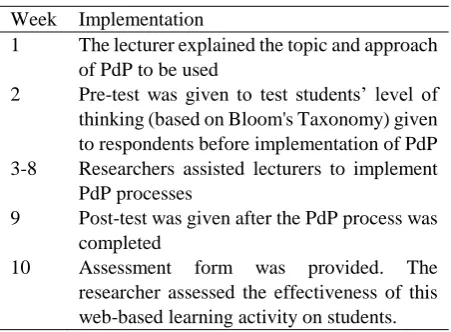
[image:2.595.56.282.547.713.2]Pre and post tests were carried out to uncover the effects of web-based learning activity on students’ cognitive level (based on Bloom's Taxonomy). However, only the pre-achievement test questions were distributed prior to the learning activity. Before the T&L session was carried out, the students were requested to answer the questionnaire on cognitive thinking level. After that, the students were given brief information on the subject chosen. The naturalistic study involved all final-year students who were taking the subject “Web Technology” in the Faculty of Education. During the PdP process, four meetings were conducted, and every meeting lasted approximately two hours. The experiment was carried out for ten weeks in the first semester of 2016/2017. Table 1 shows the actual schedule of the research work.
Table. 1 Actual Planning Study Schedule
Week Implementation
1 The lecturer explained the topic and approach of PdP to be used
2 Pre-test was given to test students’ level of thinking (based on Bloom's Taxonomy) given to respondents before implementation of PdP 3-8 Researchers assisted lecturers to implement
PdP processes
9 Post-test was given after the PdP process was completed
10 Assessment form was provided. The researcher assessed the effectiveness of this web-based learning activity on students.
Table 2 shows the pre and post test (one group pre test and post test, this type of experimental design has been widely used in educational studies. In the pre-test and post-test group design, a single group of subjects is given, pretest (O) and treatments (X).
Table. 2 Experimental Design of “One group Pretest-Posttest
Group Pre Test Method Post Test
A O X O
O Measurements or scores.
X Treatment instrument whose effect can be measured
The pre and post tests were conducted to identify the effect of a learning activity on students’ cognitive level before and after following a PdP. The questions for both tests were constructed based on Bloom’s Taxonomy, which proposes six levels of cognitive processing: knowledge, understanding, application, analysis, synthesis, and evaluation according to [8].
In order to build the pre and post-test questions, the researcher constructed test questions based on the opinion of the lecturers who taught the subjects. Subjective questions were used to mimic the format used in the tests in the previous semester. Overall, the tests consisted of ten questions with sub questions as elaborated further.
The division of pre and post test questions is divided into two sections: Part A and Part B. The researcher also asked the students to state the reason for their response to support the accuracy of the answer selection and it is directly able to determine the cognitive level of the student when responding to the test questions. Prior to the tests, the questionnaire was reviewed by a lecturer who taught the selected subjects to obtain the validity of the test questions as one of the instruments for this study. The questions for both tests were developed according to the cognitive levels proposed in Bloom’s taxonomy.
IV. RESULTS
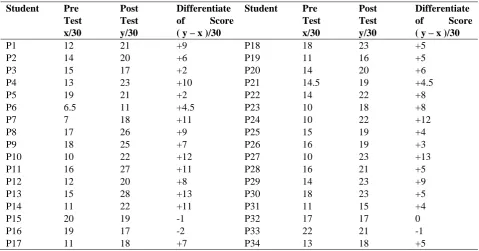
The researchers used a set of pre- and post-test questions (Campbell & Stanley, 1963). The students involved were those taking the subject “SPM 4342” (Web Based Multimedia Development) for the 2016/2017 semester session 1. Table 3 shows the distribution of scores of the pre- and post-tests for each participating student. The data analysis indicated that the lowest marks for the pre and posttest are 6.5 and 11, respectively (out of the 30 overall marks). The highest overall mark for the pre and posttest is 22 and 28, respectively. As shown in Table 3, the post-test scores are generally higher than the pre-test scores, and only one student did not improve his/her score.
Table. 3 Total Score Distribution of Pre-Student and Post-Test Achievement Tests Student Pre
Test x/30
Post Test y/30
Differentiate of Score ( y – x )/30
Student Pre Test x/30
Post Test y/30
Differentiate of Score ( y – x )/30
P1 12 21 +9 P18 18 23 +5 P2 14 20 +6 P19 11 16 +5 P3 15 17 +2 P20 14 20 +6 P4 13 23 +10 P21 14.5 19 +4.5 P5 19 21 +2 P22 14 22 +8 P6 6.5 11 +4.5 P23 10 18 +8 P7 7 18 +11 P24 10 22 +12 P8 17 26 +9 P25 15 19 +4 P9 18 25 +7 P26 16 19 +3 P10 10 22 +12 P27 10 23 +13 P11 16 27 +11 P28 16 21 +5 P12 12 20 +8 P29 14 23 +9 P13 15 28 +13 P30 18 23 +5 P14 11 22 +11 P31 11 15 +4 P15 20 19 -1 P32 17 17 0 P16 19 17 -2 P33 22 21 -1 P17 11 18 +7 P34 13 18 +5 * N = 34 students ; (+) increase ; (-) descrease
Figure 1 shows the percentage of students according to their achievement categories in the pre and post tests. Most of the students improved their scores in the post test (91%, 30 students). Only 3 students (8% students) slackened their scores in the post test, and only 1 student 1% (a student) achieved similar scores in both tests. As shown in Table 3, the pre and post test achievement scores were tested for their distribution of data normality, and Table 4 shows the results of the analysis.
Fig. 1 Percentage Distribution of Students
Figure 1 shows the percentage of students according to their achievement categories in the p and posttest. Most of the students improved their scores in the post test (91%, 30 students). Only 3 students (8% students) slackened their scores in the post test, and only 1 student 1% (a student) achieved similar scores in both tests. As shown in Table 3, the pre and posttest achievement scores were tested for their distribution of data normality, and Table 4 shows the results of the analysis have been defined in the abstract.
Table. 4 Results of the Normalised Distribution Test
[image:3.595.49.278.458.601.2]Results from the Kolmogorov-Smirnov and Shapiro-Wilk tests indicate that the data are normally distributed as the results from both tests are not significant (> 0.05). Therefore, the data of this study are normally distributed. The null hypothesis is therefore accepted; in conclusion, the pre- and post-test scores of the students are normally distributed. Figure 2 show the scatter plots for the pre- and post-test scores. Fig. 2 (a) show that the data are normally distributed because the pre- test scores appear to be distributed on a straight line. Fig. 2(b) shows that the data of the test scores are normally distributed because they appear to be scattered as a straight line. Table 5 shows the mean and standard deviation of the pre- and post-test scores.
Fig. 2 scatter plots for the pre- and post-test scores
[image:3.595.307.542.580.667.2]Table. 5 Mean Value and Standard Deviation (SD) of the Pre-test and Post-test Scores
Group N Mean SD Pretest 34 14.09 3.677 Posttest 20.41 3.491
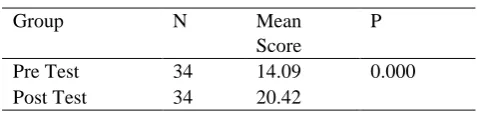
[image:4.595.49.288.236.293.2]The results of the pretest and post test scores show that the mean score for the posttest is 20.41, which is higher than the mean of the pre-test scores (14.09). To determine whether there is a significant difference between the mean score of the pre test and the post test, a paired-sampled t-type test was conducted
Table. 6 T-Test Analysis Min Pre Test Scores and Post Test
Group N Mean Score
P Pre Test 34 14.09 0.000 Post Test 34 20.42
Table 6 shows the results of the t-test analysis. A significant value was obtained (p = 0.000), which is less than the specified level of significance level (p <0.05). This shows that the results of the study rejected the null hypothesis and the researchers decided that there is a significant difference between the achievement of students before and after the web-based learning activities. A higher mean score value was noted after the web-based learning activity (20.42), thus indicating that the activities can improve the students' performance.
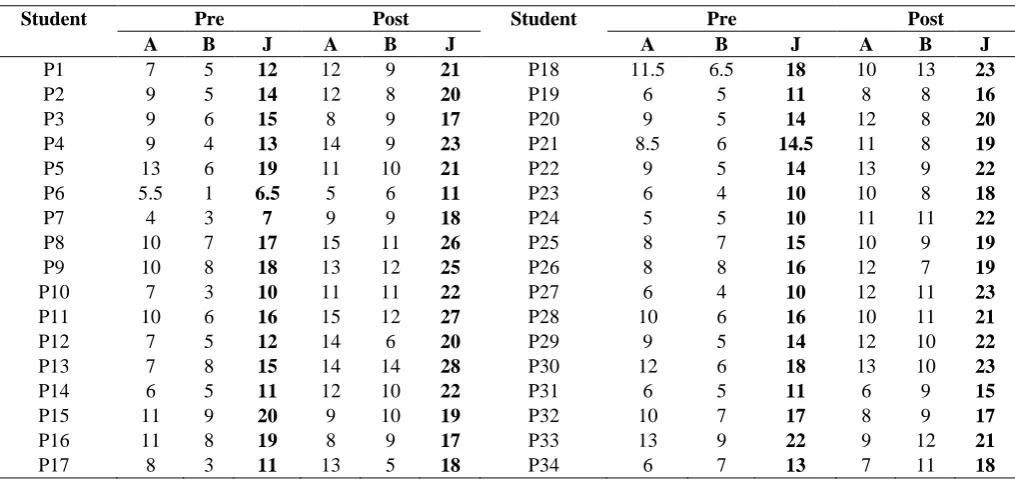
As mentioned, the pretest and posttest questions consist of two parts: Part A and Part B. Each set of questions were developed based Bloom's Taxonomy cognitive levels. Table 7 shows the test scores for Part A and Part B of both tests. Results of the analysis show that the score achieved by P13 and P27 is higher than 13 points (pretest test). P5's score rose again to a minimum by 2 marks. Nevertheless, the achievement of this test also decreased, and the highest decrease of score was achieved P16 (2 marks). In addition, the scores of P15 and P33 decreased by only 1 score. The descending score is within the range of 1 to 3 marks compared to the score of the test after the web-based learning activity was implemented (2 to 13 marks). The score of one student, P32, remains static (17/30 marks).
Table 8 shows the distribution of the number of respondents based on the answers provided for each pre and post test questions. Based on the findings of this study, it can be concluded that the web-based learning activities designed to improve the cognitive thinking level of students as the overall number of students increased for pre and post test that tested the cognitive level of students based on the bloom's taxonomy. The most significant example of the high-level improvement of student cognitive thinking in question 3 part B that tests the student's high level (level of analysis, synthesis and assessment) by increasing the number of students for pre-test questions to post test 4 people to 29 students.
Meanwhile, for question A (question 1) and section B (question 2) also increase by 22 people to give correct answer. On the other hand, the number of students who gave incomplete answers decreased the most by 23 people (pre test = 26, post test = 3) for question 3 part B. Furthermore, the number of students giving the wrong answer was the highest drop that was 25 students (pre test = 25, post test = 0) for question 1 part A.
V. DISCUSSION
The word Table 1 shows a static student of pre and post test scores. The researcher expected the student to not show an improvement over his involvement in the forum, as this student is an moderate student environment active using activities in this web based learning. Meanwhile, three students slackened their scores in the post test. They mentioned in the interview that they were not able to access the forum activities due to the lack of internet access in their residential college. These students also appeared to be less active in the e-learning process.
As indicated in Table 7, it is arguable that web-based learning activities have a positive impact on the students’ level of cognitive thinking. Table 7 shows pre-test (before) and post-test (after) scores achieved by the 34 students involved. Overall, the findings show an increase in achievement (30 students); increase were noted in the scores between 2 and 13 scores as oppose to only 3 students (student 15, student 16 and student 33) the test (1 to 2 marks). Meanwhile, one of the students scored the same for the pre and posttest (Student 32).
The researchers considered that the number of times the students viewed and posted in the discussion room (see and add discussion) is not important as their opinions are made available in the forum space. Correspondingly, [9] found that although the contribution of students to a discussion forum should be emphasized, what is more important is the level of messages in the forum space, which is expected to develop the students’ cognitive and metacognitive skills and knowledge.
Table. 7 Pre and Post Test Scores According To Part A and Section B
Student Pre Post Student Pre Post
A B J A B J A B J A B J
P1 7 5 12 12 9 21 P18 11.5 6.5 18 10 13 23
P2 9 5 14 12 8 20 P19 6 5 11 8 8 16
P3 9 6 15 8 9 17 P20 9 5 14 12 8 20
P4 9 4 13 14 9 23 P21 8.5 6 14.5 11 8 19
P5 13 6 19 11 10 21 P22 9 5 14 13 9 22
P6 5.5 1 6.5 5 6 11 P23 6 4 10 10 8 18
P7 4 3 7 9 9 18 P24 5 5 10 11 11 22
P8 10 7 17 15 11 26 P25 8 7 15 10 9 19
P9 10 8 18 13 12 25 P26 8 8 16 12 7 19
P10 7 3 10 11 11 22 P27 6 4 10 12 11 23
P11 10 6 16 15 12 27 P28 10 6 16 10 11 21
P12 7 5 12 14 6 20 P29 9 5 14 12 10 22
P13 7 8 15 14 14 28 P30 12 6 18 13 10 23
P14 6 5 11 12 10 22 P31 6 5 11 6 9 15
P15 11 9 20 9 10 19 P32 10 7 17 8 9 17
P16 11 8 19 8 9 17 P33 13 9 22 9 12 21
P17 8 3 11 13 5 18 P34 6 7 13 7 11 18
Table. 8 Percentage Distributions of Students Based On the Answers Given For Each Pre-Test and Post Test Questions
Section Question Cognitive
Level
Correct Incomplete Wrong
Pre Post Pre Post Pre Post
A
1 LL 2 24 7 10 25 0
2 LL 17 22 6 7 11 5
3 HL 23 19 10 6 1 9
4 HL 20 27 14 2 0 5
5a HL 22 21 12 12 0 1
5b HL 14 19 15 11 5 4
B 1a LL 16 20 18 14 0 0
1b LL 4 19 9 13 21 2
2 HL 6 28 24 6 4 0
3 HL 4 29 26 3 4 2
The findings corroborate the results [10], who concluded that the students involved agreed to the positive impact of a web-based learning. One of the students mentioned, ‘I feel comfortable participating in a discussion course online’. Ref [11] also reported that the level of student cognitive thinking also increased after the online learning
VI. CONCLUSION
Overall, this study has a positive implication in promoting the improvement of students’ cognitive level after following the web-based learning activities provided. In addition, this study found that the students’ level of cognitive thinking after web based learning activities increased as indicated in their test scores and their cognitive level. Their level of cognitive thinking was also noted to increase from a low level of knowledge, understanding, and application to higher levels of analysis, synthesis, and evaluation.
ACKNOWLEDGMENT
This research was partially supported by University Tun Hussein Onn Malaysia, Johor using PPG Grant (K022). We thank our colleagues from Universiti Tun Hussein Onn Malaysia who provided insight and expertise that greatly assisted the research.
REFERENCES
1. Selwyn, N., Education and technology: Key issues and debates. . 2016: Bloomsbury Publishing.
2. Yen, T.S., & Halili, S. H., Effective teaching of higher order thinking (HOT) in education. The Online Journal of Distance Education and e-Learning, 2015. 3(2): p. 41-47.
3. Zohar, A., & Lustov, E. , Challenges in Addressing Metacognition in Professional Development Programs in the Context of Instruction of Higher-Order Thinking. Contemporary Pedagogies in Teacher Education and Development, 2018. 87.
[image:5.595.40.556.352.506.2]5. Elder, L., & Paul, R., he thinker's guide to analytic thinking: How to take thinking apart and what to look for when you do. 2016.
6. Yunos, M.A.A.M., Atan, N. A., Said, M. N. H. M., Mokhtar, M., & Samah, N. A. , Collaborative Learning in Authentic Environment Apps to Promote Preschool Basic Scientific Process Skills. iJIM, , 2017. 11(3): p. 4-15.
7. Coates, H., James, R., & Baldwin, G. , A critical examination of the effects of learning management systems on university teaching and learning. Tertiary Education and Management, 2005. 11(1): p. 19-36. 8. Ramirez, T.V., On pedagogy of personality assessment: Application of
Bloom's taxonomy of educational objectives. Journal of personality assessment, 2017. 99(2): p. 146-152.
9. Khairul, A.M.D., Ahamad, Tarmizi Azizan., Mohd Sanusi,Deraman Penerimaan Dan Kebolehgunaan Rekabentuk E-Pembelajaran (CIDOS) Sebagai Sistem Pengurusan Pembelajaran Di Politeknik Malaysia. Prosiding Kolokium Pascasiswazah September 2012-2013. , 2013. 10. Shea, P., & Bidjerano, T. , A National Study of Differences between
Online and Classroom-Only Community College Students in Time to First Associate Degree Attainment, Transfer, and Dropout. Online Learning, 2016. 20(3): p. 14-15.
11. Nasser, R., Cherif, M., & Romanowski, M. , Factors that impact student usage of the learning management system in Qatari schools. International Review of Research in Open and Distance Learning,, 2011. 12 (6): p. 39 – 62.
AUTHORSPROFILE
NORHASYIMAH BINTI HAMZAH, PhD, is a lecturer at Faculty Technical and Vocational Education, Universiti Tun Hussein Onn Malaysia. She graduated her doctorate degree in Educational Technology from Universiti Teknologi Malaysia, 2014. She received the B.E. degree in computer science and technology with education (mathematics) from University Technology Malaysia, 2010. Her current research interests includes web based collaborative learning, blended learning, MOOC.
MUHAMMAD FAZRULHELMI BIN AHMAD, Master, is a student master of technical and vocational education, Universiti Tun Hussein Onn Malaysia. He graduated degree in Bachelor of Vocational Education (Multimedia Creative) from Universiti Tun Hussein Onn Malaysia at 2018 and he current research interests include web based collaborative learning, blended learning, MOOC.
NORMAH BINTI ZAKARIA, PhD, is a lecturer at Faculty Technical and Vocational Education, Universiti Tun Hussein Onn Malaysia. She graduated her doctorate degree in Technic and Vocational Education from Universiti Putra Malaysia 2013 She received her bacherlor degree in Electric and Microelektronics from Univesiti Teknology Malaysia, 2010 and Master in Technical and Vocation Education from Unversiti Tun Husseion Onn Malaysia, 2007. Her current research interests includes social studies (i.e single mother, ex-convict, and enterpreurship)
SITI NUR KAMARIAH BINTI RUBANI, PhD, is a lecturer at Faculty Technical and Vocational Education, Universiti Tun Hussein Onn Malaysia. She graduated her doctorate degree in Educational Technology from Universiti Sains Malaysia 2016 She received her B.E degree in technology with education (Mechanical Engineering) from Univesiti Teknology Malaysia, 2017. Her current research interests includes project based learning with structured scaffolding, technology education, technical and vocational, teaching and learning, and instructional design technology.
ARIHASNIDA BINTI ARIFFIN, PhD, is a senior lecturer at Faculty Technical and Vocational Education, Universiti Tun Hussein Onn Malaysia. She graduated her doctorate degree in Educational Technology from Universiti Sains Malaysia, USM 2015. She received the B.E. degree in Technical and Vocational Education in