https://doi.org/10.5194/angeo-37-289-2019 © Author(s) 2019. This work is distributed under the Creative Commons Attribution 4.0 License.
Magnetic dipolarizations inside geosynchronous orbit
with tailward ion flows
Xiaoying Sun1,2, Weining William Liu1, and Suping Duan1
1State Key Laboratory of Space Weather, National Space Science Center (NSSC), Chinese Academy of Sciences (CAS), Beijing, 100190, China
2University of Chinese Academy of Sciences, Beijing, 100049, China
Correspondence:Weining William Liu ([email protected]) and Suping Duan ([email protected]) Received: 19 November 2018 – Discussion started: 22 November 2018
Accepted: 10 April 2019 – Published: 6 May 2019
Abstract. Electromagnetic field and plasma data from the Time History of Events and Macroscale Interactions during Substorms (THEMIS) near-Earth probes are used to inves-tigate magnetic dipolarizations inside geosynchronous orbit on 27 August 2014 during an intense substorm with AEmax∼ 1000 nT. THEMIS-D (TH-D) was located inside geosyn-chronous orbit around midnight in the interval from 09:25 to 09:55 UT. During this period, two distinct magnetic dipo-larizations with tailward ion flows are observed by TH-D. The first one is indicated by the magnetic elevation angle in-crease from 15 to 25◦around 09:30:40 UT. The tailward per-pendicular velocity is V⊥x∼ −50 km s−1. The second one is presented by the elevation angle increase from 25 to 45◦ around 09:36 UT, and the tailward perpendicular velocity is V⊥x∼ −70 km s−1. These two significant dipolarizations are accompanied with the sharp increase in the energy flux of en-ergetic electron inside geosynchronous orbit. After a 5 min expansion of the near-Earth plasma sheet (NEPS), THEMIS-E (TH-THEMIS-E) located outside geosynchronous orbit also de-tected this tailward expanding plasma sheet with ion flows of−150 km s−1. The dipolarization propagates tailward with a speed of−47 km s−1along a 2.2REdistance in theX di-rection between TH-D and TH-E within 5 min. These dipo-larizations with tailward ion flows observed inside geosyn-chronous orbit indicate a new energy transfer path in the in-ner magnetosphere during substorms.
1 Introduction
Magnetic dipolarization can be observed at or inside geosyn-chronous orbit during intense substorms with high Auroral Electrojet (AE) indices (AE > 500 nT) (e.g., Dai et al., 2015; Nagai, 1982; Nosé et al., 2014; Ohtani et al., 2018). Dipolar-izations are marked by the magnetic elevation angle increase with the decrease in the radial components ofBxandByand
the increase in theBzcomponent (Liu and Liang, 2009; Duan
et al., 2011; Dai et al., 2014, 2015). Ohtani et al. (2018) presented the statistical characteristics of magnetic dipolar-izations inside geosynchronous orbit. They reported that the dipolarization region expanded in the azimuthal direction with a speed of 60 km s−1at 5.5RE. Using multiple satellite conjunction observations at or inside geosynchronous orbit, Dai et al. (2015) reported that the large dipolarization elec-tric field was associated with a substorm injection of MeV electrons into the inner magnetosphere (r<6.6RE).
290 X. Sun et al.: Magnetic dipolarizations inside geosynchronous orbit
that dipolarization atX∼10REwas detected with tailward flows. Inside geosynchronous orbit, magnetic dipolarizations were detected with the earthward ion bulk flow (Dai et al., 2015).
Near-Earth dipolarizations with low-frequency waves are detected with thermal ions and electron energization (e.g., Dai et al., 2015; Liang et al., 2009; Nosé et al., 2014; Ohtani et al., 2018). These energetic particles are the main source of inner magnetosphere during substorms and storms. Nosé et al. (2014) proposed that the dipolarizations associated with low-frequency fluctuations were observed in the inner magnetosphere during the storm main phase. These low-frequency electromagnetic waves can accelerate O+ions in the perpendicular direction. The low-frequency waves can accelerate particles crossing the magnetic field with a large perpendicular electric field (e.g., Dai et al., 2014, 2015; Duan et al., 2016; Nosé et al., 2014). Usually, dipolarization asso-ciated dispersionless energetic particle injections are accom-panied with earthward ion bulk flows in the NEPS (Dai et al., 2015). But few reports show dipolarizations with a sharp in-crease in the energy flux of energetic particles are associated with tailward ion flows at or inside geosynchronous orbit.
The ballooning mode which occurred in the near-Earth plasma sheet is associated with a tailward expansion of the plasma sheet during substorms (Liu, 1997; Liu et al., 2008; Liu and Liang, 2009; Liang et al., 2009; Saito et al., 2008). Liu et al. (2008) pointed out that the ballooning mode could excite a quasi-electrostatic field a few minutes before local current disruption and that the perturbations associated with the ballooning instability propagated downtail.
In this paper we present dipolarizations with tailward ion flows inside geosynchronous orbit during an intense substorm expansion phase. The observations of an intense substorm on 27 August 2014 by THEMIS-D (TH-D) and THEMIS-E (TH-E) are presented in detail in Sect. 2. Dis-cussions and conclusions of our observations are displayed in the last section.
2 Observations of an intense substorm on 27 August 2014
The OMNI data of the solar wind, interplanetary magnetic field (IMF) and the Disturbance Storm Time (Dst) and AE geomagnetic field indices, during a storm on 27 August 2014, are presented in Fig. 1. The minimum value of SYM-H index is about−90 nT, as shown in Fig. 1f and implies that a mod-erate storm had taken place. During the main phase of this moderate storm, there was an intense substorm with the AE maximum value 700 nT around 10:10 UT. The beginning of this intense substorm expansion phase was around 09:31 UT with decrease in AL index. A significant substorm enhance-ment occurred around 09:48 UT with a sharp decrease in AL index and an increase in AE index.
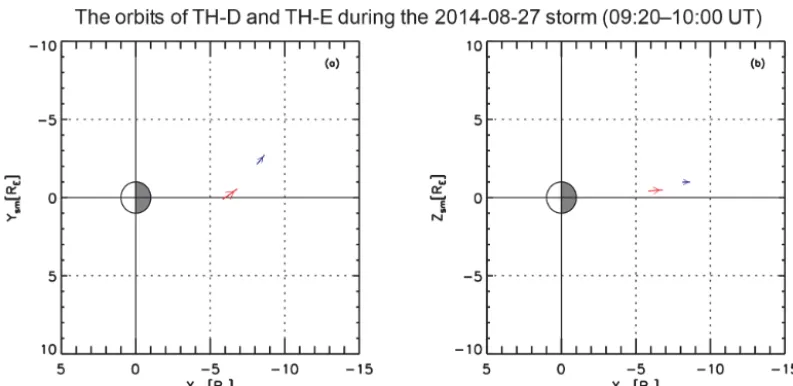
During this intense substorm, THEMIS probes (An-gelopoulos, 2008) TH-D and TH-E were both located in the near-Earth magnetotail. Figure 2 displays the orbits of TH-D and TH-E from 09:20 to 10:00 UT in the solar magnetic (SM) coordinate system. At 09:30 UT, locations of these two spacecraft in SM coordinates were (−6.10,−0.06, 0.43)RE for TH-D and (−8.26, −2.28, 0.99) RE for TH-E, respec-tively. The TH-D orbit plot shows that it was located inside geosynchronous orbit at the beginning of this intense sub-storm expansion phase. On the other hand, TH-E was lo-cated outside geosynchronous orbit. These two spacecraft presented good conjunction observations during this intense substorm expansion phase. The instruments adopted in our investigations were a fluxgate magnetometer (FGM) (Auster et al., 2008), an electrostatic analyzer (ESA) (McFadden et al., 2008), an electric field instrument (EFI) (Bonnell et al., 2008) and a solid state telescope (SST) on-board the THEMIS probes.
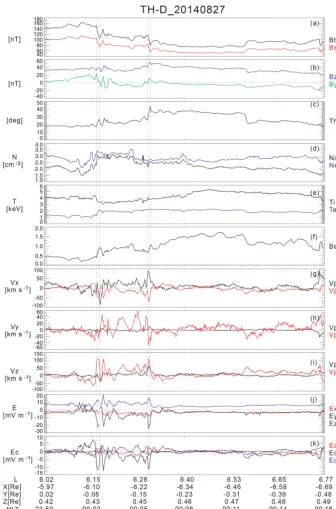
Figure 3 shows the plasma parameters and the electromag-netic field detected by TH-D mostly inside geosynchronous orbit at around midnight in the interval from 09:25 to 09:55 UT. The solar magnetic (SM) coordinate system is adopted. The panels from top to bottom represent the following: the total magnetic field value Bt and the Bx component; the
By and Bz components; the magnetic field elevation
an-gle defined by θ=tan−1(Bz/(Bx2+By2)1/2); the ion and
electron density and temperature; the plasma valueβ (β=
2µ0nT/B2) which determines the location of the satellite (Miyashita et al., 2000); three components of ion bulk flow velocity parallel (black line) and perpendicular (red line) to the magnetic field,Vx,Vy andVz; three components of the
electric field,Ex(red),Ey(black) andEz(blue); three
com-ponents of convection electric field from−V×B,Ecx(red),
Ecy (black) and Ecz (blue), respectively. Figure 3 displays
the distinct fluctuations of the magnetic field and plasma den-sity and velocity at around 09:30 and 09:36 UT, respectively. The magnetic elevation angle has two step enhancements as displayed in Fig. 3c. The first increase in elevation angle is from about 15 to 25◦ during the interval from 09:30:34 to 09:30:54 UT, which are marked by the left two vertical dashed lines in Fig. 3. The total magnetic field value and the Bx component both decrease. TheBz component increases
weakly from about 35 to 45 nT. TheBycomponent has
obvi-ous fluctuations around 0 nT. These magnetic signatures indi-cate a magnetic dipolarization had taken place inside geosyn-chronous orbit around (−6.10,−0.06, 0.43)RE. During this weak magnetic field dipolarization, the plasma beta value,β, increases from around 0.5 to 1.0. The electron density and temperature both increase. The ion density also increases, but the ion temperature decreases. This dipolarization ac-companied by tailward ion bulk flows,V// x∼ −100 km s−1,
and the perpendicular component to the magnetic field in the X direction, V⊥x∼ −50 km s−1, is detected by TH-D,
dipo-Figure 1.The solar wind, IMFBzconditions and geomagnetic indices between 01:00 and 23:00 UT on 27 August 2014. From top to bottom,
panels(a–g)show the change of solar wind dynamic pressure(a),Bz,IMFin geocentric solar magnetospheric (GSM) coordinates(b), the x component of the solar wind flow speed in GSM coordinates(c), electric fieldE(d), AE–AU–AL indices(e), SYM-H index(f) and ASY-H index(g). From left to right, the vertical dotted lines in(a–g)panels mark the times 01:48, 06:42, 09:31, 09:48, 21:56 and 22:35 UT, respectively.
larization,V⊥y∼ −30 km s−1. The electric field detected by
TH-D also has large fluctuations with negative Ey values
during the first depolarization as shown in Fig. 3j. During the intervals from 09:30:34 to 09:30:54 UT, the convection electric field direction is dawnward with a large magnitude, Ecy∼ −12 mV m−1, as presented in Fig. 3k. The second
magnetic field elevation angle increases sharply at around 09:36 as displayed in Fig. 3c marked by the right two verti-cal dashed lines. The elevation angle increases from about 25 to 45◦during the interval from 09:36:06 to 09:36:21 UT. The magnetic field has similar variations to the first dipolarization signatures. Especially, the second dipolarization has larger elevation angle maximum value, ∼45◦, as marked by the fourth vertical dashed line in Fig. 3c. During the second
dipo-larization, the tailward ion bulk flows perpendicular to the magnetic field is also detected by TH-D,V⊥x∼ −70 km s−1,
as presented in Fig. 3g. Also the significant negative Ey
component is accompanied by this intense dipolarization in Fig. 3j and k.
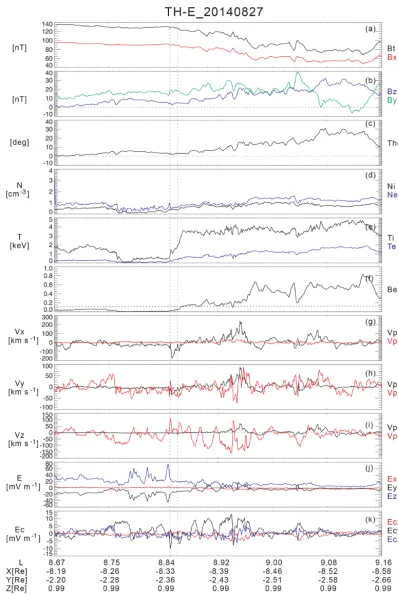
During the intervals of magnetic dipolarizations with tailward ion bulk flows detected by TH-D inside geosyn-chronous orbit, TH-E observed a very weak increase in the magnetic field elevation angle and theBzcomponent around
[image:3.612.62.542.69.470.2]292 X. Sun et al.: Magnetic dipolarizations inside geosynchronous orbit
Figure 2.The orbits of TH-D and TH-E in theX−YSMplane and theX−ZSMplane from 09:20 to 10:00 UT on 27 August 2014, which were in the nightside magnetosphere. The arrow shows the flying direction of the satellites. TH-D is red and TH-E is blue.
shown in Fig. 4f, β∼0.01 and β∼0.2 around 09:35 and 09:41 UT, respectively. An interesting phenomenon, where the weak dipolarization was with tailward ion bulk flows, V// x∼ −180 km s−1, was also detected by TH-E around
09:35 UT, as shown in Fig. 4g. The perpendicular velocity is dominated in the negativeY direction,V⊥y∼ −50 km s−1.
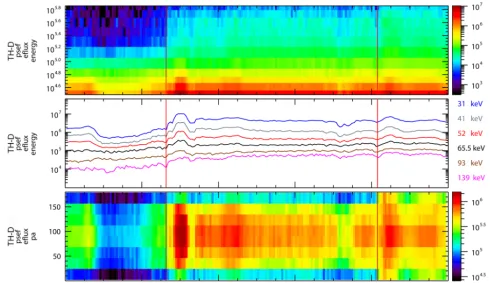
The energy fluxes of energetic electrons associated with the intense electric field inside geosynchronous orbit dur-ing the two dipolarizations, as shown in the middle panel of Fig. 5, with energies of 31 (blue), 41 (gray), 52 (red), 65.5 (black), 93 (brown) and 139 keV (purple), all simulta-neously increase at 09:30:38 and 09:36:09 UT as detected by the SST on-board TH-D. These energetic electrons have a quasi-perpendicular pitch angle distribution, as presented in the bottom panel of Fig. 5.
3 Discussion and conclusions
The dipolarizations with tailward ion bulk flows inside geosynchronous orbit are investigated in our present paper. The energy fluxes of energetic electrons accompanied these dipolarizations with energies between 31 and 139 keV si-multaneously increase inside geosynchronous orbit. In accor-dance with these energetic electron pitch angle distributions, it was found that high-energy electrons were mainly in the quasi-perpendicular direction to the magnetic field, as shown in Fig. 5. On the other hand, the inductive electric field during these two magnetic dipolarizations was in the dawnward di-rection as displayed in Fig. 3j and k. Previous research work reported that the inductive electric field associated with sub-storm dipolarization can accelerate particles in the near-Earth plasma sheet (e.g., Dai et al., 2014, 2015; Duan et al., 2016; Fu et al., 2011; Fok et al., 2001; Liu et al., 2010; Lui et al., 1988, 1999; Nakamura et al., 2009; Nosé et al., 2014). As
shown in Fig. 3j, at around 09:36:30 UT the inductive electric fields in the second dipolarization are dominated in theEy
component with a large negative value,Ey∼ −25 mV m−1,
and the X component also increases with a negative value Ex∼ −6 mV m−1. This intense electric field can drive ions
moving into the tailward–dawnward direction. On the other hand, we can calculate the energy quantity relationship be-tween the electric field and energetic electrons. The energy of such an intenseEyin the distance of∼1000 km is about
∼10−15 J. The energetic electrons with energy range from 31 to 139 keV are of the same energy order∼10−15J. It is inferred that the intenseEy can perpendicularly accelerate
electrons to a state of tens of kiloelectronvolts.
Dipolarizations occurring at the inner edge of plasma sheet are complicated with disturbances of ion bulk flows and the electromagnetic field. Lui et al. (1999) pointed out that near-Earth dipolarization was a non-magnetohydrodynamic (non-MHD) process and was also accompanied with tailward ion flows. Our observations of dipolarizations inside geosyn-chronous orbit are also associated with tailward ion flows. This result is consistent with the report proposed by Liu et al. (2008) that the perturbations associated with the balloon-ing mode in the near-Earth plasma sheet propagate tailward. Based on the statistical studies, Nosé et al. (2016) proposed that the occurrence probability of the dipolarizations in the inner magnetosphere had a peak at 21:00–00:00 magnetic local time (MLT). Our observations show that two distinct dipolarizations with tailward flows inside geosynchronous orbit are detected by TH-D around 00:02 and 00:05 MLT, re-spectively.
ex-Figure 3.The electromagnetic field and plasma parameters detected by TH-D in intervals from 09:25 to 09:55 UT on 27 August 2014. The solar magnetic (SM) coordinate system is adopted. From top to bottom, panels show(a)the total magnetic fieldBt (black) and the X componentBx (red),(b) theY componentBy (green) and theZ componentBz (blue), (c)the magnetic field elevation angleθ;(d)
ion and electron densityNi,Ne,(e)ion and electron temperatureTi,Te,(f)plasma betaβ,(g)theXcomponent of ion parallel velocity and perpendicular velocityVparx,Vperpx,(h)theY component of ion parallel velocity and perpendicular velocityVpary,Vperpy;(i)theZ component of ion parallel velocity and perpendicular velocity Vparz,Vperpz,(j)the electric fieldEx (red),Ey(black) andEz (blue) by
assumingE×B=0 and(k)the electric fieldEcx(red),Ecy(black),Ecz(blue) calculated byE=B×V. The black vertical dashed lines
[image:5.612.128.465.91.601.2]294 X. Sun et al.: Magnetic dipolarizations inside geosynchronous orbit
Figure 5.The energetic electrons energy flux (psef) and pitch angle (pa) distribution of energetic electrons detected by the SST on-board TH-D in 3 s time resolution. The red vertical lines mark the times 09:30:38 and 09:36:09 UT.
panding speeds can be estimated as Vx∼ −47, Vy∼ −48
and Vz∼12 km s−1, respectively. Liou et al. (2002)
pro-posed that the dipolarization region expanding speed was
∼60 km s−1 westward at geosynchronous orbit. By com-paring observations between TH-D and TH-E in our inves-tigations, the azimuth speed of dipolarization region is ob-tained∼48 km s−1. These two observational results are con-sistent with each other. The dipolarization associated with the current disruption propagated tailward with a speed of Vx∼ −100 km s−1 detected by THEMIS satellites in the
near-Earth plasma sheet X∼ −11RE (Liu et al., 2008). It is larger than the dipolarization propagating speed from in-side to outin-side geosynchronous orbitVx∼ −47 km s−1. The
different speeds of dipolarizations propagating tailward im-ply that the magnitude of the dipolarization speed may be associated with its beginning location in magnetotail plasma sheet.
On the other hand, Lui (1991) reported that substorm disturbance propagated tailward through a rarefaction wave front accompanied by earthward flows during the early sub-storm expansion phase period. Chao et al. (1977) proposed that the rarefaction wave propagating tailward was accompa-nied by the thinning of the plasma sheet and an earthward plasma flow. This earthward flow is possibly a convection flow or outflow of magnetic reconnection from the middle magnetotail.
Based on the above observation analysis, we can draw the results as follows. Two distinct magnetic dipolariza-tions with tailward ion flows are observed by TH-D inside geosynchronous orbit on 27 August 2014 during the intense substorm with AEmax∼1000 nT. TH-D was located inside geosynchronous orbit around midnight in the interval from 09:20 to 10:00 UT. The first dipolarization is displayed by the magnetic elevation angle increase from 15 to 25◦around 09:30:40 UT. The second one is presented by the elevation angle increase from 25 to 45◦ around 09:36 UT. These two significant dipolarizations are accompanied by the energy flux of energetic electrons which simultaneously increase in-side geosynchronous orbit. After a 5 min expansion tailward of near-Earth plasma sheet, TH-E located outside geosyn-chronous orbit also detects this tailward expanding plasma sheet with an ion flow of−150 km s−1. The dipolarization propagates tailward with a speed of−45 km s−1along a 2RE distance in theXdirection between TH-D and TH-E within 5 min. These dipolarizations with tailward ion flows observed inside geosynchronous orbit indicate a new energy transfer path in the inner magnetosphere during substorms.
Facil-296 X. Sun et al.: Magnetic dipolarizations inside geosynchronous orbit
ity (SPDF) at https://omniweb.gsfc.nasa.gov/form/omni_min.html (NASA’s GSFC, Goddard Space Flight Center, last access: 11 June 2018). THEMIS data of the electromagnetic field and plasma pa-rameters are publicly available from NASA at http://themis.ssl. berkeley.edu/data/themis/ (NASA, last access: 13 November 2018).
Competing interests. The authors declare that they have no conflict of interest.
Acknowledgements. We acknowledge NASA contract NAS5-02099 for the use of the data from the THEMIS mission. Specif-ically, we thank Davin E. Larson for the use of the SST data, Charles W. Carlson and James P. McFadden for use of the ESA data, John W. Bonnell and Forrest S. Mozer for use of the EFI data, and Karl-Heinz Glassmeier, Hans-Ulrich Auster and Wolf-gang Baumjohann for the use of FGM data provided under the lead of the Technical University of Braunschweig, with financial sup-port from the German Ministry for Economy and Technology and the German Center for Aviation and Space (DLR) under the con-tract 50 OC 0302. The authors thank NASA CDAWeb and Taiwan Ascii and ldl_save Data Archives (AIDA) for the THEMIS data. The SYM-H index was provided by Data Analysis Center for Ge-omagnetism and Space Magnetism in Kyoto, Japan. This work is supported by the National Natural Science Foundation of China grants 41674167, 41731070 and 41574161 and in part by the Spe-cialized Research Fund for State Key Laboratories.
Review statement. This paper was edited by Anna Milillo and re-viewed by one anonymous referee.
References
Angelopoulos, V.: The THEMIS Mission, Space Sci. Rev., 141, 5– 34, 2008.
Angelopoulos, V., Baumjohann, W., Kennel, C. F., Coro-niti, F. V., Kivelson, M. G., Pellat, R., Walker, R. J., Lühr, H., and Paschmann, G.: Bursty bulk flows in the inner central plasma sheet, J. Geophys. Res., 97, 4027, https://doi.org/10.1029/91JA02701, 1992.
Auster, H. U., Glassmeier, K. H., Magnes, W., Aydogar, O., Baumjohann, W., Constantinescu, D., Fischer, D., Fornacon, K. H., Georgescu, E., Harvey, P., Hillenmaier, O., Kroth, R., Lud-lam, M., Narita, Y., Nakamura, R., Okrafka, K., Plaschke, F., Richter, I., Schwarzl, H., Stoll, B., Valavanoglou, A., and Wiede-mann, M.: The THEMIS Fluxgate Magnetometer, Space Sci. Rev., 141, 235–264, 2008.
Baumjohann, W., Hesse, M., Kokubun, S., Mukai, T., Nagai, T., and Petrukovich, A. A.: Substorm dipolarization and recovery, J. Geophys. Res.-Space, 104, 24995–25000, 1999.
Bonnell, J. W., Mozer, F. S., Delory, G. T., Hull, A. J., Ergun, R. E., Cully, C. M., Angelopoulos, V., and Harvey, P. R.: The Electric Field Instrument (EFI) for THEMIS, Space Sci. Rev., 141, 303– 341, 2008.
Chao, J. K., Kan, J. R., Lui, A. T. Y., and Akasofu, S.-I.: A model for thinning of the plasma sheet, Planet. Space Sci., 25, 703–710, 1977.
Dai, L., Wygant, J. R., Cattell, C. A., Thaller, S., Kersten, K., Bren-eman, A., Tang, X., Friedel, R. H., Claudepierre, S. G., and Tao, X.: Evidence for injection of relativistic electrons into the Earth’s outer radiation belt via intense substorm electric fields, Geophys. Res. Lett., 41, 1133–1141, 2014.
Dai, L., Wang, C., Duan, S., He, Z., Wygant, J. R., Cattell, C. A., Tao, X., Su, Z., Kletzing, C., Baker, D. N., Li, X., Malaspina, D., Blake, J. B., Fennell, J., Claudepierre, S., Turner, D. L., Reeves, G. D., Funsten, H. O., Spence, H. E., Angelopoulos, V., Fruehauff, D., Chen, L., Thaller, S., Breneman, A., and Tang, X.: Near-Earth injection of MeV electrons associated with in-tense dipolarization electric fields: Van Allen Probes observa-tions, Geophys. Res. Lett., 42, 6170–6179, 2015.
Duan, S., Liu, Z., Cao, J., Lu, L., Rème, H., Dandouras, I., and Carr, C. M.: TC-1 observation of ion high-speed flow reversal in the near-Earth plasma sheet during substorm, Sci. China Ser. E, 51, 1721–1730, 2008.
Duan, S. P., Liu, Z. X., Liang, J., Zhang, Y. C., and Chen, T.: Multiple magnetic dipolarizations observed by THEMIS during a substorm, Ann. Geophys., 29, 331–339, https://doi.org/10.5194/angeo-29-331-2011, 2011.
Duan, S. P., Dai, L., Wang, C., Liang, J., Lui, A. T. Y., Chen, L. J., He, Z. H., Zhang, Y. C., and Angelopoulos, V.: Evidence of kinetic Alfven eigenmode in the near-Earth magnetotail during substorm expansion phase, J. Geophys. Res.-Space, 121, 4316– 4330, 2016.
Fok, M.-C., Moore, T. E., and Spjeldvik, W. N.: Rapid enhancement of radiation belt electron fluxes due to substorm dipolarization of the geomagnetic field, J. Geophys. Res.-Space, 106, 3873–3881, 2001.
Fu, H. S., Khotyaintsev, Y. V., André, M., and Vaivads, A.: Fermi and betatron acceleration of suprathermal electrons be-hind dipolarization fronts, Geophys. Res. Lett., 38, L16104, https://doi.org/10.1029/2011GL048528, 2011.
Liang, J., Liu, W. W., and Donovan, E. F.: Ion temperature drop and quasi-electrostatic electric field at the current sheet boundary minutes prior to the local current disruption, J. Geophys. Res.-Space, 114, A10215, https://doi.org/10.1029/2009JA014357, 2009.
Liou, K., Meng, C.-I., Lui, A. T. Y., Newell, P. T., and Wing, S.: Magnetic dipolarization with substorm expansion onset, J. Geo-phys. Res., 107, 1131, https://doi.org/10.1029/2001JA000179, 2002.
Liu, W. W.: Physics of the explosive growth phase: Ballooning instability revisited, J. Geophys. Res.-Space, 102, 4927–4931, 1997.
Liu, W. W. and Liang, J.: Disruption of magnetospheric current sheet by quasi-electrostatic field, Ann. Geophys., 27, 1941–1950, https://doi.org/10.5194/angeo-27-1941-2009, 2009.
Liu, W. W., Liang, J., and Donovan, E. F.: Electro-static field and ion temperature drop in thin current sheets: A theory, J. Geophys. Res.-Space, 115, A03211, https://doi.org/10.1029/2009JA014359, 2010.
global characteristics, Geophys. Res. Lett., 35, L20107, https://doi.org/10.1029/2008GL035757, 2008.
Lui, A. T. Y.: A synthesis of magnetospheric sub-storm models, J. Geophys. Res., 96, 1849–1856, https://doi.org/10.1029/90JA02430, 1991.
Lui, A. T. Y., Lopez, R. E., Krimigis, S. M., McEntire, R. W., Zanetti, L. J., and Potemra, T. A.: A case study of magnetotail current sheet disruption and diversion, Geophys. Res. Lett., 15, 721–724, 1988.
Lui, A. T. Y., Liou, K., Nosé, M., Ohtani, S., Williams, D. J., Mukai, T., Tsuruda, K., and Kokubun, S.: Near-Earth dipolarization: Ev-idence for a non-MHD process, Geophys. Res. Lett., 26, 2905– 2908, 1999.
McFadden, J. P., Carlson, C. W., Larson, D., Ludlam, M., Abiad, R., Elliott, B., Turin, P., Marckwordt, M., and Angelopoulos, V.: The THEMIS ESA Plasma Instrument and In-flight Calibration, Space Sci. Rev., 141, 277–302, 2008.
Miyashita, Y., Machida, S., Mukai, T., Saito, Y., Tsuruda, K., Hayakawa, H., and Sutcliffe, P. R.: A statistical study of varia-tions in the near and middistant magnetotail associated with sub-storm onsets: GEOTAIL observations, J. Geophys. Res.-Space, 105, 15913–15930, 2000.
Nagai, T.: Observed magnetic substorm signatures at syn-chronous altitude, J. Geophys. Res., 87, 4405–4417, https://doi.org/10.1029/JA087iA06p04405, 1982.
Nakamura, R., Retino, A., Baumjohann, W., Volwerk, M., Erkaev, N., Klecker, B., Lucek, E. A., Dandouras, I., Andre, M., and Khotyaintsev, Y.: Evolution of dipolarization in the near-Earth current sheet induced by Earthward rapid flux transport, Ann. Geophys., 27, 1743–1754, 2009.
NASA: THEMIS data of the electromagnetic field and plasma parameters, available at: http://themis.ssl.berkeley.edu/data/ themis/, last access: 13 November 2018.
NASA’s GSFC: the Space Physics Data Facility (SPDF), available at: https://omniweb.gsfc.nasa.gov/form/omni_min.html, last ac-cess: 11 June 2018.
Nosé, M., Takahashi, K., Keika, K., Kistler, L. M., Koga, K., Koshiishi, H., Matsumoto, H., Shoji, M., Miyashita, Y., and No-mura, R.: Magnetic fluctuations embedded in dipolarization in-side geosynchronous orbit and their associated selective accel-eration of O+ ions, J. Geophys. Res.-Space, 119, 4639–4655, 2014.
Nosé, M., Keika, K., Kletzing, C. A., Spence, H. E., Smith, C. W., MacDowall, R. J., Reeves, G. D., Larsen, B. A., and Mitchell, D. G.: Van Allen Probes observations of magnetic field dipolar-ization and its associated O+ flux variations in the inner mag-netosphere atL<6.6, J. Geophys. Res.-Space, 121, 7572–7589, 2016.
Ohtani, S., Motoba, T., Gkioulidou, M., Takahashi, K., and Singer, H. J.: Spatial Development of the Dipolarization Region in the Inner Magnetosphere, J. Geophys. Res.-Space, 123, 5452–5463, 2018.
Saito, M. H., Miyashita, Y., Fujimoto, M., Shinohara, I., Saito, Y., Liou, K., and Mukai, T.: Ballooning mode waves prior to substorm-associated dipolarizations: Geo-tail observations, Geophys. Res. Lett., 35, L07103, https://doi.org/10.1029/2008GL033269, 2008.