Abstract—The theory of membrane computing was formulated by Paun as an attempt to formulate a computational model inspired by the way in which the living cells function. P systems which is a highly distributed, parallel, theoretical model and is an area of special interest in recent times. P systems have various application one such area of research is the generation of array grammars using them. In this study we define a model of P system to generate a new class of languages called grammar based two-dimensional pattern languages and their picture generation.
Key Words: Two-dimensional patterns, Two-dimensional axioms, Factorization of array, Array rewriting P system for grammar based 2D patterns
I. INTRODUCTION
String grammars are used to describe various forms of language constructs, hence the study of string grammars find their application in various fields such as Linguistics, Mathematics and Computer Science. String grammars also play an important role in analysis of high level languages. In this context, a pattern ′𝛼′ is a string over an alphabet set {𝑥1, 𝑥2, 𝑥3, ⋯ } of variables. For some finite alphabet of terminal symbols, the pattern language described by 𝛼 (with respect to ) is the set of all words over that can be derived from 𝛼 by uniformly substituting the variables in 𝛼 by non-empty terminal words was introduced by Angluin [2]. Dassow et.al., [5] introduced pattern grammars which is a generative device to modify the pattern languages defined by Angluin [2] namely, not allowing the replacing of variables by arbitrary strings, but to adopt the following strategy more usual in formal language theory: start from a finite set of given strings (axioms), replace them by variables in a given set of pattern(s), all strings generated (identified) in this way constitute the associated languages. This way of obtaining languages by substituting all occurrences of the same variable by the same string is related to rewriting in parallel. In [4] the concept of pattern as language descriptors was generalized to two-dimensional case, preserving the simplicity and compactness of the descriptors.
The theory of P system (or membrane computing) introduced by Paun [6] is a theoretical model which is processed in a parallel manner. Recently Natural computing, a field of research which deals with the computation to
Revised Manuscript Received on August 05, 2019.
Christopher Kezia Parimalam, Research Scholar, Department of Mathematics, Queen Mary’s College, Chennai, Tamilnadu, India
(Email: [email protected])
J.D.Emerald, Assistant Professor, Department of Mathematics, Queen
imitate nature is of great interest. Already a lot of work has been done in the areas of DNA computing, Generic Algorithms and Neural networks. P systems introduced by Paun deals with how to process multi-sets by evolution rules in a hierarchical arrangement of membranes that represent the living cell. Rewriting P systems is a branch of membrane computing where objects are replaced by strings and are processed using rewriting rules.
Pictures are described as finite arrays in two-dimensional plane [3] which are connected and has been an area of great interest for many researchers. The study of pictures is in an attempt to extend recognisability in one dimension to two dimensions. Array grammars are extension of string grammars to pictures in two-dimension, where the points with integer coordinates of the plane represent symbols. It is easily seen that array grammars are immediate extensions of the string grammars, where the strings in the membranes are replaced by arrays and string operations by array rewriting rules.
In this paper we define an array rewriting P system to generate languages defined by two-dimensional grammars based on patterns defined in [1]. We also to analyse the picture generated by two-dimensional grammars based on patterns.
II. PRELIMINARIES
For a finite alphabet , a string or word (over ) is a finite sequence of symbols from, and𝜖 stands for the empty string. The notation + denotes the set of all nonempty strings over , and ∗ = + ∪ 𝜖 . We say that a string 𝑣𝜖∗ is a factor of a string 𝜔𝜖∗ if there are 𝑢
1, 𝑢2𝜖∗ such that 𝜔 = 𝑢1. 𝑣.𝑢2. If 𝑢1or 𝑢2is empty string then 𝑣 is a prefix (or a suffix respectively) of 𝜔 .the notation 𝜔 stands for the length of a string 𝜔.
A two-dimensional word (or array) over is a tuple W=
𝑎11, 𝑎12, ⋯ , 𝑎1𝑛 , 𝑎21, 𝑎22, ⋯ , 𝑎2𝑛 , ⋯ , 𝑎𝑚1, 𝑎𝑚2, ⋯ , 𝑎𝑚𝑛 , where m, n𝜖ℕ and, for every i, 1≤ 𝑖 ≤ 𝑚, 1≤ 𝑗 ≤ 𝑛,𝑎𝑖𝑗𝜖 . We define width to be the number of columns and height to be the number of rows of W. 𝜆, denotes the empty array.For the sake of convenience, we denote W by 𝑎𝑖𝑗 𝑚 ,𝑛 or by a matrix of one of the following form:
Generation of Two-Dimensional Grammar
Based Pattern Languages using Array Rewriting
P System
𝑎11𝑎12 ⋯ 𝑎1𝑛 𝑎21𝑎22 ⋯ 𝑎2𝑛 ⋮ ⋮ ⋱ ⋮ 𝑎𝑚1𝑎𝑚2 ⋯ 𝑎𝑚𝑛
𝑎11𝑎12 ⋯ 𝑎1𝑛 𝑎21𝑎22 ⋯ 𝑎2𝑛 ⋮ ⋮ ⋱ ⋮ 𝑎𝑚1𝑎𝑚2 ⋯ 𝑎𝑚𝑛
If we want to refer to the jth symbol in row i of the array When we use W[i,j] =𝑎𝑖.𝑗.By ++, we denote the set of all nonempty arrays over , and ∗∗ =++ ∪ 𝜆 . An array language is every subset of languages that belong to ∗∗
Definition 2.1[1] Two-dimensional Pattern Grammar is a four tuple 𝐺 = , Δ, Α, Ρ where
= Set of terminal alphabets Δ = Set of pattern variables
Α = Set of two-dimensional axioms which satisfy the patterns defined by their factorization
Ρ = The two-dimensional pattern, defined by pattern variables only and some𝛿𝑖𝑗 the same.
i.e., Ρ =
𝛿11𝛿12⋯ 𝛿1𝑛 𝛿21𝛿22⋯ 𝛿2𝑛 ⋮ ⋮ ⋱ ⋮ 𝛿𝑛1𝛿𝑛2⋯ 𝛿𝑚𝑛
all the m x n entries are
defined by a pattern variable.
The pattern follows one of the concatenation (factorization) (i) row, (ii) column (iii) row-column (iv) column-row (v) proper (where it satisfies both row-column and column-row).
Given pattern Ρ and initial axiom to start with 𝑃(𝐿) is the set of two-dimensional arrays obtained by replacing the variables in the pattern P by the arrays in A, the same variable being replaced by the same array in all their occurrences.
The language generated by 𝐺, denoted by 𝐿 𝐺 , is the smallest language 𝐿 ⊆ ∗∗ for which we have:
(i) 𝐴 ⊆ 𝐿 (ii) P(L) ⊆ 𝐿.
Arrays are obtained starting from the axioms and using them in the patterns finite number of times. The language generated 𝐿 𝐺 = 𝑃 ∪ 𝑃 𝐴 ∪ 𝑃 𝑃 𝐴 ∪ 𝑃 𝑃 𝑃 𝐴 ⋯
A language 𝐿 𝐺 thus obtained is called a two-dimensional pattern Language and we denote it as
𝐿𝑝,𝑓where f denotes the array factorization type of the pattern defined ; and its family is denoted by ℒP,f .
A two-dimensional pattern is a mxn array, and the axiom set is a set of mxn dimensional arrays which satisfy the concatenation rules for arrays either by row, column, row-column or row-column-row or proper factorization.
Example 2.1𝐺1= 𝑎 , 𝛿 , 𝑎 , 𝑃 , 𝑃 = 𝛿 𝛿 𝛿 𝛿 𝑝 𝐿 𝐺1 = 𝐿𝑃,𝑝
= 𝐴 ∪ 𝑠𝑒𝑡 𝑜𝑓 𝑎𝑙𝑙 𝑎𝑟𝑟𝑎𝑦𝑠 𝑜𝑓 𝑎′𝑠 𝑤𝑖𝑡 𝑑𝑖𝑚𝑒𝑛𝑠𝑖𝑜𝑛 2𝑛× 2𝑛 𝑤𝑒𝑟𝑒 𝑛 = 1,2 ⋯
III. ARRAY REWRITING P SYSTEM FOR GRAMMAR BASED TWO-DIMENSIONAL
PATTERN LANGUAGES
Definition 3.1 An array-rewriting P systemfor two-dimensional patterns ARPS2DP (of degree m≥ 1) is a construct
Π𝑅= (𝑁, 𝑇, 𝜇, 𝐴1, ⋯ 𝐴𝑚, 𝑃1, ⋯ 𝑃𝑚, 𝑖0𝑢𝑡),
Where N is the set of pattern variables and terminals, T⊆ 𝑉 is the terminal alphabet, 𝜇 represents the way in which the ‘m’ membranes are arranged in the system, 𝐴1, ⋯ , 𝐴𝑚 are the arrays present initially in the regions of 𝜇 and are finite in number, 𝑃1, ⋯ 𝑃𝑚, are finite set of rewriting rules in the m regions of 𝜇; the pattern rewriting rules are of the form 𝐴 → 𝐵(𝑡𝑎𝑟 ); where the target can be in, out, here, 𝐴, 𝐵 ∈ (𝑁 ∪ 𝑇)∗ , 𝑖
0𝑢𝑡 is the label of the output membrane. A computation in an array rewriting P system for 2D patterns is defined in the same way as in a string rewriting P system. Each variable in the array from each region can be rewritten by exactly one rewriting rule applicable to it in the given region, the same variable being rewritten with the same rule and is sent to the target specified in the rewriting rule. When there are no more rewriting rule to be applied and if the array reaches the output membrane the computation stops. A successful computation consists of arrays composed only of symbols from T placed in the membrane with label 𝑖0𝑢𝑡in the halting configuration. The set of all such arrays generated by the system Π𝑅 is denoted by APL(Π𝑅).
We now give an example of an array rewriting P system that can generate a given two-dimensional pattern language based on grammars that defines it. We consider the case where the pattern is a two-dimensional array in particular a 2×2 array and the axioms are over a single alphabet.
Example 3.1 Consider the two-dimensional pattern grammar 𝐺2= (, Δ, 𝐴, 𝑃)
Where, = 𝑎, 𝑏 ; Δ = 𝛿1, 𝛿2 ; 𝐴 = 𝑎, 𝑏 ; P= 𝛿1 𝛿2
𝛿1 𝛿2 𝑐𝑟 ; 𝐿 𝐺2
= { 𝑤𝑤1 𝑤2
1 𝑤2 / 𝑤1, 𝑤2 𝑎𝑟𝑒 𝑠𝑞𝑢𝑎𝑟𝑒 𝑚𝑎𝑡𝑟𝑖𝑐𝑒𝑠 𝑜𝑓 𝑜𝑟𝑑𝑒𝑟 2 𝑚
× 2𝑚, 𝑚 = 0, 1, ⋯ }
The array rewriting P system to generate the above two-dimensional pattern language is defined as follows: Π𝑅2= (𝑁, 𝑇, 𝐴1⋯ 𝐴3,𝑃1⋯ 𝑃3, 𝑖1); where
N= {𝜂11,𝜂12,𝜂21, 𝜂22};T= {a,b} 𝜇 = [1[2[3]1]2]3
𝐴1= {𝑎, 𝑏,
𝜂11 𝜂22
𝜂11 𝜂22}; 𝐴2= 𝜙; 𝐴3=
𝜂11 𝜂22 𝜂11 𝜂22 } 𝑃1
= 𝜂11→ 𝑎, 𝜂11→ 𝑏, 𝜂𝜂12→ 𝑎, 𝜂12→ 𝑏, 𝜂21→ 𝑎, 𝜂21→ 𝑏, 22→ 𝑎, 𝜂22→ 𝑏
𝑃2=
𝜂11𝜂11→ 𝜂11𝜂11
𝜂11𝜂11 𝑖𝑛 ,𝑜𝑢𝑡; 𝜂11𝜂12→ 𝜂11𝜂12 𝜂11𝜂12 𝑖𝑛 ,𝑜𝑢𝑡;
𝜂12𝜂11→ 𝜂12𝜂11
𝜂12𝜂11 𝑖𝑛 ,𝑜𝑢𝑡; 𝜂12𝜂12→ 𝜂12𝜂12 𝜂12𝜂12 𝑖𝑛 ,𝑜𝑢𝑡;
𝜂21𝜂21→ 𝜂21𝜂21
𝜂21𝜂21 𝑖𝑛,𝑜𝑢𝑡; 𝜂21𝜂22→ 𝜂21𝜂22 𝜂21𝜂22 𝑖𝑛 ,𝑜𝑢𝑡;
𝜂22𝜂21→ 𝜂22𝜂21
𝑃3=
𝜂11→ 𝜂11𝜂11 𝑖𝑛/𝜂11𝜂12 𝑖𝑛/𝜂12𝜂11 𝑖𝑛/𝜂12 𝑖𝑛; 𝜂12→ 𝜂11𝜂11 𝑖𝑛/𝜂11𝜂12 𝑖𝑛/𝜂12𝜂11 𝑖𝑛/𝜂12 𝑖𝑛; 𝜂21→ 𝜂21𝜂21 𝑖𝑛/𝜂21𝜂22 𝑖𝑛/𝜂22𝜂21 𝑖𝑛/𝜂22𝜂22 𝑖𝑛;
𝜂22→ 𝜂21𝜂21 𝑖𝑛/𝜂21𝜂22 𝑖𝑛/𝜂22𝜂21 𝑖𝑛/𝜂22𝜂22 𝑖𝑛 P = (𝛿1𝛿2) ⊖ (𝛿1𝛿2) ; hence we have a rule in the third membrane which first grows each pattern variable according to the column catenation rule in the first parenthesis of the
pattern rule and the second membrane has a rule to grow the pattern according to the row catenation rule. Thus we form the frame work to grow the patterns and finally terminate them using the termination rules in the first membrane which is the output membrane.
𝐴𝑃𝐿 Π𝑅2 = { 𝑎, 𝑏,
𝑎 𝑎
𝑎 𝑎 ,
𝑎 𝑏
𝑎 𝑏 ,
𝑏 𝑎
𝑏 𝑎 ,
𝑏 𝑏
𝑏 𝑏,
𝑎 𝑎 𝑎 𝑎 𝑎 𝑎 𝑎 𝑎 𝑎 𝑎 𝑎 𝑎 𝑎 𝑎 𝑎 𝑎 , 𝑎 𝑎 𝑎 𝑎 𝑎 𝑏 𝑎 𝑏 𝑎 𝑎 𝑎 𝑎 𝑎 𝑏 𝑎 𝑏 , 𝑎 𝑎 𝑎 𝑎 𝑏 𝑎 𝑏 𝑎 𝑎 𝑎 𝑎 𝑎 𝑏 𝑎 𝑏 𝑎 , 𝑎 𝑎 𝑎 𝑎 𝑏 𝑏 𝑏 𝑏 𝑎 𝑎 𝑎 𝑎 𝑏 𝑏 𝑏 𝑏 , 𝑎 𝑏 𝑎 𝑏 𝑎 𝑎 𝑎 𝑎 𝑎 𝑏 𝑎 𝑏 𝑎 𝑎 𝑎 𝑎 , 𝑎 𝑏 𝑎 𝑏 𝑎 𝑏 𝑎 𝑏 𝑎 𝑏 𝑎 𝑏 𝑎 𝑏 𝑎 𝑏 , 𝑎 𝑏 𝑎 𝑏 𝑏 𝑎 𝑏 𝑎 𝑎 𝑏 𝑎 𝑏 𝑏 𝑎 𝑏 𝑎 , 𝑎 𝑏 𝑎 𝑏 𝑏 𝑏 𝑏 𝑏 𝑎 𝑏 𝑎 𝑏 𝑏 𝑏, 𝑏 𝑏 𝑏 𝑎 𝑏 𝑎 𝑎 𝑎 𝑎 𝑎 𝑏 𝑎 𝑏 𝑎 𝑎 𝑎 𝑎 𝑎 , 𝑏 𝑎 𝑏 𝑎 𝑎 𝑏 𝑎 𝑏 𝑏 𝑎 𝑏 𝑎 𝑎 𝑏 𝑎 𝑏 , 𝑏 𝑎 𝑏 𝑎 𝑏 𝑎 𝑏 𝑎 𝑏 𝑎 𝑏 𝑎 𝑏 𝑎 𝑏 𝑎 , 𝑏 𝑎 𝑏 𝑎 𝑏 𝑏 𝑏 𝑏 𝑏 𝑎 𝑏 𝑎 𝑏 𝑏 𝑏 𝑏 , 𝑏 𝑏 𝑏 𝑏 𝑎 𝑎 𝑎 𝑎 𝑏 𝑏 𝑏 𝑏 𝑎 𝑎 𝑎 𝑎 , 𝑏 𝑏 𝑏 𝑏 𝑎 𝑏 𝑎 𝑏 𝑏 𝑏 𝑏 𝑏 𝑎 𝑏 𝑎 𝑏 , 𝑏 𝑏 𝑏 𝑏 𝑏 𝑎 𝑏 𝑎 𝑎 𝑏 𝑎 𝑏 𝑏 𝑎 𝑏 𝑎 , 𝑏 𝑏 𝑏 𝑏 𝑏 𝑏 𝑏 𝑏 𝑏 𝑏 𝑏 𝑏 𝑏 𝑏, 𝑏 𝑏
⋯ } = L(𝐺2)
IV. CONSTRUCTION OF AN ARRAY REWRITING P SYSTEM MODEL FOR TWO-DIMENSIONAL
PATTERNS
Theorem 4.1 For every two-dimensional grammar based on pattern we have an Array Rewriting P System for two-dimensional pattern 𝐴𝑅𝑃𝑆2𝐷𝑃3 that generates it.
Proof: We give the construct for the Array rewriting P system for two-dimensional pattern in two cases. The first being the 2D pattern satisfying column-row factorization and the second when the 2D pattern satisfies the row-column factorization.
Case 1: Given a 2D pattern grammar 𝐺 = , Δ, Α, Ρ , in which the 2D pattern satisfies the column-row factorization, we define the P-system model where
Π𝑅= (𝑁, 𝑇, 𝜇, 𝐴1, ⋯ 𝐴3, 𝑃1, ⋯ 𝑃3, 𝑖1)
𝑁 = 𝜂𝑖𝑗 , 𝑖 = 1,2 ⋯ 𝑛, 𝑓𝑜𝑟 𝑒𝑣𝑒𝑟𝑦 𝛿𝑖∈ ∆, 𝑖 = 1 ⋯ 𝑛; 𝑗 = 1 ⋯ 𝑚, 𝑤𝑒𝑟𝑒 𝑚 𝑖𝑠 𝑡𝑒 𝑛𝑢𝑚𝑏𝑒𝑟 𝑜𝑓 𝑐𝑜𝑙𝑢𝑚𝑛𝑠 𝑖𝑛 𝑡𝑒 𝑝𝑎𝑡𝑡𝑒𝑟𝑛
𝑇 = 𝐴
𝜇 = [1[2[3]3]2]1
𝐴1= 𝐴, 𝑃 ; where P is replaced with the 𝜂𝑖𝑖 in the place of 𝛿𝑖.
𝐴2= 𝜙; 𝐴3= 𝑃 𝑎𝑠 𝑑𝑒𝑓𝑖𝑛𝑒𝑑 𝑖𝑛 𝐴1
𝑅1= {𝜂𝑖𝑗 →𝑎𝑡, 𝑓𝑜𝑟 𝑖, = 1, ⋯ 𝑛, 𝑗 = 1, ⋯ 𝑚, for each 𝑎𝑡 ∈ 𝐴}
𝑅2
=
𝜂𝑖1⋯ 𝜂𝑖𝑠𝑇→ 𝜂𝑖1⋯ 𝜂𝑖𝑡𝑇; 𝑖𝑓 𝛿1⋯ 𝛿𝑠𝑇→ 𝛿1⋯ 𝛿𝑡𝑇
𝑖𝑠 𝑎 𝑟𝑜𝑤 𝑐𝑎𝑡𝑒𝑛𝑎𝑡𝑖𝑜𝑛 𝑟𝑢𝑙𝑒 𝑖𝑛 𝑡𝑒 𝑔𝑖𝑣𝑒𝑛 2𝐷 𝑝𝑎𝑡𝑡𝑒𝑟𝑛 𝑓𝑜𝑟 𝑡𝑒 𝑖𝑡 𝑐𝑜𝑙𝑢𝑚𝑛 𝑎𝑛𝑑 𝜂
𝑖𝑛= 𝜂𝑖𝑚 𝑖𝑓 𝛿𝑛= 𝛿𝑚 𝑖𝑛 ,𝑜𝑢𝑡
𝑅3= {𝜂𝑖𝑖→ 𝜂𝑖1⋯ 𝜂𝑖𝑛; 𝑓𝑜𝑟 𝑖
= 1 ⋯ 𝑛, 𝑖𝑓 𝛿1⋯ 𝛿𝑛 𝑖𝑠 𝑡𝑒 𝑓𝑖𝑟𝑠𝑡 𝑟𝑜𝑤 𝑜𝑓 𝑡𝑒2𝐷 𝑝𝑎𝑡𝑡𝑒𝑟𝑛; 𝑎𝑛𝑑 𝜂𝑖𝑗 →
𝜂𝑖1⋯ 𝜂𝑖𝑛 𝑓𝑜𝑟 𝑒𝑣𝑒𝑟𝑦 𝜂𝑖𝑗 𝑜𝑛 𝑡𝑒 𝑅𝐻𝑆 𝑜𝑓 𝑡𝑒 𝑝𝑟𝑜𝑑𝑢𝑐𝑡𝑖𝑜𝑛𝑠 𝑜𝑓 𝜂𝑖𝑖 }
To begin with the P system contains the initial words in membrane 1 and 3. The set of axioms are present in membrane 1 which are the initial words in the pattern language. The pattern is present at the beginning in membrane 1 and 3. Applying the rules of 𝑅1 to the pattern variables in membrane 1 we get the resultant as P(A). In membrane three applying the rules of 𝑅3, each pattern variable expands in the column where each variable is expanded to form the first row of the array in P(P(A)) and sent into membrane 2. In this membrane the pattern is expanded according to the row catenation rules in the pattern and is sent to membrane 1 and 3. In membrane1 the terminating rules are applied to the pattern variables which result in P(P(A)). While the membrane 3 further builds the array in column and then again sends it membrane two where the process is repeated and the resultant is P(P(P(A))). Thus 𝐴𝑅𝑃𝑆2𝐷𝑃3 generates 𝐿(G).
Case 2: We now give the construction for 2D patterns which satisfy row-column factorization rule. T, 𝜇, 𝐴1, 𝐴2, 𝐴3 are as defined in case1.
𝑁
= 𝜂𝑖𝑗 , 𝑖 = 1,2 ⋯ 𝑛, 𝑓𝑜𝑟 𝑒𝑣𝑒𝑟𝑦 𝛿𝑖∈ ∆, 𝑖 = 1 ⋯ 𝑛;
𝑗 = 1 ⋯ 𝑚, 𝑤𝑒𝑟𝑒 𝑚 𝑖𝑠 𝑡𝑒 𝑛𝑢𝑚𝑏𝑒𝑟 𝑜𝑓 𝑐𝑜𝑙𝑢𝑚𝑛𝑠 𝑖𝑛 𝑡𝑒 𝑝𝑎𝑡𝑡𝑒𝑟𝑛
The array rewriting rules for the three membranes are defined as follows
𝑅1= {𝜂𝑖𝑗 →𝑎𝑡, 𝑓𝑜𝑟 𝑖, = 1, ⋯ 𝑛, 𝑗 = 1, ⋯ 𝑚, for each 𝑎𝑡∈ 𝐴}
𝑅2 =
𝜂𝑖1⋯ 𝜂𝑖𝑠→ 𝜂𝑖1⋯ 𝜂𝑖𝑡; 𝑖𝑓 𝛿1⋯ 𝛿𝑠→ 𝛿1⋯ 𝛿𝑡
𝑖𝑠 𝑎 𝑐𝑜𝑙𝑢𝑚𝑛 𝑐𝑎𝑡𝑒𝑛𝑎𝑡𝑖𝑜𝑛 𝑟𝑢𝑙𝑒 𝑖𝑛 𝑡𝑒 𝑔𝑖𝑣𝑒𝑛 2𝐷 𝑝𝑎𝑡𝑡𝑒𝑟𝑛 𝑓𝑜𝑟 𝑡𝑒 𝑖𝑡 𝑟𝑜𝑤 𝑎𝑛𝑑 𝜂
𝑅3=
{𝜂𝑖𝑖→ 𝜂𝑖1⋯ 𝜂𝑖𝑛 𝑇 𝑓𝑜𝑟𝑒𝑎𝑐 𝑖 = 1 ⋯ 𝑛,
𝑖𝑓 𝛿1⋯ 𝛿𝑛 𝑇𝑖𝑠 𝑡𝑒 𝑓𝑖𝑟𝑠𝑡 𝑐𝑜𝑙𝑢𝑚𝑛 𝑜𝑓 𝑡𝑒2𝐷 𝑝𝑎𝑡𝑡𝑒𝑟𝑛; 𝑎𝑛𝑑 𝜂𝑖𝑗 →
𝜂𝑖1⋯ 𝜂𝑖𝑛 𝑇𝑓𝑜𝑟 𝑒𝑣𝑒𝑟𝑦 𝜂𝑖𝑗 𝑜𝑛 𝑡𝑒 𝑅𝐻𝑆 𝑜𝑓 𝑡𝑒 𝑝𝑟𝑜𝑑𝑢𝑐𝑡𝑖𝑜𝑛𝑠 𝑜𝑓 𝜂𝑖𝑖 }.
The working is similar as in case 1, and we see that the P system generates L(G).
A 2D pattern defined by proper factorization can be generated either by 𝐴𝑅𝑃𝑆2𝐷𝑃3 in case 1 or
case 2.
Thus 𝐴𝑅𝑃𝑆2𝐷𝑃3 = L(G). Example4.1
𝐺3= 𝑎, 𝑏 , 𝛿1, 𝛿2 , 𝑎 𝑎 , 𝑏𝑏 𝑏𝑏 , 𝑃 , 𝑃 = 𝛿1 𝛿2
𝛿2 𝛿1 𝑟𝑐
; i.e., P = (𝛿1⊖ 𝛿2)(𝛿2⊖ 𝛿1)
𝐿 𝐺3 = ℒ𝑝,𝑟𝑐 = 𝑤𝑖 𝑤𝑗 𝑤𝑗 𝑤𝑖
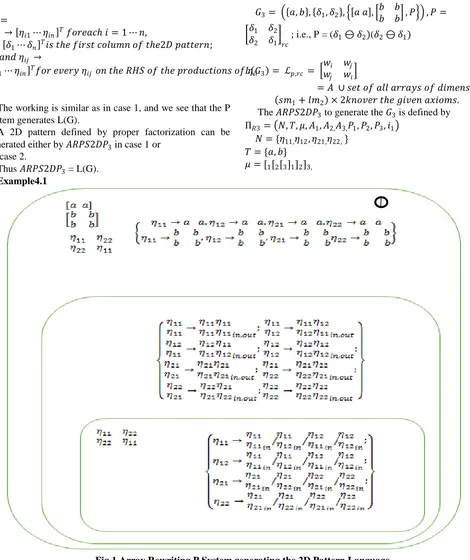
= 𝐴 ∪ 𝑠𝑒𝑡 𝑜𝑓 𝑎𝑙𝑙 𝑎𝑟𝑟𝑎𝑦𝑠 𝑜𝑓 𝑑𝑖𝑚𝑒𝑛𝑠𝑖𝑜𝑛 𝑠𝑚1+ 𝑙𝑚2 × 2𝑘𝑛𝑜𝑣𝑒𝑟 𝑡𝑒 𝑔𝑖𝑣𝑒𝑛 𝑎𝑥𝑖𝑜𝑚𝑠. The 𝐴𝑅𝑃𝑆2𝐷𝑃3 to generate the 𝐺3 is defined by Π𝑅3= 𝑁, 𝑇, 𝜇, 𝐴1, 𝐴2,𝐴3,𝑃1, 𝑃2, 𝑃3, 𝑖1
𝑁 = {𝜂11,𝜂12, 𝜂21,𝜂22, } 𝑇 = {𝑎, 𝑏}
[image:4.595.60.530.49.609.2]𝜇 = [1[2[3]1]2]3,
Fig 1 Array Rewriting P System generating the 2D Pattern Language V. PICTURE GENERATION FOR
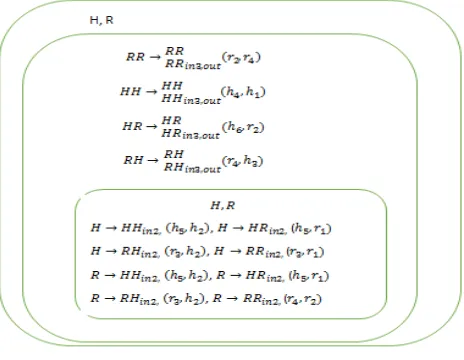
TWO-DIMENSIONAL PATTERN LANGUAGES& RESULTS
Fig 2 𝑨𝑹𝑷𝑺𝟐𝑫𝑷𝟑 with pasting rules for picture generation
[image:5.595.63.295.52.232.2]VI. CONCLUSION
In this paper we have defined an array rewriting P system model to generate two-dimensional pattern languages based on pattern grammar with two-dimensional axioms. We also generated pictures associated with these languages. The study would be further extended to make a comparative study of 2D pattern languages with other array languages and picture languages.
REFERENCES
1 C.K. Parimalam, J.D. Emerald Two-dimensional
grammars based on Patterns, International Journal for
Computer Science and Engineering,Vol.07, Issue.05 , pp.216-220, 2019.
2 D. Angluin, Finding Pattern common to set of strings,
Journal of Computer and System Sciences 21, 46-62, 1980.
3 3. D. Giammarresi, A. Restivo, Recognizable picture
languages, International Journal of Pattern Recognition and Artificial Intelligence. 6:31-46, 1992.
4 H. Fernau, M.L. Schmid, K.G. Subramanian,
Two-Dimensional Pattern Languages, In S.Bensch, F. Drewes, R. Freund, and F.Otto, editors, Fifth Workshop on Non-Classical Models for Automata and Applications, NCMA, Volume 294 of [email protected], pp.117-132. Osterreichische Computer Gesellschaft, 2013.
5 J. Dassow, Gh. Paun, Arto Salomaa, Grammars based on
Patterns, International Journal of Foundations of Computer Science, Vol 4: 1-14, 1993.
6 Gh. Paun , Computiong with Membranes, Journal of