ORIGINAL RESEARCH ARTICLE
DIASPORA, DEDICATION AND DEVELOPMENT (3D): INDIAN
PERSPECTIVE
*Satya Bhan Yadav
Associate Professor and Research Supervisor PG Dept of Economics, BSR GAC Matsya University,
Alwar (India)
ARTICLE INFO ABSTRACT
Matrix Diaspora can and in many cases, do play a very significant role in economic, social, cultural and political development of any country. Beyond sending remittances, they can promote trade, foreign direct investment (FDI), create businesses and spur entrepreneurship, and transfer new technology and skills.
The Indian Diaspora is a generic term to describe the people who migrated from territories that are currently within the borders of the Republic of India. It also refers to their descendants. The Diaspora is currently estimated to number over twenty million, composed of ‘NRIs’ (Indian citizens not residing in India) and ‘PIOs’ (Persons of Indian Origin who have acquired the citizenship of some other country). The Diaspora covers practically every part of the world. It is regarded as an asset in case of emergency in any country. For example, in India in the age of economy slowdown, India was passing through a bad phase and its monetary condition was severely affected. Inflation rate was high and people were unable to manage their daily life. In this condition, the impressive Indian Diaspora had played an important role in promoting India’s interest in domestic and abroad and act as its unnamed ambassadors. This was more so in the fields of culture, education, economic development and health and arts.
This paper discusses various aspects and fields in which Indian Diaspora could play a very decisive role in economic development of the country. The later section talks about the major implications on economic development by role playing of Indian Diaspora in 21st century. Findings and conclusion have been described in the last section of the paper.
*Corresponding author
Copyright ©2017, Satya Bhan Yadav.This is an open access article distributed under the Creative Commons Attribution License, which permits unrestricted use, distribution, and reproduction in any medium, provided the original work is properly cited.
INTRODUCTION
This article assesses the role of Diaspora in development of Indian state through their dedication and their commitment to their soil and mother land. This assessment of the Indian Diaspora’s response to these initiatives is situated within the debates on Diaspora and development and from the perspectives of state–society relations. The rest of this paper is divided into three sections, with the first marking out the paradigm shift in the theoretical domain of Diaspora and development with regard to historical background. The second part narrates the role in different sectors of Indian economy contributed by the Diaspora during the last few decades. The third section talks about conclusion and recommendations
while pointing out the steps to be taken in order to strengthen engagement of Diaspora in years to come.
Introduction: Diaspora is a generic term to describe the people who migrated from territories that are currently within the borders of the Republic of India. It also refers to their descendants. The Diaspora is currently estimated to number over twenty million, composed of ‘NRIs’ (Indian citizens not residing in India) and ‘PIOs’ (Persons of Indian Origin who have acquired the citizenship of some other country). The Diaspora covers practically every part of the world. India's population living abroad is the largest in the world with 1.6 crore (16 million) people living outside the country in 2015, according to a latest UN survey on international migrant
ISSN: 2230-9926
International Journal of Development Research
Vol. 07, Issue, 11, pp.16799-16805, November,2017
Article History:
Received 19th August 2017 Received in revised form 25th September, 2017 Accepted 20th October, 2017 Published online 29th November, 2017
Key Words:
Remittances, Information Technology, Economic Development,
Indian Diaspora, Inflation.
Citation: Satya Bhan Yadav,2017. “Actions performed by the family health support centers: an analysis of the results from the second cycle of the national program for access and quality improvement in primary care”, International Journal of Development Research, 7, (11), 16799-16805.
trends. Owing to their colonial history and their historic integration with global markets, Indians have been migrating across the world for centuries. They span the spectrum of class, profession, and history—ranging from construction workers in the Middle East and taxi drivers in New Jersey to bank managers in Latin America and information technology (IT) entrepreneurs in Silicon Valley. Given the magnitude and diversity of the Indian Diaspora, it is surprising how little we know about their activities and their impact on the country of origin. Surveys have shown that nearly 95 percent of overseas Indians send money to their families or close friends to support education, health, or other personal concerns in the homeland (Sampradaan 2001).
Historical Background
However, Indian Diaspora has been in limelight since many decades. Prior to the mid-1980s, the Indian Diaspora’s relations with the homeland were weak. Under British rule, Indians abroad were seen as a labour pool designed to benefit mainly the British Empire. In 1947, the newly independent Indian government pushed the Diaspora away by using the state’s physical boundaries to define the nebulous limits of national identity. Only those residing within the country’s borders were deemed Indian. Since the mid-1980s, the Indian government and the Diaspora have altered their stance toward one another. In the United States, for example, there has been an expansion in the number of organizations that Indian immigrants have launched to foster linkages with their country of origin. Concurrently, the Indian government has initiated new policies and institutions to strengthen its bonds with the Diaspora. In the mid-1980s, it created new bank accounts that allowed Non Resident Indians (NRIs) to invest in their home country. In 1999, it launched two new visa status cards for Persons of Indian Origin (PIO) and Overseas Citizens of India (OCI), which facilitated emigrants’ ability to travel in and out of India, invest in property, and hold rupee bank accounts. In 2000, the Indian government commissioned a high-profile committee to write a report on the Diaspora. Based on that report, in January 2003 the government inaugurated its first annual conference of overseas Indians, known as Pravasi Bharatiya Divas (PVD) or Overseas Indian Day. The conference date, 9 January, commemorated the day that Mahatma Gandhi (perhaps India’s most famous emigrant) returned from South Africa to launch the independence movement. The PVD conference facilitates networking opportunities between emigrants, the Indian government, and Indian organizations; commemorates emigrants who have contributed to the country’s development; and communicates new Diaspora policies, such as the recent bill that will enable overseas Indians to vote in their country of origin.
Objectives
To examine the nature and scope of the role of Diaspora in development, this study examines the following questions:
What is the scope of Indian Diaspora in development ofIndian State? When and why did they play a supportive role? Who participates in them?
How does Indian Diaspora affect homelanddevelopment?
In what areas are they concentrated? What explains thisconcentration?
How do linkages between Indian Diaspora and theGovernment of India affect power dynamics between the Indian government and the Indian Diaspora?
The Indian Diaspora
Indian Diaspora has been playing a very constructive and significant role in overall development of the country. It is now reputed to be the second largest Diaspora in the world, after the Chinese. Without undermining the narratives of loss and alienation of the Indian Diaspora, it can be argued that they have contributed considerably to the progress of their host countries as well as the home (India). Recognition of this vital potential that the Indian diasporic community has for the development of India has led to a rethinking of the government’s approach towards this community. A critical paradigm shift in policy promulgation has occurred, from one that was essentially emotional and cultural to one that is more pragmatic and based on economic matters. In an attempt to replicate the ‘Chinese model’ of utilising the potential of its Diaspora for the development of China, the Indian government introduced several initiatives to attract the capital and skills of the Indian Diaspora for the development of India.
Diaspora, Dedication and Development: A Paradigm Shift
In the early decades after independence, mostly during the 1950s until the 1960s, several post-colonial nations, including India, followed a closed model of nation-building and development planning. The primary intention of these governments was to safeguard the economic interests of these newly emerging nations from the vulnerability of being too exposed to the outside world and from being too dependent on external resources to develop their burgeoning economies. Development models that were adopted were essentially based on consolidation within and gradual progression towards self-reliance on various sectors of the economy. There was a strong emphasis on the construction and consolidation of a territorially determined nation and citizens who could claim entitlements as well as engage in the process of ‘national reconstruction’ or development. In this nationalist discourse of development, the people who were not staying within the territorial boundaries of the nation, labelled loosely as Diasporas, were viewed with a certain apprehension for their lack of commitment to the nation they had once lived in.
look at the literature on Diaspora, Dedication and Development, including those produced in the context of India by Indian scholars, will reveal certain distressing trends. In its celebration of diasporic remittances and the economic strength of the Indian Diaspora, in attempts to mobilise this community for development, the primary focus has shifted from intangible human aspects to tangible figures of how much money is flowing in. In the process, the human costs in terms of displacement, emigrants’ suffering and the effects of being left-behind are disappearing from the debate. This ‘feel good, bring good’ approach is particularly evident in the Indian context where state initiatives are largely aimed at preparing the emigrants and keeping them out so that the flows continue. In this Diaspora and development debate, the focus is on dispassionately crunching the data on money coming in without perceiving the ‘emigrant’ as a human. For example, Indian Americans are mostly socially and politically conservative, they donate to a limited set of causes. Donors are quick to give to natural disaster relief (Gujarat earthquake, tsunami in Tamil Nadu, floods in Punjab), but sustained development efforts are often underfunded. Many groups focus on children, which are considered an attractive area of philanthropy for Indian expatriates. By far the most popular cause for Indian Americans is education in India. Most Indian immigrants in the United States explain their own success as a result of education.
For first-generation immigrants, their education was mostly completed in their country of origin, and they remain loyal to the teachers and adults who supported them. They see education as the path out of poverty for India’s masses and as a politically noncontroversial subject. The focus on education has not only inspired many transnational development organizations in the United States, but has also forced several organizations that address broad-based development to rebrand themselves as education-oriented. Although ‘new Diaspora’ is a product of Indian emigration post-1960, with migration of Indian professionals, doctors, engineers, scientists, academics, and now IT professionals to developed economies in Western Europe, North America and Australasia. This new Diaspora includes the semi-skilled working class who went to the Gulf countries during the post-oil boom of the 1970s. This cohort includes low-wage workers in the West as well a large number of illegal immigrants. The origins of this Diaspora can be traced primarily to Kerala, Tamil Nadu, Andhra Pradesh, Punjab and UP, though this is a more pan-Indian Diaspora. The connection to home is much more real for this Diaspora because of frequent travels, social– cultural linkages, and inventions in communication technology. Both old and new segments of Indian Diaspora feature almost all the traits of home in terms of religious, social, cultural and regional diversities which have had a decisive influence on their relationship with India.
India’s Engagement with the Diaspora
A government can adopt a range of methods to engage with its Diaspora, ranging from the very symbolic to concrete policies. Diaspora policies of a nation essentially entail a composite of
state institutions, statutory practices and legislative
promulgations formulated to serve the interests of the extraterritorial population. Through these policies, the home country will attempt to capitalise on its Diaspora by extracting from them finances, expertise of different sorts and strategic influence. In India, these policy initiatives include bilateral
arrangements to facilitate the flow of emigrants and money, changes in basic financial regulations, state-sponsored celebrations of expatriates and recognition of their achievements. These initiatives by the Indian government were not well structured and articulated. In fact, for a long time, particularly during the Nehru and Indira Gandhi regimes, the government had been accused of being indifferent to the concerns of the Indian Diaspora. This alleged indifference has often been judged as a missed opportunity.
For systematic presentation of the paper, we have selected four areas in which Indian Diaspora have been playing a vital role and expected to play in the days to come. These are:
Remittances
Foreign Policy
Trade and Investment, and
Tourism.
Diaspora and Remittances
Figure 1. Average utilisation pattern of remittances in India. (Source: RBI Bulletin April 2010.)
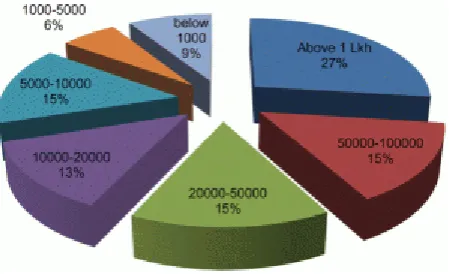
Similarly, 58% of remittances were of less than Rs 50,000, while 15% of them were of less than Rs5,000. Of great surprise and cause for celebration by the Indian government was that of the total figure of US$60 billion, 9% of these remittances were less than Rs1,000 (see Figure 2).
Figure 2. Size of remittances by overseas Indians (%) (Source: RBI Bulletin April 2010)
Remittances are generally thought to be counter-cyclical. The stability of remittance flows amidst financial crises and economic downturns make them a reliable source of foreign exchange earnings for developing countries. As migrant remittances are sent cumulatively over the years and not only by new migrants, remittances are able to be persistent over time. This is particularly true of remittances sent by circular migrants, migrant workers who move back and forth between their home and host countries in a temporary and repetitive manner. At the state level, countries with diversified migration destinations are likely to have more sustainable remittance flows. From a macroeconomic perspective, there is no conclusive relationship between remittances and GDP growth. While remittances can boost aggregate demand and thereby spur economic activity, other research indicates that remittances may also have adverse macroeconomic impacts by
increasing income inequality and reducing labour supply among recipient countries.
Diaspora and India’s foreign policy
After achieving independence in 1947, there was a paradigm shift in the position of Diaspora policy as a result of India’s foreign policy being guided by Nehruvian ideals of anti- imperialism and racial apartheid, respect for Sovereignty and non-alignment. On the economic front, India chose to follow self-reliance as its goal for economic development. The then Prime Minister of India, Jawaharlal Nehru categorically announced that ethnic Indians who chose to remain abroad would consider themselves as citizens or nationals of their respective host lands. In fact, they were encouraged to integrate with host culture and fight for the liberation of their adopted lands. Later, in spite of a change of focus in the India’s foreign policy from Nehruvian idealism to realism under the regime of Indira Gandhi, there was no change of position in the Diaspora policy or the Indian economic foreign policy. The implication of Nehru’s views was that the Diaspora could not expect India to fight for their rights and therefore India’s foreign policy was accordingly structured as a model of non- interference whenever the emigrant Indians got into trouble in Sri Lanka, Myanmar, etc. This naturally reflected the ethos of post-colonial independent India that was trying to make its presence felt in the international politics of Cold War era. With India’s rising economic power and military might, things have changed drastically.
[image:4.595.50.277.170.321.2]This has become further accentuated due to the high remittances that Indian Diaspora contribute. At $69 billion, India was the recipient of the highest NRI contributions in 2015. India’s non-alignment posture also precluded it from taking any sides in conflict zones. But since 1990, India has been engaged in major evacuations of Indians from conflict zones, the highlight being the Yemen rescue in 2015. Later, when there was a switch of foreign policy priorities from realism to inter- third world cooperation under the regime of Rajiv Gandhi, there was a slight shift in Diaspora policy as well. He offered his amicable support and tried to handle Fiji Indian crisis in 1986, which had strained our relationship with Fiji. Besides, having realized Indian Diaspora as a strategic asset, he invited Indian diasporic talents like Sam Pitroda to realize his vision of 21st century India and took administrative measures like the establishment of Indian Overseas Affairs department in 1984. After the end of Cold War, the emergence of a multi-polar centric foreign policy, a structural shift in the global economy and the relentless foreign reserve crisis of Indian economy in the 1990s, facilitated the Indian government led by Narasimha Rao to announce drastic economic reforms such as Liberalization, Privatization, Globalization (LPG). On the advent of new economic model, the Indian Diaspora was able to participate in the plethora of economic opportunities of the unregulated and open Indian Table 1. Top 5 recipient countries of remittances
(in billions of US Dollar) Countries Remittances
2012
Remittances 2013
Remittances 2014
Remittances 2015
Remittances 2016
India 68.82 69.97 70.97 72.20 62.7
China 57.99 59.49 61.49 63.90 61.0
Philippines 24.61 26.70 27.90 29.80 29.9
Mexico 23.37 23.02 24.50 25.70 28.5
France 22.05 23.34 23.94 24.60 18.9
[image:4.595.51.276.430.567.2]economy. It resolved the foreign currency crisis due to substantial investment and remittance from the Indian Diaspora. Subsequently, the Indian government changed its outlook towards Diaspora and reviewed its Diaspora policy. The NDA government led by BJP had initiated major steps to leverage upon the Indian Diaspora for economic growth and also as part of its larger vision of culturalnationalism.
The present government believes that the vast community of NRIs and PIOs also constitute a part of the Great Indian Family. There should endeavour to continually strengthen their social, cultural, economic and emotional ties with their mother country. Diaspora is a rich reservoir of intellectual, managerial and entrepreneurial resources. The government should devise innovative schemes to facilitate the investment of these resources for India’s all-round development. In the light of this, long and short term comprehensive policy measures were unveiled to engage its diverse Diaspora during its regime such as the appointment of High Level Committee on Indian Diaspora, launching of PIO card scheme, organizing annual Pravsi Bharatiya Divas on 9th January, giving out Pravasi Bharatiya Samman Awards, offering Dual citizenship (OCI) and so on. The subsequent UPA government established a separate Ministry of Overseas Indian Affairs which has taken several initiatives for engaging the Diaspora. From the above discussion, one can understand the mutual influence of Diaspora policy and Indian foreign policy. Under the Modi government, proactive outreach towards the diaspora has reached heights not seen before. From Madison Square to Sydney, Suva to Dubai, his words have echoed a singular sentiment. The colour of the passport does not matter. The only thing that is relevant is whether a person is Indian or not. That is enough for him to get help from the Indian government. Moreover, the merger of Person of Indian Origin (PIO) and Overseas Citizen of India (OCI) cards has brought the relationship closer. Such a politically charged policy has huge implications on domestic as well as foreign policy.
Diaspora and Trade and Investment
Owing to certain ideological and structural issues, FDI in India remains a controversial issue and this has seriously limited its utilisation as a channel for financial engagement with the India Diaspora. India’s attempts to attract FDI from the Diaspora have raised concerns particularly because of enormous FDI from Mauritius, a small island with the majority population being people of Indian origin. Since 1995, Mauritius (total GDP in 2011 was US$19.29 billion) has been India’s largest source of FDI, contributing about 40% of the total FDI of US$55 billion in 2011–12. Diaspora’s help in enhancing trade, foreign direct investment and growth of a country and bring prosperity. Diasporas not only enhance trade and investment for the home country but also augment human and financial capital; provide new ideas and connections through emigrant’s education and working experience (Kapur, 2004). These ethnic networks continue through kinship, social and professional ties, and get their strengths from strands of information, common contacts, trust and finance (Bräutigam, 2003). Such social and business networks promote trade and investment and thus are valuable for both hosts as well as for the home country. In this context, Flisi and Murat (2010) analyze the impact of social networks on FDI from five European countries – France, Germany, Italy, Spain and the UK, and find that bilateral FDI between France, Germany and the UK are affected by the social links while FDI from Spain and Italy
in particular depend their respective Diasporas. Despite the fact that trade plays a very crucial role in development of any country.
It not only enhances income of the people but employment
opportunities through industrialisation. The financial
engagement of the Indian Diaspora through FDI has been modest compared with the money they have remitted. For several years now, inflow of remittances by the Indian Diaspora has crossed not only the FDI by this community but also total FDI into ndia. A report by the Reserve Bank of India (RBI) indicates that total FDI in India for 2011–12 was US$46.84 billion compared with US$66.13 billion remitted by the Diaspora. The share of Indian Diaspora in the total FDI has never been very significant compared with the situation in China. In the 1990s, Chinese FDI in China’s economy was 20 times higher than the FDI in the Indian economy. However, there was a marked increase, with intermittent decline, in the FDI following liberalisation of the economy. FDI in India for 2011–12 was US$66.13 billion. In the initial years after liberalisation, the unfavourable regulatory regime and the hostility by the indigenous capitalist class were possible reasons for low FDI, particularly by the Indian Diaspora. In the 1980s when an NRI industrialist from Britain, Swaraj Paul, tried to invest in India’s automobile sector, he faced severe hostility and obstruction from Indian industrialists. In recent years, some of the leading business moguls of Indian origin such as Laxmi Nivas Mittal (of British-based steel-producing giant Arcelor Mittal) and Anil Agarwal (of British-based Vedanta) have started or have proposed to initiate massive FDI, primarily in sectors related to mining and metal. These initiatives have raised serious concerns about the human and ecological costs of these initiatives and have been opposed by a cross section of the Indian population. The only exceptions are the IT and services sectors where diasporic entrepreneurs have played an important role through FDI and technology transfer.
Diaspora and Tourism
projects. Creative tourism is mainly about an engaged experience that leads into learning outcome for tourists who are looking for authentic experience immersed in local culture. It becomes more meaningful when the Indian Diaspora is linked, as many among them, particularly the second and third generations, have lost the ties to their roots and want to remain connected in some ways with the original culture to which they belong. One way that governments attract Diaspora tourists is by promoting genealogy tourism as an exciting way to learn about one’s family history and reconnect with the past. India's large and disperse diaspora are in fact creative tourists looking for knowledge and experiences that connects the new generation to their civilization and culture and give them the opportunity to understand the nuances of that culture in a more connected and participatory way. They get connected with stories of their roots, place or people and value those experiences. It is a true sense of dynamic tourism with participative prospects.
Responses from the Diaspora
According to the government, ‘India has been deeply appreciative of the support of the Pravasi Bhartiya community, at times of need. However, as noted earlier in this study, the capacities and interest of people of Indian origin worldwide vary enormously according to their class composition and their location. As a result of this, India’s engagement with people of Indian origin has taken on many different forms and occupies so many different spheres. These forms range from levels of personal family ties to business ventures involving international financial markets. A review of the responses of people of Indian origin underlines the complexity of their different historical trajectories in their different territorial and temporal locations. This diverse community cannot be bundled together and presented as a homogenising singular block called the Indian Diaspora. It is evident that the descendants of Indian immigrants have not responded to calls by India to invest in its economic development. This Diaspora cannot be labelled as the lost children of India. The responses made by descendants of Indian immigrants in regions such as Southeast Asia need to be read differently because the metaphors of belonging and obligation to the ‘homeland’ may have a different meaning for them. India’s burgeoning economy with its rapidly growing middle class could well serve as an ideal investment opportunity, one that is made by this diaspora without subscribing to the government’s nationalist imagery of common Indian identity.
Concluding Remarks
The government of India is no longer oblivious of the communities of Indian origin abroad, increasingly celebrating the success stories of these people while also recognising the potential they offer for the country’s development. The government has made proactive efforts to engage these communities, and people of Indian origin abroad have responded to these initiatives, making significant contributions in several tangible and intangible forms. However, there are segments of the Indian Diaspora, particularly the ‘old Diaspora’ or the descendants of Indian migrants who are citizens in their countries, who have not responded in the ways expected by the government of India. A close review of this debate about Diaspora, dedication and development and development through Diaspora’s dedication indicates two crucial points:
first, a very strong penchant for the elite classes of Diaspora, or the dollar Diaspora, to invest in India; and
Second, that there are several missing links in this narrative. These are:
The first missing link is the callous failure of the Indian government to make a distinction between first generation migrants who may return to India and the descendants of emigrants from India born and bred as citizens of other countries.
Another such missing link is the exploitation of this Diaspora in their destinations, particularly in the Gulf, which includes severe restrictions on employment, personal life, withholding of passports, etc. Another is the trap created at home in order to realise the ‘émigré dream’. The cost of emigration is very high (an average of about Rs 57,000), which many of the intending emigrants cannot afford. They therefore, fall into the trap of moneylenders, which substantially reduces the benefits of earning abroad, while creating difficulties, even extreme hardships, for families back home.
The third missing link is the hype about employment generation. A study about Kerala shows that 64% of the emigrants were already gainfully employed at home; this draws attention to the possible labour crises at home because of the emigration of the working population.
and negative stigma earlier attached to partnering with those living outside the country. Finally, India’s recent rise in economic and geopolitical terms has provided emigrants with the dignity that many crave, as their income and skill have proved insufficient in ensuring their full assimilation into their host countries.
REFERENCES
Ages, Arnold. 1973. The diaspora dimension, The Hague: Martinus Nijhoff.
Arendt, H. 1978. The Jew as pariah: Jewish identity and politics in the modern age, New.
Armstrong, John A. 1976. ‘Mobilized and proletarian diasporas’, American Political Science.
Bakewell, O. 2008. ‘In search of the diasporas within Africa’, African Diaspora 1(1– 2): 5–27.
Bamyeh, Mohammed A. 2007. ‘The Palestinian diaspora’ in Hazel Smith and Paul Stares (eds) Diasporas in conflict: peace-makers and peace-wreckers, Tokyo: United Nations University Press, 90–105.
Bhaba, Homi. 1990. Nation and Narration. London: Routledge. Boyajian, Levon and Haigaz Grigorian 1991. ‘Psychosocial sequelae of the Armenian genocide’ in R. G. Hovannisian (ed.) The Armenian genocide in perspective, New Brunswick, NJ: Transaction Publishers, 177–85.
Boyarin, Daniel 1994. A radical Jew: Paul and the politics of identity, Berkeley: University of California Press
Boyarin, Daniel and Jonathan Boyarin 1993. ‘Diaspora: generation and the ground of Jewish identity’, Critical Enquiry, 19 (4), 693–725.
Boyarin, Daniel and Jonathan Boyarin 1994. ‘Powers of diaspora’, paper presented at the International Congress of the Historical Sciences, Montreal, 27 August–3 September. Boyarin, Jonathan. 1995. ‘Powers of diaspora’, paper
presented to a panel on diaspora at the International Congress of the Historical Sciences, Montreal, 27 August– 3 September.
Brah, Avtar, 1996. Cartographies of diaspora: contesting identities, London: Routledge
Cho, L. 2007. ‘The turn to diaspora’, Topia: Canadian Journal
of Cultural Studies 17: 4. Available at
https://pi.library.yorku.ca/ojs/index.php/topia/article/viewF ile/13229/22406
Cohen, R .2010. Global Diasporas, an Introduction. London and New York. Routledge.
Cohen, R. 2008. Global Diasporas: An Introduction, London: Routledge (2nd edition).
Cohen, Robin, 1996. ‘Diasporas and the Nation-State: from victims to challengers’ http://www2.warwick.ac.uk/fac/soc /sociology/staff/emeritus/cohenr/research/papers/d
iasporas.pd f
Dekmejian, R. Hrair, 1991. ‘Determinants of genocide: Armenians and Jews as case studies’ in R. G. Hovannisian (ed.) The Armenian genocide in perspective, New Brunswick, NJ: Transaction Publishers, 85–96.
Dhaliwal, Amarpal K. 1994b. ‘Reading diaspora: self-representational practices and the politics of reception, Socialist review, 24 (4), 13–43.
Dicken, Peter, 1992. Global shift: the internationalization of economic activity, London: Paul Chapman Publishing (second edition).
Dufoix, S. 2012. La Dispersion. Une histoire des usages du mot diaspora, Paris: Editions Amsterdam.
Endelman, M. 1991. ‘The legitimization of the diaspora experience in recent Jewish historiography’, Modern Judaism, 11 (2), 195–209.
Gilroy, P. 1993. The Black Atlantic: Modernity and Double Consciousness, London: Verso.
Glazer, N. and D. Moynihan 1963. Beyond the Melting Pot: The Negroes, Puerto Ricans, of Jews, Italians and Irish of New York City, Boston: MIT Press.
Gopinath, G. 1995 ‘Bombay, U.K., Yuba City: Bhangra music and the engendering diaspora’, Diaspora 4(3): 303–21. Hirsch, M. 2008. ‘The Generation of Postmemory’, Poetics
Today 29(1): 103–28. Kennedy, J. F. (1964) A Nation of Immigrants, New York: Popular Library.
Laguerre, M. 1999. ‘State, diasporas and
transnational politics: Haiti reconceptualise, Millennium:
Journal of International Studies 28(3): 633–51.
Ong, A. 1999 Flexible Citizenship: The Cultural Logics of Transnationality, Durham, NC: Duke University Press. Roberston, R. 1992. Globalisation. London: Sage. Schnapper,
D. and C. Bordes- Benayoun 2006. Diasporas et nations, Paris: Odile Jacob.
Shuval, J. T. 2000. ‘Diaspora Migration: Definitional Ambiguities and a Theoretical Paradigm’. International Migration, Vol. 38. No. 5: pp 41-56.
Sinnreich, A. 2010. Mashed Up: Music, Technology and the Rise of Configurable Culture, moment’ Amherst, MA: University of Massachusetts Press.
Tölölyan, K. 1996. ‘Rethinking diaspora (s): stateless power in the transnational Diaspora: a journal of transnational studies, 5(1): 3–36.
Tölölyan, K. 2007 ‘The contemporary discourse of diaspora studies’, Comparative Studies of South Asia, Africa and the Middle East 27(3): 647–55.