International Journal of Innovative Technology and Exploring Engineering (IJITEE) ISSN: 2278-3075, Volume-8 Issue-11, September 2019
Abstract: Abstract: Now a days one of the critical factors that affects the recognition performance of any face recognition system is partial occlusion. The paper addresses face recognition in the presence of sunglasses and scarf occlusion. The face recognition approach that we proposed, detects the face region that is not occluded and then uses this region to obtain the face recognition. To segment the occluded and non-occluded parts, adaptive Fuzzy C-Means Clustering is used and for recognition Minimum Cost Sub-Block Matching Distance(MCSBMD) are used. The input face image is divided in to number of sub blocks and each block is checked if occlusion present or not and only from non-occluded blocks MWLBP features are extracted and are used for classification. Experiment results shows our method is giving promising results when compared to the other conventional techniques.
Keywords: Facerecognition, Occlusion, Fuzzy Segmentation, SVM
I. INTRODUCTION
Due to the rapid growth in the technology, there is a high demand for high level of security for persons and organization to sustain their privacy in the business world. So in order to secure assets and privacy one needs more secure system called Biometrics. Human usually identify the persons by their face. Based on this human tendency in matching faces for recognition, face biometric has evolved and succeeded in mimicking human natural phenomenon and also performing better even in large amounts (millions) of images. If the number of images exceeds certain limit, humans fails to identify correctly but the face recognition system developed has reached a good accuracy of 92% even the database contains millions of images. It is observed that when the database size increases its accuracy decreases linearly.There are several biometrics like iris, retina, finger print, face etc., out of several biometrics, face biometric is the one that is mostly used because as stated above it is the natural human acting way of recognition and it does not need any cooperation of the user and it is more reliable biometric since it possess complex nonlinear patterns. The face biometric performs better on the face images that are collected in well cooperative and utmost organized settings where well-ordered lab conditions maintain sufficient illumination and resolution and also cooperation from the
Revised Manuscript Received on September 03, 2019
Ch.Rathna Jyothi Asst.Professor, CSE Department,Prasad V Poturi Siddhartha Institute of Technology Kanuru, Vijayawada-7, India
subjects. The identification of persons whose images are collected in non-controlled environment is really a tough job. The reliability of face biometric is also a big issue because the accuracy of face biometric depreciates when face images are added with different variations like pose, illumination and expression. There are occasions where face biometric fails are aging, resolution and occlusion. Organization of the entire paper is as follows. Part II contains the literature studies of related works, Part III contains how Occlusion in face image can be detected, Part IV explains about segmenting the face image in to occluded and non-occluded regions. Part V describes the face recognition method using Mean Weighted Local Binary Pattern Features of the non occluded face image. Part VI describes experimental results with discussion and Part VII concludes the research work with future directions.
II. RELATEDWORK
The original image of the face greatly influenced by the amount of Occlusion. Further it can significantly diminish the performance of classical face recognition systems. So there is a need to control partial occlusion in order to achieve substantial performance in face recognition. The literature [2–15] focus on finding occlusion-tolerant features or classifiers to reduce the effect of partial occlusions in face recognition. Though, the hidden features from the occluded parts can still deteriorate the recognition performance. Recently, the studies [16–19] demonstrated that prior information about the occlusion (e.g., type, location, and size) can be used to exclude the occluded parts to achieve significant improvement in the recognition rate. Hence, explicit occlusion analysis is become a necessary step in occlusion-robust face recognition. In this paper, we proposed face recognition method based on mean weighted local binary patterns [11], which complements the literature works [18–20]. First occluded portion in the image detected and then segmenting the occluded parts (e.g., sunglasses/scarves) from the face image and then face recognition is performed only on the non-occluded facial regions. Each block of the image is analysed using SVM classifier and then the occluded part is segmented using Adaptive Fuzzy C-Means clustering. It is basically identifies the presence of occlusion at the pixel-level and enables to preserve as much as possible information of the face image for the recognition. After the computation of an occlusion
prone area,
Integarted Minimum Cost Sub-Block Matching
Distance based Face Recognition using Internet
of Things
We propose Mean weighted local binary pattern histogram sequences (MWLBPHS) [11] to efficiently represent occluded faces by excluding features extracted from the occluded pixels. Our technique is compared with other state of art techniques[2, 4, 11], and state-of-the-art methods [13,19, 20] on AR face database and obtained the best results.
III.OCCLUSIONDETECTION
The face image is initially divided in to number of sub blocks. Each sub-block is verified for the presence of occlusion. This research work considered only two cases of occlusion,one is scarf and the other is sunglass. Occlusion detection can be casted as a two-class classification problem. Since non-linear support vector machines (SVM) [81] are proven to be a powerful tool for discriminating 2 classes of high dimensional data, we adopted then a non-linear SVM classifier for occlusion detection. Let us consider a training set consisting of N pairs {xi,yi}where i=1…..N. Here xi refers to a
reduced feature vector, Mean weighted local binary pattern histogram sequences (MWLBPHS) of a face sample i, and yi {-1,1}
is the label which indicates if the sample xi is occluded or not. SVM
is used to find the optimal separating hyper plane { } and predict the label of an unknown face x by Eq(3.1)
F(x)= sign (3.1)
Where {xj j } indicates support vectors.
IV.OCCLUSIONSEGMENTATION
The standard Fuzzy C-Means Algorithmic rule (FCM) is used for segmentation of occluded part as it does not pay-off any information by excluding occluded portion the recognition performance can be greatly improved. The main objective of FCM is to partition the information in such away that the information pointedness within one clustering are more similar to each other as possible and as far away as possible from the data points of other cluster. Let us consider the face image contains N pixels and let us suppose this N should be segmented in to K(K=2) clusters in fuzzy fashion. That means a point i does not necessarily belonging in one of the two classes (one is occluded portion and the other is non occluded portion) but can partially belong to two classes as well. For each point iЄN the sum of memberships with respect to k classes must be one i.e and uijЄ[0,1]. In
FCM approach the segmentation is carried out to minimize an objective function shown in Eq (4.1).
F= 2 (4.1)
Where yc represent the cluster center and m denotes the
fuzziness parameter typically set to 2.FCM operates in such a way that it assigns high membership to the points whose intensities are closer to the centroid of its class and low membership values to the points which are far away from the centroid. The Fuzzy segmentation applied on a sample image and the corresponding segmentation results are presented in the Fig 4.1
V. Mean Weighted Local Binary Pattern Feature Extraction (MWLBP)
5.1 Local Binary Pattern (LBP) Extraction
In the basic LBP extraction , the image is partitioned in to 3X3 sub blocks and from 3X3 neighborhood, each pixel pi is examined and the eight neighboring pixels and their intensities are compared with the central pixel value cpi then the eight bit binary number is formed. The binary bit value is 0 if the neighbor pixel intensity is less than cpi otherwise it’s value is 1 as given in equation (4.3). With these binary numbers a histogram is generated.
f(pi-cpi)= (5.1)
Where cpi is the central pixel intensity value in a3x3 neighbourhood.
[image:2.595.311.522.246.426.2]a) b) c)
Figure 4.1 Illustration of occlusion segmentation a) face images occluded by scarf and sunglass b) Initial guess of occlusion
through thresholding c) visualization after applying fuzzy segmentation
I f(I)
Figure 5.1 Basic LBP Calculation LBP= (11000101)2=20+21+25+27=163
Now the LBP codes are caluculated by using the equation (5.2)
LBP= (5.2)
1 1 0
1 0
0 1 0 161 154 110
150 150 69
[image:2.595.359.557.510.657.2]International Journal of Innovative Technology and Exploring Engineering (IJITEE) ISSN: 2278-3075, Volume-8 Issue-11, September 2019
5.2 MeanWeightedLocalBinary Pattern Feature Extraction(MWLBP)
In basic LBP central pixel intensity is considered for thresholding. But this may overlook the noise present in in nearby pixels. Since face images are almost uniform in order to make the conventional LBP robust the mean intensity of 3x3 neighborhood is taken for thresholding purpose and then the weights are calculated using the Eq (5.3)
f(pi-pm)= (5.3)
The MWLBP features are calculated then mean and standard deviation of MWLBP features are computed. These features are used for classification of test face image.
5.3 Face Recognition Using MWLBP Features
Initially the face image is tested for occurrence of occlusion using SVM detector. If occlusion is detected image is segmented so that only non-occluded portion of the image is considered for classification. The face recognition problem under occlusion can be casted as follows.
Let us consider the mean set of features MF={MF1,MF2,……} and
standard deviation features SD={SD1,SD2…….} be the first order
statistics features of theoriginal face image. For each training image of the database and for the test image, from the non- occluded portion of the face image the MWLBP features are extracted. For the test image Y the mean set of features MFt={MF1,MF2,….}
and standard deviation features SDt={SD1,SD2,……..} are
computed. For each training image Xi where i={1,2,3,…K}, K is
the total no. of images in the training set, the same selected non occluded MWLBP features and their corresponding mean and standard deviation vectors are computed. The Fae recognition is done by finding the closest training image by using the integrated minimum cost sub block matching(IMCSBM).
5.4 Integrated Minimum Cost Sub-block Matching(IMCSBM) Integrated Minimum Cost Sub-block Matching (IMCSBM) is a technique of using the sub-block properties to measure the similarity between the images. A new Integrated Minimum Cost
Sub-block matching (IMCSBM) is developed to avoid the
drawbacks associated with Intergrated Region Matching (IRM). The IMCSBM allows matching a sub-block of one sample to a number of sub-blocks of another sample. That means, the matching of sub-blocks between any two images is a many-to-many relationship, which is applicable to measure the similarity between the images having fixed number of sub-blocks and fixed sized sub-blocks. There is no need to find the weight of the sub-block because all the sub-blocks are of equal size. The significance of each sub-block is assumed as one unit.
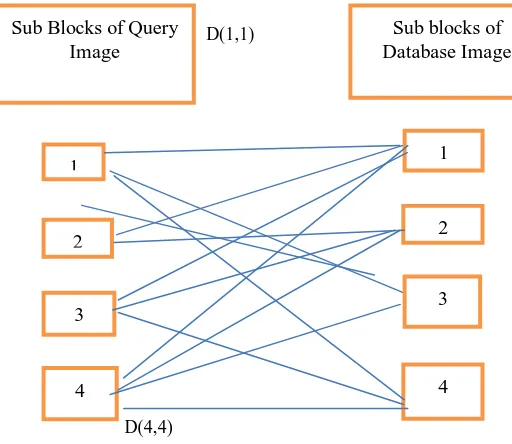
IMCSBM is very simple and less complex matching principle, which consumes less time to find the similarity between two images. A bi-partite graph is formed to represent the mapping of query image sub-blocks and the database image sub-blocks as shown in Fig. 5.2. The edge labels of the bipartite graph indicate the distances between sub-blocks.
A Minimum Cost Matching is performed for this bi-partite graph. Each sub-block in the query image is matched with all the sub-blocks of the database image. Four blocks of a database image and four blocks of a query image are used for constructing the bipartite graph. The distance from block 1 of database image to block1 in query image is denoted by D(1,1). In the similar manner D(4,4) indicates the distance between blocks 4 of the two images. The Bi-partite graph shows n2 comparisons for the images having n sub-blocks. As this process involves too many comparisons, an efficient implementation of the matching technique is desired. Hence, an algorithm is used to find the Minimum Cost Matching using the bipartite graph.
D(1,1)
[image:3.595.312.568.50.272.2]
D(4,4)
Figure 5.2 Bipartite graph
The procedure for finding the minimum distance between two blocks is calculated as follows:
In step1 an adjacency matrix is computed based on the distance between any two blocks say m, n.
I. The distance dmn of the distance matrix which is
minimum is found between sub-blocks m of test image and n of training image of the database.
II. The distance is noted and the corresponding entry in the distance matrix is (replaced by some high value, say 99999).This will prevent sub-block m of test image and sub-block n of training image from further participating in the matching process.
III. The distances between sub-block p and other sub-blocks of database image and the distances between sub-block q and other sub-blocks of query image, are ignored (because every sub-block is allowed to participate in th
IV. e matching process only once).
V. The step II-IV are repeated till every sub-block finds a matching.
The complexity of the matching procedure is reduced from O(n2) to O(n), where n is the number of sub-blocks involved. The Integrated Minimum Cost Sub-block Matching distance between images is now defined as:
Dqt=∑ ∑ dij, Where i=1, 2,--n j=1, 2---n. (5.4)
where dij is the best-match distance between sub-block i of query image q and sub-block j of database image t. Dqt is the distance between images q and t.
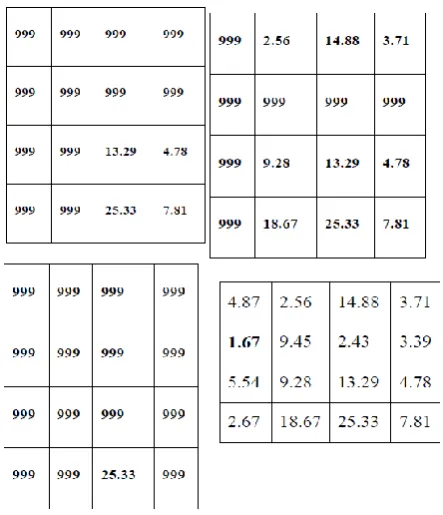
Image similarity computation based on IMCSBM principle is shown in Fig 5.3. In (a) first pair of matched sub-blocks are found at i=2,j=1, In (b) second pair of matched sub-blocks are found at i=1, j=2 , In (c) third pair of matched sub-blocks are found at i=3, j=4,In (d) fourth pair of matched sub-blocks are found at i=4,j=3, yielding the Minimum Cost Integrated
Matching distance 34.34. Each is sub-block is involved in the matchingprocess only once.
The minimum cost distance is sum of n distances. Thus the time complexity of determining the integrated matching distance is O(n).
1
2
1
2
3
4
3
4 Sub Blocks of Query
Image
Figure.5.3 Computation of Integrated Minimum Cost Sub-block Matching distance.
D=1.67+2.56+4.78+25.33=34.34
VI.THE FACE RECOGNITION PROCEDUR The main component of our system is a face recognition procedure that identifies the user based on the captured facial image. In general, biometric identification consists of two distinct phases: enrollment and recognition [31]. During the enrollment phase we acquire biometric data, process it and then store it in the system’s database along with the users identity. During the recognition phase we again acquire the biometric data of the user and compare it against the stored data to determine the users identity. In the following sections we describe the implementation of both phases in our system.
Enrollment: An overview of the enrollment procedure is shown in Fig. 6.1
In the enrollment , images are acquired from the USB web camera on the Raspberry Pi , which by default, captures 10 images from the USB web camera on the Raspberry Pi. Users then upload the images to the web application running on a back-end server where they are further processed. For the enrollment procedure, face detection is first performed on the
captured images to exclude the image background from the processing and focus solely on the region of interest and it is resized to predefined width and height, i.e.,200 ×200 pixels. Next, the resized image is enhanced by applying Gaussian blurring and histogram equalization. This step is needed to reduce noise and mitigate potential effect of the external lighting. Each image is represented as a 1D feature vector . The feature vectors of all enrollment images are collected in a 2D matrix and stored in the system’s database.
Recognition: An overview of the recognition procedure is shown in Fig.6.2. During the recognition phase, motion detection is employed to detect whether the user would like to start using the system. When a sufficient level of motion is detected, the frame that triggers the recognition procedure is captured. Each frame is pre-processed by converting it to gray-scale and applying Gaussian blur to remove high frequency noise so we can focus on the structural objects of the image. For the motion detection, we first initialize the average frame as the first frame of the captured video stream. As the stream continues the weighted average of all previous frames is computed including the current one .With this procedure, dynamically the back- ground adjusted and account for the changes in lightning. Next, we sub- tract the current frame from our background leaving us with the frame delta. We then apply thresholding to the calculated delta and find regions that are substantially different from the background model. If the regions are large enough, we assume that we have found motion in the current frame. We send this frame to the back-end for recognition. On the back-end we convert the input frame to a feature vector .
VII.RESULTS & DISCUSSION 7.1 Dataset
AR database contains total 126 classes with 26 images in each class. The face images that includes in the database vary in facial expressions, pose variation and containing occlusion either upper and lower half of the face image. In the experiments, for training the model, images having expression variations and images having occlusion are used. To test the model the occluded face images are used in order to check the robustness of the system. The comparative results are presented in Table 6.2. Experiments are also conducted on the ORL dataset. ORL dataset contains forty classes with 10 images per each class. Out of ten images five are used for training the model and rest are used for the testing the model.
Experiment #1
[image:4.595.52.277.527.708.2]This experimentation is performed on the images in ORL dataset; The experiment results are presented in Table 7.1.
Table 7.1 Recognition accuracy on ORL database Method Recognition rates on ORL database
PCA 97.33LBP 95
International Journal of Innovative Technology and Exploring Engineering (IJITEE) ISSN: 2278-3075, Volume-8 Issue-11, September 2019
FIGURE 7.1 RECOGNITION ACCURACY ON ORL DATABASE
EXPERIMENT #2
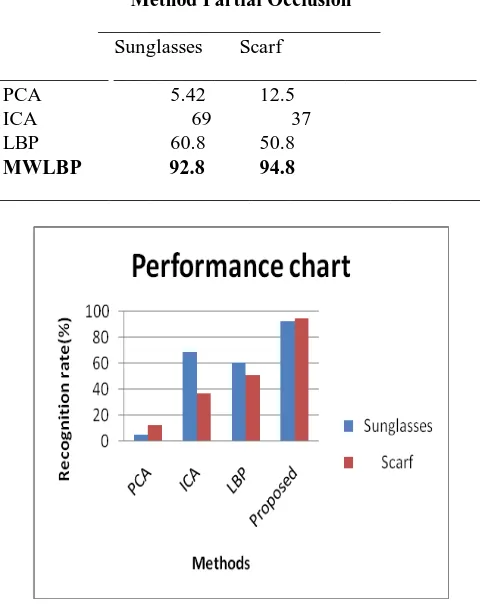
[image:5.595.81.290.49.188.2]The AR dataset contains images with sunglass and scarf. Each set of partially occluded images of sunglass and scarf are considered separately to evaluate the performance of the proposed feature extraction technique and results are tabulated as shown in Table 7.2. The performance chart of the same is presented in Fig 7.2.
Table 7.2 Recognition performance on AR Database with partial Occlusion
Method Partial Occlusion ____________________________ Sunglasses Scarf
___________ ____________________________________ PCA 5.42 12.5
ICA 69 37 LBP 60.8 50.8 MWLBP 92.8 94.8
________________________________________________
FIGURE 7.2RECOGNITION PERFORMANCE ON ARFACE
DATABASE WITH PARTIAL OCCLUSION As shown in the table the conventional LBP has recognition performance of 60% when applied on images occluded with sunglasses and only has the success rate of 50% on images occluded with scarf accessory. The recognition rate on ORL dataset LBP method is giving promising result where pose and illumination variant images are only present. The method that we presented in this paper MWLBP is outperforming the conventional techniques
when applied irrespective of occlusion present in the images as shown in tables 6.1 and 6.2.
VIII.CONCLUSION&FUTURESCOPE In our paper we considered occluded face images by Scarf and Sunglass. The distance metric we (IMCSBM) applied reduces the complexity of matching to O(N) from O(N2) compared to other state of art. The occluded portion is segmented first and then features of non occluded region are only considered in recognition process. The mean weighted LBP features are most relavent features to recognize the ace image when occluded with pose, illumination, rotation , scarf and sunglass. As a future work it can be extended to other forms of occlusion like cap, beard etc., are not in the scope of this paper so they can be considered in future work since they are also most general forms of occlusion in daily life.
ACKNOWLEDGMENT
I would like to thank our Siddhartha Academy of General and Technical Education for encouraging young researchers by sponsorship.
REFERENCES
1. Li, S. Z. and Jain, A. K.(2011).Handbook of Face Recognition, Second Edition, Springer.
2. Grother, P. J., Quinn, G.W. and Phillips P. J(2010). Multiple-Biometric Evaluation (MBE) 2010, Report on the Evaluation of 2D Still-Image Face Recognition Algorithms, NIST Interagency Report 7709.
3. Abate, A. F., Nappi, M., Riccio, D. and Sabatino G. (2007). 2D and 3D face recognition: A survey, Pattern Recognition Letters, 28(14):1885-906.
4. Zhao, W., Chellappa, R., Phillips, P. J. and Rosenfield A. (2003). Face recognition: A liter-ature survey, ACM Computing Surveys, 35(4):399-458.
5. Crawford M. (2011). Facial recognition progress report, Defense & Security, SPIE Newsroom.
6. www.nist.gov
7. Jain, A. K., Klare, B. and Park U. (2012). Face matching and retrieval in
forensics applications, IEEE Multimedia, Multimedia in
Forensics,vSecurity, and Intelligence, pp.1-9.
8. Mvg Rao. (2015).A survey of recent advances in face detection, Article in International Journal of Control Theory and Applications 8(5):2145. 9. Javier Hernández-Aceituno, Leopoldo Acosta, and José D. Piñeiro. (2016).
Pedestrian Detection in Crowded Environments through Bayesian Prediction of Sequential Probability Matrices,Technical report, Hindawi Publishing Corporation, Journal of Sensors.Volume 2016, Article ID 4697260, 8 pages
10. Klare, B. F., Burge, M. J., Klontz, J. C., Bruegge, R. W. V. and Jain, A. K.(2012) Face recognition performance: role of demographic information, IEEE Transactions on Information Forensics and Security, 7(6):1789-1801.
11. Spaun, N. A. (2009). Facial comparisons by subject matter experts: their role in biometrics and their training, Advance in Biometrics, Lecture Notes in Computer Science, 5558, pp. 161-168.
12. T. Ahonen, A. Hadid, and M. Pietikainen. (2006). Face description with local binary patterns: Application to face recognition. Pattern Analysis and Machine Intelligence, IEEE Transactions on, 28(12):2037 –2041. 13. S.Z.Li and A.K.Jain. (2011). Hand book of Face Recognition (Second
Editio on). Springer.
14. GiacomoIndiveri Senior Member, IEEE and Shih-Chii Liu Senior Member, IEEE. (2015) “Memory and information processing in neuromorphic systems”,proceedings of the IEEE,
15. Adrian RhesaSeptianSiswanto. (2014). “Implementation of face recognition algorithm for biometrics based time attendance system”. IEEE conference on ICT for smart cities,
[image:5.595.48.288.318.622.2]thor-1 Photo
16.Jindong Wang,LipingJia. (2016).Eigenfaces vs. Fisherfaces: recognition using class specific linear projection. Pervasive Computing Research Center,Institute of Computing Technology,ChineseAcademy of Sciences. 17.X. He, S. Yan, Y. Hu, P. Niyogi, and H. Zhang. (2005). Face recognition
using Laplacianfaces. IEEE Transactions on Pattern Analysis and Machine Intelligence, 27(3):328–340.
18.T. Kim and J. Kittler. (2005).Locally linear discriminant analysis for multimodally distributed classes for face recognition with a single model image. IEEE Transactions on Pattern Analysis and Machine Intelligence, 27(3):318–327.
19.H. Chen, H. Chang, and T. Liu. (2005). Local discriminant embedding and its variants. In Proceedings of the IEEE International Conference on Computer Vision and Pattern Recognition.
20.S. Yan, D. Xu, B. Zhang, H. Zhang, Q. Yang, and S. Lin. (2007). Graph embedding and extension: A general framework for dimensionality reduction. IEEE Transactions on Pattern Analysis and Machine Intelligence, 29:40–51.
AUTHORSPROFILE
Dr Ch.Ratna Jyothi working as Asst.Professor in Prasad. V. Potluri Siddhartha Institute of Technology had completed B.Tech in Computer Science & Engineering and M.Tech in Computer Science & Engineering and Ph.d in Computer Science & Engineering and passionate to do teaching and research in the domain of Image Processing, Soft Computing, Internet of Things etc.,.