R E S E A R C H A R T I C L E
Open Access
The effect of standard dose multivitamin
supplementation on disease progression in
HIV-infected adults initiating HAART: a randomized
double blind placebo-controlled trial in Uganda
David Guwatudde
1*, Molin Wang
2, Amara E. Ezeamama
3, Danstan Bagenda
4,1, Rachel Kyeyune
5, Henry Wamani
1,
Yukari C. Manabe
6and Wafaie W. Fawzi
7Abstract
Background:Efficacy trials investigating the effect of multivitamin (MV) supplementations among patients on Highly Active Antiretroviral Therapy (HAART) have so far been inconclusive. We conducted a randomized, double blind, placebo controlled trial to determine the effect of one recommended daily allowance (RDA) of MV supplementation on disease progression in patients initiating HAART.
Methods:Eligible subjects were randomized to receive placebo or MV supplementation including vitamins
B-complex, C and E. Participants were followed for up to 18 months. Primary endpoints were: change in CD4 cell count, weight and quality of life (QoL). Secondary endpoints were: i) development of a new or recurrent HIV disease progression event, including all-cause mortality; ii) switching from first- to second-line antiretroviral therapy (ART); and iii) occurrence of an adverse event. Intent-to-treat analysis, using linear regression mixed effects models were used to compare changes over time in the primary endpoints between the study arms. Kaplan-Meier time-to-event analysis and the log-rank test was used to compare HIV disease progression time-to-events and all-cause mortality.
Results:Four hundred participants were randomized, 200 onto MV and 200 onto placebo. By month 18, the
average change in CD4 cell count in the MV arm was 141 cells/uL compared to 147 cells/uL in the placebo arm, a mean difference of−6 · 17 [95 % CI−29 · 3, 16 · 9]. The average change in weight in the MV arm was 3 · 9 kg compared to 3 · 3 kg in the placebo arm, a mean difference of 0 · 54 [95 % CI−0 · 40, 1 · 48]; whereas average change in QoL scores in the MV arm was 6 · 8 compared to 8 · 8 in the placebo arm, a mean difference of−2.16 [95 % CI−4 · 59,0 · 27]. No significant differences were observed in these primary endpoints, or in occurrence of adverse events between the trial arms.
Conclusions:One RDA of MV supplementation was safe but did not have an effect on indicators of disease
progression among HIV infected adults initiating HAART.
Trial registration:Clinical trials NCT01228578, registered on 15th October 2010.
* Correspondence:[email protected] 1
School of Public Health, Makerere University College of Health Sciences, Kampala, Uganda
Full list of author information is available at the end of the article
Background
Vitamins and minerals are important for maintaining an optimal and responsive immune system [1, 2]. Micronu-trient deficiencies and their effects on immune function and disease progression have been documented in HIV-infected persons [3]. These deficiencies are prevalent even before the development of symptoms of disease and are associated with accelerated HIV disease progres-sion [4–6]. A number of studies conducted among HIV-infected adults during the pre-highly active antiretroviral therapy (HAART) era, have shown that multivitamin supplementation enhances immune reconstitution, re-duces viral load, improves overall clinical outcomes, and reduces mortality [7–14]. However, only a few trials have explored the effect of multivitamin supplementation in relation to HIV progression during HAART, and some have reported beneficial treatment outcomes [15–17].
A recent trial conducted in Tanzania among HIV-infected adults initiating HAART compared the effect of multiple recommended daily allowance (RDA) doses of multivitamin supplements including vitamins B-complex, C and E, to a single RDA. Although the trial was stopped early because of negative side effects, at the time of stopping the trial at a median follow-up time of 15 months, multiple RDA supplementation was no dif-ferent from a single RDA on several key measures that reveal HIV disease progression and risk of death [18]. Because this trial did not use a placebo arm, it is plaus-ible that individuals in both treatment arms had similar benefits or supplementation had no effect in either arm. Thus, in spite of widespread use of nutritional supple-ments among HIV-infected patients, it is unclear if the benefits of micronutrient supplementation observed in relatively healthy patients not yet on HAART would also be notable among HIV-infected patients on HAART. We conducted a randomized, double-blind, placebo-controlled trial comparing one RDA of multivitamin supplements to placebo to evaluate the benefit of multi-vitamin supplements on disease progression among HIV-infected patients on HAART in Uganda. Parti-cipants were provided with daily dose of one RDA of oral multivitamin supplements including vitamins B-complex, C and E, or placebo for 18 months, and the efficacy and safety of the supplements were examined.
Methods
A detailed description of methods used in this trial has been reported elsewhere [19]. Here we only describe methods relevant for results presented in this article.
Setting
The trial was conducted at the Infectious Diseases Insti-tute (IDI) in Kampala, Uganda. IDI provides out-patient care and treatment for HIV-infected persons. Over
10,000 people receive care through IDI, approximately 6000 of which are on HAART.
Eligibility
Patients were recruited between April 2010 and June 2012, and eligible subjects had to meet the following in-clusion criteria: a) at least 18 years old, b) HIV positive, c) initiating HAART at the time of randomization or had been on HAART for no longer than 6 months, d) had no intention of re-locating more than 20 km outside of the IDI within the next 18 months, e) agreed to allow home visits, and follow-up contacts as part of the trial, and f ) provided written informed consent. Subjects with any of the following were excluded: a) women with a positive pregnancy test (who are provided iron and folic acid supplementation as prenatal standard of care per the Uganda Ministry of Health standards); b) individuals who were too ill to provide consent.
Randomization and masking
Prior to initiation of the trial, a staff not associated with implementation of the trial at Harvard School of Public Health (HSPH), generated serial numbers from 1 to 400 and randomly assigned to intervention or placebo groups, in blocks of 10 participants. Trial regimen bottles (manu-factured on special order from Tishcon Corp, Salisbury, MD), were then labeled with the appropriate participant serial numbers only. The regimen bottles were shipped to Uganda, but the list showing the trial arm to which each serial number was assigned remained anonymous at HSPH and was not accessible to trial staff in Uganda until the trial was un-blinded. The trial pharmacist dispensed the assigned regimen bottles to the participants in sequen-tial order of enrollment. The intervention arm consisted of a daily dose of one RDA of oral multivitamins at a sin-gle RDA (based on the United States of America’s Food and Nutrition Board, Institute of Medicine, National Academies) [20, 21], of the following micronutrient for-mulations: B-complex vitamins (1 · 4 mg B1, 1 · 4 mg B2, 1 · 9 mg B6, 2 · 6 mcg B12, 18 mg niacin, 0 · 4 mg folic acid), 70 mg of vitamin C, and 10 mg of vitamin E; whereas the placebo consisted of an inactive pill of the same size, packaging, and coloration as the active multi-vitamin tablets. Participants were followed for up to 18 months with evaluations at baseline, months 3, 6, 12, and 18. Except the trial statistician who had to conduct in-terim analyses to facilitate the Data Safety Monitoring Board reviews; trial participants, trial staff, and the investi-gators were all blinded to the treatment allocation until the trial was un-blinded in March 2014.
Measurements
each study visit, medical officers performed a complete clinical examination, recorded all diagnostic tests per-formed and any medications prescribed. They also docu-mented whether participants had attended additional clinic visits outside their scheduled study appointments, recording reasons, diagnoses, and any medications re-ceived outside those prescribed in the trial, as well as any hospitalizations and/or any heakltbh related adverse events that might have occurred.
Laboratory investigations
A blood specimen was taken from each participant at enrolment and every 6 months thereafter to measure CD4 cell counts, complete blood count, bilirubin, cre-atinine, and alanine transaminase (ALT) as part of clin-ical standard of care. Outside of standard of care measurements, we repeated CD4 cell count measure-ment at month 3 to enable us investigate any acute changes in CD4 cell count following randomization.
Quality of life
Quality of life (QoL) of participants was assessed at base-line and every 6 months thereafter, using the validated, culturally-adapted local language version of the Medical Outcomes Survey-HIV (MOS-HIV) [22]. This QoL survey consisted of the following ten subscales: perceived health (five items), pain (two items), QoL (one item), health tran-sition (one item), role functioning (two items), social func-tioning (one item), physical funcfunc-tioning (six items), cognitive functioning (four items), health distress (three items), energy (four items). Item scores were arranged such that for each item, a higher score corresponded to better QoL. The QoL score of a subscale was computed as the sum of all the item scores under the subscale.
There is no published information about how to com-pute an overall QoL score for the MOS-HIV. We there-fore considered the following two ways for computing the overall QoL score: 1) performing a linear transformation (i.e. subscale score multiplied by ten) so that the perfect score of each subscale is 10, then summing up the trans-formed subscale scores, 2) summing up the ten subscale scores to get an overall score, then performing the linear transformation on the overall score so that the perfect overall score is 100. We then compared the Coefficient of Variation (CV) of the overall QoL scores at baseline based on the two definitions above, and found that the first one was associated with a smaller CV. We therefore used the first definition for the overall QoL score.
Adherence At each monthly drug refill visit, research nurses assessed compliance to the treatment (ART and trial regimens) through two ways, by direct questioning and recording patient self reported compliance to the medications, and using a pill count.
Trial endpoints
The primary endpoints were changes over time in abso-lute CD4+T cell count, weight, and QoL. Secondary end-points were: i) development of a new or recurrent HIV disease progression event, including all cause mortality; ii) switching from 1st line to 2nd line HAART regimen; and iii) occurrence of an adverse event, including peripheral neuropathy, severe anemia, and diarrhea.
Ethical compliance
The trial protocol was approved by the Scientific Review Committee of IDI; and the Institutional Review Boards of HSPH, and that of Makerere University School of Public Health. A Data Safety Monitoring Board was setup at the beginning of the trial, and monitored the trial every 6 months within the first year of initiation of the trial, and annually subsequently.
Statistical analysis Baseline comparisons
We compared the distribution of participants at enrollment in the two trial arms along baseline socio-demographic, and clinical characteristics using the chi-square or Fisher’s exact test for categorical variables, and the t-test or Wilcoxon rank sum test for continuous variables.
Primary endpoints analysis
Analyses for primary endpoints were based on the intention-to-treat analysis strategy. We applied linear mixed effects modeling with a random intercept, un-structured correlation matrix and robust standard errors, to evaluate changes over time in the primary outcomes in relation to the assigned treatment group. Visit month (categorical) at which the outcome was measured, treat-ment group and their interactions were included in the model as fixed effects. P-values for change over time were obtained through the contrast statements in SAS PROC MIXED, testing the null hypothesis that the mean changes at all the post-baseline visit months were equal between the treatment groups. The alternative hypoth-esis was that the mean changes were not equal at, at least one post-baseline visit month.
Secondary endpoints analysis
We examined a number of secondary endpoints that are indicative of HIV disease progression:
mucocutaneous herpes simplex virus, histoplas-mosis, esophageal candidiasis, extrapulmonary tuberculosis, lymphoma, Kaposi sarcoma, pulmonary M. tuberculosis, and recurrent pneumonia.
b) Percentage of switching from first line, to second line antiretroviral (ARV) regimen, between the trial arms using the Fisher’s exact test.
c) Occurrence of adverse events between the trial arms using Fisher’s Exact test, and mixed effects modeling with a logit link. The adverse events monitored included severe anemia (HB≤7 g/dL), nausea, vomiting, high ALT levels (≥200 IU/I), peripheral neuropathy and diarrhea.
We also compared occurrence of post-randomization hospitalizations between the trial arms using the gener-alized estimating equation method, with log-link, an ex-changeable correlation structure, and robust variance estimates; and the change over time in hemoglobin (HB), and ALT levels between the trial arms using linear mixed effects model analysis.
Finally, given some imbalance in the participants’ age between the trial arms at baseline, age was adjusted for in all model-based analyses. In the linear mixed effects model analyses for endpoints that constituted changes from baseline, the baseline value of the outcome was also adjusted for. For primary endpoints, we checked for effect modification by baseline values of CD4 cell count, BMI, and baseline ART use status (HAART naïve, on treatment for less or equal to 3 months, or on treatment for 3 to 6 months). We also examined effect modifica-tion by post-randomizamodifica-tion multivitamin use prescribed outside of the trial as a time varying variable (1 = once taken, from then onwards assumed to be on multivita-mins outside of the trial; and =0 for periods before tak-ing). All tests were two-sided, statistical significance level was set to 0 · 05, and all analyses were performed using SAS version 9 · 0.
Results
Enrollment and follow-up
Between April 2010 and June 2011, we enrolled a total of 400 participants in this trial. Overall, 18 participants died during follow-up (ten in the multivitamin, and eight in the placebo arm), seven migrated to outside the study area (four in the multivitamin, and three in the placebo arm), six were lost to follow-up (four in the multivita-min, and two in the placebo arm), and one participant in the multivitamin arm voluntarily withdrew from the trial. The minimum follow up time was 1 · 5 months, a maximum of 18 months, and a median of 18 months. No significant differences were observed in the median
follow-up times between the trial arms (p= 0 · 432). Figure 1 summarizes the trial schema.
Baseline characteristics of trial participants
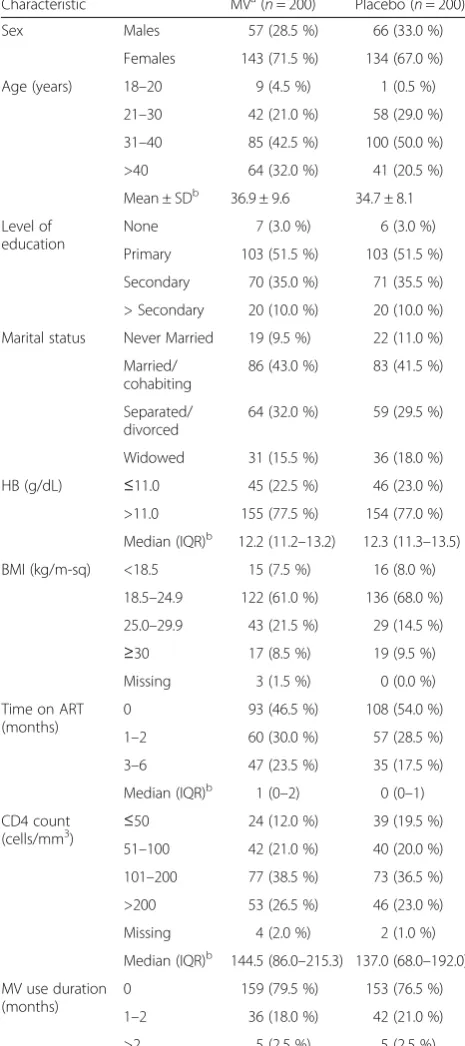
The majority of the participants, 227 (69 %) were female, 290 (72 %) were older than 30 years with an overall aver-age of 35 · 8 years, and standard deviation (SD) of 9 · 0. Only 88 participants (22 %) reported using multivitamins prior to enrollment into the trial for a median duration of 1 month, and 200 (50 %) had been initiated on HAART within the past 6 months for a median duration of 1 · 9 months (Interquartile range = 0 · 5–3 · 9). Except for age, the trial arms were comparable at baseline with respect to socio-demographic characteristics, duration of ART use prior to randomization, and duration of multi-vitamin use prior to randomization (Table 1). The aver-age aver-age of the participants in the multivitamin arm was 36 · 9 years (SD = 9 · 6), compared to 34 · 7 years (SD = 8 · 1) in the placebo arm.
Effect of multivitamin supplementation on primary endpoints
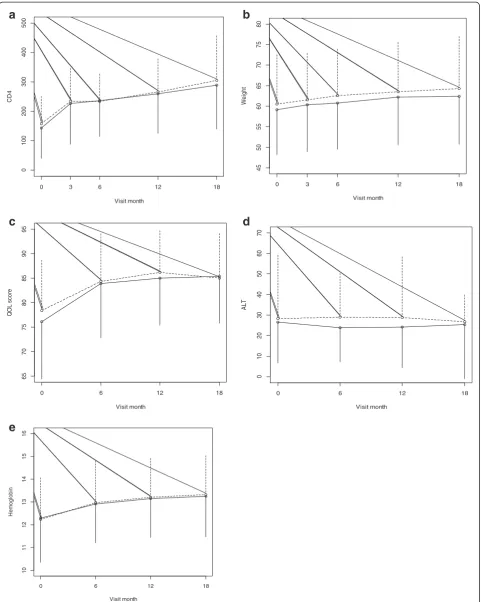
No significant differences were observed in changes of the primary endpoints between the trial arms. In the multivitamin arm, the observed average increase in CD4 cell count between baseline and month 18 was 141 cells/ uL, compared to 147 cells/uL in the placebo arm (p-value for change over time =0 · 726). Regarding weight, the observed average change in weight between baseline and month 18 was 3 · 9 kg in the multivitamin arm, compared to 3 · 3 kg in the placebo arm (p-value for change over time = 0 · 691). The observed average change in QoL scores between baseline and month 18 was 6 · 8 in the multivitamin arm, compared to 8 · 8 in the placebo arm (p-value for change over time = 0 · 454) (Table 2 and Fig. 2). Effect modification by post-randomization multivitamin use prescribed outside of the trial on the effect of the intervention on any of the three primary endpoints was not statistically significant. The effect of multivitamins was also not modified by baseline CD4 cell count, weight, age, or HAART status at baseline.
Effect of multivitamin supplementation on secondary endpoints
The confirmed post randomization HIV disease pro-gression events observed in this trial were: five cases of extra pulmonary tuberculosis (all in the placebo arm), and one case of Kaposi sarcoma in the intervention arm. Figure 3 shows the Kaplan-Meier plot of the time to a confirmed post-randomization HIV disease progression event or death (whichever occurred first), by trial arm. There was no significant difference in occurrence HIV disease progression events and all cause mortality be-tween the trial arms (p-value = 0 · 615, HR = 0 · 81, 95 % CI = [0 · 53–2 · 88]).
A total of 35 post-randomization hospitalization events were observed among 34 participants in the multivitamin arm, compared to 39 among 35 partici-pants in the placebo arm. There was no difference in oc-currence of these events between the trial arms (Risk Ratio = 0 · 94, 95 % CI = 0 · 61–1 · 47). Only 2 participants in the placebo arm were switched from a first line to a second line anti-retroviral regimen (Fisher’s Exact test
p-value = 0.479).
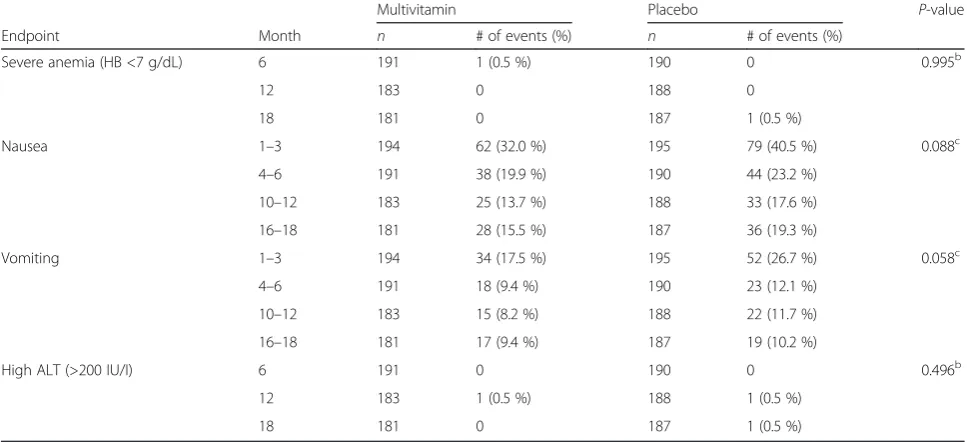
A total of 550 adverse events were observed in this trial that included one event of severe anemia in the
1134 screened for eligibility
713 ineligible
236 live more than 20 km from clinic 216 pregnant
151 on another trial
80 ART duration greater than 6 mths 30 too sick
421 eligible and approached for consent
400 enrolled and randomized
200 placebo 200
multivitamins
Month 3:195 evaluated
Month 6:194 evaluated
Month 12:
191 evaluated
Month 18:187 evaluated
2 migrated 1 lost to follow-up
2 died 1 migrated 1 lost to follow-up 21 declined
consent
Month 3:197 evaluated 1 died
1 migrated 1 withdrew consent
Month 6:193 evaluated 3 died
1 migrated
1 died
Month 12:185 evaluated 4 died
2 migrated 2 lost to follow-up
2 died
1 withdrew consent 2 lost to follow-up
5 died
Month 18:180 evaluated for month 18
[image:5.595.57.538.89.568.2]multivitamin arm, and one in the placebo arm (p= 0 · 995), 345 events of nausea (153 in the multivitamin and 192 in the placebo arm; p= 0 · 088), 200 cases of vomit-ing (84 in the multivitamin, and 116 in the placebo arm;
p= 0 · 058), and one event of high ALT (>200 IU/I) in
the multivitamin arm compared to none in the placebo arm;p= 0 · 496, (Table 3).
Discussion
We examined the effect of one RDA dose of multivita-min supplementation including vitamultivita-mins B-complex, C, and E on disease progression among HIV-infected adults in Uganda initiating HAART and observed no overall effect on the primary endpoints, nor in the secondary endpoints.
[image:6.595.304.536.109.545.2]Previously, in several placebo-controlled trials and high quality large observational studies, multivitamins
Table 2Observed mean changes by visit month and treatment
group for primary endpoints, ALT and HBa
End point Multivitamin Placebo Two-sidedp-value for change over timeb -n
-Mean (SD) -n
-Mean (SD)
Change in CD4 (cells/uL)
0–3 months 194 77 (97) 193 86 (103) 0.726
0–6 months 191 74 (95) 190 94 (92)
0–12 months
183 106 (112) 188 117 (116)
0–18 months
181 141 (160) 186 147 (130)
Change in weight (kg)
0–3 months 194 1.2 (2.9) 195 1.2 (3.3) 0.691
0–6 months 191 2.1 (4.2) 190 1.7 (4.0)
0–12 months
183 3.2 (5.4) 188 3.1 (5.0)
0–18 months
181 3.9 (6.2) 187 3.3 (5.8)
Change in QoL score
0–6 months 191 6.1 (11.1) 190 7.5 (12.7) 0.454
0–12 months
181 8.1 (10.9) 187 8.4 (12.0)
0–18 months
181 6.8 (12.4) 186 8.8 (12.4)
Change in ALT (IU/I)
0–6 months 190 0.99 (32.8) 188 −2.78 (20.9)
0–12 months
183 0.56 (41.5) 187 −1.66 (22.1) 0.064
0–18 months
180 −1.69 (33.4) 186 −0.02 (30.0)
Change in HB (g/dL)
0–6 months 191 0.68 (1.6) 190 0.60 (1.5)
0–12 months
183 0.92 (1.4) 188 0.81 (1.6) 0.977
0–18 months
181 1.01 (1.5) 186 0.91 (1.7)
a
ALTAlanine transaminase,HBHemoglobin,Q1Upper limit of first quartile,Q3
Upper limit of third quartile
b
Based on linear mixed effects model analysis adjusting for age and baseline value
Table 1Baseline characteristics of trial participants by treatment
arma
Characteristic MVa(
n= 200) Placebo (n= 200)
Sex Males 57 (28.5 %) 66 (33.0 %)
Females 143 (71.5 %) 134 (67.0 %)
Age (years) 18–20 9 (4.5 %) 1 (0.5 %)
21–30 42 (21.0 %) 58 (29.0 %)
31–40 85 (42.5 %) 100 (50.0 %)
>40 64 (32.0 %) 41 (20.5 %)
Mean ± SDb 36.9 ± 9.6 34.7 ± 8.1
Level of education
None 7 (3.0 %) 6 (3.0 %)
Primary 103 (51.5 %) 103 (51.5 %)
Secondary 70 (35.0 %) 71 (35.5 %)
> Secondary 20 (10.0 %) 20 (10.0 %)
Marital status Never Married 19 (9.5 %) 22 (11.0 %)
Married/ cohabiting
86 (43.0 %) 83 (41.5 %)
Separated/ divorced
64 (32.0 %) 59 (29.5 %)
Widowed 31 (15.5 %) 36 (18.0 %)
HB (g/dL) ≤11.0 45 (22.5 %) 46 (23.0 %)
>11.0 155 (77.5 %) 154 (77.0 %)
Median (IQR)b 12.2 (11.2–13.2) 12.3 (11.3–13.5)
BMI (kg/m-sq) <18.5 15 (7.5 %) 16 (8.0 %)
18.5–24.9 122 (61.0 %) 136 (68.0 %)
25.0–29.9 43 (21.5 %) 29 (14.5 %)
≥30 17 (8.5 %) 19 (9.5 %)
Missing 3 (1.5 %) 0 (0.0 %)
Time on ART (months)
0 93 (46.5 %) 108 (54.0 %)
1–2 60 (30.0 %) 57 (28.5 %)
3–6 47 (23.5 %) 35 (17.5 %)
Median (IQR)b 1 (0–2) 0 (0–1)
CD4 count (cells/mm3)
≤50 24 (12.0 %) 39 (19.5 %)
51–100 42 (21.0 %) 40 (20.0 %)
101–200 77 (38.5 %) 73 (36.5 %)
>200 53 (26.5 %) 46 (23.0 %)
Missing 4 (2.0 %) 2 (1.0 %)
Median (IQR)b 144.5 (86.0–215.3) 137.0 (68.0–192.0)
MV use duration (months)
0 159 (79.5 %) 153 (76.5 %)
1–2 36 (18.0 %) 42 (21.0 %)
>2 5 (2.5 %) 5 (2.5 %)
aART
antiretroviral therapy,HBHemoglobin,MVMultivitamin supplementation
b
[image:6.595.56.289.116.640.2]45
50
55
60
65
70
75
80
Visit month
We
ig
h
t
0 3 6 12 18
0
100
200
300
400
500
Visit month
CD4
0 3 6 12 18
65
70
75
80
85
90
95
Visit month
Q
O
L
sco
re
0 6 12 18
01
0
2
0
30
40
50
60
70
Visit month
AL
T
0 6 12 18
10
11
12
13
14
15
16
Visit month
He
m
o
g
lo
b
in
0 6 12 18
a
b
c
e
d
[image:7.595.58.540.88.691.2]provided in single RDA or multiples of RDA resulted in slower disease progression and mortality among HIV in-fected individuals who were in earlier stages of disease and had not yet been initiated on HAART. These studies have been carried out in the U.S., Thailand, Tanzania, and South Africa, among other settings [23]. In a
recently published randomized controlled trial from Botswana [10], these findings were confirmed among pre-HAART patients among whom micronutrient sup-plementation that included multivitamins and selenium for 24 months was found to be safe and significantly delayed disease progression.
[image:8.595.59.538.88.355.2]Fig. 3Kaplan-Meier plots for confirmed HIV disease progression events or all-cause death.Solid lineMultivitamin arm,broken linePlacebo
Table 3Adverse events in the multivitamin and placebo armsa
Multivitamin Placebo P-value
Endpoint Month n # of events (%) n # of events (%)
Severe anemia (HB <7 g/dL) 6 191 1 (0.5 %) 190 0 0.995b
12 183 0 188 0
18 181 0 187 1 (0.5 %)
Nausea 1–3 194 62 (32.0 %) 195 79 (40.5 %) 0.088c
4–6 191 38 (19.9 %) 190 44 (23.2 %)
10–12 183 25 (13.7 %) 188 33 (17.6 %)
16–18 181 28 (15.5 %) 187 36 (19.3 %)
Vomiting 1–3 194 34 (17.5 %) 195 52 (26.7 %) 0.058c
4–6 191 18 (9.4 %) 190 23 (12.1 %)
10–12 183 15 (8.2 %) 188 22 (11.7 %)
16–18 181 17 (9.4 %) 187 19 (10.2 %)
High ALT (>200 IU/I) 6 191 0 190 0 0.496b
12 183 1 (0.5 %) 188 1 (0.5 %)
18 181 0 187 1 (0.5 %)
a
ALTAlanine transaminase,HBHemoglobin
b
From Fisher’s exact test for 2 × 2 table
c
[image:8.595.56.540.487.708.2]We wanted to examine the efficacy of nutritional sup-plements as adjunct to HAART, given the high mortality and risk of opportunistic infections in the first several months of antiretroviral therapy particularly in those with low CD4 T cell counts [24]. A previous trial con-ducted by our team in Tanzania to investigate the effect of a similar combination of multivitamin supplements (B-complex, C and E) found no difference in the effect of a multiple dose versus one RDA multivitamin supple-mentation on HIV disease progression or death among HIV-infected adults initiating HAART [18]. Of concern in that trial, high dose multivitamins supplementation resulted in a significant elevation of liver enzyme ALT, and there was a suggestion of higher mortality among individuals who had BMI <16 kg/m2[18]. In the current trial from Uganda, the single RDA dose of multivitamins was safe, with no difference compared with placebo in risk of elevated liver enzymes and other safety endpoints.
While micronutrients supplements are beneficial among individuals in stages prior to the initiation of HAART [10, 23], it may be that these nutrients are not sufficient and the addition of macronutrients is critical with advanced disease stage. In a recently published trial from Ethiopia, lipid based supplements containing es-sential fatty acids, protein, in addition to multivitamins provided for 3 months at the initiation of HAART re-sulted in a significant improvement in lean body mass and total weight gain compared with individuals who did not receive the nutritional supplement [25].
We examined whether timing of provision of nutri-tional supplements relative to HAART initiation pro-vides differential effects. Based on work in Zambia, Koethe and Heimburger proposed that with increased appetite and nutritional intake after HAART initiation, a precipitous decline in serum phosphate may occur con-tributing to higher early mortality [26]. In the trial from Ethiopia noted above, individuals provided with nutritional supplement in the second 3 months after initiation of HAART had significant better weight gain compared with those who received the intervention in the first 3 months [25], suggesting that delay in provision of nutritional inter-vention may result in better outcomes. In our Uganda trial, we found no difference in the effect of multivitamins on any of the primary outcomes whether patients where HAART naïve or had been on therapy for up to 6 months.
The trial has several strengths and limitations. This is the first placebo-controlled trial to examine the efficacy of multivitamin supplements among individuals who are on antiretroviral therapy in an African setting. The trial from Tanzania compared one RDA with multiples of the RDA of the same vitamins (B-complex, C and E) [18], and thus it was not possible to exclude the possibility that both single and multiple RDA dose regimens had equivalent effects.
Participants in this trial from Uganda were relatively well-nourished group at baseline as evidenced by the fact that only 7 · 8 % were under-weight (BMI <18 · 5 kg/m2). It is possible that there is minimal benefit to nutritional supplementation among participants with controlled disease. Thus, the findings of the trial may not be generalizable to populations where severe malnutri-tion is more prevalent with advanced HIV disease.
We note that our trial with a sample size of 400 was relatively small and was powered to examine the effect of multivitamin supplementation on only three end-points. It is possible that the trial did not have enough power to detect differences in the effect of the multivita-min supplementation on less common endpoints (such as incidence of severe immunosuppression or wasting) that may indicate HIV advanced disease progression, and to examine effect modification by various partici-pants’ characteristics. Larger trials may be necessary to confirm or dispel our findings.
Conclusions
This trial found that single dose RDA of MV supplemen-tation did not have an effect on indicators of disease progression among HIV infected adults initiating HAART. However multivitamin supplements at single RDA dose are safe and can be provided to individuals on anti-retroviral therapy. Although our trial participants were relatively well nourished, malnutrition is endemic in many low income countries and is a common mani-festation among HIV-infected individuals [27–29]. Micronutrient intakes at daily recommended levels need to be assured, either through diet or when needed through use of supplements [30]. Additional research is needed on the role of more comprehensive supplement including other essential macronutrients, as the benefits of these may be higher.
Competing interest
The authors declare that they have no competing interests.
Authors’contributions
WWF, DG, and YCM conceptualized the trial. DG, RK, YCM, AEE, WWF, DB and HW implemented the trial. MW, DB, DG and WWF conducted the data analysis. DG and WWF had primary responsibility for final content. All authors participated in writing, read and approved the final manuscript.
Acknowledgments
Research findings reported in this article were supported by the Eunice Kennedy Shriver National Institute of Child Health & Human Development of the National Institutes of Health [grant number R01HD060333]. The content is solely the responsibility of the authors and does not necessarily represent the official views of the National Institutes of Health.
Author details
1
School of Public Health, Makerere University College of Health Sciences, Kampala, Uganda.2Departments of Epidemiology and Biostatistics, Harvard School of Public Health, Channing Division of Network Medicine, Harvard Medical School, Boston, MA, USA.3Department of Epidemiology and Biostatistics, University of Georgia, Athens, GA, USA.4Department of Global Health and Population, Harvard School of Public Health, Boston, MA, USA. 5
Infectious Diseases Institute, Makerere University College of Health Sciences, Kampala, Uganda.6Division of Infectious Diseases, Department of Medicine, John Hopkins University, Baltimore, MD, USA.7Departments of Global Health and Population, Nutrition and Epidemiology, Harvard School of Public Health, Boston, MA, USA.
Received: 11 March 2015 Accepted: 4 August 2015
References
1. Beisel WR. In: Gershwin ME, German JB, Keen CL, editors. Nutrition and immunology: principles and practices. Totowa, NJ: Humana Press; 2000. p. 389–403.
2. Coyne-Meyers K, Trombley LE. A review of nutrition in human immunodeficiency virus infection in the era of highly active antiretroviral therapy. Nutr Clin Pract. 2004;19(4):340–55.
3. Beisel WR. Single nutrients and immunity. Am J Clin Nutr. 1982;35(2 Suppl):417–68.
4. Beach RS, Mantero-Atienza E, Shor-Posner G, Javier JJ, Szapocznik J, Morgan R, et al. Specific nutrient abnormalities in asymptomatic HIV-1 infection. AIDS. 1992;6(7):701–8.
5. Baum MK, Shor-Posner G, Lu Y, Rosner B, Sauberlich HE, Fletcher MA, et al. Micronutrients and HIV-1 disease progression. AIDS. 1995;9(9):1051–6. 6. Vorster HH, Kruger A, Margetts BM, Venter CS, Kruger HS, Veldman FJ, et al.
The nutritional status of asymptomatic HIV-infected Africans: directions for dietary intervention? Public Health Nutr. 2004;7(8):1055–64.
7. Jiamton S, Pepin J, Suttent R, Filteau S, Mahakkanukrauh B, Hanshaoworakul W, et al. A randomized trial of the impact of multiple micronutrient supplementation on mortality among HIV-infected individuals living in Bangkok. AIDS. 2003;17(17):2461–9.
8. Fawzi WW, Msamanga GI, Spiegelman D, Urassa EJ, McGrath N, Mwakagile D, et al. Randomised trial of effects of vitamin supplements on pregnancy outcomes and T cell counts in HIV-1-infected women in Tanzania. Lancet. 1998;351(9114):1477–82.
9. Allard JP, Aghdassi E, Chau J, Tam C, Kovacs CM, Salit IE, et al. Effects of vitamin E and C supplementation on oxidative stress and viral load in HIV-infected subjects. AIDS. 1998;12(13):1653–9.
10. Baum MK, Campa A, Lai S, Sales Martinez S, Tsalaile L, Burns P, et al. Effect of micronutrient supplementation on disease progression in asymptomatic, antiretroviral-naive, HIV-infected adults in Botswana: a randomized clinical trial. JAMA. 2013;310(20):2154–63.
11. Mugusi F, Med M, Hertzmark E, Essex M, Hunter DJ. A randomized trial of multivitamin supplements and HIV disease progression and mortality. N Engl J Med. 2004;351(1):23–32.
12. Jiang S, He J, Zhao X, Li H. The effect of multiple micronutrient supplementation on mortality and morbidity of HIV-infected adults: a meta-analysis of randomized controlled trials. J Nutr Sci Vitaminol (Tokyo). 2012;58(2):105–12.
13. Giacomet V, Vigano A, Manfredini V, Cerini C, Bedogni G, Mora S, et al. Cholecalciferol supplementation in HIV-infected youth with vitamin D insufficiency: effects on vitamin D status and T-cell phenotype: a randomized controlled trial. HIV Clin Trials. 2013;14(2):51–60.
14. Grigoletti SS, Guindani G, Moraes RS, Ribeiro JP, Sprinz E. Short-term folinic acid supplementation improves vascular reactivity in HIV-infected individuals: a randomized trial. Nutrition. 2013;29(6):886–91.
15. Batterham M, Gold J, Naidoo D, Lux O, Sadler S, Bridle S, et al. A preliminary open label dose comparison using an antioxidant regimen to determine the effect on viral load and oxidative stress in men with HIV/AIDS. Eur J Clin Nutr. 2001;55(2):107–14.
16. De Souza Junior O, Treitinger A, Baggio GL, Michelon C, Verdi JC, Cunha J, et al. alpha-Tocopherol as an antiretroviral therapy supplement for HIV-1-infected patients for increased lymphocyte viability. Clin Chem Lab Med. 2005;43(4):376–82.
17. Kaiser JD, Campa AM, Ondercin JP, Leoung GS, Pless RF, Baum MK. Micronutrient supplementation increases CD4 count in HIV-infected individuals on highly active antiretroviral therapy: a prospective, double-blinded, placebo-controlled trial. J Acquir Immune Defic Syndr. 2006;42(5):523–8.
18. Isanaka S, Mugusi F, Hawkins C, Spiegelman D, Okuma J, Aboud S, et al. Effect of high-dose vs standard-dose multivitamin supplementation at the initiation of HAART on HIV disease progression and mortality in Tanzania: a randomized controlled trial. JAMA. 2012;308(15):1535–44.
19. Guwatudde D, Ezeamama AE, Bagenda D, Kyeyune R, Wabwire-Mangen F, Wamani H, et al. Multivitamin supplementation in HIV infected adults initiating antiretroviral therapy in Uganda: the protocol for a randomized double blinded placebo controlled efficacy trial. BMC Infect Dis. 2012;12:304. 20. Reports–Institute of Medicine. 2015 May 22.
21. Dietary Reference Intakes (DRIs): estimated average requirements. 2015 May 21. 22. Mast TC, Kigozi G, Wabwire-Mangen F, Black R, Sewankambo N, Serwadda
D, et al. Measuring quality of life among HIV-infected women using a culturally adapted questionnaire in Rakai district, Uganda. AIDS Care. 2004;16(1):81–94.
23. Fawzi W, Msamanga G, Spiegelman D, Hunter DJ. Studies of vitamins and minerals and HIV transmission and disease progression. J Nutr. 2005;135(4):938–44.
24. Lawn SD, Harries AD, Anglaret X, Myer L, Wood R. Early mortality among adults accessing antiretroviral treatment programmes in sub-Saharan Africa. AIDS. 2008;22(15):1897–908.
25. Olsen MF, Abdissa A, Kæstel P, Tesfaye M, Yilma D, Girma T, et al. Effects of nutritional supplementation for HIV patients starting antiretroviral treatment: randomised controlled trial in Ethiopia. BMJ. 2014;348:g3187.
26. Koethe JR, Heimburger DC. Nutritional aspects of HIV-associated wasting in sub-Saharan Africa. Am J Clin Nutr. 2010;91(4):1138S–42.
27. Swaminathan S, Padmapriyadarsini C, Sukumar B, Iliayas S, Kumar SR, Triveni C, et al. Nutritional status of persons with HIV infection, persons with HIV infection and tuberculosis, and HIV-negative individuals from southern India. Clin Infect Dis. 2008;46(6):946–9.
28. Swaminathan S, Padmapriyadarsini C, Yoojin L, Sukumar B, Iliayas S, Karthipriya J, et al. Nutritional supplementation in HIV-infected individuals in South India: a prospective interventional study. Clin Infect Dis. 2010;51(1):51–7. 29. Wig N, Bhatt SP, Sakhuja A, Srivastava S, Agarwal S. Dietary adequacy in
Asian Indians with HIV. AIDS Care. 2008;20(3):370–5.
30. Executive Board 116. Nutrition and HIV/AIDS: report by the Secretariat. World Health Organization. 2005.
Submit your next manuscript to BioMed Central and take full advantage of:
• Convenient online submission
• Thorough peer review
• No space constraints or color figure charges
• Immediate publication on acceptance
• Inclusion in PubMed, CAS, Scopus and Google Scholar
• Research which is freely available for redistribution