New Lightweight Construction Material: Cellular Mat using Recycled
Plastic
T. I. T Noor Hasanah
1, a, D. C. Wijeyesekera
2,b, B. Ismail
3,cand W. Saidin
4,d 1,2,3Faculty of Civil and Environmental Engineering, Universiti Tun Hussein Onn Malaysia, 86400Parit Raja, Batu Pahat, Johor, Malaysia.
4Faculty of Mechanical and Manufacturing Engineering, Universiti Tun Hussein Onn Malaysia, 86400 Parit Raja, Batu Pahat, Johor, Malaysia.
a[email protected], b[email protected], [email protected]c, [email protected]
Keywords: cellular structure, lightweight construction material, recycled plastic
Abstract. Applications of lightweight construction materials enable the design and construction in challenging, difficult and demanding scenarios. Construction materials with enhanced stiffness as in sandwich panels, large portable structures and floating foundations are examples of such materials. The advent of cellular structure technology has actively introduced innovation and enabled design and construction, meeting engineering requirements such as in the construction of the body of air crafts. Cellular mat structures present in the minimum, triple benefits in being lightweight, load sharing and minimising non-uniform deformation. This paper further explores the use of recycled plastic waste as the base material for an innovative geomaterial. The combination of cellular structure, mat structure and use of recycled waste material is a desirable development in manufacturing. Paper also outlines the techno social benefit of adopting such material in construction. Other application-specific benefits related to cellular mats are those like noise reduction, energy absorption, thermal insulation, mechanical damping. This paper specifically presents the development of a new multifunctional lightweight material is been proposed as an invective innovation for highway construction on challenging ground condition.
Introduction
Increasing global competition and environmental awareness necessitates the development of optimum weight aerospace structures. Cellular structures are an emerged technology adopted for weight reduction application for aircraft structure (see Fig. 1). Relatively low densities are desirable to create greater buoyancy, and each cell becomes effectively a separate floatation cell. Application of the lightweight cellular structures has enabled aircrafts to carry heavier loads and also be able to fly at greater heights. Cell doctrine states that they are the fundamental units of both structure and function in all living things and any form of life (plant, animal and microbial) is composed of cells [1]. Cellular structure technology has been used in engineering at least since 1952 [2,3], with the use of natural material having a cellular structure as found in wood, cork, sponge and cancellous bone.
[image:1.595.97.448.645.769.2]
Fig. 1 Aircraft structure (Adopted from [4]) Honeycomb Panel Key Engineering Materials Vols. 594-595 (2014) pp 503-510
Now many cellular structures are being made of polymers, composites, ceramics and metals. In recent years, cellular metals have been the focus in engineering, replacing or substituting the use of solid heavy metals. By virtue of their porous structure (up to as much as 95% porosity), they are extremely lightweight, but possess required compressive strength and stiffness or its design purpose. At the same time, they feature low heat conductivities (approximately 1-5% of the matrix material) and sound absorption coefficients comparable to the values of polymeric damping material [5]. Fiber composite materials are also introduced as a new lightweight material to construct lighter and stiffer aircraft wings (see Fig. 1). Materials with or manufactured in the form of cellular structure have many advantageous properties that enable further potential engineering applications.
Lately, recycled plastic is encouraged as a material which is being introduced in line with the ‘waste to wealth’ strategy supporting eco-engineering. In Malaysia, plastic waste amounts to be about 24% of the domestic waste that is sent into landfill. As plastic is not biodegradable, it is creating a critical environmental concern [6]. These wastes cannot be degraded or destroyed and they take a long time to break down. Plastics can stay unchanged for as long as 4500 years on earth under moderate environmental conditions [7]. The development of new construction materials using recycled plastic is important to both the construction and the waste recycling industries. Such innovative product and the associated techno social factors promote the modernization of the respective construction technologies, in particular for extremely challenging built environment scenarios.
Built Environment Engineering Applications
The demand for construction material such as natural rock, brick, timber, concrete and steels are increasing due to the rapid expanse of construction activities for housing and other structures. However, these traditional materials and in particular the conventional concrete is characteristically heavy (~2400 kg/m3) in self-weight, causing it to be a major proportion of the total structural loading. As a consequence, foam concrete has been developed as a preferred form of lightweight concrete. This foam concrete, though not strictly to be cellular, can yet be classified as a weight reducing cellular concrete. Foam concrete has a variably induced distribution of air voids throughout the paste or mortar, while “no-fines” concrete or lightly compacted concretes also contain large, irregular voids [8]. Table 1 shows a density classification for the structural lightweight aggregates-concrete. The table shows that with increasing lightweight, the strength of the concrete decreases due to the increasing air void content. This versatile material has many and varied application including multistorey building frames and floors, bridges, offshore oil platforms, and prestressed or precast elements of all types.
Lightweight cellular material is a feasible alternative in construction as a weight reducing material with a disproportionate strength reduction. Since the 1990s, lightweight manufactured and natural geomaterials such as expended polystyrene (EPS), bark, sawdust, chip wood, fly ash, slag, cinders, cellular concrete, oyster and clams shells, shredded tires, lightweight concrete as well as lightweight aggregates were highly sought after in road and building construction particularly for construction on challenging ground [9,10]. The expanded polystyrene (EPS) is a common lightweight fill material used in highway embankment construction as a super lightweight fill with a density of only 20 kg/m3 (approximately 100 times lighter than the ordinary earth fill density which can be as much as 2000 kg/m3) [11]. In highway Engineering, non-uniform road settlement problems is a common phenomenon facing the geotechnical and geoenvironmental engineers due to the inherent weakness of soft soil ground to support heavy loads and the variation in geotechnical properties. This problem is exacerbated with compressible soils affecting stability and excessive settlement causing discomfort and hazards to road users. These can be overcome using lightweight fill material so that it will induce very little pressure on the existing ground. Three ways of adopting lightweight fill material over the native soil are:
Cut the sub base in block forms, to be stacked according to a design specific arrangement.
Spread the sub base in a loose form, and then compacted.
Pump in the sub base as a flowable liquid form.
Table 1Classification of aggregate-concrete products (modified from [8])
Classification Unit Weight (kg/m3) Concrete Compressive Strengths (MPa)
Typical Application Dry Aggregate Concrete
Ultra Lightweight < 500 300 – 1100 < 7 Nonstructural
Lightweight 500 – 800 1100 – 1600 7 – 14 Structural
Normal Weight 1100 – 1750 2100 – 2500 20 – 40 Structural
Heavy Weight > 2100 2900 – 6100 20 – 40 Radiation Shielding
Expanded Polystyrene (EPS) blocks are being commonly used in highway construction. However experience with two failures associated with buoyancy forces arising from water level fluctuations were reported by [4]. The failures reported were in Northern Europe (Oslo, Norway, in 1987) and Asia (Thailand).
This paper presents a new multifunctional lightweight material based on cellular mats using recycled plastic. Besides the large weight reduction, the associated material savings that arise from the cell structure, there are also other application-specific benefits such as noise reduction, energy absorption, heat insulation, mechanical damping and filtration effects [5]. A composite cellular mat embraces the sufficient strength and stiffness properties of the cellular, plate and shell structural theory, whilst accommodating the high permeability characteristic for unhindered flow due to the open-porous structure cells.
Usage and Characteristic Properties of Industrial Polymers
Industrial Usage. The consumption of plastics has significantly increased to meet the demands of society by enabling the affordable manufacture of numerous products for packaging, protecting, serving, lightweight vehicle fabric and components, mobile phones, construction materials, medical devices, toys, security and communication systems and other applications. These products become waste material after its life time and green technology promotes the use of the recycled waste materials for applications as described in Table 2 for the variety of industrial plastics. The proposed innovative cellular mat will principally be made of recycled PP because propylene (PP) and polystyrene (PS) have a lower melting point than the other polymers. This criterion of the lower melting point is necessary to facilitate the heat fusion welding at a convenient and safe working temperature of the initial material that is in tube form.
Characteristics of Plastics. The characteristic properties of PP investigated are density, melting point, tensile strength, elongation at break, flexural modulus and melt flow index. Information form a comprehensive literature review of virgin PP and recycled PP is given in Table 3.The table shows that while the density and the melt flow index may remain unchanged the other material properties of the recycled PP has been approximately halved. If the techno – social benefits of the use of recycled PP was to be harnessed in a backdrop of reduced engineering characteristics, there has to be greater strategic incentives given by environmental conscious governments to utilise such materials and to promote recycling initiatives.
Significance of Cellular Shapes and Sizes
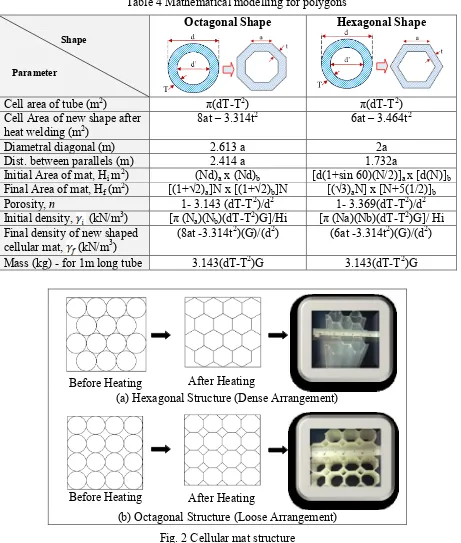
Physical properties of cellular materials depend on shape, cell size and porosity. Isotropy and anisotropy of the cellular mat also depends on the shape of the cell (equilateral triangle, isosceles triangle, square, parallelogram, regular hexagon and irregular hexagon). Regular hexagonal cell structure is common and stable as seen in nature in the bee honeycombs. Three particular shapes (circle, octagon and hexagon) are further analysed in this paper as being relevant to this study. The analyse of the transformation of a circle to octagon and a circle to hexagon are presented in Table 4.
Table 2 Variety of recycling plastic for industrial uses [12]
Type of plastic Description Some uses of recycled waste plastic
High density polyethylene (DPE)
Very common plastic, usually white or coloured
Compost bins, detergent bottles, crates, mobile rubbish bins, agricultural pipes, pallets, kerbside recycling crates Polyethylene terephthalate
(PET)
Clear tough plastic, may be used as a fiber
Soft drink bottles, (multi-layer) detergent bottles, clear film for
packaging, carpet fibers, fleecy jackets Low density polyethylene
(LDPE)
Soft, flexible plastic Film for builders, industry, packaging and plant nurseries, bags
Plasticized polyvinyl chloride (PPVC)
Flexible, clear, elastic plastic
Hose inner core, industrial flooring
Unplasticised polyvinyl chloride (UPVC)
Hard rigid plastic, may be clear
Detergent bottles, tiles, plumbing pipe fittings
Polypropylene (PP) Hard, but flexible plastic Compost bins, kerbside recycling crates, worm factories
Polystyrene (PS) Rigid, brittle plastic.
[image:4.595.60.539.406.584.2]May be clear, glassy Clothes pegs, coat hangers, office accessories, spools, rulers, CD boxes Expanded polystyrene (EPS) Foamed, lightweight, energy absorbing, thermal insulation Lightweight-fill material
Table 3 Characteristic properties of virgin polypropylene (PP) and recycled polypropylene (rPP)
Material Density (g/cm3)
Melting Point
(oC)
Tensile Strength (MPa) Elongation at Break (%) Flexural Modulus (MPa) Young’s Modulus (MPa) Melt Flow Index (g/10 min) Reference Virgin
PP 0.901- - - 34.5 300 1380 - - [13]
0.905 164 25 - 33 - 1103 - 1344 - 0.6 - 0.7 [14]
0.898 -
0.920 135 - 165 - - - 1100 - 1300 - [15]
0.900
-0.091 - 31.03 - 41.37 100 - 600 117.2 -172.3 - - [16]
Recycle PP
0.900 - 16.1 - 700 700 2.14 [17]
0.897 141 24 - 850 - 0.5 - 1.3 [18]
The Conceptual Fabrication Process of Lightweight Cellular Mats
Fig. 2 illustrates the concept of the manufacture of the lightweight cellular mats (hexagonal and square-octagonal structure). It is conceptualised that with appropriate heat fusion welding of tubes packed in a dense arrangement or loose arrangement will produce the hexagonal and the square-octagonal structure respectively as shown in the Fig. 2.
Relative Density of Lightweight Structure
Relative density ( ) is defined by, Eq. (1)
where and are the density of the cellular material and the density of the solid from which the cells are made.
Table 4 Mathematical modelling for polygons
Octagonal Shape
Hexagonal Shape
Cell area of tube (m2) π(dT-T2) π(dT-T2)
Cell Area of new shape after
heat welding (m2) 8at – 3.314t
2 6at – 3.464t2
Diametral diagonal(m) 2.613 a 2a
Dist. between parallels (m) 2.414 a 1.732a
Initial Area of mat, Hi m2) (Nd)a x (Nd)b [d(1+sin 60)(N/2)]a x [d(N)]b Final Area of mat, Hf (m2) [(1+√2)a]N x [(1+√2)b]N [(√3)aN] x [N+5(1/2)]b
Porosity, n 1- 3.143 (dT-T2)/d2 1- 3.369(dT-T2)/d2
Initial density, (kN/m3) [π (Na)(Nb)(dT-T2)G]/Hi [π (Na)(Nb)(dT-T2)G]/ Hi Final density of new shaped
cellular mat, (kN/m3)
(8at -3.314t2)(G)/(d2) (6at -3.314t2)(G)/(d2)
Mass (kg) - for 1m long tube 3.143(dT-T2)G 3.143(dT-T2)G
Before Heating After Heating
(a) Hexagonal Structure (Dense Arrangement)
Before Heating After Heating
[image:5.595.70.531.116.659.2] [image:5.595.93.507.689.794.2](b) Octagonal Structure (Loose Arrangement) Fig. 2 Cellular mat structure
Table 5 Typical relative densities of some cellular material (modified from [19,20])
Categories Material Relative Density,
Manufactured Special ultra-low-density foams 0.001
Polymeric foams 0.05 – 0.2
Honeycomb Structure 0.3 – 0.9
Natural Cork 0.14
Softwoods 0.15– 0.40
Manufacture natural solid Porous solids >0.3
Parameter Shape
Relative density of cellular structure must depend also on the thickness of the cell walls. With the increasing wall thickness, the pore space shrinks and the relative density increases. Cellular solid have relative densities which can be less than 0.03. If the relative density is above 0.30, the material is no longer considered as a cellular structure but is better thought of as a solid material containing isolated pores. Table 5 indicates the typical relative densities of some cellular material.
[image:6.595.77.539.229.425.2]Initial Manufacturing Process
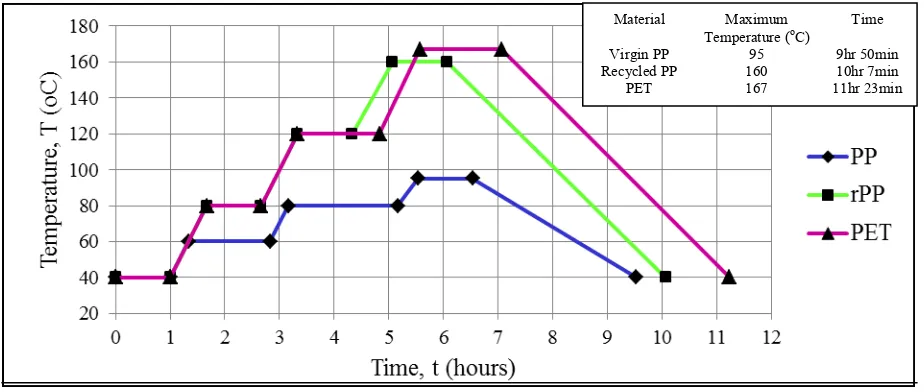
[image:6.595.78.537.464.575.2]Fig. 3 shows the temperature programme that will be adopted for the staged heat fusion welding of the polymer tubes. It shows that the PET and the rPP require more thermal energy for the heat fusion welding. Both the temperature and the time for welding is larger for the rPP and the PET.
Fig. 3 Control the heating programme to facilitate welding the plastic
(b)
Fig. 4 (a) Road in Ur, Circa 2500 BC (adopted from [21]), (b) Major Components of an innovative lightweight fill material levee
Construction Technologies of Lightweight Products for Highway Embankments on Soft Ground
Fig. 4(a) illustrates the construction technology that was used in 2500 BC in Babylon, where tree trunks (logs) were laid on the yielding ground to form a permeable, stiff but disconnected mat structure. Fig. 4(b) presents an arrangement of the composite cellular mat to form the lightweight core of an embankment. The major levee components are lightweight fill core, foundation soil, overburden material and earth cover.
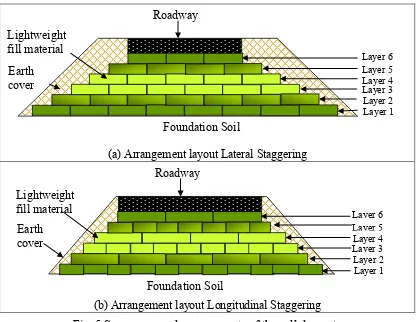
This technology can replace or constitute the base and/or sub-base layer of a highway embankment or a fill of an excavated trench. The primary facilitator is that the blocks are aligned transverse to the embankment’s longitudinal axis tend to provide better structural integrity and support for the overlying pavement system, compared to blocks placed parallel to the longitudinal axis of the
Foundation soil Earth
cover
Lightweight fill material Overburden
material
Material Maximum
Temperature (oC) Time
Virgin PP 95 9hr 50min
Recycled PP 160 10hr 7min
PET 167 11hr 23min
Wooden Logs
roadway. If lightweight mats cause joints parallel to and located directly below the vehicle wheel lanes, these joints may open when subjected to vehicle stresses and cause stepped settlement profiles in the overlying pavement system materials.
(a) Arrangement layout Lateral Staggering
[image:7.595.90.506.120.442.2](b) Arrangement layout Longitudinal Staggering Fig. 5 Some proposed arrangements of the cellular mats
Conclusion
The environmental friendly adoption of recycled PP in the manufacture of a new innovative cellular mat has been presented. The advantages of the cellular adoption in highway engineering are:
Reduce the embankment settlement that will occur due to self-weight of embankment. Where the low densities of the mat prevail and add to the design benefits of light and stiff component such as sandwich panel and facilitating/building on the buoyancy concept.
Minimize the differential settlement that may occur through the stiff and contiguous mat structure and the consequent load sharing mechanism of the mosaic laying of the mats.
Accelerate the consolidation settlement within the sub-grade through the dissipation of the excess pore water pressure through the very open porous cellular structure of the composite cellular mat. Composite cellular mat is thus better than expanded polystyrene (EPS).
Besides its use for construction of highway embankments, this product has other multiple construction environment uses such as in liquid and gas filtration, lightweight building panels, parking lots, instant estate track, rail track, sustainable urban drainage and so on.
Acknowledgement
The authors wish to thank the Ministry of Higher Education for the financial support for this research through MTUN COE Grant (Vot. C012) and MyPhD Scholarships.
Roadway Lightweight
fill material Earth cover
Foundation Soil
Layer 2 Layer 1 Layer 3 Layer 5 Layer 4 Layer 6
Lightweight fill material
Earth cover
Roadway
Foundation Soil
Layer 2 Layer 1 Layer 3 Layer 5 Layer 4 Layer 6
References
[1] P. Sheeler and D. E. Bianchi, in: Cell and Molecular Biology, Third Publisher, Publications by John Wiley & Sons, Inc. (1987).
[2] John J. Hoffman, U.S. Patent 2,660,194. (1952)
[3] T. E. Frydenlund and R. Aaboe: submitted to 3rd International Conference, Salt Lake City (2001).
[4] Michael C. Y. Niu, in: Airframe Structure Design, Second Publisher, Publications by Hong Kong Conmilit Press LTD Publising (1999).
[5] G. Stephani, P. Quadbeck and O. Andersen: submitted to International Conference on Advanced Structural Material Design (2008)
[6] T. N. H. Tuan Ismail, R. Adon, S. F. Diman and D. C. Wijeyesekera: submitted to Malaysia Technical Universities Conference on Engineering & Technology 2012 Vol. 53 (2012), pp. 104-115.
[7] S. S. Verma: submitted to Journal of Indian Concrete (2008)
[8] S. Suryani & N. Mohamad: submitted to International Journal of Integrated Engineering Vol. 4 (2012), pp. 47 – 52
[9] H. L. Riad, D. A. D’Angelo, A. L. Ricci, J. S. Horvanth and P. W. Osborn: submitted to Fifth International Conference on Case Histories in Geotechnical Engineering New York (2004) [10] I. Ahmed and C. W. Lovell, in: Transportation Research Record 1422, Publications by
Transportation Research Board (1993).
[11] Information on http://www.fhwa.dot.gov/research /deployment/geofoam.cfm
[12] R. Siddique J. Khatib and I. Kaur: submitted to Journal of Waste Management (2008)
[13] A. Brent Strong, in: Plastic (Material and Processing, edited by Deborah Yarnell, Third Publisher, Publication by Pearson Education, Inc, United States (2006).
[14] Information on http://www.sdplastics.com/polyprosheet.html
[15] Information on
http://www.ineos.com/Global/Olefins%20and%20Polymers%20USA/Products /Technical%20information/Engineering%20Properties%20of%20PP.pdf [16] Information on http://www.iapd.org/bookstore/property_tables/pp.pdf
[17] B. Bodzay, M. Fejos, K. Bocz, A. Toldy, F. Ronkay and G. Marosi: submitted to eXPRESS Polymer Latters, Vol. 6 (2012), pp. 895-902
[18] Information from RLanD Technic Resources Company
[19] A. Ajdari, in: Mechanical Behaviour of Cellular Structures: A Finite Element Study, Mechanical Engineering Master’s Theses, Northeastern University, Boston, Massachusetts (2008)
[20] S. Balawi and J. L. Abot: submitted to Paper of Composite Structure, Vol. 84 (2008), pp. 293-299
[21] Information from http://sumerianshakespeare.com/mediac/450_0/media/3d3dfff71aa0f304ffff 8169ffffe417. jpg
![Fig. 1 Aircraft structure (Adopted from [4])](https://thumb-us.123doks.com/thumbv2/123dok_us/8775292.901086/1.595.97.448.645.769/fig-aircraft-structure-adopted-from.webp)
![Table 2 Variety of recycling plastic for industrial uses [12]](https://thumb-us.123doks.com/thumbv2/123dok_us/8775292.901086/4.595.52.542.86.371/table-variety-recycling-plastic-industrial-uses.webp)