White Rose Research Online URL for this paper:
http://eprints.whiterose.ac.uk/82398/
Version: Accepted Version
Article:
Bruine de Bruin, W and Wong-Parodi, G (2014) The role of initial affective impressions in
responses to educational communications: The case of carbon capture and sequestration
(CCS). Journal of Experimental Psychology: Applied, 20 (2). 126 - 135. ISSN 1076-898X
https://doi.org/10.1037/xap0000008
[email protected] https://eprints.whiterose.ac.uk/ Reuse
Unless indicated otherwise, fulltext items are protected by copyright with all rights reserved. The copyright exception in section 29 of the Copyright, Designs and Patents Act 1988 allows the making of a single copy solely for the purpose of non-commercial research or private study within the limits of fair dealing. The publisher or other rights-holder may allow further reproduction and re-use of this version - refer to the White Rose Research Online record for this item. Where records identify the publisher as the copyright holder, users can verify any specific terms of use on the publisher’s website.
Takedown
If you consider content in White Rose Research Online to be in breach of UK law, please notify us by
The role of initial affective impressions in responses to educational communications:
The case of carbon capture and sequestration (CCS)
Accepted for publication in Journal of Experimental Psychology: Applied
Wändi Bruine de Bruin
1, 2*
Gabrielle Wong-Parodi
21
Centre for Decision Research, Leeds University Business School (UK)
2
Department of Engineering and Public Policy, Carnegie Mellon University (US)
* Please address correspondence to Wändi Bruine de Bruin, Centre for Decision Research, Leeds
University Business School, Maurice Keyworth Building, Leeds LS2 9JT, United Kingdom.
[email protected] (email); +44(0)1133438839 (phone)
Acknowledgments: This work was supported by the center for Climate and Energy Decision
Making (SES-0949710), through a cooperative agreement between the National Science
Foundation and Carnegie Mellon University. We thank Lauren Fleishman for her invaluable
insights and access to her educational materials, as well as Ann Bostrom, Casey Canfield, and
Abstract
Emerging technologies promise potential benefits at a potential cost. Developers of educational
communications aim to improve people’s understanding and to facilitate public debate.
However, even relatively uninformed recipients may have initial feelings that are difficult to
change. We report that people’s initial affective impressions about Carbon Capture and
Sequestration (CCS), a low-carbon coal-based electricity-generation technology with which most
people are unfamiliar, influences how they interpret previously validated education materials. As
a result, even individuals who had originally self-identified as uninformed persisted in their
initial feelings after reading the educational communication -- though perseverance of feelings
about CCS was stronger among recipients who had originally self-identified as relatively
informed (Study 1). Moreover, uninformed recipients whose initial feelings were experimentally
manipulated by relatively uninformative pro-CCS or anti-CCS arguments persisted in their
manipulated feelings after reading the educational communication, due to evaluating the
educational communication in line with their manipulated impressions (Study 2). Hence, our
results suggest that educational communications will have more impact if they are disseminated
before people form strong feelings about the topic under consideration, especially if these are
based on little to no factual understanding.
Keywords:
Public perceptions of emerging technologies; educational communication; impression
The role of initial affective impressions in responses to educational communications:
The case of carbon capture and sequestration (CCS)
New technological developments bring the promise of societal benefits while introducing
potential risks. Members of a democratic society face public debates about whether or not to
support the implementation of specific technologies. Well-meaning educators may aim to
facilitate those public debates by informing people’s perceptions through educational
communications. Here, we refer to “educational communications” when describing materials
that have been designed to provide balanced and accurate information, and that have been tested
for their ability to improve people’s understanding of the topic under consideration (see for
example Fischhoff, Brewer, & Downs, 2011; Morgan, Fischhoff, Bostrom, & Atman, 2002).
Yet, it may be difficult to change recipients’ feelings about CCS once they have already
formed initial impressions, even if they may still have limited knowledge. First impressions are
affective in nature, can be formed on the basis of little to no information, guide cognitions and
perceptions of risks and benefits, and tend to be difficult to change (Finucane et al., 2000;
Zajonc, 1980). Evidence for the perseverance of first impressions comes from three lines of
psychological research in which undergraduate participants made hypothetical decisions in
carefully controlled experiments. First, research on impression formation has shown a primacy
effect, such that people described as intelligent, tall and mean are evaluated more positively than
those described as mean, tall, and intelligent (Asch, 1961; for exceptions see Hogarth & Einhorn,
1992). Second, feelings that are evoked by positive or negative performance feedback tend to
linger, even after it is disclosed that the feedback has been fabricated (Anderson et al., 1980).
are difficult to change, because participants feel that the original claims are more likely to ring
true than the refutations (Johar, 1996; Johar & Simmons, 2000).
Several studies have reported that ill-founded first impressions are especially hard to
change among individuals who perceive that they know more, even though people often think
that they know more than they actually do (Keren, 1991). Perceptions of knowledge may
increase with repeated exposure to ambiguous statements (Ares, Boehm, & Xu, 1991), and
thinking more about a one-sided argument (Petty & Cacioppo, 1986; Koriat, Lichtenstein, &
Fischhoff, 1980). People who perceive themselves as more knowledgeable about an issue
become less open to advice (Gino & Moore, 2007), find it harder to consider alternative points of
view (Koehler, 1991), and become more likely to interpret new information as confirming what
they think they know (Klayman, 1995; Kunda, 1990; Nickerson, 1998).
Most of the studies cited above have used controlled experiments about fabricated issues,
so as to ensure that participants had not yet developed any initial impressions. Few studies have
tested whether the reported findings generalize to real-world settings. It has been shown that
people who distrust a technology tend to interpret new information about it more negatively
(Cvetovich, Siegrist, Murray, & Tragesser, 2002; Poortinga & Pidgeon, 2004). Proponents of
nuclear power interpret near-accidents as evidence of successful safety strategies, while
opponents view them as evidence of risk (Plous, 1991). Individuals who worry about a risk may
feel alarmed when reading information that experts deem to be neutral or positive (Levy,
Weinstein, Kidney, Scheld, & Guarnaccia, 2008). Finally, people who had initially voted for
Nixon persisted in their positive feelings for him after Watergate, while those who had not voted
Naturally, one limitation of these real-world studies is that participants had prior access to
outside information, leaving it unclear whether or not the impressions in which they persisted
were well-informed. Newly emerging technologies provide the appropriate real-world context,
because they are typically not well known by members of the general public, and the few people
with some familiarity remain relatively uninformed (see for example Fleishman, Bruine de
Bruin, & Morgan, 2010).
Application to the case of Carbon Capture and Sequestration (CCS)
CCS is a relatively new technology that aims to mitigate climate change by capturing
carbon dioxide from coal-fired power plants and sequestering it deep underground instead of
allowing it to be released into the atmosphere. CCS proponents have suggested that the
electricity sector may achieve policy goals to cut carbon dioxide emissions through the
aggressive deployment of low-carbon strategies including energy efficiency, natural gas, wind,
nuclear, as well as coal plants with CCS. Opponents of CCS have voiced concerns about
environmental damage, leaks, and small earthquakes (Huijts, Midden, & Meijnders, 2007;
James, Richels, Blanford, & Gehl, 2007; Pacala & Socolow, 2004; Shackley et al., 2009).
To date, public perception studies find that most people are unfamiliar with CCS, and that
those who have heard of it are still relatively uninformed (Huijts et al. 2007; Palmgren et al.,
2004; Shackley, McLachlan, & Gough, 2005; Sharp, Jaccard, & Keith, 2009; Wallquist et al.,
2009, 2010). Outreach activities to the general public remain largely non-existent (Ashworth et
al., 2010; Shackley et al., 2007). One exception includes the educational communication that
was developed by a team at Carnegie Mellon University with input from a diverse team of
tested for its ability to effectively inform participants (Fleishman et al., 2010). In the present
work, we provided these validated educational communications to residents of Wyoming and
nearby states with coal-fired power plants, who may soon face decisions about whether or not to
accept CCS in their area (Wong-Parodi et al., 2011).
Research questions
Following recommendations that studies of the perseverance of initial impressions should
focus on real-world topics (Carreta & Moreland, 1982), we generated specific hypotheses from
laboratory research to learn more about how people respond to a validated educational
communication about CCS. In Study 1, we tested whether people’s responses to educational
materials about CCS were associated with prior impressions about CCS (Hypothesis 1), and
whether that relationship was stronger in individuals with more perceived knowledge
(Hypothesis 2). In Study 2, we tested whether, among self-identified uninformed participants,
exposure to one-sided pro-CCS (vs. anti-CCS) arguments would lead to more positive
post-argument feelings about CCS (Hypothesis 3) and subsequently more positive post-education
feelings about CCS (Hypothesis 4), with manipulated post-argument feelings about CCS
persisting in subsequent post-education feelings about CCS (Hypothesis 5). The one-sided
arguments were provided with little to no factual information, so that any effect on subsequent
feelings about CCS would lack a solid foundation in CCS knowledge.
Additionally, we also explored potential mediators of the relationship between initial
feelings (that were pre-existing in Study 1 or newly manipulated in Study 2) and post-education
feelings, including interpretation of communication content, and ratings of trust and quality, as
measures were adapted from communication studies (Fischhoff et al., 2011; Lipkus, 2007) and
play a role in responses to corrective advertising, advice taking (Gardner & Berry, 1995; Harvey
& Fischer, 1997; Johar, 1996; Johar & Simmons, 2000; Yaniv, 2004; Yaniv & Kleinberger,
2000) and public perceptions of CCS (Palmgren et al., 2004; Huijts et al., 2007; Walquist,
Visschers, and Siegrist, 2010).
Study 1
Method
Participants
Participants were recruited through online advertisements entitled “Energy policy survey
for residents of Montana, North Dakota, South Dakota, Wyoming, Colorado, Utah, Kansas, and
Nebraska only.” We recruited from these states because they may soon face decisions about
CCS sites (Wong-Parodi et al., 2011). Online advertisements appeared at Amazon’s Mechanical
Turk, an online market place that is increasingly used for recruiting survey participants
(Buhrmester, Kwang, & Gosling, 2011). Participants were offered $1 for completing our survey,
which is within the range of subject fees for advertised studies.
Study 1 and Study 2 participants were recruited at the same time, which allowed us to
engage in one large recruitment effort and to prevent participants from enrolling in both studies.
At baseline, all 571 answered “how much do you know about CCS?” on a scale ranging from 1
(=nothing) to 7 (=a lot).
1The 88 who self-rated their knowledge above the midpoint of 4 were
enrolled into Study 1. The low number reflects the widespread lack of public CCS awareness
(Huijts et al., 2007; Palmgren et al., 2004; Shackley et al., 2005; Sharp et al., 2009; Wallquist et
or Study 2 (
n
=320). Hence, the combined total number of participants in Study 1 was 251.
Average age of the Study 1 participants was 31.15 (
SD
=11.78), with 40% female, 24% nonwhite,
and 47% having a college degree.
Procedure and measures
Baseline assessment. Following previous work (Fleishman et al., 2010), participants
received a brief introduction about the study and CCS, noting that “as you read more about it, we
will ask for your views.” Specifically, participants read “The U.S. Congress may decide to limit
the carbon dioxide (CO
2) released by new power plants. As a result, [your state] would have to
reduce the CO
2released by some of its future power plants. Imagine that [your state] is going to
build a new coal power plant. The plant can be either with or without CO
2capture and
sequestration (CCS). Imagine that the Governor has asked you to serve on a Citizen’s Panel to
give your advice.”
Next, the baseline assessment of
feelings about CCS
asked “how do you feel about
CCS?” with a scale from 1 (=very negative) to 7 (=very positive), which was taken from
previous work (Fleishman et al., 2010; Huijts et al., 2007; Wallquist et al., 2009, 2010).
1The
baseline question about perceived knowledge about CCS asked “how much do you know about
CCS?” with a scale from 1 (=nothing) to 7 (=a lot), which was also adapted from previous work
(Huijts et al., 2007).
2These single-item measures were chosen to reduce survey length,
repetition, and respondent burden, while noting that findings based on single-item measures tend
to replicate findings based on multi-item measures (Bergkvist & Rossiter, 2007; Wanous,
Educational communication. Participants received an educational communication about
CCS that was adapted from publicly available materials (Figure 1) which in a validation study
were shown to effectively inform recipients about CCS (Fleishman & Bruine de Bruin, in press;
Fleishman et al., 2010). Content covered twelve CCS attributes, starting with a section on CO
2release that explained “a coal power plant releases CO
2into the air” and “adding CCS to a coal
power plant prevents much of the CO
2from being released into the air.” Subsequent sections
covered current use, availability, benefits, land use and ecology, lifespan, limits of use, safety,
noise, pollution and other waste, price, and reliability.
3Post-education assessment. After reading the educational communication,
feelings about
CCS
were assessed again using the same question as at baseline, which showed consistency with
related post-education questions about preferences for CCS.
1Participants rated their
interpretation
of the educational content about the twelve CCS attributes (e.g., CO
2release,
current use, availability, benefits, land use and ecology, lifespan, limits of use, safety, noise,
pollution and other waste, price and reliability), on a scale from 1 (=very negative) to 7 (=very
positive), adapting a procedure used previously (Palmgren et al., 2004; Wallquist et al., 2010;
Sharp et al., 2009). Cronbach’s alpha across the twelve items was .92, thus showing sufficient
internal consistency to allow the computation of an averaged summary measure.
Questions about
trust and quality
in the educational communication asked “do you trust
the information about coal plants with CCS?” and “do you think the information about coal
plants is of low or high quality?” with a scale ranging from 1 (=very low) to 7 (=very high), as
adapted from a recent study (Bruine de Bruin et al., in press). Cronbach’s alpha across the two
Following a standard confidence assessment procedure (Keren, 1991),
knowledge
about
the educational communication’s content was measured with 10 true/false questions.
Participants indicated their
confidence
in their answer to each question, on a scale from 50%
(=just guessing) to 100% (=absolutely sure). This procedure is designed to allow a systematic
comparison of knowledge, which is reflected in the overall percent of correct responses across
items, and confidence, which is expressed as the mean confidence rating across items (Keren,
1991). Overall, we found moderate consistency across participants’ responses to the ten
knowledge items ( =.61), and good consistency across the confidence ratings they gave for those
ten responses ( =.81), which replicate previous findings (Pallier et al., 2002; Stankov &
Crawford, 1996). We computed an averaged summary measure for knowledge and for
confidence in knowledge.
Results
Initial analyses.
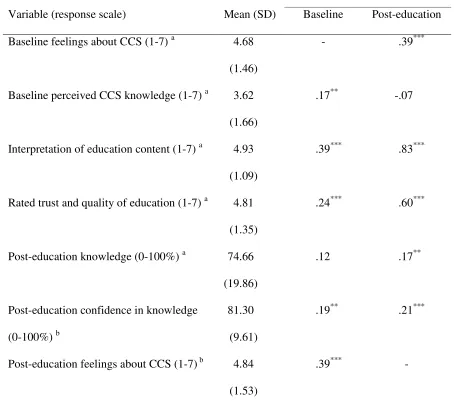
Table 1 shows the descriptive statistics for the assessed measures, as well as the results of
our initial analyses. For the variables that were assessed on 1-7 rating scales, one-sided
t
-tests
examined whether the means in Table 1 were significantly different from the midpoint of 4.
Results indicated that, at baseline, participants’ feelings about CCS were slightly positive, while
their perceived knowledge was relatively low, which replicates findings of previous CCS studies
(Huijts et al., 2007; Palmgren et al., 2004; Shackley et al., 2005; Sharp et al., 2009; Wallquist et
al., 2009, 2010). After reading the educational communication, participants’ feelings about CCS
The role of prior feelings in forming post-education feelings (Hypothesis 1).
We found support for Hypothesis 1, which predicted that responses to educational
materials about CCS would be informed by prior feelings about CCS. Table 1 shows a
significant correlation between post-education feelings about CCS and baseline feelings about
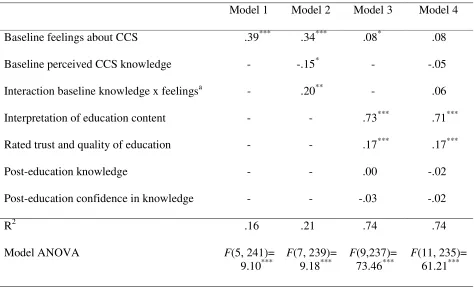
CCS. Table 2 shows that this relationship holds in a linear regression that controlled for
demographic variables (Model 1).
Moderation of the relationship between prior and post-education feelings (Hypothesis 2).
We found support for Hypothesis 2, which predicted that the association between prior
feelings about CCS and responses to educational materials about CCS would be stronger in
recipients with more prior self-rated knowledge, thus showing significant moderation. The linear
regression in Model 2 had the same predictors as Model 1 (Table 2) but additionally included the
interaction between self-rated baseline knowledge and baseline feelings about CCS while
controlling for main effects and demographic variables, thus slightly improving predictive ability
R
2=.05,
F
(2, 239)=8.11,
p
<.001. As expected, we found a significant interaction, which
showed that self-rated knowledge moderated the relationship between baseline and immediate
post-education feelings about CCS perceptions (Table 2). To further examine the interaction, we
repeated Model 1 for those who self-rated their baseline CCS knowledge above (vs. at or below)
the scale midpoint (=4). We found a stronger relationship between baseline CCS perceptions
feelings about CCS and immediate post-education feelings about CCS perceptions among those
with high self-rated baseline knowledge (
=.57,
p
<.001) than those with lower self-rated
Mediators of the relationship between baseline and post-education feelings.
Table 1 shows significant positive correlations of baseline feelings about CCS and of
post-education feelings about CCS with potential mediator variables, including interpretation of
education content, rated trust and quality of education, post-education knowledge, and
confidence in knowledge. To examine which of these variables drove the perseverance of initial
feelings about CCS after exposure to the educational communication, we compared the linear
regression predicting feelings about CCS as reported after the educational communication from
baseline feelings about CCS, while including demographic controls (Model 1), with another
linear regression that also included the potential mediator variables including post-education
assessments of interpretation of content, trust, perceived quality of the materials, knowledge, and
confidence in knowledge (Model 3). The latter showed improved predictive ability,
R
2=.58,
F
(4, 237)=129.74,
p
<.001. Moreover, the positive relationship of post-education feelings about
CCS with baseline feelings about CCS (Model 1) was no longer significant after controlling for
the potential mediator variables, of which interpretation of education content and rated trust and
quality were positively associated with post-education feelings about CCS (Model 3). A
multi-mediation analysis that included the potential mediator variables and demographic controls
(Preacher & Hayes, 2008) did indeed find that interpretations of the education’s content (95%
CI
=.19, .40) and ratings of trust and quality (95%
CI
=.02, .09) significantly mediated the
positive relationship of baseline feelings about CCS with post-education feelings about CCS.
Hence, participants persisted in baseline CCS perceptions because they interpreted and evaluated
the educational communication in light of their initial impressions.
We also found that the interaction effect between baseline feelings about CCS and
longer significant after controlling for the potential mediator variables (Model 4),
R
2=.53,
F
(4,
235)=120.22,
p
<.001. However, a multi-mediation analysis that included the potential mediator
variables and demographic controls (Preacher & Hayes, 2008) found no significant mediation of
the interaction effect, suggesting that the mediation pattern reported above was independent of
perceived CCS knowledge at baseline. Hence, these findings suggest that, independent of how
much baseline knowledge participants perceived to have, they may have persisted in their
baseline feelings about CCS even after reading the educational communication because they
interpreted and evaluated the educational communication in light of their initial impressions.
Discussion
In Study 1, we shared educational communications that were designed to inform public
perceptions of CCS (Fleishman et al., 2010) with participants from states where CCS is likely to
be deployed. Our findings add three insights to the literature. First, pre-existing feelings in this
sample predicted feelings recorded after reading the educational materials, with positive baseline
feelings about CCS yielding positive post-education feelings about CCS. Hence, persistence of
initial impressions is not limited to hypothetical topics considered in the psychological
laboratory, and occurs even when people receive a genuine educational communication about an
existing real-world topic. Second, perseverance of initial impressions is found even among
participants who thought they were relatively uninformed, although it was stronger among
recipients who perceived themselves as relatively knowledgeable. Third, perseverance of initial
impressions occurred because participants evaluated the educational communication in light of
their pre-existing feelings about CCS, thus allowing them to maintain those feelings after the
The educational communication we used had previously been found to effectively inform
recipients’ understanding about CCS (Fleishman et al., 2010; Fleishman & Bruine de Bruin, in
press). Nevertheless, our findings suggest that these educational materials may be interpreted
differently by recipients who have already formed relatively positive or negative first
impressions. These first impressions were likely based on incomplete information, because most
people remain largely uninformed about CCS, with the few who have heard about the technology
commonly showing gaps and misconceptions in their CCS knowledge (Huijts et al., 2007;
Palmgren et al., 2004; Shackley et al., 2005; Sharp et al., 2009; Wallquist et al., 2009, 2010).
Indeed, the large majority of our participants rated themselves as relatively uninformed – despite
people’s general tendency to think that they know more than they actually do (Keren, 1991).
Yet, as noted, those who perceived themselves as relatively more informed about CCS showed a
stronger tendency to stick with their prior impressions after reading educational communications
about CCS.
Because those who self-identify as uninformed are more likely to be swayed from their
initial impressions (Yaniv, 2004; Ross & Ward, 1995; Gino & Moore, 2007; Gunther et al.,
2009; Richardson et al., 2008; Banas & Rains, 2010), Study 2 examined whether people would
persevere in relatively uninformed impressions after being manipulated through one-sided
arguments. We followed the design of laboratory studies of belief persistence, in terms of
randomly assigning participants who self-identified as relatively uninformed about CCS to
one-sided pro-CCS or anti-CCS arguments. We then tested whether exposure to one-one-sided pro-CCS
(vs. anti-CCS) arguments would manipulate post-argument feelings about CCS (Hypothesis 3) as
recorded over time (Hypothesis 4), with manipulated post-argument feelings about CCS
reverberating in post-education perceptions of CCS (Hypotheses 5).
Study 2
Method
Participants
Following the same recruitment procedures as Study 1, Study 2 included 320 participants
from Wyoming, Montana, North Dakota, South Dakota, Colorado, Utah, and Kansas, and
Nebraska. These participants were unique to Study 2 and did not participate in Study 1.
Volunteers were eligible for Study 2 if they rated themselves as relatively uninformed about
CCS.
2Thus, as in previous research, informed participants were omitted from Study 2, because
their existing convictions about CCS are less likely to be influenced (Yaniv, 2004; Ross & Ward,
1995; Gino & Moore, 2007; Gunther et al., 2009; Richardson et al., 2008; Banas & Rains, 2010).
The average age of Study 2 participants was 31.26 (
SD
=10.77), with 51% female, 23%
nonwhite, and 44% having a college degree.
Procedure and measures.
The procedure and measures for Study 2 were the same as those for Study 1, with a few
exceptions. Unlike Study 1 participants, Study 2 participants received one-sided arguments after
reporting initial baseline feelings about CCS (1=very negative; 7=very positive), but before
receiving the pre-communication assessment or the educational communication. They were
randomly assigned to a one-sided argument with pro-CCS or anti-CCS content, which focused
We used simple arguments that provided little to no factual information, which were designed by
Wyoming residents to appeal to people like them (Wong-Parodi et al., 2011). Respectively, our
pro-CCS arguments about nature, the economy, and state independence stated: (a) “CCS will not
harm nature and will not change your state’s landscape,” (b) “CCS will create construction jobs,”
and (c) “CCS means that your state is building new technology before the U.S. government tells
it what to do.” Anti-CCS arguments on these topics stated: (a) “CCS will harm nature and will
change your state’s landscape,” (b) “CCS will not create construction jobs,” and (c) “CCS means
that your state is building new technology because the U.S. government tells it what to do.”
Participants were subsequently asked to elaborate on the specific argument they read by writing
one or two sentences, which has been shown to increase processing of the one-sided argument
and confidence in its content (Banas & Rains, 2010; Roggeveen & Johar, 2002). Participants
indicated their post-argument feelings about CCS on a scale from 1 (=very negative) to 7 (=very
positive).
Subsequently, participants followed the procedure described for Study 1. They received
the educational communication and the post-education assessment, which used the same
measures.
6As in Study 1, we found internal consistency for the 12 items assessing
interpretations of the educational communication’s content ( =.92), and for the 2 items assessing
their ratings of the materials in terms of trust and quality ( =.76). Again, as in Study 1, better
internal consistency was found for confidence in post-education knowledge ( =.82) than for
Results
Initial analyses.
As in Study 1, a one-sided
t
-test found that baseline feelings about CCS as reported across
participants were slightly positive, with a one-sided
t
-test showing that the mean rating was
significantly above the scale midpoint of 4 (
M
=4.51,
SD
=1.24),
t
(319)=7.31,
p
<.001, thus falling
in the range of previous public perception studies, which have reported ratings that vary from
slightly negative to slightly positive (Huijts et al., 2007; Palmgren et al., 2004; Shackley et al.,
2005; Sharp et al., 2009; Wallquist et al., 2009, 2010). Because the baseline assessment
occurred before participants received the one-sided argument, baseline feelings about CCS
should show no significant difference between participants who were to receive the pro-CCS
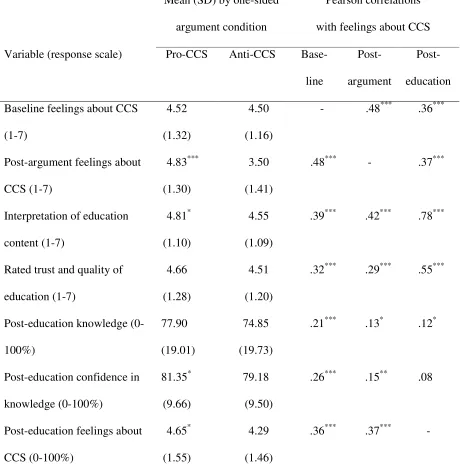
argument and those who were to receive the anti-CCS argument, as is indeed the case (Table 3).
Tests of Study 2 hypotheses appear below.
Effect of exposure to one-sided arguments on feelings about CCS (Hypothesis 3).
We found support for Hypothesis 3, such that exposure to the one-sided arguments
created a significant group difference in post-argument feelings about CCS. That is, after
reading the one-sided argument (but before seeing the educational communication) recipients of
the pro-CCS argument were significantly more positive about CCS than recipients of the
anti-CCS argument (Table 3).
Effect of exposure to one-sided arguments on post-education feelings about CCS (Hypothesis 4).
We found support for Hypothesis 4, which predicted that the effect of exposure to
after reading the educational materials. Indeed, recipients of the pro-CCS argument reported
significantly more positive post-education feelings about CCS than recipients of the anti-CCS
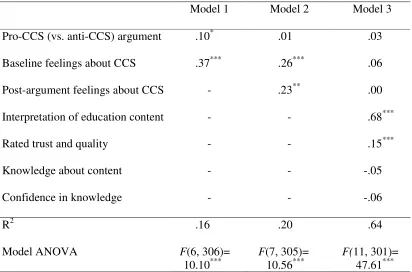
argument (Table 3). This relationship held in a linear regression that took into account baseline
feelings about CCS and demographic variables (Model 1; Table 4). Specifically, recipients of
the one-sided pro-CCS (vs. anti-CCS) argument had more positive post-education feelings about
CCS, as did those who had stronger positive feelings about CCS at baseline (Model 1; Table 4).
The role of manipulated feelings in forming post-education feelings (Hypothesis 5).
We found support for Hypothesis 5, which predicted that post-education feelings about
CCS would be associated with argument feelings about CCS. Table 3 shows that
post-education feelings about CCS were indeed significantly correlated with post-argument feelings
about CCS. This relationship held in a regression model that also took into account whether
participants received the pro-CCS (vs. anti-CCS) argument, baseline feelings about CCS and
demographic variables (Model 2; Table 4). Adding post-argument feelings slightly improved the
predictive ability of the model, (Model 2 vs. Model 1; Table 4)
R
2=.09),
F
(1, 128)=11=4.61,
p
<.001, but reduced the effect of the one-sided arguments on post-education feelings about CCS,
thus showing significant mediation (95% CI=.14, .58). Hence, the one-sided arguments
manipulated post-argument feelings about CCS which then informed post-education feelings
about CCS. The association of baseline feelings about CCS with post-education feelings about
CCS was also reduced after adding post-argument feelings about CCS (Model 2), showing
significant mediation (95% CI=.06, .24). This result suggests that baseline feelings about CCS
informed post-argument feelings about CCS, which in turn informed post-education feelings
Mediators of the relationship between manipulated post-argument and post-education feelings.
Independent-sample
t
-tests compared the group means and found that recipients of the
pro-CCS (vs. anti-CCS) argument had significantly more positive interpretations of the
educational content and more confidence in their post-education knowledge, despite showing no
differences in their trust of the educational communication or their post-education knowledge
(Table 3). Hence, although this study was not designed to test the ability of the educational
communication to meet its goal of informing recipients about CCS, we do find that people with
different feelings about CCS end up with similar levels of knowledge about CCS after reading
the educational communication.
Perhaps more importantly, both manipulated argument feelings about CCS and
post-education feelings about CCS showed significant correlations with potential mediator variables
that were assessed in between, including interpretation of education content, rated trust and
quality of the educational materials, and post-education knowledge (Table 3). To examine what
drove the perseverance of manipulated feelings about CCS after exposure to the educational
communication, we compared a linear regression predicting post-education feelings about CCS
from post-argument feelings about CCS while taking into account the valence of the one-sided
argument, baseline feelings about CCS, and demographic variables (Model 2), with a linear
regression that additionally included participants’ interpretation of education content, ratings of
trust and quality, as well as knowledge and confidence (Model 3). The latter had improved
ability to predict post-education feelings about
R
2=.44,
F
(4, 301)=90.71,
p
<.001. It showed a
reduced relationship of post-education feelings about CCS with post-argument feelings about
content and trust (Model 3). A multi-mediation analysis (Preacher & Hayes, 2008) found that
interpretations of communication content (95%
CI
=.21, .38) and ratings of trust and quality
associated with the educational communication (95%
CI
=.01, .08) both mediated the positive
relationship of post-argument and post-education feelings about CCS as reported after reading
the educational communication. As in Study 1, these results indicate that participants who felt
positively about CCS before reading the educational communication interpreted and evaluated it
more positively, which helped them to maintain their initially positive feelings about CCS after
reading the educational communication.
Discussion
As in Study 1, we provided educational communications that were designed by educators
to inform public perceptions of CCS (Fleishman & Bruine de Bruin, in press; Fleishman et al.,
2010) to participants from states where CCS is likely to be deployed. Participants who
self-identified as uninformed were randomly assigned to one-sided arguments with pro-CCS or
anti-CCS content which provided little to no factual information about the technology. As expected,
these one-sided arguments successfully manipulated participants’ feelings about CCS, causing
group differences in feelings about CCS that did not exist upon participants’ entry into the study
but that nevertheless persisted even after reading a genuine educational communication. Hence,
Study 2 applies the laboratory findings about the persistence of manipulated feelings (Anderson,
Lepper, & Ross, 1980; Ross, Lepper, & Hubbard, 1975) to a real-world context, and additionally
shows that such persistence remains even after people receive educational communications.
Indeed, participants who had been manipulated to have positive (vs. negative) feelings
educational communication, due to interpreting the educational communication’s content and
trusting the educational communication more. These findings occurred even though our
participants ended up with similar knowledge levels after reading the educational
communication, independent of whether they had been manipulated to have positive or negative
feelings about CCS. Hence, educational communications may improve recipients’ understanding
without changing their potentially ill-founded feelings about the topic under consideration.
General discussion
Educational communications aim to inform public debate about emerging technologies
and associated policies. These well-intended communication efforts, including our own, may
fail if recipients already have formed initial impressions that are hard to change. Psychological
laboratory studies have suggested that people may persevere in initial impressions that are based
on limited information (Anderson, Lepper, & Ross, 1980; Johar, 1996; Johar & Simmons, 2000;
Ross, Lepper, & Hubbard, 1975). We found that these laboratory findings apply when people
learn about a real-world topic, with initial impressions lingering in responses to educational
communications. These results held when initial impressions were pre-existing (in Study 1) or
manipulated by one-sided messages (Study 2). In both studies, perseverance of initial
impressions seemed to occur because participants evaluated the content of the educational
communication in light of their initial impressions, thus allowing them to maintain those
impressions after the educational communication.
Our two studies have several limitations and should therefore be interpreted with caution.
First, our participants were paid to read the educational communication, which may have
selectively seek information that confirms their initial impressions (Nickerson, 1998). Second,
our participants volunteered to complete in a survey about “energy policy” and may therefore not
be representative of their states’ or the US population. Third, the one-sided arguments in Study 2
were designed to appeal to residents from states where CCS might be implemented and although
their effects were persistent they were relatively small. Fourth, because our studies were not
meant to evaluate the effectiveness of the educational materials, our studies did not include a
no-education control group, which makes it impossible to determine how much (if at all) the
observed persistence in initial impressions of CCS was reduced by exposure to the educational
communication.
Nevertheless, our findings appear to have practical implications for developers of
educational communications on various topics. That is, educational communications would
likely be more effective if they were developed before people form persistent initial impressions
that are based on little to no information. Indeed, laboratory research suggests that once initial
impressions have formed they become difficult to change, even after it becomes clear that they
were based on fabricated information (Anderson, Lepper, & Ross, 1980; Johar, 1996; Johar &
Simmons, 2000; Ross, Lepper, & Hubbard, 1975). However, the development of educational
communications about CCS has been postponed because CCS is not yet fully developed for
market-based deployment (Ashworth et al., 2010; Shackley et al., 2009). Similar hesitance to
develop communications has been seen in the context of other technologies, potentially leading
to the suspicion that facts were deliberately hidden from the public (Fischhoff, 1995). Combined
with our findings, this suggests that it might be better to develop educational materials about
The mental models approach provides a systematic methodology for developing
educational communications to inform people’s decisions (Morgan et al., 2002). It recognizes
that educational communications need to be designed with an understanding of the intended
audience, focusing on decision-relevant facts people are missing but need and want from experts
with varying points of view (Bruine de Bruin & Bostrom, in press). The mental models
approach has been used to develop educational materials about CCS and alternative low-carbon
technologies, which was used in the present experiments and is available online (Fleishman &
Bruine de Bruin, in press; Fleishman et al., 2010). It has also been applied to topics such as
smart meters, nanotechnology or chemicals in the work place (e.g., Cousin & Siegrist, 2010;
Krishnamurti et al., 2012; Niewöhner, Cox, Gerrard, & Pigeon, 2004).
The dissemination of accurate educational materials will be most effective if it occurs
before the development of public debate, which may also help to build perceptions of trust and
quality (Fischhoff, 1995). Yet, it is unclear that making educational materials available in timely
manner will (or should) promote public support of each emerging technology or prevent conflicts
in public debates, but it may help to avoid that disagreements are based on misunderstandings.
Footnotes
1
The measure of feelings about CCS was relatively reliable. At the post-education
assessment, Cronbach’s alpha was .78 across the standardized scores for responses across
four related questions, with the first pertaining to feelings about CCS. The second
presented a ranking task taken from previous CCS research in which participants expressed
their relative preferences of CCS as compared to six other low-carbon electricity
participants whether they would prefer that their state build a coal power plant with or
without CCS. In the fourth, they gave advice to their governor about whether to build a
coal plant with or without CCS. Inter-item correlations showed that post-education
feelings about CCS were positively correlated with relative preferences of CCS compared
to other low-carbon technologies (
r
=.35,
p
<.001), with preferences for a coal plant with
CCS rather than without (
r
=.59,
p
<.001), and with advice to the governor to build a coal
plant with CCS rather than without (
r
=.57,
p
<.001).
2
We had three reasons for asking for perceived knowledge rather than measuring actual
knowledge. First, research in other domains has shown that perceived knowledge is
associated with actual knowledge, even though correlations are of course imperfect
(Fagerlin et al., 2007; Zikmund-Fisher et al., 2007). Second, self-report questions of
knowledge are much less frustrating to participants than tests of actual knowledge, thus
reducing attrition rates (Zikmund-Fisher et al., 2007). Third, giving people knowledge
tests artificially improves their knowledge and increases how much they learn from any
subsequently presented information (Foediger & Karpicke, 2006).
3
The original materials covered ten low-carbon technologies including CCS, using one page
for each technology. Technology descriptions were at the 6th-8
thgrade reading level. For
each technology, the associated page systematically described the same set of features,
which were identified as relevant in pilot interviews with experts and members of the
general public. Special attention was given to fix common knowledge gaps and
misconceptions that emerged in previous interview and survey research (Palmgren et al.,
2004; Wallquist et al., 2009, 2010). The final version was tested for readability in
wording), and for accuracy with diverse experts in low-carbon electricity generation. A
detailed description of materials development is given by Fleishman and colleagues (in
press). A validation study showed that the materials reduced the prevalence of common
misunderstandings, as measured on a true/false knowledge test (Fleishman et al., 2010).
4
Although this study was not designed to replicate a previous validation of the educational
materials (Fleishman et al., 2010), the effectiveness of the educational materials in terms of
informing participants is suggested by independent-sample
t
-tests showing that recipients
who perceived being relatively knowledgeable at baseline (seen in a self-rating above the
scale midpoint of 4) and recipients who perceived being relatively uninformed at baseline
(seen in a self-rating at or below the scale midpoint) ended up with similar levels of
post-education knowledge and confidence after reading the post-educational communication (
p
>.05).
(See footnote 2 for our reasons for measuring perceived knowledge at baseline.)
5
A total of 40.9% selected nature, 52.5% the economy, and 6.6% state independence.
Overall, separate analyses on the first two groups suggest that the overall conclusions
drawn in this paper hold for each. The third group was too small to warrant separate
analyses.
6