Journal of Heredity
doi:10.1093/jhered/esu079 This is an Open Access article distributed under the terms of the Creative Commons Attribution © The American Genetic Association. 2014. License (http://creativecommons.org/licenses/by/3.0/), which permits unrestricted reuse, distribution, and reproduction in any medium, provided the original work is properly cited.
Major Breeding Plumage Color
Differences of Male Ruffs (Philomachus
pugnax) Are Not Associated With
Coding Sequence Variation in the
MC1R Gene
L
indsayL. F
arreLL, C
LemensK
üpper, T
erryB
urKe,
andd
avidB. L
anKFrom the Department of Animal and Plant Sciences, University of Sheffield, Sheffield S10 2TN, UK (Farrell, Küpper, and Burke); and the Department of Biological Sciences, Simon Fraser University, Burnaby, British Columbia V5A 1S6, Canada (Farrell and Lank). Lindsay L. Farrell is now at Roslin Institute, University of Edinburgh, Easter Bush Campus, Midlothian EH25 9RG, UK.
Address correspondence to Lindsay L. Farrell, Roslin Institute, University of Edinburgh, Easter Bush Campus, Midlothian EH25 9RG, UK, or e-mail: [email protected].
Abstract
Sequence variation in the melanocortin-1 receptor (MC1R) gene explains color morph variation in several species of birds and
mammals. Ruffs (Philomachus pugnax) exhibit major dark/light color differences in melanin-based male breeding plumage
which is closely associated with alternative reproductive behavior. A previous study identified a microsatellite marker (Ppu020)
near the MC1R locus associated with the presence/absence of ornamental plumage. We investigated whether coding sequence
variation in the MC1R gene explains major dark/light plumage color variation and/or the presence/absence of ornamental
plumage in ruffs. Among 821 bp of the MC1R coding region from 44 male ruffs we found 3 single nucleotide
polymor-phisms, representing 1 nonsynonymous and 2 synonymous amino acid substitutions. None were associated with major dark/ light color differences or the presence/absence of ornamental plumage. At all amino acid sites known to be functionally important in other avian species with dark/light plumage color variation, ruffs were either monomorphic or the shared poly-morphism did not coincide with color morph. Neither ornamental plumage color differences nor the presence/absence of
ornamental plumage in ruffs are likely to be caused entirely by amino acid variation within the coding regions of the MC1R
locus. Regulatory elements and structural variation at other loci may be involved in melanin expression and contribute to the extreme plumage polymorphism observed in this species.
Key words: MC1R, melanism, pigmentation, plumage variation, sequence variation Subject areas: Genomics and gene mapping
Birds display a wide range of variation in plumage colora-tion and pattern that has long fascinated biologists because of its importance in sexual selection, speciation, and
adapta-tion (Roulin 2004). The ruff (Philomachus pugnax) is a lekking
sandpiper which exhibits major dark/light color differences in melanin-based male breeding plumage that is closely asso-ciated with a genetic polymorphism for alternative male
mat-ing behavior (Hogan-Warburg 1966; Van Rhijn 1973; Lank
et al. 1995). Three genetic male morphs persist in ruff popu-lations: 1) dark-plumed territorial “Independents”; 2) light-plumed non-territorial “Satellites”; and 3) small female-like
males called “Faeders” that lack ornamental plumage (Jukema and Piersma 2006; Lank et al. 2013). The extensive individual variation in melanin-based coloration of orna-mental neck ruffs and head tufts of male ruffs has been well
described (Hogan-Warburg 1966; Höglund and Lundberg
1989; Ekblom et al. 2012; Van Rhijn et al. 2014) and a wide range of plumage colors and patterns exists within both inde-pendent and satellite morph types. Indeinde-pendents range from black, dark rust, light rust to ivory, with occasional patches of white, but always contain predominantly dark rust or black feathers in ruff, head tufts, or both. In contrast, satellites
by guest on December 23, 2014
http://jhered.oxfordjournals.org/
are predominantly white in ornamental plumage color, but range from white, ivory to straw yellow, with secondary ruff colors of light to medium rust, but lack solid black feathers
in the ruff or head tufts (Figure 1). This hypervariability has
been attributed to diversifying selection for individual
iden-tity signalling (Lank and Dale 2001; Dale et al. 2001). Finally,
the faeder males grow breeding plumage typical of females, lacking ornamental feather growth and conspicuous plumage
colors (Jukema and Piersma 2006) (Figure 1).
Sequence variation in the melanocortin-1 receptor (MC1R) gene
explains major dark/light plumage color variation in several avian species as well as coat color variation in many mammals (Hubbard et al. 2010; Roulin and Ducrest 2013). Mutations that increase the activation of MC1R result in increased syn-thesis of eumelanin, producing shades of black or brown, whereas mutations reducing MC1R activation lead to increased
synthesis of phaeomelanin producing shades of rust (Mundy
2005). For example, single base-pair mutations in the coding
sequence of the MC1R gene perfectly associate with dark and
light plumage types in bananaquit (Coereba flaveola), lesser snow
goose (Anser c. caerulescens), Arctic skua (Stercorarius parasiticus)
and chestnut-bellied monarch (Monarcha castaneiventris) (Uy
et al. 2009; Theron et al. 2001; Mundy et al. 2004). In ruffs, we
previously found that the presence/absence of male
breed-ing plumage (the putative Faeder locus) (Lank et al. 2013) was
associated with a microsatellite marker predicted to be in the
close vicinity of MC1R (Farrell et al. 2013b), in addition to
evi-dence of linkage disequilibrium between white ruff coloration
and the Satellite locus (Farrell 2013). We therefore investigated
whether coding sequence variation in the MC1R gene explains
major dark/light breeding plumage color variation and/or the presence/absence of ornamental plumage in male ruffs.
Methods
Sample PopulationForty-four male ruffs with a diversity of breeding plumage
phe-notypes previously used in linkage mapping (Farrell et al. 2013a)
were selected from a captive-bred population maintained by DBL at Simon Fraser University in Burnaby, British Columbia. The sample included 12 dark-plumed males, 12 light-plumed
males, and 20 unornamented female-like faeder males (Table 1).
[image:2.594.149.440.333.635.2]The dark-plumed males are assumed to have higher levels of eumelanin within their dark feathers, whereas the light-plumed males are assumed to have phaeomelanin or lack pigmentation
Figure 1. The wide range of melanic plumage coloration and patterns exhibited by male ruffs in their ornamental breeding plumage. Independents (top row) are predominantly dark in color, ranging from black, dark rust, light rust to ivory, with occasional patches of white. Satellites (middle row) are predominantly white in color and range from white, ivory to straw yellow, with secondary colors of light to medium rust, but lack solid black in the ruff or head tufts. Faeder males (bottom row) lack ornamental plumage and closely resemble the breeding plumage of ruff females (female far right) (Photos by D.B.L., C.K., and L.L.F.).
by guest on December 23, 2014
http://jhered.oxfordjournals.org/
(pure white) (Van Rhijn et al. 2014). Unornamented individu-als were included because of the apparent close linkage of the Faeder locus with a microsatellite marker located near the
pre-dicted location of MC1R (Farrell et al. 2013b).
MC1R Genotyping and Analysis
Genomic DNA was extracted from blood samples stored in absolute ethanol (50 μL of blood in 1.5 mL of absolute
ethanol) using an ammonium acetate precipitation method (Nicholls et al. 2000). A segment of the MC1R gene that encompassed sites previously associated with plumage poly-morphism in birds was amplified using the conserved prim-ers MSHR72 and MSHR9, with internal sequencing primprim-ers
MSHR73 and MSHR74 (Mundy et al. 2004). Each 10-μL
Polymerase Chain Reaction (PCR) contained approximately 10 ng of genomic DNA, 1 μL of each primer (5 μM), 3 µL
[image:3.594.56.541.81.561.2]ultrapure H0 and 4 μL Qiagen Multiplex PCR Mix (Qiagen
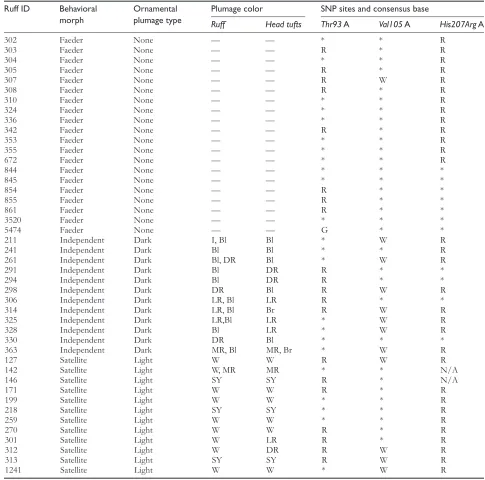
Table 1 Behavioral morph, plumage type, plumage color of ruff, head tufts, and MC1R sequence data for 44 male ruff individuals included in this study
Ruff ID Behavioral
morph
Ornamental plumage type
Plumage color SNP sites and consensus base
Ruff Head tufts Thr93 A Val105 A His207Arg A
302 Faeder None — — * * R
303 Faeder None — — R * R
304 Faeder None — — * * R
305 Faeder None — — R * R
307 Faeder None — — R W R
308 Faeder None — — R * R
310 Faeder None — — * * R
324 Faeder None — — * * R
336 Faeder None — — * * R
342 Faeder None — — R * R
353 Faeder None — — * * R
355 Faeder None — — * * R
672 Faeder None — — * * R
844 Faeder None — — * * *
845 Faeder None — — * * *
854 Faeder None — — R * *
855 Faeder None — — R * *
861 Faeder None — — R * *
3520 Faeder None — — * * *
5474 Faeder None — — G * *
211 Independent Dark I, Bl Bl * W R
241 Independent Dark Bl Bl * * R
261 Independent Dark Bl, DR Bl * W R
291 Independent Dark Bl DR R * *
294 Independent Dark Bl DR R * *
298 Independent Dark DR Bl R W R
306 Independent Dark LR, Bl LR R * *
314 Independent Dark LR, Bl Br R W R
325 Independent Dark LR,Bl LR * W R
328 Independent Dark Bl LR * W R
330 Independent Dark DR Bl * * *
363 Independent Dark MR, Bl MR, Br * W R
127 Satellite Light W W R W R
142 Satellite Light W, MR MR * * N/A
146 Satellite Light SY SY R * N/A
171 Satellite Light W W R * R
199 Satellite Light W W * * R
218 Satellite Light SY SY * * R
259 Satellite Light W W * * R
270 Satellite Light W W R * R
301 Satellite Light W LR R * R
312 Satellite Light W DR R W R
313 Satellite Light SY SY R W R
1241 Satellite Light W W * W R
* indicate agreement with the consensus sequence. All data were aligned and numbered with reference to the chicken MC1R sequence (Genbank AY220305). Plumage colors: W, white; I, ivory; Bl, black; Br, brown; DR, dark rust; MR, medium rust; LR, light rust; SY, straw yellow; HT, head tufts; heterozygotes denoted with standard IUPAC letter codes (R = A/G; W = A/T).
by guest on December 23, 2014
http://jhered.oxfordjournals.org/
Inc.). PCR amplification was performed using a DNA Engine Tetrad 2 Thermal Cycler (MJ Research, BioRad, UK), with the following cycling parameters: 95 °C for 15 min, followed by touchdown cycling 6× (95 °C for 30 s, 65 °C–60 °C for 20 s, 72 °C for 90 s), 30× (95 °C for 30 s, 60 °C for 20 s, and 72 °C for 90 s), and finally 72 °C for 10 min. PCR products were treated with EXO-SAP (Illustra ExoStar) for 15 min at 37 °C to remove unincorporated prim-ers and dNTPs, followed by an inactivation step for 15 min at 80 °C. Sequence reactions were ethanol/EDTA/sodium
acetate precipitated (Sambrook et al. 1989). Purified template
DNA was directly sequenced using Big Dye.v3.1 chemistry (PE Biosystems), according to the manufacturer’s protocol using an ABI3730 Genetic Analyzer (Applied Biosystems). Amplified fragments were sequenced in the forward and reverse complementary directions and a consensus sequence
was created using a modified version of the Phred (Ewing
et al. 1998; Ewing and Green 1998) and Phrap/Cross_match/
Swat (Green 1996) software (PERL scripts provided by the
NERC Biomolecular Facilty, UK). Sequences that did not form a consensus between their forward or reverse strands, but that were of good quality, were included in the study by alignment with those that did produce a consensus. Manual base calling and comparative analyses were performed in
CODONCODE ALIGNER v 4.0 (http://www.codoncode.
com/). Sequences were aligned in MEGA.v5.0 (Tamura et al.
2011) using ClustalW and sequences deposited in Genbank
(Accession numbers LM993813-LM993852).
Results
A total of 821 bp of the MC1R gene corresponding to
posi-tions 79–899 of the aligned chicken MC1R gene sequence
(Kerje et al. 2003) was sequenced from 44 male ruff individuals. Three polymorphic SNPs were found: 2 synonymous
substitu-tions (A/G: Thr93, A/T: Val105) and 1 nonsynonymous
sub-stitution (A/G: His207Arg); the latter polymorphism is shared
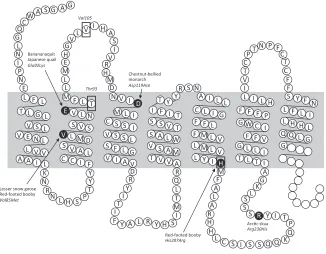
with dark/light plumage differences in the red-footed booby (Sula sula) (Baião et al. 2007). At all the other functional sites known to be associated with dark and light melanic plumage
variation in other species, all ruff MC1R sequences were
mono-morphic (Figure 2). None of the SNPs at the polymorphic ruff
sites were associated with major dark/light plumage morphs or
the presence/absence of breeding plumage (Table 1).
Conclusion
More than 150 genes are known to affect animal coloration and
pattern (Barsh 1996; Hoekstra 2006) and ruffs have the greatest
naturally evolved intraspecific plumage diversity among birds (Lank and Dale 2001). Given that coding sequence variation in
MC1R does not explain the major plumage color differences
[image:4.594.132.458.396.650.2]of male ruffs, we conclude that the control of plumage vari-ation in ruffs is more complex than in other bird species with simple dark and light morphs. It is unlikely that the presence of dark or light coloration or the presence/absence of ornamen-tal plumage in male ruffs is solely determined by amino acid
Figure 2. Partial amino acid sequence of the ruff (Philomachus pugnax) melanocortin-1 receptor gene (MC1R) with position of amino acids numbered after the chicken (Gallus gallus) (Kerje et al. 2003). The MC1R receptor is depicted in the cell membrane of a melanocyte (shaded in grey). Above is the extracellular region and below the intracellular region. Blank circles indicate partially missing data in MC1R sequence. Nonsynonymous SNPs associated with melanic plumage polymorphism in other bird species are shaded in black. Boxed amino acids indicate polymorphic SNPs detected in ruffs (Figure after Dobson et al. 2012).
by guest on December 23, 2014
http://jhered.oxfordjournals.org/
variation within the MC1R locus. Because only a partial amino
acid sequence of the coding region of the MC1R gene was
sequenced, we cannot rule out the possibility that functional non-synonymous substitutions affecting plumage color may be present in the regions (approximately 9% based on other bird species) not sequenced. However, it seems more likely that reg-ulatory polymorphisms account for the observed variation. The extensive individual variation suggests that ornamental plumage coloration is a polygenic trait, which might nonetheless involve
MC1R along with other genes that affect the deposition of
melanin (Dale et al. 2001; Roulin and Ducrest 2013; Van Rhijn
et al. 2014). The potential functional significance, implied by
the apparent proximity of the Faeder locus and MC1R (Farrell
et al. 2013b), remains to be determined through more detailed
mapping and analysis. Promoter regions of MC1R remain as
candidates that might influence ornamental plumage type in
ruffs. For example, local expression differences in MC1R and/
or other pigmentation genes in the feather follicles of the neck ruff and head tufts could produce the observed hypervariability of the breeding plumage in this species.
Funding
Natural Sciences and Engineering Research Council of Canada (NSERC to D.B.L.); UK Biotechnology and Biological Sciences Research Council grant (BB/J018937/1 to T.B.); NSERC PGS-D3 (L.L.F.); and Marie Curie Intra-European Fellowship (C.K.).
Acknowledgments
We thank Gavin Horsburgh for providing modified PERL scripts for sequence alignment and Deborah Dawson for editorial input on earlier ver-sions of this manuscript.
References
Baião PC, Schreiber E, Parker PG. 2007. The genetic basis of the plumage polymorphism in red-footed boobies (Sula sula): a melanocortin-1 receptor (MC1R) analysis. J Hered. 98:287–292.
Barsh GS. 1996. The genetics of pigmentation: from fancy genes to complex traits. Trends Genet. 12:299–305.
Dale J, Lank D, Reeve H. 2001. Signaling individuality vs. quality: a model and case studies with ruffs, queleas and house finches. Am Nat. 158:75–86. Dobson AE, Schmidt DJ, Hughes JM. 2012. Sequence variation in the mel-anocortin-1 receptor (MC1R) does not explain continent-wide plumage color differences in the Australian magpie (Cracticus tibicen). J Hered. 103:769–780. Ekblom R, Farrell LL, Lank DB, Burke T. 2012. Gene expression divergence and nucleotide differentiation between males of different color morphs and mating strategies in the ruff. Ecol Evol. 2:2485–2505.
Ewing B, Hillier L, Wendl MC, Green P. 1998. Base-calling of automated sequencer traces using phred. I. Accuracy assessment. Genome Res. 8:175–185. Ewing B, Green P. 1998. Base-calling of automated sequencer traces using phred. II. Error probabilities. Genome Res. 8:186–194.
Farrell L. 2013. Molecular genetics of alternative reproductive morph in ruffs [PhD thesis]. Department of Biological Sciences, Simon Fraser University. Farrell L, Burke T, Slate J, Lank D. 2013a. A first-generation microsatellite
Farrell L, Burke T, Slate J, McRae S, Lank D. 2013b. Genetic mapping of the female mimic morph locus in the ruff. BMC Genet. 14:109.
Green P. 1996. Phrap/Cross_match/Swat Software. Washington (DC): University of Washington Press. (Laboratory of Phil Green http://www. phrap.org).
Hoekstra H. 2006. Genetics, development and evolution of adaptive pig-mentation in vertebrates. Heredity. 97:222–234.
Hogan-Warburg AJ. 1966. Social behavior of the ruff (Philomachus pug-nax). Ardea. 54:108–229.
Höglund J, Lundberg A. 1989. Plumage color correlates with body size in the ruff (Philomachus pugnax). Auk. 106:336–338.
Hubbard JK, Uy JA, Hauber ME, Hoekstra HE, Safran RJ. 2010. Vertebrate pigmentation: from underlying genes to adaptive function. Trends Genet. 26:231–239.
Jukema J, Piersma T. 2006. Permanent female mimics in a lekking shorebird. Biol Lett. 2:161–164.
Kerje S, Lind J, Schütz K, Jensen P, Andersson L. 2003. Melanocortin 1-receptor (MC1R) mutations are associated with plumage colour in chicken. Anim Genet. 34:241–248.
Lank DB,Smith CM, Hanotte O, Burke T, Cooke F. 1995. Genetic polymor-phism for alternative mating behaviour in lekking male ruff, Philomachus pugnax. Nature. 378:59–62.
Lank D, Dale J. 2001. Visual signals for individual identification: the silent “song” of ruffs. Auk. 118:759–765.
Lank DB, Farrell LL, Burke T, Piersma T, McRae SB. 2013. A dominant allele controls development into female mimic male and diminutive female ruffs. Biol Lett. 9:20130653.
Mundy NI, Badcock NS, Hart T, Scribner K, Janssen K, Nadeau NJ. 2004. Conserved genetic basis of a quantitative plumage trait involved in mate choice. Science. 303:1870–1873.
Mundy N. 2005. A window on the genetics of evolution: MC1R and plum-age colouration in birds. Proc R Soc Lond B. 272:1633–1640.
Nicholls J, Double M, Rowell D, Magrath D. 2000. The evolution of coop-erative and pair breeding in thornbills Acanthiza (Pardalotidae). J Avian Biol. 31:165–176.
Roulin A. 2004. The evolution, maintenance and adaptive function of genetic colour polymorphism in birds. Biol Rev. 79:815–848.
Roulin A, Ducrest AL. 2013. Genetics of colouration in birds. Semin Cell Dev Biol. 24(6):594–608. doi:10.1016/j.semcdb.2013.05.005.
Sambrook J, Fritsch E, Maniatis T. 1989. Molecular cloning: a laboratory man-ual. 2nd ed. Cold Spring Harbor (NY): Cold Spring Harbor Laboratory Press. Tamura K, Peterson D, Peterson N, Stecher G, Nei M, Kumar S. 2011. MEGA5: molecular evolutionary genetics analysis using maximum likeli-hood, evolutionary distance, and maximum parsimony methods. Mol Biol Evol. 28:2731–2739.
Theron E, Hawkins K, Bermingham E, Ricklefs RE, Mundy NI. 2001. The molecular basis of an avian plumage polymorphism in the wild: a melano-cortin-1-receptor point mutation is perfectly associated with the melanic plumage morph of the bananaquit, Coereba flaveola. Curr Biol. 11:550–557. Uy JA, Moyle RG, Filardi CE, Cheviron ZA. 2009. Difference in plumage color used in species recognition between incipient species is linked to a single amino acid substitution in the melanocortin-1 receptor. Am Nat. 174:244–254. Van Rhijn JG. 1973. Behavioural dimorphism in male ruffs Philomachus pug-nax (L.). Behaviour. 47:153–229.
Van Rhijn J, Jukema J, Piersma T. 2014. Diversity of nuptial plumages in male ruffs Philomachus pugnax. Ardea. 102:5–20.
Received August 21, 2014; First decision October 5, 2014; Accepted November 6, 2014
by guest on December 23, 2014
http://jhered.oxfordjournals.org/