European Free Trade Association
Geneva, May 1982 3/82
The economic outlook
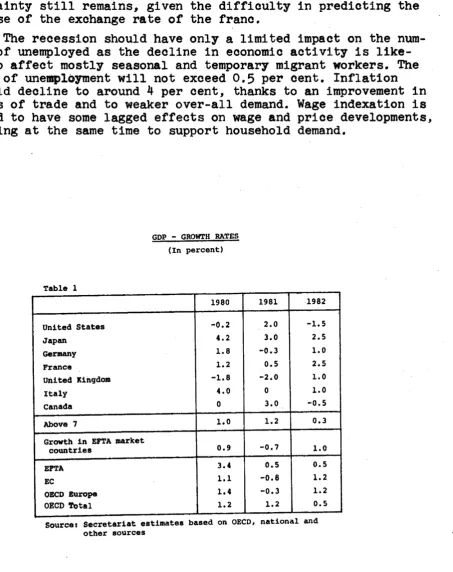
The prospects for a recovery in the OECD area later this year remain highly uncertain, according to an EFTA Secretariat report written for this week's meeting of the Committee of Mem-bers of Parliament of the EFTA countries.
GDP in the US appears to have fallen at an annual ra.te of about 4 per cent in the first-quarter of 1982 and in Europe and Japan economic activity is still weak. On the other hand there are signs that the cyclical ·trough has been reached in most OECD countries and that the world economy could gradually pull
itself out of the recession later this year but gather streng.~h only in 1983.
For the European OECD countries the growth rate this year can be expected to average between land
1!
per cent. GDP in the OEcn-area as a whole is, however, greatly influenced by theevolution of the US economy. Judging from developments in early 1982 and the prospect of a continuation of relatively high real interest rates, the upswing which is expected in the US a:round mid-year could be less steep than is anticipated. This would mean that GDP in the US would fall again this year by around
1!
per cent, reducing the total OECD growth rate to0.5
per cent. EmploymentThe outlook for employment is bound to remain bleak. Unem-ployment will grow to more than 30 million people (8! per cent of the OECD labour force) by 1983. For Europe it is predicted that sixteen and a half million people (10 per cent of the labour forc~will be out of work by mid-1983. Especially disturbing is.
the outlook for youth unemployment.
/--Table of contents
The economic outlook 1
Developments in individual EFTA countries 2
EFTA Trade 1979-1980 9
EFrA scholarships 9
The EFrA Industrial Development Fund for Portugal: new loans for 420 million
escudos granted -9
Forthcoming meetings 10
The contents of the EFTA Reporter do not necessarily reflect the views of the EFTA Council or of individual EFI'A governments. Articles may be reproduced without special permission. The editor would be grateful to receive a copy of any reproductions or items based on this material.
Editor: David Egli
Press and Information Service of the European Free Trade Association
The prospects for reducing inflation in
1982
are somewhat better than expected earlier, partly because the prices of crude oil, raw materials and food have reacted more to low demand. At the same time, wage increases in a number of OECD countries have been more moderate than could have been expected. Nevertheless the level of inflation remains high. This year the rate of infla-tion in the OECD area will still be around 8 per cent and in the ·EC around 10 per cent.
Current account balances
Perhaps the brightest spot in the economic picture is the development of current accounts. According to the latest estimates the OECD current account deficit was halved last year. A further reduction to about US$ 10 billion is forecast for this year
be-cause of the weakening of oil prices and the likelihood of easy oil market conditions throughout the year.
While part of the reduction or·the OECD current account de-ficit is certainly due to the slack in economic activity and destocking, more lasting changes in the structure
or
demand for energy seem to have been accomplished. It is possible, however, that energy prices might fall so low as to reduce ~he incentive to raise energy efficiency in production and consumption.The distribution
or
current account imbalances within the OECD area will remain rather uneven and could accentuate the strains on the open trading system. Since the seven major OECD co~tries are expected to move into a sizeable combined surplus, the smaller member countries will incur a deficit exceeding thatof ·the whole OECD area. For some ot them the-current account posi-tion could constitute quite a severe external constraint tor
poli-cy making. ·
Developments in individual EF'l'A countries
Austria
In the first quarter ot 1982 the Austrian economy continued to stagnate. Only good export performance prevented a tall in GDP in
1981.
Unemployment began to edge up from May1981
and exceeded5 per cent of the labour force early this year. Inflation rose to
6.8
per cent but peaked in the first halfor
last vear. The balance3
For 1982 a mild recovery is expected, its .time pattern roughly following the international economy and its main sti-mulus being a predicted 6 per cent rise in exports. Economic activity is expected to be supported also by the turn·or the business cycle. Domestic demand will remain rather weak. Alto-gether, GDP growth of the order of 1! per cent is expected.
The prospects for the current account are quite promising. With the surplus on net services increasing slightly the current account deficit will narrow to about 1! per cent of GDP. Infla-tion should fall to under 6 per cent, reflecting the softening of international price rises, sluggish domestic demand and fairly
low wage settlements.
Unemployment will remain serious by Austrian standards and is now expected to be some
3!
per cent. In order to counteract the rise in unemployment the Austrian Government introduced mea-sures early this year to assist the construction industry as well as the iron and steel industry and to support investment more generally, with the aim of lowering the unemployment rateby about half a percentage point for 1982.
Finland
After two years of rapid growth GDP in Finland levelled off in 1981. The downswing was expected but proved sharper
than earlier envisaged and the growth forecast for this year has therefore been revised downwards. This is due bo·th to less buoyant domestic demand and to weakening export growth.
Finland's exports to Western markets have been falling in volume terms since 1980, the cyclically sensitive forest indus-tries being the hardest hit. Last year this was more than compen-sated for by a rapid rise or exports to the Soviet Union to pay for the increased bill tor oil. As a result, total exports of goods increased by 3 per cent in 1981.
Both private and public consumption slowed down in 1981 and there was a big downward swing in investment. As a whole domes-tic demand fell ""ly some 1! per cent, reduo1·ng GDP growth from 5
per cent in 1980 to 1 per cent in 1981. The marked swing in the real foreign balance resulted in a larger than expected improve-ment in the external balance, the current account deficit being cut· to 1.7 billion Finnish marks or
o.8
per cent of GDP in 1981.Unemployment has been increasing since the middle of last year. The average.rate in 1981 was 5.3 per cent compared to 4.8
in 198o. Inflation, although decelerating, remained high in 1981: the average rise in consumer prices was 12 per cent. Finland continued to lose some or its competitiveness in terms of unit labour costs.
The prospects for the current year are not very promising. Posst·bili ties for increasing Eastern exports have been ex-hausted but a gradual revival of international demand could
4
marginally from 1981, the current account turnin~ into surplus and unemployment continuing to increase, up to 62 ~ 7 per cent.
Economic policy has endeavoured to maintain the reasonably good macro-economic balance reached in previous years 'ttlile helping to support growth and employment on the one hand and price stability and competitiveness on the other by selective measures. The over-all fiscal position, which was slightly res-trictive in 1981, is turning into a moderately stimulatory factor in 1982.
Iceland
In Iceland GNP rose by 1.1 per cent in 1981 because of a significant upsurge of domestic demand. Sharply rising imports in. conjunction with a fall of exports led to a current account deficit of
4.7
per cent of GNP or I. Kr. 1 billion. Full employ-ment was maintained.For 1982 a decline in real GNP of
i
per cent is forecast. Falling investment, a much slower rise in consumption and a re-duction of stocks will reduce domestic demand by 1.1 per cent. This will be partly offset by a rise in net exports. Nonethelessthe balance of trade is expected to close with a deficit of I. Kr.
140 million. A further substantial rise (to more than I. Kr. 1
billion) in the deficit on services account reflects the growing burden of servicing the foreign debt and is causing concern to the authorities. The current account deficit is expected to rise to about I. Kr. 1.2 billion which, however, entails a reduction to
4.1
per cent of GNP.The export of marine products is expected to fall between 3
and 6 per cent depending on the cod catch. The total fish catch is likely to decline by some 20 per cent in
1982.
On the other hand the production of manufacturing industries (aluminium,ferro-sili-con, diatomite) as well as other manufacturing products is fore-cast to rise. Total export production will at best remain unchanged,
at woPi!st fall by 2.5 per cent from 1981's ievel.
The Government expects to bring the rate of inflation down from 50 per cent last year to 35 per cent by the end of this year.
The likelihood of achieving this was reduced with the 12 per cent devaluation of the kronur in January to relax the squeeze on profit margins of the fisheries. In order to offset some of the effect on prices the Government sharply increased consumer subsidies on 1st February. In addition, import duties on household appliances were cut by half. These measures are also designed to influence the wage negotiations which began in mid-March.
Norway
In Norway output from the North Sea levelled off in 1981~
in
198o)
that there will be a drop of l per cent in GDP in1982.
.
Although traditional commodity exports will rise by some 4 per cent in volume in 1982, the drop in oil and gas·, output will cause exports as a whole to fall. With
increas-ing imports, the trade surplus is likely to be cut consi-derably and will not offset the high deficit on the transfer account. Thus the current account will show a small deficit of some 3 billion Norwegian kroner.
Unemployment remains very low in Norway although tending to rise. The labour force sample survey of the last quarter of 1981 showed an unemployment rate of 2 per cent. Registered unemployment (which is usually lower) reached
1.6
per cent in January 1982 (seasonally adjusted).Inflation is expected to remain a major policy problem in 1982 and to stay above the average for Norway's main tra-ding oartners. The annualized six-months' inflation rate roae
trom
6.9
per oent in December, after the ending .of the price freeze, to 10.3 per cent in January. Moreover, general wage negotiations, now taking place, will have a major impact on the inflation rate. Taking into account the abating interna-tional inflation and the generally·high pressures in theNor-wegian economy, it is quite likely that Norway's competitive
position will deteriorate further.
The changed outlook for oil production and State revenue has limited the scope tor manoeuvre in economic policy. The
current account is expected to show deficits of the order of 2 to 3 per cent of GDP in the next few years but these should be manageable. But an extensive investment programme_ with a high import content and costing 5 to 7 per cent of GDP, will be carried out in the Continental Shelf during these years. It can be expected that the budget surplus will be
at least significantly reduced and the efforts to limit public expenditure growth increased.
, Portugal
5
The state of the Portuguese economy worsened on almost all fronts in 198l: the deficit
on
current a coo~nt doubled to nearly ll·per cent ot GDP; output growth slowed down fromSi
per cent to 1! per cent; inflation accelerated from an average annual rate of16.6
per cent to 20 per cent; and unemployment rose from7.8
to
8.8
per cent of the civilian labour force.Agriculture and electricity production were seriously affec-ted by drought and industrial production was hit by declining international demand, aggravated by protectionist measures es-pecially against·1extiles.
For
1982
a recovery of exports, with a contribution from the new petrochemical production from the Sines complex, together with an expected improvement in terms of trade and a slowdown or imports should produce an improvement in the external balance and allow ro·r slightly higher output growth. Inflation should gradually slow down, especially if the weather permits a better agricultural pro-duction, although the average inflation rate in1982
will be about the same as last year and unemployment is not likely to show any improvement.Sweden
. In
1981
the Swedish economy was in recession. Real GDP decli-ned by about l per cent and manufacturing output decreased by 2 to 3 per cent in real terms. Of the domestic demand components only public.consumption increased. Investment, especially in ma-nufacturing, fell sharply. Exports remained unchanged compared with1980.
Imports decreased substantially, thereby helping to improvethe current account. The deficit was reduced from about
19
billion in1980
to somewhat less than16
billion Swedish Kronor in1981.
Last September's 10 per cent devaluation improved the compe-titiveness of Swedish goods and is expected to boost exports which
may grow by as much as 7 per cent this year with most of the growth in the second half. The rest of the economy, however, gives few impulses to growth. Real wages will decline by some - per cent, real disposable income by some 2! per cent and private consumption by almost 2 per cent. The budget proposal implies only a slight increase in public consumption. Fixed capital formation is expected to continue falling although not at the same rate as in 1981. Thus, GDP could grow by 1 per cent in
1982.
Abating international price pressures and weak domestic de-mand resulted in an easing of inflation by the end of
1981.
A further slowdown is expected for1982.
With moderate import growth and the expected rise in exports the trade balance would be in surplus. Heavy transfer payments and a deterioration in the terms of trade will, however, offset this improvement. The cu~rent account will therefore remain roughly unchanged in nominal terms. New steps to curb public expenditure were announced. in January when the budget proposals were presented. For
1982
the Government intends to bring the growth down to a little more than 1 per cent compared with~ per cent last year.Switzerland
GDP in Switzerland rose by about 2 per cent last year. Consumer demand slowed down considerably in the latter part or the year
be-cause of declining real wages and worsening employment prospects. Since this coincided with lower State expenditure and with weaker investment, domestic demand decelerated in the second half of 1981. Export demand, however, revived in the second and third quarters, making for a net positive contribution of the foreign sector to GDP growth. The rate of unemployment remained insignificant (0.3 per cent).
7
in 1981 but by the end of the year consumer prices were weakening thanks to the appreciation of the franc and to ~alling oil prices.
Good export performance combined with a decline in imports led to a sharp contraction of the trade deficit - from 11.3 to
7.3
billion Swiss francs - and to the re-emergence of aoomfort-apie
surplus of S.Frs4.2
billion on current account.For
1982
a decline in GDP of close to 1 per cent isexpec-ted, mostly due to a fall in construction activity, the conti-nuation of destocking and stagnating exports. A good deal of un-certainty still remains, given the difficulty in predicting the course of the exchange rate of the franc.
The recession should have only a limited impact on the num-ber of unemployed as the decline in economic activity is like-ly to affect mostly seasonal and temporary migrant workers. The rate of unemployment will not exceed
0.5
per cent. Inflation should decline to around 4 per cent, thanks to an improvement in terms of trade and to weaker over-all demand. Wage indexation is bound to have some lagged effects on wage and price developments,helping at the same time to support household demand.
Table 1
United States Japan
Germany
France
united Kingdom Italy
Canada
Above 7
Growth in EFTA market countries
EPTA
EC
OECD Europe OECD Total
GOP - GROWTH RATES
(In percent)
1980
-0.2
4.2
1.8 1.2 -1.8 4.0 0 1.0
0.9
3.4 1.1 1.4 1.2
1981 .1982
2.0 -LS
3.0 2.5 -0.3 LO
0.5 2.5 -2.0 1.0
0 LO
3.0 -o.s 1.2 0.3
-0.1 1.0
o.s o.s
-0.8 1.2 -0.3 1.2 1.2 o.s
sourcei Secretariat estimates based on OECD, national and
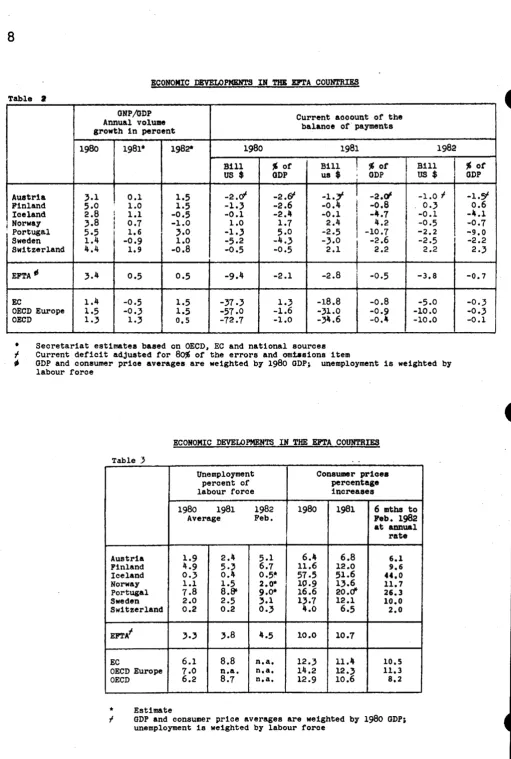
[image:7.568.92.546.211.784.2]ECONOMIC DEVELOPMiH'l'S IN THI EPTA COUNTRIES
Table 2
GNP/GDP Current account of the
Annual volume balance of payments growth in percent
1980 1981* 1982* 1980 1981 1982
Bill • of Bill
!
• ofI
Billus$ GDP us$ GDP us$
I
Austria ,.1 0.1 1.5 -2 .rl' -2 .€/' -1.:,'
I
-2.ct -1.0 -I Finland 5.0 l.0 1.5-i.,
-2.6 -o.4 ! -o.8 O .3Iceland 2.8 I
1.1 -0.5 -0.1 -2.4 -0.l
i
-4.7 -0.1
i
i Norway :,.8 I 0.7 -l.O 1.0 1.7 2.4 4.2 -0.5
i
· Portugal 5.5 i 1.6
,.o
-1.,
5.0 -2.5 -10.7 -2.2Sweden l.4 I -0.9 1.0 -5.2 -4.3 -3.0 I -2.6 -2.5 Switzerland 4.4 1.9 -o.8 -0.5 -o.s 2.1
i
2.2 2.2EFTA-' :,.4 0.5 0.5 -9.4 -2.l -2.8 l -0.5 -3.8
EC 1.4 -0.5 1.5 -37-3 1.3 -18.8 -o.8 -5.0 OECD Europe 1.5 -o.:, 1.5 -57.0 -1.6 -:,1.0 -0.9 -10.0
OECD 1.:, 1.3 o.s -12.7 -1.0 -3~.6 -0.4 -10.0
• Secretariat estimates based on OECD, EC and national sources Current deficit adjusted for So~ of the errors and omtasions item
GDP and consumer price averages are weighted by 1980 GDP; unemployment is weighted by labour force
ECONOMIC DEVELOPMENTS IN THE EFTA COUNTRIES
Table }
Unemplo7ment Consumer prices
percent of percentage
labour force increases
1980 1981 1982 1980 1981 6 mtbs to
Average Feb. Peb. 1982
at annual rate
Austria 1.9 2.4 5.1 6.4 6.8 6.1
Finland 4.9 5.:, 6.7 11.6 12.0 9.6
Iceland O.} 0.4 0.5111 57.5 51.6 u.o Norway 1.1 1.5 2.0* 10.9 13.6 11. 7
Portugal 7.8 8.& 9.0* 16.6 20.cf 26.3
Sweden 2.0 2.5 ,.1 1:,.7 12.l 10.0
Switzerland 0.2 0.2 o • .:, 4.o 6.5 2.0
E'P'rl°
,.,
:,.8 4.5 10.0 10.7EC 6.1 8.8 n.a. 12 • .:, 11.4 10.s
OECD Europe 7.0 n.a. n.a. 14.2 12 • .:, 11.3
OECD 6.2 8.7 n.a. 12.9 10.6 s.2
* Estimate
t GDP and consumer price averages are weighted by 1980 GDP. unemployment is weighted by labour force
i
II
4
• of GDP
-l.5"
o.6
-4.l
-0.7 -9.0 -2.2
2.3
-0.7
-0.3 -0.3 -0.l
[image:8.568.55.567.38.798.2]9
EFTA Trade
1979-1980
With the
1979-1980
edition~ EFTA Trade undergoes a reform both in content and presentation. The size of the publication has been substantially reduced by avoiding multiple presentations of the more disaggregated trade statistics and preference has been given to statistics on trade shares, since the changes in the nom-inal trade values are often dominated by price movements.The number. of selected commodities for which detailed data are provided has been cut down as some of these have lost weight in EFI'A trade. 9n the other hand, more detailed information is now supplied on trade with Japan, Spain and Yugoslavia. This is because of the increased importance of Japan in EFTA trade and the special relationship between EFTA and the other two countries. Greater detail than earlier is also provided on trade with devel-oping countries, as well as on trade in energy and in some "sens-itive" goods like textiles and clothing, iron and steel and· oars.
Individual copies of EFI'A Trade
1979-1980
are available free of charge from the EFTA Press and Information Service.EFI'A Scholarships
For the second year in succession, EFI'A last November in-vited applications for postgraduate scholarships for research into the activities of EFI'A or European trade and trade policy. Three scholarships, amounting to a total of Sw.frs. 17,000 and covering.
the
1982-1983
academic year, have now been a warded. Theaward-winners are: Mr. Ossie.Tuusvuori (Finland), Mr. Ari Saarinen (Finland) and Mr. Fernando de las Cuevas (Spain).
Mr. Tuusvuori's research project, entitled "The premises and function of the EFTA-EC free trade" ·is part of a comprehensive project on the development of European free trade being carried· out at the University of Turku. Mr. Saarinen, who is studying at the Helsinki School of Economics, is preparing a paper on the effects of EFTA tariff and quota reductions and elimination on the Finnish economy while Mr. de las Cuevas, who is at the College of Europe in Bruges, is working on a project entitled "E.eonomic
effects of the
1979
agreement. between EFTA and Spain"..The EFTA Industrial Development Fund for Portugal new loans for 420 million escudos granted
Two loans for a total of 420 million escudos (almost 6
. The bigger of the two loans, Esc. 300 million (about$ 4.2 million) goes to Celulose Beira Industrial SAHL, which is located in-Leirosa, near Figueira da Foz, and produces pulp and paper. The.company was founded in 1964 and is owned by the Swedish firm
of Billeruds. The new investment, 0£ a total of over Esc. 720
million, will finance the conversion of a recovery boiler to wood waste burning and the installation of ancillary equipment. This
conversion will achieve substantial ·savings in the use of fuel oil and thus contribute to an improvement in Portugal's balance of
pay-ments.
Another loan, of Esc. 120 million (about$ 1.7 million), will help finance an extension and modernisation project of Sociedade Nacional de Saboes. The company is of Portugal's most important manufacturers of soaps, oils, detergents, margarines and animal
feeding stuffs. The total investment, about Esc.
147
million, will increase capacity, reduce the consumption of steam, improve product quality and make it possible to increase exports substantially.Forthcoming meetings
May
10 - 11
11 - 12
13
18 - 19
18 - 19
27
27 - 28
June 3
4
Economic and Social Sub-Committee of the Consultative Committee
Pharmaceutical Inspection Convention (PIC): Working Group on Packaging and Labelling PIC - Comm! ttee of Official.s
Economic Committee (Lisbon)
Committee on Pharmaceutical Evaluation Reports (PER) (Vienna)
Pressure yessels Scheme: Participating authorities Bilateral Customs Committees (Brussels)
Consultative Committee meeting with Ministers (Helsinki)
EFTA Councils: ministerial meeting (Helsinki)