1999
Annual
Report
European
Investment
Bank
Eur
opean
Investment
Outside the European Union 4 035 4 410
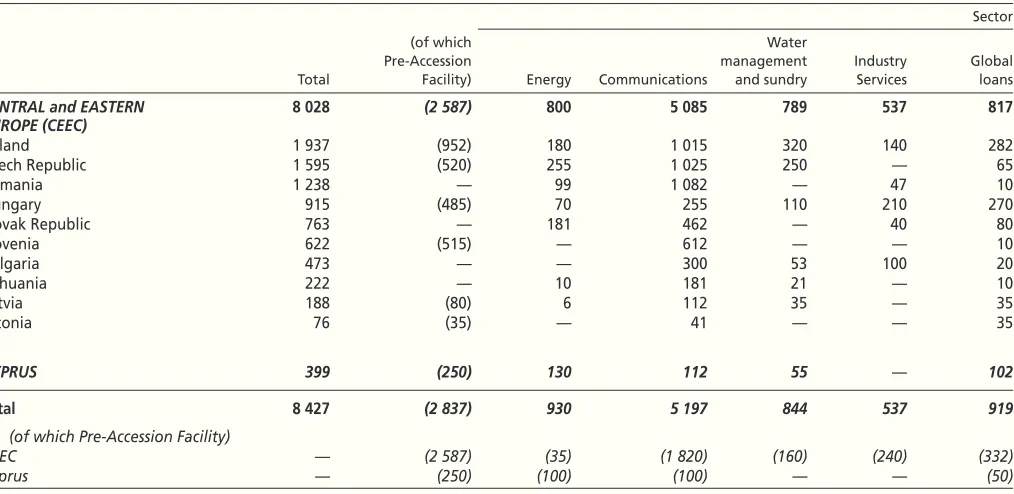
•Candidate Countries 2 373 2 375
(of which Pre-Accession Facility) (1 467) (1 370)
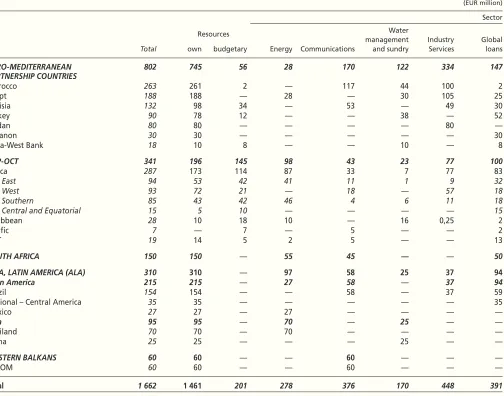
•Mediterranean Countries (excluding Cyprus) 802 886
•Africa, Caribbean, Pacific, OCT 341 560
South Africa 150 135
•Asia, Latin America 310 362
•Western Balkans 60 92
Loans approved 35 117 33 369
Within the European Union 30 380 28 246
Outside the European Union 4 732 5 123
Disbursements 27 612 27 993
From own resources 27 449 27 792
From other resources 163 201
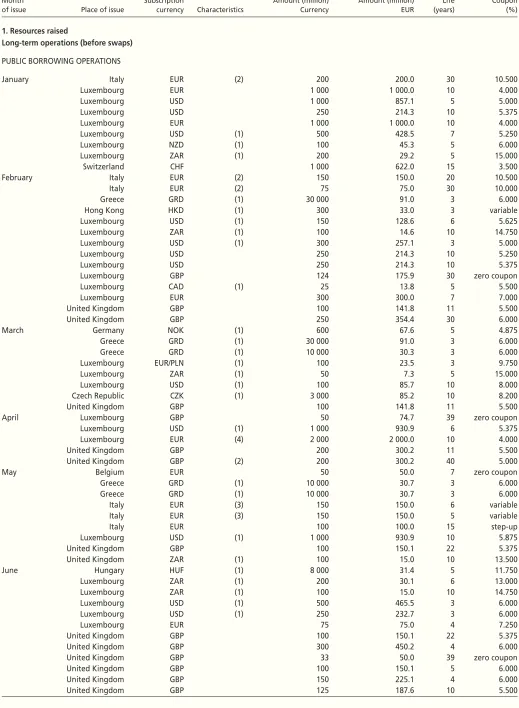
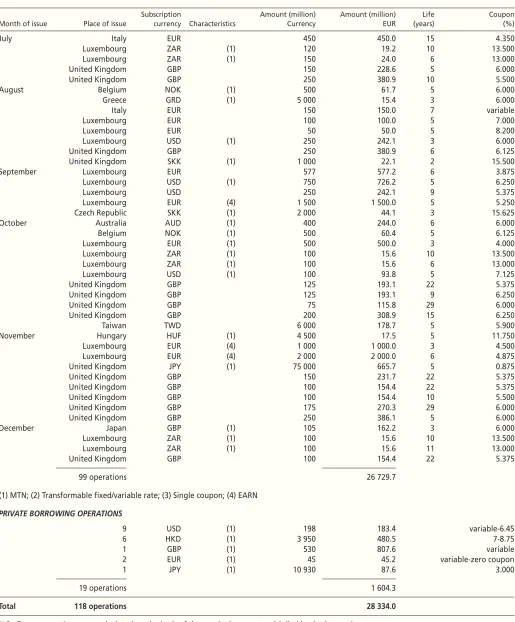
Resources raised 28 355 30 098
Community currencies 19 658 23 395
Non-Community currencies 8 697 6 703
Outstandings
Loans from own resources 178 775 155 333
Guarantees 277 347
Financing from budgetary resources 2 352 2 360
Short, medium and long-term borrowings 146 223 123 767
Own funds 20 494 19 306
Balance sheet total 201 104 176 544
1999
Annual
Report
Page
Message from the President 4
1999: Overview 6
The Bank’s Corporate Operational Plan 8
Promoting European integration 11
Regional development 11
Human capital 16
European communications infrastructure 18
Natural and urban environment 22
Energy conservation 25
Industrial competitiveness 26
SMEs 28
Supporting cooperation policies with non-member countries 33
Candidate Countries 35
Euro-Mediterranean Partnership Countries 39
African, Caribbean and Pacific States and OCT 41
South Africa 42
Asia and Latin America 43
Resources raised 47
EIB borrowing operations on the financial markets 47
Liquidity management 58
Liquidity management results 59
Decision-making bodies, administration and staff 63
Decision-making bodies 63
Organisation chart 68
Administration and staff 71
Presentation of the accounts 75
Results for the year 77
Financial statements 78
Report of the Auditor 99
Statement by the Audit Committee 100
Annexes
Lending within the European Union 103
Lending outside the European Union 116
Statistical annex 123
European Investment Bank
In furtherance of the Union’s objectives, in 1999 the European Investment Bank once again embraced wholeheartedly its role of mobilising savings in support of projects fostering European integration and improving the quality of life of EU citizens.
Working together with Europe’s banking sector, the EIB advanced loans totalling
EUR 28 billion to strengthen the Union’s mutual solidarity and underpin economic activity. Projects financed by us during the year accounted for more than 5% of aggregate capital investment in Europe; these are located for the most part in the EU’s less favoured regions, which attract nearly 70% of our lending. Against this backdrop, the EIB also drew on the cooperation of its 180 or so partner banks to support nearly 30 000 schemes undertaken by smaller businesses and local authorities in Europe and to mount some 40 venture capital operations injecting equity into innovative SMEs.
At the same time, the Bank directed financing towards dozens of major projects and hundreds of medium-scale infrastructure schemes in the health and education sectors. These lay the foundations for our societies’ future and provide countless firms with work. The EIB’s backing ensures access to reliable sources of bank finance facilitating establishment of sound financing packages, especially when undertaken as public-private partnerships.
Since effective communications and environmental protection are essential to a modern economy, the Bank pressed ahead with its initiatives in these two fields. For almost a decade, we have confirmed our position as the leading source of bank finance for trans-European networks, which have attracted over EUR 65 billion in EIB loans since being iden-tified by the Essen European Council in 1994. This action goes hand in hand with funding for projects aimed at preserving the natural or urban environment, priorities accounting on average for one third of Bank operations.
As Europe’s foremost non-sovereign borrower, the EIB also promotes attainment of the Union’s objectives through its borrowing activity on the capital markets. Hence, as early as 1996, it began issuing euro-denominated products ahead of the launch of the future single currency, and has since established a critical mass of euro debt in excess of EUR 60 billion. In this context, the EIB has made available to the market both structured operations tailored to investors’ needs and a new issuance facility for its euro benchmarks.
In support of the Union’s development aid and cooperation policies towards some
150 countries around the world, in 1999 the Bank provided some EUR 4 billion in the form of long-term loans, subordinated finance and risk capital. Naturally, the lion’s share of this amount went to countries in areas bordering the EU to the south and east, furthering the objectives of the “Barcelona Process” in the Mediterranean region and paving the way for enlargement of the Union to include the candidate countries.
This review of 1999 amply illustrates the achievements of my predecessor, Sir Brian Unwin, in turning the EIB into a bank not only willing but above all able, by virtue of its financial soundness and partnership with the banking community, to provide decisive support for achievement of the Union’s objectives. At virtually all its meetings, moreover, the European Council of Heads of State or Government draws on the Bank’s ability to mount innovative operations in support of a variety of initiatives contributing to the Union’s harmonious economic development.
As a follow-up to the Lisbon European Council’s guidelines for building a knowledge-based society driven by innovation, the Bank will therefore launch its “Innovation 2000 Initiative”, a programme combining new measures to promote development of information networks, human capital formation and intangible corporate investment. Costed at some EUR 40 bil-lion over the next three years, this activity will help to lay the foundations for dynamic growth in Europe, the basis of a more open society in which everyone has ready access to information.
Deployment of the “Innovation 2000 Initiative”, along with the EIB’s new Pre-Accession Facility for the candidate countries, will be the Bank’s operational priorities for the period 2000-2002. These will have to be implemented in a changing environment, marked in particular by establishment of the euro, requiring the EIB to step up its efforts to develop new products tailored ever more closely to its customers’ needs.
I believe that this report, addressed to a wide readership, paints a detailed picture of the EIB and its role within Europe.
Philippe Maystadt
President and Chairman of the Board of Directors
The EIB’s
Management Committee
1999:
Overview
The EIB, whose subscribed capital has stood
at EUR 100 billion since 1 January 1999,
con-tinued its activity in furtherance of the
Euro-pean Union’s major policies, maintaining in
particular a high level of financing to
strengthen the Union’s economic and social
fabric, preparing the candidate countries for
EU membership and developing its
commit-ted euro borrowing strategy. The Bank’s
con-tribution to achievement of the Union’s goals
was highlighted by the European Council at
its meetings in Berlin (24 and 25 March 1999)
and Cologne (3 and 4 June 1999).
Aggregate loans signed by the Bank
amounted to 31.8 billion, up from 29.5 billion
the previous year. Reflecting the range and
diversity of the EIB’s remits, this activity took
forward 1998’s line of action.
Disbursements totalled 27.4 billion, of which
24.6 billion in the Member States. The 310 or
so capital projects appraised by Bank staff in
1999 resulted in 35.1 billion in loan
approv-als, i.e. higher than the 1998 level (33.4
bil-lion).
By the close of 1999, total outstanding
lend-ing from own resources and guarantees came to 179.1 billion. Aggregate outstanding
bor-rowings amounted to 146.2 billion and the
balance sheet totalled 201.1 billion.
Actively promoting the euro
The EIB pressed ahead with its role of actively
promoting the European single currency,
intro-duced on 1 January: nearly 45 % of the Bank’s
issues were denominated in euro, helping to
create a substantial “critical mass” of
instru-ments denominated in the new currency.
Further-more, over half of resources raised in euro
were mobilised under the EARN (Euro Area
Reference Note) programme. Launched in
March 1999 and deployed in close cooperation
with major international banks, this issuance
facility ensures market liquidity for investors
on the basis of transparency and regularity.
Hence, the amount of borrowing operations
signed came to EUR 29.3 billion, down slightly
on the previous year. This figure includes
nearly one billion issued under the programme
for exchanging existing bonds for new euro
bonds.
Supporting economic and social cohesion
within the Union
Within the European Union, aggregate
finance contracts signed amounted to
27.8 billion, or 10.5% more than in 1998. 71% of Bank lending served to further
re-gional policy objectives, fostering the Union’s
cohesion and underpinning Economic and
Monetary Union. In response to the
Resolu-tion on Growth and Employment adopted by
the Amsterdam European Council, investment
in trans-European communications networks,
support for SMEs and lending in the health
and education sectors were the main focus of
the Bank’s operations.
Increased backing for SMEs and high
technology
The Cologne European Council called on the
Bank to expand its operations to promote
investment and employment, especially by
means of risk capital funding, over the period 2000-2003. In this context, the Governors
approved activation of the second tranche of
500 million drawn from the Bank’s 1998
operat-ing surplus, allocated to the Amsterdam Special
Action Programme (ASAP) reserve. The latter,
thereby increased to one billion, is intended to
cover the risk associated with venture capital
operations. In May 1999, the Board of Directors
had authorised a doubling of the EIB’s
alloca-tion to the European Technology Facility (ETF),
managed by the European Investment Fund (EIF)
under an EIB mandate, from 125 million to
250 million. The Bank has thus equipped itself
to give significant momentum to the European
venture capital market. Furthermore, the
contin-ued development of financing operations in the
fields of health and education led the Governors
to bring these sectors within the Bank’s
main-stream activity, whereas the 1997 ASAP decision
had restricted their eligibility to a period of
three years.
Also as a direct follow-up to the conclusions of
the Cologne European Council, the Governors
invited the Bank to step up support for
high-tech network projects and to continue
finan-cing trans-European communications
net-works, where appropriate through
public-private partnerships.
Paving the way for enlargement
EIB activity outside the Union ran to 4 billion,
down by 8.5% compared with the previous
financial year. Amounts deployed in the ten
Central and Eastern European candidate
countries and Cyprus were maintained at a substantial level (2.4 billion), accounting for
more than half of aggregate lending outside
the European Union.
The Governors approved the principle of
re-newing the current Pre-Accession Facility as
from 31 January 2000, extending it to cover
the period 2000-2003 and substantially
increas-ing its volume to 8.5 billion.
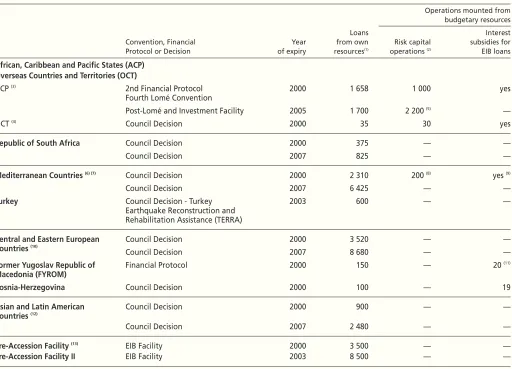
A new framework for operations outside the
Union
Financing provided outside the EU totalled
over 4 billion. Given the expiry in early 2000 of
the mandates determining Bank operations in
support of the Union’s development aid and
cooperation policies, on 22 December 1999 the
Council decided to introduce new guarantee
arrangements for EIB loans in non-member
Countries. A global guarantee, covering the
pe-riod 2000-2007, was made available in respect
of aggregate lending of up to 18.41 billion in
the Central and Eastern European Countries,
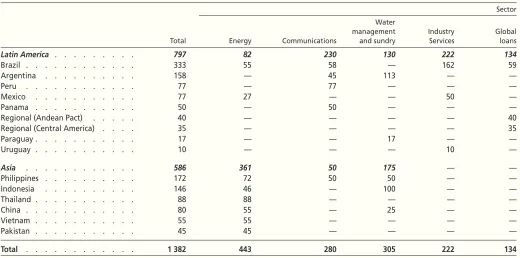
the Mediterranean Region, Asia, Latin America
and South Africa.
Furthermore, 1999 saw negotiations on a
new Convention governing relations with the
ACP States well advanced by the end of the
year and offering the prospect of a greater
role for the Bank in this area.
Disbursements, contracts signed and projects approved (1990 - 1999)
(EUR million)
Disbursements
Signatures
Approvals 10 000
1995 1996 1997 1998 1999 20 000
30 000 40 000
The Bank’s Corporate
Operational Plan (COP)
With a view to targeting Bank operations more effectively in support of Community policies
both within and outside the Union, in January 1999 the Board of Directors adopted the
EIB’s first Corporate Operational Plan (COP), covering the period 1999-2000. A logical
extension of the Strategic Framework adopted by the Governors on 5 June 1998 in
conjunc-tion with their decision to increase the subscribed capital of the Bank, this is a rolling plan:
in subsequent financial years it will be possible, on the strength of experience, to extend the
time horizon further.
General policy objectives:
Within the Union, top priorityis accorded to: • fostering regional development and the Union’s cohesion, especially by means of close
cooperation with the Commission in
imple-menting Agenda 2000;
• promoting human capital (health, educa-tion), which becomes a priority of the Bank
within its mainstream activity throughout the
Union;
• providing venture capital finance for SMEs, together with the Union’s financial sector
and the EIF.
High priority is to be maintained for: • trans-European networks (TENs) and the environment, focusing in particular on
quali-tative adaptations;
• continued close cooperation with the bank-ing sector, especially necessary in a rapidly changing environment in which introduction
of the euro requires the EIB and banks to
work together on the capital markets.
A selective approach is to be applied for
loans to enterprises located outside assisted
areas, based on the establishment of
eligibil-ity criteria allowing the value added of the
Bank’s involvement to be identified more
precisely. Furthermore, the Bank is to
con-sider making some adjustments to financing
facilities for SMEs.
Outside the Union, where traditional activi-ties under EU and Member States’ mandates
will continue to form the backbone of
opera-tions, the Bank’s main priorities will be:
• promoting the transposal of Community
regulatory practices by the candidate
coun-tries through renewal of the Pre-Accession
Facility;
• fostering development and privatisation of the productive sector;
• strengthening support for local banking sectors.
In all these areas, fulfilment of COP objectives
implies enhanced relations with the
Commis-sion
In anchoring its approach on Community
ob-jectives, the Bank will continue to cooperate
complement the latter’s activities and
poli-cies, both within and outside the Union.
The three pillars of value added
Financing decisions are to be based on three
criteria:
• consistency between each operation and the Union’s priority objectives;
• the quality and soundness of the project concerned;
• the particular financial benefits obtained by the use of EIB funds.
Drawing on its accumulated know-how and
practical experience, the Bank will contribute
to-wards refining the content and presentation of
eligible investment projects. It will strive to
pro-pose innovative solutions and to encourage the
spread of best practice in its fields of activity. Its
consultancy input in arranging complex
financ-ing packages (public-private partnerships for
financing infrastructure) is set to expand.
Presence on the capital markets
In pursuance of its objectives, the Bank will con-tinue to build upon its AAA credit rating and to
make its know-how available on the capital
markets. It will press ahead with its initiatives to
promote the euro and to underpin the
develop-ment of capital markets in the candidate
coun-tries, as well as with its policy of maintaining a
diversified presence on the capital markets.
Furthermore, it will endeavour to accommodate
its borrowers’ and investors’ needs more
effec-tively, especially by formulating innovative
products.
By the close of 1999, the Bank had already
adopted a number of measures in the priority
areas identified in the COP:
• Regional policy: on 19 January 2000, a new
framework agreement setting out the
principles for enhanced cooperation in
de-ployment of the Structural Funds was
signed with the Commission. The Bank also
made clear its readiness to play a
support-ing role in implementation of the new
fi-nancial instrument for the European
Economic Area;
• Human capital: the health and education sectors were brought within the Bank’s
mainstream activity; as part of cooperation
with the World Health Organisation (WHO)
a joint conference on health care systems
was arranged;
• Venture capital: the Bank has set prepara-tions in train for proposing to its Board of
Directors and Board of Governors during
the first half of 2000 that the funds
allo-cated to its “SME Window” be doubled,
giving practical effect to the EIB’s growing
role on the European venture capital
mar-ket. The Bank has also become a member
of the EVCA (European Venture Capital
Association);
• Trans-European Networks: increased com-mitment was evidenced to the financing of
PPP projects. A number of preparatory
studies were financed for environmental
and infrastructure schemes;
• Environment: suitable ways and means of implementing the Kyoto agreements were
studied with the Commission.
In qualitative terms, the COP confirmed and prioritised the EIB’s traditional objectives. It established the three pillars of value added for Bank operations and underlined the
importance of cooperation with the Commission.
Promoting European
integration
Through its long-term lending, the EIB is contributing towards the
integra-tion, balanced development and economic and social cohesion of the Member
States of the Union, thereby helping to meet the challenges of the Europe of
tomorrow.
In carrying out its tasks in support of Community policies, the Bank is giving
priority to promoting the less favoured regions while at the same time
further-ing the other economic priorities defined by its Board of Governors and the
European Councils. Loans granted in favour of economically sound projects
encompass a wide range of objectives: communications networks and basic
infrastructure; the natural and urban environment; SMEs; health and
educa-tion; energy; industry and services.
Regional development
The Treaty of Amsterdam identified the strengthening of economic and social cohesion,
with a view to harmonious development throughout the regions of the Union, as one of
the main priorities of Community policy. It thereby confirmed the goal of balanced
devel-opment first established in 1958 in the Treaty of Rome, which assigned to the European
Investment Bank the vital task of supporting projects contributing to growth in the less
developed regions. The widening of the Bank’s field of activities as a result of
diversifica-tion of EU policies and accession of new Member States has in no way diminished the
importance of this specific role or lowered the priority given to regional development.
The strategic action framework, spelt out by the Board of Governors in June 1998 and
implemented through the COP, endorses the focus of the Bank’s efforts on less favoured
and peripheral areas as one of the top priorities. The Bank is therefore concentrating on
strengthening the productive fabric of the regions of the Union lagging behind. In these
regions, its loans are helping to build up basic communications, environmental and
ener-gy infrastructure and to develop social amenities, with a view to laying the foundations
for economic development.
The new Structural Fund programming, based on the Agenda 2000 decisions, will lend added weight to the Bank’s role and remits in terms of Community structural action. To
this end, in January 2000, a cooperation agreement between the Commission,
repre-sented by Commissioner Barnier, and the EIB was signed in Luxembourg. Its purpose is to
make the Community’s structural assistance more effective and to reinforce the
comple-mentarity between budgetary funding and Bank lending over the period 2000 - 2006.
Full-page photo
The Elbe Tunnel - developing
Hamburg’s transport system, Germany
Under this agreement, the Commission will be able to draw on EIB expertise for
evaluat-ing investment projects eligible for financevaluat-ing not only from the Cohesion Fund, as is
already the case, but also from the European Regional Development Fund (ERDF)
throughout the EU or under the Structural Policies Pre-Accession Instrument (ISPA) in the
candidate countries. The Commission and the EIB will regularly exchange information on
each of these facilities so as to ensure that their respective support measures are properly
programmed and project feasibility is assessed at an early stage. The Bank will be making
its expertise available both directly to the Commission, in connection with appraisal of
projects to be co-financed from EIB resources and the Community budget, and on behalf
of the Commission, where EIB co-financing is not envisaged.
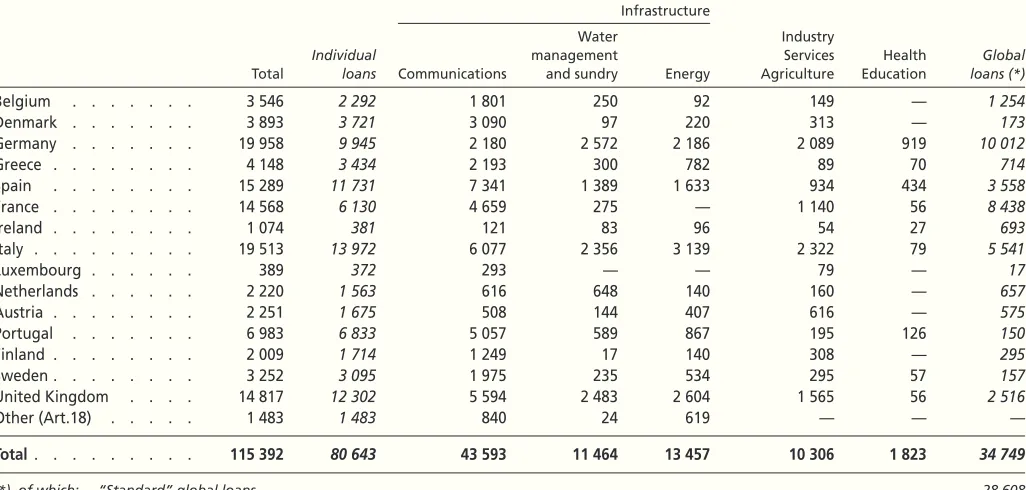
In 1999,individual loansfrom the EIB in the less favoured regions of the Union amounted to
12.9 billion, i.e. 71% of total individual loans, in keeping with COP objectives assigning these
op-erations absolute priority equivalent to two
thirds of lending activity within the Union.
In addition to these operations, allocations
under ongoing global loans, amounting to
4 650 million, have also had an impact on small and medium-scale ventures in assisted
areas.
Thus, overall,total lendingduring the year in favour of regional development amounted to
17.5 billion.
48% of regional development loans go to
Objective 1 regions
In 1999, regions lagging behind in their
devel-opment (Objective 1) received 6 208 millionin
individual loans, well up on 1998 (4 600 mil-lion). Germany’s Eastern Länder attracted
839 million, the Cohesion Countries (Spain,
Portugal, Ireland and Greece) 4 075 million and
the Italian Mezzogiorno 600 million.
Of this total, 66% was invested in communications
infrastructure and energy networks, thus helping to offset the effects of the geographical isolation
of these regions. Of the remainder, 13% went
to-wards improving the natural and urban
environ-ment, while industry and services accounted for
15% and health and education 6%.
To assist with reconstruction of buildings
de-stroyed by the earthquake which struck the
Athens area in September, the EIB advanced a
300 million loan as part of a 900 million
frame-work contract covering a period of two to three years.
Promoting economic adjustment
Individual loans for regions faced with indus-trial decline(Objective 2), rural areas encoun-tering conversion problems (Objective 5(b))
and sparsely populated areas (Objective 6)
totalled3 663 million.
The sectoral breakdown reveals that in these
areas the lion’s share of lending (45%) was
given over to transport infrastructure,
al-though the importance of protecting the
natural and urban environment (18%) was
also recognised. Industry and services
ab-sorbed 15% of the total.
Support for network financing More than two thirds
of individual loans go to the less favoured regions Regional development Sectoral breakdown (1999)
(EUR million)
Total amount %
Energy 1 820 14
Communications 7 389 57 Water management
and sundry 1 071 8
Urban
development 402 3
Industry,
agriculture 1 394 11
Health, education 391 3
Other services 411 3
Total individual
loans 12 877 100
and transport networks as well as power grid
interconnections benefiting several assisted
areas or an individual country as a whole.
The EEA Financial Mechanism
The EIB continues to manage the Financial
Mechanism of the European Economic Area
(EEA), funded by the Commission and the
EFTA - EEA countries. The package of 1.5
bil-lion in loans with interest rebates and
500 million in grant aid, established in 1994,
has been committed in full for projects in
Greece, Portugal, the island of Ireland and
Spain. Further progress was made on
imple-menting these projects in 1999.
Review of EIB lending since reform of the
Structural Funds in 1989
Since the 1989 reform of the Structural Funds,
individual loansgranted by the EIB for financ-ing projects in regional development areas
have amounted to 104.4 billion, or 70% of aggregate individual loans.
Having risen from 5.4 billion in 1989 to reach
12.9 billion in 1999, EIB regional
develop-ment lending has grown on average by 9%
per annum, a rate higher than that for loan
signatures overall (8% a year).
In addition, allocations under ongoingglobal loanshave also made an impact at the level of small and medium-scale infrastructure
schemes and SME ventures in assisted areas.
Weighting the global loans concluded in each
country in terms of the percentage of the
population living in eligible areas produces a
figure of some28.5 billion.
Thus,globally, over the period from 1989 to 1999, EIB lending in support of regional de-velopment amounts to133 billion.
This activity was pursued in close cooperation
with the Community institutions, particularly
the Commission, which deploys the
budget-ary instruments facilitating structural
adjust-ment in these regions.
Individual loans for regional development 1989-1999: 104 billion
1989 - 1993 1994 - 1999
EIB operations in Member States
(individual loans) 55.5 100% 94.5 100%
Regional development, of which: 37.8 68% 66.5 70%
* Objective 1 areas 21.3 56% 30.6 46%
* Objective 2, 5(b) and 6 areas 12.8 34% 23.7 36%
* Community specific action areas and areas benefiting from national aid schemes; multi-regional projects involving several eligible areas (*)
3.8 10% 12.2 18%
(*) mainly communications networks
Individual loans regional development: 1989 - 1999: 104 billion
The period 1989-1999
saw individual loans for
regional development
totalling 104 billion.
The annual growth rate (9%)
outstripped that for
the Bank’s activities overall Regional development
5 000 10 000 15 000 1999
1997
1995
1993
1991
1989
1994 - 1999 overview
During the second period covered by the Structural Funds, from 1994 to 1999,
indi-vidual loans granted by the Bank in support
of regional development totalled 66.5 billion.
All areas combined, this figure comprised
25 billion for transport, 11.8 billion for
en-ergy, 11 billion for telecommunications,
7.7 billion for the environment, 9.4 billion for
industry and services and 1.7 billion for
hu-man capital. In addition, global loans signed
in favour of these areas amounted to some
19.5 billion for SMEs and small-scale local
in-frastructure.
Individual loans made available in areas
lagging behind in their development (Objec-tive 1 areas) came to 30.6 billion. They
tar-geted improved basic infrastructure
-transport (40%), telecommunications (8%),
energy networks (24%) - with a view to
miti-gating the disadvantages of comparative
inaccessibility. Since introduction of ASAP
(November 1997), the EIB has also been
sup-porting an increasing volume of health and
education sector projects in these areas (4%).
In Objective 2, 5(b) and 6 regions, i.e. those undergoing economic restructuring or
charac-terised by an extremely low population
den-sity, individual loans account for 23.7 billion.
The Bank has given top priority to economic
adjustment through upgrading of transport
(46%), energy transfer (16%) and
environ-mental protection (16%) infrastructure.
Sectoral breakdown of loans in Objective 1 regions
Sectoral breakdown of loans in Objectives 2, 5(b) and 6 regions
Energy Transport
Telecommunications
Environment and sundry Industry, services
Human capital
Global loans 2 000
1994 1995 1996 1997 1998 1999 4 000
6 000 8 000
1 000
1994 1995 1996 1997 1998 1999 5 000
7 000
ensuring complementarity, in line with the conclusions of the Cologne European Council of 3 and 4 June 1999, which invited the EIB “to support and supplement Community structural and
regional assistance, especially in areas that will no longer qualify for assistance in future”.
This complementarity will take two forms:
• Geographical complementarity: in favour of certain regions which, because of their improved economic health, will eventually lose the benefit of structural support or have that support
sharply reduced.
• Sectoral complementarity: for projects in sectors in which the income generated by invest-ment will be sufficiently substantial for there no longer to be any justification for public
sub-sidies, despite the importance of the part such projects play in regional development. This
applies, in particular, to certain communications, energy and sewerage infrastructure.
With these as its watchwords, the EIB intends to develop its operations in two main directions:
• Encouraging local business initiatives in the less favoured areas
- by providing increased support for innovative enterprises and for infrastructure, as well as
for information society services,
- by improving the urban environment and strengthening the potential of towns and cities,
- by promoting education and training,
- by continuing to equip these regions with the basic energy, communications and
environ-mental infrastructure essential for their development.
• Continuing to integrate the less favoured and peripheral regions
- by improving not only the Trans-European Networks (TENs) but also sections of national
networks giving access to them, together with accompanying environmental protection
measures,
- by developing the network infrastructure necessary for dissemination of information,
together with related services.
At the same time, the Bank will, of course, pay special attention to preparing for the accession
of the candidate countries. It will do so, on the one hand, by stepping up its direct lending with
the same objectives as for the Member States and, on the other, by assisting the Community
institutions to identify high priority and economically sound operations that most deserve
budgetary support.
Cooperation and complementarity with the Commission
Human capital (health and education)
Following adoption of the Resolution on Growth and Employment by the Amsterdam
European Council (June 1997) and with activation of ASAP, the health and education
sectors became eligible for EIB financing for a period of three years.
The Cologne European Council (June 1999) requested the EIB “to continue, and widen,
credit allocation for ... education and health ...” beyond the year 2000. Hence, since July
1999, health sector projects, along with those in the field of education, have been
auto-matically eligible for EIB lending throughout the Union as part of the process of
promot-ing and preservpromot-ing the value of its human capital.
Making the most of experience already acquired, the Bank is pursuing a policy, in both
the health and education sectors, of operating on the basis of a sound knowledge of the
national context and in accordance with the specific investment programmes devised by
the decision-making bodies at national and regional levels.
The Bank’s support for these projects therefore takes into account economic and social
parameters in the country or region concerned, one of its objectives being to enable the
people living in outlying areas or areas with social problems to have readier access to
health and education facilities comparable in quality with that available in the rest of the Union.
Since it began operating in the fields of health and education, the EIB has broadened its
experience by organising conferences and developing contacts with European networks
of health and education professionals, such as the European Observatory on Health Care
Systems, set up jointly by the EIB, the WHO, the World Bank, the Spanish and Norwegian
Governments and the London Schools of Economics and Hygiene and Tropical Medicine,
as well as by establishing close relations with the OECD. These contacts are giving the EIB
access to specialist data and skills and are helping it to refine its project appraisal
techniques.
In 1999, individual loans provided by the Bank for human capital projects with
abso-lute priority under the COP amounted to
571 million. They centred on construction of hospitals in Spain, Germany and Italy and
educational establishments in France,
Germany, Sweden, Spain and Italy.
Moreover, numerous schools and hospitals
have been financed through global loans,
mainly in Germany, the Netherlands and
Belgium. According to information from the
intermediaries, 626 million has been made available in global loan allocations.
Between 1997 and the end of 1999,individual loans worth nearly 1.8 billion were signed in eight countries, with 778 million going into
education and 1 billion into health.
Of these projects, 91% are situated in
assisted areas.
Since the ASAP initiative was launched in
The 1999 approvals include:
• ten projects in the field of education, in-cluding the Babelsberg College for Film
and Television, in Germany, an interesting
case of Bank involvement in a highly
spe-cialised education project, schools in
Glasgow, Stoke-on-Trent and Sheffield in
the United Kingdom, within the context of
a public-private partnership initiative, and
universities in Turin, Valencia and Athens.
• in the health sector, the two projects ap-proved related to modernisation of
hospi-tal centres in the Land of Sachsen-Anhalt
and in Austria.
91% of human capital development projects financed since 1997 situated in assisted areas
Amsterdam Special Action Programme (ASAP):
the specifics
Formulated in response to the Amsterdam European Council Resolution on Growth and
Employment (June 1997), the Amsterdam Special Action Programme enabled the Bank to
undertake new tasks with regard to mobilising additional resources designed to contribute to economic growth and thus stimulate employment.
This programme, initially spanning three years (September 1997 - 2000), has three components
(for a detailed description see pages 16 and 17 of the 1998 Annual Report):
• a “SME Window” intended to provide new venture capital instruments offering equity fi-nance for high-technology and growth-oriented SMEs. The risks associated with such
opera-tions are offset by a 1 billion reserve set aside from the Bank’s operating surpluses. The results
are analysed in the section on “Promoting SMEs” on pages 28 and 29;
• expansion of Bank financing into the areas of health and education; as these have become fully-fledged objectives in their own right (in July 1999), a separate sub-chapter has been devoted to them (see above);
• intensification of the Bank’s already substantial support for investment in TENs and other large-scale infrastructure networks, as well as for investment in urban renewal and
environ-mental protection. Operations corresponding to these various objectives are described on
pages 19 to 24. This support can also take the form of financing for preliminary or feasibility
studies for TEN projects in the fields of transport and the environment.
European communications
infrastructure
From the outset, pursuant to the remits entrusted to it, the Bank has actively participated
in the development of transport, telecommunications and energy transfer infrastructure
networks with a Community dimension.
Completion of the TENs is of vital importance for the economic integration of the Union
and the development of its less favoured regions. Particular attention is being paid to
outlying and remote areas and to the elimination of bottlenecks created by obsolete
infrastructure, especially in industrial conversion areas and conurbations.
The Report on the European Employment Pact, appended to the conclusions of the
Cologne European Council, stressed that “European infrastructure is to be further
improved by Trans-European Networks - in particular, the priority projects in the trans-port field as well as the development of projects in telecommunications and information
technology to improve innovation and competition - and the assistance provided by the
European Investment Bank”.
In January 1999, the European Parliament gave a favourable reception to the Commission’s
communication on the financing of trans-European transport network projects by means of
public-private partnerships (PPPs). It considered that recourse to this form of financing was
the key to carrying forward the Trans-European Network programme.
Over the entire spectrum of projects associated with European communications
infra-structure, the Bank has provided strong support for PPPs. The experience built up by the
EIB over the years continues to represent an added bonus, particularly in the transport
sector where the primary objective of Community policy is to bring the countries of the
Union closer together and to improve links with non-member countries, principally
candi-dates for accession.
In the field of telecommunications, which has been opened up to liberalisation and
com-petition throughout the Union, the Bank is providing support not only for investment in
capacity uprating but also for expansion of the range of services available and the
poten-tial of the networks to absorb new developments. The aim is to exploit to the full the
advantages of the burgeoning information society.
In 1999, EIB lending for European
commu-nications infrastructure amounted to
10 269 million.
This accounted for 56% of total individual loans provided within the Union, with 70% targeting
projects in assisted areas.
Over the past five years, some 40.8 billion
-telecommunications networks - has been
directed towards supporting this
fundamen-tal interlinking fabric, very much the
main-stay of balanced regional development.
More for transport
Lending for transport projects increased
al-the crest of sustained activity in al-the motorway
and air transport sectors.
The level of financing for rail transport
(1 736 million) reflects the completion of
cer-tain large-scale projects (Belgian and French
Mediterranean high-speed rail links) at a
time when other projects are only just
start-ing up. Loans signed in 1999 helped, in
par-ticular, to fund the Bologna-Florence and
Rome-Naples sections of the Italian
high-speed network; technical upgrading of the
west coast London-to-Glasgow line; and
mod-ernisation programmes in Finland and Spain.
Lending forroads and motorways(3 541 mil-lions) rose steeply. In addition to loans for
building new motorway sections in Germany,
the Cohesion Countries, France and Norway,
there was also financing for modernising
parts of the existing network in France and
Italy.
Loans for theair and maritime transport sec-tor (2 064 million) also recorded marked
growth. More than half centred on airline fleet renewal and expansion in seven EU
countries (1 148 million). Next came loans for
the construction or extension of airports:
links, the Great Belt, joining eastern and
western Denmark, and the Oresund, joining
Sweden and Denmark.
Levelling-off in telecommunications financing
In 1999, lending for telecommunications
(2 126 million) returned to a level on a par
with that for 1997.Fixed network extension projects in Denmark, Spain, Italy, Finland and
the United Kingdom accounted for 1 702
mil-lion, while 424 million was advanced for mo-bile telephony development in Greece and Portugal. In addition, 256 million supported
rationalisation ofpostal servicesin Germany, Denmark and Sweden.
transport 2 064
Postal services and
telecommunications 2 382
Networks and exchanges 1 702
Mobile telephony 424
Postal services 256
Total 10 269
(*) Great Belt and Oresund
European communications infrastructure:
1995-1999: 40.8 billion
Transport
Telecommunications 1999
1998
1997
1996
1995
2 000 4 000 6 000 8 00010 000
Since 1993, the EIB has approved 65 billion dedicated to financing TENs and their extension outside the Union
Trans-European Networks: 1995 - 1999:
41 billion in contracts signed
Financing Trans-European Networks
Since 1993, following the recommendations of the High-Level Group chaired by
Commis-sioner Christophersen and the December 1994 Essen European Council’s identification of
priority projects, the Bank has stepped up its operations in support of European trans-port, energy and telecommunications networks (TENs) and their extension to regions
bor-dering on the Union, especially in the countries of Central and Eastern Europe applying for
EU membership.
The EIB has thus approved, since 1993, 65 billion in loans for TENs inside and outside the Union, involving aggregate capital expenditure estimated at around 206 billion.
By the close of 1999, loans amounting to 13.5 billion had been approved for ten of the
fourteenpriority transport projectsidentified at the Essen European Council in Decem-ber 1994. Contracts signed for these same projects ran to 9.8 billion, including 1.6
bil-lion signed during the course of 1999.
Approvals for seven of the tenpriority projects in the energy sectortotalled more than 2.5 billion, while signatures amounted to 2.2 billion.
Over the period1995-1999, approved TEN loans inside the European Union amounted to 42 billion in all: 28 billion for transport networks, 3 billion for energy transfer
net-works and 11 billion for telecommunications infrastructure. Of this total, contracts
worth 36 billion have already been signed.
Outside the Union, 6 billion has been approved for transport networks, power and gas
links and telecommunications development schemes in the Central and Eastern
Euro-pean and Mediterranean rim countries. Contracts have been signed for the equivalent
of 5 billion.
Having climbed from 6 billion in 1995 to 9.7 billion in 1999, loans signed for
Trans-European Networks have grown at an average rate of 13% per annum, distinctly higher
than the average growth level for Bank loans.
The sectoral breakdown of these signatures over the period in question reveals the
pre-dominance of loans for transport networks, which account for 65% of lending.
Devel-opment of telecommunications networks represents 26% of the total and energy
trans-fer financing 19%.
In 1994, with a view to adapting its
lending conditions to the special
requirements of investment in these
networks - large-scale, high-cost
operations spread over several years
-and expediting their finalisation, the
EIB introduced a series of specific
mea-sures under its “TENs Window” facility.
Transport
Telecommunications
Energy 1999 1998
1997
1996
1995
Stockholm
Berlin Amsterdam
London
København Oslo
Helsinki
Cork Dublin Belfast
Edinburgh
Felixstowe
Athinai Thessaloniki Roma
Milano Lyon
MünchenWien Strasbourg
Paris
Luxembourg Bruxelles
Barcelona Madrid
Porto
Lisboa
Praha
Warszawa Tallinn
Riga
Vilnius
Bratislava Budapest
Bucuresti
Sofia Ljubljana
Tiranë In addition to involving itself more closely with each project from the outset in order
to optimise individual financing arrangements, the Bank has made a determined effort
to offer longer loan maturities and grace periods.
Similarly, it has taken an active part in the development of public-private partnerships
to support the expansion of these networks. The most significant projects under this
heading include Athens airport, the Channel Tunnel high-speed link, the Oresund
rail-road fixed link, the new tunnel under the Elbe near Hamburg, the E18 motorway in Norway, financed under Article 18, and several motorway sections in the United
Kingdom and Portugal.
At the invitation of the European Council, meeting in
Cologne on 3 and 4 June 1999, the EIB will continue to
cooperate with the Commission and the Member States
in promoting the introduction of innovative financial
arrangements bringing together the combined
inputs of the public and private sectors.
EIB financing operations in support of Trans-European Networks plus key road and rail corridors in neighbouring countries 1993-1999
Priority Trans-European Networks (TENs) Sections of these TENs for which financing has been committed
Other infrastructure and networks financed with a European dimension Road and rail corridors
in Central and Eastern Europe Sections of these
corridors financed
Road/rail
Electricity
Gas
Airport
Intermodal freight terminal
Port Air traffic management
Development of oil and natural gas deposits
Natural and urban environment
For many years now, the EIB has made a very real contribution to furthering the Union’s environmental policies, not only by funding specific environmental protection schemes,
but also by taking environmental factors into account in all projects which it appraises.
The provision of any EIB loan is conditional upon compliance with current environmental
standards and implementation of the most appropriate environmental protection
mea-sures.
The Bank’s concern for environmental issues spans the natural environment (conservation
and management of water resources, waste processing, and protection of the soil and air)
and the urban environment (public transport systems within dedicated corridors and urban
renewal). This latter aspect was identified by the Amsterdam and Cologne European
Coun-cils as a determining factor in providing fresh economic and job-creating impetus.
The Cologne European Council called upon the EIB to “continue, and widen, credit
allo-cation for urban renewal, ... and also environmental protection, including renewable
energy promotion”. The Cologne Summit also emphasised the European Union’s desire
to fulfil the commitments entered into at the Kyoto Conference on Climate Change with
a view to reducing greenhouse gas emissions and to bringing the Kyoto Protocol into
effect. This underscored the Council’s dedication to making environmental issues an
inte-gral part of other Union policies.
In tandem with implementing the Union’s environmental policy priorities, over the past
five years the Bank has maintained a high level of funding for environmental protection,
averaging some 30% of aggregate lending in the European Union. Finance channelled
into renewable energy has equated to an annual reduction in CO2emissions of around
23 million tonnes.
The Bank is also very alert to environmental problems outside the Union. Accordingly,
the EIB and the World Bank have been jointly implementing the Mediterranean
Environ-mental Technical Assistance Programme (METAP) since 1990, with the financial support of
the European Commission and the United Nations Development Programme.
The Pre-Accession Facility established in 1998 for the candidate countries of Central and
Eastern Europe as well as Cyprus (and Malta as from 2000) allows for increased support
for environmental schemes or projects with a significant environmental component. Water tower in Rome
Wastewater treatment plant
in Wuppertal Natural and urban environment: 1995 - 1999: 31.5 billion
Natural environment
Urban environment
Global loans 1999
1998
1997
1996
1995
In 1999, individual loans for protecting the natural and urban environment ran to4 577 million, an increase of 4.8% on the 1998 level. This was equivalent to 25% of
aggre-gate individual loans.
To this figure should be added some1 650 mil-lion in traditional global loan allocations, chiefly in Germany, for small-scale sewerage
and sewage disposal schemes and urban
devel-opment projects. Environmental lending thus totalled 6.2 billion, matching the previous year’s figure.
The balance between funding for the natural
and the urban environment was reversed by
comparison with 1998. Urban transport and
development accounted for 42% of
indi-vidual loans, as against 58% one year earlier,
although this is still higher than the average
for the period 1995 to 1997 of 35% of
envi-ronmental projects.
Altogether, between 1995 and 1999, urban
areas attracted 41% of all environmental lending.
Increased funding for water resource
management and waste processing
Wastewater treatment and drinking water
supplies attracted 32% of funding,
apprecia-bly more than in 1998 (881 million and 20%).
Projects were financed under this heading in
Austria, Belgium, Germany, Spain, the United
Kingdom, Italy, the Netherlands, Portugal
and Sweden.
Loans were made available for processing
urban solid waste in Austria, Germany,
Denmark, France, Portugal and Sweden.
Incineration of this waste is generally
com-bined with heat and power generation to
supply urban districts.
Reduction in harmful emissions
Lending to reduce atmospheric pollution
tar-geted the industrial sector, chiefly chemicals
and petrochemicals, in Austria, Germany, Italy
and Sweden.
Sustained support for urban transport
Urban public transport schemes accounted
for 27% of environmental lending, on a par
with the 1998 level. These schemes
encom-passed urban and suburban railway networks
in Germany, Denmark, Spain and Greece, as
well as a tram system in France.
Financing for urban development, however,
experienced a decline as certain large-scale
projects came to fruition. Noteworthy projects
include those to refurbish social housing in
Portugal and in the United Kingdom, and to
improve the urban environment in Bastia and
Lyons, in France, and in Bologna and Venice, in
Italy, which have received further funding.
Natural and urban environment (1999)
(EUR million)
Total
Natural environment 2 640
Water conservation and
management 1 465
Waste management 656
Measures to combat
atmospheric pollution 519
Urban environment 1 937
Urban and suburban
transport 1 200
Urban development 737
Total individual loans 4 577
Global loans 1 650
Enhancing the
urban environment in Malmö
Financing sustainable urban development
Efficient organisation of urban areas helps to create jobs and enhance the quality of life for
a large number of EU citizens.
Since 1987, investment in urban transport systems and projects to upgrade roads and preserve
historical, cultural and architectural sites have been eligible for EIB support throughout the
Union. The Amsterdam European Council (June 1997) invited the EIB to step up its funding for
urban renewal, a sector which became part and parcel of ASAP when eligibility for financing was
extended to social housing and regeneration of city centres. This invitation was confirmed at the
Cologne Summit held on 3 and 4 June 1999.
Over the past five years, 1995-1999, schemes to improve living conditions in urban areas
attracted 10 billion. These principally concerned urban transportand directly related services – metro, tram and bus systems, suburban trains and parking facilities – as well as construction
of bypasses, ring roads and tunnels.
Many towns have benefited from urban renewal schemes: develop-ment of new districts, creation of parks and sports amenities,
re-furbishment of social housing, and enhancement of cultural
assets. Householdwaste incineration plantswhich cogener-ate heat and power have also received funding, as have
numerous water supply, wastewater collection
and treatment facilities, generally forming part of wider-ranging programmes
covering an entire region.
With 10 billion over five years, lending for the urban environment has accounted for 41% of overall EIB environmental funding
Financing provided for urban development (1995 - 1999)
Urban transport
Bypasses, ring roads
District heating and/or waste incineration
Urban development
Social housing
Urban water schemes
now been more or less completed. Meanwhile, promotion of energy savings and efficient
new technologies, including renewable energy sources, is set to become increasingly
im-portant.
The new multi-annual programme to encourage energy efficiency, adopted in December,
aims to underpin the rational use of energy resources by promoting energy efficiency
schemes across all sectors. It thus accords with the objectives subscribed to by the Union
at the Kyoto Conference.
In 1999, individual loans provided by the EIB
amounted to 2 571 million, consistent with the levels attained in 1998 and 1997.
Priority for rational use of energy
Lending to promote rational use of energy
made up 83% of the total. Funding went,
al-most entirely, to energy projects as such:
dis-trict heating and electricity supply schemes in
Austria, Denmark, Spain, Finland, France,
Italy, Portugal, Germany, the United Kingdom
and Sweden; and a combined-cycle power
station in Greece.
In the industrial sector, loans were made
avail-able for modernising an oil refinery and for
research in the metallurgical engineering
sec-tor in Austria, as well as for investment in two
refineries in Sweden.
The volume of lending has risen steadily,
from 41% of total energy financing in 1995
to 57% in 1997 and 83% in 1999.
Harnessing resources
Funds for developing indigenous resources
targeted hydropower schemes in Austria and
Portugal and harnessing of two oil deposits
in Italy.
Lastly, loans for diversifying imports went
to-wards completing the introduction of natural
gas in Portugal and Germany.
Energy objectives (1999)
(EUR million)
Indigenous resources 367
Oil and natural gas 200
Hydropower 167
Import diversification 71
Natural gas 71
Management and rational
use 2 133
In energy sector 2 014
In industry 119
Total 2 571
Between 1995 and 1999, 52% of energy financing was channelled into schemes promoting rational use of energy
Indigenous resources Import
diversification
Management and rational use 1995
2 000 4 000
Industrial competitiveness
Through its individual loans, the Bank is helping to underpin the international
competi-tiveness of Community industry. The EIB’s support for industrial projects reflects the
Union’s own objectives for industry, in particular structural adjustment and improved
productivity in regions lagging behind in their development, promotion of high
technol-ogy in sectors offering strong growth potential, acquisition of new expertise in mature
economic sectors, and enhanced energy efficiency.
Acting on an invitation from the Vienna European Council (December 1998), on 29 April
1999 the “Industry” Council adopted its “Conclusions on integrating environment and
sustainable development into industry policy of the European Union”.
In accordance with the objectives spelt out in the COP, the EIB has employed a more se-lective approach to financing industrial enterprises with the result that, in 1999, almost
all funding (94%) went to firms located in assisted areas.
In 1999,individual loansintended to bolster the international competitiveness of
Commu-nity industry amounted to 749 million. This figure is in keeping with the lower priority
assigned to this objective in the COP and the
more selective approach to financing projects
outside assisted areas.
Broad spectrum of sectors financed
The projects, situated in seven different
coun-tries, covered the manufacture of electrical
and electronic equipment and domestic
ap-pliances in Germany and Italy, the chemicals
and plastics industries in Germany and
Belgium, upgrading of paper and pulp
pro-duction facilities in Italy, Germany, Sweden
and Finland, and pasta factories in Greece
and Italy.
Finance was also provided for research and
development projects concerning
metallurgi-cal engineering and industrial steam
genera-tion in Austria.
This assistance is also serving to protect the
environment by introducing less polluting
technologies. Industrial competitiveness:
1995 – 1999: 5.8 billion
1999 1998
1997
1996
1995
Closer cooperation with the banking sector
Cooperation with the banking sector is a constant priority, offering an essential channel through
which the EIB can:
* optimise its operations on the capital markets;
* contribute funding to important individual projects, many of which are brought to the EIB’s
attention by banks, part of the financing being suitable for intermediation;
* obtain adequate security for funding private-sector individual projects, with one third of
guar-antees offered to the EIB being furnished by banks or other financial institutions;
* act as a catalyst in establishing sound financing packages so that projects can be funded on
the keenest terms as regards interest rate and maturity.
The EIB has consistently sought to enhance the financial environment for SMEs and local
authori-ties by making more resources available to the banking sector, in the form of global loans, for
financing SMEs or small-scale infrastructure. This cooperation, introduced in 1968, embodies the
Community principle of subsidiarity and has since increased steadily. At present, relations have
been established with close on 180 financial institutions or commercial banks which have the
requi-site networks and expertise for deploying global loans in partnership with the EIB.
Broader lending criteria for global loans
While global loans were originally designed for small-scale projects undertaken by firms in assisted
areas, their scope has gradually been widened to encompass all SMEs so as to adapt to firms’
changing requirements and the diversification of Community and national economic policies.
Ac-cordingly, eligibility was extended, in 1979, to small-scale infrastructure projects carried out by local
authorities, in 1986, to environmental projects and, more recently, to the health and education
sectors (human capital). The infrastructure sector now accounts for about half of all global loan
operations.
The successive extensions of the scope of global loans are described in detail in the 1998 Annual
Report, page 28.
Diversification of intermediaries and lending instruments
The Bank is keen to diversify its network of intermediary banks so as to offer the final
bene-ficiaries an ever-wider array of financial partners and products from which to choose. In 1999,
23 new institutions were selected, of which ten are distinctly regional in character.
In order to facilitate deployment of its global loans by established partner banks, in 1996 the
EIB developed a new approach: portfolio financing, whereby projects are funded on the basis
of the loan portfolio of the institution concerned and its calibre, rather than on an individual
basis. Operations of this type were concluded in France and Germany.
At the same time, under the Amsterdam Special Action Programme, the EIB introduced, jointly
with the banking sector, a “SME Window”. The purpose of this facility, which involves a degree
of risk sharing, is to develop venture capital instruments for financing rapidly growing
high-technology SMEs (see page 29).
Global loans
in the European Union: 1995 - 1999: 34.7 billion
Standard global loans
Portfolio global loans
ASAP/SME Window 1999
1998
1997
1996
1995
4 000 8 000
55 000 SMEs financed between 1995 and 1999
Promoting SMEs
For over 30 years, the EIB has attached priority to supporting the development of SMEs
by improving the financial environment in which they operate. This assistance is of key
importance: there are more than 18.5 million small and medium-sized enterprises,
ac-counting for 99% of all private firms in Europe. They employ in excess of 70 million
people, compared with the 38 million working in large firms, and also have a linchpin
role in the introduction of advanced technologies.
The Amsterdam European Council in June 1997 called upon the EIB to develop new
ven-ture capital instruments for financing high-technology SMEs and those offering strong
growth potential, while addressing national as well as regional needs and specifics. The
EIB responded by instituting the “SME Window” (see page 29). In December 1998, the
Vienna European Council then gave further impetus to this initiative by inviting the Bank
to step up the pace of lending for venture capital operations. Lastly, the Cologne Council,
in June 1999, encouraged the EIB to redouble its efforts in favour of SMEs.
Financing SMEs through standard global
loans
These global loans are deployed in
partner-ship with national or regional financial
insti-tutions.
On the basis of data collated by financial
inter-mediaries, in 1999 a sum of 2 800 million in global
loan allocations was distributed among about 11 500 SMEs.
Over the past five years, 12.8 billion has been
provided for starting up, modernising or
Investment by small and medium-sized enterprises Allocations from ongoing standard global loans
(EUR million)
1999 1995-1999
number amount number amount
Belgium 488 224 2 605 1 175
Denmark 24 12 814 193
Germany 510 410 3 888 1 958
Greece 15 42 98 165
Spain 2 274 567 4 987 1 262
France 5 644 356 30 128 2 001
Ireland 387 85 652 161
Italy 599 463 3 866 3 289
Luxembourg 2 2 6 5
Austria 180 107 479 246
Netherlands 27 24 459 363
Portugal 85 45 345 171
Finland 1 1 85 57
Sweden 1 1 57 16
United Kingdom 1 234 461 5 931 1 670
Number of SMEs Amount
1995
3 000
2 500
2 000
1 500
1 000
500
0 10 000
7 500
5 000
2 500 12 500
0
expanding some 55 000 SMEs in the
produc-tive sectors. Capital projects in industry and
agriculture attracted 8.6 billion, while 4.2
bil-lion was allocated to the service sector.
The sectoral breakdown of global loan
allo-cations reveals the extent of the contribution
made to the mechanical engineering and
metalworking sectors (22%), the building
in-dustry and construction materials (16%),
paper and pulp production (12%) and the
agricultural and foodstuffs sectors (11%).
Private-sector services received 22% of this
fi-nancing, commerce 15% and the leisure and
tourism sector 10%.
Funding per SME averaged out at
EUR 230 000, an appropriate amount for the
specific needs of these businesses.
An examination of these SMEs highlights the
predominance of very small businesses, with
those employing fewer than 50 persons
at-tracting 85% of overall credit. Furthermore,
projects in the less favoured regions absorbed
69% of aggregate allocations.
Venture capital
The EIB has been expanding its facility, introduced in 1997, aimed at bolstering the venture
capital market in the European Union. The “SME Window”, the most innovative feature of
ASAP, is intended to provide equity and quasi-equity financing for high-technology SMEs and
those with strong growth potential, while taking specific national conditions into account. This
facility is being deployed in close cooperation with the European Investment Fund (EIF) and the
banking and financial communities in the Member States, whose involvement is having a
significant multiplier effect on EIB venture capital support. The risks associated with these
op-erations are guaranteed under a reserve of 1 billion set aside from the Bank’s operating
surpluses.
The “SME Window” takes two forms:
• Operations deployed directly by the EIB which, in 1999, resulted in the financing of 17 venture capital funds, a broadly similar outcome to that for 1998 (19 operations). High-technology
funds feature large among the new operations concluded or approved during 1999, examples
being the Merlin European Biosciences Fund (the first pan-European fund with which the EIB
has been involved) for an amount of 50 million, and Eqvitec Technology Mezzanine Fund, in
Finland, for 17 million.
• The EIB has endowed the EIF, which thus acts as a “fund of funds”, with a 125 million package which went towards setting up the European Technology Facility (ETF 1). By the close of 1999,
the ETF had committed 85 million to 19 funds established in ten EU countries. A second
man-date (ETF 2, maximum of 125 million) was concluded with the EIF on 22 October 1999. The
Bank and the EIF have undertaken to set their working relations on a new footing with a
view to making the most effective use of their respective complementary financing facilities
for SMEs, notably their venture capital instruments. The two institutions intend, in particular,
to widen the geographical coverage of investment operations of this kind and to promote
development of venture capital markets in the Cohesion Countries.
Between 1995 and 1999,
global loans benefited
55 000 SMEs, of which
85% had fewer than
50 employees