This is a repository copy of Network Interdiction through Length-Bounded Critical Disruption Paths: a Bi-Objective Approach.
White Rose Research Online URL for this paper: http://eprints.whiterose.ac.uk/126010/
Version: Accepted Version
Proceedings Paper:
Granata, D. and Sgalambro, A. orcid.org/0000-0002-0052-4950 (2016) Network
Interdiction through Length-Bounded Critical Disruption Paths: a Bi-Objective Approach. In: Pioro, M., Tomaszewski, A. and Rak, J., (eds.) Electronic Notes in Discrete Mathematics. INOC 2015 – 7th International Network Optimization Conference, 18-20 May 2015, Warsaw. Elsevier , pp. 375-382.
https://doi.org/10.1016/j.endm.2016.03.049
[email protected] https://eprints.whiterose.ac.uk/
Reuse
This article is distributed under the terms of the Creative Commons Attribution-NonCommercial-NoDerivs (CC BY-NC-ND) licence. This licence only allows you to download this work and share it with others as long as you credit the authors, but you can’t change the article in any way or use it commercially. More
information and the full terms of the licence here: https://creativecommons.org/licenses/
Takedown
If you consider content in White Rose Research Online to be in breach of UK law, please notify us by
Network Interdiction through Length-Bounded
Critical Disruption Paths: a Bi-Objective
Approach
Donatella Granata
1Antonino Sgalambro
2Istituto per le Applicazioni del Calcolo “Mauro Picone” National Research Council of Italy
Abstract
In this paper the Bi-Objective k-Length-Bounded Critical Disruption Path (BO-kLB-CDP) optimization problem is proposed, aimed at maximizing the interdiction effects provided on a network by removing a simple path connecting a given source and destination whose length does not exceed a certain threshold. The BO-k LB-CDP problem extends the Critical Disruption Path (LB-CDP) problem introduced by Granata et al. in [1]. Several real applications of this class of optimization problems arise in the field of security, surveillance, transportation and evacuation operations. In order to overcome some limits of the original CDP problem and increase its suitability for practical purposes, first we consider a length limitation for Critical Disruption Paths. Second, we generalize the concept of network interdiction con-sidered in the CDP: beside minimizing the cardinality of the maximal connected component after the removal of the CDP, now we are also interested in maximiz-ing the number of connected components in the residual graph. A Mixed Integer Programming formulation for the BO-kLB-CDP problem is therefore proposed and discussed, presenting the results of a multiple objective analysis performed through a computational experience on a large set of instances.
1
Introduction
Many real-world systems can accurately be represented as networks. In recent years, the goal is also to predict and evaluate the behavior of the system, via measuring the rules governing individual vertices, edges, or associated sub-structures. Network interdiction models explore techniques to inhibit network operations. The problem of removing a node or a set of nodes has been broadly studied by [2] and [3]. In this paper the Bi-Objectivek-Length-Bounded Criti-cal Disruption Path (BO-kLB-CDP) optimization problem is proposed, aimed at maximizing the interdiction effects provided on a network by removing a simple path connecting a given source and destination whose length does not exceed a given threshold k.
The BO-kLB-CDP problem extends the Critical Disruption Path (CDP) con-cept introduced by Granata et al. in [1], in which, given source and destination nodes on a connected graph, any simple path can be selected whose removal gives rise to the most severe among the possible disconnection damages on the considered graph, measured by minimizing the maximal cardinality of the largest connected component. Although many real applications of this class of optimization problems arise in the field of security, surveillance, transportation and evacuation operations, the solutions provided by the CDP as formulated in [1] suffer from two main drawbacks. First, being the original CDP problem closely connected to the longest path problem and the Hamiltonian path prob-lem, the mean length of the selected path in the optimal solutions of the CDP problem is by far too large in general to be considered for real applications pur-poses. Second, minimizing the cardinality of the largest connected component does not always lead to the maximum possible number of isolated parts in the network, which can be an interesting measure of the interdiction damages after the removal of a path in the network. Therefore, the BO-kLB-CPD problem introduced in this paper is a compound of these two necessities: on one hand we consider the problem of imposing an upper bound on the maximum length of a Critical Disruption Path, based on the size of the considered network, in order to increase the practical suitability within interdiction operations. On the other hand, as a measure of network fragmentation, we take into account the number of connected components arising in the residual graph after the disruption beside the cardinality of the largest connected component. The remainder of the paper is organized as follows. In Section 2, the Bi-Objective
k-Length-Bounded Critical Disruption Path is formally introduced, together
with the notation adopted in this paper, and a Bi-Objective Mixed Integer Programming formulation is presented and discussed. In Section 3, we pro-pose a wide set of computational experiments, based on a large set of instances solved at the optimum by means of a state-of-art commercial solver. An anal-ysis of the results of the experiments is provided, then proposals for further lines of research conclude the paper.
2
Notation and Problem Definition
LetG = (V, E, s, t) be a symmetric directed graph with vertex and edge setsV
and E respectively and two special vertices: a source s∈V and a destination
t ∈V. Let lij ≥0 be the length of edge (i, j)∈E. We denote the number of vertices (or nodes) in the graph by nwhilem is the number of edges. In order to formally introduce the Bi-Objective k-Length-Bounded Critical Disruption Path (BO-kLB-CDP), we start from introducing some basic definitions as follows.
Definition 2.1 A Component-Size-optimal k-Length-Bounded Critical
Dis-ruption Path (CS-kLB-CDP), p, in G = (V, E, s, t) is a simple path from s
to t, among all the s-t paths whose length does not exceed a given threshold
k ≥ 0, such that the largest connected component of the induced subgraph Gp := (Vp, Ep) where Vp := V \V(p), Ep := E ∩(Vp ×Vp), obtained via deletion of p, contains the smallest number of vertices.
Definition 2.2 AComponent-Number-optimalk-Length-Bounded Critical
Dis-ruption Path (CN-kLB-CDP), p, in G = (V, E, s, t) is a simple path from s
to t, among all the s-t paths whose length does not exceed a given threshold
k ≥ 0, such that the number of connected components in the induced sub-graph Gp := (Vp, Ep) where Vp :=V \V(p), Ep :=E ∩(Vp×Vp), obtained via deletion of p, is the maximum.
bicriteria mixed integer programming formulation.
z1:= minψ
z2:= max X
i∈V\{s,t}
di
s.t. X
j:(i,j)∈E
xij =
X
j:(j,i)∈E
xji ∀i∈V \ {s, t} (1)
X
i:(s,i)∈E
xsi = 1 (2)
X
i:(i,t)∈E
xit= 1 (3)
X
i,j:(i,j)∈E
lijxij ≤k (4)
xij +xji ≤1 ∀(i, j)∈E ∧ j > i (5)
X
i,j∈S: (i,j)∈E
xij ≤ |S| −1 ∀S⊂V, |S| ≥2 (6)
yii= 1−
X
l:(l,i)∈E
xli ∀i∈V \ {s, t} (7)
yij ≥yih−
X
l:(l,j)∈E
xlj
∀h, i, j∈V \ {s, t}: j6=i ∧ (h, j)∈E (8)
ψ≥ X
j∈V\{s,t}∧j≥i
yij ∀i∈V \ {s, t} (9)
n·di≤n·yii−
X
j∈V\{s,t}:j>i
yji ∀i∈V \ {s, t} (10)
ψ≥0 (11)
di ∈ {0,1} ∀i∈V \ {s, t} (12)
xij ∈ {0,1} ∀(i, j)∈E (13)
yij ∈ {0,1} ∀i, j∈V \ {s, t} (14)
The decision on the choice of the CDP is encoded by the binary variables xij. Binary decision variables yij take value 1 if and only if both vertices i ∈ V and j ∈V are contained in the same connected component after the removal of the CDP and 0 otherwise; yiihas value 1 if vertex i∈V is not contained in the CDP and 0 otherwise. A non-negative variable ψ is used to indicate the cardinality of the largest connected component arising in the residual graph after the removal of the CDP. Binary variablesdi are used to select among all the vertices of each connected component in the residual graph the one with the highest index as representative of the connected component: di equals 1 if and only if node i has the maximum index among those belonging to its component. Constraints (1)-(6) ensure that variables xij define a k -length-bounded simple s−t path. In particular, balance constraints (1) verify that every vertex in the CDP has one associated edge in and out. Constraints (2) and (3) ensure exactly one edge exists from the source vertex and to the destination vertex, respectively, in the CDP. The length of the CDP is limited by constraint (4). The complexity of sub-tour elimination constraints (6) is reduced by a separation mechanism and by constraints (5). Connected components in the network are identified by constraints (7) and (8): vertex
j ∈ V is forced to be in the same connected component as vertex i ∈ V, if there exists a vertex h ∈ V in the connected component which is connected via an edge to vertex j and vertex j is not in the CDP. Constraints (9) assign the largest connected component size to variable ψ. Finally, the number of connected components is computed by constraints (10).
3
Multi-Objective Computational Experiments
A large set of instances was generated at pseudo-random according to two main parameters: the number of nodes n and the number of edges m. Seven groups of instances were created, based on the n parameter and ranging in
[20, ...,80] step 10. The number m of edges in each network was fixed as
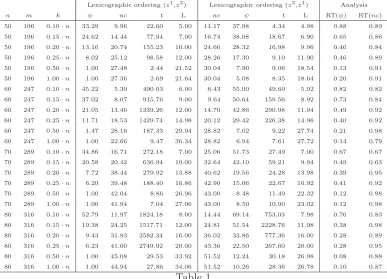
by the related two sets of experiments are presented in Table 1. Second, a scalarization technique approach was considered to explore the pareto front of the optimal solutions. All experiments were conducted at varying the k
parameter to analyze the impact of the maximum length of the selectedCDP
on the disruption performance. The values considered for the k parameters were: {0.10·n, 0.15·n, 0.20·n, 0.25·n, 0.50·n, 1.00·n}.
Lexicographic Ordering analysis.
Table 1 reports on the results obtained by adopting the lexicographic order-ing approach on the Bi-Objective problem. Each line in the table presents the mean values obtained by solving to optimality within the time limit the set of 50 instances for each group. The characteristics of each group are sum-marized in the first three columns of the table: the number of vertices n, the number of edges m, and the parameter k limiting the CDP length. Then the following output values are presented for each lexicographic ordering (z1,z2) and (z2,z1): cardinality of the largest connected component (ψ) and number of connected components (nc) in the residual graph after the removal of the selected CDP, CPU times (t) and length of the CDP (L). Finally, the last two columns present two ratio indexes defined to evaluate the effect of the objec-tive function ordering in the Lexicographic approach, namely RT(ψ) := ψψ((zz12)) and RT(nc) := ncnc((zz12)). Computational times increase with the size of the net-work. Moreover, the presence of length bounds on selected paths influences the computational effort: when path length constraints are less tight (e.g.
k = 0.50·n ork = 1.00·n) the time required to reach the optimum is much lower. This effect is particularly evident on larger instances. The mean length of the Critical Disruption Paths seems to increase when the size of the largest connected components is the first goal to be minimized. The results confirm the suitability of the model to properly represent the considered Bi-Criteria optimization problem. From observing theRT(ψ) andRT(nc) ratios, it turns out the size of the largest component is largely influenced by the changes in the kparameter and in the ordering considered in the lexicographic approach.
Scalarization Technique Analysis.
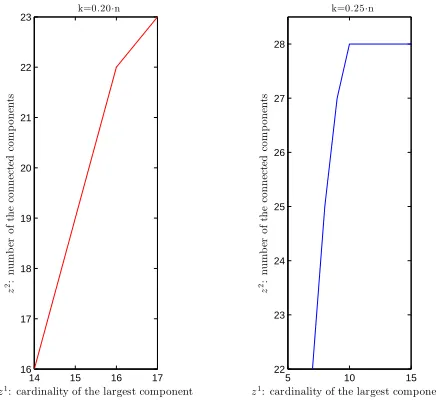
of the k parameter, namely k = 0.20·n and k = 0.25·n. The results of the analysis, depicted in Figure 1, show the possible conflicts arising between the two considered objective functions and confirm the relevance of the Bi-Objective optimization approach proposed in this paper to cope effectively with Network Interdiction applications. The role of the path length is also important to find a proper trade-off between different and conflicting goals.
Conclusions and further lines of research.
The presented computational experiments provide a valid Proof-of-concept for the Mixed Integer Programming formulation of the Bi-Objective k -Length-Bounded Critical Disruption Path problem introduced in this paper. Fur-thermore, the analysis of the results showed how the proposed multicriteria optimization problem provides valuable information to increase the effective-ness of the interdiction action, depending on the specific field of application. The computational times required to solve at the optimum the considered
in-Lexicographic ordering (z1,z2) Lexicographic ordering (z2,z1) Analysis
n m k ψ nc t L nc ψ t L RT(ψ) RT(nc)
[image:8.612.111.498.412.691.2]50 196 0.10·n 33.29 9.96 22.60 5.00 11.17 37.98 4.34 4.98 0.88 0.89 50 196 0.15·n 24.62 14.44 77.94 7.00 16.74 38.08 18.67 6.90 0.65 0.86 50 196 0.20·n 13.16 20.74 155.23 10.00 24.66 28.32 16.98 9.96 0.46 0.84 50 196 0.25·n 8.02 25.12 98.58 12.00 28.26 17.30 9.10 11.90 0.46 0.89 50 196 0.50·n 1.00 27.48 2.44 21.52 30.04 7.90 9.06 18.54 0.13 0.91 50 196 1.00·n 1.00 27.36 2.69 21.64 30.04 5.08 8.35 18.64 0.20 0.91 60 247 0.10·n 45.22 5.30 490.03 6.00 6.43 55.00 49.60 5.92 0.82 0.82 60 247 0.15·n 37.02 8.07 915.76 9.00 9.64 50.64 159.56 8.92 0.73 0.84 60 247 0.20·n 21.05 13.46 1339.26 12.00 14.70 42.86 290.98 11.94 0.49 0.92 60 247 0.25·n 11.71 18.53 1429.74 14.98 20.12 29.42 226.38 14.96 0.40 0.92 60 247 0.50·n 1.47 28.16 187.33 29.94 28.82 7.02 9.22 27.74 0.21 0.98 60 247 1.00·n 1.00 22.66 9.47 36.34 28.82 6.94 7.61 27.72 0.14 0.79 70 289 0.10·n 34.86 16.71 272.18 7.00 25.06 51.73 27.49 7.00 0.67 0.67 70 289 0.15·n 20.58 20.42 636.94 10.00 32.64 42.10 59.21 9.94 0.49 0.63 70 289 0.20·n 7.72 38.44 279.92 13.88 40.62 19.56 24.28 13.98 0.39 0.95 70 289 0.25·n 6.20 39.48 188.40 16.86 42.90 15.06 22.67 16.92 0.41 0.92 70 289 0.50·n 1.00 42.04 8.86 26.96 43.00 8.48 11.49 22.32 0.12 0.98 70 289 1.00·n 1.00 41.94 7.04 27.06 43.00 8.50 10.90 23.02 0.12 0.98 80 316 0.10·n 52.79 11.97 1824.18 8.00 14.44 69.14 753.03 7.98 0.76 0.83 80 316 0.15·n 19.38 24.25 1517.71 12.00 24.81 51.54 2228.76 11.98 0.38 0.98 80 316 0.20·n 9.43 31.93 2582.34 16.00 36.02 33.86 777.36 16.00 0.28 0.89 80 316 0.25·n 6.23 41.00 2749.92 20.00 43.36 22.50 267.60 20.00 0.28 0.95 80 316 0.50·n 1.00 45.08 29.53 33.92 51.52 12.24 30.18 26.98 0.08 0.88 80 316 1.00·n 1.00 44.94 27.86 34.06 51.52 10.26 28.36 26.78 0.10 0.87
Table 1
stances show a dependence from the size of the network and from the bounds on the length of the disruption path, suggesting as further lines of research in this field the development of efficient algorithms to find pareto optimal solutions on dense and large scale networks.
14 15 16 17
16 17 18 19 20 21 22
23 k=0.20·n
z1: cardinality of the largest component
z 2: n u m b er o f th e co n n ec te d co m p o n en ts
5 10 15
22 23 24 25 26 27 28
k=0.25·n
z1: cardinality of the largest component
[image:9.612.192.410.226.426.2]z 2: n u m b er o f th e co n n ec te d co m p o n en ts
Fig. 1. Representation of the pareto front at varying λfor different values of thek param-eter.
References
[1] Granata, D. and Steeger, G. and Rebennack, S., Network interdiction via a Critical Disruption Path: Branch-and-Price algorithms, Computers & Operations Research, Volume 40, Issue 11, November 2013, Pages 2689–2702.
[2] Summa, M.D. and Grosso, A. and Locatelli, M.,Complexity of the critical node problem over trees, Computers & Operations Research, Volume 38, 2011, Pages 1766–1774.