by local finite-range pseudopotentials.
White Rose Research Online URL for this paper: http://eprints.whiterose.ac.uk/111955/
Version: Accepted Version
Article:
Idini, A., Bennaceur, K. and Dobaczewski, Jacek Jan orcid.org/0000-0002-4158-3770 (2017) Landau parameters for energy density functionals generated by local finite-range pseudopotentials. Journal of physics g-Nuclear and particle physics. 064004. ISSN 0954-3899
[email protected] https://eprints.whiterose.ac.uk/
Reuse
Items deposited in White Rose Research Online are protected by copyright, with all rights reserved unless indicated otherwise. They may be downloaded and/or printed for private study, or other acts as permitted by national copyright laws. The publisher or other rights holders may allow further reproduction and re-use of the full text version. This is indicated by the licence information on the White Rose Research Online record for the item.
Takedown
If you consider content in White Rose Research Online to be in breach of UK law, please notify us by
generated by local finite-range pseudopotentials
A. Idini1,2, K. Bennaceur1,3,4, and J. Dobaczewski1,4,5,6
1Department of Physics, PO Box 35 (YFL), FI-40014 University of Jyv¨askyl¨a,
Finland
2Department of Physics, University of Surrey, Guildford GU2 7XH, United Kingdom 3Univ Lyon, Universit´e Lyon 1, CNRS/IN2P3, IPNL, F-69622 Villeurbanne, France 4Helsinki Institute of Physics, P.O. Box 64, FI-00014 University of Helsinki, Finland 5Department of Physics, University of York, Heslington, York YO10 5DD, United
Kingdom
6Institute of Theoretical Physics, Faculty of Physics, University of Warsaw, ul. Ho˙za
69, PL-00681 Warsaw, Poland
Abstract. In Landau theory of Fermi liquids, the particle-hole interaction near the Fermi energy in different spin-isospin channels is probed in terms of an expansion over the Legendre polynomials. This provides a useful and efficient way to constrain properties of nuclear energy density functionals in symmetric nuclear matter and finite nuclei. In this study, we present general expressions for Landau parameters corresponding to a two-body central local regularized pseudopotential. We also show results obtained for two recently adjusted NLO and N2LO parametrizations.
1. Introduction
The study of low-energy properties of atomic nuclei has progressed both theoretically and experimentally during the last 50 years. Thanks to systematic use of stable and exotic beams, pioneered at ISOLDE and then constantly improved, nuclear structure models can today dispose of a wealth of data for binding energies and low-energy excitations. Among other models, the nuclear density functional theory (DFT) represents the only approach that is able to describe ground-state and low-energy excited states across the entire nuclear chart. In 1958, T.H.R. Skyrme proposed an effective interaction for nuclear systems composed of contact two-body and three-body terms in the form of an expansion in relative momenta of interacting nucleons [1]. After this seminal work, other forms of nuclear effective interactions were considered with, for example, the inclusion finite-range terms [2, 3]. Furthermore, the three-body term was replaced by a density-dependent term [4], thus allowing to reproduce the empirical values of incompressibility modulus of nuclear matter and quasi-particle effective mass. However, this gave away the Hamiltonian formulation of the model and transformed the interactions into functional generators.
Over the past decade, one has seen a renewed endeavor in the development of parametrizations and analytical forms for novel nuclear energy density functionals (EDFs) and functional generators. This has been ushered by (i) the application of modern statistical tools for the fitting of density functionals to nuclear observables [5, 6, 7], (ii) the highlighting of the precision limits of present Skyrme functional forms [8], and (iii) the discovery of difficulties in beyond-mean-field calculations using most of the present functionals [9, 10, 11].
A few years ago, in the spirit of the effective theory [12], we have introduced a momentum-dependent pseudopotential that uses finite-range Gaussian regulators [13]. This approach has proven to be adequate to reproduce infinite nuclear matter properties (aside from the effective mass, due to the purely two-body nature of the considered pseudopotential), binding energies of closed-shell nuclei [14] and average pairing gaps for open-shell nuclei [15].
Adjustments of coupling constants, which define specific parametrizations of pseudopotentials, represent a challenge because of the potentially large number of parameters to be optimized, and because the finite-range derivative terms make computation of observables for finite nuclei more demanding. In this sense, calculation of infinite nuclear matter properties represents an efficient way to add constraints to the fitting procedure. In particular, Landau parameters can be constrained to their empirical values, when they are available, or can be used to avoid entering regions of instability in the parameters space (see [16] and references therein).
can, for example, be found in [19], we recall the following sum rules that the Landau parameters have to fulfill [20] in order to respect the Pauli exclusion principle,
∑
ℓ,(α)
fℓ(α) = 0, (1)
∑
ℓ
fℓ(0,1)+fℓ(1,0)−2fℓ(1,1) =∑
ℓ
fℓ′+gℓ−2gℓ′ = 0, (2)
where indices (α) = (S, T) represent different spin-isospin channels. The fulfillment of these sum rules implies the avoidance of the spurious self-interaction in the particle-hole channel, usually arising from the use of density-dependent terms. A purely two-body regularized pseudopotential discussed in this article is free from self-interaction by construction, hence the sum rules have to be analytically fulfilled. A phenomenon of spurious self-pairing of similar nature appears when the normal and pairing parts of the EDF are not derived from the same effective interaction as pointed out in [9, 21].
Finally, let us recall that the correspondence between Landau parameters and bulk nuclear properties implies constrains on their values, so as to ensure the stability of homogeneous infinite nuclear matter with respect to different polarizations. This gives the Migdal stability conditions,
Fℓ(α)=NFfℓ(α) >−(2ℓ+ 1), (3)
where
NF = 2m∗kF/(π2~2)≈(m∗/m)(kF/204.68) (4)
is the density of states at the Fermi surface [22].
The article is organized as follows. In section 2, we recall definitions of Landau parameters derived from a finite-range pseudopotential that may contain momentum-dependent terms. In section 3 we give explicit formulae for two pseudopotentials proposed in our recent study [15]. Results obtained for these pseudopotentials are reported in section 4 together with comparison with those obtained for the Gogny D1S effective interaction [23] and with discussion of propagated errors. Finally, conclusions are presented in section 5.
2. Landau parameters for a momentum-dependent central interaction
In [13], we considered a pseudopotential that is a sum of two-body terms built as products of two locality delta functions and finite-range regulator, that is,
δ(r13)δ(r24)ga(r12). Higher-order momentum-dependent terms contain differential
operators of ordern, denoted by ˆO(jn)(k12,k34), and read
Vj(n)(r1,r2;r3,r4) = (
Wj(n)ˆ1σˆ1τ+B( n)
j ˆ1τPˆσ−H( n)
j ˆ1σPˆτ−M( n) j Pˆ
σPˆτ)
×Oˆj(n)(k12,k34)δ(r13)δ(r24)ga(r12), (5)
where n stands for even powers of the relative momenta of incoming (k12 = k1 −k2)
The particle-hole residual interaction is given by the antisymmetrization of the considered pseudopotential
Vjph(n) =Vj(n)(1−PˆxPˆσPˆτ), (6)
and the total residual interaction is given by the sum over the various contributions at all included orders
Vresph=∑
n,j
Vj(n)(1−Pˆ xˆ
PσPˆτ). (7)
Making use of the Fourier transform, matrix elements in the momentum space of the particle-hole residual interaction can be written as
Vph
res(k1,k2;k3,k4) =⟨k1,k2|Vresph|k3k4⟩=
δ(q−q′) (2π)3
∑
n,j
Vj(n)(q,k−k
′),(8)
where k1 =k+q, k2 =k′, k
3 =k and k4 =k′+q′, and
Vj(n)(q) =V (0,0)
(n)j(q) +V (1,0)
(n)j(q)σ1·σ2
+ V((0n,)1)j(q)τ1·τ2+V(1,1)
(n)j(q)σ1·σ2τ1 ·τ2, (9)
where σi and τi are vectors formed with, respectively, spin and isospin Pauli matrices
for particle i.
Landau parameters are then the coefficients of the particle-hole interaction expanded over Legendre polynomials in different spin-isospin channels (α) ≡ (S, T), and calculated at the Fermi surface, that is, for |k|=|k′|=kF
lim
q→0 ∑
n,j
V((nα))j(q,k−k
′)
|k|=|k′|=kF
= ∑
n,j
D((αn))j(kF) +E( α)
(n)j(kF,kˆ·kˆ
′),
= ∑
ℓ
fℓ(α)(kF)Pℓ(ˆk·ˆk′). (10)
In the latter equation, functions D((nα))j(kF) come from the direct term in Eq. (7), and
depend on kF only, whereas functions E((nα))j(kF) come from the exchange term and
depend both on kF and on the angle between kand k′.
3. Regularized pseudopotential
In [13, 15], a Gaussian function,
ga(r) =
1 (a√π)3 e
−r2
a2 , (11)
was used as a regulator of the pseudopotential. In the following, we use simplified notations {W0(0), B
(0) 0 , H
(0) 0 , M
(0)
0 } ≡ {W0, B0, H0, M0} for the coupling constants at
LO, and {Wi(2), B (2) i , H
(2) i , M
(2)
i } ≡ {Wi, Bi, Hi, Mi} and {Wi(4), B (4) i , H
(4) i , M
Using Eqs. (8) and (10), Landau parameters with contributions up to second order of the pseudopotential (NLO) are given by
fℓ(α)(kF) = A (α)
0 δℓ0+B0(α)(2ℓ+ 1) e−
a2k2 F 2 iℓ
(a2k2 F 2 ) +k 2 F 2 (
A(1α)+A2(α))(δℓ0−δℓ1)
+k
2 F
2
(
B1(α)−B2(α))e−
a2k2 F 2
[
(2ℓ+ 1)iℓ (a2k2
F
2 )
−ℓ iℓ−1 (a2k2
F
2 )
−(ℓ+ 1)iℓ+1 (a2k2
F
2 )]
, (12)
where iℓ is a modified spherical Bessel function of the first kind and of order ℓ. In this
expression, the coupling constants defining Landau parameters are given by
A(0i ,0) =Wi+12 Bi− 12Hi− 14Mi, (13)
Bi(0,0) = − 1 4Wi−
1 2Bi+
1
2 Hi+Mi, (14)
A(1i ,0) = 12Bi− 1
4Mi, (15)
Bi(1,0) = − 14Wi+12Hi, (16)
A(0i ,1) = − 1 2Hi−
1
4Mi, (17)
Bi(0,1) = − 1 4Wi−
1
2Bi, (18)
A(1i ,1) = − 14Mi, (19)
Bi(1,1) = − 14Wi (20)
with i= 0, 1 or 2.
In the case of a local pseudopotential, as discussed in [13, 15], one hasA(2α) =−A(1α)
and B2(α) =−B1(α) so that equation (12) reduces to
fℓ(α)(kF) = A( α)
0 δℓ0+B( α)
0 (2ℓ+ 1) e−
a2k2 F 2 iℓ
(a2k2 F
2 )
+k2FB (α)
1 (2ℓ+ 1) (
−a1 ∂a∂ ) [
e−
a2k2 F 2 iℓ
(a2k2 F
2 )]
(21)
where the contribution at NLO is simply obtained by acting on the one at LO with the operator−1a ∂
∂a. This latter operator can be iterated ptimes on the expression at LO to
give the expression at NpLO.
In the next section, we discuss results obtained for two local pseudopotentials whose parameters are given in [15]. Let us note that a contact two-body interaction had to be included in these pseudopotentials in order to avoid excessive surface pairing effects. This two-body contact interaction is a standard local contact Skyrme force
Vδ(r1,r2;r3,r4) = t0 (
1 +x0Pˆσ )
δ(r13)δ(r24)δ(r12), (22)
which gives additional contributions A′0(α) to the Landau parameters with
A′0(0,0) = 3
4 t0, (23)
A′0(1,0) = −14 t0+ 1
A′0(0,1) = −14 t0− 1
2t0x0, (25)
A′0(0,0) = −14 t0. (26)
Equations (23)–(26) represent general expressions for Landau parameters obtained from interaction (22). In the case considered here, parameter x0 was set to 1 so that this
term was not active in the pairing channel. Taking into account this contact term and considering the fact that the finite-range part of the pseudopotential is local, expressions for Landau parameters discussed in the next section are given by
fℓ(α)(kF) = (A
′(α) 0 +A
(α)
0 )δℓ0+B(0α)(2ℓ+ 1) e−
a2k2 F 2 iℓ
(a2k2 F
2 )
+ (2ℓ+ 1)k2F 2 ∑
i=1
B2(αi−)1 (
−1a ∂a∂ )i[
e−
a2k2 F 2 iℓ
(a2k2 F
2 )]
. (27)
4. Results in symmetric nuclear matter
In the following we consider the NLO and N2LO local regularized pseudopotentials
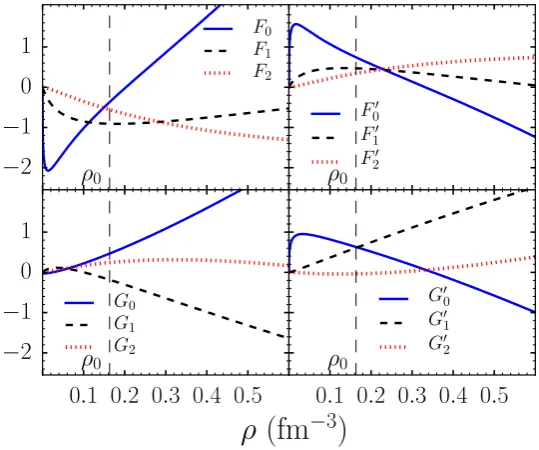
as in Eq. (5), supplemented by the contact term given by Eq. (22), and we show Landau parameters evaluated for two recent parametrizations REG2c.161026 and REG4c.161026 [15], respectively. Using Eq. (27), we calculate the ℓ = 0,1,2 Landau parameters as functions of the nuclear-matter density as depicted in Figs. 1 and 2. For comparison, in Fig. 3 we show results obtained for the Gogny D1S force [23]. Landau parameters at saturation densities, with corresponding theoretical errors, are summarized in Table 1.
We begin by recalling relations between Landau parameters and infinite-nuclear-matter properties. For the effective mass one has,
m∗ =m
(
1 + F1 3
)
, (28)
and for REG2c.161026 and REG4c.161026 we obtain values of m∗ = (0.4076 ±
0.0009)m and (0.4061 ± 0.0011)m, respectively. These can be used to consistently calculate densities of states NF, Eq. (4), which gives 0.02655±0.00006 and 0.02655±
0.00007 MeV−1fm−3. As discussed in [15], small values of effective masses are obtained
for pure two-body pseudopotentials. This implies that some Landau parameters like
F0 and F1 are not consistent with literature references, e.g., [24] provides limits of
−0.51< F0 <0.21 and−1.07< F1 <−0.89.
The incompressibility modulus and symmetry energy coefficient of nuclear matter can also be related to Landau parameters as [25],
K∞=
3~2k2 F
m∗ (1 +F0), (29)
J = ~
2k2 F
6m∗ (1 +F ′
0), (30)
giving K∞ = 229.8± 4.8 MeV and J = 31.96± 4.71 MeV for REG2c.161026 and
K∞= 230.0±5.6 MeV andJ = 31.95±5.41 MeV for REG4c.161026, consistently with
An analysis of the spin and spin-isospin response of nuclei performed in [26, 27] leads to the recommended values of G0 ≃ 0.15 and G′0 ≃ 0.3. In fact, the spin-isospin
channel of the particle-hole interaction is related to the Gamow-Teller distribution, and for contact interactions can be easily parametrized through Landau parameters as [28],
Cs 1 =
π2~2
2m∗k
F
(G′0+G′1), (31) where Cs
1 is the coupling constant defining the isovector spin-spin interaction [29].
Although our NLO and N2LO pseudopotentials are finite range, values extracted from
Landau parameters, Eq. (31), that is, Cs
1 = 135.8 ± 0.4 and 148.4± 0.8 MeV fm3,
respectively, compare quite favorably with that of ∼120 MeV fm3 quoted in [28].
Since our regularized pseudopotentials supplemented with the contact two-body terms are pure two-body EDF generators that do not introduce any spuriousities, the Migdal sum rules of Eqs. (1) and (2) are exactly obeyed.
All propagated errors quoted in this study result from the statistical error analysis performed for the parameters of the REG2c.161026 and REG4c.161026 pseudopotentials. We made use of the covariance matrices determined in [15] along the lines delineated in [6]. That is, first the Hessian matrix built of derivatives of the scaled penalty function with respect to parameters of the pseudopotential was calculated. Second, the covariance matrix was obtained as the inverse of the Hessian matrix, while keeping only a given number of its largest eigenvalues.
In Fig. 4, we see that the propagated errors of the Landau parameters are qualitatively similar when going from NLO to N2LO. Errors of F
0, F0′, and F1 form
a plateau after keeping 4 or 5 eigenvalues. This means that, as we expect, these parameters are already well constrained by the current penalty function. They are, in fact, determined by constrainingK∞ and J, whereas for purely two–body functional
generators, the effective mass is always ∼0.4m [15]. On the contrary errors of F′
1, G1,
G′1 seem to increase up to the inclusion of the very last eigenvalue. This means that the
current penalty function does not carry information concerning the properties of these particle-hole channels, and that, by including these Landau parameters into the fitting procedure, future parametrizations might be better constrained.
5. Conclusions
We presented general expressions for Landau parameters expressed in terms of Fourier transform of a general two-body central regularized pseudopotential, and we specified them to the case of local NLO and N2LO pseudopotentials. We also showed numerical
values of Landau parameters derived for two recent parametrizations REG2c.161026 and REG4c.161026.
NLO N2LO D1S [25] [26, 27] [28] [30]
F0 −0.576(12) −0.578(14) −0.369 0.1 0±0.16
F′
0 0.061(9) 0.056(10) 0.743 0.7 0.64
G0 0.151(10) 0.189(7) 0.466 1.15 0.15 0.16
G′
0 0.982(2) 1.044(5) 0.631 1.45 0.3 1.2 0.72
F1 −1.777(4) −1.782(5) −0.909 -0.6
F′
1 0.766(5) 0.553(3) 0.470 0.5
G1 0.015(2) −0.018(3) −0.185 0.3
G′
[image:9.595.101.502.88.233.2]1 −0.01452(15) 0.10868(98) 0.610 0.3 0.2
Table 1. Landau parameters calculated at saturation densities ofρsat = 0.1599 fm−3
(regularized pseudopotential at NLO, REG2c.161026),ρsat = 0.1601 fm−3(regularized pseudopotential at N2LO, REG4c.161026) or 0.1633 fm−3 (Gogny D1S force), compared with empirical values quoted in [25]–[30].
−2 −1 0 1
ρ0 F0
F1
F2
ρ0
F′
0
F′
1
F′
2
0.1 0.2 0.3 0.4 0.5
−2 −1 0 1
ρ0
G0
G1
G2
0.1 0.2 0.3 0.4 0.5
ρ
(fm
−3)
ρ0
G′
0
G′
1
G′
2
Figure 1. (Color online) Landau parameters for the REG2c.161026 pseudopotential as functions of density, determined for different spin-isospin channels and forℓ= 0 (solid line),ℓ= 1 (dashed line), andℓ= 2 (dotted line). Saturation densityρ0 = 0.16 fm−3 is denoted by a dashed vertical line.
towards developing spuriousity-free functionals that are consistent in particle-hole and in particle-particle channels and that lead to more realistic values of the effective mass.
Acknowledgments
[image:9.595.159.421.337.544.2]−2 −1 0 1
ρ0 F0
F1
F2
ρ0 F′
0
F′
1
F′
2
0.1 0.2 0.3 0.4 0.5
−2 −1 0 1
ρ0
G0
G1
G2
0.1 0.2 0.3 0.4 0.5
ρ
(fm
−3)
ρ0 G′
0
G′
1
G′
[image:10.595.158.423.107.319.2]2
Figure 2. (Color online) Same as in Fig. 1 but for the REG4c.161026 pseudopotential.
Figure 3. (Color online) Same as in Fig. 1 but for the Gogny force D1S [23].
[image:10.595.159.429.359.584.2]2 4 6 8 10 12
N
2LO
Number of kept eigenvalues
F0 F'0
G0 G'0
F1 F'1 G1 G'1
10-6 10-5 10-4 10-3 10-2 10-1
2 4 6 8
NLO
P
ro
p
a
g
a
te
d
e
rr
o
[image:11.595.100.491.86.242.2]rs
References
[1] Skyrme T H R 1959 Nuclear Physics 9 615 – 634 ISSN 0029-5582 URL
http://www.sciencedirect.com/science/article/pii/0029558258903456
[2] Brink D and Boeker E 1967 Nuclear Physics A 91 1 – 26 ISSN 0375-9474 URL
http://www.sciencedirect.com/science/article/pii/0375947467904460
[3] Decharg´e J and Gogny D 1980Phys. Rev. C 21(4) 1568–1593
[4] Vautherin D and Brink D M 1972 Phys. Rev. C 5(3) 626–647 URL
http://link.aps.org/doi/10.1103/PhysRevC.5.626
[5] Toivanen J, Dobaczewski J, Kortelainen M and Mizuyama K 2008 Phys. Rev. C 78(3) 034306
URLhttp://link.aps.org/doi/10.1103/PhysRevC.78.034306
[6] Dobaczewski J, Nazarewicz W and Reinhard P G 2014Journal of Physics G: Nuclear and Particle
Physics 41074001 URLhttp://stacks.iop.org/0954-3899/41/i=7/a=074001
[7] Ireland D G and Nazarewicz W 2015 Journal of Physics G: Nuclear and Particle Physics 42
030301 URLhttp://stacks.iop.org/0954-3899/42/i=3/a=030301
[8] Kortelainen M, McDonnell J, Nazarewicz W, Olsen E, Reinhard P G, Sarich J, Schunck N, Wild S M, Davesne D, Erler J and Pastore A 2014 Phys. Rev. C 89(5) 054314 URL
http://link.aps.org/doi/10.1103/PhysRevC.89.054314
[9] Anguiano M, Egido J and Robledo L 2001Nuclear Physics A696467 – 493 ISSN 0375-9474 URL
http://www.sciencedirect.com/science/article/pii/S0375947401012192
[10] Dobaczewski J, Stoitsov M V, Nazarewicz W and Reinhard P G 2007Phys. Rev. C 76(5) 054315
URLhttp://link.aps.org/doi/10.1103/PhysRevC.76.054315
[11] Lacroix D, Duguet T and Bender M 2009 Phys. Rev. C 79(4) 044318 URL
http://link.aps.org/doi/10.1103/PhysRevC.79.044318
[12] Dobaczewski J, Bennaceur K and Raimondi F 2012Journal of Physics G: Nuclear and Particle
Physics 39125103 URLhttp://stacks.iop.org/0954-3899/39/i=12/a=125103
[13] Raimondi F, Bennaceur K and Dobaczewski J 2014Journal of Physics G: Nuclear and Particle
Physics 41055112 URLhttp://stacks.iop.org/0954-3899/41/i=5/a=055112
[14] Bennaceur K, Dobaczewski J and Raimondi F 2014 EPJ Web of Conferences 66 02031 URL
http://dx.doi.org/10.1051/epjconf/20146602031
[15] Bennaceur K, Idini A, Dobaczewski J, Dobaczewski P, Kortelainen M and Raimondi F submitted
toJournal of Physics G: Nuclear and Particle Physics (Preprint arXiv:1611.09311)
[16] Davesne D, Pastore A and Navarro J 2013Journal of Physics G: Nuclear and Particle Physics40
095104 URLhttp://stacks.iop.org/0954-3899/40/i=9/a=095104
[17] Migdal A 1967 Theory of Finite Fermi Systems And Applications to Atomic Nuclei Interscience monographs and texts in physics and astronomy, v. 19 (Interscience Publishers)
[18] Ring P and Schuck P 2004The Nuclear Many-Body ProblemPhysics and astronomy online library (Springer) ISBN 9783540212065
[19] Bender M, Dobaczewski J, Engel J and Nazarewicz W 2002 Phys. Rev. C 65(5) 054322 URL
http://link.aps.org/doi/10.1103/PhysRevC.65.054322
[20] B¨ackman S O, Brown G, Klemt V and Speth J 1980 Nuclear Physics A 345 202 – 220 ISSN 0375-9474 URLhttp://www.sciencedirect.com/science/article/pii/0375947480904194
[21] Bender M, Duguet T and Lacroix D 2009 Phys. Rev. C 79(4) 044319 URL
http://link.aps.org/doi/10.1103/PhysRevC.79.044319
[22] Pastore A, Davesne D and Navarro J 2015 Physics Reports 563 1 – 67 ISSN 0370-1573 linear response of homogeneous nuclear matter with energy density functionals URL
http://www.sciencedirect.com/science/article/pii/S0370157314003998
[23] Berger J, Girod M and Gogny D 1991 Computer Physics Communications 63 365 – 374 ISSN 0010-4655 URLhttp://www.sciencedirect.com/science/article/pii/001046559190263K
[24] Caillon J C, Gabinski P and Labarsouque J 2002 Journal of Physics G: Nuclear and Particle
[25] B¨ackman S O, Jackson A and Speth J 1975Physics Letters B 56209 – 211 ISSN 0370-2693 URL
http://www.sciencedirect.com/science/article/pii/0370269375903767
[26] Wakasa T, Ichimura M and Sakai H 2005 Phys. Rev. C 72(6) 067303 URL
http://link.aps.org/doi/10.1103/PhysRevC.72.067303
[27] Roca-Maza X, Col`o G and Sagawa H 2012 Phys. Rev. C 86(3) 031306 URL
http://link.aps.org/doi/10.1103/PhysRevC.86.031306
[28] Bender M, Dobaczewski J, Engel J and Nazarewicz W 2002 Phys. Rev. C 65(5) 054322 URL
http://link.aps.org/doi/10.1103/PhysRevC.65.054322
[29] Perli´nska E, Rohozi´nski S G, Dobaczewski J and Nazarewicz W 2004Phys. Rev. C 69(1) 014316
URLhttp://link.aps.org/doi/10.1103/PhysRevC.69.014316
[30] Speth J, Krewald S and Gr¨ummer F 2002Theory of Finite Fermi Systems – The Stony Brook J¨ulich
InteractionFrom Nuclei to Stars Festschrift in Honor of Gerald E Brown (World Scientific) URL
![Table 1. Landau parameters calculated at saturation densities ofpseudopotential at N(regularized pseudopotential at NLO, REG2c.161026), ρsat = 0.1599 fm−3 ρsat = 0.1601 fm−3 (regularized2LO, REG4c.161026) or 0.1633 fm−3(Gogny D1S force),compared with empirical values quoted in [25]–[30].](https://thumb-us.123doks.com/thumbv2/123dok_us/7758834.169417/9.595.159.421.337.544/parameters-calculated-saturation-densities-ofpseudopotential-regularized-pseudopotential-regularized.webp)