This is a repository copy of Effect of Robotic-Assisted vs Conventional Laparoscopic Surgery on Risk of Conversion to Open Laparotomy Among Patients Undergoing Resection for Rectal Cancer: The ROLARR Randomized Clinical Trial.
White Rose Research Online URL for this paper: http://eprints.whiterose.ac.uk/123390/
Version: Accepted Version
Article:
Jayne, D, Pigazzi, A, Marshall, H et al. (13 more authors) (2017) Effect of Robotic-Assisted vs Conventional Laparoscopic Surgery on Risk of Conversion to Open Laparotomy Among Patients Undergoing Resection for Rectal Cancer: The ROLARR Randomized Clinical Trial. Journal of the American Medical Association, 318 (16). pp. 1569-1580. ISSN 0098-7484
https://doi.org/10.1001/jama.2017.7219
(c) 2017, American Medical Association. All rights reserved. This is an author produced version of a paper published in the Journal of the American Medical Association. Uploaded in accordance with the publisher's self-archiving policy.
[email protected] https://eprints.whiterose.ac.uk/
Reuse
Items deposited in White Rose Research Online are protected by copyright, with all rights reserved unless indicated otherwise. They may be downloaded and/or printed for private study, or other acts as permitted by national copyright laws. The publisher or other rights holders may allow further reproduction and re-use of the full text version. This is indicated by the licence information on the White Rose Research Online record for the item.
Takedown
If you consider content in White Rose Research Online to be in breach of UK law, please notify us by
EFFECT OF ROBOTIC-ASSISTED VS CONVENTIONAL LAPAROSCOPIC SURGERY ON RISK OFCONVERSION TO OPEN LAPAROTOMY AMNG PATIENTS UNDERGOING RESECTION FOR RECTAL CANCER. THE ROLARR RANDOMIZED CLINICAL TRIAL.
Authors:
David Jayne MD1*, Alessio Pigazzi PhD2, Helen Marshall 3, Julie Croft BSc3, Neil Corrigan MSc3, Joanne Copeland BSc3, Phil Quirke FMedSci4, Nick West PhD4, Tero Rautio PhD5, Niels Thomassen MD6, Henry Tilney MD7, Mark Gudgeon MS7, Paolo Pietro Bianchi MD8, Richard Edlin PhD9, Claire
Hulme PhD10, Julia Brown MSc3.
Author affiliation
1Academic Surgery, Leeds Institute of Biological and Clinical Sciences, University of Leeds,
Leeds, UK
2Department of Surgery, University of California, Irvine, US
3Clinical Trials Research Unit, Leeds Institute of Clinical Trials Research, University of Leeds, Leeds, UK 4Pathology and Tumour Biology, Leeds Institute of Cancer and Pathology, University of
Leeds, Leeds, UK
5 Department of Surgery, Division of Gastroenterology, University Hospital of Oulu, Finland 6Aarhus Hospital, Aarhus, Denmark
7Frimley Park Hospital, Frimley, UK
8 Ospedale Della Misericordia, Grosseto, Italy
9 School of Population Health, University of Auckland, Auckland, New Zealand 10Academic Unit of health Economics, University of Leeds, Leeds, UK
Author for correspondence: David Jayne
Academic Surgery, Level 7 Clinical Sciences Building, St James’s University Hospital, Leeds, United Kingdom, LS9 7TF
[email protected] +44 113 2065281
Subtitle: The ROLARR clinical trial.
KEY POINTS
Question: Does robotic-assisted, as compared to conventional laparoscopic surgery, reduce the risk of
conversion to laparotomy among patients undergoing surgery for rectal cancer?
Findings: In this randomised clinical trial that included 471 patients undergoing surgery for rectal cancer,
the conversion rate was 8.1% for robotic surgery and 12.2% for laparoscopic surgery, a non-significant difference.
Meaning: Among patients undergoing resection for rectal cancer, robotic-assisted laparoscopic
surgery performed by surgeons with varying experience with robotic surgery, did not confer an
advantage compared with laparoscopic surgery for reducing the odds of conversion to laparotomy.
ABSTRACT
Importance: Robotic rectal cancer surgery is gaining popularity, but limited data are available
regarding safety and efficacy.
Objective: To compare robotic-assisted with conventional laparoscopic surgery for risk of conversion to
laparotomy among patients undergoing resection rectal cancer resection.
Design, setting, and participants: Multicentre, randomised, clinical trial comparing robotic-assisted
surgery versus conventional laparoscopic surgery among 471 patients with rectal adenocarcinoma suitable for curative resection conducted at 26 sites across 10 countries and including 40 surgeons. Recruitment of patients was from 07/01/11 to 30/09/14 with 30 day and 6 month follow-up, and final follow-up on16/06/2015.
Intervention: Robotic-assisted and conventional laparoscopic rectal cancer resections were performed by
either high (upper rectum) or low (total rectum) anterior resection or abdominoperineal resection (rectum and perineum). 237 patients were randomised to robotic-assisted and 234 to conventional laparoscopic surgery. Follow-up was at 30-days and 6-months post-operation.
(CRM+) and other pathological outcomes, quality of life (36-Item Short Form Survery (SF-36), Multidimensional Fatigue Inventory (MFI-20)), bladder and sexual dysfunction (International Prostate Symptom Score (I-PSS), International Index of Erectile Function (IIEF), Female Sexual Function Index (FSFI)), and oncological outcomes. Of 11 pre-specified short-term secondary endpoints, 9 are reported. Results: Among 471 randomised patients (mean age 64.9 years (s.d. 11.0); 320 (67.9%) men), 466
(98.9%) completed the study. The overall rate of conversion to laparotomy was 10.1%: 19 (8.1%) patients in the robotic-assisted group and in 28 (12.2%) of patients in the conventional laparoscopic group - unadjusted risk difference 4.12% (95% CI: -1.35%, 9.59%), adjusted odds ratio 0.61 (95% CI: 0.31-1.21; p=0.16). Overall CRM+ rate was 5.7%, and occurred in 14 (6.3%) in the laparoscopic group and 12 (5.1%) in the robotic group – unadjusted risk difference 1.14% (95% CI: -3.10%, 5.38%), adjusted odds ratio 0.785 (95% CI: 0.350, 1.762); p=0.56). Of the other 8 pre-specified secondary endpoints, including intra-operative complications, post-operative complications, plane of surgery, 30-day mortality and bladder and sexual dysfunction, none showed a statistically significant difference between groups.
Conclusions and Relevance: Among patients with rectal adenocarcinoma suitable for curative resection,
robotic-assisted laparoscopic surgery, compared with conventional laparoscopic surgery, did not significantly reduce the risk of conversion to open laparotomy. These findings suggest that robotic-assisted laparoscopic surgery, when performed by surgeons with varying experience with robotic surgery, does not confer an advantage in rectal cancer resection.
www.isrctn.com ISRCTN80500123 Robotic versus laparoscopic resection for rectal cancer
INTRODUCTION
surgery and two other major trials[3 4] reporting evidence that does not allow a designation of "non-inferior" as compared to open surgery.
Robotic-assistance has the potential to overcome some of the limitations of laparoscopic rectal cancer surgery, providing an immersive 3-dimensional depth of field, articulating instruments, and a stable camera platform. Several small, non-randomised studies have supported its safety and efficacy in rectal cancer surgery[5 6]. Meta-analyses have failed to show superiority for robotic over laparoscopic surgery in terms of short-term patient and pathological outcomes, and have consistently reported longer operating times, but a reduced need to convert to open surgery with the robot[7 8]. A few non-randomised studies have suggested the robot may offer an advantage in terms of better preservation of bladder and sexual function [9 10].
The main concern about robotic surgery is the cost, including the capital and ongoing maintenance charges. A few studies have analysed the costs of robotic rectal cancer surgery, reporting higher total hospital costs than laparoscopic surgery [11 12]. In spite of this, robotic rectal cancer surgery has continued to gain global utilization.
In 2009, the UK Medical Research Council and National Institute of Health Research, through the Efficacy and Mechanism Evaluation (EME) programme, funded the Robotic versus Laparoscopic Resection for Rectal Cancer (ROLARR) trial to undertake an evaluation of the safety, efficacy, and short- and long-term outcomes of robotic as compared to laparoscopic rectal cancer surgery. This trial was designed as a multicentre, international clinical trial to accommodate the limited adoption of the robotic system at that time. This manuscript presents the short-term results to 6-months follow-up.
METHODS
15cm of the anal margin) either by high anterior resection, low anterior resection, or abdominoperineal resection. Participating surgeons had to perform a minimum of 30 minimally invasive (laparoscopic or robotic) rectal cancer resections before taking part in the trial, of which at least 10 had to be laparoscopic and at least 10 robotic resections [14]. The trial received national ethical approval in the UK or either local ethical committee/institutional review board approval at international centres. An independent Trial Steering Committee and Data Monitoring & Ethics Committee oversaw the trial conduct. All participants provided written, informed consent.
The trial design has been reported previously [13]. To be included, patients had to be fit for resectional surgery with a diagnosis of adenocarcinoma of the rectum. Patients with benign lesions of the rectum, cancers of the anal canal, locally advanced cancers not amenable to curative surgery or requiring en bloc
multi-visceral resection or with synchronous colorectal tumours requiring multi-segment surgical
resection were not eligible.
Randomisation (minimisation incorporating a random element) was on a 1:1 basis. The stratification factors were treating surgeon, patient, sex, preoperative radio- or chemoradiotherapy, intended procedure and body mass index (BMI) classified according to WHO criteria[15].
ranging from 2-36 and greater scores indicating greater function. Patients underwent clinical review at 30 days and 6 months post-operation. Annual follow-up is continuing.
The primary endpoint was rate of conversion to open surgery, defined as the use of a laparotomy wound for any part of the mesorectal dissection. The use of a small abdominal wound to facilitate a low, stapled anastomosis and/or specimen extraction was permissible and not defined as an open conversion. Secondary endpoints were all pre-specified and included pathological circumferential resection margin positivity (CRM+, defined as tumour ≤ 1mm), intra-operative and post-operative (30-day and 6-month) complications, 30-day operative mortality, patient reported bladder and sexual function, and pathological assessment of the quality of the plane of surgery. Quality of plane of surgery was judged according to the method of Quirke et al [20], grading the pathology specimen in terms of completeness of surgical resection. For high and low anterior resection this was defined as mesorectal (best), intramesorectal (intermediate), and muscularis propria (worst). For abdominoperineal excision this was defined as levator (best), sphincteric (intermediate), and intrasphincteric (worst). Other pre-specified secondary endpoints, not reported here, include central pathology review with photo documentation of resection specimens, and a full quality of life analysis. A full health economic evaluation was undertaken separately. Longer-term endpoints (local recurrence rates, disease-free survival and overall survival) will be reported at 3 years after the last patient randomisation.
Committee and Data Monitoring Committee without review of data or an interim analysis being performed.
All analyses were pre-specified and were conducted on the intention-to-treat (ITT) population i.e. all randomised patients were accounted for in the analyses, and patients were categorised into treatment groups based on their randomisation regardless of what they subsequently received. Complete case analyses were performed for all pre-specified endpoints. When the complete case analysis excluded more than 3% of patients due to missing data,exploratory analyses to investigate the effect of missing data were performed. Specifically, to explore the mechanism of the missing data and the validity of a complete case analysis for each endpoint, patient characteristics were compared between those with and without missing data and multi-level logistic regression models were used to identify any associations between prognostic variables and whether or not a patient had missing data to inform whether data was missing at random. All hypothesis tests were two-sided and conducted at the 5% level of significance. Estimates and their corresponding 95% confidence intervals (CIs) and p-values are presented for fixed effects. For the (random) surgeon effect, the intra-cluster correlation coefficient (ICC), estimated via the ANOVA method along with bias-corrected bootstrapped 95% confidence intervals is reported[22 23]. Analyses were carried out in SAS v9.4.
Multi-level logistic regression was used to estimate the odds ratios for conversion to laparotomy, CRM+, intra-operative complications and post-operative complications between treatment groups adjusting for the stratification factors, where operating surgeon was modelled as a random effect. Generalised linear mixed models were used to compare 6-month bladder and sexual function scores adjusting for baseline scores and the stratification factors.
treatment effect. Subgroup analyses relating to the primary endpoint across sex, BMI class and procedure received were performed as well as relating to CRM+ across sex, BMI class and T-stage. All subgroup analyses tested heterogeneity of the treatment effect across the subgroups, and also estimated the treatment effect within each subgroup, via the inclusion of an appropriate interaction term. All sensitivity analyses and subgroup analyses were pre-specified.
Cost analysis was undertaken from the perspective of a public (i.e. NHS UK) health care provider for all patients. Resource utilisation data for 190 UK and US patients were collected at baseline, intra-operative, 30 days and 6-months post-operatively using study forms. Costs were computed in £ using a price year of 2015 and estimated using UK NHS unit costs from national data sources including the NHS Reference Costs database, Personal Social Services Research Unit (PSSRU) costs of health and social care and British National Formulary. For reporting purposes, costs are converted with 2015 OECD purchasing power parity (0.866 GBP/USD) and reported here as 2015 US dollars. Multiple imputation methods were used for missing data. Sensitivity analysis was undertaken to account for uncertainty (see Supplemental data). Given wide variation in costs due to contractual arrangements, acquisition and maintenance costs for the robotic and laparoscopic systems were excluded.
RESULTS
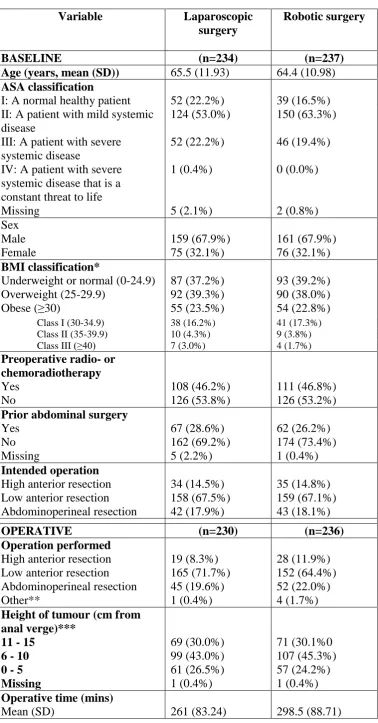
The two treatment groups were well balanced with respect to baseline characteristics and operative procedures (Table 1). Low anterior resection was performed in 317/466 (68.0%) cases with an abdominoperineal rate of 97/466 (20.8%). Mean operative time was 37.5 minutes longer in the robotic group. The length of hospital stay was similar between groups.
Participating surgeons had a wide range of previous laparoscopic and robotic experience. On average, patients received an operation performed by a surgeon with experience of around 91 (Median. IQR: 45, 180) previous laparoscopic and 50 (Median. IQR: 30, 101) previous robotic operations.
219/471 (46.5%) patients received preoperative radio- or chemoradiotherapy, with no difference between the two treatment groups (see Supplemental data). 222/471 (47.6%) patients received postoperative chemotherapy, with no difference between the two treatment groups (see Supplemental data).
Conversion rate
Results from the sensitivity analysis that extended the primary analysis model to account for potential learning effects suggest that the benefit of robotic surgery compared to conventional laparoscopic (with respect to conversion rate) is greater under surgeons who have more robotic experience, regardless of their level of laparoscopic experience. For further information, see Supplemental data.
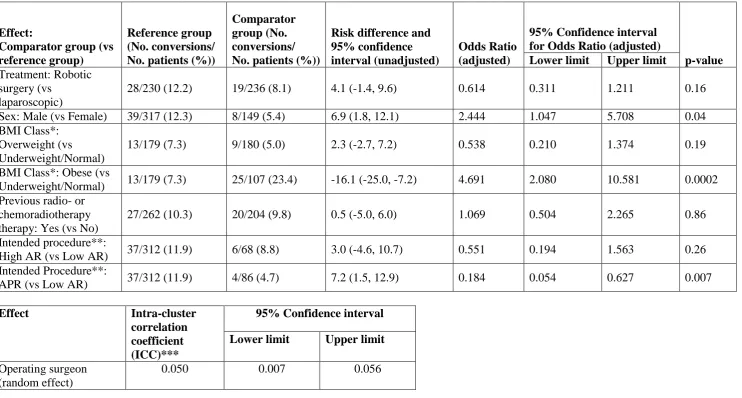
None of the pre-specified subgroup analyses were statistically significant. Regarding the sex subgroup analysis, 39/317 (12.3%) male patients underwent conversion to laparotomy, 25/156 (16.0%) in the laparoscopic group and 14/161 (8.7%) in the robotic group – unadjusted difference in proportions 7.3% (95% CI: 0.1%, 14.6%). 8/149 (5.4%) female patients underwent conversion to laparotomy, 3/74 (4.1%) in the laparoscopic group and 5/75 (6.7%) in the robotic group – unadjusted difference in proportions -2.6% (95% CI: -9.8%, 4.6%). A Wald test of interaction between treatment effect and sex in the adjusted model yielded p=0.09, and the estimated adjusted OR for conversion to laparotomy (robotic vs. conventional laparoscopic) in males given by the model is 0.455 (95% CI: 0.209, 0.987; p=0.04). Further details on all subgroup analyses are given in the Supplemental data.
Pathology outcomes
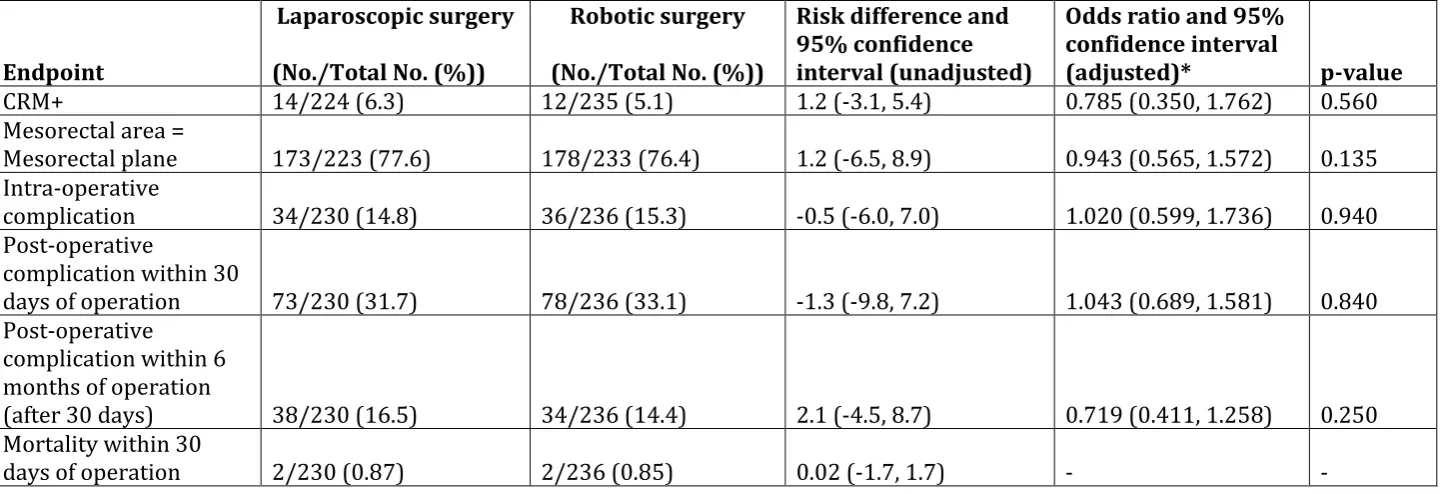
for the mesorectal area was captured for 456/466 (97.9%) patients and was of the highest standard (mesorectal plane) in 351/456 (76.97%) cases, 173/223 (77.58%) in the laparoscopic group and 178/233 (76.39%) in the robotic group – unadjusted difference in proportions 1.18% (95% CI: -6.54%, 8.91%). There was no statistically significant difference in the odds of achieving the highest standard plane of surgery (mesorectal plane) between the groups – adjusted OR 0.943 (95% CI: 0.565, 1.572); p=0.14 (Table 3).
Complications
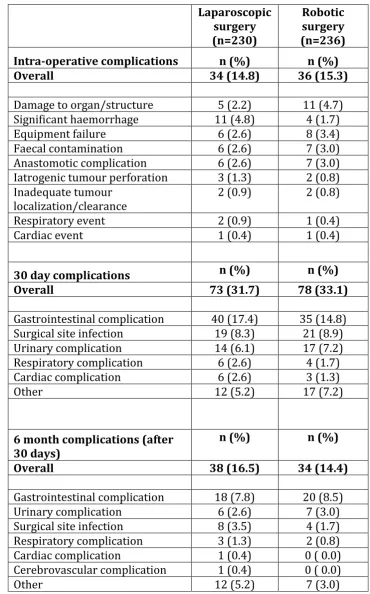
Table 4 shows the complication rates up to 6 months post-operative. 70/466 (15.0%) patients had an intra-operative complication, 34/230 (14.8%) in the laparoscopic group and 36/236 (15.3%) in the robotic group – unadjusted RD -0.5% (95% CI: -6.0%, 7.0%). There was no significant difference between the groups – adjusted OR 1.020 (95% CI: 0.599, 1.736. p=0.94). The most common intra-operative complications were damage to an organ/structure, significant haemorrhage, and surgical equipment failure. 151/466 (32.4%) patients reported a complication within 30 days, 73/230 (31.7%) in the laparoscopic group and 78/236 (33.1%) in the robotic group – unadjusted RD -1.3% (95% CI: -9.8%, 7.2%). There was no significant difference between the groups - adjusted OR 1.043 (95% CI: 0.689, 1.581. p=0.84). 72/466 (15.5%) patients reported a complication after 30 days and within 6 months, 38/230 (16.5%) in the laparoscopic group and 34/236 (14.4%) in the robotic group – unadjusted RD 2.1% (95% CI: -4.5%, 8.7%). There was no significant difference between the groups - adjusted OR 0.719 (95% CI: 0.411, 1.258. p=0.25). The occurrence of anastomotic leak was determined by the surgeon and reported under “Gastrointestinal complication”. Of the 361 patients with an anastomosis 40 (11.1%) reported an anastomotic leak within 6 months - 18/181 (9.9%) laparoscopic and 22/180 (12.2%) robotic.
Mortality (within 30 days post-operation)
Post-operative Bladder and Sexual function
Patient self-reported assessment of bladder function between baseline and 6 months was complete in 351/466 (75.3%) cases. Patient self-reported assessment of sexual function was complete in 181/320 (56.6%) males and 108/151 (71.5%) females. Exploratory analyses comparing prognostic factors between patients with and without complete data and also between the two treatment groups showed that the conclusions of the complete case analyses are robust to any potential effect of the missing data.
I-PSS scores – relating to bladder function, with higher scores indicating worse function on a scale of 0-35 - for laparoscopic and robotic surgery at baseline and 6 months are presented in Figure 2. The adjusted analysis comparing 6-month scores yielded an estimated difference (laparoscopic – robotic) of 0.743 (95% CI: -0.587, 2.072. p=0.27), indicating there was no statistically significant difference between the groups.
IIEF - relating to male sexual function, with higher scores indicating worse function on a scale of 5-75 - and FSFI - relating to female sexual function, with higher scores indicating better function on a scale of 2-36 - scores for laparoscopic and robotic surgery at baseline and 6 months are also presented in Figure 2. Adjusted analyses comparing the 6 month scores yielded estimated IIEF total score difference (laparoscopic – robotic) of 0.802 (95% CI: -4.100, 5.704. p=0.75) and estimated FSFI total score difference (laparoscopic – robotic) of 0.332 (95% CI: -2.474, 3.138. p=0.81), indicating there was no difference between the groups.
Health economic analysis
minutes (95% CI: 20.26, 81.56. p = 0.001) and the cost of instruments (robotic – laparoscopic) of £513 or ($593, 95% CI: $493, 693. p < 0.001)..
Health care resource allocation data was complete in 47/95 patients receiving laparoscopic surgery and 52/95 patients receiving robotic surgery. Amongst the patients with complete data, the mean cost for patients receiving laparoscopic surgery was slightly lower than the imputed analysis ($12 341 vs $12 556) and was almost identical for those patients receiving robotic surgery ($13 691 vs. $13 688).
DISCUSSION
In this study, to our knowledge the largest randomised trial of robotic-assisted surgery for patients with rectal adenocarcinoma suitable for curative resection, there were no statistically significant differences in the rates of conversion to laparotomy for robotic-assisted laparoscopic surgery, compared with conventional laparoscopic surgery, (8.1% vs 12.2%, respectively), and there were no statistically significant differences in resection margin positivity, complication rates, or quality of life at 6 months. There is insufficient evidence to conclude that robotic-assisted laparoscopic surgery, compared with conventional laparoscopic surgery, reduces the risk of conversion to laparotomy when performed by surgeons of varying experience with robotic surgery.
trial, a difference in conversion rate between laparoscopic (12.2%) and robotic (8.1%) surgery was not statistically significant. The statistically significant lower overall conversion in patients undergoing low anterior resection, as compared to abdominoperineal resection, probably reflects that the majority of the oncological component of the operation is performed from the perineum in the abdomino-perineal approach and is less affected by the laparoscopic approach. Similarly, the higher overall conversion rates for males, as compared to females, and obese, as compared to underweight/normal, probably reflects the increasing technical difficulty in these patients.
The sensitivity analysis exploring learning effects suggested a potential benefit of robotic surgery when performed by surgeons with substantial prior robotic experience, regardless of their level of laparoscopic experience. This suggests that the majority of participating surgeons were experts in laparoscopic surgery, but still in their learning phases for robotic surgery, and that at the higher end of the spectrum of experience in robotic surgery there is evidence of a benefit (in terms of conversion rate) over standard laparoscopic surgery.
In almost all of the subgroup analyses, there were insufficient numbers of patients to produce statistically meaningful comparisons between the groups regarding the need to convert to an open operation . However, differences were apparent in the conversion rates for the laparoscopic and robotic groups in males, with robotic surgery appearing to offer a benefit. Whilst results yielded by a subgroup analysis must be interpreted with caution, the moderate evidence of interaction between sex and treatment effect, evidence of a difference between treatments in males and the clinical plausibility of the robot facilitating dissections in the narrower male pelvis with more operator-controlled retraction, better optics, and instrument precision all warrants further investigation into the potential benefit of robotic surgery in this subgroup of technically challenging patients.
12.1%, ALaCaRT 7%. Pathological grading of the plane of surgery showed a good standard, with mesorectal plane surgery observed in 75.3% overall. This is lower than reported in COLOR II (88%) and ALaCaRT (87%), but similar to ACOSOG Z5601 (72.9%), and is probably due to the recognised variation in reporting between pathologists. In our trial, reporting of pathological plane of surgery was standardised to the method described by Quirke[25].
In accordance with other studies, robotic surgery was associated with longer operating times, and with no benefit over laparoscopic surgery in terms of length of hospital stay[7 26]. A full healthcare economics analysis will be reported separately.
The complication rates following laparoscopic and robotic surgery were similar and there were no safety issues attributable to the robotic system. Overall 30-day mortality was low at 0.9%, in keeping with the results of meta-analyses [7]. The leading causes of intra-operative morbidity were iatrogenic damage to an organ/structure and significant haemorrhage. In contrast to other studies, haemorrhage was not more frequently associated with robotic surgery[27]. Rectal cancer surgery is a high-risk intervention with 32.4% of patients experiencing a complication within 30 days and after that 15.5% of the patients had complications between 30 days and 6 months.
Previous studies have shown that both laparoscopic and robotic rectal cancer surgery can result in bladder and sexual dysfunction, but suggest that recovery is earlier for robotic surgery[28 29]. This analysis of bladder and sexual function, at the same time points and using the same research questionnaires, does not support previous findings. There was little change in any of the I-PSS, IIEF and FSFI scores between baseline and 6-month, suggesting that the surgeons were accomplished in autonomic nerve preservation, and that clinically relevant bladder and sexual dysfunction were an infrequent event.
£980 ($1 132) and driven by longer operating theatre time and increased costs for robotic instruments. When considering robotic surgery as a whole, rather than just rectal cancer surgery, one has to consider the cost of purchase and maintenance of the system, the operational life, and the total utilisation of the robot per year for all robotic procedures. Estimates of acquisition costs in 2017 vary between $0.6-$2.5 million with maintenance costs between $0.08-$0.17 million per year (30). Assuming a mid-point acquisition cost of $1.55 million and mid-point maintenance cost of $0.125 million per year, with an operational life/amortisation period of 7 years (31, 32), the total cost of a robot would be around $2.425 million. Estimates for total utilisation of the robot per year in 2017 vary between 819,000 and 843,000 procedures across 3919 installed systems, or 1505 procedures per robot over 7 years (30). This gives the total fixed costs of around $1611 per procedure, in addition to the variable costs.
Alternatively stated, the net benefits (excluding fixed costs) of any robotic procedure included in a set of cost-effective procedures needs to be positive, and the whole set of cost-effective procedures needs to have an average net benefit of at least $1611. On average all robot procedures combined must exceed this figure with all procedures making at least some positive contribution. On the basis of the evidence presented here, robotic rectal cancer surgery does not appear to provide a positive contribution and does not appear to be justified given the extra costs and equivalency of clinical outcomes..
Limitations
No blinding to treatment allocation was incorporated into this trial. Our primary endpoint and the measure of mortality with certainly be unaffected by this, as objective endpoint. However, there is the potential for endpoints which are not completely objective to have been affected. In our pathology endpoints, including CRM+, we have guarded against this by carrying out a blinded central review of pathology assessments.
Despite enforcing a mandatory minimum experience level for surgeon participation, operations in this trial were performed, on average, by a surgeon considered to be an expert in conventional laparoscopic surgery and who may still have been in their learning phase for robotic surgery. The pre-specified sensitivity analysis of learning effects addresses this by extending the primary analysis model to analyse the interaction between operating surgeon experience and the treatment effect (see Supplemental data).
The primary analysis adjusted only for stratification factors (including operating surgeon), and thus in particular did not include an adjustment for treating site. A (pre-specified) adjustment for treating site was considered in a sensitivity analysis, but model estimation issues were caused by the small sizes of the resulting strata, resulting in no meaningful output.
CONCLUSIONS
Among patients with rectal adenocarcinoma suitable for curative resection,
robotic-assisted laparoscopic surgery, compared with conventional laparoscopic surgery, did not
significantly reduce the risk of conversion to open laparotomy. These findings suggest
that robotic-assisted laparoscopic surgery, when performed by surgeons with varying
experience with robotic surgery, does not confer an advantage in rectal cancer resection
Acknowledgements
PhD), additional members of the Trial Management Group (Jennifer Barrie PhD, Sarah Perry BSc, Christopher Garbett MSc, Helen Howard PhD, Fiona Collinson PhD) and the Clinical Trials Research Unit Project Team for their important contributions.
The following institutions and surgeons participated in the trial:
Aarhus University Hospital (Denmark): Soren Laurberg, Niels Thomassen, Lene H. Iversen; Aria Health (USA): Luca Giordano; Augusta Kranken Anstalt (Germany): Benno Mann; Azienda Ospedaliera SS Antonio e Biagio (Italy): Giuseppe Spinoglio; Barnet & Chase Farm Hospitals NHS Trust (UK): Daren Francis; Centre Oscar Lambret (France): Mehrdad Jafari; Christie Hospital (UK): Chelliah Selvasekar; Duke University (USA): Linda Farkas, Michael Hopkins; EIO: Unit of Integrated Abdominal Surgery (Italy): Fabrizio Luca, Roberto Biffi; EIO: Unit of Minimally Invasive Surgery (Italy): Paolo Pietro Bianchi, Roberto Biffi; Frimley Park (UK): Henry Tilney, Mark Gudgeon; Gangnam Severance Hospital (South Korea): Kang Young Lee; Hospital Herlev, Copenhagen University (Denmark): Jacob Rosenburg, Henrik Loft Jakobsen, Mads Bundgaard, Jens Ravn Eriksen, Jesper Olsen, Thomas Bent Harvald; Jackson South Community Hospital (USA): Gustavo Plasencia, Henry J Lujan; John Muir Medical Center (USA): Samuel Oommen; Leeds Teaching Hospital Trust (UK): David Jayne, Richard Baker, Julian Hance; National University Hospital (Singapore): Charles Tsang; Oulu University Hospital (Finland): Tero Rautio; Peter MacCallum Cancer Centre (Australia): Andrew Craig Lynch; Roskilde Hospital (Denmark): Per Jess, Michael Seiersen, Ole Roikjaer, Steffen Brisling; Royal Surrey County Hospital (UK): Tim Rockall; San Pio X Hospital (Italy) Jacques Megevand; Torbay Hospital (UK): Stephen Mitchell; University of California, Irvine Medical Center (USA): Alessio Pigazzi, Joseph C. Carmichael, Steven Mills; University of Pisa (Italy): Luca Morelli; Washington University in St. Louis School of Medicine (USA): Elisa Birnbaum, Paul Wise .
The following people were local pathologists for the trial:
Philippou, Konrad Morgenroth; Azienda Ospedaliera SS Antonio e Biagio (Italy): Narciso Mariani, Paola Barbieri and Paola Re; Barnet & Chase Farm Hospitals NHS Trust (UK): K. Chaudhary and A. Joshi; Centre Oscar Lambret (France): Charles André; Christie Hospital (UK): Bipasha Chakrabarty, Guy Betts, Igor Racu-Amoasii and Khalifa Sawalem; Duke University (USA): Carol Filomena; EIO: Unit of Integrated Abdominal Pelvic Surgery (Italy): Angelica Sonzogni, Luca Bottiglieri; EIO: Unit of Minimally Invasive Surgery (Italy): Angelica Sonzogni, Luca Bottiglieri; Frimley Park (UK): Salome Beeslaar, George Kousparos; Gangnam Severance Hospital (South Korea): Soon Won Hong; Hospital Herlev, Copenhagen University (Denmark): Jill Levin Langhoff, Peter Ingeholm; Jackson South Community Hospital (USA): Rebeca Porto; John Muir Medical Center (USA): Barry Latner; Leeds Teaching Hospital Trust (UK): Padmini Prasad, Heike Grabsch; National University Hospital (Singapore): Teh Ming, Fredrik Petersson and Wang Shi; Oulu University Hospital (Finland): Markus Mäkinen, Tuomo Karttunen; Peter MacCallum Cancer Centre (Australia): Phillip Moss, Catherine Mitchell; Roskilde Hospital (Denmark): Peter Engel, Susanne Eiholm, Matteo Biagini and Anne Mellon Mogensen; Royal Surrey County Hospital (UK): Izhar Bagwan; San Pio X Hospital (Italy): Claudio Clemente, Anna Maria Ferrari, Stefania Rao and Cristina Campidelli; Torbay Hospital (UK) Nick Ryley, Ian Buley and Maria Consuelo Garrido; University of California, Irvine Medical Center (USA): Mark Li-Cheng Wu, Roberta Edwards and Philip Carpenter; University of Pisa (Italy): Daniela Campani, Luca Emanuele Pollina; Washington University in St. Louis School of Medicine (USA): Ilke Nalbantoglu.
Professor DG Jayne and Mr N Corrigan had full access to all of the data in the study and take full responsibility for the integrity of the data and the accuracy of the data analysis.
Author Contributions
DGJ, AP, JC, NC, HM, JC, and JMB designed the study and were involved in study coordination. DGJ, AP, TR, NT, HT, MG, and PPB made major contributions to patient recruitment. NC, HM, and JMB were responsible for the statistical analysis. PQ and NW designed the pathology protocol, provided training to other centres, reviewed the pathology, and interpreted the pathology data. RE and CH conducted the cost analysis and reporting. All authors contributed to data interpretation and the writing and review of the manuscript.
Potential conflicts of interest
References
1. Bonjer HJ, Deijen CL, Abis GA, et al. A randomized trial of laparoscopic versus open surgery for rectal cancer. New England Journal of Medicine 2015;372(14):1324-32
2. Jeong SY, Park JW, Nam BH, et al. Open versus laparoscopic surgery for mid-rectal or low-rectal cancer after neoadjuvant chemoradiotherapy (COREAN trial): survival outcomes of an open-label, non-inferiority, randomised controlled trial. Lancet Oncology 2014;15(7):767-74 3. Stevenson AR, Solomon MJ, Lumley JW, et al. Effect of Laparoscopic-Assisted Resection vs Open
Resection on Pathological Outcomes in Rectal Cancer: The ALaCaRT Randomized Clinical Trial. JAMA 2015;314(13):1356-63
4. Fleshman J, Branda M, Sargent DJ, et al. Effect of Laparoscopic-Assisted Resection vs Open Resection of Stage II or III Rectal Cancer on Pathologic Outcomes: The ACOSOG Z6051 Randomized Clinical Trial. JAMA 2015;314(13):1346-55
5. Pigazzi A, Luca F, Patriti A, et al. Multicentric study on robotic tumor-specific mesorectal excision for the treatment of rectal cancer. Annals of Surgical Oncology 2010;17(6):1614-20
6. Baik SH, Kwon HY, Kim JS, et al. Robotic versus laparoscopic low anterior resection of rectal cancer: short-term outcome of a prospective comparative study. Annals of Surgical Oncology
2009;16(6):1480-7
7. Ortiz-Oshiro E, Sanchez-Egido I, Moreno-Sierra J, et al. Robotic assistance may reduce conversion to open in rectal carcinoma laparoscopic surgery: systematic review and meta-analysis. The
International Journal Of Medical Robotics & Computer Assisted Surgery: MRCAS 2012;8(3):360-70
8. Yang Y, Wang F, Zhang P, et al. Robot-assisted versus conventional laparoscopic surgery for colorectal disease, focusing on rectal cancer: a meta-analysis. Annals of Surgical Oncology 2012;19(12):3727-36
9. Luca F, Valvo M, Ghezzi TL, et al. Impact of robotic surgery on sexual and urinary functions after fully robotic nerve-sparing total mesorectal excision for rectal cancer. Annals of Surgery 2013;257(4):672-8
10. Kim JY, Kim N-K, Lee KY, Hur H, Min BS; Kim JH. A comparative study of voiding and sexual function after total mesorectal excision with autonomic nerve preservation for rectal cancer: laparoscopic versus robotic surgery. Ann Surg Oncol. 2012;19(2485-93)
11. Kim CW, Baik SH, Roh YH, et al. Cost-effectiveness of robotic surgery for rectal cancer focusing on short-term outcomes: a propensity score-matching analysis. Medicine 2015;94(22):e823
12. Pai A, Marecik SJ, Park JJ, et al. Oncologic and Clinicopathologic Outcomes of Robot-Assisted Total Mesorectal Excision for Rectal Cancer. Diseases of the Colon & Rectum 2015;58(7):659-67 13. Collinson FJ, Jayne DG, Pigazzi A, et al. An international, multicentre, prospective, randomised,
controlled, unblinded, parallel-group trial of robotic-assisted versus standard laparoscopic surgery for the curative treatment of rectal cancer. International Journal of Colorectal Disease
2012;27(2):233-41
14 Barri, J, Jayne DG, Wright J, Murray CJ, Collinson F J, Pavitt SH. Attaining surgical competency and its implications in surgical clinical trial design: a systematic review of the learning curve in
laparoscopic and robot-assisted laparoscopic colorectal cancer surgery. Ann Surg Oncol. 2014; 21(3), 829-840.
15. http://apps.who.int/bmi/index.jsp?introPage=intro_3.html.
16. The Royal College of Pathologists. Dataset for colorectal cancer. 2007; Available from: http://www.rcpath.org/resources/pdf/G049-ColorectalDataset-Sep07.pdf.
17. Barry MJ, Fowler FJ, Jr., O'Leary MP, et al. The American Urological Association symptom index for benign prostatic hyperplasia. The Measurement Committee of the American Urological Association. Journal of Urology 1992;148(5):1549-57
19. Rosen R, Brown C, Heiman J, et al. The Female Sexual Function Index (FSFI): a multidimensional self-report instrument for the assessment of female sexual function. Journal of Sex & Marital Therapy 2000;26(2):191-208
20. Quirke P, Dixon MF. The prediction of local recurrence in rectal adenocarcinoma by
histopathological examination. International Journal of Colorectal Disease 1988;3(2):127-31 21. Guillou PJ, Quirke P, Thorpe H, Walker J, Jayne DG, Smith AHM, Heath RM, Brown JM. Short-term endpoints of conventional versus laparoscopic-assisted surgery in patients with colorectal cancer (MRC CLASICC Trial): multicentre, randomised controlled trial. The Lancet 2005; 22. Wu S CC, Wong WK. Comparison of methods for estimating the intraclass correlation corefficient
for binary responses in cancer prevention cluster randomized trials. . Contemp Clin Trials 2012;33(5):12
23. Cook JA, Bruckner T, MacLennan GS, Seiler CM. Clustering in surgical trials – database of intracluster correlations. Trials 2012;13:1
24. van der Pas MH, Haglind E, Cuesta MA, et al. Laparoscopic versus open surgery for rectal cancer (COLOR II): short-term outcomes of a randomised, phase 3 trial. Lancet Oncology 2013;14(3):210-8 25. Nagtegaal ID, Quirke P. What is the role for the circumferential margin in the modern treatment of
rectal cancer? Journal of Clinical Oncology 2008;26(2):303-12
26. Memon S, Heriot AG, Murphy DG, et al. Robotic versus laparoscopic proctectomy for rectal cancer: a meta-analysis. Annals of Surgical Oncology 2012;19(7):2095-101
27. Keller DS, Hashemi L, Lu M, et al. Short-term outcomes for robotic colorectal surgery by provider volume. Journal of the American College of Surgeons 2013;217(6):1063-9.e1
28. Park SY, Choi GS, Park JS, et al. Urinary and erectile function in men after total mesorectal excision by laparoscopic or robot-assisted methods for the treatment of rectal cancer: a case-matched comparison. World Journal of Surgery 2014;38(7):1834-42
29. Kim JY, Kim NK, Lee KY, et al. A comparative study of voiding and sexual function after total mesorectal excision with autonomic nerve preservation for rectal cancer: laparoscopic versus robotic surgery. Annals of Surgical Oncology 2012;19(8):2485-93
30. Intuitive Surgical Investor Presentation, Q1 2017. Available from:
https://www.google.ca/url?sa=t&rct=j&q=&esrc=s&source=web&cd=2&cad=rja&uact=8&ved=0 ahUKEwjKvaS6npTUAhWM44MKHfW8CNoQFggsMAE&url=http%3A%2F%2Fphx.corporate ir.net%2FExternal.File%3Fitem%3DUGFyZW50SUQ9MzY3MzYwfENoaWxkSUQ9LTF8VHl wZT0z%26t%3D1%26cb%3D636229691488309586&usg=AFQjCNHTqTMCezWHTCdVQfsM KKb5non4VQ
31. Iavazzo C, Papdopoulou EK, Gkegkes ID. Cost assessment of robotics in gynecologic surgery: a systematic review. J. Obst. Gynae Res. 2014; 40: 2125-34.
TABLE LEGENDS
Table 1: Patient baseline characteristics, operative details, and pathological outcomes.
Table 2: Conversion rates by treatment group, conversion rates within all stratification factor groups, unadjusted risk differences of conversion between treatment groups and between all stratification subgroups, and multi-level logistic regression model of odds of conversion including estimated surgeon effect (ICC).
Table 3: Circumferential resection margin positivity (secondary end point) by treatment group. Table 4: Number of patients with intra-operative and post-operative complications
FIGURE LEGENDS
Figure 1. Diagram showing the flow of participants.
Table 1
Variable Laparoscopic surgery
Robotic surgery
BASELINE (n=234) (n=237)
Age (years, mean (SD)) 65.5 (11.93) 64.4 (10.98) ASA classification
I: A normal healthy patient 52 (22.2%) 39 (16.5%) II: A patient with mild systemic
disease
124 (53.0%) 150 (63.3%) III: A patient with severe
systemic disease
52 (22.2%) 46 (19.4%) IV: A patient with severe
systemic disease that is a constant threat to life
1 (0.4%) 0 (0.0%)
Missing 5 (2.1%) 2 (0.8%)
Sex Male Female 159 (67.9%) 75 (32.1%) 161 (67.9%) 76 (32.1%) BMI classification*
Underweight or normal (0-24.9) Overweight (25-29.9)
Obese (≥30)
87 (37.2%) 92 (39.3%) 55 (23.5%) 93 (39.2%) 90 (38.0%) 54 (22.8%)
Class I (30-34.9) 38 (16.2%) 41 (17.3%) Class II (35-39.9) 10 (4.3%) 9 (3.8%) Class III (≥40) 7 (3.0%) 4 (1.7%)
Preoperative radio- or chemoradiotherapy Yes No 108 (46.2%) 126 (53.8%) 111 (46.8%) 126 (53.2%) Prior abdominal surgery
Yes No Missing 67 (28.6%) 162 (69.2%) 5 (2.2%) 62 (26.2%) 174 (73.4%) 1 (0.4%) Intended operation
High anterior resection Low anterior resection Abdominoperineal resection 34 (14.5%) 158 (67.5%) 42 (17.9%) 35 (14.8%) 159 (67.1%) 43 (18.1%)
OPERATIVE (n=230) (n=236)
Operation performed High anterior resection Low anterior resection Abdominoperineal resection Other** 19 (8.3%) 165 (71.7%) 45 (19.6%) 1 (0.4%) 28 (11.9%) 152 (64.4%) 52 (22.0%) 4 (1.7%) Height of tumour (cm from
anal verge)*** 11 - 15
6 - 10 0 - 5 Missing 69 (30.0%) 99 (43.0%) 61 (26.5%) 1 (0.4%) 71 (30.1%0 107 (45.3%) 57 (24.2%) 1 (0.4%) Operative time (mins)
Missing 4 1 Stoma formation Temporary Permanent No 157 (68.3%) 49 (21.3%) 24 (10.4%) 142 (60.2%) 53 (22.5%) 41 (17.4%) Length of stay (days)
Mean (SD) Missing 8.2 (6.03) 13 8.0 (5.85) 14
PATHOLOGY (n=230) (n=236)
T-stage 0 1 2 3 4
Tx or missing
24 (10.4%) 20 (8.7%) 61 (26.5%) 114 (49.6%) 8 (3.5%) 3 (1.3%) 22 (9.3%) 24 (10.2%) 64 (27.1%) 117 (49.6%) 5 (2.1%) 4 (1.7%) N-stage 0 1 2 Missing 150 (65.2%) 58 (25.2%) 21 (9.1%) 1 (0.4%) 146 (61.9%) 63 (26.7%) 25 (10.6%) 2 (0.8%) Lymph node yield
Mean (SD) Missing 24.1 (12.91) 9 23.2 (11.97) 1
Plane of surgery
Mesorectal area (all specimens) Mesorectal plane
Intramesorectal plane Muscularis propria plane Missing 173 (75.2%) 38 (16.5%) 12 (5.2%) 7 (3.1%) 178 (75.4%) 33 (14.0%) 22 (9.3%) 3 (1.3%) Sphincter area (abdominoperineal resections only) Levator plane Sphincteric plane
Intrasphincteric or submucosal plane Missing (n=45) 18 (40.0%) 19 (42.2%) 5 (11%) 3 (6.7%) (n=52) 18 (34.6%) 22 (42.3%) 9 (17.3%) 3 (5.8%)
*derived from WHO classification of obesity based on BMI (kg/m2): overweight 25.0-29.9, obese ≥30. **“Other” operations: Laparoscopic group –“Laparoscopicbiopsy of peritoneum”. Robotic group – “Dorsal pelvic exenteration, ureter resection distally right sided”, “Hartmann’s procedure” (x2), “High anterior resection + subtotal colectomy”.
*** Height of tumour determined by the lower border of the tumour from the anal verge at examination under anaesthesia.
Lymph node yield refers to the number of lymph nodes retrieved from the specimen for histological analysis.
Plane of surgery was categorized according to the method of Quirke et al [20] by grading the pathological specimen in terms of completeness of surgical resection. Mesorectal refers to an intact mesorectal
Table 2
Effect:
Comparator group (vs reference group)
Reference group (No. conversions/ No. patients (%))
Comparator group (No. conversions/ No. patients (%))
Risk difference and 95% confidence interval (unadjusted)
Odds Ratio (adjusted)
95% Confidence interval for Odds Ratio (adjusted)
p-value Lower limit Upper limit
Treatment: Robotic surgery (vs
laparoscopic)
28/230 (12.2) 19/236 (8.1) 4.1 (-1.4, 9.6) 0.614 0.311 1.211 0.16
Sex: Male (vs Female) 39/317 (12.3) 8/149 (5.4) 6.9 (1.8, 12.1) 2.444 1.047 5.708 0.04
BMI Class*: Overweight (vs Underweight/Normal)
13/179 (7.3) 9/180 (5.0) 2.3 (-2.7, 7.2) 0.538 0.210 1.374 0.19
BMI Class*: Obese (vs
Underweight/Normal) 13/179 (7.3) 25/107 (23.4) -16.1 (-25.0, -7.2) 4.691 2.080 10.581 0.0002 Previous radio- or
chemoradiotherapy therapy: Yes (vs No)
27/262 (10.3) 20/204 (9.8) 0.5 (-5.0, 6.0) 1.069 0.504 2.265 0.86
Intended procedure**:
High AR (vs Low AR) 37/312 (11.9) 6/68 (8.8) 3.0 (-4.6, 10.7) 0.551 0.194 1.563 0.26
Intended Procedure**:
APR (vs Low AR) 37/312 (11.9) 4/86 (4.7) 7.2 (1.5, 12.9) 0.184 0.054 0.627 0.007
Effect Intra-cluster
correlation coefficient (ICC)***
95% Confidence interval
Lower limit Upper limit
Operating surgeon (random effect)
0.050 0.007 0.056
AR= anterior resection
APR= abdominoperineal resection
* derived from WHO classification of obesity based on BMI (kg/m2): overweight 25.0-29.9, obese ≥30.
**Note: Intended procedure, rather than actual procedure, is included in the model. The intended procedure was collected at randomisation and used for stratification.
A sensitivity analysis adjusting for actual procedure instead of intended procedure showed no notable changes to the effect estimates, with the exception of the odds ratio comparing APR vs. LAR, which was less pronounced (adjusted OR: 0.433, 95% CI: 0.165, 1.134; p=0.09).
Table 3
Endpoint
Laparoscopic surgery
(No./Total No. (%))
Robotic surgery
(No./Total No. (%))
Risk difference and 95% confidence interval (unadjusted)
Odds ratio and 95% confidence interval
(adjusted)* p-value
CRM+ 14/224 (6.3) 12/235 (5.1) 1.2 (-3.1, 5.4) 0.785 (0.350, 1.762) 0.560
Mesorectal area =
Mesorectal plane 173/223 (77.6) 178/233 (76.4) 1.2 (-6.5, 8.9) 0.943 (0.565, 1.572) 0.135
Intra-operative
complication 34/230 (14.8) 36/236 (15.3) -0.5 (-6.0, 7.0) 1.020 (0.599, 1.736) 0.940
Post-operative
complication within 30
days of operation 73/230 (31.7) 78/236 (33.1) -1.3 (-9.8, 7.2) 1.043 (0.689, 1.581) 0.840
Post-operative
complication within 6 months of operation
(after 30 days) 38/230 (16.5) 34/236 (14.4) 2.1 (-4.5, 8.7) 0.719 (0.411, 1.258) 0.250
Mortality within 30
days of operation 2/230 (0.87) 2/236 (0.85) 0.02 (-1.7, 1.7) - -
*adjusted for sex, BMI class, preoperative radiotherapy, intended procedure and operating surgeon. CRM+ defined as tumour cells within 1mm of circumferential resection margin on histological analysis
Table 4
Note: the categories are not mutually exclusive.
Laparoscopic surgery (n=230)
Robotic surgery (n=236)
Intra-operative complications n (%) n (%)
Overall 34 (14.8) 36 (15.3)
Damage to organ/structure 5 (2.2) 11 (4.7)
Significant haemorrhage 11 (4.8) 4 (1.7)
Equipment failure 6 (2.6) 8 (3.4)
Faecal contamination 6 (2.6) 7 (3.0)
Anastomotic complication 6 (2.6) 7 (3.0)
Iatrogenic tumour perforation 3 (1.3) 2 (0.8)
Inadequate tumour localization/clearance
2 (0.9) 2 (0.8)
Respiratory event 2 (0.9) 1 (0.4)
Cardiac event 1 (0.4) 1 (0.4)
30 day complications n (%) n (%)
Overall 73 (31.7) 78 (33.1)
Gastrointestinal complication 40 (17.4) 35 (14.8)
Surgical site infection 19 (8.3) 21 (8.9)
Urinary complication 14 (6.1) 17 (7.2)
Respiratory complication 6 (2.6) 4 (1.7)
Cardiac complication 6 (2.6) 3 (1.3)
Other 12 (5.2) 17 (7.2)
6 month complications (after 30 days)
n (%) n (%)
Overall 38 (16.5) 34 (14.4)
Gastrointestinal complication 18 (7.8) 20 (8.5)
Urinary complication 6 (2.6) 7 (3.0)
Surgical site infection 8 (3.5) 4 (1.7)
Respiratory complication 3 (1.3) 2 (0.8)
Cardiac complication 1 (0.4) 0 ( 0.0)
Cerebrovascular complication 1 (0.4) 0 ( 0.0)