The
Jour
nal
of
P
hysiology
S Y M P O S I U M R E V I E W
How a fly photoreceptor samples light information in time
Mikko Juusola
1,2and Zhuoyi Song
11Department of Biomedical Science, University of Sheffield, Sheffield S10 T2N, UK
2National Key laboratory of Cognitive Neuroscience and Learning, Beijing, Beijing Normal University, Beijing 100875, China
A Estimating light intensity time series in natural environment
B Naturalistic light stimulation
C Intracellular in vivo recording
E Information theory
D Stochastic model simulation
Microvillus
Rhabdomer
e
Biophysically r
ealistic
photor
eceptor model
Estimating a fly photoreceptor’s rate of information transfer
Voltage responses Voltage responses
LED light source
Micro-electrode
Neutral density filter
Mikko Juusola(left) is Professor at the University of Sheffield, UK, and Visiting Professor at Beijing Normal University, China. His background is in neurophysiology and biophysics. Zhuoyi Song (right) is senior researcher at the University of Sheffield. Her background is in systems engineering. Visual information processing in insect photoreceptors and interneurones is one of their major research interests. Using intracellularin vivoelectrophysiology, information theory and mathematical modelling, their work has contributed to the elucidation of biophysical mechanisms that govern visual information sampling and processing in microvillar photoreceptors.
This review was presented at the symposium “Phototransduction and synaptic transmission” which took place at the Phototransduction UK workshop, Sheffield, 31 August – 2 September 2016.
C
Abstract A photoreceptor’s information capture is constrained by the structure and function of its light-sensitive parts. Specifically, in a fly photoreceptor, this limit is set by the number of its photon sampling units (microvilli), constituting its light sensor (the rhabdomere), and the speed and recoverability of their phototransduction reactions. In this review, using an insightful constructionist viewpoint of a fly photoreceptor being an ‘imperfect’ photon counting machine, we explain how these constraints give rise to adaptive quantal information sampling in time, which maximises information in responses to salient light changes while antialiasing visual signals. Interestingly, such sampling innately determines also why photoreceptors extract more information, and more economically, from naturalistic light contrast changes than Gaussian white-noise stimuli, and we explicate why this is so. Our main message is that stochasticity in quantal information sampling is less noise and more processing, representing an ‘evolutionary adaptation’ to generate a reliable neural estimate of the variable world.
(Received 2 December 2016; accepted after revision 17 February 2017; first published online 23 February 2017)
Corresponding authorM. Juusola: Department of Biomedical Science, University of Sheffield, Sheffield S10 T2N, UK. Email: [email protected]
Abstract figure legendDifferent steps for estimating a fly photoreceptor’s rate of information transfer to naturalistic light intensity time series.A, naturalistic light intensity patterns can be collected from natural surroundings or from natural images. These can further include estimated modulation by a fly’s normal saccadic visual behaviours.B, naturalistic light stimulation can be played back to a fly photoreceptor by a calibrated LED stimulus system during intracellular recording, or it can be used as light input to a biophysically realistic photoreceptor model.C, voltage responses to repeated stimulus presentations can be recorded or simulated.D, information sampling dynamics in the recordings and simulations are estimated by using mathematic methods of Shannon’s information theory.
Abbreviations GWN, Gaussian white-noise; NS, naturalistic stimulation; R1–R6s, outer photoreceptors; R7 and R8, inner photoreceptors; TRP/TRPL, transient receptor potential/transient receptor potential like.
Introduction to adaptive quantal information sampling
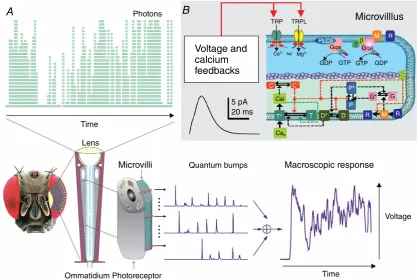
A fly photoreceptor collects information about the world
by counting photons within its receptive field (Fig. 1A).
These counts (samples) are its quantum bumps – small discrete transmembrane ion fluxes, produced by
single microvilli (sampling units, Fig. 1B) in response
to single photons (Hardie & Juusola, 2015). A fruit
fly (Drosophila melanogaster) R1–R6 photoreceptor has
30,000 microvilli, each of which houses full
photo-transduction reactions. Collectively, the microvilli form the photoreceptor’s light guide, the rhabdomere, and their quantum bumps, through stochastic size and timing
variations (Fig. 1A), integrate for each moment (time bin)
its graded macroscopic response (output) to light intensity changes (input).
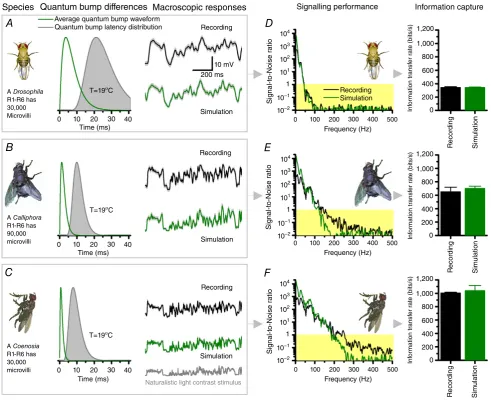
Based on information theory (Shannon, 1948), information in photoreceptor output depends upon the signal-to-noise ratio of its frequency-domain represen-tation (Fig. 2). This estimate, which measures the reproducibility of the underlying quantum bump size and
rate changes (Juusola & Hardie, 2001a), can be inferred
from high-quality intracellular recordings to repeated light
stimulation by signal and noise analyses (Juusola et al.
1994, 2016b; Juusola & Hardie, 2001a,b) and reproduced
by stochastic simulations (Songet al.2012; Song & Juusola,
2014, 2017; Juusolaet al.2015). Equally, this information
is the difference between the output entropy and noise entropy rates (Shannon, 1948; Juusola & de Polavieja, 2003).
Experiments and simulations about light information sampling in R1–R6 photoreceptors of different fly species, which boast different microvilli numbers and quantum
bump speeds (Fig. 2A–C), have demonstrated that
the photoreceptor’s signalling performance (Fig. 2D–F)
increases as a function of quantum bump production rate. Specifically, the larger, the finer and the more precise a photoreceptor’s bump rate changes are, the higher its information transfer rate. This means that
fast flying Calliphora and Coenosia can extract more
visual information from the same natural environment
than a slow flying Drosophila, in which photoreceptors,
respectively, have either fewer or slower microvilli and thus produce fewer, slower and more variable quantum bumps.
Visual invariance emerging from adaptive quantal sampling
Nonetheless, the accurate behaviours of both diurnal
and nocturnal insects (Eschet al.2001; Gonzalez-Bellido
their visual systems to generate highly invariable neural representations of natural images and objects over vastly (logarithmically) varying light conditions. Remarkably,
this invariance is already clearly seen in both locust (Fig. 3A
andB) and fly photoreceptor (Fig. 3C) outputs (Faivre &
Juusola, 2008; Songet al.2012; Friederichet al.2016) and
is mechanistically traceable to two central adaptations in quantal information sampling:
First, after a microvillus generates a quantum bump, it is briefly rendered refractory (full range: 50–500 ms;
Fig. 3D, inset), during which it cannot respond to
another photon (Song et al. 2012). This progressively
reduces quantum efficiency (Fig. 3D; a photoreceptor’s
photon-to-bump-conversion probability) with increasing light intensity, ultimately saturating sample (quantum
bump) rate changes (Fig. 3E, continuous line) to a given
contrast stimulus (Songet al.2012).
Second, during intense quantum bump production in
bright illumination, the increased Ca2+ and Na+ influx
through transient receptor potential (TRP)/transient receptor potential like (TRPL) channels reduces cationic
driving force (Song et al. 2012) and the average bump
size and duration (Figs 1B and 3E, inset and dotted
line) (Hendersonet al. 2000; Juusola & Hardie, 2001a).
Photoreceptor output is further smoothened by quantum
bump jitter (latency distribution; Fig. 2A, grey), caused
by stochasticity in the microvillar phototransduction
reactions (Hendersonet al.2000; Juusola & Hardie, 2001a;
Songet al.2012).
Consequently, with the average quantum count
(Fig. 3E, continuous line) and bump size (dotted
line) adapting to mean light intensity, the resulting macroscopic photoreceptor voltage response to a given natural contrast stimulus scales to look similar at different
TRP TRPL Microvilllus
PLCβ
Gqa Gqa
β M R
γ
Ca2+
Mg2+
Na+
GDP GTP GTP GDP
Photons
Voltage and calcium feedbacks
5 pA 20 ms
C C* P*
G* G
P
Cai
T* T D* D R M R
Cao
Time
Lens
Microvilli Quantum bumps Macroscopic response
Ommatidium Photoreceptor
Voltage
Time
A B
Figure 1. Schematic representation of adaptive quantal light information sampling by aDrosophila R1–R6 photoreceptor
[image:3.595.92.510.291.571.2]illumination conditions (Faivre & Juusola, 2008; Song
et al. 2012; Friederich et al. 2016) (Fig. 3A–C). These adapting quantum bump dynamics thus much contribute to the divisive nonlinearity, associated with amplitude normalisation in empirical photoreceptor models (French
et al.1993; van Hateren & Snippe, 2006; Friederichet al.
2016), providing mechanistic insight into descriptive
nonlinear systems identification. [Note: Divisive
non-linearity is an arbitrary but necessary mathematical operation in empirical (black-box) photoreceptor models to
compress vast light input changes into their limited output range. It makes the model output better approximate the real photoreceptor output.] But while the average light intensity increasing over a range of magnitudes progressively
reduces the photoreceptor’s quantum efficiency (Fig. 3D),
the macroscopic responses still count in more quantum
bumps (samples) (Fig. 3E). This increase in their sample
rate changes (from the same contrast) is the main reason why an insect photoreceptor’s signal-to-noise ratio and
information transfer (Fig. 3F) increases with brightening
Macroscopic responses Quantum bump differences
Species
Average quantum bump waveform
Quantum bump latency distribution Recording
Recording Recording 10 mV 200 ms Simulation Simulation Simulation T=19οC
T=19οC
T=19οC
ADrosophila R1-R6 has 30,000 Microvilli ACalliphora R1-R6 has 90,000 microvilli ACoenosia R1-R6 has 30,000 microvilli
0 10 20 30 40 Time (ms)
0 10 20 30 40 Time (ms)
0 10 20 30 40 Time (ms)
Signalling performance Information capture
Signal-t o-Noise r atio Signal-t o-Noise r atio Signal-t o-Noise r atio Frequency (Hz) Recording Simulation Inf or mation tr ansf er r at e (bits/s) Inf or mation tr ansf er r at e (bits/s) Inf or mation tr ansf er r at e (bits/s) R ecor ding Sim ulation R ecor ding Sim ulation R ecor ding Sim ulation
Naturalistic light contrast stimulus
0 100 200 300 400 500
Frequency (Hz)
0 100 200 300 400 500
Frequency (Hz)
0 100 200 300 400 500
[image:4.595.48.540.204.610.2]1,200 1,000 800 600 400 200 0 1,200 1,000 800 600 400 200 0 1,200 1,000 800 600 400 200 0 104 103 102 101 10−1 10−2 1 104 103 102 101 10−1 10−2 1 104 103 102 101 10−1 10−2 1 A D E B C F
Figure 2. Photoreceptors that generate more, faster and more precise samples (quantum bumps) from the same light stimulus carry more visual information
Locust photoreceptor output
Responses Bright
Bright
Bright
Bright Dim
5 mV 100 ms Normalised
signals
Normalised Drosophila photoreceptor output
Bright
Recordings Simulations
Dim
Dim
Dim
Dim Dim
Naturalistic contrast stimulus
Adapting quantum bump dynamics
Bump r ate
Bump size
Bump siz
e
Dim bump
Bright
Bright
0 40 80
Time (ms)
S
ample r
at
e
(quantum b
ump/s)
S
ample siz
e (quqntum b
u
mp/max)
Light intensity (photons/s) Light intensity (photons/s)
Light intensity (photons/s)
105
105 106
104
104 103
105 106 104
103
105 106
104 103
103
1
0.1
T = 25 οC
T = 25 οC T = 25 οC
Frequency (Hz)
2 10 100
102
101
100
10−1
10−2
10−3
Microvilli refractoriness
0 200 400
Time (ms) 100
80
60
40
20
0
Quantum ef
ficienc
y (%)
Inf
or
mation tr
ansf
er r
at
e (bits/s)
500
400
300
200
100 |S(f)|2
Signal po
w
e
r (mV
2)
A B
C D
[image:5.595.86.518.64.507.2]E F
until saturation (Juusola et al. 1994; Juusola & Hardie,
2001a; Faivre & Juusola, 2008; Frederiksen et al. 2008;
Heimonenet al.2012; Song & Juusola, 2014), when about
half of its microvilli become refractory (Songet al.2012).
[Note: in dim stimulation, a photoreceptor may count 10 quantum bumps (samples) in time-bin1and 2 in time-bin2.
But in brighter stimulation, time-bin1 may have 100 and
time-bin2 20 samples. Thus, the corresponding sample
rate changes would be 8 and 80 samples/time, with the brightening increasing their difference by 10-fold. The larger the sample rate changes, the higher the entropy rate. And if reproducible (having low noise), then the larger sample rate changes have a higher signal-to-noise ratio and transmit more information.]
Thus, at the level of sampling, the neural code of insect photoreceptors inherently emphasises natural contrast constancy (relative light changes in the environment remain the same in different illumination conditions) (Attneave, 1954; Barlow, 1961; van Hateren, 1997) and efficiently allocates this information as invariable response waveforms within their limited output range (Atick, 1992;
van Hateren, 1992b). And it does this, unavoidably, at the
expense of coding the absolute light intensity.
Markedly, however, losing photons galore to refractory microvilli, when the flux of incident photons into distinct receptive fields in daylight can be 106–109photons s−1, is
not critical for good vision. As long as aDrosophilaR1–R6
photoreceptor counts up 15,000–150,000 quantum
bumps s−1, its neural estimate of local contrast changes
will be reliable (of very high signal-to-noise ratio), with each photoreceptor in the eye providing hundreds of bits of information per second to the brain.
Functional comparisons in light information processing and representation between different insect receptors suggest that perhaps all rhabdomeric photo-receptors would sample quantal light information similarly. Yet, by evolving different microvilli numbers and phototransduction speeds (Fig. 2), photoreceptors of different species have specialised visual capabilities
for different life-styles and habitats (Wong et al. 1982;
van Hateren, 1992a; Juusola et al. 1994; van Steveninck
& Laughlin, 1996; Anderson & Laughlin, 2000; Juusola
& Hardie, 2001a; Niven et al. 2007; Faivre & Juusola,
2008; Frederiksen et al. 2008; Gonzalez-Bellido et al.
2011; Frolov et al. 2012; Heimonen et al. 2012; Song
et al. 2012; Song & Juusola, 2014; Song et al. 2016). Here, the trade-off is that while having more micro-villi increases photoreceptor output, its bandwidth, and information transfer rate for representing natural contrast changes (Song & Juusola, 2014), so does the total cost for constructing, maintaining and running this
sampling machinery (Laughlinet al.1998; Song & Juusola,
2014).
Future work is needed to test how these sampling rules and constraints apply to nocturnal moths, which have high
microvillus numbers but seemingly noisy macroscopic
responses (Stockl et al. 2016) and possibly inferior
information transfer rates compared to diurnal insects with fewer microvilli. Moreover, an open question remains of how the refractory light information sampling dynamics of microvillar photoreceptors compare mechanistically with bleaching adaptation of vertebrate ciliary photo-receptors (Yau & Hardie, 2009).
Antialiasing through quantal adaptive sampling
Interestingly, stochastic quantal information sampling is not only an elegant light-adaptation strategy but possibly also an evolutionary solution to the temporal aliasing problem to provide reliable neural estimates
of the variable world (Juusola et al. 2015). It scatters
high-frequency information into broadband noise rather than generating the false patterns produced by regular sampling (Dippe & Wold, 1985). Thus, variable sampling times and sample sizes (quantum bump jitter and size differences) prevent distortions or artefacts, such as
harmonic oscillations (Songet al.2012), in reconstruction
of macroscopic responses from the original (continuous) light patterns. And because the flies have neural superposition eyes, which provide eight independent estimates (outer R1–R6 and inner R7 and R8 photo-receptors) of local light intensity changes for each image pixel (Kirschfeld & Franceschini, 1969; Horridge & Meinertzhagen, 1970), parallel sampling by microvilli in each photoreceptor and the later synaptic pooling of their macroscopic outputs would actively cancel noise.
In support of this view, stochastic modelling implies that intrinsic noise – caused by the quantum bump variations – seems to degrade the fly photoreceptor output less than what was thought before (Lillywhite & Laughlin, 1979;
Laughlin & Lillywhite, 1982), maximally5–10% (Song
et al. 2012; Song & Juusola, 2014; Juusolaet al. 2015). The concerted action of many thousands of microvilli in photon sampling reduces intrinsic noise as their quantum bumps add up the macroscopic response. Moreover, global (intracellular calcium and membrane voltage)
feed-backs (Fig. 1B), which carry memory of the past events,
reduce noise by adapting the bump sizes to the ongoing
light stimulation. This accounts for10% improvement
in the rate of information transfer, in comparison to sampling the bumps randomly from the same distribution
(Song et al. 2012). Intrinsic noise is almost certainly
further reduced when the parallel macroscopic responses of photoreceptors, which view the same point in space, are pooled in convergent synaptic transmission to
inter-neurons (Zhenget al.2006).
noise, improving the robustness, reliability and accuracy of the resulting neural estimates (see also: Galton,
1907; Heimonen et al. 2006; Padmanabhan & Urban,
2010). Conversely, filtering responses downstream, which occurs by a voltage-sensitive cell membrane (Hardie,
1991; Weckstromet al. 1991; V¨ah¨as¨oyrinki et al. 2006),
can reshape and smoothen photoreceptor output but not increase its information (data processing theorem) (Shannon, 1948; Juusola & de Polavieja, 2003; Abou
Tayounet al.2011).
Armed with this essential mechanistic knowledge about fly photoreceptors’ stochastic refractory photon sampling, we next briefly consider why and how this makes encoding inefficient for Gaussian white-noise (GWN) stimulation but sensitised to salient natural world features.
Gaussian white-noise stimulation does not fully test photoreceptor performance
In electronic systems, GWN stimulus, which maximises information within its bandwidth and variance, is regularly used for testing information transmission capacity. However, for neural systems, such as photo-receptors, which employ adaptive quantal information sampling, GWN fails to test their true signalling
performance (Rieke et al.1995; Juusola & de Polavieja,
2003; Song & Juusola, 2014).
This disparity has less to do with the used GWN’s absolute energy, phase distribution or photon content, but primarily depends upon how a photoreceptor samples photons (Song & Juusola, 2014). Therefore, a bright GWN stimulus with a mean intensity that is 100-fold
Coenosia attenuata
Recordings
Simulations
Simulations
2 mV 100 ms
Recordings Simulations
Recordings Simulations
R,
Inf
or
mation r
at
e (bits/s)
R,
Inf
or
mation r
at
e (bits/s)
GWN NS
GWN NS GWN NS GWN NS
GWN NS GWN NS
R / Rinput R / Rinput
Simulations vs the best recordings
Simulations vs the best recordings
Encoding ef
fi
cienc
y (%)
Encoding ef
fi
cienc
y (%)
Drosophila melanogaster
Recordings
C
ontr
ast
1,400 1,200 1,000 800 600 400 200 0
1,400 1,200 1,000 800 600 400 200 0
50
30
20
10
0 40
50
30
20
10
0 40 T = 19-20οC
T = 19-20οC ***
***
1 0 −1
A B C
D E F
GWN 300 Hz cut-off
n=1
0
cells
n=1
0
cells
[image:7.595.86.516.265.532.2]n=4
Figure 4. Fly photoreceptors encode Gaussian white-noise (GWN) and naturalistic stimuli (NS) differently, with different efficiencies and costs
higher than the mean intensity of a naturalistic stimulus would still yield lower information transfer estimates in a photoreceptor. This is because stochastic photon sampling by finite refractory microvilli populations makes a photoreceptor to encode different stimulus statistics differently, with different efficiencies and costs (Fig. 4). Specifically, longer dark contrasts, which characterize naturalistic stimuli, help to recover more refractory microvilli than equally bright stimuli without these features, improving neural information while lowering its metabolic costs (Song & Juusola, 2014). Photoreceptor output to natural/naturalistic stimulation thus typically entails larger phasic quantum bump rate changes, while maintaining a lower mean level of depolarization (costing less) than corresponding responses to GWN (Juusola & de Polavieja, 2003; Song & Juusola, 2014). Conversely, GWN experiments underestimate a photoreceptor’s information transmission capacity, while often overestimating its normal energy consumption (Song & Juusola, 2014), making the subsequent neuro-economics estimates and their cross-species comparisons unrealistic.
For example, at 25°C, a typical Drosophila R1–R6
photoreceptor would sample 282 bits s−1 from
200 Hz band-limited GWN, costing 1.31 × 10⁷ ATP
molecules bit−1. However, from a rich naturalistic contrast
stimulus of equal mean brightness, the same
photo-receptor would sample 455 bits s−1 with the price of
1.15×10⁷ATP molecules bit−1(Song & Juusola, 2014).
Adaptive quantal sampling enhances salient stimuli
Importantly, adaptive quantal sampling gives a fly photo-receptor an innate capacity to enhance stimulus salience. Adaptation that follows the phototransduction cannot increase the photoreceptor’s information transfer rate (Juusola & de Polavieja, 2003). However, if the receptor adapts during the process of sampling, it can accentuate quantum bump rate changes to new (surprising) stimuli, increasing information transfer rate transiently.
Naturalistic stimulation includes longer dark contrasts that are not present in GWN stimulation. The effect of short-term adaptation to these events was first quantified
#1
#1
#2 #3 #1 #2
#2
#3 #1 #2 #3 #1 #2 #3 #1 #2 #3
#3
bright dark
20 mV
20 mV 1 sec
n=6
1 2 3
Response sections (#) 800
750
700
650
R
, inf
or
mation r
at
e (bits/s)
A
B
[image:8.595.79.510.338.601.2]C
Figure 5. Quantal adaptive sampling innately accentuates salient contrast changes, boosting their information content
by showing howCalliphoraR1–R6s’ information transfer changes during three identical naturalistic stimulus
sequences (Fig. 5A; marked 1, 2 and 3) that followed a 1 s
dark period (Juusola & de Polavieja, 2003). In repetitive stimulation, the responses to the 1st sequence (green)
were always larger (Fig. 5B) and carried more information
(Fig. 5C) than the responses to the 2nd and 3rd sequences.
Thus, the signalling precision of fly photoreceptors was higher at transitions from dark to bright light and then reduced with adaptation to a lower voltage response.
Further recordings and photoreceptor model simula-tions have since demonstrated that the first larger response to a bright step simply contains more quantum bumps, and thus has a higher signal-to-noise ratio than sub-sequent responses, for which fewer microvilli are activated, with more microvilli becoming refractory (Juusola & de
Polavieja, 2003; Songet al.2012; Song & Juusola, 2014).
Similarly, the first negative voltage response to a dark contrast step will be larger (Juusola, 1993) because more microvilli will be refractory, generating fewer quantum bumps than the subsequent responses. Accordingly, the photoreceptors’ information transfer is higher at large dark-to-bright or bright-to-dark contrast transitions and decreases afterwards in correlation with the adaptation to
the stimulus (Juusola & de Polavieja, 2003; Zhenget al.
2006, 2009).
Thus, not only does adaptive quantal sampling lead to robust encoding of natural light changes over the full dynamic range of environmental light intensities
(Fig. 3) (Faivre & Juusola, 2008; Songet al.2012, 2016;
Friederich et al. 2016; Juusola et al. 2016a), it also
enhances novel or surprising stimuli, which generate the largest quantum bump rate changes (increments or decrements) with respect to the ongoing average (Juusola
& de Polavieja, 2003; Songet al.2012; Song & Juusola,
2014) (Fig. 5). Remarkably, further analyses have shown that while accentuating saliency, adaptive quantal photon sampling also improves the allocation of information in naturalistic stimulation on the photoreceptors’ limited bandwidth and amplitude range (van Hateren, 1997;
Zhenget al.2009; Songet al.2012; Juusolaet al.2016a).
As the output frequency distribution flattens (or whitens) while its amplitude distribution becomes Gaussian, every symbol (voltage value) of a message (macroscopic voltage response) would be transmitted equally often (Shannon, 1948).
Discussion
In this review, we have presented a basic account of how a fly photoreceptor samples light information in time, and why this improves vision. For clarity, the focus was upon stochastic adaptive photon sampling to highlight its fundamental role in generating reliable macroscopic responses to environmental light contrast changes. This
meant that the primary sampling process was considered in isolation.
While the description given is accurate, the reality is more complex and in perpetual motion, and we know that optimal visual information sampling, at
least in Drosophila, further involves elaborate
photo-mechanical adaptations and self-motion (body, head and eye movements), which prevent retinal images from
fading during fast adaptation (Juusola et al. 2016a). In
fact, during photon sampling, light input intensity is regulated by two photomechanical processes inside photo-receptors. Slower screening pigment migration (intra-cellular pupil, 1–10 s) (Franceschini & Kirschfeld, 1971, 1976) and much faster autonomous microsaccadic photo-receptor contractions (0.01–1 s) (Hardie & Franze, 2012;
Juusola et al. 2016a) dynamically reduce photon flux
into the rhabdomere, shifting and narrowing its receptive
field (Juusola et al. 2016a). In addition, downstream,
in the photoreceptor axons, asymmetric synaptic and gap-junctional inputs from the network differentiate
individual R1–R6 outputs (Shaw, 1984; Shawet al.1989;
Zhenget al.2006, 2009; Nikolaevet al.2009; Rivera-Alba
et al.2011; Wardillet al.2012; Dauet al.2016).
How all these factors contribute to spatiotemporal encoding of the visual world and perception, providing
Drosophila hyperacute vision, is analysed in detail in
(Juusolaet al.2016a) and is beyond the scope of this review.
References
Abou Tayoun AN, Li XF, Chu B, Hardie RC, Juusola M & Dolph
PJ (2011). TheDrosophilaSK channel (dSK) contributes to
photoreceptor performance by mediating sensitivity control
at the first visual network.J Neurosci31, 13897–13910.
Anderson JC & Laughlin SB (2000). Photoreceptor performance and the co-ordination of achromatic and
chromatic inputs in the fly visual system.Vision Res40,
13–31.
Atick JJ (1992). Could information-theory provide an
ecological theory of sensory processing.Network3, 213–251.
Attneave F (1954). Some informational aspects of visual
perception.Psychol Rev61, 183–193.
Baird E, Fernandez DC, Wcislo WT & Warrant EJ (2015). Flight control and landing precision in the nocturnal bee
Megaloptais robust to large changes in light intensity.Front Physiol6, 305.
Barlow HB (1961). Possible principles underlying the
transformation of sensory messages. InSensory
Communication, ed. Rosenblith WA MIT Press, Cambridge, MA, USA.
Dau A, Friederich U, Dongre S, Li X, Bollepalli MK, Hardie RC & Juusola M (2016). Evidence for dynamic network
regulation ofDrosophilaphotoreceptor function from
mutants lacking the neurotransmitter histamine.Front
Neural Circuits10, 19.
Dippe MAZ & Wold EH (1985). Antialiasing through
Esch HE, Zhang SW, Srinivasan MV & Tautz J (2001).
Honeybee dances communicate distances measured by optic
flow.Nature411, 581–583.
Faivre O & Juusola M (2008). Visual coding in locust
photoreceptors.PLoS One3, e2173.
Franceschini N & Kirschfeld K (1971). Phenomena of
pseudopupil in the compound eye ofDrosophila.Kybernetik
9, 159–182.
Franceschini N & Kirschfeld K (1976). Automatic-control of
light flux in compound eye ofDiptera– spectral, statical, and
dynamical properties of mechanism.Biol Cybern21,
181–203.
Frederiksen R, Wcislo WT & Warrant EJ (2008). Visual reliability and information rate in the retina of a nocturnal bee.Curr Biol18, 349–353.
French AS, Korenberg MJ, Jarvilehto M, Kouvalainen E, Juusola M & Weckstrom M (1993). The dynamic nonlinear behavior of fly photoreceptors evoked by a wide-range of light
intensities.Biophys J65, 832–839.
Friederich U, Billings SA, Hardie RC, Juusola M & Coca D
(2016). Fly photoreceptors encode phase congruency.PLoS
One11, e0157993.
Frolov R, Immonen EV, Vahasoyrinki M & Weckstrom M (2012). Postembryonic developmental changes in
photoreceptors of the stick insectCarausius morosusenhance
the shift to an adult nocturnal life-style.J Neurosci32,
16821–16831.
Galton F (1907). Vox populi.Nature75, 450–451.
Gonzalez-Bellido PT, Wardill TJ & Juusola M (2011). Compound eyes and retinal information processing in
miniaturedipteranspecies match their specific ecological
demands.Proc Natl Acad Sci USA108, 4224–4229.
Hardie RC (1991). Voltage-sensitive potassium channels in
Drosophilaphotoreceptors.J Neurosci11, 3079–3095. Hardie RC & Franze K (2012). Photomechanical responses in
Drosophilaphotoreceptors.Science338, 260–263. Hardie RC & Juusola M (2015). Phototransduction in
Drosophila.Curr Opin Neurobiol34C, 37–45.
Heimonen K, Immonen EV, Frolov RV, Salmela I, Juusola M, Vahasoyrinki M & Weckstrom M (2012). Signal coding in cockroach photoreceptors is tuned to dim environments.
J Neurophysiol108, 2641–2652.
Heimonen K, Salmela I, Kontiokari P & Weckstrom M (2006). Large functional variability in cockroach photoreceptors:
optimization to low light levels.J Neurosci26, 13454–13462.
Henderson SR, Reuss H & Hardie RC (2000). Single photon
responses inDrosophilaphotoreceptors and their regulation
by Ca2+.J Physiol524, 179–194.
Horridge GA & Meinertzhagen IA (1970). Accuracy of patterns of connexions of first-order and second-order neurons of
visual system ofCalliphora.Proc R Soc Lond B Biol Sci175,
69–82.
Juusola M (1993). Linear and nonlinear contrast coding in
light-adapted blowfly photoreceptors.J Comp Physiol A172,
511–521.
Juusola M, Dau A, Song Z, Solanki N, Rien D, Jaciuch D, Dongre S, Blanchard F, de Polavieja GG, Hardie RC & Takalo
J (2016a). Microsaccadic information sampling provides
Drosophilahyperacute vision.bioRxivdoi: 10.1101/083691.
Juusola M, Dau A, Zheng L & Rien D (2016b).
Electrophysiological method for recording intracellular
voltage responses ofDrosophilaphotoreceptors and
interneurons to light stimuli in vivo.J Vis Exp, e54142.
Juusola M & de Polavieja GG (2003). The rate of information transfer of naturalistic stimulation by graded potentials.
J Gen Physiol122, 191–206.
Juusola M & Hardie RC (2001a). Light adaptation in
Drosophilaphotoreceptors: I. Response dynamics and
signaling efficiency at 25 degrees C.J Gen Physiol117, 3–25.
Juusola M & Hardie RC (2001b). Light adaptation in
Drosophilaphotoreceptors: II. Rising temperature increases
the bandwidth of reliable signaling.J Gen Physiol
117, 27–41.
Juusola M, Kouvalainen E, Jarvilehto M & Weckstrom M (1994). Contrast gain, signal-to-noise ratio, and linearity in
light-adapted blowfly photoreceptors.J Gen Physiol104,
593–621.
Juusola M, Song Z & Hardie RC (2015). Phototransduction
biophysics. InEncyclopedia of Computational Neuroscience,
ed. Jaeger D & Jung R, pp. 2359–2376. Springer, New York. Kirschfeld K & Franceschini N (1969). A mechanism for
directing flow of light in rhabdomeres of complex eyes in
Musca.Kybernetik6, 13–22.
Laughlin SB & Lillywhite PG (1982). Intrinsic noise in locust
photoreceptors.J Physiol332, 25–45.
Laughlin SB, van Steveninck RRD & Anderson JC (1998). The
metabolic cost of neural information.Nat Neurosci1, 36–41.
Lillywhite PG & Laughlin SB (1979). Transducer noise in a
photoreceptor.Nature277, 569–572.
Nikolaev A, Zheng L, Wardill TJ, O’Kane CJ, de Polavieja GG & Juusola M (2009). Network adaptation improves temporal
representation of naturalistic stimuli inDrosophilaeye: II
mechanisms.PLoS One4, e4306.
Niven JE, Anderson JC & Laughlin SB (2007). Fly
photoreceptors demonstrate energy-information trade-offs
in neural coding.PLoS Biol5, 828–840.
Padmanabhan K & Urban NN (2010). Intrinsic biophysical diversity decorrelates neuronal firing while increasing
information content.Nat Neurosci13, 1276–1282.
Rieke F, Bodnar DA & Bialek W (1995). Naturalistic stimuli increase the rate and efficiency of information transmission
by primary auditory afferents.Proc Biol Sci262, 259–265.
Rivera-Alba M, Vitaladevuni SN, Mischenko Y, Lu ZY, Takemura SY, Scheffer L, Meinertzhagen IA, Chklovskii DB & de Polavieja GG (2011). Wiring economy and volume
exclusion determine neuronal placement in theDrosophila
brain.Curr Biol21, 2000–2005.
Shannon CE (1948). A mathematical theory of
communication.AT&T Tech J27, 379–423.
Shaw SR (1984). Early visual processing in insects.J Exp Biol
112, 225–251.
Shaw SR, Frohlich A & Meinertzhagen IA (1989). Direct connections between the R7/8 and R1-6 photoreceptor
subsystems in thedipteranvisual-system.Cell Tissue Res257,
295–302.
Song Z & Juusola M (2014). Refractory sampling links efficiency and costs of sensory encoding to stimulus
Song Z & Juusola M (2017). A biomimetic fly photoreceptor model educidates how stochastic adaptive quantal sampling
provides a large dynamic range.J Physiol595(in press).
Song Z, Postma M, Billings SA, Coca D, Hardie RC & Juusola M (2012). Stochastic, adaptive sampling of information
by microvilli in fly photoreceptors.Curr Biol22,
1371–1380.
Song Z, Zhou Y & Juusola M (2016). Random photon absorption model elucidates how early gain control in fly
photoreceptors arises from quantal sampling.Front Comput
Neurosci10, 61.
Stockl AL, O’Carroll DC & Warrant EJ (2016). Neural summation in the hawkmoth visual system extends the
limits of vision in dim light.Curr Biol26, 821–826.
St¨urzl W, Zeil J, Boeddeker N & Hemmi JM (2016). How
wasps acquire and use views for homing.Curr Biol26,
470–482.
V¨ah¨as¨oyrinki M, Niven JE, Hardie RC, Weckstr¨om M & Juusola
M (2006). Robustness of neural coding inDrosophila
photoreceptors in the absence of slow delayed rectifier K+
channels.J Neurosci26, 2652–2660.
van Hateren JH (1992a). Theoretical predictions of
spatiotemporal receptive-fields of fly LMCs, and
experimental validation.J Comp Physiol A171, 157–170.
van Hateren JH (1992b). A theory of maximizing sensory
information.Biol Cybern68, 23–29.
van Hateren JH (1997). Processing of natural time series of
intensities by the visual system of the blowfly.Vision Res37,
3407–3416.
van Hateren JH & Snippe HP (2006). Phototransduction in primate cones and blowfly photoreceptors: different
mechanisms, different algorithms, similar response.J Comp
Physiol A192, 187–197.
van Steveninck RRD & Laughlin SB (1996). The rate of
information transfer at graded-potential synapses.Nature
379, 642–645.
Wardill TJ, List O, Li XF, Dongre S, McCulloch M, Ting CY, O’Kane CJ, Tang SM, Lee CH, Hardie RC & Juusola M (2012). Multiple spectral inputs improve motion
discrimination in theDrosophilavisual system.Science336,
925–931.
Weckstrom M, Hardie RC & Laughlin SB (1991). Voltage-activated potassium channels in blowfly photoreceptors and
their role in light adaptation.J Physiol440, 635–657.
Wong F, Knight BW & Dodge FA (1982). Adapting bump
model for ventral photoreceptors ofLimulus.J Gen Physiol
79, 1089–1113.
Yau KW & Hardie RC (2009). Phototransduction motifs and
variations.Cell139, 246–264.
Zheng L, de Polavieja GG, Wolfram V, Asyali MH, Hardie RC & Juusola M (2006). Feedback network controls
photoreceptor output at the layer of first visual synapses in
Drosophila.J Gen Physiol127, 495–510.
Zheng L, Nikolaev A, Wardill TJ, O’Kane CJ, de Polavieja GG & Juusola M (2009). Network adaptation improves temporal
representation of naturalistic stimuli inDrosophilaeye: I
dynamics.PLoS One4, e4307.
Additional information
Competing interests
The authors declare no conflict of interest.
Author contributions
M.J. and Z.S. wrote the paper. M.J. and Z.S. approved the final version of the manuscript and agree to be accountable for all aspects of the work. All persons designated as authors qualify for authorship, and all those who qualify for authorship are listed.
Funding
This work was supported by the open research fund of the State Key Laboratory of Cognitive Neuroscience and Learning (M.J.), NSFC project (30810103906: M.J.), Jane and Aatos Erkko Foundation (M.J.), The Leverhulme Trust grant (RPG-2012-567: M.J.) and the BBSRC grants (BB/F012071/1, BB/D001900/1 and BB/H013849/1: M.J.). EPSRC-funded 2020 Science fellowship (EP/I017909/1: S.Z.) provided the major funding for the ‘1st UK Phototransduction and Synaptic Transmission’ workshop.
Acknowledgements