This is a repository copy of Trends in Self-Harm in Kuala Lumpur, 2005-2011.. White Rose Research Online URL for this paper:
http://eprints.whiterose.ac.uk/95407/ Version: Accepted Version
Article:
Armitage, C.J., Abdul Rahim, W., Rowe, R. et al. (1 more author) (2016) Trends in
Self-Harm in Kuala Lumpur, 2005-2011. Archives of Suicide Research, 20 (1). pp. 22-28. ISSN 1381-1118
https://doi.org/10.1080/13811118.2015.1004493
[email protected] https://eprints.whiterose.ac.uk/ Reuse
Unless indicated otherwise, fulltext items are protected by copyright with all rights reserved. The copyright exception in section 29 of the Copyright, Designs and Patents Act 1988 allows the making of a single copy solely for the purpose of non-commercial research or private study within the limits of fair dealing. The publisher or other rights-holder may allow further reproduction and re-use of this version - refer to the White Rose Research Online record for this item. Where records identify the publisher as the copyright holder, users can verify any specific terms of use on the publisher’s website.
Takedown
If you consider content in White Rose Research Online to be in breach of UK law, please notify us by
Full Terms & Conditions of access and use can be found at
http://www.tandfonline.com/action/journalInformation?journalCode=usui20
Archives of Suicide Research
ISSN: 1381-1118 (Print) 1543-6136 (Online) Journal homepage: http://www.tandfonline.com/loi/usui20
Trends in Self-Harm in Kuala Lumpur, 2005–2011
Christopher Armitage PhD, Wirda Abdul Rahim PhD, Richard Rowe PhD & Rory O'Connor PhD
To cite this article: Christopher Armitage PhD, Wirda Abdul Rahim PhD, Richard Rowe PhD & Rory O'Connor PhD (2015): Trends in Self-Harm in Kuala Lumpur, 2005–2011, Archives of Suicide Research, DOI: 10.1080/13811118.2015.1004493
To link to this article: http://dx.doi.org/10.1080/13811118.2015.1004493
Accepted author version posted online: 09 Dec 2015.
Submit your article to this journal
Article views: 11
View related articles
Trends in Self-Harm in Kuala Lumpur, 2005
–
2011
Christopher Armitage, PhD
University of Manchester
Wirda Abdul Rahim, PhD
University of Sheffield
Richard Rowe, PhD
University of Sheffield
Rory O'Connor, PhD
University of Glasgow
Address correspondence to Christopher Armitage, Manchester Centre for Health Psychology,
School of Psychological Sciences, Manchester Academic Health Science Centre, University of
Manchester, Coupland Street, Oxford Road, Manchester M13 9PL. Tel: +44(0) 161 275 2556.
E-mail: [email protected]
Received 27 February 2014; revised 21 August 2014; accepted 29 September 2014.
Abstract
Acts of self-harm are not routinely tracked in Malaysia. The present study investigates the
prevalence of self-harm in Kuala Lumpur, Malaysia over a 7-year period. The aims were to: (a)
assess the prevalence of self-harm; (b) examine any changes over a period of 7 years, and (c)
identify correlates of methods of self-harm. Data were extracted from the hospital records of
Kuala Lumpur Hospital to review trends in self-harm between 2005 and 2011. There were 918
episodes of self-harm across the 7-year period, with a significant peak in 2007–2009. The
average rate of self-harm (7.7 per 100,000 population per year) was lower than the rate of suicide
(8–13 per 100,000) suggesting that genuine cases of self-harm are often attributed to other
causes. Nevertheless, over-representation of young people, women and Indians suggest areas in
which resources to prevent self-harm might usefully be targeted. Estimating rates of self-harm
are fraught with problems and further research is needed to understand the economic and cultural
barriers around seeking treatment for self-harm, reporting self-harm and classifying self-harm.
Keywords: Kuala Lumpur, prevalence, self-harm, suicide
It is important to monitor trends in harm because any changes in the rates of
self-harm or the demographic characteristics of the patient population could exert a substantial
impact on clinical services and future suicidal behaviour (Hawton, Fagg, Simkin, Bale, & Bond,
1997; Hawton, Fagg, Simkin, Bale, & Bond, 2000). However, acts of self-harm are not routinely
tracked in Malaysia and just three studies have used hospital records to assess the prevalence of
self-harm (Habil, Ganesvaran, & Agnes, 1992-3; Ong & Yeoh, 1992; Orr & Pu, 1985). The
present research is timely because previous studies analysed data from the 1980s and novel
because previous studies only analysed data for a period of one (Habil, Ganesvaran, & Agnes,
1992-3; Orr & Pu, 1985) or 2 years (Ong & Yeoh, 1992). For the present purposes, self-harm is
defined as “any act of self-poisoning or self-injury carried out by an individual irrespective of
motivation. This commonly involves self-poisoning with medication or self-injury by cutting.”
(National Institute for Health and Care Excellence, 2011).
The present study aims to: (a) assess the prevalence and correlates of self-harm in Kuala
Lumpa, Malaysia; (b) examine any changes over a period of 7 years; and (c) identify correlates
of the most prevalent methods used.
METHOD
Location
The present research uses the records of Kuala Lumpur Hospital, from 2005 to 2011
inclusive, to estimate the prevalence of self-harm in Kuala Lumpur. Kuala Lumpur Hospital was
chosen because it covers emergency admissions for the whole of Kuala Lumpur. Kuala Lumpur
has a population of approximately 1.7 million, is the most densely populated area in Malaysia,
and is broadly representative of Malaysia as a whole in terms of population age and ethnicity
(Malaysian Statistics Department, 2010).
Procedure
The study received ethical approval from the Hospital Director, the Head of Department
of the Records Office, the Ethics Committee of the National Medical Research Registry
Malaysia, and the University’s ethics committee. Data were extracted by administrators who
were independent of the research team from all records containing the International Statistical
Classification of Diseases and Related Health Problems 10th Revision (World Health
Organization (WHO), 2010) cause codes X60-X84 for the years 2005–2011.
Analyses
Nonparametric techniques were used to analyze the data. The pattern of self-harm across
years was tested using the Kolmogorov-Smirnov (K-S) statistic, which compares the rate of
harm against a flat (uniform) distribution, where all possible outcomes are equally probable. A
statistically significant K-S statistic indicates that the pattern deviates from uniformity. Odds
ratios (OR) and 95% confidence intervals (CI) were generated using logistic regression.
RESULTS
Comparison of People Admitted to Hospital for Self-Harm with the General
Population
Table 1 compares people admitted to hospital for self-harm with the general population.
Gender
There were significant differences in the rates of admission between men and women,
²(1, n = 918) = 69.18, p < .01, with almost twice as many women (n = 585, 63.7%) being
admitted for self-harm compared with men (n = 333, 36.3%). The mean episode-based rate of
self-harm per 100,000 was 2.8 per 100,000 for men and 4.2 per 100,000 for women.
Age
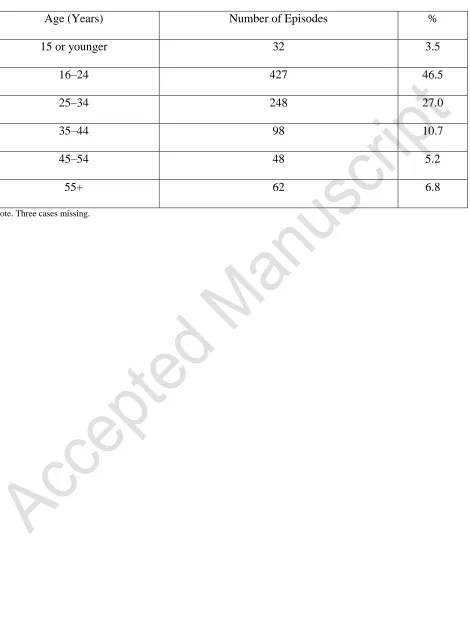
The distribution of self-harm across age groups differed significantly from uniformity,
K-S = 16.60, p < .01, with 777 (84.6%) of the sample aged 34 years or younger (Table 2). There
were significantly more 16–24 year olds than 25–34 year olds, ²(1, n = 675) = 47.47, p < .01,
and significantly more 25–34 year olds than 35–44 year olds, ²(1, n = 346) = 65.03, p < .01.
Ethnicity
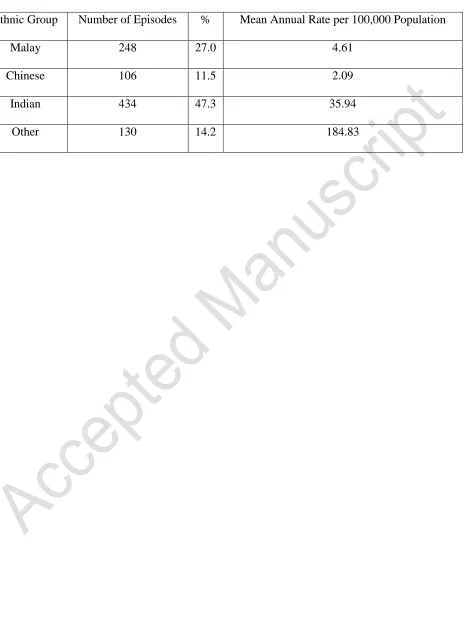
The distribution of self-harm across ethnic groups also differed significantly from
uniformity, K-S = 8.51, p < .01. There were significantly more Malay than Chinese, ²(1,
n = 354) = 56.96, p < .01, and significantly more Indians than Malay, ²(1, n = 682) = 50.73,
p < .01. However adjusting the figures for the proportions of ethnic groups in the population
revealed significantly more self-harm cases who were classified as Indian or “other” (Table 3).
Deaths as a Result of Self-Harm
Twenty-four patients (2.6%) were recorded as having died in hospital, 13 men and 11
women (1.4 and 1.2% of hospital admissions, respectively). More than half (54.2%) of deaths
were in the 16–34 age group and 62.5% of deaths were from the Indian ethnic group.
Trends in Self-Harm: 2005 to 2011
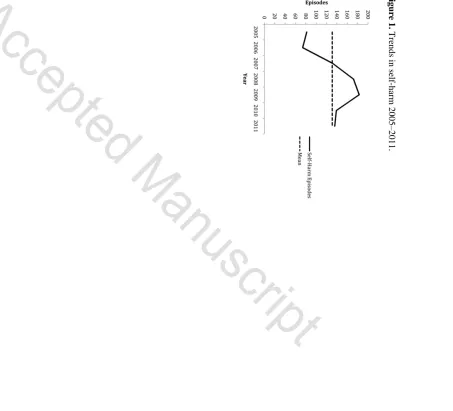
Between 2005 and 2011, 916 patients, as a result of 918 episodes, were admitted for
self-harm and there appears to be a peak around 2008 (Figure 1). The distribution of self-self-harm across
the years differed significantly from uniformity, K-S = 5.64, p < .01. There were significant
increases in self-harm between 2006 and 2007, ²(1, n = 206) = 16.33, p < .01, and between 2007
and 2008, ²(1, n = 304) = 5.26, p = .02, but there was a significant decrease in self-harm
between 2009 and 2010, ²(1, n = 322) = 6.01, p = .01. There were no significant differences in
the rate of self-harm between the years 2005–2006, 2008–2009 or 2010–2011. Thus, admissions
for self-harm peaked in the years 2007–2009.
Means of Self-Harm
Table 4 shows that the majority of self-harm was attributed to self-poisoning (n = 886),
rather than other means (n = 32), with “other and unspecified drugs, medicaments and biological
substances” being the most common means (n = 486). Logistic regression was used to identify
whether demographic correlates of of self-poisoning differed from self-harm using other means.
Age, gender and ethnicity were entered as independent variables. Ethnicity emerged as the only
significant predictor of poisoning, with Indians substantially more likely to engage in
self-poisoning than any other ethnic group. This effect remained when all predictors were entered
into the model simultaneously (Table 5).
DISCUSSION
In the present study, we investigated trends in self-harm admissions to Kuala Lumpur
Hospital. The key finding was that between 2005 and 2011 a total of 918 episodes of self-harm
were recorded, with a crude rate of self-harm in Kuala Lumpur of approximately 7.7 per 100,000
population per year. Among those who self-harmed, there was: (a) an over-representation of
younger people, women and Indians compared with the general population; (b) a peak in
episodes of self-harm between 2007 and 2009 with a significant decline to 2011; and (c) a
preponderance of diagnoses of intentional self-poisoning (accounting for >90% of all self-harm
episodes), which was particularly common in the Indian ethnic group.
The present rate of 131 self-harm episodes per year is lower than reported in previous
studies from the same hospital, with 271 episodes in 1982 (Orr & Pu, 1985) and 306 episodes in
1989 (Habil, Ganesvaran, & Agnes, 1992-3). However, caution should be exercised when
considering these figures because the self-harm rate in Kuala Lumpur is lower than the estimated
suicide rate (8–13 per 100,000 population, Kaur, 2006). This pattern contrasts starkly with
research elsewhere where self-harm is usually more common than suicide. For example, in the
UK, the suicide rate in 2011 was 11.8 suicides per 100,000 population per year (UK Office for
National Statistics, 2011) yet the hospital-based self-harm rate rarely falls below 300 per 100,000
population per year (Hawton et al., 2010).
Given that several authors have argued that the suicide rates in Malaysia have been
subject to underreporting (Ong & Yeoh, 1992), it seems likely that the present self-harm rates
also include reporting biases. Orr and Pu (1985) argue that there are strong economic and
cultural pressures to misclassify self-harm, from avoiding the invalidation of insurance claims to
the fact that attempted suicide is a serious breach of faith for the Muslim majority. Such social
and cultural pressures might also help to explain why there is an over-representation of Indians
in the present data: There are conditions under which suicide is acceptable among Hindus
(Adityanjee, 1986).
Thus, people who have self-harmed may not seek treatment, may prefer to attend private
clinics rather than those run by central government, or may claim their injury was accidental
when they get to the hospital. One possible explanation for the almost 1:1 correspondence
between suicide rates and self-harm rates in Malaysia is misclassification of self-harm events by
health professionals. For example, in relation to completed suicides, there are persistent claims
that autopsies are not routinely carried out and that deaths have been described as “severely brain
injured,” omitting the external cause of that condition (e.g., “intentional self-harm by jumping
from a high place” (Ong & Yeoh, 1992)).
It appears that, even where self-harm is diagnosed, there is a tendency to use the broader
ICD-10 codes. For example, it is notable that 486/886 (54.85%) self-poisoning episodes were
attributed to X64 (“other and unspecified drugs”), 110/886 (12.4%) self-poisoning episodes were
attributed to X69 (“other and unspecified chemicals”), and that 18/32 (56.25%) self-harm
episodes were attributed to X84 (“intentional self-harm by other means”). It would be valuable to
conduct work with health professionals to understand the ways in which ICD-10 codes
(particularly X60-X84) are being applied in Malaysia. It might be the case that further
contextualization might be necessary to ensure that the ICD-10 is fit for purpose in the
Malaysian context.
The most salient limitation of the present study relates to the quality of the data. In
addition to the problems of misclassifications outlined above, a lot of data was missing from
records, most notably methods implicated in harm, reasons for the act and treatment for
self-harm. Future work is required to establish a more reliable body of data, and to explore the social
and cultural influences on the diagnosis, classification and help-seeking following an episode of
self-harm. The issue of intentionality also merits comment. Although we have adhered to the
ICD terminology that describes self-poisoning and self-harm as intentional to distinguish these
behaviours from accidental self-harm, our conclusions are based on the method of self-harm
rather than a detailed exploration of intention. As a consequence, it is difficult to judge the extent
to which the self-harm was intentional and it is also not possible to comment on how the
different motives (including suicidal intent) that underpin self-harm affect recording practices
(Hawton, Saunders, & O’Connor, 2012; Kapur, Cooper, O’Connor, & Hawton, 2013).
Nevertheless, there is sufficient evidence to suggest that women, younger people and
members of the Indian minority may need particular help, given that they are overrepresented in
the present data. Further research is required to understand the factors leading to self-harm in
these sociodemographic groups. Self-poisoning among the Indian minority group might need
particularly close attention from clinicians and researchers, particularly because they accounted
for more than 50% of deaths due to self-harm.
Author Note
On behalf of all authors, the corresponding author states that there is no conflict of
interest. We would like to thank the Ministry of Health Malaysia for funding this research.
References
Adityanjee, D. R. (1986). Suicide attempts and suicides in India: Cross-cultural aspects. The International Journal of Social Psychiatry, 32, 64–73. doi:10.1177/002076408603200208
Habil, M. H., Ganesvaran, T., & Agnes, L. (1992-3). Attempted suicide in Kuala Lumpur. Asia-Pacific Journal of Public Health, 6, 5–7. doi:10.1177/101053959300600201
Hawton, K., Casey, D., Bale, E., Rutherford, D., Bergen, H., Simkin, S., Lascelles, K. (2010). Self-harm in Oxford 2010. Retrieved from the University of Oxford, Centre for Suicide Research website http://cebmh.warne.ox.ac.uk/csr/images/annualreport2010.pdf
Hawton, K., Fagg, J., Simkin, S., Bale, E., & Bond, A. (1997). Trends in deliberate self-harm in Oxford, 1985-1995. Implications for clinical services and the prevention of suicide. British Journal of Psychiatry, 171, 556–560. doi:10.1192/bjp.171.6.556
Hawton, K., Fagg, J., Simkin, S., Bale, E., & Bond, A. (2000). Deliberate self-harm in adolescents in Oxford, 1985-1995. Journal of Adolescence, 23, 47–55. doi:10.1006/jado.1999.0290
Hawton, K., Saunders, K. E. A., & O’Connor, R. C. (2012). Self-harm and suicide in adolescents. The Lancet, 379, 2373–2382. doi:10.1016/s0140-6736(12)60322-5
Kapur, N., Cooper, J., O’Connor, R. C., & Hawton, K. (2013). Attempted suicide versus non-suicidal self-injury: New diagnosis, or false dichotomy? British Journal of Psychiatry, 202, 326–238.
Kaur, M. (2006, October 10). Living dangerously (p. 59). New Straits Times.
National Institute for Health and Care Excellence. (2011). Self-harm: Longer-term management. Retrieved from http://www.nice.org.uk/nicemedia/live/13619/57179/57179.pdf
Ong, S., & Yeoh, K. L. (1992). Suicidal behaviour in Kuala Lumpur. In L. P. Kok & W. Tseng (Eds.), Suicidal behaviour in the Asia-Pacific region (pp. 144–175). Singapore:
Singapore University Press.
Orr, J. W., & Pu, T. N. (1985). Parasuicides in Kuala Lumpur: A descriptive study. Singapore Medical Journal, 26, 161–170.
UK Office for National Statistics. (2011). Suicides in the United Kingdom, 2011. Retrieved from http://www.ons.gov.uk/ons/dcp171778_295718.pdf
World Health Organization (WHO). (2010). International statistical classification of diseases and related health problems 10th revision (ICD-10) version for 2010. Retrieved from http://apps.who.int/classifications/icd10/browse/2010/en#/X64
Table 1. Comparison between the present sample and the general population
Variable Present Sample
(n = 918)
Populationa
(N = 1,674,621)
2 for difference between
sample and population
Gender (%)
Male 36.3 50.9 78.53 (p < .01)
Female 63.7 49.1
Age (%)
0–14 years 2.1 22.1 213.90 (p < .01)
15–64 years 94.3 73.2 208.98 (p < .01)
65 years and older 3.6 4.7 2.50 (p = .11)
Ethnicity (%)
Malay 27.0 45.9 138.63 (p < .01)
Chinese 11.5 43.2 374.67 (p < .01)
Indian 47.3 10.3 1355.42 (p < .01)
Other 14.2 0.6 2794.73 (p < .01)
Table 2. Prevalence of self-harm by age
Age (Years) Number of Episodes %
15 or younger 32 3.5
16–24 427 46.5
25–34 248 27.0
35–44 98 10.7
45–54 48 5.2
55+ 62 6.8
Note. Three cases missing.
Table 3. Prevalence of self-harm by ethnicity
Ethnic Group Number of Episodes % Mean Annual Rate per 100,000 Population
Malay 248 27.0 4.61
Chinese 106 11.5 2.09
Indian 434 47.3 35.94
Other 130 14.2 184.83
Table 4. Causes of self-harm 2005–2011
ICD-10 codes Freque
ncy
%
X6
0
Intentional self-poisoning by and exposure to non-opioid analgesics,
antipyretics and antirheumatics
96 10.
5
X6
1
Intentional self-poisoning by and exposure to antiepileptic,
sedative-hypnotic, anti-parkinsonism and psychotropic drugs, not elsewhere
classified
64 7.3
X6
2
Intentional self-poisoning by and exposure to narcotics and
psychodysleptics [hallucinogens], not elsewhere classified
10 <0.
1
X6
3
Intentional self-poisoning by and exposure to other drugs acting on the
autonomic nervous system
2 <0.
1
X6
4
Intentional self-poisoning by and exposure to other and unspecified drugs,
medicaments and biological substances
486 52.
9
X6
5
Intentional self-poisoning by and exposure to alcohol 5 <0.
1
X6
6
Intentional self-poisoning by and exposure to organic solvents and
halogenated hydrocarbons and their vapours
14 <0.
1
X6
7
Intentional self-poisoning by and exposure to other gases and vapours 5 <0.
1
X6
8
Intentional self-poisoning by and exposure to pesticides 93 10.
1
X6 Intentional self-poisoning by and exposure to other and unspecified 110 12.
9 chemicals and noxious substances 0
X7
0
Intentional self-harm by hanging, strangulation and suffocation 1 <0.
1
X7
1
Intentional self-harm by drowning and submersion 0 0.0
X7
2
Intentional self-harm by handgun discharge 0 0.0
X7
3
Intentional self-harm by rifle, shotgun and larger firearm discharge 0 0.0
X7
4
Intentional self-harm by other and unspecified firearm discharge 0 0.0
X7
5
Intentional self-harm by explosive material 0 0.0
X7
6
Intentional self-harm by smoke, fire and flames 1 <0.
1
X7
7
Intentional self-harm by steam, hot vapours and hot objects 0 0.0
X7
8
Intentional self-harm by sharp object 3 <0.
1
X7
9
Intentional self-harm by blunt object 2 <0.
1
X8
0
Intentional self-harm by jumping from a high place 4 <0.
1
X8
1
Intentional self-harm by jumping or lying in front of moving object 0 0.0
X8
2
Intentional self-harm by crashing of motor vehicle 0 0.0
X8
3
Intentional self-harm by other specified means 2 <0.
1
X8
4
Intentional self-harm by unspecified means 18 <0.
1
Table 5. Factors associated with intentional self-poisoning (N = 918)
Independent
Variables
N (%) Full
Sample
n (%) Not
Self-Poisoning
OR (95% CI) Adjustedb OR
(95% CI)
Gender
Women 585 (63.72) 16 (2.73) 0.56 (0.27–1.13) 0.61 (0.30–1.25)
Men 333 (36.28) 16 (4.80) 1.00 1.00
Ethnicity
Malay 248 (27.02) 12 (4.84) 1.29 (0.51–3.24) 1.25 (0.50–3.16)
Chinese 106 (11.55) 6 (5.66) 1.09 (0.37–3.25) 1.23 (0.40–3.78)
Indian 434 (47.28) 6 (1.38) 4.68 (1.59–
13.74)*
4.47 (1.52–
13.17)*
Other 130 (14.16) 8 (6.15) 1.00 1.00
Agea – = 0.04
(p = .28)
0.98 (0.96–1.01) 0.99 (0.97–1.02)
Note. aAge (in years) was analyzed as a continuous variable. bAdjusted for gender, ethnicity, and age. *p < .01.
17
F
igu
re
1
. T
re
nds i
n
se
lf
-ha
rm
2005
–
2011.
[image:19.612.159.715.62.530.2]