ISSN 2250-3153
Optimization of Adsorption of Heavy Metals onto
Coconut Husk Adsorbent Using OFAT Methodology
Sirajo Lawal+*, Musa Lawal*, Ibrahim Alhaji Ndanusa Department of Chemical Engineering, Kaduna Polytechnic, Kaduna, Nigeria
DOI: 10.29322/IJSRP.8.11.2018.p8384
http://dx.doi.org/10.29322/IJSRP.8.11.2018.p8384
Abstract- In Nigeria, large quantity of coconut husk is generated in the rural areas as agriculture waste, and a critical question is to find alternative use of this waste into useful product such as adsorbent for the adsorption of heavy metals in industrial effluent. In this paper, optimization of adsorption of heavy metal onto the surface of activated and non-activated coconut husk using one-factor-at- a- time (OFAT) method was studied. The values of particle size, adsorbate concentration, contact time, adsorbent dose, process temperature and pH that optimizes adsorption capacity of the adsorbent was determined. For both activated and non-activated coconut husk, the particle size was varied from 250 µm to 1180 µm, while the concentration was varied from 0.1 mol/L to 0.5 mol/L. The temperature was varied from 25 oC to 65 oC while the contact time was varied from 10 to 50 minute. The adsorbent dose was varied from 2 g to 10 g, while the pH was varied from 6.0 to 7.3 respectively. The results indicated that optimal adsorption capacity of 0.522 mg/g and 0.1 mg/g were obtained for both non-activated and activated coconut husk at particle size of 820 µm, while the optimum adsorption capacity of 0.204 mg/g and 0.78 mg/g at concentration of 0.4 M were obtained respectively for both adsorbents. The results also indicate optimum adsorption capacity of 0.8 mg/g at pH of 8.4 for both adsorbent. Particle size, concentration, contact time, adsorbent dose, temperature, and pH were found to be suitable process parameters for optimization of adsorption of heavy metal onto to the surface of coconut husk.
Index Terms- Activated Carbon, Non-activated Carbon, Adsorbate, Adsorbent, Coconut Husk
1.INTRODUCTION
ctivated carbon is defined as a carbonaceous material with a large internal surface area and highly developed porous structure resulting from the processing of raw materials under high temperature reactions. It is composed of 87% to 97% carbon but also contains other elements depending on the processing method used and raw material it is derived from. Activated carbon’s porous structure allows it to adsorb materials from the liquid and gas phase. Its pore volume typically ranges from 0.20 to 0.60 cm3/g, and has been found to be as large as 1 cm3/g. Its surface area ranges typically from 800 to 1500 m2/g but has been found to be in excess of 3,000 m2/g (Bansal etal., 2005). The surface area contains mostly micro pores with pore diameters smaller than 2 nm. These favorable properties make activated carbon a popular adsorbent for many applications (Gomez etal., 2009).
Ania etal., (2014) reported that sorption capacities were 0.86 and 1.781mg/g for activated and non-activated coconut husk respectively. Non-activated coconut husk presented the highest adsorption capacities for the Cr (VI) ion. Also Daud etal, (2004) reported that 89% of copper ion removal with coconut husk as the adsorbent can be achieved at 120-minute contact time. Sun etal, (2006) reported that coconut husk can be effectively used to remove methylene blue from solution. Important functional groups responsible for ion uptake include O-H, N-H, C-O and C=O groups (Sun etal., 2006). Due to the disposal of heavy metals such as Chromium, Lead, and cupper, the pollution of water resources has been an increasing worldwide concern for the last few decades. The quality of water supply is affected due to discharge of toxic metals into water sources and is a serious pollution problem. In the industrialized world, the use of chromium in industries like electroplating, textile, leather tanning, metallurgical metal finishing, photography, dye manufacturing, ink and pigments, power generation, and chemical manufacturing etc., is extensive and hence it is not uncommon for the aqueous effluents from such industrial plants to have high amounts of chromium.
One-factor-at-a-time is optimization experiment which vary only one factor or variable at a time while keeping others variable fixed (Veronica, 1999). The advantage of the OFAT is that it can be used to determine whether there is curvature.
It is clear from various earlier researches work on production of adsorbent from cellulose materials such as coconut husk (Augustine etal., 2015; Okafor etal., 2012; and Ekpete etal., 2011) that adsorption capacity of adsorbent produced from these materials are function of particle size, adsorbate concentration, contact time, adsorbent dose, process temperature and pH. There exists a relationship between the adsorption capacity and these process parameters. These study was therefore to develop an optimization framework by using OFAT method in order to established the type of relationship that exist between these variables.
Activated coconut husk was prepared by treatment of the dried coconut husk with concentrated phosphoric acid and keeping it in an
oven at 90oc for 7 hours. The activated material was washed with distilled water to remove free acid and sun dried.
2.3 Preparation of Solution of Heavy Metal
The stock solution of 1000 ppm Cr (VI) was prepared by dissolving 19.4 g quantity of Potassium dichromate (K2Cr2O7) in 500ml
de-ionized water. Working solution of Cr (VI) standard was prepared by diluting the appropriate quantity of the above stock solution.
2.4 Determination of Adsorption Capacity
Batch experiment were carried out to determine the adsorption of metal ions onto to the adsorbent in a 500 Ml adsorption glass flask.
The flask was shaken at a constant rate to allowed sufficient time for equilibrium. The pH of the solution in the flask was measured
with a Graffin-pH meter. The flask was kept closed to avoid the fluctuation of pH. The effects of contact time, pH, adsorbent dosage,
adsorbate concentration, particle size, and temperature were observed. The amount of metal adsorbed per unit mass is calculated using
equation 1:
𝑄𝑒=(𝐶𝑖− 𝐶𝑚 𝑒) (1)
Where
Ci and Ce are the initial and equilibrium concentration (mg/L), m is the mass of the adsorbent (g).
3.RESULTS AND DISCUSSION
The effect of particle size, adsorbent dose, contact time, concentration, temperature, and pH on amount of metal adsorbed (adsorption
capacity) were investigated. These variables were varied one at a time to identify the values of the adsorption process parameters that
produced highest adsorption capacity. The results obtained are explained in what follows:
3.1 Effect of Adsorbent Dose on Adsorption Capacity
The effect of adsorbent dose on adsorption capacity for fixed particle size of 600 µm while other parameters are kept constant is
shown in Figure 1 below. The result revealed that optimum adsorbent dose is 10g with optimum adsorption capacities of 0.763 mg/g
and 0.57 mg/g for non-activated and activated coconut husk respectively. Ania etal., (2014) have reported adsorption capacities of
0.86 mg/g for activated coconut husk which is closed to the result obtained in this experiment. The minimum adsorption capacities of
ISSN 2250-3153
Figure1: Dose versus Adsorption capacity
3.2 Effect of Contact Time Adsorption Capacity
The effect of contact time on the adsorption capacity was investigated. The result obtained is shown in Figure 2. The result revealed
that optimum contact time of 20 minute was established with optimum adsorption capacities of 0.58 mg/g and 0.016 mg/g for
activated and non-activated coconut husk respectively. Contact time is one of the most effective factors in batch adsorption process
(Hanit etal., 2016). Adsorption rate rapidly increases initially, and the optimal removal was reached within 20 minute.
Figure 2: Effect of contact time on adsorption capacity
3.3Effect of Adsorbate Concentration on Adsorption Capacity
Effect of adsorbate concentration on adsorption of the heavy metal onto coconut husk activated carbon was investigated at varied
concentration while remaining parameters are kept constant. The result obtained is shown in Figure 3. Optimum adsorbate
concentration of 0.4 mol/L was established with optimum adsorption capacities of 0.78 mg/g and 0.204 mg/g for activated and
non-activated coconut husk respectively. The minimum adsorbate concentration was found to be 0.1 mol/L with minimum adsorption
Figure 3: Adsorbate Conc. Versus Adsorption capacity
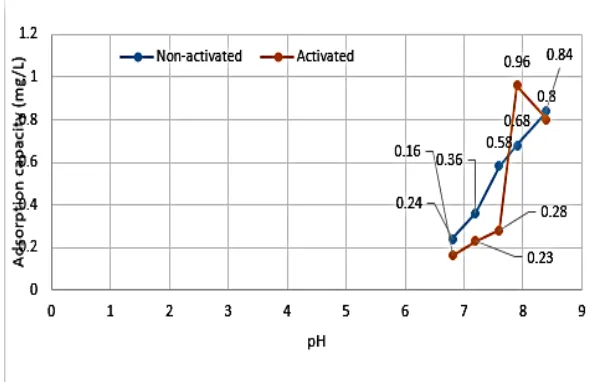
3.4Effect of pH on Adsorption Capacity
Effect of pH on adsorption of the heavy metal onto coconut husk activated carbon was investigated at varied pH while remaining
parameters are kept constant. During this study, results revealed that removal of metal ions was strongly depend on the pH of the
solution as shown in Figure 4. Optimum pH value of 7.9 was established with optimum adsorption capacities of 0.96 mg/g and 0.68
mg/g for activated and non-activated coconut husk respectively. Minimum pH value of 6.8 with minimum adsorption capacities of
0.16 mg/g and 0.24 mg/g were obtained for activated and non-activated carbon respectively. This result revealed that adsorption
capacity is higher in weak alkaline medium compared to acidic medium.
Figure 4: pH versus adsorption capacity
3.5Effect of Temperature on Adsorption Capacity
Effect of process temperature on adsorption of the heavy metal onto coconut husk carbon was investigated at varied temperature while
remaining parameters are kept constant. The result as shown in Figure 5 revealed that optimum temperature of 70 oC was established
with optimum adsorption capacity of 0.83 mg/g and 0.13 mg/g for non-activated and activated carbon respectively. It shown from this
result that the non-activated coconut husk adsorbed more heavy metal than the activated coconut husk. This result is supported by
[image:4.612.155.450.401.592.2]ISSN 2250-3153
Figure 5: Temperature versus Adsorption capacity
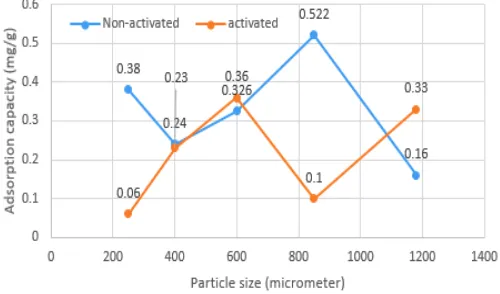
3.6 Effect of Particle size on Adsorption Capacity
The effect of particle size on the adsorption capacity was investigated. The result obtained is shown in Figure 6. From the result,
optimum particle size of 820 µm was established with optimum adsorption capacities of 0.522 mg/g and 0.1 mg/g for both
non-activated and non-activated respectively. The result further revealed that non-non-activated coconut husk adsorption rate is higher than that of
the activated coconut husk.
Figure 6: Particle size versus Adsorption capacity
4.CONCLUSION
This investigation has demonstrated the optimization of adsorption of heavy metals by coconut husk using OFAT method. The following conclusions were drawn from this study:
• The optimum adsorbent dose for adsorption of heavy metal by both non-activated and activated coconut husk using OFAT method is 10 grams.
• The optimum contact time for adsorption of heavy metal by both non-activated and activated coconut husk using OFAT method is 20 minutes.
• The optimum adsorbate concentration for adsorption of heavy metal by both non-activated and activated coconut husk using OFAT method is 0.4 mol/L.
• The optimum pH for adsorption of heavy metal by both non-activated and activated coconut husk using OFAT method is 7.9. • The optimum temperature for adsorption of heavy metal by both non-activated and activated coconut husk using OFAT method is 70 oC.
[image:5.612.192.442.326.473.2]Daud, A.W., and Ali, S.W., (2004). Comparison on pore development of Activated carbon produced from palm shell and coconut shell; Journal of Environmental Science and Technology pg 63 - 69.
Ekpete, O.A., Horsfall, M., (2011). Preparation and characterization of activated carbon derived from fluted pumpkin stem waste (Telfairia occidentalis hook F), Res. J. Chem. Sci, vol.1(3), pp10-16
Gomez, Serrano. (2009), The development of an activated carbon from corn Cob and its use in the removal of Ochratoxin from red wine. Journal of Hazardous Materials, vol 130, pg 298 - 303.
Hammed, B. H., Din, A. T., Ahmad, A. I. (2007), Adsorption of methylene blue onto bamboo-based activated carbon: kinetic and equilibrium studies, Journal of Hazardous Materials, vol 141, pp. 819 – 825.
McKay, G., Otterburn, M. S., Sweeney, A. G., (1980). The removal of colour from effluent using various adsorbents. Water Research, vol, 14, pg. 15 – 20.
Mulu, B. D., (2013), Batch Sorption Experiments: Langmuir and Freundlich Isotherm Studies for the Adsorption of Textile Metal Ions onto Teff Straw (Eragrostis tef) Agricultural Waste, Journal of Thermodynamics, vol. A, pp 6 – 11.
Reed, B. E., Matsumoto, (1993). Modeling cadmium adsorption by activated carbon using the Langmuir and Freundlich isotherm expressions. Separation Science and Technology, vol. 28, pg. 13 – 14.
Sun, Y., Zhang, J.P., Yang, G., and Li, Z.H., (2006), Removal of pollutants with Activated Carbon produced from K2CO3 activation of lignin from reed black Liquors, Journal of Environmental Science and Technology, vol 2, pg 429–435.
Ozer, A., Pirincci, H. B, (2006). The adsorption of Cd(II) ions on sulphuric acid-treated wheat bran. Journal of Hazardous Materials, vol 137, pg. 849 – 855.
Okafor, P.C., Okon, P.U., Daniel, E.F., Ebenso E.E., (2012). Adsorption capacity of coconut (Cocos nucifera L.) shell for lead, copper, cadmium and arsenic from aqueous solution, International Journal of Electrochemical Science, VOL. 7: pp.12354-12369
Veronica, Czttrom, (1999). One-Factor-at-a-Time Versus Designed Experiments, Journal of The American Statistician; vol. 53, No 2; pp 126-131
AUTHORS
First Author – Sirajo Lawal,MEng, Department of Chemical Engineering, Kaduna Polytechnic, Nigeria, [email protected] Second Author –
Musa Lawal.MEng, Department of Chemical Engineering, Kaduna Polytechnic, Nigeria [email protected] Third Author-
Ibrahim Alhaji Ndanusa, MEng, Department of Chemical Engineering, Kaduna Polytechnic, Nigeria, [email protected]
Correspondence Author –