-
--=-
-
-
_--l
UTAS
---�--�---·
Props for Social Discourse
By
Wayne
Z.Hudson
BFA (Hons)
Submitted in fulfilment of the requirements for the degree
of Doctor of Philosophy (Fine Arts) University of
To Helene
Declaration of Originality
This Thesjs contains no material which has been accepted
for a degree or diploma by the University or any other
institution, except by way of background information and
duly acknowledged in the Exegesis and to the best of my
knowledge and belief no material previously published or
written by another person except where due
acknowledgment is made in the text of the Exegesis.
Statement of Authority
This Exegesis may be made available for loan and limited
copying in accordance with the Copyright Act 1968.
ABSTRACT
This research project investigates the role of seating
in rural and urban public spaces. It incorporates referencesto both past and contemporary societies and has been developed as a series of Props for Social Discourse. The result has been the development of pieces of furniture that began with a narrative response to thinking about my life, growing up and living on the North West Coast of
Tasmania. On one level, the resulting works tell a story about how country folk or city folk converse with one another in relatively relaxed social situations. The narrative depicts this Australian discourse both with humour and with a more serious cultural intention, one which is focussed upon how furniture might influence social intercourse.
Running parallel to this investigation, on a formal level,
I have explored the integration of metals and leather. I have woven these two materials together to create a unity. The works challenge the traditional use of these materials, especially in the manner that they have been utilised jointly to date.The starting point for these Props for Social Discourse
was my observation of the manner in which rural people from my district placed their bodies in particular positions when participating in social discourse. This led me to develop the theme of the Leaning Post which, in its various manifestations, is intended to be introduced into public social spaces. These works are directed towards bars, cafes, clubs and meeting places. The public spaces
are specific to
peo
ple who rest and have social discourse
whilst their body is in a vertical, semi-standing position.
Another body of work in these Props for Social Discourse is a range of seating which has been formulated through my investigations of the positions strangers place
developed seating where the sitting positions are separated in order to create a comfortable personal resting place. The seating also addresses the direction that people need to face whilst sitting. This directional position changes constantly as strangers rest together within public spaces.
It is my intention that these Props for Social Discourse have an immediate tactile response with the body. This feeling is visually enhanced where I have integrated metals and leather. I have paralleled these responses with the sexual ones we encounter when relating body skin with sheer fabric or with see-through metal fabric that is presently evident within contemporary body adornment. The outcome has been the melding of these responses within the Props. This development has allowed me to produce larger scale pieces for public spaces which give people the opportunity to respond to the tactility of the form, in both a sensual and sensory way. It is intended that their regional source is also emphasized.
By drawing upon my past regional imagery and
Acknowledgements
Supervisor- Mr. John Smith
Assistant Supervisor - Mr. Kevin Perkins
Postgraduate Co - Ordinator - Associate Professor Jonathan Holmes
Postgraduate Co-Ordinator- Professor Geoff Parr
Editor- Ms. Maria Kunda
Metal Technician - Mr. Graeme Roberts
Table of Contents
Introduction
Chapter One - Behind the Basalt Hills
Chapter Two - The Early Years
Chapter Three - The Power of My Craft
Chapter Four - Regional Vernacular- Tribal
Chapter Five- Social Discourse and Props
Chapter Six - Sexual, Social Interaction, Skin - Metal
Chapter Seven - Technical Experiments
Conclusion
List of Illustrations
Bibliography
Curriculum Vitae
Portfolio
Title - Size ( W. - D. - H. ) Materials
i-xxix
1 -2
3-9
1 0- 1 4
1 5 - 1 6
1 7 -62
63-69
70-77
Introduction
My dreams are my own - so how can anyone ever enter into them. My instincts - my desires - my thoughts, all which have taken a lifetime.
Picasso's letter - 19351
Art School
I came to design from an upholstery background. I completed a
four-year apprenticeship, followed by twelve years in the trade in which the last four years were spent running my own business. I
arrived at Art School keen to pursue my dreams. My passion was to make f umiture out of wood and leather based on the organic
logic of the 70s. I was interested in some of the American designers and craft artists because of their skill and concepts.
I moved on to draw upon Italian designers, becoming excited
with their slick, clean looks and the way that they developed
unorthodox furniture pieces.
In my final year I began to consolidate my forms using images
from my life growing up on the North West Coast of Tasmania, and techniques from my upholstery trade. I used brightly
coloured leather, split wood - based on my grandfather's shingle
cutting techniques, stainless steel, aluminium and coloured paint.
Design Influences
During my Honours year I became interested in artists such as the
architect Antoni Gaudi2 and sculptor David Smith3. Gaudi
inspired me with the way he designed iron within architecture.
Some of the design was structural; other ironwork twisted and overlapped massive stone forms to act as decoration. The way he
used iron in a fluid state was different to any other iron work I
had seen before. I was interested in the way that he used iron in
an organic, decorative format and also where he chose to use it.
Smith's work left me excited about heavy sections of metal being manipulated to create fonns which narrated concepts through abstractness. His personal w ritings and philosophical approach gave me the confidence to introduce my own stories into my work. I also began to use stainless steel, as he had used this material in a large scale forms to play with light and the reflective power of light.
2 lgnasi de Sola-Morales Gaudi, Rizzoli New York, 1986. Antoni Gaudi occupies a unique position in the history of modem architecture. This Spanish architect and his flamboyant art stands alone. Between the mid-1880s until his death in 1926, Gaudi designed a large body of works, including apartment houses, private residences, park complexes, and religious and secular institutions, most of which were erected in or around Barcelona.
3 David Smith,
David Smith Sculpture and Writings,
edited by Cleve Gray, Thames and Hudson Ltd, London, 1988.My honours year produced of a body of work that represented a narrative from my past. I used steel for the first time to depict the ideologies of rural and urban life on that part of the island. Only in one piece did I re-introduced leather for the seating element. This period was important for me, as for the previous two years I had taken sculpture as my second major. Sculpture gave me much satisfaction and had influenced my work greatly. Against all odds, I decided to pursue making furniture in this manner. My work at that point - and even today - has a strong sculptural aesthetic about it. By using steel as a medium for my work, I began to look at the early blacksmithing skills which took me to North Carolina in America in 199 1, to attend a traditional black smithing course.
Paley Studios
Meeting Albert Paley, one of America's leading metal smiths, signaled the beginning of a new approach to my work. In 1993 I was offered a two-month internship at his studio in Rochester, New York. This experience opened up many possibilities,
allowing me to manipulate metals within my discipline. It placed me at a crossroads, forcing me to set new goals and restructure my work. Not only was the experience of working in such a creative and powerful environment exciting, the whole American experience stirred my blood. The attitude of professionalism towards craft and art was positive and assuring, and I felt that to take on this attitude myself would be a great asset to my practice.
Albert Paley runs a large studio employing eleven full-time
people working on large steel sculptures and smaller furniture
pieces. Most of the employees have a fine arts background and
are dedicated to the studio. Some of them pursue their own
practice part-time. I learned how to manipulate larger stock steel;
to take it to white heat and then bend and draw it in a fluid
manner. Being constantly surrounded by large heavy objects, I
became accustomed and at ease with working and moving them.
The understanding of scale and ways of manipulating the material I gained from Paley's studio would strongly influence
my future work. Another thing to challenge my thinking was the way Paley melded many different metals together. This triggered
the idea that I could meld metals and leather together. Albert Paley states:
My basic approach was to clarify and make visible those aspects unique to iron or steel as a material through the working process. The resulting form vocabulary became the basic construct for the development of a work philosophy and approach to design theory unique to ferrous metalworking. The plasticity of iron and steel was what initially attracted me to and fascinated me about them This inherent characteristic gave an understanding of these materials and a design theory founded in paradox. The acknowledgment and acceptance of the dichotomousnature of the materials that present opposite and seemingly contradictory states at the same time and at the same place -movement and stagnation, rigidity and plasticity -created a perceptual reality founded in change and alter ability basic to the organic. The tool imprints, incisions, tears, twists, and burns record the
evolutionary nature of process and form development Movement basic to the organic, of which we are a part, made visible in the steel becomes a foil to human gesture resulting in empathy and anticipated through this visual dialogue. 4
Snake Seats Commission
to be installed. To my amazement they sat around on the floor in
front of the full length windows leaning on one another, back to
oock with legs sprawled in all directions. They reminded me of
snakes on a hot day woven together basking in the sun; it was this
image that led me to design the
Snake Seats.Figure I. Single Snake Seat, 19%.
Figure 2. Three seats in the fo
y
er
, I 9%.The
Snake Seatswere designed with a circular top to allow the
users to sit facing any direction. They also had the option to lean
on one another in a collective social manner. I designed the legs
to be constructed from heavy solid rod twisted and wrapped
around in the lower section of the seat, responding to the initial
concept of snakes basking on a hot day in the country. At the end
of one of the leg elements I fixed a cast bronze head of a snake
and curved it upwards, just edging its mouth through a circular
cut in the centre of the seat. The legs were hot-dipped galvanised
and the seat tops were covered in a clear two-pack finish. This
process gave a lasting quality to the pieces.
This commission allowed me to produce seats in a slightly un conventional way, as the circular seating elements were initially looked upon as tables. A circular was sent around the school to collect their attitudes towards the seats. Their response came in many forms- for example, "they look like tables", "very sculptural", "crazy thinking", "interesting", "they look like snakes- yuk", to "fantastic arty things". The principal of the school was very supportive of the concept and sent a memo around the class rooms telling the students that in fact they were not tables and unlike the ones at your homes, you have my permission to sit on them. The whole exercise was inspirational in that it lead me towards new ways to present public seating.
Another interesting part of the commission was to construct a sign for the front of the new Arts Block, which was immediately
outside the foyer where the seating was placed. They wanted an
image that didn't take over the whole face of the building and
which did not in any way detract from the architecture. My
response was to view the sign like a brooch, as body adornment. The result worked well, as it was visible from many sections of
the surrounding buildings and grounds. The sign was split into two sections horizontally at 80 degrees. A twisted metal pin
separated the two sections, to look like a brooch, and to link the
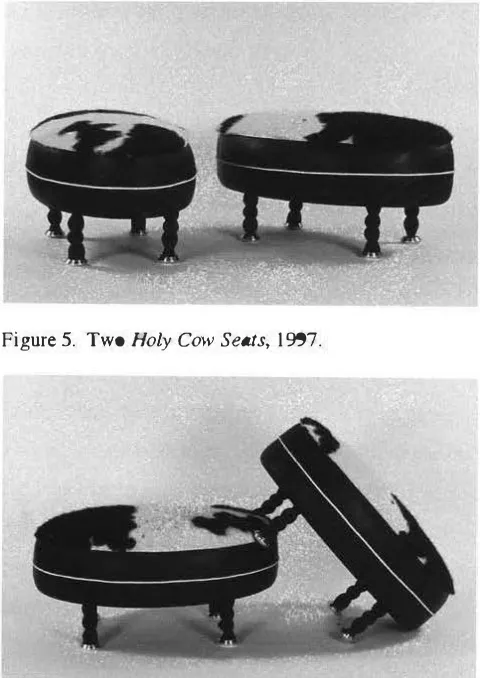
S.O.F.A. Chicago, USA: Holy Cow Seats
I exhibited in Chicago in
1 997,
with Despard Gallery, in.. S.O.F.A": Sculpture Objects Functional Art. As I was
experimenting with the way people use seating, I designed
two oval benches or ottomans upholstered in black-and
white cow fur on the tops, and black and white leather for
the sides. I twisted heavy metal legs, which were finished
with a black acid etching and fitted with bright aluminum
feet resembling cows • hooves. I often think of rural
humour when I am making work. This tends to be visible
in the end result in one way or another. I was interested in
producing a seat for one person to occupy comfortably, or
two people to use in an intimate way.
[image:16.596.190.430.372.711.2]Burnie Streetscape and Beach Seating
In 1997 I undertook a commission for the Bumie City Council to
design and construct bench seating for two locations, one in the
city centre and one on the grass area at the beach, located at the end of the main street. This project used recycled timber from
the Burnie Ocean Wharf, which had recently been demolished.
The timber, called turpentine, was unique: imported from Queensland in 1919, it had provided the piers for the old Ocean
wharf for 7 4 years. At the lower section the wood had been
submerged in two fathoms of water. The turpentine was ideally
suited to last in that environment. After the timber was salvaged
and milled it was still in good condition. I decided to have the
timber cut into slat form, 70nun wide and 25mm thick to use in
short lengths running from the back to the front of the seats. This
method was designed to minimise any cracking that may occur if the wood was cut in larger sections, because the seats were to be
placed in hot sunny positions.
The design and construction of the seats were carried out with the assistance of two Hellyer College students. Part of the program was for me to act as a mentor, to pass on the skills to younger local students. We looked closely at Burnie historically, its development into the next decade, and considered the positioning of the seats in the city.
Long bench seats six metres in length were designed to
accommodate both sites, using images from the ocean to work the legs like twisted kelp. On the ends of the seats we placed
waves reflecting the fierce North West Coast ocean, and we
treated the slat work to resemble the train tracks that link the coastline.
We used a photographer to select images of the city's history and
screen printed them onto stainless steel sheet, which I curved and
placed on the ends of the seats and the inner sections under neath
the ann
rests.
Figure 7. Seat in the main street.
A feature of the seats is the way the long lengths of seating are divided into two sections, providing a separation for more than
one group of people to use at the same time. With straight long benches, people at different ages tend not to use them at the same
time. Allowing for this, I placed a large arm rest in the centre to
provide segregated areas. It works as I found out by returning
many times to observe. The seat in the main street has a fixed
position against a wall, whereas the seat on the beach gave me freedom to create an opposite curve on the seating section.
Research in America at Paley's Studio
In late 1997, as well as showing work in the S.O.F.A. exhibition in Chicago, I took part in the lecture series there discussing my work and my experiences living in Tasmania. After this I extended my research by taking up my second two-month internship at Albert Paley's Studio's. This time the studio was working more in stainless steel, and fabricating large sculptures in a new way. I witnessed and took part in many aspects of this work, and gained enough knowledge and confidence to be able to return to Tasmania and apply this to my own style of work. During my travels I have seen stainless steel used in all facets of trades and arts, but I hadn't seen it worked in such an organic and contoured method before. This is due to the way that Paley applies massive blasts of heat; the resulting forms are the result of years of experience coupled with a masterful understanding of the process and of the completed object.
Figure IO. Albert Paley, Genesee Passage, 1996.
Fonned and fabricated weathering steel Bausch & Lomb Headquarters, Rochester, NY 7W x !56" diam (in-situ).
Figure I I. Albert Paley, Bearing Blocks, 1997.
Figure 12. Albert Paley, Oasis, 1994. Steel, Mahogany, Stainless Steel Function: Coffee Table
54" x 109-l/2"x 19-1/2".
Figure 13. Albert Paley, Mystery Table, 1993.
Formed and Fabricated Steel, Stainless Steel, Marble Top Function: Sideboard
59-1/2 X 104" X 18-1/2".
Figure 14. Albert Paley, Museum Bench, 1994. Forged and Fabricated Steel, Mahogany Victoria and Albert Museum, London, England 27'' X 1 35" X 30".
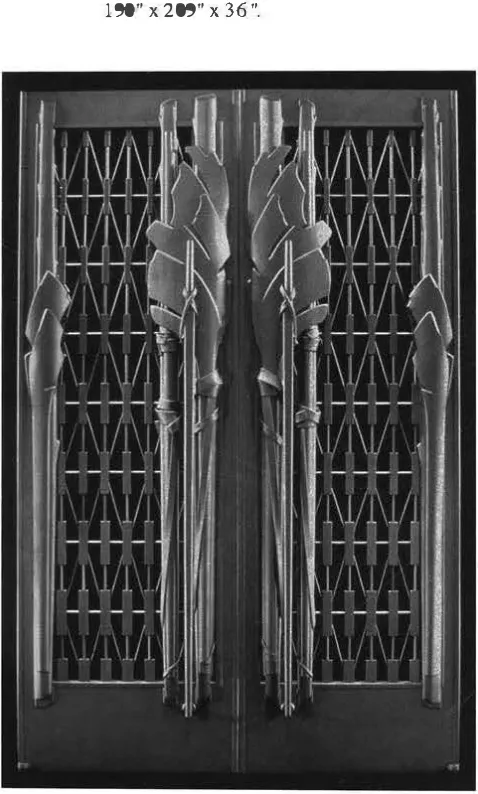
Figure 15. Albert Paley, Apollo, 19%.
Fonned and fabricated weathering steel and Stainless steel
190" X 209" X 36".
[image:22.596.189.428.277.674.2]Burnie Surf Club Commission
I returned to Tasmania and accepted a commission from the City of Burnie, to design and fabricate a sculpture for the wall of the Surf Life Saving Club, situated near the end of the main street on the waterfront in Burnie. I took the opportunity to put into practice the skills I had learnt in Paley Studio's of using stainless steel as the material for the project.
The project gave me confidence to tackle larger scale projects of
this nature. I also made progress with the technique of using
twisted stainless steel, as well as being able to move back to
working the smaller scale objects with ease.
Figure 17. Burnie Surf Life Saving Club, Stainless Steel, cast glass, lighting
1 2 metres long, 8 metres high 1999.
Figure I 8. Sculpture with lights on.
l.cuning l'osts
i\ 1y II r:.;t y�..: ;u· ur PhD Studi c:� wen: taken up ex peri rnenti ng
with Ill:\\' tt.:chnique� uJ' working with rnt.:tal anc.lleatha and
thinking about 11ew way� of re�ting the body. During my
:;c�ond year uf PhD Studil!� ! developed the concept ol' the
Ll!.llJing Pust. I have written about the �ignillcance of leaning
po:;turL'� in variou� �ocial �etting� in chapter one; the way
partkular po�ture� provided the impetus !'or my designs is
discussed in chapter five.
The Props sit at the edges of the furniture discipline, but step
outside the boundaries due to the way they responds to the
function of resting the body. This function has moved from the
squat position to the vertical rest, which also can act as a pose or
stance. The conceptual outcome is derived from the way the
object interplays with the user. The human scale of the object
encompasses the body to create singularity. Some of the pieces
incorporate a grid at face level, which acts as a "protection"
between users. At the same time, the grid creates a situation like
that which the board creates for a chess piece: it delineates a
position for placing oneself into social dialogue. This quality
straddles the work between furniture and sculpture disciplines.
The platform of sculpture presents this work as figurative
expression, leaning towards radical abstractness, with fragmented
body parts. The vertical component�, in most cases, suggest
gestural dance and theatrical movements. The lower sections of
the Props are designed with footrests in a number of positions.
The bases have been designed to present the objects so that they
won't fall over; at the same time they have been aesthetically
Props are commissioned to be fixed permanently in one position.
This would not detract from the integrity of the works.
The Leaning Posts will fit into public meeting spaces of the 2 1 st century, fulfilling the demands of a fast, turbulent life style. The
works display the energy evident in the late '90s, portraying movement and bodily gestures. The works have a place as one off pieces, or can be constructed as a series to fulfil a brief for a
particular space.
Accessories
Throughout the process of developing the Leaning Props I have concentrated purely on the object as a support for the body while resting. I have often been asked whether I have considered
designing flat surfaces for a drink or a plate of food to be placed upon. These accessories could indeed be designed in a number of formats and constructed to blend with the piece rather than a visually awkward attachment. If a future commission specified a modification of this nature, I would certainly consider designing the Props with the necessary accessories. The Leaning Props would be more vulnerable to having drinks or food knocked by arms and elbows, due to their height. To overcome this problem, the accessories would need to be designed with a guard placed around the edge in order to minimise spillage.
Surveying the Field
During the past four years I have been searching within Australia, Americ a and Europe in order to locate artists, designers and
crafts people that are working in a similar manner to myself.
While undertaking my PhD. course, I have visited Chicago, New
York, Rochester, Paris, Auckland and Sydney, as well as searching international magazines. I found artists working in
metals and leather, but no one working them in the same way as I
am. There are some instances of design precedents for furniture
that supports leaning and resting postures, and I have detailed
some of these in the following chapters.
Recently I read in Wallpaper, an English magazine, an article on
Alex Welch, a graduate student whose final year works were
exhibited at Central S aint Martin's London.
Welch is quoted as saying,
Originally, I was interested in small urban living spaces and the role of flexible objects within them; says Welch, producing prototypes from a shroud of bubblewrap. "People use the most abstract of surfaces and structures for sitting, leaning and reading; he enthuses. "usually, public spaces are divided into areas of activity by partitions, glass screens and other similar structures. My design replaces that by dividing or guiding people through these spaces and turning what would otherwise be bland partitions into furniture .. 1
Figure 19. Divide and Conquer, Alex Welch's 30. rubber screens, 1999.
This was an interesting find, and although the work is pursuing a
different path, it shares the objectives fonnulated around my
Props. It also reinforces my direction in continuing to make
Leaning Posts and the particular area that I need to address for
marketing this work.
Although I have found few examples of designers working in the
specific ways I design and make, it nevertheless remains the case
that there are a number of contemporary designers whose works
have had a bearing on this research project. In this next section I
provide an account of the work of these designers and have
highlighted the techniques and conceptual concerns that seem to
me to relate to this project.
RonArad
Designer I Maker- London.
Ron Arad's work has fascinated me since I first saw it in
Barcelona in
1990.
I was interested in the way that he mouldedmetal and formed it into compound curves to produce chairs and
tables. The moulding consisted of heat forming, rolling,
hammering and finally securing the joints by welding. His work
consists of shiny metal forms which contrast with the layering of
materials and the highly textured surfaces of my work. However
there are shared elements in our work, that may evoke responses.
For example, the stainless steel seat cushions in Sit and Lean p
58 have similar qualities to Arad's chair, Big Easy volume 2
L 989. Big Easy Red Volume I, 1989, as shown in figure 20
conveys the upholstered version of the original silver metal chair.
The voluptuous form also possesses the gestural qualities which I
intend my forms to express.
Figure 20. Ron Arad, Big Easy Red, Volume 1, 1989. Charlotte and Peter Fiell, 1000 Chairs p. 609. Taschen, ltaly, 1997.
Wen dell Castle
Designer I Maker, Rochester, New York.
Wendell Castle is one of America's leading Furniture Designers,
who employs up to 11 people in his studio. Castle produces one
off pieces and specialises in wood, which he tools, carves and
paints to a high degree of textural finish. I first met him in 1990
and again in 1993 and 1997. During my visits to his studio I
noted an aspect of his work that correlated with my own
methodologies. The most important aspect is the way he
They create relationships to one another and address site specific
locations.
Castle's work, Round Midnight, figure
21, shows an organic form
with a textured surface that displays an ambiguity of materials. Most of his organic forms have opposing geometric elements
attached to them, providing hard edges at particular points of the
object. This differs to the ovemll softness of my work, which seduces people, where his sharp hard edges do not invite people
to fully engulf themselves.
Figure 21. Wendell Castle, Round Midnight, 19%.
Sculpture Objects Functional Art, Exposition Chicago.
Catalogue 1997 .p. 123.
Jaroslav Susta
Designer I Maker, Prague, Czechoslovakia.
1 discovered the work of Susta's in a catalogue of a design group
called Atika, working in Prague. The group of five designer I
makers graduated from Design Colleges in London and Prague
and have limited documentation outside of Europe, but have
made a mark within the contemporary field in Prague. The
members of the group concentrate on one off pieces of furniture.
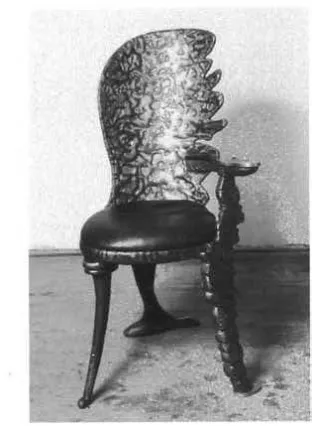
The chair of Susta's, Muzatka, figure
22
is designed with oneann. The layering of the materials on the back support is not
dissimilar in the way in which I have placed leather behind the
cut out fonns of metal. The pleating in the seat has a way of
drawing you to the arm side of the chair, especially as that side is
heavily textured with waves on the back and the strong front leg.
The asymmetrical design of the chair and the placement of one
arm to rest upon, has a similar postural approach to Nadar's chair
[image:30.596.167.323.190.403.2]in Chapter Five p.
30.
Figure 22. Jaroslav Susta, Muzatka Chair, 1992. Catalogue Object Contra Design Atika, p. 6. Prague, Czechoslovakia, 1993.
Tom Dixon
Designer, London, UK.
Dixon's earlier work as shown in Kitchen Chair, figure
23,
fitswithin the parameters of industrial assemblage, where the process
of the machine is visible. The curved sections of the chair are
constructed from iron frying pans and ladles welded together
with the joints intentionally exposed. Though I am working with
curved metal forms and steel, my process is opposite to Dixon's
work. I use techniques of working the metal that produces a
softer finish. I also grind away the visible welds and texture the
wa�houses. This method of construction gives the bright colored clulirs an abundance of strength. I have applied the same method 10 construct lhc inner frame on Solo, Chapter 5, p. 51. where I ha"e then covered lhe frame with moulded leather. Dixon' us� thi melhod. translating it well imo an upholstered fonn d1rcctcd towards industnal production.
Ftgure 23. Tom Dixoo, Kitchen Chair, 1987.
Charlotte aod Peter Fiell. 1000 Chairs, p. 5�
Tascheo, Italy, 1997.
Figure 24. Tom Dixoo, Bird 2, 1992.
Charlotte aod Peter Fiell, 1000 Chairs, p. 651.
Tascheo, I taly. 1997.
I have made an attempt to juxtapose these two processes into
some of my work as shown in Chaos on Friday Night, Chapter
5,
and Separated. Chapter5,
p.56.
Jasper Morrison
Designer, London, UK.
Morrison's work is directed towards the manufacturing process,
with a strong aesthetic of purity and clean lines with bright
coloured fabrics. The settee Three, figure
25,
is visuallyexpressive and relates to my seating work, Twisted Love 2,
Chapter
5,
p.22,
through the way Morrison has separated the seating positions and omitted the back rest. Settee Three allowsthree people to sit at different heights, or two people to sit with a
space between them, or to use the central section as an arm rest.
If the settee were placed in an open space then people could use
the seat by sitting on either side, facing opposite directions as in
Twisted Love 2.
Figure 25. Jasper Morrison. Three, 1992. Charlotte and Peter Fiell, 1000 Chairs, p. 638. Taschen, Italy, 1997.
Morrison's Benches, figure
26,
are designed to offer the user single, double or multiple seating positions. This simple blockform can be arranged in many formations and is a practical
solution for arranging people to rest in public spaces. This
solution runs parallel to my prescription for people resting
together in public spaces. confirmed in Twisted Love 2, Chapter
Figure 26. Jasper Morrison, Benches, 1989-I 991.
Charlotte and Peter Fiell. 1000 Chairs, p. 639.
Taschen. Italy, 1997.
Marc Newson
Designer, Australia.
Newson's Lockheed Lounge, figure
27,
captures the workbetween
1985-86,
but this piece still retains a significant visualpresence about it. The design combines molded metal sections
riveted together and formed over the compound curved armature.
This piece provides a point of comparison for my pieces Sit and
Lean 2000, Chapter
5,
p.58.
The Lockheed Lounge sacrifices comfort for aesthetics. Although the piece provides someinteresting curved lines based on aircraft construction it lacks
concave seating form. The seating cushions on Sit and Lean
2000, have similar qualities to the Lockheed Lounge but in terms of comfort, are considerably ahead. Lounge chair cushions were
the criteria for developing the metal seats. This idea led me to
contour the top edges and lower the central surface section of the
cushions, which resulted in creating a sense of ambiguity at first
sight. This ambiguous presence with the seat cushions supports
my argument that the
Leaning Propsproject a strong usage of
both function and sculptural form.
Figure 27. Marc Newson, Lockl1eed Low1ge, 1985-86.
Michael Bogle and Peter Landman, Modern Australian Furniture, p. 37.
Craftma.r1 House, 1989.
Andrea Branzi
Designer, Milan, Italy
Branzi is a leading Italian designer. His work is based on a
postindustrial approach, which places importance on the
individual user of the object. The
Niccolachair figure 28, is a
strong example of postmodem furniture, as the Italian designers
have recognition for being highly active in this period. The
chair's form displays fluent lines, softened on the edges with a
fine cord covered with fabric. This is a traditional upholstery
technique used extensively between 1 920 to 1960 on lounge
chairs. The chrome metal tubing on the chair legs and stool is
reminiscent of a 1960s style of seating. The head, arm and foot
rests have been designed with a decorative intention,
demonstrating the importance of the placement of limb supports.
The positioning of the rests offer many alternative positions for
Figure 2&. Andrea Branzi, Niccola, 1992.
Charlotte and Peter Fiell. 1000 Chairs, p. 663.
Taschen, Italy, 1997.
Phillippe Stark
Designer, Paris, France
Stark's work is based upon a design criterion that is directed at
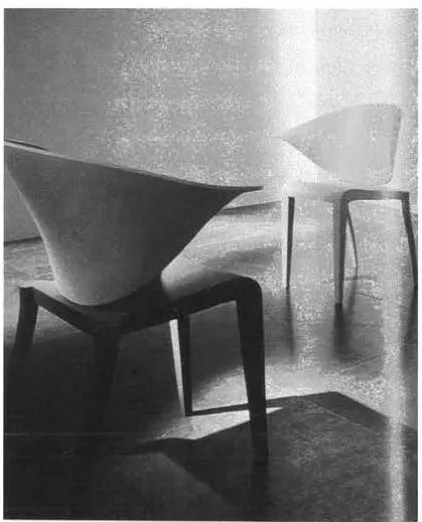
mass producing superbly crafted objects. The
Boom Boomchair
figure 29, projects biomorphic forms that visually exhibit a
softness that is in contrast to the hard polyurethane frame over
steel inserts.
Figure 29. Phillippe Stark, Boom Boom, 1992.
Charlotte and Peter Fiel I, I 000 Chairs, p. 644.
Taschen, Italy, 1997.
The Boom Boom chair displays the aesthetic role of bringing
together the organic and geometric form. Wherever Stark uses
this format he considers the joining of the two opposing elements
with great care as the fragility of this technique is a unique factor
within many of his his designs.
Stark's
W. W. Stool,figure 30, resembles a moving creature, the
fluidity of the components relationship to one another is similar
to the approach I have taken when constructing the Leaning
Props.
The Props are well resolved in this same manner, where
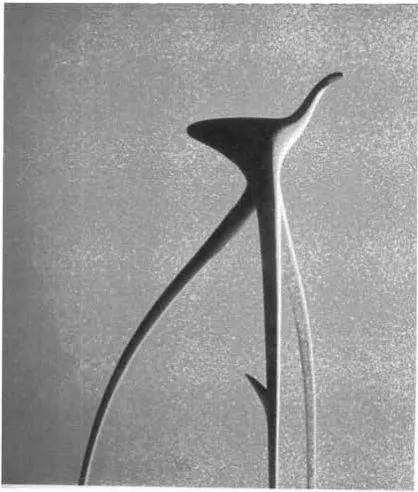
[image:36.596.183.392.337.583.2]the foot rests, legs and resting components are often formulated
from the same piece of metal. This factor is important as is
directed towards assimilating the object with the form of the
human body.
Figure 30. Phillippe Stark, W.W.Stool, 1990.
Charlotte and Peter Fiell, 1000 Chairs, p. 645.
Summary
I see my work as being informed by the designs of these
international designers and many of their technical and
conceptual applications employed by them are not dissimilar to
my concerns. It will have been noted however, that all of those
design solutions covered in this section deal with the body in the
seated position. My claim in this thesis is that the solutions I
have created for the resting body in the vertical position, the
Leaning Posts,represent a significant design innovation in the
field of funtiture.
Chapter One
Behind the Basalt Hills
My earliest, most exciting memory as a child was travelling
with my father during school holidays, early in the mornings
to his place of work. This journey dislocated us from the
ocean of the North West Coast. We would cut our way
through the grassy covered basalt hills of Surrey Road to the
plateau, which slowly inclined and wound its way through
Hampshire to the base of St. Valentines Peak. The locals
call it simply "The Peak". When descending from the
north, you entered the grassy plains of the Surrey Hills that
roll down through Old Park, Hampshire, Highclere and into
Burnie town, which is located on Emu Bay.
The power of this land is overwhelming. The weather is
changeable from sunshine to snow in a moment, with a
vast range of possibilities between. In the winter months,
black frosts occur in early mornings. Mist and fog cover
the valleys, icy cold sleet drives from the south, and heavy
snow fuses with rain. The summer months might well be
the same, but there can be many warm to hot days and
dry, windy conditions that can rapidly change into raging
bush fires.
My inspirations come from my experiences roaming the
basalt hills and swimming in the crashing waves of the
North West Coast; witnessing the changeable weather
storms, rain, snow, hail and massive waves crashing over
the Burnie breakwater during winter storms:
The taste of salted lips; learning how to kiss on the beach on Saturday nights. The drive or walk through the rain
forests on hot summer and stormy winter days, trees bending and creaking at full pitch. The sound of
Football spectators cheering in the local parks. The vista
in the main street during the anti Vietnam rally. Crying
lovers in distress, fighting at a street corner on Friday
nights. The darkness in the cold lane, the currawongs in
the fields, bees swarming, the wattle grubs before a fishing
trip. The miners underground swearing and drilling
rocks, blasting rock faces 400 meters under the ground
surface. The quiet voice of my father as he told me stories.
The resting and relaxing at social and sporting events.
My experiences of the land, and those of my forbears of the North West Coast, are associations with a landscape which speaks poignantly of hardship, heroism, beauty and failure, and have done at least since colonisation. A main road linking the West Coast marks a change, along with the logged forests and belts of the new growth of pinus radiata. The soil, gravel, mist, frosts, snow, march flies, hail, heat, snakes, vegetation and currawongs are still the same. The harshness of the weather prevails in the same manner as it did all those years ago. From my many experiences growing up in the area, I see the changes as insignificant.
The topographical conditions surrounding my formative years, and their impressions upon me have an ongoing presence within my work. My interest in leather and skin was formed through the same experience. Not only was this due to viewing the hills and distant plains, but also to observing the earth that I trod upon.
Chapter Two
The Early Years
In this chapter I address the imagery that is evident in my work. I will outline how the imagery is evoked from nostalgic memories of a determined past.
My grandparents were a driving force for me, especially
my grandmother, with whom I spent numerous holidays, in a nearby coastal country town on the North West Coast. She was a strong, determined, self-sufficient woman who spent many years of her life living on a farm. She was resourceful, and could turn her hand to a multitude of skills.
I spent time with both my grandparents on their farm when I was very young. Images I recollect are of riding
on the sledge behind the draught horses, and ploughing in preparation for the planting of the potato crops. I
remember going to the horse races to watch my grandfather race. He often took me to the stables
afterwards.
I can vividly remember the odours of the horses.
Especially when they had been working, they produced a creamy lather on their bodies, because horses perspire
through their skins, as humans do. The leather saddles creaked as the horses moved around their stables. The scent of the freshly applied leather dressing blended with their lathered body odour, fumes from their waste and the smell of hay. There was an ambiance of strength and warmth.
Often, somewhere within the stable complex, there was
for working with metal and leather comes from the aura
of the -stables.
Those early years were full of notable occasions of
travelling to country shows and festivals with my parents,
and spending many hours with my father watching the
wood chopping, horse and machinery events. These events
were mostly associated with the male rural activities, which
highlighted physical strength.
The plank seating which surrounded the arenas and show
rings were often full to capacity, leaving many people to
stand for hours, including my father and myself on many
occasions. Most of the arenas, show grounds and football
ovals had horizontal railing running around the perimeter.
Vertical posts at a finished railing height of approximately
900mm to
IOOOmm supported this railing. The railing
acted as a barrier between spectators and competitors, in
parallel to the way domesticate farming animals are
fenced off.
Observing these events, many people seemed comfortable
simply leaning on the rails. This was an i nformal stance
in which to place one's body while resting, maintained by
occasionally changing the positions of the legs in the
same manner that a horse rests its body.
Figure 31. At the Royal Hobart Show, 1999.
rigure 32. Ar the Royili Hobart Show. i 999
It was generally the I113le gender that occup1ed th1s
particular stance. They would look relaxed as they leaned
over the railing, chatting and observing the evems_ We men
too -sometimes assumed a version of this position.
Photographic images clearly show that in the 1920s
women in iong dresses did in fact gen�iy iean on the raiis vi�wing sut.:h cvtnts.. Thtre nw.y havt been consideration
taken to avoid crushing the :fabric� but the casualness of
these po�toral events incited the observer to rest in this
me de.
rtbout 1863 fre:;n /\.Han Sierp .. s Cnlonial L.ife in To..�rnar.iu.rt .. p. 56 .. �r:i.fty Yeu.r ,') of Photogr{t.Jil; y. 1855-1905 Rigby Li:nited .. i 976.
people resting 1n such a -.;/a_y -.; .. 'as a common occurrence Iri
fGrmers i�ned on something .... �hiie engaged c3suaiiy in
sociai discourse. This couid be a tractor tire� a baie of hay
or oats� the bonnet. of � motor vehicle or a ver�ndah r�iling T'he:;t \:tJouid also tend to mo·ve their bodies in
such o position \;;hiie they observed their pastures or
<mimals.
The verar1daJ1 ralling becau.1e a rituaJ sett!ng i n (he
·v.tcs setting. This rail ''vas used
prop oneself upon "�vhiie proudly ga:zutg over their
pror---ert):- or the results of the day· s v}ork:� Some ;rerand.ah
T'he roac and forest v .... orkers are another gro:_:p of people
·.�110 tend to positio:1 t11eir bodies over vettical objects for
resting� Road v�1orkers have a tendency to rest on the�r
or a faHen tree placed i�1 a particular position to brace the
body for rest I had vvondered ':vhy it wa� .net:essary to 1ift
one foot onto an object of approximately 1!J!Jmm to 200mm (:ff the gTGUnd 'lih.ilst 1eaning . .:i .. fter ill!H.;h
Exploring the leaning stance further, I found that outdoor
workers in Australia in a particular period - at least in the
1900s to 1950 that I can verify by local research - could
take an unprescribed break from work by leaning on an
object to have a "smoke". This was widely tolerated,
although by some it was considered as slothful or lazy,
but if workers actually sat down to smoke they would run
a high risk of being dismissed from their employment.
Fjgure 37. Road Worker, Hobart CHy, 1999.
My mother would lean on the back fence casually
speaking with the neighbours: "over the paling fence
discourse". This often happened while one woman was
hanging the washing out.
Acup of tea was often at hand
while the conversation was taking place. This type of
meeting would take the place of a more formal invited
visit for tea, due to the fact that in that period, w orking class women at home would not have time for social events through the day. This was a pattern of social intercourse in many backyards throughout the coastal
regions of the North West Coast and, in fact, all over Australia.
Whilst in New Y ark, USA I found this style of behaviour was common in outer regi onal districts of the major cities. My research in Rochester New York found that it was very common in the 'twenties to the ' fifties.
The memories from my early years have triggered
imagery that I gather and manipulate to respond to a
changeable contemporary society. The images that I have
described in "My Early Years" were a starting point for
me to scrutinise the way people communicate with one
another, and the way that they socialize and position themselves in vertical positions while resting. It is this line
of enquiry that has provided the main context of my
Chapter three
The Power Of My Craft
My craft discipline was introduced to me at an early age
through my family, where background skills ranged from
farming to timber work. When I was born my father
presented me with the family icon, an axe. From this
point he persisted for many years teaching me how to use
it correctly. There was a period in my youth where he
would fasten a short length of a sapling, (a round limb of
a eucalyptus tree) onto another block, (known as a
dummy) for me to practice my cutting skills when I
returned home from school. During this part of my life I
discovered my passion for the material. I was interested in
the way that the axe would cut into the wood, and how the
cutting would leave an overlaying mass of patterns. I
worked at this for many years as well as learning other
skills associated with timber.
My grandfather on my father's side was a shingle splitter.
I learned the skills, and consequently the tools of trade
were passed onto me. For a few years later in life I used
to demonstrate shingle splitting at some of the local shows
and animal field days, as well as splitting many for a
house I built.
Figure 38. Myself learning the skill of using an axe c.l956.
Figure 39. Shingle splitting tools and split shingles.
During and after my apprenticeship as an upholsterer
Ispent 16 years stretching fabric and leather over forms to
create seating for people to rest their bodies in. The way I
manipulate metals is akin to the way
Iused the materials
in upholstery:
Iwork metal to give the appearance of
leather.
I soften it to be able to curve, stretch and squashit into organic forms.
Cold steel is extremely hard and rigid by nature, evoking
the hardship of early industrial processes and the struggle
of underground mining whereby ore is obtained to
produce steeL For me, the confrontation with black steel
early on a cold morning brings back memories of hard
work amongst the basalt hills of the North West Coast.
Steel's harsh rigidity sometimes pushes me away from the
material, until I
take it past this point. Viewing the hot
embers engulfing the metal in the forge; feeling the heat
when the metal falls into its plastic state: this plasticity
presents an extreme contrast to metal's cold state.
The exciting, spontaneous part of my work occurs when
Iengulf myself within the process; when
Ibring the coke
fired forge to extraordinary heat. To be able to take the
Under extreme heat, metal is easily manipulated into an
organic form. As the heat falls away quickly, the metal
has to be worked fast to be able to complete the particular
design in process. This physical process demands speed
and spontaneous calculations as to where the metal needs
to move next. One heat is taken and worked upon, then
the metal is then placed back in the forge to prepare for
the next heat. This is repeated until the particular
component is ready to be part of the object.
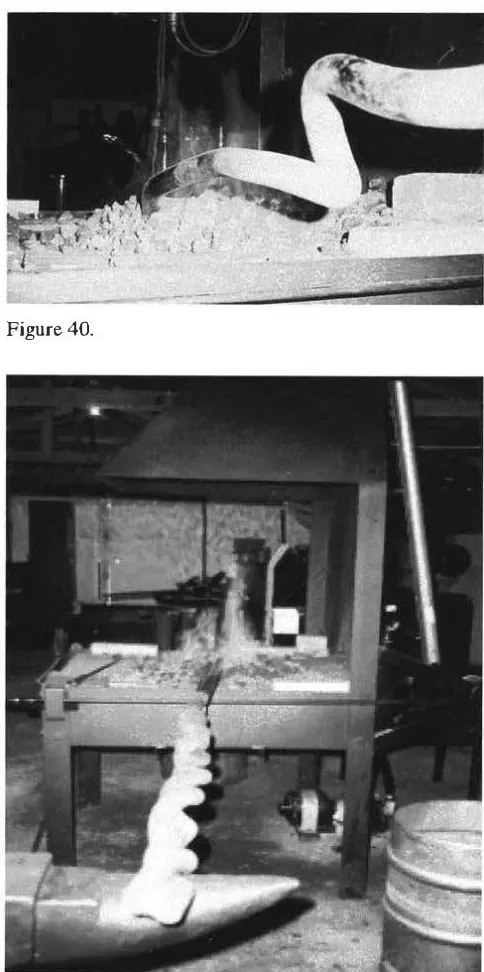
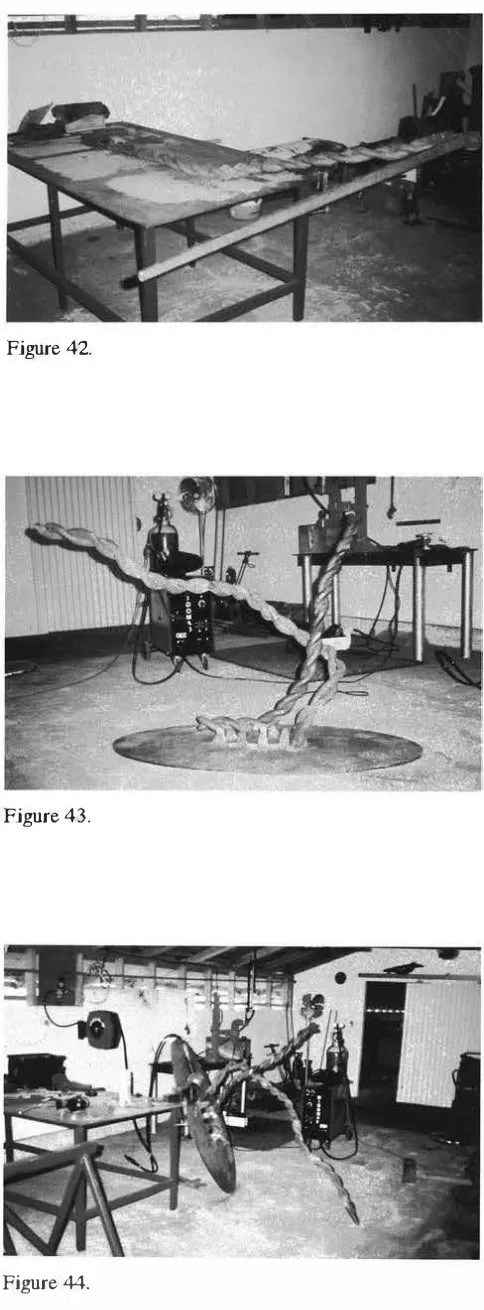
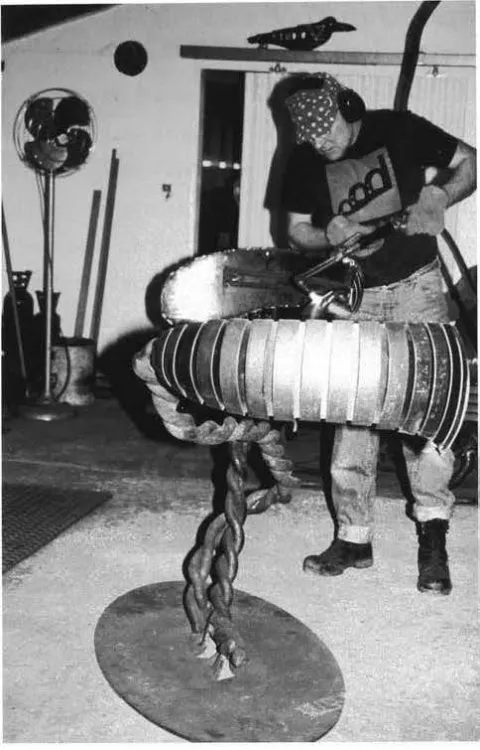
Figures 40-45. Body Hug under construction,
[image:49.596.236.478.279.765.2]from the forging stage to the compteted metat construction stage.
Figure 40.
Figure 41
Figure 42.
Figure 43.
Figure 45.
Paley's manipulation of metals in such a fluid way
inspired me to recall the way I had previously used
leather. As
I
was already intertwining these two materials,
the urge to reverse the roles of these materials became
stronger. I was provoked to place these materials together
in many different ways, using the accuracy of sewing soft
leather in sympathy with heating and manipulating metals.
From these technical discoveries, the next logical step was
to reconsider my conceptual approach to designing
'props' for people to interact with in public space. The
Props
are a fusion of many aspects of my past, linked with
the exploration of change, new experiences, fashion,
sexuality and looking into how people relax in
contemporary society.
Chapter four
Regional Vernacular: Tribal
Living on the North West Coast of Tasmania I discovered
that there were many territorial claims over a distance of
40 kilometres. This was evident within the arenas of sport,
politics and general living in small isolated communities.
The coastal people all lived under the same protective,
vast, powerful basalt hills which face the massive waterway
called Bass Strait. The power of the topographical
location has created small pockets of dwellers, highly
over-protective of their pieces of territory. This territorial
attitude has been instilled in them through the pride of the
early pioneers who carved their own plots across the
coastal hills.
Next to the tribal towns, St Valentines Peak is the pinnacle
that separates the coastal towns and the West Coast. As the
crow flies, the distance is not great. It is only the vast
gorges and rugged interior land that separates the west
from the northwest. The West Coast is notoriously harsh
in living and working conditions, made up of a series of
mining towns. The West Coast encompasses iron ore,
steel, walls of rock, deformed and twisted tunnels,
diamond drilling by hand and machine, steels vibrating
into the columns of rock: these are hard working, hard
drinking, male dominated places.
around, notices the Toyota parked nearby, and calls to me
to drive it onto the platform. He lifts the bonnet and
connects the firing wires to the battery terminals.
Amongst the sparks and cheering of the miners, a massive
explosion and ground shaking experience happens. This
unorthodox event is probably familiar to the many people
from different cultures working underground in the
mining industry. Their passion and hatred towards their
job and one another runs parallel with the tribal
differences of the North West Coast of Tasmania. The
weather pattern in this area creates havoc with the
inhabitants' lifestyles, as it is unpredictable and extreme;
from passive to wild conditions within hours. Yet in times
of hardship and crisis these people stand together and are
tender and affectionate towards one another.
During my recent travels to New Zealand and America I
found a similar line of tension flowing between the many
worldly tribes.
In my work,
I
take the historical and ideological aspects of
regional areas and meld them with late twentieth century
social issues. The work has an anthropomorphic quality
because it draws upon tensions of regional situations,
which I express through the materials by the particular
ways I use them. It is this anthropomorphic quality that
generates humor through the work; humor that I find
necessary to soften the heavier issues which are the
inherent in the work.
Chapter Five
Social Discourse and
Props
I have made a variety of objects that offer people personal
space while resting their bodies in public places. These
resting objects are designed to give people the choice of
resting intimately or positioning their body to minimize
any discomfort that may be presented by another person
being close by. The Leaning Posts provide space for two
or more people, and can be used from either side. In this
sense, the object sets up a barrier between its users.
For many years I have been observing the usage of public
seating. The areas of research have been parks, malls,
beachfronts and other general public resting-places. I
have noticed that people do not entirely utilise traditional
long bench seats. In most cases people perch on either
end of the seat, leaving lots of personal space in between.
This space could suggest unused space: looked upon
critically, the construction and materials can be seen as
wasted.
Throughout my travels in other countries I have seen that
every human being has the need to rest parts of the body
while in a number of situations, but the mannerisms are
likely to change slightly, according to cultural
In his essay "Techniques of the Body", Mauss discusses how from society to society, men and women use their bodies in socially defined poses and postures, and he observes that each society has its own special habits:
During the W ar I was able to make many observations on this specificity of technique of digging. The English troops I was with did not know how to use French spades, which forced us to change 8,000 spades a division when we relieved a French division, and vice versa. This plainly shows that a manual knack can only be learnt slowly. Every
technique properly so-called has its own form. But the same is true of every attitude of the body. Each society has its own special habits. 6
Mauss describes how the British and French infantries marched with a different step, also the French bugle sound was completely at odds when the English tried to march in step: the music would be out of step. He observed that cultures crossed over techniques.
A kind of revelation came to me in hospital. I was ill in New York. I wondered where I had seen girls walking as my nurses walked. I had the time to think about it. At last I realized that it was at the cinema. Returning to France, I noticed how common this gait was, especially in Paris; the girls were French and they were too walking in this way. In fact, American-walking fashions had begun to arrive over here, thanks to the cinema. This was an idea that I could generalize. The positions of the arms and hands while walking form a social idiosyncrasy, they are not simply a product of some purely individual, almost completely psychical and mechanisms.7
6 Marcel Mauss, "Techniques of the Body", translated by Ben Brewster in
Economy and So ciety,
2 , 1 , Feb 1973, p.70. 7 Ibid, p. 72.As well as pointing the influence of social habits on posture, Mauss also connects what he terms "techniques of the body" with the terrain that people inhabit.
Rest can be perfect rest or a mere suspension of activity: lying down, sitting, squatting, etc. Try squatting. You will realize the torture that a Moroccan meal, for example eaten according to all the rituals, would cause you. The way of sitting down is fundamental. You can distinguish squatting mankind and sitting mankind. And, in the latter, people with benches and people without benches and diases; people with chairs and people without chairs. Wooden chairs supported by crouching figures are widespread, curiously enough, in all the regions at fifteen degrees of latitude north and along the Equator in both continents.8
There are people who have tables and people who do not. The table, the Greek 'trapeza', is farfrom universal. Normally it is still a carpet, a mat, throughout the East. This is all complicated, for these forms of rest include meals, conversation, etc. Certain societies take their rest in very peculiar positions. Thus, the whole of Nilotic Africa and part of the Chad region, all the way to Tanganyika, is populated by men who rest in the fields like storks. Some manage to rest on one foot without a pole, others lean on a stick. These resting techniques form real characteristics of civilisations, common to a large number of them, to whole families of peoples. Nothing seems more natural to the psychologists; I do not know if they would quite agree with me, but 1 believe thatthese postures in the savannah are due to the height of the grasses there and the functions of shepherd or sentry, etc.; they are laboriously acquired by education and preserved. 9
Twisted Loa·e
Love eab
were designed o accommodate two people
iLung close to one another. Some had a similar width sear
and back. Other desagns provided a sear for two people,
bur the back was curved, narrow and tapered at the top,
which naturally moved the top sections of the two bodies
closer together. Another account suggests that the wide
seats were designed to accommodate the voluminous skirts
of ladies of fashion more comfortably.
IOThe other
example is a favourite of the Victorian era, an innovative
form in the
rete-a-rete,or Love Sear of the mid-I 800s.
This sr yle was designed to separate the young courting
couple while they were engaged in social discourse.
Although they were facing opposite directions, they could
in fact look sideways to view one another and because of
the low upholstered section that separated them they were
able to hold hands or touch discretely.
Figure 46. Love Seat or the Sociable, English 1844.
C. King, An Encyclopaedia of Sofas, London. Apple Press, I 990.
10 C King. An Encyclopaedta of Soja!.. London, Apple Press, 1990, p.IS.
Figure 47. Conversation Piece, English 1 &50.
C. King, An Encyclopaedia of Sofas, London, Apple Press, 1990.
A link with this period can be made with the days of
drive-in theatres. The bench seat of the motor vehicle
provided the situation for social and physical couplings to
take place or not. Where on many occasions the film
passed quickly with both participants still sitting hard
against the doors with a feeling of cold space in between
them, the bench seat acted like a chessboard. One kind of
"move" permitted two people to sit together, while the
other "move" allowed them not to: the cinema setting
provided the options for ignoring or engaging with the
activity on screen.
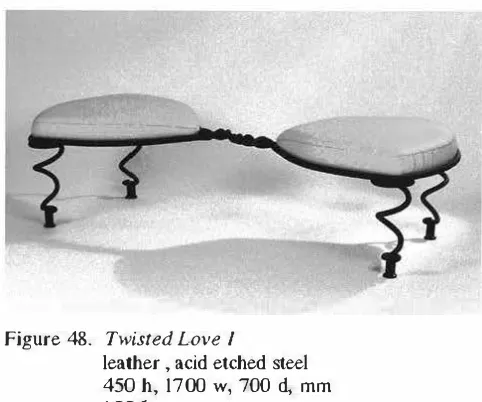
Figure 4&. Twisted Love I
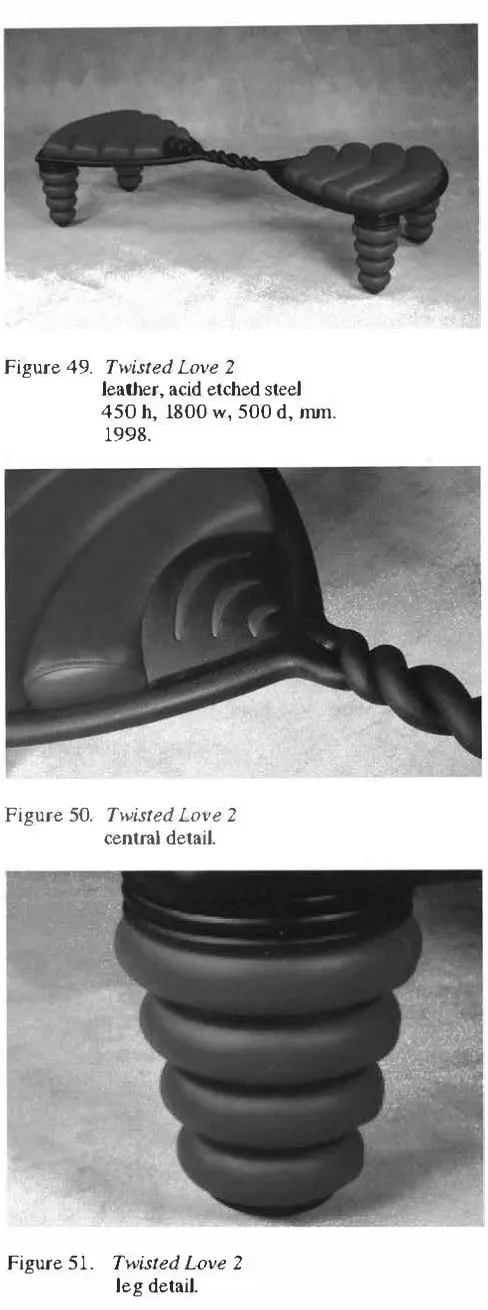
Figure 49. Twisted Love 2
Jeat11er, acid etched steeJ 450 h, 1&00 w, 500 d, mm.
1998.
Figure 50. Twisted Love 2
central detaiJ.
Figure 51. Twisted Love 2
Jeg detaiJ.
These situations have been behind the concept of
TwistedLove.
The name is derived from the fine line between
love and hatred, and the way that there can still be a strong
binding force between people who possess these mixed
feelings. There are many twists to love and in all relationships between individuals and between cultures. The separate seating allows people to exchange social discourse or be silent and dwell on their own presence. The twisted metal form speaks about the hidden twists within human nature, the solid unity, the vitality, and the feelings that for whatever reason keeps us alive every day.
I designed Twisted Love to allow two people to be able to sit together on either end, but at the same time I wanted to offer a space for two strangers to rest on either end. The strangers have these options: to straddle the seat and face one another; to face the same direction, or to face in opposite directions.
Lovers have many options for placing themselves on this seat. Strangers too have the option of sitting 500mm or
1300mm apart, as well as utilising directional approaches. The possibilities will vary depending on the situation; the aura that one is confronted with when coming into contact with a stranger.
I have noticed that when people are placed together en masse, for example at sporting events, parades,
ceremonies, or concerts, they will sit or move together and be less concerned with maintaining their personal space. Even though some of these events are controlled or orderly in approach, others are in a situation where excitement and hyperbole is evident.
Other situations, like the 6pm bar closing time in the pre-1950s, expose the shedding of inhibitions about rubbing shoulders between strangers in public places. This was very much a male setting where a large working
Inhibitions are sometimes visibly diminished through the consumption of alcohol and, in a bar situation, human behavior changes and peoples' sense of personal space is diminished or disregarded altogether in some cases.
I find that our own culture has a particular body
technique: leaning and squatting. The warmer weather in most parts of the inhabited continent provides a
highlighted, leisurely laid back life style, informal in its behavioral patterns. This is a country that provides freedom, open spaces and more leisure hours than many other places. Males in particular express an informality in their poses and in the resting positions they adopt to participate in social discourse.
In general, Australians have developed a social etiquette of informal postures that contain anti-authoritarian gestures. This is noticeable within certain situations where the warrior and the blokeish gestures of fighting and toughness come into play. Attitudes towards police are often conveyed through postures and gestures. These gestures are informal and reveal disrespect towards the law. This attitude runs a fine line towards actually provoking the law.
Mary Douglas, in her essay entitled "The Two Bodies", conceptualises the social body and space. Her ideas appeal to me because, as Douglas points out, the
informality of resting in the vertical position is associated with social informality.
Formality signifies social distance, well defined, public, insulated roles. Informality is appropriate to role confusion, familiarity, intimacy. Bodily control will be appropriate where formality is valued, and most appropriate where the valuing of culture above nature is most
emphasised. All this is very obvious. It goes without saying that any individual moves between areas of social life where formality is required and others where it is in appropriate.
There are two physical dimensions for expressing social distance; one is the front - back dimension, the other the spatial. Front is more dignified and respect-worthy than back. Greater space means more formality, nearness means intimacy. By these rules an ordered pattern is found in the apparently chaotic variations between diverse cultures. The distance between two bodies is the range of pressure and classification in the society. A complex social system devises for itself ways of behaving that suggest that human intercourse is disembodied compared to that of animal creation. lO
Research In America
The major American cities provide seating in a number of formats. Surprisingly, the bench seat is the most common form for resting one's body. It appears in outdoor public spaces and indoor spaces, such as Art Galleries and
Many office and corporate workers tend to take a break at mid-day, often spending some time on their own. I noticed two people sitting on either end of a bench in a park having lunch, one female and one male. I sat in the center of the bench to see what would happen. The female looked disgruntled and moved away, the male felt uneasy until I moved myself to the other end of the seat. As stated, this is an uptight city, where tolerance is a little thin at times, especially through a snowstorm or a heat wave.
I also noticed that the bench seat was fully utilised at transport pick up points, where groups of school children or older people sat together. On one occasion, I was sitting in the middle of a bench seat alone, when a group of students came along and sat on both sides of me. They were interacting with one another in a boisterous manner which made me feel uneasy, so I was the one who left.
I have had to position myself in some awkward and strange situations. I visited clubs and bars on the East and West Side of the city, night and day as the ambiance changes. These places are frequented by straights, gays, transvestites and others, all with song and dance. I discovered that people "lean or lie" about, which convinced me that the Leaning Posts were going in a positive direction.
There are many situations for resting one ' s body. Following Mary Douglas' observations about the fit between postures and social spaces, the critical point is to develop the correct concept for the space.