THE DEVELOPMENT, IMPLEMENTATION AND EVALUATION OF AN INSERVICE
-PROGRAM FOR TEACHERS
This dissertation is submitted in partial fulfillment of requirements for the Master of Education Studies degree,
Centre for Education, University of Tasmania.
,
Acknowledgements (i)
Chapter 1 : Introduction 1
Chapter 2 : Mandate and Ultimate Purpose 15 Chapter
3
The Desired Products of the Program 27 Chapter4
The Desired Processes of the Program 45 Chapter5
The Program in its Implementation :Observed Processes
69
Chapter
6
The Observed Products of the Program 80Chapter
7
Conclusion 99ACKNOWLEDGEMENTS
CHAPTER 1
INTRODUCTION
This first chapter is an introductory one to provide
a statement of purpose, to briefly overview the program
under consideration, to discuss several aspects of evaluation,
to introduce the evaluation model followed in the study,
and to outline the structure of the remainder of the report.
THE PURPOSE OF THE DISSERTATION
The dissertation's purpose is to describe and judge the
development, implementation and outcomes of a particular
in-service training program for teachers. The program was
conducted during 1984 in the Burnie area of the North-West
Coast of Tasmania, and was entitled "Managing the Classroom
Environment".
AN OVERVIEW OF THE PROGRAM
"Managing the Classroom Environment" itself, and its
development, implementation and evaluation, were quite complex
in a number of ways, and these complexities unfold in
succeeding chapters. However, the reader will be assisted
by the provision of a brief overview at this early stage.
The program was developed, implemented and evaluated by
the writer and a colleague, who are both members of the staff
of the School of Teacher Education within the Tasmanian
College of Advanced Education. These two, together with a
Primary Schools liaison officer, a regional staff development
cfficer, a teachers' centre co-ordinator, and a senior
management group to facilitate the program's implementation.
This group met on several occasions during the latter part
of 1983 and early 1984. Funding was sought through the
Federal Government's •Participation and Equity Program and
other sources, and a teachers' centre offered the use of
its facilities.
It was intended that participating teachers would come
from both Primary and High Schools; that they would be
released from their schools for ten days of workshopping
throughout the year; that they would enter the program in
pairs and strengthen their collegial relationship during
the year; and that they would return to their schools
between workshops to apply their newly acquired or refined
knowledge, skills and attitudes. The two program leaders
(those from the TCAE) were both involved in all the
workshop sessions.
The Principals
of
three Primary Schools and three High Schools each nominated two teachers to join the program.The twelve participants formed, indeed, a heterogeneous
group : six from High Schools and six from Primary Schools;
a Principal and several senior teachers; some with two or
three years experience, others with much more; some seeking
to use their work in the program to further their formal
qualifications, others opting for non-assessment of their
work.
The program's product and process goals, together with
the content Covered, were derived 'entirely from the body
of the program was to encourage and assist participating
teachers to analyse and reflect upon their teaching practices
and upon the likely effects of these on the quality of
student learning. Special emphasis was given to teachers,
as colleagues, working together to achieve this end, and to
student perceptions of their classroom environment.
The development of the program was based upon the views
presented in Figure 1. Each of the aspects depicted in this
figure is elaborated upon in succeeding chapters, but a
brief description is essential at this point.
The ultimate purpose of any in-service training
program for teachers was seen to be an improvement in the
quality of learning enjoyed by children. In order to
achieve this ultimate purpose, a degree of professional
growth and development of the teachers themselves is
necessary, and such professional growth and development can
be facilitated by an effective in-service training program.
In-service training programs though, in order to be effective,
must pay close attention to their processes and products, and
sound guidance in these areas can only come from good theory
and research. Four highly significant areas of such theory
and research are those concerned with a range of preconditions
for effective change, including the nature of the school
climate; with effective teaching and effective schools,
including for example, the nature of the classroom environment
and classroom managment practices; with theories about how
adults learn and transfer that learning to their work situation;
and with teachers working together in a collaborative fashio:.
Figure 1
A PICTORIAL REPRESENTATION OF THE BASES FOR
"MANAGING THE CLASSROOM ENVIRONMENT"
Preconditions Research into Adult learning Colleagues for effective effective theories working change teaching and
effective schools
together to improve their teaching
Desired processes and products
An effective in-service training program
Professional growth and development of teachers
The program's developers adhere to the two perspectives
sketched below, and endeavoured to integrate them into the
program. The first is the view of Hoyle (as cited by
Stenhouse,
1975, 144)
that teachers are important in any innovation process because of their capacity for independentinitiative in the classroom, their ability to 'champion'
an innovation among colleagues, and because they are the ones
who must ultimately operationalise the innovation in the
classroom. The second is Stenhouse's,view which is
summarised in the following quotation :
Effective curriculum development of the highest quality depends upon the capacity of teachers to take a research stance to their own teaching. By research I mean a disposition to examine one's own practice
critically and systematically. (Stenhouse,
1975, 156)
The essence of the program, then, was that pairs of
teachers would come to the workshops where they would be
introduced, through a variety of methods, to a range of
recommendations that have emerged from theoretical perspectives
and research findings. It was intended that the teachers
would then return to their schools/classrooms to try out
their selection of these recommendations with the assistance
of a colleague, and that together they would share their
experiences with others in their school and with others in
the program. It was envisaged that professional growth and
development would follow for these teachers, and that the
quality of student learning would be enhanced as a result.
It should be clear to the reader that, .following Logan (1979)
for example, any notion that an 'expert' should decide what,
when and how the teachers were to learn was rejected by the
EVALUATION PERSPECTIVES
The field of educational program evaluation is very
broad indeed and no attempt is made here to summarise the
field. However, a number of perspectives, which are
significant to this report, are briefly discussed.
Programs such as the one described here are expensive
in terms of time, money, energy and other valuable resources,
both in absolute and opportunity cost terms. They must be
evaluated in a summative way to determine their merit, value
or worth, so that decision-makers can be guided in their
deliberations concerning the future of the programs -
whether to offer them again (or an alternative instead), and.
if so, in what form, where, when, to whom and by whom.
However, satisfactory program outcomes are 'guaranteed' only
if the programs are evaluated, in a formative way, DURING
their development and implementation stages. This is not to -.:
say that, in practice, there is a clear-cut distinction
between formative and summative evaluation, since with
on-going programs summative evaluation can lead to program
improvements in the future. (see, for example, Bolam,
1979, 2)
Robert Stake held that
BOTH description and judgement are essential - in fact they are the two
basic acts of evaluation. (Stake, 1967, 525)
Although this view of evaluation is certainly not the only
one (compare with Stufflebeam's view that evaluation is
"a process of providing useful information for decision
making." Stufflebeam, 1983, 120), it is the one accepted
'Goal-free' evaluation, as described by Michael Scriven
(1983) for example, is frequently the ideal approach to adopt.
This is because unintended outcomes may be as important
(if not more important) as those which were intended, and
because knowledge of the goals may promote perceptual biases
among the evaluators. This is fair comment. However, the
program was to seek the satisfaction of a number of stated
goals and objectives, and, of course, the evaluators had
intimate knowledge of them. Goal-free evaluation was
impossible in this case. This is not to say, though, that
the evaluators did not attempt to assess the nature and
importance of any unintended outcomes.
While the evaluation aspects reported here are mainly
concerned with goal attainment, they do satisfy Scriven's
demand that
... evaluation proper must include, as an equal partner with the measuring of
performance against intended goals, procedures for the evaluation of the goals. (Scriven,
1973, 73)
The rationale for this approach is that if the goals of
a program have merit or worth, and if the goals are achieved
through the program, then the program itself has merit or
worth. This report reveals that attention was given to
both the evaluation of the goals of the program and of the
means to achieve those goals, and, further, that the
evaluators contemplated the match between the intentions of
the program on the one hand, and the realities of it on
be attached to it is usually enhanced if the evaluators
are external to the program itself, for external evaluators
may be able to be more highly 'objective' and 'open-minded'.
Obviously though, this need not be the case. The program
being considered here was developed, implemented and
evaluated by the same two people. Inevitably, these two
people have a range of biases in a number of areas. The
problem has been brought into the open, and little more
can be-said on the point. However, some of the reader's
uneasiness might be alleviated by the following views.
Alexander maintained
Nor do we have clear evidence that the sort of evaluation a good teacher engages in if left to his own devices - in which he relies on experience, self-awareness, intuition and a finely developed sensitivity to varieties of student engagement in the educational experiences he provides - is any less reliable or useful than the relatively crude measuring devices which are sometimes used in formal evaluation programs. (Alexander, 1980, 187)
Further, Alexander added that
Methods [of evaluation] are also influenced by institutional factors; in practice
decisions about evaluation methods are
compromises between the need for methodological integrity and the constraints of time,
resources, available expertise and above all, what those involved will countenance.
(Alexander, 1980, 183)
The fact that the two program leaders collaborated
closely in the program's development, in refining it, in
refining it yet again, was a cornerstone of the evaluation
process. They also had a definite evaluation strategy to
guide them. If, as Alexander claimed, a good teacher can
productively evaluate his programs, then two highly
qualified and experienced (and perhaps self-aware, intuitive
and sensitive) teachers should be able to do an even better
and more credible job in evaluating their program.
An evaluation must revolve around the gathering,
organisation and interpretation of data. Fraser (1973, 36)
distinguished between two types of data : 'hard' and 'soft'.
He defined hard data as being "OBJECTIVE data consisting
of measurements of pupils' achievement of desirable
educational goals." On the other hand, he saw soft data
as being "SUBJECTIVE data consisting of the opinions of
students, teachers and others." Fraser was persuasive in
his call for the gathering of both types of data in an
evaluation. He argued from two points of view. Firstly,
he maintained that soft data can illuminate aspects not
covered by hard data, especially the "unwanted side effects
and incidental gains." (attributed to Robert Stake by
Fraser, 1973, 39) Secondly, Fraser claimed that "every
method of data collection is plagued with its own weaknesses,
biases and errors of measurement." (1973, 39) Fraser
therefore called for 'multiple operationism' or 'triangulation'
by which the same object or process is viewed from two
different vantage points by employing both hard and soft
data.
This report contains a liberal sprinkling of hard,
during the year. This portfolio consists of a large sample
of the literature which provided the basis for the program's
desired processes and products. It also contains workshop
programs and content summaries. Further, the artifacts
include a number of reports written by the participants
which describe their initiatives in their classrooms/
schools as a result of the program. Unfortunately, the
portfolio cannot be appended to this report.
Despite the fact that 'goal-free' evaluation was
rejected as an approach to evaluation in this case, the
literature provides a host of alternative 'models'.
Texts such as Worthen and Sanders (1973) and Madaus,
Scriven and Stufflebeam (1983) each outline at least a
dozen frameworks. Each of these 'models' has its strengths
and weaknesses, advantages and disadvantages. All can be
used effectively at one time or another, but none can be
used on all occasions. Few provide the evaluator with a
'blueprint' to follow. Despite the lack of attention paid
to it in the more widely known literature, the Katz and
Morgan 'Holistic Strategy for the Formative Evaluation of
Educational Programs' was selected from those available
as being most suitable to this particular task.
The Katz-Morgan strategy does provide a 'blueprint'.
It is in sympathy with the classical Tyler 'objectives'
realised by the program of instruction and curriculum. However, since educational objectives are essentially changes in human beings, that is, the objectives aimed at are to produce certain desirable changes in the behavior patterns of the student, then
evaluation is the process of determining the degree to which these changes in behavior are actually taking place. (Tyler, 1949, 105-106)
Many of the defences against attacks on Tyler's approach,
as provided by Popham (1973) , continue to be sound, and
it would be argued by many that attention to the extent
to which objectives are being/have been satisfied should
play a part in any evaluation. Nevertheless, it must be
admitted that to describe fully and judge a program it
is necessary to go beyond the Tylerian approach. The
Katz-Morgan model does focus the attention of the evaluator
on more than goals and objectives. In particular, it
forces the evaluator to focus upon the program's rationale
and upon the degree of congruence between program
components and between program intents and outcomes.
In some ways, then, the model is not too unlike that
proposed by Robert Stake (1967). Further, the model
directs attention to 'inputs', 'processes' and 'products',
and might satisfy, at least partially, Stufflebeam's
search for guidance in making and defending decisions in
order to improve, rather than prove, educational programs.
(Stufflebeam, 1983) Not the least of the merits of the
Katz-Morgan strategy is the fact that the evaluator is
forced to contemplate the merit of the goals and objectives
themselves. Elliot Eisner (1983) has advocated a
connoisseur of good wine or a work of art can critically
describe and appraise his subject, and report his findings
to others, so Eisner saw evaluators 'tasting' and reporting
upon educational programs, products and processes. With
Alexander's comments in mind (see page 8), this approach to evaluation has a certain appeal. The Katz-Morgan model
does not deny the connoisseur the use of his 'nose' and
'palate', but does provide him with a framework to guide
his observations and reports.
The Katz-Morgan strategy directs the evaluator's
attention to the degree of congruence between the program's
Mandate
Ultimate purpose
Desired products (at three levels of specificity)
Desired processes (at two levels of specificity)
Observed processes
Product outcomes.
The strategy is outlined in Figure 2. The strengths,
weaknesses' and utility of this approach are discussed,. in
hindsight, in the final chapter of this report. At this
stage it is sufficient to say that it was modified at two
points. Prior to step I indicated in Figure 2, a comparison
was made between the ultimate purpose of the program and
its mandate. Such a comparison was advocated in the text
of the model, but for unexplained reasons, was omitted from
their tabular presentation. Secondly, because the distinction
between the 'program' and the 'environment' was blurred, the
FOR THE FORMATIVE EVALUATION OF EDUCATIONAL PROGRAMS _ (Katz and Morgan, 1974, Table 1, 226)
STEP COMPARE RECOMMENDED MODIFICATIONS IF INCONGRUENCE IS
IDENTIFIED Ultimate purpose with
desired outcomes Desired outcomes Desired outcomes with
desired outputs Desired outputs
3
Desired outputs withbehavioural objectives Behavioural objectives Desired outputs with
process goals Process goals
5
Process goals withprocess objectives Process objectives 6 Behavioural objectives
with process objectives Process objectives
7
Process objectives withobserved processes Process objectives 8 Behavioural objectives
with attributes of participants as
described by behavioural
objectives Process objectives
9
Desired outputs withobserved outputs Behavioural objectives 10 Desired outcomes with
was necessarily blurred too. The components of the
strategy are defined as they are introduced in this report,
and explanations for the recommended modifications are
offered as they are encountered.
The structure of the remainder of this report is governed
by the Katz-Morgan strategy. Most dissertations probably
allocate a single chapter to a review of the relevant
literature. In this case such a review is dispersed
throughout the report. Ample headings and subheadings
should prevent the reader from having difficulty with this
arrangement. Chapter 2 pays close attention to the program's
mandate and its ultimate purpose, and examines the degree of
congruence between the two. Chapter
3
is devoted to adescription of the desired products of the program. Chapter
3
also attends to the degree of congruence between the generalgoals and the program's ultimate purpose, and between the
desired products at each level of specificity. Desired
processes are discussed in Chapter
4.
Particular attention is given to the preconditions for effective change, adultlearning theories and colleagues working together to improve
their teaching. The merit of the process goals is discussed,
as is the degree of congruence between process goals and
process objectives, and between the desired processes and
desired products. Chapter
5
focuses upon the observed processes, and Chapter6
upon the observed products of the program. The final chapter pays attention to summativeevaluation, draws conclusions, discusses implications
No educational program can have merit, value or worth
unless its ultimate purpose has merit, value or worth, and
in order for its ultimate purpose to have these characteristics
the program's mandate must be satisfied. This chapter
attempts to discover the mandate of "Managing the Classroom -
Environment", to outline the ultimate purpose of the
program, and to address the question of the degree of
congruence between them.
THE PROGRAM'S MANDATE
The mandate for the program is both nebulous and
informal and is derived from a wide variety of sources.
A number of these sources are acknowledged here.
Since schools (and Colleges of Advanced Education) are
the educational agents of society, they must attempt to
interpret the wishes of society. (The School in Society, 1968)
The 'wishes of society' though, are many, varied,
ever-changing, and often in conflict with each other. One
composite interpretation of our society's wishes is :
1. Schools must assist students "in the competition for
socio-economic success", and in their "development as a
Person and a member of society"; and raise or maintain
standards of education within society. (Schools Commission,
2. Schools must assist in
... the pursuit of excellence, the transmission of valuable knowledge, the promotion of greater equality of opportunity, the development of values in an increasingly pluralist and
multicultural society, and the advancement of the welfare and progress of the nation.
(Schools Commission, 1981)
3. Schools must provide access to education for people of all ages and all different backgrounds in order to satisfy a demand for lifelong learning. (Ford, 1981)
A number of reports to the Tasmanian Government or its
agencies have made calls for initiatives in the professional
development and growth of teachers. For example, the TEND
Report maintained that
Teacher education, both pre- and in-service, will need careful and constant attention to ensure that there are enough teachers who understand the new ideas and have the skill to put them effectively into practice ....
(TEND Report, 1978, 4)
Further, this report observed (supported by the COPE Report,
1980, 76) that the teaching profession must be
alert, ready to accept change, critical of its own performance, and interested in ways of improving educational activities.
(TEND Report, 1978, 105)
Similarly, the Scott Report called for teachers to consider
their INTENTIONS in their interactions with their students,
and recommended that they involve themselves in continuous
professional development, by which they alert themselves to
recent developments in education ad discuss methods and
The Federal Government has provided input to the mandate.
ln its Participation and Equity Program, for example, it has
called for "doing new things" in making "life at school
better for students in a variety of ways". (Research Branch,
Tasmanian Education Department, 1983)
Published works in the areas of educational theory and
research provide direction, thrust and impetus. Louis Rubin
(1978), for example, maintained that some form of teacher
growth was essential in order to improve schooling for
children, and that such teacher growth should include
in-service training which focuses on the practical application
and cumulative practice of fundamental skills.
Further, the Tasmanian College of Advanced Education
' has been given an unambiguous directive by the Tasmanian
Government to extend its offerings to the people of the
North-West Coast, and this is given fiscal support by the
Federal Government in its budgetary considerations.
In addition, a number of senior teachers and Education
Department personnel in the North-West region expressed a
desire for an in-service program which, among other things,
would pay attention to the Grade 6-7 transition problem,
recent research findings in the area of classroom environment
impact on student outcomes, and the prospect of 'schools
Many writings of Herbert Walberg were inspirational in
the development of the program, and the following quotation
appears to be particularly appropriate to conclude this
overview of the program's mandate.
It still seems reasonable in a democratic society to raise skeptical questions about the effectiveness and efficiency of our public agencies, including the schools, rather than to place complete trust in tradition or expert opinion. With respect to effectiveness, democracy assumes an educated citizenry; if education can be improved by objective means, so much the better for society and individuals.
(Walberg, 1982, 1)
THE PROGRAM'S ULTIMATE PURPOSE
The program aimed at assisting teachers to reflect upon
their teaching practices and those of their colleagues, to
acquire and improve their technical teaching skills, and
to integrate those skills into their active repertoires.
Nevertheless, this aim was an intermediary one. As Figure 1
shows, the ultimate purpose of the program was to assist
participating teachers to promote higher quality learning
among their students, in particular, and more generally,
among the students in their schools. It is necessary to
contemplate the meaning of 'high quality learning'.
After Lefrancois (1972) and Gagne (1977), the program
developers accepted that learning can be defined as a
change in human disposition, capability, performance or
behaviour, which persists over a period-of time, and
j, followed that they accepted that the quality of learning
can be defined in terms of the degree to which such
dispositions and the like are changed in a desirable
direction, the speed with which such changes are effected,
and the longevity of the resultant changes.
The developers agreed with the views of Cuban and Raven.
Cuban maintained that parents. and educators
•.. prize outcomes of schooling that reach beyond current definitions of effectiveness :
sharing, learning to make decisions,
developing self-esteem, and acquiring higher-level thinking skills ... and aesthetic
sense. (Cuban, 1983, 695)
Raven (reported by Walberg, 198)4, 25) concluded that,
given a choice, educators, parents and students rank goals
such as co-operation, critical thinking, self reliance,
constructive attitudes, and lifelong learning above
'achievement' as revealed by test scores and marks.
These two perspectives, together with that provided
by the Hoy and Miskel model of organisational effectiveness
(1982), pointed to the following definition of high quality
learning :
High quality learning is evident if
• student academic achievement
student adaptability
student satisfaction
student central life interest in learning
for the class and for individuals, are all at a
This definition, from an operational point of view, is
fraught with difficulties. Nevertheless, Walberg provided
h neat solution :
... research shows that student perceptions can be validly measured and that they serve as INDEXES, for classes or individual students, of the amount of cognitive, affective, and
behavioral learning that takes place during the school year or during shorter periods of time. (Walberg, 1982, 291) (my emphasis)
The four components of high quality learning presented on the
previous page could, fairly, be encompassed within Walberg's
ambit of 'cognitive, affective, and behavioral learning'.
Given the above discussion, the following proposition
suggests itself. Indeed, this proposition was central to
the program's development, implementation and evaluation.
High quality learning, when viewed, in a broad
sense to include student academic achievement,
adaptability, satisfaction, and central life
interest in learning, can be promoted by ensuring
that students are in their preferred psychosocial
classroom environments. Further, the extent of
such learning can be gauged by the degree of
congruence between preferred and
student-actual perceptions of their classroom's
psychosocial environment.
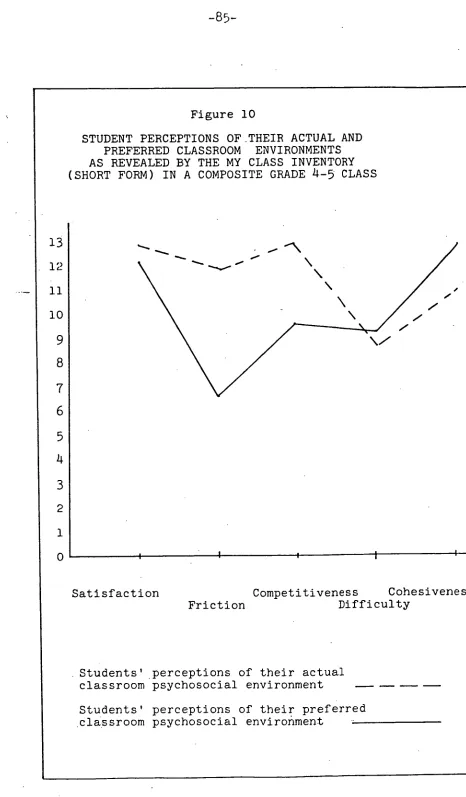
CLASSROOM ENVIRONMENT LITERATURE REVIEW
The frequently quoted Coleman Report(see for example
when home background variables (which do have considerable
influence upon the student's self-image) were controlled,
f;01001 factors did not explain variances in test scores.
Marjoribanks (197 )4) also found that the effect of the school
on student outcomes was minimal in comparison to the impact
of the home environment. Findings such as these generated
a sense of 'school doesn't tatter' among some during the
late 1960's and through the 1970's.
Ultimately though, it became obvious to many that this
view was far too extreme. Indeed, some writers went too far
in the other direction, and downgraded the influence of the home.
Brookover (cited by Hoy and Miskel, 1982, 332) found
that as much as 80% of the variance in achievement which
occurred between students could be attributed to student
and teacher expectations of, and commitment to, high
quality learning.
Further, Walberg (1981) maintained that research has
shown that learning is a function of seven factors :
Student Age (Age)
Student Ability (Abl)
Student Motivation (Mot)
Quality of Instruction (Qul)
Quantity of Instruction (including self-instruction) (Qun
Psychological Environment of the Classroom (Cis)
Jn fact, Walberg claimed that he had brought the famous
Cobb-Douglas agricultural function into the field of
education, and provided the following equation :
Learning =a(Age) b (Abl) c (Mot) d (Qul) e (Qun) f (C1s) g (Hom) h
where a represents a constant, and where b through h are
positive but less than one;
Walberg (1982, 118) suggested that this equation could
be used to make more
... confident our understanding of school learning and point out the most potent, least difficult means of maximising learning.
More recently, Walberg (1984) extended his list of
"potent, consistent, and widely generalizable" factors to
include the peer group outside the school and the use of
out-of-school time (specifically, the amount of leisure time
allocated to viewing television). While Walberg acknowledged
that other factors may influence learning, he maintained that
... improvements in the more direct and more alterable factors hold the best
hope for increasing educational productivity. (Walberg, 1984, 21)
A most significant claim by Walberg (1981, 245) was that
a doubling of the impact of the psychosocial environment of
the classroom resulted in a 43% increase in learning.
Other research supports Walberg's findings. Haertel, Walberg
and Haertel (1981), for example, found that students'
perceptions of cohesiveness, satisfaction, task difficulty,
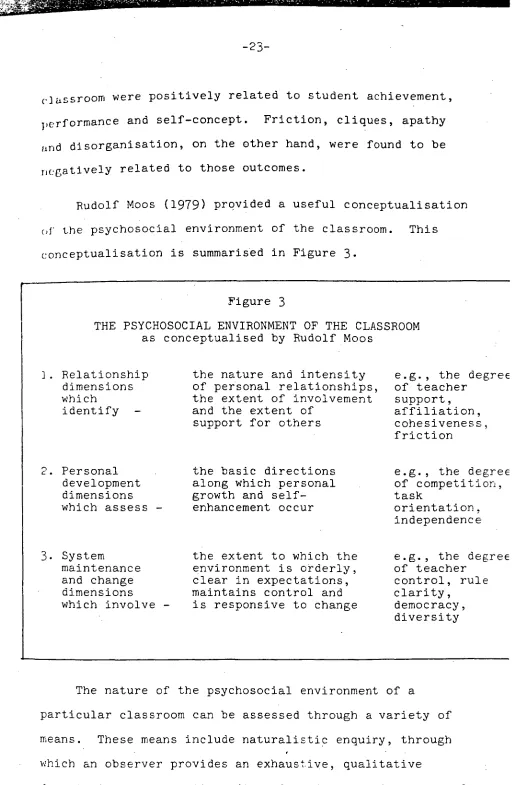
Figure
3
THE PSYCHOSOCIAL ENVIRONMENT OF THE CLASSROOM as conceptualised by Rudolf Moos
1. Relationship dimensions which identify - 2. Personal development dimensions which assess -
the nature and intensity of personal relationships, the extent of involvement and the extent of
support for others
the basic directions along which personal growth and
self-enhancement occur
e.g., the degree of teacher
support, affiliation, cohesiveness, friction
e.g., the degree of competition, task
orientation, independence classroom were positively related to student achievement,
performance and self-concept. Friction, cliques, apathy
and disorganisation, on the other hand, were found to be
negatively related to those outcomes.
Rudolf Moos (1979) provided a useful conceptualisation
of the psychosocial environment of the classroom. This
conceptualisation is summarised in Figure
3.
3. System
maintenance and change dimensions
which involve -
the extent to which the environment is orderly, clear in expectations, maintains control and is responsive to change
e.g., the degree of teacher
control, rule clarity,
democracy, diversity
The nature of the psychosocial environment of a
particular classroom can be assessed through a variety of
means. These means include naturalistic enquiry, through
which an observer provides an exhaustive, qualitative
environment. Not only can student perceptions be validly
meLlsured (Walberg, 1982, 291), they can be measured
economically. Further, since students experience the
clssroom's environment all day every day, their perceptions
(if it are most likely to be accurate. Moos summed this
j :
Students are a good source of information about a class, since they have encountered many different learning environments, are in a class for many hours, and have enough time to form accurate impressions of the classroom milieu. (Moos,
1979, 139)
A number of well validated instruments are now available
to assess student perceptions of their classroom's
psychosocial environment. A number of these instruments
are available in two forms - one form to assess the
environment as it ACTUALLY IS (in the eyes of the students),
and a second form to assess the environment as the students
would PREFER it to be.
Hunt (1975) maintained that person-environment fit
or congruence is positively related to student academic
performance. This conclusion was supported by Walsh and
Russel (cited by Nielsen and Moos, 1978). In addition,
Fisher (1982) and a number of others (e.g., Fraser and Deer,
1983, Fraser and Rentoul, 1980) have found that student
outcomes other than academic performance, such as satisfaction,
are also promoted if students are in psychosocial environments
Which match those they prefer. Fisher (1984, 16) summed
The approach of maximizing actual-preferred congruence enhances an individual's
functioning, satisfaction, and productivity within an environment.
Again, perhaps "functioning, satisfaction, and productivity"
not too far removed from the "achievement, adaptability,
:;:itisfaction, central life interest in learning" definition
of high quality learning offered earlier in this report.
HELEVANCE TO THIS PROGRAM
It will be recalled that the ultimate purpose of the
program was stated to be the promotion of higher quality
learning among children. The literature review suggests,
quite strongly, that this ultimate purpose can be achieved
through teachers being assisted and encouraged to 'engineer'
the psychosocial environment of their classroom, so that
student perceptions of the actual environment match as
closely as possible their perceptions of how they would
prefer their environment to be. The program pays particular
attention to this perspective. This is not to say, though,
that such environment 'engineering' is a panacea for all
the ills that may be evident in classrooms and schools.
EVALUATION
The formative evaluation question addressed at this
stage of the program's development was :
To what extent is the ultimate purpose of the program,
stated, congruent with the mandate outlined at the
beginning of this chapter?
The developers of the program, given their experience,
knowledge, imagination, intuition and the support of the
theory and research outlined in this chapter, were
convinced that the ultimate purpose matched the mandate
closely. However, the question was offered to a panel of
experienced educators, each with expertise in curriculum
development, delivery and evaluation. The responses of
these panelists reinforced the positive opinion of the
CHAPTER
3
THE DESIRED PRODUCTS OF THE PROGRAM
In order to satisfy the ultimate purpose of the program,
its developers paid close attention to the desired products.
]n other words, the professional growth and development of
the participants was not to be left entirely to chance.
The Katz-Morgan strategy dictates that the desired
products should be contemplated at three levels of specificity :
desired outcomes or goals at the most general level, then
desired outputs, and then, at the most specific level,
behavioural objectives. The basic criterion to be applied
during this development phase is that concerned with the
degree of congruence between the three levels.
The rationale for this approach is that the validity of
the program's ultimate purpose had already been established;
the general desired outcomes should therefore be in sympathy
with that ultimate purpose; that the more specific desired
outputs should be aligned with the desired outcomes, so that
the latter can be achieved; and that the behavioural
objectives should be congruent with the desired outputs
so that the latter, in turn, can be achieved. This is
clearly evidenced in the first three steps of the strategy
depicted in Figure 2.
The organisation of this chapter follows these steps
closely, and as a result the literature review is dispersed
It was at this stage of the program's development that
the 'Research into effective teaching and effective schools'
a5pect of Figure 1 was of considerable significance.
Following the argument of Phillips (1981) any
view of teacher as 'conscious automata', in the Descartes
iradition, was rejected. In order to change any teacher's
behaviours, he must be assisted to change his beliefs and
intentions, and this.is no easy task. According to Phillips
(1981)
J. there is no reason to believe that effective teachers can
offer reasons for their success - they know HOW, but
they frequently do not know THAT;
2. a teacher's 'justifications and deep-lying motives' may
overlap stated intentions;
3. actions may be designed to achieve conscious purposes,
but in addition, may bring about unintended outcomes;
4. desirable results may emanate from misplaced intentions,
and similarly, disastrous results may follow from
worthy intentions; and
5. a number of (justifiable?) teacher intentions may not
be directly related to desired student outcomes.
Given this view, the developers of the program determined
not to 'impose' any of their beliefs upon the participants.
Rather, a variety of perspectives were to be offered at most
points to encourage discussion, refleCtion, and action in
A search of the contemporary literature in the areas
of effective teaching and effective schools (here used in
a non-aligned sense) revealed a vast number of general
recommendations towards which to aim. Twenty five such
recommendations were extracted and offered to a validation
panel of four college lecturers with expertise in the area.
ln addition, thirty one Tasmanian teachers, all reading
towards a higher degree, and all familiar with this body of
Literature were surveyed. Each of these two groups
- indicated a high degree of acceptance of these twenty five
recommendations. The developers based their general goals
or desired outcomes for the program upon these recommendations.
THE DESIRED OUTCOMES OR GENERAL GOALS OF THE PROGRAM
Katz and Morgan (1974, 21 )4) defined desired outcomes as
being the desired "interactions between the outputs of the
program and the environment". The outputs of the program
were the participating teachers, and their environment
consisted of their classrooms, schools and other places
teachers meet. Eight desired outcomes were selected and
these are described below.
1. To promote those teacher behaviours which are likely
to establish a classroom environment which is
sympathetic to the preferences of students.
Classroom environment research findings were overviewed
in Chapter 2 of this report. Suffice to say here that it
seems if teachers can change the psychosocial environment
between student perceptions of the environment as it really
is and student perceptions of how they would prefer it to
be, then the quality of learning will be improved.
2. To promote those teacher behaviours which might reduce
the amount of time wasted, increase student time-on-task,
and increase student academic learning time.
Time is, indeed, a scarce and valuable resource. The
literature offers many insights into the effective and
efficient use of time in the classroom. Effective teachers _
do, for example, ensure that time is allocated to
instruction (Clauset and Gaynor, 1982, Murphy, 1982,
Rubin, 1982). They also ensure that students are involved,
in that they actively work on the academic content at hand
(Squires et al, 1983); that interruptions are minimised
and that transitions between activity segments are planned
(Anderson, 198)4); that they reinforce student behaviours
which indicate that they are paying attention, completing
tasks, volunteering, and complying with teacher requests
(Anderson, 198)4); that there is adequate coverage of new
material (Squires et al, 1983) but at the same time students
are given sufficient time to practise the material being
learnt (Berliner, 1982); and that students spend a good
proportion of their time working on tasks which are
challenging but which offer them a fair chance of success
Berliner, 1982, Squires et al, 1983). Involvement, coverage
and success by students seem to be essential criteria for
or academic futility.
Riordan (1982) maintained that the most significant
factor in determining poor student performance is student
: - cnse of learned helplessness or academic futility. The
Porter-Lawler model of motivation (Owens, 1981) provides
valuable insights into this problem. The model suggests
that people will devote effort to a task only if they
anticipate that they have a reasonable chance of completing
the task and, hence, receiving an expected (extrinsic or
intrinsic) reward, and only if they value the anticipated
reward sufficiently highly. A number of implications can
be drawn from this brief discussion. Effective teachers
might be expected to provide appropriate, equitable
rewards; 'break down the barriers' which prevent student
effort resulting in successful performance of tasks
(e.g., through setting appropriate goals, establishing order
and organisation, and allocating sufficient time to the
task); and assist students to perceive any failure to be
the result of a lack of effort on their part rather than •
any lack of ability (Maehr and Willig, 1982). As a result
of practices such as these, students might be led to think
of themselves as 'origins' rather than 'pawns' in terms of
the control they perceive themselves as having over their
)i. To assist teachers to adopt behaviours aimed at
promoting student leadership, responsibility,
co-operative activity and participation in
decision-making.
A strong case has been established in favour of teachers
f.mploying co-operative strategies as the basis for classroom
ctivities (e.g., Johnson and Johnson,
1975,
Slavin 1980, 1983, Allen, 1983). Strategies such as 'Teams-Games-Tournament'and 'Jigsaw' (Slavin, 1980), and peer and cross-age
tutoring appear to_be valuable tools in promoting high
quality learning. Less formal strategies, too, may be
potent in promoting such outcomes. For example, a recent
project (Claridge, 1984) resulted in teacher-devised
co-operative strategies leading to almost perfect congruence
between a typing class' perceptions of preferred and
actual involvement, affiliation, teacher support, task
orientation, order and organisation and rule clarity.
Student responsibility and participation in
decision-making are central to a number of approaches to good
discipline, and are advocated by, among others, Murphy (1982),
Maehr and Willig (1982), Wolf et al (1981) and Mackenzie (1983).
5.
To assist in the development of teacher behaviours that are likely to promote order, organisation, gooddiscipline and good teacher-student relationships.
Emmer and Evertson (1981) drew on Kounin's research to
stress the need for teachers to es.tablish expectations for
behaviour, and to teach classroom rules and procedures to
classroom management system, Emmer and Evertson argued that
the teacher must be able to demonstrate a number of
monitoring skills, including prompt and accurate 'desists',
handling several events simultaneously and keeping the
class alert.
A number of useful theoretical and research foundations
have been laid to assist the teacher establish good
discipline and good interpersonal relationships in the
classroom. Thomas Gordon's (1979) distinction between
'teacher-owned' problems and 'student-owned' problems,
William Glasser's (1984) definite set of procedures,
Robert Spaulding's (1983a, 1983b) systematic approach to
treating different types of children differently, and
Maurice Balson's (1984) view of groups being encouraged
to participate in discipline/management procedures, all
offer valuable insights to this present and
ever-increasing problem.
6.
To promote teacher behaviours that are likely toprovide a balance between individual activities,
group activities, personal meanings, culturally
defined meanings, current enjoyment and possible
future utility.
Sergiovanni and Starratt (1979) presented a 'human
resources' perspective of how school goals can be achieved
through the 'human growth' of its constituents. Such
human growth, in turn, was seen to be possible only through
to have "satisfying and fulfilling experiences in the
cducational process." (Sergiovanni and Starratt,
1979,
250) These writers maintained that a student's self-concept,hnd his consequent perceptions of the degree of control
tic has over his own destiny, is a dominant factor determining
achievement at school, and that many adolescents make
tenacious attempts ... to frustrate the designs of the system of schooling
precisely because it communicates so little respect for them as persons, and because it fails to provide them with-genuine opportunities for personal
commitment. (Sergiovanni and Starratt,
1979, 251)
Sergiovanni and Starratt drew heavily upon the works of
Abraham Maslow, James Macdonald and Dwayne Huebner to
formulate a model of a 'human curriculum' which stresses
the need for an appropriate balance between the six
(.1ements that make up this goal.
7.
To assist teachers to develop behaviours that lead to an 'aligned' curriculum in their classrooms.An exaggerated example serves to illustrate the intent
of this general goal.
Aim Children will learn to ride
a bicycle
Specific objective Children will repair a puncture in a bicycle tube, using a
vulcaniser kit and given the necessary tools, in five minutes
Content The evolution of the bicycle
Learning experiences Children view a film of a bicycle race
Children list the Olympic Games medal winners in cycling since World War II
I teacher who offered a curriculum such as this could hardly
he said to test what was taught and teach what was intended.
An aligned curriculum satisfies these requirements.
To promote teacher behaviours that are of a high
technical quality in terms of, for example, questioning,
explaining and reinforcing.
Sydney Micro Skills Redeveloped (Turney et al, 1983)
provides a theory and research based coverage of many of
the technical skills demonstrated by effective teachers.
Other investigations, however, abound.
The reader will have noticed that these general goals
!:eem to overlap and reinforce each other. The developers
of the program maintain that this was one of the program's
!'.trengths. Further, such overlapping prevents any
meaningful prioritisation of the general goals.
EVALUATION
The relevant formative evaluation question to be
posed at this stage was :
To what extent are the desired outcomes (general goals)
congruent with the ultimate purpose of the program?
The process by which the desired outcomes were selected
(determine ultimate purpose, search the literature for
recommendations on how to achieve that purpose, check the
acceptance of those recommendations by a large sample of
experienced and knowledgeable teachers,. derive desired
outcomes from well-supported recommendations) served its
This is not to say that the stated desired outcomes are
the only possible ones. Nor can the developers maintain that they are the most effective and efficient in terms
of their ability to satisfy the program's ultimate
purpose. The current state of the art does not allow a
valid judgement on this latter point. Herbert Walberg (1984)
and Benjamin Bloom (1984) have recently reported exciting
findings in the search for the most productive mix of
factors. This work is at a very early stage, but it was -
heartening to the developers of this program to note that
several of their stated desired outcomes have been given
high effect size by both Walberg and Bloom.
THE DESIRED OUTPUTS OF THE PROGRAM
In order to ensure that the program could achieve its
desired outcomes, and therefore its ultimate purpose, the
developers of "Managing the Classroom Environment" turned
their attention to more specific desired products : the
desired outputs of the program.
Katz and Morgan (1974, 215) defined the desired
outputs as the desired conditions of the program participants
upon completion of the program, but prior to any interaction
with their school environment. In other words, the desired
outputs were seen to be the more specific abilities of the
participants unconfounded by the vagaries of their
environment which are beyond the reach of the program's
influence. This definition could not be adhered to in
ate simultaneously in the school and the workshop.
3nr.tead, the desired outputs were seen to be intermediary
between general goals or desired outcomes and specific
behavioural objectives, combining several specific
behavioural objectives together as stepping stones towards
thc- general goals. With this interpretation, there would
be no need to consider desired outputs if the specific
behavioural objectives were exhaustively stated.
While theory and research pointed quite clearly to a
bevy of worthwhile general goals, such guidance was less
marked at this more specific level. It is clear, for
example, that effective teachers do ensure that there is
order and organisation in their classrooms, but it is less
e7ear what they actually do to achieve this order and
organisation. The literature appears to be moving into a
phase which is characterised by a call for moderation in
the extent and intensity of claims to finding the 'right
medicine'. D'Amico (1982) for example, cast doubts on the
research base employed by proponents of the 'effectiveness
movement', and more recently Cuban (1983), McFaul (1983)
and Ralph and Fennessey (1983) added their caveats.
Cuban demanded caution as a result of the following
observations :
3. No one knows what to DO in order to achieve effective
schooling;
2. The language of the "effectiveness school' is 'fuzzy';
3. Typically, research has concentrated only on the basic
skills in literacy and numeracy; and
4. Research has been undertaken mainly at the Primary
j. strong case has been built in favour of 'direct
inr.truction as the preferred method of teaching basic
competencies in mathematics and reading in the Primary
•hoo1s. McFaul (1983), however, correctly pointed out
th:It this does not mean that it is the preferred method
for all purposes at all levels of schooling. Indeed,
'direct instruction', if used exclusively, would actually
prcvent a number of desired outcomes of this program, and
hence.its ultimate purpose, from being achieved.
In order to satisfy a number of the desired outcomes,
the program attempted to develop a growing awareness among
the participants of the program of what actually takes place
in their classrooms. However, since all classrooms are
very complex places and because each is unique, they
c;Innot be adequately contemplated in a workshop situation.
'lechers, though, typically work in isolation from colleagues
nnd need to be assisted in their attempts to achieve this
increased awareness. The program developers accepted the
recommendation of a number of researchers that the participants
be introduced to the rationale, process, roles and skills
of 'clinical supervision' as practiced by colleagues.
This was viewed as a process to achieve increased awareness
rather than as an outcome to be valued for itself, and is
overviewed in some depth in Chapter
4.
An essential ingredient of such collegial supervision
is the mutual agreement of aspects to be focused upon in
, the improvement process. It would . be quite inappropriate
for this program's developers to attempt to identify all
In order to establish a classroom which is sympathetic
to the preferences of students (desired outcome 1),
products of the program should be able and willing to
engage in the following cycle :
i) Assess the psychosocial environment of the
classroom from both student-preferred and
student-actual perceptions;
ii) Obtain feedback through the generation of
environment profiles;
iii) Reflect upon the profiles and possible
intervention strategies and discuss these
with colleagues and students;
iv) Intervene to change the environment;
v) Reassess student-actual perceptions.
(This strategy was advocated by Fisher,
Grady and Archer, in press)
• In order to make good use of time in the classroom
(desired outcome 2) participants should be able to :
i) Observe and record the use of time;
ii) Compose routine procedures for starting and
finishing lessons, and for facilitating
a smooth transition from one activity segment
to another;
iii) Identify the 'survival skills' demonstrated
by students and develop appropriate
techniques to reinforce those students who
-4o-
Participants should become aware of any of their
behaviours which are likely to communicate inappropriate
expectations of student behaviour and performance to
ntudents. The development of such an awareness should
enable desired outcome
3
(assisting students to avoid sense of 'learned helplessness') to be at leastpartially satisfied.
4. Teachers should become more committed to co-operative
learning (desired outcome 4) if they are able to
i) Analyse classrooms to determine the
dominant task structure, authority structure
and reward structure;
ii) assess students' preferences for co-operation
rather than competition;
iii) understand the potential benefits of peer
and cross-age tutoring in classrooms. r.
5.
In order to achieve desired output5
(order, organisation,good discipline and good teacher-student relationships)
the products of the program should be able to
i) demonstrate 'with-itness', 'overlapping'
'smoothness and momentum' and 'group
alerting' (Emmer and Evertson, 1981);
ii) Categorise problems according to the
Spaulding (1983a, 1983b) and Gordon
(1979) schemes.
6.
A start can be made toward the achievement of a'human curriculum' (desired outcome 6) if the participants
pinns to discover the emphasis given to individual
bctivities, group activities, personal meanings,
culturally defined meanings, current enjoyment and
future utility..
EVALUATION
Given the caveats stressed at the beginning of this
!leopi-ct of the report, little can be said on the formative
•v:IidbtJon processes followed. The developers had the
dc:Arcd outcomes firmly in mind, but they had to rely
hvily upon their experience, intuition and so on to
ctiblish the desired outputs of the program. All that can
b.. concluded is that the developers themselves were
::itisfied that they had sought to ensure a high degree of
conuuence between the desired outputs and the desired
outcomes. This problem became all the more acute in the
formative evaluation at the next stage : the congruence
bctween the desired outputs and their supporting behavioural
objectives.
BEHAVIOURAL OBJECTIVES
Logically, and in conformity with the Katz-Morgan
strategy of formative evaluation, the next step in the
program's development was to contemplate the behavioural
objectives which the participants should be able to satisfy.
Behavioural objectives, the most specific of the
a.:sired products, should state what participants should be
le to do in observable terms, to what standard and under
conditions as a result of the program. However,
because of the fact that much of the program was to take
place in classrooms with the aid of colleague and student
feedback, and because of the fact that no one has yet
identified precisely what effective teachers actually do,
this task was not completed. Nevertheless, a number of
behavioural objectives were generated, and a small sample
is provided here.
Participants will be able to :
i) Select the classroom environment instrument
most appropriate to their needs (desired
output 1 i));
ii) Administer the selected instrument to their
classes (desired output 1 1));
iii) Score student responses to the instrument
(desired output 1 i));
iv) Identify discrepancies between student-actual
and student-preferred responses on each
dimension for each student (desired output 1 ii));
v) Devise strategies to increase student sense
of affiliation in the classroom
(desired output 1 iii));
vi) Devise strategies to reduce student sense
of friction in the classroom
(desired output 1 iii));
vii) Determine the effect of the strategies devised
at v) and vi) on classroom environment
profiles (desired output 1 v));
• viii) Construct an instrument suitable for recording
teacher-created and student-created classroom
output 3);
x) Identify the dominant authority structure
in the classroom (desired output 4 i);
xi) State the procedures for implementing
'Teams-Games-Tournament' (desired output 4);
xii) Describe the procedures for implementing the
Neurological Impress method of peer/cross-age
tutoring (desired output 4 iii);
xiii) Distinguish between 'teacher-owned problems'
and 'student-owned problems' from case
studies (desired output 5 ii));
xiv) Calculate student engagement rates
(desired output 2 i));
xv) Devise activities which provide a balance
between individual and group activity,
personal and culturally defined meanings,
and present enjoyment and future utility
(desired output 6).
EVALUATION
The developers of the program must always be uneasy
about the extent of congruence achieved between the
behavioural objectives that were generated and the desired
outputs of the program. Personal knowledge, experience,
imagination and intuition (with all their biases) had to be
relied upon to a great extent. At first glance this might
people collaborate closely, pooling their knowledge,
experience, imagination and intuition (and perhaps offsetting
each other's biases), and both being keenly aware of the
need to seek congruence between the elements under consideration,
it is likely that many potential discrepancies will be avoided.
It is true that other program developers would derive different
behavioural objectives. Such behavioural objectives though,
may not be better. The key point to be made is that the
developers of "Managing the Classroom Environment", having
followed the Katz-Morgan strategy, having read widely, and
having pooled their resources, were quite satisfied with
the decisions they had made.
The program's development had arrived at the stage
where the desired products had been identified. Attention
was then turned to the desired processes of the program;
that is, to those processes likely to effectively and
efficiently achieve the desired products. The next chapter
CHAPTER 4
THE DESIRED PROCESSES OF THE PROGRAM
The developers of the program maintained that there was little point in identifying desired products without paying close attention to the processes by which these products might be achieved. This chapter contains an extensive overview of relevant theory and research in three areas :
'preconditions for effective change', 'adult learning theories', and 'colleagues working together to improve their teaching'. Following this review, a number of desired process goals and objectives are listed. Three formative evaluation steps are contemplated : the match between process goals and
desired outputs, the match between process objectives and process goals, and the match between process objectives and behavioural objectives.
PRECONDITIONS FOR EFFECTIVE CHANGE
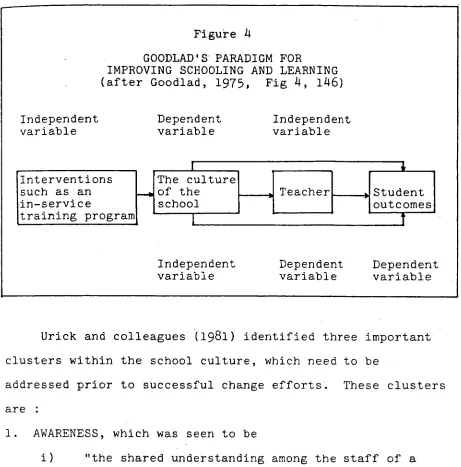
Figure
4
GOODLAD'S PARADIGM FOR
IMPROVING SCHOOLING AND LEARNING
(after Goodlad, 1975,Fig
4,
146)
Independent Dependent Independent
variable variable variable
Interventions The culture
such as an of the Teacher Student
in-service
training program
school outcomes
Independent Dependent Dependent variable variable variable
Urick and colleagues (1981) identified three important
clusters within the school culture, which need to be
addressed prior to successful change efforts. These clusters
are :
1. AWARENESS, which was seen to be
i) "the shared understanding among the staff of a
school regarding the range of alternatives in
school policies, curriculum, and instructional
practices"; and
ii) knowledge of "the factors influencing student
learning that are subject to control by school
staffs and that show significant promise for
improving learning."
2.
READINESS, which Urick et al saw as "a composite offeelings, opinions, beliefs and attitudes that the staff
3.
COMMITMENT, which in this context refers to the"willingness or agreement of staff members to participate
in ... staff development", and which has at least two
components :
i) "the level of intensity of involvement that is
acceptable among the staff"; and
ii) "the participation of school staffs in specifying
plans for ... staff development."
To these clusters of preconditions for effective change,
Richard Bates (1982) would add the nature of 'myths',
'metaphors' and 'language of negotiation' that pervade any
school's culture.
Wood and his associates (1982) proposed an 'RPTIM Model'
of staff development, which contained thirty five steps within
five stages : Readiness, Planning, Training, Implementation,
Maintenance. The first two of these stages are in sympathy
with the preconditions outlined by Urick et al above.
The portrayals of 'Jim' and 'David' by Ingvarson and
Greenway (1984), provide a rich indication of the large
variety of elements (including school, parents, professional
associations, school principal, education department,
perceived control, personal contacts) which might determine
a teacher's perception of himself, his job, his students,
his colleagues and so on. Clearly, 'I as teacher' differs
for each individual, and no in-service program can, or
It is difficult to dispute the claim by Ingvarson and
Greenway (198 )4,
46)
that... professional development is an individual process influenced more pervasively by
administrative and contextual features of the particular educational system within which teachers work, than by the particular forms of in-service education available.
These researchers maintained that we frequently underestimate
the filtering effect that the culture of teachers can have
on innovations and change efforts. In particular,
they saw this culture being Characterised by
... concern with status, anxieties about expertise and competence, and a powerful
cult of individualism or 'live and let live'.. (Ingvarson and Greenway, 198)4, 46)
Further, Doyle and Ponder (cited by Ingvarson and Greenway,
1984, 48) have put forward three criteria
... which teachers appear to bring to bear in evaluating the perceived attributes of innovations : instrumentality, congruence, and cost.
A final aspect to be touched upon under the umbrella
of preconditions for effective change is that of leardership,
including supervision. Change does not 'happen' in schools,
•
it needs to be 'engineered', and a 'change agent' needs to
lead the process. This change agent will frequently be the
school principal, but if he is not, he must be at least
sympathetic to change efforts and supportive of them. There
are a number of powerful perspectives on leadership Processes
and functions, including those of SergiOvanni and Starratt