Analysis and Definition of the close-to-crop Area
in Relation to Robotic Weeding
M. Nørremark
1and H.W. Griepentrog
1Presented at the
6th Workshop of the EWRS Working Group 'Physical and Cultural Weed Control',
8th March 2004 Lillehammer, Norway
1
The Royal Veterinary and Agricultural University Dept. of Agricultural Sciences,
Section Environment, Resources and Technology Hojbakkegaard Alle 2, DK-2630 Taastrup
Denmark
Analysis and definition of the close-to-crop area in relation to robotic weeding
M. Nørremark & H.W. Griepentrog
The Royal Veterinary and Agricultural University,
Department of Agricultural Sciences/AgroTechnology, Copenhagen, Denmark
Abstract
The objective of this paper is to analyse and define the field conditions close to the crop plants of sugar beet (Beta vulgaris L.). The aim is to use this study for the choice and development of new physical weeding methods to target weeds at individual plant scale level. It was found that the close to crop area is like a ring structure, comprising an area between an inner- and outer-circle around the sugar beet seedling. Physical weeding should not be applied to the area within the inner circle. The radius of the inner circle increases with the appearance of young beet leaves during the growth season. It was also found, that no weeds were germinating within 1 cm around individual sugar beet seedlings. Therefore this distance should be added to the radius of the inner circle. The space between the inner and outer circle is termed the close to crop area where physical weeding should be applied. The size of this area is defined by the developmental stage of the sugar beet fibrous root system and foliage. Thus, the determination of the growth stage of individual crop plants is necessary before any physical weeding can take place in the close to crop area.
Uprooting, cutting between stem and root or damage of main shoot can do the physical control of most weed species located in the close to crop area. However, the targeting of weeds from above and from different angels above ground is limited in the close to crop area. This is caused by the fact that sugar beet leaves do not leave much space between leaves and ground and that our own study indicate that 26.4% of sugar beet plants at the 4-6 leaf stage are covering the main shoot of weeds. The most problematic weeds are the species, which have their main shoot and leaves located close to ground level. These species can either be controlled by damage of the main shoot or with a combination of shallow surface cutting and burial.
Discrimination between weed species is beneficial under certain circumstances. First, the efficiency of the physical control of individual weed species is depending on the timing. Secondly some weeds species do not have significant negative impact on the yield, but instead leaving these species uncontrolled could benefit to an increased bio-diversity and reduced time and energy input for a physical weeding process. This paper is contributing to the ongoing Danish research project Robotic Weeding.
Introduction
implements and robotic systems for more automated weed control received much attention (Van Zuydam et al., 1995; Tillett et al., 2002, Tillett et al., 1998, Marchant et al., 1998, Astrand & Baerveldt, 2002, Blasco et al., 2002). The main obstacle for the progress of high selective weed control is; i) the lack of automated detection and classification of crop and weed plants, and ii) to target or treat weeds with high resolution and accuracy. The reliability of identification of crop seedlings using computer vision under field conditions can vary e.g. from 60 to 80% (Lee et al., 1999). This result is not acceptable for weeding operations. However, the rapid development of computer image and data processing in real-time is promising. On-going research of a vision system based on active shape modelling to recognise sugar beet and weed seedlings and locate their positions is done at the Research Centre Bygholm, Denmark (Søgaard & Heisel 2002). Weeding tools with high accuracy and high spatial resolution have also been investigated (Lee et al., 1999, Heisel et al., 2001). These systems are able to apply liquids in very small dose rates at precise locations (micro-spraying) or can cut weed plants by laser beams.
These novel weeding systems shall operate in the area within crop rows. In order to enhance the efficiency of these methods it seems to be recommendable to divide the target areas of a field into different zones. In this context the authors defined already previously the following target areas (Griepentrog et al. 2003):
• Inter-row area: Space in strips between and parallel to crop rows keeping a particular distance to the crop plants.
• Within-row area: Space between crop plants within rows, excluding the area close to the crop plant.
• Close-to-crop area: Space around a crop plant which should or cannot be targeted by within-row or inter-within-row weeding operations.
The objective of this paper is to analyse and define the close to crop area. The aim is to use this study for the choice and development of new physical weeding methods to target weeds at individual plant scale level. The paper comprises a definition of the close to crop area for sugar beet based on a description of; i) the above and below ground properties for both sugar beet and weed plants, ii) crop and weed establishment factors, iii) crop and weed tolerance to physical interactions, and iv) the sugar beet:weed competition with focus on neighbourhood effects.
Sugar beet
Crop establishment
Properties above ground.
Sugar beet is a C3 plant with broad, dark green, succulent leaves. After emergence and cotyledon stage, successive leaves then develop in pairs throughout the growing season (Milford et al., 1985b). The first pair appear synchronously and later leaves appear singly on a spiral of five rings each with 13 leaves (~ 5:13 phyllotaxis) (Elliot & Weston, 1993, Meier et al., 1993). This phyllotaxis is growing in diameter during the growth season. The radii of the phylootaxis is usually bigger than the one for the tap-root at early growth stages. That is, the appearance of new leaves are pressing the stem of earlier leaves outwards from the centre of the spiral.
The leaves of sugar beet plants are very small at the cotyledon stage. After the 2-leaf stage the leaves gets broad and long (Meier et al., 1993). 2-3 leaves appear each week during summer months (at intervals of 30 oD) (Bachmann, 1986). Leaves appear and expand in a linear relationship with the temperature that controls the developmental rate, the so-called physiological time (~oD) (Milford et al., 1985abc). At 42 days old, the plant has 8-10 leaves but only a small tap-root. From the 8-10 leaf stage onward, leaf and tap-root growth occur simultaneously, with the tap-root making up increasing proportion of the total plant dry weight (Elliott & Weston, 1993). The maximum size attained by individual leaves increase progressively about the 12-leaf stage (in some varieties the largest leave reached an area of 0.05 m2), and later formed leaves achieve smaller final sizes (Milford et al., 1985b). Early leaves die in the order in which they are produced. Leaf number 5 to 20 accounts for almost all the leaf area duration (Elliott & Weston, 1993). Sugar beet does not leave much space between leaf and ground level starting from the cotyledon stage to the beginning of wilting of the early leaves. The first 8 leaves are elongating from the phyllotaxis located just above ground and is exploiting mostly to the side, not upright, resulting in the limited space between leaf and ground.
The main shoot of weeds germinating underneath the leaves of sugar beet plant are impossible to detect from above the crop plant because of the relative broad beet leaves developed already at 4-leaf stage. A study based on analysing digital photos taken from above sugar beet plants at the 4-6 leaf stage showed that main shoots of one or more weed seedlings were hidden underneath crop leaves in 26.4% of the number of crop plants analysed (n = 212). Weed seedlings emerging underneath sugar beet leaves at the cotyledon stage were not observed. The digital photos were provided by previous work by Griepentrog et al. (2003) and Nørremark et al. (2003)
Properties below soil surface
Tolerance to physical interaction
Because the seeds energy reserves are limited, the distance from the seed to the soil surface must not be too large. Furthermore, physically resistance to seedling growth must not be excessive, and the seedling must not be damaged physically, chemically or by pests or diseases (Scott & Jaggard, 1993). A surface crust (cap) is sometimes formed before or after the plants emerge, especially on clay soils. This may lead to a very poor numbers of emerged plants per area. The effects of crusting on crop emergence may depend to a small extend on the initial aggregate sizes of the soil. Breaking a surface crust mechanically and close to a sugar beet seedling can cause vial damage to the seedling, because the cap breaks up in relative big clods, which can cover, cut or uproot the seedlings. Once the seedling has become established, the plant enters a period of leaf initiation, during which there is very little root growth. The plant is therefore very sensitive to physical damage directly or in directly from e.g. movement of soil clods or stones (Meier et al., 1993, Scott & Jaggard, 1993). Only the seedling tap root is slowly exploiting the soil downwards until the 8-leaf stage. At this growth stage, the strength of the seedling tap root is higher and increase with later growth stages. At this stage the establishment of the whole plant is so good, that much energy is required to e.g. pull the plant out from the soil. However, the strength of the fibrous root system is not high compared to the strength of the tap root. Uprooting of the fibrous root system can occur with use of very little energy. In the early growth stages, uprooting of the fibrous roots exploiting laterally can be vial to the further development of the plant. When the fibrous root system have intermingled with adjacent rows, the uprooting effect becomes less important. Therefore, the sugar beet plant root system resistance to physical damage increase with growth development.
With the cotyledon to the 8-leaf stage as the stage where the plant roots, stem and leaves are less tolerant to physical damage. The physical damage may not be the damage it self, but the wound from a mechanical damage may allow establishment of diseases (Scott & Jaggard, 1993, Hatcher & Melander, 2003). Cutting a few leaves or some part of them, especially the early leaves, may not contribute to decreasing yield. However, damaged plant leaves are still sensitive to establishment of diseases (Elliot & Weston, 1993).
Weeds
Population dynamics
Mature annual weeds often produce seeds small in size, which allows for production of many seeds by individual plants. This facilitates colonization of new localisations of establishment of the weeds. Due to dormancy processes, most annual weed species germinate at particular times of year. The wandering perennial weeds also propagate at different time of year.
Germination of weed seeds is more likely near the soil surface because seeds are more likely to experience light, fluctuated temperatures and other factors that commonly promote germination. When shallow tillage stirs the upper soil layer, weed seeds will be exposed to light (Roberts and Potter, 1980, Jensen, 1999). Many subsequent studies have shown that germination of a great range of weeds species is promoted by light (Mohler, 2001).
Mohler (1993) reviewed 21 studies on seedling emergence from weed seeds placed at various depths and found that most individuals of most weed species depending on seed weight arise from the top 2-4 cm of soil. However, for many weed species, some individuals emerge from deeper soil layers, and a small percentage of some large-seeded species can emerge from 100 millimetre or deeper (Mohler, 1993; Cussans et al. 1996). The germination of weeds requires almost the same soil tilth, moisture and stone-free conditions as previously mentioned for sugar beet establishment. Shallow incorporation into the soil affects various species differently, but in general for most weed species shallow incorporation into the soil increase emergence rates (Mohler, 2001).
Properties above ground level
The relative high growth rates of weeds allow weeds to grow large rapidly and occupy space before resources are monopolised by crop seedlings. The height above ground for the most common weed species in Danish sugar beet fields is different from species to species. The main shoot of weeds species like Chamomilla suaveolens, Tripleurospermum inodorum, Cirsium arvense and
Taraxacum officinale is located very close to the soil surface until the 6-8 leaf stage. The early leaves of these species are usually creeping along the soil surface. Species like Polygonum convolvulus and Chenopodium album have more upright and branched stems already from the first true leaf stage. The height of the main shoot above soil surface of these species is increasing with later growth stages.
Properties below soil surface
The proportion of biomass invested in roots is low in most small seeded weed species, but their root diameter is small so that total length of roots is increased quickly after germination. Roots of many weed species are located in the 2-4 cm top soil at early growth stages. Later, the roots are exploiting the soil downwards and laterally. Rhizomes from wandering perennials like Elymus repens exploit laterally in the top 2.5-5 cm soil layer and can in a few days occupy a large proportion of the soil (Håkannson & Wallgren, 1976). To be able to target and uproot weed roots in the close to crop area at early growth stages, an operating depth of 4 cm is needed.
Tolerance to physical interaction
Boutin & Harper (1991) studied the population dynamics of five species of Veronica in natural habitats and indicated that the period of establishment represents the most critical period for these species. The definition of period of establishment is the time between germination and the production of the first true leaf. Several mortality factors act on establishing weeds, including exhaustion of seed reserves, drought, seedling predation, disease, physical disturbance, and expression of morphological and genetic defects (Mohler, 2001, Hatcher & Melander, 2003). Although oxygen concentration influences germination, oxygen levels near the soil surface are rarely low enough to direct inhibit germination, except when the soil is saturated with water.
cultivator tine is less likely to cause fatal breakage to a large old plant than to a small young seedling. Following the concept of modularity in botany (White, 1979) the growth of individual weed plants can be viewed as assemblages of repeated additions of metamers, units consisting of leaf, the subtended bud(s), and an internode. Potentially, a weed can loose most of its shoot and with only one single bud still re-grow into a full size plant. The modularity in botany for root growth similarly allows recovery from drastic damage to the root system. However, for most herbaceous dicotyledons species, a seedling that is broken between the root and base of the cotyledons will not survive. At this growth stage, the weed has only one shoot meristem, and its loss is fatal. Establishing monocotyledons seedlings are somewhat less susceptible to damage than dicotyledons, because they lack the long hypocotyl between the roots and shoot meristems, but they too may fail to recover following loss of substantial portion of the cotyledon or primary root (Mohler, 2001). Thus, very small weeds in the cotyledon stages are more easily controlled by physical means than are weeds that are more developed. However, Heisel et al. (2001) found that the weed species Sinapsis arvensis L. and Lolium perenne L. was most susceptible to cutting two month after emerge. Most weed seedlings being uprooted only can re-root under circumstances that do not desiccate the seedling quickly. These conditions are dry weather and dry soil surface. The size, position and physiology of shoots and underground organs have a large influence on the weeds ability to survive a particular type of disturbance. For example Håkansson and Wallgren (1976) showed that Agropyron repens were most susceptible to damage by burial at the point when its perennating organs reached minimum dry mass. For Agropyron repens this occurs when three to four leaves have formed on the new shoots, just prior to initiation of tillers and new rhizomes. Frequent repeated tillage is often detrimental to wandering perennial weed species.
Vleeshouwers (1997) studied the emergence rate of the weed species Polygonum persicaria L.,
Chenopodium album L. and Spergula arvensis L. after burial of pre-germinated seeds at different depths in soil with different penetration resistances. For these species emergence through a surface crust or compact soil (i.e. untilled) is more difficult and requires more energy than through loose soil (i.e. tilled). Thus, in addition to indirectly affecting emergence via seed distribution, tillage changes soil properties that affect emergence. Cussans et al. (1996) showed that emergence percentages decreased with increasing burial depth for Alopecurus myosuroides Huds., Stellaria media L. (Vill.), Galium aparine L. and wheat (Triticum aestivum L.).
Sugar beet:weed competition
The seed reserves are very important for sugar beet and weed to emerge successfully. Seed weight indicates how much reserves the species have. The seeds of many common annual weeds in a Danish sugar beet field weigh less than 2 mg and few exceed 10 mg, similar to seed weight of sugar beet. Sugar beet seeds are usually placed at 2-3 cm. This is giving the weed seeds placed from 0 to 2 cm an advantage, except when moisture content in that layer is too low for germination of the weed seeds.
arvensis has a moderate germination rate in the dark. However, placing Veronica arvensis seeds under a shading leaf canopy reduces germination compared to germination on bare soil, due to a low red:far-red ratio under the leaf canopy (King, 1975). Thus, weed germination under established sugar beet plants in the close to crop area is controlled not only by the amount of light, but also by its spectral composition.
Both sugar beet and weed seedlings are adapted to open habitats, and both are intolerant of shade. If the sugar beet is in a superior position, it will suppress the growth of weeds, especially if other factors like physical damage to weeds have been done. At emergence, the sugar beet has a similar or slightly greater leaf area and a larger root system than most small seeded weeds. Therefore the sugar beet absolute growth rate is initially greater, and usually remains greater for at least several weeks. Because small seeded weed species tend to have higher rate of root elongation, the weeds tend to rapidly occupy the soil volume to the detriment of the sugar beet plant. Probably because weeds are adapted to exploit the brief pulse of nutrient availability that follows disturbance, they also usually have substantially higher macronutrient concentrations in the shoot than do the crops with which they compete (Mohler, 2001). They thus sequester nutrients that would otherwise be available for the crop.
Resources like nutrients, hours of sun light, high temperatures greatly exceed the needs of both crop and weeds for several weeks after seedbed preparation and sowing of e.g. sugar beet seeds. During this period of time competition has a negligible effect on crop and weed seedling establishment. The annual weed species that do well in these conditions prosper because they have very high maximum relative growth rates and the seed numbers able to germinate are often very high per area relative to for example sugar beets.
Sugar beets growing in rows provide almost no competition against weeds at least not until the row closure of the crop canopy (van Heemst, 1985). If the land area that the foliage of the individual plant covers completely can be represented by a concentric circle, the root yield and weed suppression will be maximised when the area between the plants is within the circles so all land is exploited. The radius of the circle may change between varieties, but is normally in the range of 13-30 cm. Current row spacing is 45-50 cm, which then has to be decreased to enhance the suppression of weeds by sugar beet. However, the limitations for narrowing the distance between rows are associated to the need for access for mechanical weeding and harvesting procedures.
A limited number of studies of the effect of timing for physical control of weeds in sugar beet have been done. Farahbahsh & Murphy (1986) made a glass house pot experiment to study competition between sugar beet and the weed species Avena fatua L., Alopecurus myosuroides L. and Stellaria media L.. Avena fatua L competition caused significant loss in the growth, leaf chlorophyll and yield of sugar beet. In general, time of Avena fatua L emergence and beet plant and density was important factors of the severity of crop yield loss. There was no competition effect from the weeds on crop yield if the weeds were removed just before the true 6-leaf stage of the sugar beet. The field experiment by Heisel et al. (2001) showed similar results for the weed species Sinapsis arvensis L. and Lolium perenne L. The experiments showed significant higher yield when the cutting of the weeds was done 2 month after emergence, suggesting that the optimal period of weed cutting is a period between the final flush of weed emerge and the mutual overlapping of the leaves and roots of the species. However, it was noticed that a normal weed density might change that conclusion (Heisel et al., 2001).
weed seedlings increased the beet yield significantly in average by 20% regardless of weed species. Pike et al. (1990) analysed the correlation between soybean (Glycine max) seed yield and the distances from crop plant to weeds ranging from 0 to 1 m. When the distance was decreased, a decrease in soybean seed yield was seen. Weiner (1982) has proposed a neighbourhood model estimating a measure for the close to crop competition. The study was based on monocultures of
Polygonum minimum Wats and Polygonum cascadense. The model described seed production by individual annual plants within a population as a function of the numbers and species of individuals within each of several circular neighbourhood areas. The close to crop area was set to 1.5 cm, as this was beyond the limit observed for horizontal root extension. The neighbours of each subject plant were categorised in one of three neighbourhoods defined by radius at 0.5 cm intervals. The output of the neighbourhood model was measure for competition based on number of weeds of a single weed species and distances. A hyperbolic relationship between the measure of competition and seed production was seen. The contribution of each individual plant to this hyperbolic effect was in inverse proportion to the square of its distance from the test individual.
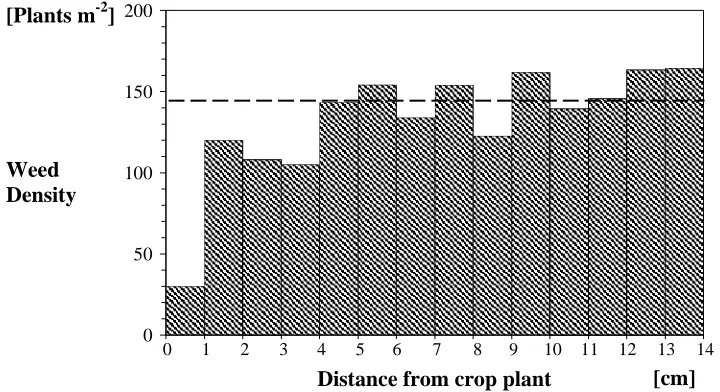
In order to give an impression of the number of weed seedlings in the close neighbourhood to individual sugar beet plants, a small pre-study was carried out by the authors using digital photos of sugar beets. The photos were provided by previous work by Griepentrog et al. (2003) and Nørremark et al. (2003). The photos were digitised to reveal information about the positions of weed individuals relative to individual sugar beet plants. Weeds were located in a radius of 14 cm from the centre of the sugar beet. Figure 1 and 2 shows the results obtained at the sugar beet cotyledon stage and the 4-6 leaf stage respectively.
0 50 100
0 1 2 3 4 5 6 7 8 9 10 11 12 13 14
[Plants m-2]
[cm] Weed
Density
[image:9.595.118.472.387.581.2]Distance from crop plant
0 50 100 150 200
[Plants m-2]
[cm] Weed
Density
Distance from crop plant
[image:10.595.116.476.68.264.2]0 1 2 3 4 5 6 7 8 9 10 11 12 13 14
Figure 2. Relationship between weed counts and distance from centre of sugar beet plant at the 4-8 leaf stage. The average weed density of whole plot is indicated by a dotted line.
In the circular area with radii of 1 cm, the determined number of weed seedlings did not at any of the two growth stages coincides with the average number of weeds per m2. This indicates the existence of a weed free zone around sugar beet seedlings. Another finding was that the number of crop plants detected, where weeds germinate within the 1 cm radii, equalled only 0.5-1% of total number of crop plants analysed.
Ecology and bio-diversity
Control of only particular weed species in the close to crop area provides new opportunities for ecology, weeding strategy and bio-diversity. First, highly selective weed control strategies can be successfully targeted towards key growth periods and key problem species in order to minimize the impact of weeds on crop yield and quality. Table 1 is showing the frequency of weed species on Danish sugar beet fields. The key problem species are grouped by their negative impact on yield.
Table 1. Frequency of weed species on Danish sugar beet fields. Data from a vegetation study during 1987 to 1989 on 47 locations in Denmark (Andreasen, 1990). The weed species, which have a negative impact on yield is indicated by ‘Yes’. ‘No’ means the weed species do not have an negative impact on yield (modified after Melander, 1993)
Latin name
Frequency1 [%]
Yield reduction impact
Chenopodium album 37.4 Yes
Stellaria media 33.6 Yes
Viola arvensis/Viola tricolor 29.4 Yes
Lamium spp. 23.8 Yes
Veronica spp. 23.8 No
Polygonum convolvulus 22.3 Yes
Poa annua 13.0 No
Elymus repens 11.1 Yes
Cirsium spp. 10.4 Yes
Polygonum persicaria 8.7 No2
Polygonum aviculare 8.7 No
Trifolium repens 7.7 No
[image:10.595.143.454.548.725.2]Not all of the most frequent weed species in a Danish sugar beet field have a negative impact on yield as shown in table 1. That is indicating a possibility for applying highly species-selective weeding methods to a typical sugar beet field. This can help to minimise the energy and time input to the highly selective weeding methods.
Not only the savings of time and energy input can be beneficial, but the weeds also have positive properties that can be utilised in organic agricultural systems. Weeds can supply ground cover to an otherwise bare soil, reducing the risk of erosion, leaching and soil crusting. Soil structural characteristics can be affected by weed root systems. Roots exude large quantities of polysaccharides, which help to bind soil aggregates to form larger, more stable aggregates (Robson et al., 2002). Axial pressure exerted by roots as they grow and move through the soil compresses the area adjacent to the root channel; pressing aggregates together and increasing their stability. Bio-pores made by weed roots facilitate air and water movement into the subsoil (Robson et al., 2002).
The additional roots in the soil also contribute to biological activity. As plant roots die, they decompose to provide energy and nutrients for the microbial population. Weeds with different root biomass and architecture will deposit organic matter in varying amounts at different depths in the soil profile. This encourages microbial activity at different rooting depths and means that nutrients will be available for other plants at those depths. Weeds can also act as a reservoir for beneficial mycorrhizal fungi, which naturally occur on most crop species (Robson et al., 2002). Plant roots infected with mycorrhizal fungi have been shown to take up more soil nutrients and have greater resistance to root pathogens (AzconAguilar & Barea, 1996).
As previously mentioned, damaged leaves can survive the damage itself, but due to pathogenic fungi that naturally occur in the environment, there is a possibility that these fungi can act as a biological control organism (Hatcher & Melander, 2003). A correlation between the number of damaged plants and the amount of natural biological control organisms may exist.
Weed species increase the plant diversity within the cropping system, and provide habitats for a wider range of insects and other invertebrates. However, van Elsen (2000) has proposed that mechanical weeding may decline the number of long-lived winter annual weed species and support of short-lived summer annual weed species. This can improve static and impoverished weed vegetation (van Elsen, 2000).
Conclusion
The above descriptions of different parameters have so far lead to the following definition of the close to crop area.
• The close to crop area is like a ring structure, comprising an inner- and outer-circular boundary around the sugar beet seedling. In this definition, it is assumed that the centre of sugar beet seedling is known and the land area that the foliage and fibrous root system covers can be represented by a circle.
from the center of a sugar beet plant at both the cotyledon and 4-6 leaf stage. This 1 cm ‘weed-free zone’ should be added to the phyllotaxis radii to reveal the true area where no physical weeding should be applied.
• The space between the inner and outer circle is then the close to crop area where physical weeding should be applied. The size of this area is defined by the developmental stage of roots and foliage. At the cotyledons stage the radii of the close to crop area above ground is defined by the inner circle alone, because the foliage size is very small. However, there is a high risk of uprooting of sugar beet seedlings at very early growth stages within a radius of at least 2 cm from the plant center. This radius is based on the laterally wandering of the emerging shoot from the location of the seed. Uprooting directly or by disturbance of soil clods and stones should be considered at the cotyledon stage. The close to crop area is therefore increasing with increasing size distribution of soil clods and stones. If a soil cap is present, the close to crop area is also increased. After the first pair of true leaves have appeared the close to crop area above ground expands. At the 10-12 leaf stage the close to crop area can have expanded to more than 10 cm based on the foliage ground cover. However, the below ground close to crop area is usually less than 10 cm at that growth stage, because the risk of uprooting of the tap-root is getting lower from the 10-12 leaf stage and later growth stages. The depth of the close to crop area is 0-3 cm based on the usually depth of the fibrous root system
From the above it is obvious that a determination of the growth stage of individual crop plants is necessary before any physical weeding process can take place in the close to crop area.
The optimum timing for physical weed control in the close to crop area is influenced by the first flushes of seedlings and weed density. The first and most numerous weed flush is emerging within 2-3 weeks after sowing, where the sugar beet seedlings have 2-4 leaves. The weed density also influences a second weed control, but in addition the competitive ability of the crop in the close to crop area and the growth stage of the weeds should be included in the weeding strategy. Uprooting, cutting between stem and root or damage of main shoot can do the physical control of most weed species. However, the targeting of weeds from above and from different angels above ground is limited in the close to crop area. This is caused by the fact that sugar beet leaves do not leave much space between leaves and ground and that our own study indicate that 26.4% of sugar beet plants at the 4-6 leaf stage are covering the main shoot of weeds. The most problematic weeds is the species which have their main shoot and leaves located close to ground level. These species can best be controlled by damage of the main shoot or with a combination of shallow surface cutting and burial.
References
ANDREASEN C (1990) The occurrence of weed species in Danish arable fields. PhD thesis, The Royal Veterinary and Agricultural University, Copenhagen, Denmark
ASCARD J (1998) Comparison of flaming and infrared radiation techniques for thermal weed control. Weed Research 38, 69-76
ASCARD J & MATTSON B (1994) Inter-row cultivation in weed-free carrots: the effect on yield of hoeing and brush weeding. Biological Agriculture and Horticulture 10, 161-173.
ASTRAND B & BAERVELDT (2002) An agricultural mobile robot with vision-based perception for mechanical weed control. Autonomous Robots 14, 21-35.
AZCONAGUILAR C & BAREA JM (1996). Arbuscular mycorrhizas and biological control of soil-borne pathogens - an overview of the mechanisms involved. Mycorrhiza 6, 457-464.
BACHMANN L (1986) Zur Einführung eines zweiziffrigen Codes zur Kennzeichnung der Wachstumsstadien bei Zuckerrüben. Feldwirtschaft 27, 392-394.
BLASCO J, ALEIXOS N, ROGER JM et al. (2002) Robotic weed control using machine vision.
Biosystems Engineering 83, 149-157.
BOND W & GRUNDY AC (2001) Non-chemical weed management in organic farming systems.
Weed Research 41, 383-405.
BOUTIN C & HARPER JL (1991) A comparative study of the population dynamics of five species of Veronica in natural habitats. Journal of Ecology 79, 199-122.
CUSSANS GW, RAUDONIUS S, BRAIN S & CUMBERWORTH S (1996) Effects of depth of seed burial and soil aggregate size on seedling emergence of Alopecurus myosurides, galium aparine, stellaria media and wheat. Weed Research 36, 133-141.
DUNHAM RJ (1993) Water use and irrigation. In: The Sugar Beet Crop (eds DA Cooke & RK Scott), 1st edn, 278-311. Chapman and Hall, London, UK.
ELLIOTT MC & WESTON GD (1993) Biology and physiology of the sugar beet plant. In: The Sugar Beet Crop (eds DA Cooke & RK Scott), 1st edn, 37-66. Chapman and Hall, London, UK.
FARAHBAKHSH A & MURPHY J (1986) Comparative studies of weed competition in sugar beet. Crop protection of sugar beet and crop protection and quality of potatoes. Aspects of applied
biology 13, 11-17.
GRIEPENTROG HW, NØRREMARK M, NIELSEN H & BLACKMORE S (2003) Individual plant care in cropping systems. In: Proceedings 4th European Conference on Precision Agriculture, Berlin, Germany, 247-258.
HATCHER PE & MELANDER B (2003) Combining physical, cultural and biological methods: prospects for integrated non-chemical weed management strategies. Weed Research 43, 303-322.
times – prediction of yield loss based on early relative weed leaf area. Weeds in sugar beet rows: I Influence of neighbour plant on the beet yield, II Investigation of CO2 laser for in-row weed control.
Danish Institute of Agricultural Sciences (DIAS) Report 51, 3-61.
HÅKANSSON S & WALLGREN B (1976) Agropyron repens (L.), Beauv., Holcus mollis L. and
Agrostis gigantea Roth as weeds – some properties. Swedish Journal of Agricultural Research 6, 109-120.
JENSEN PK (1999) The effect of timing and frequency of soil cultivation on emergence and depletion of the soil seed bank of volunteer grass seeds and dicotyledonous weeds. Journal of Applied Seed Production 17, 27-34.
KING TJ (1975) Inhibition of seed germination under leaf canopies in Arenaria serpyllifolia,
Veronica arvensis and Cerastium holosteoides. New Phytologist 75, 87-90.
LEE WS, SLAUGHTER DC & GILES DK (1999) Robotic weed control system for tomatoes.
Precision Agriculture 1, 95-113.
MARCHANT JA, HAUGE T TILLETT N (1997) Row-following accuracy of an autonomous vision-guided agricultural vehicle. Computers and Electronics in Agriculture 16, 165-175.
MEIER U, BACHMANN L, BUHTZ E et al. (1993) Phänologische Entwicklungsstadien der Beta-Rüben (Beta vulagaris L. sspp.). Nachrichtenbl. Deut. Pflanzenschutzd. 45, 37-41.
MELANDER B (1993) Beskrivelse af ukrudtsarterne. In: Ukrudtsbekaempelse i Landbruget. 2nd edn, 41-186. Statens Planteavlsforsøg, Skejby, Denmark
MELANDER B (1997). Optimization of the Adjustment of a Vertical Axis Rotary Brush Weeder for Intra-Row Weed Control in Row Crops. Journal of Agricultural Engineering Research 68, 39-50.
MILFORD GFJ (1973) The growth and development of the storage root of sugar beet. Annals of Applied Biology 75, 427-438.
MILFORD GFJ, POCOCK TO, JAGGARD KW et al. (1985a) An analysis of leaf growth in sugar beet. IV: The expansion of the leaf canopy in relation to temperature and nitrogen. Annals of Applied Biology 107, 335-347.
MILFORD GFJ, POCOCK TO & RILEY J (1985b) An analysis of leaf growth in sugar beet. II: Leaf appearance in field crops. Annals of Applied Biology 106, 163-172.
MILFORD GFJ, POCOCK TO & RILEY J (1985c) An analysis of leaf growth in sugar beet. I: Leaf appearance and expansion in relation to temperature under controlled conditions. Annals of Applied Biology 106, 173-185.
MOHLER CL (1993) A model of the effects of tillage on emergence of weed seedlings. Ecological Applications 3, 53-73.
MOHLER CL (2001) Weed life history: identifying vulnerabilities. In: Ecological Management of Agricultural Weeds (eds M Liebman, CL Mohler & CP Staver), 1st edn, 40-84. Cambridge
NØRREMARK M, GRIEPENTROG HW, NIELSEN H & BLACKMORE S (2003) A method for high accuracy geo-referencing of data from field operations. In: Proceedings 4th European
Conference on Precision Agriculture, Berlin, Germany, 463-468.
PIKE DR, STOLLER EW & WAX LM (1990) Modelling soybean growth and canopy apportionment in weed-soybean (Glycine max) competition. Weed Science 38, 522-527.
RASMUSSEN J & ASCARD J (1995) Weed control in organic farming systems. In: Ecology and Integrated Farming Systems (eds DM Glen, MP Graves & HM Anderson), 49-67. John
Wiley & Sons, Chichester, UK.
ROBERTS HA & POTTER ME (1980) Emergence patterns of weed seedlings in relation to cultivation and rainfall. Weed Research 20, 377-386.
ROBSON MC, FOWLER SM, LAMPKIN NH, et al. (2002) The agronomic and economic potential of break crops for ley/arable rotations in temperate organic agriculture. Advances in Agronomy 37, 369-427.
SCHWEIZER & MAY (1993) Weeds and weed control. In: The Sugar Beet Crop (eds DA Cooke & RK Scott), 1st edn, 484-520. Chapman and Hall, London, UK.
SCOTT RK & JAGGARD KW (1993). Crop Physiology and Agronomy. In: The Sugar Beet Crop
(eds DA Cooke & RK Scott), 1st edn, 179-233. Chapman and Hall, London, UK.
SØGAARD HT & HEISEL T (2002) Machine vision identification of weed species based on active shape models. In: Proceedings 2002 12th International Symposium of the European Weed Research Society, Wageningen, The Netherlands, 402-403.
TILLETT ND, HAUGE T & MILES SJ (2002) Inter-row vision guidance for mechanical weed control in sugar beet. Computers and Electronics in Agriculture 33, 163-177.
TILLETT ND, HAUGE T & MARCHANT JA (1998) A robotic system for plant-scale husbandry.
Journal of Agricultural Engineering Research 69, 169-178.
VAN ELSEN T (2000) Species diversity as a task for organic agriculture in Europe. Agriculture, Ecosystems & Environment 77, 101-109.
VAN HEEMST HJD (1985) The influence of weed competition on crop yield. Agricultural Systems
18, 81-93.
VAN ZUYDAM RP, SONNEVELD C & NABER H (1995) Weed control in sugar beet by precision implements. Crop Protection 14, 335-340.
VLEEHOUWERS LM (1997) Modelling the effect of temperature, soil penetration resistance, burial depth and seed weight on pre-emergence growth of weeds. Annals of Botany 79, 553-565.
WEINER J (1982) A neighbourhood model of annual-plant interference. Ecology 63, 1237-1241.