HELLYER HOST ROCK ALl'ERATION
BY
DOUGLAS JAMES JACK, BSc (Eng) (Mining Geology) (Witwatersrand)
Submitted in fulfilment of the requirements
for the degree of Master of Science
UNIVERSITY OF TASMANIA
HOBART
This thesis contains no material that has been accepted for the award of
any degree or diploma in any university.
To the best of the candidate's
knowledge this thesis contains no copy or paraphrase of material
previously written or published by another person, except where due
reference is made.
CONTENTS
ABSTRAcr
CHAPTER 1
INTRODUCTION
The
Be11yer Deposit and its Discovery
Aims
Physiography, Vegetation
and
Cl..imate
Previous Literature
and
Research
Outline of Thesis
Work Comp1eted
Ack:now1edg~nts
CHAPTER 2
GEOLOGICAL SE'l'TING
Regiona1 Geology
Hellyer District Geo1ogy
· Stratigraphy
Structure
Metamorphism
Mineralization and Ore Deposits
CHAPTER 3
THE O:RE BODY
Introduction
Zoning
Textures and Mineralogy
Interpretation
CliAPTER 4
PRIMARY PETROLOGY AND GEOCHEMISTRY
OF THE HOST SEQUENCE
Introduction
Petrography
Macroscopic Textures
Microscopic Textures
i.
PAGE
1
3
3
3
4
4
6
7
8
10
10
15
19
19
19
. 24
26
27
27
Regional Metamorphic Imprint
Interpretation of Petrographic Textures
Primary Mineral Chemistry (Relict Primary Phases)
Primary Whole-Rock Geochemistry
Tectonic Setting based on Geochemistry
The Hellyer Core Lava
Comparison with other VMS Host Rocks
CHAPmR
s·
EFFECTS OF HYDROTHERMAL ALTERATION
Introduction
Textures and Mineralogy
Whole Rock Geochemistry
Introduction
Element Distribution on Cross Sections
Through the Hydrother.al Centre
Isocon Diagram
Rare Earth
El~ntsInterpretation
Mineral Chemistry
Comparison with other VMS Alteration
CHAPTER
6
SULPHUR ISOTOPES
Introduction
Results
Interpretation
CHAPTER 7
CONCLUSIONS ARD RECOMMENDATIONS
REFERENCES
i i .
PAGE
34
34
35
38
47
.48
51
53
53
54
63
63
67
87
96
99
104
110
113
113
113
119
APPENDICES
Appendix 1
Appendix 2
iii.
Cross Sections through Stringer Zone Core
and Orebody
Whole-Rock Geochemical Analyses
PAGE
145
FIGURE 1
FIGURE 2
FIGURE 3
FIGURE 4
FIGURE 5
FIGURE 6
FIGURE 7
FIGURE 8
FIGURE 9
FIGURE 10
FIGURE 11
FIGURE 12
FIGURE 13
FIGURE 14
FIGURE 15
FIGURE 16
FIGURE 17
FIGURE 18
iv.
PAGE
FIGIIJRES
Distribution of Mount Read Volcanics in Western Tasmania
11
Hellyer District Geology
13 ·
Que River - Hellyer Stratigraphy Schematic Sections
14
Hellyer Long Section Projection Showing Drill Holes
20
Sampled
Hellyer Cross Section 10900N
21
Hellyer Cross Section 10750N
22
Hellyer Schematic Cross Section
23
Composition of Augites at Hellyer
37
Cr.lOO/(Cr+Al) versus Mg.100/(Mg+Fe2
+)
in Hellyer
39
Hangingwall Basalt Chromites.
Si02 versus Ti/Zr for all Hellyer Rock Types Outside the
41
Stringer Zone.
Ti/Zr versus Nb/Y for all Hellyer Rock Types Outside the
42
Stringer Zone.
Ti/100-Zr-Yx3 Ternary Plot for all Hellyer Volcanic Rocks 44
Outside the Stringer Zone.
Rare-Earth Element Chrondrite-normalized Spidergram for
45
Hellyer Andesites and Basalts compared with High-K Lavas
from Java.
Rare-Earth and Other Element Chrondrite-normalized
46
Spidergram for Continuous Core Grinds
Thr~ughthe Hellyer
Hangingwall Core Basalt and the Surrounding Basalt.
Hellyer Research Section •. Ti/Zr Ratio Distribution.
49
Ppm Zr versus
%
Ti02 for the Hellyer Hangingwall Basalt
50
in Drill Hole HL55 through the Hellyer Hangingwall
Alteration Plume.
Hellyer Research Section. Drill Hole Locations and
Transpositions.
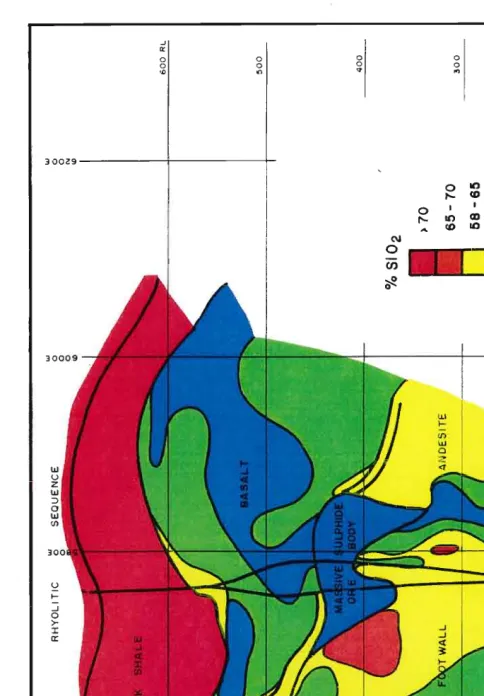
Silica Distribution.
64
FIGURE 19
FIGURE 20
FIGURE 21
FIGURE 22
FIGURE 23
FIGURE 24
FIGURE 25
FIGURE 26
FIGURE 27
FIGURE 28
FIGURE 29
FIGURE 30
FIGURE 31
FIGURE 32
FIGURE 33
FIGURE 34
FIGURE 35
FIGURE 36
FIGURE 37
FIGURE 38
FIGURE 39
FIGURE 40,41
FIGURE 42,43
v.
PAGE
Alumina Distribution.
73
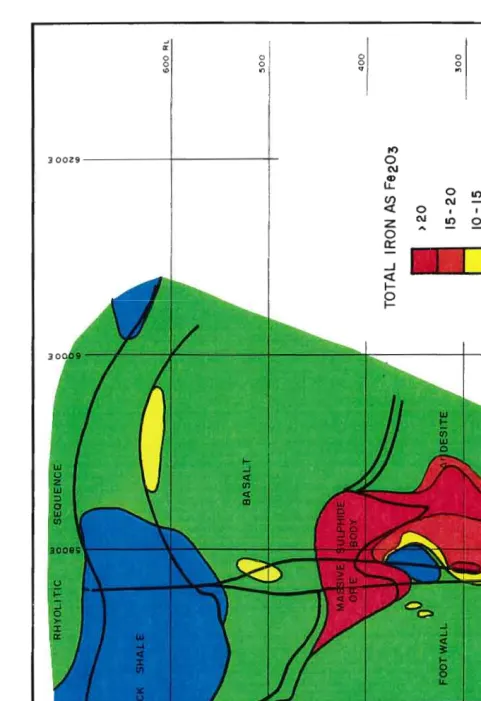
Total Iron Distribution.
74
Manganese Distribution.
75
Magnesium Distribution.
76
Calcium Distribution.
77
Sodium Distribution.
78
Potassium
Distribu~ion.79
Sulphur Distribution.
80
Copper Distribution.
81
Lead Distribution.
82
Zinc Distribution.
83
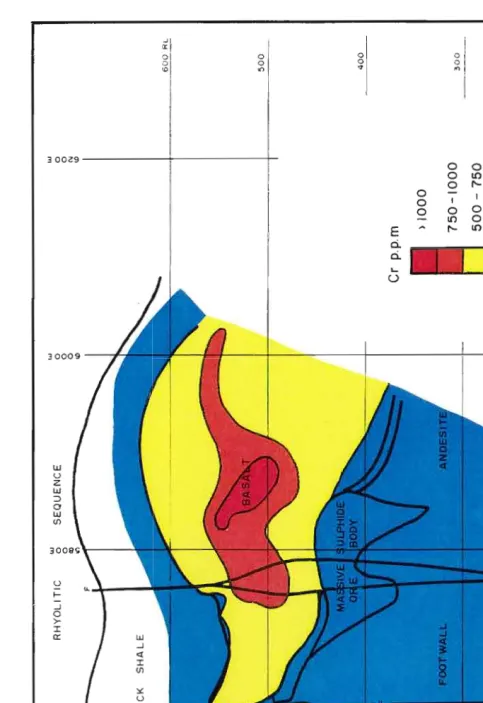
Chromium Distribution.
84
Barium Distribution.
85
Quartz-barite Alteration Isocon
90
Sericite-pyrite Alteration Isocon
91
Mg-chlorite Alteration Isocon
92
Quartz-sericite Stringer-envelope-zone Alteration Isocon
93
Mean Fuchsite Alteration Isocon
94
Albite Alteration Isocon
95
REE Chrondrite-normalized Spidergram for Stringer Zone
97
Rocks
1.
REE Chrondrite-normalized Spidergram for Stringer Zone
Rocks 2.
Element abundances in DDH HL55 through the calcite
fuchsite-pyrite plume - Major Elements.
Element abundances in DDH BL55 through the calcite
fuchsite-pyrite plume - Trace Elements.
98
100
FIGURE 44
FIGURE 45
FIGURE 46
FIGURE 47
FIGURE 48
FIGURE 49
vi.
PAGE
Hellyer Sulphur Isotopes - Histogram
118
Sulphur Isotopes .in Mount Read Volcanic Ore Deposits.
122
Hellyer Sulphur Isotopes - Models
124
Log fo 2 versus pH at 250°C Showing the Isotopic
125
Composition of Sulphur in Pyrite.
Progressive Reduction of Seawater with a Non-replenished
126
Supply by Rayleigh Fractionation.
(so
4
2--H
2S) Sulphate - sulphide Isotopic Fractionation
130
TABLE 1
TABLE 2
TABLE 3
TABLE 4
TABLE 5
TABLE 6
TABLE 7
TABLE 8
TABLE 9
TABLE 10
vii.
PAGE
TABLES
Augite Microprobe Analyses
36
Chromite Microprobe Analyses
36
Rare-earth Element Analyses
43
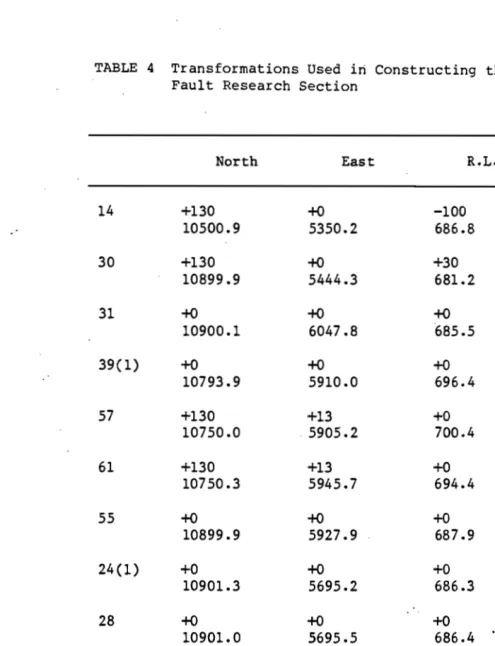
Transformations Used in Constructing the Hellyer Pre-Jack 65
Fault Research Section.
Major Additions and Losses of Elements during Alteration. 89
Mica Microprobe Analyses
105
Variations in Illite Composition with Reference to
106
Muscovite.
Chlorite Carbonate Albite Apatite and Titanite Microprobe 109
Analyses.
Sulphur Isotope Data
114
viii.
PAGE
PLATES
PLATE
1
The Que-Hellyer area looking south.
5
PLATE
2
Textures in albite porphyritic andesite.
28
PLATE·
3
Textures in polymict ash volcaniclastic.
30
PLATE 4
Textures in Hellyer hangingwall basalt (unaltered).
31
PLATE
5
Textures in the stringer zone core.
55
PLATE
6
Textures in the stringer envelope zone.
58
PLATE
7
Textures in calcite-fuchsite alteration.
60
ix.
PAGE
APPENDIX
Appendix 1
Cross Sections through Stringer Zone Core and Orebody.
145
Figure i
Orebody and Upper Stringer Zone
Figure ii
Orebody and Upper Stringer Zone
Figure iii
Orebody and Upper Stringer Zone
Figure iv
Orebody and Upper Stringer Zone
Figure v
Orebody and Upper Stringer Zone
Figure vi
Orebody and Upper Stringer Zone
Figure vii
Orebody and Upper Stringer Zone
Figure viii
Orebody and Upper Stringer Zone
Copper Distribution.
146
Lead Distribution.
147
Zinc Distribution.
148
Silver Distribution.
149
Gold Distribution.
150
Barium Distribution.
151
Arsenic Distribution.
152
Density Distribution.
153
Appendix 2i
Element Analyses, Holes, Sample Intervals, Rock
154
Descriptions.
Appendix 2ii Northings, Eastings, RLs, Ratios
165
Appendix 2iii Transformed co-ordinates for Sample Points used in the
176
Research Section.
[image:11.842.30.544.76.813.2]I.
ABSTRACT
Hellyer is a large (16 million tonne plus), Kuroko-style,
polymetallic, volcanogenic massive sulphide deposit in Cambrian high-K,
calc-alkaline, arc-like, volcanics in western Tasmania.
Hydrothermal
alteration in the Hellyer host lavas is preserved in a near pristine
condition, overprinted only by low-grade prehnite-pumpellyite facies
metamorphism.
The massive sulphide deposit occurs at the time break between an
albite porphyritic andesite footwall and a hangingwall basalt. Within
the Hellyer hangingwall basalt is a lava flow directly above the Hellyer
deposit with regionally high Ti/Zr -53, higher primary MgO, Ni, Cr and
lower primary Si02, Ti02, P205, Y, Zr, La and Nb than the surrounding
basalt. The structure which localized the Hellyer hydrothermal system
is thought to have also provided the locus for the extrusion of this
deeper sourced, more-primitive lava.
Not only is an excellent example of a hydrothermal feeder system
developed in the footwall andesite, but a plume shaped zone of chrome
green alteration occurs in the hangingwall basalt. The basalt was
extruded while the hydrothermal system was still active. The Cu, Pb, Zn
mineralized stringer-zone core consists of quartz barite surrounded by
quartz sericite pyrite grading outwards into a chlorite rich zone
including massive Mg-chlorite schists. This is surrounded by an
envelope zone of quartz sericite pyrite alteration.
K-feldspar develops
across the outer margins of the envelope zone. The green hangingwall
plume consists of pervasive calcite-fuchsite, accessory Fe-chlorite
patches, calcite veining and increased quantities of interpillow pyrite.
2.
Element distributions highlight the stringer zone with a Na20 low,
and more complexly, with Si02, Fe203' MgO, S, Cu, Pb, Zn, Ba highs. CaO
and Sr depletion in the footwall is more widespread than the Na20
depletion and extends outside the stringer zone.
In the hangingwall,
the plume is highlighted by increased S (2-4 times background S),
increased CaO (2 times background CaO), and elevated Ba.
Na20 highs
trace albite alteration.
In the hangingwall calcite-fuchsite alteration there has been a
major mass addition of CaD, K20, A1203, Ba and depletion in Fe203' MgO,
and Si02 , with relative enrichment in As, Rb and Mn. Zr, Ti02, Y, Nb and
the rare-earth elements remain immobile as evidenced by unchanged ratios
of these elements regardless of the degree of alteration.
In the
footwall stringer zone core there is some mobility of all elements.
Sulphur isotopes show a progressive decrease in
6
34S (pyrite)
values inwards and up the stringer zone from +13 per mil at depth
through +8 per mil to consistent values of +7 per mil in the orebody.
This is due either to an increase in oxygen fugacity towards the quartz
barite stringer-zone top and into a narrow oxygen fugacity field for the
deposition of the orebody, or to mixing a hydrothermal fluid with a
value of +7 per mil with a variable supply of reduced seawater sulphate.
Sulphur in light pyrite (-14 per mil) in hangingwall interpillow areas
is
produced from reduced seawater sulphate rapidly replenished by a
3.
CHAPTER. 1
INTRODUCTION
The Hellyer deposit and its Discovery
Hellyer is a large (16 million tonne plus) Kuroko-style
volcanogenic sulphide deposit in Cambrian andesitic and basaltic lavas
in western Tasmania (McArthur, 1986). The deposit was discovered in
August 1983 (Sise and Jack, 1984; Eadie et al., 1985) by drilling an
electromagnetic conductor which occurred below bright chrome-green
alteration and a barite pod exposed at surface in the hinge of an
anticline. Hellyer occurs three kilometres north of Que River (Webster
and Skey, 1979), a 2.6 million tonne volcanogenic deposit that also has
bright chrome-green alteration in its hangingwall and which has been
interpreted to occur in a tightly folded synform (Large et al., 1987b).
Aims
This study aimed to document mineralogical and geochemical changes
due to hydrothermal alteration in the Hellyer host rocks and to relate
these changes to the ore forming process. A cross section extensively
drilled to aid geologic understanding during the resource establishment
programme was chosen to construct a series of diagrams detailing the
distribution of elements in host rocks on a section through the centre
of the ore body.
It
~ashoped to develop criteria useful for
exploration based on this documentation and to use the results of this
4.
Physiography,
Vegetation and Climate
The Que River-He1lyer area comprises densely forested rugged
terrain typical of the west coast of Tasmania. The present physiography
is dominated by the Southwell River gorge in the east with the Cambrian
volcanics forming a prominent ridge to the west (Plate 1). On this
ridge, Mt. Charter is a low high (840 metres) and the Sharks Fin is a
prominent spine on the edge of the ridge. Quaternary-Recent glaciation
has formed some of the valleys down into the Southwell River. However,
little till has developed and Cambrian rocks are only covered by a rare,
thin veneer of glacial sediment.
Temperate rainforest covers the entire Que River-Hellyer area
except for patches of sedgeland which develop more especially on the
more acid intrusions and sediment-rich areas.
The climate is cold and wet with most rain falling in winter.
Average annual rainfall at Hellyer is 2083mm.
Previous Literature and Research
The only published account of the geology at Hellyer is McArthur
(1986).
Unpublished Aberfoyle reports include Jack (1983) and Jack
(1984), in which the host stratigraphy, way up, and gross character of
the alteration system and orebody was first described, and McArthur
(1985), a detailed account of the resource drilling programme,
5.
Shark's Fin
Que River Mine
Mt Charter
Plate 1
The Que-Hellyer area looking south.
Photography D. Jack 1984
The Que-Hellyer Volcanicsform a prominent ridge with the
Southwell River gorge and Lake Mackintosh just visible in the
east (top left of photograph).
The cleared area along the
ridge is a powerline and Que River Mine can be seen in the
background as a clearing east of the powerline.
Hellyer is
below the logged area in the foreground.
Access to Hellyer is
6.
rocks and alteration. W. Fander, in a series of unpublished
petrographic reports, described many Hellyer rocks from both the orebody
and host rocks.
The CSIRO produced a series of unpublished reports on
the mineralogy of the orebody (Ramsden and Creelman, 1984; Ramsden et
aI., 1986; Whitford et aI., 1984, 1985). G.R. Green researched the
oxygen and carbon isotopes around Hellyer.
More recently, Large et al.
(in press), produced a paper on gold in western Tasmania which includes
some data on Hellyer.
The first report (unpublished) on recent research
in the stringer system (Gemmel, 1988) recently became available but is
restricted. Harris, 1986 completed a regional study on the hangingwall
volcaniclastic rocks.
Waters (1988) has issued three unpublished
progress reports on a PhD on the regional vulcanology and sedimentology.
Recently, McArthur and Dronseika have completed a paper on the geology
of Que River and Hellyer, (McArthur and Dronseika, in press).
Outline of Thesis
In order to describe the alteration in the Hellyer host rocks,
their original character needed description.
Therefore after brief
introductions to the regional setting (Chapter 2), and geology of the
orebody (Chapter 3), Chapter 4 is devoted to the primary geology and
geochemistry of the host rocks.
Chapter 5 describes the effects of
hydrothermal alteration, an important part being presented
diagramatically depicted element distribution around the orebody. The
question of element mobility in various alteration facies is also
addressed.
Finally, in Chapter 6 the distribution of sulphur isotope
7.
Work Completed
A series of drill holes covering all the rock types and as wide as
possible a distribution around the orebody were selected for sampling
concentrating on a section drilled extensively in the early resource
drilling. This section passes close to the centre of the hydrothermal
system as established by subsequent underground drilling. 140
continuous core grinds covering intervals logged macroscopically by the
author were analysed for whole-rock geochemistry (Appendix 2) • . In
addition a further 208 split core samples
tmost from within the core
grind intervals
twere analysed for whole-rock geochemistry (Appendix 2).
All split core samples have an accompanying polished thin section and
these were examined and related to the geochemical analysis. These are
filed together with photographs and offcuts in Aberfoyle's thin section
library in Burnie. In addition 19 rocks were selected for rare-earth
element analysis. Most analyses
tincluding all the rare-earth element
analyses
twere done or supervised by P. Robinson at the University of
Tasmania as detailed in Appendix 2 and Table 3
t(XRF and XRF-ion
exchange).
Some samples (see Appendix 2) were analysed by AMDEL
laboratories in Adelaide and by the Tasmanian Mines Department
Laboratories in Launceston by a combination of lCP and XRF methods (see
Appendix 2).
All the data is stored on Aberfoyle's HP1000 computer
'nMAP' programme with selected data stored on Macintosh P.C. 'Cricket'
and 'Excel' systems.
Aberfoyle's Appollo computer and an 'Eagle-Condor'
gridding and interpolated programme were used to produce a series of .pa
a
Aberfoyle's Burnie file together with numerous other scattergrams,
histograms and
geosta~isticaldata not presented in this thesis.
Selected microprobe analyses were performed at the Central Science
Laboratory at the University of Tasmania by the author on a JEOL JXA
50A microprobe. The
d~tailed2
~etrecore
grin~~through the upper
stringer zone and orebody were provided by G. McArthur at Hellyer
Mining, analyses being done by Analabs and Aberfoyle's Cleveland
Laboratory.
Contouring was done by the author.
59 Sulphur isotope
analyses were performed by Ritchie Woolley at the Central Science
Laboratory University of Tasmania and by Dr. Sue Golding at the
University of Queensland. All sulphur isotope analyses were performed
on samples drilled out using a dentist's drill and are accompanied by a
polished thin section filed in the library in Burnie. Most work
associated with this thesis was conducted part-time during the period
1985-87 and a series of nine progress reports were produced (Jack, D.,
1985 to 1987).
Interpretation and writing of this thesis was done patt
time in 1988 and early 1989.
kb~le~~eMs
I would like to thank Dr. Ross Large for guidance, constructive
criticism and numerous suggestions while undertaking the research and
writing of this thesis. I would also like to thank Dr. Anthony Crawford
for similar guidance on the primary character of the rocks. Discussion
9~
Huston, Dr. Peter McGoldrick, Dr. Bruce Gemmel, Dr. Ron Berry and Dr.
Rick Varne helped consolidate ideas.
Phil Robinson supervised the
geochemical analyses and Ritchie Woolley and Dr. Sue Golding did the
sulphur isotope analyses.
Dr. Geoff Green from the Tasmanian Department of Mines is thanked
for arranging some geochemical analyses at their Launceston laboratory,
free of charge and for providing data and discussion on carbon oxygen
and sulphur isotopes.
Many people at Aberfoyle helped in the production of this thesis:
thanks especially to Jacky Cure who typed the thesis and put up with
numerous revisions, to Julia Rapier who did most of the drafting, to Rod
Paterson and Richard de Bomford who helped with the computer
applications, to Gary McArthur who provided the underground drilling
analyses and under whom the author worked during the 1984/85 resource
drilling at Hellyer, and to Hugh Skey and David Wallace for
encour~gement
and support.
10.
CHAPTER. 2
GEOLOGICAL SETTIBG
R.eglona1 Geology
Hellyer occurs in an
arcua~ebelt of Cambrian calc-alkaline
volcanics in western Tasmania described as the Mount Read Volcanics
(MRV) (Campana and King, 1963) (Figure 1).
The MRV is host to the other
volcanogenic massive sulphide (VMS) deposits, Que River, Rosebery,
Hercules and Prince Lyell. The MRV are flanked to the west by a
volcano-sedimentary sequence deposited in the Dundas Trough.
(Campana
and King, 1963).
The Dundas Trough and the MRV occur between two Precambrian blocks,
the Rocky Cape in north-west Tasmania and the Tyenenean Nucleus of
central Tasmania.
The Dundas Trough contains the carbonate-dominated Success Creek
Group stratigraphically overlain by greywacke - mudstones and tholeiitic
volcanics of the Crimson Creek Formation. Several fault-bounded
ultramafic bodies occur. All of these rocks are thought to be older
than the MRV.
They occur together in the Dundas Trough with younger
sediments and volcanics assigned to the Dundas Group (Corbett, 1981).
The Dundas Group sediments are at least partly formed from detritus shed
off the MRV.
Other volcanogenic deposits in Tasmania (Figure 1) are confined to
a division of the MRV that consists predominantly of acid lavas,
pyroclastic rocks and intrusive rocks known as the Central Volcanic
Complex (Corbett and Solomon, in press).
Hellyer and Que River occur in
a more mafic package of volcanics, the Que-Hellyer Volcanic interpreted
to be younger than the Central Volcanic Complex to the south (Komyshan,
11.
P£
Pt
Tertiary sediments 8 basaltsDevonian granites
Permian P€m
Ordovician - Devonion sediments Owen Conglomerate
(Late Combrian - Early Ordovician) CAMBR/AN
I':>
:l
Undifferentiated sedimentary 80•• " volcano sedimenfary sequences
• Oundas Group (Middle-Late Cambrian)
[lJ
Ultramaf ic - mafic bodiesTYENNAN
BLOCK Calc.- olkaline acid rocks north of Hellyer MOUNT READ VOLCANICS
Tynda 11 Group
a
correlates (Middle - Late Cambrian)'0
o
Que- Hellyer volconics 8 intermediate tobasic calc.-alkalinewolcanics nth. of Hellyer Centra I Volcanic Complex
P€m
I
0
GranitesVolcano-sedimentary Western Sequence
PRECAMBRIAN
rp:£l
Relatively unmetamorphosed~ Rocky Cope Block
I
Peml Metamorphosed schists 8 quartzites of Tyennan Block~ Operatino Mine
o 10 20 3OI<m
! , ! !
Aberfoyle Resources Limited
FIG.I.
EXPLORATION DIVISION REVISIONS
Inil.
I
O.t,I
Init.I
O.t.NORTH WEST TASMANIA Compil.d
-
' D JJI
I
I
I
I DISTRIBUTION OF MOUNT READ VOLCANICS
Drawn:IN
WESTERN TASMANIA
Trac.d , JL RMODIFIED AFTER LARGE et 01., 1997
Chock.d
La ••tion Code' Seal. O.t. June 1988 PI.t. No. Ot 95
FIGURE 1: The Distribution of Mount Read Volcanics in Western Tasmania. The Mount Read Volcanics are exclusively calc-alkaline.
I
12.
The Henty Fault system (Figure 1) transects the MRV, separating the
Central Complex into a dacitic-apdesitic arc segment immediately south
of the Que-Hellyer volcanics from a more rhyolitic arc segment in the
southeast (Corbett and Lees, 1987).
In the southeast the Central
Volcanic Complex is flanked by a western volcano-sedimentary sequence
interpreted to be partly older and partly coeval with the Central
Complex (Corbett, 1979, 1981).
Quartz-feldspar porphyritic volcanics and volcaniclastic rocks
assigned to the Tundall Group in the southeast overly and flank the
Central Volcanic Complex, mostly in troughs or grabens. At Hellyer, the
mafic lavas containing the ore body are overlain by a black shale and
then by younger rhyolitic quartz and feldspar porphyritic lavas and
pyroclastics mixed with sediments (Figure 2).
Tasmanian Mines
Department mapping (Komyshan, 1986) has grouped all these rocks,
including the Que-Hellyer volcanics, into the Dundas Group.
Berry and
Crawford (1988) group the Que-Hellyer volcanics into the western
Sequence of Corbett (1981).
Cambrian granites, notably the Murchison granite, intrude the
Tyndall Group in the east. The end of volcanism was marked by the
deposition, again in grabens, of siliclastic rocks assigned to the Owen
Conglomerate. Major folding and greenschist facies metamorphism
occurred in the Devonian.
The MRV themselves have been linked to rifting and grabens (Campana
et al., 1958; Williams, 1978; Corbett, 1981).
Large et al. (1987a),
emphasise the importance of rifting in locating the volcanogenic massive
13.
Ogl
Operotino mine
dip
anriform sy"form
QUATERNARY
TERTIARY Terfiary basal'
SILURIAN-OEVONIAN [!:[] Sediments
ORDOVICIAN Lim•• ton.
-
~E. ORD. L.CAMBRIAN ~ Owen conglomerat.
.
-Tyndoll F81sic volconic,votcaniclOsfic
Group
C£:J
conoranerot.Upper rhyolir. Yolcono sldimentary sequence
Que River black snale
0.
o ~
.~[-
~He JI'Yer HonoinowaU Bosolt~
2
·
~::l~~lo~TICjO.8 olh
la ·Oocir••
o
'"
."~
• And ••
i'"
inc .Olbite port!'P/l"itic!
yCl: and.sire
Clj ~
"
• Lo... r 80solto
::1
o
I35J
Micaceous siltsfOnl3~
Central ~g18~:~~~.-feldsparI Sequence
80 8arif.
BNS 901. metol sulPhide
• HonOinowoll Fucn ..,.
MINERALIZATION
calcite oltwation
IJ!!J .
Footwol .rrin_ oIf. .oJ;onINTRUSIVES CJI:] Rhyolif.
o - , Dol.rit. 2Km
I I I
FIG.2.
HELLYER DISTRICT GEOLOGY
Modified after mapping by Aberfoyle Geologists including author. Slratigraphic classification after Komyshan 1986 I
Drawn' DJJ Traced' JLR Date: .June I 1988 Plate No' HEL 107
FIGURE 2:
Hellyer
DistrictGeology. Hellyer
occurs in the hingezone of a prominent regional anticline
below
brightSECTIO N ON 5000 E
NOOTH SOUTH
"l MT CII
H
C) o
C
f;i
fPA w
LB
o
rt 0 0 Mic S.
:r c c
ID ID ID LB
11160N
c.
w-?
6100N10100N 6200" (EAST) C'2
?
Mic S. 8000H
8100N 9300N 10ZOON
1600H 9100N
C.
6 zoort (WEST)
WEST
SECTION ON 7800 N
- LEGEND
0:1=-_"";::===
9ase Metal and/or Barit" Mlnt:ralisotion
®
Upper Rhyol it e Sequence
c ..,
~
'0 '0
()
0
..
Block Shale, minor SII"Ione
~
ID
..,
7i" 0c:
::J He!lyer Hanging 1001/ Basalt
"'
<T
en
"'
~
Polymict Volcaniclasllc5Oocll"
"'
~
~
~
:J:
"'
~
feldspar Phyrlc AndeslleI
Q!:]
Low"r Basaltc. ::J
"'
0
I
MIc 5,
I
Mica Sandstoneu
E Bedded tuffs, smdslones, quartzites, 'elslles, 11Inlmbrlles
~ 0.
~
... ID o 0
rt rt'0 - c
..
{
[ 5 ]
Polymlct Volcanlclasltc5:r ::T ... o III
III ... ()
QUE RIVER
HELLYER
STRATIGRAPHY
>
::Jrt :l rt
-g
~
Ignimbrllas~(/)
~ LJndifler8 nlloled
..
~
0
Schematic
Sections
15.
many tectonic hypotheses. This varies from analogues to the east
African rift system (Williams, 1978; Collins and Williams, 1986), to the
incorporation of accretionary prisms, extension tectonics and crus tal
thinning on the edge of an active continental margin (Varne and Foden,
1987).
Corbett and Lees (1987), modifying an hypothesis of Green
(1983), have suggested an east-dipping subduction zone below a Cambrian
accretionary prism - forearc sequence near Rosebery. Berry and Crawford
(1988) draw analogies with present day arc-continent collisions and
associate back-arc thrusting.
Hellyer District
Geology
A simplified geologic mapping of the Hellyer area is presented as
Figure 2 and interpreted schematic long and cross sections as Figure 3.
Stratigraphy
The intermediate lava-dominated package containing Hellyer, is
called the Que-Hellyer volcanics (Komyshan, 1986), and this rests on a
. mica sandstone basement. Lava extrusion begins with a lower basalt
which passes into an andesite that often contains prominent albite
phenocrysts. Within these lavas are subsidiary dacites and polymict ash
volcaniclastics and breccias, many of which are interpreted to be
epiclastics.
At the top of this lava sequence is the Hellyer
hangingwall basalt which directly overlies the Hellyer ore position.
The contacts at the base and the top of this lava package are
16.
sandstone, and the Hellyer hangingwall basalt often having a peperitic
contact with the late Middle
Ca~brianblack shale above.
The lava package varies from less than 300 metres thick in the west
to in excess of 800 metres in the east and individual units change
rapidly in thickness.
The black shale above the lavas passes into a sequence of rhyolitic
volcanics and sediments informally called the Upper rhyolitic sequence.
Rhyolitic volcanics include possible ignimbritic and subaerial units and
the sediments include shales and polymict volcaniclastics. Further to
the northeast is another block of sediments, rhyolitic lavas and
epiclastics interpreted to belong to the Tyndall Group (Komyshan, 1986).
The whole sequence is intruded by rhyolitic dykes and by dolerites.
A K-Ar determination on pyroxene concentrates from the dolerite gave a
Devonian age (Webb, 1985), interpreted to be a signature superimposed
during Devonian tectonism.
Structure
Major faults have cut and partly bound the Que-Hellyer sequence
(Figure 2).
Prominent are the Henty fault and Mount Charter fault which
together form a V-shaped southern limit to the lavas. The Henty fault
contains sheared and folded shales in a horst to the south (Berry 1986),
and this is interpreted to extend up the east of the Que-Hellyer
volcanics and then to coalsesce with the Que fault - Mount Cripps fault
to the north (Aberfoyle staff maping, 1978 - 1988).
An
anticline has
been mapped at Hel1yer (Aberfoyle staff mapping 1978-1988) and a synform
has been interpreted at Que River (Young 1980, Large et al., 1987).
The
folding is interpreted to have occurred in the Devonian (Large et al.,
17.
Metamorphism
The rocks have undergone prehnite-pumpellyite grade metamorphism
(Whitford et al., 1982).
In contrast with Rosebery and Hercules, both
of which are subject to intense folding and greenschist facies
metamorphism, little internal deformation of the Hellyer VMS has
occurred and metamorphic grade is not high enough to develop amphibole
in the lavas.
Mineralization and Ore Deposits
Two operating VMS mines Que River and Hellyer occur in the Hellyer
district. Que River mine, 3 kilometres south of Hellyer, is hosted by
andesitic lavas with minor polymict epiclastic rocks.
The major VMS
body, PQ lens, occurs in a subvertical, lensoid wedge-shaped body below
a dacite lava. The shape and metal distribution within the orebody has
led to PQ lens being interpreted as a synform with the centre of the
feeder system represented by coarse pyrite at the base of the keel
(Large et.al., 1987).
This represents a refinement of a
proposa~by
Young (1980) and differs considerably from previous interpretations of
stacked vertical lenses in a west facing sequence (Webster and Skey,
1979; Wallace and Green, 1982).
In addition. to the PQ - P north lens system, a massive sulphide
lens called S lens with a copper rich facies and an equivocal
relationship with PQ lens outcrops 130 metres to the east of the main PQ
- P north Que River orebody.
These massive sulphide lenses occur in a
18.
pyrite, sphalerite, chalcopyrite alteration up to 100 metres wide and
more than 300 metres deep. At the top of PQ lens in the core of the
interpreted synform is a polymict unit approximately a metre thick,
containing basaltic fragments pervasively altered to fuchsite and
calcite.
Three kilometres south of Que River mine, a stockwork of barite
veinlets and lenses outcrops at Mount Charter. Coarse white and grey
barite intercalated with sulphides is underlain by a zone of alteration
interpreted to be a footwall stringer system (Figure 2).
Other
interpreted stringer systems exposed at surface are also shown in Figure
2.
High grade VMS clasts in a polymict volcaniclastic rock one
kilometre south-east of Hellyer mine, may be the remnants of a VMS
deposit fragmented and redistributed by explosive volcanism.
Calcite-fuchsite alteration occurs above Hellyer and also one
kilometre south east of Hellyer, where it forms an exploration target
based on data discussed below. There is a barite lens at surface in the
19.
CHAPTER 3
THE ORE BODY
Introduction
A detailed description
of~theore body is outside the scope of this
thesis~
and only a brief description is provided as background and to
relate some features to alteration in the host rocks.
An indicated geological resource of 16.1 million tonnes at 0.38%
Cu~
7.4%
Pb~14.4%
Zn~175 glt
Ag~2.4 g/t
Au~2.3% Ba and 1.1% As is
drilled between 10285N and 11075N at
Hellyer~(June 1987 Ore Reserve; G.
McArthur~
pers. comm. 1987).
This excludes any stringer zone
mineralisation.
The elongate cigar-shaped ore body is depicted on a long section in
Figure 4 and on cross sections 10900N and 10750N (Figures 5 and 6).
The
ore body is transected by a fault major called the Jack fault. By
comparing mineral
zoning~grade and the shape of the ore body on either
side of the
fault~the movement has been established as east side 130
metres north up 30 metres
(McArthur~1986).
Hellyer's shape is probably controlled partly by palaeotopography
with sulphide deposition occurring in topographic lows and by mounding
outwards from a central core. Recent underground exposures suggest some
structural modification with occasional parasitic folds on the edges of
the ore body and possible tight fold hinges at the top of a possible
antiform east of the fault and a possible synform west of the fault.
Zoning
Zoning in the ore body is illustrated on a schematic cross section
z
z
z
0
g
o
0
III
o
0
9
t"Ij H G)
Cl
~
HAH8IHGWALL BASALT
~
::r:
CD I-' I-''<:
CD t-1
l:"l 0 ::l l!l
(J) CD 0 rt"
\-'-0 ::l
'tl
t-1
0
w_
CD
0 ORE BODY WEST OF
rt"
\-'- JACK FAULT
0 ::l
(J)
::r
0:€
\-'-::l l!l
b
t-1
\-'-I-' HL,.. 'OOTWALL AHDESlT!
I-'
::r:
0I-' CD l/I
EAST OF FAULT
HUI
(J)
Aberfoyle Resources Limited
::l
,..
EXPLORATION DIVISION'"Cl AIVIS,ONS NORTH 'ME S T TA SMANIA
I-'
CD CD hut.
u".
III.t 0111 HELLYER0..
.,.
LONG SECTION PROJECTION SHOWING
DRLL HOLES SAMPLED
700 RL
600
~OO
400
300
200
c...1I : DJJ D,.•• : OJJ
"
...
: JLllN (all! 100'l'OUTLIH! 'llOM 11. . 0111 llUlllVIl
C"".II :
DUl,ulI'. Ct" . Se... ,; 2~OO pt,.. " •.. HEL 105
o.J o.J o.J o.J lI.I
'"'J
0 0
~
on
o o CO on
o o
CD
on
o o
'"
coo o
o CO H
Cl c:
E:l
RHYOLlTE SEQUEU1
_..---
---.
BLACK SHALErr
....
;:I;::r ::J ro 600 RL
ro f-'
() f-'
;:I; 0"<
ro f-'ro
f-' 0
...,
BLACK SHALE
f-' C
"<
...,
n ro...,
...,
....
0 FUl Ul
::0 Ul
ro w.
Ul 0 r.n
ro .... ro 500
III ::J ()
"
ro rr() Q, ....
::r 0
~ ::J
r.n
....
ro rr f-'() ::r 0 et ID
,....
et 0 0 ::r 0 ::J ro Z400
()
0 ;:I;
'"'J f-' 0
,....
0 f-'<0 C ro
C
...,
Ul Hangingwall basalt"
ro ro Q, UlIII
f-' III 3 Massive sulphide
....
"
'0ro f-'
DJ ro
Q,
....
300::J III
"
'"'J ro
,....
<0 Ul
C ::r
"
0 ro ~::J
a-rr o-,J
0 ::r 200
ro I"'t1
0 DJ
...,
"
3 roIII
Aberfoyle Resources Limited
EXPLORATION DIVISION "'TI
G' lait.
"iEVISIONS
DII. I_il. Du. NORTH WEST TASMANIA C'''I''- : DJJ
DJI." 1 DJJ
(]I HELLYER CROSS SECTION I0900N Tt.cetl : JL R
c... :
w w w w w 0 0
...
III o o o IDo 0
o 0
_
___
~:g~---lF----~---""<":
...:-....---.,...-.... ...:-....---.,...-.... "'::"....-....
-R-H-Y-O-L~IT-E-S-E-Q-U-E-N-C-E-o o N ID
....
.......
..."'l ... BLACK SHALE
H
C) BLACK SHALE ...
c
Gl
HANGINGWALL 8ASALTm 600 RL
rt ::r III
...
:J () :I: III ... ... .... ...-
... ...'
....,::-.
....,
:I: III ... ... '< III....
0'< ... Ill 0...
c:...
n
...
...
0"
\\ \\BOOY \\
\\
\'
l500en :u
III w.
en en HANGINGWAL~ _ -r-/ ... ...
..:::::-... --=-:::::en 0 Ul
III
...
IIIQI :J ()
....
III rt() 0..
...
::r 0 :£ :J
Ul
...
III rt ...
() ::r 0 rt
...,
...
rt U1 0 ::r 0 :J III Z()
"'l 0 :I:
...
... 0FOOTWALL VOLCANICLASTlC ANOE51TE ENVELOPE
't--
STRINGER \ \ \ I I I \\
,
FOOTWALL ANOESITE\
,
\,
,
\,
I I \ \ \,
ZONEHongingwoll basalt
400
..a 0 c: c:
... ...
III III
... III en I I I I I I
Massive sulphide
...
...,
0.. en QI QI 3...
'0ZONE
300 III ...
QI III 0..
...
:J QI....
"'l III
...
..a
c:
...
en 0 ::r 200III :(
:J VI
~
rt ::r 0 III
Hl 0
....
3 QI....
IIIIII
Aberfoyle Resources Limited
EXPLORATION DIVISION." 1.11.
IUVISIO ..S
DIU lilt. D... NORTH WEST TASMANIA
_ , OJJ
0
HELLYER CROSS SECTION I0750Nm
23.
F'
CIIrome ;reen plume
Hanqinq wCllI
Bosalf
Rlawall
AItiIe Pllf1lllYmic
And....
'\
\ \
\
Man , \
\
\
teeo..I
j
\Enve,oDe \
-\ Srnnqer zone
-Zonecore \
\
\
o ~
\
\
I I
I
Focrrwall
F' AWe pcI'llft'frjt;C
AlICleslfe
•
Stringer Zone
HELLYER - SCHEMATIC
CROSS
SECTION
(Pre Jack Fault movemenr
J
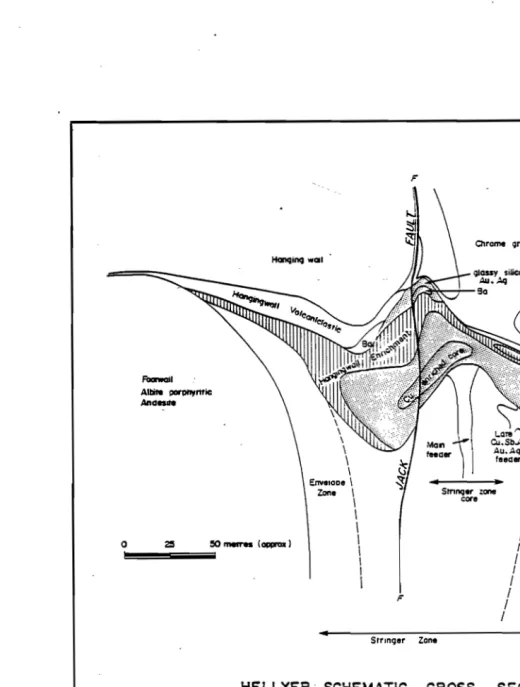
1-FIGURE 7:
Hellyer Schematic Cross Section: This depicts the zoning
in the stringer zone and in the massive sulphide.
The location of the chrome green hangingwall plume above
the "main feeder" in the stringer zone is also shown.
[image:34.842.63.584.66.753.2]24.
viii in Appendix 1).
The zoning consists of a pyrite base at the centre
top of the stringer-zone, a chalcopyrite-pyriterich lower ore body, a
central massive zone passing upwards and outwards into a Pb, As, Ag, Au
and Sb enriched hangingwall zone which extends into the footwall in the
trough west of the Jack Fault.
There is a barite top to the ore body
and an auriferous glassy quartz-pyrite cap.
Textures and Mineralogy
Fragmental textures are rare, and the ore is commonly a featureless
pyrite-rich massive variety. Jigsaw-like brecciation, interpreted to be
a response to shrinkage and load adjustment phenomena, is common,
(Fander, 1984).
In the outer hangingwall enriched-zone, banded brown
sphalerite-pyrite-galena occurs. Sphalerite-enriched banding between blocks of
massive sulphide has been observed in this enriched zone.
The base of
ore body is marked by a porous lead-and zinc-poor, pyrite-rich zone.
There is a major barite-pyrite and precious-metal cap to the ore body.
Pyrite set in glassy silica caps the barite.
The dominant microscopic feature is the complex fine-grained
intergrowth of pyrite with galena and sphalerite. Framboids, radial and
concentric textures, colloform and banded structures occur in zones in
the massive ore. Spongy arsenopyrite is intergrown with other minerals,
especially sphalerite and galena.
Barite can be interbanded with
sulphides that display sedimentary characteristics such as graded
bedding.
Sphalerite with chalcopyrite disease is especially abundant in
25.
tabular pyrite in veins in the upper precious metal zone (Ramsden et
al., 1984,1985).
The deposit averages 51% pyrite, ZZ% sphalerite, 8.5% galena, Z%
arsenopyrite, and 1% chalcopyrite with trace tetrahedrite. Boulangerite
(5PbS.ZSb ZS3), subsidiary bournonite (ZPbS.CuZS.SbZS3) tetrahedrite
(Cu1ZSb4S13) - tennantite (Cu1ZAs4S13) occur in the precious metal zone
(Fander, 1984; Ramsden et al., 1984, 1985).
The principal non-sulphide gangue mineral is calcite which occurs as
veinlets, tension gashes and also microscopically between the sulphide
grains. The other major gangue mineral is quartz especially in the hangingwall
precious-metal zone.
Barite increases in quantity from a major barium
low in the lower and central parts of the ore body to massive barite in
the hangingwall (see Figure iv in Appendix 1).
Other gangue minerals
include chlorite and sericite, but these occur in zones where there is
evidence of faulting and their occurrence is possibly. related to
deformation. Other less prevalent gangue minerals are ankerite, which
occurs with calcite towards the hangingwall in the western trough
(Figure 6), and apatite, with the ore having a PZ05 content of up to 0.15%
(Abermet internal reports).
Little internal deformation or metamorphism of the Hellyer VMS has
occurred.
Deformation is confined to restricted areas such as the hinge
of the trough west of the fault. This is in contrast to Que River which
has suffered intense folding, and where banding within the ore may be the
26.
Interpretation
The zoning is interpreted
to
be the result of remobilization of
metals outwards from the stringer zone core.
This is evident in the
contoured cross sections in Appendix 1 where the hangingwall enriched
zone forms a halo around a central metal-depleted zone. This accords
broadly with models presented for Kuroko deposits such as these of
Eldridge et aI., 1983. There also appears to be late Au, Ag, As, Sb
and Cu metasomatism interpreted, based on its position, to be related to
the secondary stringer system east of the central core (see Figure 7 and
Figures i to viii in Appendix 1).
Interpretation of the mechanisms
involved in this redistribution is beyond the scope of this thesis.
The abundance of calcite in the ore body is important in
considering the calcite-fuchsite plume-shaped zone in the hangingwall
lavas (see Chapter 5) in that a carbonate-rich phase has clearly
27.
CHAPTER 4
PRIMARY PETROLOGY AND GEOCHEMISTRY OF THE HOST SEQUENCE
Introduction
The Que-Hellyer volcanics, host to the Hellyer deposit, consist of
basalt and andesite, with subsidiary polymictic rocks and dacites. At
Hellyer, the hangingwall is a basalt lava and the footwall an albite
porphyritic andesite lava. At the ore position between these two lavas
is a polymict breccia and ash volcaniclastic rock which onlaps onto the
sulphide mound.
The primary petrology and geochemistry of these rocks are
described to provide a basis for petrographic comparison with altered
products and to assess the direction and amount of element mobility.
Petrography
Hacroscopic Textures
The Hellyer footwall andesite
The Hellyer footwall andesite is a grey albite porphyritic lava and
lava breccia.
Plate 2 depicts typical textures in this unit.
The lava
commonly consists of lapilli-sized andesitic lava fragments set in an
andesite matrix.
The albite phenocrysts, the grey colour, the absence
of pillows, and the scarcity of vesicles are the most striking
macroscopic features to contrast with the Hellyer hangingwall basalt.
A secondary lava type in the andesite is a lava breccia with pink
siliceous angular fragments set in a green chlorite-rich matrix. Both
matrix and fragments are albite porphyritic. These pink fragments may
28.
Plate 2:
Textures in albite
porphyritic
andesite.
Middle:
augite (left) and
albite (right)
phenocrysts .
Bottom:
Perlitic glass
(left)
Ipurnpellyte
at end of augite
phenocryst in glass
fragments altered
to chlorite with
sericite rims(right).
HLOJO
319.'1
o
5cm (above)t I I ! I I
29.
within the lava include dacite and a variety of lava fragments
exhibiting changes in colour and silica content of the andesite.
Epidote and distinctive green pumpellyite may be visible with epidote
usually developed in the matrix and pumpellyite psedomorphing the
albite.
The Hellyer hangingwall volcaniclastic rocks
The Hellyer hangingwall volcaniclastic rock is a highly polymict,
poorly sorted unit of breccia with intercalated bedded ash
volcaniclastic rock illustrated in Plate 3.
Fragment types in order of
abundance include andesite, usually albite porphyritic, basalt usually
with prominent carbonate-filled vesicles, leucoandesite normally flow
banded and commonly the largest of the fragments, grey felsite, whispy
green sericite-altered fragments, rare massive volcanogenic sulphide and
pyrite fragments. Finer sericitized, elongate volcanic fragments form
the matrix.
The Hellyer hangingwall basalt
The Hellyer hangingwall basalt is a mixed lava unit with highly
vesicular flows intercalated with pillow lavas, massive non-vesicular
lavas, lava breccias and increasingly, closer to the shale contact, a
mixture of lava and shale with a characteristic peperitic texture. The
pillow lavas display a wide variety of pillow shapes, from near
spherical to tubular (Plate 4).
Grey chert is less common than shale in
interpillow areas, and flow margins to pillows are altered to muscovite
and chlorite.
The lava breccias often consist of hyaloclastic quench fragments.
30.
Plate
3:
Textures in
IX'lymict ash
volcaniclastic.
HLO.3
L33E..ur,
3J405
o
5cm (above)! , , ! ,
Cryptocrystalline quartz-pyrite-sericite.
Variably sericitized volcanic fragments (above).
Pervasive sericite (above)
Pervasive seric.i. te-pvri te-calci'te.
~
....
~;:r·'~'~'ilr-·
in sericite.
1mm (above)
31.
•
• ,4""'~'" '.~':" '':''--.~11".. 1, ~r~~Z"i:~-- ~-.... , -,",.
- •. -"~'~")-:.J?'~"-"'"....
.><It .~~1 • •': .' ..'
~
~~·-~~.r~~.L
."t~i':··"·
X 1;~'~':'
~-;'
:"" ' , ' ~" ~'';'',- .. 3'-.;",!. y~~~~• ,,':it,~"'Stt.
••
~;r.•.
~.. ': .•
~-.
•
~.--..
...,:•.... :- ...
~ :·A~·.·..
"..;.j '" (-k," 'l..~~~;';~.y.''::';: '.,
~,
t,~.,:
',. \ ,':'~
'.""",~
.;'t, .., .,." .:; ',!'~,JJ.!j7-'
....
:Jp.~.
. '?....'?r"
*J'f;~
. • .
~
' . ; •,.~.
. ' , f " , ':\iJ',
~.,
...
I~
• • .~ ~
•....,.j,: ~.
r:. .
~I - , I'l
.
.'
...
t· ~'~f.~\-/:'.. i ••' ... .r.. ' a: ':'~"'.'. \.-~~ -I .C;..,... ,.... • • • • . , ' . . . ,-:;. ,... .,.. t.
J!.
• '•.
j".
..~ ,;0•••./:> '.. '.
r ..
r-:' ..
,":~
~
.:'.
·~~::·
...
;t"i;i~~~;'l
JJi)~.'
i'J4,
f~);'
'F.'~1
\
' .., . ' ... '
~ ~
. :,"-f ...: .
~'.
. • ::'\....
r"."t"'"
...
~'-,!-;;'t'
""'~
, r·
_ :~;, ~r,
",t~ f . " " ,\!
:!l .. :...
~,'..
~ .. 1J . .
. t
":t').: '.
l':"
it-::-;~:
~~,;,'~I
·t
r
:,I.·
,(:;.'~
~-·fr:.
<.t.1
~
~L
..•.
.
'~..4
• --, . '"~~.,
f" .... _,. :.; ... --r - .. r ~ ) . \ . • IT ,) ~ ... ,..
~
.': ,'..•..~.#':,
,,' ... "'\:t; J.-.l1ft
~'~
'.'
' . : 1 ,,_.. ,.
.,~..
,- 4iIl. " . ( ) • ,,··t~~;;·:., . ":.'
'.
i?~::,'4...
~ ~Jl "'.' " ' l ' ~ . " .. \ _ . " ' . J " f '
J • • tT -'. ' . . " " .~ ,
~ ~ f • . . : ~'J :.~,.~" • ''l'':YI't'
.. ' " ' ; ' " -1·\ '.v .-',,' .. ' . '"
''1.-.
C."r"-::- t~.. :~,
,;..,
'...
~""'" ; ' . "'/".~,.;
.
I ' i'~,:,:1'· ..
~'.._•.
I:t' ;:-'\,.••.. ..:.:..; .,..
~
~~.~:
...«.~;\;
'\;~::;;".(
'~'~';~~~);
, .~\.;~_.
, • ..,' '., ' . ' .~
, - ,'~\"""
~j
,j
.'. 1<, ... , •.•• , ' , .\~ . . • ,••
\-"J, ".':'~ ~t·~ .•.. .: .. If, . ".'.: . '.-
-?--::f'"
~'t
.
"'~'
~:
.
;~.
I'...
(f,l.:.
""t., .'; ." ,...
~.
1
';\'
,
~ ." ~•. i ~:. .- . .' '. ...., '\'~ . " ' . b •..' ' . ' . , . ' . "' r'"
" ~(' .. \' fJo!t-\ J... ~ , ~, . / . ':'-", ~~r"'\~'" ,~_ . t";
,.' ,'" i~')' - "- .. - . 1 " ' 1 ' ·l~~~·'
..
."
\
~ '~ . ~,~;'...
,....
."\.
'. " ., '.. ··Itv·""
~v 'Ii '. ~.:.:. .•. . ••. ''t .... i',,~.
'..
1 -~,... I ..f~~,:·I:JII 4
i
·'b· . . ',', "; ' . , .• ; t J t - . . .• '("", ~ '.~'''~.
".
~. .
~ '." ~....
• '\ • '. ~ ' " "'11':..
' _ . '
..
-
\:.,~
-,.,.
, " .~
".~".~~.:ll.
~,:.
~ ":~., \ . . . .
..:;.
Cl
! " , Metre (above)