THE AWARENESS 01 TIME AND ETEINITY IT THE GERMkN LYRICS OF ANDREAS CRYPHIUS by
Edith Katherine Evenhuis B.A. Honours, submittea in fulfilment of the requirements
for the degree of Doctor of Philosophy, University of Tasmania,
NovPmber
1975.
T
MKS
Record Copy
STATEMENT
I, the undersigned, herewith declare that the following thesis
contains no material which has been accepted for the award of any
other degree or diploma in any university, and that, to the best
of my knowledge and belief, the thesis contains no copy or paraphrase
of material previously published or written by another person, except
when due reference is made in the text of the thesis.
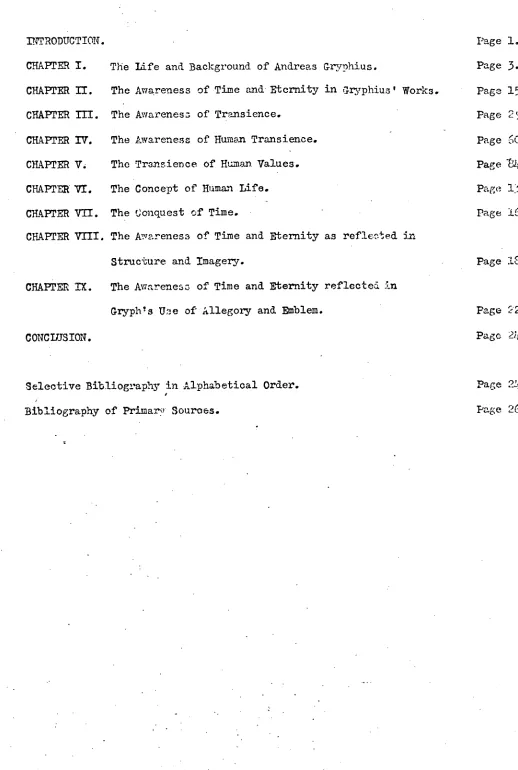
TABLE OF COT:TENTS:
Page 1. Page
3.
Page 15. Page 29. Page Page14.
Page 1;9. Page 167. INTRODUCTION.CHAPTER I. The life and Background of Andreas Gryphius.
CHAPTER II. The Awareness of Time and Eternity in Gryphius' Works. CHAPTER III. The Awareness of Transience.
CHAPTER IV. The Awareness of Human Transience. CHAPTER V. The Transience of Human Values. CHAPTER VI. The Concept of Human Life. CHAPTER VII. The Uonquest of Time.
CHAPTER VIII. The Awareness of Time and Eternity as refle:tted in Structure and Imagery.
CHAPTER IX. The Awareness of Time and Eternity reflected In Gryph's Uf3e of Allegory and Emblem.
CONCLUSION.
Selective Bibliography in Alphabetical Order. Bibliography of Primarv Sources.
Page 18 14..
Page 229. Page
24..S.
THE AWARENESS OF TIME AND ETERNITY IN THE
GERMAN LYRICS OF ANDREAS GRYPHIUS
Abstract of Thesis submitted by Edith Katherine Evenhuis B.A. Honours for the degree of Doctor of Philosophy, University of Tasmania, November 1975.
The intention of this thesis has been to demonstrate the centrality of
Gryphius' awareness of time and eternity in his German lyrics. By way of
introduction, we have looked briefly at the poet's life and background, as
well as at the concept of poetry prevalent in his era.
In the main body of the thesis we have then proceeded to discuss.the,:,
poet's awareness of time and eternity as revealed, firstly ., in the theme
and subject matter of his German lyrics, secondly, in structure and imagery.
Wherever relevant, reference has been made to his drama and funeral t.;. dissertations.
Having attempted to define the concepts of time and eternity - as far as
possible in terms of Gryphius' own statements - we have then dealt With'the
poet's predominant themes: transience of universe, world-system, man and
his values, human life, the use and conquest of time - always within the
wider context of the awareness of time and eternity.
From the above analysis we have arrived at the following conclusions:
• far from being torn apart by the dichotomy between time and eternity, Gryphius' whole creative personality is orientated towards the ultimate integration of
the two. This is not to deny, in any way, his profound sense of the transience
and futility of the things of time in themselves. But here his awareness does
not end. While refusing to ascribe any eternal or eternalising qualities
to anything born of, or created in, time, he is swift to recognise that
the temporal may well serve as a pointer to the eternal. He also believes
in the potential of every individual to conquer time, not by any of the
temporal means, whose spuriousness he decries, but by availing himself of
the ultimate conquest of time accomplished by Christ.
It is still within this essentially Christian framework that we have
viewed Gryphius' use of structure and imagery. In examining his exploitation
of the sonnet form, we have pointed to a definite correspondence between
structure and the view of life presented, it being virtually impossible, in
Gryphius' serious sonnets, to speak of intricacy of form for its own sake.
Similarly, in the domain of imagery, we have detected a clear purpose behind
his incorporation of even the most conventional metaphors and similes.
We have shown that Gryphius' frequent use of allegory and emblem is
highly symptomatic of his assessment of time in the light of eternity: it
is not just that merely incidental or accidental phenomena from the material
realm may assume universal and spiritual significance, but rather that,
according to Gryphius' conviction, the temporal assumes value, significance
and durability only as it is brought into focus with the eternal.
In our final conclusion we have noted that, for Gryphius, the only unit
of time to which man may lay any claim is the moment. Depending on the
individual's attitude towards it, it is either an elusive, moving point in
the inexorable course of time or the very point at which eternity offers
INTROTTCTION.'
The subject of this thesis is the awareness of time and eternity in the
German lyrics of Andreas Gryphius, reference being made, wherever relevant,
to his dramatic and prose writings, in particular the 7uneral Dissertations.
It is not, however, our intention to deal with his Latin works.
By way of introduction to the main body of the thesis, we have included a
short biographical chapter in which we have attempted to draw attention to thoee
facets of the Poet's life, background and experience that appear to have a
bear-ing on his poetry. Thus we have emphasised Gtyphius' immense learnbear-ing, his ,
scientific curiosity and above all, his acute sense of vocation as a Chrisian
in secular life - all o-)7 which attributes are reflected in his literary works. In passing, we have cianced at the general concept of the poet's role in
Gryphius' era,. noting, once again, the importance attached to the notion of
social resnonsibility.. It is this aspect that we .stress before commencing the
.discussion of our central topic. Translated into the specific terms of this
thesis: we have expressed Gryphius' . poetic vocation as the r.easlily accepted respOnsibility of opening men's eyes to their condition, of freeinp: them from
their enslavement to time and of pointing them towards eternity.
The thesis proper is die.i(4..ed into two main sections. In the first section, the poet's awareness of time and eternity in its relationship to the predominsmt
themes of his works is discussed. The second section is concerned with the wey
2
dualistic awareness, attention being focussed on the significance of his
exploit-ation and manipulexploit-ation of the sonnet-structure, as well as on his use of allegory
and emblem.
This present work does not purport to be a synthetic analysis of critical texts
on gryphius. Our intention throughout is to discuss gryphius' Weltanschauung, as
far as possible, in terms of his own statements. Invariably, our point of
den,lrt-ure has been his lyrics, whose ideological, content we have then attempted to elucid-ate and expand by reference to his own dramas and funeral dissertations, rather than
to secondary literature. However, this does not mean that we disavow our
inlebte-ness to the authors listed in the selective bibliography. Nevertheless, at this
stage we mu -it emphasise that, being far from expert on the subject of theology, ,se have tended to disregard those works which have a purely theologieal approach. On
the other hand, given the undeniably Christian orientation of Or7phius' writings, we
have preferred not to take up cudgels with critics who attempt to 5.mpose an a(nes!,ic
or atheistic perspective on his works.
Our primary soirees throughout have been the gesamtausgabe der deutsehsl
.)Imehl-en 7rerke Bd. feVII, referred to in our thesis as c.a., Marian Szye'oeki and Hugh
Pow-ell, Max T'Tiemeyer Verlk;, MsiwTen, 1963 (we have chosen this edition, in prefereeicc
to others, for the sake of convenience and relative completeness, in spite of some
doubtful readings) and the Original edition of the Dissertationes FUnebres,
o.
3
CRAFTER T.
THE LIFE AND BACKGROTIND OF ANDREAS GRYPHrTS.
Andreas Gryphius was born in Glogau, Silesia, nn the 2nd. of October 1616, two years before the outbreak of the Thirty Years' War. An orphan by the time he was twelve - his father, an archidiakonus in the Lutheran church, died in 1620 and his mother in 1628 - his childhood and early youth were difficult and un-settled and dogged by a long series of illnesses and mishaps. There is, moreover, some indication that his relationship with his stepfather, Michael Eder, in whose care his mother's death left him, was not particularly cordial.
Owing to the state of war in his homeland, his education waa continually in-terrupted, as, for instance, in 1628, when Glogau was occupied
br•
the Lichtenatein Dragoons and Gryphius was forced to take refuge in Driebitz, with his stepfather who was the Lutheran paeter there. During the next two years Gryphius studdedat home, under Eder's tutelage.
Early in 1631, after a fruitless attempt to find lodgings in 01.1itz, where he had hoped to attend. the Gymnasium, he witnessed the razing of Glogau by fire. Eventually his stepfather found him a place in a school at Fraustalt, and hers, thanks to his conside2ab1e scholastic abilities, he was able to help himself oat financially by tutoring the sons of well-to-do families.
dustrious and gifted student that he was, he was quick to grasp the opportunities presented by this new and fertile milieu. He made friends with Scholars like Peter Crager, the mathematician and Riecius, the lawyer; and won quite a reputat-ion for himself with his Latin poem, Parnassus.
Upon Gryphius' return from Danzig, Eder was instrumental to his obtaining a position as house-tutor to the sons of the wealthy and cultured nobleman, Schbnborner. Fere, once again, Gryphius found himself in a stimulating intellect-ual climate. His patron, who was in possession of an extremely well-stocked library, was knowledgeable on a wide variety of subjects and, although subject to fits of intense depressiou, a brilliant conversationalist. Swift to recognisa Gryphius' scholastic and poetic potential, Sch5nbonner bestowed on him the title of Magister Artis and had his daughter, Elisabeth, crown him poet laureate. Schemborner's death in 1637 was a cruel blew to Gryphius who was called upon to deliver the funeral oration - another indication of the Schbnborners' appreciation of the young poet's gifts.
In mid. 1638, six months after his patron's death, Gryphius left for Holland with a group of wealthy young men, aluong them Seh5nborner's two sons. After a brief stay in Amsterdam, the party moved on to the university town of Leyden, where Gryphius spent the next five years - the formative years of his life 1).
Ast"onomy, Trigonometry, Logic, Poetry, Tragedy and Physiognomy; and lectured on A
Roman Antiquity, History, Mathematics, Physics and Chirooancy. In parked contrast
to his obvious thirst for knowledge in every known field of science, he held a -
public discourse: De Rerum Omnium Vanitate 2).
In June 16414., having benefited to the full from all that the "most cultured
country in Europa" had to offer an astute young scholar, having " served his
anprentceship !Is a !dramatist" 3), (ryphius . left Holland for Prance, as travelling
companion to the rich. young 7omeranian, Wilhelm Schlegel. After sixteen months
in Paris, where Orephius was greatly impressed by Cardima Richelieu's library 4),
they set out for Italy, whose great artistic and historical centres they intended
to visit. Rome, in particular, seems to have fascinated Gryphius. In sonnet and
epigri7,T he records vivid: memories of, above all, its catacombs 5) and its fleas 6).
From Ital.!: Gryphius went on to Strasbourg, stayine, there for six months, during
which time he made the acquaintance of the eminent professors Biccius, Dannhauser I. and B .6oler and fin*el.ed his Leo Armenius . His wander*ngs then took him via
Speye>', Mainz, Frankfurt am Main, Cologne and Amsterdam to Stettin, where he stared for 3CMC time with Wilhelm Schlegel, finally leaving for Fraustadt on the 8th November 1647.
Although his fame as a scholar brought him offers of professorships both in
Germany and abroad, he declined them all, preferring to reroi .0 in war-scarred
•
Silesia, which, he believed, it was his God-given vocation to serve. Early in
1649 he married nosina Deutschlander, the daughter of a oell-to-do Fraustadt mer-
The last fifteen years of his life were no easier than the preceding ones: as a protestant filling a responsible civic office, in a community which, althougl predominantly protestant, was nevertheless under the supremacy of the catholic Hapsburgs, he would continually have been called upon to exercise more than aver-age resourcefulness and discretion in the furthering and protecting of protestant interests, without incurring the displeasure of the catholics. The very fact
that he was able to work as syndic for so long a term, without ever changing or compromising his religious loyalties, is an indication of his rare diplomacy ank and integrity.
In 1656 Glogau was ravaged by the Plague; and the following year, the town
a,
fell prey to another disastrous fire. In the lqze, Gryphius lost his home and a large number of books and manuscripts.
Nor was his intinate family-life free from sorrow and anxiety. 3e and his wife had seven children of whom one was still-born and three died.in their in- '
fancy. A daughter, Anna Poslna, developed severe mental illness at the age of fo717; C-ryphius himself, whose whole life had been dogged by sickness and. mishap, Elea of a heart attack.
Gryphius' native Siissia had been,and still was, a centre. of Gemsn mypt-
A
icism', with such names an nhme, Spee, Scheffler and Kuhlmann. The border tows of Lissa and Fraustadt(actually in Poland) were a melting-pot of varicuA7
Indeed, he must have been characterised by an unusually large measure of toler-ance - an ability,in the words of Saint Paul in I Thessalonians 5,21, to "prove all things" and "hold fast that which is good."
As a schoolboy he took part,as an actor, in Jesuit-produced plays. The Latin works of his youth, in particular his Herodesepen, written when he was seventeen, do not merely fit into the Humanistic tradition, the "Gefolgschaft des Marino oder des Daniel Heinsius, sender besonders auch jesuitischer Werke wie vor alien Jakob Bidermanns Herodias "...8). Included in the first collection of his German sonnets ever published (Lissa 1637), as well as in later editions, were threeNaci dichtungen" of Latin originals by the Jesuits Bidermann, Sarbieaski and
Bau-hahsius. His Kirchhofsgedancken are, to a large extent, inspired by the poema de Vanitate Mundi of the catholic JakobHalde. That GrYPhius was not averse to draw-
ing on the experience and skill of the great Jesuit dramatiste,in borne out by th( dramatic and stylistic techniques he employs in he tragedies and by tie very themes he treats: martyrdom, unflinching constancy and endurance, the sudden de-cline of greatness, vanity, which are among those beloved of the learned padree. The subject matter of his Leo Armenius was presumably suggested by the Latin play of the same title, written by the English Jesuit, Josephus Simon - althout;h Gryphtust interpretation of the facts is at variance with simonts. He also t , Ins-lated Nicolas Caussinls martyr-drama, Felicitas.
47 In much the same way as he ad/opted and adapted Jesuit material and tech-
8
(Ga. Bd. T, p. qi ) Verlangen nach den Ewigen Hngeln (Ga. Bd. II, p.35 ) and so on, where he attempts to evoke realities outside the possible realms of con- crete experience. But to assume, on the evidence of such passages, that Glyphlua
had a definite disposition towards mysticism, would be to overlook the context in which they occur and to deny the evidence of his whole life - a life spent, 13 not in solitary meditation and aspiration towards the "unio mystica", but in the active pursuit of knowledge and the unselfish service of his fellow men.
This preacher of earthly vanity and transience and of eternal bliss or dam-nation , beyond the grave, did not summarily turn his back on the world and what
it had to offer in the way of allurements or challenges. Rather, he studied it and its institutions carefully. The face,which KiXlian's engraving of the poet presents to us, is not that of an ascetic, but a full-blooded face, tempered by sadness, wisdom and experience. Born into the"century,of genius"10), when seienti: le discovery challenged much traditional belief - to the extent of coming into
conflict with certain church doctrines - Gryphius delved into the new sciences, even writing a treatise refuting the previously accepted theory that fire wae an element 11). As a classical scholar, polyhistor and statesman, he was, no doubt,
continually involved with those very values that his poetry dismisses as npuriouf Or was this really the case,.., since, in these pursuits, his ultimate authority was still the divine wisdom and order of God? Thia particular qdestion will be covered in a later chapter.
Andreas Gryphius.the scholar maybe said to have been a typical example of
a,
9
terror of a country torn by religious wars, his was the experience of many. But what of Andreas Gryphids the poet? Is he to be regarded as a representative spokes man for his age, or is he a unique figure in seventeenth century German literature The perusal of any comprehensive antho3igy of seventeenth century German verse reveals an abundance of evidence to the fact that Gryphius,was far from being an "Einzelganger, either as regards themes and sentiments expressed, or even imagery and technique. His is a voice in a chorus of many voices, standing out from the others only by virtue of its resonance, clarity and power. But, in order to apprec iate fully the extent to which Andreas Gryphius, as a poet, is representative of his age, it will be necessary to examine briefly his contemporaries concept of the poet's role and of the nature of poetry, and to see how far Gryphius and his works conform to this coneept.
The sixteen hun&eeds caw in Germany a . phenomenon, observable a century eale-lier in Renaissance France and Italylyan attempt to emulate, on a national level, by way of the national language, the great literary achievements of classioal e
10
erature, but also to have a wide knowledge of contemporary foreign languages and literatures and to be practised in the art of translation 14). In addition, he was a responnible member of the community - usually with a dual role: the civic
or social vocation of his workaday profession and his poetic vocation, equally socially orientated, to instruct and rlease.
"Ndtzen" and "erOtzen" - these, in short, were the poetic criteria of the age. In his Buch er deutschen Poeterey, Martin Opitz lays particular stress on "Ndtzen" when he speaks of the oracular nature of poetry:
Die Poetery war anfangs nichts anders als sine verborgene Theologie und und Unterrisht von ettlichen Sachen 14).
verborgene Theologie" because disguised by the attractive covering of poetic for HarsdBrffer also draws attention to the serious, didactic function of the poet:
Es soil der Poet den inhalt Seines Gedichte auf den Nutzen and die Lehre richten:
once again coupling the instructive element with the pleasing, captivating or mov-ing aspect:
die Ausfdhrung aber mit schbnen Worten und (edanken leisten/dass der Leser dadurch belustiget/ unn. ihm gleichsam das Hertz abgewonnen wird 15).
That "delectare" and "movere" may be complementary, or even interchangeable, is brought out by Buchner's insistence on the careful choice of words ani expressions by the poet, whose language must be
U
In its higher manifestations, poetry, for the seventeenth century German theorists, is the conveying of universal values and eternal truths by the tempora) means of an extremely "zielbewusst", audience-conscious and often highly ornate prosody.However, it would be an oversimplification to state that precisely the same criteria governed the so-called 'lower " Gattungen. While these criteria may, to a large extent, be said to apply to the "strafgedicht", whose didactic purposes are self-evident, it would be difficult to extend them to include many examples of the pastoral lyric - with, of course, the notable exception of "geistliche Hirt enlieder.
In the person of AndrbaaGryphius we have virtually the epitome of the seven-teenth century German poet, as defined in the poetics of the time. He was a schol-ar of extraordinschol-ary intellectual capacity and versatility, whom Kuhlmann, in his Entsprossende Teutsche Falmen des PalmenOrdend, eulogises as
Der deutsche Sophoklasi das Wunder unser Zeit....17).
12
Above all, he must have had a profound sense of social responsibility and vocation, reflected in his fifteen years of untiring service as syndic of Glogau,
in preference to less arduous positions outside Silesia; reflected, too, in the predominant note of seriousness in his writing. If his poetry were, as he puts it
J.)
merely the "Beschaftigung mlssiger Nebenstunden 18), then, his sense of mission in
life
was certainly not limited to his. normal working hours 18). As a poet, it is the spiritual good of his fellow men he is concerned with, rather than their material, or even moral, well-being. His calling is to point to a solid, external reality.boyond the ultimate instability of this temporal life; it necess-ary, to shake the foundations of false security, to prick the bubble of illusion, but always in .order to superimpose absolute, inalienable values. Even his satire' is not the destructive axe of the idealist, driven to nausea or despair, but the judicious pruning-knife of the sage, whose wisdom is based upon experience and faith. Although like most writers of. his day, he produced his share of flippant and saucy .telegenh ,Atsver" , by and large;the
'teriOr of his work does indeed correspond to °pits' definition of the original function of poetry: "em n Ott-liches zu verk(lnden" 19)..To sum up: Paul Hanka ...4er's app"raisal of the Baroque poet-can be applied word for word to Gryphius:
Der Dichter der Barockzit steht als geistiger Mensch in der Haltung da, wie sic die sittlich vorbildliche der Zeit war, als der standhaft Beharren-
de... Was er zu sagen hatte, wenn er ernsthaft Sprach, war nur nach Klar- .
heit, Tiefe und Umfallg unterschieden von demWissen aller. 20)
13
among the ruins . of time, giving expression to the geniul, the problems, the ideal of his age.
References:
1
Hugh Powell: Introduction to Andreas Gryphius' Carolus Stuardus. Leicester University Press,1955 1963; p.xxix.
2 " p.xxix.
3 "
p.xxxi.4
Hans Dieter Klaus: Leben andWerk des Andreas Grvphius. In: FvnIpasche gegeg-- nung Vo1.14. K161n,
1969; pp. 54--69.
Bd.I
5
Andreas aryphius: Sonnotte. Das Ander Buch. Sonnets XLI and XLII (Ga.Ap.87).6
Rpigramwata.Bdcher Epigrams MIX and LXY:Z. p.p.217-214).7
cf. Marian Szyrocki: Der junge Gryphius. Rfttten und Loening, Berlin,1959; p.36, 8 Max Wehrli: Andreas 4ryphius und die Dichtung der Jesuiten. In Stimmender Zeit 90, Bd. 175. 1964-1965; pp25-39.
9 Paul Hutsoh: Andreas Cryphius.und die Mystik. In: Schlesien 5. 1960; p.215 10 Muth Powell: Introduction to Andreas GrYPhius 1 Carolus Stuardus. p.xi5. 11 " Andreas GrYP hius and the"New Philosophy". In: Germcin Life •Pnd
. Letters 1i.S.5.2195171952; P.274.
12 cf. Johannes Pfeiffer: Andreas Gryphius. Wilhelmshavener VertrIge, Heft
33. p.3
14
Willi Flemming: Andreas Gryphius: eine Monographie. Kohlhammer, Stuttgart, Be: lin, KES1n, Mainz, 1965; pp.142-143.15 cf. Harsd5rffer: Poetischer Trichter III. p.13 . In: Poetik des Barock. p.116. 16 Buchner: Anleitung zur deutschen Poeterey. Das TIECapitel. In: Poetik
des Brock. p.15.
17 Quoted by Heinz Ludwig Arnold: Barock Heute. In
:
Eckhardt Jdhrbuch. 1956-1966,.1.1111111.
p.102.
18
of. Willi Flemming: Andreas Gryphius: eine Monographie.p.39.
19
Martin Opitz: Poet ,.k des Barock. p.11.20 Paul Hankamoter: Deutsahe Gegenreformation und deutehes Barcek. Metzler, Stul
A
15
CHAPTER II.
The Awareness of Time and Eternity in Gryphius' Works.
It is impossible, when considering the works of Andreas Gryphius, to speak of an acute awareness of time, without simultaneously referring to an equally . strong awareness of eternity, 1) since it is against the background of an unchangc able and unshakable "Jenseits", that the transience and mutability of temporal existence are thrown into sharp relief. In other words: temporal existence, with its rapid succession of events and changes, is seen in contrast to an immoveable eternity; and it is in the perspective of this stationary, timeless background that the impression of movement and transience is intensified.
Time and eternity, as two distinct realms or spheres, are co-existent for Gryphius and his contemporaries; and condition their whole assessment of reality. Far from being a matter of reasonable doubt, the existence of an Eternal Creator God, who has expressed himself both in the Scriptures and in the created universe, is, for the seventeenth century artist and scientist alike, an unquestioned and unquestionable truth.2) But equally unquestioned is the doctrine of original sin: owl the fact that the expression of God the universe is imperfect and only "in part" (I Corinthians 13.9.), is ascribed to the fall of Adam - as is also tha whole tragicality of time. For whilst time came into being with the beginning of
16
terms understandable to temporal man,(i.e the only perfect manifestation of etern-ity in time). Apart from him, nothing created or material is capable of being either a source or a guarantee of eternity, since at best, it can be nothing more than a mere token - a pointer to the eternal.
Temporal existence, per se and in se, is felt to be futile for the very reas-on that it is not held to be man's ultimate destiny. However, it is imbued with intense significance as a period of preparation, opportunity and trial, in which it is up to every inaividual to make his stand for the spurious or the valid, to cheOse his own course towards destruction or eternal In the words. of Daniel ( von Czepko, in his Consolatio: man•
1st reder von der Zeit noch der Eaigkeit, sondem 1st eine Natur gemacht zaischen beyden. ( Consolatio. p. 80, o)
• /
Whether or not he is ultimately "zeitlieh" or "ewig" hinges on his inclination towards temporal or eternal things. This alternative of choice is, in essence, thE main theme of Gi.gphius lyrical and dramatic works.0
1
7
Zeit and Auff den letzten December. ••••••■•••■•■=11,
Following this, since it is impossible, in the context, to consider time with-out also considering eternity, a brief examination of Gryphiusl concept of eternity will be undertaken, reference again being made to his own statements on the subject
a) The awareness of time.
For Gryphius time, in itself, is neither positive nor negative; nor, on the other hand., is it something completely neutral, since, depend1n4 on man's attitude to-wards it and on the perspective in which it is viewed, it is open to both positive and negative evaluations.In the broadest sense, time is the realm of the finite and circumscribed, as opposed to the immeasurable infini'cy of eternity:
her ellen wir aurch Zeiten 0 Herr der EW1gkeiten/ Nach jenem gressen Tag
Den weder sonnenlauff noch Abend schliessen mag. Ofernischte Gedichte:Geist- liche Ga.Bd.III, p.116.) In a much more,restrictive sense, time is personal time( man's alotted time, his life-spa)
Die Anzahl schneller Tag' in dehn uns ach und leidt
So lsnge krInkt bis sie/und wie:it ihr entfliehen, (41a Herr n Christophorum Iteth. Sennete XXXIX, Ga. Bd.I,R55 Again, time is something elusive and intangible which,because of its very nature, it is imp6ssible to poses, control or predict. It is this elusive, unsub-
18
Jahres:
Wir zehlen was nicht ist und langst in nichts verschwunden/ Verwichener Zeiten Lauff und Menge vieler Jahr
Und was den Augenblick noch kaum vorhanden war.
Wir zehlen was sich noch nicht von der Zeit gefunden.(Ga. MI, p.105.) and again, in the opening lines of the epigram, Betrachtung der Zeit,where the impossibility of laying claim to either past or future is clearly stated:
Mein sind die Jahre nicht die mir die Zeit.gc.;nommen/
Mein sind Le Jahre nicht/ die etwa mlichten kommen. (Fpigrammata. I. Buoh, LXXVI. Sa,Bd.II, p.182.) For all his calendars, his calculations of the movements of the hoa7enly bodies, his reckoning of dates, man has no hold over time:
Wit amen schawn die Gonnt itzt von/ itz zu uns zihen: Und gehn den Sternen nach/ wir lernen welche Seitt Der Himmel Phoebe *TPA/ ....
W Wir rechnen Monatt aus/ und spilen mit dem Jahr Und ordnen Tag au Tag/ Undt wen die Raitung klaar:
nns doeh
Blefbt/Nunser tag und Untergang verhohlen.(An Herrn Ghristophorum Loth- Ga. Bd..
Although he can predict with accuracy the rising and setting of the sun, moon and stars, even where his own personal time, his life-span, is concerned, he has no means of predicting its futnre duration - the length of his day, the hour of his
19
taken from the ode, Beschluss des Jahres: Je mehr wir Jahre zehlen:
Je mehr uns Tage fehlen/
Je mehr uns Zeit abgeht...(0den. III. Buch,IX. Ga. Bd.II, p.87.)
a truism that grasps at the very essence of time, its paradoxical capacity of becoming less and less, of eluding us more and more, the more years we accumulate. In other words: the longer we have lived, the less time we have to live and the more conscious we are of the passage of time.
Of all the qualities of time, it is its swift passage that has the most pro-found effect on man and his whole environment; since everything that is born or created in time shares in that swift passage and disappears with
Wie uns die Jah, efitrallen 0.44[4100
Wie sich das Ziel abkartzt So wird_ mit ihm verlohren/
Was in der Zeit gebohren...(Beschluss des Jahres. Oden. III.Buch,IX, Ga. Bd.II,p.87.)
Indeed, how could anything temporal, "zeitlich", be expected to last
20
Nichts ist das Zeitt und todt nicht unterdrecken kan..(An Herrn Christoph- orum Loth. Ga. Bd.I p.55.)
whose impact has been felt by entire empires and civilisations:
Die Zeit hat gantze Reich' alss Asch in Wind gesiebt..(An Herrn Guilhelm Schlegel.Sonnette. Das Anaer Buch,XVII. Ga•,Bd.II,p.74.)
The awareness of the finite nature of time, of its elusive, unsubstantial qualities, coupled with the awareness of its swift passage, leads to a proftand sense of the vanity and futility or things temporal which affects all areas of man's life and activity. The adjectives 4 zeitlich andftverganglich" may, on eecas-ions, be equivalent in meaning to "eiter, as, fer instance, in the ode,BeschIuss des Jahres:
...lass sie nicht beschweren Mit dem was zeitlich - ist/ (rM.
On the other hand, the swift passage of time has ite positive side - time may run out quickly, but it runs Out into eternity!
Der Menschen Jahr vergeht/ du der du zeitlich bisg
21
that eternal destiny:
Ach Menschen / diese Jahre
Die ftihren nach der Baare .
Und nach der Baar zur Kron
Wenenicht zu stetem Hohn. (Beschluss dess Jahres, Ga. Bd 2, p.88.)
an Eternity of Heaven or Hell.
Here then, in brief • is Gryphius' concept of time. An attempt will now be
made to show how this concept is vitally linked to the various themes he deals
with in his works. Tie is preoccupied with the finite nature of time, its elusive,
Linsubstantial quality, its swift passage: one of his major themes is that of
transience - whether it be taken in the sense of the passage of all things
temp-oral with time or of the destructive tyranny of time. Arising from this theme
is the theme of instability and vanity - of the world, of man himself, of human
values and achievements - a theme that gains added resonaece from the fact that
.Gryphius . sees time as running out into eternity. is treatment of the question of the significance of life is conditioned both by his awareness of transience,
instability and vanity and by his awareness of time as leading to eternity, as
is also his landIing of the related themes, the use of time and the conquest of
time. .Closely linked to these themes is that of death, who significance is -
shown to vary with man's attitude to life (his personal time). According to the
way in which he has used his time, death is either the catting off of everything
• he has striven for or the gateway to everything. Intimately connected with this 'whole complex - time leading to eternity, the use of time, death, is the theme of
the Last Judgment, that day at the end of ilime (in the breadest sense) when the
22
b) The awareness of eternity.
Although the awareness of eternity is so integral a part of Gryphius'
aware-ness of time, a perusal of his works soon reveals that actual statements on the
nature of eternity are far less frequent and far less specific than those on the
nature of time; and is this to be wondered at? The poet is surrounded on every
side by concrete evidence of the effects of time; and eternity, by definition,
is outside, and not to be confined in, or by, the concrete. The latter may, at
best, be a mere pointer to it, in much the same way as a guide post indicates a
destination.
The majority. of Gryphius' statements about eternity are "negative
time-state-ments", i.e. eternity is evoked infterms of what time is not, as for instance,. in
the tableaux of transicnce presented by the sonnet . Es 1st alles gantz eytel and,
in much greater detail, by Lhe prologue to Catharina von Georgien, where "die
Ewigkeit", in person, steps on to the stage. In both cases , eternity is shown to
be absent frem the entire roaln of the concrete and material and fron the whole
field of man's feverish strivings after self-aggrandisement and immortality. Even Gryphiust most eyplicit attempt at evoking eternity, where he enlarges upon
a statement made by Boethius, leans heavily on a. depiction of the characteristics
of time:
)i.e Ewigkeit ist•ein gentzer stets. vorhandener und vollkommener Bcsitz•
eines unendlichen Iebens... Denn was hier sich allffhalit / laufft von dem
Vergangenen durch einen Augenblick auff•daa Zuktinfftige: Tind wir seen
ja riht in:dieser Zeit / dass semen Anfang und Ende ja sich gantz / uns
auf stets vorstellen ktnne. Das Morgende sol noch erscheinn. Das Cest(ri
23
unser. So 1st denn dieses nur ewig / was das unendliche Leben •/ gantz und
vollkommen zugleich besitzet: Welchem nichts abgehet / das verstrichen; nichts mangelt / was noch kunfftig / sondern beydes gegenwartig /
Gryphius is swift to point out the inadequacy and incompleteness of this attempt
at evoking eternity, comparing it to the fruitless efforts of even the most
talent-ed painter to represent the sun "mit irdischen Rarben":
Was ist aber dieses? als eine / zwar .../ sehr veraanfftige / doch gantz. unvollkommene Abbildung dessen / was in dieser Zeit so wenig recht
abge-mahlet werden kane/ fas unm5glichen such dem kunstreichsten Maler die
hell-stralende Sonne mit irdischen Yarben / in ihrem Glantz undWesen
vorzu-stellen. (Diss. run. Abend Menschlichen Lebens, p. 486-487)
Yet the sun is no less real for being impossible to imint in earthly colours. in
much the same way eternity, for Gryphius, is no less real for being Niti.rtually
in-expressible in earthly language.
In the above enlargement on Boethius, the basic aspects of Gryphius'
&gare-ness of eternity are indicated.. In order, however, to understand more fully thiz
concept and its implications for the poet, it will be ueefult to bring together,
Prom various sources) examples of the way in which he uses and refers to "Rifigke 4
(i.e. of the various associations in which the term occurs.)
'Eternity is, above all, &uality of the Godhead-, the "dreymal einig Eiligkeit'
(Sonnette: Ewige Frewde der AusserNehlten, Ga.Bd. I, p.91.), the great T As, the
"unendlich enig Wesee. (Beschluss des Jahres, Ga. 3d. II, p.88.) who iz from
ever-lasting to everever-lasting: ' Der vor Ewigkeit geherrsehet: una in Ewigkeit wird blei-ben." (BeSchluss des Jahres, Oden das andere Buch XII, Ga. d. II, p.61,), who
24.
fllt noch kommt / dem alles steht and blaht. .Der was noch kftnfftig ist als
Gegenwartig sieht..." (Auf den Anfang des 16r:Osten Jahres, Sonnette aus dem
Nach-lass XXI, Ga. Bd. I, p.105). Simultaneously, eternity is also the realm of Goa:
"diss Reich ... In dem du sonne bist", Christ being referred to as "Prinz der
Exigkeit" (Auff den Sonntag des Richters der Todten itnd Iebendigen, IXVIII, Sonn=
und 7eiertag=Sonnette, Ga. Bd.I, p.221).
In its endlessness and wholeness, eternity is seen to be the very matrix of
time, out of which, in the words of one of the '1.1bersetzte Lobgesange", time was
born: "eh die Zeit Gebohren aus der Exigkeit" (Vermischte Gedichte; rfbersetzte
Iobgesange I, Ga. Bd. III, p.61-62.) always existent before time, always to be existent after time comes to an end.
In the broadest sense eternity is. as stated previously in the discussion
on time, the realm of immeasurable infinity "die aurch hein End adfh6rt" (Sonnettt-,
Aus dem Nachlass, Ga. Bd. T., p.127,), of timelessness (as opposed to the cir-cumscribed, measurable units which go to make up time),the realm where "em n Tag
allein ... wird vor alle Jahre seYn", (Geburtsgedaneken an Jesum; Epigrammata I.
Buch, IXXI, Ga. Bd. II, p. 181.) in stark contrast to tine, the realm of the
finite and time in the sense of personal time.
As opposed. to the swift movement of time from one moment to the next and the rapid changes it brings about (eg. joy can be turned to sorrow in the twinkling
-.If an eye cf. Auff den Sontag des Herren dess Sabbaths LEV, Ga. Bd. I, p, 217.)
eternity is motionless, immoveable, unchanging, that "Sabbath" or rest, "IAngst
( verhoffte Ruh" (Catherina - 7.1; Abhanalung v. 24.3,. Ga. Bd VI, p.199.) in which "der
A.
keuschen Seelen .Freude / ...Keine Zeit kein side (wird) kartzen." (huff den Sontag
25
In a more restrictive sense; corresponding to the restrictive sense in which
"time" may be understood (i.e. personal life-span), eternity may be used by
GrY-phius to imply "personal" eternal life, the one true form of immortality: "...wenn
mir Zeit abgeht verley die Ewigkeit". (Beschluss. des XXIV Jahres, Ga. Bd. I, p.72 Nothing in the realm of time is capable of imparting such eternal life to the
individual, only God whose attribute it is:
Der immer Kemig bleibet Den keine . Zeit vertreibet
Der•einig enig machen kan. (Vanit:Is Vanitatum Vanitas! Oden; I.Buch TX, Ga. Bd. II, p. 20) This quality of eternal life is for Gryphius the "pearl of greatest price" for
which the individual must be prepared to sacrifice everything:
Diese Ewigkeit 1st die einigc Perie / die in d‘=!m tieffen Acker der inrern
Geheimnftss verborgen / welcher wegea 50 viel hoher Seelen / Ehre / Stand Reichtum und alles vernorffen / damit sic dicsenige: erhalten mochten /
zu welcher man anderwerts nicht / als durch den Tod selangen kan...(Diss.
Fun.: Abena Menschlichen Iebens p. /4-86. )
It is not to be obtained by mere physical death but by s2iri.tual rebirth in ths
3ense of the well-known passage in the third chapter of John's Gospel where Nieo- •
(lemus comes to Jesus by night. "'Vas zehlt ihr newe Jahr?" writes Gryphius in the
epigramme Auf das neweJahr; "es bleibt die alto Zeict / Wer newgel.ohren wird er-langt die Ewigkeit". (Epigrammata das ander Buch XVI, Ga. Bd. II, p. 200.)
Closely related to the concept "EWigkeit" in the sense of eternal life,
"EWigkeit".in the sense of indestructible,. absolute valw;s such as absclute,
26
nise the momentous significance of their personal time (cf. Welcher Stein "Seelen/ die... Durch Tugend vollen Schweiss die Ewigkeit zu kauffen Euch Tag fdr Tag be-
t (9, 1.53 )
mdht'A: values that are, once again, qualities of the Godhead and not to be found in, or imparted by, anything material or temporal, for all man's searching or
questioning of the material universe. (cf. Grabschrifft eines Hochberahmten Mannes. Sonnette: das ander Buch XXXVII. Ga. Bd. -I, p. 85.) What we apprehend with our finite senses and. reasoning faculties is so limited in its scope, so restricted in its duration and significance) as to be nothing: Was Augen sehen ist nichts."
• (Augen. Optisches Paradoxon; Epigrammata, Das erste Buch XL, Ga. Bd. II, p. 157.)
It is usually only when we are freed from such restrictioha by death "Wenn wir die Augen schliessen" (ibid.), that we are able to grasp the absolute, "Die a/fig Ewigkeit aie hier nicht zu erreichen" (Grabschrifft einee Hochberahmten Mannes, ibid.) to appreheai infinity "ja, alles sehn und wissen" - (Augen. Optisches Para-doxon, ibid.) - because, as Gryphius remarks in the funeral oration, Mutua Amantum Fuga, "Was in der Ewigkeit gezeuget / von der Zeit nicht begriffen werden kan."
(Diss. Fun., n.691. ) Finally,Gryphius uses eternity to denote the other world"jene welt", man's ultimate destination, as in the sonnets Ewige Frewde de Ausserwehlten and
La
H1511e.(11a. Bd. I, p.91.) and in the prologue to Catharina von Georgien where eter-nity personified confronts man with the choice between Hen - en and Hell:Hier dber ouch ist diss / was f-faig lacht
Hier unter euch / was eaig brennt und kracht. jcidclexxx)
Diss ist moin Reich! Wehlt was ihr wanscht . Z1: besitzenP(lines 71-73.) Diss ist / was eaig euch ergetzen.unl verletzen kann. (line 80.) (Ga. Bd.VI
27
As remarked previously, it is this connotaion of eternity that imbues time with profound significance, as a phase of decision and choice.
More commonly, however, "Ewigkeit" denotes purely the destination of the blessea, Heaven, referred to repeatedly as the "castle of eternity", eg. "das werthe Schloss.der Ewigkeit", (Auff den Sontag dess von der geheimen Ewigkeit lehrenden Gottes, Sonn= und ?eiertag=8onnette, Ga. Bd. I, p. 207.),"Das reiche Schloss der-Ewigkeit" (Oden II. BUch, VII, Ga. Bd. II, p. 61.), "Schloss der Ewigkeiten" CBeschluss des Jahres Oden II. Bitch XII, V.
45.
Ga. Bd. II, p. or as the true fatherland of the Christian believer:Liebstes . Vaterland / gitlok zu. Wen das III. Bitch X, Ga. Bd. II, p. 9(.) 0 euig nnigreich! 0 Vaterland gltick zu! (Catharina
IV-.
Abhandlung, v.244,Ga.Ba. VI, p, 199.) In either case thelehoice of nouns in the evocation of eternity (=Heaven‘, is
nificant. "Schloss" is ounestive of solidity, stability,durability as opposed to the complete lack of these qualities in the realm of time. In ad,lition, the word is frequently coupled with epithets which further emphasise the complete
"otherness" of etemity, eg, "reich", •"werth", epithets expressive of value-judg-ments, here used positively, but to be found, if at all, in Gryphius's appraispi of •things temporal, only in tho negative sense. "Vaterland" is again suggestive of durability, of the perma:ience of man's destination in eternity, as against the trnsitery nature of his sojourn in the realm of time. This same juxtaposition is the theme of the funeral dissertation AusAndische in dem Vaterland•(Diss. Fun. p. 501 ff.), where manes nominal fatherland is contrasted with his real fatherland.
28
ing and unchangeable. It is a quality of God, imparted by Him and by Him alone to
man- as eternal life. It is a quality of certain absolute values of which God is
the source; and, finally, it is seen to be man's ultimate destiny: be that an etern-
arm
ity of heavenly bliss or an eternity of damnation in Hell. It is simultaneous1y the
backdrop against which the passage of time is registered, the yard-stick against which man's activities are measured, the goal toward which he presses forward ccn-
0
fidentiy or the inexorable gallows tziard which he stumbles blindly.
References:
3 cf. E. Conradt:
2 cf. H. Powell:
3
cf. W. Vosskamp :ibid. :
Barocke 7hematik in &r lurik des Andreas L1-1 -71..T.L
ius. In: Neophilologus 40, 1956; p. 166.
Andreas Grvphius and the "New Philosophy". In:
German life and Letters N.S.
5, 1951-2;
p.275-6 Untersuchungen zur Zeit und GeschishtsauffassurJahrhuade,:st bei Gryphius und Lohenstcin.
Bouvier, Bovn,
1967;
p.89.p. 76.
. 5 quoted by F. W. Wentzlaff-Eggebert: Deutsche 1y3tik zwischen Mittelalter und Neu-
. zeit. J.C.B. Mohr (Riul Siebeck), Tabingen,
6 of_ Paul Hankamer:
Richard Newald:
1947; p. 211.
Die Slrache:,Thr Begrif und ihre Deutung int 16
uncl 17. Jahrhuhdert. (Repro'-raph. Nachdruck i.
Ausgabe 1927.) Olms, Hildeshcim, 1965; p. 299.
Die deutsche Titer., tur vom p5thumanirnus ur
Empfindsamkeit. 1570-1750. 5. verbesserte Auf-
29
CHAPTER
The Awareness of Transience.
The theme of transience is probably as old and as universal as poetry itself, being found as early as the so-called "poetic" books of the Bible and running through the literature of Middle Ages and Renaissance - alike. However, in the works of Gryphius and his contemporaries it is manifested with a-new intensity, cor-responding to - a heightened awareness of time and its effects on the entire man and his universe, in both of which, thanks to the Renaissance, there is a nemly-awak-ened and vital interest.
Certainly the awareness of the effects of time is pre3ent - even if only by implication - in works dating from the Middle Ages such as TePipla's Ackermann aus
•.■W
Hbhmen, in much of Franpis Villon's verse, be it pagan or christian in oriertetion, as well as in the broad ,,.tream of memento mori literature; but here, as in the Bible, the attitude towards change and decay tends to be one of quiet resigmtica,
summed up in the belief th ,,:ib everything is directed and ordained by God, and. tere-fore part of his purpose, an attitude also to be found occasionally in Gryphius' works.
In medieval literature, as well as in the religious writings of the early Italian Renaissance, time is a figure similar to, if not equivalent to death - ness the pictorial repfesentations of Father Time, the skeleton with hour-glass and scythe - with an equivalent role to play, a role that has a definite .place in God's plan and purpose for men. Like death, time is seen to be a messenger sent by God from the next vorld to summon men into eternity. 2)
30
over the passage of youth, on the one hand, and carpe diem exhortations on the
other: as in the lines writeen by Lorenz& il Magnifico, where the realisation ,
that youth and beauty are of such brief duration, gives rise to the counsel that
what time we have must be made use of while it is there, ie. before it escapes us:
Che tempo aspetta, assai tempo si strugge
E il tempo non agpetta, ma via fugge...
Ma l'animo gentile e ben discroto
dispensa il tempo, wentre che via fugge....
To credo che non sia maggior dolore
Che del tempo perduto a sua cagione;
questo a ciascun debbe essere uno sprone
di usare ±1 tempo ben, che vela e fugge. (Opere at.;II, p. 201.) 3)
• These and similar sentiments regarding transience are echoed by the "Renaissance'
poetry of other cultures, influenced and inspired by the Italian Renaissance. In
the works of the Prench Plaade and of Spenser and Shakespeare it is agaLn ehLedy
the transience of beauty that is dealt with: be it regretted with graceful
melan-choly - "Mignonne, allons voir si e la rose" 4), playfulness and irony - "Quand you,:
serez bien vieille le soir la chandelle.,." t;), or matter of fact resignation to the inevitable - "When I do Count the clock that tells the time ... then of thy
beauty do / question make". 5)
In general, with some exceptions - notably some of the later poems by the
ageing Ronsard - the poet of this era remains purely an observer of the effects
of time, and is not pereonally involved in the cIelnges he sees taking pleze. He
31
while giving rise to feelings of gentle melancholy and regret, lead him to draw the conclusion that, because time is so fleeting, it is best to "gather..rosebuds while (he) may"..6), to enjoy to the full the delights of life and love and beauty,
since they may be snatched away from him at any moment. This"carpe diem" outlook, reflected, for instance, in German literature, in the verse of Weckherlin and Fleming, persists throughout the literature of the seventeenth century, side by side with a much more "serious-minded" and pessimistic assessment of transience, already present in the works of the disillusioned -r'ranris du Bellay - Les ruines du temps, Les Antiquitei-, in the verse of another French poet, Jean Desponde, with his acute awareness of bodily decay. At times both the light-hearted and the pes:,;.- imistic attitude towards transience may be reflected in the same poem, as in Andrm Marvell's witty lines To his Coy Mistress, 7) where the "carpe diem" motif is com-bined with touches of almost brutal realisn, which realism the poet uses , tongue in cheek, to shock his lady out of her coyness.
Where the theme of transience is concerned, Gryphius' era is remarkable for the number of different tnreadc,from entirely different origins,that are drawn together and may be found woven parallel or inextricably intel wined; and this is not merely in the works of the many writers but also in the works of the individual writer. It is not uncommon to find a biblical image of the passage of time coupled
32
To some degree, all these elements may be said to have a bearing on Gryphius' attitude towards transience, or at least to colour the expression of his outlook. But it must always be borne in mindethat all of them are, in turn, coloured, if ne
sublimated, by the poet's attitude towatds eternity. He is extremely well-versed in the Scriptures and a firm believer in the truth of the Bible, whose teachings on transience he frequently repeats. He is a scholar and admirer of classical anti-
guity, but like du Bellay, acutely aware of the effects of time on the great and "indestructible" monuments of the past. He is fascinated_ by the intricacies of the humn body but, like Desponde, as painfully conscious of the destructive work of time on its physical perfection as the writer of Des Todes Gehugde. In short, be in conscims of tne transience of all things materi. But in common with the religious writers of the Italian Renaissance, his awereness of transience extends still further than this, to include those non-material values, such as fame, hell by the Renaissance Humanists tO be immortal and immortalising. 8)
An attempt will now be made to trace the various aspects of the theme of . transience in Gryphiuz' uerks, beginningtransionee as manifested in the
uni-verse createa. by c•oa, proceeding to transience reflected in the world system (buil -i; up by man), o transience reflected by man himself and by what he values.
Transience reflecteA in the universe created by
c,
0a.33
or Opitz, he is filled with wonder at the immensity, intricacy and order of its design that point to the unlimited power and wisdom, the infinite skill of its Creator:
Dass du den Bau gemacht / den Bau der schanen 'Melt Und so viel tausend Heer unendlich heller Iichter Und Carper die die Xrafft gleich fallender Gewichter An den gesetzten Ort / durch deinen Schluss erhftlt/ Dass du die Carper selbst mit so viel Schmuck bestellt Und auf der Erden 'gauss unzehlich Angesichter /
Die ungleich dennoch gleich als vorgesetzte Richter
Aussprechen dass nur dir nichts gleich wird hier vermeldt. auf semen (-o-, burtPs.Tag. Sonnette aus dem Nachlass XXIV, Ga. Bd. I. p. 106.) But that same creation tht testifies to the nature of the eternal Creator also teaches that nothing like, equal to Him is to be found here. It is this real, isation that is virtually the crux of Gryphius' whole attitude ta‘vards material
"reality"; and these lines _written on his birthday should not be regarded as an
compromising refusal to promote or indulge in idolatry, i.e. to become so wrapped
up in the creation as to lose sight of the Creator or, in the terms of this thesis,
to extol the temporal at the expense of neglecting the eternal.
So it is that, even in those spheres of God's creation beyond the jurisdiction
of man, Gryphius. is aware of the passage of time. The very heavens that "declare
the glory of God" ( PLialm 19 v.1), whose stars are pledges of eternity (cf. An die Sternen, Ga. Bd. I, p. 53.) are subject to time and change. The sun, in its
radi-ance an emblem of Christ, "the light of the world" (John 8 v.12), in its cyclical
movement an emblem of eternity, is also a reflection of 1)assing time. In the ode Besehlu3s des ,Tahre6 (Caen III. Buch, IX, Ga. Bd. II, p. 87), its movements, by
which time is measured, are seen as a manifestation of transience:
In dem em n Je_hr vergangen: !Tat eines angefangen /
Den AnCang fahrt Cas End / Vor stig die sonne nieder o
Jtzt kommt ihrulagen wieder
Der schon was hbher rennt. (Ga. Bd. II, p. 87-)
while in the epigram,Luff den Schluss des Jahres (Ga. Bd. TI, p. 200.), the same
sun that is described as regulating and dispensing time - "die aus sich die Zeit
gebB.hrt und toilet" is shown to be subject to time and finite - "wird mit der ZPit eofof tt
vergehn so . ihrem Ziel zneilet". Together with the0-11n—, -The movements of other heavenly bodies, the moon ana the comets, also reflect tile dominion of time over all
things temporal:
c.
Der sonnen grosse PlachtDess MondeaVranckelmuth / die Leiche der . Cometen
35
Bezeugen / dass die Zeit / kana was nur zeitlich todten. (Scire tuum nihil
est. Ga. Bd. II, p. 72.)
and give rise to a sense of instability and inconstancy, of proneness to change
affecting the whole material universe. This is the awareness that comes to the
fore in the following lines taken from the funeral dissertation, Schlesiens Stern
in der yacht:
• ...in dem Himmel selbst haben wir inner wenig Jahren traurige Veranderungen
wargenommen • wo selbst die Sterne nieht nur auff und untergehen / sondem
auch gant7, verschw6iLaen..." (p. 94).
. As examples of instability, then, the poet cites not only the rising and setting
of the stars, but also their actual disappearance.
If even the heavers are a mirror of transienoe and instability, how much more
so is the earth, 'here the effects of time may be observed at close hand., both in
. those areas over which man has no control and in the sphere of his influence. Be-fore discussing Gryphiui0 awareness of transieace in these two fields, it is
im-perative to roint out that, in his poetry, the' are not always kept sqrate and
are therefore not necessarily distinguishable one from another, but tend either
. to overlap or present themselves simultaneously in the poet's experience - especial
ly as he tends to think on more than one level at 'a time. Thus when he speaks of
"der Fall und Zerrattung irdischer Dinge" as eviaenee of the instability of "alles
was in der (Diss. Fun. Schlesiens Stern in aer vacht, p. 94..), he is pre-, sumably referring both to the world. or God's creation aid. to the world-system of man's orgaaisaticm. Again, when he describes the world. as "das verzauberte Palast
Radbodi welcheg. in einem Augcnblick prahlet und verschwindet ..." (ibid.), it is
36
fronted. This is also the case in the following lines taken from a poem written
on the death of his young step-mother, Maria Rissmann, where the theme of universa
transience is coupled with the expression of genuine grief:
0 dass doch auff der Welt nichts kann bestandig bleiben. 0 dass doch alle Dinge so nichts und fluchtii .; sind!
Niehts ist / class sich nicht selbst - zum untergang muss treiben..." '(Ga.. Bd.: p. In the two latter quotations a third element. besides transience and instability
comes into play - a sense of futility and vanity - reflected (implicitly) in the
image of the momentary splendour od "das.Palast Radbodi" (piss. Fula., p. 94.) that
dissolves into thin air and, more explicitly, in that recognition of the
nothing-ness of ell things, the outcry: "0 class doch all Ding so nichts und flachtig
. sin" (Ga. Bd. I, p. 23.). This juxtaposition "nichts' - "flachtig" is a
recurr-ent one in qryph's assessmrecurr-ent of this world and what it holds. We find it, for
instance, in the Brunnenliskurs, an oratio
q
delivered by (117phius at the grave of his patron, Schbnbol in which he refers to this world as "unser Schauplatz eitle:Niohtigkeit" ani in the same breath points out the transient nature of everything
in the world "findet was iemals entstanden semen Untergang." (Diss. Fun., p. 55.)
Or we may find the same juxtaposition expressed'in even more pictorial terms as,
for instance, in the sonnet, Grabschrifft eines hochberahmten Mannes:
Die7elt hat nichts uis Dunst
as lebt muss stracks erbleichen...(Ga. Bd. I, p. 85.)
where the abstract Concept "Nichtigkeit" is replaced by the concrete and visual
equivalent "Dunst"; and transience is epitomised in the imminent fading of life:
37
In his observations of the universe, the poet's recognition of transience
is. coupled with a sense of instability, resulting from his awareness of the changes
that take place in the condition and position of the heavenly bodies with the
. passage of time. In his observations of the Earth, the awareness of transience
and instability leads quite naturally to a sense of futility, of "vanity" - as - S
is the case with Solomon (Ecelieastes). Before proceeding further it will perhaps
A
be useful to examine briefly the concept, "vanity", and to point out how intimately
it is linked with the concept of transience. Unlike the other closely-connected c
eonept, instability, it is not always self-explanatory. Whereas transience and
instability may be said to be intrinsic, objective qualities of things temporal,
"vanity" necessarily implies a value-judgment arising, in this case, from the rec-
ognition of those objective qualities and the comparison of them to a predetermined _
standard. In Gryphius' case, the ultimate point of reference, the supreme standard,
against which temporal reality, is measured and found to fall short; is eternity. In its bnoadest sense, then, the term, "Eitelkeit", is a condemnation implying
a falling short of the ultimate standard, a lack of eternity-content. (Cf. Isaiah 40
where God's eternity is contrasted with human transience. Verses 17 and 23 are
especially relevant.) If we consider again, for a moment, Gryphius' concept of
eternity - its qualities of being endless, immeasurable, immcveable, unchanging
and unchangeable - it becomes clear that, in the terms of the above definition, any deviation from these qualities . may be assessed as "vanity .'; hence, the intimate
association in Gryphiusl works, of transience - vanity, instability - vanity.
Because of this intimate connection, it is not the intention of this thesis to
deal with the theme of vanity under a separate heading, but to treat it for what
it is - an element in the transience - instability - vanity syndrome.
38
by man; what he observes in the former having obvious repercussions and parallels in his assessment of the latter; i.e. his realisation of the unenduring quality of even God's creation makes him doubly aware of the impermanence and futility of anything man may set up. So it is that his most sweeping condemnations of van-ity - the sonnet, Es ist alles eitell:
Du sihst / wohin du sihst / nur Eitelkeit auff Erden...(Ga. Bd.I,p.33.) and the ode:
Die Herrlichkeit der Erden muss Rauch und 1,sche werden... (Oden. I. Buch IX. Ga. Bd.II, p.17.) are corroborated by evidence drawn both from creation and from the sphere of man's influence, while in that exemplification and demonstration of the vanity in the world-system, the drama Leo Amenius, a clear parallel is drawn between the vicissitudes of human affairs and the instability and impermanence of all things temporal:
0 du Wechsel aller Dinge! Immerwarend' Eitelkeit
Laufft denn in der zeiten ringe
Nichts mit fester Sicherheit? (Lacj.rmenius. Re . en der 1ft,71inge. Ga.
n.v
p.46, v.617-620It is now the intention of this chatter to examine and discuss Gryphius' awareness af transience, instability and vanity in the specific are=., of (a) the world
of
Ood's creation and (b) the world system of man's orsaniF.ing.a) The awareness of transience, instablity And vanity in the world of God's creat- ion.
39
p.106.), besides testifying to the skill of the Eternal Creator, also testifies
to the effects of time upon creation: -
Wir dringen durch die Welt
Die weil sie wachst/ zerfallt. ( Verlangen nach den emigen Hageln. Ga. Bd.
II,p.35.)
being in a state of perpetual change. The ravages of tine are manifested in the destruction of the very components of the Earth, in the disintegration of metal and stone : "Nichts / das eaig sey / kein Ertz hein Marmorstein";(Es ist eitell. Ga.
La.',
p.53.) "kein Fels kein Ertz kan stehn,." ( Oden.I Buch IX. Ga. BLII,p,17.) Time is described as consuming or annihilating these substances: "die Zeit die Marmor frisst und ertzin
nichts verkehrt".( Carolus Stuardus II. Ab-handlung, v.296-297,Ga. Bd.IV,p.82.) Its effects are also evidenced by the rad-ical changes that take place in the faoe of the Earth; such being the instability of things temporal that, with the passage of time, oreaton itself contributes to its own downfall - and here vanity-motif obtrudes, the elemental forces of fire, wind and water working hand in glove with time:• Dort schluckt die Erd' em n .jhre pracht / Die aar in Rauch verschwunden;
Was nicht der strenge Nord auslescht! • Was nicht die stolze Well' abwascht
40
and subject to, time - implies the inevitability of undergoing changes and of coming to an end, be this through the agency of external factors or simply through the maturing of those seeds of self-destruction, incipient in everything created.
(cf. the lines written on the death of Maria Rissmann: "Nichts ist / das sich niCht selbst zum Untergang muss treiben " (Ga. Bd. I, p. 23, v. 39.). It is this awareness that nothing is constant, nothing is permanent that makes Gryphins perceive, even in the wonders of the world that God has created, in its apparent solidity and durability, the mark of vanity and futility.
Transience, instability and vanity are manifested in all aspects of the
created world, where even 'seemingly static phenomena, because of their subser7ienc to time, are seen by the poet to be in a 'state of perpetual flux. What then of those non-static phenomena whose very essence is movement or change (or both) - the elemental forcee of nature shown above, the cycle of the seasons and the whole realm of lower creation? In all these areas the poet is so profoundly conscious of the manifestations of passing .time, that in his works such natural phenomena. virtually *cease to exist in themselves, or as themselves, but persist almost ex-clusively as purveyors of the abstract moral or spiritual truths they are found to embody, or to parallel (i.e. they tend to become emblems of transience.)
The elemental forces of fire, wind and water and their accompanying phenomena rscur throughout. Gryphius' work as manifestations of paseing time or embodimente of its destructive powers.
Fire is first and foremost an embodiment of time the destroyer, time the per-petrator of change, instability and vanity, to which nothing material is immune. As such we see it. in the sonnet.Threnen des Vaterlandes Anno 1636 (Ga. Bd. I,p.48.
In the New Testament fire is seen to be both a means of purification, of elimin-ating dross and a test of integrity - straw and wood being consumed, pure metal withstanding it and actually being refined by it. As such, fire is a perfect para
bae:f
Gryphius' concept of time which for him is also a destroyer of dross, a test ofultimate worth - true worth residing only in those values or qualities that instead of being destroyed by time are refined, by it. From this concept of fire it is but a short step to the eschatological connotations it so often has in Gryphius' works (cf. rber den Untergang der Stadt Freystadt, Ga. Bd. III, pp. 171-173.)' pointing ahead as it does to that day in which the whole earth shall burn like an oven: "Was frag' ich :clash der Welt / sic wird in Flammen stehr..." ( 17er-leugnung der Welt, Oden III. Duch, Ga. Bd. II, p. 40.) the day of judgment in which the ultimate worth (i.e. the eternity-content) or worthlessness ofevery-thing will be revealed.
Completely cons1.stent with the way in which Gryphius' concept of fire relates to his main theme of time and eternity, is his observation and assessment ofthe residue or products of fire - smoke and ash - both of which become equivalents of transience, insubstantiality and vanity - of transience and insubstantiality be-cause of the speed with which thay can be dissipated: "Was sag ich wir vergehn wiz -Rauch von starken 'Minden" (genschliehes Elende, versions CDE,'Ga. M. I, p. 35.);
of vanity because, as the only residue left by fire, they reveal a lack of worth-wh]1e content: "Die Zeit hat gantze Reich / aiss Asch in Wind gesiebt / " (n7 •
Guilhelm Schlegel, Ga. Bd. I, p. 74.).
Was nutzt mein Thun und Treiben Das die geschwinde Zeit
Wird als den Rauch zutrefben. .(Dimitte me, Oden III.Buch, VII, Ga. Bd. II, p. 82.) The poet sees in wind a manifestation of that dissipating, aisint grating force which, again like fire, tries the eternity-content of tartly values, proving their cpuriousness and insubstantiality by the swiftness with which they are made to disappear. At the same time, the quality of wind itself to be invisible, un-substantial, swift of passage, suggests further parallals. Not only does Gryphiu use wind as a manifestation of time the destroyer, time tie demonstrator of vanity but also as an equivalent of temporality, of those things that are destroyed by time, whose vanity and nothingness are revealed by the .urse of time:
Was ist doch alles was man alhier find
Tin
leichter windt. (21girexEnximx3ghwExerxXxazukutt;
Oden I,Buch, IT, Ga.Bd. II, p. 5.) Wir sind ein windt / ein (Threnen in Schweref Kranckheit, Sonnette
43
On
the other handJ there are numerous examples of water and its accompanying pheno-mena being seen as embodiments of transience and vanity. Thus the inevitable passage of things temporal is likened to the inexorable course of a river "den keine Macht aufhalt" (Menschliches Elende, Ga. Bd. I, p. 35.), "den niemand halten kann" (Oden, TIT.Buch, VII, Ga. Bd.II, p. 24.) - a simile drawn not so much from personal observation, perhaps, as from the Bible, which fact is clearly demon-strated by a passage in the Brunnendiskurs (piss. Fun. op.cit., pp. 55-56) where Gryphius gives biblical reference for expressions of.transience . based on water.Other phenomena deriving from water and equally, if not more, swift of pass-age are used by Gryphius to convey transience and vanity: the foam of the sea as it breaks on the rooks - "Wir sindt elm Wind elm 5chaum Elm Nebel / eine Bach / elm reiff / em n taw.(Threnen in Schwerer Kranckheit, Ga.
Da.
I, p. 59.); thea
morning dew that so ooickly evaporates - Gleich wie der Thau verraucht" (Auf einer nahen Anverwandter.
Tod,
Vermischte Gedichte, Begr8,bnisgedtchte.II, Ga. Bd. I,p.59) the apparent solidity and substance of ice and snow that assolve and disappear inthe heat of the sun (Diss.Fun. pp. 246-247.), the insubstantiality of mist, like 'smoke, the ultimate expression of transience and vanity, since it is something
dissipated or dissolved in a matter of moments (cf. Oden, IT.BuCh, Ga. Bd.II, p.40 and also Sonnette, Das erste Euch. Ga. Bd. I, p. 59.).
The seasons for Gryphius are also a manifestation of passing time and its
effects, and may be an iflus',;ration of vanity. In the allegorical poem Der :7eicher Stein, for instance, the poet uses the various times of the year to parallel the
—