arXiv:1412.6432v2 [hep-th] 27 Jun 2015
LTH–1030 December 2014
A Light
Z
′Heterotic–String Derived Model
Alon E. Faraggi
1, and John Rizos
21 Dept. of Mathematical Sciences, University of Liverpool, Liverpool L69 7ZL, UK
2 Department of Physics, University of Ioannina, GR45110 Ioannina, Greece
Abstract
The existence of an extra Z′ inspired from heterotic–string theory at ac-cessible energy scales attracted considerable interest in the particle physics literature. Surprisingly, however, the construction of heterotic–string derived models that allow for an extra Z′ to remain unbroken down to low scales has proven to be very difficult. The main reason being that the U(1) symmetries that are typically discussed in the literature are either anomalous or have to be broken at a high scale to generate light neutrino masses. In this paper we use for that purpose the self duality property under the spinor vector dual-ity, which was discovered in free fermionic heterotic string models. The chiral massless states in the self–dual models fill complete27 representations of E6.
The anomaly free gauge symmetry in the effective low energy field theory of our string model isSU(4)C×SU(2)L×SU(2)R×U(1)ζ, whereU(1)ζ is the family universal U(1) symmetry that descends from E6, and is typically anomalous
in other free fermionic heterotic–string models. Our model therefore allows for the existence of a low scale Z′, which is a combination of B−L,T3L and T3R. The string model is free of exotic fractionally charged states in the mass-less spectrum. It contains exotic SO(10) singlet states that carry fractional, non–E6 charge, with respect to U(1)ζ. These non–E6 string states arise in the
model due to the breaking of theE6 symmetry by discrete Wilson lines. They
1
Introduction
The consistency conditions of string theory necessitate the existence of additional gauge degrees of freedom beyond those that are observed in the Standard Model. Experimental observation of extra gauge degrees of freedom in contemporary exper-iment will lend evidence for the extra gauge degrees of freedom predicted in string theory. The Standard Model states may be neutral under some of these degrees of freedom and charged with respect to some others. The neutral sector is dubbed the hidden sector, and typically consists of a rank eight gauge group. The observable sector of the heterotic–string correspond to a rank eight group, whereas the Stan-dard Model utilises four of these degrees of freedom. Naturally, the experimental signatures of extra vector bosons arising in the hidden and observable sectors will be markedly different. In this paper we consider the case with an extra vector boson arising in the observable sector.
Extra U(1) gauge symmetries in string theory have been of interest since the mid–eighties and occupy a significant number of papers that use effective field the-ory methods to study their phenomenological implications [1, 2, 3, 4]. Surprisingly, however, the construction of viable heterotic–string models that admit an additional observable U(1) vector boson that may remain unbroken down to low energies, has proven to be very difficult, for a variety of phenomenological restrictions. In fact, to date there does not exist a free fermionic heterotic–string derived model that allows an extra observable U(1) symmetry to remain unbroken down to low scales.
One issue that must be addressed is that of simultaneously suppressing proton decay mediating operators, while allowing for a mechanism that suppresses the left– handed neutrino masses [3]. Embedding the Standard Model inSO(10) extends the rank of the Standard Model gauge group by one. Hence giving rise to an extraU(1), which is a combination ofB−L, baryon minus lepton number, and T3R, the diagonal
generator of SU(2)R. The existence of this extra U(1) at low scales was already
entertained in the late eighties [2]. The caveat is that since the lepton number is gauged the extra U(1) symmetry forbids the formation of Majorana mass terms for the right–handed neutrinos. On the other hand, the underlying SO(10) symmetry dictates the equality of the top–quark and tau–neutrino Yukawa couplings, and hence the equality of the tau–neutrino Dirac mass term and the top quark mass. Preserving
U(1)B−L unbroken down to the TeV scale, entails a low seesaw scale and a tau
neutrino mass scale of the order of O(10MeV) [5]. Ensuring neutrino masses below the eV scale necessitates that U(1)B−L is broken at a scale of order O(1015GeV) [3].
matter resides in incomplete E6 representations [9]. The left–right symmetric het-erotic string models [10] circumvent this symmetry breaking pattern and do produce anomaly free models. On the other hand, string inspired constructions that utilise the U(1)ζ charge assignments of the left–right symmetric heterotic string models [4]
disagree with the gauge coupling data [11]. The reason is that the charges of the Standard Model states under the extraU(1) do not admit an E6 embedding, which is a necessary ingredient for accommodating the gauge coupling data [11].
The challenge is therefore to construct three generation string models that allow for an extra family universalU(1) symmetry withE6 embedding of its chiral charges. The E6 symmetry is broken directly at the string level and is not manifested at low scales. The fact that the chiral spectrum must be anomaly free entails that the chiral generations must come in complete E6 multiplets. In this paper we use for that purpose the spinor vector duality that was observed in Z2×Z2 heterotic–string orbifolds with SO(10) GUT symmetry [12, 13, 14, 15]. The spinor–vector duality entails that for every string vacuum with a number of 16⊕16, and a number 10
representations of SO(10), there exist another vacuum in which the two numbers are interchanged. The spinor vector duality was first noted in the classification of free fermion SO(10) models [12, 13] in terms of the Generalised GSO projection coefficients. It was subsequently discussed in terms of discrete torsion in orbifold models [14, 15]. It was shown to arise generally from the breaking of the world–sheet supersymmetry from (2,2) → (2,0), and is induced by the spectral flow operator of the right–moving world–sheet supersymmetry [15]. A special class of models are the self–dual models under the spinor–vector duality, which contain an equal number of 16⊕16 and 10, representations of SO(10). In the self–dual models U(1)ζ may
be anomaly free without enhancement of the gauge symmetry to E6. The reason being that the spinorial and vectorial states that form complete E6 representations are obtained from different fixed points of the underlying Z2×Z2 orbifold. The next step in our construction is to add a basis vector that breaks the SO(10) symmetry to the Pati–Salam subgroup [16, 8], while maintaining the spinor–vector self–duality. We present an exemplary three generation model with these characteristics, which is free of exotic fractionally charged states, and contains the Higgs states necessary for realistic phenomenology. An interesting property of the model is that while it is free of SO(10) exotic states, it contains states that carry exotic charges with respect to U(1)ζ, i.e. states that are not descending from E6 representations. Such states are therefore signature of the string models. Furthermore, these states fall into the general category of Wilsonian matter states, considered in ref. [17], and therefore may provide viable dark matter candidates. The reason being that breaking the
U(1)Z′ with E6 states leaves a remnant discrete symmetry that forbids the decay of
2
A String derived extra
U
(1)
model
Our challenge is to construct three generation heterotic–string models that allow for an extra family universalU(1) symmetry withE6embedding of the chiral charges. The E6 symmetry is broken directly at the string level. The fact that the chiral spectrum must be anomaly free entails that the chiral generations must come in completeE6multiplets. In refs [11] and [18] the construction ofSO(6)×SO(4)×U(1)ζ
and SU(3)C ×SU(2)W ×U(1)B−L×U(1)T3R ×U(1)ζ models was outlined. In both
cases the symmetry is broken spontaneously toSU(3)C×SU(2)W ×U(1)Y ×U(1)Z′
by the vacuum expectation value of the Standard Model singlet in the spinorial 16
representation of SO(10). The outline of these constructions goes as follows. The spacetime vector bosons that produce the observable E8 gauge symmetry in free fermion models are obtained from two sectors. The first is the untwisted sector and the second is the x–sector [19]. In the decomposition of E8 → SO(16), the adjoint representation decomposes as 248 → 120+128, where the 120 representation is obtained from the untwisted sector, whereas the 128 is obtained from the x–sector. In many of the existing quasi–realistic free fermionic models the states from the x– sector are projected out. The consequence is that U(1)ζ and consequently U(1)Z′ is
anomalous. The key to the proposals in [11, 18] is to construct models in which some of the vector bosons from thex–sector are retained in the spectrum and enhance the untwisted gauge symmetry.
An explicit realisation of such a construction is theSU(6)×SU(2) model of [20]. The caveat with this model is that the only scalar states available to break the gauge symmetry down to the Standard Model are obtained from the27ofE6. It is therefore impossible to break the symmetry down to the Standard Model, while maintaining an unbroken extraU(1) symmetry. The reason being that this model requires two stages of non–Abelian symmetry breaking. The first being the breaking ofSU(6)×SU(2) to either the Pati–Salam or flippedSU(5) subgroups, and the second being the breaking of these subgroups to the Standard Model. The strategy proposed in ref. [11, 18] is therefore to construct similar models, but in which the enhancement of the untwisted gauge group is toSO(6)×SO(4)×U(1)ζandSU(3)C×SU(2)W×U(1)B−L×U(1)T3R×
U(1)ζ, respectively, rather than to SU(6)×SU(2). However, explicit string derived
models that realise this construction were not presented in refs. [11, 18].
in the right–moving bosonic side of the heterotic–string. With N = 2 world–sheet supersymmetry the SO(10)×U(1) GUT symmetry is enhanced to E6. The chiral multiplets reside in the 27 and 27 representations of E6, which decompose as 27 =
16+1
2+10−1+1+2 and27=16−
1
2 +10+1+1−2, respectively, underSO(10)×U(1)ζ.
When the symmetry is enhanced toE6 the total number of 16⊕16 representations is equal to the total number of vectorial 10 representations. Hence, this case is self–dual under the spinor–vector duality. In this case the spectral flow generator on the bosonic side exchanges between the multiplets that are embedded in the E6 representations. Breaking the N = 2 world–sheet supersymmetry to N = 0 induces the E6 → SO(10)×U(1)ζ breaking. In this case the spectral flow operator induces
the spinor–vector duality map between the dual vacua [15]. Since, theE6 symmetry is broken, the chiral spectrum resides in incomplete E6 multiplets, and U(1)ζ is,
in general, anomalous. A special class of models are the N = 0 self–dual models under the spinor–vector duality map. In these models the E6 symmetry is broken to
SO(10)×U(1). However the total number of spinor plus anti–spinor representations is equal to the total number of vectorial representations. Hence, these models produce complete E6 multiplets, but the gauge symmetry is not enhanced to E6. This is possible if the different components of the E6 multiplets are obtained from different fixed points of the underlyingZ2×Z2 orbifold. Obtaining the spinorial and vectorial components at the same fixed point would necessarily imply that theSO(10)×U(1) symmetry is enhanced toE6. However, if the spinorial and vectorial components are obtained at different fixed points the symmetry is not enhanced. The chiral spectrum in the self–dual models may therefore arise in complete E6 multiplets, with anomaly freeU(1)ζ, but without enhancedE6 symmetry. The next stage in our construction is to break theSO(10)×U(1)ζ symmetry toSO(6)×SO(4)×U(1)ζ, while maintaining
the spinor–vector self–duality.
We use the free fermionic formulation of the heterotic string in four dimensions [21] to construct our string derived model. In this formulation all the degrees of freedom required to cancel the world–sheet conformal anomaly are represented in terms of free fermions propagating on the string world–sheet. These fermions pick up a phase under parallel transport around the non–contractible loops of the worldsheet torus. The free fermion heterotic string models are fully described in terms of the boundary condition basis vectors vi, i= 1, . . . , N
vi ={vi(f1), vi(f2), vi(f3)). . .},
for the 64 world–sheet real fermions fj [21], and the associated one–loop GGSO
coefficients cvi vj
. Taking all possible combinations of the basis vectors
η =XNivi, Ni = 0,1 (2.1)
imposing the GGSO projections
eiπvi·FS|S >=δ S c
S vi
|S >, (2.2)
whereδS =±1 is the spacetime spin statistics index andFS is a fermion number
oper-ator. In the usual notation the sixty–four worldsheet fermions in the light–cone gauge are: ψµ, χi, yi, ωi, i= 1, . . . ,6 (left-movers) and ¯yi,ω¯i, i= 1, . . . ,6, ψA, A = 1, . . . ,5,
¯
ηB, B = 1,2,3, ¯φα, α= 1, . . . ,8 (right-movers). Further details of the formalism and
notation that we use in this paper are found in the literature [21, 6, 7, 8, 19, 22, 12, 23]. Our string model is constructed by using the methods developed in [25] for the classification of type IIB superstrings, and in [22] for the classification heterotic–string vacua with an unbrokenSO(10) symmetry. It was adapted in [23] for the classification of Pati–Salam vacua, and in [24] for the classification of flippedSU(5) vacua. In this classification method the set of basis vectors is fixed and the enumeration of the models is achieved by varying GGSO phases. The set of basis vectors that we use here is identical to the one used in the classification of Pati–Salam vacua in ref [23] and is given by a set of thirteen basis vectors B ={v1, v2, . . . , v13}, where
v1 = 1 = {ψµ, χ1,...,6, y1,...,6, ω1,...,6| ¯
y1,...,6,ω¯1,...,6,η¯1,2,3,ψ¯1,...,5,φ¯1,...,8}, v2 =S = {ψµ, χ1,...,6},
v2+i =ei = {yi, ωi|y¯i,ω¯i}, i= 1, . . . ,6,
v9 =b1 = {χ34, χ56, y34, y56|y¯34,y¯56,η¯1,ψ¯1,...,5}, (2.3)
v10=b2 = {χ12, χ56, y12, y56|y¯12,y¯56,η¯2,ψ¯1,...,5},
v11 =z1 = {φ¯1,...,4},
v12 =z2 = {φ¯5,...,8},
v13 =α = {ψ¯4,5,φ¯1,2}.
In the notation used in eq. (2.3) the fermions appearing in the curly brackets are periodic, whereas those that do not appear are antiperiodic. The untwisted gauge symmetry generated by this set is
observable : SO(6)×SO(4)×U(1)3 hidden : SO(4)2×SO(8)
Additional spacetime vector bosons may arise from the sectors
G=
z1, z2, α, α+z1,
x, z1+z2, α+z2, α+z1+z2, α+x, α+x+z1
(2.4)
and enhance the four dimensional gauge group. In Eq. (2.4) we defined the combi-nation
x= 1 +S+ 6
X
i=1
that may enhance the observable SO(16) gauge group to E8. For suitable choices of the GGSO phases the spacetime gauge bosons arising in the sectors of eq. (2.4) are projected out, and the gauge symmetry is generated solely by the vector bosons arising in the untwisted sector. A suitable choice of the GGSO projection coefficients guarantees the existence ofN = 1 spacetime supersymmetry.
The matter states in the Pati–Salam heterotic–string models are embedded in
SU(4)×SU(2)L×SU(2)R representations as follows:
FL(4,2,1)→q
3,2,−1
6
+ℓ
1,2,1
2
¯
FR(¯4,1,2)→uc
¯ 3,1,2
3
+dc
¯
3,1,−1
3
+ec(1,1,−1) +νc(1,1,0)
h(1,2,2)→hd
1,2,1
2
+hu
1,2,−1
2
D(6,1,1)→d3
3,1,1
3
+ ¯d3
¯ 3,1,−1
3
.
Here ¯FR and FL contain one Standard Model generation; hu and hd are electroweak
Higgs doublets; andDcontains vector–like colour triplets. The Pati–Salam breaking Higgs fields, decomposed in terms of the Standard Model group factors, are given by:
¯
H(¯4,1,2)→uc H
¯ 3,1,2
3
+dcH
¯
3,1,−1
3
+νHc (1,1,0) +ecH(1,1,−1)
H(4,1,2)→uH
3,1,−2
3
+dH
3,1,1
3
+νH(1,1,0) +eH(1,1,1)
The electric charge in the Pati–Salam models is given by:
Qem =
1
√
6T15+ 1 2T3L+
1
2T3R (2.5)
whereT15 is the diagonal generator ofSU(4) and T3L,T3R are the diagonal generators
of SU(2)L, SU(2)R, respectively.
The next ingredient required to define the string model are the GGSO projection coefficients that are obtained from the one–loop partition function cvi
vj
, spanning a 13×13 matrix. Modular invariance constraints imply that only the elements with
our interest is in the particular class of models that preserve the spinor–vector self– duality and that admit the additional anomaly freeU(1)ζ symmetry in the observable
sector. The phases displayed in eq. (2.6),
(vi|vj) =
1 S e1 e2 e3 e4 e5 e6 b1 b2 z1 z2 α
1 1 1 1 1 1 1 1 1 1 1 1 1 1
S 1 1 1 1 1 1 1 1 1 1 1 1 1
e1 1 1 0 0 0 0 0 0 0 0 0 0 1
e2 1 1 0 0 0 0 0 1 0 0 0 1 0
e3 1 1 0 0 0 1 0 0 0 0 0 1 1
e4 1 1 0 0 1 0 0 0 0 0 1 0 0
e5 1 1 0 0 0 0 0 1 0 0 0 1 1
e6 1 1 0 1 0 0 1 0 0 0 1 0 0
b1 1 0 0 0 0 0 0 0 1 1 0 0 0
b2 1 0 0 0 0 0 0 0 1 1 0 0 1
z1 1 1 0 0 0 1 0 1 0 0 1 1 0
z2 1 1 0 1 1 0 1 0 0 0 1 1 0
α 1 1 1 0 1 0 1 0 1 0 1 0 1
(2.6)
where we introduced the notation cvi vj
= eiπ(vi|vj), represent a specific example of
a heterotic–string model in this class. We estimate the existence of some 2×10⁵ models with similar properties. The model was obtained using a fishing algorithm to extract a specific configuration with particular phenomenological properties [23]. An alternative method is to use the genetic algorithm proposed in ref. [26].
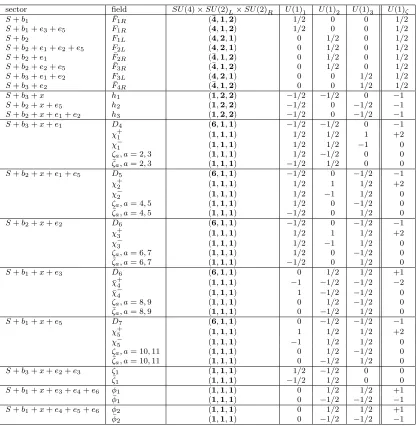
In tables 1, 2 and 3 we display the entire massless spectrum that arise in the model generated by the set of GGSO phases in eq. (2.6). The vector combination defined in the tables asb3 =b1+b2+x correspond to the third twisted plane of the
Z2×Z2 orbifold.
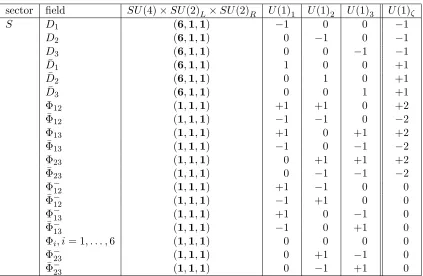
In addition to the spacetime vector bosons that generate the four dimensional gauge group the untwisted sector gives rise to three pairs ofSU(4) sextets; six pairs of SO(10)×E8 singlets that are charged with respect to U(1) symmetries; and six states that are neutral under the entire four dimensional gauge group. These states are displayed in table 1. The states arising from the untwisted sector are identical to all the Pati–Salam free fermionic models that use the basis set given in eq. (2.3) since the projections of the untwisted set only depend on the basis vectors and are independent of the choice of GGSO projection coefficients given in eq. (2.6).
sector field SU(4)×SU(2)L×SU(2)R U(1)1 U(1)2 U(1)3 U(1)ζ
S D1 (6,1,1) −1 0 0 −1
D2 (6,1,1) 0 −1 0 −1
D3 (6,1,1) 0 0 −1 −1
¯
D1 (6,1,1) 1 0 0 +1
¯
D2 (6,1,1) 0 1 0 +1
¯
D3 (6,1,1) 0 0 1 +1
Φ12 (1,1,1) +1 +1 0 +2
¯
Φ12 (1,1,1) −1 −1 0 −2
Φ13 (1,1,1) +1 0 +1 +2
¯
Φ13 (1,1,1) −1 0 −1 −2
Φ23 (1,1,1) 0 +1 +1 +2
¯
Φ23 (1,1,1) 0 −1 −1 −2
Φ−12 (1,1,1) +1 −1 0 0
¯
Φ−12 (1,1,1) −1 +1 0 0
Φ−13 (1,1,1) +1 0 −1 0
¯
Φ−13 (1,1,1) −1 0 +1 0
Φi, i= 1, . . . ,6 (1,1,1) 0 0 0 0 Φ−23 (1,1,1) 0 +1 −1 0
¯
[image:9.612.83.506.55.331.2]Φ−23 (1,1,1) 0 −1 +1 0
Table 1: The untwisted matter states andSU(4)×SU(2)L×SU(2)R×U(1)3 charges.
partner mechanism. The massless spectrum is completely free of exotic fractionally charged states that are endemic in heterotic string vacua [27, 28, 29, 17]. Addition-ally, the spectrum contains a number of SO(10)×U(1)ζ singlet states, that can be
used to produce a supersymmetric vacuum along F– and D–flat directions. Some of these states transform in non–trivial representations of the hidden sector gauge group. From table 2 it is seen that the spinor–vector self–duality at theSO(10) level is preserved in the Pati–Salam model.
Several observations can be noted from the twisted sectors states displayed in tables 2 and 3. First, it is seen that the chiral representations indeed form complete
27representations and consequentlyU(1)ζis anomaly free. The string model contains
two anomalous U(1) with
TrU(1)1 = 36 and TrU(1)3 =−36, (2.7)
where theU(1)1,2,3symmetries are generated by the right–moving complex worldsheet fermions ¯η1,2,3. Hence, the two combinations
U(1)ζ = U(1)1+U(1)2+U(1)3 (2.8)
U(1)2′ = U(1)1−2U(1)2+U(1)3 (2.9)
are anomaly free, whereas the combination
is anomalous. The anomalousU(1) symmetry generates a Fayet–Iliopoulos term that breaks supersymmetry near the Planck scale [30]. Supersymmetry can be restored along a flat directions by assigning a VEV to some SO(10)×U(1)ζ singlet fields in
the string massless spectrum, for example by giving a VEV to ¯Φ−13. Assigning a VEV to the heavy Higgs field that breaks the Pati–Salam symmetry leaves unbroken the weak hypercharge combination
U(1)Y =
1 3UC+
1 2UL, and theZ′ combination given by
U(1)Z′ =
1 5UC−
1
5UL−Uζ, (2.11)
where we used the U(1) definitions traditionally used in free fermionic models Uc =
3/2UB−L and UL = 2T3R.
As noted from table 2 the χ+i states with i= 1,· · · ,5 correspond to the SO(10) singlet in the 27 representation ofE6. The correspondingχ−i states correspond to the twisted moduli [19, 31]. Thus, contrary to the cases [31] in which the twisted moduli are projected out, in the self–dual model of eq. (2.6) they are retained. The states
ζa and ¯ζa with a= 1,· · · ,11 are neutral underSO(10)×U(1)ζ and can therefore get
non–trivial VEVs along supersymmetric F– andD–flat directions.
A particularly interesting class of states are the states φ1,2 and ¯φ1,2. These states
are SO(10) singlets and are charged with respect to U(1)ζ. These states therefore
carry standard charges with respect to the Standard Model gauge group. However, they carry non standard charges with respect to U(1)ζ. That is, while these states
are standard with respect to the Standard Model, they are exotic with respect toE6. The general characteristic of string vacua, due to the breaking of the non–Abelian GUT symmetries by Wilson lines with a left over unembeddedU(1) symmetry, is the existence of massless states that do not satisfy theU(1) quantisation of the underlying GUT symmetry [27]. In many models the resulting exotic states carry fractional electric charge, which are severely constrained by experiments [32].
The φ1,2 and ¯φ1,2 states in table 2 are similarly exotic states. Namely, they arise due to the breaking of E6 by discrete Wilson lines in the string vacuum. However, as they carry standard charges with respect to the SO(10) subgroup they are not exotic with respect to the Standard Model. Such states are therefore a particular signature of the string vacuum and may have interesting observational consequences [29]. Furthermore, if they remain sufficiently light they may be instrumental for generating an extended seesaw mechanism [33]. It should be remarked, though, that the E6 exotic states are vector–like and are not chiral. Therefore, a priori there is no clear argument why they should remain light.
The φ1,2 and ¯φ1,2 states fall into the general category of Wilsonian matter states considered in ref. [17]. Namely, they arise as a general consequence of the breaking of theE6 gauge symmetry by discrete Wilson lines [27]. However, they carry exotic non–E6 charges only with respect toU(1)ζ, and consequently with respect toU(1)Z′,
whereas they carry the standard charges with respect to the SO(10) subgroup of
E6. In fact, they are SO(10) singlets. This is quite an intriguing situation as it renders them ideal dark matter candidates. The reason being that if only states with standard E6 charges are used to break the U(1)Z′ symmetry, say the χ± states and
their conjugates, then a local discrete symmetry [34] is left which forbids the decay of these states to the Standard Model states. The relic abundance of such states was considered in ref. [17] and it was shown that they may provide viable dark matter candidates. However, the singlet states considered in ref. [17] are Standard Model singlets, but not SO(10) singlets. That is they carry exotic charges with respect to theU(1) combination, which is a combination ofU(1)B−LandU(1)T3R, and
must be broken at a high scale to suppress the left–handed neutrino masses. Hence, their relic abundance depends on an interplay between the reheating temperature following inflation and the extra U(1) breaking scale. However, the states φ1,2 and
¯
φ1,2 areSO(10) singlets and are not constrained by the suppression of the left–handed neutrino masses. They may therefore remain light and stable down to theZ′breaking
scale, and may be within reach of forthcoming colliders.
Table 3 contains the vector–like matter states that transform non–trivially under hidden E8 subgroup. All of these states are SO(10) singlets, but carry nontrivial charges under U(1)1,2,3. Furthermore, some of the hidden matter states in 3 carry exotic charges with respect to U(1)ζ. The hidden sector gauge group is broken to
SU(2)4×SO(8). This model may therefore accommodate the self–interacting dark matter candidates proposed in ref [35].
2.1 The superpotential
transform nontrivially under the observable Pati–Salam group,
¯
F1RF1Lh1+ ¯F1RF3Lh3+ ¯F1RF¯2RD4+ ¯F1RF¯4RD6+F1RF¯3Rζ1 + ¯F1RF¯1RD1+F1LF1LD2+ ¯F3RF¯3RD2+ ¯F2RF¯2RD2+F2LF2LD2 +F1RF1RD¯1+F3LF3LD3+ ¯F4RF¯4RD3+ ¯F3RF¯4RD7+F2LF3LD7
+h2h2Φ13+h3h3Φ13+h1h1Φ12+h1h2χ+5 +D1D2Φ12+D2D¯1Φ¯−12+D1D¯2Φ¯−12+ ¯D1D¯2Φ12¯ +D2D¯3Φ−23+D2D3Φ23+D3D¯2Φ¯−23+ ¯D2D¯3Φ23¯ +D1D3Φ13+D1D¯3Φ−13+D3D¯1Φ¯−13+ ¯D1D¯3Φ13¯ +D4D4Φ12+D5D5Φ13+D6D6Φ13+ ¯D6D¯6Φ23¯ +D7D7Φ23 +D5D7χ+1 +D3D4χ+1 +D2D5χ+2 +D2D6χ+3 +D1D¯6χ¯−4 +D1D7χ+5
+ ¯D1D¯6χ¯+4 + ¯D1D7χ−5 + ¯D2D5χ−2 + ¯D2D6χ−3 + ¯D3D4χ−1
+D6D¯6ζ1+D4D5χ+5 +D4D7χ+2. (2.12)
A particular requirement that we impose on the selected string vacuum is the exis-tence of a top quark mass term at the cubic level of the superpotential [37]. Such potential term may arise from the couplings toh1 and h3 in the first two terms in eq. (2.12).
Eq. (2.13) contains only states that are singlets of the observable and hidden non–Abelian group factors,
¯
Φ12Φ−13Φ23+ ¯Φ12Φ−23Φ13+ ¯Φ12− Φ¯−23Φ−13+ ¯Φ−12Φ23¯ Φ13 + ¯Φ13Φ¯−23Φ12+ ¯Φ13Φ¯−12Φ23+ ¯Φ−13Φ¯−12Φ−23+ ¯Φ23Φ¯−13Φ12 + ¯Φ12χ−1 χ+1 + ¯Φ13χ−2 χ+2 + ¯Φ13χ3−χ+3 + Φ23χ¯+4 χ¯−4 + ¯Φ23χ−5 χ+5 + ¯Φ−12ζ1ζ1+ ¯Φ−12ζ2ζ2+ ¯Φ−12ζ3ζ3+ ¯Φ−13ζ4ζ4+ ¯Φ−13ζ5ζ5+ ¯Φ−13ζ6ζ6
+ ¯Φ−13ζ7ζ7+ ¯Φ−23ζ8ζ8+ ¯Φ−23ζ9ζ9+ ¯Φ−23ζ10ζ10+ ¯Φ−23ζ11ζ11 + ¯Φ−12ζ¯1ζ¯1+ ¯Φ12− ζ¯2ζ¯2+ ¯Φ−12ζ¯3ζ¯3+ Φ−13ζ¯4ζ¯4+ Φ−13ζ¯5ζ¯5+ Φ−13ζ¯6ζ¯6
+Φ−13ζ¯7ζ¯7+ Φ−23ζ¯8ζ¯8+ Φ−23ζ¯9ζ¯9+ Φ−23ζ¯10ζ¯10+ Φ−23ζ¯11ζ¯11 +ζ1χ+3 χ¯+4 + ¯ζ1ζ¯7χ¯−4 + ¯ζ1χ−3 ζ9+ζ2ζ4χ−5 +ζ3ζ5χ−5
+¯ζ2χ−2 ζ10+ ¯ζ3χ−2 ζ11+χ−1 ζ¯4ζ¯10+χ−1 ζ¯5ζ¯11 +Φ6ζ1ζ¯1+ζ1ζ¯6ζ8+ζ1ζ¯7ζ9+χ−1 χ−2 χ−5
+ ¯Φ23φ1φ1+ ¯Φ23φ2φ2+ Φ23φ¯1φ¯1+ Φ23φ¯2φ¯2+ Φ2φ1φ¯1 + Φ2φ¯2φ2. (2.13)
factors,
¯ Φ13H2
34H342 + ¯Φ13H123 H123 + Φ13H122 H122 + Φ13H343 H343 + ¯Φ−23H3
13H133 + ¯Φ−23H345 H345 + ¯Φ−23H143 H143 +Φ−23H2
13H132 + Φ−23H344 H344 + Φ−23H142 H142 + ¯Φ−12H1
12H121 + ¯Φ−12H141 H141 + ¯Φ−12H131 H131 + ¯Φ−
12H341 H341 + ¯Φ−12H231 H231 + ¯Φ−12H241 H241 +χ−2 H1
34H345 +χ−3 H141 H143 +χ−3 H131 H133 + ¯χ−4 Z5Z1+ ¯φ2H121 H123 + ¯φ2H341 H342 +Φ−13Z1Z1+ ¯Φ−23Z2Z2+ ¯Φ−23Z3Z3+ Φ−13Z4Z4+ ¯Φ−12Z5Z5 (2.14)
As noted above a VEV that cancels the anomalous U(1) D–term, which is also
F–flat to all orders in the superpotential is given by the VEV of ¯Φ−13.
3
Conclusions
Extensions of the Standard Model by an Abelian gauge symmetry are among the most popular cases investigated in studies of physics beyond the Standard Model. Extra U(1) symmetries arise naturally in Grand Unified Theories with SO(10) and
E6 gauge symmetry. Furthermore, the internal consistency conditions of string con-structions mandate the existence of additional gauge symmetries, and may be viewed as a general prediction of string theory. Indeed, since the mid–eighties many authors explored the physics implication of a string inspired extraZ′ vector boson in collider
experiments and astroparticle observatories. Many of those studies are inspired by the heterotic–string, which also admit the appealing GUT structure, and gave rise to string inspired Z′ models with E
6 embedding. Surprisingly, however, the construc-tion of explicit string derived models that allow the extra U(1) symmetry to remain unbroken down to low scales has proven to be a difficult challenge. The reason being that the extra U(1)s that arise in string models could not satisfy the phenomeno-logical constraints that must be imposed on a viable U(1) symmetry down to low scales. Some of those constraints being: family universality; anomaly freedom; gauge coupling unification; suppressed left–handed neutrino masses. The main obstacle be-ing the construction of an extra anomaly free U(1) with E6 embedding of its chiral charges.
In this paper we constructed a string model that can satisfy these phenomeno-logical constraints. The model that we constructed is a self–dual model under the spinor–vector duality map that was observed in free fermionicZ2×Z2 orbifolds. As a consequence of the self–duality property the chiral states in the model form complete
sector field SU(4)×SU(2)L×SU(2)R U(1)1 U(1)2 U(1)3 U(1)ζ S+b1 F¯1R (¯4,1,2) 1/2 0 0 1/2 S+b1+e3+e5 F1R (4,1,2) 1/2 0 0 1/2 S+b2 F1L (4,2,1) 0 1/2 0 1/2 S+b2+e1+e2+e5 F2L (4,2,1) 0 1/2 0 1/2 S+b2+e1 F¯2R (¯4,1,2) 0 1/2 0 1/2 S+b2+e2+e5 F¯3R (¯4,1,2) 0 1/2 0 1/2 S+b3+e1+e2 F3L (4,2,1) 0 0 1/2 1/2 S+b3+e2 F¯4R (¯4,1,2) 0 0 1/2 1/2 S+b3+x h1 (1,2,2) −1/2 −1/2 0 −1 S+b2+x+e5 h2 (1,2,2) −1/2 0 −1/2 −1 S+b2+x+e1+e2 h3 (1,2,2) −1/2 0 −1/2 −1 S+b3+x+e1 D4 (6,1,1) −1/2 −1/2 0 −1
χ+
1 (1,1,1) 1/2 1/2 1 +2
χ−
1 (1,1,1) 1/2 1/2 −1 0
ζa, a= 2,3 (1,1,1) 1/2 −1/2 0 0
¯
ζa, a= 2,3 (1,1,1) −1/2 1/2 0 0 S+b2+x+e1+e5 D5 (6,1,1) −1/2 0 −1/2 −1
χ+
2 (1,1,1) 1/2 1 1/2 +2
χ−
2 (1,1,1) 1/2 −1 1/2 0
ζa, a= 4,5 (1,1,1) 1/2 0 −1/2 0
¯
ζa, a= 4,5 (1,1,1) −1/2 0 1/2 0 S+b2+x+e2 D6 (6,1,1) −1/2 0 −1/2 −1
χ+
3 (1,1,1) 1/2 1 1/2 +2
χ−
3 (1,1,1) 1/2 −1 1/2 0
ζa, a= 6,7 (1,1,1) 1/2 0 −1/2 0
¯
ζa, a= 6,7 (1,1,1) −1/2 0 1/2 0 S+b1+x+e3 D¯6 (6,1,1) 0 1/2 1/2 +1
¯
χ+
4 (1,1,1) −1 −1/2 −1/2 −2
¯
χ−
4 (1,1,1) 1 −1/2 −1/2 0
ζa, a= 8,9 (1,1,1) 0 1/2 −1/2 0
¯
ζa, a= 8,9 (1,1,1) 0 −1/2 1/2 0 S+b1+x+e5 D7 (6,1,1) 0 −1/2 −1/2 −1
χ+
5 (1,1,1) 1 1/2 1/2 +2
χ−
5 (1,1,1) −1 1/2 1/2 0
ζa, a= 10,11 (1,1,1) 0 1/2 −1/2 0
¯
ζa, a= 10,11 (1,1,1) 0 −1/2 1/2 0 S+b3+x+e2+e3 ζ1 (1,1,1) 1/2 −1/2 0 0
¯
ζ1 (1,1,1) −1/2 1/2 0 0 S+b1+x+e3+e4+e6 φ1 (1,1,1) 0 1/2 1/2 +1
¯
φ1 (1,1,1) 0 −1/2 −1/2 −1 S+b1+x+e4+e5+e6 φ2 (1,1,1) 0 1/2 1/2 +1
¯
[image:14.612.83.502.54.480.2]φ2 (1,1,1) 0 −1/2 −1/2 −1
Table 2: Twisted matter spectrum (observable sector) andSU(4)×SU(2)L×SU(2)R×
U(1)3 quantum numbers.
Our three generation Pati–Salam model contains the Higgs fields required for generating a realistic mass spectrum. The model admits a mass term at the cubic level of the superpotential that may generate mass for the heavy fermion family at leading order. The massless spectrum of the model is free of exotic fractionally charged states.
Perhaps most tantalising is the appearance in the string model of vector–like states that carry standard charges with respect to Standard Model gauge group, but carry non–standard charges with respect to U(1)ζ, which descends from E6. Such states
sector field SU(2)4×SO(8) U(1)1 U(1)2 U(1)3 U(1)ζ S+b3+x+e4 H121 (2,2,1,1,1) 1/2 −1/2 0 0 S+b3+x+e1+e4 H341 (1,1,2,2,1) −1/2 +1/2 0 0 S+b2+x+e1+e2+e6 H122 (2,2,1,1,1) −1/2 0 −1/2 −1 S+b2+x+e1+e5+e6 H342 (1,1,2,2,1) +1/2 0 +1/2 +1 S+b2+x+e2+e6 H343 (1,1,2,2,1) −1/2 0 −1/2 −1 S+b1+x+e3+e4+e6 H344 (1,1,2,2,1) 0 −1/2 +1/2 0 S+b1+x+e4+e5 H345 (1,1,2,2,1) 0 +1/2 −1/2 0 S+b2+x+e5+e6 H123 (2,2,1,1,1) +1/2 0 +1/2 +1 S+b3+x+z1+e2 H141 (2,1,1,2,1) −1/2 +1/2 0 0 S+b3+x+z1+e2+e4 H131 (2,1,2,1,1) −1/2 +1/2 0 0 S+b3+x+z1+e1+e2 H231 (1,2,2,1,1) −1/2 +1/2 0 0 S+b3+x+z1+e1+e2+e4 H241 (1,2,1,2,1) −1/2 +1/2 0 0 S+b1+x+z1+e3+e4+e5 H132 (2,1,2,1,1) 0 −1/2 +1/2 0 S+b1+x+z1+e3+e5 H142 (2,1,1,2,1) 0 −1/2 +1/2 0 S+b1+x+z1+e4+e5 H133 (2,1,2,1,1) 0 +1/2 −1/2 0 S+b1+x+z1 H143 (2,1,1,2,1) 0 +1/2 −1/2 0 S+b2+x Z1 (1,1,1,1,8v) −1/2 0 +1/2 0 S+b1+x+z2+e5+e6 Z2 (1,1,1,1,8s) 0 +1/2 −1/2 0 S+b1+x+z2+e3+e6 Z3 (1,1,1,1,8s) 0 +1/2 −1/2 0 S+b2+x+e1+e2+e5 Z4 (1,1,1,1,8v) −1/2 0 +1/2 0 S+b3+x+e3 Z5 (1,1,1,1,8v) −1/2 +1/2 0 0
Table 3: Twisted matter spectrum (hidden sector) andSU(2)4×SO(8)×U(1)3 quan-tum numbers.
by discrete Wilson lines. Combined observation of the extra E6 U(1) symmetry and of the E6 exotic states will therefore provide strong evidence in favour of a string construction. Furthermore, as we discussed in section 2, they provide viable dark matter candidates. Existence of a lightZ′ in these models may therefore not only be
accompanied by the extra E6 states, required for anomaly cancellation, but by the extra exotic states that serve as a distinct signature of the string vacua and provide viable dark matter candidates.
4
Acknowledgements
AEF would like to thank the University of Oxford and the Mainz Institute for Theoretical Physic for hospitality. AEF is supported in part by STFC under contract ST/G00062X/1. This research has been co-financed by the European Union (Euro-pean Social Fund - ESF) and Greek national funds through the Operational Program “Education and Lifelong Learning” of the National Strategic Reference Framework (NSRF) - Research Funding Program: THALIS Investing in the society of knowledge through the European Social Fund.
References
[1] G. Costa, J.R. Ellis, G.L. Fogli, D.V. Nanopoulos and F. Zwirner, Nucl. Phys.
F. Zwirner, Int. J. Mod. Phys. AA3 (1988) 49; J.L. Hewett, T.G. Rizzo, Phys. Rep.183 (1989) 193;
Y. Y. Komachenko and M. Y. Khlopov,Sov. J. Nucl. Phys.51 (1990) 692;Yad. Fiz. 51 (1990) 1081;
A.E. Faraggi M. Masip, Phys. Lett. B388(1996) 524;
G. Cleaver, M. Cvetic, J.R. Espinosa, L.L. Everett and P. Langacker, Phys. Rev.
D57(1998) 2701;
A. Leike, Phys. Rep. 317 (1999) 143;
S.F. King, S. Moretti, R. Nevzorov, Phys. Rev. D73(2006) 035009; P. Langacker,Rev. Mod. Phys. 81 (2009) 1199;
P. Athron, S.F. King, D.J. Miller, S. Moretti and R. Nevzorov, Phys. Rev.D80
(2009) 035009;
O. Lebedev and S. Ramos–Sanchez, Phys. Lett. B684(2010) 48; M. Ambroso and B.A. Ovrut,Int. J. Mod. Phys. A26 (2011) 1569;
M. Goodsell, S. Ramos–Sanchez and A. Ringwald, JHEP 1201 (2012) 021; A. Belyaev, S.F. King and P. Svantesson, Phys. Rev. D88(2013) 035015; Z. Marshall, B.A. Ovrut, A. Purves and S. Spinner, Phys. Lett. B732 (2014) 325
[2] A.E. Faraggi and D.V. Nanopoulos, Mod. Phys. Lett. A6 (1991) 61.
[3] J. Pati, Phys. Lett. B388 (1996) 532; A.E. Faraggi,Phys. Lett. B499 (2001) 147;
A.E. Faraggi and M. Thormeier, Nucl. Phys.B624 (2002) 163;
C. Coriano, A.E. Faraggi and M. Guzzi,Eur. Phys. Jour.C53(2008) 421;Phys. Rev. D78(2008) 015012.
[4] A.E. Faraggi and V.M. Mehta, Phys. Rev.D84 (2011) 086006.
[5] A.E. Faraggi, Phys. Lett. B245 (1990) 435.
[6] I. Antoniadis, J. Ellis, J. Hagelin and D.V. Nanopoulos,Phys. Lett.B231(1989) 65.
[7] A.E. Faraggi, D.V. Nanopoulos and K. Yuan, Nucl. Phys. B335(1990) 347; A.E. Faraggi,Phys. Lett. B278 (1992) 131; Nucl. Phys.B387(1992) 239; G.B. Cleaver, A.E. Faraggi and D.V. Nanopoulos,Phys. Lett.B455(1999) 135.
[8] I. Antoniadis. G.K. Leontaris and J. Rizos, Phys. Lett. B245(1990) 161; G.K. Leontaris and J. Rizos, Nucl. Phys.B554 (1999) 3;
K. Christodoulides, A.E. Faraggi and J. Rizos, Phys. Lett. B702 (2011) 81.
[10] G.B. Cleaver, A.E. Faraggi and C. Savage, Phys. Rev.D63 (2001) 066001; G.B. Cleaver, D.J. Clements and A.E. Faraggi, Phys. Rev.D65 (2002) 106003.
[11] A.E. Faraggi and V.M. Mehta, Phys. Rev.D88 (2013) 025006.
[12] A.E. Faraggi, C. Kounnas and J. Rizos, Phys. Lett. B648(2007) 84.
[13] A.E. Faraggi, C. Kounnas and J. Rizos, Nucl. Phys. B774 (2007) 208; Nucl.
Phys. B799(2008) 19;
T. Catelin-Julian, A.E. Faraggi, C. Kounnas and J. Rizos, Nucl. Phys. B812
(2009) 103.
[14] C. Angelantonj, A.E. Faraggi and M. Tsulaia, JHEP 1007 (2010) 004.
[15] A.E. Faraggi, I. Florakis, T. Mohaupt and M. Tsulaia,Nucl. Phys.B848(2011) 332.
[16] J.C. Pati and A. Salam,Phys. Rev. D10 (1974) 275;
I. Antoniadis and G.K. Leontaris, Phys. Lett. B216(1989) 333.
[17] S. Chang, C. Coriano and A.E. Faraggi,Nucl. Phys.B477 (1996) 65; A.E. Faraggi, arXiv:hep-ph/9608420;
C. Coriano, A.E. Faraggi and M. Pl¨umacher, Nucl. Phys. B614(2001) 233.
[18] P. Athanasopoulos, A.E. Faraggi and V.M. Mehta, Phys. Rev. D89 (2014) 105023.
[19] A.E. Faraggi,Nucl. Phys. B407(1993) 57.
[20] L. Bernard, A.E. Faraggi, I. Glasser, J. Rizos and H. Sonmez,Nucl. Phys.B868
(2013) 1.
[21] I. Antoniadis, C. Bachas, and C. Kounnas,Nucl. Phys. B289(1987) 87; H. Kawai, D.C. Lewellen, and S.H.-H. Tye, Nucl. Phys.B288 (1987) 1.
[22] A.E. Faraggi, C. Kounnas, S.E.M. Nooij and J. Rizos, hep-th/0311058; Nucl.
Phys. B695(2004) 41.
[23] B. Assel, K. Christodoulides, A.E. Faraggi, C. Kounnas and J. RizosPhys. Lett.
B683(2010) 306; Nucl. Phys.B844 (2011) 365.
[24] A.E. Faraggi, J. Rizos and H. Sonmez, Nucl. Phys. B886(2014) 202.
[25] A. Gregori, C. Kounnas and J. Rizos, Nucl. Phys.B549 (1999) 16.
[27] X.G. Wen and E. Witten, Nucl. Phys.B261 (1985) 651;
G. Athanasiu, J. Atick, M. Dine, and W. Fischler, Phys. Lett. B214(1988) 55.
[28] A.N. Schellekens, Phys. Lett. B237 (1990) 363.
[29] A.E. Faraggi,Phys. Rev.D46 (1992) 3204.
[30] M. Dine, N. Seiberg and E. Witten, Nucl. Phys.B289 (1987) 589; J. Atick, L. Dixon and A. Sen, Nucl. Phys.B292 (1987) 109.
[31] A.E. Faraggi,Nucl. Phys. B728(2005) 83.
[32] See e.g.: V. Halyo et al, Phys. Rev. Lett. 84 (2000) 2576.
[33] I. Antoniadis, J. Rizos and K. Tamvakis, Phys. Lett. B279 (1992) 281; A.E. Faraggi and E. Halyo, Phys. Lett. B307 (1993) 311;
C. Coriano and A.E. Faraggi, Phys. Lett. B581 (2004) 99.
[34] A.E. Faraggi,Phys. Lett. B398 (1997) 88.
[35] A.E. Faraggi and M. Pospelov, Astropart. Phys. 16 (2002) 451.
[36] S.Kalara, J.L. Lopez and D.V. Nanopoulos, Nucl. Phys.B353 (1991) 650; J. Rizos and K. Tamvakis, Phys. Lett. B262(1991) 227;
A.E. Faraggi,Nucl. Phys. B487(1997) 55.