This is a repository copy of
Physiology as a caste-defining feature
.
White Rose Research Online URL for this paper:
http://eprints.whiterose.ac.uk/46210/
Version: Published Version
Article:
Robinson, E. J. H. orcid.org/0000-0003-4914-9327 (2009) Physiology as a caste-defining
feature. Insectes Sociaux. p. 16. ISSN 1420-9098
https://doi.org/10.1007/s00040-008-1035-0
[email protected] https://eprints.whiterose.ac.uk/ Reuse
Items deposited in White Rose Research Online are protected by copyright, with all rights reserved unless indicated otherwise. They may be downloaded and/or printed for private study, or other acts as permitted by national copyright laws. The publisher or other rights holders may allow further reproduction and re-use of the full text version. This is indicated by the licence information on the White Rose Research Online record for the item.
Takedown
If you consider content in White Rose Research Online to be in breach of UK law, please notify us by
Review article
Physiology as a caste-defining feature
E.J.H. Robinson
School of Biological Sciences, University of Bristol, Woodland Road, Bristol, BS8 1UG, UK, e-mail: [email protected]
Received 19 December 2007; revised 24 July and 18 September 2008; accepted 19 September 2008. Published Online First 13 October 2008
Abstract. Division of labour is a key factor in the ecological success of social insects. Groups of individuals specializing on a particular behaviour are known as castes and are usually distinguished by morphology or age. Physiology plays a key role in both these types of caste, in either the developmental physiology which determines morphology, or the temporal changes in physiology over an insects life. Physiological correlates of morphological or temporal caste include differences in gland structure, secretory products, leanness, neuroanatomy and neuro-chemistry. However, purely physiological castes could also occur. Physiological castes are discrete groups of same-age same-size individuals with particular physio-logical competencies, or groups of individuals with similar physiology crossing age or size groups. A stable physio-logical caste occurs in the monomorphic Pharaohs ant, where some ants can detect old pheromone trails and retain this specialization over time. These ants differ physiologically from other workers, and the differences arise before eclosion. More temporary physiological
castes occur in the ant Ectatomma where brood care
specialists have more developed ovarioles than other same-aged workers, and in the honeybee where nurses, wax-workers and soldiers all differ physiologically from same-aged nestmates. Physiology is an important aspect of caste, not only in its contribution to age-related and morphological castes, but also in its own right as a caste grouping factor. While age and morphological differences make caste structures accessible for study, more cryptic physiological castes may play just as important a role in division of labour.
Keywords: Caste, division of labour, physiology, social
insects, polyethism.
Introduction
Division of labour is considered a key factor in the ecological success of social insects. Reproductive division of labour is characteristic of eusocial species, but in the social insects, further division of labour among the workers increases the efficiency of task performance by allowing parallel task processing and specialisation on particular tasks such as foraging, defence or brood care. Groups of individuals that contribute to specific colony functions are known as castes, and caste differences are accompanied by distinct behavioural specializations (Oster and Wilson, 1978). Beyond that, castes are usually distinguished by morphological features of the exoskel-eton, or grouped by age. A third type of caste is occasionally mentioned, the physiological caste, based on physiological differences not linked to morphology or age (Wilson, 1963; Hçlldobler and Wilson, 1990). How-ever, no examples of such a caste are given, and age and morphology are often listed as the only two types of caste (Wilson, 1968, 1980; Traniello and Rosengaus, 1997; Beshers et al., 1999).
Differences between individuals which cannot be attributed to age or morphological differences have been classed simply as idiosyncrasies (Beshers et al., 1999) but it is possible that many species have physio-logical castes – discrete groups of same-age same-size individuals with particular physiological competencies and behavioural specialisations, or groups of individuals with similar physiology and behaviour crossing age or size groups. Such groups could easily be overlooked. Mor-phological castes are, after all, determined by develop-mental physiology (Nijhout and Wheeler, 1982), and temporal castes can be considered to be temporary physiological castes (Johnson, 2003), so morphological and age-related castes could be seen as particular sub-types of physiological caste. Rather than focussing on morphological or temporal groupings and then looking
for physiological correlates, we should perhaps focus first on finding the physiological basis of observed behavioural specialisations, and then, if appropriate, look for mor-phological and age group correlates of these. Here I review physiological differences among age-related and morphological castes, showing that physiology can be as or more important to caste identity than morphology or age. I also give some examples of possible purely
physio-ACHTUNGTRENNUNG
logical castes.
Morphological castes
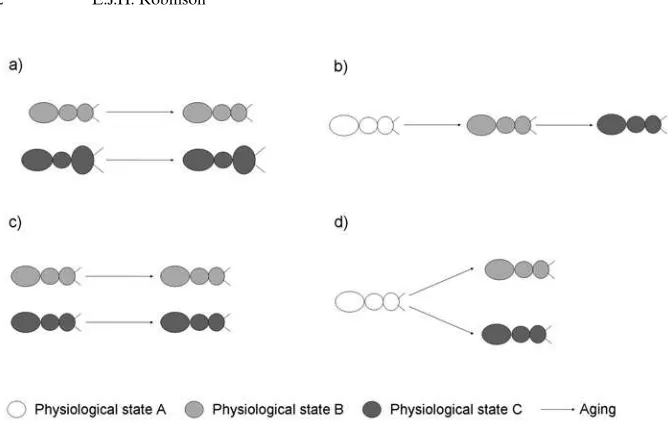
Where morphological (or physical) castes occur, the size or shape of workers is correlated with the tasks they perform. Morphological castes are found in the termites and some ants. Although morphological castes are characterised by features of the exoskeleton, the differ-ences between these castes often extend below the exoskeleton to the gland morphology and secretions (Fig. 1a). There are many examples of such physiological correlates of morphological caste. Where a particular morphological caste carries out most of the trail laying, the appropriate gland may be larger in that group, for example the enlarged Dufours gland in the trail-laying
Pheidole fallaxminors, compared to the non-trail-laying
majors (Law et al., 1965), and the proportionally longer
poison-sac in the trail-laying intermediate-sized Atta
sexdens workers compared to the other castes (Wilson,
1980). In other species, the specialisation is not gland size but rather the secretion produced. In the harvester ant
Messor barbarus, the trail substance produced from the
Dufours gland of the media workers has the most potent recruitment effect, although it is major workers which have the largest Dufours glands (Heredia and Detrain,
2000). In the termites too, trail laying ability may differ between castes in terms of the trail substance produced in
Nasutitermes ephrataeandN. corniger(Arab et al., 2006),
or in the ability to produce any trail substance at all in
Trinervitermes bettonianus(Leuthold and Lscher, 1974).
A soldier (or major) caste defending the colony is one of the commonest morphological specialisations, and physiological correlates are widespread here too. In some ants, majors have larger poison glands than minor work-ers and produce all or most of the alarm pheromone (Law et al., 1965; Heredia and Detrain, 2000). Among the leaf-cutter ants, the composition of the alarm pheromones from the mandibular glands differs between soldiers, medias and minors (Do Nascimento et al., 1993; Hernn-dez et al., 1999; Hughes et al., 2001; Francelino et al., 2006) and it also differs between majors and minors in the
weaver ant Oecophylla longinoda (Bradshaw et al.,
1979). In the nasute termites, the soldiers differ greatly in their physiology from other workers. The soldiers possess a specialised nasus for secretion of viscous defensive substances unique to the soldier caste (Miura and Matsumoto, 2000; Hojo et al., 2005). In other termite groups, the soldiers also show differences in the man-dibular gland physiology (Miura et al., 1999).
In the leaf-cutter ants, the very smallest individuals specialise on tending the fungus garden. Substances which inhibit bacteria and alien fungi are produced from the metapleural glands. These glands are propor-tionally largest in the smallest workers, which makes them more resistant to parasitic fungi (Wilson, 1980; Poulsen et al., 2006). The small leaf-cutter ants also carry out brood care, and correspondingly have the proportionally largest postpharyngeal gland, from which larval food is secreted
(Wilson, 1980). In the macrotermite Macrotermes
[image:3.595.49.383.57.269.2]belli-cosus, labial gland secretions (important in trophallaxis
Figure 1.Schematic of the different types of physiological caste.a.Two morphological castes, each accompanied by physiological differences maintained over time, e.g.Atta cephalotes.b.Three temporal castes accompanied by physiological changes, e.g.Myrmica rubra.c.Two physiological castes: physiological differences maintained over time and with no morphological differences, e.g.Monomorium pharaonis.d.Physiology diverges over time forming physiological castes with no morphological differences, e.g.Ectatomma tuberculatum.
and nest construction) and gut enzymes differ between majors and minors (Hinze et al., 2002). It is clear that physiological specialisations within a morphological caste system have evolved many times in the social insects; indeed the morphological and physiological traits prob-ably coevolved, and thus the physiological traits may be as important as the morphological traits in determining such caste differences.
Temporal castes
Temporal (age-related) castes are more common than morphological ones, and are found in many bees, wasps, ants and termites. They vary in strength and discreteness, but generally follow the pattern of younger individuals working inside the nest, and older ones outside. The clearest examples of stable age-related or temporal castes are accompanied by physiological changes (Fig. 1b), so it has been suggested that temporal castes should be viewed as temporary physiological castes (Johnson, 2003). Phys-iological changes have been best studied in the honey bee
Apis mellifera.In the honeybee, juvenile hormone (JH)
increases during a bees life and the yolk protein
vitello-ACHTUNGTRENNUNG
genin decreases. These changes are more closely linked to task than absolute age, as demonstrated by the low JH and slower decrease of vitellogenin in long-lived winter bees which do not forage (Fluri et al., 1982). In addition, precocious foragers and over-aged nurses have JH and vitellogenin levels more appropriate to their task than their age (Fluri et al., 1982; Robinson et al., 1989; Huang and Robinson, 1992; Amdam et al., 2005). Both JH and vitellogenin influence the timing of the switch to foraging (Sullivan et al., 2000; Nelson et al., 2007). JH and vitellogenin exert regulatory influence on each other (Rutz et al., 1976; Pinto et al., 2000; Guidugli et al., 2005), and, at least in honeybees, changes in levels of these factors underlie many of the age-correlated physiological changes discussed below.
As with morphological castes, changes in glands correlated with age group are common, and many of these have been demonstrated to be correlates of age-related task, rather than simply part of the aging process. Younger honeybees, which care for brood, secrete a larval-feeding substance from well developed hypophar-yngeal glands, which degenerate later in life (Kubo et al., 1996; Ohashi et al., 1997) This degeneration is caused by increasing levels of JH (Jaycox et al., 1974; Rutz et al., 1976). Hypopharyngeal gland degeneration will be re-versed in some foragers if young bees are removed from the colony, showing the link with task (Van der Blom, 1993). Such reverted bees show reduced JH and increased vitellogenin compared to same-aged foragers (Amdam et al., 2005). Changes in the composition of mandibular gland secretions with age are also seen in the
stingless beeScaptotrigona postica(Gracioli-Vitti et al.,
2004) and the ant Myrmica rubra (Cammaerts-Tricot,
1974). In the termiteMacrotermes bellicosuslabial gland
secretions (important in trophallaxis and nest construc-tion) and gut enzymes change with age as workers move from feeding on plant material to feeding on fungus comb (Hinze et al., 2002). Reproductive physiology may also change with temporal caste, because in many species of social insect the workers produce non-viable trophic eggs
to feed brood. In the wood antsFormica sanguineaandF.
rufibarbis, the ovarioles are developed in younger
work-ers, but degenerate in older workers (Hohorst, 1972; Billen, 1982).
Older workers, often foraging outside of the nest, have different glandular physiology from younger workers. In the honeybee, the now much reduced hypopharyngeal gland switches to secreting carbohydrate-metabolising enzymes required for the processing of nectar into honey (Kubo et al., 1996; Ohashi et al., 1999; Deseyn and Billen, 2005). In trail-laying ants, changes in the abdominal
glands are common with age. In Myrmica rubra, the
Dufours gland which produces trail pheromones in-creases in size over the age period 0 – 17 days and, as the ant ages further, the secretions continue to increase in
attractiveness (Cammaerts-Tricot, 1974). InTetramorium
aculeatum young workers have almost empty Dufours
glands, and the trail substance produced from their poison and sternal glands elicits less effect than that of the older
foragers (Cammaerts et al., 1994). In the antCamponotus
obscuripes, formic acid reservoirs in the older foraging
ants are a different shape and contain much more formic acid (used in alarm) than in younger nest workers (Fujiwara-Tsujii and Yamaoka, 2006).
In addition to differences in glandular physiology, foragers may be leaner, a pattern seen in bees, wasps and ants (ODonnell and Jeanne, 1995; Blanchard et al., 2000;
Toth and Robinson, 2005). In the waspPolybia
occiden-talis, lipid stores decrease after performing their first
external task (ODonnell and Jeanne, 1995) whereas in the honeybee, lipid declines prior to the onset of foraging, and this decline has been demonstrated to have a causal role in the switch (Toth et al., 2005). Although external nest workers are older individuals, and older individuals have less lipid, in both these studies there was a closer correlation between task and lipid than between age and lipid (ODonnell and Jeanne, 1995; Toth and Robinson, 2005).
(ODon-nell et al., 2004) and ants (Gronenberg et al., 1996; Seid et al., 2005; Khn-Bhlmann and Wehner, 2006).
Neuro-chemical correlates of age are seen in the ant Pheidole
dentata (Seid and Traniello, 2005) and the honeybee
(Wagener-Hulme et al., 1999). In the honeybee, some of these changes are associated with task (Wagener-Hulme et al., 1999) or transitions between tasks (Schulz and Robinson, 1999; Schulz et al., 2002) and are modulated by juvenile hormone (Schulz et al., 2002). In the honeybee, hormone receptors in the ecdysteroid signalling pathway are expressed most strongly in the mushroom bodies of foragers (Yamazaki et al., 2006), though it has not yet been determined whether this change is age- or task-linked.
Physiological castes
It is evident that physiological differences between castes are common, but are they always age-linked or connected to morphology? The possible existence of purely physio-logical castes is rarely mentioned. Hçlldobler and Wilson (1990) suggest insemination as a physiological state which could define a caste but, in addition to reproductive physiology, the other physiological differences outlined above (glandular morphology, secretory products, lean-ness, neuroanatomy, neurochemistry) could also occur within same-aged monomorphic groups (Fig. 1c).
A recent paper on the monomorphic Pharaohs ant,
Monomorium pharaonis describes just such a case
(Jackson et al., 2007). Within the Pharaohs ant, only some ants are able to detect pheromone trails laid the previous day. These specialist pathfinders retain their specialisations over time and are physiologically different from other foragers, as pathfinders have significantly lower ratio of monomorine 3 to monomorine 1 than other ants (Jackson et al., 2006). The proportion of the ants which are behaviourally and physiologically pathfinders remains constant in different age cohorts, suggesting that no age polyethism is involved here (Jackson et al., 2007). Venom in Pharaohs ants is synthesised before eclosion of pupae (Jackson et al., 2007), so the consistency through-out age groups suggests that this group of specialists are developmentally determined, like morphological castes. As is also the case with most morphological castes, a level of behavioural flexibility is maintained in this physiolog-ical caste. Food deprivation temporarily increased trail-detecting performance in non-specialists, but it dropped again after feeding (Jackson et al., 2006).
In the Pharaohs ant, the physiological caste seems to be stable across all age groups; however physiological specialisations also occur within an age group (Fig. 1d). In
the ponerine ant Ectatomma tuberculatum there are
changes in reproductive and glandular physiology with age, but also with task within same-aged cohorts. Workers specialising in brood care have more developed ovarioles (allowing them to lay trophic eggs) than other same-aged ants (Fnron et al., 1996).
Physiological changes with temporal caste in honey-bees have been well studied, as discussed above, and here too physiological specialisations within age groups have been recorded. Honeybee nurses have more developed ovaries and smaller poison glands than same-aged nest maintenance specialists (Huang et al., 1994). Wax-work-ers come from a particular age group with active wax-glands (Muller and Hepburn, 1992), but wax-working specialists also have lower Juvenile Hormone and higher dopamine levels than other members of this age group such as guards or food storers (Huang et al., 1994; Wagener-Hulme et al., 1999). Among older honeybees, foragers and soldiers differ behaviourally and genetically (Breed et al., 1990). There may be slight differences in age between these two groups (Wagener-Hulme et al., 1999) but the significant differences in hypopharyngeal glands and neurochemistry make the soldier caste more clearly defined by physiology than age (Huang and Robinson, 1996; Wagener-Hulme et al., 1999).
It seems likely that there may be many more such physiological castes throughout the social insects, but these may have been overlooked because physiological differences are less easily observable than morphological, age-related and behavioural differences.
How would physiological castes arise?
Two types of physiological castes have been observed (Fig. 1). The physiological differences in the Pharaohs ant are stable across all age groups. This sort of caste could arise due to differences in hormone levels or trophic factors during larval development, as morphological castes do. In this case, the physiological caste would be fixed before eclosion as is the case for morphological castes in ants. The second sort of physiological castes only
diverge at certain stages of life, as in the honeybee andE.
tuberculatum.These could arise in several different ways,
as is the case for temporal castes. If individuals are initially identical, physiological task fixation could occur, amplifying differences which have arisen due to social interactions or spatial location (Franks and Tofts, 1994). Alternatively, genetic differences between individuals could lead directly to specialisation via an intrinsic physiological bias towards performing a certain task. Genetic differences could also lead indirectly to physio-logical bias via effects on spatial location or social clustering. Genetic differences between individuals spe-cialising on different tasks have been recorded in bees, wasps and ants (Frummhoff and Baker, 1988; Robinson and Page, 1988; Stuart and Page, 1991; ODonnell, 1998). Page et al. (2000) bred strains of bees which differ in their propensity to store pollen, and this behavioural differ-ence during foraging is associated with life-long physio-logical characteristics. In high strain bees which store more pollen, vitellogenin increases more rapidly in the young workers and declines more rapidly in older bees (Amdam et al., 2007). Thus genetically determined
differences in the timing of endocrine signals can have far-reaching effects on physiology and behaviour.
I suggest that physiology is an important aspect of caste, not only in its contribution to age-related and morphological castes, but also in its own right as a caste grouping factor. Indeed physiological differences (cur-rent or developmental) could be seen as the overarching caste grouping factor, while differences in morphology and age may be the observable signs. Behavioural specialisations may be flexible, and looking for physio-logical differences would help distinguish between stable castes and short-term behavioural specialisations. Age and morphological differences have been used for this purpose in the past, however while age and morphology make caste structures accessible for study, we should be prepared to look for more cryptic physiological castes, which may play just as important a role in division of labour.
Acknowledgments
Thanks to S.J. Almond, B.P. Coffin, M.J. Couvillon, N.R. Franks, S.J. Martin, T.O. Richardson and two anonymous reviewers for discussions and comments on the manuscript.
References
Amdam G.V., Aase A., Seehuus S.C., Fondrk M.K., Norberg K. and Hartfelder K. 2005. Social reversal of immunosenescence in honey bee workers.Exp. Gerontol.40:939 – 947
Amdam G.V., Nilsen K.A., Norberg K., Fondrk M.K. and Hartfelder K. 2007. Variation in endocrine signaling underlies variation in social life history.Am. Nat.170:37 – 46
Arab A., Issa S., Alfonzo D. and Jaff K. 2006. Caste, colony, and species specificity of the trail pheromone in two sympatric nasutitermitinae (Isoptera: Termitidae).Sociobiology47:345 – 351 Beshers S.N., Robinson G.E. and Mittenthal J.E. 1999. Response thresholds and division of labor in insect colonies. In:Information Processing in Social Insects (Detrain C., Deneubourg J.L. and Pasteels J.M., Eds), Birkhuser, Basel, Switzerland. pp 115 – 139 Billen J. 1982. Ovariole development in workers ofFormica sanguinea
Latr. (Hymenoptera, Formicidae).Insect. Soc.29:86 – 94 Blanchard G.B., Orledge G.M., Reynolds S.E. and Franks N.R. 2000.
Division of labour and seasonality in the ant Leptothorax albipennis: worker corpulence and its influence on behaviour.
Anim. Behav.59:723 – 738
Bradshaw J.W.S., Baker R., Howse P.E. and Higgs M.D. 1979. Caste and colony variation in the chemical composition of the cephalic secretions of the African weaver ant Oecophylla longinodea. Physiol. Entomol.4:27 – 28
Breed M.D., Robinson G.E. and Page R.E. 1990. Division of labor during honey bee colony defense.Behav. Ecol. Sociobiol.27:395 – 401
Cammaerts-Tricot M.C. 1974. Production and perception of attractive pheromones by differently aged workers of Myrmica rubra
(Hymenoptera: Formicidae).Insect. Soc.21:235 – 248
Cammaerts R., Cammaerts M.C. and Dejean A. 1994. The trail of the African urticating antTetramorium aculeatum– source, potency, and workers behavior (Hymenoptera, Formicidae). J. Insect Behav.7:533 – 552
Coss R.G., Brandon J.G. and Globus A. 1980. Changes in morphology of dendritic spines on honeybee calycal interneurons associated
with cumulative nursing and foraging experiences.Brain Res.192:
49 – 59
Deseyn J. and Billen J. 2005. Age-dependent morphology and ultra-structure of the hypopharyngeal gland ofApis melliferaworkers (Hymenoptera, Apidae).Apidologie36:49 – 57
Do Nascimento R.R., Morgan E.D., Billen J., Schoeters E., Della Lucia T.M.C. and Bento J.M.S. 1993. Variation with caste of the mandibular gland secretion in the leaf-cutting ant –Atta sexdens rubropilosa. J. Chem. Ecol.19:907 – 918
Durst C., Eichmller S. and Menzel R. 1994. Development and experience lead to increased volume of subcompartments of the honeybee mushroom body.Behav. Neur. Biol.62:259 – 263 Farris S.M., Robinson G.E. and Fahrbach S.E. 2001. Experience- and
age-related outgrowth of intrinsic neurons in the mushroom bodies of the adult worker honeybee.J. Neurosci.21:6395 – 6404 Fnron R., Durand J.L. and Jaisson P. 1996. Relation between
behaviour and physiological maturation in a ponerine ant.
Behaviour133:791 – 806
Fluri P., Lscher M., Wille H. and Gerig L. 1982. Changes in weight of the pharyngeal gland and the haemolymph titres of juvenile hormone, protein and vitellogenin in worker honey bees.J. Insect Physiol.28:61 – 68
Francelino M.R., MendonÅa A.L., Do Nascimento R.R. and Santana A.E.G. 2006. The mandibular gland secretions of the leaf-cutting antsAtta sexdens sexdensandAtta opacicepsexhibit intercaste and intercolony variations.J. Chem. Ecol.32:643 – 656
Franks N.R. and Tofts C. 1994. Foraging for work – How tasks allocate workers.Anim. Behav.48:470 – 472
Frummhoff P.C. and Baker J. 1988. A genetic component to division of labour within honey bee colonies.Nature333:358 – 361
Fujiwara-Tsujii N. and Yamaoka R. 2006. Variation in formic acid quantities in the poison gland reservoir among age and task cohorts inCamponotus obscuripes(Hymenoptera : Formicidae). Socio-biology47:495 – 503
Gracioli-Vitti L.F., Abdalla F.C. and da Cruz-Landim C. 2004. Characterization of the mandibular glands in different adult types ofScaptotrigona posticaLatreille (Hymenoptera: Apidae).
Neotrop. Entomol.33:703 – 708
Gronenberg W., Heeren S. and Hçlldobler B. 1996. Age-dependent and task-related morphological changes in the brain and the mushroom bodies of the antCamponotus floridanus. J. Exp. Biol.199:2011 – 2019
Guidugli K.R., Nascimento A.M., Amdam G.V., Barchuk A.R., Omholt S., Simoes Z.L.P. and Hartfelder K. 2005. Vitellogenin regulates hormonal dynamics in the worker caste of a eusocial insect.FEBS Lett.579:4961 – 4965
Heredia A. and Detrain C. 2000. Worker size polymorphism and ethological role of sting associated glands in the harvester ant
Messor barbarus. Insect. Soc.47:383 – 389
Hernndez J.V., Cabrera A. and Jaff K. 1999. Mandibular gland secretion in different castes of the leaf-cutter antAtta laevigata. J. Chem. Ecol.25:2433 – 2444
Hinze B., Crailsheim K. and Leuthold R.H. 2002. Polyethism in food processing and social organisation in the nest of Macrotermes bellicosus(Isoptera, Termitidae).Insect. Soc.49:31 – 37
Hohorst B. 1972. Development and formation of ovaries in worker ants of Formica (Serviformica) rufibarbis Fabricius (Hymenoptera, Formicidae).Insect. Soc.19:389 – 402
Hojo M., Morioka M., Matsumoto T. and Miura T. 2005. Identification of soldier caste-specific protein in the frontal gland of nasute termiteNasutitermes takasagoensis(Isoptera : Termitidae).Insect Biochem. Mol. Biol.35:347 – 354
Hçlldobler B. and Wilson E.O. 1990.The Ants.The Belknap Press of Harvard University Press, Cambridge, Massachusetts. 732 pp Huang Z.Y. and Robinson G.E. 1992. Honeybee colony integration:
worker – worker interactions mediate hormonally regulated plasticity in division of labor.Proc. R. Soc. Lond. B.89:11726 – 11729
Huang Z.Y. and Robinson G.E. 1996. Regulation of honey bee division of labor by colony age demography.Behav. Ecol. Sociobiol.147 – 158
Hughes W.O., Howse P.E. and Goulson G. 2001. Mandibular gland chemistry of grass-cutting ants: species, caste and colony variation.
J. Chem. Ecol.27:109 – 123
Jackson D.E., Martin S.J., Holcombe M. and Ratnieks F.L.W. 2006. Longevity and detection of persistent foraging trails in Pharaohs ants,Monomorium pharaonis(L.).Anim. Behav.71:351 – 359 Jackson D.E., Martin S.J., Ratnieks F.L.W. and Holcombe M. 2007.
Spatial and temporal variation in pheromone composition of ant foraging trails.Behav. Ecol.18:444 – 450
Jaycox E.R., Skowrone W. and Guynn G. 1974. Behavioral changes in worker honey bees (Apis mellifera) induced by injections of a Juvenile-hormone mimic.Ann. Entomol. Soc. Am.67:529 – 535 Johnson B.R. 2003. Organization of work in the honeybee: a
com-ACHTUNGTRENNUNG
promise between division of labour and behavioural flexibility.
Proc. R. Soc. Lond. B.270:147 – 152
Kubo T., Sasaki M., Nakamura J., Sasagawa H., Ohashi K., Takeuchi H. and Natori S. 1996. Change in the expression of
hypopharyn-ACHTUNGTRENNUNG
geal-gland proteins of the worker honeybees (Apis melliferaL) with age and/or role.J. Biochem.119:291 – 295
Khn-Bhlmann S. and Wehner R. 2006. Age-dependent and task-related volume changes in the mushroom bodies of visually guided desert ants,Cataglyphis bicolor. J. Neurobiol.66:511 – 521 Law J.H., Wilson E.O. and McCloskey J.A. 1965. Biochemical
poly-morphism in ants.Science149:544 – 546
Leuthold R.H. and Lscher M. 1974. An unusual caste polymorphism of the sternal gland and its trail pheromone production in the termiteTrinervitermes bettonianus. Insect. Soc.21:335 – 342 Miura T., Kamikouchi A., Sawata M., Takeuchi H., Natori S., Kubo T.
and Matsumoto T. 1999. Soldier caste-specific gene expression in the mandibular glands of Hodotermopsis japonica (Isoptera : Termopsidae).Proc. Natl. Acad. Sci. USA96:13874 – 13879 Miura T. and Matsumoto T. 2000. Soldier morphogenesis in a nasute
termite: discovery of a disc-like structure forming a soldier nasus.
Proc. R. Soc. Lond. B. Biol. Sci.267:1185 – 1189
Muller W.J. and Hepburn H.R. 1992. Temporal and spatial patterns of wax secretion and related behavior in the division of labor of the honeybee (Apis mellifera capensis).J. Comp. Physiol. A171:111 – 115
Nelson C.M., Ihle K.E., Fondrk M.K., Page R.E. and Amdam G.V. 2007. The gene vitellogenin has multiple coordinating effects on social organization.Plos Biology5:673 – 677
Nijhout H.F. and Wheeler D.E. 1982. Juvenile Hormone and the physiological basis of insect polymorphisms.Q. Rev. Biol.57:109 – 133
ODonnell S. and Jeanne R.L. 1995. Worker lipid stores decrease with outside nest task performance in wasps: implications for the evolution of age polyethism.Experientia51:749 – 752
ODonnell S. 1998. Genetic effects on task performance, but not on age polyethism, in a swarm-founding eusocial wasp.Anim. Behav.55:
417 – 426
ODonnell S., Donlan N.A. and Jones T.A. 2004. Mushroom body structural change is associated with division of labor in eusocial wasp workers (Polybia aequatorialis, Hymenoptera: Vespidae).
Neurosci. Lett.356:159 – 162
Ohashi K., Natori S. and Kubo T. 1997. Change in the mode of gene expression of the hypopharyngeal gland cells with an age-depend-ent role change of the worker honeybeeApis melliferaL.Euro. J. Biochem.249:797 – 802
Ohashi K., Natori S. and Kubo T. 1999. Expression of amylase and glucose oxidase in the hypopharyngeal gland with an age-depend-ent role change of the worker honeybee (Apis melliferaL.).Euro. J. Biochem.265:127 – 133
Oster G.F. and Wilson E.O. 1978. Caste and Ecology in the Social Insects.Princeton University Press, Princeton, New Jersey. 352 pp Page R.E., Fondrk M.K., Hunt G.J., Guzman-Novoa E., Humphries M.A., Nguyen K. and Greene A.S. 2000. Genetic dissection of
honeybee (Apis melliferaL.) foraging behavior.J. Hered.91:474 – 479
Pinto L.Z., Bitondi M.M.G. and Sim es Z.L.P. 2000. Inhibition of vitellogen synthesis in Apis mellifera workers by a juvenile hormone analogue, pyriproxyfen.J. Insect Physiol.46:153 – 160 Poulsen M., Hughes W.O.H. and Boomsma J.J. 2006. Differential
resistance and the importance of antibiotic production in Acro-myrmex echinatiorleaf-cutting ant castes towards the entomopa-thogenic fungusAspergillus nomius. Insect. Soc.53:349 – 355 Robinson G.E. and Page R.E. 1988. Genetic determination of guarding
and undertaking in honey-bee colonies.Nature333:356 – 358 Robinson G.E., Page R.E., Strambi C. and Strambi A. 1989. Hormonal
and genetic-control of behavioral integration in honey bee colonies.Science246:109 – 111
Rutz W., Gerig L., Wille H. and Lscher M. 1976. Function of Juvenile Hormone in adult worker honeybees,Apis mellifera. J. Insect Physiol.22:1485-1491
Schulz D.J. and Robinson G.E. 1999. Biogenic amines and division of labor in honey bee colonies: Behaviorally related changes in the antennal lobes and age-related change in the mushroom bodies.J. Comp. Physiol. A184:481 – 488
Schulz D.J., Barron A.B. and Robinson G.E. 2002. A role for octopamine in honey bee division of labor. Brain Behav. Evol.60:350 – 359
Seid M.A., Harris K.M. and Traniello J.F.A. 2005. Age-related changes in the number and structure of synapses in the lip region of the mushroom bodies in the ant Pheidole dentata. J. Comp. Neu-rol.488:269 – 277
Seid M.A. and Traniello J.F.A. 2005. Age-related changes in biogenic amines in individual brains of the antPheidole dentata. Natur-wissenschaften92:198 – 201
Stuart R.J. and Page R.E. 1991. Genetic component to division of labor among workers of a leptothoracine ant.Naturwissenschaften78:
375 – 377
Sullivan J.P., Jassim O., Fahrbach S.E. and Robinson G.E. 2000. Juvenile hormone paces behavioral development in the adult worker honey bee.Horm. Behav.37:1 – 14
Toth A.L., Kantarovich S., Meisel A.F. and Robinson G.E. 2005. Nutritional status influences socially regulated foraging ontogeny in honey bees.J. Exp. Biol.208:4641 – 4649
Toth A.L. and Robinson G.E. 2005. Worker nutrition and division of labour in honeybees.Anim. Behav.69:427 – 435
Traniello J.F.A. and Rosengaus R.B. 1997. Ecology, evolution and division of labour in social insects.Anim. Behav.53:209 – 213 Van der Blom J. 1993. Individual differentiation in behaviour of honey
bee workers (Apis melliferaL.).Insect. Soc.40:345 – 361 Wagener-Hulme C., Kuehn J.C., Schulz D.J. and Robinson G.E. 1999.
Biogenic amines and division of labor in honey bee colonies.J. Comp. Physiol. A184:471 – 479
Wilson E.O. 1963. The social biology of ants.Annu. Rev. Entomol.8:
345 – 368
Wilson E.O. 1968. The ergonomics of caste in the social insects.Am. Nat.102:41 – 66
Wilson E.O. 1980. Caste and division of labor in leaf-cutter ants (Hymenoptera: Formicidae:Atta). I. The overall pattern inA. sexdens. Behav. Ecol. Sociobiol.7:143 – 156
Withers G.S., Fahrbach S.E. and Robinson G.E. 1993. Selective neuroanatomical plasticity and division-of-labor in the honeybee.
Nature364:238 – 240
Withers G.S., Fahrbach S.E. and Robinson G.E. 1995. Effects of experience and juvenile-hormone on the organization of the mushroom bodies of honey-bees.J. Neurobiol.26:130 – 144 Yamazaki Y., Shirai K., Paul R.K., Fujiyuki T., Wakamoto A.,
Takeuchi H. and Kubo T. 2006. Differential expression of HR38 in the mushroom bodies of the honeybee brain depends on the caste and division of labor.FEBS Lett.580:2667 – 2670