Integration, Contextualisation and Continuity: Three themes for the development of effective music teacher education programs
Abstract
This paper reports the findings of a study exploring early-career music teachers’
perceptions of the effectiveness of their pre-service teacher education programs in
Queensland, Australia. It also explores influences impacting upon early-career
music teachers’ perceptions of effectiveness and early-career music teachers’
perceived needs in relation to their pre-service preparation. Findings suggest that
pre-service teachers perceive a need for teacher education courses to be
contextualised, integrated and allow for the continual development of knowledge
and skills throughout their early years in schools. This research provides an
empirical basis for reconceptualising music teacher education courses and raises
important issues that music teacher educators need to address in order to ensure
that graduates are adequately prepared for classroom music teaching.
Key words
early-career teachers, music education, praxis shock, pre-service preparation, teacher
education
Why do we need to look at music teacher education?
The quality of teacher education directly impacts on the quality of teaching occurring in
schools (Carter, Carre, & Bennett, 1993; Committee for the Review of Teaching and
Teacher Education, 2003; Darling-Hammond, 2000a; Temmerman, 1997), as well as
early-career teachers’ ability to cope effectively in the classroom (Gratch, 2000;
Kelchtermans & Ballet, 2002). If pre-service teacher education courses do not effectively
assist early-career teachers (those teachers in their first four years of teaching) to have
realistic expectations of teaching life, they may experience praxis shock. Praxis shock is
the ‘shock’ experienced by teachers when there is a discrepancy between their
expectations of school life and the realities of teaching (Ballantyne, 2006a). This ‘shock’
causes teachers to re-evaluate their preconceived notions about teaching (Kelchtermans &
Ballet, 2002) and seems to manifest itself in the high incidence of ‘burnout’ among music
teachers documented in Australia by both Kelly (1999) and Leong (1996). One way to
address praxis shock and ‘burnout’ among early-career music teachers is to explore ways
to better prepare them for the workforce during their teacher education1 (Stokking, Leenders, De Jong, & Van Tartwijk, 2003).
The literature suggests that early-career music teachers have a unique perspective on
what constitutes effective teacher education – firstly, secondary teachers tend to view
themselves as discipline specialists i.e. most music teachers view themselves as
musicians or music teachers rather than merely teachers (Ballantyne, 2005; Ramsey,
1
2000). Secondly, music teachers in Australia are “not very positive about their
pre-service education experience” (Leong, 1996, p. 110), and of all music teachers in
Australia, “music teachers in Queensland were most likely to consider a career change or
focus” (Leong, 1996, p. 114). Thirdly, in Queensland, where this research study is set,
quantitative research suggests that early-career music teachers feel that their preparation
left considerable room for improvement (Ballantyne & Packer, 2004).
Previous research that influenced this study included Yourn’s (2000) study into how
pre-service music teachers learn to be teachers, DeLorenzo (1992), Krueger (2000) and
Richard and Killen’s (1993) research into perceived problems of beginning music
teachers, DeLorenzo (1992) and Conway’s (2002) research exploring teachers’
perceptions of their induction experiences, Conway (2001; 2002) and Temmerman’s
(1997) studies into the effectiveness of pre-service courses in preparing primary and
instrumental teachers to teach music, and Leong’s (1996) PhD into the competencies
required by beginning music teachers. More recently, an Australian review of school
music education argued that the improvement of music teacher education was essential in
order to improve music education in schools (Pascoe et al., 2005). However, despite
arguments that music teachers are the key stakeholders in music education (Pascoe et al.,
2005), and that the needs of early-career music teachers should be considered when
reconceptualising teacher education courses (Yourn, 2000), no research so far has
specifically explored early-career classroom music teachers’ perceptions of the
effectiveness of their pre-service teacher education in light of their early teaching
perceptions of their course is important in improving the teaching of music education in
universities.
This paper will summarise the findings from a doctoral thesis that aimed to fill the gap in
the literature by exploring early-career music teachers’ perceptions of the effectiveness of
their pre-service preparation.
Context for the research
This study was undertaken in Queensland, Australia, with early-career music teachers
who had graduated from pre-service education programs at the University of Queensland,
the Queensland University of Technology and Griffith University. All accredited teacher
education programs in Queensland have to comply with the Queensland Board of
Teacher Registration’s guidelines, which details course requirements in terms of
philosophies, goals, structure and content of programs, the teaching and learning
approaches of the program and assessment of student work. Accordingly, in order to
meet accreditation requirements, the course designs at all Queensland universities are
fairly similar throughout the State. There are, of course, pedagogical and curriculum
differences across universities, but in this study, this did not impact significantly on
perceptions of effectiveness (as investigated using chi-square analyses).
The music teachers in this study were required to attend university in a full-time capacity
for at least four years (this is required in order to be registered as a teacher - some
attended for five years). These four years usually comprised two years of content studies
previous degree in music or could demonstrate skills equivalent to significant tertiary
musical studies, completed only the final two years of education studies (Queensland
Board of Teacher Registration, 1999).
Method
The research questions which guided this study were:
1. How do practicing early-career secondary music teachers regard the
effectiveness of their pre-service course in preparing them for teaching in
schools?
2. How do teacher education tradition preferences and early years of teaching
experiences impact on early-career music teachers’ perceptions of effectiveness?
3. What other influences impact upon early-career music teachers’
perceptions of the effectiveness of their pre-service preparation?
4. How do early-career music teachers perceive their needs in relation to
pre-service preparation?
This study was conducted in two stages using a range of methods:
1. Questionnaire survey of early-career music teachers (focussing on research
questions 1 and 2).
In Stage 1, all teachers who had graduated from Queensland University of Technology
(QUT), the University of Queensland (UQ) or Griffith University (GU) in the years
1998-mid 2002 were sent a mail questionnaire investigating their perceptions of the
effectiveness of their pre-service music teacher education program. These universities are
the major providers of music teacher education for secondary teachers,2 and therefore
2
their graduates represent more than 90% of the early-career music teachers currently
teaching in Queensland (17% from GU, 44% from QUT, 39% from UQ, 75% female).
Completed responses were returned by 76 people, which was a response rate of 56%.
Respondents to the questionnaire had similar demographics to those the questionnaire
was sent to, and were therefore representative of early-career music teachers teaching in
Queensland, viz., approximately 17% from GU, 40% from QUT, 40% from UQ and 78%
female. In addition, the spread of experience of respondents was fairly even with 22.4%
having taught for one year, 34.2% having taught for two years, 21.1% having taught for
three years, and 22.4% having taught for four years. The detailed demographics of
questionnaire respondents are found in Appendix 1.
2. Semi-structured interviews with selected early-career music teachers (focussing
on research questions 3 and 4).
In Stage 2, 15 early-career music teachers were interviewed using a semi-structured
interviewing process in order to investigate in depth the issues arising from the analysis
of the questionnaire data (research questions 1 and 2). Research questions 3 and 4 were
also addressed in the interviews. Participants were purposefully selected to represent
varied teaching experiences and perceptions on the effectiveness of the course and
comprised 11 females and 4 males, the majority of whom were either somewhat satisfied
or somewhat dissatisfied with their pre-service course and three who were very satisfied
metropolitan and rural schools in State, Catholic, and non-Catholic Christian schools.
Detailed characteristics of interview participants can be found in Appendix 2.
Data analysis
The quantitative data from the questionnaires were analysed using simple descriptive
statistical analysis. Mann-Whitney, Wilcoxon and chi-square tests were also used to
investigate differences between teacher groups and between item responses. In addition,
a technique known as Importance-Performance Analysis (IPA) was applied to
participants’ ratings of the importance of various areas of knowledge and skills, and the
performance of their teacher education program in addressing these areas of knowledge
and skills. This method was used specifically to address research question 1, and has
been reported in detail in Ballantyne and Packer (2004).
The qualitative data were subjected to content analysis. Content analysis is a method
commonly used to identify themes, concepts and meaning emerging from participants’
discussions in interviews (Burns, 2000). The analysis in this study followed the process
described by Cavana, Delahaye and Sekaran (2001) and used coding for manifest content.
Manifest content is that which is directly said in the interviews, whereas latent content is
that which is implied (Wallen & Fraenkel, 2001).
Summary of research findings
In this paper, the research findings of this study are summarised using the research
the findings, further research in the area is discussed and the significance of the study and
limitations are outlined.
The quotations included in this paper are representative of comments given by
interviewees.3 Findings are presented within the context of this study, but may be useful in drawing comparisons between the experiences of early-career music teachers who
have undergone similar pre-service courses and early-career experiences elsewhere in the
world. For example, comparisons may be drawn when examining the design of
pre-service courses in other contexts, particularly where pre-pre-service music teachers enrol
firstly in music courses, followed by studies in education. Similarities may also exist
between this study and contexts around the world where early-career music teachers find
themselves in charge of music departments, and dealing with multiple roles and
responsibilities beyond those for which they were trained.
How do practicing early-career secondary music teachers regard the effectiveness of
their pre-service course in preparing them for teaching in schools?
The findings from this study indicate that early-career secondary music teachers perceive
that their pre-service courses provided inadequate preparation for teaching - 55% of
questionnaire respondents reported being ‘somewhat satisfied’ with their pre-service
preparation and 29% reported being either ‘somewhat dissatisfied’ or ‘very dissatisfied’.
3
In particular, it was found (and reported in Ballantyne & Packer, 2004) that:
• pre-service music teacher education programs should place greater emphasis on
developing knowledge and skills specific to the teaching of music within the
classroom (this was called pedagogical content knowledge and skills);
• greater emphasis in pre-service preparation should be placed on the development of
specific professional knowledge and skills associated with the practical aspects of
running a music program, including involvement in extra-curricular programs, legal
issues, budgeting, and communication skills;
• music knowledge and skills are perceived as very important, but are not always
adequately covered in pre-service programs; and
• general pedagogical knowledge and skills are considered as both important and
adequately covered in pre-service courses.
Analysis of the interviews similarly found that when discussing their ideal teacher
education preparation, early-career teachers in this study felt that pedagogical content
knowledge and skills and professional knowledge and skills were most useful to them as
teachers. However, their comments indicate that the present structure of music
coursework programs appears to concentrate predominantly on general education
knowledge and skills rather than the knowledge and skills specific to teaching music.
This resulted in most teachers reporting that they felt unable to apply the knowledge and
skills from general education subjects (where general pedagogical knowledge and skills
were predominantly addressed) to the context of the music classroom.
Claire I wish they’d … just taken us and gone: “ok this is how you teach major scales” … I guess in the education department we got taught vaguely how to teach stuff and in music department they taught us music skills but no one married the two … and said: “This is how you can make it real for kids”.
They consequently valued music curriculum subjects and the practicum (where
pedagogical content knowledge and skills were addressed) over general education
subjects.4
The comments of the interviewees suggest that the professional knowledge and skills
associated with being a music teacher were hardly addressed at all in the pre-service
courses.
Janis I guess [I went in] a bit naively and expect[ed] that all you got to do is classroom music, then you get to the other side when you get all the
instrumental stuff, especially in the small schools. Running ensembles for the instrumental side of things, and organising newsletters or letters home to parents about the music … I guess I just didn’t expect [that there would be]… so much of it to do …
Carolyn: Nobody tells you how much time it takes for you to do all these things … They don’t prepare you for that as a music teacher specifically.
Consequently, this was the area that seemed to cause the most difficulties for early-career
teachers as they began teaching and is an area where competence needs to be developed
by pre-service music teachers, prior to entering the teaching workforce.
Analysis of both the questionnaires and interviews revealed that early-career teachers in
this study perceived an effective teacher education course to be one that facilitates the
integration of pedagogical content knowledge and skills and professional knowledge and
skills throughout. Their ideal music education course would be contextualised and
4
embedded within the future school context of pre-service music teachers. In particular,
interviewees reported that they would have liked to see guided reflection on their
classroom practice incorporated into their course before, during and after their pre-service
practicum experiences.
In both questionnaires and interviews, the practicum was viewed as a very important part
of the course. It was viewed as the area of their course where knowledge and skills were
most easily applied to the music teaching context.
Antoinette Thank goodness for my practical experiences … I think more emphasis needs to be placed on the practicum process because this is really where most of the learning happens for the pre-service teacher.
Jessica The only thing of value was the prac, which we didn’t get to do until we were two years into our course.
This contrasts with their perception that the theoretical part of the course was too far
removed from its application in the music classroom and thus not ‘useful’ to future
early-career music teachers. Accordingly, interviewees proposed that the theoretical subjects
in their pre-service course be restructured - with clear links being made between general
education ‘theory’ and the music classroom.
One way of bridging the theory-practice divide was suggested by Ken, when he noted
that the practicum experience would be improved if the format was slightly changed so
that guided reflection (at university) could take place alongside the school experience.
Fiona also noted that guided reflection and communication among pre-service students
might enhance the practicum experience.
Fiona I would like to see more networking between students, so that we can discuss our pre-service experience. Some good things that were done was internet communication. We all had a website to log on to each week and we could chat on that a little bit, but I would like to see more follow up with meetings or times to get together to chat about it, because … it’s a very steep learning curve.
On the whole, the early-career music teachers in this study felt that their courses needed
to create more links between general education theory and music teaching practice.
How do teacher education tradition preferences and early years of teaching
experiences impact on early-career music teachers’ perceptions of effectiveness?
This research question explored two factors which the literature suggests impact on
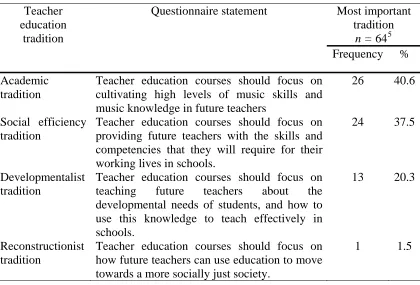
teachers’ perceptions of course effectiveness. Analysis of the questionnaire data revealed
that early-career music teachers in this study would like teacher education courses to
reflect their preference for Zeichner and Liston’s (1990) academic and social efficiency
Table 1
Number of respondents who gave first preference to each of the four teacher education
traditions
Teacher education
tradition
Questionnaire statement Most important
tradition n = 645
Frequency %
Academic tradition
Teacher education courses should focus on cultivating high levels of music skills and music knowledge in future teachers
26 40.6
Social efficiency tradition
Teacher education courses should focus on providing future teachers with the skills and competencies that they will require for their working lives in schools.
24 37.5
Developmentalist tradition
Teacher education courses should focus on teaching future teachers about the developmental needs of students, and how to use this knowledge to teach effectively in schools.
13 20.3
Reconstructionist tradition
Teacher education courses should focus on how future teachers can use education to move towards a more socially just society.
1 1.5
The results clearly indicated that early-career teachers viewed high levels of music skills
and knowledge (academic tradition) and preparation for the realities of their working
lives (social efficiency tradition) as similarly important. It was expected that preferences
for teacher education traditions would determine how teachers viewed the importance of
5
the various aspects of the course, and how well they felt this was accomplished.
However, chi-square analyses revealed that there were no significant relationships
between tradition preferences and perceived relevance of their course; satisfaction with
their course, or perceived importance or performance of any aspects of the course.
Upon further exploration (in the interviews), it was found that interviewees’ perceptions
of the academic and social efficiency traditions were remarkably close - many perceived
the academic tradition to be relevant only in the context of music teaching, and therefore
strongly linked to the social efficiency tradition, where music teaching knowledge and
skills were valued (Ballantyne, 2006c). Their expressed difficulty separating these two
approaches to teacher education seems to confirm the argument that teachers view
themselves as content specialists, and that pre-service teacher learning is ‘situated’ within
discipline areas (Ramsey, 2000; Shulman & Sparks, 1992).
The approach or ‘tradition’ that early-career music teachers predominantly speak of
reflects their desire for the integration and contextualisation of music and education
components throughout the course. It is likely that teachers’ preference for an integrated
approach that is located specifically within the context of music education underlies the
value they place on pedagogical content knowledge and skills and professional
knowledge and skills.6
6
In exploring the impact of the early years of teaching, all teachers interviewed reported
having experienced praxis shock in their first few years of teaching (Ballantyne, 2006a).
Indeed interviewees reported that the areas where they felt most unprepared were
perceived to be related specifically to their experience of teaching music in the secondary
school. When describing these early experiences, interviewees continually repeated that
these problems were a ‘shock’ to them following their pre-service preparation. Analysis
of the interviews identified two factors underlying the experience of praxis shock:
• physical and professional isolation within the school; and
• high workload and multiple responsibilities associated with the extra-curricular
music program.
In short, teachers did not feel that their pre-service education had prepared them
adequately for these aspects of being a secondary classroom music teacher. It is
interesting that most of their reported difficulties fell within the area of professional
knowledge and skills – an area where the pre-service preparation was perceived to be
particularly lacking. The common experience of praxis shock in the early years of music
teachers was most keenly felt in relation to areas that are specific to the music discipline
(Ballantyne, 2006a).
What other influences impact upon early-career music teachers’ perceptions of the
effectiveness of their pre-service preparation?
Words such as ‘love’, ‘passion’ and ‘rewarding’ were repeatedly used by teachers when
Antoinette I absolutely love being a music teacher. It is a very rewarding experience to help students strive to achieve their performance goals. I like the fact that I am able to get to know students on a number of levels.
It is clear from the interviews that early-career music teachers want to make music
meaningful for students and to help them love music.
Claire I love the fact that you can have a kid that has had no experience in music come into your classroom and you can get them playing three chords on a guitar and see their face light up when they make music. … I love that part of being a music teacher, it allows kids to create, and they get such an excited feeling, about you know, this is their work, its … something they’ve done, you know, from nothing and I think that’s one of the best parts about being a music teacher.
Early-career music teachers’ ‘passion’ for music teaching seems to originate in their
‘love’ for the subject area and this ‘passion’ for teaching music seemed to sustain them
through rough periods of praxis shock, and may therefore explain their continuation in
the profession.
Although most interviewees reported that they ‘love’ their job, they perceived themselves
professionally in a variety of ways – as a ‘musician’, a ‘music teacher’, or a ‘teacher’. It
emerged that their perceived ability in the subject area seemed to determine how they
view themselves professionally – the ‘better’ they felt they were at music, the more likely
they were to see themselves as musicians. Conversely, if they reported little confidence
in music skills and knowledge, they were more likely to see themselves as ‘teachers’
(Ballantyne, 2005).
The professional identities of music teachers, which are arguably based on their self
Purves, & Marshall, 2003) may impact on their perceptions of the effectiveness of their
course. Teacher education has the potential to either challenge or maintain pre-service
teachers’ preconceptions of their professional identity, and teacher education should
arguably develop in future teachers a professional identity which enables them to be
effective throughout their career. It seems that professional identities (and their
underlying assumptions) should be examined critically during pre-service teacher
education. Beliefs about musical efficacy, including efficacy doubts (Wheatley, 2002)
should be explored in terms of how these might influence their success as teachers. By
engaging in this style of reflection, pre-service music teachers will arguably develop the
skills to reflect and consolidate their developing identities once in schools and therefore
improve as effective classroom practitioners (Hawkey, 1996).
How do early-career music teachers perceive their needs in relation to pre-service
preparation?
Participants in this study expressed the need for pre-service preparation that overtly
encourages and helps students to apply educational knowledge and skills to the context of
the music classroom (pedagogical content knowledge and skills) and to the professional
responsibilities of a music teacher (professional knowledge and skills). They suggested
that practicum be incorporated from the first year, and combined with guided critical
reflection in order to help students make links between general educational theory and its
In addition, when discussing their early teaching experience, interviewees highlighted the
importance of quality induction programs that were discipline specific. They spoke of
the need for appropriate induction methods incorporating mentoring by experienced
music teachers. This finding supports prior research showing that music teachers value
mentors who are also music teachers (Conway, 2001; DeLorenzo, 1992; Krueger, 1999,
2000; Yourn, 2000).
Three themes emerging from the findings
Three significant themes emerged from this study into early-career music teachers’
perceptions of pre-service teacher education programs – the need for contextualisation,
integration and continuity of pre-service music teacher education programs.
Contextualisation and integration mostly occur within the pre-service program, and will
be discussed first, followed by continuity.
Contextualisation
Findings from the questionnaire and interviews suggest teachers felt that both music and
education theory was presented in isolation from the context of music teaching during
their pre-service course. This seems to be an important criterion by which early-career
music teachers evaluate the ‘effectiveness’ of a pre-service course. As such, it is
recommended that pre-service teacher education courses for music teachers should
prepare future teachers for the specific context within which they will be operating (in
this case as secondary classroom music teachers). This incorporates the skills and
extra-curricular and professional expectations of classroom music teachers in Queensland
(thereby addressing pedagogical content knowledge and skills as well as professional
knowledge and skills). A contextualised course should, according to the participants in
this study, provide pre-service teachers with the means to apply knowledge and skills
learnt in all subjects to their future context as music teachers by presenting both music
and education theory in terms of their application to music teaching. Clear links should
be made between general education ‘theory’ and the music classroom, and regular school
practicums should be combined with guided critical reflection in order to help students
make ‘links’ between general educational ‘theory’ and its application in the music
classroom.
Integration
This study revealed that early-career music teachers perceive integration to be central to
effective music teacher education programs. An integrated course is defined here as one
that helps students make links between theory and practice, between general education
and music education as well as relating the knowledge presented in all their music
discipline and education units to their future professional practice. This need for
integration is reflected in participants’ teacher education tradition preferences - they did
not identify wholly with any of the teacher education traditions but rather favoured a
music teacher education course that integrated elements from each tradition. In practice,
a course that truly integrates areas of social efficiency (or teacher professionalism),
academia (or content knowledge and skills), developmental psychology and social justice
be achieved by assisting students to make explicit links between theory and practice
(within courses), between general education and music education (across courses) as well
as relating the knowledge presented in all their music discipline and education units to
their future professional practice (between schools, the community, and universities).
Integration and contextualisation in practice
Integration and contextualisation can only occur when the structural design of the
pre-service course is reconceptualised, particularly in terms of the practicum and the
sequence of preparation. Practicum needs to be located throughout the course, coupled
with reflective-style discussions that explicitly link current educational theory with the
context into which music teachers will be operating in their early years (the music
classroom). In particular, the areas of pedagogical content knowledge and skills and
professional knowledge and skills should be used to contextualise courses. These areas
may provide a bridge between music knowledge and skills and general education
pedagogical knowledge and skills, and therefore provide the contextualised element so
obviously desired in a pre-service course. In this way, the links between education and
music, university and schools will be made clearer to future music teachers.
Continuity
The theme of continuity is one that predominantly emerged from teachers’ discussion of
their early experiences, where the nature of the praxis shock experienced by early-career
music teachers in Queensland became evident. Although a pre-service course that is both
appropriate continuation of this style of support once teachers enter the schools seems
essential. Continuing support would need to address the unique problems that
early-career music teachers face, and their need for discipline-specific induction and mentoring
programs. While this study did not specifically address the issue of in-service music
teacher education, it is clearly an area for further research. Similarly, some attention to
the working conditions of music teachers in Queensland may be warranted.
This study is generative, in that analysis of early-career music teachers’ perceptions
regarding the effectiveness of their teacher education courses highlights the need for
more in-depth research in the following areas:
• how contextualisation should best be addressed in a pre-service course;
• other stakeholders’ perceptions of the effectiveness of music teacher education
courses;
• the nature and design of a contextualised and integrated in-service music
teacher education program;
• comparisons of how early-career teachers from other secondary discipline
specialisations perceive the effectiveness of their teacher preparation;
• the ways that early-career teachers’ perceptions of their teacher education
course may impact on their praxis shock;
• the link between discipline specialisation and perceptions of general teacher
education course effectiveness; and
• how the development of professional identity throughout the pre-service course
Limitations
This study considered only the needs and perceptions of early-career music teachers
regarding the nature and design of an effective teacher education program. Although
they are arguably the major stakeholders in the pre-service program, these teachers’
opinions should be considered alongside other stakeholders such as university lecturers
and experienced music teachers. While this could be considered a limitation, it is better
thought of as a basis for replication and elaboration in similar or different contexts.
In addition, the reported perceptions are relevant specifically to the experiences of the
early-career music teachers from three universities in Queensland who graduated between
the years 1998 to mid-2002. It is nevertheless expected that the findings of this study
may hold considerable relevance to many other pre-service programs in Australia and
worldwide.
Although the demographics of respondents were very similar to the demographics of the
total sample, it is impossible to know whether the people who responded to the
questionnaire had particular experiences in the pre-service course or early experiences in
schools that systematically influenced the likelihood of their responding to a
Conclusion
The provision of quality teacher education in Australia is a current and concerning issue
(Pascoe et al., 2005) that impacts on the quality of teaching in schools
(Darling-Hammond, 2000b). In the case of music teachers, it is apparent that teachers’ affinity
with their subject area may have much to do with the way they conceptualise an ‘ideal’
teacher education course and may also contribute to the ways that they are able to utilise
the knowledge and skills developed in their teacher education preparation once in
schools. By exploring how early-career music teachers perceive the effectiveness of their
pre-service teacher education, this study provides a basis for the planning and
development of pre-service music teacher education programs based on the needs and
experiences of new graduates. Teacher education programs that address these needs are
likely to have a greater potential to prevent praxis shock and ‘burnout’ among
early-career music teachers.
In particular, this study is significant because it proposes that the effectiveness of teacher
education could improve if courses were integrated, contextualised and provided
continued support beyond graduation. This is relevant to the education of future music
teachers and also arguably to teacher education courses in general (particularly those
training specialists for the secondary school). Consequently the concepts of
contextualisation, integration and continuity provide a platform for the development of
effective teacher education programs that align with the needs of early-career teachers
and may provide designers of teacher education programs with a way forward in the
Acknowledgements
Many thanks to Dr Jan Packer for her valuable advice on this paper. I really appreciate
it!
Appendix 1
Demographic characteristics of questionnaire respondents (Stage 1)
Category %
University attended
QUT 39.5
UQ 40.8
GU 17.1
Other 2.6
Course completed at university
Bachelor of Education (Secondary) 9.2
Bachelor of Arts/Bachelor of Education (Secondary) 13.2
Bachelor of Music/Bachelor of Education (Secondary) 26.3
Graduate Bachelor of Education (Secondary) 14.5
Bachelor of Education (Secondary) Graduate Course 5.3
Graduate Diploma of Education (Secondary) 23.7
Master of Teaching (Secondary) 2.6
Other 5.3
Gender
Female 77.6
Male 22.4
Age
25-29 58.7
30-34 5.3
35-39 4.0
Number of schools taught at
One 39.5
Two 31.6
Three 9.2
Four 3.9
Five 2.6
six or more 13.2
Years teaching classroom music
One 22.4
Two 34.2
Three 21.1
Four 22.4
Current school
Independent non-Christian School 2.8
State School 62.5
Catholic School 9.7
Church/Christian School other than Catholic 23.6
Other 1.4
Metropolitan 74.3
Category %
Current employment situation
Casual 1.4
Contract 16.9
permanent part-time 4.2
permanent full-time 77.5
Attendance at in-service training or further study
No attendance at in-service training or further study since beginning teaching 21.1
Has attended in-service training or further study since beginning teaching 75.0
Only classroom music teacher?
There are other classroom music teachers at school 40.8
Only classroom music teacher at school 55.3
Employment as instrumental teacher
Not employed as an instrumental teacher 67.1
Appendix 2
Characteristics of interview participants
Participant Teacher education tradition favoured Satisfaction with course Degree undertaken University attended (numbers assigned to indicate different universities)
School type Yrs
teach-ing
Carolyn Academic Somewhat
dissatisfied Graduate Diploma of Education 1 Metropolitan State School 4
Fiona Academic Somewhat
satisfied Graduate Bachelor of Education 2 Metropolitan State School 1
Colleen Academic Very
satisfied Bachelor of Music/ Bachelor of Education 1 Metropolitan State School 1
Lotte Developmentalist Very
satisfied
Bachelor of Education
3 Rural State
School
2
Rory Developmentalist Somewhat
dissatisfied Graduate Diploma of Education 2 Metropolitan Church/ Christian school other than Catholic 2
Grant Developmentalist Somewhat
satisfied
Bachelor of Music/ Bachelor of Education
3 Rural State
School
2
Susan Developmentalist Somewhat
satisfied
Bachelor of Music/ Bachelor of Education
1 Rural State
School
2
Ken Social Efficiency Very
satisfied Graduate Bachelor of Education (Secondary) 1 Metropolitan Church/ Christian school other than Catholic 2
Roy Social Efficiency Somewhat
Bachelor of Education (Secondary)
School
Joy Social Efficiency Somewhat
dissatisfied Graduate Bachelor of Education 2 Metropolitan Catholic School 2
Claire Social Efficiency Somewhat
dissatisfied Bachelor of Arts/ Bachelor of Education 2 Metropolitan Church/ Christian school other than Catholic 3
Antoinette Social Efficiency Somewhat dissatisfied
Bachelor of Arts/
Bachelor of Education
3 Rural State
School
3
Jackie Could not decide Somewhat dissatisfied
Graduate Diploma of Education
1 Rural State
School
3
Janis Could not decide Somewhat dissatisfied
Bachelor of Music Education
3 Rural State
School
2
Jessica Could not decide Somewhat satisfied Bachelor of Music/ Bachelor of Education 1 Metropolitan State School 2 References
Ballantyne, J. (2005). Identities of music teachers: Implications for teacher education. In M. Cooper (Ed.),
Teacher Education: Local and Global: Australian Teacher Education Association Conference Proceedings (pp. 39-44). Gold Coast: Australian Teacher Education Association.
Ballantyne, J. (2006a). Crossing barriers between teacher preparation and teaching: Documenting praxis shock in early-career music teachers. Paper presented at the Music In Schools and Teacher Education Commission, Hong Kong.
Ballantyne, J. (2006b). Reconceptualising preservice teacher education courses for music teachers: The importance of pedagogical content knowledge and skills and professional knowledge and skills.
Research Studies in Music Education, 26, 37-50.
Ballantyne, J. (2006c). What music teachers want: The emergence of a unified understanding of an ideal teacher education course. Australian Journal of Teacher Education, 31(1), 2-11.
Ballantyne, J., & Packer, J. (2004). Effectiveness of preservice music teacher education programs: Perceptions of early-career music teachers. Music Education Research, 6(3), 299-312. Burns, R. (2000). Introduction to research methods (4th ed.). Sydney: Pearson Education Australia. Carter, D. S. G., Carre, C. G., & Bennett, S. N. (1993). Student teachers' changing perceptions of their
subject matter competence during an initial teacher training programme. Educational Research, 35(1), 89-95.
Committee for the Review of Teaching and Teacher Education. (2003). Australia's teachers: Australia's future - agenda for action: Australian Government Department of Education, Science and Training.
Conway, C. (2001). What has research told us about the beginning music teacher? Journal of Music Teacher Education, 10(2), 14-22.
Conway, C. (2002). Perceptions of beginning teachers, their mentors, and administrators regarding preservice music teacher preparation. Journal of Research in Music Education, 50(1), 20-36. Darling-Hammond, L. (2000a). How teacher education matters. Journal of Teacher Education, 51(3),
166-173.
Darling-Hammond, L. (2000b). Teacher quality and student achievement: A review of state policy evidence. Education Policy Analysis Archives, 8(1), 1-46.
DeLorenzo, L. C. (1992). The perceived problems of beginning music teachers. Bulletin of the Council for Research in Music Education, 113, 9-25.
Gratch, A. (2000). Teacher voice, teacher education, teaching professionals. The High School Journal, 83(3), 43.
Hargreaves, D., Welch, G., Purves, R., & Marshall, N. (2003). ESRC End of award report: Effective teaching in secondary school music: teacher and pupil identities. Executive summary. Retrieved 18.10.04, 2004, from http://www.roehampton.ac.uk/cirme/TIME/index.asp#Background
Hawkey, K. (1996). Image and the pressure to conform in learning to teach. Teaching and Teacher Education, 12(1), 99-108.
Kelchtermans, G., & Ballet, K. (2002). The micropolitics of teacher induction. A narrative-biographical study on teacher socialisation. Teaching and Teacher Education, 18, 105-120.
Kelly, J. (1999). What stress factors specific to music teaching are critical to 'burnout' in secondary school classroom music teachers in Queensland? Paper presented at the ASME XII National Conference, University of Sydney, N.S.W.
Krueger, P. J. (1999). New music teachers speak out on mentoring. Journal of Music Teacher Education, 8(2), 7-14.
Krueger, P. J. (2000). Beginning music teachers: Will they leave the profession? Update: Applications of research in Music Education, 19(1), 22.
Leong, S. (1996). The relationship between music competencies perceived as important for novice teachers and the professional expectations of high school music teachers in Australia. Unpublished PhD, University of Western Australia, Perth.
Pascoe, R., Leong, S., MacCallum, J., Mackinlay, E., Marsh, K., Smith, B., et al. (2005). National review of school music education: Augmenting the diminished: Australian Government.
Queensland Board of Teacher Registration. (1999). Guidelines on the acceptability of teacher education programs for teacher registration purposes. Brisbane: Queensland Board of Teacher Registraion. Ramsey, G. (2000). Quality matters. New South Wales: Department of Education and Training.
Richards, C., & Killen, R. (1993). Problems of beginning teachers: Perceptions of pre-service music teachers. Research Studies in Music Education, 1(1), 40-51.
Shulman, L. S., & Sparks, D. (1992). Merging content knowledge and pedagogy: An interview with Lee Shulman. Journal of Staff Development, 13(1), 14-16.
Stokking, K., Leenders, F., De Jong, J., & Van Tartwijk, J. (2003). From student to teacher: Reducing practice shock and early dropout in the teaching profession. European Journal of Teacher Education, 25(3), 329-350.
Temmerman, N. (1997). An investigation of undergraduate music education curriculum content in primary teacher education programmes in Australia. International Journal of Music Education, 30, 26-34. Wallen, N., & Fraenkel, J. (2001). Educational research: A guide to the process. In (2nd ed.). Mahwah,
New Jersey: Lawrence Erlbaum Associates.
Wheatley, K. F. (2002). The potential benefits of teacher efficacy doubts for educational reform. Teaching and Teacher Education, 18, 5-22.
Yourn, B. R. (2000). Learning to teach: Perspectives from beginning music teachers. Music Education Research, 2(2), 181-192.