THE INITIAL SOFTWARE DEVELOPMENT PROCESS AT AN INTERNET START-UP COMPANY: A STUDY OF TEAM
COMMUNICATION, PRODUCT DEFINITION, AND THE RESULTING DESIGN DECISIONS
by Ann Duffy
A Master's paper submitted to the faculty of the School of Information and Library Science of the University of North Carolina at Chapel Hill in
partial fulfillment of the requirements for the degree of Master of Science in Information Science
Chapel Hill, North Carolina December, 1999
Approved by:
Ann Duffy. The Initial Software Development Process at an Internet Start-Up Company: A Study of Team Communication, Product Definition and Design Decisions. A Master's Paper for the M.S. in I.S. degree. December, 1999. 61 pages. Advisor: Stephanie Haas
This paper is a study of a software development process at an Internet
start-up company that offers an information product delivered over the World
Wide Web. This product gives specific information about customer usage
patterns and activity on the Internet to Internet Service Providers, e-merchants,
and advertising agencies. An analysis of the product development process,
which includes defining and then building this application, is the central
issue of this discussion. Questions are explored that relate to communication
and workflow within a development team, as well as questions relating to design
decisions specific to a Web-based implementation environment. The paper is
written from the perspective of the web developer.
Headings:
Computer Software - Development
Software Engineering
Organizational Communication
Table of Contents
Abstract… … … 2
Table of Contents… … … ...3
Introduction… … … ..4
Purpose of Study… … … 5
Literature Review… … … 7
Software Development Process… … … ..11
Communications Section… … … ..… … … ...… … … … .11
Product Section… … … ..… … … … 20
Product Implementation Environment… … … .33
Discussion and Conclusion… … … ...44
References… … … ..… … … .45
Appendix A...… … … .… … … .47
Appendix B...… … … ...48
Appendix C… … ...… … … … … … .49
Appendix D… … … ...… … … … … .50
Appendix E… … … . … … … ...… … … .51
Appendix F… … … .… … … ... 58
Appendix G...… … … . … .… … … .59
I. Introduction
This paper is a study of a software development process at an Internet
start-up company in Research Triangle Park, NC, which will be referred to as
Internet Data Views (IDV) for the purposes of this paper. IDV collects Internet
data by installing patented software on Internet Service Providers’ networks at
their point of presence (POP). The data is anonymized, meaning it is stripped of
individual user identifying information and replaced with a session ID so the
anonymous user can be tracked during a session, the period of time between
logging on to and logging off of the Internet. (IDV has a proponent in Christine
Varney, who chairs the Online Privacy Alliance, an industry consortium that acts
as a watchdog for consumers regarding matters of privacy and the Internet.) IDV
shows customer usage patterns in the aggregate for a particular ISP service
area. The company has also begun to introduce its data to the e-merchant and
advertising agency markets by providing these industries with the means to
better understand consumer behavior on the Internet. Consequently, this paper
will be discussed with the awareness that the need for scalability will figure
prominently into all aspects of product development. What has been developed
to date for ISP customers will be used as the precedent for future product sites
The data IDV provides its customers is its product. The implementation
environment for this product is the Internet. As such, IDV is concentrating much
of its product development efforts on translating the raw data from databases into
statistically relevant and visually clear graphical representations in a format for
the Web. This process involves database administrators and developers,
statisticians, web developers, Java programmers, GIS (graphical information
systems) developers, a systems engineer, a project manager, a product
manager, and other technical staff, including system administrators. The
development of this product has gone through three main prototype iterations,
and the development team continues to move toward a final web-based product
for customers. The release date for the beta version of the web-based ISP
product is December 15, 1999.
II.
Purpose of Study
The purpose of this paper is to isolate issues involved in the
product development process at IDV. After being involved in and observing this
process, it has become clear to the writer that an analysis of it is necessary to
understand where improvements can be made to the system. An especially
important area for better understanding the system's performance and
effectiveness is team communication and interpersonal networking. To what
degree is there a symbiotic relationship between team communication and
building aiding the process of translating conceptual definitions into implemented
design choices? Where are the disconnects between dialogue and completed
design? Once the design process is underway and the product has been
defined, how well does the team continue to communicate about alterations to
the original plan? What suggestions for improvement can be offered in
analyzing the development process at IDV?
By analyzing IDV’s software development team and process, the writer will
offer her experiences to others who are responsible for or feel the necessity of
establishing software development standards for newly formed development
projects. With the rise of the e-market and of e-commerce, the economy often
requires that companies operate at an accelerated pace than what they may be
used to or used to seeing in other companies. The threat of competition in this
environment is an ever-present reminder to the small start-up that development
cycles must be rapid. A solid product and presence on the Internet, among other
things, is vital to its success. The questions explored in this paper are questions
that any software company faces in the new Internet-based competitive market.
The environment at IDV affords the writer the opportunity to study a
software development process from the ground up and with rapid prototyping as
the chosen development style. The company is growing quickly, both in the area
of new staff hires and in the area of ISP contractual agreements. The experience
of six months (June – November, 1999), during which time the number of
employees has grown from 12 to 50.
The development process will be studied from two separate but related
viewpoints. The first will focus on the team-based system that produces the
product, both in terms of information flow and workflow. The second will be
concerned with the Web environment in which the product will be implemented
and how best to represent the product in this environment. Having a Web-based
product, IDV must consider issues relating to usability and navigation, among
other things, as the product is prepared for the Internet. As suggested, there are
some persistent themes that remain relevant throughout this paper. One such
issue is concerned with the evolution of informal communication and design
processes into a system of structured and documented development procedures.
Tied to this larger idea is the relationship between communication flow and
design processes. There is an ongoing challenge for the development team to
translate information exchange, whether formal or informal, into specific design
decisions. The first part of this paper is an analysis of the communication
dynamics, the second focuses on product implementation. However, the broader
theme, which relates to the integration of the two, is of primary importance
III.
Literature Review
Literature from a range of subject areas informs the analysis of IDV's
software development process. A discussion about the importance and
complexities of communication and network building within software development
teams opens the paper. In Communicating in Organizations: A Cultural
Approach, Pepper describes communication at the workplace as a cultural event.
Taking a sociological viewpoint, he stresses the need for team members to find
shared meanings, semantics, and terminology in order to reach consensus about
sometimes vague or confusing concepts (1995, p. 19). Albrecht and Bach focus
specifically on development teams and elements that contribute to a strong team
structure. In their book, Communication in Complex Organizations, they focus on
ways of managing and monitoring the work and information flow within teams
(1997, p.3, 123, 156). They also, like Pepper, stress the importance of shared
meanings. They argue that the evolution of a "symbol-referent system", or a
documented body of common terminology relating to common tasks, encourages
cooperative teamwork and greater productivity (p. 156). The environment is the
most productive when the information flow is in sync with the workflow.
A substantial amount of work has been concentrated on defining the ISP
product at IDV. This involves frequent conversations with customers, collection
of their feedback, and analysis of the gathered data. Holtzblatt and Beyer offer
insights into effective ways of handling data collection and analysis. They stress
responses. It is also essential, they argue, to visit the customer's workplace to
better understand the unique values, problems, and standards that affect what
the customer will expect to see in their customized product. The data should be
collected, developed into a customer profile, and then analyzed by a small group
(1998, p. 6).
However, in today’s economy companies do not always operate along
traditional lines. Especially within the e-marketplace, there may be no physical
space to visit. This will often be the case with telecommuting companies and
other organizations whose workforce is dispersed and which lack a central office.
In these situations, the product manager may meet with one or more employees
from the company wherever convenient. Additionally, due to keen competition
and the changing nature of the Internet, this "in person" relationship is often not
possible. Conference calls and email messages become the sole communication
channels for data collection. This reality is further evidence for the need to ask
direct, pointed, probing questions during the data collection process.
After the collected data has been analyzed, a product definition is
generated, which often involves an iterative process, as is the case at IDV. A
product is defined, although continual refinements are made to that definition
during the product development process. The project manager at IDV is
responsible for monitoring product development, ensuring that it is aligned with
the product definition throughout the development cycle. According to Conger
requirements. In The New Software Engineering, she discusses the importance
of developing a scheme for teamwork flow. One specific way of targeting time
and staffing requirements is to develop a task dependency diagram. This
schematic shows relationships between tasks, and those that are independent of
other processes. She situates her discussion on project management within the
context of a rapid prototyping environment (1994, p. 60). West and Norris (1997)
focus on task management but within the particular context of web development.
In Media Engineering: A Guide to Developing Information Products, they offer
specific strategies the web developer can adopt as she translates the information
product into a format for the Web. They also give suggestions for good website
management, including methods for handling volumes of files that must move
from server to server on a regular basis (p. 139).
The rest of the literature cited in this paper centers around the
implementation environment for the product. Usability testing plays a central role
during the development of a Web-based product. Nielsen offers some usability
principles that, he argues, are the most important to attend to while creating a
site. He has conducted numerous usability studies and posts weekly columns on
the Web. Some of his usability suggestions include the use of keywords,
meaningful subheadings, bulleted lists, and single idea paragraphs instead of the
more traditional printed format for text. He argues that many of his respondents
have indicated that they have less patience scanning a web page than if they
find. He also cautions against the use of too many graphics because of
download time, but also because overuse of graphics can make a site seem
cluttered and difficult to sort through (1994, pgs. 1-15).
Rosenfeld and Morville are information architects who also publish
extensively on the Internet. They address issues related to good website
construction and management. They emphasize the need for a site blueprint
during the planning stage (1998, p. 53). They distinguish between global and
local navigational schemes, both essential to a usable website as together they
facilitate both vertical and lateral movement through the site. They stress the
need to test for usability on multiple platforms, since the Web is accessible from
numerous browsers, each of which has numerous versions (1998, p. 53). Shiple
also publishes information architecture literature on the Internet. He suggests
breaking your site design into parts based on pages that perform a function or
transaction, pages that are generated dynamically, and pages merely comprised
of static text. By breaking them into categories, like tasks can be performed all at
once in an efficient manner (1998, Lesson 3 pgs. 1-3).
Burger and Jackson (1997) add to the body of literature on website
usability. In the article, "Usability techniques for large-scale websites", they
suggest the use of simple and natural dialogue to minimize user memory load (p.
571). Among other suggestions, they also stress the need for user feedback,
clearly marked exits, and built in shortcuts and error messages (p. 571). Caro
submenus that decrease the toll on user memory and reduce the need for
valuable screen space, so often an issue during the design of a webpage (1997,
p. 573).
Morris places a special emphasis on <HTML> frames in the article
"Navbars, Frames, Site Maps" (1999, pgs. 1-5). He is mainly opposed to their
use, the reasons for which do not strike the author of this paper as being as
problematic as he contends, especially after having worked with frames
extensively for the past six months.
Finally, Pilgrim's asserts in the article, "Enhancing WWW Navigation, that
scroll bars often add difficulty to the user's navigational experience. He sites the
results of an empirical study that suggests that users perform suboptimally on
tasks that require frequent scrolling (1997, p. 644).
The writer considered the above usability topics while designing the IDV
product site and much commentary on her experiences during the development
process is integrated into this paper. Additionally, the guidance offered in the
literature has provided the starting point for many useful conversations within the
development team. Conversations dealing with navigational elements, browser
compatibility, and the use of frames, among other topics, have often grown out of
reading an article or scanning a site for relevant information. This paper shows
the link between effective communication and a well designed Web product. It
would be impossible to design a useful product based on Nielsen's usability
suggested by Pepper and others. It would also create barriers when planning the
product site based on Morville and Rosenfeld's website planning suggestions if
the web developer was not able to talk with the systems engineer and project
manager about large scale considerations, such as server resources and website
content approval.
Pepper and Albrecht & Bach both stress the need for shared meanings.
At IDV, in particular, the writer has noted the need for a common terminology to
discuss developing concepts. Because IDV's product is undergoing many
changes and refinements, new ideas are often generated. So the need to
establish new labels arises continually. This literatures helps support the
argument that a common terminology is fundamental to precise communication.
Conger and West & Norris focus on management aspects of application
design and development. Whereas Conger is concerned with the larger
processes involved in project management for a software development process,
West and Norris concentrate more specifically on the management of the web
development process. Both are concerned with the implementation of standards
and procedures to streamline design and development. Their viewpoints share
an emphasis on the management of operations. These suggestions are relevant
to a young start-up that is striving to establish documented procedures for
software development.
There are many similarities among the authors cited to support website
can be built into a website. Pilgrim discusses the cons of scroll bars, while Morris
cautions against the use of frames. Other authors deal with the larger issues
involved in the development of a website, which will be the end result of IDV
product development. Rosenfeld and Morville write about information
architecture and the need for thorough planning before website construction
begins. One of their many suggestions is the development of a site blueprint,
which helps the web developer get an overall sense of the planned site . With a
completed blueprint, decisions related to more specific facets of the site will be
easier to make when the time comes. that the processes of communication and
development are integrally related during the development of a Web-based
application. Along with Nielsen, Caro, and Burger and Jackson, Rosenfeld and
Morville emphasize important usability considerations and principles to bear in
mind as the site is being designed. Nielsen, in particular, lays out specific
principles based on numerous usability tests. There are countless issues to bear
in mind during site development. These authors' suggestions help the web
developer identify problems that the end user might have when navigating
through the site. Since IDV's product is Web-based, the contributions of these
authors can serve as guidelines during the development of the end product.
The next section moves into a discussion about information flow and the
communication dynamics that help or hinder the development process. It has
effective communication patterns and habits among the product development
staff.
III.
Software Development Process
A. Communications Section
Communication and interpersonal networking are inherent to the success
of a software development process. Numerous people are working on different
pieces of the same product and communication is necessary to integrate these
pieces. Networking facilitates the creation of shared meanings for developing
concepts. Once shared meanings are established, there is the possibility of a
team-wide workflow, where group members operate in tandem on parallel
development efforts (Pepper, 1995, p. 19). Although this is an ideal situation,
perhaps difficult to achieve, common ways of describing new ideas is
fundamental to successful communications. For example, "interface" at IDV has
come to mean all development efforts concerning the Web-based product. This
may be a bit misleading to a newcomer, who may think of an interface as a shell
that holds something else. However, once an employee understands the intent
of others when using "interface", he/she can use the term appropriately in this
IDV development context.
The “interface group”, as it is loosely called, is the focus of this study of
employees and outside consultants who are working for the company on a
long-term basis. Thus, relationships have been established and interaction occurs
over an extended period of time between the same groupings of people. The
interface group can be thought of as a series of concentric ripples, much like the
pattern a stone makes after hitting the water’s surface. (See Appendix A for an
illustration.) The innermost circle is where the majority of the communication
must take place. This is the figurative location of the primary interface team.
The outer circles show other employees who are not as essential to the network
but who are, nonetheless, important points of communication, especially when
questions arise as to whether the product under development is in accord with
research emerging from other areas of the company. For example, one of the
marketing employee’s main focus is to research what IDV's competition is
offering as products. Networking with her must occur to ensure that the
completed software is a valuable product, a consumer offering that has a unique
appeal. However, very little communication takes place between a
representative from the development team and her. This can keep the
development group somewhat isolated from the newest trends in the competition.
In this scenario, IDV runs the risk of offering a product that lacks an original
offering. IDV does have a safety net of sorts, though, since the level of data
granularity we are offering has not been done before. With IDV it is a matter of
Although it is easy to understand the need for communication, it can be
difficult to establish effective information flow patterns. Communication
disconnects have been a stubborn problem at IDV as this fledgling company
struggles to develop an effective operational process for its rapid growth. For
example, there is a marketing employee whose main focus is to research what
our competition is offering as products. Networking with her must occur to
ensure that the completed software is a unique product, a consumer offering that
has a unique appeal.
The communicative culture at IDV is, in large part, developing informally,
as suggested previously. When the company was 15 employees, the CTO could
meet with the entire technical staff on a weekly basis to monitor progress and
keep everyone working within an organized system. This is no longer the case
as his responsibilities have expanded. There are no “conscious, persuasive
strategies of upper management” to create a company culture, which would
include establishing paths of communication (Pepper, 1995, p. 32). Rather,
channels are being developed and sustained by the “everyday communicative
acts of all employees” (p. 32). Standards at IDV are being set by smaller
groupings. As a result, IDV's is a “self-managed” team for software product
development (Albrecht and Bach, 1997, 123). When an information need arises,
numerous people are sought out until the knowledge source is found. Once
established as the “expert” on the particular question, he/she is contacted again
administrators on staff, each with different server responsibilities. When there
are problems with product prototypes on the Web, any number of servers might
be responsible since database servers as well as web servers interact with the
webpages. Trial and error has taught the web developer who can handle a
particular problem the fastest. In some instances, another web developer has
proven more helpful with server problems than the system administrators,
perhaps because he is more aware of the immediate development issues.
Sometimes the most effective lines of communication are not what would make
sense by looking at an organizational chart.
This next section will take a look at more structured methods to facilitate
knowledge sharing, information flow, and product innovation among the IDV
interface group. The heart of this issue is how best to share essential information
on a team wide basis about the application being developed.
Albrecht and Bach (1997) assert that there are four critical elements of
good team structure. First, roles and responsibilities should be clearly defined.
This first point does not seem to target IDV’s communication disconnects. The
roles in the group are fairly well understood, mainly because each member is
working on tasks that do not spill over into others’ responsibilities. For example,
IDV has a GIS employee working on the map component of the product, and a
programmer working on the charts and graphs that are being created as Java
applets. There are clearly differentiated roles requiring distinct skill sets. Other
one’s tasks, but may also strengthen some of the communication barriers.
Although tasks do not “bleed” from one employee to another, interaction is
obviously critical since these pieces must be integrated in the end (Albrecht &
Bach, 1997, p. 123). In fact, more overlap in task responsibility would be helpful
at times and would encourage more communication flow. This may suggest that
IDV still has some work ahead in terms of hiring new employees. The lack of
task overlap may suggest that more staffing is needed.
The second group feature is the establishment of an information system.
This idea gets at one of the main problems within the IDV interface group, as
discussed above. Since roles are well defined and participants can often work
autonomously, members are quite productive working independently but
sometimes fail to be productive as a group. This developing culture of
independence, although in many ways beneficial, must give way to a degree of
communal cooperation. A pressing issue for IDV employees is the importance of
working in larger team groupings. Original company employees became
accustomed to few staff members and were individually responsible for larger
pieces of the company's business process. Now they need to be flexible enough
to see where another employee may lift some of the burden. How can an
employee's job responsibilities shift to take advantage of new staff "resources?"
The lack of available information as to how development should proceed
for the IDV product necessitates team brainstorming. The somewhat fragmented
handled. In reality, however, if someone has a lingering question about an
aspect of development and wonders if another is grappling with it, oftentimes the
question is not being addressed (Albrecht & Bach, 1997, p. 123).
At a recent ISP trade show, one of the maps used in the demonstration
did not show highly relevant demographic combinations. Thematic maps of
income levels alone give little useful data. However, if the map had shown
income levels and areas where xDSL potential is high (i.e., high bandwidth use)
then the geographical representation would have had more of an impact on
potential customers who are wanting to expand their DSL subscriber base. In
the end, the map had to be reworked during mid-trade show with the GIS staff
under pressure to produce a usable map. This is the kind of situation that creates
last minute crises before a deadline. Healthy and frequent networking is crucial
to give group members an accurate sense of what others are and are not
handling. Team members quickly realize that there is no one source of
information. All are uncertain about product direction to a greater or lesser
degree and frequent contact is critical.
It is essential to build an information system into the development process,
as networking does not always evolve organically. An information system can
effectively “increase the speed of information flow and the accessibility of each
team member “ (Albrecht & Bach, 1997, p. 123). For example, an email list was
created several months ago for interface team members. This has allowed an
at hand, including consultants whose home base may be in another state.
Additionally, there are weekly management meetings among operations and
development personnel. A new strategy is the larger scale meeting every six
weeks at an off-site location. This includes all operations and development
employees. A disconnect still exits between these groups and the sales and
marketing staff. This problem is expanded in the "Discussion and Conclusion"
section at the end of the paper.
The third feature for effective team interaction is another area that
deserves special attention within the product development group: routinized
performance monitoring and constructive feedback on performance. The
importance of this to IDV is not aimed so much at informing management of
employee performance or behavior as it is done for the benefit of the employee.
In other words, team members are feeling unsure whether they are devoting their
time to the most appropriate tasks. They need regular feedback to remain sure
of the direction they are pursuing. The GIS employees have, on numerous
occasions, asked the web developer if the maps they are producing will
represent our data relevantly. This is a topic that the sales and marketing staff
need to advise on. Since there are few standard checkpoints in place between
the sales and marketing group and the development group, the GIS staff often
produce what they understand to be needed, and the sales and marketing staff
as some representations do not show useful patterns (Albrecht & Bach, 1997, p.
123).
A weekly meeting, which includes the right people, could solve in a simple
some of the performance monitoring problems. The key is to get the important
players and then get them to agree on a regular day and time. This way they
begin to expect this interaction each week. Appendix B maps each major team
member to other team members with whom they must interact and shows why
each point of communication is necessary.
The final team structure characteristic deals with value judgments and
objective decision-making. “Effective teams need members who agree to form
judgments and make decisions based on reliable data and evidence so as to
avoid capricious impressions and to minimize errors” (Albrecht & Bach, 1997, p.
123). This strikes the writer as an important point but one that is not as helpful in
targeting the communication problems within the interface group. Perhaps it is
taken for granted that team members are using sounds judgments. It is also an
atmosphere of respect. It is assumed that fellow team members have the
expertise to manage their realm of the project.
This process of socialization reduces team member uncertainty
about the product and development process. At IDV, and probably elsewhere,
there is a need to brainstorm as a group in order to work through some of the
undefined space while defining the product. IDV’s product is unique, although
collected at an ISP’s point of presence, extracted to an Oracle database, then
analyzed and combined in ways that prove statistically significant to prospective
and current customers. Additionally, the way the data is presented can also
influence the customer’s perception of its usefulness. It is a continual challenge
to decide which are the most revealing and meaningful combinations and how
they will be visually represented.
IDV employs statisticians, database administrators, a system engineer,
GIS specialists, system administrators, and web developers who must be aware
of what all others are doing. If has frequently been observed that confidence
levels seem to increase when members feel welcome to express half-formed
ideas with each other and which often culminate in conceptual consensus. It
may mean more work or a setback in progress, but this seems to be more
desirable than uncertainty. This is often the case when observing interactions
between statistician and GIS specialist. During preparations for a recent ISP
trade show at which IDV presented its product, a statistician and a GIS specialist
were in a continual communication loop trying to get a better handle on what the
Vice President of Marketing was requesting. Frequent interaction gave the two
members a clear idea of what could be done for the show because each got a
strong sense of the limits under which the other was working. The statistician
could only supply certain types of data to the GIS specialist because the data
must be tested to guarantee its accuracy. And the GIS specialist had to specify
one situation where communication was relied upon and which demonstrated
how effectively if can be used to rectify a confusing issue.
Another issue that has begun to show a pattern has to do with barriers to
communication, even when staff make overt and ongoing attempts to be
accessible and to interface frequently with other team members. There are three
main problems here, which involve disconnects in the form of linguistic,
conceptual, or semantic misunderstandings. There is frequent dyadic, or
two-person, interaction between one of the Java programmers and others on the
development team. He has a great deal of knowledge to share and is a valuable
resource for others. However, his Russian accent is so thick that there is a dual
challenge for the listener: reaching a conceptual understanding of his
explanations by, first, simply understanding the words he is speaking and,
secondly, processing the technically-specific nature of the ideas he is conveying.
The listener must be prepared for a lengthier instructional interchange, however
his willingness to assist others balances out the difficulty.
At other times, the native language used by both employees may be
English, however, problems still arise due to semantic disconnects. The project
manager and web developer often talk about specific design choices with regard
to the interface. The two may be imagining the same concepts, however an
impasse sometimes occurs because of different terminology use. For example,
the web developer uses the term “select box” for an <HTML> drop-down list, but
until JavaScript components are added. The web developer makes a distinction
between the <HTML> and the JavaScript terms by using “drop-down menu” for
the JavaScript-specific functionality. The issue is complicated within JavaScript
by the use of such terms as “pop-up menus”, “mouseOvers”, “pop-up boxes”,
help boxes”, “floating menus”, “tool palettes", and so on. These differing terms
elicit opposing conceptual understandings in each person.
Mutual clarification of these concepts is critical because the agreed upon
term becomes the goal of a development effort. It would be useful, when time
permits, to add to the development standards document, accessible to all via our
intranet, a section on term use and visual examples of the terms when
applicable. By developing a “symbol-referent system”, it is more likely that
members’ “perceptions, beliefs, and possibly their values are congruent as well”
(Albrecht & Bach, 1997, p. 156).
This discussion has shown how vital communication is to a successful
product development cycle. It has also shown how easily problems arise when
information flow is lacking. People need to exchange information in order to
manage the execution of a task (Albrecht & Bach, 1997, p. 3). The
communication network that forms among the group determines the nature of
information flow, the knowledge levels of individuals, and the amount of
participation and involvement of team members. IDV has made some progress
with communication problems. However, a closer inspection of the issue is
communication exchange? And where do these points occur between sales and
marketing, who are, in turn, the direct links to our customers? The development
team can become somewhat isolated from the latest set of customer input and
requests. (This issue will be discussed further in the section on data collection.)
The main communication channels need to be targeted and group meetings
should be frequent, but individual responsibility comes into play as well. Each
employee is responsible for keeping daily communication patterns intact.
Occasional meetings are not the antidote for poor communication. Rather, the
informal, daily interactions add up to form the network backbone by which
information flows.
B. Product Section
The next part of this paper focuses on the product aspect of the
development process. Communication and information flow, as discussed
previously, must develop in parallel with workflow and product definition and
development. Issues, such as data collection, prototyping, benchmarking, the
balance of innovation with concrete progress, and the maintenance of
momentum toward product completion, are some of the product management
considerations. IDV has not yet developed a body of standards to monitor these
issues. Agreements are formed in process and need to be compiled by the
newly hired project manager. This next discussion will explore ways of codifying
development team. The overarching issue that affects the coordination of tasks
is the degree to which the product as it has been defined matches the product
being developed. Holtzblatt and Beyer (1998) give a high level walk-through of
the design process from data collection through implementation:
1.) Talk to specific customers
2.) Interpret the data as a team
3.) Consolidate across customers
4.) Design a system for this new work
5.) Mock up the interface
6.) Design the implementation (Holtzblatt & Beyer, 1998, p. 6)
A good starting place is to ensure that the team is quite familiar with the
product, at least as it has been defined thus far, and the gap it fills in the market.
In other words, before launching into development, each team member needs to
understand the product’s value. This is a way of laying a meaningful foundation
before employees begin planning their workflow. Perhaps one can view it as a
motivational briefing.
During initial interviews, the product vision is discussed at length, along
with the usual questions to determine if employee and employer would work well
together. Each IDV employee begins work with an understanding of product
direction and potential, giving each prospective employee the opportunity to buy
It is important to clarify that the product development process at IDV has
not yet become a smoothly orchestrated endeavor, with neat, orderly steps
following one after another. In the first place, new employee hires have been
happening concurrently with refinements, some major, to the product definition.
Employees are certainly well versed in current conceptions of the product, but
continual customer feedback requires that product definition and development
follow an iterative process, whereby previous points in the cycle are revisited.
Product definition is as experimental as the prototypes that are generated as a
result. Undoubtedly, there are many other development issues that require
iteration of previous steps, but IDV’s challenge of developing while learning
customer needs creates particular difficulty maintaining deadlines.
This ongoing process of defining and refining the product requires that at
least one employee devote the majority of his/her time to data collection at the
customer end and then to data analysis once back at IDV. To an extent, all of
the sales and marketing staff are involved in interfacing with customers to gain a
clear notion of individual needs. (At times, too, IDV staff must pose possible
scenarios to give customers a broader understanding of how IDV’s data may
improve their effectiveness in the market.) However, a well organized and
documented data collection process must be ongoing. At IDV, the product
manager is the vehicle for this process.
Each ISP customer has unique needs. It is the job of the product
customer action and language” (Holtzblatt & Beyer, 1998, p.12). Again, the issue
of shared semantics is paramount to understanding customers needs. Does the
customer have a different set of terms for concepts with which both are familiar?
Or perhaps the same term may be used in different ways by each. Shared
meanings must be established before development begins.
In order to get past potential impasses, the product manager must
“inquire into the meaning of customer action and words” and then “offer
interpretations, not just open-ended questions” (Holtzblatt & Beyer, 1998, p. 15).
It is also important to understand subtle nuances about the culture of the ISP
partner. How do aspects of their culture constrain how work is done? What are
possible standards and values that constrain ISP workflow (p. 38)? Additionally,
if problems at the ISP can be captured, this could lead to valuable scenario
development that can be fed back to the ISP to clarify how IDV’s data can help
them with their challenges. In essence, it must be assumed that with each ISP
there are particular characteristics that set them apart from others in the ISP
market. These qualities need to be captured in order to tailor the product to their
particular business model.
The product will be customized to reflect a ISP's specific needs. For
example, one ISP may want to know which of their customers tend to download
large files, thus giving the ISP the potential for increasing their xDSL customer
base. This ISP may have newly acquired technologies that allow for an
customers who are likely candidates for this newer type of service. Another,
smaller ISP just entering the market, may be more concerned with acquiring new
customers for any type of service. The second ISP would like to see a map
indicating concentrations of potential customers within their service area. (This is
done in the aggregate, so no individual customers are indicated. These are
thematic maps in which differing color gradations indicate higher or lower
concentration levels.)
Once customer data collection is accomplished, the product manager, or
“informant” returns to IDV and works closely with the project manager to analyze
the data and to make refinements or additions to the product definition. It is
essential to include others as well because there are certain strengths to
interpreting a customer interview as a group. First, all team members learn
about all customers. Second, multiple perspectives emerge on the data. Third,
team members learn each other’s perspectives. The meeting should take place
within 48 hours of the customer interview and the group should be limited to
between 4 and 6 people. If more are involved, create more than one group
(Holtzblatt & Beyer, 1998, p. 31). This way, impressions are still clear to the
product manager and they can be discussed more thoroughly in a small group
where each person’s thoughts can be contributed.
Ideally, there are other roles to be filled in this kind of meeting. The
informant introduces the customer profile. The recorder captures important
intranet. Work modelers draw diagrams or other visual representations of
customer needs, scenarios, and typical tasks. Participants clarify what happened
during the interview, identify important points and generate implications for
design. And the moderator makes the whole meeting work smoothly by keeping
the team from digressing from the most relevant issues (Holtsblatt & Beyer,
1998, p. 32). This type of meeting has not been officially built into the IDV
process, although it may be considered as an addition to the business model.
Currently, the product manager, project manager, systems engineer, and,
sometimes, statisticians conduct these meetings in a less structured manner.
Then the systems engineer and project manager map out the workflow
process and tasks to be completed. There are many aids that can be used to
identify tasks and develop a schematic for workflow and time management. For
example, a project plan developed at the outset of a new undertaking creates the
foundation that allows for system of periodic checks and well-structured flow of
work and information. “A project plan is a map of tasks, times, and their
interrelationships … .a rule of thumb for level of detail is to define activities for
which a weekly review of progress allows the SE and project manager to know
whether the schedule is being met” (Conger, 1994, p. 58).
The general methodology of planning is as follows: List tasks.
Include application development tasks, project specific tasks, interface organization tasks, and review and approval tasks. Identify dependencies between tasks.
Assign completion times to tasks; compute the most likely time for each.
Identify the critical path (Conger, 1994, pp. 58-59).
(Conger’s use of “interface” in this context differs from the use of the same
throughout this paper. With regard to project planning activities, she describes
an interface as “data that is sent or received between applications” (p. 60). At
IDV this would refer to, for an example, the necessary interaction between Oracle
database applications and web application charts that show the data in a
graphical format for customer consumption.)
As elucidated previously, the two team members at IDV who are
responsible for developing and maintaining the project plan are the project
manager, as would be expected, and the systems engineer. The SE’s more
precise title at IDV is Interface (as in web product interface) Manager. The SE is
responsible for a knowledge of all tasks relating to the application being developed.
The project manager must be aware of all organizationally related tasks. The
project manager’s tasks relate more to work flow and schedules within the product
development group.
A task dependency diagram is a useful way of mapping out all tasks and
their relationships. These include sequences of tasks, which are grouped because
they must be performed together to reach a goal, and independent tasks (Conger,
1994, p. 60). Tasks that are dependent upon one another must be defined, with
sequence of dependent tasks that together take the most development time. “If
any of the tasks in the critical path are delayed, the project is also delayed. So, the
critical path tasks are the greatest source of risk for project completion” (p. 60).
Once the required tasks are defined, time estimation should be done for
each task. “Times are assigned to each task based on complexity and amount of
work. Three times should be estimated: an optimistic time, a realistic time, and a
pessimistic time” (Conger, 1994, p. 60). No deadlines should be finalized before
pessimistic time frames are considered.
With task and time requirements determined, the project manager and
systems engineer are ready for staff hiring and/or assignment of tasks to
employees. This involves defining the skill sets and experience levels required to
fill a particular team role. Next the systems engineer and project manager use the
finalized resource and time requirements to create schedules, perhaps in the form
of Gant charts, in which a time line is defined and tasks are assigned to portions of
the time continuum. The Gant chart gives a temporal glimpse of tasks and when
they overlap. At a recent IDV Operations meeting, a Gant chart was presented by
the interface development manager (SE), project manager, chief statistician, chief
database administrator, and the operations director. Together they showed the
staff an integrated look at development efforts for the next year.
Rapid prototyping typifies the nature of the development cycle at IDV,
especially with regard to Web interface samples. “Prototyping is the development of
specification “(Conger, 1994, p. 29). The interface samples are the best way of
visually demonstrating to anyone in the company the design concepts and
functionality under consideration. This is important for two reasons: 1.) Sales and
marketing staff use some of the prototypes when making presentations to potential
customers. It is important for these employees to familiarize themselves with both
the content and navigation of these prototypes beforehand. 2.) The Web developer
needs feedback about prototypes under consideration. IDV will soon have beta
testers in some of our ISP customers, but for now the best usability and other
feedback is coming from in-house responses. These samples are put in a directory
on a web server so they can be viewed by anyone within IDV’s firewall through a
web browser.
Prototyping can be quite useful:
1.) When an application must be developed and the requirements of which
are not well understood.
2.) As a way of demonstrating a proof-of-concept.
Quickly developing numerous versions is useful when the planning and design
phase has generated murky and unsolidified ideas. Prototyping allows designers to
fill in the conceptual gaps by, for example, bringing missing aspects of the product to
light. IDV finds itself in a sort of limbo, at a mid-way point between idea and final
product, although the beta version of the ISP product has recently been developed
by using the well documented product definition produced by the new project
Perhaps this style would be better suited for an established company with a solid
conceptual understanding of its product. However, as suggested previously, high
technology companies are faced with frequent changes from the marketplace and
development cycles must be flexible enough to accommodate time and product
changes. IDV product development and product definition evolve side by side, at
least during this first phase of product design. Prototyping allows the relationship
between definition and development to remain dynamic.
Prototyping, as discussed, is not a highly structured development model.
However, thorough task and workflow monitoring is as important in this environment
as it is in any other. The project manager is responsible for much of this, yet
individual team members must also formulate a “game plan” or strategic sequence
of steps and monitor their own efforts throughout the process. There are many
potential difficulties that may arise during a rapid development process. Monitoring
development efforts on a continual basis improves the chances of maintaining
compliance between the original product design and the developing product.
One issue, which can pose problems on a daily basis is version control. The
web developer has had to develop a file management system whereby files from
different versions are kept in correct locations, even as work is being done on
multiple versions at once. One version may have some features that are carried
over to a subsequent version. This may mean that some files may be almost
identical from version to version. However, differences in JavaScript code, for
work. When the first version of our web product is complete (as opposed to the
paper reports already being sent out), the web developer will spend time evaluating
version control software to become informed about the tools available that can be
used to help safeguard development efforts during rapid prototyping.
One of the earliest practices IDV adopted to safeguard the customer product
from the many “under-development” versions was to create two distinct
environments for each. There is a development environment for both the database
work and for web development. In order to avert file synchronization problems
within web development, a complete, functional, tested system (i.e., the set of files
and directories) should be created in the development environment and transferred
as a whole to the production environment using an FTP-based file transfer utility
(West and Norris, 1998, p. 139). As for the database environment, all the scripts,
SQL commands, and procedures are written and tested in the on the database
development server before they are transferred to the production database. (Each
should have similar data, however the development database sometimes lags
behind the production database where the recent ISP data loads occur. This
sometimes causes some problems as the graphical representations of the data in
the development environment differ from what they end up showing once in
production.) Each time significant changes are made and tested in the development
environment the files and directories are FTPed to the “live” environment.
The implementation environment for the final product is the World
appropriate team member evaluates each part of the product interface before
being uploaded to the external web server (i.e., not behind IDV’s firewall).The
Chief Technical Officer recently sent an email to all IDV employees (37 at the
time; now close to 50) outlining the process to follow when a change is needed to
the website. This plan is being incorporated into the larger business process so
that all content, graphics, and functionality that are included in the product site
will have gone through the proper screening channels before reaching Internet
publication. This gives the web developer a contact person for each content area
of our website.
A statistician must review the way the data is represented to ensure that is
accurate and that it is portraying the data the intended way. For example, if a set
of data is represented as both chart (graph) and table, the data must agree.
Additionally, much of the data is represented in relation to usage by site type.
IDV's site type classification system is still in flux and gets redefined from time to
time. Sometimes, the latest version of the product does not reflect the newest
changes made by the statisticians in this regard. The product manager must
also review the structure. The product manager must also review the structure
and contents to make sure they accurately reflect the ISP definition
documentation as a whole. Finally, it is the web developer’s responsibility to find
any problems with functionality, whether there is a bad link, a problem with one of
the portions of JavaScript code when using Internet Explorer, an old version of
developer will also ask others on the technical team to double check her work
before putting the version into production. Additionally, since the Internet is the
environment for delivery, attention must be paid to the changing nature of this
space. “The Web currently changes so rapidly that a major redesign is needed
at least once per year simply to avoid a completely outdated look and to
accommodate changing user expectations. Additional maintenance is needed
throughout the year to bring fresh content online, reorganize and revise old
pages, and avoid linkrot” (Nielsen, 1997). The writer finds the first part of
Nielsen’s statement to be, perhaps, a bit exaggerated, however, in essence, the
point is well taken regarding the need for continual maintenance of and updates
to the site.
Monitoring the development process has much to do with communication.
Without going too deeply into this topic again, it is important, nonetheless, to point
out a few of the essential information channels that keep team members in sync
during the development process. As long as there is at least one link between
database developer and web developer, between web developer and GIS
developer, and between project manager and all of the above mentioned, then
information can get disseminated to the rest of the team. The database developer
enables access to the data by providing SQL for special views that pull the
appropriate data from numerous and often lengthy tables. These views simplify the
process of extracting data from database into charting software. The web developer
creates the interface that will house this data. The GIS developer creates the maps
that will also be included in the interface. And the product manager must make
certain that each person who represents a different segment of development has the
same understandings about daily changes and frequent decisions that may alter the
direction of development. All team members must be working from the same
documentation and must be receiving the same messages from day to day.
To formalize the process a bit further, IDV now holds operations
meetings every six weeks at an off-site location. All employees (except sales and
marketing staff) attend. A representative from each section of development or
operations summarizes progress and makes projections for the next six weeks. This
daylong “retreat” brings everyone involved back to a place of common
understanding. It also provides an opportunity to hash out different opinions and
resolve other difficulties.
V.
Product Implementation Environment
The implementation environment for the product is the Internet. As such,
some of the design process is in the area of web development. The final section of
this paper will focus on the process of creating a web interface that satisfies the
product definition specification and that accommodates the development efforts that
have already occurred. Although there are inevitable changes to be made to IDV's
product definition, as suggested previously, the main categories have been
elaborated. Enough detail has been generated to allow for development of the first
with team members can decrease. Once working in the implementation
environment, the web developer becomes more intimately involved with specific
product definition issues. Questions that arise from this more involved relationship
will need to be clarified by other team members. Additionally, unexpected problems
will occur that will require some research into other fingers of the development
process. For example, the web developer was recently involved in making some of
the data views, or charts and graphs, and was held up by some issues at the
database end. After working with an Oracle developer to determine how to draw
the data from the appropriate database and server, the web developer was able to
access the correct database tables to produce the charts and graphs. This type of
interaction is a typical, daily occurrence as development progresses. The
relationship between communicating product definition and designing the product
remains at the heart of the development effort.
The first step in designing the interface is to decide on and implement the
global navigation system for the product site. “A global or site-wide navigation
system often complements the information hierarchy by enabling greater vertical
and lateral movement throughout the entire site. At the heart of most global
navigation systems are some standard rules that dictate the implementation of
the system at each level of the site” (Rosenfeld & Morville, 1998, p. 53). With
this framework in place, it will be easier to go back and make changes to more
localized sections as the product becomes better defined and as the it is
creation of the navigation system has involved interactions between web
developer and project manager. The project manager has a vision for IDV’s
“weblication”, based on the product definition documentation, and has provided
guidance about the specific look and feel of the product as it is being designed.
As suggested by Rosenfeld and Morville, the web developer has
“employed a graphic bar for global navigation and a textual menu for local
navigation ” to balance form with function and to limit page download time
(Rosenfeld & Morville, 1998, p. 59). (See Appendices B and C for two interface
samples showing this type of global and local navigation.) Additionally, text
descriptions of images in the <alt> portion of each image tag have been included
to accommodate users with text-only browsers. A further site-wide consideration
is to ensure that the pages are viewable with screen settings and monitors of
differing sizes. “Because user’s platforms may vary greatly, the site should be
specifically tested for usability on the minimum platform environment
specified… .test scenarios should also represent the wider context of use, for
example home or work tasks” (Burger and Jackson, 1997, p. 572). The web
developer has frequent conversations with the project manager, the systems
engineer, and a graphic designer contractor about cross platform compatibility
and screen resolution and size. It is easy to forget one or more of these
considerations along the way, and it is important for the web developer to get
feedback about how the interface appears on various computers screens
range of performance in comparison to the rest of corporate America, these
varying environments for viewing the interface allow for valuable input. ISP customers will, more than likely, be seasoned computer experts using relatively
powerful machines. However, that is not an assumption that can be made, and
as IDV expands its services to include other customers, the web developer may
not have the luxury of designing for high-end systems.
Once much of the planning has been done and major categories of the
site have been determined, it is useful to create a visual layout of the site in the
form of a blueprint that summarizes the structure and general flow of the site. It
is suggested by John Shiple in his “Crash Course in Information Architecture"
that the developer
“make up a legend that defines how… links, page components, pages, and
groups of pages are represented in the blueprints. You might want to distinguish
among parts of the site that perform a function or transaction, parts of the site
that are generated dynamically, and pages merely comprised of text" (Shiple,
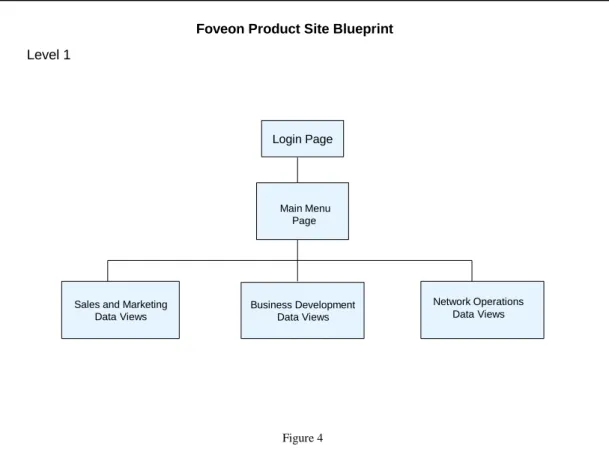
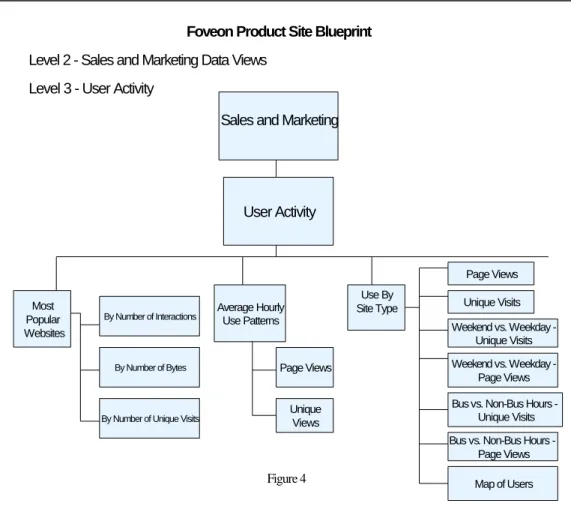
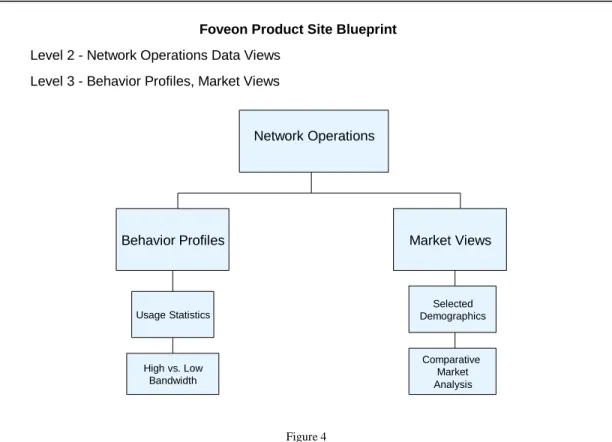
1999). (Appendix E is a blueprint of the IDV product site.) Distinguishing among
the pages allows the web developer to group like tasks more easily. For
example, those pages requiring CGI scripts can be grouped at a glance by
looking at the blueprint and then developed at once, if all the data to carry this
out has been collected. Tasks are completed more quickly and efficiently if they
The next step in the development process is the topic of human-computer
interaction. Inherent in this discussion is the topic of usability and navigation.
Most sites are at least partially interactive, giving the user choices to make and
tasks to perform. The IDV product site is no exception. Once the online version
of the ISP product is released, customers will navigate through menus and
drop-down lists to get at the desired data and to view it in a customized fashion (e.g.,
according to selected preferences). There is much discussion at IDV about the
product interface’s usability. There are factions that prefer that local navigation
always be along the left side of the screen. Others favor drop-down menus
below the global navigation categories that are across the top of the page. Still
others prefer that local navigation be placed on the right side of the page.
Additionally, prefers an expandable tree structure for local navigation, while the
project manager disagrees with this approach as the left menu takes up the main
content areas’ screen real estate. Based on the preferences gleaned from these
in-house conversations, usability principles and discussions in recent literature
are serving as guidelines while developing numerous examples of the product
site. According to Nielsen and Molich, the most significant usability principles are
the following:
a. Use simple and natural dialogue
b. Speak the user’s language
c. Minimize memory load
d. Maintain consistency
f. Use clearly marked exits
g. Build in shortcuts and error messages
h. Prevent errors
(Burger and Jackson, 1997, p. 571)
The following section, which addresses some of the above categories,
outlines design decisions being incorporated into the IDV product site. The use of
“simple and natural dialogue” is a difficult usability consideration when applied to
the ISP product site. Currently, the company is targeting the ISP as customer
(not the same as ISP customer). So the language is going to be fairly technical
in nature, and the labeling system will become increasingly complex as more
customized and specific reports are requested ISPs. Although the choice of
wording may not be simple, it is appropriate to the audience. The following data
view title, “User Activity – Usage by Site Type – Unique Visits – Weekend versus
Weekday Hours” (hierarchically broken down in a menu), is a lengthy one but
relevant to the targeted customer. Recently, however, it was decided that the
following simplified title would suffice to describe the same data: “Usage by Site
Type, Weekend versus Weekday Hours.” Additionally, there is a IDV database
of terms that will be accessible to customers while viewing their data. (See
Appendix F for an example of definition pop-up boxes.) This also addresses
Nielsen and Molich’s second usability principal, “speaks the user’s language.”
A collapsible and expandable menu is one design choice aimed at
Another menuing scheme that has been designed for the same purpose is the
drop-down menu. (See Appendices C and G for examples.) Each local area of
the product site has submenus, sometimes multiple levels. These designs have
been adopted because they hide secondary level data until needed. When the
page first loads the user can quickly scan the higher level choices and then
expand or "pull-down" the menu for more specific information.
The menuing system will grow in complexity as the product matures. This
does not mean, however, that the menus should become more difficult to use.
Rapid prototyping is especially well suited to IDV's development as it allows the
design of numerous menuing systems as new pieces of information are
communicated and better arrangements for navigation are discussed. As labels
change and expand in number, the navigation scheme must be revisited to
determine the most usable system with the strongest visual appeal. This issue is
of central importance because the rest of the site is built off of and based on the
menuing scheme.
Jacob Nielsen argues that ”people rarely read Web pages word by word;
instead, they scan the page, picking out individual words and sentences”
(Nielsen, 1997). He and his colleagues found that measured usability was
considerably higher for concise and “scannable” versions of websites (Nielsen,
1997). (http://www.useit.com/alertbox/9710a.htm for more on their usability studies)
Based on these findings, Nielsen concluded that web pages have to