ACOMPARATIVE STUDY BETWEEN EFFECTIVENESS OF
SWISS BALL TRAINING AND CONVENTIONAL BALANCE
TRAINING VERSUS
CONVENTIONAL BALANCE TRAINING TO IMPROVE
BALANCE IN SUBACUTE STROKE PATIENTS
A Dissertation Submitted In Partial Fulfillment
of the Requirements for the Degree of
MASTER OF PHYSIOTHERAPY
With Specialization In
A
AD
DV
V
AN
A
NC
CE
ED
D
P
PH
HY
YS
SI
IO
OT
TH
HE
ER
R
AP
A
PY
Y
I
IN
N
N
NE
E
UR
U
RO
OL
LO
OG
GY
Y
Register Number: 27091411
Submitted to
THE TAMILNADU DR. M.G.R MEDICAL UNIVERSITY
Chennai
JKK MUNIRAJAH MEDICAL RESEARCH FOUNDATION
COLLEGE OF PHYSIOTHERAPY
Department Of Post Graduate Studies
Komarapalayam -
638 183
ACOMPARATIVE STUDY BETWEEN EFFECTIVENESS OF
SWISS BALL TRAINING AND CONVENTIONAL BALANCE
TRAINING VERSUS
CONVENTIONAL BALANCE TRAINING TO IMPROVE
BALANCE IN SUBACUTE STROKE PATIENTS
Internal Examiner:
External examiner:
A Dissertation Submitted In Partial Fulfillment
of the Requirements for the Degree of
MASTER OF PHYSIOTHERAPY
To
THE TAMILNADU DR.M.G.R MEDICAL UNIVERSITY
Chennai
CERTIFICATE
This is to certify that the research work entitled
A Comparative Study
between Effectiveness Of Swiss Ball Training And Conventional Balance
Training Versus Conventional Balance Training To Improve Balance In
Subacute Stroke
was carried out at JKK MUNIRAJAH MEDICAL
RESEARCH FOUNDATION COLLEGE OF PHYSIOTHERAPY,
KOMARAPALAYAM, affiliated to The Tamilnadu Dr. M.G.R Medical
University, Chennai-
32
towards partial fulfillment for the award of Degree of
“Master of Physiotherapy” course with “Advanced Physiotherapy in
Neurology” as specialization. This work was done under the supervision and
guidance of Assistant Professor Mr. R. John Vinoth Raj, M.P.T., (Neuro),
MIAP.
Mr. A.Ayyappan M.P.T., (NEURO), M.I.A.P,
PRINCIPAL,
JKKMMRF COLLEGE OF PHYSIOTHERAPY,
C
C
E
E
R
R
T
T
I
I
F
F
I
I
C
C
A
A
T
T
E
E
This is to certify that the research work
A COMPARATIVE STUDY BETWEEN EFFECTIVENESS OF
SWISS BALL TRAINING AND CONVENTIONAL BALANCE
TRAINING VERSUS CONVENTIONAL BALANCE TRAINING
TO IMPROVE BALANCE IN SUBACUTE STROKE
was carried out at JKK MUNIRAJAH MEDICAL RESEARCH FOUNDATION
COLLEGE OF PHYSIOTHERAPY, KOMARAPALAYAM, affiliated to The
Tamilnadu Dr. M.G.R Medical University, Chennai-32, towards partial
fulfillment for the award of Degree of “Master of Physiotherapy” course with
“Advanced Physiotherapy in Neurology” as specialization. This work was
done under my supervision and guidance.
Mr. D. KANNAN, M.P.T., (NEURO), M.I.A.P,
Acknowledgement
I prioritize my thanks to the Almighty for his external grace.
I wish to express my heartfelt appreciation to my father
Mr.R.Samathanam my mother Mrs. Rathi and my brother and sister
for their valuable support throughout my study.
I wish to express my heartfelt appreciation to my husband Mr.V.
Anand
and my child Mr.Amurith Anand valuable support throughout
my study.
I express my heartful thanks to my brother
DR. S.K.RAJKUMAR M.P.T , M.I.A.P, Ph.D
for their support
throughout my course of study
I express my heartfelt thanks to t h e management
DR.JKK. MUNIRAJAHH, M.Tech (Bolton) the managing trustee of
JKKMMRF college of physiotherapy for his support in completion of
my study .
I express my sincere thanks to Mr. kalaivani B.P.T,
M.I.A.P,for their support throughout my course of study
I express my thanks to my principal of JKKMMRF college of
physiotheraphy MR.D.KANNAN, M.P.T, M.I.A.P & professor
MR.JOHN VINOTH M.P.T for supporting my project.
LIST OF CONTENTS
INTRODUCTION
AIM
OBJECTIVES
HYPOTHESIS
REVIEW OF LITERATURE
Review of literature
MATERIALS AND METHODOLOGY
MATERIALS
STUDY
DESIGN
STUDY
SAMPLING
STUDY
SETTING
INCLUSION
CRITERIA
EXCLUSION
CRITERIA
PARAMETERS
PROCEDURES
DATA PRESENTATION
DATA ANALYSIS AND INTERPRETATION
Results & discussion
DISCUSSION
Limitations of the study
Scope of future study
conclusion
SUMMARY AND CONCLUSION
RECOMMENDATIO
BIBLIOGRAPHY
REFERENCES
APPENDIX
INFORMED CONSENT
ASSESSMENT CHART
BERG BALANCE SCALE
LIST OF TABLES
TABLE – 1 :
DATA PRESENTATION ( BERG BALANCE SCALE)
TABLE -2 :
Pre Vs Post test values of Amount of Participation Scale for
Group A
TABLES- 3:
Pre Vs Post test values of Amount of Participation Scale for
Group B
TABLES-4:
LIST OF GRAPHS
GRAPH -1:
Amount of Participation Scale for Group A
GRAPH-2
:
Amount
of
Participation Scale for Group B
GRAPH-3
:
LIST OF FIGURES
FIGURE-1
:
FIGURE-2:
CHAPTER-1
1
INTRODUCTION
Hemiplegia is one of the commonest neurological disorder seen these
days generally the hemiplegia patients affect the limb movements and the
body balance besides other disabilities.
When the upright posture sitting requires the proper functioning of a
number of central balancing mechanism. The afferent impulses of wide
spread origin including signals from periphery play an important role in
eliciting and guiding responses. While the efferent impulses carry the
message to muscles for the execution of the balancing act.
Damage to any one of the central balancing mechanisms might result
in deficiency of balance.
The damage to sensory or motor pathways and the imbalance of the
trunk musculature may lead to deficient balance in hemiplegic patients.
Conventional balance training for stroke patients given in sitting and
standing postures.
The Swiss ball has been used in physiotherapy for neuromuscular /
neuro developmental treatment for the last 40 years. ( Oettery and Larsen
1996).
The Swiss ball is one of the devices for proprioceptive feedback. It is
an easily perdurable element suitable for rocking the posture of the patients
2
AIM OF THE STUDY:
To compare the study between effectiveness of swiss ball training and
conventional balance training versus conventional balance training to
improve balance in subacute stroke patients.
O BJECTIVE
¾ To determine the effect of swiss ball training& conventional balance
training in improving the balance in subacute stroke patients with berg
balance scale.
¾ To determine the effect of conventional training in improving the
balance in subacute stroke patients with berg balance scale
¾ To determine the effectiveness of swissball training &conventional
balance training versus conventional balance training to improve
3
HYPOTHESIS
NULL HYPOTHESIS:
The null hypothesis states that there were no significant difference
between Swiss ball training and conventional balance training versus
conventional balance training to improve balance in sub acute stroke
patients.
ALTERNATE HYPOTHESIS:
The alternate hypothesis states that there was significant difference in
Swiss ball training and conventional balance training versus conventional
balance training to improve balance in sub acute stroke patients
4
REVIEW OF LITERATURE
1
. Stanton R et. al., - 2004:
Conducted on experimental study on 18 young male athletes. The aim
of the study was to determine the effect of short term Swiss ball on core
stability.18 clients were divided into control and experimental groups. The
Swiss ball training 2 sessions per week for 6 weeks was given. The outcome
was measured by core stability, electromyographic activity of abdominal and
back muscles and running posture
The result of the study showed that positive effects in core stability,
electromyographic activity of abdominal and back muscles and running
posture. The study concluded that Swiss ball training had improved affect on
core stability
2. Tung FL et. al., – 2010:
Conducted on experimental study on 32 patients with stroke. They
were divided into 2 groups train was given to 3 times a week for four weeks.
The aim of the study was to determine the effectiveness of sit to stand
training in individual with stroke. The main outcome was measured by berg
balance scale and extensor muscle strength of lower extremity
Result of the study showed that significant improvement in directional
control and affected hip extensor strength. The study concluded that
additional sit to stand training is encouraged on dynamics balance in
5
3. Lubetzky - Vilnai A et. al.,
Conducted a systemic review search published between January 2006
and February 2010. Aim of the study to evaluate the evidence related to the
effect of balance training on balance performance among individuals post
stroke. 22 published studies met the inclusive criteria. Moderate evidence for
one to one balance training or group therapy for acute, sub acute or chronic
stroke for 2-3 times/ week
The study concluded that use of balance exercise to improve balance
performance for moderately severe stroke
4. Lehman GJ et. al., -2005:
The aim of the study was to determine whether the addition of a swiss
ball to trunk bridbinb exercises influences trunk muscle activity. The
outcome was measured by myoelectric activity of trunk muscles Briding
exercises were performed on the floor as well as on a labile surface {Swiss
ball}. The result of the study showed that during the prone bridge the
addition of an exercise ball resulted in increased myoelectric activity in the
rectus abdominis and external oblique.
The study concluded that addition of a Swiss ball is capable of
influencing trunk muscle activity in the rectus abdominis and external
6
5. Marshall PW et. al.,-2005:
Conducted an experimental study on 8 healthy volunteers from a
university population. The aim of the study was to assess lumbo pelvic
muscle activity during different core stability during different core stability
exercise on and off a Swiss ball. Intervention: press-up, upper body roll- out,
single- leg hold and quadruped exercise were given to the patient. The main
outcome was measured by visual analog scale, surface electromyography.
The result of the study showed that increase in the activation of the rectus
abdominis with Swiss ball.
The study concluded that study showed that swiss ball provides a
training stimulus for the rectus abdominis.
6. Behm DG et. al., – 2005:
Conducted an experimental study on 11 patients between 20 and 45
years of age participated. The aim of the study was to evaluate the effect of
unstable and unilateral resistance exercises on trunk muscle activation. The
main outcomes were measured by electromyographic activity of the upper
lumbar, lumbosacral erector spinae and lower-abdominal muscles. The result
of the study shows increased activation of above muscles
The study concluded that most effective means for trunk
strengthening should involve back (or) abdominal exercises with unstable
7
7. Combs SA et. al., – 2010:
Conducted an experimental study on 12 patients with chronic stroke.
The program included whole body goal focused activities, gait training and
strengthening exercises for 4h, 5 days per week for 2 week. The aim of the
study to determine that of the intensive, task- specific intervention was a
feasible program for these participants with stroke. The main outcomes
measured by wolf motor function test, berg balance scale, timed up and go
test and 6-min walk test and stroke impact scale and Canadian occupational
performance measure. The result of the study shows that the effect of the
intervention on participation based outcomes was much greater than on the
activity based outcomes
The study concluded that improvements in participation with personal
goal- related activities
8. Marigold DS et. al., - 2005:
Conducted on experimental study on 61 community dwelling older
adults with chronic stroke. Intervention – participants were randomly
assigned to an agility (n=30) or (n=31) exercise groups. Both groups
exercised 3 times a week for 10 weeks. The aim of the study was to
determine the effect of the two different community based group exercise
programs on functional balance, mobility, postural reflexes and falls in older
adults with chronic stroke. The main outcomes was measured by berg
balance , timed up and go, step reaction time, activities- specific balance
confidence and nothingham health profile. The result of the study shows that
8
group demonstrated greater improvements in step reaction time and paretic
rectus femoris postural reflex onset latency than the stretching / weight
shifting group
The study concluded show that improve postural reflexes, functional
balance and mobility may lead to a reduction of falls in older adults with
stroke
9. Vearrier LA et. al., - 2005
Conducted on experimental study on 10 patients with chronic stroke
disability 6 hours / day for consecutive weeks. The aim of the study was to
determine the test if the intensive massed practice intervention could
significantly improve balance function post – stroke. The outcome was
measured by the clinical tests and time to stabilization (TTS) of the center of
pressure in response to a platform perturbation. The result of the study states
that improvements in anticipatory and steady- state balance control.
The study concluded show that intensive massed practice of standard
physical therapy produced significant results in balance retraining with
patients post stroke.
10. Bayouk JF et. al., - 2006
Conducted on experimental study on 61 hemiparetic subjects at least 6
months post stroke. The aim of the study was to compare the effects of a
task oriented exercise program with and without altered sensory input on
9
center of pressure (cop), double – legged stance and sit- to-stand under (4
sensory conditions: 1.eyes open, normal surface 2. Eyes open soft surface
3.eyes closed, normal surface 4.eyes closed soft surfaces) 10- min walking
test. The result of the study was showed that more effective at improving the
standing balance of stroke subjects than a conventional task oriented
program.
The study concluded that shows more effective at improving the
standing balance of stroke subjects than a conventional task oriented
program.
11. Salbach NM et. al., – 2006
Conducted on experimental study on a 91 patients with a first stroke.
The aim of the study was to determine the relative importance of balance
self efficacy compared with functional walking capacity in predicting
physical and perceived health status. The main outcome was measured by
the activities specific balance confidence (ABC) scale, short- form health
survey physical function scale and EQ- 5D visual analog scale.
The result of the study showed that enhancing balance self efficacy in
10
MATERIALS AND METHODOLOGY
MATERIALS:
• Swiss ball
• Mat
• Couch
• Pillows
• Chair
• Assessment chart
• Hammer
• Marking tools
• Berg balance scale
• Ruler
• Two standard chairs (1 with arm rests, 1 without)
• Footstool or step
• Stopwatch
• 15 ft walkway
METHODOLOGY:
Study Design
11
Study Setting
The study was conducted at out patient department in J.K.K.
Munirajahh Medical Research Foundation College of Physiotherapy,
Komarapalayam and District Head Quarters Hospital, Erode under the
supervision of the concerned authorities
Study Sampling
A total number of 30 subjects with sub acute stroke patients were
selected by convenient sampling method after the consideration of inclusion
and exclusion criteria and they were divided into group A and group B with
15 subjects in each group.
Study Duration
Duration of study: 1 month.
Group A: 45 min (Conventional training) for 5 days per week for a
period of 1 month.
Group B: 45 min (30 min conventional experimental) 15 min Swiss
ball for 5 days per week for a period of 1 month.
Inclusion Criteria
12
• Both male and female patients
• Embolism
• Age between 45 to 60 years
Exclusion Criteria
• The patients having seizures
• Patients having any secondary complications
• Cognitive defects
• Dysarthria
• Aphasia
• Degenerating and demyelinating conditions
Parameters
• Berg balance scale
Procedure
The sample size of 30 subjects was selected who satisfied inclusion
criteria.
They were divided into two groups, one as group A, and other as
group B for each 15 subjects. A pre test score was evaluated by using berg
balance scale.The group A of the hemiplegic patients was treated by
13
The group B of the hemiplegia patients was treated by 30 min
conventional therapy & 15 min Swiss ball training for 5 days per week for a
period of 1 month.
Before the data collection procedure the purpose and benefits of the
swiss ball training and conventional balance training were explained to
patients and caregivers.
The hemiplegic patients were assessed through proform and the pre
test scores were recorded before the balance exercises were introduced. The
post test scores were observed from both group A and group B by using
14
PARIED ’t’ TEST:
The paired t- test was used to compare the pre and post test values of
swissball training combine with conventional balance training versus
conventional balance training for group A and group B
15
UN PAIRED “t” – TEST
The unpaired t-test was used to compare the mean difference between
Group A and Group B subjects treated with swissball training combine with
conventional balance training versus conventional balance training.
16
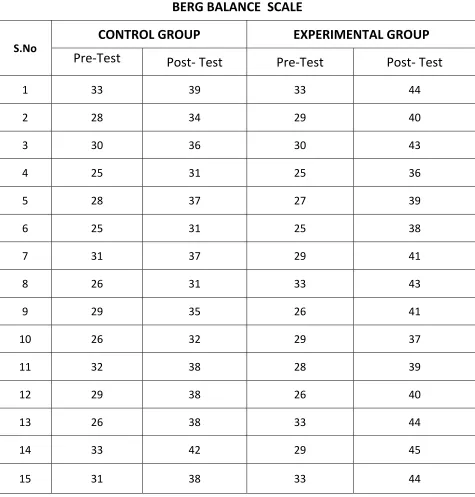
DATA PRESENTATION
TABLE 1
BERG BALANCE SCALE
S.No
CONTROL GROUP EXPERIMENTAL GROUP
Pre‐Test Post‐ Test Pre‐Test Post‐ Test
1 33 39 33 44
2 28 34 29 40
3 30 36 30 43
4 25 31 25 36
5 28 37 27 39
6 25 31 25 38
7 31 37 29 41
8 26 31 33 43
9 29 35 26 41
10 26 32 29 37
11 32 38 28 39
12 29 38 26 40
13 26 38 33 44
14 33 42 29 45
[image:28.612.104.579.159.656.2]17
DATA ANALYSIS AND INTERPRETATION
GROUP –A
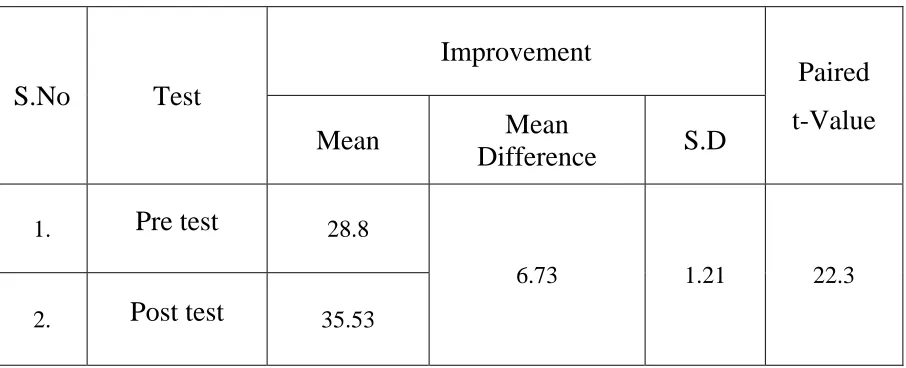
The comparative mean value, mean difference, standard deviation and
paired “t” values between pre Vs post test of Swiss ball balance training and
[image:29.612.99.552.269.453.2]conventional balance training in group A.
TABLE-II
S.No Test
Improvement
Paired
t-Value Mean Mean
Difference S.D
1. Pre test 28.8
6.73 1.21 22.3
2. Post test 35.53
It shows the analysis of Patient Rated subacute stroke,the paired ‘t’ value
of pre Vs post sessions of group A was 22.3 at 0.05level of significance, which
was greater than the tabulated value of 2.14.This showed that there was a
statistical significant difference in between preVs post test results. The pre test
mean was 28.8, the post test mean was 35.53and mean difference was 6.73,
which showed that there was a increase in Patient Rated subacute stroke in post
18
GRAPH-1 PATIENT RATED SUBACUTE STROKE EVALUATION
OF GROUP-A
28.8 35.53
0 10 20 30 40 50
BB
S
19
GROUP –B
The comparative mean value, mean difference, standard deviation and
paired “t” values between pre Vs post test of conventional balance exercises
in group B.
TABLE- III
S.No Test
Improvement
Paired
t-Value Mean Mean
Difference S.D
1. Pre test 29
12.06 4.07 11.31
2. Post test 41.06
It shows the analysis of Patient Rated subacute stroke,the paired ‘t’ value
of pre Vs post sessions of group A was 11.31 at 0.05level of significance,
which was greater than the tabulated value of 2.14. This showed that there was
a statistical significant difference in between preVs post test results. The pre
test mean was 29, the post test mean was 41.06and mean difference was 12.06,
which showed that there was a increase in Patient Rated subacute stroke in post
20
GRAPH-2 PATIENT RATED SUBACUTE STROKE
EVALUATION OF GROUP-B
29 41.06
0 10 20 30 40 50
BB
S
21
TABLE – IV
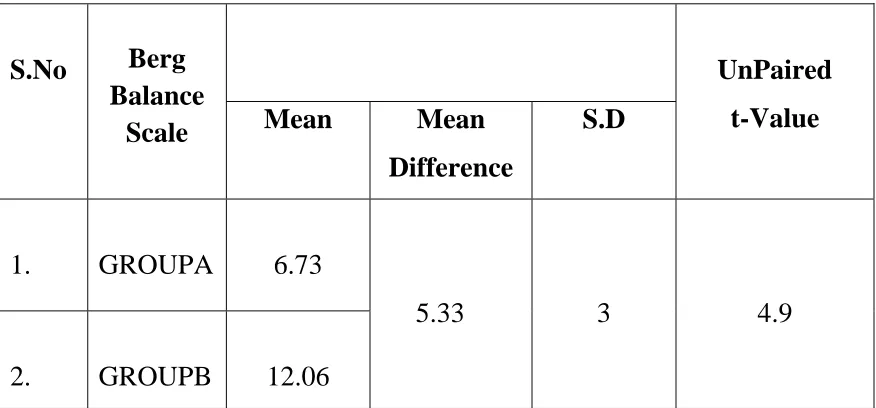
Table IV represents the comparative mean values, mean difference,
standard deviation, and unpaired‘t’ value between group A and group B on
[image:33.612.103.541.197.401.2]Patient Rated subacute stroke
Table IV shows the analysis of group A and group B with Patient Rated
sub acute stroke. The unpaired‘t’ value of 4.9 was greater than the tabulated ‘t’
value of 2.05, which showed that there was statistically significant difference at
0.05 level between group A and group B. The mean value of group A was and
the mean value of group B was 8, which showed that there was a greater
improvement in groupB than group A.
Therefore, the study is rejecting the null hypothesis and accepting the alternate hypothesis.
S.No Berg Balance
Scale
UnPaired
t-Value Mean Mean
Difference
S.D
1. GROUPA 6.73
5.33 3 4.9
22
GRAPH -3 MEAN DIFFERENCE BETWEEN GROUP A & GROUP B
6.73 12.06
0 10 20 30 40 50
BBS
23
DISCUSSION
The purpose of the study was to find the effect of Swiss ball combine
conventional balance training significantly improvement of balance in sub
acute hemiplegic patients using berg balance scale.
Balance is diminished in people with hemiplegia and hemiparesis.
Postural sway for patients with hemiplegia can be twice that of their age
matched peers. Symmetry of weight bearing is also impaired following
stroke, with patients bearing as much as 61/to 81/ of their body weight
through nonparetic lower extremity. Hemiplegia also can cause a reduction
in patient’s limits of stability. A major focus of rehabilitation program
therefore is to improve ‘static’ dynamic balance in sitting and standing
positions.
Ruth Ann Geiger, Jeffery B Allel (2001) conducted a study on 13
out patients with hemiplegia following stroke to investigate whether the
addition of visual biofeedback training could enhance the effects of other
physical therapy interventions on balance and mobility. Subjects were
assessed using Berg Balance Scale and the Timed “up & Go” test before and
after 4 weeks of physical therapy. Following intervention both groups
scored higher in the berg balance scale and required less time to perform the
timed up & Go test. These improvements show the increased independence
24
Joy YM wee et. al., (1999) conducted a study on 128 hemiplegic
patients to examine the utility of the Berg Balance Scale in predicting the
length of stay and discharge destination. The result of the study concluded
that the measuring the Berg Balance Scale scores of patients with
hemiplegia admitted in acute stroke rehabilitation unit may help in
approximating length of stay and predicting discharge destination and also
documented that Berg Balance Scale was a better tool for assessing balance
in hemiplegia.
Based on the above study results, the present study was include by
Berg Balance Scale as parameter, conventional training & swiss ball as
interversion produre
Smyth M.M Mason. (1998) supported the above, the Swiss ball
training are effective in improving balance in patients with development &
Coordination defects.
• The conventional sitting balance exercise shows no significant improvement in sitting balance in hemiplegic patients than the
swiss ball sitting balance training.
A study of Amstad, Bachlin, and Vonarxn supported that hemiplegic
patient balance training by using Swiss ball alone we find out the
25
• Swiss ball training combined with balance exercise improves the sitting in hemiplegic patients by stimulating balance reaction and
maintain the body equilibrium responses.
This study was supported by George Chen, the Swiss ball training
increase co ordination between muscles to provide functional strength,
stability and balance.
The observed effect of this study,
• The main advantage of the Swiss ball is the base of support is less comparatively then normal bed contact in conventional balance
training.
• The Swiss ball base of support is “instantaneous” i.e., the point of contact between the patient part and ball varies with the direction of
rocking the ball.
IN THE ANALYSIS & INTERPRETATION OF BERG BALANCE
SCALE IN SUBACUTE TO IMPROVE BALANCE TRAINING WITH
SWISSBALL COMBINE WITH CONVENTIONAL BALANCE
TRAINING(group A)
The paired ‘t’ value of 22.3 greater than the tabulated paired ‘t’ value
of 2.14 which showed that there was satistically significant difference at
0.05 level between pre & post result. The pre test mean was 28.8& the post
mean was 35.53& the mean difference was 6.73 which showed that there
was stastically improve in balance with swiss ball combine with
26
IN THE ANALYSIS &INTERPRETATION OF BERG BALANCE
SCALE IN SUBACUTE STROKE TO IMPROVE CONVENTIONAL
BALANCE TRAINING IN SUBACUTE STROKE PATIENTS
(group B )
The paired ‘t’ value of 11.31 greater than the tabulated paired ‘t’ value
of 2.14 which showed that there was satistically significant difference at
0.05 level between pre & post result. The pre test mean was 29 & the post
mean was 41.06 & the mean difference was 12.06 which showed that there
was stastically improve in balance with conventional training in subacute
stroke patients.
IN THE COMPARISION OF GROUP A & GROUP B IN THE
ANALYSIS & INTERPRETATION OF BERG BALANCE SCALE OF
GROUP A&B
The unpaired ‘t’ value of 4.9 was greater than the tabulated paired ‘t’
value of 2.05 which showed that there was stastically significant difference
at 0.05 level between the mean difference of group A &group B. The pre Vs
post test mean of group A was 6.73 & the preVs post test of mean group B
was 12.06 & the mean difference of group A &B was5.33. This concludes
that there was greater improvement in subacute stroke patients (swissball
combine with conventional balance training )group A compared to group B (
27
REASON FOR IMPROVEMENT IN SWISS BALL
¾ Structural changes such as cell growth, migration, and the formation
of axons, dendrites and synapses.
¾ Enhances equilibrium and righting reactions, strengthening
exercisescombined with proprioception training, manage muscle
tonus, to train skill and function, to make exercising fun and
challenging
¾ Swiss ball facilitate the sensori motor system: the amount of
transmitter fluid released from the synaptic endings increases with
frequent use. Regular exercise damask or activate silent unused
synapses, axon collaterals sprout and bilateral trats become activated.
And increases protective extension of the extremities
¾ Bouncing with the swiss ball triggers proprioceptive pathways of the
28
SUMMARY:
The aim of the study was to compare the swiss ball training combine
with conventional balance versus conventional balance training to improve
balance in subacute stroke patients.
A total number 30 subjects with hemiplegia were selected by
convenvient sampling method after due consideration to the inclusion &
exclusion criteria.
Berg balance scale were taken as parameter to measure changes. The
pre treatment data were collected for group A & group B subjects &
computed.
Group A subjects were given swiss ball combine with conventional
therapy. Group B subjects were given conventional theraphy. The result of
same parameter were record for comparision after 1 month of treatment.
The paired ‘t’ test was used to compare the pre versus post treatment
result of group A & group B separately.
The unpaired ‘t’ test was used to compare the mean difference of
29
In analysis & interpretation of berg balance between group A &
group B the unpaired ‘t’ value of 4.9 was greater than the tabulated ‘t’ value
of 2.05 which showed that there was stastically significant difference at 0.05
level between mean difference of group A & group B .The mean value of
group A which was 6.73 greater than the group B value of 12.06 shows that
there was significant increase in balance in group A compare to group B in
30
CONCLUSION
With the limitation of the study the following conclusion were draw
from the results obtained.
Swiss ball balance exercises combine with conventional exercises
show improvement in balance in sub acute hemiplegic patients
Conventional balance exercises also improve balance in sub acute
hemiplegic patients.
Swiss ball balance exercise combine with conventional exercises
shows more improvement than conventional balance exercise to improving
balance in sub acute hemiplegic patient.
Based on these results this study concluded that Swiss ball
exercises combine with conventional balance exercise is much more
effective for balance training in sub acute hemiplegic patients, and also
documented that berg Balance Scale is a better tool for assess balance in
hemiplegia.
31
SCOPE OF FUTURE STUDY
¾ A similar study can be done with an increased sample size
¾ More sittings and long duration of the study will help to further study
¾ The comibination of proprioceptive neuro muscular facilitation (PNF) techniques and swiss ball balance training may help to futher study
LIMITATION OF STUDY
¾ The sample size was small so that the result cannot be generalized.
32
RECOMMENDATION
¾ The swiss ball is used for training trunk balance and neck control in
cerebral palsy
¾ The swiss ball is also used in fitness programme
¾ The swiss ball is also used in swiss ball exercise training in patients
with mechanical low back pain
¾ Swiss ball is used in acute stage rehabilition in bedridden patients in
bed in orthopaedics, neurology and cardiology units.
¾ Swiss ball is used in shoulder rehabilitation after shoulder injury or
mastectomy
33
BIBLIOGRAPHY
1. Maria strokes , “Neurological Physiotherapy”, Mosby
publication, London, 1998.
2. James Milligan, “ The Swiss Ball, A step by step guide to improve
strength and stability “ London, 2005.
3. Beate Carriere, “The Swiss ball , theory,basic exercises and
clinical application” , Heidelberg, New York, 1998.
4. Susan B.O.Suillivan, “ Physical Rehabilitation Assessment and
Treatment”, Jaypee Brothers Medical Publication, 3rd Ed., 1998.
5. Gupta S.P., “Statistical Methods”, Sultan Chand & sons, 26th
ED.,1993.
6. Kothari C.R ., “Research Methodology, Methods Techniques”,
Wishwa Prakasham, New Delhi, 1990.
7. Mahajan .B.K., “ Methods in Biostatistics”, Jaypee Brothers, 5th
Ed., 1991.
8. Adolfo M. Bronstein, Thomas Brant “ Clinical Disorders of
Balance, Posture and Gait”, London Arnold 1996.
9. Kenneth W. Lindsay, Ianbone, “Neurology and Neurosurgery
IIustrated” Newyork,3rd edition, Churchill Livingstone : 1997
10.Marilyn A. Harrison, “ Physiotherapy in Stroke Management”.
Edinburgh 1st edition., Churchil Livingstone : 1995.
11.Louis R.Caplan,”Caplan s stroke : A clinical approach ,” oxford,
3rd edition ,Butterworth – Heinemann; 2000
12.Susan B.O Sullivan, Thomas J. Schmitz, “ Physical
Rehabilitation Laboratory Mannul: Focus on functional
34
REFERENCES
1. Chen IC , Chung CY et.al., “Effects of balance training on
hemiplegia stroke patients,” chang Gung Med J,2002 sep; 25 (9) :
583-90.
2. Barto PS, Gardner ER,et al., “Standing balance training : effect of
balance and locomotion in hemiplegic adults ,” Arch Phys Med
Rehabil, 1989 Oct ; 70(10) : 755-62
3. Bohannow RW , Leary KM ,” Standing balance and function over
the course of acute rehabilitation,” Arch Phys Med Rehabil, 1995
Nov; 76(11): 994-6.
4. Joy Y.M.WIL, Stephen d. Bagg, “The Berg Balance Scale as a
predicator of length of stay and Discharge Destination in an
Acute stroke Rehabilitation setting “ Arch Phys Med rehabil , 1999
Apr ;80: 448-452.
5. Hong WH, Liaw MY ,et al ., “Balance evaluation in hemiplegic
stroke patients” Chang Geng Yi Xue Za Zhi , 2000 jun 23(6):339-47.
6. Dickstein R,Hocherman S,”Stroke Rehabilitation- Three exercise
therapy approaches ,” Phys Ther, 1986 Aug 66; 1233-8.
7. Nichols DS “ Balance retraining after stroke using force platform
biofeedback,” Phys Ther, 1997 May ; 77(5) 553-8.
8. Marshall P.W., Murphy B.A ., “ core stability exercises on and off a
swiss ball “, Arch.Phys. Med. Rehabilitation , Vol. 86, no.2 (
February 2005,pp.242-249.
9. Deni Preston .s., “ Fitness, Training with the stability ball” Apirl 4,
35
10.Casio- lima. L., et.al., (2003), “Effects of physioball training more
effective than the same movements on the floor (conventional
floor exercises)”, Journal of strength and conditioned research, vol .
36
APPENDIX
DEFINITION OF TERMS
Stroke
Stroke is rapidly developing clinical sign of focal disturbance of
cerebral function of presumed vascular origin and of more than 24 hours
duration.
-Susan O Sullivan
Balance
Balance is defined as the ability to control the center of mass over the
base of supports within the limits of stability resulting in maintence of
stability and equilibrium.
-Ghez 1975
Swiss Ball
It is a ball used as the therapeutic tool to facilitate the balance and
movements.
-Kleinvogalbach 1990
Balanced Sitting
It is defined as the ability to sit without using undue muscle activity to
perform a wide variety of motor tasks.
37
TECHNIQUES
SWISS BALL BALANCE EXERCISE
1. Erect sitting with or out support on Swiss ball
2. Weight transfer – “ tilts on Swiss ball” ( anterior , posterior and lateral
pelvic tilts performed on the Swiss ball with or with out support)
3. Bilateral side rotation on Swiss ball
4. Alternate leg raising with or without support on Swiss ball
5. Rocking the pelvis (anterior, posterior &lateral rolling)
6. Reaching the objects on Swiss ball (up & downward and sideways)
7. Sit to stand from the ball properly
8. Back to sit over the ball properly9.
38
CONVENTIONAL BALANCE EXERCISE
1. Weight transfer, anterior, posterior and lateral pelvic tilt
2. Side rotation of the trunk
3. Elongation of the trunk (lateral bending)
4. Reaching the objects (upward , downward,
5. Sideward and back ward)
6. Sit to stand
7. Back
8. Erect sitting with support &with out support
39
LATERAL BALANCE
40
BRIDGING
41
ASSESSMENT CHART
Name :
Age :
Sex :
Mode of treatment : Swiss ball balance exercise and
Conventional balance exercise
Measurement :
Parameter Before treatment After treatment
Berg balance scale
Signature of the Signature of the
42
Berg Balance Scale
Name : __________________________________
Date : ___________________
Location : ________________________________
Rater : ___________________
ITEM DESCRIPTION SCORE (0-4)
Sitting to standing : ________
Standing unsupported : ________
Sitting unsupported : ________
Standing to sitting : ________
Transfers : ________
Standing with eyes closed : ________
Standing with feet together : ________
Reaching forward with outstretched arm : ________
Retrieving object from floor : ________
Turning to look behind : ________
Turning 360 degrees : ________
Placing alternate foot on stool : ________
Standing with one foot in front : ________
Standing on one foot : ________
43
Berg Balance Scale
1. SITTING TO STANDING
INSTRUCTIONS: Please stand up. Try not to use your hand for support.
( ) 4 able to stand without using hands and stabilize independently
( ) 3 able to stand independently using hands
( ) 2 able to stand using hands after several tries
( ) 1 needs minimal aid to stand or stabilize
( ) 0 needs moderate or maximal assist to stand
2. STANDING UNSUPPORTED
INSTRUCTIONS: Please stand for two minutes without holding on.
( ) 4 able to stand safely for 2 minutes
( ) 3 able to stand 2 minutes with supervision
( ) 2 able to stand 30 seconds unsupported
( ) 1 needs several tries to stand 30 seconds unsupported
( ) 0 unable to stand 30 seconds unsupported
If a subject is able to stand 2 minutes unsupported, score full points
44
3. SITTING WITH BACK UNSUPPORTED BUT FEET SUPPORTED
ON FLOOR OR ON A STOOL
INSTRUCTIONS: Please sit with arms folded for 2 minutes.
( ) 4 able to sit safely and securely for 2 minutes
( ) 3 able to sit 2 minutes under supervision
( ) 2 able to able to sit 30 seconds
( ) 1 able to sit 10 seconds
( ) 0 unable to sit without support 10 seconds
4. STANDING TO SITTING
INSTRUCTIONS: Please sit down.
( ) 4 sits safely with minimal use of hands
( ) 3 controls descent by using hands
( ) 2 uses back of legs against chair to control descent
( ) 1 sits independently but has uncontrolled descent
( ) 0 needs assist to sit
5. TRANSFERS
INSTRUCTIONS: Arrange chair(s) for pivot transfer. Ask subject to
transfer one way toward a seat with armrests and one way
toward a seat without armrests. You may use two chairs (one with and one
45
( ) 4 able to transfer safely with minor use of hands
( ) 3 able to transfer safely definite need of hands
( ) 2 able to transfer with verbal cuing and/or supervision
( ) 1 needs one person to assist
( ) 0 needs two people to assist or supervise to be safe
6. STANDING UNSUPPORTED WITH EYES CLOSED
INSTRUCTIONS: Please close your eyes and stand still for 10 seconds.
( ) 4 able to stand 10 seconds safely
( ) 3 able to stand 10 seconds with supervision
( ) 2 able to stand 3 seconds
( ) 1 unable to keep eyes closed 3 seconds but stays safely
( ) 0 needs help to keep from falling
7. STANDING UNSUPPORTED WITH FEET TOGETHER
INSTRUCTIONS: Place your feet together and stand without holding on.
( ) 4 able to place feet together independently and stand 1 minute
safely
( ) 3 able to place feet together independently and stand 1 minute with
supervision
( ) 2 able to place feet together independently but unable to hold for
46
( ) 1 needs help to attain position but able to stand 15 seconds feet
together
( ) 0 needs help to attain position and unable to hold for 15 seconds
8. REACHING FORWARD WITH OUTSTRETCHED ARM WHILE
STANDING
INSTRUCTIONS: Lift arm to 90 degrees. Stretch out your fingers and reach
forward as far as you can.
( ) 4 can reach forward confidently 25 cm (10 inches)
( ) 3 can reach forward 12 cm (5 inches)
( ) 2 can reach forward 5 cm (2 inches)
( ) 1 reaches forward but needs supervision
( ) 0 loses balance while trying/requires external support
9. PICK UP OBJECT FROM THE FLOOR FROM A STANDING
POSITION
INSTRUCTIONS: Pick up the shoe/slipper, which is in front of your feet.
( ) 4 able to pick up slipper safely and easily
( ) 3 able to pick up slipper but needs supervision
( ) 2 unable to pick up but reaches 2-5 cm(1-2 inches) from slipper
and keeps balance independently
( ) 1 unable to pick up and needs supervision while trying
47
10. TURNING TO LOOK BEHIND OVER LEFT AND RIGHT
SHOULDERS WHILE STANDING
INSTRUCTIONS: Turn to look directly behind you over toward the left
shoulder. Repeat to the right.
( ) 4 looks behind from both sides and weight shifts well
( ) 3 looks behind one side only other side shows less weight shift
( ) 2 turns sideways only but maintains balance
( ) 1 needs supervision when turning
( ) 0 needs assist to keep from losing balance or falling
11. TURN 360 DEGREES
INSTRUCTIONS: Turn completely around in a full circle. Pause. Then turn
a full circle in the other direction.
( ) 4 able to turn 360 degrees safely in 4 seconds or less
( ) 3 able to turn 360 degrees safely one side only 4 seconds or less
( ) 2 able to turn 360 degrees safely but slowly
( ) 1 needs close supervision or verbal cuing
48
12. PLACE ALTERNATE FOOT ON STEP OR STOOL WHILE
STANDING UNSUPPORTED
INSTRUCTIONS: Place each foot alternately on the step/stool. Continue
until each foot has touched the step/stool four times.
( ) 4 able to stand independently and safely and complete 8 steps in 20
seconds
( ) 3 able to stand independently and complete 8 steps in > 20 seconds
( ) 2 able to complete 4 steps without aid with supervision
( ) 1 able to complete > 2 steps needs minimal assist
( ) 0 needs assistance to keep from falling/unable to try
13. STANDING UNSUPPORTED ONE FOOT IN FRONT
INSTRUCTIONS: (DEMONSTRATE TO SUBJECT) Place one foot
directly in front of the other. If you feel that you cannot place your foot
directly in front, try to step far enough ahead that the heel of your forward
foot is ahead of the toes of the other foot.
( ) 4 able to place foot tandem independently and hold 30 seconds
( ) 3 able to place foot ahead independently and hold 30 seconds
( ) 2 able to take small step independently and hold 30 seconds
( ) 1 needs help to step but can hold 15 seconds
49
14. STANDING ON ONE LEG
INSTRUCTIONS: Stand on one leg as long as you can without holding on.
( ) 4 able to lift leg independently and hold > 10 seconds
( ) 3 able to lift leg independently and hold 5-10 seconds
( ) 2 able to lift leg independently and hold L 3 seconds
( ) 1 tries to lift leg unable to hold 3 seconds but remains standing
independently.
( ) 0 unable to try of needs assist to prevent fall
50
INFORMED CONSENT TO PARTICIPATE VOLUNTARILY IN A
RESEACH INVESTICATION
Department of physical therapy (P.G studies)
JKK munirajah medical research foundation
Tamilnadu, india- 638183
NAME ::
AGE ::
SEX ::
OCCUPATION ::
ADDRESS FOR COMMUNICATION ::
HEIGHT ::
WEIGHT ::
BODY MASS INDEX ::
DECLARATION :
I certify that I have fully understood the details of the
above project
I willingly consent to participate
Signature of witness Signature of the subject
DATE :
S.No Test
Improvement
Paired
t‐Value
Mean Mean
Difference S.D
1. Pre test
2. Post test
S.No Test Mean Mean Difference S.D Unpaired t‐
value
1 Group A 46.5
11.7 6.03 5.54
2 Group B 34.8