
Learners and technology: 7-11
March 2008
Sue Cranmer, John Potter and Neil Selwyn
London Knowledge Lab,
Contents
Background ... 3
Research questions ... 4
Methods ... 5
Pupil questionnaire ... 7
Pupil drawings ... 8
Pupil-led and researcher-led ‘focused-group interviews’ ... 9
Online / digital elicitation of pupils’ views ... 10
Analysis of data ... 12
Results ... 13
Pupils’ access to ICTs inside and outside the school ... 13
Pupils’ internet use ... 14
Pupils’ computer use ... 15
Pupils’ favoured and least favoured ICT applications ... 16
Perceived influence of ICTs on learning ... 19
Information retrieval ... 21
Literacy ... 22
Numeracy ... 22
Languages ... 23
Games ... 23
Pupils’ view of e-safety issues ... 24
Pupils’ views of desirable changes to school ICT provision ... 28
Pupil views of the future of ICT and schools ... 31
Findings from video data ... 33
Discussion ... 36
Patterns of pupils’ ICT use ... 36
Differences in pupils’ ICT use ... 37
Pupil’s desire for changes to school ICT provision ... 37
Conclusions and recommendations ... 40
Acknowledgements ... 42
Background
The use of information and communications technology (ICT) within school settings is often cast in an unfavourable light when compared to young people’s rather more expansive engagement with digital media outside of the classroom (Cuban 2001, Buckingham 2007). This disparity has led to warnings of a new ICT-driven
‘generation gap’ and growing ‘digital disconnect’ between schools and cohorts of learners who are now accustomed to sustained levels of ICT use in their everyday lives (Madden et al 2005, Levin & Arafeh 2002). In this sense Green and Bigum’s (1993) concern over technology-savvy young people becoming ‘aliens’ in their classrooms has retained its relevance as we progress into the early twenty-first century - not least in light of the emergence of so-called Web 2.0 applications such as MySpace, YouTube and Wikipedia.
Whilst applicable to all stages of compulsory and post-compulsory education, these issues have tended to be examined from the perspective of learners from secondary schools, colleges and universities. Indeed, whilst there is a thriving literature on the ‘messy realities’ of ICT use in these settings, colleges and universities, the context of the primary school has received rather less attention from academic researchers. This omission stems in part from an assumption that primary school pupils enjoy a relatively less constrained educational experience in terms of curriculum,
assessment and pedagogy than students later on in the formal education cycle. There is also a sense that substantial increases in the funding, resourcing and support of primary ICT deriving from the UK government’s ten-year ‘ICT in schools’ strategy have dissipated barriers to ICT use in primary schools. Indeed, the primary sector now spends annually £320million on ICT hardware and infrastructure
alongside £76million on curriculum software and content. Accordingly the ratio of pupils to computers in primary education has diminished from 107 pupils per computer in 1985 to around 6:1 in 2007 (BESA 2007). Moreover, recent statistics suggest that primary teachers are more technically confident and more likely to make regular use of ICT in their teaching than their secondary school counterparts (Barker and Gardiner 2007, BESA 2007). With ICT use now an embedded cross-curricular priority in primary schools, concerns over lack of access and expertise are felt to be less applicable than in the 1980s and 1990s.
Yet the relatively small body of academic research in this area suggests that the increased funding and improved resourcing belies an inconsistent and sometimes ineffectual use of ICT in primary schools. Whilst some studies celebrate the
such as computers, the internet and interactive whiteboards. (Selwyn 2001, Moseley et al 2001, Wall et al 2005, Hall and Higgins 2005, Tondeur et al 2007a, 2007b, Waite et al 2007). It therefore seems appropriate that researchers pay close
attention to the realities of ICT use in the primary school setting - not least from the perspective of the pupils themselves. In particular, there remains a need to develop better understandings of how in-school engagement with ICT relates to children’s uses of ICTs outside of the classroom (see Kerawalla and Crook 2002). Indeed, it could be argued that the issue of in-school and out-of-school uses of ICTs is
fundamental to the effective development of schools’ ICT in the (near) future. As the Impact2 study concluded, “schools and homes have more to learn from each other about the ways in which ICT is being used in each context ... schools could usefully examine the ways in which ICT is being used in other contexts and whether these have any potential in the school environment” (Comer et al 2003, p.38).
Despite such arguments, to date most studies have tended to concentrate mainly on practitioner and institutional concerns over the likely pedagogic and organisational changes that the potential blurring of home and school ICT uses may entail. Whilst these perspectives are important, there has been a tendency to pay less attention to the views, opinions and ideas of pupils themselves. As the ultimate ‘end users’ of ICT in the classroom, it could be argued that education technologists need to pay more attention to the understandings and ‘life worlds’ of learners (Selwyn 2000, 2006). Indeed, the need to develop a more learner-centred perspective is now an integral element of the UK government’s stated commitment to developing a more ‘personalised’ education system, with young people positioned as ‘partners in learning’ rather than passive recipients of education provision (DfES 2004). In particular there is now an increased policy emphasis on the notion of facilitating ‘learner voice’ – ie allowing learners to enter into dialogue and bring about change with regards to their schools and learning. In this respect, schools’ ICT would appear to be an ideal area for such dialogue to be enabled and encouraged (see Shields 2003, Rudd et al 2006).
Research questions
Against this background a seven month project was conducted by a research team from the Institute of Education’s London Knowledge Lab. The project aimed to facilitate the ‘learner voice’ of primary pupils with regards to their use of information and communication technologies (ICTs). The project was designed to:
• investigate the experience of learners in using technology for (in)formal learning;
In particular the project set out to address the following research questions in relation to primary pupils in Key Stage 2 (ie Years 3 to 6):
• What is the ICT background of primary pupils in terms of ICT access?
• How do primary pupils use computers and the internet in school and out-of-school settings?
• What ICT applications do primary pupils favour in schools and at home?
• How do primary pupils think ICTs influence the way they learn, both formally (ie related to work) and informally (ie not related to school-work)?
• What changes to ICT provision and practices within schools do pupils see as desirable?
• What types of ICTs do pupils imagine will be developed in the near future, and what forms of learning could they lead to?
• What qualities/capabilities of current ICTs would learners like to see continued, and what new qualities/capabilities would they like to see developed?
• What inputs can learners and schools have in the participatory design and development of future forms of ICT?
• How do these ICT uses, perceptions and opinions differ by gender, age, and school attended?
Methods
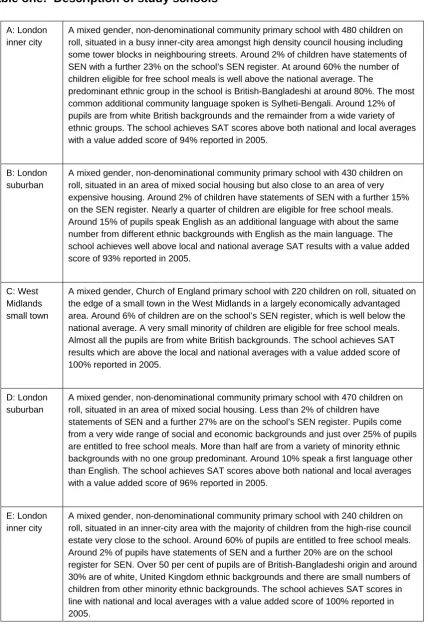
Table one: Description of study schools
A: London inner city
A mixed gender, non-denominational community primary school with 480 children on roll, situated in a busy inner-city area amongst high density council housing including some tower blocks in neighbouring streets. Around 2% of children have statements of SEN with a further 23% on the school’s SEN register. At around 60% the number of children eligible for free school meals is well above the national average. The
predominant ethnic group in the school is British-Bangladeshi at around 80%. The most common additional community language spoken is Sylheti-Bengali. Around 12% of pupils are from white British backgrounds and the remainder from a wide variety of ethnic groups. The school achieves SAT scores above both national and local averages with a value added score of 94% reported in 2005.
B: London suburban
A mixed gender, non-denominational community primary school with 430 children on roll, situated in an area of mixed social housing but also close to an area of very expensive housing. Around 2% of children have statements of SEN with a further 15% on the SEN register. Nearly a quarter of children are eligible for free school meals. Around 15% of pupils speak English as an additional language with about the same number from different ethnic backgrounds with English as the main language. The school achieves well above local and national average SAT results with a value added score of 93% reported in 2005.
C: West Midlands small town
A mixed gender, Church of England primary school with 220 children on roll, situated on the edge of a small town in the West Midlands in a largely economically advantaged area. Around 6% of children are on the school’s SEN register, which is well below the national average. A very small minority of children are eligible for free school meals. Almost all the pupils are from white British backgrounds. The school achieves SAT results which are above the local and national averages with a value added score of 100% reported in 2005.
D: London suburban
A mixed gender, non-denominational community primary school with 470 children on roll, situated in an area of mixed social housing. Less than 2% of children have statements of SEN and a further 27% are on the school’s SEN register. Pupils come from a very wide range of social and economic backgrounds and just over 25% of pupils are entitled to free school meals. More than half are from a variety of minority ethnic backgrounds with no one group predominant. Around 10% speak a first language other than English. The school achieves SAT scores above both national and local averages with a value added score of 96% reported in 2005.
E: London inner city
From this background four distinct offline and online phases of research were used to offer an element of triangulation to the research process, whilst providing a
number of opportunities to capture authentic instances of learner voice. Briefly, these methods were:
Pupil questionnaire
A four page questionnaire was developed to investigate pupils’ engagement with ICT inside and outside of the primary school setting. Items were included to cover
demographic information, details of ICT access and use, engagement with ICTs at home and in school, and perceived learning gains associated with ICTs. A final section of the questionnaire invited pupils to comment on how they thought school ICT provision could be improved in the near future. Questionnaires were
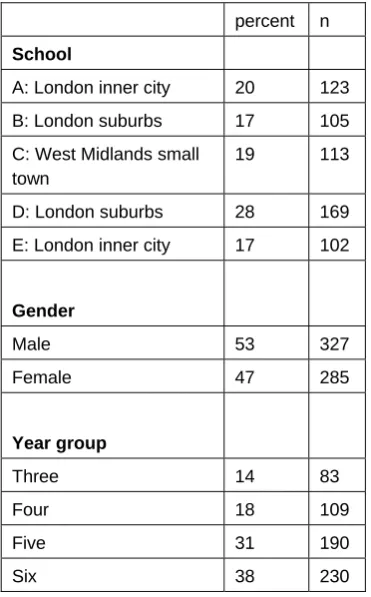
administered to pupils by teachers in class-time during the autumn term of the 2007/8 academic year. As can be seen in table two, completed questionnaires were received from 612 respondents aged between seven and eleven years old
[image:7.595.66.252.396.695.2](mean=9.1 years, sd=1.1) from across the five schools.
Table two: Distribution of questionnaire sample
percent n
School
A: London inner city 20 123
B: London suburbs 17 105
C: West Midlands small town
19 113
D: London suburbs 28 169
E: London inner city 17 102
Gender
Male 53 327
Female 47 285
Year group
Three 14 83
Four 18 109
Five 31 190
Six 38 230
Pupil drawings
The need to elicit the views, opinions and understandings of learners in a variety of ways led us to consider the use of drawings as an especially appropriate means of allowing children to express themselves within the research process. As Barraza argues, drawings can be seen as an inherently child-centred procedure, with the non-verbal nature of drawings freeing the child to express emotions and attitudes that would be otherwise difficult to assess (see also Fury et al 1997, MacPhail and Kinchin 2004). Although the data collected through drawings are constrained by the skill of the artist and can only reflect values that can be represented graphically, researchers have nevertheless been enthused by “children’s extraordinary skills in making meaning through the affordances of drawing” (Mavers 2003, p.20). Moreover the use of drawing as a method of data collection is seen to allow children free
choice of inclusion rather than be prompted by the researcher’s frame of reference, offering those children lacking in literacy skills the chance to express themselves (MacPhail and Kinchin 2004).
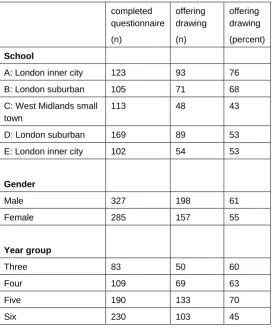
Table three: Distribution of drawings received from questionnaire sample
completed questionnaire
(n)
offering drawing
(n)
offering drawing
(percent)
School
A: London inner city 123 93 76
B: London suburban 105 71 68
C: West Midlands small town
113 48 43
D: London suburban 169 89 53
E: London inner city 102 54 53
Gender
Male 327 198 61
Female 285 157 55
Year group
Three 83 50 60
Four 109 69 63
Five 190 133 70
Six 230 103 45
NB. Summed totals may not add up to 100 percent due to rounding up
Pupil-led and researcher-led ‘focused-group interviews’
A further pupil centred stage of the research process involved a series of group interviews using pupils and adults as researchers. These group sessions lasted for 45 minutes (2 x 20 minute discussions, with a 5 minute break). The sessions were run during lesson time by pupil researchers (one boy and one girl in each year group). These pupil-researchers were pre-selected and trained during the initial visit to the school, and themselves each selected a group of five pupils in advance of the session to work with. The first half of the discussion was led by the
pupil-researchers. They were responsible for conducting and audio-recording the
group to report back and reflect upon their discussions - thus initiating an element of reflection and dialogue between learners and adults. It also allowed for a number of more specifically focused questions to be asked of the pupils, namely: pupils' current and future uses of ICTs; views on the transferability of their informal uses into more formal settings; perceptions of risk and suggestions for ensuring e-safety.
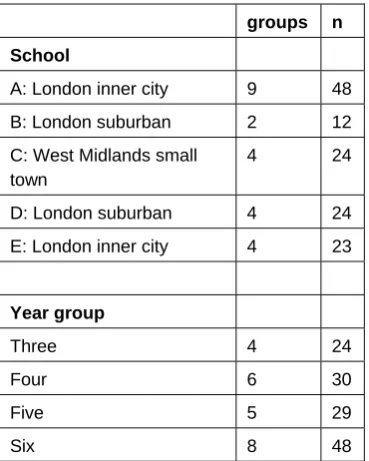
Table four: Distribution of focus group sample
groups n
School
A: London inner city 9 48
B: London suburban 2 12
C: West Midlands small town
4 24
D: London suburban 4 24
E: London inner city 4 23
Year group
Three 4 24
Four 6 30
Five 5 29
Six 8 48
Online / digital elicitation of pupils’ views
A final phase of the project used specially designed ‘closed’ websites for pupils to submit their ideas and thoughts about how ‘their’ uses of technology could be brought into how schools use ICT. The website was in operation throughout the fieldwork period and allowed young people to respond to the overall question ‘How could we make the experience of ICT at school, more like what we are doing with ICT at home?’ in three different ways:
• submission of open-ended text: one section of the website replicated Levin and Arafeh’s (2002) US study which utilised the online solicitation of
student written stories detailing how they use ICTs. Following this research design, pupils were invited to submit, to a ‘closed member’ subscription space within the Wikispace website, a story of at least 100 words in length suggesting innovative ideas relating to how ‘their’ ICTs could be used in schools in the future.
illustrating their responses. In order to allow an element of dialogue, other pupils were able to view and to comment on these pictures.
• submission of videos/films: a third section of the project website linked to a ‘closed’ TeacherTube space where pupils could upload short
self-produced video clips from mobile phones or digital cameras which
illustrated their responses. Other pupils in the study were able to view and comment on these pictures.
The availability of the website was password-protected only to pupils and their
teachers from the research schools. Whilst this method of elicitation obviously results in a self-selecting, non-probability sample of learners it was intended to initiate
‘honest conversation’ with young people about technology which was meaningful to their contexts and modes of technology use.
However, unlike the offline phases of the data collection process these online methods elicited very little data from the pupils. There are a number of possible reasons for this. Firstly, our data showed that schools in the project were not experienced in writing and publishing in Web 2.0 environments. It was not a part of the culture of any of the schools in the sample to compose online content in either blog or wiki form, although all schools had static school websites functioning as notice-boards and online prospectuses. Secondly, the submission process was compromised by the security structures in place at school and local authority levels. The websites were set up in the form of secure “wiki” spaces for collaborative writing and uploading of pictures and video files. In order to link to the videos so that they could be viewed within the secure space, they first had to be uploaded to a private teacher video sharing space. This two-stage process also required administrator rights to access the external sites. In most cases the wiki and the video sharing site were inaccessible from school due to security protocols. Given the short timescale and relatively small staffing resources in the project we were unable to support the teachers and pupils further in developing alternative solutions for the online data collection.
In light of these practical impediments an alternative method for collecting video data was offered one month after the online sites became operational. Digital video
cameras were provided by the researchers for use by pupils in the project schools. These cameras were small, light and easily held and operated by children, even without any particular previous training in shooting for video. They could work in still or moving image mode using memory cards rather than tape in order to simplify further the storage and uploading of video data. Files were simply moved from the cameras by dragging and dropping after connecting with a standard lead. In providing the video cameras to the schools we emphasised the use of short clips which did not need to be edited further into finished, longer, higher quality
home use of ICTs or to film others using and talking about ICTs in school settings. Despite the lack of success of submitting the videos online, we knew that children were making videos in some of the project schools using cameras provided by us. We made contact and invited submission of these short videos on CD as an alternative to the online spaces. At the time of writing two of the schools had submitted several short video pieces.
Analysis of data
Given the non-probability nature of our sample and the relatively simple questions of patterning which we wished to derive from the data, it was our contention that all the data were best analysed in a relatively straightforward manner. In terms of the quantitative data gathered from the questionnaire we followed Gorard’s (2001, p.xv) line that one of the key methodological reasons underlying the recent high-profile challenging of the quality and relevance of educational research has been the “over-use of statistical tests, inappropriate “over-use of statistical tests, confusion between levels of measurement, confusion between design error and random variation”. For the purposes of this report, therefore, the data have been analysed in a relatively
straightforward manner. Analysis of the quantitative questionnaire data is described in terms of frequencies and cross-tabulations. Where appropriate, bi-variate tests of statistical difference and association were conducted to ascertain statistical
significance. In this report the statistics are not reported for ease of reading. Where the word ‘significant’ is used, it denotes statistically significant at a level of p<0.05 or above.
In terms of the analysis of the qualitative data arising from the pupil interviews and drawing tasks, it was also our contention that these data were also best analysed in a relatively straightforward manner. Following this lead, a constant comparison technique was employed during our analysis of the interview data and drawings (Strauss 1987). This initially involved ‘reading’ all the texts to gain an overall sense of the data. All the data were then read again and ‘open-coded’ to produce an initial code list until, in the opinion of the researchers, analysis had reached theoretical saturation. From this basis the data were then selectively coded in terms of
Results
Pupils’ access to ICTs inside and outside the school
In terms of pupils’ outside school access to ICTs, 61 percent (n=376) of respondents reported having access to their own television in their bedroom, 86 per cent (n=523) access to a games console (eg WII, x-box, PS3), 89 per cent (n=543) a computer that was available to them to use if they required and 51 percent (n=314) a mobile phone that they could use if required. As can be seen in figure one, these levels of access increased by the age of the respondent, with older pupils more likely to report access to all four of these ICTs. In terms of significant gender differences, boys (94 percent) were more likely than girls (76 per cent) to report having access to a games console. No other gendered differences in access to the other three ICTs were apparent.
Whilst nearly nine-in-ten respondents reported having access to a computer that they could use outside of school the nature of this access varied across the sample. For 86 percent of the sample computer access was situated in the home (either in the child’s bedroom or in another room). Conversely 7 percent of the sample relied solely on computer access in other sites (either other households or community sites such as libraries, community centres, youth clubs and so on). Significant differences in these modes of access were apparent by respondents’ school of study and year group. Pupils in Years 3 and 4 were more likely to rely on ICT access in a community site (eg library, community centre, youth club) than those in Years 5 and 6. Pupils in schools A and E (both inner-city London) were more likely to rely on ICT access in a community site than those in the suburban and small town schools.
Figure one. Pupils’ access to ICTs outside of school
0 10 20 30 40 50 60 70 80 90 100
Child’s own television Games console Computer that child can use Mobile phone that child can use
year 3 year 4 year 5 year 6
classroom and in an ICT suite, although significant differences in these modes of access were apparent between schools. In terms of the nature of pupils’
engagement with ICT in school, half of the sample reported using a computer on their own in school during lessons, 67 per cent using a computer in a group in school during lessons, 34 per cent using a computer in school during break
[image:14.595.82.475.360.545.2]times/lunchtimes and 46 per cent using a computer in school before or after school. These types of engagement differed by pupils’ school attended and year of study. As can be seen in figure two, modes of computer use varied significantly between the five schools in the study. In terms of age differences, pupils in Year six (57 per cent) were more likely than pupils in Years three (47 per cent), four (44 per cent) or five (45 percent) to report using a computer in school during lessons. Conversely, group use of computers was more likely to be reported by year three pupils (81 per cent) as opposed to those in years four (64 per cent), five (68 per cent) and year six (64 per cent). Notably, no significant differences were found in terms of pupils’ gender.
Figure two. Pupils’ engagement with ICTs in school by school attended
0 10 20 30 40 50 60 70 80 90
Use a computer on your own in school during lessons
Use a computer in a group in school during lessons
Use a computer in school during break times/lunchtimes
Use a computer in school before or after school
A: London inner city B: London suburban C: West Midlands small town D: London suburban E: London inner city
Pupils’ internet use
Respondents were then asked to indicate the nature and level of their engagement with internet applications at school and in non-school contexts. An open-ended method was used to elicit these applications, in order to guard against pupils
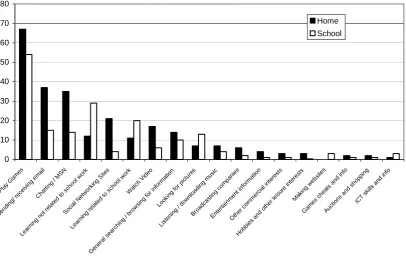
responding to items they did not use, and also not to preclude applications which the researchers may have been unfamiliar with. As can be seen in figure three,
Figure three. Pupils’ use of internet applications by location 0 10 20 30 40 50 60 70 80 Play Gam es Send ing / re ceiv ing em ail Cha tting / MSN Learn ing no
t re late
d to schoo
l wor k
Soci al Ne
two rking Site s Lear ning rel ated
to sc hool wo rk Watch Video Ge nera
l sea rchi
ng / bro
wsin g for
inform ation
Look ing f
or pic tures List ening / d own loadi ng mu sic Broa dca stin g com
pani es
Ente rtainm
ent i nform
atio n
Oth er co
mm ercia
l intere sts
Hobb ies an
d o ther l
eisure inte rests Mak ing webs ites Game s ch eat s an
d info
Auct ions
an d sho
ppin g
ICT skill
s a nd in
fo
Home School
NB. Data are percentage of sample reporting doing each activity ‘A lot’ rather than ‘Never’ or ‘A little’
In terms of school-based engagement with these internet applications, use varied considerably by pupils’ age and school attended. For instance, use of the internet for school-related learning increased with year group. Conversely, games playing and video watching decreased from year three through to year six. Notably, no significant gender differences in school internet use were apparent. In terms of pupils’
engagement with these internet applications at home, engagement varied
considerably by pupils’ gender, age and school attended. Boys were more likely than girls to report playing games and watching videos online whilst at home. Conversely, girls were more likely than boys to use MSN and other computer mediated
communication applications, as well as social networking sites. Use of games at home was found to decline with age, whilst use of social networking sites increased as pupils got older.
Pupils’ computer use
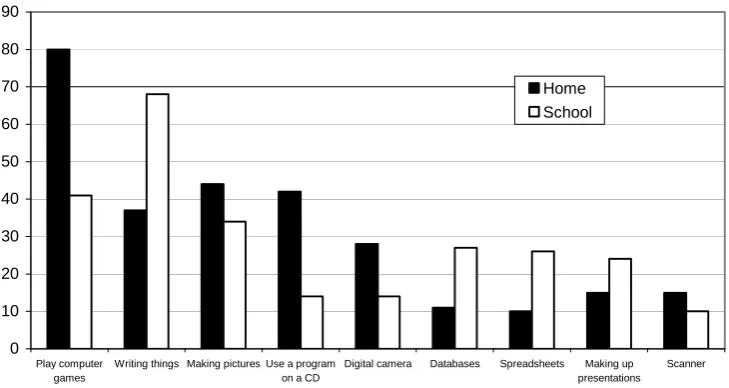
school context. Conversely, use of computers for writing, presentations, spreadsheets and databases was more likely to be school-based.
Figure four. Pupils’ use of computer applications by location
0 10 20 30 40 50 60 70 80 90
Play computer games
Writing things Making pictures Use a program on a CD
Digital camera Databases Spreadsheets Making up presentations
Scanner
Home School
NB. Data are percentage of sample reporting doing each activity ‘A lot’ rather than ‘Never’ or ‘A little’
Pupils’ engagement with these computer applications at school varied considerably by age and school attended. School-based use of computer games, CD
programmes, making pictures and email were more likely to be reported by boys as opposed to girls. Whilst the use of databases and spreadsheets increased from Years three through to six, making pictures, using CD programmes, digital cameras, scanners and playing computer games all declined in use as pupils got older.
Similarly, pupils’ engagement with computer applications at home varied
considerably by pupils’ gender, age and school attended. Boys were more likely to report playing games and using CD programs than girls whilst at home. Conversely, girls were more likely than boys to use computers for writing and making pictures. Use of games and CD programs at home declined with pupils’ age.
Pupils’ favoured and least favoured ICT applications
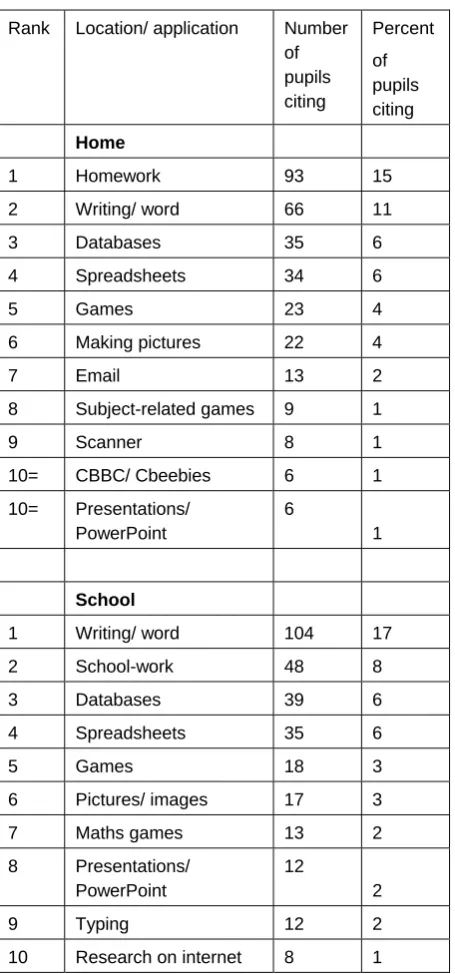
In order to gain an understanding of pupils’ preferred uses of ICTs in school and at home, a set of open-ended questionnaire items enquired about pupils ‘most favourite thing to use ICT for’ and, conversely, their ‘least favourite thing to use ICT for’ at home and at school. As can be seen in table five, pupils cited their favourite out-of-school applications as video games, computer and mediated communication
applications at home, pupils cited their least favourite applications as homework, writing/ word, databases and spreadsheets (see table six). In terms of school ICT use, respondents cited a similar range of least favourite applications - ie writing/ word, school-work, databases and spreadsheets.
Table five. What is your most favourite thing to use ICT for?
Rank Location/ application Number
of pupils citing
Percent
of pupils citing
Home
1 Games 237 39
2 Games consoles 40 7
3 MSN 21 4
3 Email 21 4
5 Club penguin 17 3
6 YouTube/ videos 15 2
7 mp3s/music 14 2
8 Presentations 11 2
9 Writing stories 10 2
10= Pokémon 7 1
10= Chat 7 1
School
1 Games 159 26
2 Presentations/ PowerPoint
37
6
3 Writing 32 5
4 Drawing/ art 31 5
5 Internet 26 4
6 Maths games 15 2
7 Spreadsheets 13 2
8 Google 9 1
8 Publisher 9 1
Table six. What is your least favourite thing to use ICT for?
Rank Location/ application Number
of pupils citing
Percent
of pupils citing
Home
1 Homework 93 15
2 Writing/ word 66 11
3 Databases 35 6
4 Spreadsheets 34 6
5 Games 23 4
6 Making pictures 22 4
7 Email 13 2
8 Subject-related games 9 1
9 Scanner 8 1
10= CBBC/ Cbeebies 6 1
10= Presentations/ PowerPoint
6
1
School
1 Writing/ word 104 17
2 School-work 48 8
3 Databases 39 6
4 Spreadsheets 35 6
5 Games 18 3
6 Pictures/ images 17 3
7 Maths games 13 2
8 Presentations/ PowerPoint
12
2
9 Typing 12 2
10 Research on internet 8 1
learning. In particular, younger girls enthused about playing tennis and cooking games on the Wii, playing dressing up and makeover games on the internet, and caring for animals on Neopetz and CBBC 'puppy games'. Younger boys spoke animatedly about playing games such as Spiderman and Batman, and other fighting, racing, soccer, baseball, wrestling games. Older children's accounts suggested that they remained committed to games playing (whether on a games consoles,
computer or the internet) whilst other ICTs, such as mobile phones and MP3 players were also coming to the fore.
Perceived influence of ICTs on learning
The questionnaire also sought to investigate students’ perceptions of learning gains associated with using ICTs both at school and at home, although these data are obviously limited by the self-report nature of the responses. This limitation
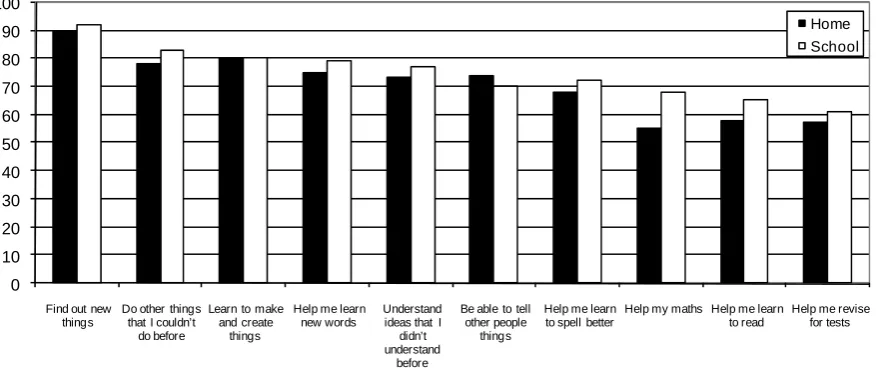
[image:19.595.86.527.448.636.2]notwithstanding, pupils were most likely to indicate that they felt they were learning from school and home ICT use in terms of finding out new things, learning to make and create things, and doing other things that they could not do before. Pupils were less likely to indicate that they felt they were learning from school or home ICT use in terms of maths, revising for tests or learning to read (see figure five).
Figure five. Pupils’ perceived ICT-based learning benefits by location
0 10 20 30 40 50 60 70 80 90 100
Find out new things
Do other things that I couldn’t
do before
Learn to make and create
things
Help me learn new words
Understand ideas that I didn’t understand
before
Be able to tell other people
things
Help me learn to spell better
Help my maths Help me learn to read
Help me revise for tests
Home School
NB. Data are percentage of sample reporting that ICT had helped them learn each category Whilst no differences in gender were apparent, perceptions of learning gains
associated with using ICTs both at school and at home differed according to pupils’ age and school attended. In particular, older pupils were more likely than their
that they did not understand before. Perceived learning gains in reading, maths and understanding ideas differed between schools.
The themes of formal and informal learning were also raised throughout the interview data. For instance, there were some incidences of children talking with enthusiasm about ICT related activities they had experienced at school. In School E for example year four pupils related searching for information on Henry VIII:
Boy You see facts on the computer and see if you can find more facts and print it out or anything.
Girl Or you could go to Google and go to images and you click on one of Henry the VIII’s pictures and there’s a website that’s underneath the picture and it says all about Henry the VIII like when Henry the VIII reached 50 his waist inch was 54 inches.
Interestingly, it appears in this example that it is Henry VIII’s seemingly excessive measurements which have brought this example to life. Moreover, children described instances of learning where it was clear that teachers had tried to tailor the activities to children's own interests and experiences. In the following example, School B year five pupils described using databases to catalogue details around toy animals: Girl We’re doing data handling at the moment.
Boy Data handling. Boy Data base, yes. […]
Boy Like we’re sorting out data into different pieces so if it's like… if I’m talking about toys, if it's furry or not…
Boy And different colours.
Boy Different colours and what colours and… Boy The material.
Boy The materials so we’d be sorting it out.
In terms of how pupils thought ICTs enhanced their learning, the activities were highlighted: (i) information retrieval, (ii) literacy, (iii) numeracy, (iv) languages and, most prominently, (v) games.
Information retrieval
There were numerous examples throughout the interview data of pupils retrieving information from the internet for either school or non-school related purposes. Many pupils typically mentioned using Google, Ask.com, Yahoo and Wikipedia. Accounts given showed that there were some issues around using search engines which related to how far pupils understood what they were searching for. One year four pupil from School E described an unproductive search which he had carried out about sumo wrestlers. When inputting search terms, he had mis-associated sumo wrestlers with China rather than Japan producing limited results. At the same time, there were examples in the interviews of children's search skills being highly
developed as in the case of these pupils in year six in School B:
Int. If you had to find out about something like dolphins, how would you go about it in Google for example?
Boy You would just type in dolphins.
Boy You would type in dolphins and if you want to find a picture you go on images.
Girl Or Web.
Int. So you type in dolphins and you get a whole screen full of stuff and it's about the Miami Dolphins football in America.
Boy You type in sea dolphins. Girl Or you type in like sea.
Int. So you have to put other words in as well. Girl Give more description about it.
Similarly, children's critical literacy skills varied in the extent to which they trusted what they found on the web. Some pupils said that they tended to trust sites found with search engines such as Ask.com and Google as these were thought to be 'reliable'. Other children had more developed strategies which included
Int. So you must be very good at spotting them. How can you tell?
Boy I think I can tell by …well there’s Wikipedia, that sort of thing. And every time I go on there that’s true and everything. And when it sort of doesn’t…I haven’t heard anything in my life and when I read it I was thinking what’s that all about, I think it's not really true.
Int. So who writes Wikipedia? Boy I don’t know.
Int. So who writes all the information on Wikipedia? Boy I don’t know.
Girl Mr Wikipedia.
Literacy
Children often described the pleasure they gained through writing stories using Microsoft Word. Some also reported that they had produced stories and poetry as Microsoft PowerPoint presentations. Being able to present work neatly seemed in particular to satisfy older girls. Nevertheless, both boys and girls were engaged in writing either for fun or for homework. They reported that being able to spell check improved their spelling skills. Exceptionally, one year six boy in School B said that playing RuneScape online, which facilitated communicating with other players, had improved his reading and spelling skills with the proviso that not all the spelling he had encountered online was standard.
Numeracy
So-called educational software such as Brain Trainer and other similar games were often referred to as improving numeracy skills. Whilst children frequently referred to these it was generally with little enthusiasm, as can be seen in this excerpt from discussion between year five pupils in School B:
Girl If you’re on a computer and you get these programmes like ICT maths and you can learn about anything you want to do with maths on it.
Girl But the thing is hardly anybody wants to go on there. Int. People don’t like using it?
Languages
In School E, year three pupils spoke with great enthusiasm about using the internet for language learning related to additional languages to English spoken in their homes by parents including Bengali, Italian and Turkish and how they would like to learn languages in school.
Girl In Turkish I play number games but it goes a b c but it's got a number so you have to get a b c d in order.
Int. What does that help you learn?
Girl That helps me to do… a b c’s for different letters, like numbers. Int. So are you learning to speak Turkish?
Girl Yeah. I’m Turkish so I speak some.
Games
Across the groups there were many children, particularly boys, keen to justify their games playing in educational terms. The reasons they give refer to the content of games, for instance learning factual information from Zoo Tycoon, Brain Trainer; learning manual dexterity skills such as hand and eye coordination, mouse control and typing skills; simulation games which teach them to drive, fly, fight and defend themselves more generally. Nevertheless, at the same time, these proponents of learning from games also saw them as a distraction from school related learning which leads them to resist the idea of further games playing at school to some extent. For instance, the following excerpt highlights this contradiction for boys in Year 6 at School A:
Boy Like on the computer when you’re sometimes playing games you could do mathematical games or science questions and stuff like that so you can learn more when you come to school you know a little bit more about the subject.
Int. So do you think that maybe there should be more games in school on the school computers?
Boy Yeah.
Boy I don’t think so because it might interfere with real learning. Int. So games is not real learning?
On occasion, some girls rejected the notion of games being useful for learning generally commenting that, 'it's not good for our education' (girl, year five, School A). This may be underpinned by boys greater enthusiasm for spending time playing games at home in any case as demonstrated by the quantitative findings in this study.
[image:24.595.36.520.395.698.2]Addressing these issues in terms of the drawing data, nearly half of the children’s drawings which featured discernible activities taking place via the technology featured acts of learning and other educational activities (42 drawings – most likely to be depicted by boys and those children in older year groups). Some of these pictures featured ICTs as supplementing formal education provision – as can be seen in figure six’s depiction of computers “help[ing] us learn if we don’t really understand”. Less prevalent were more child-centred (and one could argue progressive) notions of technology-based learning. Whilst not completely clear, figure seven suggests a sense of unfettered technology use which, as the child posits, “maybe [...] could be educational?”. In this picture a games console is seemingly flying through the air accompanied by exclamations of “radical”,
“education”, “cool” and “bang”. To the right-hand side of the picture is a figure with their hands in the air saying ‘I’m the teacher’.
Pupils’ view of e-safety issues
Questionnaire respondents were asked briefly about their perceptions of e-safety when using ICTs outside of school. As can be seen in table seven, nearly
quarters of pupils indicated that they had thought about how to stay safe when you are using the internet outside school, with the majority claiming to be aware of ways that they could keep themselves safe when you are using the internet outside
[image:25.595.67.396.265.621.2]school. However, when asked to provide an example of these ways, only one third percent of pupils were able to cite a valid answer. Invalid answers included keeping water away from the keyboard, keeping doors closed, not using a computer and not tripping over power cables.
Table seven. Pupils’ responses to questionnaire items concerning e-safety
Thought about
e-safety
Claimed to be aware of ways to remain e-safe
Able to cite ways to remain e-safe
School
A: London inner city 63 59 24
B: London suburban 63 66 46
C: West Midlands small town 83 81 46
D: London suburban 72 67 33
E: London inner city 77 73 24
Gender
Male 69 70 31
Female 74 67 38
Year group
Three 79 58 11
Four 72 73 22
Five 67 64 37
Six 72 74 46
TOTAL 72 69 34
In relation to children's own safety practices online, children appeared muddled about the potential outcomes of not following safety advice. Even so, many of the key messages had been internalised by the pupils such as not giving out personal information and not talking to strangers. In addition, children were reportedly wary of clicking on pop-ups which they typically saw as causing viruses which could damage the computer. In School C, pupils were able to recall in detail advice they had been given in discrete sessions about internet safety provided by one of their teachers. This excerpt from a discussion with year five children in School C demonstrates how they have taken onboard the message not to talk to strangers, apparently alongside technical knowledge of using MSN:
Int. Because if somebody comes in and their name appears and you don’t recognize that name, what can you do?
Boy You can delete them…
Boy Ignore them.
Boy …or put them on the ignore list and they can email. Boy …talk to you.
Int. So you can block them off? Boy Yeah.
Int. So they can’t come in again. Boy No they can’t message you.
Boy They can’t message you or they can’t talk to you.
There were instances, however, where it appeared that children's sense of e-safety was less advanced. This year five boy in School E gave the following example of this happening in a chat room:
Boy You can talk to them and all that and see if you know them and phone them and see what they’re like and if they’re bad or…
and not being able to find your way back and so on. As one year three girl in School C asserted:
Int. What about when they use the internet or they play games… Girl Don’t have them get too close to it because they’ll get sterilised.
More moderate risks raised in discussion included eyestrain from using the computer too much, copycat behaviour stemming from viewing video clips showing examples of ‘happy slapping’ for instance, having phones stolen, and falling victim to viruses. Children's responses in particular suggested high levels of anxiety about seeing sites which were too old for them, specifically 'rude' or violent websites which they were afraid would upset them and/or generate nightmares, as in this example from a year three boy in School D:
Boy Because certain web sites are for adults not for children and if they went on that it might be a bit violent or get violent.
Conversely, given the somewhat exaggerated risks that children related, when they were asked about ICT-related experiences that had upset or disturbed them,
responses were mundane and unspectacular. For instance, pupils related
experiences of losing documents, losing their place within games, getting into trouble with parents through mishandling error messages on the computer and, the prospect of getting bored when playing games or using the internet. As can be seen in this example from year 4 children at School C:
Int. Has anything ever happened when you’ve been using the internet or any other ICT, has anything happened that you’ve not liked, anything that’s made you feel really uncomfortable or upset you or anything like that? Ok lets hear from the boys.
Boy If you’ve done a card for your mom or dad and then suddenly your computer crashes then you could lose all of it.
Pupils’ views of desirable changes to school ICT provision
A final section of the questionnaire sought suggestions for improving ICT provision at school. Eight pre-determined suggested changes were presented and pupils invited to rate each item on a scale of ‘a good idea’, ‘not a good idea’ and ‘we already do this’. As can be seen in table eight, pupils’ views on potential improvements to
school regulation of ICT use highlighted a desire for removing restrictions in terms of computer, whiteboard and email use. Similarly, pupils’ responses to potential
[image:28.595.69.430.296.525.2]improvements to teachers’ practice suggest a desire for increased assistance with internet safety and information retrieval.
Table eight. Pupils’ views of improvements to teachers and teaching practice
Improvement Percent agreeing
that change is required in this area
Teachers could help us learn ways of staying safe on the internet 63
Let us use a computer any time that we like 61
Teachers could show us how to quickly find information on the internet
61
Teachers could help us to tell if a website is safe to use 56
Let us use the interactive white board 55
Teachers could help us more when we are stuck with something on the computer
53
Let us use our own email (such as hotmail) 52
Let us go on any web site that we like 49
Let us use a mobile phone at any time 38
Desired changes to school ICT provision was a prominent topic throughout the interview data. In general, the consensus amongst the pupils interviewed was that ICTs should be used to make learning more ‘fun’. Unfortunately, children struggled to come up with practical ideas of what they thought would help it to become so. A lot of attention was given to the prospect of developing games that might help with literacy and numeracy skills, for instance, games that facilitated times tables 'fighting' with each other. However, many respondents baulked at these ideas, arguing that games were a distraction from 'real work' and would not help with the kinds of
why games would not help with learning and in doing so, indicates a perceived separation between games and school-based learning:
Int Do you think games could help you with your school stuff?
Boy Not really because we ain’t got Office programmes and stuff like we have in school.
Other pupils' responses suggest an acceptance with the status quo to some extent. Even so, they also made moderate requests for improvements including having greater access to computers, having newer and faster computers, using information retrieval more, using the computer more to type up coursework, having less
restrictive filters and being able to build their own websites. Occasionally an original idea occurred such as when a year 6 boy in School A suggested making podcasts of ‘lectures’ so that he could listen to them as he went to sleep . Where the
researchers offered ideas for using programmes such as MSN for peer learning or Google Earth to enhance geography teaching, for example, pupils generally
responded positively to these ideas as in the following excerpt involving a year five girl at School A:
Int Why could MSN or emailing people help you at school?
Girl Because you can talk to a friend and they can help you on work and things, they can tell you things.
Nevertheless, pupils also then frequently added the caveat that such activities would need to be very carefully controlled by teachers if uses were not to become a
distraction or risky in some other way. For instance, it was suggested that pupils allowed to use MSN would chat rather than focussing on the task in hand. In general, these instances are revealing of children's perceptions that ‘fun’ uses of ICTs are seen to be a distraction from what can be considered to be ‘real’ work and learning rather than a serious means through which learning can be enhanced.
Such conversations notwithstanding, certainly the most prevalent views of change depicted in the pupil drawings were the portrayals of home ICT artefacts and
The most prevalent activity was one of play and other child-directed leisure activities – illustrated in figure ten where games playing children are accompanied by the exhortation to “do what you want”. Indeed, notions of play, free-activity and other leisure pursuits featured in 49 drawings, most notably amongst boys. The portrayal of other activities was rarer – for instance only 18 drawings portrayed communication uses, and no pictures featured noticeably creative or collaborative activities.
It was notable that many of these suggestions for change adopted an almost pleading tone and were often qualified by an acknowledgement and (begrudging) acceptance of school restrictions and regulations. This was evident, for example, in
the labels that children attached to their pictures outlining a range of conditions to their visions for future change, eg “games at playtime instead of going outside at playtime” [male, yr. 5, #269], “iPod then you give it to the teacher and she looks after it till spesail time [sic]” [female, yr. 6, #548], “play games if the whole class has had a stressful day” [female, yr. 6, #212] and “ten minutes of time on the computer to do whatever we want as long as its safe” [female, yr. 5, #269] (see also figure eleven’s provisos for use ‘if good’, ‘if you are star of the week’, and only during ‘freetime’).
Pupil views of the future of ICT and schools
The interviews also encompassed pupil’s thoughts on longer-term changes to school ICT-provision. As with much of our data, these tended to be fairly conservative in nature suggesting modifications to existing hardware and software rather than radically new innovations. For example, it was hoped that computers would become faster and more reliable and less likely to cause headaches. Moreover, boys were keen to see developments in games playing particularly in the direction of virtual reality games and the miniaturisation of games consoles and other gadgets. One year three boy in School C suggested that your own image could be imposed on games characters so that you would actually be playing yourself online. A further idea from was for the invention of a tiny television which could fit inside school uniforms to stave off boredom within lessons. Another, perhaps more practical idea was to develop simulation games where you could try out particular jobs in order to help you choose your future career. In relation to more futuristic ideas, such as the
development of robots, two of the boys identified that robots could be useful for carrying out various tasks, including housework. Similarly, a year four girl in School C suggested a robot could be useful as company for children without siblings: Girl Like a robot that can actually talk to you so like if you haven’t got any
brothers or sisters, like you have someone to talk to or something like that. Many of the suggestions which the pupils made about how ICT use could be
improved in the future were related to issues they were concerned in schools as they presently are. For example, often children referred to wanting to have more freedom and less restrictions on their activities than as they currently perceived of them. However, contradictory concerns were raised over the need for protective controls. This can be seen in the following example from year three pupils at School A: Girl If I was in charge I would just say what ever you want and I’ll just do it in
school.
Int. What, whatever kids want? Girl Yeah.
All Chorus
Int. That’s bad language.
Girl That’s a very bad language because you can’t have whatever you want because it might be silly things and it might be rude things, so that’s why… Int. What’s being silly?
Girl Like rude stuff. Boy Naked ladies.
to watch TV’, nail-based gems which are “electronic cameras to keep girls safe” and a corresponding “camera earring for boys”. Perhaps most innovative is the tooth mounted, voiced controlled mobile telephone and the zero-gravity bubble enclosed bouncy castle.
Findings from video data
Videos submitted on CD by the project schools became, in two cases, significant additions to the dataset, both for what they revealed about ICTs in general, about levels of use of media technologies and about learner-led conversations and how they require careful setting up to acquire a learner perspective. They also provided further corroborative evidence to support, rather than contradict, many of the main findings from other modes of data collection.
School D submitted 15 short video clips. They were directed and shot by pupils and used the semi-structured interview topics as a script, sticking closely to each
individual question as a standalone item rather than a prompt for discussion. Most of these clips were filmed handheld and in mid shot or close-up on a child or pair of children, with the questions asked from behind the camera. Comments of any length or depth in these clips concerned e-safety items in the interview schedule. An
example is given below:
“…don’t go on websites that you’re not allowed…like 12 plus or something…but they’re normally blocked at school (pause)…anyway…and don’t chat on a website like with someone that you don’t know…”
(School D Upper KS2)
PHOTO REDACTED DUE TO THIRD PARTY RIGHTS OR OTHER LEGAL ISSUES
PHOTO REDACTED DUE TO THIRD PARTY RIGHTS OR OTHER LEGAL
Children often limited themselves to positing their interaction with ICTs as ‘good’ or ‘bad’ and identifying just one reason for any assertions. Mobile phone use, for example, was identified by one child in her video as being the best possible form of ICT but was required to narrow down why to “portability” with little or no development of ideas or examples of actual use. Another effect of sticking closely to questions from the sheet was the overwhelming sense of searching for a right answer or an adult-approved one and children in school D tried hard to provide sound bites which conveyed the “right” answer, in one case resulting in doubt being cast by one of the younger children on the idea of home use and school use of ICTs ever converging
[question from Behind camera]…Could we use the things we do at home with like computers, the way we use computers at home, could we use that at school? Pupil: (long thoughtful pause)…No
(School D Lower KS2)
The children in school D had no particular difficulty with using the cameras provided and had clearly been provided with them in other contexts at the school. The aspect which they found difficult was working with the camera at the same time as eliciting answers. This proved to be the case with the focus groups where clearly it was unusual to have an opportunity to talk in a context in which the answer was not known, could be contested by others or formed in discussion with others. As for the online data elicitation this could be simply a matter of time and immersion in the techniques. It certainly backed up some of the difficulties encountered in the pupil-led focus groups. Pupil-pupil-led talk is not necessarily the norm in schools at this point in time. Certainly the evidence on these videos backs the assertion that pupils wished to construct an answer which was school-focused and that they were indeed playing out the roles expected of them.
Videos from school E were constructed in a systematic way. Each of the year groups across Key Stage 2 provided two productions, one related to home use and the other related to school use. School E employs a full-time drama and media teacher (highly unusual in primary school provision) and it was possible to discern relatively high levels of previous camera experience. Pupil-led talk was a little richer in these productions with the children moving off-script and being confident to follow a line of thought. The four videos on school use from school E featured interviews of children at work in a computer suite, in the majority of cases working on PowerPoint
presentations and explaining to their interviewers how to go about changing slide properties. The video groups comprised camera operators and interviewers who were shown throughout the productions in mid-shot alongside or behind the children
PHOTO REDACTED DUE TO THIRD PARTY RIGHTS OR OTHER
working on the screen. This helped to create a documentary-style production which allowed the interviewers to assume the role of investigative journalists. One notable exception to this was a clip in which one of the investigators assumed a teaching role and took considerable camera time to explain to a younger child how to move a shape in a Maths programme. This level of peer support looked natural and commonplace and showed that, perhaps, in a busy network suite it was usual to seek support from other children.
The videos which examined the issue of home use took the form of focus group discussions, led by pupils who had been in the previous focus group visits. They used some of the techniques which the researchers had employed, building on answers in the style of a semi-structured interview and, in most cases, allowing for discussion to take place. One example, shown below, concerned the different uses of ICTs in the home between work directly connected with homework and social networking and alluded directly to the subversive nature of the activity at home compared to school:
Boy: I mostly play like maths things…like what you can do…like find things…
Boy: I don’t, I mostly go on things like MySpace, MSN (covers face and pretends not to be saying it) Piczo, things like that…
(Upper KS2)
Piczo was blocked in school E and discouraged at home. The speaker was well aware of the fact that the research video was being made in school and could be seen by teachers and researchers. He was keen to reveal his use of this site, yet in the gesture of partial disguise of his voice, he was signalling that he is aware that doing so is effectively transgressive. This echoes findings from the drawings where children are seen as only too aware of restriction and regulation.
Elsewhere the video data echoed the experience of children providing school-friendly answers and claims, playing out their roles. It was possible in all the clips to glimpse some traces of a subversive voice coming through in the playing out of media roles (such as investigative reporter), however, in the main, the divisions located
elsewhere between the two domains of computer use were played out.
Nevertheless, asking learners to become reporters and embedding cameras in this way, longer term and off-script may yet reveal more in future projects, whether or not these data are subsequently uploaded to any online areas.
PHOTO REDACTED DUE TO THIRD PARTY RIGHTS OR OTHER LEGAL
Discussion
Patterns of pupils’ ICT use
Whilst at first glance our data depict a generation of young people for whom ICT was part of their everyday lives, closer inspection shows many primary pupils’ actual engagement with ICT to be often perfunctory and unspectacular - especially within the school setting. School internet use was dominated by schoolwork-related activity such as information and picture retrieval. Home internet was dominated by online games, watching video clips and, to a lesser extent, chatting and using social networking sites. Other than for the internet, use of computers in school entailed mainly writing-up work, making presentations and, for older children, spreadsheet and database work. At home children were using computers for games and email. In light of recent rhetoric over the changing nature of young people’s internet use, it was notable that creative and collaborative uses of so-called ‘Web 2.0’ applications were not prevalent either inside or outside school, with passive consumption rather than active production the dominant mode of engagement. Indeed, regardless of location for many children ICTs were most engaging and most desirable when used for ‘games’. Conversely the least exciting and most objectionable uses of ICT were for ‘work’. As such there was little sense of ICTs having a transformatory and empowering influence on children’s learning as is often claimed by education
technology commentators. There was little evidence of a blurring of home and school uses of ICT, and little evidence of a blurring of play and learning. Instead there was a strong sense of educational uses of ICTs being shaped by the nature of the schools within which ‘educational’ use was largely framed and often situated.
Aside from a general disdain for school-related activities, the majority of children did indicate that they felt ICT use could lead to gains in learning - especially in terms of finding things out and what could be classed as self-directed learning. Interestingly these perceived learning gains were felt equally in terms of in-school and outside-school use. This could reflect the benefits of outside-school ICT use being ‘cascaded’ into the home (ie that learning benefits of ICT use in school being transported over into the pupils’ home use of ICT and replicated). Conversely, it could merely reflect the negligible role of the school in ‘adding value’ to how children are using ICTs. Nearly three-quarters of pupils indicated that they had thought about how to stay safe when using the internet, with a majority claiming to be aware of ways that they could keep themselves safe. However, when asked to provide specific examples of such e-safety practices only one third of pupils were able to cite a valid answer. Interview data also suggested that some younger children had an abstract
Differences in pupils’ ICT use
Within these patterns of engagement, some notable differences between and within schools were apparent. At first glance our data reveal very little differences between girls’ and boys’ engagement with ICT. No significant gender differences were evident in terms of ICT access, modes of use, perceived learning outcomes or desired
changes. Furthermore, any gender differences in home internet use were not carried over into the school context, and few differences between boys and girls were
evident in computer use. Whilst this lack of patterning along gendered lines is encouraging, our data did show the significant influence of pupils’ age and school attended on their eventual ICT engagement. For instance, our data illustrate how pupils’ ICT use was patterned by their age and year group - from quantity and
quality of access to ICTs to the frequency and breadth of ICT use. Similarly, activities such as online learning, database and spreadsheet use increased as children got older, with activities such as online gaming, chatting, making pictures and using digital cameras decreasing. Whilst older children were more likely to report perceived learning gains from ICT use at school and home, our data certainly showed the increased seriousness (and one could argue the increased dulling) of school ICT use as children progressed through years three to six.
Consistent differences in pupils’ ICT engagement were also found between schools. The nature of ICT engagement in terms of what children were using ICTs for, when and where they were doing it, and with what outcomes, all differed significantly between the five schools in our sample. The range of factors possibly exerting an influence relating to the ICTs here include: the physical location of the computers within the school; the curricular organisation of the school; the experience of the teachers; the type of learning environments beyond the schools, as well as the range and depth of support from Local Authorities. It should be noted that without recourse to some form of experimental research design it is not possible to conclude any causality from these data relating to any of the factors above. In particular, it would be unwise to conclude that any of these differences are somehow ‘caused’ by the schools. It should be noted that school attended acts as a proxy variable for a range of other issues, not least differences in socio-economic status, income, parental educational background and geography. Therefore whilst we note the strong differences in ICT use between children in different schools, for the time being we can conclude only that there are a number of issues this relates to. This is clearly an area worthy of further investigation.
Pupil’s desire for changes to school ICT provision
rooted in the present-day context of the classroom and confined by the structures of the school. Indeed pupils’ visions for change in school ICT mostly concerned the direct importing of ‘home’ ICT devices and practices in the classroom, with little sense of a strong desire for change with a view to learning with ICTs. For instance, in terms of what types of ICTs pupils imagined would be developed in the near future and what forms of learning they could lead to, few new developments were offered aside from the occasional drawing of a zero-gravity bouncy castle or cyber-helmet. Given the persistence in schools’ ICT provision of the standard desktop computer setup of keyboard, mouse and monitor this is perhaps a sensible assumption. In the drawings where children were depicting technology-based learning, then ICTs were portrayed as being used to help children when confused, relieve children from the stress of learning in the classroom or lead to incidental learning.
In terms of the desired qualities and capabilities of ICTs, children’s responses were concerned primarily with issues of play, fun, and the personalisation of hardware devices. These qualities and capabilities were seen to be best achieved through the importing of home technologies into the school – most notably games consoles, and for older children mobile phones, digital cameras and mp3 players - reflecting the changing nature of ICT engagement across the seven to eleven age range. Finally, in terms of desired changes to ICT provision and practices within schools, the
majority of pupils who advocated change depicted the removal (or at least relaxation) of restrictions of use imposed by the school – as a few pictures put it, ‘let us do what we want’. Significantly, letting pupils ‘do what they want’ most often involved the playing of games or passive ‘going on’ websites such as Youtube or Miniclip. There were few, if any, portrayals of more communicative, creative or collaborative ICT uses or practices associated with Web 2.0 applications.
Despite the slightly prosaic nature of some of the responses, it would be unwise to dismiss these responses as uninformed and unimaginative. Indeed, we would contend that these depictions of a desired future reflect many of the tensions
underlying children’s current engagements with ICTs in school. Specifically we would contend that the data in this report provide a telling insight into the issues underlying pupil’s understandings of ICT and schools. In particular many of the responses reflect clearly the restrictions of the schools and the (relative) freedoms of the home, as well as the oppositional relationship between the ‘work’ of learning in school and the ‘play’ of using digital media at home. A further theme running throughout many of the interview and picture data is the unequal power relations that exist between pupils, the schools, teachers, and their homes. In all these instances, the data provide stark depictions of how ICTs are shaped by the social and pedagogic

![figure seven suggests a sense of unfettered technology use which, as the child posits, “maybe [...] could be educational?”](https://thumb-us.123doks.com/thumbv2/123dok_us/170901.46760/24.595.36.520.395.698/figure-seven-suggests-sense-unfettered-technology-posits-educational.webp)
