Students as Agents for Change in Learning and Teaching
Graduate Management Trainee and Research Assistant: Roos ZandstraProject Director: Liz Dunne
Project blog: https://blogs.exeter.ac.uk/studentprojects
Project website: http://as.exeter.ac.uk/support/educationenhancementprojects/change/
Case study 9 – School of Education and School of Sports and Health Sciences: Studying on Two Campuses
Introduction
There are several programmes at the University on which students can study more than one subject. This sometimes means that students will be taught at both of the city’s campuses, St Luke’s and Streatham, and on occasion this creates problems. Issues include: travel between campuses, communication between different Schools running the shared programmes, timetabling, and module choice. The Staff-Student Liaison Committee (SSLC) Chairs of the School of Sports and Health Science and of the School of Education
decided to carry out an analysis of the extent to which students studying on the two campuses were affected by the issues raised, and to consider solutions that might minimise disruption to study. In relation to travel, there had at one time been minibus provision, but this was no longer continued. City buses run frequently but take a circuitous route around the city. Walking between campuses takes about half an hour either way. A few students drive cars, but parking is becoming increasingly restricted and permits are not easily available. The Schools of Education, and Sport and Health Sciences, are both situated on the St Luke’s campus, along with Medicine, whereas the majority of subjects are taught on the Streatham campus.
Methods of data collection
An online questionnaire was created by the SSLC Chairs from the two Schools and sent out to students studying on both St Luke’s and Streatham campuses. Content covered the perceived problems (timetabling, travel and communication, along with more general questions about prior expectations for study and their actual experiences. This survey was completed by 41 students in total: 22 Year 1, 12 Year 2, 6 Year 3 and 1 Year 4 student.
Analysis of data
Understanding the issues
Three quarters of students felt they benefited from a wide range of expertise because they studied more than one subject and most (85%) enjoyed the variety. Just over half of this sample responded positively to the statement ‘I enjoy studying on two different campuses’, however a quarter indicated that they did not appreciate this.
One in ten stated that they did not know their programme was going to be taught on two campuses when they applied. Some students (39%) had considered that studying on two campuses would be a positive aspect because they wanted to experience both campuses, and just over a third did not perceive that it would be an issue. Comments about the perception of studying on two campuses before coming to Exeter included:
‘I thought two schools, two campuses, great support, loads of friends, loads of activities to join. AKA Best of both’.
‘I would have preferred to have studied on just Streatham campus, but I liked Exeter for other reasons so I decided I could put up with being split between two campuses’.
‘We were told that transport between the two campuses would probably be provided so I did not believe it would be an issue. I was concerned about the social side of having things on two campuses, but also viewed it as an exciting opportunity to experience both campuses’.
There were a few who had considered that it could be an issue: ‘A nuisance, because of transport’.
‘I could foresee problems in terms of travelling from campus to campus’.
‘I was unsure of where to live as I did not know the weighting of time spent on each campus and where students on a split course typically live’.
Students were asked how their contact time was split across the two campuses. The table below shows their responses:
Most contact hours at St Luke’s 37%
Most contact hours at Streatham 22%
About the same number of contact hours at each campus 42% Table 1:Split of contact time between the two campuses
The number of times that students needed to travel per week between Streatham and St. Luke's campuses, in order to get to lectures, depended on the programme.
Once a week 10%
Twice a week 27%
Three times a week 17%
Four times a week 37%
Never 10%
Table 2: Essential travel between Streatham and St. Luke’s per week
Almost half of these students indicated that they had, on occasion, to travel between the two campuses more than once in a day.
Timetabling
Three out of every five students in this sample had had problems with their timetable. Almost half considered they had enough time to travel between lectures, but 3 in 10 did not think this was the case. In the case of timetabling problems due to the split campuses, half did not know whom to approach for help. A few (17%) still had a timetable issue that had not been resolved by the time the questionnaire was completed (in April). Some students found that their timetable considerably limited their module options and a third considered theirtimetable difficulties to have had a significant negative impact on their ability to produce their best quality work.
Further comments by students about timetabling included:
‘Up the communication between the Schools. When picking modules for the year/semester ahead, perhaps some idea of how the timetable would look, as I think people are put off with the hassle of travelling to and fro and so either stick with one School or the other. I like both Schools, so it would be nice to see if the timetable would be personally feasible if an even number of modules from each course was chosen’.
‘It has improved, but I think there has to be a great deal more communication between the Schools. They seem to not understand how the other's timetable works and as such make mistakes because things like Psychology tutorials and practicals are not every week, and therefore Education misunderstands this and has placed lectures during this time. I also feel the Schools compete - both arguing their time is more important, whereas it needs to be cohesive for the students’.
‘The English School utilise the electronic timetable on MyExeter, but Education do not. Therefore, I have to get my timetable from two different places. It was also the reason why I had a timetable clash,
because the English and Education faculties did not talk to one another. I place the blame firmly in the hands of Education for not using the electronic timetable system. If they did use it, then problems could have been prevented, rather than corrected at a later date’.
‘Travel time is the biggest issue with timetabling - it needs to be thought of when creating timetables’. ‘I ended up with 6 hours lectures back to back on Monday which was extremely hard to concentrate in grabbing food on the way to the next one. Lots of the option modules were in the second term and therefore I ended up with 3 modules in the first term and 5 in the second, which put a lot of pressure on in summer. I had to change modules because with my first choice modules I had 6 modules in the second term and 2 two in the first’.
‘Not have lectures on Streatham that start at the time when a lecture on St Luke's finishes. Move St Luke's subjects to Streatham’.
Transport
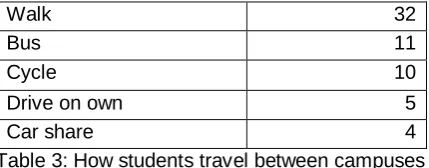
The table below shows how students travel between the two campuses.
Walk 32
Bus 11
Cycle 10
Drive on own 5
[image:3.595.95.310.102.186.2]Car share 4
Table 3: How students travel between campuses
The most popular way to travel between the two campuses was to walk. A fifth of students thought that transport links were satisfactory, but almost two thirds disagreed with this.
Further comments by students about transport included:
‘Better communication between departments. More (i.e. some would have been nice) support about travel between campuses when students first arrive’.
‘I think it unfair that we have to pay for travel between campuses. If this cannot be helped then a subsidised amount should be given to us/ or a cheaper student fare. Also, as the bus run every 15 minutes or so, starting on the hour, if our lecture finishes on the hour, then it is likely we will miss the bus between campuses and thus be late for the next lecture’.
‘More buses, shuttles? More direct’.
‘When we had a timetable issue, where one lecture ended at the same time as another starting on different campuses, we asked if were able to have a parking permit for St Luke’s and car share between the lectures so that we wouldn’t be very late, and were told we couldn’t have one, so we missed a lot of lecture time during the time the clash was being resolved’.
‘It should be cheaper or free for us and I am often late because the buses are always late’. ‘Green D bus free for students who study on both campuses’.
Communication between Schools
Fewer than one in ten students thought that there were active communication links between the Schools that they studied in, although over half responded that they received the appropriate internal emails from each, and two thirds thought that the timing of assessment was communicated clearly by the Schools. However, there were a considerable number of less positive comments by students about communication between Schools. Some were very general comments.
‘The two schools have no idea what each other do, or when they do it. I want to be a biochemist, and my Tutor at Luke’s doesn’t even know what this is’
‘Maybe additional seminars for students who would like to catch up on topics that are taught at one school but not the other’.
‘Better communication and support from Schools, have same standards and expectations from Schools, Integrate information better e.g. make sure announcements are given to all modules and students’
Some comments were about timing, including timing of assessment.
‘Communication links with the other school, and the arranging of deadlines more effectively as all work comes at once, whereas other single honours students have exams or essays, we have both, and the timing is not thought out, meaning they are all due at once. I think this is very unfair and has affected my quality of work’.
‘Even though both Schools say that they communicate and certain modules have already been discussed, it does not necessarily mean it is carried out. For example, human bioscience students feel that they have missed out on a statistics module that has been used in subsequent assignments. The sports science did this module and feel confident with it, however, we were supposed to be taught stats by Biosciences but the t-test booklet was given in the wrong old format so it ended up getting scrapped. Thus, we still do not know the appropriate stats tests.
Several comments touched on module choices.
modules interest them before they get put in the opposite block. This would not affect single honours students as they take: 1. more option modules 2.options in both terms’ .
‘The lack of communication between the schools affected my module choices for next year. I was unaware that I could not take the Education module I wanted in the first semester, because I had to take a compulsory one. Education did not know I had already chosen my English modules. Therefore, they are unaware how soon the English faculty offers module choices’.
‘When picking optional modules in the second year, we didn’t receive enough guidance, as when it came to picking third year modules we were very limited due to the pre-requisite module required. In some cases we couldn’t make up enough modules to meet the requirements of the course, thus had to do modules where specialist knowledge was already required and struggle through’.
‘I don't mind travelling between the two campus' but more communication needs to be made between the two schools (biosciences and sports science) about timetabling issues and module options. When I chose my course I felt that studying within two schools would widen my options but in fact it narrows them considerably. Especially with Bioscience modules, some of our options have prerequisites that we were not originally given the option to do the previous year so it narrows our options further.
Module choice was in fact the aspect that caused the most problems for students, as illustrated by responses to a question specifically about this.
Module choice
Students were asked if information about which modules they could choose was communicated effectively; half agreed, but a third disagreed. Six out of 10 students considered, for a variety of reasons, that they were not able to select all the modules they wanted to do.Half had been made aware of the pre-requisite modules they needed to take, but one in three was not. Overall, there were a few very positive comments about module choice, for example: ‘I really think that being able to pick modules from another School is fantastic, and really aiding my study’. Further comments were less enthusiastic.
‘Although the timetable meant I could not do the modules I wanted, I ignored the timetable and did them anyway, having to catch up later on what I’d missed’.
‘Far too limited by the choices in first and second years. Meant that when I reached my third year I could only actually choose two biology modules and had no other options so was very limited and didn’t really enjoy the modules I did in third year from the biology side. Sports science side was a lot better and had a reasonably free choice of subject’.
‘In terms of sports science, the majority of the module choices available are physiology based, and give very little choice for the ESSEDU students who have only done one semester of human physiology with no Stats, Qualitative or Quantitative research, biomechanics. We are therefore limited to which modules we can do. If the dissertation could be made optional within our course that would be an ideal situation’. ‘Information about module choices for 2nd year from the education side are clear, however I have no clue as to what I am allowed to choose from for sports sci’.
‘Module choices have been really limited as we are across the two subjects’.
‘Some modules sounded interesting and I would've liked to be able to do them but due to timetabling I couldn't. Obviously this impacts on the shaping of my degree so a better system is needed to
accommodate people's needs/wishes’.
‘We have a terrible module choice, especially for biosciences as the modules are not even human-related. We were not made aware that the choices we made this year would have such a drastic effect on the number of modules available’.
‘I have struggled with the required knowledge for stats and lab report writing as the stats module was not available to me in the first semester. I feel this has left me at a great disadvantage when coming to analysing and writing lab work. Stats is a basis for the lab write ups and assignments and I have no prior knowledge of this kind of work and such as SPSS’.
Resources
Three quarters of students felt that that they could easily access the resources they needed. A few, however, were less positive:
‘Biosciences books are not available in St Luke's Library, so as I live a St Luke's I would have to travel to Streatham to get them. It is also the same for those living on Streatham, as Sport Science books aren't available in Streatham Library. Also there aren't many copies of each book, maybe max 15, or as low as 5 for some books, this is a problem when there are 200 people doing a module’.
‘Some of the course texts to be placed on both campuses would be useful, so you don’t have to trek to both libraries to do work’.
‘A specific tutor and class time supporting students based at both campuses’
Resolving the issues
Overall, three quarters of students from this sample felt they benefited from a wide range of expertise because they studied more than one subject and most (85%) enjoyed the variety. Despite the criticisms, most students (68%) were happy to be studying on both campuses, but three quarters of students thought there were aspects of dual campus study they would want to change.
Video conferencing
When suggested that video-conferencing could be used for lectures that have a significant number of students studying at both Exeter campuses, two in five students were positive about this.
‘All lectures should be videoed and put on web-ct for revision purposes’.
‘This would be hugely beneficial. This would enable everyone to access the lecture. There have been times when it has not been possible for me to attend lectures due to the issue of timing. I think this would resolve a lot of issues’.
‘This would make communication between lecturer and student very difficult. Students often stay behind after lectures to ask questions!’
‘Maybe video conferencing on lectures so that modules that aren't available to Human Bioscience students but are to Sports Sci and BioSci can be watched by those interested to help understanding in other modules, for example, they both have studied Biochemistry and Human BioSci have not. This may become useful for further modules’.
However a few students had previously been frustrated by technical difficulties.
‘Did actually have video-conferencing between Streatham and Cornwall which worked OK but
sometimes there were technical difficulties which meant that lectures could not be finished in time. Also, I prefer the lecturer being present in person instead of staring at yet more computer screens’.
‘Video conferencing often caused technical problems in my 1st year’.
‘Video conferencing always seems to go wrong and half the lecture time is wasted trying to get the system back online’.
Others thought video-conferencing would be inappropriate:
‘English and Education students are in the minority, so I can't see this as a plausible option for us. What's more, I like going to both campuses to see friends I have made on both. I can see how this might be beneficial for other combined honours students’.
‘Not really appropriate at a university with such a good reputation for that School, when students are paying so much for tuition fees’.
Summary of Findings
Just over half of students claimed that they enjoyed studying on two campuses, benefiting from a wide range of expertise and enjoying the variety of studying more than one subject. A few did not know that their
programme would be taught on two campuses when they applied. Most students thought it would not be an issue; however some predicted (and found that) transport was a nuisance and did not know which campus to live closest to. Contact hours were in general split evenly across the two campuses, so that most students travelled between the two campuses four times a week and nearly half of this sample needed to travel there and back more than once a day. Many students had had problems and many did not know who to speak to if they were having troubles with their timetable.
Recommendations/Solutions
Students mostly did enjoy studying on two campuses but there were clearly areas where improvements could be made. Clearer communication between Schools with specific emphasis on module pre-requisites and module choice is needed to ensure that students are fully aware of the module choices they can make. A review of timetabling procedures including the setting of a limit on times students should travel between the two campuses in a day, and number of times travelled between the campuses in a week, would ensure students’ travel time was limited and therefore less wasteful. Students would benefit from clear, consistent messages about the transport available to them. In addition, transport links could be reviewed and the possibility/ feasibility of running a shuttle bus could be considered. A well-managed and thought-through implementation of video-conferencing or recording of lectures might be a way to save travel between the two campuses. This would ensure that if lectures are missed or prerequisites cannot be done, it would be
possible to catch up, saving considerable stress and providing better support for students.
Written with Charlotte Riddell, Subject Chair, School of Education and Lifelong Learning, and Philip Jones, Subject Chair, Sports and Health Sciences