Rochester Institute of Technology
RIT Scholar Works
Theses Thesis/Dissertation Collections
1991
A case study of formal training of the front desk
agent in Rochester/Monroe County, New York
Nicole Marisa HarleyFollow this and additional works at:http://scholarworks.rit.edu/theses
This Thesis is brought to you for free and open access by the Thesis/Dissertation Collections at RIT Scholar Works. It has been accepted for inclusion in Theses by an authorized administrator of RIT Scholar Works. For more information, please [email protected].
Recommended Citation
A CASE STUDY OF FORMAL TRAINING OF THE FRONT DESK AGENT
IN ROCHESTER/MONROE COUNTY, NEW YORK
by
Nicole Marisa Harley
A thesis submitted to the faculty of the
School of Food, Hotel and Travel Management
at
Rochester Institute of Technology in partial
fulfillment of the requirements for the degree
of
Master of Science
FORMK ROCHESTER INSTITUTE OF TECHNOLOGY
School of Food, Hotel and Travel Management Department of Graduate Studies
M.S. Hospitality-Tourism Management
Statement Grantina or Denyina Permission to Reproduce ThesislProject
The author of a thesis or project should complete one of the following statements and include this statement as the page following the title page.
Title of thesis/project: _ _~A~C:..!:A~S~E~S~T~Uw::D:....:oY~O~F--=.F..:::O:..i:R~M!.£:Aw::r.;!...:!:T~R~A~I~N!..:!:I~N~G~O~F-...-!.T...!.lH..!ioE~F.£lR..l:::O~N~T
DESK AGENT IN ROCHESTER/MONROE COUNTY, NEW YORK
I, Nicole M. Harley, hereby
~
permission to theWallace Memorial Library of R.I.T., to reproduce the document titled above in
whole or part. Any reproduction will not be for commercial use or profit.
OR
I, ~, prefer to be contacted each time a
request for reproduction is made. I can be reached at the following address:
FORM I ROCHESTER INSTITUTE OF TECHNOLOGY
School of Food, Hotel and Travel Management Department or Graduate Studies
M.S. Hospitality-Tourism Management Presentation of ThesislProject Findines
Name: Nicole Marisa Harley Date:2.:..28-93SS#: _
Title of Research: __A_C_A_S_E_S_T...;U;...;;D;...;;Y;...;;O;.::.F--=-F~O~R~M~A.:::.L_T~R~A::l,;I"'-lN.:L.I...NJ.loG;l...l,Q.u;;F~T..J:Hu;E...c.E..l:S.R..I...lO~N.;J;.T_ _
DESK AGENT IN ROCHESTER MONROE COUNTY, NEW YORK
Specific Recommendations: (Use other side ifnecessary.)
Thesis Committee: (1) Dr. Edward Stockham (Chairperson)
(2) Mr. David Crumb
OR (3) Mr. Michael Seelig, CHA
Faculty Advisor:
Number of Credits Approved: _
Date Committee Chairperson's Signature
9//,/(13
Date Department Chairperson's Signature
Note: This form will not be signed bythe Department Chairperson until all corrections, as suggested in the specific recommendations (above) are completed.
TABLE OF CONTENTS
page
Prayer iii
Dedication iv
Acknowledgements v
List ofTables vi
List of Figures viii
Chapter I. Introduction and Statement of
Study
Introduction 1
Significance of Study 3
Problem Statement 4
Purpose of the Study 4
Scope/Limitations of the Study 4
Assumption 5
Definition of Terms 5
Chapter n. Review of the Literature
The Labor Shortage 6
Job Satisfaction and Retention 11
Formal Training 16
Chapter HI.
Methodology
and Research DesignSelection of Population 29
Instrument Design 29
page
Chapter IV. Findings and Analysis
Descriptive Statistics 37
Chapter V. Conclusions and Recommendations
Conclusions 84
Recommendations 85
ReferencesandBibliography
86Appendices
A. Introduction Letter to Participants 94
B. Front Desk Agent/Trainee Questionnaire with
Frequencies and Valid Percents 95
C. Front Desk Manager/Trainer Questionnaire with
List ofTables
TABLE page
1. 1988-1991 Training Highlights 25
2. Specific Types of Training 27
3. Profile of Formally Trained Front Desk Agents/Trainee
in Rochester/Monroe County, NY 43
4. What Front Desk Agents Like Least about Their Jobs 48
5. What Front Desk Agents Like Most about Their Jobs 49
6. What Satisfies Front Desk Agents Most About Their Job.. 51
7. Profile of the Majority of Front Desk Agent/Trainee in
Rochester/MonroeCounty, NY 54
8. Crosstabulation of Hospitality Education by Like Least
about the Job 59
9. Crosstabulation of Hospitality Education by Like Most
about the Job 60
10. Crosstabulation of Hospitality Education by What
SatisfiesMost 62
11. Crosstabulation of Hospitality Education by Salary
Versus Job Satisfaction 64
12. Crosstabulation of Size of Hotel by Who Conducted
FormalTraining 66
13. Crosstabulation of Size of Hotel by Where Formal
TrainingWas Conducted 67
14. Crosstabulation of Size of Hotel by Cross-Training
within the Department 68
15. Crosstabulation of Size of Hotel by Cross-Training
outside of the Department 69
16. Crosstabulation of Size of Hotel by the Result of
FormalTraining 70
17. Crosstabulation of Size of Hotel by the Topics
Covered during Formal Training 71
18. Crosstabulation of Size of Hotel by Instructional
TABLE page
19. Crosstabulation of Formal Training by What Like Least.. 76
20. Crosstabulation of Formal Training by What Like Most... 78
21. Crosstabulation of Formal Training by What Satisfies
Most 80
22. Crosstabulation of Formal Training by Salary Versus
PRAYER
PSALM 23
The Lord is my sherpard: I shall not want.
He maketh me to lie down in green pastures:
he leadeth me beside the still waters.
He restoreth my soul: he leadeth me in the depths of
righteousness for his name's sake.
Yea, though I walk through the valley of the shadow of death.
I will fear no evil: for thou art with me:
thy rod and thy staff they comfort me.
Thou preparest a table before me in the presence of mine
enemies: thou anointest my head with oil;
my cup runneth over.
Surely goodness and mercy shall follow me all the days of my
life; and I will dwell in the house of the Lord forever.
DEDICATION
This thesis is dedicated to my parents, Juan and Shirley Harley, my sister, Natashia, my brother, Jason and
my Aunt Chase.
'Wind Beneath My Wings"
Itmusthave been coldthereinmy shadow, toneverhavesunlighton yourface.
You were content toletmeshine, that's yourway, you always walked a stepbehind.
So, I wasthe one with alltheglory,
while you were the one with allthe strength.
A beautiful face without aname, forsolong, abeautifulsmiletohide thepain.
Didyoueverknowthatyou'remyhero, andeverything Iwouldlike tobe?
Ican flyhigherthan aneagle,
'cause youarethe windbeneath mywings. Itmighthaveappearedtogo unnoticed,
but I'vegotitallhere inmy heart.
I want youtoknow I knowthe truth, of course I knowit, Iwouldbe nothing without you.
Did youeverknowthat you'remyhero, andeverythingIwouldlike tobe?
Ican flyhigher thanan eagle,
'cause youarethe windbeneath mywings. Fly, fly, flyaway,
youletme flyso high.
Oh, fly, fly, so highagainst the sky,
so high Ialmosttouch the sky.
ACKNOWLEDGEMENTS
I would like to express my warmest appreciation to my
wonderful family and friends, especially Gavin, Debbie, Len,
Mildred, Len Jr. , John, Anne, Julie, Mary and Trina. Not
many are as fortunate as I to have the undying support,
encouragement and most of all love of so many.
I love you all.
I would like to thank the members of my thesis committee,
Dr. Edward Stockham, Mr. David Crumb and Mr. Michael Seelig,
CHA, for their guidance and support throughout this endeavor.
Special thanks to Mrs. Monica Nyamusa for being a great
partner and friend.
I would also like to acknowledge the faculty and staff of
the School of Food, Hotel and Travel Management for five years
of hard work and beautiful memories, especially the ladies who
keep the school together, Mrs. Diane Sommers, Ms. Jayne
Downes, Mrs. Marge Ruffing and Mrs. Maria Aglietti.
Finally, I must say "Thanks for Being a Friend" to Lia,
Angela, Brenda, Leslie, Terence, Kevin, Erinne and Kiya. To
Becky, Tammy, Dino and Jamie, "Fly Me to the Moon and Let Me
Play Among the Stars."
RIT is now a part of my past, but
friends like you will always be a part of my future. Life in
the "Brick City"
A Case Study of Formal Training of the Front Desk Agent
in Rochester/Monroe County, New York
by
Nicole Marisa Harley
ABSTRACT
The hospitality industry is a billion dollar
industry
based upon customer service. Measure of quality service is
an intangible concept based upon the perception of the
customer. It is the industry's frontline employee that has
the responsibility of fulfilling the perceived image of
service the guest has envisioned.
In 1991, industries throughout the U.S. budgeted 43.2
billion dollars to be spent on formal training of its
employees. The dollar commitment made to training
exemplifies a companies commitment to its employees and
customers. The formal training of the front desk agent
bares the same commitment.
In this study is was assumed that through formal
training the front desk agent would gain a better knowledge
and confidence in their job performance and overall job
satisfaction. As a result the industry would have a
knowledgeable, confident and satisfied front desk agent that
would provide better customer service.
of formal training of the front desk agent, the effect
formal training had on job satisfaction and retention and
the differences in the perception of formal training between
the front desk agent/trainee and the front desk
manager/trainer in the Rochester/Monroe County, N.Y. area.
The study was conducted through a 28 and a 40 item
questionnaire asked of both the front desk agent/trainee and
the front desk manager/trainer. The questions asked dealt
with formal training, job satisfaction and demographics.
It was concluded that although formal training is an
important factor in the hospitality industry overall job
satisfaction is an independent variable of formal training.
The questionnaire did however infer that for those hotels
that do provide formal training there is a difference in the
perception of training between the front desk agent/trainee
CHAPTER I
Introduction
When the beginnings of the first hotel emerged, who
would have ever thought that in the year 1991, there would
be over 10,000 hotel rooms in New York City alone. The
rapid growth of the hospitality industry created millions of
job openings for many workers. The high demand for skilled
and unskilled workers alike created a labor shortage
beginning in the mid-1980'
s. The hospitality industry
relies on people as its customers, just as it relies on
people to service its customers. People, not machinery, are
the bread and butter of the hospitality industry.
When one thinks of a hotel, the first vision that
probably enters their mind is that of the front desk. There
is a natural association between the front desk and the
operations of a hotel. Conceptually, the first real point
of contact between the guest and the hotel may very well be
at the front desk. The front desk agent serves as both the
initial and final contact the guest has with the hotel. As
a frontline employee, the front desk agent is "on stage"
during their functions. At every point during their job as
front desk agent, whenever they are put in direct contact
with the guest, either face-to-face or over-the-phone, the
front desk agent is confronted with a "moment of truth".
"Moment of truth" is a phrase coined by Jan Carlzon,
truth"
is described as a point of customer contact when
everything the customer service provider has learned is put to the test and the customer forms an opinion based on that
response. As a front desk agent, you are expected to be
everything and everyone to the customer. Whenever a guest
has a problem, they always feel that they can find
resolution through the front desk agent. Therefore, the
front desk agent is expected to know all. Front desk agents
are ordinary people. They are not born with the skills and
capability to run a hotel. Only through training, training,
and more training, can the front desk agent be expected to
gain the skills and capabilities necessary to be an
effective front desk agent.
Formal training can be defined as training that is
structured, classroom or one-on-one instruction, not
on-the-job, or "pick up as you go along" training.
The only way
front desk agent can be expected to perform their duties
properly is if they are trained in their function. Formal
training enables a front desk agent to anticipate and
fulfill guest needs. The immediate response to a situation
by a front desk agent can either make or break that "moment
of truth".
A "high guest satisfaction"
and "quality of service"
are what most hospitality operations strive for in today's
competitive industry. Formal training of a front desk
goal. "Knowing a subject well allows one to therefore discuss it confidently and naturally, making the customer
feel at ease"
(Zemke, 1991). The time and effort taken for
formal training will be time and effort given back. One
must first take care of their employees who will in turn take care of their guests.
The study that follows is a descriptive study on the
status of formal training and job satisfaction of front desk
agents in the Rochester /Monroe County, New York area. The topics were researched through a survey of front desk
agents/trainees and front desk managers/trainers.
Sicrnificance of Study
The hospitality industry is one that is continually
growing and looking for new ways to service its customers better. Formal training is an important issue that needs to
be addressed, specifically pertaining to the hospitality
industry.
In 1991, 43.2 billion dollars was budgeted for formal
training in different industries throughout America (Gordon,
1991) . The hospitality industry is one that is most often
categorized as "other" when it comes to surveys or
questionnaires regarding formal training. A baseline needs to be established for the hospitality industry to create
important for the industry to know how much money is being
spent on formal training, who is doing the training, what
topics are being covered, where the training is
taking place and the length of time being devoted.
Problem Statement
Formal training is an important issue in United States'
organizations today. Is there a relationship between formal
training and job satisfaction in the hospitality industry,
specifically at the front desk of a hotel?
Purpose of the Study
The purpose of this study is to investigate the effects
of formal front desk training on employee job satisfaction
at the front desk. Provided is a "snapshot" view of formal
front desk agent training in the Rochester/Monroe County,
New York area. This study also examines the difference in
perception of formal training between the front desk
agent/trainee and the front desk manager/trainer.
Scope /Limitations of the Study
This study will examine the formal training and job
satisfaction of front desk agents/trainees in the
Rochester/Monroe County, N.Y. area only- Similar questions
were asked of two populations, front desk agents/trainees
receive a more accurate picture of formal training and to
secondly examine the possibility of difference of
perception. The study limits itself in regional area and
questionnaire content. This study deals with issues of the
social sciences, those concerning people and their opinion
of fact. The social sciences is an area in which facts
cannot be proven but trends and possibilities can be
concluded. Ultimately, this study will establish a
foundation for further studies that examine the hospitality
industries formal training activities and it effects on job
satisfaction.
Assumption
For the purpose of this study one assumption was made.
1. A front desk agent's job satisfaction is dependent
upon formal training.
Definition of Terms
Formal Training: refers to training practices which
are structured, classroom or one-on-one instruction, not
CHAPTER II
REVIEW OF THE LITERATURE
The Labor Shortage
There is no doubt that the labor shortage the
hospitality industry has been predicting for years is upon
us. Although colleges and universities are graduating more
hospitality students than in the past, management positions
do not make up the bulk of the industry jobs that are
experiencing shortages. College graduates are not looking
for the entry level positions the hospitality industry for
which there is a need. The shortages are occurring in such
positions as housekeeping, waitering, and dishwashing.
The hospitality industry typically recruits its new
staff from a labor pool of young adults. Experts predict
that from now through the turn of the century, the demand
for staff will exceed the supply in hospitality operations
throughout the nation. The reason for such a prediction is
that America's population is aging at a faster rate than the
birthrate. The occurrence is because the bulk of the baby
boom has passed beyond the 16-24 age group, from which the
hospitality industry usually recruits most of its new
workers. The United States Bureau of Labor Statistics
predicts annual shrinkage in this age group: 2.4% for men
and 2.2% for women through 1990; then 1.2% for both sexes
I
O
w
<
0\
vO 3 a
8 3
< u
k -o
s
Americans are having fewer children. The "yuppie" and
the "me"
generation is one that is more concerned with
social, economic and political advancement not raising a
large family.
Thomas E. Hill, acting Regional Administrator for the
United States Department of Labor in New York, predicted a
decline in young workers from 16% of the total labor force
in 1985 to 30% in the year 2000. "With the number of people
entering the labor force decreasing," he said, "75% of the
people who will be working at the turn of the century are
c <u 8
Ou
B spucsnoqj,
In order to remain dedicated to providing quality
service to its customers through person-to-person contact,
the hospitality industry will have to find new ways to make
it work. Three elements, as discussed by George Leposky,
will be necessary to keep the industry functional: new
sources of labor, technological advances, and cross-training
of employees.
New sources of untapped labor will involve the
recruitment of retirees, the handicapped, dislocated
workers, young mothers, immigrants, and homemakers. These
new sources of labor will help the industry remain viable.
Technology will also play a major role in aiding the
hospitality industry to combat the shortage of workers.
Better machinery will help in such areas as the kitchen and
laundry room. More advanced computers will help in all
areas by creating easier and more accessible department
linkages. Technology will hopefully do the job of two
people without taking away from the "human touch" .
Cross-training of all employees in all departments will
create many workers within one. For example, When "A",
front desk agent, becomes ill, "B", the housekeeper who has
only one room to clean that day, can replace or "fill-in"
for "A"
at the front desk. Cross-training creates the
advantage of better communication, departmental flexibility,
Recruiting new sources of labor, technology, and
cross-training practices will ease the effects of the labor crunch
and may even solve the problem. The formal training of
hospitality employees is an even more important factor when
there are less people to perform the same number of
functions without compromising the quality of service.
Job Satisfaction and Retention
The high turnover rate associated with the hospitality
industry has forced employers to look deeper into the
reasons employees leave their jobs and to ask themselves how
they can persuade them to stay. Job satisfaction and its
relationship to the retention of employees has become a
major area of concern.
There are many reasons employees decide to terminate
their employment. If an employer is to retain their
employees through job satisfaction, it is important for them
to find out first why they are leaving and second, where
they are going. A comprehensive and in-depth exit interview
will help employers discover the answers. The hospitality
industry is a competitive industry within itself, but
besides competing against each other for labor, there are
outside industries to be considered as well.
Although the reasons are numerous and sometimes depend
upon the particular situation, there are five main causes,
industry employees quit their jobs.
First, leadership through management is an important
factor in the moral and overall performance of employees.
Not all people are self-motivated. It has been the job of
management to provide their employees with the motivation to
perform. When the leadership fails, so may the employees
and often they quit because of poor management.
Second, many people enter the hospitality industry
through entry level positions. They view their jobs as a
"transitory phase"
in their career. The hospitality
industry has not been seen as a career goal, but as a
"stepping stone"
to a better position in a different field.
Making beds, bussing tables, or answering the switchboard
has been seen as "paying your dues" while either going to
school or looking for something better.
Third, the hospitality industry has not been known for its high paying positions. Low pay remains a very obvious
reason for leaving a job. Entry level wages and management
wages are not always competitive when compared to the wages
of other industries. Profit structures and wage margins
make it difficult for the industry to pay higher wages
without passing the expense along to the guest, resulting in higher room rates. Many feel that they can earn more money
elsewhere with less pressure.
Fourth, returning home with a headache has not been an
hospitality industry. Long hours and high pressure can
easily lead to early burn-out. People trying to satisfy the
needs of other people has been a difficult task. Unlike
working solely with computers or inanimate objects, humans
come in different shapes, sizes and most important
temperaments. What pleases one, does not necessarily please
another. Stress in the hospitality industry can lead to
burn-out.
Finally, although things are changing, good incentive
programs have not been easy to come by in the hospitality
industry. While other industries offer health benefits,
retirement plans, profit or stock sharing, the hospitality
industry usually does not. A lack of incentives make it an
easier decision to seek employment elsewhere.
Treat your employees with the respect you expect them
to show your customers and find a way to let them grow with
you, then they will stick with you. Along the way, fun,
team-building activities, and benefits help ease the
pressure (Boyle, 1985) .
How to satisfy your employees and make them want to
stay is a question for which there are many solutions. Not
any one solution may be right for everyone, but if given the
basics and offered alternatives employees can be better
satisfied in their functional job capacity and within
themselves, will either not think of leaving or at least
building them into reasons to stay, employee satisfaction
and retention can be better achieved.
First, making the employees feel that they too are
important has been an aspect that is often overlooked.
Today's employee wants and demands more than just a raise in
pay. A pat on the back for a job well done may be more of
what they are looking for in regards to satisfaction.
Fostering a corporate culture that promotes the well being
of "self" as being of equal importance as the well being of
the guest, proves the personal worth of each worker.
Management in the leadership role needs to help encourage
self-motivation by welcoming ideas from employees at all
levels and by providing positive feedback through individual
reward, as well as, team diligence and initiative.
Second, aggressive marketing of the hospitality
industry as a career path will counteract the "stepping
stone"
scenario. The hospitality industry has offered
advancement opportunities, but it will take creative
recruiting techniques to emphasize the openings. Through
education, students are made aware of the career
possibilities but for those already in the positions, the
educational process must be transferred so that they too may
share the insight. Promotions from within make for a
stronger case of the hospitality industry as a career path.
Formal training and cross-training make it possible for
Third, wages have been a definite problem when it comes
to any job. Keeping in a competitive wage range, and if
possible paying above the average salary, will sustain the
average employee. Surprisingly, if other working conditions
are satisfactory, most employees will not base a decision to
depart solely on wages.
Fourth, the stress that often accompanies working in
the hospitality industry has been inevitable, but it can be
lessened. Today's employee may not be willing to compromise
their mental well being for the good of the company.
Through inter-departmental communication, many of the small
problems that turn into major disputes can be avoided. When
one department understands the function of the other,
channels do not get crossed as easily. Through seminars,
retreats, outings, and workshops at all levels, employees
can learn and discuss ways to make their jobs and lives less
stressful. Not only should job related stress be discussed,
but also everyday living. Topics such as team building as
well as alcoholism and exercise should be included.
Hospitality industry burn-out can happen to anyone at any
age, but it can be combatted.
Finally, not all people have the same wants and needs.
Reward and incentive programs must be creatively flexible so
as to offer something for everyone. Health and even
retirement benefits are basic parts of the package that
become an important deciding factor as to whether or not one
will remain with their current employment or move on.
Health and benefit packages as well as rewards and
incentives are important in a job that one is to view as
more than just a job but a career.
Job satisfaction and the resulting retention of
employees in the hospitality industry, can be made easier if
simple but effective strategies are employed. It will be up
to the industry to begin to use these tools.
Formal Training
Formal training is management's responsibility.
Training results in better service to customers and has the
potential for increasing the firm's profitability. Employee
training is the answer to poor service, low productivity,
high turnover, low morale, and high absenteeism. Training
increases the self-confidence, loyalty and longevity of
employees. The objective of training is to help the trainee
acquire the skills, knowledge and attitudes necessary to
carrying out his or her present duties as well as prepare
him or her for increased responsibility (Minor, et.al. .
1984) .
Formal training incorporates the vision and goal of an
organization. It is a reflection of the lifelong commitment
an organization has to its future existence. Formal
organization individuals attend various institutions to
receive an education. Inside an organization individuals
attend formal training instruction to receive an education.
The educational process does not end when a degree is
received, but continues in the workplace through formal
training. Learning is a lifelong process. Only a foolish
person refuses to continue to learn.
Today's marketplace is a service-sensitive one.
Seasoned customers are now more inclined than ever to take
their business elsewhere if they feel they are not receiving
the service they deserve. The hospitality industry is a
buyer's marketplace. Unlike the manufacturing goal of
zero-defect, the service goal of zero-defect is harder to achieve
and measure. Manufacturing deals with tangible products.
The hospitality industry deals with intangibilities. The
product of service is customer satisfaction. Customer
satisfaction is not an item in a store, has no shelf life
and cannot be inventoried or produced in advance of
delivery. Consumer perception of service quality results
when a comparison of expectations prior to receiving the
service with actual experiences of the service. Quality
evaluations derive from the service process as well as the
service outcome (Zemke, 1989) .
The service process begins with formal training.
Zero-defect can be achieved but only through the performance of
evaluation through the guest perspective.
The hospitality industry can learn an important lesson
from the entertainment industry in reference to formal
training (Hazel. 1989) . When the curtain goes up on opening
night on Broadway you can bet that every line, every
movement, every breathe has been rehearsed. Months and
months of rehearsal goes into the production of a Broadway
play. Under the guidance of the director, the cast is moved
to a specific task. Props are used to simulate reality as
much as possible. Gradually the cast becomes more
comfortable with the situation and surroundings, and the
lines flow more naturally. The crutches of scripts and
markers are removed. Rehearsal continues until it is
perfect. When the curtain comes down and the applause of
the crowd can be heard outside the theater door, the actors
know they have done their job and done it well.
Similarities can be drawn between the curtain call and
the "moment of truth" between a service provider and guest.
Both an actor and a front desk agent are playing to a live
audience from which there is no turning back. When a guest
walks up to the front desk and makes a request, can
management be sure that every line, every movement, every
breathe has been rehearsed? Have months of formal training
gone into the anticipation of this moment? Under the
guidance of management has the front line been moved to
simulate reality as close as possible? Gradually, did the
front desk agent become more comfortable with the situation
and the solutions come more naturally? Were the crutches of
fact sheets and procedural manuals removed? As the formal
training period drew to a close, were the solutions to
virtually all anticipated situations rehearsed? When the
guest walks away from the desk, do they feel as though they
have been satisfactorily served? Will they return and make
a positive recommendation to their friends? These questions must be asked and answered through formal training if the
front desk agent is expected to get it right. Rehearsal,
upon rehearsal until it is perfect is the way they do it on
Broadway, why not in the hospitality industry?
When front-line personnel feels some autonomy in their
jobs, their result and positive attitudes will become
apparent to the guest. A cycle of employee success and
guest satisfaction develops from the facilitative mode of
training through management. When the employees feel good
about their work, they work harder to satisfy the guest; the
guest has a good experience and returns for another visit.
The cycle's final outcome is increased profitability
(Atkinson, et.al. . 1989).
Setting up a formal training program is a great
challenge since many factors such as time, place and content
have to be considered. It is most appropriate to access the
The question then becomes, who is the most appropriate
person or persons to perform a needs analysis? The needs
analysis should be a combination of input by trainer, trainee, and customer. The perspective of each is an
important contribution. Most importantly though is the
input of the front desk agent/ trainee. It is the front-line
that is closest to the competitive marketplace. It is the
front-line that will meet the challenge. A conservative
program that's owned by the line is far more useful than a
radically innovative program written off as the training department's fantasy after they've consulted with academics
(Gordon. 1989) .
The greatest deficiency in most formal training
programs is a lack of consistency. It is therefore
appropriate to pinpoint several principles of effective
formal training (Minor, et.al. . 1984). These principles are
motivation, individualization, realism, response,
objectivity and reinforcement. Trainee, trainer and company
must all be motivated in order for formal training to be
effective, one to learn, the next to train and the other to
accommodate. People learn at different rates. Training
should be individualized to meet the needs and abilities of the trainee. Formal training must be as close to reality as
possible. It should be in context to the real situation the front desk agent/trainee will encounter. Training should
duties of the front desk agent. Formal training is less
effective if it focuses on rare occurrences, although they
should be covered. The trainer should frequently solicit the trainee's response. The front desk agent's response is
important as a check on progress and as a balancing
mechanism of the formal training program. Formal training should be objective. Objective in a sense that both trainee
and trainer must know where they are at any given time and
where they are going. Reinforcement is effective in formal
training when as many as the trainee's senses (sight, smell, touch) are used in the process and in their evaluative
method.
When the first letter of each of the six principles is
combined they spell the word "mirror". Effective formal
training programs are designed to realize that the trainee
is a reflection of what is taught. The front desk
agent/trainee will go on to represent the operation and
reflect the firm's image. The hospitality industry has an image reflected, as in a mirror, projected through its
service providers. Effective formal training will polish that image and reflect the firm in a better light to the
customer (Minor, et.al. , 1984) .
Formal training is a circular loop that should never
stop. Training should be more than a ritual for new employees. For maximum effect, managers and employees
will be experts in guest satisfaction (Atkinson,
et.al. ,1989) .
For the past ten years Training magazine has conducted
a survey of U.S. organizations throughout the country with
100 or more employees. Surveyed were human resource
development (HRD) professionals, personnel directors and
other spokespersons. All questions were in regard to formal
training only. Questions such as, how many employees are
trained each year? What types of training do they receive?
How much they budget for a variety of training expenses?
How the courses are delivered and so on were asked. The
aim of Training magazine is to create a comprehensive
picture of the state of training and development in U.S.
organizations in the current year.
Although there is no hospitality industry category, the
information provided by the survey about the status of
formal training in America offers the hospitality industry
insight into what other industries are doing. The
information reported allows the hospitality industry to make
a comparison between what type formal training they are
providing as compared to an industry which is most closely
related to the hospitality industry- We can then compare
the results of my formal training survey to the broad
industry report survey findings conducted by Training
magazine.
training and development in America, the same survey
methodology has only been used for the last four years.
Therefore, presented are comparisons of findings between the
years 1989 and 1991 and the averaged results of my front
desk agent/trainee and front desk manager/trainer
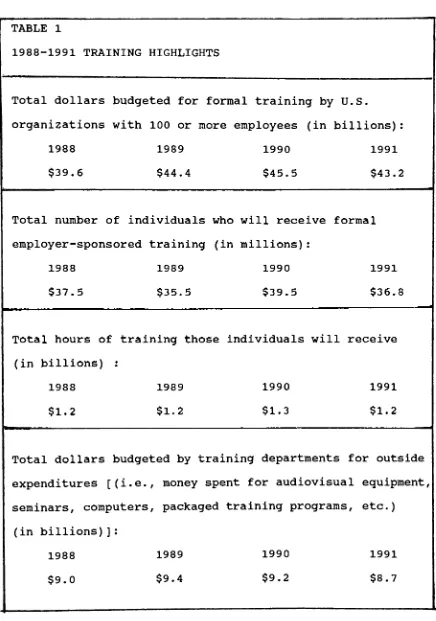
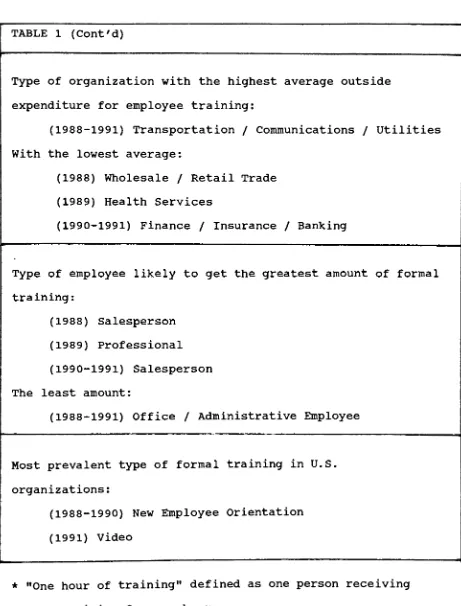
questionnaires. Table 1, represents highlights of training
practices from the year 1988 to 1991 from Training magazine
only. Overall the budgeted dollars, number of individuals
and hours of formal training gradually increased until 1990
and then took a plunge in 1991. The year 1991 also marked a
change in the concentration of businesses, individuals and
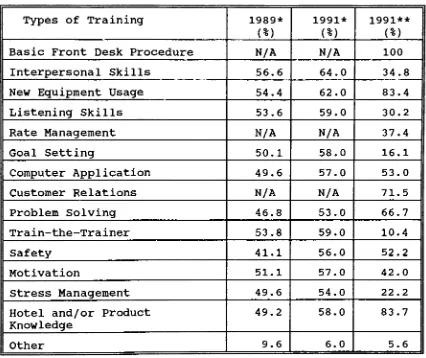
form of formal training. Table 2, represents the use of
specific types of formal training topics in U.S. industries
as a whole in the years 1989 and 1991 in comparison to the
topics that front desk agents in Rochester /Monroe County,
N.Y., said were covered in their training, 1991. Overall
the hospitality industry in comparison to the surveyed
industries rates low in the specific types of formal
training. The hospitality industry does however rate high
in the categories of new equipment usage, problem solving
and hotel and/or product knowledge. Figure 3, represents
the instructional methods that were used in U.S. industries
as a whole in the years 1989 and 1991 in comparison to the
methods that front desk agents in Rochester/Monroe County,
N.Y., said were utilized in their training, 1991. Overall
industries rate lower in the instructional methods utilized.
However in the category of self assessment/testing the
hospitality industry does rate slightly higher and in the
category of one-on-one instruction the industry rates highly
TABLE 1
1988-1991 TRAINING HIGHLIGHTS
Total dollars budgeted for formal training by U.S.
organizations with 100 or more employees (in billions) :
1988 1989 1990 1991
$39.6 $44.4 $45.5 $43.2
Total number of individuals who will receive formal
employer-sponsored training (in millions) :
1988 1989 1990 1991
$37.5 $35.5 $39.5 $36.8
Total hours of training those individuals will receive
(in billions) :
1988 1989 1990 1991
$1.2 $1.2 $1.3 $1.2
Total dollars budgeted by training departments for outside
expenditures [(i.e., money spent for audiovisual equipment,
seminars, computers, packaged training programs, etc.)
(in billions) ] :
1988 1989 1990 1991
[image:38.527.48.484.36.657.2]TABLE 1 (Cont'd)
Type of organization with the highest average outside
expenditure for employee training:
(1988-1991) Transportation / Communications / Utilities
With the lowest average:
(1988) Wholesale / Retail Trade
(1989) Health Services
(1990-1991) Finance / Insurance / Banking
Type of employee likely to get the greatest amount of formal training:
(1988) Salesperson (1989) Professional
(1990-1991) Salesperson The least amount:
(1988-1991) Office / Administrative Employee
Most prevalent type of formal training in U.S.
organizations:
(1988-1990) New Employee Orientation (1991) Video
* "One hour of training" defined as one person receiving formal training for one hour.
[image:39.527.33.494.31.637.2]TABLE 2
SPECIFIC TYPES OF FORMAL TRAINING
Types of Training 1989*
(%)
1991*
(%)
1991**
(%)
Basic Front Desk Procedure N/A N/A 100
Interpersonal Skills 56.6 64.0 34.8
New Equipment Usage 54.4 62.0 83.4
Listening Skills 53.6 59.0 30.2
Rate Management N/A N/A 37.4
Goal Setting 50.1 58.0 16.1
Computer Application 49.6 57.0 53.0
Customer Relations N/A N/A 71.5
Problem Solving 46.8 53.0 66.7
Train-the-Trainer 53.8 59.0 10.4
Safety 41.1 56.0 52.2
Motivation 51.1 57.0 42.0
Stress Management 49.6 54.0 22.2
Hotel and/or Product Knowledge
49.2 58.0 83.7
Other 9.6 6.0 5.6
* Source: Training Magazine October, 1989, 1991. ** Source: Front Desk Agent / Trainee Questionnaire
[image:40.527.51.477.126.484.2]iZ
5%c
1
c
o
U On V> V) 1 c a; a o O 1 O V) 5 V CL c D O o to c a 3 CO 3 c B V v> CO CO * o .o B > i-) o-<u CO <1> u t-H 8 ac T-H o , n On <n 00 <U o> a r-t O Ui o c *-> w u 1-1 O a a V
I
< eg ^ 2 COC Q4->
CHAPTER III
METHODOLOGY
Selection of Population
The survey population for this study was comprised of
hotels listed in the hotel directory. In total, 34 hotels
consisting of approximately 193 front desk agents in the
Rochester/Monroe County, N.Y. area were surveyed. This
survey population was purposely chosen for two reasons.
First, the accessibility that the area hotels afforded, and
secondly because the Rochester /Monroe County, N.Y. area is
considered to be a representative testing area (Greater
Rochester Metro Chamber of Commerce, 1989) .
Instrument Design
A cover letter, addressed to the general managers of
the listed hotels, was created to introduce the study and
request the hotel's participation in the study. A copy of
the front desk agent/trainee and front desk manager/trainer
questionnaires were also included for their review. The
cover letter indicated the original purpose of the study,
formal training and its effects on retention, and how it was
to be administered, through a questionnaire to be filled out
by all front desk agents and the interviewing of a randomly
selected front desk agent/trainee and the front desk
manager.
that the original administration process would allot for too
much time. It was therefore decided that instead of
interviews of the front desk agent/trainee and the front
desk manager/trainer a second questionnaire similar to that
of the front desk agent/trainee would be created for the
front desk manager/trainer.
In the interest of time and to avoid confusion on the
part of the hotel, because a second master's degree
candidate would also solicit the aid of the Rochester/Monroe
County, N.Y. area hotels, one cover letter was designed to
introduce both studies (Appendix A) .
The questionnaires (Appendix B) were original in nature
and went through 5 revisions, including review by the
Rochester Hotel and Motel Association (RH&MA) before its
ultimate completion and approval. The first revision
involved the addition and subtraction of questions which did
not test for a specific purpose. The second revision
involved changes in the wording of questions for
clarification and the addition or subtraction of selection
choices. The third revision involved the addition of
questions in regards to job satisfaction. The fourth
revision involved the addition and subtraction of selection
choices. The fifth revision involved the placement and
sequence of questions in an order by which the front desk
comfortable in their understanding and responding to the
question.
In order to compare the views of both front desk
agents/trainees and front desk managers/trainers, the two
questionnaires were created. The first 28 questions of both
questionnaires were similar. The addition of twelve
questions on the front desk agent/trainee questionnaire
applied specifically to them. They included questions
pertaining to demographics, retention, education and
previous front desk experience; questions which only the
front desk agent/ trainee would be able to answer. Many of
the items for the formal front desk agent/trainee training
questions were a direct result of reading the categories
presented in Training magazine's Industry Reports 1988-1991.
It was recommended by the thesis committee members that
another master's degree candidate, and I work together with
the Rochester /Monroe County, N.Y., hotels in order to
fulfill our requirements, however, the studies and
questionnaires are separate in nature.
The cover letter explaining the purpose of both
studies, accompanied by copies of two front desk
questionnaires and a third dealing with the housekeeping
The questionnaires consisted of three types of questions:
1. Questions which require a direct yes or no response.
2. Questions which require the respondent to choose one
only among various choices, which may include an
"other"
choice.
3. Questions which require the respondent to choose all
that apply among various choices, which may include an
"
other" choice.
The first 28 questions on both questionnaires asked for
similar information. The front desk agent/trainee questionnaire asked for fact, while the front desk
manager/trainer questionnaire asked for the manager's perception.
Question one (1) attempted to identify the length of time in the front desk agent position or the average length of time
a front desk agent spends in the position.
Question two (2) and three (3) attempted to identify whether or not an employee manual was received and reviewed.
Question four (4) directly asked whether or not formal front desk agent training takes place.
Questions five (5) through sixteen (16) attempted to
identify the formal training practices and content, such as who conducted the training, when and where the training took place, topics that were covered in training, etc.
Questions seventeen (17) through twenty-five (25) and thirty
(30) attempted to identify reasons for job satisfaction, why
the job was chosen, and where the job was introduced.
Questions twenty-six (26) through twenty-nine (29) attempted
to identify the demographics of age, sex, marital status and income.
the hotel for classification purposes.
Questions thirty-three (33) through thirty-five (35) dealt
with the retention factor.
Questions thirty-six (36) through thirty-eight (38)
pertained to the educational background of the front desk
agent.
Questions thirty-nine (39) and forty (40) attempted to
identify whether or not the front desk agent may have had former front desk experience.
The sequential order of the questions (Appendix B) went
from broad in scope to specific and then back to broad
again. Questions 1-4 were asked of the entire population ,
while questions 5-17 were asked of only those who had
received formal front desk training, and questions 17-28, on
the front desk manager/ trainer questionnaire, 17-40, on the
front desk agent/trainee questionnaire, continued to
question the entire population. The reason for the division
and sequential order of the questionnaire was to first
involve the entire population with simple questions, then
question solely those who received formal training with more
detailed questions, and then once again involve the entire
population with more in depth questions.
The three types of questions asked, yes or no response,
choose one only response and choose all that apply response
were used to try to solicit the most accurate answer from the respondent. These types of "choice" close-ended
questions as opposed to "fill-in-the-blank" open-ended
analysis. In the construction of the choose one only and
the choose all that apply questions, as many choices that
were applicable and appropriate were given. This was done
so as to offer the respondent a wide array of possibilities
and so that the "other"
category would not be utilized as
frequently, because statistically it is harder to evaluate.
Survey Administration
On July 12, 1991, the cover letter and questionnaires
were mailed to the general managers of the 34 hotels in the
Rochester/Monroe County, N.Y. area. A series of follow-up
telephone calls began July 19, 1991. During these telephone
conversations, the general managers were asked if they had
received the letter, and if they would be willing to
participate in the survey. Of the 34 hotels that were asked
to participate, 20 agreed. Upon agreement, appointments
were scheduled to visit the hotel and administer the survey
instrument. Following the first two appointments, it was
requested that we simply meet with the general manager (or
whomever was put in charge of the project) , answer any
questions they may have had, and then leave the
questionnaires for the hotel to administer.
Because no name was required, the respondent remained
anonymous. A pre-addressed envelope was left with the hotel
to facilitate the ease in mailing the completed responses.
appointments with the 20 hotels that were willing to
participate.
Within approximately 10 days of handing out the first
questionnaires, responses started to arrive. As responses
were received, the questionnaire data was tabulated using
SPSS-X on the VAX system at Rochester Institute of
Technology- The last of the questionnaire responses were
received September 30, 1991.
Data Processing and Analysis
The SPSS-X program was designed specifically to
tabulate the questionnaire responses for analysis. A single
program was written that would analyze data from both
questionnaires. The data was then entered into the SPSS-X
program for all statistical analysis and tabulation
information.
Due to the nature of this study and the types of
questions asked, statistical analysis were able to be
computed but were often not relevant in discussion of the
study because of its descriptive nature. The data computed
from the questionnaire is ordinal, non-interval data as
compared to interval data, therefore, common tests, such as
the T-test for normality, and means analysis are not
applicable. Cross-tabulations are only possible within the
same population, either solely the front desk agent/trainee
questionnaires test two different populations, front desk
agents/trainees and front desk managers/trainers, many
cross-tabulations were rendered impossible. Trends in the
responses can be explored but concrete proof of fact cannot
CHAPTER IV
FINDINGS AND ANALYSIS
Of the 141 questionnaires delivered to the 20
participating hotels, 17 hotels returned a total of 53
questionnaires. Four of the 53 questionnaires were
disqualified because of missing pages during a copying
process by a participating hotel. Therefore, 49 valid
responses were obtained thus resulting in a 35% response
rate.
Descriptive Statistics
All variables, questions 1-40 on the front desk
agent/trainee questionnaire and questions 1-28 on the front
desk manager/trainer questionnaire, were tabulated
individually by the SPSS-X data analysis program. The
program produced scores of statistical information. For the
purposes of this study, the two most important numbers are
the frequencies (the actual number of respondents) and the
valid percent (the portion that responded as compared to the
whole) . Appendix B includes a copy of the original
questionnaire with the frequency and valid percent filled in
next to each question. If the respondent answered "No" to
question #4 on both questionnaires, they were instructed to
leave questions 5-16 blank and skip to question number 17
and thereafter. Therefore, on the front desk agent/ trainee
and on the front desk manager/trainer questionnaire there
are 5 missing cases in questions 5-16. Missing cases in all
other questions are for the following reasons:
(1) the respondent skipped or chose not to answer the question;
or
(2) the respondent answered the questions incorrectly.
For example, where the question asked that the
respondent choose one, they in turn chose more
than one. The responses were therefore invalid.
Of the 49 responding front desk agents/trainees 37.5%
had been in the position of front desk agent (FDA) for 6
months, 27.1% for 1-3 years, 18.8% for 6-12 months, 10.4%
for more than 3 years and 6.3% for less than one month.
When asked whether or not they had received a policies and
procedures manual or an employee handbook, 71.4% answered
yes, and of that 71.4%, 69.2% said a supervisor, manager or
personnel reviewed it with them.
When asked whether or not they had received formal
front desk training at their hotel 55.1% (27 of the 49)
responded yes and 14.8% received general orientation as
their only form of formal training. Those that did receive
formal front desk training began their training on their
first day, 92.6% or within one week in their position, 7.4%.
Formal training periods varied, most FDAs were trained
for 2-3 days, 51.9%, or on the lower end of 2-6 hours,
said they were trained for 1-2 weeks. The persons who
trained the FDAs were either their managers, 51.8%, a
supervisor, 48.1%, and/or an experienced employee, 40.7%.
The other category, 11.1%, responded that a computer program
also aided as their trainer and 3.7% responded a human
resource employee. Training was conducted at the hotel
site, either at the front desk, 74.0%, in a
conference/meeting room, 14.8%, and/or in an office, 22.2%.
If the FDA was cross-trained within their department
they were trained as a telephone operator, 85.2%, as a
reservationist, 77.8%, and/or as a night auditor, 22.2%.
The other category, 14.8%, included that they were trained
as a bell staff person or in guest services. Respondents
indicated that 11.1% received no cross-training within their
department. If the FDA was cross-trained outside of their
department it was in housekeeping, 26.9%, and/or throughout
the entire hotel, 3.8%. The other category, 11.5%, also
included that they were cross-trained in the maintenance
department. Respondents indicated that 65.4% received no
cross-training outside of their department.
When asked whether or not their training conflicted
with the actual duties at the front desk, 96.0% responded
no. As a result of their training respondents were 100.0%
sure that they could check-in/check-out customers and make
folio adjusting entries. Respondents indicated that 92.6%
answer customer inquiries. FDAs also felt they were able to
handle walking a customer, 85.2%, handle automated computer
systems, 74.1% and 66.7% answer touristic questions. When
asked what topics were covered by the trainer during formal
training, FDAs responded 100.0% for basic front desk
procedure, 74.1% for hotel/product knowledge, 66.7% for new
equipment usage and 63.0% for customer relations. Figure 4
g 3 8 o u 0-. .V! co <U Q *-> c o Ij 'Jo CO CO JO a co D a CO CO c 4-1 C C o <U C co
a 3
<l> a, co fr 3 J V
ri
tf
S * o
|
B
'
1
I
a S o* fcl 3 *H
& .52 <5
a s ex ^ w o ^ u
1) D Z o CD 4-J B
3
60 C o CO B X) o.S S -a
H
6
5 l c G E-a o 2G 60 W J> -a J3
When asked what types of instructional methods were
used, FDAs responded, one-on-one instruction, 80.8%, self
assessment/self-testing instruction, 42.3%,
videotapes/films/slides, 26.9%, self-study programs, 26.9%,
lectures/group discussion, 15.4%, and role plays, 11.5%.
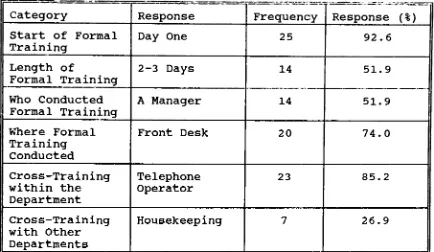
Table 3 represents a profile of formally trained FDAs in
the Rochester/Monroe County, N.Y. area.
Of the 49 responding FDAs, whether formally trained or
not, all were asked how their job as a FDA could be made
easier. The majority, 50.0%, responded that better
communications between departments and front desk staffing
according to need, 45.7% would make their job easier.
Figure 5 represents a complete breakdown of the ways FDAs
TABLE 3
PROFILE OF FORMALLY TRAINED FDA'S IN THE ROCHESTER/MONROE
COUNTY, NY AREA.
Category Response Frequency Response (%)
Start of Formal
Training
Day One 25 92.6
Length of
Formal Training
2-3 Days 14 51.9
Who Conducted
Formal Training
A Manager 14 51.9
Where Formal
Training
Conducted
Front Desk 20 74.0
Cross-Training within the Department
Telephone
Operator
23 85.2
Cross-Training with Other Departments
[image:56.527.47.481.116.368.2]FDAs were asked what attracted them to their position.
The majority.- 47.2%, responded that contact with customers
was the reason they were attracted to their position.
Respondents also indicated that 30.6% said it was because
the job was easy, 13.9% because of the work hours/schedule,
5.6% because of the importance of the job and 2.8% because
of the glamour of the job.
FDAs were asked why they chose to work in the
hospitality industry. The majority, 60.4%, responded that
it suited their personality. Respondents indicated that
50.0% viewed the industry as a career opportunity and 47.9%
responded that they were either receiving or had received an
education in the hospitality industry. Figure 6 represents
a complete breakdown of the reasons FDAs choose to work in
co 3 s 3 O a O C co 3 C 3 t; o D-, a, O u, a> <u \->
5
C O D Oh U, 3 O C o aI
3
3 CO 4> 60 a CO a 2 c co 3 c o co 3 C 2 T3 a ? ,'O i ,
a o a